English file Pre-
Intermediate
Unit 2B – Past continuous
• Lead in famous photos from history (5 mins)
• Discussion taking photos (10 mins)
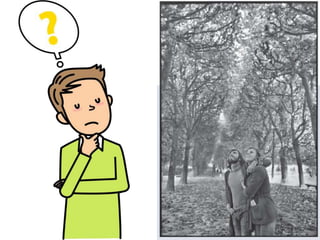
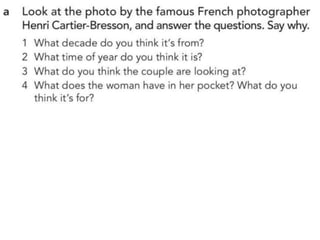
• Reading (1) Making predictions (5 mins)
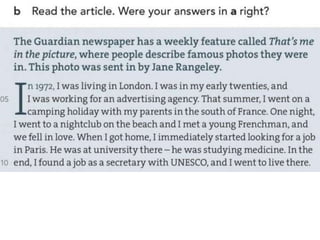
• Reading (2) Checking new vocabulary (10 mins)
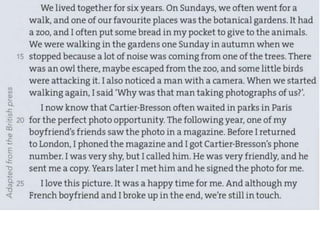
• Reading (3) Comprehension questions (10 mins)
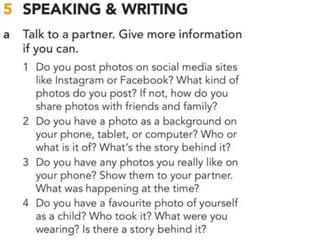
• Speaking discussion my favourite photo (5 mins)
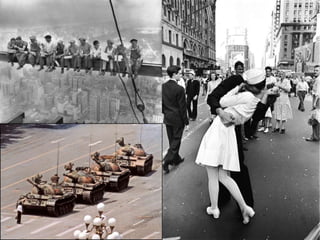
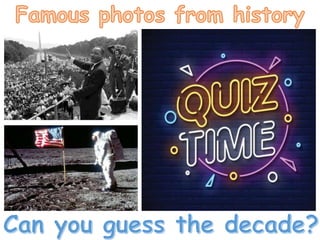
• Famous photos from history – guess the decade (10 mins)
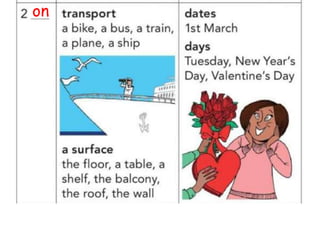
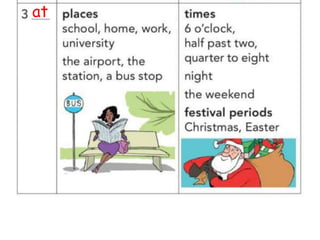
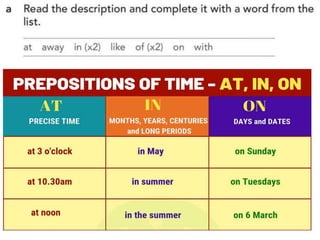
• Grammar (1) Prepositions – highlighting (5 mins)
• Grammar (1) Prepositions – highlighting (10 mins)
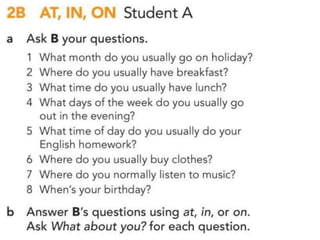
• Grammar (1) Prepositions – Speaking (10 mins) 80
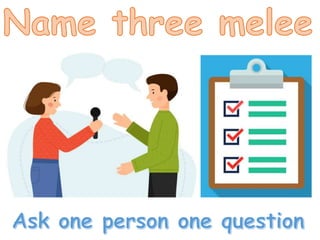
• Name three – prepositions – melee (15 mins)
• Speaking practice – describing photos (10 mins)
• Vocabulary from the class quiz (10 mins)
•How often do you take photos?
•What do you usually take photos of?
•Do people take too many photos these
days? Why do they take so many?
•Do you have any photos on display around
your house? What are they of?
•What’s the last photo you took?
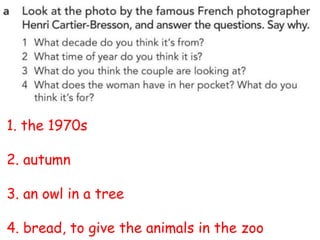
1. the 1970s
2. autumn
3. an owl in a tree
4. bread, to give the animals in the zoo
1. She was living in London, in her early twenties, working
for an advertising agency.
2. She met him at a nightclub on a beach in the south of
France.
She found a job in Paris because she wanted to be with
him.
3. They went for a walk.
4. They stopped because they heard a lot of noise
coming from a tree. They saw an owl and some little
birds attacking it.
5. She called Cartier-Bresson, and he sent her a copy.
6. Because it was a happy time for her.
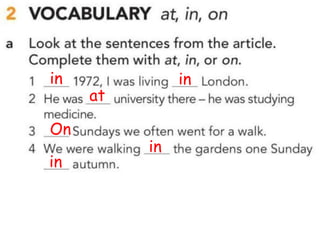
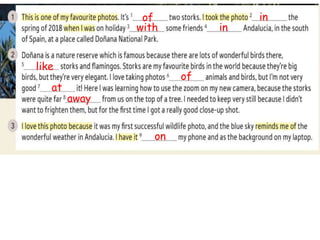
in in
at
On
in
in
in
on
at
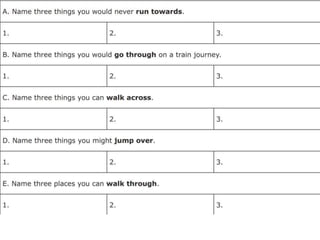
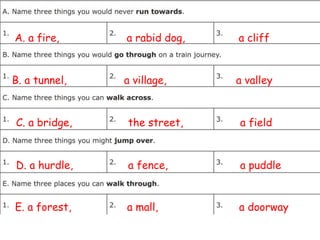
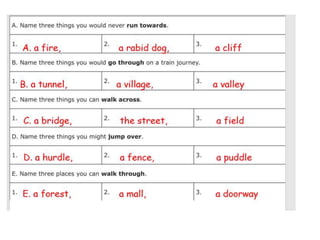
A. a fire, a rabid dog, a cliff
B. a tunnel, a village, a valley
C. a bridge, the street, a field
D. a hurdle, a fence, a puddle
E. a forest, a mall, a doorway
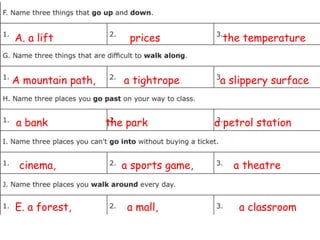
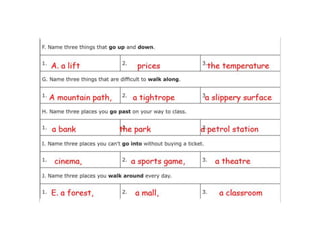
A. a lift prices the temperature
A mountain path, a tightrope a slippery surface
a bank the park a petrol station
cinema, a sports game, a theatre
E. a forest, a mall, a classroom
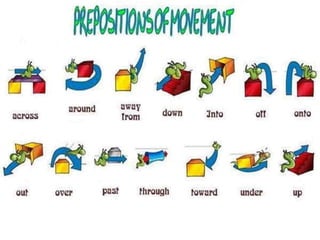
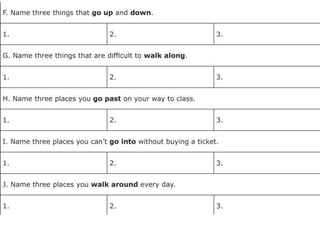
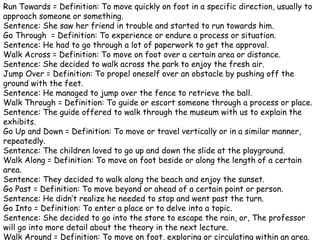
Run Towards = Definition: To move quickly on foot in a specific direction, usually to
approach someone or something.
Sentence: She saw her friend in trouble and started to run towards him.
Go Through = Definition: To experience or endure a process or situation.
Sentence: He had to go through a lot of paperwork to get the approval.
Walk Across = Definition: To move on foot over a certain area or distance.
Sentence: She decided to walk across the park to enjoy the fresh air.
Jump Over = Definition: To propel oneself over an obstacle by pushing off the
ground with the feet.
Sentence: He managed to jump over the fence to retrieve the ball.
Walk Through = Definition: To guide or escort someone through a process or place.
Sentence: The guide offered to walk through the museum with us to explain the
exhibits.
Go Up and Down = Definition: To move or travel vertically or in a similar manner,
repeatedly.

Sentence: The children loved to go up and down the slide at the playground.
Walk Along = Definition: To move on foot beside or along the length of a certain
area.
Sentence: They decided to walk along the beach and enjoy the sunset.
Go Past = Definition: To move beyond or ahead of a certain point or person.
Sentence: He didn’t realize he needed to stop and went past the turn.
Go Into = Definition: To enter a place or to delve into a topic.
Sentence: She decided to go into the store to escape the rain, or, The professor
will go into more detail about the theory in the next lecture.
Walk Around = Definition: To move on foot, exploring or circulating within an area.
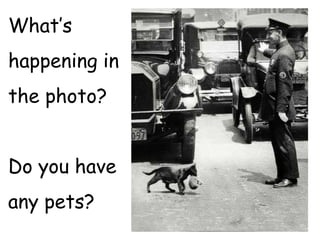
What’s
happening in
the photo?
Do you have
any pets?
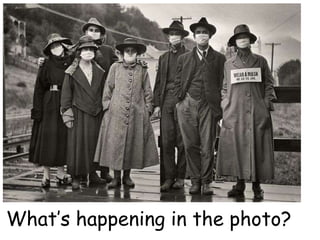
What’s happening in the photo?
What’s
happening in
the photo?
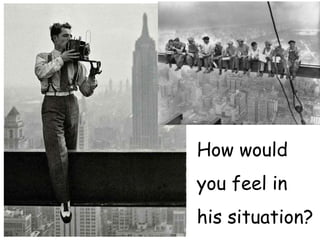
How would
you feel in
his situation?
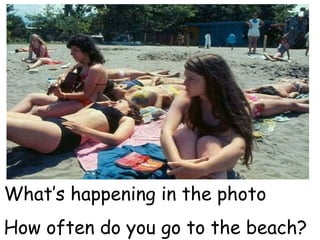
What’s happening in the photo
How often do you go to the beach?
Class 2
• Lead in (5 mins)
• Discussion questions (10 mins)
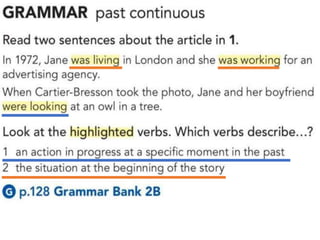
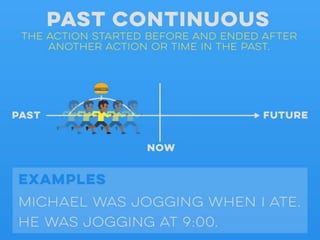
• Grammar (2) Past continuous – highlighting (5 mins)
• Grammar (2) Past continuous – exercises (10 mins)
• Grammar board game – speaking practice (15 mins)
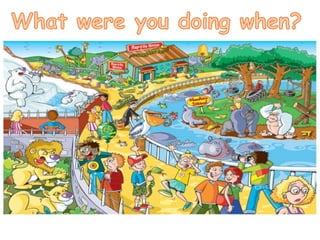
• Listening (1) What was happening? (5 mins)
• Pronunciation focus (1) weak forms (10 mins)
• Listening (2) Ordering activity – which photos (5 mins)
• Speaking practice – discussion questions about photos (10 mins)
• Writing practice (1) – Writing about a photo – reading (5 mins)
• Writing practice (2) – Writing about a photo – Prepositions (5 mins)
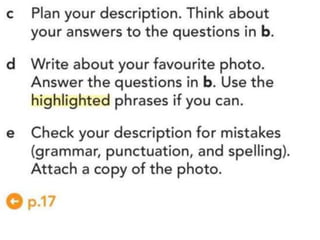
• Writing practice (3) – Writing about a photo – paragraph topics (5
mins)
• Writing practice (3) – Writing about a photo – planning (5 mins)
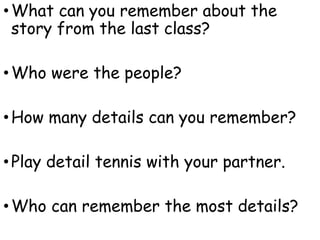
•What can you remember about the
story from the last class?
•Who were the people?
•How many details can you remember?
•Play detail tennis with your partner.
•Who can remember the most details?
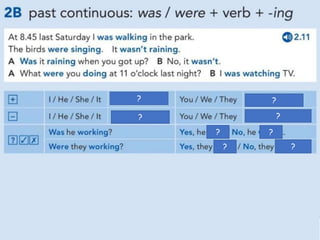
? ?
? ?
? ?
? ?
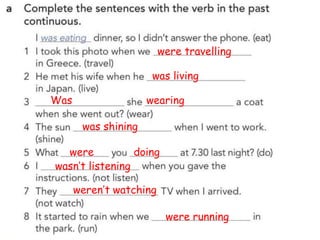
were travelling
was living
Was wearing
was shining
were doing
wasn’t listening
weren’t watching
were running
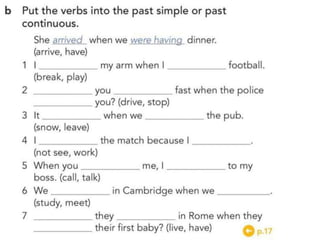
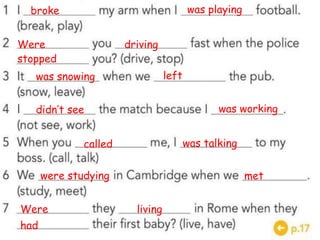
broke was playing
Were driving
stopped
was snowing left
didn’t see was working
called was talking
were studying met
Were living
had
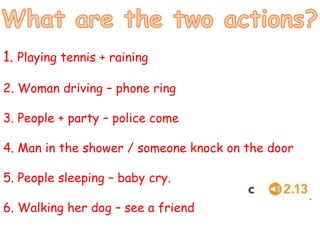
1. Playing tennis + raining
2. Woman driving – phone ring
3. People + party – police come
4. Man in the shower / someone knock on the door
5. People sleeping – baby cry.
6. Walking her dog – see a friend
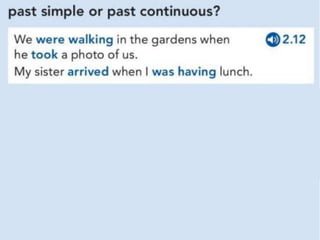
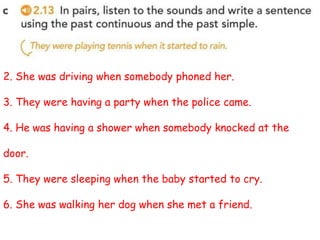
2. She was driving when somebody phoned her.
3. They were having a party when the police came.
4. He was having a shower when somebody knocked at the
door.
5. They were sleeping when the baby started to cry.
6. She was walking her dog when she met a friend.
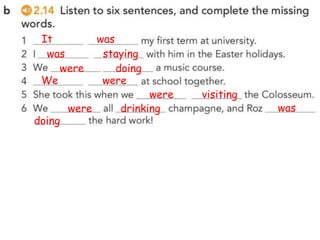
It was
was staying
were doing
We were
were visiting
were drinking was
doing
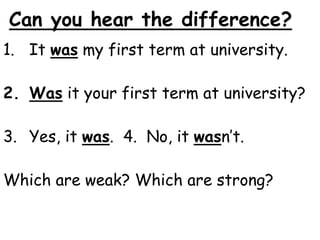
Can you hear the difference?
1. It was my first term at university.
2. Was it your first term at university?
3. Yes, it was. 4. No, it wasn’t.
Which are weak? Which are strong?
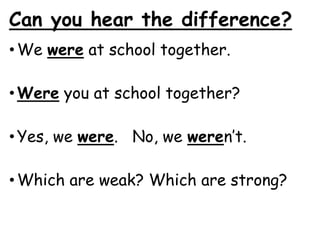
Can you hear the difference?
•We were at school together.
•Were you at school together?
•Yes, we were. No, we weren’t.
•Which are weak? Which are strong?
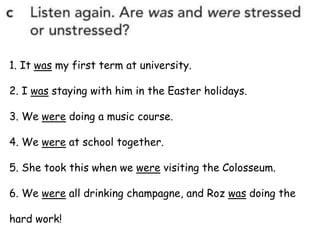
1. It was my first term at university.
2. I was staying with him in the Easter holidays.
3. We were doing a music course.
4. We were at school together.
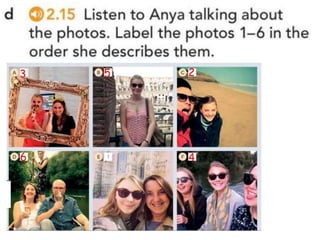
5. She took this when we were visiting the Colosseum.
6. We were all drinking champagne, and Roz was doing the
hard work!
2
3
4
5
6
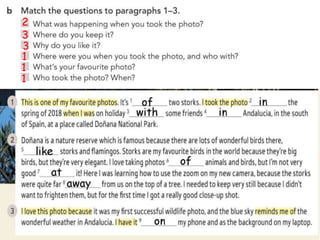
of in
with in
like
of
at
away
on
2
3
3
1
1
1
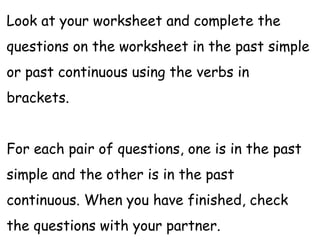
Look at your worksheet and complete the
questions on the worksheet in the past simple
or past continuous using the verbs in
brackets.
For each pair of questions, one is in the past
simple and the other is in the past
continuous. When you have finished, check
the questions with your partner.
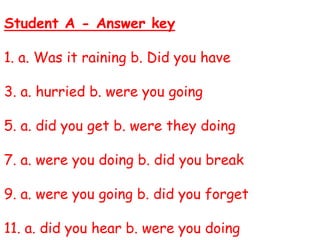
Student A - Answer key
1. a. Was it raining b. Did you have
3. a. hurried b. were you going
5. a. did you get b. were they doing
7. a. were you doing b. did you break
9. a. were you going b. did you forget
11. a. did you hear b. were you doing
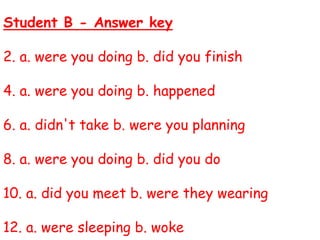
Student B - Answer key
2. a. were you doing b. did you finish
4. a. were you doing b. happened
6. a. didn't take b. were you planning
8. a. were you doing b. did you do
10. a. did you meet b. were they wearing
12. a. were sleeping b. woke
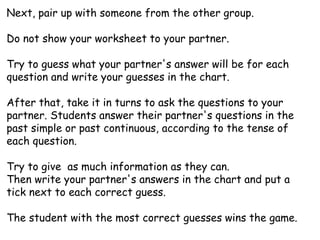
Next, pair up with someone from the other group.
Do not show your worksheet to your partner.
Try to guess what your partner's answer will be for each
question and write your guesses in the chart.
After that, take it in turns to ask the questions to your
partner. Students answer their partner's questions in the
past simple or past continuous, according to the tense of
each question.
Try to give as much information as they can.
Then write your partner's answers in the chart and put a
tick next to each correct guess.
The student with the most correct guesses wins the game.
EF4PI Unit 2B - Past continuous.pptx

EF4PI Unit 2B - Past continuous.pptx

  • 1.
  • 2.
    • Lead infamous photos from history (5 mins) • Discussion taking photos (10 mins) • Reading (1) Making predictions (5 mins) • Reading (2) Checking new vocabulary (10 mins) • Reading (3) Comprehension questions (10 mins) • Speaking discussion my favourite photo (5 mins) • Famous photos from history – guess the decade (10 mins) • Grammar (1) Prepositions – highlighting (5 mins) • Grammar (1) Prepositions – highlighting (10 mins) • Grammar (1) Prepositions – Speaking (10 mins) 80 • Name three – prepositions – melee (15 mins) • Speaking practice – describing photos (10 mins) • Vocabulary from the class quiz (10 mins)
  • 4.
    •How often doyou take photos? •What do you usually take photos of? •Do people take too many photos these days? Why do they take so many? •Do you have any photos on display around your house? What are they of? •What’s the last photo you took?
  • 9.
    1. the 1970s 2.autumn 3. an owl in a tree 4. bread, to give the animals in the zoo
  • 11.
    1. She wasliving in London, in her early twenties, working for an advertising agency. 2. She met him at a nightclub on a beach in the south of France. She found a job in Paris because she wanted to be with him. 3. They went for a walk.
  • 12.
    4. They stoppedbecause they heard a lot of noise coming from a tree. They saw an owl and some little birds attacking it. 5. She called Cartier-Bresson, and he sent her a copy. 6. Because it was a happy time for her.
  • 15.
  • 16.
  • 17.
  • 18.
  • 26.
    A. a fire,a rabid dog, a cliff B. a tunnel, a village, a valley C. a bridge, the street, a field D. a hurdle, a fence, a puddle E. a forest, a mall, a doorway
  • 27.
    A. a liftprices the temperature A mountain path, a tightrope a slippery surface a bank the park a petrol station cinema, a sports game, a theatre E. a forest, a mall, a classroom
  • 28.
    Run Towards =Definition: To move quickly on foot in a specific direction, usually to approach someone or something. Sentence: She saw her friend in trouble and started to run towards him. Go Through = Definition: To experience or endure a process or situation. Sentence: He had to go through a lot of paperwork to get the approval. Walk Across = Definition: To move on foot over a certain area or distance. Sentence: She decided to walk across the park to enjoy the fresh air. Jump Over = Definition: To propel oneself over an obstacle by pushing off the ground with the feet. Sentence: He managed to jump over the fence to retrieve the ball. Walk Through = Definition: To guide or escort someone through a process or place. Sentence: The guide offered to walk through the museum with us to explain the exhibits. Go Up and Down = Definition: To move or travel vertically or in a similar manner, repeatedly. Sentence: The children loved to go up and down the slide at the playground. Walk Along = Definition: To move on foot beside or along the length of a certain area. Sentence: They decided to walk along the beach and enjoy the sunset. Go Past = Definition: To move beyond or ahead of a certain point or person. Sentence: He didn’t realize he needed to stop and went past the turn. Go Into = Definition: To enter a place or to delve into a topic. Sentence: She decided to go into the store to escape the rain, or, The professor will go into more detail about the theory in the next lecture. Walk Around = Definition: To move on foot, exploring or circulating within an area.
  • 30.
  • 31.
  • 32.
    What’s happening in the photo? Howwould you feel in his situation?
  • 33.
    What’s happening inthe photo How often do you go to the beach?
  • 37.
  • 38.
    • Lead in(5 mins) • Discussion questions (10 mins) • Grammar (2) Past continuous – highlighting (5 mins) • Grammar (2) Past continuous – exercises (10 mins) • Grammar board game – speaking practice (15 mins) • Listening (1) What was happening? (5 mins) • Pronunciation focus (1) weak forms (10 mins) • Listening (2) Ordering activity – which photos (5 mins) • Speaking practice – discussion questions about photos (10 mins) • Writing practice (1) – Writing about a photo – reading (5 mins) • Writing practice (2) – Writing about a photo – Prepositions (5 mins) • Writing practice (3) – Writing about a photo – paragraph topics (5 mins) • Writing practice (3) – Writing about a photo – planning (5 mins)
  • 40.
    •What can youremember about the story from the last class? •Who were the people? •How many details can you remember? •Play detail tennis with your partner. •Who can remember the most details?
  • 43.
    ? ? ? ? ?? ? ?
  • 45.
    were travelling was living Waswearing was shining were doing wasn’t listening weren’t watching were running
  • 47.
    broke was playing Weredriving stopped was snowing left didn’t see was working called was talking were studying met Were living had
  • 49.
    1. Playing tennis+ raining 2. Woman driving – phone ring 3. People + party – police come 4. Man in the shower / someone knock on the door 5. People sleeping – baby cry. 6. Walking her dog – see a friend
  • 50.
    2. She wasdriving when somebody phoned her. 3. They were having a party when the police came. 4. He was having a shower when somebody knocked at the door. 5. They were sleeping when the baby started to cry. 6. She was walking her dog when she met a friend.
  • 52.
    It was was staying weredoing We were were visiting were drinking was doing
  • 53.
    Can you hearthe difference? 1. It was my first term at university. 2. Was it your first term at university? 3. Yes, it was. 4. No, it wasn’t. Which are weak? Which are strong?
  • 54.
    Can you hearthe difference? •We were at school together. •Were you at school together? •Yes, we were. No, we weren’t. •Which are weak? Which are strong?
  • 55.
    1. It wasmy first term at university. 2. I was staying with him in the Easter holidays. 3. We were doing a music course. 4. We were at school together. 5. She took this when we were visiting the Colosseum. 6. We were all drinking champagne, and Roz was doing the hard work!
  • 56.
  • 60.
  • 61.
  • 65.
    Look at yourworksheet and complete the questions on the worksheet in the past simple or past continuous using the verbs in brackets. For each pair of questions, one is in the past simple and the other is in the past continuous. When you have finished, check the questions with your partner.
  • 66.
    Student A -Answer key 1. a. Was it raining b. Did you have 3. a. hurried b. were you going 5. a. did you get b. were they doing 7. a. were you doing b. did you break 9. a. were you going b. did you forget 11. a. did you hear b. were you doing
  • 67.
    Student B -Answer key 2. a. were you doing b. did you finish 4. a. were you doing b. happened 6. a. didn't take b. were you planning 8. a. were you doing b. did you do 10. a. did you meet b. were they wearing 12. a. were sleeping b. woke
  • 68.
    Next, pair upwith someone from the other group. Do not show your worksheet to your partner. Try to guess what your partner's answer will be for each question and write your guesses in the chart. After that, take it in turns to ask the questions to your partner. Students answer their partner's questions in the past simple or past continuous, according to the tense of each question. Try to give as much information as they can. Then write your partner's answers in the chart and put a tick next to each correct guess. The student with the most correct guesses wins the game.

Editor's Notes

  • #34 A Beach In Iran A Few Months Before The Islamic Revolution, 1979
  • #56 unstressed