
Attention
in sense of touch
    DongNyeok Jeong
• What makes somatosensation so different
  from other senses to look exclusively into
  the impact of attention onto that sensory
  system?
Somatosensory Cortex


•   Areas 1, 2, and 3, which constitute PRIMARY SOMATOSENSORY
    AREA I, 40 is SECONDARY SOMATOSENSORY AREA II and areas 5
    and 7, which constitute the SOMATOSENSORY ASSOCIATION
    AREA.
SEP

• Somatosensory evoked potentials
 • By combining SEP recordings at
    different levels of the somatosensory
    pathways, it is possible to assess the
    transmission of the afferent volley from
    the periphery up to the cortex.
• latency of 38 and 68ms
• attentional modulation of SEFs (125 and
  138ms)
• one such variable might be the level to
  what extend stimuli have to be processed
  in order to perform a particular task.
• SEP consists of the components P50, N70,
  P100, N140 and positive late
  component(LC).
• spatial attention alters the neural responses
  to transient stimuli is not a hard-wired
  mechanism but might be influenced by a
  number of variables.
• Spatial separation of stimulation sites as
  well as inter stimulus intervals play an
  important role to determine which
  component of the SEP is modulated with
  attention.
• The somatosensory system in particular
  seems to be organized in a way to
  automatically shift attention to that body
  location where something happens.
• When you search for key-ring in a dark
  bag, spatial and non-spatial information
  gathered from your sense of touch highly
  determines the success of this search.
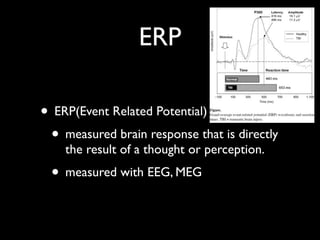
ERP

• ERP(Event Related Potential)
 • measured brain response that is directly
    the result of a thought or perception.
 • measured with EEG, MEG
SSSEP

•   Somatosensory Steady-Stated Evoked Potentials

•   A form of response to repetitive sensory
    stimulation in which the constituent frequency
    components of the response remain constant with
    time in both amplitude and phase

•   20 (left finger), 26 Hz (right finger)

•   Amplitude was increased with attention
The Neuronal Basis of Preferential
      Stimulus Processing

• A sensory gain control mechanism : visual
  modality
  • Amplification / Suppression
  • Attended or not stimulus
• A change in the temporal pattern of action
  potentials
Topographical distribution
Synchronisation of
   neuronal responses
• Correlation between pairs of neurons in SII
• Temporal synchronisation of action
  potentials of neurons that code the to-be-
  attended stimulus produces a ‘pop-out’
  from the background noise.

EEG presentation

  • 1.
    Attention in sense oftouch DongNyeok Jeong
  • 2.
    • What makessomatosensation so different from other senses to look exclusively into the impact of attention onto that sensory system?
  • 3.
    Somatosensory Cortex • Areas 1, 2, and 3, which constitute PRIMARY SOMATOSENSORY AREA I, 40 is SECONDARY SOMATOSENSORY AREA II and areas 5 and 7, which constitute the SOMATOSENSORY ASSOCIATION AREA.
  • 4.
    SEP • Somatosensory evokedpotentials • By combining SEP recordings at different levels of the somatosensory pathways, it is possible to assess the transmission of the afferent volley from the periphery up to the cortex.
  • 5.
    • latency of38 and 68ms • attentional modulation of SEFs (125 and 138ms) • one such variable might be the level to what extend stimuli have to be processed in order to perform a particular task.
  • 6.
    • SEP consistsof the components P50, N70, P100, N140 and positive late component(LC). • spatial attention alters the neural responses to transient stimuli is not a hard-wired mechanism but might be influenced by a number of variables.
  • 7.
    • Spatial separationof stimulation sites as well as inter stimulus intervals play an important role to determine which component of the SEP is modulated with attention. • The somatosensory system in particular seems to be organized in a way to automatically shift attention to that body location where something happens.
  • 8.
    • When yousearch for key-ring in a dark bag, spatial and non-spatial information gathered from your sense of touch highly determines the success of this search.
  • 9.
    ERP • ERP(Event RelatedPotential) • measured brain response that is directly the result of a thought or perception. • measured with EEG, MEG
  • 10.
    SSSEP • Somatosensory Steady-Stated Evoked Potentials • A form of response to repetitive sensory stimulation in which the constituent frequency components of the response remain constant with time in both amplitude and phase • 20 (left finger), 26 Hz (right finger) • Amplitude was increased with attention
  • 11.
    The Neuronal Basisof Preferential Stimulus Processing • A sensory gain control mechanism : visual modality • Amplification / Suppression • Attended or not stimulus • A change in the temporal pattern of action potentials
  • 12.
  • 13.
    Synchronisation of neuronal responses • Correlation between pairs of neurons in SII • Temporal synchronisation of action potentials of neurons that code the to-be- attended stimulus produces a ‘pop-out’ from the background noise.

Editor's Notes