Download to read offline
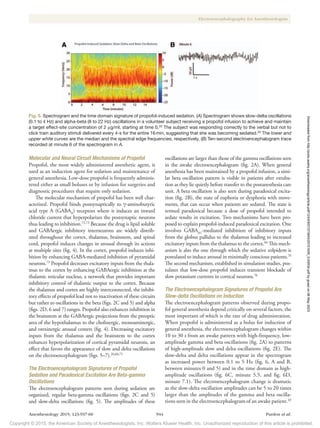
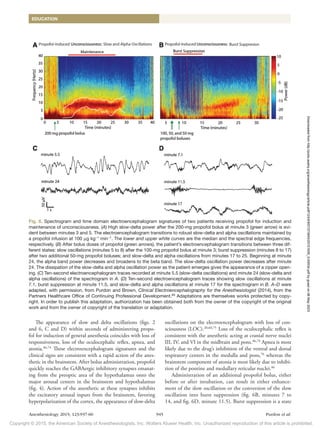
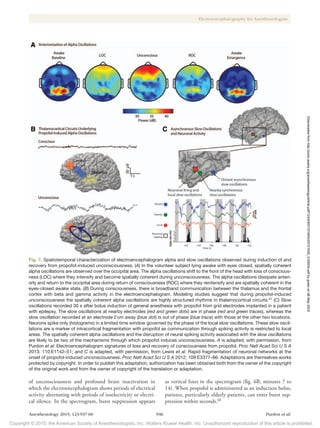
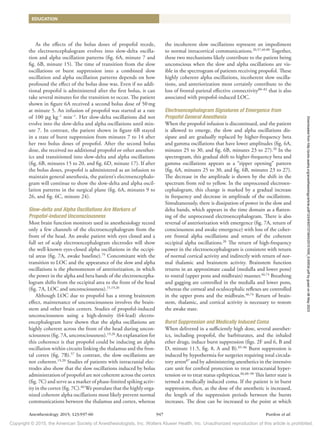
![Copyright © 2015, the American Society of Anesthesiologists, Inc. Wolters Kluwer Health, Inc. Unauthorized reproduction of this article is prohibited.
Anesthesiology 2015; 123:937-60 958 Purdon et al.
Electroencephalography for Anesthesiologists
23. Palanca BJ, Mashour GA, Avidan MS: Processed electroen-
cephalogram in depth of anesthesia monitoring. Curr Opin
Anaesthesiol 2009; 22:553–9
24. BolCJJG,DanhofM,StanskiDR,MandemaJW:Pharmacokinetic-
pharmacodynamic characterization of the cardiovascular, hyp-
notic, EEG and ventilatory responses to dexmedetomidine in
the rat. J Pharmacol Exp Ther 1997; 283:1051–8
25. Barnard JP, Bennett C, Voss LJ, Sleigh JW: Can anaesthe-
tists be taught to interpret the effects of general anaesthesia
on the electroencephalogram? Comparison of performance
with the BIS and spectral entropy. Br J Anaesth 2007;
99:532–7
26. Kearse LA Jr, Manberg P, Chamoun N, deBros F, Zaslavsky
A: Bispectral analysis of the electroencephalogram cor-
relates with patient movement to skin incision during
propofol/nitrous oxide anesthesia. Anesthesiology 1994;
81:1365–70
27. Glass PS, Bloom M, Kearse L, Rosow C, Sebel P, Manberg P:
Bispectral analysis measures sedation and memory effects
of propofol, midazolam, isoflurane, and alfentanil in healthy
volunteers. Anesthesiology 1997; 86:836–47
28. Prichep LS, Gugino LD, John ER, Chabot RJ, Howard B,
Merkin H, Tom ML, Wolter S, Rausch L, Kox WJ: The Patient
State Index as an indicator of the level of hypnosis under
general anaesthesia. Br J Anaesth 2004; 92:393–9
29. Drover D, Ortega HR: Patient state index. Best Pract Res Clin
Anaesthesiol 2006; 20:121–8
30. Schultz B, Kreuer S, Wilhelm W, Grouven U, Schultz A: [The
Narcotrend monitor. Development and interpretation algo-
rithms]. Anaesthesist 2003; 52:1143–8
31. Kreuer S, Wilhelm W: The Narcotrend monitor. Best Pract
Res Clin Anaesthesiol 2006; 20:111–9
32. Viertiö-Oja H, Maja V, Särkelä M, Talja P, Tenkanen N,
Tolvanen-Laakso H, Paloheimo M, Vakkuri A, Yli-Hankala
A, Meriläinen P: Description of the Entropy algorithm as
applied in the Datex-Ohmeda S/5 Entropy Module. Acta
Anaesthesiol Scand 2004; 48:154–61
33. Jäntti V, Alahuhta S: Spectral entropy—What has it to do
with anaesthesia, and the EEG? Br J Anaesth 2004; 93:150–1;
author reply 151–2
34. Avidan MS, Zhang L, Burnside BA, Finkel KJ, Searleman AC,
Selvidge JA, Saager L, Turner MS, Rao S, Bottros M, Hantler C,
Jacobsohn E, Evers AS: Anesthesia awareness and the bispec-
tral index. N Engl J Med 2008; 358:1097–108
35. Avidan MS, Jacobsohn E, Glick D, Burnside BA, Zhang L,
Villafranca A, Karl L, Kamal S, Torres B, O’Connor M, Evers
AS, Gradwohl S, Lin N, Palanca BJ, Mashour GA, Group
B-RR: Prevention of intraoperative awareness in a high-risk
surgical population. N Engl J Med 2011; 365:591–600
36. Samarkandi AH: The bispectral index system in pediatrics—
Is it related to the end-tidal concentration of inhalation anes-
thetics? Middle East J Anaesthesiol 2006; 18:769–78
37. Tirel O, Wodey E, Harris R, Bansard JY, Ecoffey C, Senhadji
L: Variation of bispectral index under TIVA with propofol in
a paediatric population. Br J Anaesth 2008; 100:82–7
38. Hayashi K, Tsuda N, Sawa T, Hagihira S: Ketamine increases
the frequency of electroencephalographic bicoherence
peak on the alpha spindle area induced with propofol. Br J
Anaesth 2007; 99:389–95
39. Tsuda N, Hayashi K, Hagihira S, Sawa T: Ketamine, an NMDA-
antagonist, increases the oscillatory frequencies of alpha-
peaks on the electroencephalographic power spectrum. Acta
Anaesthesiol Scand 2007; 51:472–81
40. Yamamura T, Fukuda M, Takeya H, Goto Y, Furukawa K: Fast
oscillatory EEG activity induced by analgesic concentrations
of nitrous oxide in man. Anesth Analg 1981; 60:283–8
41. Foster BL, Liley DT: Nitrous oxide paradoxically modulates
slow electroencephalogram oscillations: Implications for
anesthesia monitoring. Anesth Analg 2011; 113:758–65
42. Foster BL, Liley DT: Effects of nitrous oxide sedation on rest-
ing electroencephalogram topography. Clin Neurophysiol
2013; 124:417–23
43. Akeju O, Pavone KJ, Westover MB, Vazquez R, Prerau MJ,
Harrell PG, Hartnack KE, Rhee J, Sampson AL, Habeeb K,
Gao L, Lei G, Pierce ET, Walsh JL, Brown EN, Purdon PL:
A comparison of propofol- and dexmedetomidine-induced
electroencephalogram dynamics using spectral and coher-
ence analysis. Anesthesiology 2014; 121:978–89
44. Huupponen E, Maksimow A, Lapinlampi P, Särkelä M,
Saastamoinen A, Snapir A, Scheinin H, Scheinin M, Meriläinen
P, Himanen SL, Jääskeläinen S: Electroencephalogram spin-
dle activity during dexmedetomidine sedation and physi-
ological sleep. Acta Anaesthesiol Scand 2008; 52:289–94
45. Brown EN, Purdon PL, Van Dort CJ: General anesthesia and
altered states of arousal: A systems neuroscience analysis.
Annu Rev Neurosci 2011; 34:601–28
46. Brown EN, Lydic R, Schiff ND: General anesthesia, sleep, and
coma. N Engl J Med 2010; 363:2638–50
47. Akeju O, Westover MB, Pavone KJ, Sampson AL, Hartnack
KE, Brown EN, Purdon PL: Effects of sevoflurane and propo-
fol on frontal electroencephalogram power and coherence.
Anesthesiology 2014; 121:990–8
48. Kertai MD, Whitlock EL, Avidan MS: Brain monitoring with
electroencephalography and the electroencephalogram-
derived bispectral index during cardiac surgery. Anesth
Analg 2012; 114:533–46
49. Bennett C, Voss LJ, Barnard JP, Sleigh JW: Practical use of the
raw electroencephalogram waveform during general anes-
thesia: The art and science. Anesth Analg 2009; 109:539–50
50. Drover DR, Schmiesing C, Buchin AF, Ortega HR, Tanner
JW, Atkins JH, Macario A: Titration of sevoflurane in elderly
patients: Blinded, randomized clinical trial, in non-cardiac
surgery after beta-adrenergic blockade. J Clin Monit Comput
2011; 25:175–81
51. Kandel ER, Schwartz JH, Jessell TM, Siegelbaum SA, Hudspeth
AJ: Nerve cells and behavior, Principles of Neural Science, 5th
edition. New York, McGraw-Hill, 2013, pp 19–35
52. Buzsáki G: Synchronization by oscillation, Rhythms of the
Brain. Oxford; New York, Oxford University Press, 2006, pp
136–174
53. Buzsáki G, Anastassiou CA, Koch C: The origin of extracellu-
lar fields and currents—EEG, ECoG, LFP and spikes. Nat Rev
Neurosci 2012; 13:407–20
54. Hughes SW, Crunelli V: Thalamic mechanisms of EEG alpha
rhythms and their pathological implications. Neuroscientist
2005; 11:357–72
55. Purves D, Augustine GJ, Fitzpatrick D, Hall WC, LaMantis
AS, McNamara JO, White LE: Neuroscience, 4th edition.
Sunderland, Sinauer Associates, Inc., 2008, pp 715–17
56. Hamalainen M, Hari R, Ilmoniemi RJ, Knuutila J, Lounasmaa
OV: Magnetoencephalography—Theory, instrumentation,
and applications to noninvasive studies of the working
human brain. Reviews of Modern Physics 1993; 65:413–497
57. Ching S, Cimenser A, Purdon PL, Brown EN, Kopell NJ:
Thalamocortical model for a propofol-induced alpha-rhythm
associated with loss of consciousness. Proc Natl Acad Sci U S
A 2010; 107:22665–70
58. Supp GG, Siegel M, Hipp JF, Engel AK: Cortical hypersyn-
chrony predicts breakdown of sensory processing during
loss of consciousness. Curr Biol 2011; 21:1988–93
59. Chauvette S, Crochet S, Volgushev M, Timofeev I: Properties
of slow oscillation during slow-wave sleep and anesthesia in
cats. J Neurosci 2011; 31:14998–5008
60. Lewis LD, Weiner VS, Mukamel EA, Donoghue JA, Eskandar
EN, Madsen JR, Anderson WS, Hochberg LR, Cash SS, Brown
EN, Purdon PL: Rapid fragmentation of neuronal networks
at the onset of propofol-induced unconsciousness. Proc Natl
Acad Sci U S A 2012; 109:E3377–86
Downloaded
from
http://pubs.asahq.org/anesthesiology/article-pdf/123/4/937/373943/20151000_0-00034.pdf
by
guest
on
06
May
2023](https://image.slidesharecdn.com/eegclincaparaanesingles-231009012607-ce4db4b1/85/eeg-clinca-para-anes-ingles-pdf-22-320.jpg)

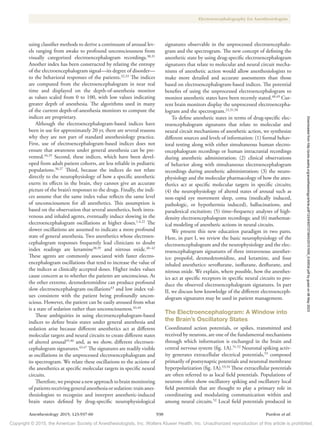
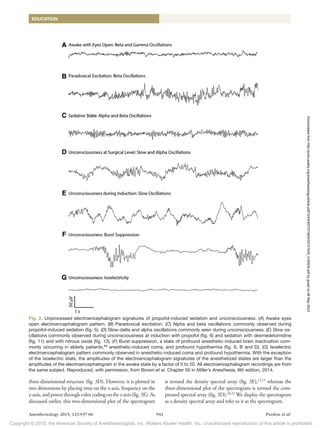
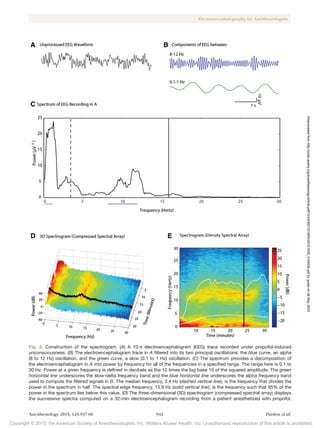
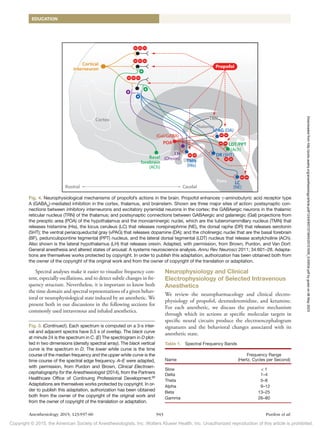
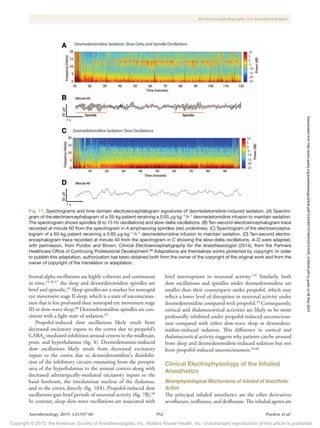
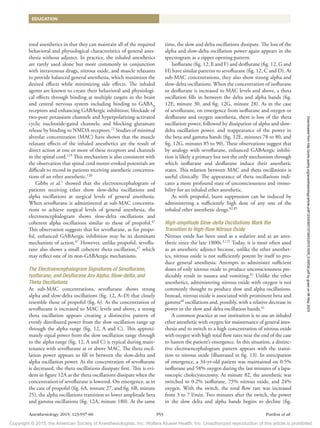
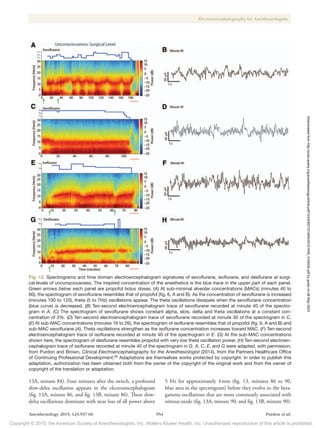
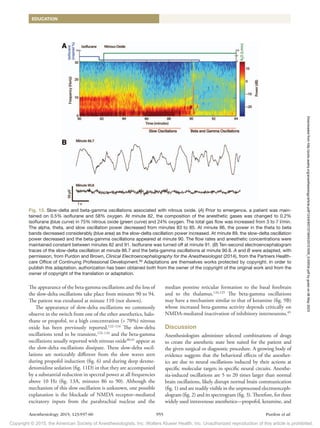
This document discusses using electroencephalography (EEG) to monitor brain states under general anesthesia. It reviews: 1) The neurophysiological basis of the EEG as a measure of oscillatory brain activity originating from cortical and subcortical regions. 2) How different anesthetic drugs (propofol, dexmedetomidine, ketamine, sevoflurane, isoflurane, desflurane, nitrous oxide) induce distinct EEG signatures related to their molecular targets and effects on neural circuits. 3) The limitations of existing EEG-based depth of anesthesia monitors, which assume the same index value indicates the same unconsciousness level for all anesthetics. 4) A proposed new approach where anesthesi


![CASE_PRESENTATION_ON_subdural_hematoma(SDH)[1 FINAL PPT]-1.pptx](https://cdn.slidesharecdn.com/ss_thumbnails/casepresentationonsubduralhematomasdh1finalppt-1-260129172522-d405d375-thumbnail.jpg?width=640&height=640&fit=bounds)


