BUILD_ME Training:
Basics of climate-friendly
buildings and the BEP Tool
3 & 4 August 2021
©2021 Guidehouse Inc. All Rights Reserved 2
Welcome words
Mohamed Salheen, IDG
Bild
von
PIRO4D
auf
Pixabay
©2021 Guidehouse Inc. All Rights Reserved 3
Provide an overview of the big picture
Transfer general technical understanding of holistic assessment of
EE building projects
Increase awareness of the importance and financial attractiveness of
investing in EE measures
Enable the utilisation of the BEP tool
Objectives of the training session
For project developers, architects and engineers
1
2
3
4
©2021 Guidehouse Inc. All Rights Reserved 4
Mohamed Salheen
Founder of IDG, Integrated Planning and Design Expert, IDG
salheen@idg.com.eg
Mai Adel
Building Energy Systems Expert, IDG
mai_adel@idg.com.eg
Marian Nessim
Energy and Building materials Expert, HBRC
mariannessim7@gmail.com
Presenters of the training session
For project developers, architects and engineers
©2021 Guidehouse Inc. All Rights Reserved 5
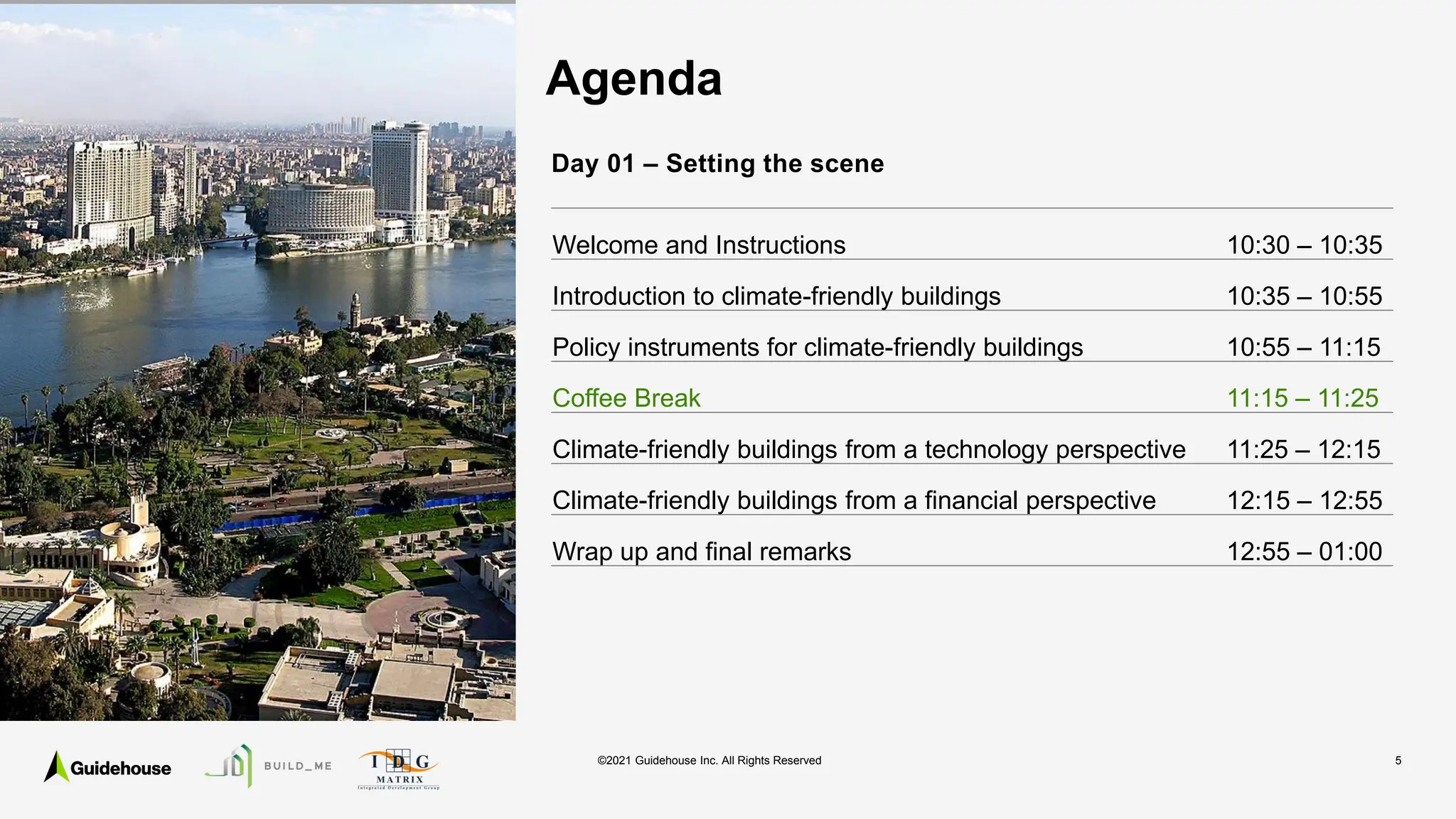
Agenda
Day 01 – Setting the scene
Welcome and Instructions 10:30 – 10:35
Introduction to climate-friendly buildings 10:35 – 10:55
Policy instruments for climate-friendly buildings 10:55 – 11:15
Coffee Break 11:15 – 11:25
Climate-friendly buildings from a technology perspective 11:25 – 12:15
Climate-friendly buildings from a financial perspective 12:15 – 12:55
Wrap up and final remarks 12:55 – 01:00
©2021 Guidehouse Inc. All Rights Reserved 6
Introduction to
Climate-Friendly
Buildings
MaiAdel, IDG
20 minutes
©2021 Guidehouse Inc. All Rights Reserved 7
Understand the big picture
Improve familiarity with common definitions and
terminology
Introduce Building Energy Levels and Sustainable
Certifications
Key learnings
1
2
3
©2021 Guidehouse Inc. All Rights Reserved 8
The big picture
Photo
by
Wolfgang
Hasselmann
on
Unsplash
©2021 Guidehouse Inc. All Rights Reserved 9
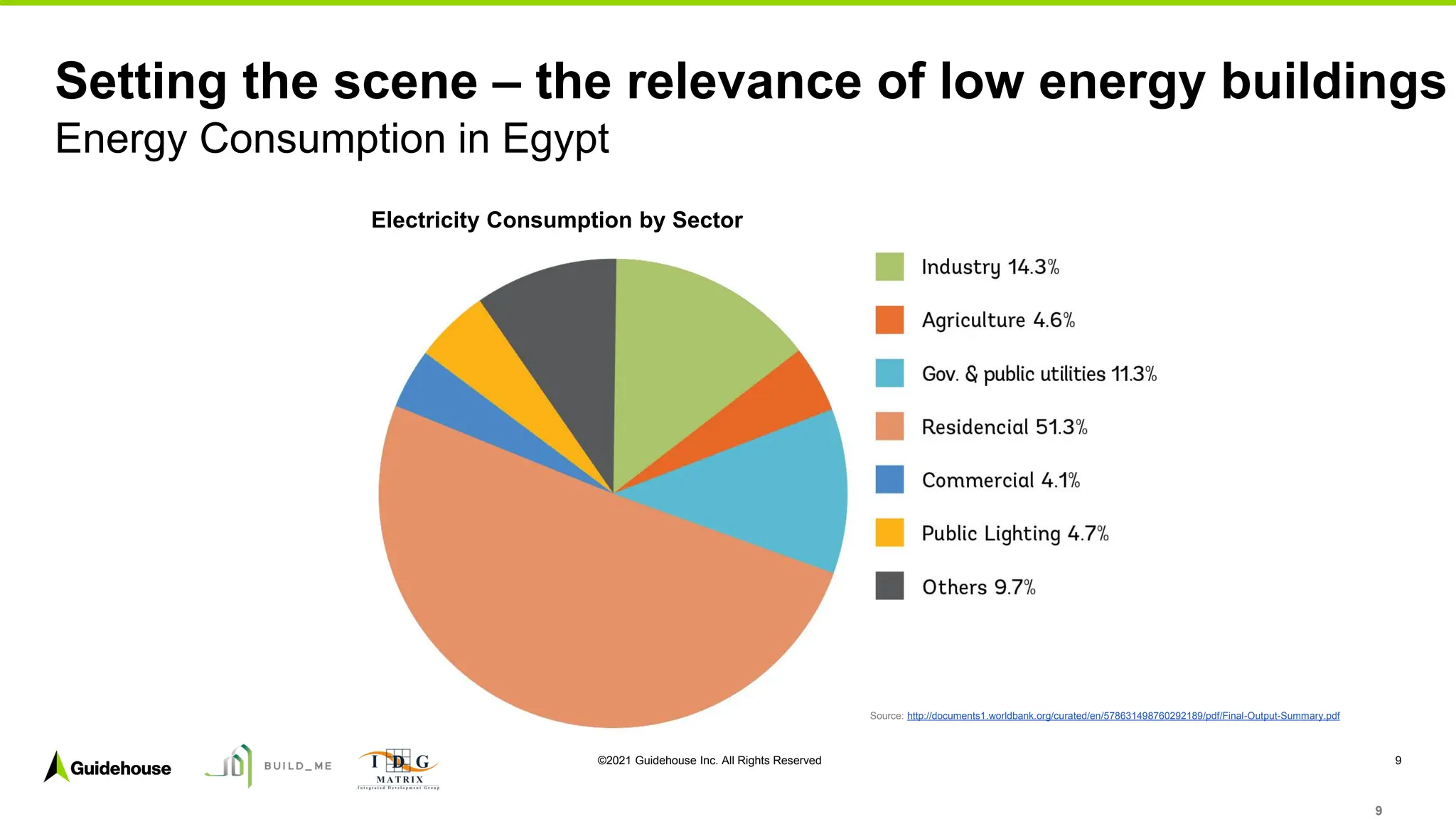
Setting the scene – the relevance of low energy buildings
Energy Consumption in Egypt
9
Electricity Consumption by Sector
Source: http://documents1.worldbank.org/curated/en/578631498760292189/pdf/Final-Output-Summary.pdf
©2021 Guidehouse Inc. All Rights Reserved 10
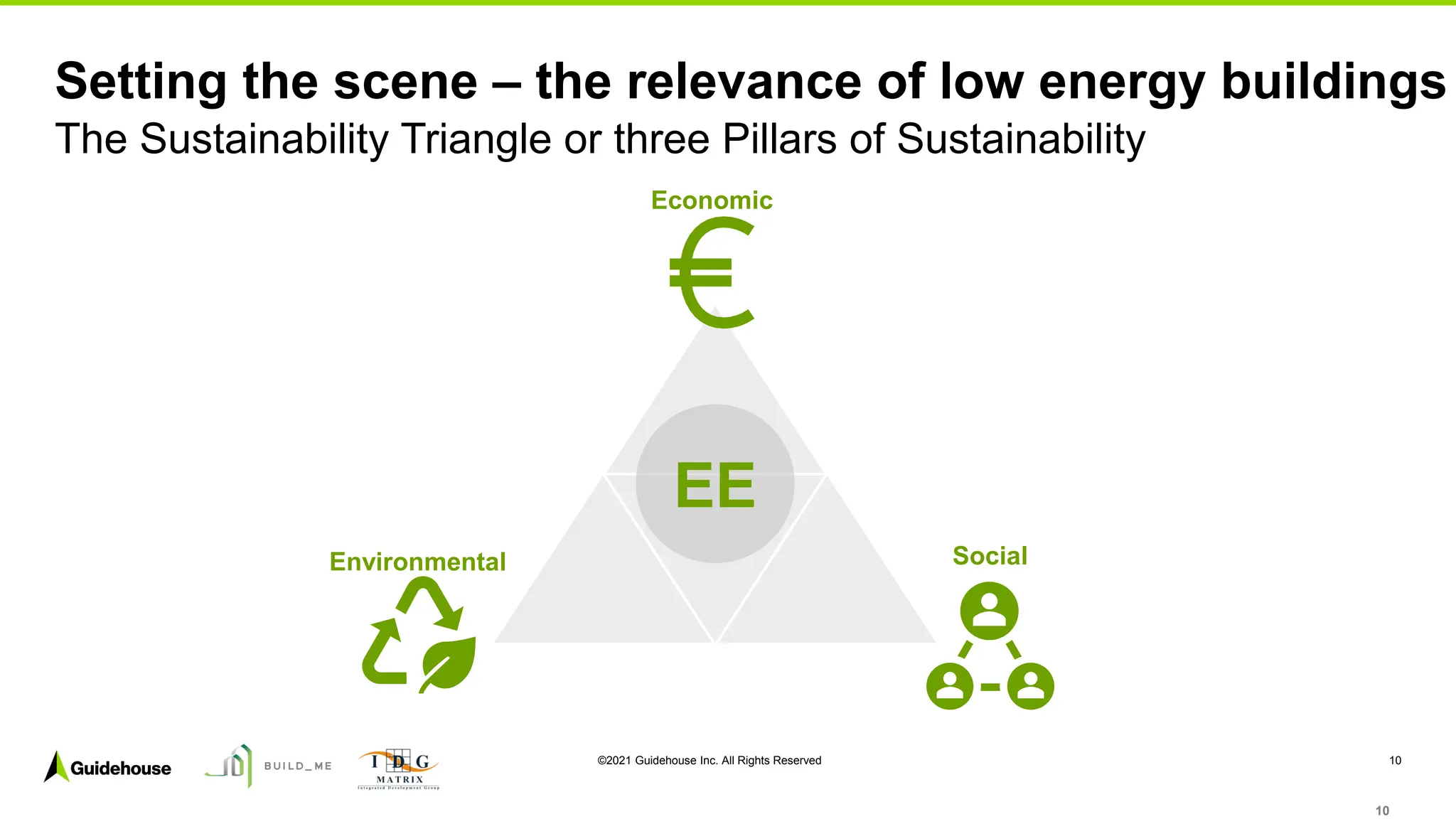
Setting the scene – the relevance of low energy buildings
The Sustainability Triangle or three Pillars of Sustainability
10
Economic
Environmental Social
EE
©2021 Guidehouse Inc. All Rights Reserved 11
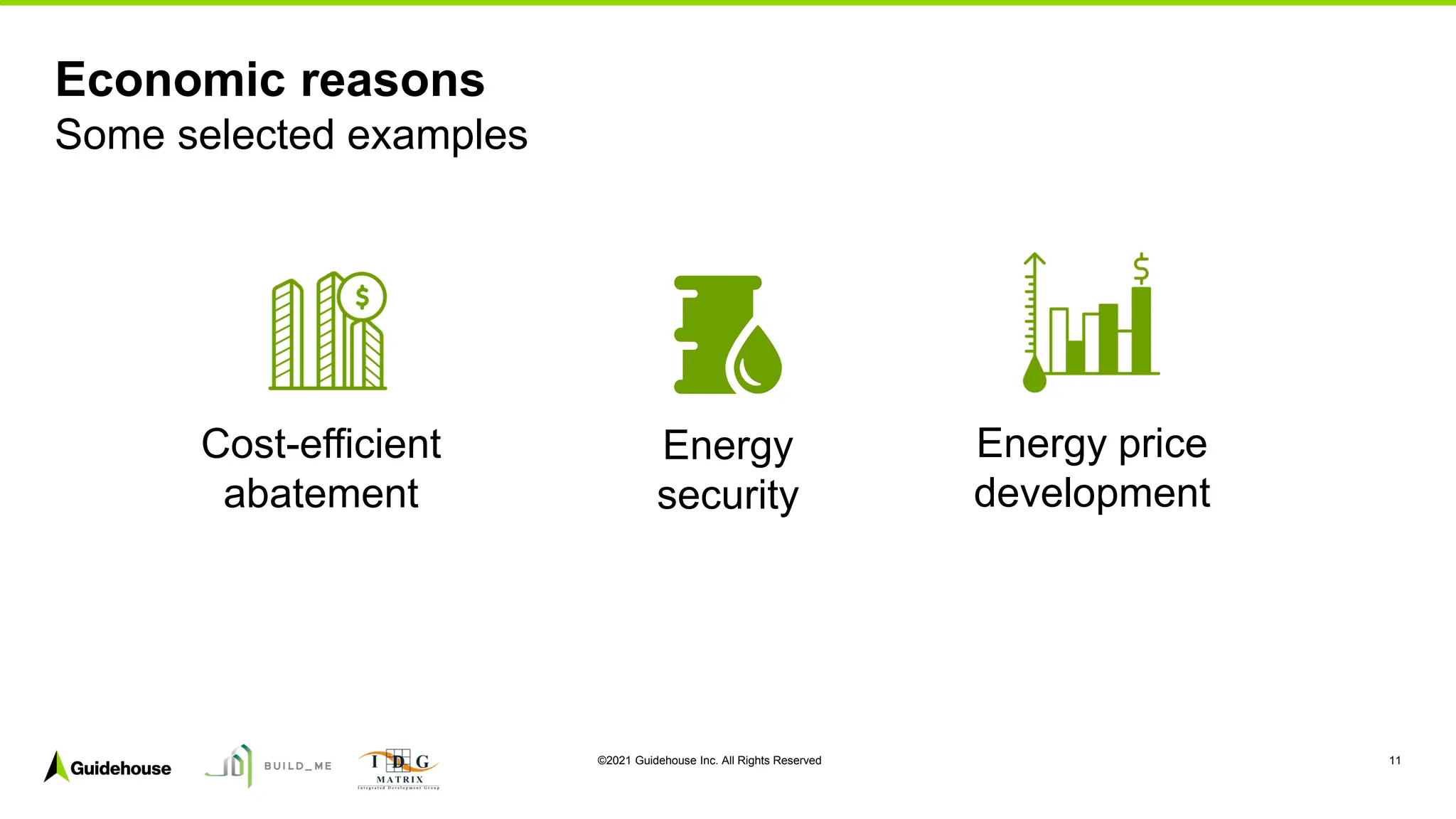
Economic reasons
Some selected examples
Energy
security
Cost-efficient
abatement
Energy price
development
©2021 Guidehouse Inc. All Rights Reserved 12
Environmental reasons
Some selected examples
Rising
temperatures
Sea level
rise
Droughts Extreme weather
events
Pollution
©2021 Guidehouse Inc. All Rights Reserved 13
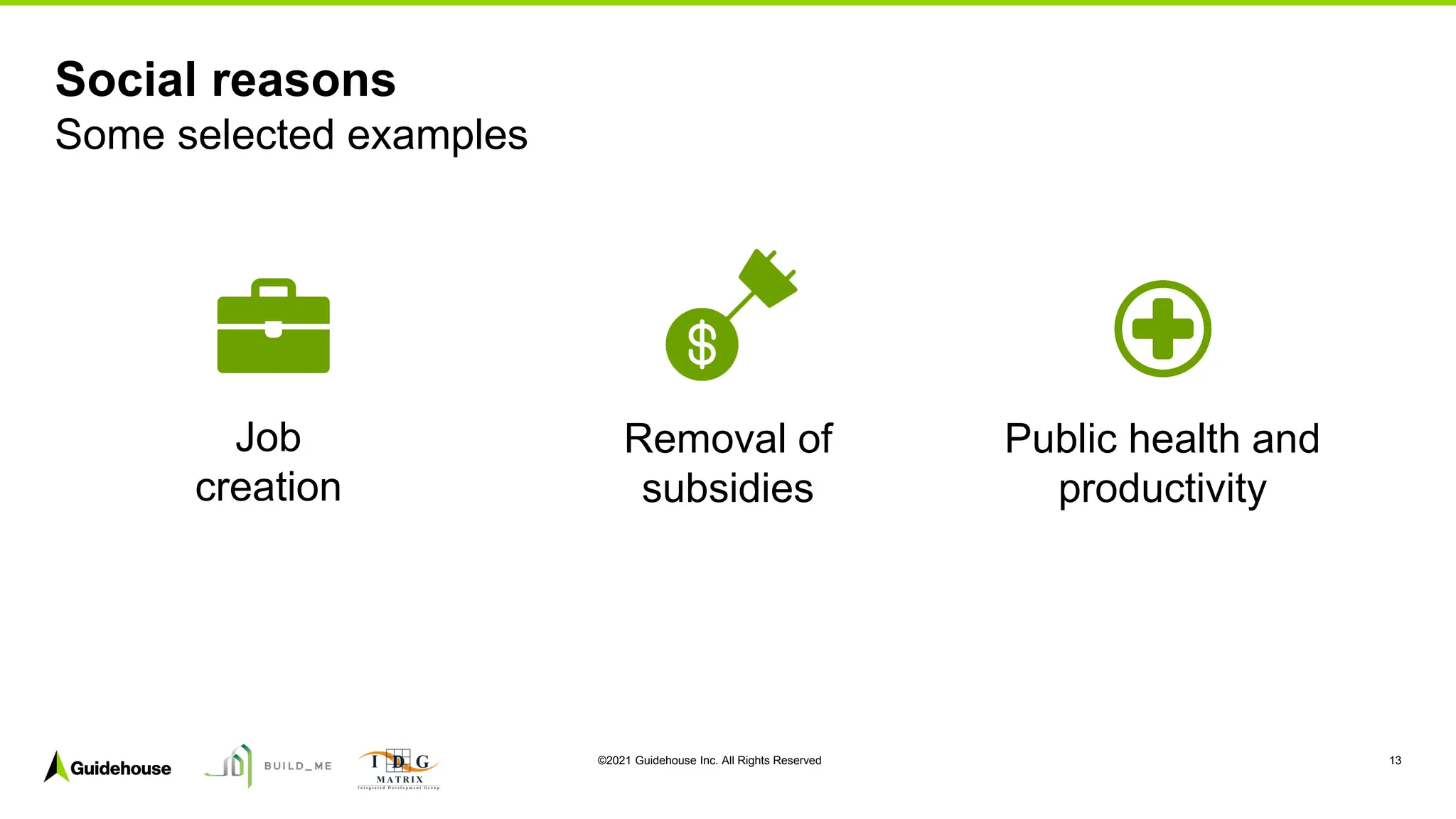
Social reasons
Some selected examples
Job
creation
Removal of
subsidies
Public health and
productivity
©2021 Guidehouse Inc. All Rights Reserved 14
Definitions, terminology, boundary conditions
Photo
by
zibik
on
Unsplash
©2021 Guidehouse Inc. All Rights Reserved 15
A couple of concepts and definitions are essential in order to embark on
energy efficiency projects:
Climate parameters
Energy units/levels
Building energy standards
Definitions, standards and technical terms
Knowledge of standard terminology required to understand EE projects
1
2
3
©2021 Guidehouse Inc. All Rights Reserved 16
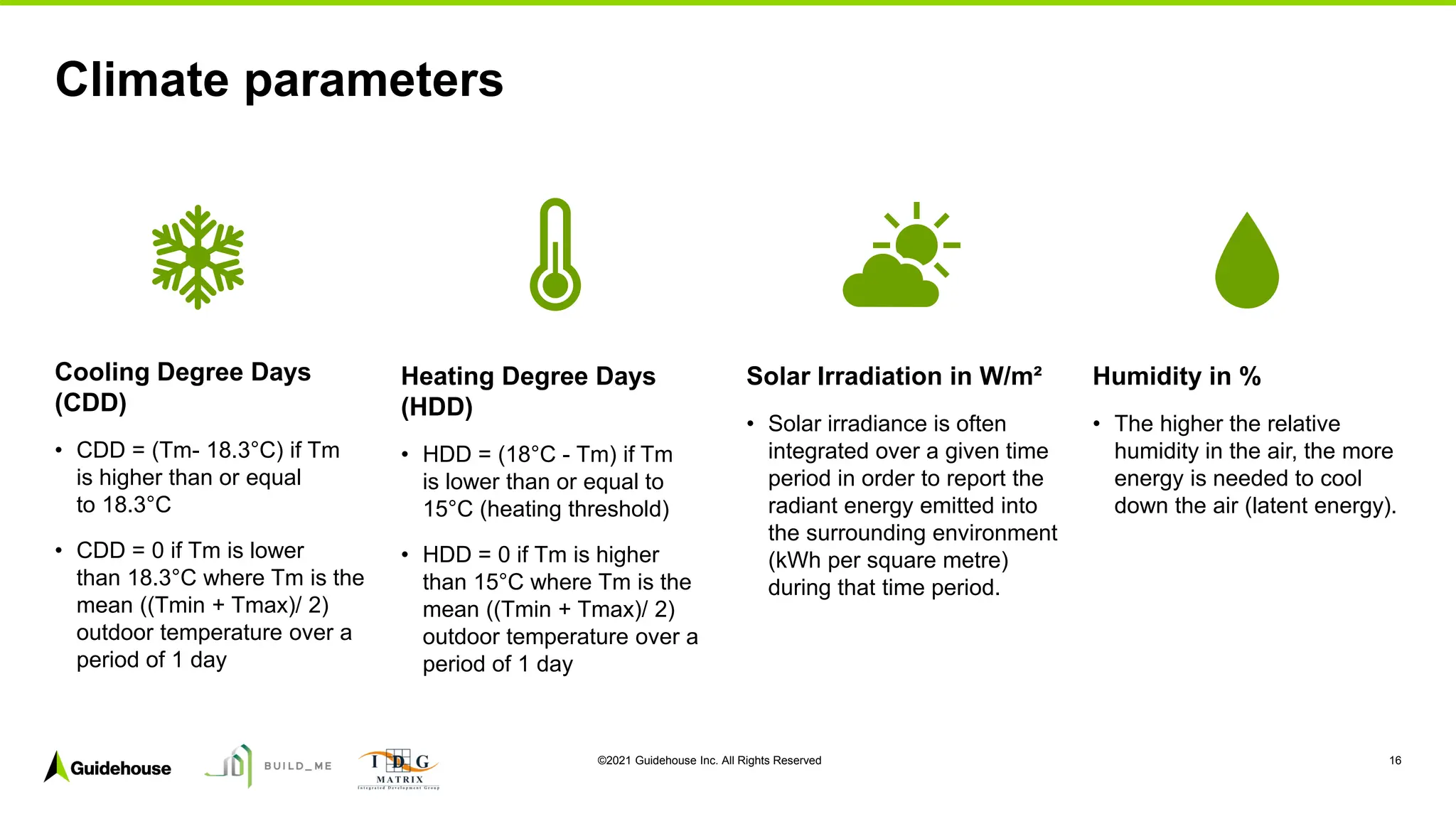
Cooling Degree Days
(CDD)
• CDD = (Tm- 18.3°C) if Tm
is higher than or equal
to 18.3°C
• CDD = 0 if Tm is lower
than 18.3°C where Tm is the
mean ((Tmin + Tmax)/ 2)
outdoor temperature over a
period of 1 day
Heating Degree Days
(HDD)
• HDD = (18°C - Tm) if Tm
is lower than or equal to
15°C (heating threshold)
• HDD = 0 if Tm is higher
than 15°C where Tm is the
mean ((Tmin + Tmax)/ 2)
outdoor temperature over a
period of 1 day
Solar Irradiation in W/m²
• Solar irradiance is often
integrated over a given time
period in order to report the
radiant energy emitted into
the surrounding environment
(kWh per square metre)
during that time period.
Humidity in %
• The higher the relative
humidity in the air, the more
energy is needed to cool
down the air (latent energy).
Climate parameters
©2021 Guidehouse Inc. All Rights Reserved 17
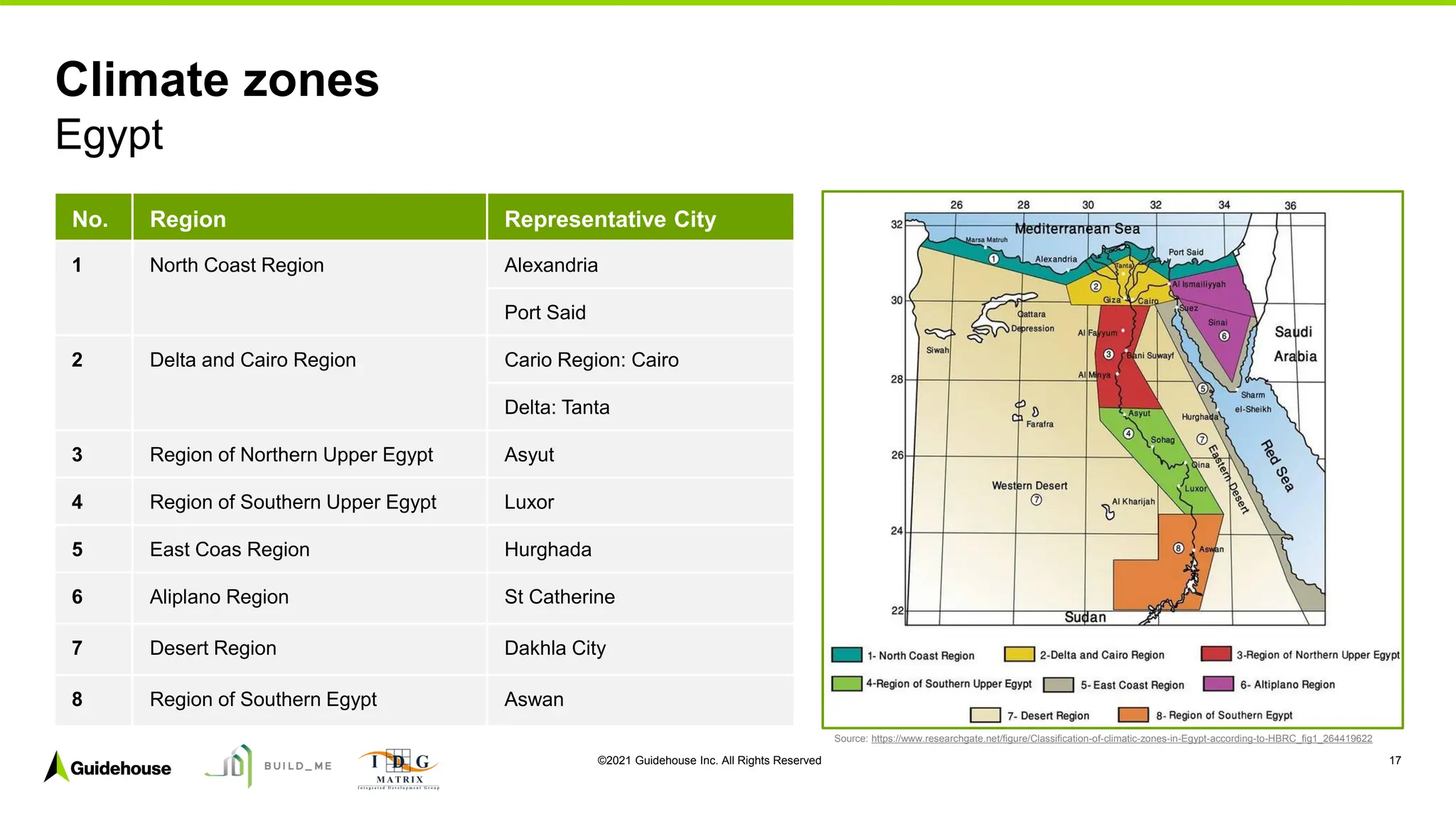
Climate zones
Egypt
No. Region Representative City
1 North Coast Region Alexandria
Port Said
2 Delta and Cairo Region Cario Region: Cairo
Delta: Tanta
3 Region of Northern Upper Egypt Asyut
4 Region of Southern Upper Egypt Luxor
5 East Coas Region Hurghada
6 Aliplano Region St Catherine
7 Desert Region Dakhla City
8 Region of Southern Egypt Aswan
Source: https://www.researchgate.net/figure/Classification-of-climatic-zones-in-Egypt-according-to-HBRC_fig1_264419622
©2021 Guidehouse Inc. All Rights Reserved 18
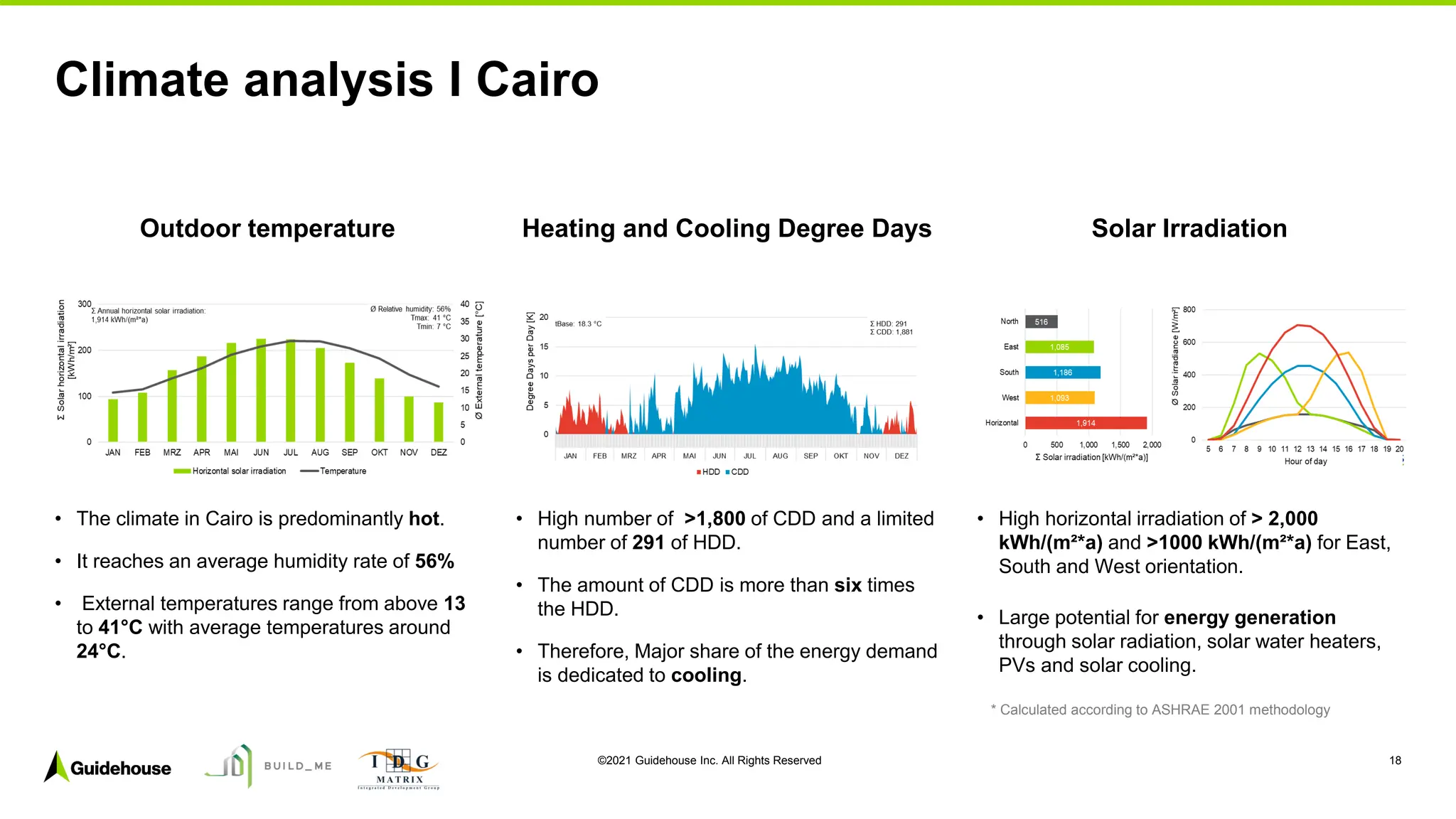
• The climate in Cairo is predominantly hot.
• It reaches an average humidity rate of 56%
• External temperatures range from above 13
to 41°C with average temperatures around
24°C.
Climate analysis I Cairo
Outdoor temperature
• High number of >1,800 of CDD and a limited
number of 291 of HDD.
• The amount of CDD is more than six times
the HDD.
• Therefore, Major share of the energy demand
is dedicated to cooling.
• High horizontal irradiation of > 2,000
kWh/(m²*a) and >1000 kWh/(m²*a) for East,
South and West orientation.
• Large potential for energy generation
through solar radiation, solar water heaters,
PVs and solar cooling.
Heating and Cooling Degree Days Solar Irradiation
* Calculated according to ASHRAE 2001 methodology
©2021 Guidehouse Inc. All Rights Reserved 19
Solar radiation
BUILD_ME countries (Egypt, Jordan and Lebanon)
Source: https://solargis.com/maps-and-gis-data/download/jordan
©2021 Guidehouse Inc. All Rights Reserved 20
Energy unit/level definitions
Generation of
final energy
Useful energy
Loss in
generation
Losses in
transportation
Generation of
useful energy
Final energy
Loss in generation of
useful energy
Losses in
distribution
Primary energy
Losses in storage
• Primary Energy refers to energy
sources as found in their natural
state.
• Final Energy refers to energy
consumption based on the
calculation of heating, ventilation,
cooling, lighting, domestic hot water,
and auxiliary energy consumption
(e.g. pumps).
• Useful Energy is comparable with
thermal energy demand.
Source:
https://www.sciencedirect.com/science/article/abs/pii/S0142061512003778
©2021 Guidehouse Inc. All Rights Reserved 21
SEER
• Seasonal Energy Efficiency Ratio
(SEER) is used to define the
average annual cooling efficiency of
an air-conditioning or heat pump
system.
• The term SEER is similar to the term
EER but is related to a typical
(hypothetical) season rather than for
a single rated condition.
EER
• Efficiency Ratio (EER) is a term
generally used to define cooling
efficiencies
• The efficiency is determined at a
single rated condition specified by
an appropriate equipment standard
and is defined as the ratio of net
cooling capacity - or heat removed
in Btu/h - to the total input rate of
electric power applied - in Watts.
The units of EER are Btu/Wh.
• Higher EER = more efficient system
COP
• Coefficient of Performance (COP) is
the ratio of cooling or heating to
electricity consumption.
• A refrigerator with a COP of 2
transforms 2 Watts of heat using
one Watt of electricity.
• An air conditioner with a COP of 4
transforms 4 Watts of heat using
one Watt of electricity.
Efficiency Definitions
©2021 Guidehouse Inc. All Rights Reserved 22
Building energy levels and
sustainable certification schemes
Photo by zibik on Unsplash
Source: https://unsplash.com/photos/8RfX3u26FkM
©2021 Guidehouse Inc. All Rights Reserved 23
Buildings energy levels
Net Zero Energy Buildings (NZEB)
• Total amount of energy used by the building
on an annual basis is equal to the amount of
renewable energy created on-site
• Need to consider country-specific climate
conditions, primary energy factors, ambition
levels, calculation methodologies and building
traditions
• Existing NZEB definitions can differ
significantly (e.g. regarding the definition of
energy, which can be either final or primary
energy)
-50
0
50
100
150
200
250
Existing
Building
Stock
New
Buildings
Passive
House
Standard
Net Zero
Energy
Building
Plus Energy
Building
Energy
Consumption
(kWh/m²a)
Comparison of Building Types by Energy
Consumption
©2021 Guidehouse Inc. All Rights Reserved 24
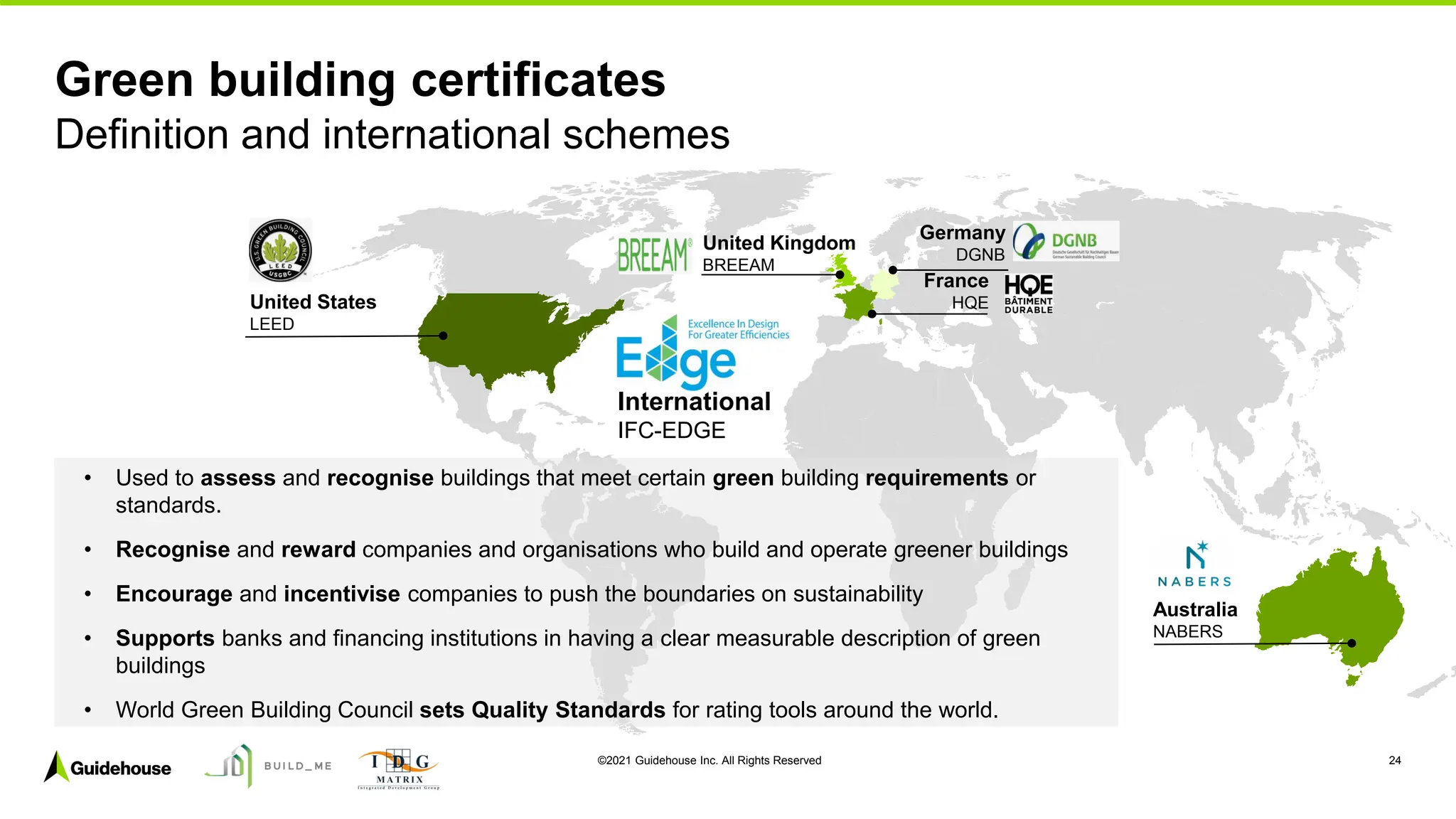
Green building certificates
Definition and international schemes
United States
LEED
Australia
NABERS
Germany
DGNB
France
HQE
United Kingdom
BREEAM
International
IFC-EDGE
• Used to assess and recognise buildings that meet certain green building requirements or
standards.
• Recognise and reward companies and organisations who build and operate greener buildings
• Encourage and incentivise companies to push the boundaries on sustainability
• Supports banks and financing institutions in having a clear measurable description of green
buildings
• World Green Building Council sets Quality Standards for rating tools around the world.
©2021 Guidehouse Inc. All Rights Reserved 25
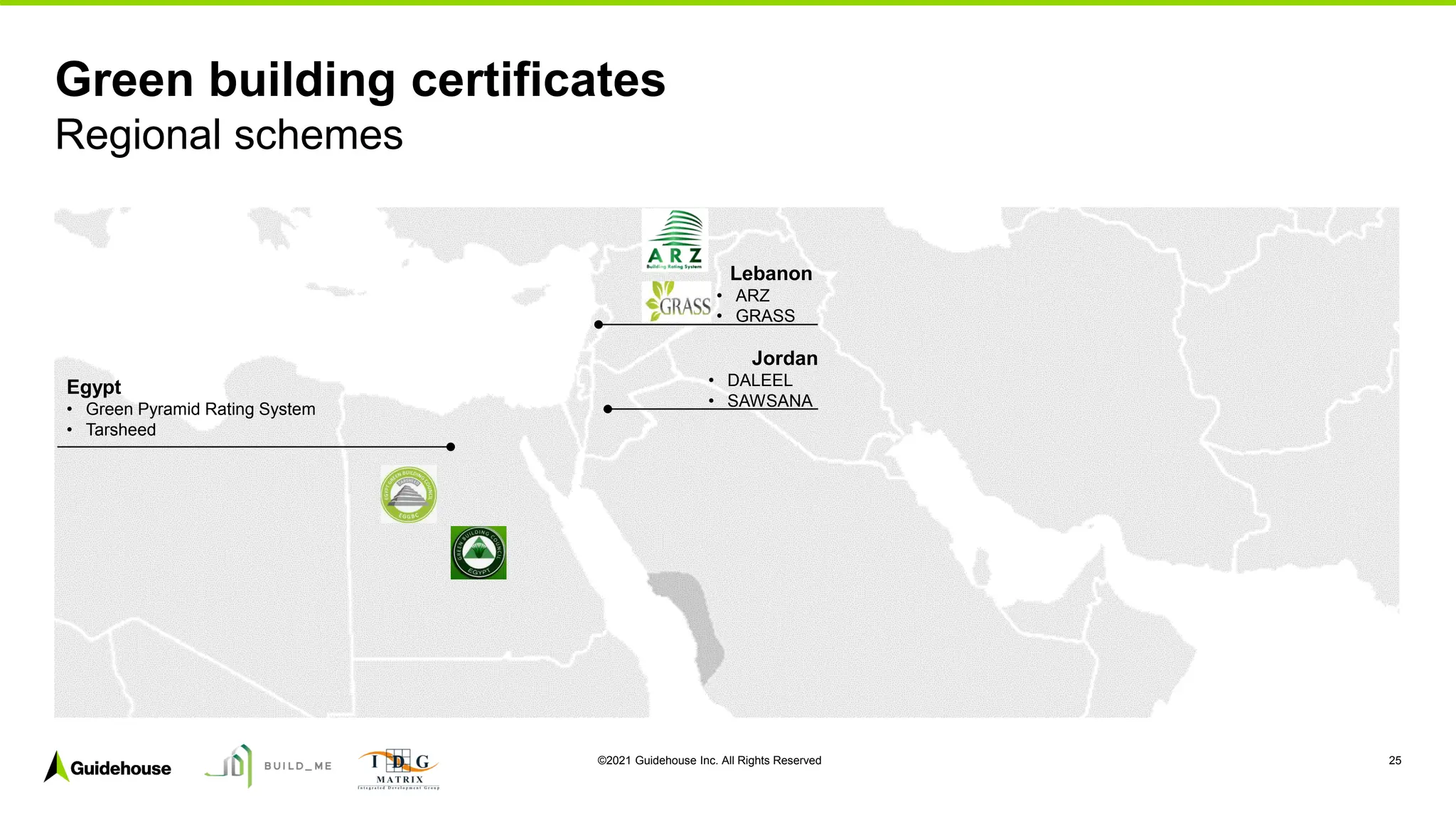
Green building certificates
Regional schemes
Jordan
• DALEEL
• SAWSANA
Lebanon
• ARZ
• GRASS
Egypt
• Green Pyramid Rating System
• Tarsheed
©2021 Guidehouse Inc. All Rights Reserved 26
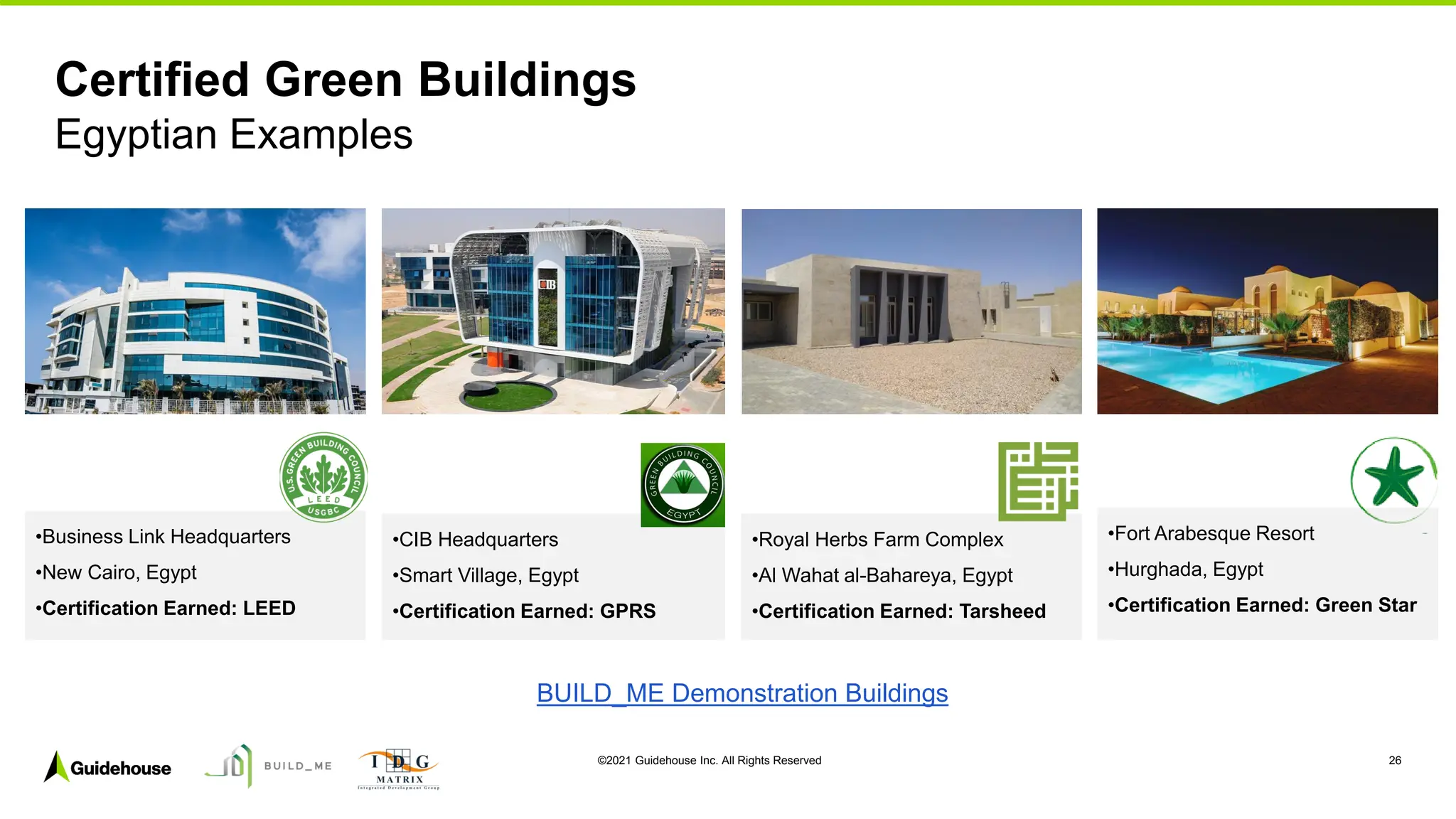
Certified Green Buildings
Egyptian Examples
•Royal Herbs Farm Complex
•Al Wahat al-Bahareya, Egypt
•Certification Earned: Tarsheed
•Business Link Headquarters
•New Cairo, Egypt
•Certification Earned: LEED
•Fort Arabesque Resort
•Hurghada, Egypt
•Certification Earned: Green Star
•CIB Headquarters
•Smart Village, Egypt
•Certification Earned: GPRS
BUILD_ME Demonstration Buildings
©2021 Guidehouse Inc. All Rights Reserved 27
Discussion
What other rated building have you participated in designing,
constructing or know of? What obstacles did you face?
Share your ideas & experiences
BUILD_ME Demonstration Buildings
©2021 Guidehouse Inc. All Rights Reserved 28
Conclusion
Understand the big picture
• Global Warming is causing
tremendous environmental stress
• EE/RE huge economic and social
potential
Familiarity with common
definitions and terminology
• Boundary conditions like climate
and economic parameters (energy
costs, CAPEX) influences the
feasibility of low energy buildings
Introduce building energy
levels and sustainable
certifications
• Several international sustainable
certification schemes exist, but all
BUILD_ME countries have as well
national schemes in operation
©2021 Guidehouse Inc. All Rights Reserved 29
Questions
Bild
von
PIRO4D
auf
Pixabay
©2021 Guidehouse Inc. All Rights Reserved 30
Policy instruments
for climate-friendly
buildings
MaiAdel, IDG
Photo
by
Lukas
Blazek
on
Unsplash
20 minutes
©2021 Guidehouse Inc. All Rights Reserved 31
Key take-aways 2 – Policy instruments session
Diversity of possible
instruments
Principles of policy instrument
formulation
©2021 Guidehouse Inc. All Rights Reserved 32
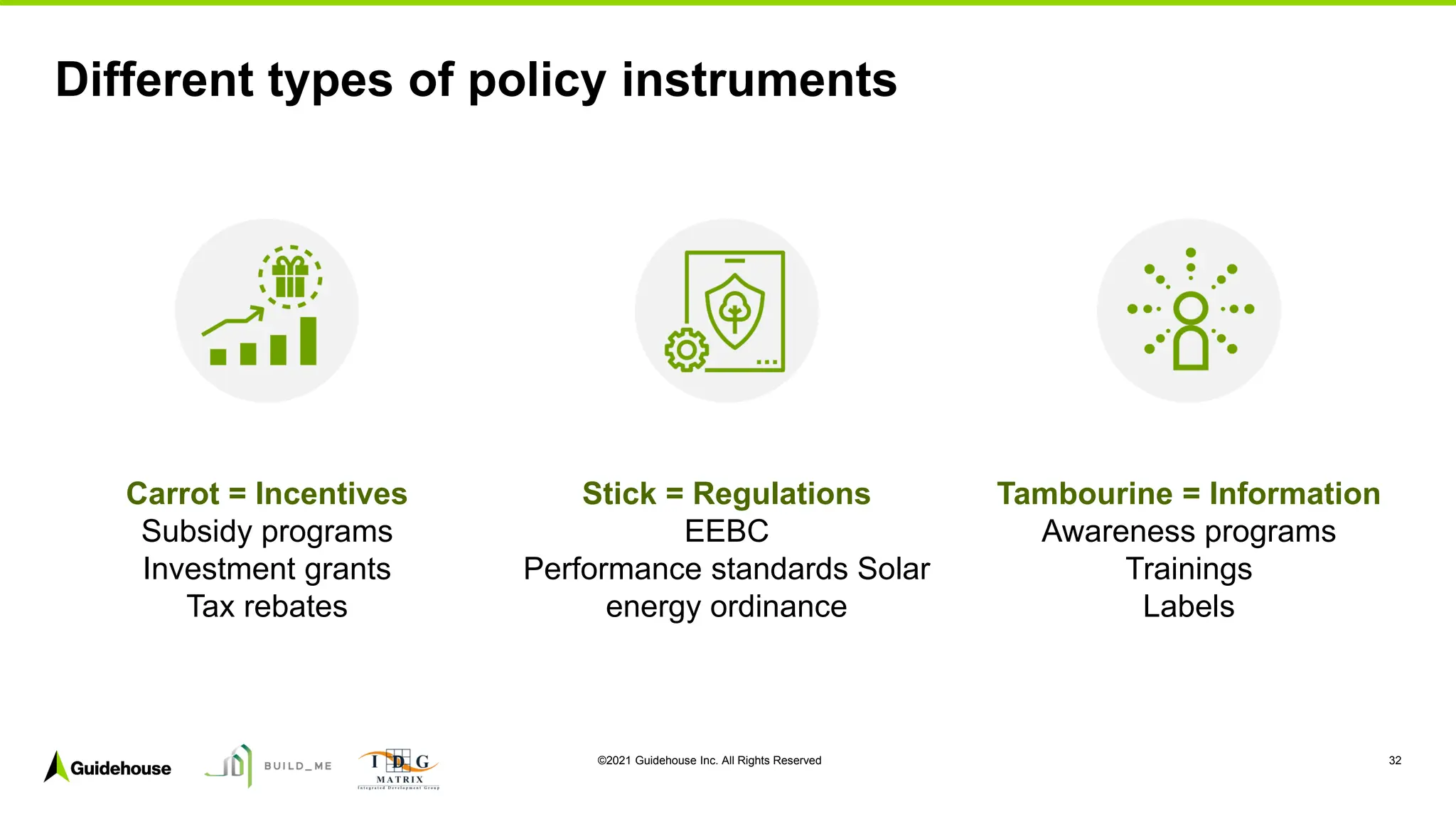
Different types of policy instruments
Carrot = Incentives
Subsidy programs
Investment grants
Tax rebates
Stick = Regulations
EEBC
Performance standards Solar
energy ordinance
Tambourine = Information
Awareness programs
Trainings
Labels
©2021 Guidehouse Inc. All Rights Reserved 33
Carrot = Incentives
Instrument Features and characteristics Status
Soft loans • Soft loans are loans offered at subsidised interest rates (i.e. lower than the market rate) to
consumers who invest in energy efficient technologies
• Implemented by banking institutions
- CIB Bank solar
loan (RE)
- QNB Bank green
loan (RE)
Investment
grants
• A financial award to facilitate a goal or incentivise performance
• Do not have to be paid back under most conditions
• Some have waiting periods before the grantee can take full ownership of the financial reward
- EBRD / GEFF
Tax rebates • Amount of money that project developers can subtract directly from the income taxes that
they owe
• Tax credits are more favourable than tax deductions because they actually reduce the tax
due, not just the amount of taxable income
• Three basic types of tax credits: non-refundable, refundable, and partially refundable
- Tax reduction in
the energy sector
(Amendment to
law no. 72)
Source: Invstopedia
©2021 Guidehouse Inc. All Rights Reserved 34
Stick = Regulations
Instrument Features and characteristics Status
Energy Efficiency
Building Codes
Building standards can be classified in four categories:
1. Maximum heat transfer through individual building components (e.g. walls, roof, windows)
2. Limit on the overall heat transfer through the building envelope
3. Limitation of heating/cooling demand (taking into account the contribution from ventilation
losses, passive solar gains and internal heat sources (maximum demand per m3 or m2).
4. Energy performance standards
EERBC in
2005
EECBC in
2009
Minimum energy
performance
standards
These standards consider the whole building as a system and also include building equipment
such as heating and air conditioning systems, ventilation, water heaters, and in some countries
even pumps and elevators
MEPS are
mandatory
(last update in
2018)
Solar Thermal
Ordinance
Regulate the incorporation of solar thermal energy and its use for the production of sanitary hot
water in the city’s buildings
Many of existing STOs are related to national or regional energy laws and implemented
through municipal building codes
---
©2021 Guidehouse Inc. All Rights Reserved 35
Energy Efficiency Building Codes – Egypt
Stick = Regulations
Energy Efficiency
Residential Buildings
Code (EERBC)
Energy Efficiency
Commercial Buildings
Code (EECBC)
©2021 Guidehouse Inc. All Rights Reserved 36
Instrument Features and characteristics
Awareness raising programmes • Methods for monitoring energy consumption and possible energy savings
• Demonstrate that there are proven technologies, methods and services that can
substantially and cost-effectively reduce energy consumption
Building energy certificates • Mandatory / Voluntary
• Enable the buyer to obtain information about the energy
consumption of the dwelling they are going to buy or rent
Trainings • Capacity building programs, training courses
• Develop culture of literacy in energy efficiency
Tambourine = Information
©2021 Guidehouse Inc. All Rights Reserved 37
Energy Performance Certificate Example
Tambourine= Information
• S: https://selfbuild.ie/advice/basics/energy-ratings/
©2021 Guidehouse Inc. All Rights Reserved 38
Discussion
Which instrument do you consider as the best starting point for
boosting the transformation to climate-friendly buildings?
Share your ideas
©2021 Guidehouse Inc. All Rights Reserved 39
Conclusion
Diversity of possible
instruments
Selection requires national/regional
adaptation
Principles of policy instrument
formulation
Carrot, Stick and Tambourine
principle
©2021 Guidehouse Inc. All Rights Reserved 40
Questions
Bild
von
PIRO4D
auf
Pixabay
©2021 Guidehouse Inc. All Rights Reserved 41
Coffee break
Photo
by
Fahmi
Fakhrudin
on
Unsplash
©2021 Guidehouse Inc. All Rights Reserved 42
Climate-friendly
buildings from a
technology
perspective
Marian Nessim, HBRC
Photo
by
Lukas
Blazek
on
Unsplash
50 minutes
©2021 Guidehouse Inc. All Rights Reserved 43
Principles of a holistic planning
Key Learnings
Measures to reduce energy consumption
Renewable energy measures
Cost efficiency measures
©2021 Guidehouse Inc. All Rights Reserved 44
General principles to conceive a low energy building
Embed Trias energetica, „The most sustainable energy is saved energy“
BUILD_ME Project
Manage
operations
Use fossil
fuels
efficiently
Use
renewable
energies
Reduce
energy
demand
Holistic
planning
©2021 Guidehouse Inc. All Rights Reserved 45
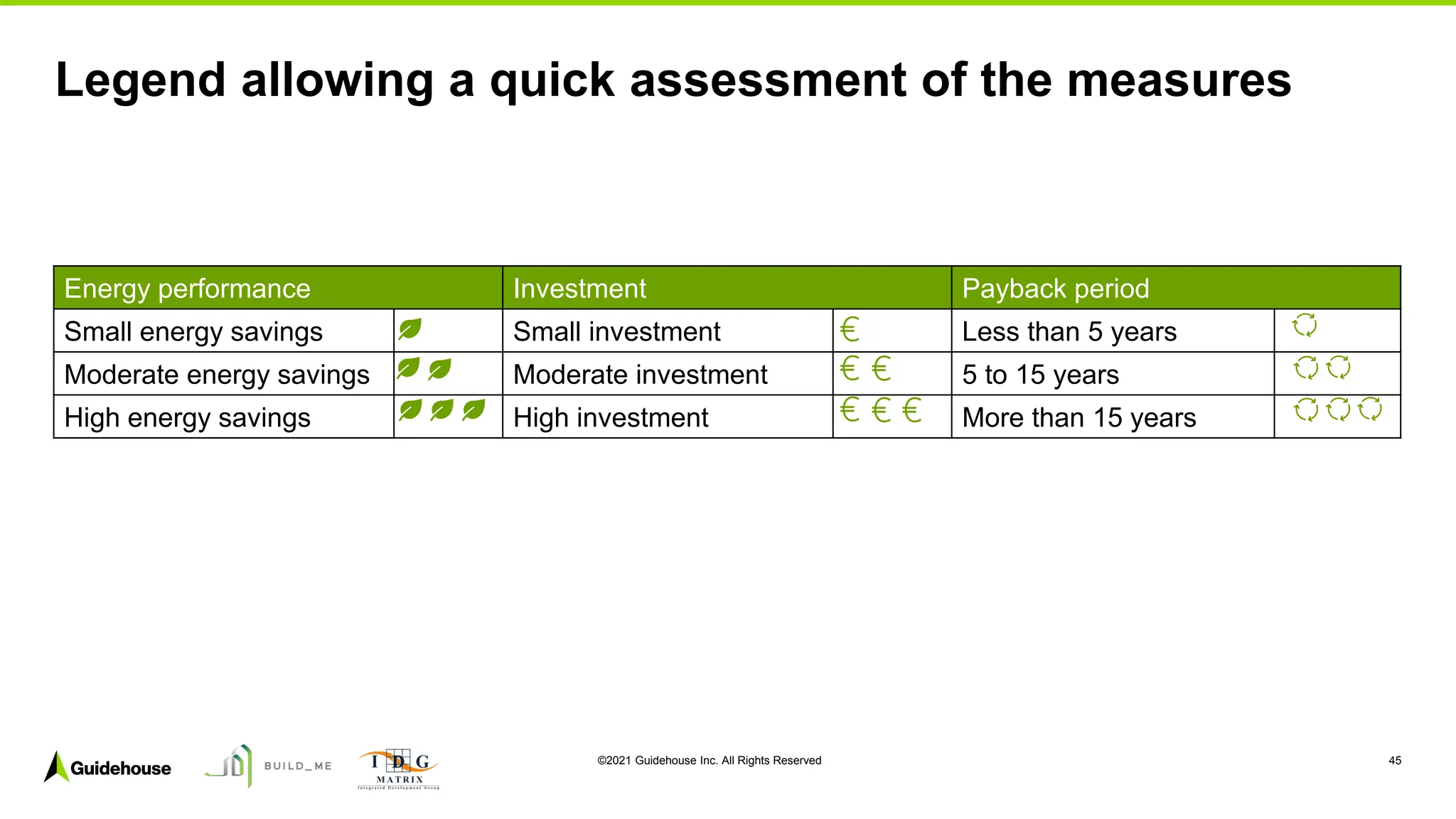
Energy performance Investment Payback period
Small energy savings Small investment Less than 5 years
Moderate energy savings Moderate investment 5 to 15 years
High energy savings High investment More than 15 years
Legend allowing a quick assessment of the measures
©2021 Guidehouse Inc. All Rights Reserved 46
Step 1: Holistic planning
Source.
https://unsplash.com/photos/KqEYj1VHA_o
©2021 Guidehouse Inc. All Rights Reserved 47
Influence of design decisions on life cycle impacts and
costs
Source: Kohler & Moffatt, 2003
©2021 Guidehouse Inc. All Rights Reserved 48
Step 2: Reduce energy demand (Passive)
Source:
https://unsplash.com/photos/0MKzwPmehRE
©2021 Guidehouse Inc. All Rights Reserved 49
Energy Consumption in Egypt
• Egyptian Electricity Holding Company annual report 2018-2019
• New and Renewable Energy Authority annual report 2020
©2021 Guidehouse Inc. All Rights Reserved 50
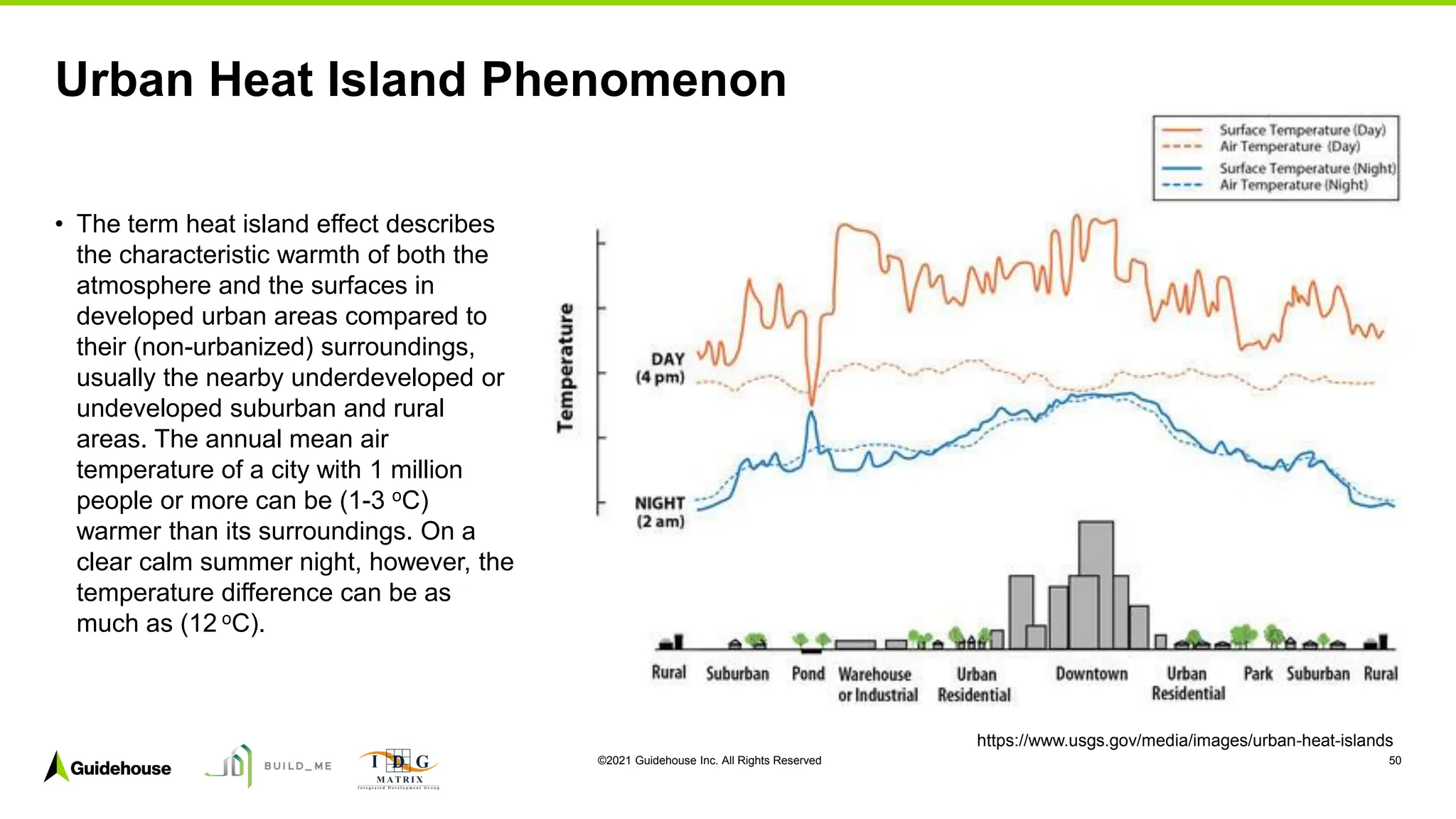
Urban Heat Island Phenomenon
• The term heat island effect describes
the characteristic warmth of both the
atmosphere and the surfaces in
developed urban areas compared to
their (non-urbanized) surroundings,
usually the nearby underdeveloped or
undeveloped suburban and rural
areas. The annual mean air
temperature of a city with 1 million
people or more can be (1-3 oC)
warmer than its surroundings. On a
clear calm summer night, however, the
temperature difference can be as
much as (12 oC).
https://www.usgs.gov/media/images/urban-heat-islands
©2021 Guidehouse Inc. All Rights Reserved 51
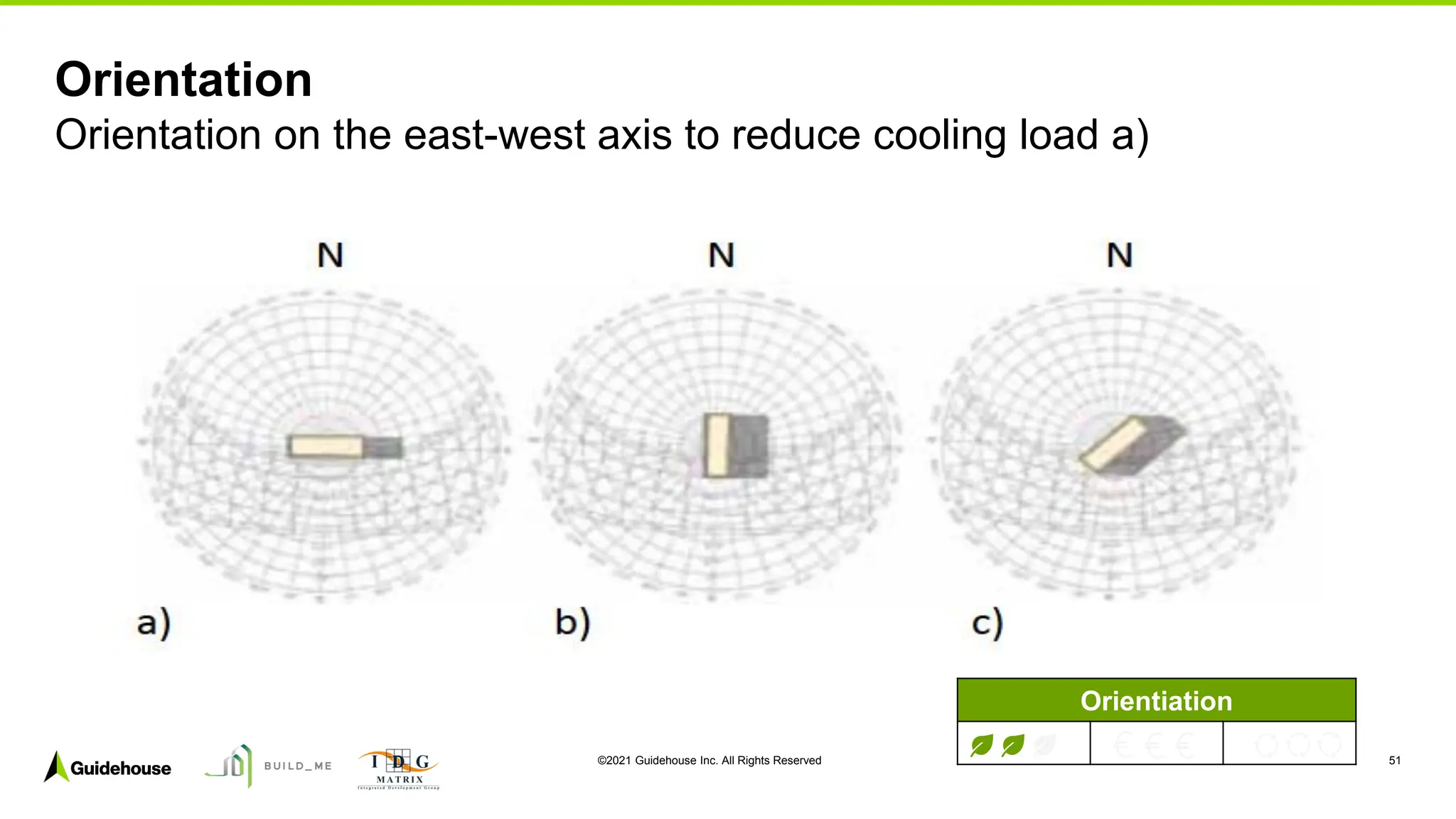
Orientation
Orientation on the east-west axis to reduce cooling load a)
Orientiation
©2021 Guidehouse Inc. All Rights Reserved 52
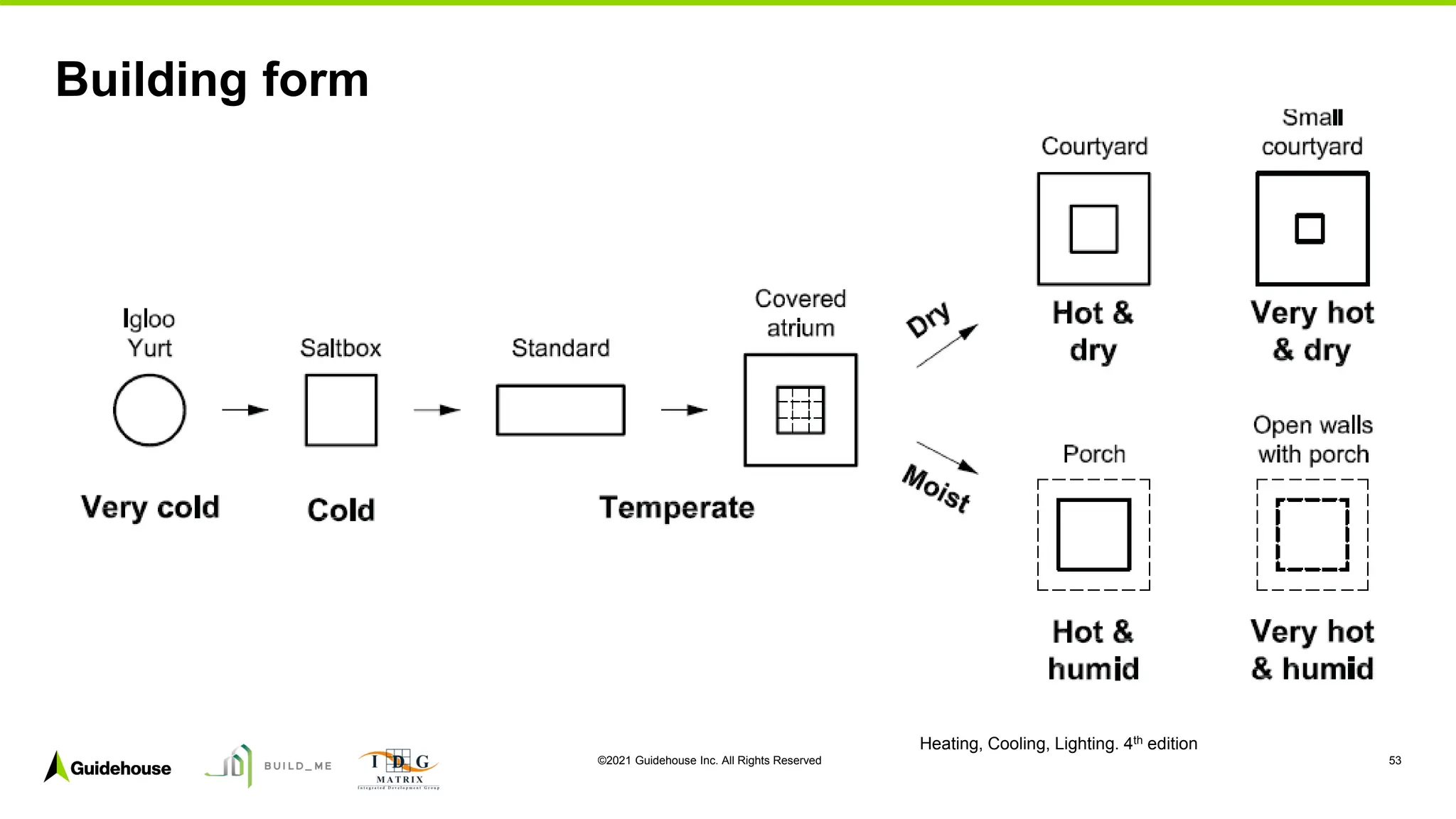
Building form and typology
Compact building form has a lower surface/volume ratio (S/V)
BUILD_ME Project
Building form and typology
©2021 Guidehouse Inc. All Rights Reserved 53
Building form
Heating, Cooling, Lighting. 4th edition
©2021 Guidehouse Inc. All Rights Reserved 54
Landscape design
Use vegetation for a better microclimate, shading, thermal mass
Landscape design
©2021 Guidehouse Inc. All Rights Reserved 55
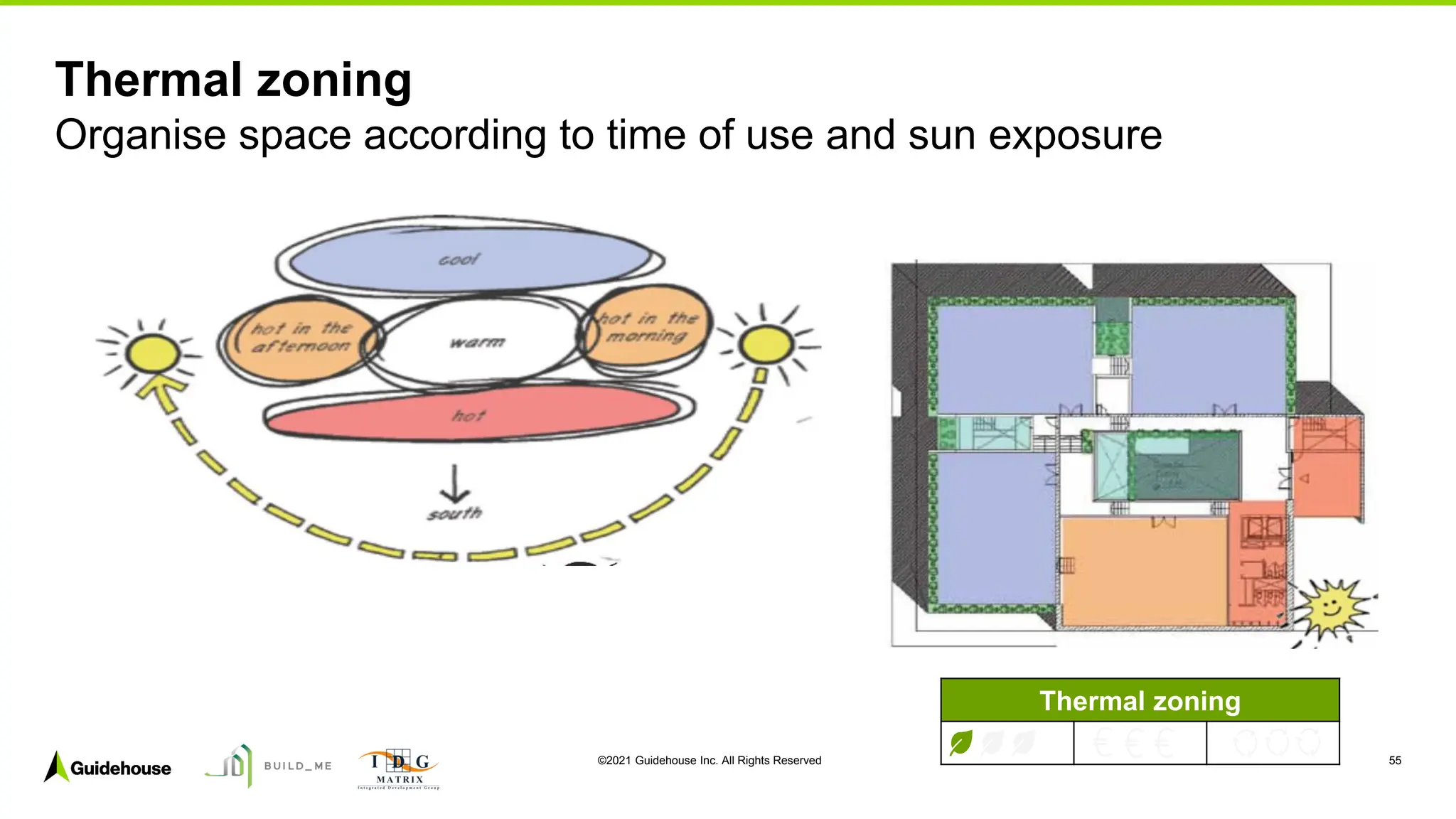
Thermal zoning
Organise space according to time of use and sun exposure
Thermal zoning
©2021 Guidehouse Inc. All Rights Reserved 56
Window Wall Ratio [WWR]
Natural Lighting
Windows and their ratio
Heating, Cooling, Lighting. 4th edition
Energy Efficient Building Guidelines for MENA region
©2021 Guidehouse Inc. All Rights Reserved 57
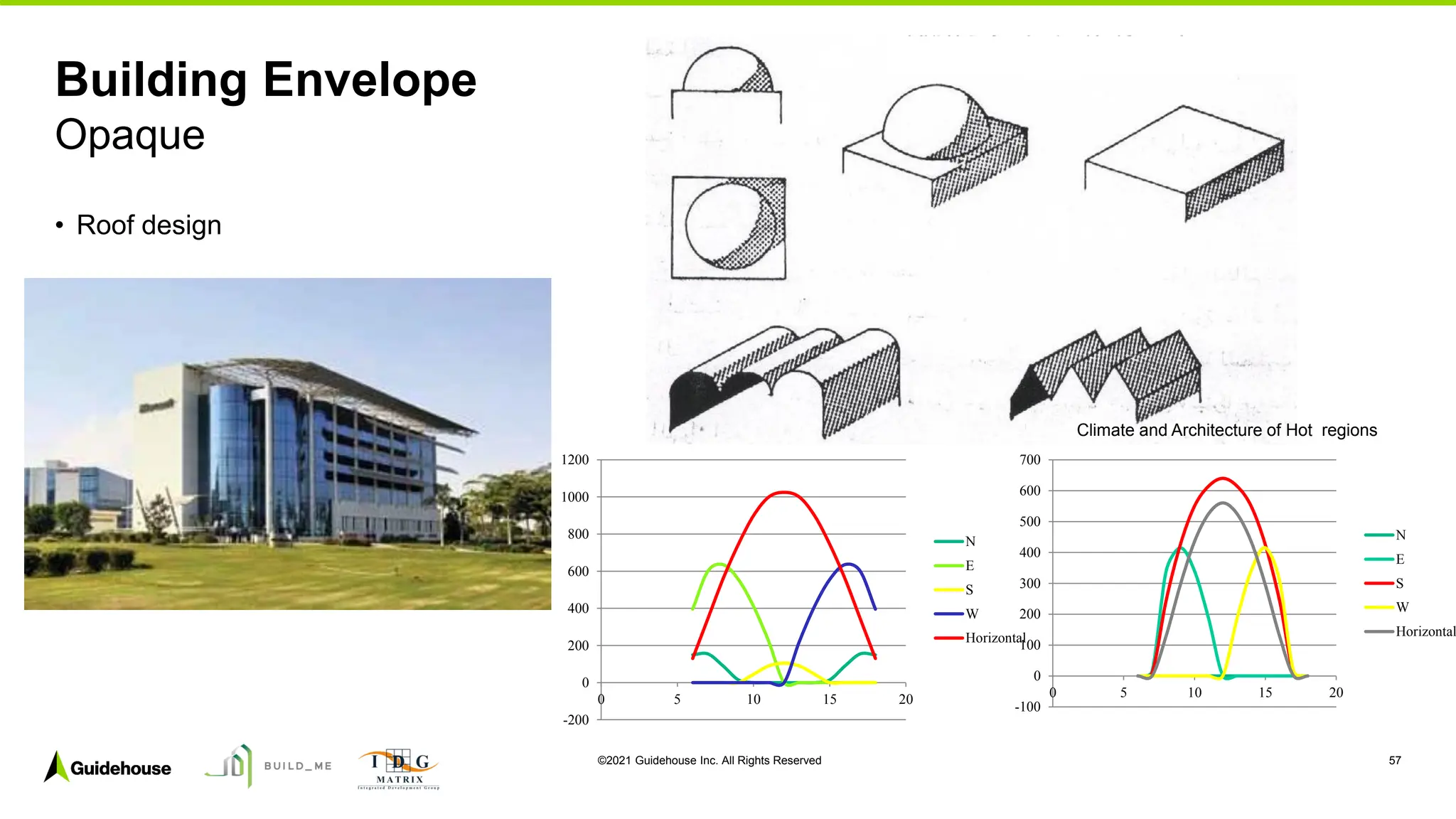
• Roof design
Building Envelope
Opaque
-200
0
200
400
600
800
1000
1200
0 5 10 15 20
N
E
S
W
Horizontal
-100
0
100
200
300
400
500
600
700
0 5 10 15 20
N
E
S
W
Horizontal
Climate and Architecture of Hot regions
©2021 Guidehouse Inc. All Rights Reserved 58
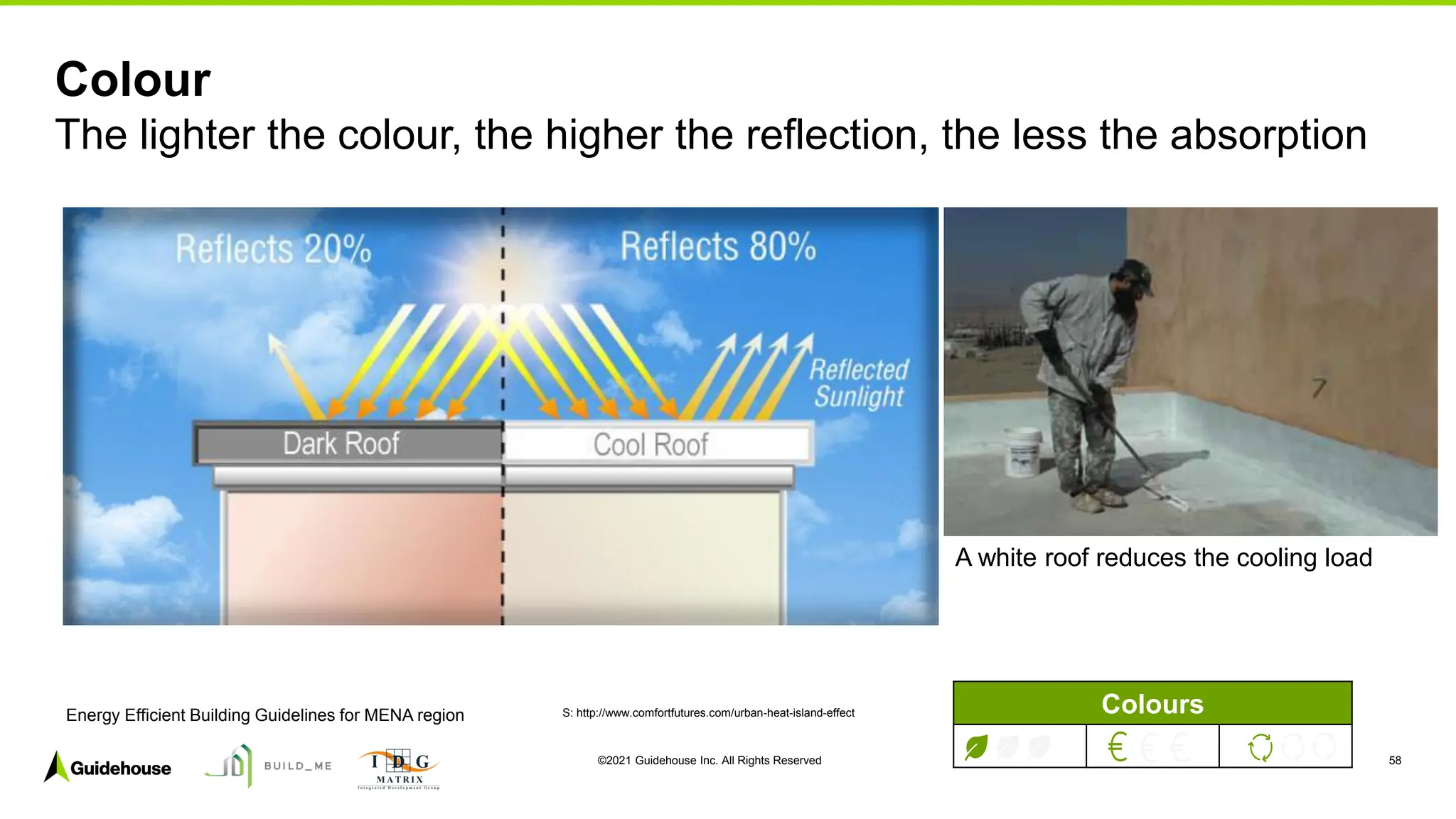
Colour
The lighter the colour, the higher the reflection, the less the absorption
S: http://www.comfortfutures.com/urban-heat-island-effect Colours
A white roof reduces the cooling load
Energy Efficient Building Guidelines for MENA region
©2021 Guidehouse Inc. All Rights Reserved 59
Material Selection
Thermal insulation
Thermal insulation
©2021 Guidehouse Inc. All Rights Reserved 60
Material Selection
Regular Block, U=5.55 W/m2K
Volcanic aggregate,
U=3.13 W/ K
Perlite aggregate,
U=2.00 W/m2K
Concrete block with different U-values (the lower,
the better)
Cavity wall with 3cm polystyrene insulation in
Jordan
Energy Efficient Building Guidelines for MENA region
©2021 Guidehouse Inc. All Rights Reserved 61
Material Selection
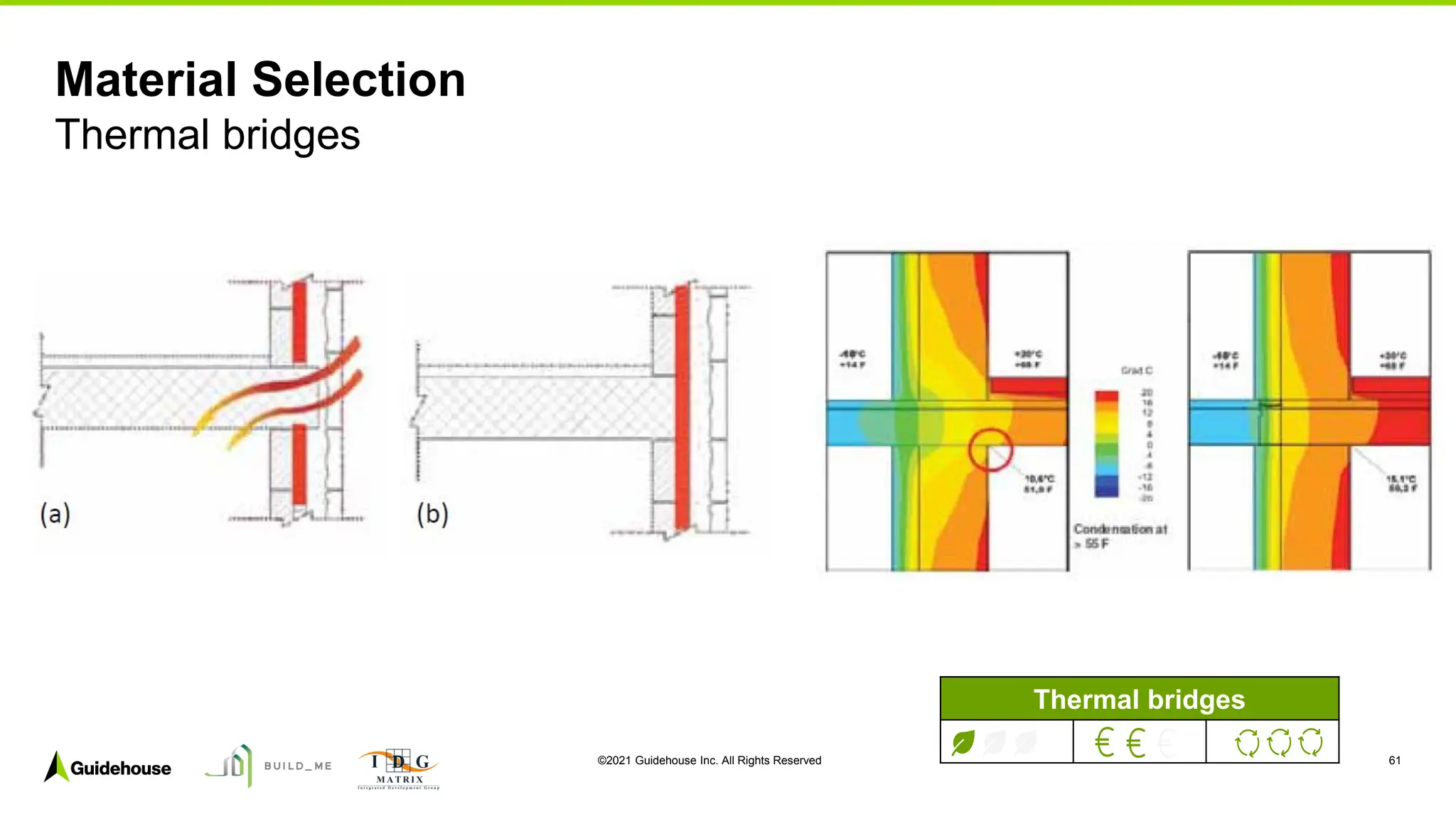
Thermal bridges
Thermal bridges
©2021 Guidehouse Inc. All Rights Reserved 62
Building Envelope
Transparent
Absorbing glass: 6mm Reflecting glass & clear glass: 6mm
Double glazing: effective to
reduce the cooling load
Energy Efficient Building Guidelines for MENA region
©2021 Guidehouse Inc. All Rights Reserved 63
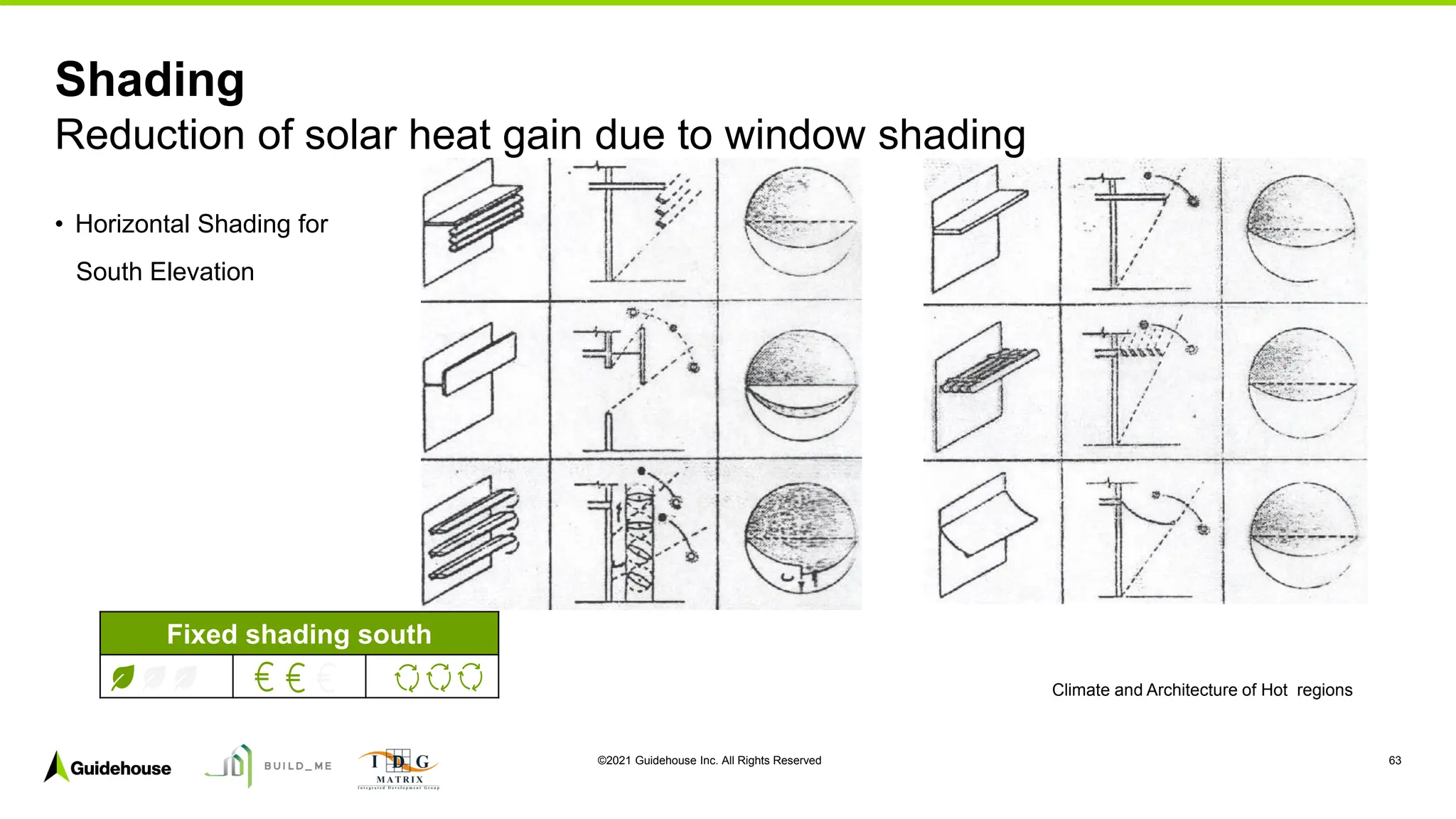
Shading
Reduction of solar heat gain due to window shading
Fixed shading south
• Horizontal Shading for
South Elevation
Climate and Architecture of Hot regions
©2021 Guidehouse Inc. All Rights Reserved 64
• Vertical Shading for East and
West Elevations
• Egg crate for South East and
South West Elevations
Movable Shading east/west
Climate and Architecture of Hot regions
Shading
©2021 Guidehouse Inc. All Rights Reserved 65
Material selection
Air tightness – avoid leakages (Infiltration)
Air tightness
©2021 Guidehouse Inc. All Rights Reserved 66
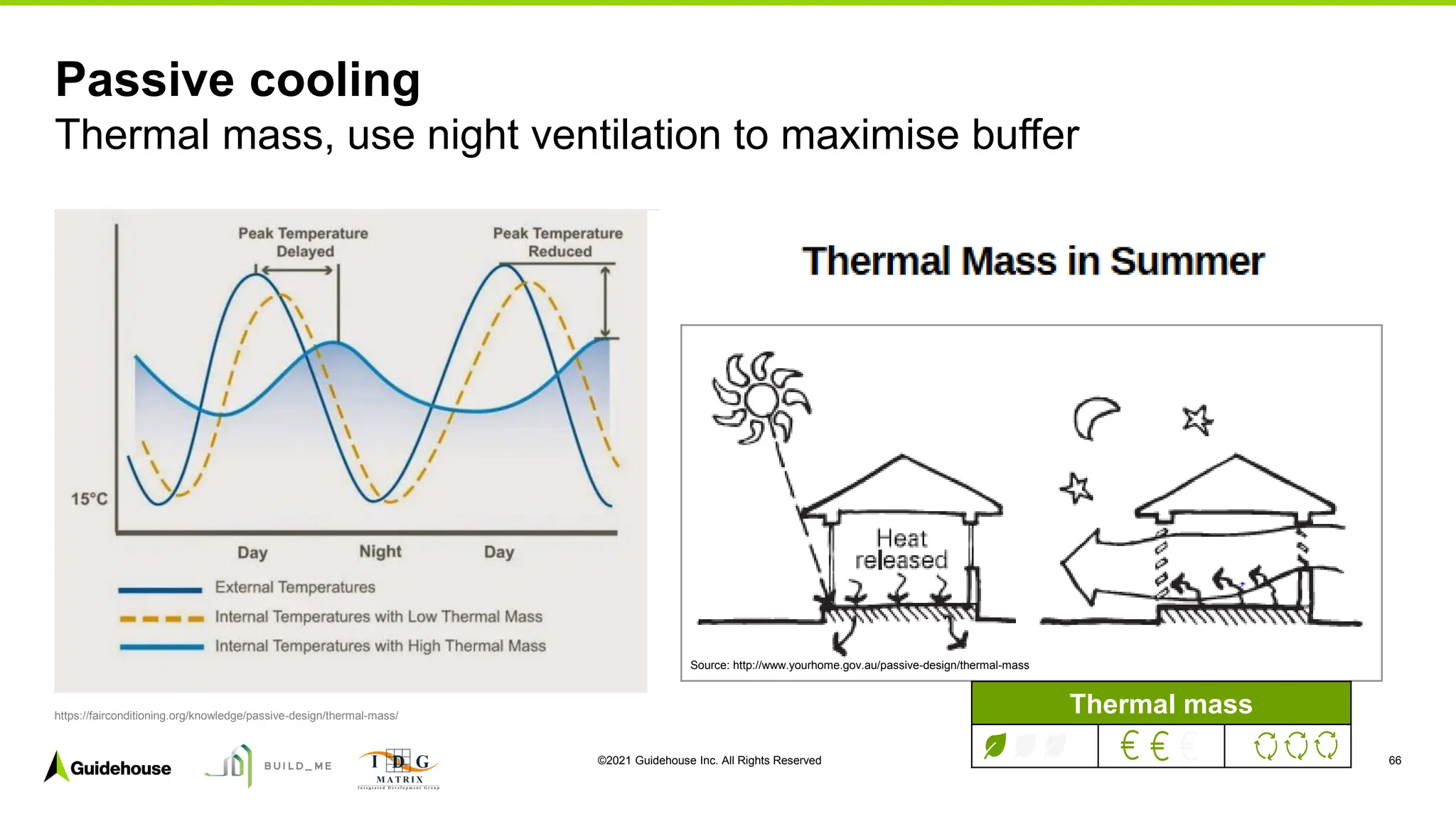
Passive cooling
Thermal mass, use night ventilation to maximise buffer
https://fairconditioning.org/knowledge/passive-design/thermal-mass/
Source: http://www.yourhome.gov.au/passive-design/thermal-mass
Thermal mass
©2021 Guidehouse Inc. All Rights Reserved 67
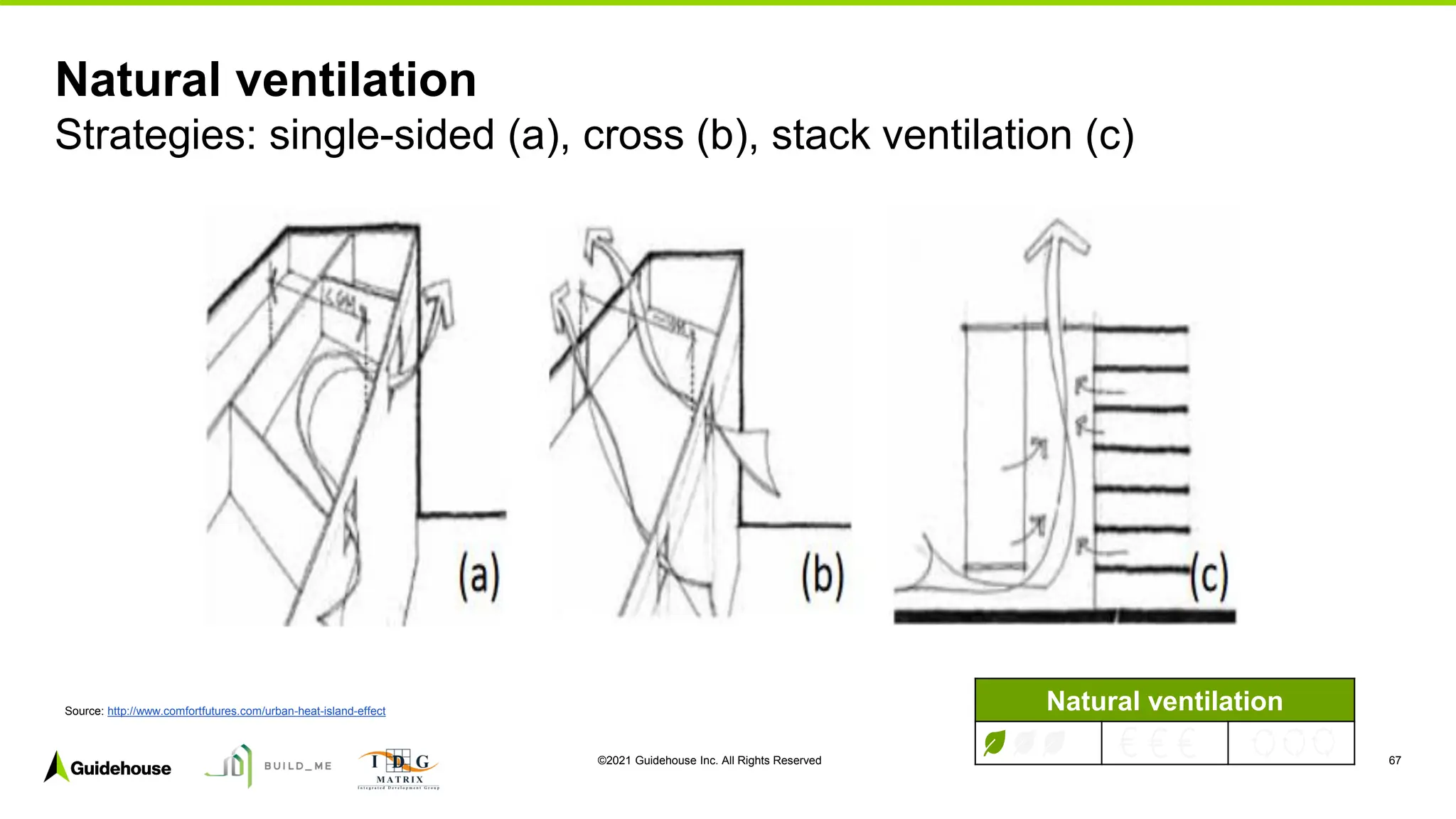
Natural ventilation
Strategies: single-sided (a), cross (b), stack ventilation (c)
Source: http://www.comfortfutures.com/urban-heat-island-effect Natural ventilation
©2021 Guidehouse Inc. All Rights Reserved 68
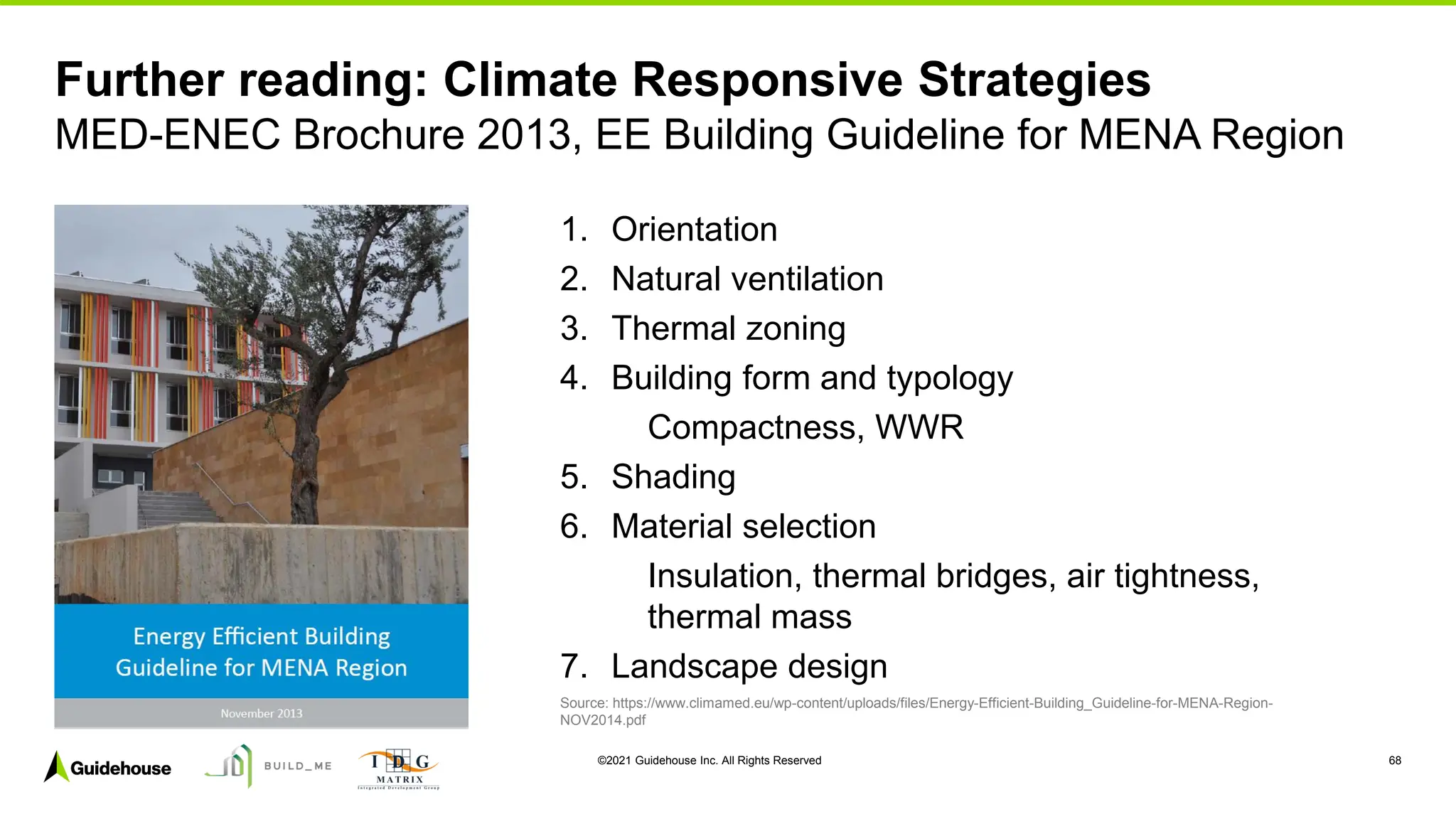
1. Orientation
2. Natural ventilation
3. Thermal zoning
4. Building form and typology
Compactness, WWR
5. Shading
6. Material selection
Insulation, thermal bridges, air tightness,
thermal mass
7. Landscape design
Source: https://www.climamed.eu/wp-content/uploads/files/Energy-Efficient-Building_Guideline-for-MENA-Region-
NOV2014.pdf
Further reading: Climate Responsive Strategies
MED-ENEC Brochure 2013, EE Building Guideline for MENA Region
©2021 Guidehouse Inc. All Rights Reserved 69
Discussion
Which of these measures did you use in your projects/designs? What
tools do you use to evaluate the suitability of the measures?
Share your ideas & experiences
©2021 Guidehouse Inc. All Rights Reserved 70
Step 3: Integrate renewable energies
Source. https://unsplash.com/photos/BB0mMC8y0Pc
©2021 Guidehouse Inc. All Rights Reserved 71
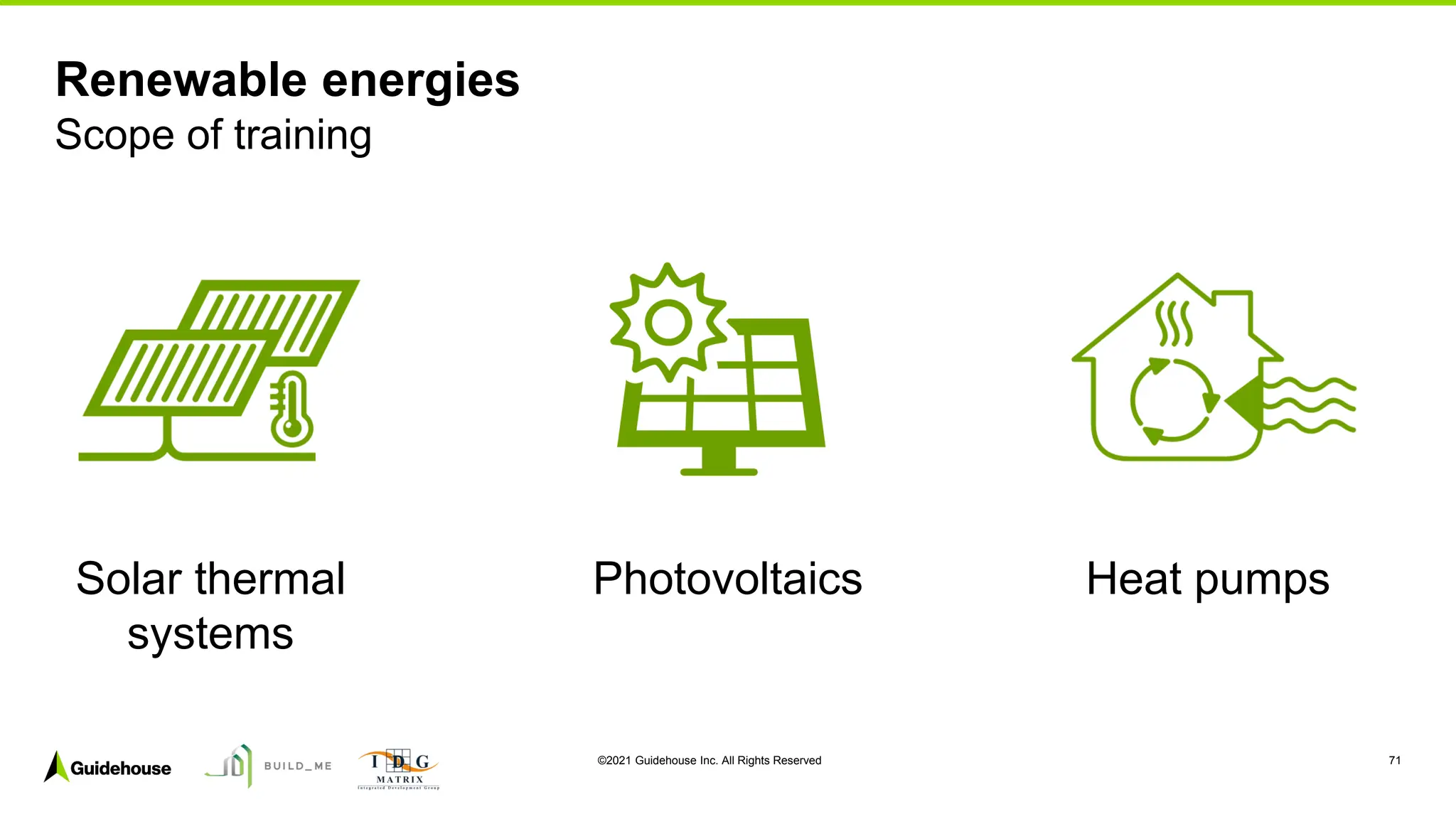
Renewable energies
Scope of training
Photovoltaics Heat pumps
Solar thermal
systems
©2021 Guidehouse Inc. All Rights Reserved 72
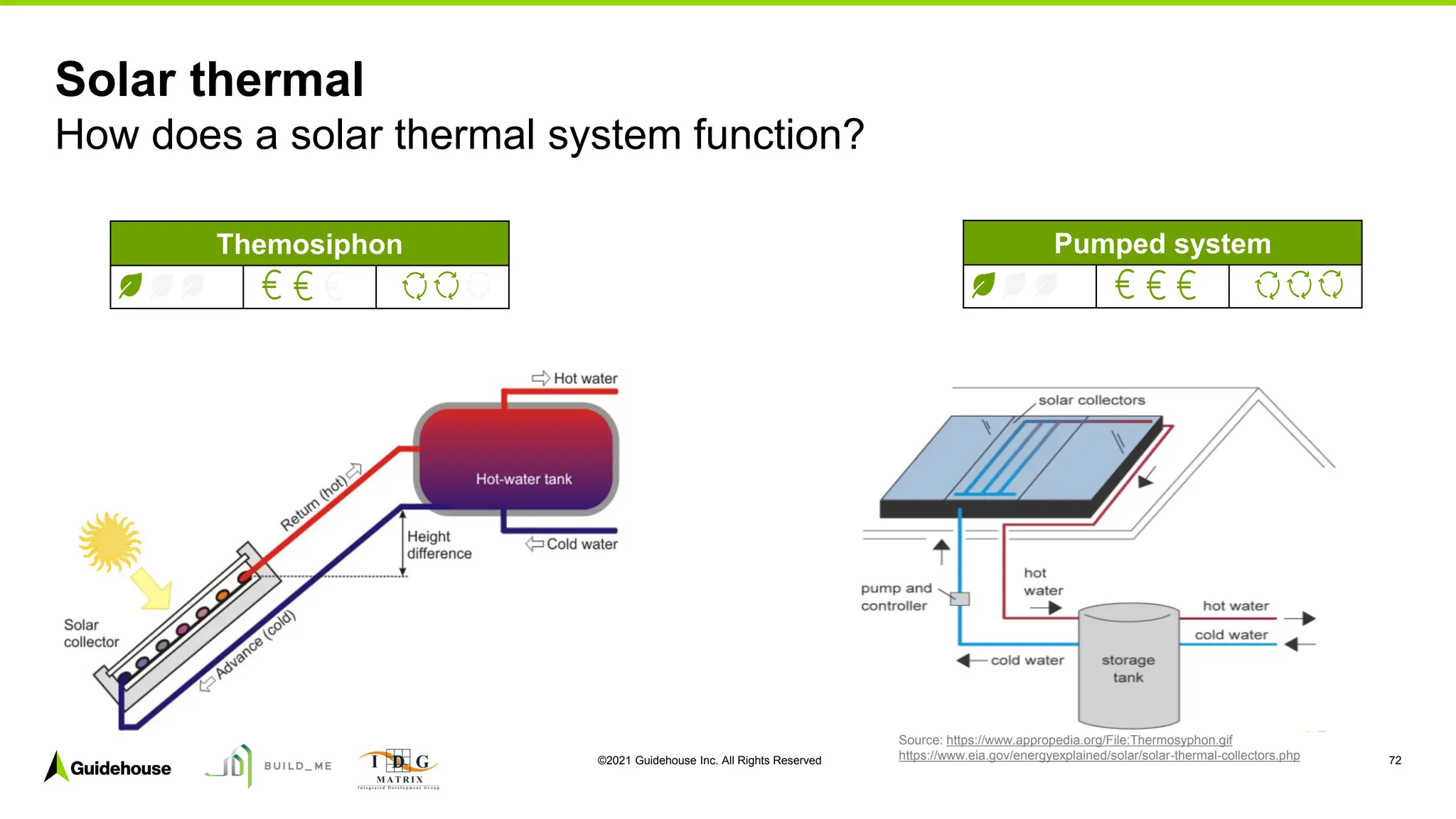
Solar thermal
How does a solar thermal system function?
Source: https://www.appropedia.org/File:Thermosyphon.gif
https://www.eia.gov/energyexplained/solar/solar-thermal-collectors.php
Themosiphon Pumped system
©2021 Guidehouse Inc. All Rights Reserved 73
Collectors types
Source: http://www.windupbattery.com/energy/solar/heating-panels-components.htm
Simple absorbers Flat plate collectors Vacuum collectors
©2021 Guidehouse Inc. All Rights Reserved 74
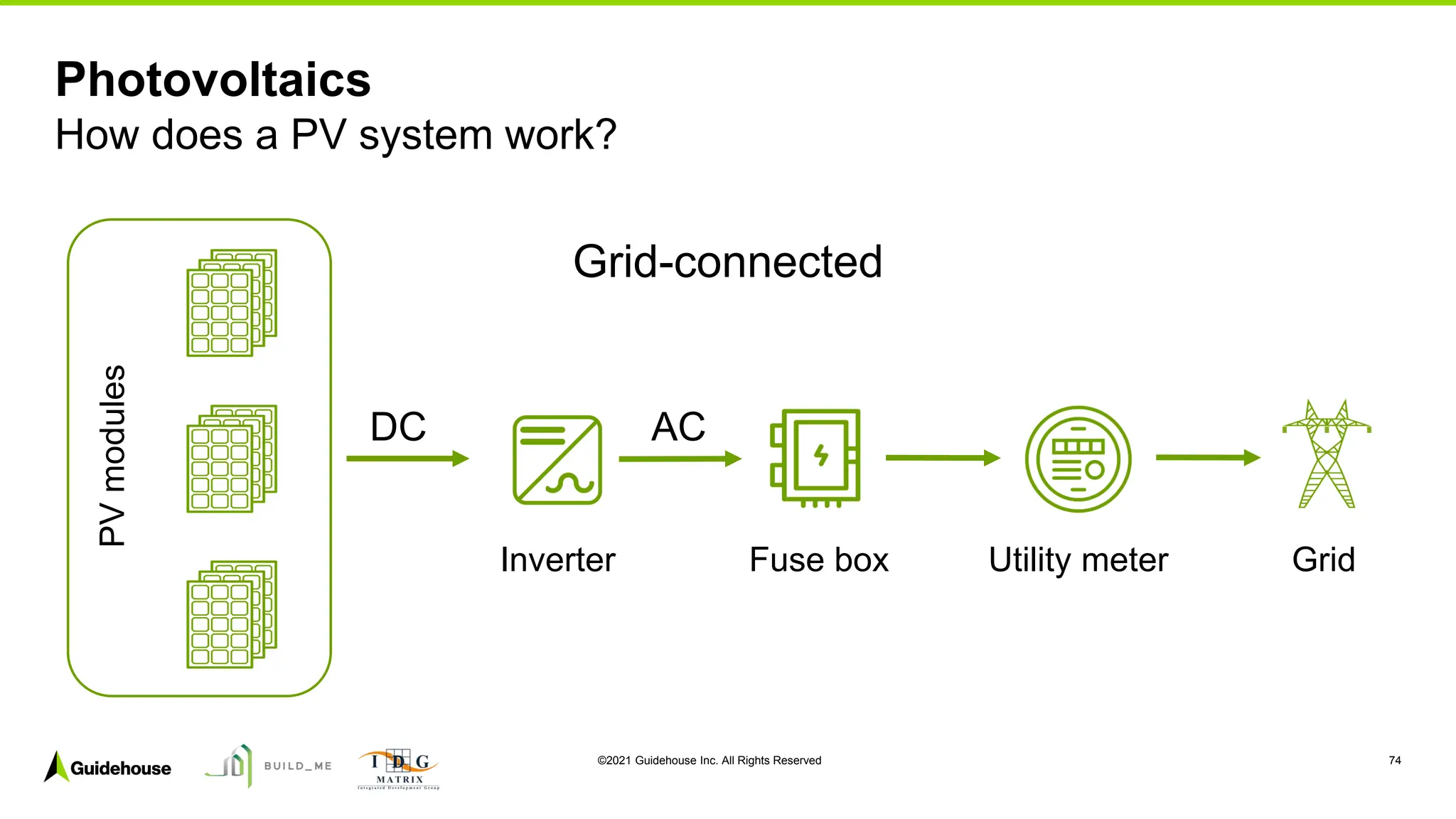
Photovoltaics
How does a PV system work?
Fuse box
Inverter
DC
PV
modules
AC
Grid
Utility meter
Grid-connected
©2021 Guidehouse Inc. All Rights Reserved 75
Photovoltaics
How does a PV system work?
Fuse box
Inverter
DC AC
Stand-alone
PV module
Battery
charger
DC
Storage system
Load centre
©2021 Guidehouse Inc. All Rights Reserved 76
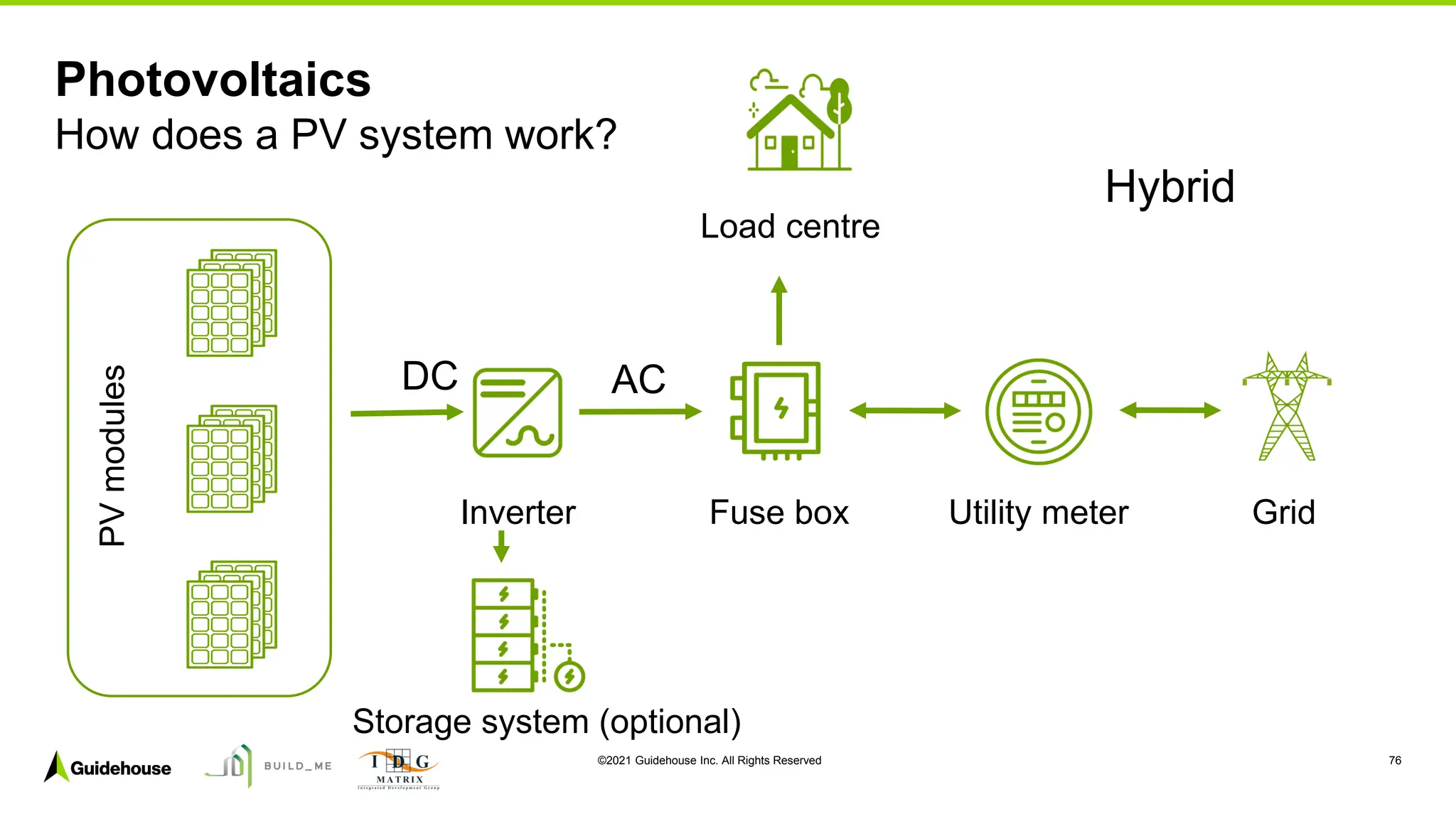
Photovoltaics
How does a PV system work?
Fuse box
Inverter
PV
modules
AC
Grid
Utility meter
Hybrid
Storage system (optional)
DC
Load centre
©2021 Guidehouse Inc. All Rights Reserved 77
Photovoltaics
Overview of technology/modules
14 – 18% Eff.
18 – 22% Eff.
Source:https://www.solarquotes.com.au/panels/ph
otovoltaic/monocrystalline-vs-polycrystalline/
10 – 16% Eff.
Mono-crystalline Poly-crystalline Thin films
©2021 Guidehouse Inc. All Rights Reserved 78
Photovoltaics
Conclusion
Visible technology also supports marketing of the building asset
Sharp cost reductions make PV cost-efficient
High solar radiation in the MENA region
©2021 Guidehouse Inc. All Rights Reserved 79
Source : https://www.ehpa.org/technology/
Heat pump
How does a heat pump work?
©2021 Guidehouse Inc. All Rights Reserved 80
Heat pump examples
Source: air Source: water
Source: https://www.ehpa.org/
©2021 Guidehouse Inc. All Rights Reserved 81
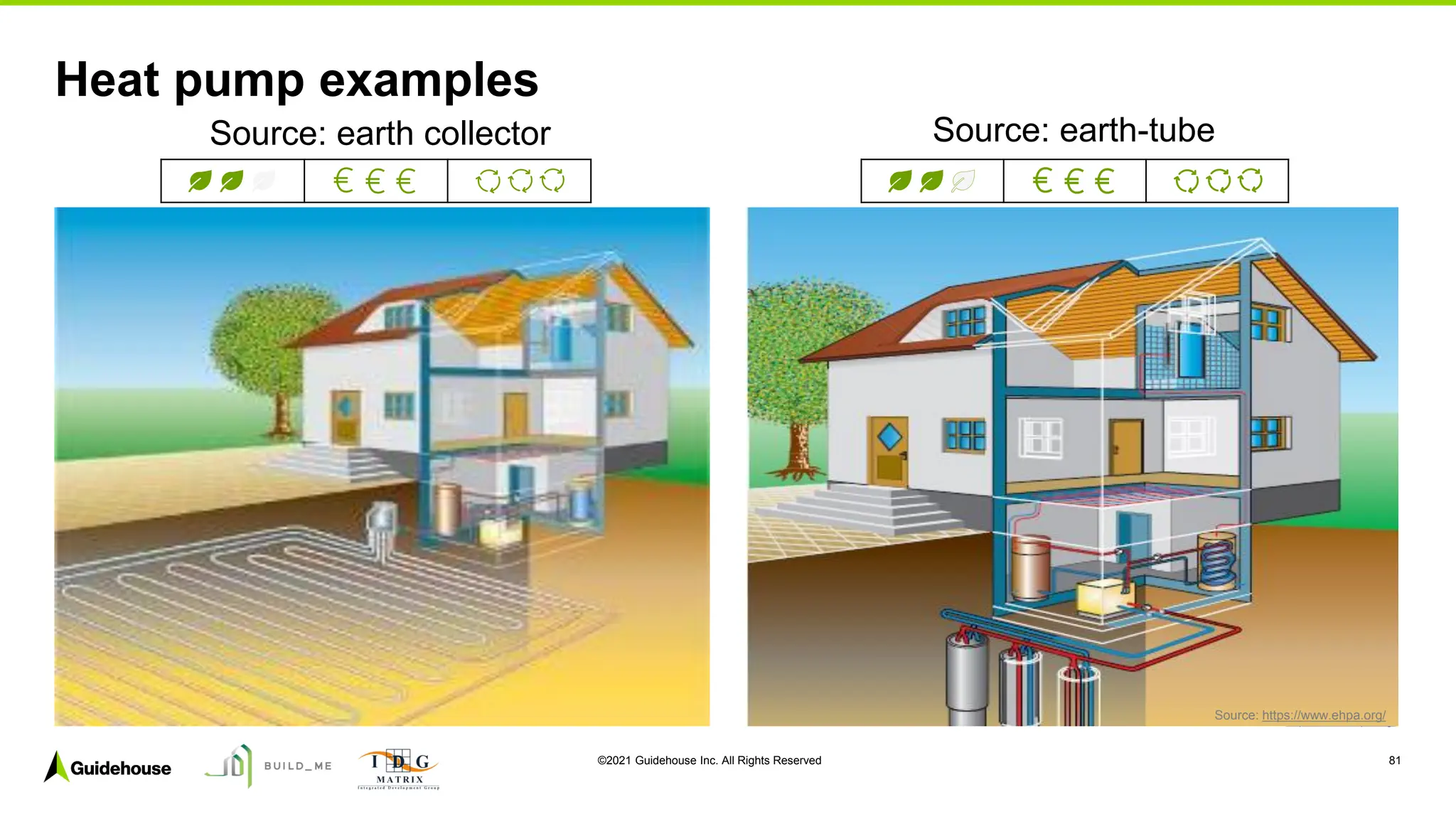
Heat pump examples
Source: earth collector Source: earth-tube
Source: https://www.ehpa.org/
©2021 Guidehouse Inc. All Rights Reserved 82
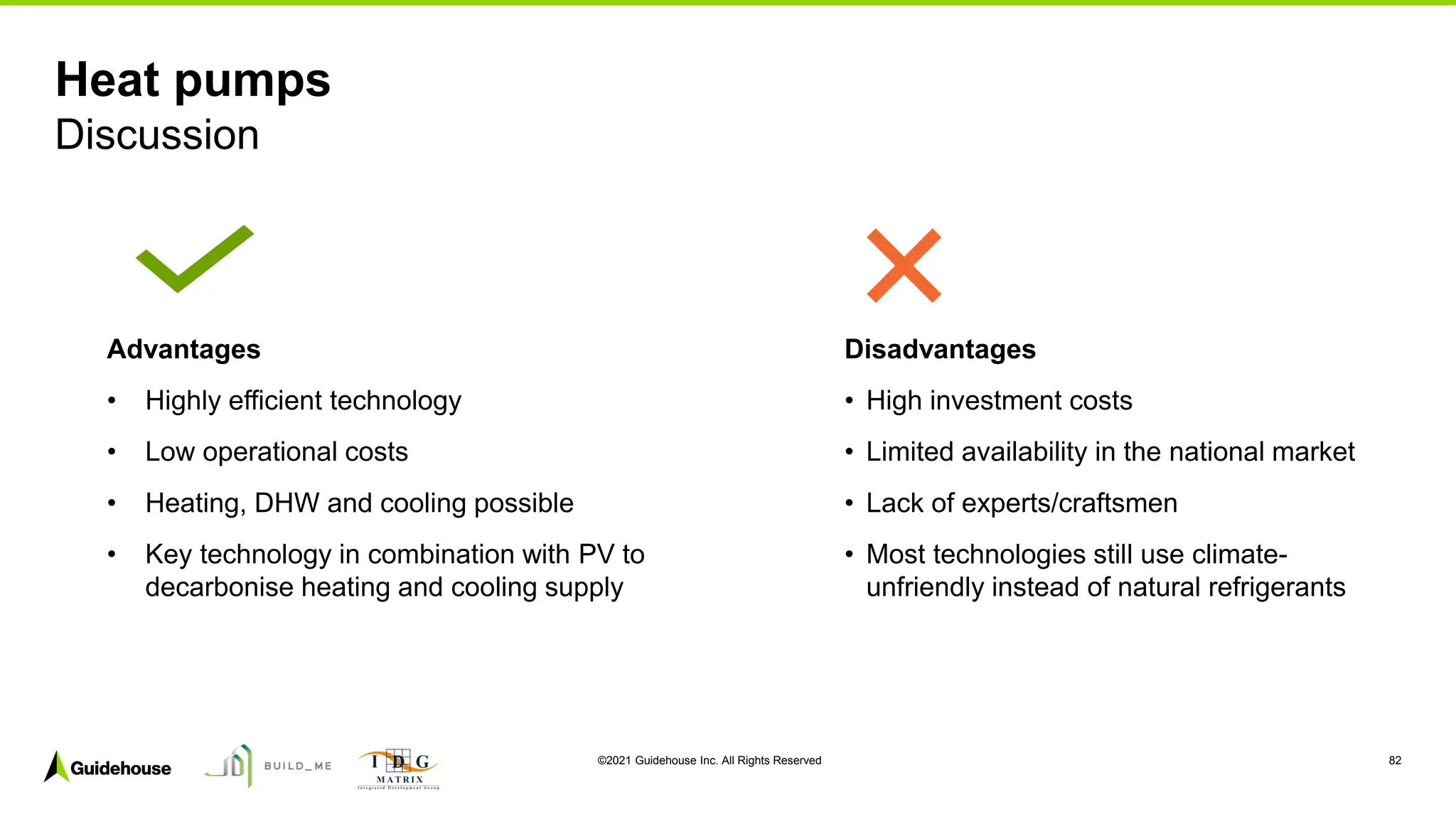
Advantages
• Highly efficient technology
• Low operational costs
• Heating, DHW and cooling possible
• Key technology in combination with PV to
decarbonise heating and cooling supply
Disadvantages
• High investment costs
• Limited availability in the national market
• Lack of experts/craftsmen
• Most technologies still use climate-
unfriendly instead of natural refrigerants
Heat pumps
Discussion
©2021 Guidehouse Inc. All Rights Reserved 83
Renewable energies
Conclusion
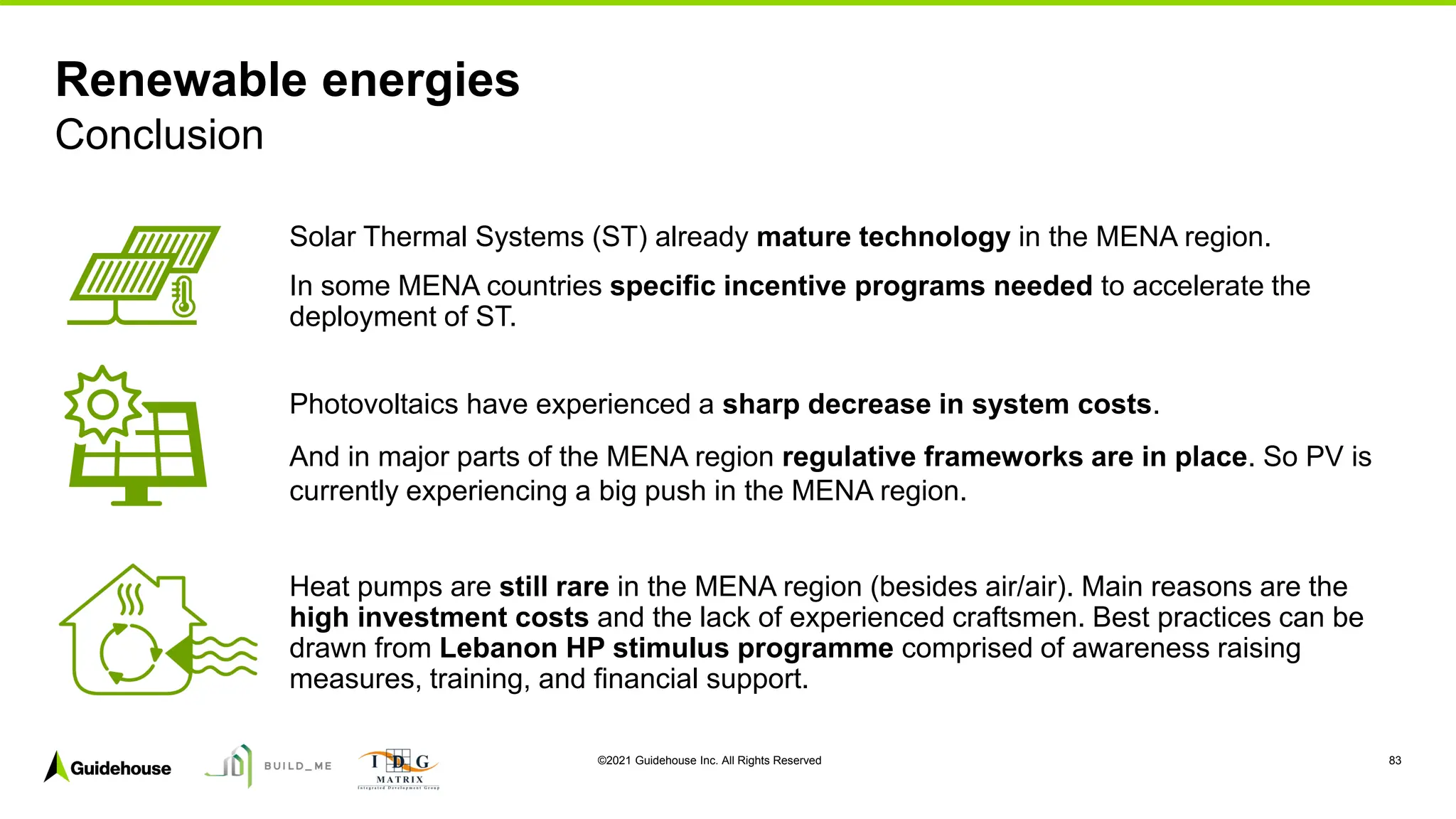
Photovoltaics have experienced a sharp decrease in system costs.
And in major parts of the MENA region regulative frameworks are in place. So PV is
currently experiencing a big push in the MENA region.
Heat pumps are still rare in the MENA region (besides air/air). Main reasons are the
high investment costs and the lack of experienced craftsmen. Best practices can be
drawn from Lebanon HP stimulus programme comprised of awareness raising
measures, training, and financial support.
Solar Thermal Systems (ST) already mature technology in the MENA region.
In some MENA countries specific incentive programs needed to accelerate the
deployment of ST.
©2021 Guidehouse Inc. All Rights Reserved 84
Discussion
Did you integrate any RE measures in your projects/designs? What
challenges did you face?
Share your ideas & experiences
©2021 Guidehouse Inc. All Rights Reserved 85
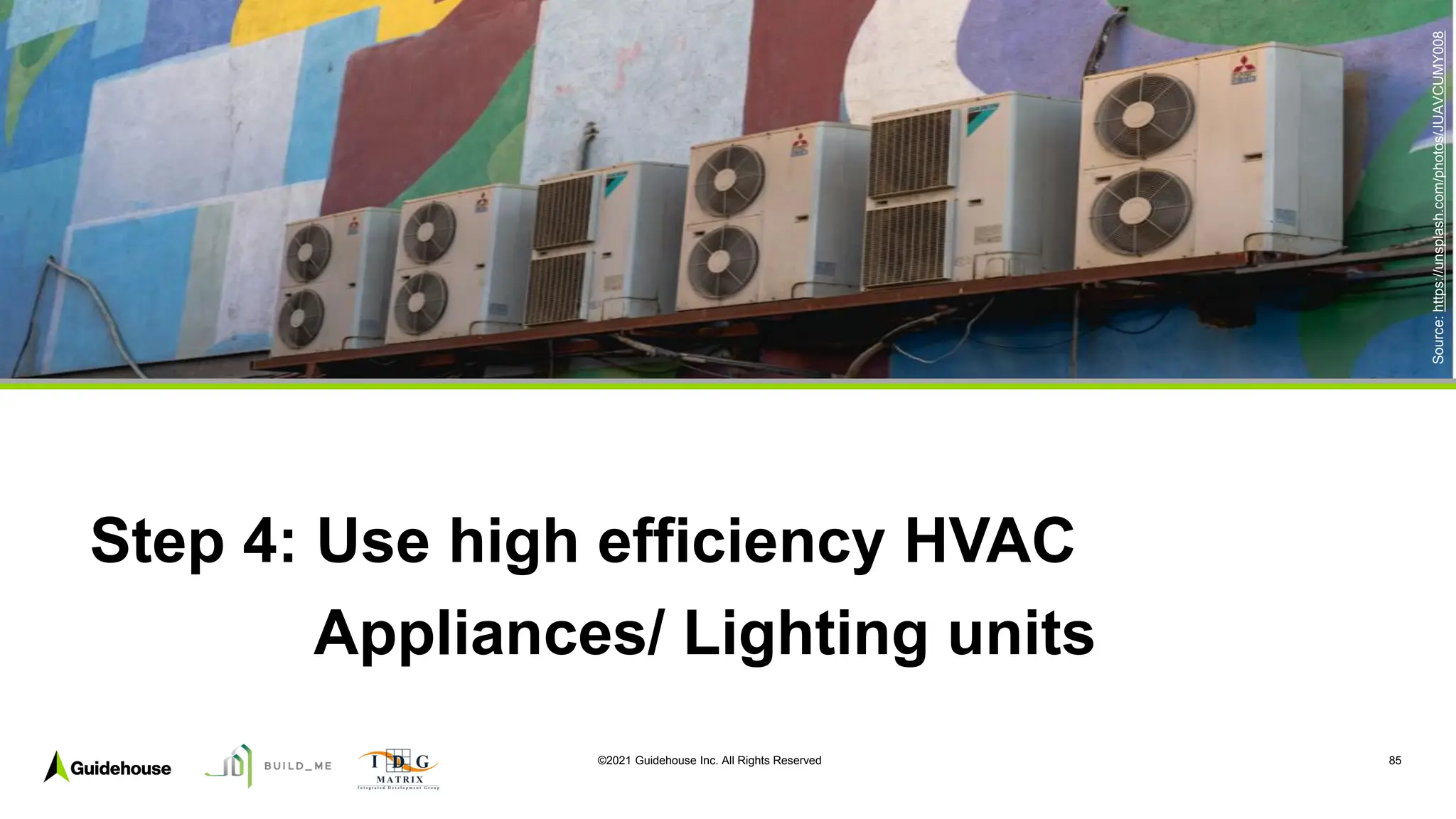
Step 4: Use high efficiency HVAC
Appliances/ Lighting units
Source:
https://unsplash.com/photos/JUAVCUMY008
©2021 Guidehouse Inc. All Rights Reserved 86
Heating
• Gas non-condensing
• Gas condensing
• Oil non-condensing
• Oil condensing
• Portable LPG (gas) heater
• Portable kerosene heater
• Heat pumps (already
covered)
Hot Water
• Combined with heating
system
• Dedicated gas heater
• Dedicated electric heater
• Solar Thermal (already
covered)
AC (Air-Conditioning)
• Movable system
• Mounted single split or
window air conditioner
• Centralised multi-split
system
• VRF – centralised multi-split
• Central systems
HVAC
Overview of selected systems
Ventilation
• Natural ventilation
• Mechanical ventilation
• Mechanical ventilation incl.
heat/cold recovery
©2021 Guidehouse Inc. All Rights Reserved 87
Heating
Principle of a condensing boiler
Source: http://gasboilerforums.com/condensing.html
Non-condensing Condensing
©2021 Guidehouse Inc. All Rights Reserved 88
Heating
Overview of efficiencies
50
60
70
80
90
100
110
120
Efficiency
%
0
100
200
300
400
500
Air Source heat pump Ground source heat
pump
Air-air heat pump
Efficiency
%
(incl,
COP)
• Condensing boilers can save 10-15% in comparison
to non-condensing boilers
• Portable heater are the least efficient appliances in
this comparison with efficiencies around 55-75%
• The COP of heat pumps are mainly influenced by the
difference of source temperature and the system
temperature
• The lower this delta, the higher the real COP
©2021 Guidehouse Inc. All Rights Reserved 89
Heating
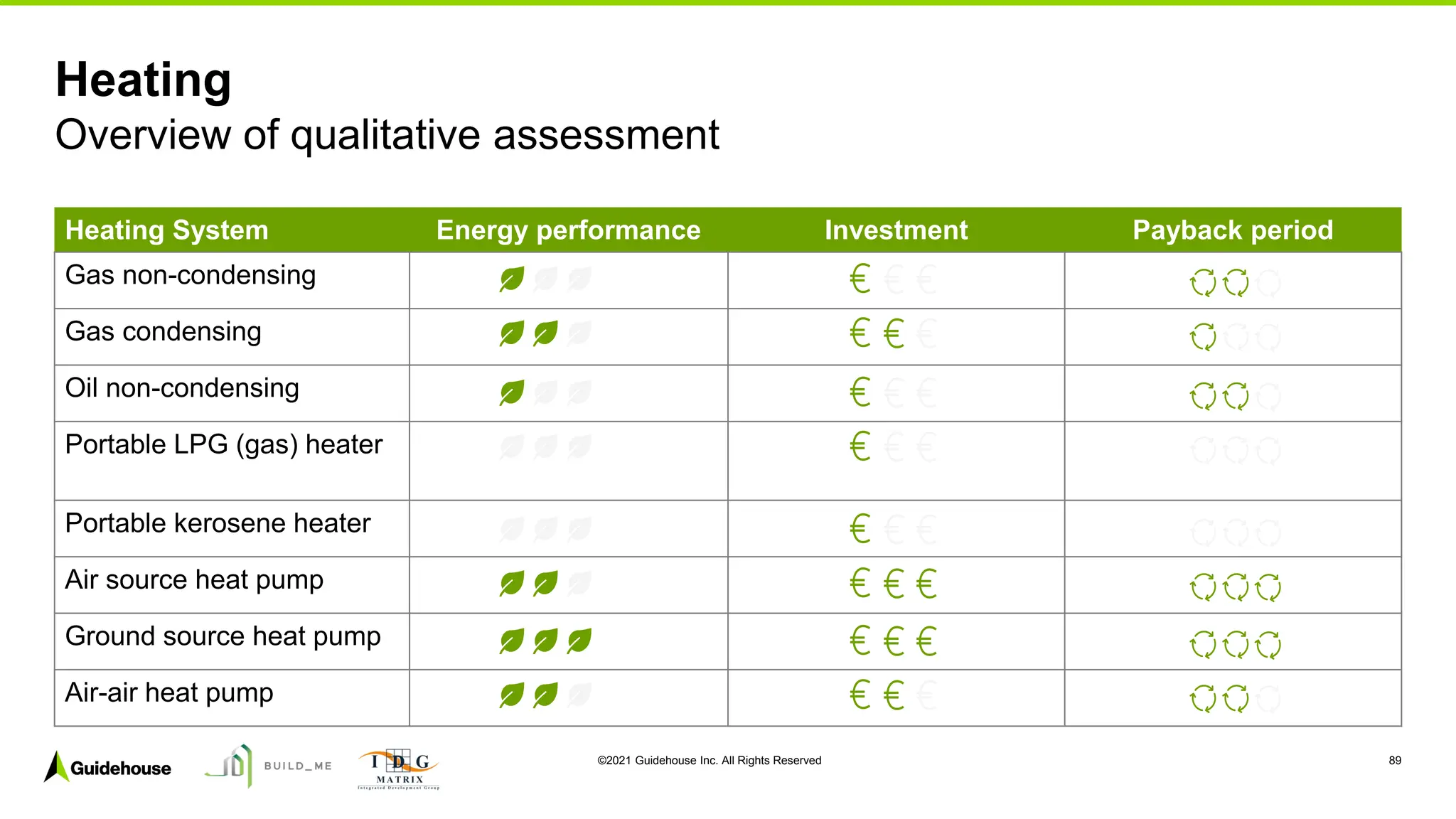
Overview of qualitative assessment
Heating System Energy performance Investment Payback period
Gas non-condensing
Gas condensing
Oil non-condensing
Portable LPG (gas) heater
Portable kerosene heater
Air source heat pump
Ground source heat pump
Air-air heat pump
©2021 Guidehouse Inc. All Rights Reserved 90
• Efficiency depends on heating
system and additional
transmission (and storage)
losses
• Centrally placed in basement or
in the apartment
• High efficiency: no transmission
losses as decentrally installed
• Needs decentral gas
connection
• High efficiency: no transmission
losses as decentrally installed,
CO2 emissions depend on grid
• Needs high power electric
connection
Hot water
Combined w. Heating System Dedicated gas heater Dedicated electric heater
©2021 Guidehouse Inc. All Rights Reserved 91
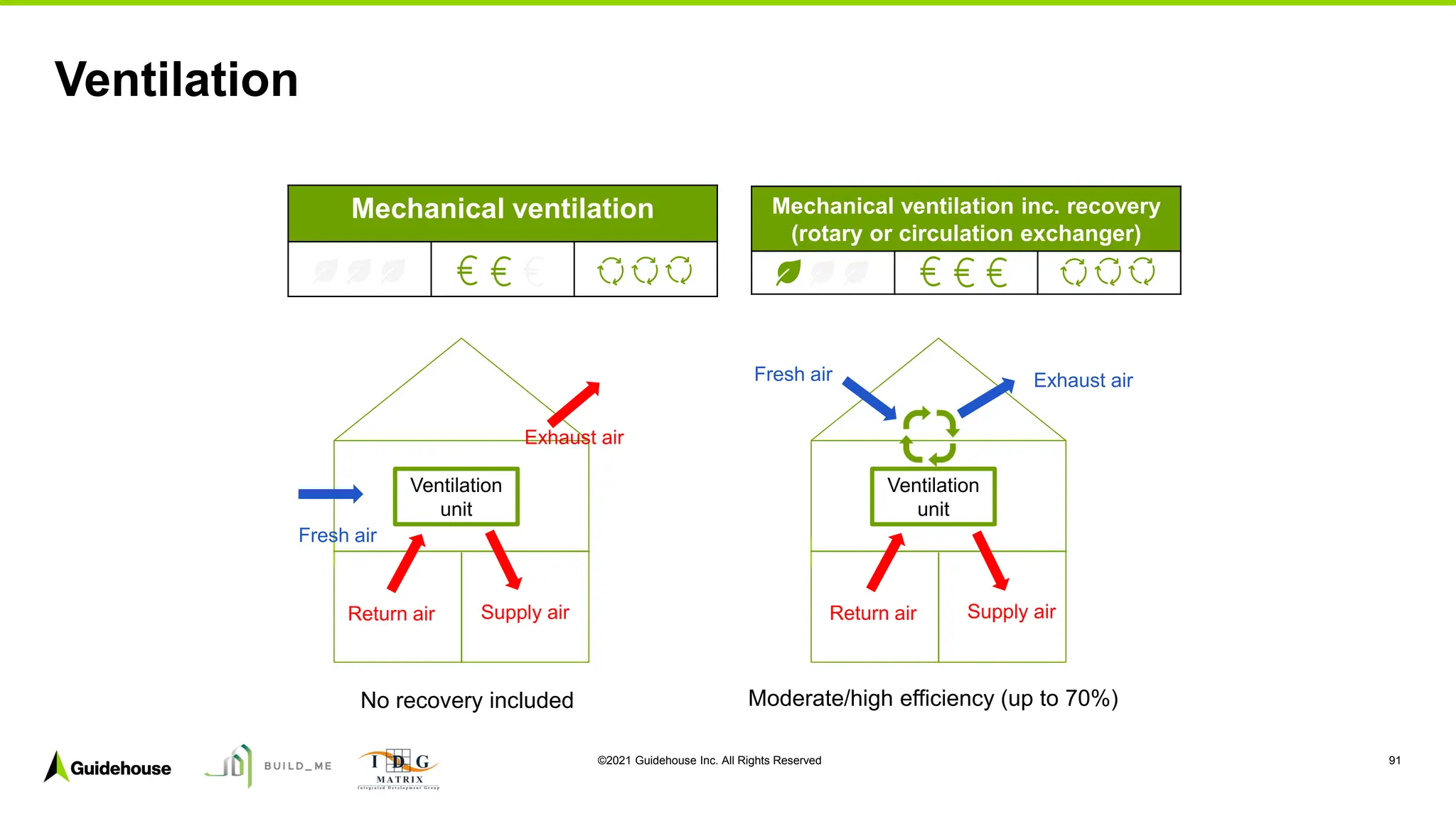
No recovery included Moderate/high efficiency (up to 70%)
Ventilation
Fresh air
Exhaust air
Ventilation
unit
Fresh air Exhaust air
Ventilation
unit
Supply air
Return air
Mechanical ventilation Mechanical ventilation inc. recovery
(rotary or circulation exchanger)
Supply air
Return air
©2021 Guidehouse Inc. All Rights Reserved 92
Decentral
One AC per room
(e.g. window or split units)
Central – small scale
One AC for a group of rooms
(e.g. VRF or multi-split units)
Central – large scale
One AC per building
(e.g. chiller serving VAV, fan coil units or
chilled beams or ceilings)
Air conditioning
Main technologies
AC
AC
AC
AC
AC
AC
©2021 Guidehouse Inc. All Rights Reserved 93
Air conditioning
Overview of efficiencies
0
1
2
3
4
5
6
7
8
Movable system Mounted single
split or window air
conditioner
Centralised multi-
split system
VRF - centralised
multi-split system
Central systems
(35/22)
Energy
efficiency
ratio
Efficiency at 35°C (EER)
• Large variety of systems on the market
• Use of labels (A,B,C…) as orientation
to select top performers, commonly
used also in the BUILD_ME countries
• Water-based systems are the most
efficient
• Efficiency highly dependent on delta of
air temperature and room temperature
©2021 Guidehouse Inc. All Rights Reserved 94
AC system Energy performance Investment Payback period
Movable system
Mounted single split or
window air conditioner
Centralised multi-split
system
VRF-centralised multi-
split system
Central systems
Air conditioning
Overview of qualitative assessment
©2021 Guidehouse Inc. All Rights Reserved 95
Linear Fluorescent Lamp (LFLs)
Lighting
Main technologies
Compact Fluorescent Lamp (CFLs)
LED Light bulbs
©2021 Guidehouse Inc. All Rights Reserved 96
Step 5: Operation
Source:
https://unsplash.com/photos/JUAVCUM
Y008
Source:
https://unsplash.com/photos/mAwE-fqgDXc
©2021 Guidehouse Inc. All Rights Reserved 97
Basics of thermal comfort
Example of temperature ranges
Use/function Winter Summer
Residenti
al
Living room 20-22°C 24-26°C
Sleeping room 18-20°C 24-26 °C
Bathroom 22-24°C 24-26°C
Office 20-22°C 24-26°C
School (classroom) 20-22°C 24-26°C
Shops 18-20°C 22-25°C
According to Egyptian Energy Efficient code for buildings,
thermal comfort for Egypt region is:
Temperature : 21.8-30 oC
Humidity : 20-50%
Wind speed : 0.5-1.5 m/sec
©2021 Guidehouse Inc. All Rights Reserved 98
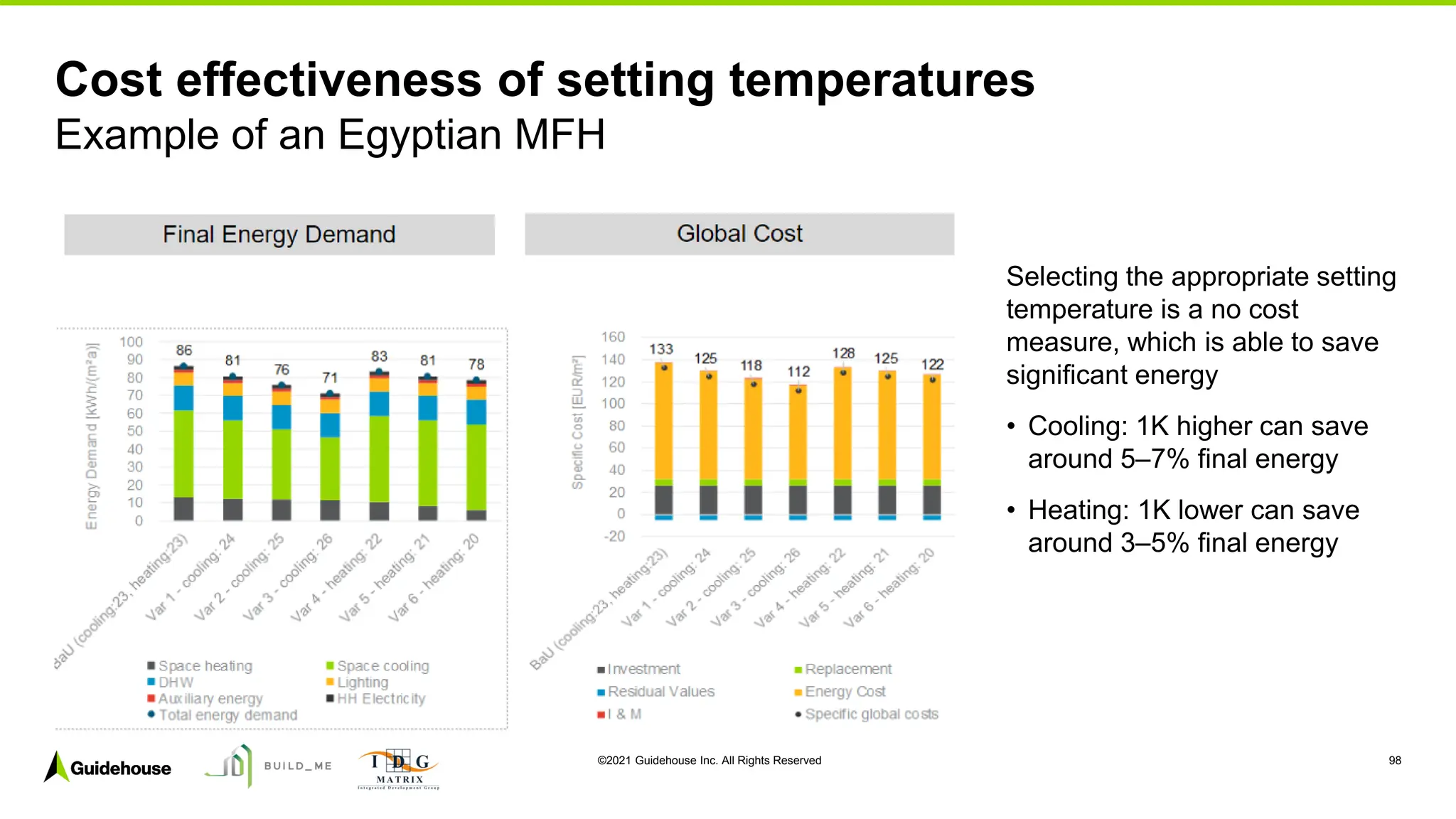
Selecting the appropriate setting
temperature is a no cost
measure, which is able to save
significant energy
• Cooling: 1K higher can save
around 5–7% final energy
• Heating: 1K lower can save
around 3–5% final energy
Cost effectiveness of setting temperatures
Example of an Egyptian MFH
©2021 Guidehouse Inc. All Rights Reserved 99
Conclusion
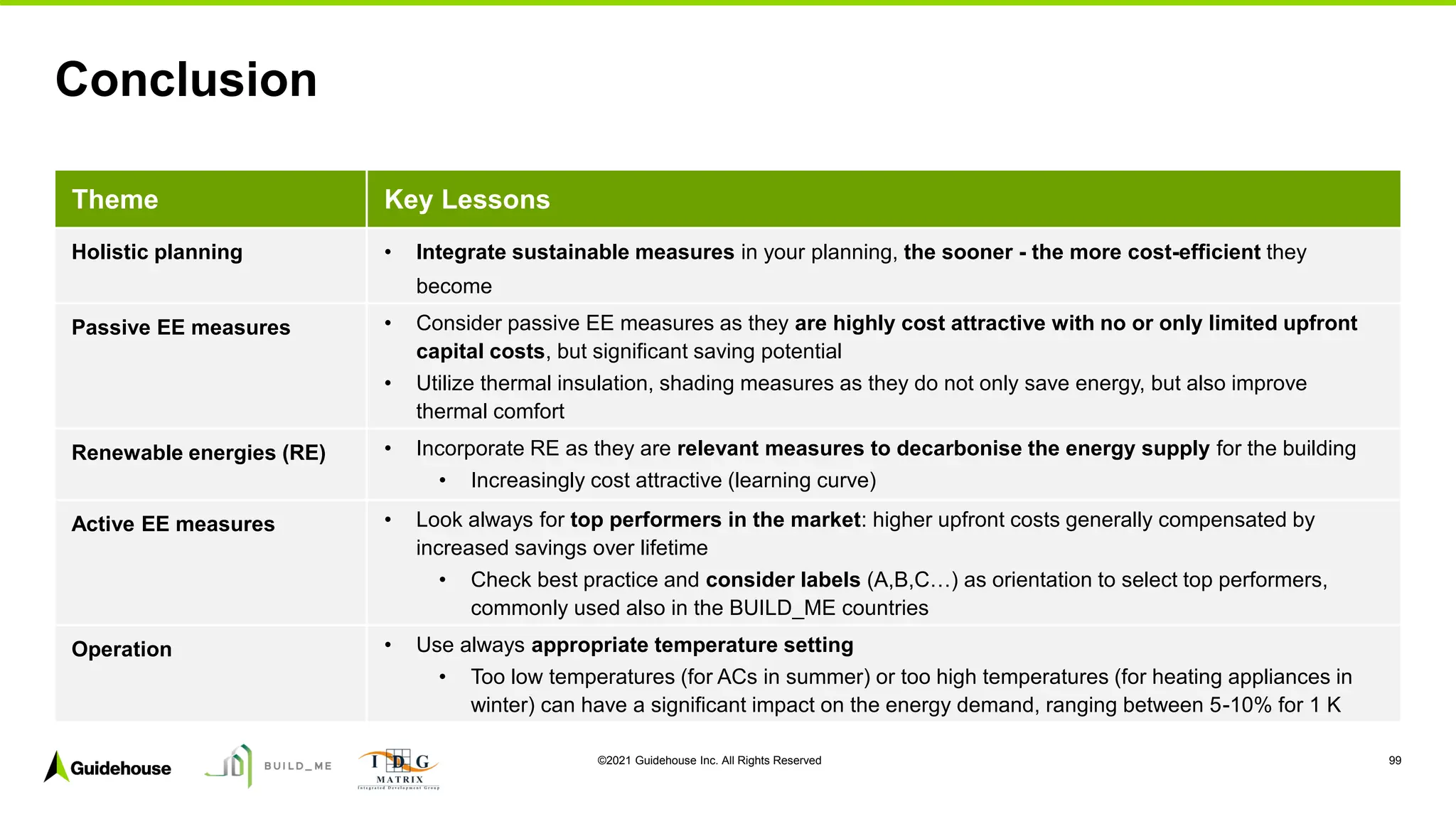
Theme Key Lessons
Holistic planning • Integrate sustainable measures in your planning, the sooner - the more cost-efficient they
become
Passive EE measures • Consider passive EE measures as they are highly cost attractive with no or only limited upfront
capital costs, but significant saving potential
• Utilize thermal insulation, shading measures as they do not only save energy, but also improve
thermal comfort
Renewable energies (RE) • Incorporate RE as they are relevant measures to decarbonise the energy supply for the building
• Increasingly cost attractive (learning curve)
Active EE measures • Look always for top performers in the market: higher upfront costs generally compensated by
increased savings over lifetime
• Check best practice and consider labels (A,B,C…) as orientation to select top performers,
commonly used also in the BUILD_ME countries
Operation • Use always appropriate temperature setting
• Too low temperatures (for ACs in summer) or too high temperatures (for heating appliances in
winter) can have a significant impact on the energy demand, ranging between 5-10% for 1 K
©2021 Guidehouse Inc. All Rights Reserved 100
Questions
Bild
von
PIRO4D
auf
Pixabay
©2021 Guidehouse Inc. All Rights Reserved 101
Climate-friendly
buildings from a
financing
perspective
MaiAdel, IDG
40 minutes
©2021 Guidehouse Inc. All Rights Reserved 102
Key learnings
Terminology Global Costs Case Studies
©2021 Guidehouse Inc. All Rights Reserved 103
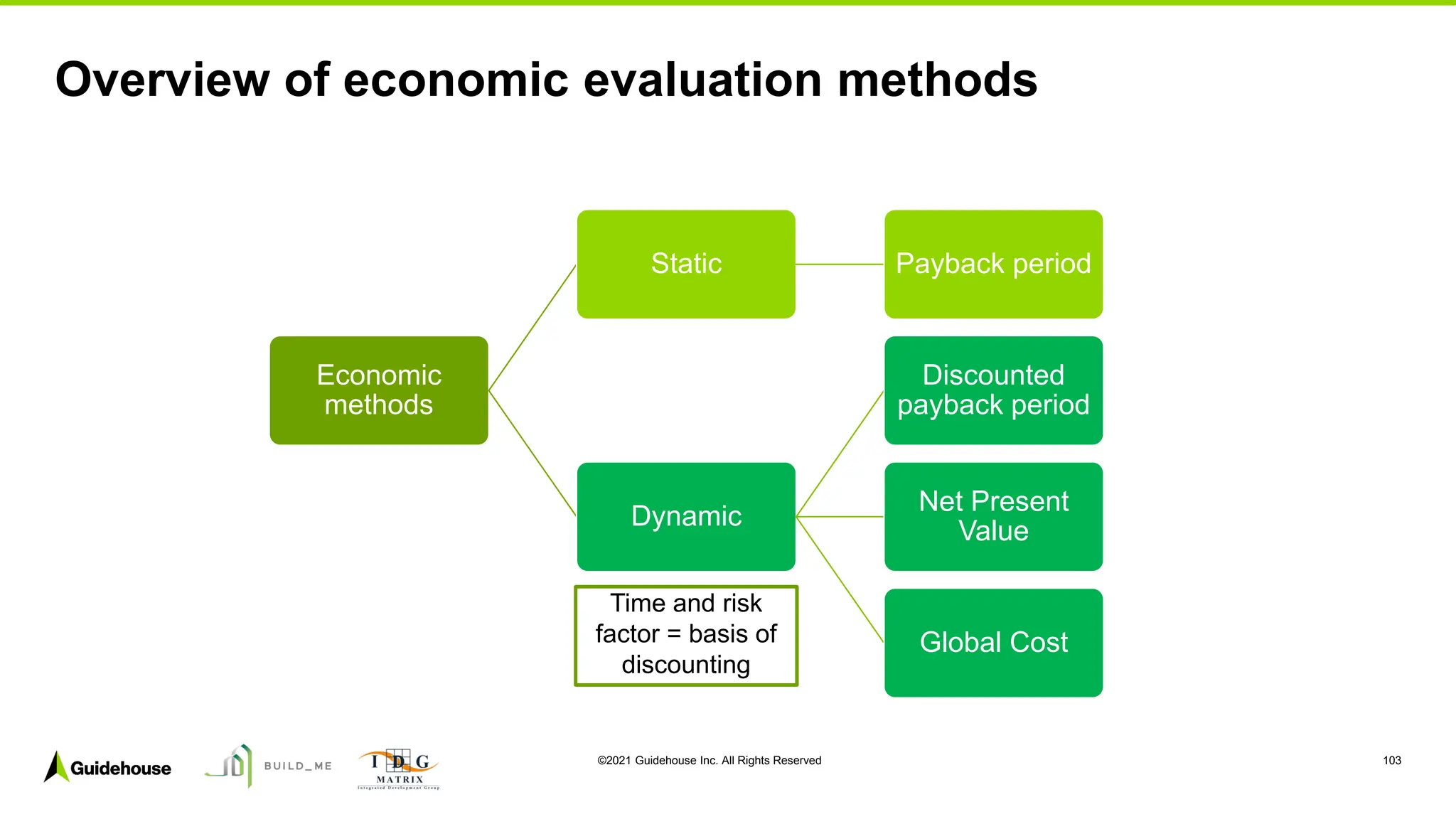
Overview of economic evaluation methods
Economic
methods
Static Payback period
Dynamic
Discounted
payback period
Net Present
Value
Global Cost
Time and risk
factor = basis of
discounting
©2021 Guidehouse Inc. All Rights Reserved 104
• The amount of time it takes to recover the cost of an
investment, meaning to reach break-even point
• Calculated by dividing the amount of the investment by
the annual cash flow.
• The desirability of an investment is directly related to its
payback period. Shorter paybacks mean more
attractive investments.
Static Payback period
Definition
Source: Investopedia
Disadvantages
• Disregards time value of money
• Ignores overall profitability of investment
Advantages
• Simple to calculate and compare options
• Useful for ‘back of the envelope’ calculations
©2021 Guidehouse Inc. All Rights Reserved 105
• A discounted payback period provides the number of years
it takes to break even from the initial expenditure, by
discounting future cash flows and recognising the time
value of money.
• Shows how long it will take to recoup an investment
based on observing the present value of the project's
projected cash flows
• The shorter a discounted payback period is, the sooner a
project or investment will generate cash flows to cover the
initial cost.
Dynamic Discounted Payback Period
Definition
Source: Investopedia
Disadvantages
• Highly sensitive to discount rate
• Challenging to arrive at discount rate that
accurately represents investment’s true
risk premium
Advantages
• More accurate picture than simple payback
period
©2021 Guidehouse Inc. All Rights Reserved 106
• Difference between the present value of cash inflows
and the present value of cash outflows over a period of
time
• NPV is the result of calculations used to find today’s value
of a future stream of payments.
• To calculate NPV you need to estimate future cash flows
for each period and determine the correct discount rate.
Net Present Value
Definition
Source: Investopedia
Disadvantages
• Highly sensitive to discount rate
• Challenging to arrive at discount rate that
accurately represents investment’s true
risk premium
Advantages
• Indicates the profitability of future cash
©2021 Guidehouse Inc. All Rights Reserved 107
• All cost elements are considered: Operational and
investment cost incurred over a relevant time period
• The different types of costs incurred each year,
respectively, are summed by using the NPV methodology,
in order to express them in terms of value in the first year.
Cost elements:
• Initial investment cost
• Annual cost
– Replacement of systems
– Running cost (energy, maintenance & operation)
Global Cost
Definition
Disadvantages
• Sensitivities of NPV (described before)
• Sensitive to assumed cost and price increase
Advantages
• All costs incurred over a relevant period are
considered
• Costs are comparable because their value is
calculated back to the same base year > ideal to
identify cost-optimal solution
• Lifetime of the elements is explicitly considered
©2021 Guidehouse Inc. All Rights Reserved 108
Global Costs
Details
Initial
Investment
Replacement Residual
Energy
Inspection &
Maintenance
One-time
cost
Annual
cost
Global Cost
Cost for energy carriers that are used
every year to meet the final energy
demand. Annual price in- or decrease
for energy carrier can be considered.
The discounted sum of
each year (NPV) over the
calculation period – for all
the five cost elements –
results in in the Global
Cost.
A certain percentage (0.5 – 2%) of the initial
investment cost are considered to reflect the cost
for inspection and maintenance of each system.
Sum of all investment costs in
the first year, incl. envelope
insulation, HVAC systems,
lighting, etc.
If the lifetime of an element or system is
lower than the considered time period, it must
be replaced. The costs are the investment
cost of the specific system (plus potential
cost increase).
At the end of the considered time
period, most elements have a
remaining lifetime. This is credited
(negative) to the overall cost*.
*The amount credited is calculated by dividing the investment by the lifetime (10,000 €/10 year = 1,000 €/year). For each remaining
year of the lifetime, this amount is multiplied by and considered as a “refund” to the owner (1,000 €/year * -2 year = -2,000 €).
©2021 Guidehouse Inc. All Rights Reserved 109
Global Costs
Example case – without discount rate and price increase
• The global cost represent the sum of
all cost and values that occur over
the considered calculation period
• ....
2022
Cost
2024 2030
Total 2023
2021
2020 2031 2039 2040
Investement I&M
Replacement Residual
Energy
Calculation period
(20 years)
Global cost
∑
©2021 Guidehouse Inc. All Rights Reserved 110
Global Costs
Example case – without discount rate and price increase
• Year 1: The initial investment cost
are paid
• Annually the cost for energy and
inspection and maintenance (I&M)
are payed
• If systems have a lifetime of less
than the calculation period (<20
years) the invest incurred again after
the lifetime is over
• In the last year, the residual value of
the systems that will still function in
future years is considered a negative
value on the global cost
2022
Cost
2024 2030
Total 2023
2021
2020 2031 2039 2040
Investement I&M
Replacement Residual
Energy
1st year: Initial investment
cost + Energy cost
Annually:
Energy + I&M cost
Replacement of system(s)
Residual value of
components after
calculation period
©2021 Guidehouse Inc. All Rights Reserved 111
Global Costs
Example case – without discount rate and price increase
How to get to the total global cost?
• Investment cost from first year
80
80
Cost
2021
Total 2020 2024
2022 2030
2023 2039
2031 2040
Investement Replacement Energy
I&M Residual
Investment
cost
©2021 Guidehouse Inc. All Rights Reserved 112
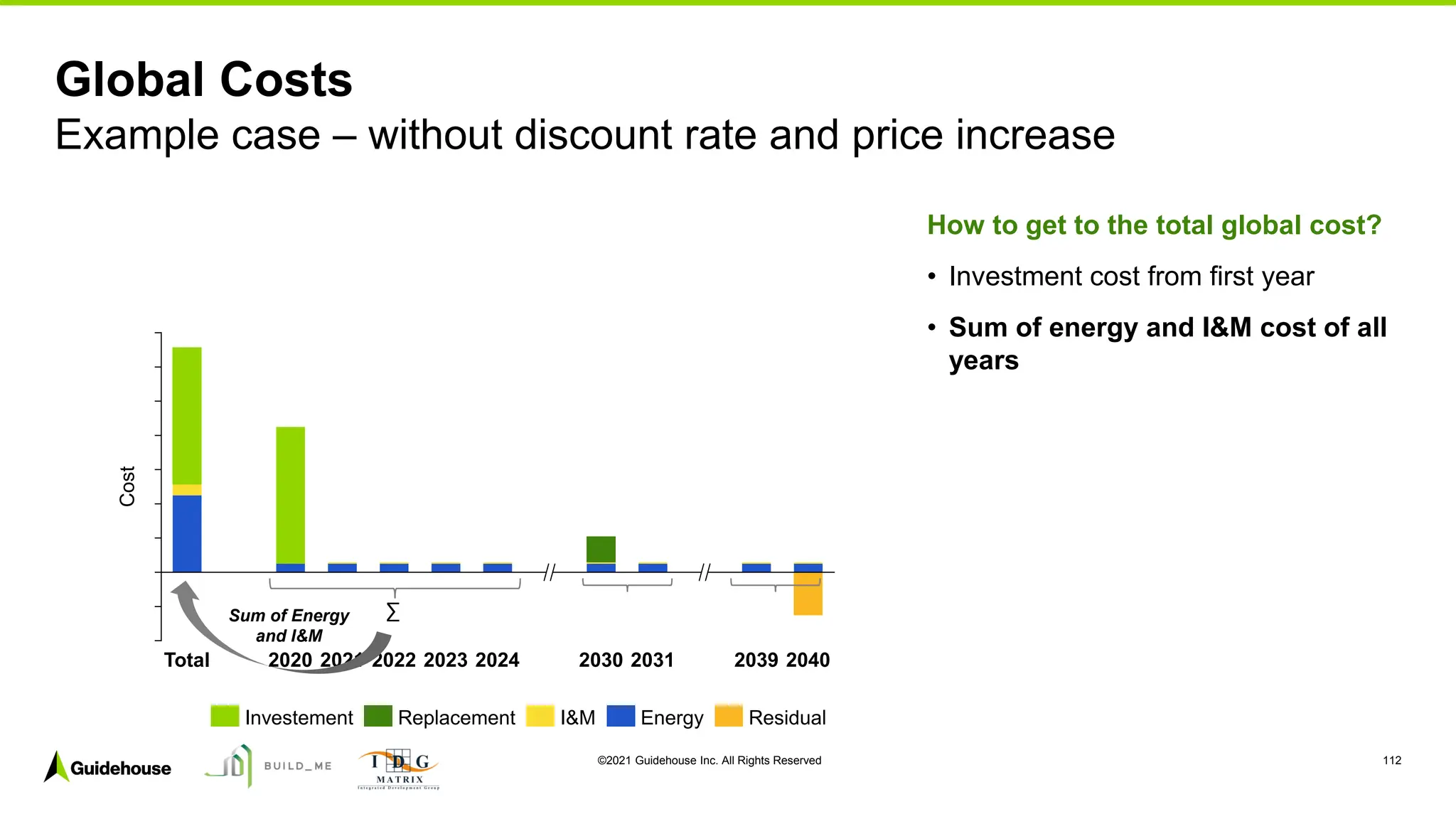
Global Costs
Example case – without discount rate and price increase
2024
2023
Cost
Total 2022
2020 2021 2030 2031 2039 2040
Investement Energy
Replacement I&M Residual
∑
Sum of Energy
and I&M
How to get to the total global cost?
• Investment cost from first year
• Sum of energy and I&M cost of all
years
©2021 Guidehouse Inc. All Rights Reserved 113
How to get to the total global cost?
• Investment cost from first year
• Sum of energy and I&M cost of all
years
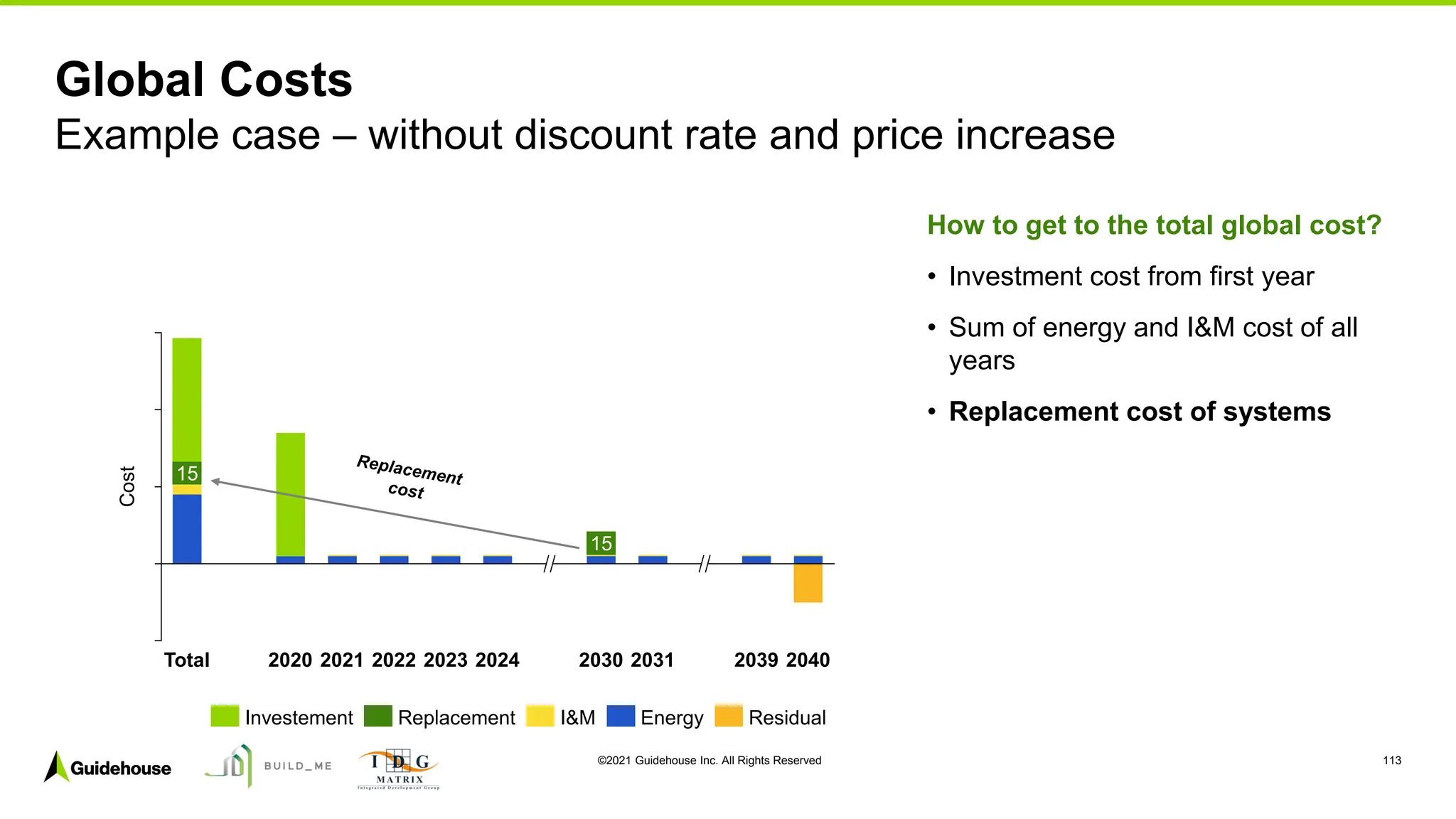
• Replacement cost of systems
Global Costs
Example case – without discount rate and price increase
15
15
2023
2022
Cost
Total 2020 2030
2021 2024 2039
2031 2040
Investement Energy
Replacement I&M Residual
©2021 Guidehouse Inc. All Rights Reserved 114
Global Costs
Example case – without discount rate and price increase
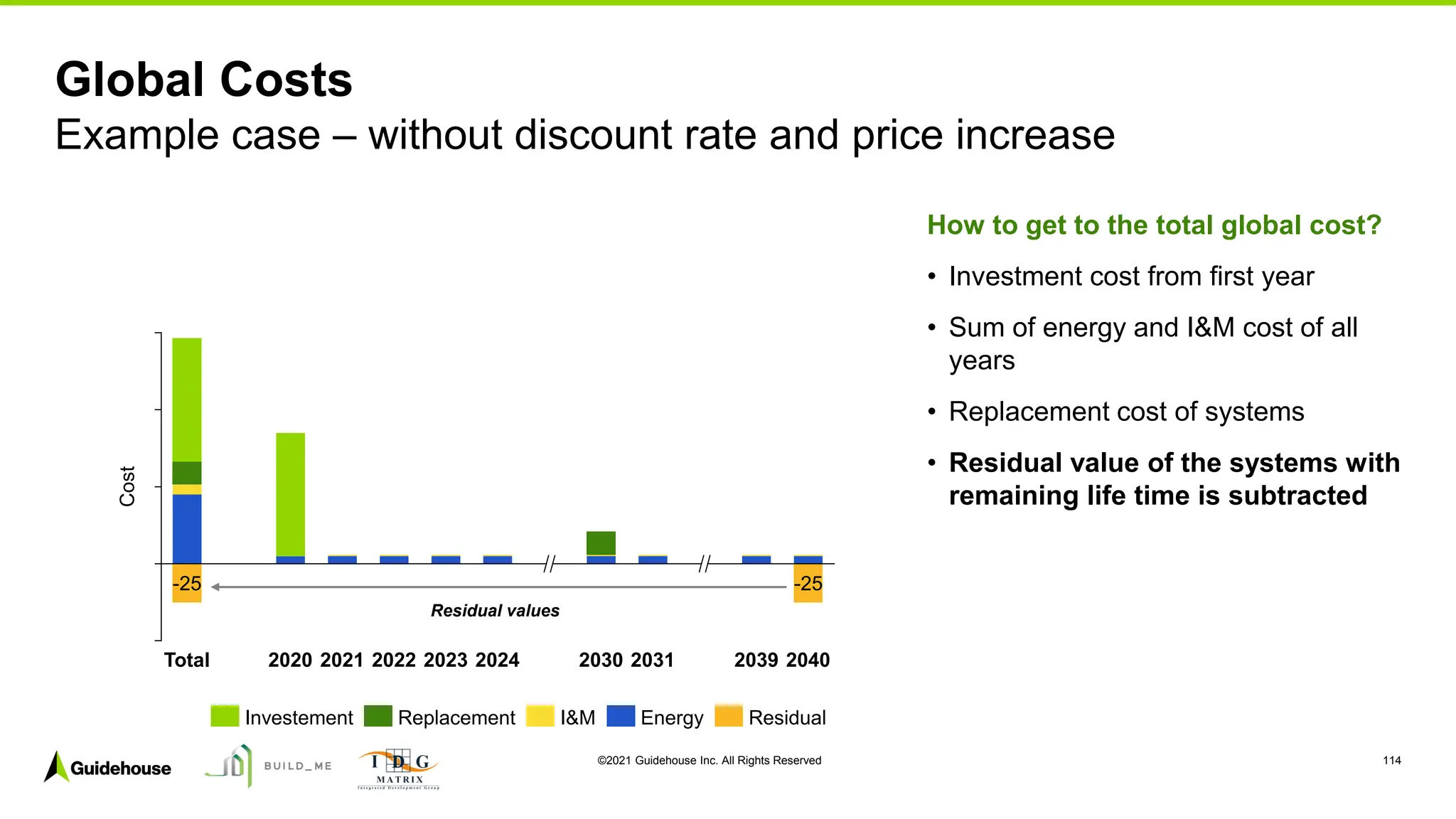
-25
-25
2023
Cost
2030
Total 2020 2021 2024
2022 2031 2039 2040
Investement I&M
Replacement Energy Residual
Residual values
How to get to the total global cost?
• Investment cost from first year
• Sum of energy and I&M cost of all
years
• Replacement cost of systems
• Residual value of the systems with
remaining life time is subtracted
©2021 Guidehouse Inc. All Rights Reserved 115
Global Costs
Example case – without discount rate and price increase
2022
Cost
2024 2030
Total 2023
2021
2020 2031 2039 2040
Investement I&M
Replacement Residual
Energy
Calculation period
(20 years)
Global cost
∑ How to get to the total global cost?
• Investment cost from 1st year
• Sum of energy and I&M cost of all
years
• Replacement cost of systems
• Residual value of the systems with
remaining life time is subtracted
• Global cost are complete
©2021 Guidehouse Inc. All Rights Reserved 116
Discussion
Which of these economic evaluation methods are familiar to you?
Which of the new methods would you use to convince clients?
Share your ideas & experiences
©2021 Guidehouse Inc. All Rights Reserved 117
Egypt
Source.
https://unsplash.com/photos/R9oCkCUcvBo
©2021 Guidehouse Inc. All Rights Reserved 118
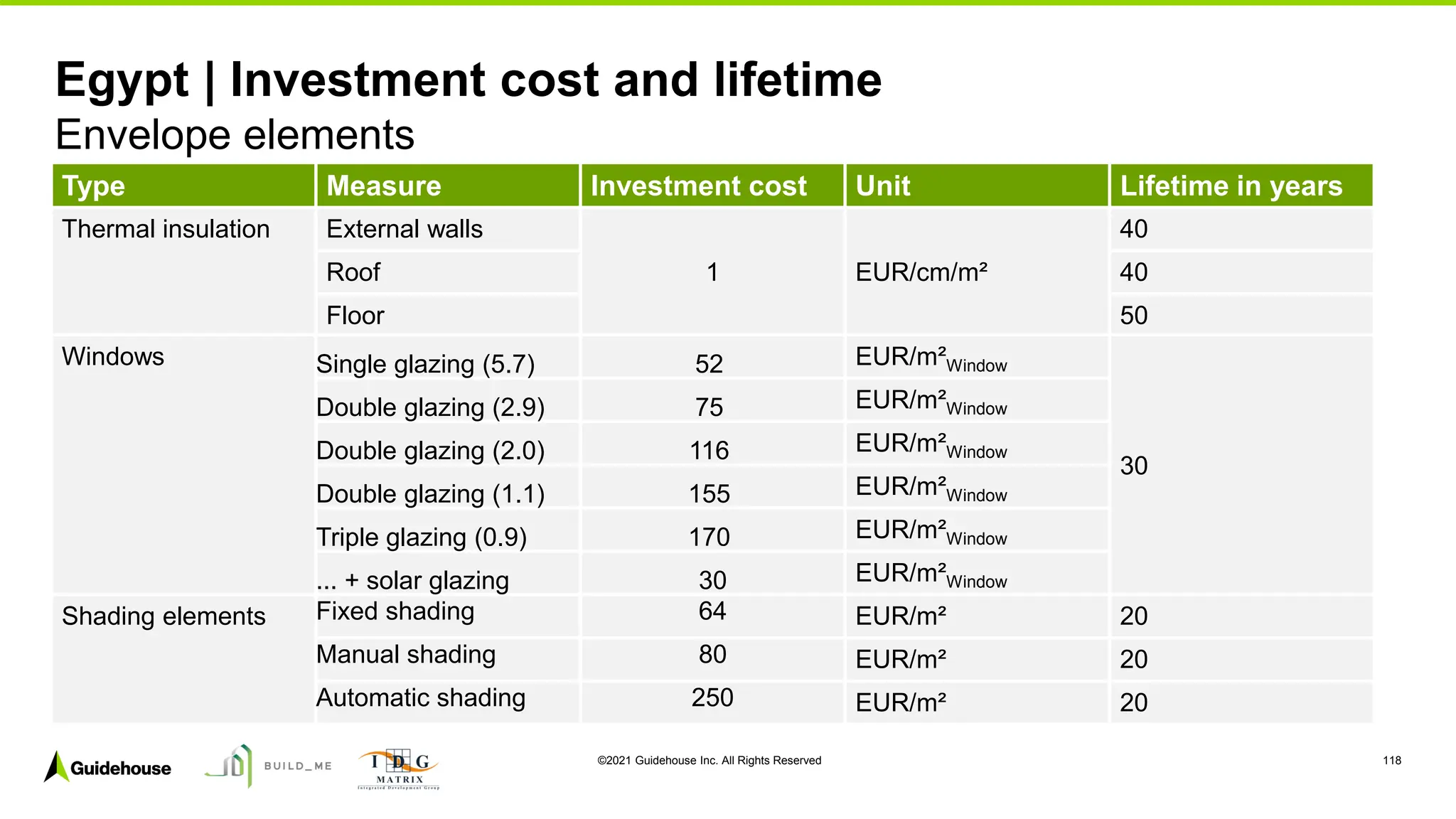
Egypt | Investment cost and lifetime
Envelope elements
Type Measure Investment cost Unit Lifetime in years
Thermal insulation External walls
1 EUR/cm/m²
40
Roof 40
Floor 50
Windows Single glazing (5.7) 52 EUR/m²Window
30
Double glazing (2.9) 75 EUR/m²Window
Double glazing (2.0) 116 EUR/m²Window
Double glazing (1.1) 155 EUR/m²Window
Triple glazing (0.9) 170 EUR/m²Window
... + solar glazing 30 EUR/m²Window
Shading elements Fixed shading 64 EUR/m² 20
Manual shading 80 EUR/m² 20
Automatic shading 250 EUR/m² 20
©2021 Guidehouse Inc. All Rights Reserved 119
Total
cost
of
cooling
system
[EUR]
Egypt | Investment cost and lifetime
HVAC systems - cooling
0
1.000
2.000
3.000
4.000
5.000
6.000
7.000
8.000
15
10
0 5 20
Movable system
Mounted single-split
VRF
Multi-split
Central system | Surface
Central system | Fan coil
Central system | Air vent
0
10.000
20.000
30.000
40.000
50.000
60.000
70.000
80.000
90.000
100.000
70
20 30 60
40 90
50 80 100
Cooling systems 1 – 20 kW Cooling systems 20 - 100 kW
Total
cost
of
cooling
system
[EUR]
©2021 Guidehouse Inc. All Rights Reserved 120
Egypt | Investment cost and lifetime
HVAC systems - Heating
0
200
400
600
800
1.000
1.200
1.400
1.600
1.800
10
0 5 20
15
Total
cost
of
cooling
system
[EUR]
Power [kW]
Portable kerosene heater Oil condensing
Portable LPG (gas) heater Oil non-condensing
Gas condensing
Gas non-condensing
0
1.000
2.000
3.000
4.000
5.000
6.000
7.000
8.000
9.000
50
20 90
40
30 80
60 70 100
Power [kW]
Total
cost
of
cooling
system
[EUR]
Heating systems 1 – 20 kW Heating systems 20 - 100 kW
©2021 Guidehouse Inc. All Rights Reserved 121
Egypt | Investment cost and lifetime
HVAC systems – Hot water
0
20
40
60
80
100
120
140
160
180
200
220
0 2 4 6 8
Total
cost
of
cooling
system
[EUR]
Power [kW]
0
50
100
150
200
250
300
350
400
450
500
550
5.0 10.0 15.0 20.0
Power [kW]
Total
cost
of
cooling
system
[EUR]
DHW systems 1 – 7.5 kW DHW systems 7.5 - 20 kW
Dedicated gas heater
Dedicated electric heater
Combi system (add. cost to space heating boiler)
©2021 Guidehouse Inc. All Rights Reserved 122
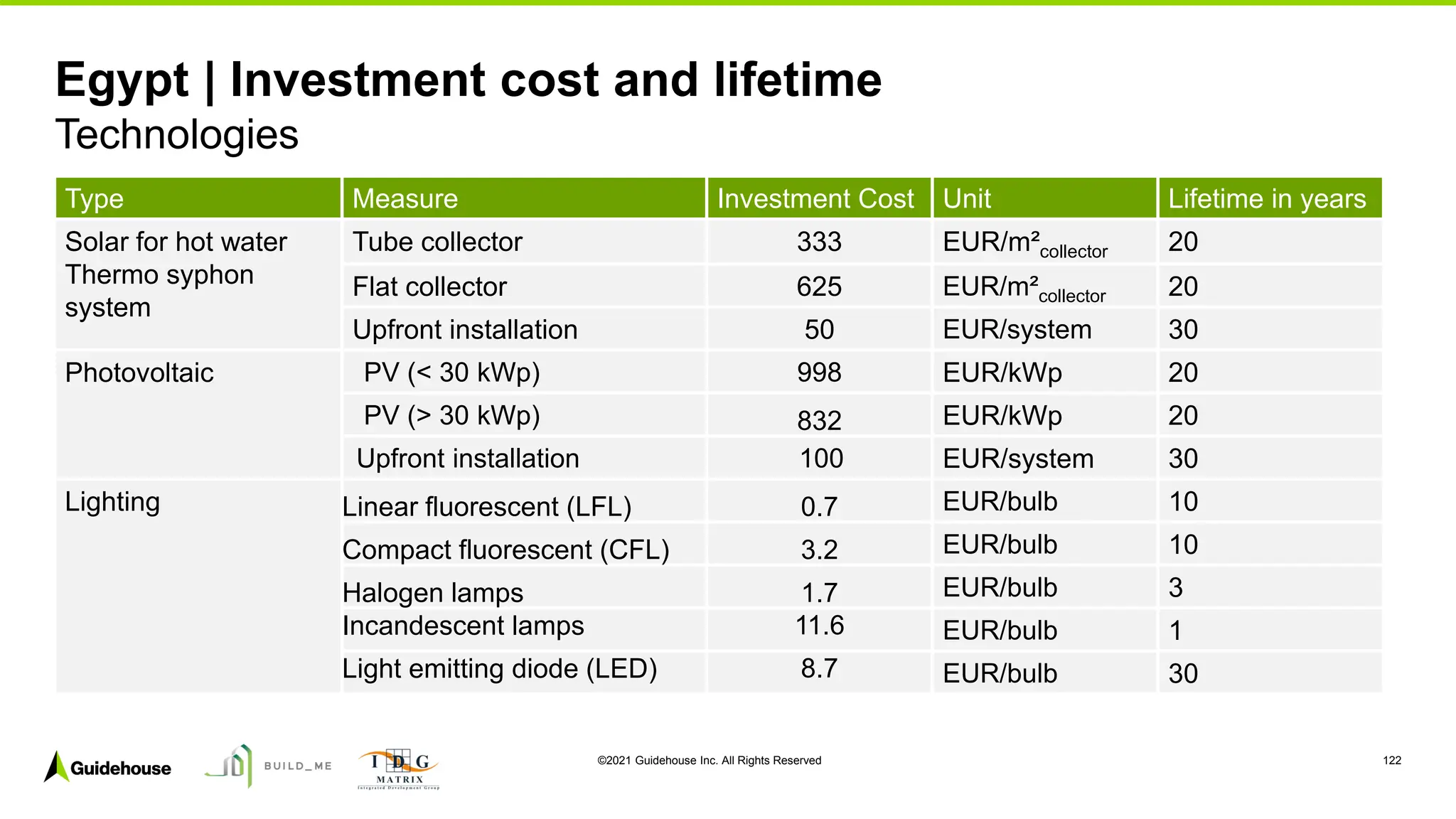
Egypt | Investment cost and lifetime
Technologies
Type Measure Investment Cost Unit Lifetime in years
Solar for hot water
Thermo syphon
system
Tube collector 333 EUR/m²collector 20
Flat collector 625 EUR/m²collector 20
Upfront installation 50 EUR/system 30
Photovoltaic PV (< 30 kWp) 998 EUR/kWp 20
PV (> 30 kWp) 832 EUR/kWp 20
Upfront installation 100 EUR/system 30
Lighting Linear fluorescent (LFL) 0.7 EUR/bulb 10
Compact fluorescent (CFL) 3.2 EUR/bulb 10
Halogen lamps 1.7 EUR/bulb 3
Incandescent lamps 11.6 EUR/bulb 1
Light emitting diode (LED) 8.7 EUR/bulb 30
©2021 Guidehouse Inc. All Rights Reserved 123
Energy prices and CO2 emissions
Parameter Unit Electricity Natural gas
Energy price EG Pound/kWh Mean 1.0 - 1.45 3.10 per m3
Energy price EUR/kWh 0.056 – 0.082 0.18 per m3
Price development in the last 5 years %/year 25% 6%
CO2 emission factor gCO2/kWh 444 220
Economic parameters
Interest rate (real) %/year 4
Calculation period years 20
Egypt | Economic and emissions inputs
Boundary conditions
Status
In Egypt, electricity is the main
source of power in household
consumption. Natural gas is
also used for cooking.
Energy subsidies will be totally
cut in 2023.
Objectives
Energy price increases are
assumed in the future and will
be factored in the economic
assessment.
• Exchange rate: 1 EUR = 17.61 EGP as of 29.05.2020
©2021 Guidehouse Inc. All Rights Reserved 124
Approach and methodology
Steps towards a low energy building
1
Final
recommendations
Comparison with
baseline
Energy efficiency
recommendations
Development
▪ Estimate the baseline consumption
▪ Estimate the consumption of current
design
▪ Comparison
▪ Building envelope
▪ HVAC I efficiencies
▪ Renewables
▪ Other measures
▪ Optimized as result
▪ Discussion with developers
▪ Local and market inputs
▪ Costs and ROI
▪ Final loop discussing feasibility of
measures
▪ Adapt selected measures and
finalize calculation including
payback, investment and lifetime
2 3 4
0
10
20
30
40
50
60
70
80
BaU Current
Energy
Demand
[kWh/(m²a)]
Space heating Space cooling
Lighting Auxiliary energy
Ventilation
0
10
20
30
40
50
60
70
80
BaU Current
Energy
Demand
[kWh/(m²a)]
Space heating Space cooling
Lighting Auxiliary energy
Ventilation
Building
Envelope
HVAC Building
Systems
Renewables
0
5
10
15
20
25
Final
energy
demand
[kWh/m²a]
Space heating Space cooling Lighting
Auxiliary energy Ventilation
585
352
208
-100
0
100
200
300
400
500
600
700
BaU Current Optimized
Specific
Cost
[EUR/m²]
Investment Replacement
Residual Values Energy Cost
I & M Specific global costs
1
©2021 Guidehouse Inc. All Rights Reserved 125
The key components of
the energy concept are
illustrated in this table, it
shows that the building
envelope is in line with the
thresholds of the baseline
derived from the BUILD_ME
building typology. While no
special attention is given to
use renewable energy
sources.
Case Study Egypt I Multi-family house in Alexandria
Business as Usual : Based on building typology analysis
Energy Cost
5.8 EUR / (m²*a)
CO2 - Emission
3.0 kg / (m²*a)
Parameters Baseline
Roof insulation (U-Value) 0.8 W/m²K
Wall insulation (U-Value) 2.4 W/m²K
Floor insulation (U-Value) 2.2 W/m²K
Windows (U-Value; G-
Value)
5.6 W/m²K; 0.85
Window fraction Ø 36%
Shading Fixed shading
Air tightness 0.25 1/h
Heat supply -
Cold supply Single split - EER 3.4
Hot water Direct electric
Ventilation systems Free ventilation
Lighting systems LED
Renewable energy
Set temperature
cooling/heating
23°C / 20°C
Lighting
HH Electricity
DHW
Cooling Auxiliary Energy
12%
70%
5%
12%
1%
82.7
kWh/(m²*a)
©2021 Guidehouse Inc. All Rights Reserved 126
Case Study Egypt I Multi-family house in Alexandria
External wall | Analysis of energy and global cost savings
Final energy demand Global cost
BaU: U-Value = 2.1 W/m²K
Single wall (25 cm bricks)
Var 1: U-Value = 1.11 W/m²K
Double wall with air gap 5 cm
Var 2: U-Value = 0.73 W/m²K
Double wall 2cm air gap, 3cm insulation
Var 3: U-Value = 0.53 W/m²K
Double wall 2cm air gap, 5cm insulation
Var 4: U-Value = 0.38 W/m²K
Double wall 2cm air gap, 8cm insulation
Result: Var 4 with 8 cm
insulation is the most cost
effective measure.
Current plan**
10 10 10 10 10
10 10 10 10 10
64
46 41 39 38
21
13
10 9 8
0
10
20
30
40
50
60
70
80
90
100
110
120
4
2
Energy
demand
[kWh/(m²a)]
4
3
BaU - 2.1* Var 1
- 0.73
4
2
Var 2
- 0.53
4
72
2
77
Var 3
- 0.43
4
2
Var 4
- 0.38
112
85
75
-36%
Auxiliary energy
Space heating
Space cooling
DHW
Lighting HH Electricity
5 5 4 4 4
156
118 108 104 100
35
35
30 30 30
90
92
85 87 90
-22 -22 -19 -19 -20
-50
0
50
100
150
200
250
300
Var 2
- 0.53
Var 1
- 0.73
Cost
[EUR/m²]
BaU - 2.1* Var 3
- 0.43
Var 4
- 0.38
264
228
208 204
206
-23%
Replacement
Investment
Energy Cost
Residual Values I & M
**Current plan is actually even worse than BaU
*Baseline is 2.4, BaU as measure 2.1
©2021 Guidehouse Inc. All Rights Reserved 127
Case Study Egypt I Multi-family house in Alexandria
Windows | Analysis of energy and global cost savings
Final energy demand Global cost
BaU – Single glazing
U value 5.7 W/m²K
G-Value 0.85
Double glazing (Var 1)
U value 2.9 W/m²K
G-Value 0.7
Double glazing low E
U value 1.3 W/m²K,
G-Value 0.7
Triple glazing
U value 1.3 W/m²K,
G-Value 0.7
Var 1 (double glazing) is the
more cost-effective case, with
improved but not best window.
10 10 10 10
10 10 10 10
64
54 51 45
21
16
12
11
0
10
20
30
40
50
60
70
80
90
100
110
120
Double
glazing
(3.0, 0.7)
4
2
2
Energy
demand
[kWh/(m²a)]
4
4
3
Single glazing
(5.7, 0.85)
2
Double
glazing low
E (1.3, 0.65)
4
83
Triple glazing
(0.9, 0.5)
112
96
89
-15%
Space heating
Lighting
Space cooling
Auxiliary energy
DHW
HH Electricity
156
134 123 115
35
35
35 35
91
105 128 134
-22 -24 -27 -28
-50
0
50
100
150
200
250
300
Double
glazing
(3.0, 0.7)
Single glazing
(5.7, 0.85)
Triple glazing
(0.9, 0.5)
5
Double
glazing low
E (1.3, 0.65)
Cost
[EUR/m²]
5 5 5
265 255
264 261
-4%
I & M
Replacement
Investment Residual Values
Energy Cost
Current plan
©2021 Guidehouse Inc. All Rights Reserved 128
BaU
Reversible Split Unit
Real annual EER: 3.4
Var 1 | 2 | 3
Reversible Split Unit with increased
efficiency
Real annual EER: 3.7 | 4.0 | 4.5
Case Study Egypt I Multi-family house in Alexandria
HVAC | Analysis of energy and global cost savings
Final energy demand Global cost
Var 3 (System with best COP)
has the highest efficiency and is
most cost-effective.
*resulting EER over year
10 10 10 10
10 10 10 10
88
64
48
39
21
21
21
21
0
20
40
60
80
100
120
140
3 4
Var 1 -
EER* 3.7
4
Energy
demand
[kWh/(m²a)]
3 4
BaU -
EER* 3.4
4 3
Var 2 -
EER* 4.0
3
Var 3 -
EER* 4.5
137
112
96
87
-36%
Space heating Auxiliary energy
Lighting
DHW
HH Electricity
Space cooling
190
156
134 121
31
35
38 42
84
90
97 103
-22 -25 -28
-50
0
50
100
150
200
250
300
350
-19
Cost
[EUR/m²]
5
4
BaU -
EER* 3.4
Var 1 -
EER* 3.7
5
Var 2 -
EER* 4.0
6
Var 3 -
EER* 4.5
290
264
249 244
-16%
Replacement
Investment Residual Values
Energy Cost
I & M
©2021 Guidehouse Inc. All Rights Reserved 129
The key components of the
energy concept are illustrated
in this table, it shows that the
building envelope is
significantly enhanced
compared to the current
building code.
Special attention is given to
the use of renewable energy
sources, particularly PV (for
electricity).
This leads to energy savings
and emissions reductions.
Case Study Egypt I Multi-family house in Alexandria
Results of an optimised solution
Energy Cost
1.1 EUR / (m²*a)
CO2 - Emission
0.6 kg / (m²*a)
Parameters Optimised building
Roof insulation (U-Value) 0.31 W/m²K
Wall insulation (U-Value) 0.38 W/m²K
Floor insulation (U-Value) 2.2 W/m²K
Windows (U-Value; G-
Value)
3.0 W/m²K; 0.3
Window fraction Ø 36%
Shading Solar Glazing
Air tightness 0.25 1/h
Heat supply Reversible split unit - COP 3.7
Cold supply Reversible split unit - EER 4.5
Hot water Direct electric
Ventilation systems Free ventilation
Lighting systems LED
Renewable energy 8 kWp (PV), 8 m² (solar)
Set temperature
cooling/heating
26°C / 20°C
11%
32%
16%
3%
1%
37%
Lighting
Heating
HH Electricity
DHW
Cooling Auxiliary Energy
15.7
kWh/(m²*a)
(PV: -11.7)
©2021 Guidehouse Inc. All Rights Reserved 130
Case Study Egypt I Multi-Family House in Alexandria
Comparative overview of BaU vs. current vs. optimised
Final Energy Demand Global Cost
Conclusion
• The suggested measures
and the current situation
lead to a significant
decrease in energy
demand
• The optimized solution,
detected the most cost
effective efficiency
measures
Savings
Energy: - 86%
Cost: - 46%
10 10 10 0
4
10 10
64
53
9
25
-12
-20
0
20
40
60
80
100
120
4
105
3
4
Energy
demand
[kWh/(m²a)]
21
3
16
Baseline
3
Current
1
Optimized
112
0
0
-86%
Lighting
Space heating
Space cooling
DHW Auxiliary energy PV
HH Electricity
156 146
22
35
35
31
91
92
108
-22 -22 -26
-50
0
50
100
150
200
250
300
Cost
[EUR/m²]
Current
5
5
Baseline
7
Optimized
265 256
142
-46%
Residual Values
Investment
Replacement
I & M
Energy Cost
©2021 Guidehouse Inc. All Rights Reserved 131
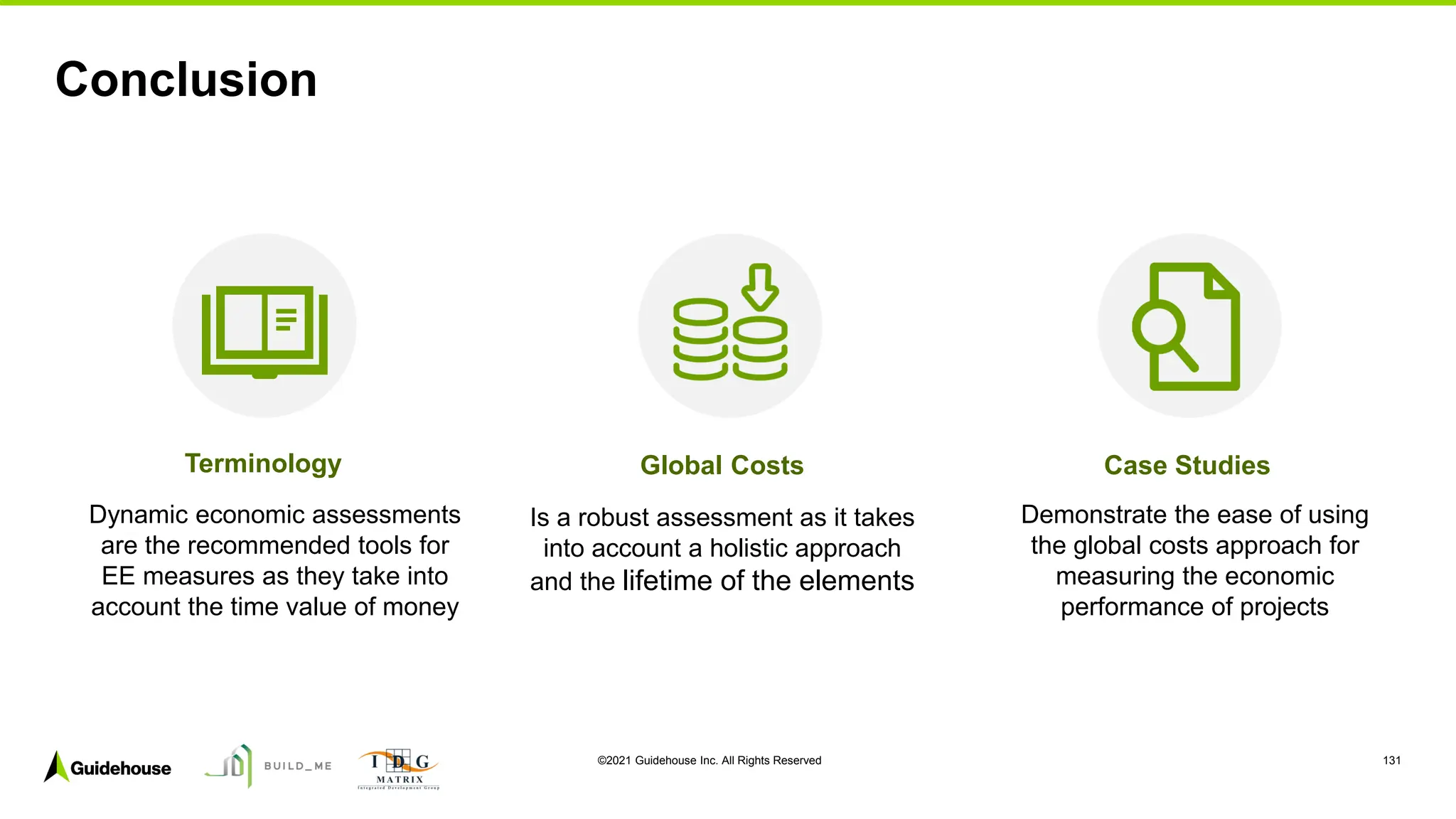
Conclusion
Terminology Global Costs Case Studies
Dynamic economic assessments
are the recommended tools for
EE measures as they take into
account the time value of money
Is a robust assessment as it takes
into account a holistic approach
and the lifetime of the elements
Demonstrate the ease of using
the global costs approach for
measuring the economic
performance of projects
©2021 Guidehouse Inc. All Rights Reserved 132
Questions
Bild
von
PIRO4D
auf
Pixabay
©2021 Guidehouse Inc. All Rights Reserved 133
Outlook
Scope of Day 2
Introduction to BUILD_ME
Project
Building Energy Performance
Tool
Voluntary Classification
Schemes
©2021 Guidehouse Inc. All Rights Reserved 134
Agenda
Day 02 – BUILD_ME tools
Recap of Day 01 content 10:30 – 10:40
Introduction of the BUILD_ME Project 10:40 – 11:00
Building Energy Performance (BEP) tool 11:00 – 11:30
Coffee Break 11:30 – 11:40
Calculate Case Studies 11:40 – 12:20
BEP Tool next steps 12:20 – 12:35
Wrap-up/closing 12:35 – 12:45
©2021 Guidehouse Inc. All Rights Reserved 135
Refresh day 1
MaiAdel, IDG
Marian Nessim, HBRC
Bild
von
PIRO4D
auf
Pixabay
©2021 Guidehouse Inc. All Rights Reserved 136
Key take-aways 1 - Introduction session
Understand the big picture
• Global Warming is causing
tremendous environmental
stress
• EE/RE huge economic and
social potential
Familiarity with common
definitions and terminology
• Boundary conditions like climate
and economic parameters (energy
costs, CAPEX) influences the
feasibility of low energy buildings
Introduce building energy
levels and sustainable
certifications
• Several international sustainable
certification schemes exist, but all
BUILD_ME countries have as
well national schemes in
operation
©2021 Guidehouse Inc. All Rights Reserved 137
Key Take-aways 2 – Policy instruments session
Diversity of possible
instruments
Selection requires national/regional
adaptation
Principles of policy instrument
formulation
Carrot, Stick and Tambourine
principle
©2021 Guidehouse Inc. All Rights Reserved 138
Key take-aways 3 - Technical session
Theme Key Lessons
Holistic planning • Integrate sustainable measures in your planning, the sooner - the more cost-efficient they
become
Passive EE measures • Consider passive EE measures as they are highly cost attractive with no or only limited upfront
capital costs, but significant saving potential
• Utilize thermal insulation, shading measures as they do not only save energy, but also improve
thermal comfort
Renewable energies (RE) • Incorporate RE as they are relevant measures to decarbonise the energy supply for the building
• Increasingly cost attractive (learning curve)
Active EE measures • Look always for top performers in the market: higher upfront costs generally compensated by
increased savings over lifetime
• Check best practice and consider labels (A,B,C…) as orientation to select top performers,
commonly used also in the BUILD_ME countries
Operation • Use always appropriate temperature setting
• Too low temperatures (for ACs in summer) or too high temperatures (for heating appliances in
winter) can have a significant impact on the energy demand, ranging between 5-10% for 1 K
©2021 Guidehouse Inc. All Rights Reserved 139
Key take-aways 4 – Financial session
Terminology
Dynamic economic assessments
are the recommended tools for
EE measures as they take into
account the time value of money
Global Costs
Is a robust assessment as it takes
into account a holistic approach
and the lifetime of the elements
Case Studies
Demonstrate the ease of using
the global costs approach
formeasuring the economic
performance of projects
©2021 Guidehouse Inc. All Rights Reserved 140
Introduction of
the BUILD_ME
Project
MaiAdel, IDG
20 minutes
©2021 Guidehouse Inc. All Rights Reserved 141
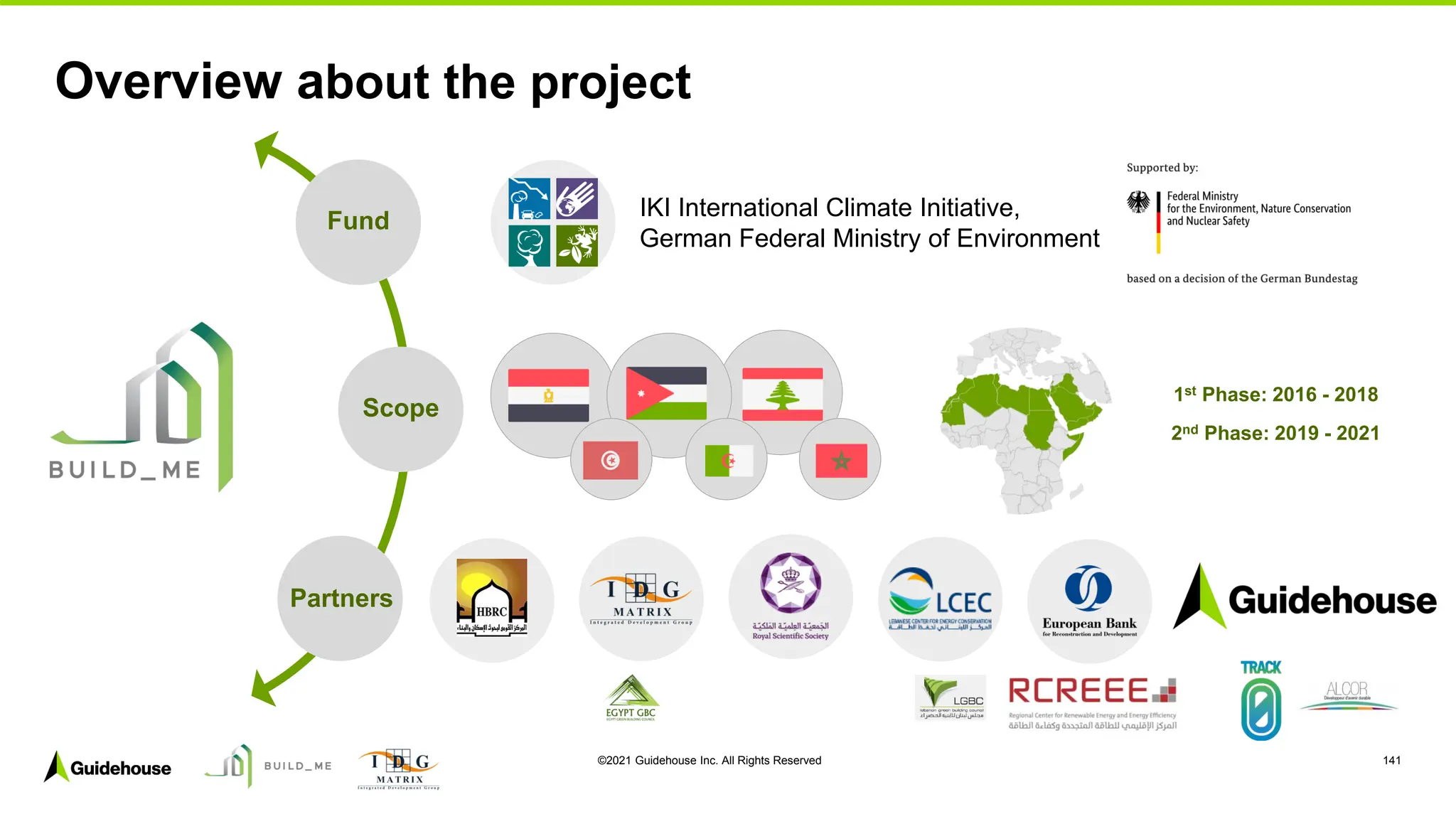
Overview about the project
Fund
Scope
IKI International Climate Initiative,
German Federal Ministry of Environment
2nd Phase: 2019 - 2021
1st Phase: 2016 - 2018
Partners
©2021 Guidehouse Inc. All Rights Reserved 142
BUILD_ME scope
Approach
Original project
2016 - 2018
• Extensive analysis and research
• Identification of barriers
• Recommendations
Project extension
2019 – 2021
• Implementation of recommendations
• Dissemination of results
• Upscaling
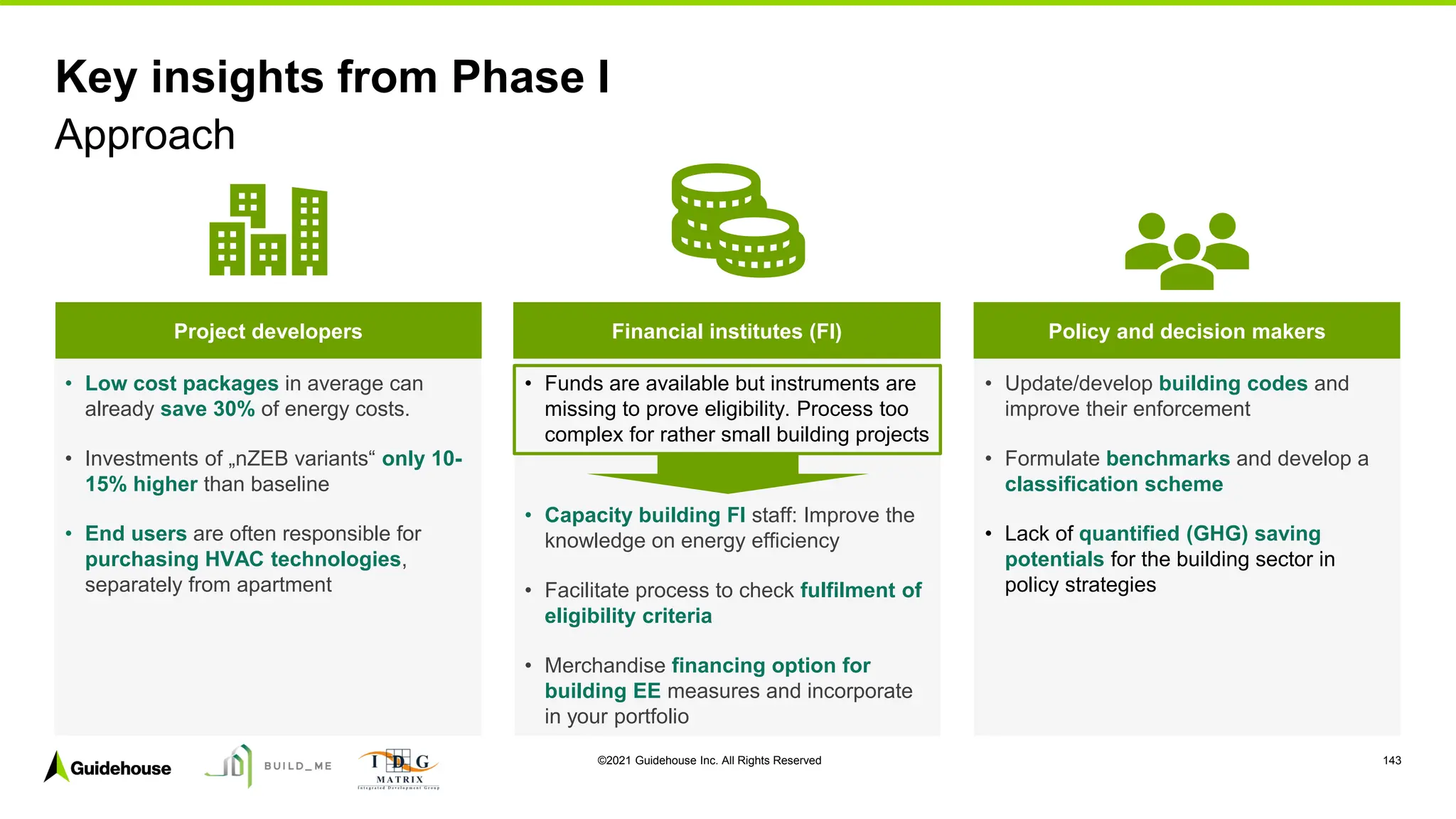
©2021 Guidehouse Inc. All Rights Reserved 143
• Funds are available but instruments are
missing to prove eligibility. Process too
complex for rather small building projects
• Capacity building FI staff: Improve the
knowledge on energy efficiency
• Facilitate process to check fulfilment of
eligibility criteria
• Merchandise financing option for
building EE measures and incorporate
in your portfolio
Financial institutes (FI)
• Update/develop building codes and
improve their enforcement
• Formulate benchmarks and develop a
classification scheme
• Lack of quantified (GHG) saving
potentials for the building sector in
policy strategies
Policy and decision makers
• Low cost packages in average can
already save 30% of energy costs.
• Investments of „nZEB variants“ only 10-
15% higher than baseline
• End users are often responsible for
purchasing HVAC technologies,
separately from apartment
Project developers
Key insights from Phase I
Approach
©2021 Guidehouse Inc. All Rights Reserved 144
Structure and objectives of Phase II
Approach
WP1
Preparatory
Steps
WP2
Support Pilot
Projects
WP3
Framework
Conditions
WP4
Capacity
Building and
Dissemination
▪ Software tool: energy performance &
cost-effectiveness
▪ Building Typology
▪ Buildings specifications & reference
values
▪ Technical support
▪ Collect insights on the ground as
input for WP3
▪ Testing EE classification scheme
▪ Support financing applications
▪ Voluntary EE classification scheme
▪ Facilitate & increase access to financing
▪ Building codes
▪ Support national strategies
(NEEAPs & NDCs)
▪ Website, workshops, trainings,
database for best practice
buildings, webinars, newsletters,
brochures, etc.
▪ Facilitate & increase access to financing & funding opportunities for EE building projects.
▪ Support the reform & transitions of political frameworks towards improving energy efficiency in the building sector.
▪ Focus on supporting the implementation of energy efficiency measures in pilot projects
Objectives and Goals
©2021 Guidehouse Inc. All Rights Reserved 145
Easier access to financing for energy efficient buildings
Approach
How to design
and finance an
energy efficient
project?
€
BEP Tool shows:
✓ [25]% energy saving
in comparison with
baseline
✓ Financing available at
local bank
Project is
realised as
energy efficient
building
Intermediating bank
grants credit based
on trusted
classification
scheme
©2021 Guidehouse Inc. All Rights Reserved 146
Support the reform & transitions of political frameworks
National strategies
NDC
NEEAPs
Regulations:
EEBC
Standards
Voluntary Classification
Scheme
EE
towards improving
energy efficiency in the
building sector
✓
©2021 Guidehouse Inc. All Rights Reserved 147
Focus on supporting the implementation of energy
efficiency measures in pilot projects
Technical support for pilot projects
New Mansoura university
Cairo West Residence
✓
Policy work
To connect the challenges and lessons learnt with the policy frameworks activities
Facilitating finance
Support the PP in their application (if any).
€
Capacity building
Provide training on EE and RE
Test the classification scheme
The national classification scheme will allow for better access to the available green finance
programs
Test the tool
To test and improve the BEP tool with real-life examples
©2021 Guidehouse Inc. All Rights Reserved 148
Zoom into Building Typology
©2021 Guidehouse Inc. All Rights Reserved 149
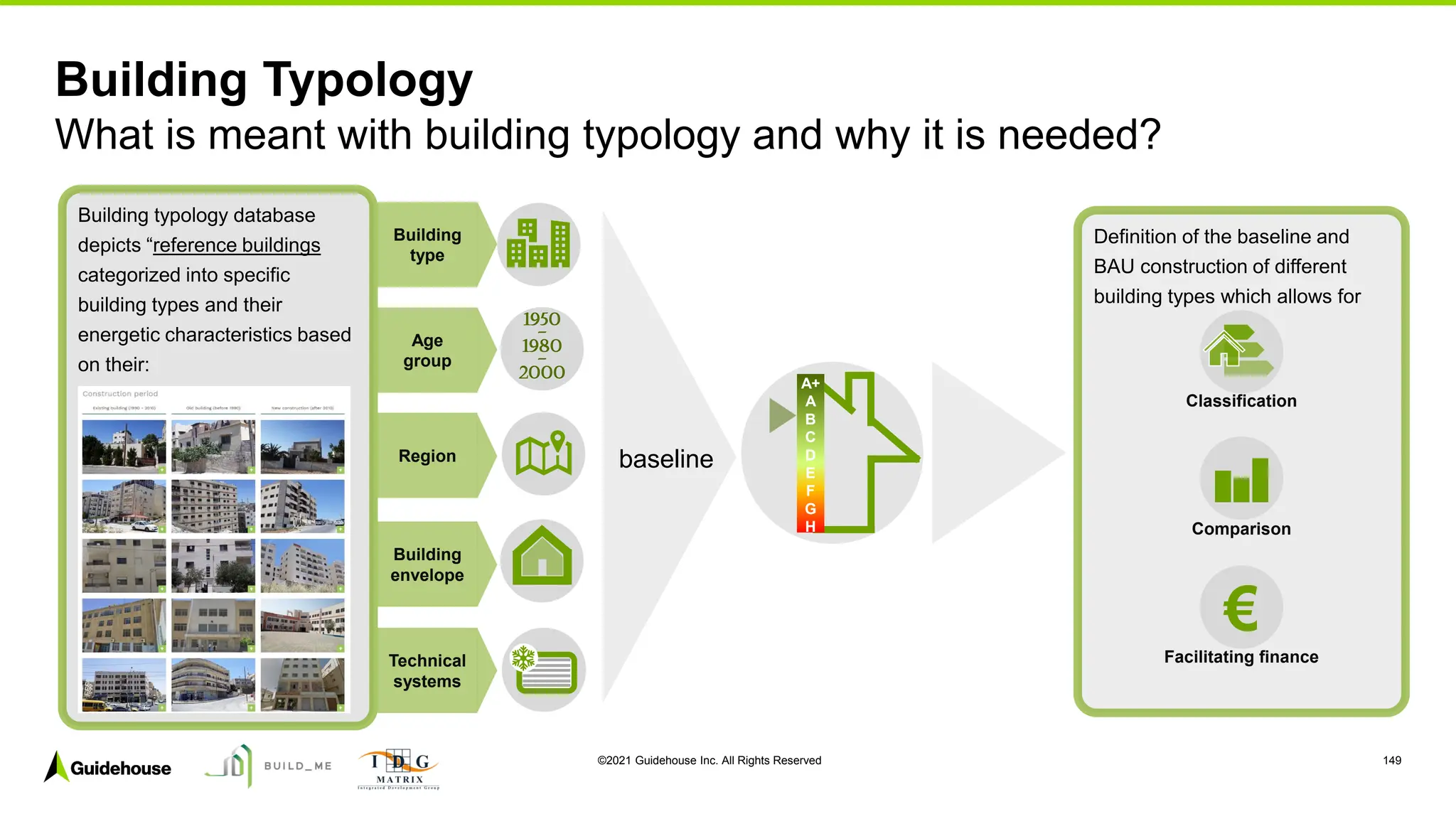
Building Typology
What is meant with building typology and why it is needed?
A+
A
B
C
D
E
F
G
H
Building typology database
depicts “reference buildings
categorized into specific
building types and their
energetic characteristics based
on their:
1950
-
1980
-
2000
Age
group
Region
Building
envelope
Technical
systems
Building
type
baseline
Definition of the baseline and
BAU construction of different
building types which allows for
Classification
Comparison
Facilitating finance
€
©2021 Guidehouse Inc. All Rights Reserved 150
Approach of development of building typology
Four main working steps 2019 2020
Aug. Sep. Oct. Nov. Dec. Jan. Feb. Mar. Apr. May. Jun. Jul. Aug. Sep.
Data collection
National partners collect data from literature,
databases and stakeholder interviews
Data validation
by Guidehouse and National partners
Reporting > upload on the website
Template formulation
prepared by Guidehouse
©2021 Guidehouse Inc. All Rights Reserved 151
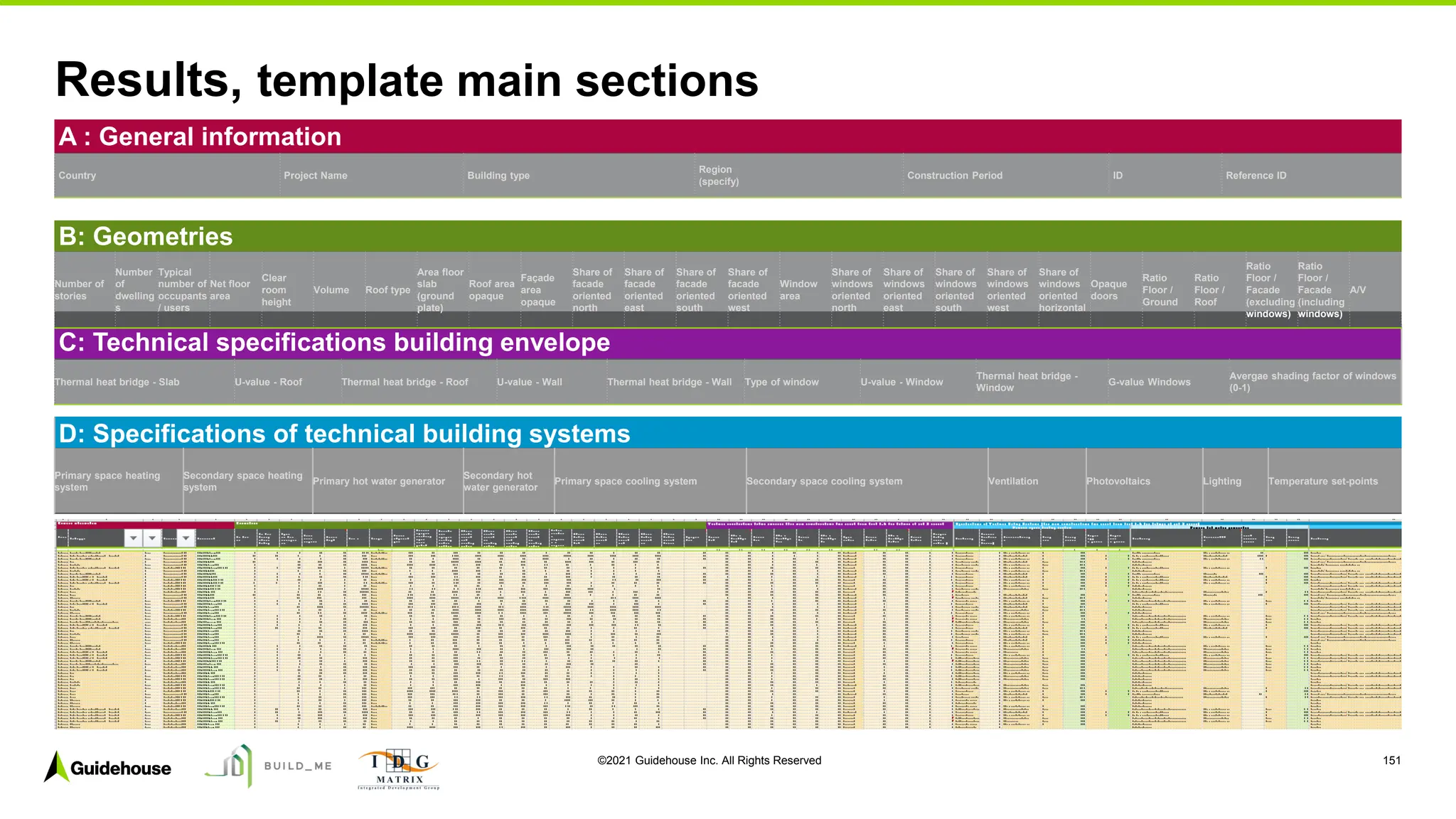
Results, template main sections
A : General information
Country Project Name Building type
Region
(specify)
Construction Period ID Reference ID
C: Technical specifications building envelope
Thermal heat bridge - Slab U-value - Roof Thermal heat bridge - Roof U-value - Wall Thermal heat bridge - Wall Type of window U-value - Window
Thermal heat bridge -
Window
G-value Windows
Avergae shading factor of windows
(0-1)
D: Specifications of technical building systems
Primary space heating
system
Secondary space heating
system
Primary hot water generator
Secondary hot
water generator
Primary space cooling system Secondary space cooling system Ventilation Photovoltaics Lighting Temperature set-points
B: Geometries
Number of
stories
Number
of
dwelling
s
Typical
number of
occupants
/ users
Net floor
area
Clear
room
height
Volume Roof type
Area floor
slab
(ground
plate)
Roof area
opaque
Façade
area
opaque
Share of
facade
oriented
north
Share of
facade
oriented
east
Share of
facade
oriented
south
Share of
facade
oriented
west
Window
area
Share of
windows
oriented
north
Share of
windows
oriented
east
Share of
windows
oriented
south
Share of
windows
oriented
west
Share of
windows
oriented
horizontal
Opaque
doors
Ratio
Floor /
Ground
Ratio
Floor /
Roof
Ratio
Floor /
Facade
(excluding
windows)
Ratio
Floor /
Facade
(including
windows)
A/V
©2021 Guidehouse Inc. All Rights Reserved 152
Building Typology | Egypt
Results
▪ Multi-family house
▪ Single-family house
▪ Education
▪ Retail/Trade
▪ Office
▪ Mixed-use
▪ Hospital
▪ Hotels
▪ New and recent
constructions (after 2015)
▪ Existing building: 1980-
2015
▪ Existing building: before
1980
▪ National
▪ Cairo
▪ Alexandria
▪ Aswan
1950
-
1980
-
2000
Age group
Building type Regions
Link to the typology on BUILD_ME website
©2021 Guidehouse Inc. All Rights Reserved 153
Zoom into Baseline
©2021 Guidehouse Inc. All Rights Reserved 154
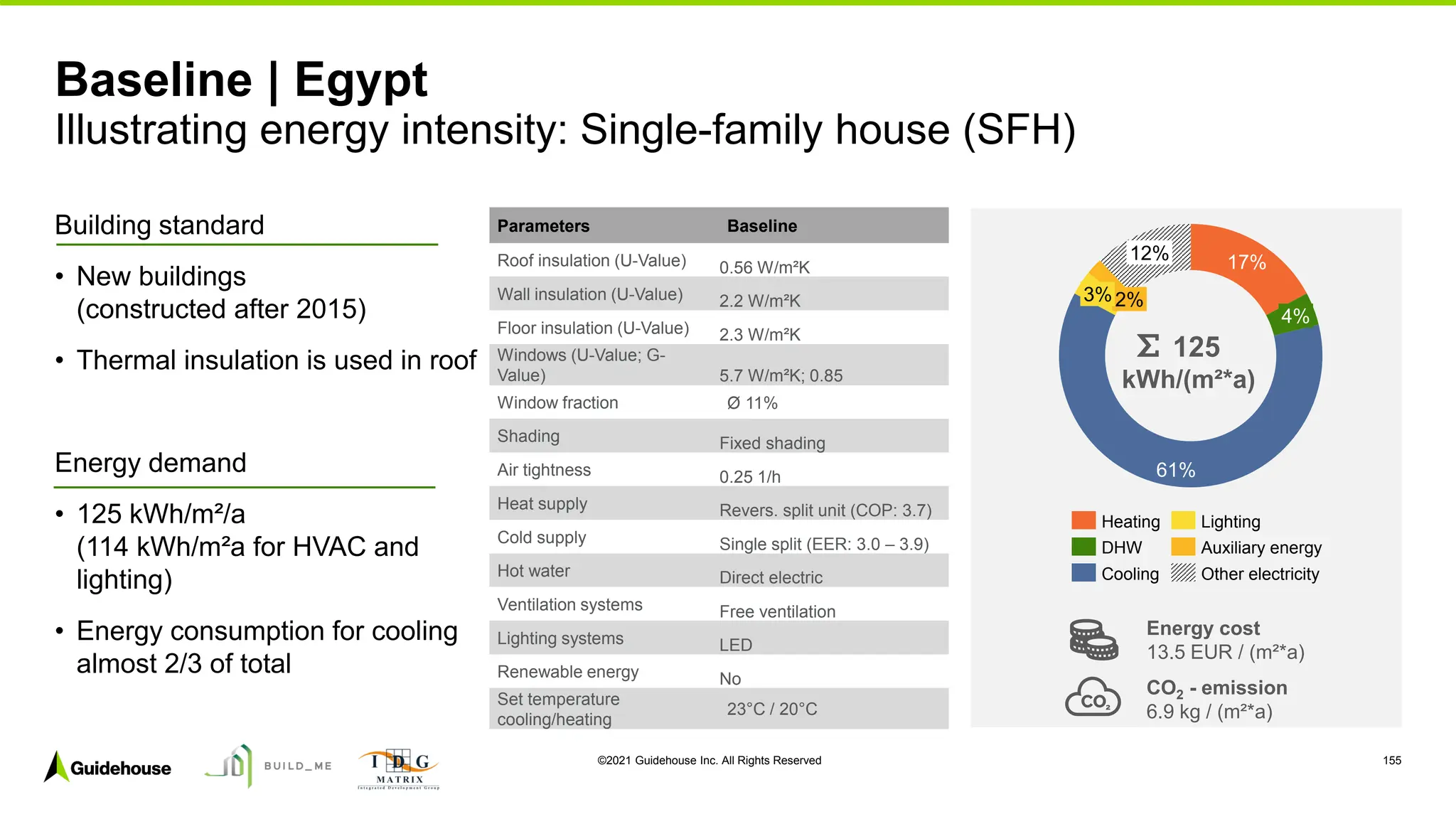
Key takeaways
• Specific final energy demand
ranges between 115 – 220
kWh/(m²a) for buildings
constructed over the past decade
• Space cooling accounts for
largest energy demand
• Space heating is only installed in
less than 50% of the cases
• Note: Other electricity stands for
plug-loads (e.g. fridge, TV, etc.)
and is informational.
Baseline | Egypt
Illustrating energy intensity of select Egyptian building types
0
20
40
60
80
100
120
140
160
180
200
220
Office
Final
energy
[kWh/(m²a)]
MFH SFH Education Retail Mixed-use
Auxiliary energy
Heating
DHW
Cooling
Lighting Ventilation
Other electricity
National baseline (new buildings, after 2015)
©2021 Guidehouse Inc. All Rights Reserved 155
17%
61%
2%
4%
12%
3%
125
kWh/(m²*a)
Building standard
• New buildings
(constructed after 2015)
• Thermal insulation is used in roof
Energy demand
• 125 kWh/m²/a
(114 kWh/m²a for HVAC and
lighting)
• Energy consumption for cooling
almost 2/3 of total
Baseline | Egypt
Illustrating energy intensity: Single-family house (SFH)
Energy cost
13.5 EUR / (m²*a)
CO2 - emission
6.9 kg / (m²*a)
Parameters Baseline
Roof insulation (U-Value) 0.56 W/m²K
Wall insulation (U-Value) 2.2 W/m²K
Floor insulation (U-Value) 2.3 W/m²K
Windows (U-Value; G-
Value) 5.7 W/m²K; 0.85
Window fraction Ø 11%
Shading Fixed shading
Air tightness 0.25 1/h
Heat supply Revers. split unit (COP: 3.7)
Cold supply Single split (EER: 3.0 – 3.9)
Hot water Direct electric
Ventilation systems Free ventilation
Lighting systems LED
Renewable energy No
Set temperature
cooling/heating
23°C / 20°C
Heating
DHW
Cooling
Lighting
Auxiliary energy
Other electricity
©2021 Guidehouse Inc. All Rights Reserved 156
Questions
Bild
von
PIRO4D
auf
Pixabay
©2021 Guidehouse Inc. All Rights Reserved 157
Building Energy
Performance (BEP)
tool
MaiAdel, IDG
Photo
by
Lukas
Blazek
on
Unsplash
30 minutes
©2021 Guidehouse Inc. All Rights Reserved 158
Performance of energy
efficiency measures & RE
• Calculate energy demand of
building
• Compare it to the country’s
baseline buildings or other
personal projects
• Determine the energy savings
of single or multiple efficiency
measures and the use of
renewable energies
Calculation of monetary
savings
• Identify cost savings resulting
from the energy efficiency
measures and get the cost-
optimal case
• Local market data is already
available for Egypt, Jordan and
Lebanon (investment cost,
energy prices) ...
• ...or enter the real investment
cost and energy prices of the
specific project (not in beta)
Free web application
• Tool is free to use as browser
application
• Optimized for mobile devices
• Provides default input values
for faster application, but also
advanced mode for
experienced user
Proven methodology
• Energy calculation is based on
the international norm for
modelling thermal building
performance (EN ISO 52016)
• The BEP-Tool was already
successfully applied in various
projects and countries
• Full transparency with a
detailed user manual, incl. all
calculation steps and internal
assumptions.
Logic of the BEP tool (1)
Customisable, transparent, adapted to the MENA region
Icons by Eucalyp from www.flaticon.com
©2021 Guidehouse Inc. All Rights Reserved 159
In comparison to other available tools, the BEP tool is
Logic of the BEP tool (2)
Customisable, transparent, adapted to the MENA region
Icons by Eucalyp from www.flaticon.com
Easy/Simple
to use
No modelling
needed
No advanced
knowledge
required
Allows for Editable
Inputs and Third
Variants' Addition
Can compare with
codes/rating systems
Useful for analysing the
retrofitting option
Provides Detailed
Explanation of the
Results
Can convert to primary
energy outputs
Can show the distribution of
CO2 savings per energy
consumer
MENA Specific
Up-to-date baseline in the
3 countries
Up-to-date cost data and
prices based on market
analysis
Updated energy consumption
patterns for building types
©2021 Guidehouse Inc. All Rights Reserved 160
Calculation methodology
Energy
• Baseline buildings
• User profiles
• HVAC system
specification
• Climates
Useful energy demand
• ISO 52016
Final energy demand
• HVAC Tool
Primary energy demand
Sizing HVAC & RE
systems
• HVAC Tool
• Geometry
• Envelope
• OP
• Climate
• HVAC and
RE systems
Investment cost
• Envelope (e.g.
insulation)
• HVAC systems
• Renewable energies
Energy cost
• Energy carrier (e.g. gas)
Other cost
• Inspection and
maintenance
• Replacement
Final & primary energy
demand...
• per energy carrier (e.g.
gas)
• per energy use
(e.g. cooling)
• specific (kWh/m²) and
total
GHG Emissions
• CO2 equivalent
Global cost
• Investment
• Energy cost
• Inspection and
maintenance
• Replacement
GHG Emissions
• HVAC and RE
systems
• Type and age
• Country
Financial
• Investment cost
• Energy prices
• Specific cost
• Energy prices
Input Calculation engine Output
Building
• Type (e.g. office)
• Geometry
• Renovation / new build
• Envelope specifications
• HVAC systems
• Renewable energies
• Operational parameters
• Location (city, country)
©2021 Guidehouse Inc. All Rights Reserved 161
Developed for the MENA region
Database from local partners & international calculation methodology
Local
investment
cost & energy
prices
Baseline reflects the
country specific
building standard
Local PEF and
CO2 emission
Factors
Baseline
buildings
Focus is on the
countries: Egypt,
Jordan and
Lebanon
Tool was successfully
applied in building
projects in the MENA
region
All data input is
collected and verified
by local partners and
project developers
Methodology is
applicable
worldwide
International
calculation
methodology:
ISO 52016
The calculation
standard is
internationally
acknowledged.
Climate
data of all
countries in the
MENA region
Internal market data is
collected from local
partners for Egypt, Jordan
and Lebanon.
International energy
calculation methodology.
Country specific climate
data, incl. multiple climate
zones within each country.
©2021 Guidehouse Inc. All Rights Reserved 162
Online Web App - Input
General Information Input Results
General
Information
Input Results
1
2
©2021 Guidehouse Inc. All Rights Reserved 163
Online Web App – Results
General Information Input Results
3
©2021 Guidehouse Inc. All Rights Reserved 164
Online Web App – Results detail
1| Quick overview
7| Performance rating
C = equal to baseline
The main facts.
2| Output selection
4 tabs to select the energy
performance indicator.
3| Overview chart
Comparison to the baseline
building.
4| Results table
Detailed results in numbers.
5| Baseline building
Detailed results of the
baseline building.
6| Comparison
Difference to the baseline
buildings.
©2021 Guidehouse Inc. All Rights Reserved 165
Online Web App – Two new features
Select building
materials
Enter thickness of
each material
1
2
Get cost delta of all systems and elements
separately
Get U-Value
3
©2021 Guidehouse Inc. All Rights Reserved 166
Questions
Bild
von
PIRO4D
auf
Pixabay
©2021 Guidehouse Inc. All Rights Reserved 167
Coffee break
Photo
by
Fahmi
Fakhrudin
on
Unsplash
©2021 Guidehouse Inc. All Rights Reserved 168
Case Studies
MaiAdel, IDG
Photo
by
Lukas
Blazek
on
Unsplash
40 minutes
©2021 Guidehouse Inc. All Rights Reserved 169
Results
Example – Current versus Improved
Current Conditions of Case Improved Scenario
©2021 Guidehouse Inc. All Rights Reserved 170
Results
Example – Current versus Improved
Current Conditions of Case Improved Scenario
©2021 Guidehouse Inc. All Rights Reserved 171
Final energy Financial
Results
Example – Current versus Improved
©2021 Guidehouse Inc. All Rights Reserved 172
Final energy Financial
Results
Example – Current versus Improved
©2021 Guidehouse Inc. All Rights Reserved 173
Instructions
Case 1 – SFH
HVAC:
Efficiency of
systems
RE – Solar for
hot water
RE - PV
Envelope
quality
HVAC: Type of
system
Shading
Objective
1 - Primary energy savings of -30%
Tools
All measures that are available in the BEP Tool (see
overview on the right)
Time
10 min to work on the case
Focus
Country: Egypt | Climate: Cairo | Building: SFH |
Age group: New construction
Measures available in
the BEP Tool
©2021 Guidehouse Inc. All Rights Reserved 174
Instructions
Case 2 – SFH
HVAC:
Efficiency of
systems
RE – Solar for
hot water
RE - PV
Envelope
quality
HVAC: Type of
system
Shading
Objective
1 - Primary energy savings of -30%
2 - Identify cost optimised measures
Tools
All measures that are available in the BEP Tool (see
overview on the right)
Time
10 min to work on the case
Focus
Country: Egypt | Climate: Cairo | Building: SFH |
Age group: New construction
Measures available in
the BEP Tool
©2021 Guidehouse Inc. All Rights Reserved 175
Discussion
How low could you go?
©2021 Guidehouse Inc. All Rights Reserved 176
Voluntary Energy
Classification Scheme
MaiAdel, IDG
15 minutes
©2021 Guidehouse Inc. All Rights Reserved 177
Starting point and objective
Adaptability to national context
Considering country needs and
managerial infrastructures
Voluntary Energy Classification Scheme
Building Energy Performance Tool
(BEP) tool as a calculation method
considering local market information
BUILD_ME Building Typology
considering the prepared typology as a
baseline
Ensure implementation and ownership of the scheme beyond BUILD_ME
Establishment of a national energy classification scheme
Systems of national
institutions
Requirements local
banks
EGY
JOR
LEB
©2021 Guidehouse Inc. All Rights Reserved 178
Option A) Integrated
▪ Integrate the BEP tool in an existing scheme
▪ BEP tool as built-in module, calculating the
energy performance of the energy chapter of
sustainable certification scheme
Option B) Independent
▪ Develop a stand-alone scheme
▪ BEP tool as stand alone with a clear focus only on energy
Problem statement
How to introduce the BEP Tool in the built environment of BM countries
Operation
What is the operational
framework? Certification
and labelling process?
Verification
How is verification,
monitoring, surveillance
and enforcement done?
Testing
Testing and roll out?
Evaluation and updates
to the scheme?
Ownership
Evaluation and ownership
of updating the scheme?
? ? ? ?
©2021 Guidehouse Inc. All Rights Reserved 179
• Final and primary energy demand
• Space heating
• Domestic hot water
• Space cooling
• Mechanical ventilation
• Photovoltaic
• Lighting
• GHG CO2 emissions
Integration of BEP Tool
Merging the BEP Tool with GPRS - As an example
BEP Integrated within GPRS
• Energy performance level
• Reductions in energy consumption
• Reduction in annual external heat gains
• Peak electrical load
• On-site and/or off-site RE
• Performance
• Inventory of energy and carbon for MEP
Step 1. Mapping BEP Tool with GPRS Step 2. Integration of BEP Tool with GPRS (within BUILD_ME II)
GPRS
Site Water Martials Environm.
Manage. Innovation
Energy
Step 3. Full Integration of BEP Tool with GPRS
BEP Tool
Next Phase
Remaining Attributes GPRS
• Availability of energy sub-meters
• Ozone depletion potential
• Guidelines on EE appliances
• Vertical transportation systems
• Refrigerants
• Operations manual for all mechanical, electrical
and plumbing (MEP)
Site Water Materials Internal Environment Management Innovation
Energy
Horizontal integration
Vertical
©2021 Guidehouse Inc. All Rights Reserved 180
Classification scores for
BUILD_ME building types
Application of the classification
score to baseline level
Methodology behind the
BUILD_ME classification
• Classification logic is based on
the European energy
performance certificates of
buildings norm [EN 15217]
• Adapted with feedback from
financial institutes active in the
markets and findings of the
building typology
• Baseline (new buildings energy
consumption) is equal to Class C
(score of 1.0)
Next steps, development of classification scheme
Identification of the rating score
Class Term Score
A
Nearly zero energy
building
<0.25
B
High performance
building
0.25 - 0.75
C
Average new
construction
0.76 - 1.25
D Stock, better quality 1.26 - 1.75
E
Stock, medium
quality
1.76 - 2.25
F Stock, poor quality 2.26 - 2.75
G
Stock, urgent
renovation demand
>2.75
A
B
C
D
E
F
G
- 75%
- 25%
Baseline
+ 25%
+ 75%
+ 125%
+ 175%
©2021 Guidehouse Inc. All Rights Reserved 181
Voluntary Energy Classification Scheme
Main conclusion and expected impacts
Market uptake
Boosting market uptake for
voluntary classification system.
Balance
Reaching required balance
between technical complexity
and accessibility of certification
system.
Accessibility
Establishing a practical,
accessible and affordable
national classification scheme
©2021 Guidehouse Inc. All Rights Reserved 182
Wrap up and
outlook
Photo
by
Martin
Adams
on
Unsplash
15 minutes
©2021 Guidehouse Inc. All Rights Reserved 183
Conclusion (1)
Several outputs will enable the acceleration of climate-friendly buildings
WP1
Preparatory
Steps
WP2
Support Pilot
Projects
WP3
Framework
Conditions
WP4
Capacity
Building and
Dissemination
• Developed public and
free available software
tool
• Developed building
typology
• Calculated baseline
• Supported 13 pilot
projects with technical
and economic
assessments of
suitable energy
concepts
• Analysed national EEBC
• Conceived voluntary EE
classification scheme
• Supported national
strategies
(NEEAPs & NDCs)
• Developed website
• Performed workshops,
trainings, webinars
• Formulated
newsletters, brochures,
etc
• Developed a database
for best practice
buildings
©2021 Guidehouse Inc. All Rights Reserved 184
Performance of
energy efficiency
measures & RE
Calculation of
monetary savings
Free web application Proven methodology
Conclusion (2)
Offered a customisable, transparent tool adapted to the MENA region
Icons by Eucalyp from www.flaticon.com
©2021 Guidehouse Inc. All Rights Reserved 185
€
Conclusion (3)
Transparency
of energy
consumptions
The benefits of a voluntary classification scheme
Marketing and
boosting
competition
Reduction of
energy bills
Job creation Facilitating
finance
€
©2021 Guidehouse Inc. All Rights Reserved 186
Final Discussions
Collecting feedback and ideas
©2021 Guidehouse Inc. All Rights Reserved 187
Wrap up and
outlook
Photo
by
Martin
Adams
on
Unsplash
©2020 Guidehouse All rights reserved.
Connect with us:
Icons
by
Smashicons,
Freepix
Visit us on the web at www.buildings-mena.com
Download our publications and explore our resources
Sign up for our newsletter by emailing us at
BUILD_ME@guidehouse.com
©2021 Guidehouse Inc. All Rights Reserved 189
Contact
©2020 Guidehouse Inc. All rights reserved. This content is for
general information purposes only, and should not be used as
a substitute for consultation with professional advisors.
Mohamed Salheen
salheen@idg.com.eg
Rana Abouzeid
rana.abouzeid@idg.com.eg
Mai Adel
mai_adel@idg.com.eg
Norhan El Dallal
norhan.eldallal@idg.com.eg
Doha Moharram
doha.moharram@idg.com.eg
This project is part of the International Climate Initiative (IKI). The Federal
Ministry for the Environment, Nature Conservation and Nuclear Safety (BMU)
supports this initiative on the basis of a decision adopted by the German
Bundestag.
Carsten Petersdorff
carsten.petersdorff@guidehouse.com
Riadh Bhar
riadh.bhar@guidehouse.com
Marco Reiser
marco.reiser@guidehouse.com
Eslam Mahdy
eslam.mahdy@guidehouse.com
©2021 Guidehouse Inc. All Rights Reserved 190
Online resources
www.buildings-mena.com
Email newsletter
One-pager
News items:
Event at COP25
National
workshops in Q1
Online tools:
Demonstration project database
Building typology database
BEP tool
Two-page
country factsheets

EE Building Guideline for MENA Region.pdf

  • 1.
    BUILD_ME Training: Basics ofclimate-friendly buildings and the BEP Tool 3 & 4 August 2021
  • 2.
    ©2021 Guidehouse Inc.All Rights Reserved 2 Welcome words Mohamed Salheen, IDG Bild von PIRO4D auf Pixabay
  • 3.
    ©2021 Guidehouse Inc.All Rights Reserved 3 Provide an overview of the big picture Transfer general technical understanding of holistic assessment of EE building projects Increase awareness of the importance and financial attractiveness of investing in EE measures Enable the utilisation of the BEP tool Objectives of the training session For project developers, architects and engineers 1 2 3 4
  • 4.
    ©2021 Guidehouse Inc.All Rights Reserved 4 Mohamed Salheen Founder of IDG, Integrated Planning and Design Expert, IDG salheen@idg.com.eg Mai Adel Building Energy Systems Expert, IDG mai_adel@idg.com.eg Marian Nessim Energy and Building materials Expert, HBRC mariannessim7@gmail.com Presenters of the training session For project developers, architects and engineers
  • 5.
    ©2021 Guidehouse Inc.All Rights Reserved 5 Agenda Day 01 – Setting the scene Welcome and Instructions 10:30 – 10:35 Introduction to climate-friendly buildings 10:35 – 10:55 Policy instruments for climate-friendly buildings 10:55 – 11:15 Coffee Break 11:15 – 11:25 Climate-friendly buildings from a technology perspective 11:25 – 12:15 Climate-friendly buildings from a financial perspective 12:15 – 12:55 Wrap up and final remarks 12:55 – 01:00
  • 6.
    ©2021 Guidehouse Inc.All Rights Reserved 6 Introduction to Climate-Friendly Buildings MaiAdel, IDG 20 minutes
  • 7.
    ©2021 Guidehouse Inc.All Rights Reserved 7 Understand the big picture Improve familiarity with common definitions and terminology Introduce Building Energy Levels and Sustainable Certifications Key learnings 1 2 3
  • 8.
    ©2021 Guidehouse Inc.All Rights Reserved 8 The big picture Photo by Wolfgang Hasselmann on Unsplash
  • 9.
    ©2021 Guidehouse Inc.All Rights Reserved 9 Setting the scene – the relevance of low energy buildings Energy Consumption in Egypt 9 Electricity Consumption by Sector Source: http://documents1.worldbank.org/curated/en/578631498760292189/pdf/Final-Output-Summary.pdf
  • 10.
    ©2021 Guidehouse Inc.All Rights Reserved 10 Setting the scene – the relevance of low energy buildings The Sustainability Triangle or three Pillars of Sustainability 10 Economic Environmental Social EE
  • 11.
    ©2021 Guidehouse Inc.All Rights Reserved 11 Economic reasons Some selected examples Energy security Cost-efficient abatement Energy price development
  • 12.
    ©2021 Guidehouse Inc.All Rights Reserved 12 Environmental reasons Some selected examples Rising temperatures Sea level rise Droughts Extreme weather events Pollution
  • 13.
    ©2021 Guidehouse Inc.All Rights Reserved 13 Social reasons Some selected examples Job creation Removal of subsidies Public health and productivity
  • 14.
    ©2021 Guidehouse Inc.All Rights Reserved 14 Definitions, terminology, boundary conditions Photo by zibik on Unsplash
  • 15.
    ©2021 Guidehouse Inc.All Rights Reserved 15 A couple of concepts and definitions are essential in order to embark on energy efficiency projects: Climate parameters Energy units/levels Building energy standards Definitions, standards and technical terms Knowledge of standard terminology required to understand EE projects 1 2 3
  • 16.
    ©2021 Guidehouse Inc.All Rights Reserved 16 Cooling Degree Days (CDD) • CDD = (Tm- 18.3°C) if Tm is higher than or equal to 18.3°C • CDD = 0 if Tm is lower than 18.3°C where Tm is the mean ((Tmin + Tmax)/ 2) outdoor temperature over a period of 1 day Heating Degree Days (HDD) • HDD = (18°C - Tm) if Tm is lower than or equal to 15°C (heating threshold) • HDD = 0 if Tm is higher than 15°C where Tm is the mean ((Tmin + Tmax)/ 2) outdoor temperature over a period of 1 day Solar Irradiation in W/m² • Solar irradiance is often integrated over a given time period in order to report the radiant energy emitted into the surrounding environment (kWh per square metre) during that time period. Humidity in % • The higher the relative humidity in the air, the more energy is needed to cool down the air (latent energy). Climate parameters
  • 17.
    ©2021 Guidehouse Inc.All Rights Reserved 17 Climate zones Egypt No. Region Representative City 1 North Coast Region Alexandria Port Said 2 Delta and Cairo Region Cario Region: Cairo Delta: Tanta 3 Region of Northern Upper Egypt Asyut 4 Region of Southern Upper Egypt Luxor 5 East Coas Region Hurghada 6 Aliplano Region St Catherine 7 Desert Region Dakhla City 8 Region of Southern Egypt Aswan Source: https://www.researchgate.net/figure/Classification-of-climatic-zones-in-Egypt-according-to-HBRC_fig1_264419622
  • 18.
    ©2021 Guidehouse Inc.All Rights Reserved 18 • The climate in Cairo is predominantly hot. • It reaches an average humidity rate of 56% • External temperatures range from above 13 to 41°C with average temperatures around 24°C. Climate analysis I Cairo Outdoor temperature • High number of >1,800 of CDD and a limited number of 291 of HDD. • The amount of CDD is more than six times the HDD. • Therefore, Major share of the energy demand is dedicated to cooling. • High horizontal irradiation of > 2,000 kWh/(m²*a) and >1000 kWh/(m²*a) for East, South and West orientation. • Large potential for energy generation through solar radiation, solar water heaters, PVs and solar cooling. Heating and Cooling Degree Days Solar Irradiation * Calculated according to ASHRAE 2001 methodology
  • 19.
    ©2021 Guidehouse Inc.All Rights Reserved 19 Solar radiation BUILD_ME countries (Egypt, Jordan and Lebanon) Source: https://solargis.com/maps-and-gis-data/download/jordan
  • 20.
    ©2021 Guidehouse Inc.All Rights Reserved 20 Energy unit/level definitions Generation of final energy Useful energy Loss in generation Losses in transportation Generation of useful energy Final energy Loss in generation of useful energy Losses in distribution Primary energy Losses in storage • Primary Energy refers to energy sources as found in their natural state. • Final Energy refers to energy consumption based on the calculation of heating, ventilation, cooling, lighting, domestic hot water, and auxiliary energy consumption (e.g. pumps). • Useful Energy is comparable with thermal energy demand. Source: https://www.sciencedirect.com/science/article/abs/pii/S0142061512003778
  • 21.
    ©2021 Guidehouse Inc.All Rights Reserved 21 SEER • Seasonal Energy Efficiency Ratio (SEER) is used to define the average annual cooling efficiency of an air-conditioning or heat pump system. • The term SEER is similar to the term EER but is related to a typical (hypothetical) season rather than for a single rated condition. EER • Efficiency Ratio (EER) is a term generally used to define cooling efficiencies • The efficiency is determined at a single rated condition specified by an appropriate equipment standard and is defined as the ratio of net cooling capacity - or heat removed in Btu/h - to the total input rate of electric power applied - in Watts. The units of EER are Btu/Wh. • Higher EER = more efficient system COP • Coefficient of Performance (COP) is the ratio of cooling or heating to electricity consumption. • A refrigerator with a COP of 2 transforms 2 Watts of heat using one Watt of electricity. • An air conditioner with a COP of 4 transforms 4 Watts of heat using one Watt of electricity. Efficiency Definitions
  • 22.
    ©2021 Guidehouse Inc.All Rights Reserved 22 Building energy levels and sustainable certification schemes Photo by zibik on Unsplash Source: https://unsplash.com/photos/8RfX3u26FkM
  • 23.
    ©2021 Guidehouse Inc.All Rights Reserved 23 Buildings energy levels Net Zero Energy Buildings (NZEB) • Total amount of energy used by the building on an annual basis is equal to the amount of renewable energy created on-site • Need to consider country-specific climate conditions, primary energy factors, ambition levels, calculation methodologies and building traditions • Existing NZEB definitions can differ significantly (e.g. regarding the definition of energy, which can be either final or primary energy) -50 0 50 100 150 200 250 Existing Building Stock New Buildings Passive House Standard Net Zero Energy Building Plus Energy Building Energy Consumption (kWh/m²a) Comparison of Building Types by Energy Consumption
  • 24.
    ©2021 Guidehouse Inc.All Rights Reserved 24 Green building certificates Definition and international schemes United States LEED Australia NABERS Germany DGNB France HQE United Kingdom BREEAM International IFC-EDGE • Used to assess and recognise buildings that meet certain green building requirements or standards. • Recognise and reward companies and organisations who build and operate greener buildings • Encourage and incentivise companies to push the boundaries on sustainability • Supports banks and financing institutions in having a clear measurable description of green buildings • World Green Building Council sets Quality Standards for rating tools around the world.
  • 25.
    ©2021 Guidehouse Inc.All Rights Reserved 25 Green building certificates Regional schemes Jordan • DALEEL • SAWSANA Lebanon • ARZ • GRASS Egypt • Green Pyramid Rating System • Tarsheed
  • 26.
    ©2021 Guidehouse Inc.All Rights Reserved 26 Certified Green Buildings Egyptian Examples •Royal Herbs Farm Complex •Al Wahat al-Bahareya, Egypt •Certification Earned: Tarsheed •Business Link Headquarters •New Cairo, Egypt •Certification Earned: LEED •Fort Arabesque Resort •Hurghada, Egypt •Certification Earned: Green Star •CIB Headquarters •Smart Village, Egypt •Certification Earned: GPRS BUILD_ME Demonstration Buildings
  • 27.
    ©2021 Guidehouse Inc.All Rights Reserved 27 Discussion What other rated building have you participated in designing, constructing or know of? What obstacles did you face? Share your ideas & experiences BUILD_ME Demonstration Buildings
  • 28.
    ©2021 Guidehouse Inc.All Rights Reserved 28 Conclusion Understand the big picture • Global Warming is causing tremendous environmental stress • EE/RE huge economic and social potential Familiarity with common definitions and terminology • Boundary conditions like climate and economic parameters (energy costs, CAPEX) influences the feasibility of low energy buildings Introduce building energy levels and sustainable certifications • Several international sustainable certification schemes exist, but all BUILD_ME countries have as well national schemes in operation
  • 29.
    ©2021 Guidehouse Inc.All Rights Reserved 29 Questions Bild von PIRO4D auf Pixabay
  • 30.
    ©2021 Guidehouse Inc.All Rights Reserved 30 Policy instruments for climate-friendly buildings MaiAdel, IDG Photo by Lukas Blazek on Unsplash 20 minutes
  • 31.
    ©2021 Guidehouse Inc.All Rights Reserved 31 Key take-aways 2 – Policy instruments session Diversity of possible instruments Principles of policy instrument formulation
  • 32.
    ©2021 Guidehouse Inc.All Rights Reserved 32 Different types of policy instruments Carrot = Incentives Subsidy programs Investment grants Tax rebates Stick = Regulations EEBC Performance standards Solar energy ordinance Tambourine = Information Awareness programs Trainings Labels
  • 33.
    ©2021 Guidehouse Inc.All Rights Reserved 33 Carrot = Incentives Instrument Features and characteristics Status Soft loans • Soft loans are loans offered at subsidised interest rates (i.e. lower than the market rate) to consumers who invest in energy efficient technologies • Implemented by banking institutions - CIB Bank solar loan (RE) - QNB Bank green loan (RE) Investment grants • A financial award to facilitate a goal or incentivise performance • Do not have to be paid back under most conditions • Some have waiting periods before the grantee can take full ownership of the financial reward - EBRD / GEFF Tax rebates • Amount of money that project developers can subtract directly from the income taxes that they owe • Tax credits are more favourable than tax deductions because they actually reduce the tax due, not just the amount of taxable income • Three basic types of tax credits: non-refundable, refundable, and partially refundable - Tax reduction in the energy sector (Amendment to law no. 72) Source: Invstopedia
  • 34.
    ©2021 Guidehouse Inc.All Rights Reserved 34 Stick = Regulations Instrument Features and characteristics Status Energy Efficiency Building Codes Building standards can be classified in four categories: 1. Maximum heat transfer through individual building components (e.g. walls, roof, windows) 2. Limit on the overall heat transfer through the building envelope 3. Limitation of heating/cooling demand (taking into account the contribution from ventilation losses, passive solar gains and internal heat sources (maximum demand per m3 or m2). 4. Energy performance standards EERBC in 2005 EECBC in 2009 Minimum energy performance standards These standards consider the whole building as a system and also include building equipment such as heating and air conditioning systems, ventilation, water heaters, and in some countries even pumps and elevators MEPS are mandatory (last update in 2018) Solar Thermal Ordinance Regulate the incorporation of solar thermal energy and its use for the production of sanitary hot water in the city’s buildings Many of existing STOs are related to national or regional energy laws and implemented through municipal building codes ---
  • 35.
    ©2021 Guidehouse Inc.All Rights Reserved 35 Energy Efficiency Building Codes – Egypt Stick = Regulations Energy Efficiency Residential Buildings Code (EERBC) Energy Efficiency Commercial Buildings Code (EECBC)
  • 36.
    ©2021 Guidehouse Inc.All Rights Reserved 36 Instrument Features and characteristics Awareness raising programmes • Methods for monitoring energy consumption and possible energy savings • Demonstrate that there are proven technologies, methods and services that can substantially and cost-effectively reduce energy consumption Building energy certificates • Mandatory / Voluntary • Enable the buyer to obtain information about the energy consumption of the dwelling they are going to buy or rent Trainings • Capacity building programs, training courses • Develop culture of literacy in energy efficiency Tambourine = Information
  • 37.
    ©2021 Guidehouse Inc.All Rights Reserved 37 Energy Performance Certificate Example Tambourine= Information • S: https://selfbuild.ie/advice/basics/energy-ratings/
  • 38.
    ©2021 Guidehouse Inc.All Rights Reserved 38 Discussion Which instrument do you consider as the best starting point for boosting the transformation to climate-friendly buildings? Share your ideas
  • 39.
    ©2021 Guidehouse Inc.All Rights Reserved 39 Conclusion Diversity of possible instruments Selection requires national/regional adaptation Principles of policy instrument formulation Carrot, Stick and Tambourine principle
  • 40.
    ©2021 Guidehouse Inc.All Rights Reserved 40 Questions Bild von PIRO4D auf Pixabay
  • 41.
    ©2021 Guidehouse Inc.All Rights Reserved 41 Coffee break Photo by Fahmi Fakhrudin on Unsplash
  • 42.
    ©2021 Guidehouse Inc.All Rights Reserved 42 Climate-friendly buildings from a technology perspective Marian Nessim, HBRC Photo by Lukas Blazek on Unsplash 50 minutes
  • 43.
    ©2021 Guidehouse Inc.All Rights Reserved 43 Principles of a holistic planning Key Learnings Measures to reduce energy consumption Renewable energy measures Cost efficiency measures
  • 44.
    ©2021 Guidehouse Inc.All Rights Reserved 44 General principles to conceive a low energy building Embed Trias energetica, „The most sustainable energy is saved energy“ BUILD_ME Project Manage operations Use fossil fuels efficiently Use renewable energies Reduce energy demand Holistic planning
  • 45.
    ©2021 Guidehouse Inc.All Rights Reserved 45 Energy performance Investment Payback period Small energy savings Small investment Less than 5 years Moderate energy savings Moderate investment 5 to 15 years High energy savings High investment More than 15 years Legend allowing a quick assessment of the measures
  • 46.
    ©2021 Guidehouse Inc.All Rights Reserved 46 Step 1: Holistic planning Source. https://unsplash.com/photos/KqEYj1VHA_o
  • 47.
    ©2021 Guidehouse Inc.All Rights Reserved 47 Influence of design decisions on life cycle impacts and costs Source: Kohler & Moffatt, 2003
  • 48.
    ©2021 Guidehouse Inc.All Rights Reserved 48 Step 2: Reduce energy demand (Passive) Source: https://unsplash.com/photos/0MKzwPmehRE
  • 49.
    ©2021 Guidehouse Inc.All Rights Reserved 49 Energy Consumption in Egypt • Egyptian Electricity Holding Company annual report 2018-2019 • New and Renewable Energy Authority annual report 2020
  • 50.
    ©2021 Guidehouse Inc.All Rights Reserved 50 Urban Heat Island Phenomenon • The term heat island effect describes the characteristic warmth of both the atmosphere and the surfaces in developed urban areas compared to their (non-urbanized) surroundings, usually the nearby underdeveloped or undeveloped suburban and rural areas. The annual mean air temperature of a city with 1 million people or more can be (1-3 oC) warmer than its surroundings. On a clear calm summer night, however, the temperature difference can be as much as (12 oC). https://www.usgs.gov/media/images/urban-heat-islands
  • 51.
    ©2021 Guidehouse Inc.All Rights Reserved 51 Orientation Orientation on the east-west axis to reduce cooling load a) Orientiation
  • 52.
    ©2021 Guidehouse Inc.All Rights Reserved 52 Building form and typology Compact building form has a lower surface/volume ratio (S/V) BUILD_ME Project Building form and typology
  • 53.
    ©2021 Guidehouse Inc.All Rights Reserved 53 Building form Heating, Cooling, Lighting. 4th edition
  • 54.
    ©2021 Guidehouse Inc.All Rights Reserved 54 Landscape design Use vegetation for a better microclimate, shading, thermal mass Landscape design
  • 55.
    ©2021 Guidehouse Inc.All Rights Reserved 55 Thermal zoning Organise space according to time of use and sun exposure Thermal zoning
  • 56.
    ©2021 Guidehouse Inc.All Rights Reserved 56 Window Wall Ratio [WWR] Natural Lighting Windows and their ratio Heating, Cooling, Lighting. 4th edition Energy Efficient Building Guidelines for MENA region
  • 57.
    ©2021 Guidehouse Inc.All Rights Reserved 57 • Roof design Building Envelope Opaque -200 0 200 400 600 800 1000 1200 0 5 10 15 20 N E S W Horizontal -100 0 100 200 300 400 500 600 700 0 5 10 15 20 N E S W Horizontal Climate and Architecture of Hot regions
  • 58.
    ©2021 Guidehouse Inc.All Rights Reserved 58 Colour The lighter the colour, the higher the reflection, the less the absorption S: http://www.comfortfutures.com/urban-heat-island-effect Colours A white roof reduces the cooling load Energy Efficient Building Guidelines for MENA region
  • 59.
    ©2021 Guidehouse Inc.All Rights Reserved 59 Material Selection Thermal insulation Thermal insulation
  • 60.
    ©2021 Guidehouse Inc.All Rights Reserved 60 Material Selection Regular Block, U=5.55 W/m2K Volcanic aggregate, U=3.13 W/ K Perlite aggregate, U=2.00 W/m2K Concrete block with different U-values (the lower, the better) Cavity wall with 3cm polystyrene insulation in Jordan Energy Efficient Building Guidelines for MENA region
  • 61.
    ©2021 Guidehouse Inc.All Rights Reserved 61 Material Selection Thermal bridges Thermal bridges
  • 62.
    ©2021 Guidehouse Inc.All Rights Reserved 62 Building Envelope Transparent Absorbing glass: 6mm Reflecting glass & clear glass: 6mm Double glazing: effective to reduce the cooling load Energy Efficient Building Guidelines for MENA region
  • 63.
    ©2021 Guidehouse Inc.All Rights Reserved 63 Shading Reduction of solar heat gain due to window shading Fixed shading south • Horizontal Shading for South Elevation Climate and Architecture of Hot regions
  • 64.
    ©2021 Guidehouse Inc.All Rights Reserved 64 • Vertical Shading for East and West Elevations • Egg crate for South East and South West Elevations Movable Shading east/west Climate and Architecture of Hot regions Shading
  • 65.
    ©2021 Guidehouse Inc.All Rights Reserved 65 Material selection Air tightness – avoid leakages (Infiltration) Air tightness
  • 66.
    ©2021 Guidehouse Inc.All Rights Reserved 66 Passive cooling Thermal mass, use night ventilation to maximise buffer https://fairconditioning.org/knowledge/passive-design/thermal-mass/ Source: http://www.yourhome.gov.au/passive-design/thermal-mass Thermal mass
  • 67.
    ©2021 Guidehouse Inc.All Rights Reserved 67 Natural ventilation Strategies: single-sided (a), cross (b), stack ventilation (c) Source: http://www.comfortfutures.com/urban-heat-island-effect Natural ventilation
  • 68.
    ©2021 Guidehouse Inc.All Rights Reserved 68 1. Orientation 2. Natural ventilation 3. Thermal zoning 4. Building form and typology Compactness, WWR 5. Shading 6. Material selection Insulation, thermal bridges, air tightness, thermal mass 7. Landscape design Source: https://www.climamed.eu/wp-content/uploads/files/Energy-Efficient-Building_Guideline-for-MENA-Region- NOV2014.pdf Further reading: Climate Responsive Strategies MED-ENEC Brochure 2013, EE Building Guideline for MENA Region
  • 69.
    ©2021 Guidehouse Inc.All Rights Reserved 69 Discussion Which of these measures did you use in your projects/designs? What tools do you use to evaluate the suitability of the measures? Share your ideas & experiences
  • 70.
    ©2021 Guidehouse Inc.All Rights Reserved 70 Step 3: Integrate renewable energies Source. https://unsplash.com/photos/BB0mMC8y0Pc
  • 71.
    ©2021 Guidehouse Inc.All Rights Reserved 71 Renewable energies Scope of training Photovoltaics Heat pumps Solar thermal systems
  • 72.
    ©2021 Guidehouse Inc.All Rights Reserved 72 Solar thermal How does a solar thermal system function? Source: https://www.appropedia.org/File:Thermosyphon.gif https://www.eia.gov/energyexplained/solar/solar-thermal-collectors.php Themosiphon Pumped system
  • 73.
    ©2021 Guidehouse Inc.All Rights Reserved 73 Collectors types Source: http://www.windupbattery.com/energy/solar/heating-panels-components.htm Simple absorbers Flat plate collectors Vacuum collectors
  • 74.
    ©2021 Guidehouse Inc.All Rights Reserved 74 Photovoltaics How does a PV system work? Fuse box Inverter DC PV modules AC Grid Utility meter Grid-connected
  • 75.
    ©2021 Guidehouse Inc.All Rights Reserved 75 Photovoltaics How does a PV system work? Fuse box Inverter DC AC Stand-alone PV module Battery charger DC Storage system Load centre
  • 76.
    ©2021 Guidehouse Inc.All Rights Reserved 76 Photovoltaics How does a PV system work? Fuse box Inverter PV modules AC Grid Utility meter Hybrid Storage system (optional) DC Load centre
  • 77.
    ©2021 Guidehouse Inc.All Rights Reserved 77 Photovoltaics Overview of technology/modules 14 – 18% Eff. 18 – 22% Eff. Source:https://www.solarquotes.com.au/panels/ph otovoltaic/monocrystalline-vs-polycrystalline/ 10 – 16% Eff. Mono-crystalline Poly-crystalline Thin films
  • 78.
    ©2021 Guidehouse Inc.All Rights Reserved 78 Photovoltaics Conclusion Visible technology also supports marketing of the building asset Sharp cost reductions make PV cost-efficient High solar radiation in the MENA region
  • 79.
    ©2021 Guidehouse Inc.All Rights Reserved 79 Source : https://www.ehpa.org/technology/ Heat pump How does a heat pump work?
  • 80.
    ©2021 Guidehouse Inc.All Rights Reserved 80 Heat pump examples Source: air Source: water Source: https://www.ehpa.org/ Source: https://www.ehpa.org/
  • 81.
    ©2021 Guidehouse Inc.All Rights Reserved 81 Heat pump examples Source: earth collector Source: earth-tube Source: https://www.ehpa.org/ Source: https://www.ehpa.org/
  • 82.
    ©2021 Guidehouse Inc.All Rights Reserved 82 Advantages • Highly efficient technology • Low operational costs • Heating, DHW and cooling possible • Key technology in combination with PV to decarbonise heating and cooling supply Disadvantages • High investment costs • Limited availability in the national market • Lack of experts/craftsmen • Most technologies still use climate- unfriendly instead of natural refrigerants Heat pumps Discussion
  • 83.
    ©2021 Guidehouse Inc.All Rights Reserved 83 Renewable energies Conclusion Photovoltaics have experienced a sharp decrease in system costs. And in major parts of the MENA region regulative frameworks are in place. So PV is currently experiencing a big push in the MENA region. Heat pumps are still rare in the MENA region (besides air/air). Main reasons are the high investment costs and the lack of experienced craftsmen. Best practices can be drawn from Lebanon HP stimulus programme comprised of awareness raising measures, training, and financial support. Solar Thermal Systems (ST) already mature technology in the MENA region. In some MENA countries specific incentive programs needed to accelerate the deployment of ST.
  • 84.
    ©2021 Guidehouse Inc.All Rights Reserved 84 Discussion Did you integrate any RE measures in your projects/designs? What challenges did you face? Share your ideas & experiences
  • 85.
    ©2021 Guidehouse Inc.All Rights Reserved 85 Step 4: Use high efficiency HVAC Appliances/ Lighting units Source: https://unsplash.com/photos/JUAVCUMY008
  • 86.
    ©2021 Guidehouse Inc.All Rights Reserved 86 Heating • Gas non-condensing • Gas condensing • Oil non-condensing • Oil condensing • Portable LPG (gas) heater • Portable kerosene heater • Heat pumps (already covered) Hot Water • Combined with heating system • Dedicated gas heater • Dedicated electric heater • Solar Thermal (already covered) AC (Air-Conditioning) • Movable system • Mounted single split or window air conditioner • Centralised multi-split system • VRF – centralised multi-split • Central systems HVAC Overview of selected systems Ventilation • Natural ventilation • Mechanical ventilation • Mechanical ventilation incl. heat/cold recovery
  • 87.
    ©2021 Guidehouse Inc.All Rights Reserved 87 Heating Principle of a condensing boiler Source: http://gasboilerforums.com/condensing.html Non-condensing Condensing
  • 88.
    ©2021 Guidehouse Inc.All Rights Reserved 88 Heating Overview of efficiencies 50 60 70 80 90 100 110 120 Efficiency % 0 100 200 300 400 500 Air Source heat pump Ground source heat pump Air-air heat pump Efficiency % (incl, COP) • Condensing boilers can save 10-15% in comparison to non-condensing boilers • Portable heater are the least efficient appliances in this comparison with efficiencies around 55-75% • The COP of heat pumps are mainly influenced by the difference of source temperature and the system temperature • The lower this delta, the higher the real COP
  • 89.
    ©2021 Guidehouse Inc.All Rights Reserved 89 Heating Overview of qualitative assessment Heating System Energy performance Investment Payback period Gas non-condensing Gas condensing Oil non-condensing Portable LPG (gas) heater Portable kerosene heater Air source heat pump Ground source heat pump Air-air heat pump
  • 90.
    ©2021 Guidehouse Inc.All Rights Reserved 90 • Efficiency depends on heating system and additional transmission (and storage) losses • Centrally placed in basement or in the apartment • High efficiency: no transmission losses as decentrally installed • Needs decentral gas connection • High efficiency: no transmission losses as decentrally installed, CO2 emissions depend on grid • Needs high power electric connection Hot water Combined w. Heating System Dedicated gas heater Dedicated electric heater
  • 91.
    ©2021 Guidehouse Inc.All Rights Reserved 91 No recovery included Moderate/high efficiency (up to 70%) Ventilation Fresh air Exhaust air Ventilation unit Fresh air Exhaust air Ventilation unit Supply air Return air Mechanical ventilation Mechanical ventilation inc. recovery (rotary or circulation exchanger) Supply air Return air
  • 92.
    ©2021 Guidehouse Inc.All Rights Reserved 92 Decentral One AC per room (e.g. window or split units) Central – small scale One AC for a group of rooms (e.g. VRF or multi-split units) Central – large scale One AC per building (e.g. chiller serving VAV, fan coil units or chilled beams or ceilings) Air conditioning Main technologies AC AC AC AC AC AC
  • 93.
    ©2021 Guidehouse Inc.All Rights Reserved 93 Air conditioning Overview of efficiencies 0 1 2 3 4 5 6 7 8 Movable system Mounted single split or window air conditioner Centralised multi- split system VRF - centralised multi-split system Central systems (35/22) Energy efficiency ratio Efficiency at 35°C (EER) • Large variety of systems on the market • Use of labels (A,B,C…) as orientation to select top performers, commonly used also in the BUILD_ME countries • Water-based systems are the most efficient • Efficiency highly dependent on delta of air temperature and room temperature
  • 94.
    ©2021 Guidehouse Inc.All Rights Reserved 94 AC system Energy performance Investment Payback period Movable system Mounted single split or window air conditioner Centralised multi-split system VRF-centralised multi- split system Central systems Air conditioning Overview of qualitative assessment
  • 95.
    ©2021 Guidehouse Inc.All Rights Reserved 95 Linear Fluorescent Lamp (LFLs) Lighting Main technologies Compact Fluorescent Lamp (CFLs) LED Light bulbs
  • 96.
    ©2021 Guidehouse Inc.All Rights Reserved 96 Step 5: Operation Source: https://unsplash.com/photos/JUAVCUM Y008 Source: https://unsplash.com/photos/mAwE-fqgDXc
  • 97.
    ©2021 Guidehouse Inc.All Rights Reserved 97 Basics of thermal comfort Example of temperature ranges Use/function Winter Summer Residenti al Living room 20-22°C 24-26°C Sleeping room 18-20°C 24-26 °C Bathroom 22-24°C 24-26°C Office 20-22°C 24-26°C School (classroom) 20-22°C 24-26°C Shops 18-20°C 22-25°C According to Egyptian Energy Efficient code for buildings, thermal comfort for Egypt region is: Temperature : 21.8-30 oC Humidity : 20-50% Wind speed : 0.5-1.5 m/sec
  • 98.
    ©2021 Guidehouse Inc.All Rights Reserved 98 Selecting the appropriate setting temperature is a no cost measure, which is able to save significant energy • Cooling: 1K higher can save around 5–7% final energy • Heating: 1K lower can save around 3–5% final energy Cost effectiveness of setting temperatures Example of an Egyptian MFH
  • 99.
    ©2021 Guidehouse Inc.All Rights Reserved 99 Conclusion Theme Key Lessons Holistic planning • Integrate sustainable measures in your planning, the sooner - the more cost-efficient they become Passive EE measures • Consider passive EE measures as they are highly cost attractive with no or only limited upfront capital costs, but significant saving potential • Utilize thermal insulation, shading measures as they do not only save energy, but also improve thermal comfort Renewable energies (RE) • Incorporate RE as they are relevant measures to decarbonise the energy supply for the building • Increasingly cost attractive (learning curve) Active EE measures • Look always for top performers in the market: higher upfront costs generally compensated by increased savings over lifetime • Check best practice and consider labels (A,B,C…) as orientation to select top performers, commonly used also in the BUILD_ME countries Operation • Use always appropriate temperature setting • Too low temperatures (for ACs in summer) or too high temperatures (for heating appliances in winter) can have a significant impact on the energy demand, ranging between 5-10% for 1 K
  • 100.
    ©2021 Guidehouse Inc.All Rights Reserved 100 Questions Bild von PIRO4D auf Pixabay
  • 101.
    ©2021 Guidehouse Inc.All Rights Reserved 101 Climate-friendly buildings from a financing perspective MaiAdel, IDG 40 minutes
  • 102.
    ©2021 Guidehouse Inc.All Rights Reserved 102 Key learnings Terminology Global Costs Case Studies
  • 103.
    ©2021 Guidehouse Inc.All Rights Reserved 103 Overview of economic evaluation methods Economic methods Static Payback period Dynamic Discounted payback period Net Present Value Global Cost Time and risk factor = basis of discounting
  • 104.
    ©2021 Guidehouse Inc.All Rights Reserved 104 • The amount of time it takes to recover the cost of an investment, meaning to reach break-even point • Calculated by dividing the amount of the investment by the annual cash flow. • The desirability of an investment is directly related to its payback period. Shorter paybacks mean more attractive investments. Static Payback period Definition Source: Investopedia Disadvantages • Disregards time value of money • Ignores overall profitability of investment Advantages • Simple to calculate and compare options • Useful for ‘back of the envelope’ calculations
  • 105.
    ©2021 Guidehouse Inc.All Rights Reserved 105 • A discounted payback period provides the number of years it takes to break even from the initial expenditure, by discounting future cash flows and recognising the time value of money. • Shows how long it will take to recoup an investment based on observing the present value of the project's projected cash flows • The shorter a discounted payback period is, the sooner a project or investment will generate cash flows to cover the initial cost. Dynamic Discounted Payback Period Definition Source: Investopedia Disadvantages • Highly sensitive to discount rate • Challenging to arrive at discount rate that accurately represents investment’s true risk premium Advantages • More accurate picture than simple payback period
  • 106.
    ©2021 Guidehouse Inc.All Rights Reserved 106 • Difference between the present value of cash inflows and the present value of cash outflows over a period of time • NPV is the result of calculations used to find today’s value of a future stream of payments. • To calculate NPV you need to estimate future cash flows for each period and determine the correct discount rate. Net Present Value Definition Source: Investopedia Disadvantages • Highly sensitive to discount rate • Challenging to arrive at discount rate that accurately represents investment’s true risk premium Advantages • Indicates the profitability of future cash
  • 107.
    ©2021 Guidehouse Inc.All Rights Reserved 107 • All cost elements are considered: Operational and investment cost incurred over a relevant time period • The different types of costs incurred each year, respectively, are summed by using the NPV methodology, in order to express them in terms of value in the first year. Cost elements: • Initial investment cost • Annual cost – Replacement of systems – Running cost (energy, maintenance & operation) Global Cost Definition Disadvantages • Sensitivities of NPV (described before) • Sensitive to assumed cost and price increase Advantages • All costs incurred over a relevant period are considered • Costs are comparable because their value is calculated back to the same base year > ideal to identify cost-optimal solution • Lifetime of the elements is explicitly considered
  • 108.
    ©2021 Guidehouse Inc.All Rights Reserved 108 Global Costs Details Initial Investment Replacement Residual Energy Inspection & Maintenance One-time cost Annual cost Global Cost Cost for energy carriers that are used every year to meet the final energy demand. Annual price in- or decrease for energy carrier can be considered. The discounted sum of each year (NPV) over the calculation period – for all the five cost elements – results in in the Global Cost. A certain percentage (0.5 – 2%) of the initial investment cost are considered to reflect the cost for inspection and maintenance of each system. Sum of all investment costs in the first year, incl. envelope insulation, HVAC systems, lighting, etc. If the lifetime of an element or system is lower than the considered time period, it must be replaced. The costs are the investment cost of the specific system (plus potential cost increase). At the end of the considered time period, most elements have a remaining lifetime. This is credited (negative) to the overall cost*. *The amount credited is calculated by dividing the investment by the lifetime (10,000 €/10 year = 1,000 €/year). For each remaining year of the lifetime, this amount is multiplied by and considered as a “refund” to the owner (1,000 €/year * -2 year = -2,000 €).
  • 109.
    ©2021 Guidehouse Inc.All Rights Reserved 109 Global Costs Example case – without discount rate and price increase • The global cost represent the sum of all cost and values that occur over the considered calculation period • .... 2022 Cost 2024 2030 Total 2023 2021 2020 2031 2039 2040 Investement I&M Replacement Residual Energy Calculation period (20 years) Global cost ∑
  • 110.
    ©2021 Guidehouse Inc.All Rights Reserved 110 Global Costs Example case – without discount rate and price increase • Year 1: The initial investment cost are paid • Annually the cost for energy and inspection and maintenance (I&M) are payed • If systems have a lifetime of less than the calculation period (<20 years) the invest incurred again after the lifetime is over • In the last year, the residual value of the systems that will still function in future years is considered a negative value on the global cost 2022 Cost 2024 2030 Total 2023 2021 2020 2031 2039 2040 Investement I&M Replacement Residual Energy 1st year: Initial investment cost + Energy cost Annually: Energy + I&M cost Replacement of system(s) Residual value of components after calculation period
  • 111.
    ©2021 Guidehouse Inc.All Rights Reserved 111 Global Costs Example case – without discount rate and price increase How to get to the total global cost? • Investment cost from first year 80 80 Cost 2021 Total 2020 2024 2022 2030 2023 2039 2031 2040 Investement Replacement Energy I&M Residual Investment cost
  • 112.
    ©2021 Guidehouse Inc.All Rights Reserved 112 Global Costs Example case – without discount rate and price increase 2024 2023 Cost Total 2022 2020 2021 2030 2031 2039 2040 Investement Energy Replacement I&M Residual ∑ Sum of Energy and I&M How to get to the total global cost? • Investment cost from first year • Sum of energy and I&M cost of all years
  • 113.
    ©2021 Guidehouse Inc.All Rights Reserved 113 How to get to the total global cost? • Investment cost from first year • Sum of energy and I&M cost of all years • Replacement cost of systems Global Costs Example case – without discount rate and price increase 15 15 2023 2022 Cost Total 2020 2030 2021 2024 2039 2031 2040 Investement Energy Replacement I&M Residual
  • 114.
    ©2021 Guidehouse Inc.All Rights Reserved 114 Global Costs Example case – without discount rate and price increase -25 -25 2023 Cost 2030 Total 2020 2021 2024 2022 2031 2039 2040 Investement I&M Replacement Energy Residual Residual values How to get to the total global cost? • Investment cost from first year • Sum of energy and I&M cost of all years • Replacement cost of systems • Residual value of the systems with remaining life time is subtracted
  • 115.
    ©2021 Guidehouse Inc.All Rights Reserved 115 Global Costs Example case – without discount rate and price increase 2022 Cost 2024 2030 Total 2023 2021 2020 2031 2039 2040 Investement I&M Replacement Residual Energy Calculation period (20 years) Global cost ∑ How to get to the total global cost? • Investment cost from 1st year • Sum of energy and I&M cost of all years • Replacement cost of systems • Residual value of the systems with remaining life time is subtracted • Global cost are complete
  • 116.
    ©2021 Guidehouse Inc.All Rights Reserved 116 Discussion Which of these economic evaluation methods are familiar to you? Which of the new methods would you use to convince clients? Share your ideas & experiences
  • 117.
    ©2021 Guidehouse Inc.All Rights Reserved 117 Egypt Source. https://unsplash.com/photos/R9oCkCUcvBo
  • 118.
    ©2021 Guidehouse Inc.All Rights Reserved 118 Egypt | Investment cost and lifetime Envelope elements Type Measure Investment cost Unit Lifetime in years Thermal insulation External walls 1 EUR/cm/m² 40 Roof 40 Floor 50 Windows Single glazing (5.7) 52 EUR/m²Window 30 Double glazing (2.9) 75 EUR/m²Window Double glazing (2.0) 116 EUR/m²Window Double glazing (1.1) 155 EUR/m²Window Triple glazing (0.9) 170 EUR/m²Window ... + solar glazing 30 EUR/m²Window Shading elements Fixed shading 64 EUR/m² 20 Manual shading 80 EUR/m² 20 Automatic shading 250 EUR/m² 20
  • 119.
    ©2021 Guidehouse Inc.All Rights Reserved 119 Total cost of cooling system [EUR] Egypt | Investment cost and lifetime HVAC systems - cooling 0 1.000 2.000 3.000 4.000 5.000 6.000 7.000 8.000 15 10 0 5 20 Movable system Mounted single-split VRF Multi-split Central system | Surface Central system | Fan coil Central system | Air vent 0 10.000 20.000 30.000 40.000 50.000 60.000 70.000 80.000 90.000 100.000 70 20 30 60 40 90 50 80 100 Cooling systems 1 – 20 kW Cooling systems 20 - 100 kW Total cost of cooling system [EUR]
  • 120.
    ©2021 Guidehouse Inc.All Rights Reserved 120 Egypt | Investment cost and lifetime HVAC systems - Heating 0 200 400 600 800 1.000 1.200 1.400 1.600 1.800 10 0 5 20 15 Total cost of cooling system [EUR] Power [kW] Portable kerosene heater Oil condensing Portable LPG (gas) heater Oil non-condensing Gas condensing Gas non-condensing 0 1.000 2.000 3.000 4.000 5.000 6.000 7.000 8.000 9.000 50 20 90 40 30 80 60 70 100 Power [kW] Total cost of cooling system [EUR] Heating systems 1 – 20 kW Heating systems 20 - 100 kW
  • 121.
    ©2021 Guidehouse Inc.All Rights Reserved 121 Egypt | Investment cost and lifetime HVAC systems – Hot water 0 20 40 60 80 100 120 140 160 180 200 220 0 2 4 6 8 Total cost of cooling system [EUR] Power [kW] 0 50 100 150 200 250 300 350 400 450 500 550 5.0 10.0 15.0 20.0 Power [kW] Total cost of cooling system [EUR] DHW systems 1 – 7.5 kW DHW systems 7.5 - 20 kW Dedicated gas heater Dedicated electric heater Combi system (add. cost to space heating boiler)
  • 122.
    ©2021 Guidehouse Inc.All Rights Reserved 122 Egypt | Investment cost and lifetime Technologies Type Measure Investment Cost Unit Lifetime in years Solar for hot water Thermo syphon system Tube collector 333 EUR/m²collector 20 Flat collector 625 EUR/m²collector 20 Upfront installation 50 EUR/system 30 Photovoltaic PV (< 30 kWp) 998 EUR/kWp 20 PV (> 30 kWp) 832 EUR/kWp 20 Upfront installation 100 EUR/system 30 Lighting Linear fluorescent (LFL) 0.7 EUR/bulb 10 Compact fluorescent (CFL) 3.2 EUR/bulb 10 Halogen lamps 1.7 EUR/bulb 3 Incandescent lamps 11.6 EUR/bulb 1 Light emitting diode (LED) 8.7 EUR/bulb 30
  • 123.
    ©2021 Guidehouse Inc.All Rights Reserved 123 Energy prices and CO2 emissions Parameter Unit Electricity Natural gas Energy price EG Pound/kWh Mean 1.0 - 1.45 3.10 per m3 Energy price EUR/kWh 0.056 – 0.082 0.18 per m3 Price development in the last 5 years %/year 25% 6% CO2 emission factor gCO2/kWh 444 220 Economic parameters Interest rate (real) %/year 4 Calculation period years 20 Egypt | Economic and emissions inputs Boundary conditions Status In Egypt, electricity is the main source of power in household consumption. Natural gas is also used for cooking. Energy subsidies will be totally cut in 2023. Objectives Energy price increases are assumed in the future and will be factored in the economic assessment. • Exchange rate: 1 EUR = 17.61 EGP as of 29.05.2020
  • 124.
    ©2021 Guidehouse Inc.All Rights Reserved 124 Approach and methodology Steps towards a low energy building 1 Final recommendations Comparison with baseline Energy efficiency recommendations Development ▪ Estimate the baseline consumption ▪ Estimate the consumption of current design ▪ Comparison ▪ Building envelope ▪ HVAC I efficiencies ▪ Renewables ▪ Other measures ▪ Optimized as result ▪ Discussion with developers ▪ Local and market inputs ▪ Costs and ROI ▪ Final loop discussing feasibility of measures ▪ Adapt selected measures and finalize calculation including payback, investment and lifetime 2 3 4 0 10 20 30 40 50 60 70 80 BaU Current Energy Demand [kWh/(m²a)] Space heating Space cooling Lighting Auxiliary energy Ventilation 0 10 20 30 40 50 60 70 80 BaU Current Energy Demand [kWh/(m²a)] Space heating Space cooling Lighting Auxiliary energy Ventilation Building Envelope HVAC Building Systems Renewables 0 5 10 15 20 25 Final energy demand [kWh/m²a] Space heating Space cooling Lighting Auxiliary energy Ventilation 585 352 208 -100 0 100 200 300 400 500 600 700 BaU Current Optimized Specific Cost [EUR/m²] Investment Replacement Residual Values Energy Cost I & M Specific global costs 1
  • 125.
    ©2021 Guidehouse Inc.All Rights Reserved 125 The key components of the energy concept are illustrated in this table, it shows that the building envelope is in line with the thresholds of the baseline derived from the BUILD_ME building typology. While no special attention is given to use renewable energy sources. Case Study Egypt I Multi-family house in Alexandria Business as Usual : Based on building typology analysis Energy Cost 5.8 EUR / (m²*a) CO2 - Emission 3.0 kg / (m²*a) Parameters Baseline Roof insulation (U-Value) 0.8 W/m²K Wall insulation (U-Value) 2.4 W/m²K Floor insulation (U-Value) 2.2 W/m²K Windows (U-Value; G- Value) 5.6 W/m²K; 0.85 Window fraction Ø 36% Shading Fixed shading Air tightness 0.25 1/h Heat supply - Cold supply Single split - EER 3.4 Hot water Direct electric Ventilation systems Free ventilation Lighting systems LED Renewable energy Set temperature cooling/heating 23°C / 20°C Lighting HH Electricity DHW Cooling Auxiliary Energy 12% 70% 5% 12% 1% 82.7 kWh/(m²*a)
  • 126.
    ©2021 Guidehouse Inc.All Rights Reserved 126 Case Study Egypt I Multi-family house in Alexandria External wall | Analysis of energy and global cost savings Final energy demand Global cost BaU: U-Value = 2.1 W/m²K Single wall (25 cm bricks) Var 1: U-Value = 1.11 W/m²K Double wall with air gap 5 cm Var 2: U-Value = 0.73 W/m²K Double wall 2cm air gap, 3cm insulation Var 3: U-Value = 0.53 W/m²K Double wall 2cm air gap, 5cm insulation Var 4: U-Value = 0.38 W/m²K Double wall 2cm air gap, 8cm insulation Result: Var 4 with 8 cm insulation is the most cost effective measure. Current plan** 10 10 10 10 10 10 10 10 10 10 64 46 41 39 38 21 13 10 9 8 0 10 20 30 40 50 60 70 80 90 100 110 120 4 2 Energy demand [kWh/(m²a)] 4 3 BaU - 2.1* Var 1 - 0.73 4 2 Var 2 - 0.53 4 72 2 77 Var 3 - 0.43 4 2 Var 4 - 0.38 112 85 75 -36% Auxiliary energy Space heating Space cooling DHW Lighting HH Electricity 5 5 4 4 4 156 118 108 104 100 35 35 30 30 30 90 92 85 87 90 -22 -22 -19 -19 -20 -50 0 50 100 150 200 250 300 Var 2 - 0.53 Var 1 - 0.73 Cost [EUR/m²] BaU - 2.1* Var 3 - 0.43 Var 4 - 0.38 264 228 208 204 206 -23% Replacement Investment Energy Cost Residual Values I & M **Current plan is actually even worse than BaU *Baseline is 2.4, BaU as measure 2.1
  • 127.
    ©2021 Guidehouse Inc.All Rights Reserved 127 Case Study Egypt I Multi-family house in Alexandria Windows | Analysis of energy and global cost savings Final energy demand Global cost BaU – Single glazing U value 5.7 W/m²K G-Value 0.85 Double glazing (Var 1) U value 2.9 W/m²K G-Value 0.7 Double glazing low E U value 1.3 W/m²K, G-Value 0.7 Triple glazing U value 1.3 W/m²K, G-Value 0.7 Var 1 (double glazing) is the more cost-effective case, with improved but not best window. 10 10 10 10 10 10 10 10 64 54 51 45 21 16 12 11 0 10 20 30 40 50 60 70 80 90 100 110 120 Double glazing (3.0, 0.7) 4 2 2 Energy demand [kWh/(m²a)] 4 4 3 Single glazing (5.7, 0.85) 2 Double glazing low E (1.3, 0.65) 4 83 Triple glazing (0.9, 0.5) 112 96 89 -15% Space heating Lighting Space cooling Auxiliary energy DHW HH Electricity 156 134 123 115 35 35 35 35 91 105 128 134 -22 -24 -27 -28 -50 0 50 100 150 200 250 300 Double glazing (3.0, 0.7) Single glazing (5.7, 0.85) Triple glazing (0.9, 0.5) 5 Double glazing low E (1.3, 0.65) Cost [EUR/m²] 5 5 5 265 255 264 261 -4% I & M Replacement Investment Residual Values Energy Cost Current plan
  • 128.
    ©2021 Guidehouse Inc.All Rights Reserved 128 BaU Reversible Split Unit Real annual EER: 3.4 Var 1 | 2 | 3 Reversible Split Unit with increased efficiency Real annual EER: 3.7 | 4.0 | 4.5 Case Study Egypt I Multi-family house in Alexandria HVAC | Analysis of energy and global cost savings Final energy demand Global cost Var 3 (System with best COP) has the highest efficiency and is most cost-effective. *resulting EER over year 10 10 10 10 10 10 10 10 88 64 48 39 21 21 21 21 0 20 40 60 80 100 120 140 3 4 Var 1 - EER* 3.7 4 Energy demand [kWh/(m²a)] 3 4 BaU - EER* 3.4 4 3 Var 2 - EER* 4.0 3 Var 3 - EER* 4.5 137 112 96 87 -36% Space heating Auxiliary energy Lighting DHW HH Electricity Space cooling 190 156 134 121 31 35 38 42 84 90 97 103 -22 -25 -28 -50 0 50 100 150 200 250 300 350 -19 Cost [EUR/m²] 5 4 BaU - EER* 3.4 Var 1 - EER* 3.7 5 Var 2 - EER* 4.0 6 Var 3 - EER* 4.5 290 264 249 244 -16% Replacement Investment Residual Values Energy Cost I & M
  • 129.
    ©2021 Guidehouse Inc.All Rights Reserved 129 The key components of the energy concept are illustrated in this table, it shows that the building envelope is significantly enhanced compared to the current building code. Special attention is given to the use of renewable energy sources, particularly PV (for electricity). This leads to energy savings and emissions reductions. Case Study Egypt I Multi-family house in Alexandria Results of an optimised solution Energy Cost 1.1 EUR / (m²*a) CO2 - Emission 0.6 kg / (m²*a) Parameters Optimised building Roof insulation (U-Value) 0.31 W/m²K Wall insulation (U-Value) 0.38 W/m²K Floor insulation (U-Value) 2.2 W/m²K Windows (U-Value; G- Value) 3.0 W/m²K; 0.3 Window fraction Ø 36% Shading Solar Glazing Air tightness 0.25 1/h Heat supply Reversible split unit - COP 3.7 Cold supply Reversible split unit - EER 4.5 Hot water Direct electric Ventilation systems Free ventilation Lighting systems LED Renewable energy 8 kWp (PV), 8 m² (solar) Set temperature cooling/heating 26°C / 20°C 11% 32% 16% 3% 1% 37% Lighting Heating HH Electricity DHW Cooling Auxiliary Energy 15.7 kWh/(m²*a) (PV: -11.7)
  • 130.
    ©2021 Guidehouse Inc.All Rights Reserved 130 Case Study Egypt I Multi-Family House in Alexandria Comparative overview of BaU vs. current vs. optimised Final Energy Demand Global Cost Conclusion • The suggested measures and the current situation lead to a significant decrease in energy demand • The optimized solution, detected the most cost effective efficiency measures Savings Energy: - 86% Cost: - 46% 10 10 10 0 4 10 10 64 53 9 25 -12 -20 0 20 40 60 80 100 120 4 105 3 4 Energy demand [kWh/(m²a)] 21 3 16 Baseline 3 Current 1 Optimized 112 0 0 -86% Lighting Space heating Space cooling DHW Auxiliary energy PV HH Electricity 156 146 22 35 35 31 91 92 108 -22 -22 -26 -50 0 50 100 150 200 250 300 Cost [EUR/m²] Current 5 5 Baseline 7 Optimized 265 256 142 -46% Residual Values Investment Replacement I & M Energy Cost
  • 131.
    ©2021 Guidehouse Inc.All Rights Reserved 131 Conclusion Terminology Global Costs Case Studies Dynamic economic assessments are the recommended tools for EE measures as they take into account the time value of money Is a robust assessment as it takes into account a holistic approach and the lifetime of the elements Demonstrate the ease of using the global costs approach for measuring the economic performance of projects
  • 132.
    ©2021 Guidehouse Inc.All Rights Reserved 132 Questions Bild von PIRO4D auf Pixabay
  • 133.
    ©2021 Guidehouse Inc.All Rights Reserved 133 Outlook Scope of Day 2 Introduction to BUILD_ME Project Building Energy Performance Tool Voluntary Classification Schemes
  • 134.
    ©2021 Guidehouse Inc.All Rights Reserved 134 Agenda Day 02 – BUILD_ME tools Recap of Day 01 content 10:30 – 10:40 Introduction of the BUILD_ME Project 10:40 – 11:00 Building Energy Performance (BEP) tool 11:00 – 11:30 Coffee Break 11:30 – 11:40 Calculate Case Studies 11:40 – 12:20 BEP Tool next steps 12:20 – 12:35 Wrap-up/closing 12:35 – 12:45
  • 135.
    ©2021 Guidehouse Inc.All Rights Reserved 135 Refresh day 1 MaiAdel, IDG Marian Nessim, HBRC Bild von PIRO4D auf Pixabay
  • 136.
    ©2021 Guidehouse Inc.All Rights Reserved 136 Key take-aways 1 - Introduction session Understand the big picture • Global Warming is causing tremendous environmental stress • EE/RE huge economic and social potential Familiarity with common definitions and terminology • Boundary conditions like climate and economic parameters (energy costs, CAPEX) influences the feasibility of low energy buildings Introduce building energy levels and sustainable certifications • Several international sustainable certification schemes exist, but all BUILD_ME countries have as well national schemes in operation
  • 137.
    ©2021 Guidehouse Inc.All Rights Reserved 137 Key Take-aways 2 – Policy instruments session Diversity of possible instruments Selection requires national/regional adaptation Principles of policy instrument formulation Carrot, Stick and Tambourine principle
  • 138.
    ©2021 Guidehouse Inc.All Rights Reserved 138 Key take-aways 3 - Technical session Theme Key Lessons Holistic planning • Integrate sustainable measures in your planning, the sooner - the more cost-efficient they become Passive EE measures • Consider passive EE measures as they are highly cost attractive with no or only limited upfront capital costs, but significant saving potential • Utilize thermal insulation, shading measures as they do not only save energy, but also improve thermal comfort Renewable energies (RE) • Incorporate RE as they are relevant measures to decarbonise the energy supply for the building • Increasingly cost attractive (learning curve) Active EE measures • Look always for top performers in the market: higher upfront costs generally compensated by increased savings over lifetime • Check best practice and consider labels (A,B,C…) as orientation to select top performers, commonly used also in the BUILD_ME countries Operation • Use always appropriate temperature setting • Too low temperatures (for ACs in summer) or too high temperatures (for heating appliances in winter) can have a significant impact on the energy demand, ranging between 5-10% for 1 K
  • 139.
    ©2021 Guidehouse Inc.All Rights Reserved 139 Key take-aways 4 – Financial session Terminology Dynamic economic assessments are the recommended tools for EE measures as they take into account the time value of money Global Costs Is a robust assessment as it takes into account a holistic approach and the lifetime of the elements Case Studies Demonstrate the ease of using the global costs approach formeasuring the economic performance of projects
  • 140.
    ©2021 Guidehouse Inc.All Rights Reserved 140 Introduction of the BUILD_ME Project MaiAdel, IDG 20 minutes
  • 141.
    ©2021 Guidehouse Inc.All Rights Reserved 141 Overview about the project Fund Scope IKI International Climate Initiative, German Federal Ministry of Environment 2nd Phase: 2019 - 2021 1st Phase: 2016 - 2018 Partners
  • 142.
    ©2021 Guidehouse Inc.All Rights Reserved 142 BUILD_ME scope Approach Original project 2016 - 2018 • Extensive analysis and research • Identification of barriers • Recommendations Project extension 2019 – 2021 • Implementation of recommendations • Dissemination of results • Upscaling
  • 143.
    ©2021 Guidehouse Inc.All Rights Reserved 143 • Funds are available but instruments are missing to prove eligibility. Process too complex for rather small building projects • Capacity building FI staff: Improve the knowledge on energy efficiency • Facilitate process to check fulfilment of eligibility criteria • Merchandise financing option for building EE measures and incorporate in your portfolio Financial institutes (FI) • Update/develop building codes and improve their enforcement • Formulate benchmarks and develop a classification scheme • Lack of quantified (GHG) saving potentials for the building sector in policy strategies Policy and decision makers • Low cost packages in average can already save 30% of energy costs. • Investments of „nZEB variants“ only 10- 15% higher than baseline • End users are often responsible for purchasing HVAC technologies, separately from apartment Project developers Key insights from Phase I Approach
  • 144.
    ©2021 Guidehouse Inc.All Rights Reserved 144 Structure and objectives of Phase II Approach WP1 Preparatory Steps WP2 Support Pilot Projects WP3 Framework Conditions WP4 Capacity Building and Dissemination ▪ Software tool: energy performance & cost-effectiveness ▪ Building Typology ▪ Buildings specifications & reference values ▪ Technical support ▪ Collect insights on the ground as input for WP3 ▪ Testing EE classification scheme ▪ Support financing applications ▪ Voluntary EE classification scheme ▪ Facilitate & increase access to financing ▪ Building codes ▪ Support national strategies (NEEAPs & NDCs) ▪ Website, workshops, trainings, database for best practice buildings, webinars, newsletters, brochures, etc. ▪ Facilitate & increase access to financing & funding opportunities for EE building projects. ▪ Support the reform & transitions of political frameworks towards improving energy efficiency in the building sector. ▪ Focus on supporting the implementation of energy efficiency measures in pilot projects Objectives and Goals
  • 145.
    ©2021 Guidehouse Inc.All Rights Reserved 145 Easier access to financing for energy efficient buildings Approach How to design and finance an energy efficient project? € BEP Tool shows: ✓ [25]% energy saving in comparison with baseline ✓ Financing available at local bank Project is realised as energy efficient building Intermediating bank grants credit based on trusted classification scheme
  • 146.
    ©2021 Guidehouse Inc.All Rights Reserved 146 Support the reform & transitions of political frameworks National strategies NDC NEEAPs Regulations: EEBC Standards Voluntary Classification Scheme EE towards improving energy efficiency in the building sector ✓
  • 147.
    ©2021 Guidehouse Inc.All Rights Reserved 147 Focus on supporting the implementation of energy efficiency measures in pilot projects Technical support for pilot projects New Mansoura university Cairo West Residence ✓ Policy work To connect the challenges and lessons learnt with the policy frameworks activities Facilitating finance Support the PP in their application (if any). € Capacity building Provide training on EE and RE Test the classification scheme The national classification scheme will allow for better access to the available green finance programs Test the tool To test and improve the BEP tool with real-life examples
  • 148.
    ©2021 Guidehouse Inc.All Rights Reserved 148 Zoom into Building Typology
  • 149.
    ©2021 Guidehouse Inc.All Rights Reserved 149 Building Typology What is meant with building typology and why it is needed? A+ A B C D E F G H Building typology database depicts “reference buildings categorized into specific building types and their energetic characteristics based on their: 1950 - 1980 - 2000 Age group Region Building envelope Technical systems Building type baseline Definition of the baseline and BAU construction of different building types which allows for Classification Comparison Facilitating finance €
  • 150.
    ©2021 Guidehouse Inc.All Rights Reserved 150 Approach of development of building typology Four main working steps 2019 2020 Aug. Sep. Oct. Nov. Dec. Jan. Feb. Mar. Apr. May. Jun. Jul. Aug. Sep. Data collection National partners collect data from literature, databases and stakeholder interviews Data validation by Guidehouse and National partners Reporting > upload on the website Template formulation prepared by Guidehouse
  • 151.
    ©2021 Guidehouse Inc.All Rights Reserved 151 Results, template main sections A : General information Country Project Name Building type Region (specify) Construction Period ID Reference ID C: Technical specifications building envelope Thermal heat bridge - Slab U-value - Roof Thermal heat bridge - Roof U-value - Wall Thermal heat bridge - Wall Type of window U-value - Window Thermal heat bridge - Window G-value Windows Avergae shading factor of windows (0-1) D: Specifications of technical building systems Primary space heating system Secondary space heating system Primary hot water generator Secondary hot water generator Primary space cooling system Secondary space cooling system Ventilation Photovoltaics Lighting Temperature set-points B: Geometries Number of stories Number of dwelling s Typical number of occupants / users Net floor area Clear room height Volume Roof type Area floor slab (ground plate) Roof area opaque Façade area opaque Share of facade oriented north Share of facade oriented east Share of facade oriented south Share of facade oriented west Window area Share of windows oriented north Share of windows oriented east Share of windows oriented south Share of windows oriented west Share of windows oriented horizontal Opaque doors Ratio Floor / Ground Ratio Floor / Roof Ratio Floor / Facade (excluding windows) Ratio Floor / Facade (including windows) A/V
  • 152.
    ©2021 Guidehouse Inc.All Rights Reserved 152 Building Typology | Egypt Results ▪ Multi-family house ▪ Single-family house ▪ Education ▪ Retail/Trade ▪ Office ▪ Mixed-use ▪ Hospital ▪ Hotels ▪ New and recent constructions (after 2015) ▪ Existing building: 1980- 2015 ▪ Existing building: before 1980 ▪ National ▪ Cairo ▪ Alexandria ▪ Aswan 1950 - 1980 - 2000 Age group Building type Regions Link to the typology on BUILD_ME website
  • 153.
    ©2021 Guidehouse Inc.All Rights Reserved 153 Zoom into Baseline
  • 154.
    ©2021 Guidehouse Inc.All Rights Reserved 154 Key takeaways • Specific final energy demand ranges between 115 – 220 kWh/(m²a) for buildings constructed over the past decade • Space cooling accounts for largest energy demand • Space heating is only installed in less than 50% of the cases • Note: Other electricity stands for plug-loads (e.g. fridge, TV, etc.) and is informational. Baseline | Egypt Illustrating energy intensity of select Egyptian building types 0 20 40 60 80 100 120 140 160 180 200 220 Office Final energy [kWh/(m²a)] MFH SFH Education Retail Mixed-use Auxiliary energy Heating DHW Cooling Lighting Ventilation Other electricity National baseline (new buildings, after 2015)
  • 155.
    ©2021 Guidehouse Inc.All Rights Reserved 155 17% 61% 2% 4% 12% 3% 125 kWh/(m²*a) Building standard • New buildings (constructed after 2015) • Thermal insulation is used in roof Energy demand • 125 kWh/m²/a (114 kWh/m²a for HVAC and lighting) • Energy consumption for cooling almost 2/3 of total Baseline | Egypt Illustrating energy intensity: Single-family house (SFH) Energy cost 13.5 EUR / (m²*a) CO2 - emission 6.9 kg / (m²*a) Parameters Baseline Roof insulation (U-Value) 0.56 W/m²K Wall insulation (U-Value) 2.2 W/m²K Floor insulation (U-Value) 2.3 W/m²K Windows (U-Value; G- Value) 5.7 W/m²K; 0.85 Window fraction Ø 11% Shading Fixed shading Air tightness 0.25 1/h Heat supply Revers. split unit (COP: 3.7) Cold supply Single split (EER: 3.0 – 3.9) Hot water Direct electric Ventilation systems Free ventilation Lighting systems LED Renewable energy No Set temperature cooling/heating 23°C / 20°C Heating DHW Cooling Lighting Auxiliary energy Other electricity
  • 156.
    ©2021 Guidehouse Inc.All Rights Reserved 156 Questions Bild von PIRO4D auf Pixabay
  • 157.
    ©2021 Guidehouse Inc.All Rights Reserved 157 Building Energy Performance (BEP) tool MaiAdel, IDG Photo by Lukas Blazek on Unsplash 30 minutes
  • 158.
    ©2021 Guidehouse Inc.All Rights Reserved 158 Performance of energy efficiency measures & RE • Calculate energy demand of building • Compare it to the country’s baseline buildings or other personal projects • Determine the energy savings of single or multiple efficiency measures and the use of renewable energies Calculation of monetary savings • Identify cost savings resulting from the energy efficiency measures and get the cost- optimal case • Local market data is already available for Egypt, Jordan and Lebanon (investment cost, energy prices) ... • ...or enter the real investment cost and energy prices of the specific project (not in beta) Free web application • Tool is free to use as browser application • Optimized for mobile devices • Provides default input values for faster application, but also advanced mode for experienced user Proven methodology • Energy calculation is based on the international norm for modelling thermal building performance (EN ISO 52016) • The BEP-Tool was already successfully applied in various projects and countries • Full transparency with a detailed user manual, incl. all calculation steps and internal assumptions. Logic of the BEP tool (1) Customisable, transparent, adapted to the MENA region Icons by Eucalyp from www.flaticon.com
  • 159.
    ©2021 Guidehouse Inc.All Rights Reserved 159 In comparison to other available tools, the BEP tool is Logic of the BEP tool (2) Customisable, transparent, adapted to the MENA region Icons by Eucalyp from www.flaticon.com Easy/Simple to use No modelling needed No advanced knowledge required Allows for Editable Inputs and Third Variants' Addition Can compare with codes/rating systems Useful for analysing the retrofitting option Provides Detailed Explanation of the Results Can convert to primary energy outputs Can show the distribution of CO2 savings per energy consumer MENA Specific Up-to-date baseline in the 3 countries Up-to-date cost data and prices based on market analysis Updated energy consumption patterns for building types
  • 160.
    ©2021 Guidehouse Inc.All Rights Reserved 160 Calculation methodology Energy • Baseline buildings • User profiles • HVAC system specification • Climates Useful energy demand • ISO 52016 Final energy demand • HVAC Tool Primary energy demand Sizing HVAC & RE systems • HVAC Tool • Geometry • Envelope • OP • Climate • HVAC and RE systems Investment cost • Envelope (e.g. insulation) • HVAC systems • Renewable energies Energy cost • Energy carrier (e.g. gas) Other cost • Inspection and maintenance • Replacement Final & primary energy demand... • per energy carrier (e.g. gas) • per energy use (e.g. cooling) • specific (kWh/m²) and total GHG Emissions • CO2 equivalent Global cost • Investment • Energy cost • Inspection and maintenance • Replacement GHG Emissions • HVAC and RE systems • Type and age • Country Financial • Investment cost • Energy prices • Specific cost • Energy prices Input Calculation engine Output Building • Type (e.g. office) • Geometry • Renovation / new build • Envelope specifications • HVAC systems • Renewable energies • Operational parameters • Location (city, country)
  • 161.
    ©2021 Guidehouse Inc.All Rights Reserved 161 Developed for the MENA region Database from local partners & international calculation methodology Local investment cost & energy prices Baseline reflects the country specific building standard Local PEF and CO2 emission Factors Baseline buildings Focus is on the countries: Egypt, Jordan and Lebanon Tool was successfully applied in building projects in the MENA region All data input is collected and verified by local partners and project developers Methodology is applicable worldwide International calculation methodology: ISO 52016 The calculation standard is internationally acknowledged. Climate data of all countries in the MENA region Internal market data is collected from local partners for Egypt, Jordan and Lebanon. International energy calculation methodology. Country specific climate data, incl. multiple climate zones within each country.
  • 162.
    ©2021 Guidehouse Inc.All Rights Reserved 162 Online Web App - Input General Information Input Results General Information Input Results 1 2
  • 163.
    ©2021 Guidehouse Inc.All Rights Reserved 163 Online Web App – Results General Information Input Results 3
  • 164.
    ©2021 Guidehouse Inc.All Rights Reserved 164 Online Web App – Results detail 1| Quick overview 7| Performance rating C = equal to baseline The main facts. 2| Output selection 4 tabs to select the energy performance indicator. 3| Overview chart Comparison to the baseline building. 4| Results table Detailed results in numbers. 5| Baseline building Detailed results of the baseline building. 6| Comparison Difference to the baseline buildings.
  • 165.
    ©2021 Guidehouse Inc.All Rights Reserved 165 Online Web App – Two new features Select building materials Enter thickness of each material 1 2 Get cost delta of all systems and elements separately Get U-Value 3
  • 166.
    ©2021 Guidehouse Inc.All Rights Reserved 166 Questions Bild von PIRO4D auf Pixabay
  • 167.
    ©2021 Guidehouse Inc.All Rights Reserved 167 Coffee break Photo by Fahmi Fakhrudin on Unsplash
  • 168.
    ©2021 Guidehouse Inc.All Rights Reserved 168 Case Studies MaiAdel, IDG Photo by Lukas Blazek on Unsplash 40 minutes
  • 169.
    ©2021 Guidehouse Inc.All Rights Reserved 169 Results Example – Current versus Improved Current Conditions of Case Improved Scenario
  • 170.
    ©2021 Guidehouse Inc.All Rights Reserved 170 Results Example – Current versus Improved Current Conditions of Case Improved Scenario
  • 171.
    ©2021 Guidehouse Inc.All Rights Reserved 171 Final energy Financial Results Example – Current versus Improved
  • 172.
    ©2021 Guidehouse Inc.All Rights Reserved 172 Final energy Financial Results Example – Current versus Improved
  • 173.
    ©2021 Guidehouse Inc.All Rights Reserved 173 Instructions Case 1 – SFH HVAC: Efficiency of systems RE – Solar for hot water RE - PV Envelope quality HVAC: Type of system Shading Objective 1 - Primary energy savings of -30% Tools All measures that are available in the BEP Tool (see overview on the right) Time 10 min to work on the case Focus Country: Egypt | Climate: Cairo | Building: SFH | Age group: New construction Measures available in the BEP Tool
  • 174.
    ©2021 Guidehouse Inc.All Rights Reserved 174 Instructions Case 2 – SFH HVAC: Efficiency of systems RE – Solar for hot water RE - PV Envelope quality HVAC: Type of system Shading Objective 1 - Primary energy savings of -30% 2 - Identify cost optimised measures Tools All measures that are available in the BEP Tool (see overview on the right) Time 10 min to work on the case Focus Country: Egypt | Climate: Cairo | Building: SFH | Age group: New construction Measures available in the BEP Tool
  • 175.
    ©2021 Guidehouse Inc.All Rights Reserved 175 Discussion How low could you go?
  • 176.
    ©2021 Guidehouse Inc.All Rights Reserved 176 Voluntary Energy Classification Scheme MaiAdel, IDG 15 minutes
  • 177.
    ©2021 Guidehouse Inc.All Rights Reserved 177 Starting point and objective Adaptability to national context Considering country needs and managerial infrastructures Voluntary Energy Classification Scheme Building Energy Performance Tool (BEP) tool as a calculation method considering local market information BUILD_ME Building Typology considering the prepared typology as a baseline Ensure implementation and ownership of the scheme beyond BUILD_ME Establishment of a national energy classification scheme Systems of national institutions Requirements local banks EGY JOR LEB
  • 178.
    ©2021 Guidehouse Inc.All Rights Reserved 178 Option A) Integrated ▪ Integrate the BEP tool in an existing scheme ▪ BEP tool as built-in module, calculating the energy performance of the energy chapter of sustainable certification scheme Option B) Independent ▪ Develop a stand-alone scheme ▪ BEP tool as stand alone with a clear focus only on energy Problem statement How to introduce the BEP Tool in the built environment of BM countries Operation What is the operational framework? Certification and labelling process? Verification How is verification, monitoring, surveillance and enforcement done? Testing Testing and roll out? Evaluation and updates to the scheme? Ownership Evaluation and ownership of updating the scheme? ? ? ? ?
  • 179.
    ©2021 Guidehouse Inc.All Rights Reserved 179 • Final and primary energy demand • Space heating • Domestic hot water • Space cooling • Mechanical ventilation • Photovoltaic • Lighting • GHG CO2 emissions Integration of BEP Tool Merging the BEP Tool with GPRS - As an example BEP Integrated within GPRS • Energy performance level • Reductions in energy consumption • Reduction in annual external heat gains • Peak electrical load • On-site and/or off-site RE • Performance • Inventory of energy and carbon for MEP Step 1. Mapping BEP Tool with GPRS Step 2. Integration of BEP Tool with GPRS (within BUILD_ME II) GPRS Site Water Martials Environm. Manage. Innovation Energy Step 3. Full Integration of BEP Tool with GPRS BEP Tool Next Phase Remaining Attributes GPRS • Availability of energy sub-meters • Ozone depletion potential • Guidelines on EE appliances • Vertical transportation systems • Refrigerants • Operations manual for all mechanical, electrical and plumbing (MEP) Site Water Materials Internal Environment Management Innovation Energy Horizontal integration Vertical
  • 180.
    ©2021 Guidehouse Inc.All Rights Reserved 180 Classification scores for BUILD_ME building types Application of the classification score to baseline level Methodology behind the BUILD_ME classification • Classification logic is based on the European energy performance certificates of buildings norm [EN 15217] • Adapted with feedback from financial institutes active in the markets and findings of the building typology • Baseline (new buildings energy consumption) is equal to Class C (score of 1.0) Next steps, development of classification scheme Identification of the rating score Class Term Score A Nearly zero energy building <0.25 B High performance building 0.25 - 0.75 C Average new construction 0.76 - 1.25 D Stock, better quality 1.26 - 1.75 E Stock, medium quality 1.76 - 2.25 F Stock, poor quality 2.26 - 2.75 G Stock, urgent renovation demand >2.75 A B C D E F G - 75% - 25% Baseline + 25% + 75% + 125% + 175%
  • 181.
    ©2021 Guidehouse Inc.All Rights Reserved 181 Voluntary Energy Classification Scheme Main conclusion and expected impacts Market uptake Boosting market uptake for voluntary classification system. Balance Reaching required balance between technical complexity and accessibility of certification system. Accessibility Establishing a practical, accessible and affordable national classification scheme
  • 182.
    ©2021 Guidehouse Inc.All Rights Reserved 182 Wrap up and outlook Photo by Martin Adams on Unsplash 15 minutes
  • 183.
    ©2021 Guidehouse Inc.All Rights Reserved 183 Conclusion (1) Several outputs will enable the acceleration of climate-friendly buildings WP1 Preparatory Steps WP2 Support Pilot Projects WP3 Framework Conditions WP4 Capacity Building and Dissemination • Developed public and free available software tool • Developed building typology • Calculated baseline • Supported 13 pilot projects with technical and economic assessments of suitable energy concepts • Analysed national EEBC • Conceived voluntary EE classification scheme • Supported national strategies (NEEAPs & NDCs) • Developed website • Performed workshops, trainings, webinars • Formulated newsletters, brochures, etc • Developed a database for best practice buildings
  • 184.
    ©2021 Guidehouse Inc.All Rights Reserved 184 Performance of energy efficiency measures & RE Calculation of monetary savings Free web application Proven methodology Conclusion (2) Offered a customisable, transparent tool adapted to the MENA region Icons by Eucalyp from www.flaticon.com
  • 185.
    ©2021 Guidehouse Inc.All Rights Reserved 185 € Conclusion (3) Transparency of energy consumptions The benefits of a voluntary classification scheme Marketing and boosting competition Reduction of energy bills Job creation Facilitating finance €
  • 186.
    ©2021 Guidehouse Inc.All Rights Reserved 186 Final Discussions Collecting feedback and ideas
  • 187.
    ©2021 Guidehouse Inc.All Rights Reserved 187 Wrap up and outlook Photo by Martin Adams on Unsplash
  • 188.
    ©2020 Guidehouse Allrights reserved. Connect with us: Icons by Smashicons, Freepix Visit us on the web at www.buildings-mena.com Download our publications and explore our resources Sign up for our newsletter by emailing us at BUILD_ME@guidehouse.com
  • 189.
    ©2021 Guidehouse Inc.All Rights Reserved 189 Contact ©2020 Guidehouse Inc. All rights reserved. This content is for general information purposes only, and should not be used as a substitute for consultation with professional advisors. Mohamed Salheen salheen@idg.com.eg Rana Abouzeid rana.abouzeid@idg.com.eg Mai Adel mai_adel@idg.com.eg Norhan El Dallal norhan.eldallal@idg.com.eg Doha Moharram doha.moharram@idg.com.eg This project is part of the International Climate Initiative (IKI). The Federal Ministry for the Environment, Nature Conservation and Nuclear Safety (BMU) supports this initiative on the basis of a decision adopted by the German Bundestag. Carsten Petersdorff carsten.petersdorff@guidehouse.com Riadh Bhar riadh.bhar@guidehouse.com Marco Reiser marco.reiser@guidehouse.com Eslam Mahdy eslam.mahdy@guidehouse.com
  • 190.
    ©2021 Guidehouse Inc.All Rights Reserved 190 Online resources www.buildings-mena.com Email newsletter One-pager News items: Event at COP25 National workshops in Q1 Online tools: Demonstration project database Building typology database BEP tool Two-page country factsheets