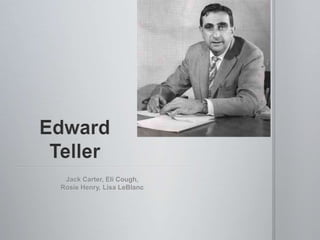
Edward TellerJack Carter, Eli Cough,Rosie Henry, Lisa LeBlanc
Edward’s ChildhoodHe was born into a Jewish family in Budapest, Hungary on January 15, 1908
He was a mathematical prodigy Edward’s SchoolingHe went to Germany in 1926 as a young student and began studying Chemical Engineering
He transferred to university of Munich in 1928 to study quantum mechanics
He graduated in chemical engineering at the University of KarlsruheEdward’s Schooling Cont.He went to the University of Leipzig and received his doctorate in physics in 1930
He took his first job as a research consultant at the University of GottingenEarly Career LifeHe published a paper on the “Hydrogen Molecular Ion”
Adolf Hitler came to power so Teller emigrate to Denmark in 1934, here he joined the Institution of Theoretical Physics
At the Institution of Theoretical Physics he met Nick Bohr who lead a secret of young scientist attempting to unlock the atomEn route to AmericaAt Bohr’s institute, Teller met physicist George GamowGeorge Gamow and Teller went different ways, Teller went to work at the University of London and Gamow went to work at George Washington UniversityGamow invited Teller to join him in Washington D.C., Teller accepted the invitation and went to the United States in 1935, he became a U.S. citizen in 1941
In WashingtonTeller worked with Gamow they created the Gamow-Teller rules for classifying subatomic particle behavior in radioactive decayThey also attempted to apply the atomic phenomena to astrophysicsHe thought he was going to have a quiet academic life but the events in Europe interfered
The ChauffeurSzilard: always thought about using nuclear energy, knew how when they discovered how to split the atom
Teller drove Szilard to Einstein’s summer house to convince him to sign a letter written to Roosevelt to do atomic bomb research (before WW2). Einstein signed it.The ChauffeurRoosevelt called together a meeting and asked teller to bring Fermi, he refused to come but told teller to tell the group to make a nuclear reactor.
Szilard and Fermi didn’t get along, Teller was friends with both, he was there since the start in 1939Working On the BombInvited in 1942 to be part of Oppenheimer’s summer planning seminar at UC Berkeley for the origins of the Manhattan project
Arrived two months late to Chicago Metallurgical lab, where he participated in the theoretical division
Moved to Los Alamos in 1943
While Teller was in Los Alamos, Szilard was in Chicago and asked Teller to start a petition to just demonstrate the bomb not drop it
Oppenheimer refused Teller’s request of the petitionWorking on the BombFirst assignment was to brief incoming scientists
Constantly brought up discussion of a fusion weapon that was suggested to him by Fermi
Discovered the method of implosion; at high pressure a less critical mass was needed, therefore pre-detonation problems with plutonium were solved
Oppenheimer immediately set out work on this implosion bombWorking on the BombFrom 1943-1944 worked on hydrodynamics of implosion and super group theory
From 1944-1946 worked on only General and Super group theory
Because Teller constantly brought up the possibility of a “super” bomb through fusion that they set up a separate division for him to focus onWorking on the BombBethe remembers that "he declined to take charge of the group which would perform the detailed calculation on the implosion and since the theoretical division was very shorthanded it was necessary to bring in new scientists to do the work that Teller declined to do.”
Teller took offense to Bethe asking him to work on “impossible equations”, beginning of the end of their friendship
Clashed with many scientists, left los Alamos in 1946 and went to university of ChicagoThe First Atomic Bomb Testhttp://www.achievement.org/autodoc/page/tel0int-1
A summary of how the scientist felt about the decision to use the bomb(s) on JapanAfter the bomb was dropped on Hiroshima, Teller admits to having two immediate regrets: a “weak” regret and a “strong regret.”
Weak RegretTeller received a letter in July 1945 from fellow countryman Leo Szilard during Teller’s time at Los Alamos regarding the moral implications of using an atomic bomb on Japan.
Szilard requested that Teller sign and pass on a petition.
Teller consulted Oppenheimer, who turned down the request.
Teller feels not signing or circulating Szilard’s petition as a weak regret because, although he regrets allowing Oppenheimer to persuade him, Szilard never personally asked for Teller’s opinion on the matter.	“It may very well be that the decision of the President whether or not to use atomic bombs in the war against Japan will largely be based on considerations of expediency. On the basis of expediency, many arguments could be put forward both for and against our use of atomic bombs against Japan. Such arguments could be considered only within the framework of a thorough analysis of the situation which will face the United States after this war and it was felt that no useful purpose would be served by considering arguments of expediency in a short petition.”-Leo Szilard July 1945
Strong RegretSeveral weeks before receiving Szilard’s letter, Teller had conversations with Enrico Fermi regarding the possible demonstration of the bomb.
Teller’s regret was that he did not give more thought to this problem.
Looking back, Teller agrees “a demonstration of an atomic bomb over Tokyo Bay, where the emperor and the Japanese people would have seen it but the danger would have been minimal” would have sufficed, if the bomb was to work. “If it does not go off, then we have done nothing.”
Even to this day Teller does not regret the USE of the atomic bomb.

Edward teller final

  • 1.
    Edward TellerJack Carter,Eli Cough,Rosie Henry, Lisa LeBlanc
  • 2.
    Edward’s ChildhoodHe wasborn into a Jewish family in Budapest, Hungary on January 15, 1908
  • 3.
    He was amathematical prodigy Edward’s SchoolingHe went to Germany in 1926 as a young student and began studying Chemical Engineering
  • 4.
    He transferred touniversity of Munich in 1928 to study quantum mechanics
  • 5.
    He graduated inchemical engineering at the University of KarlsruheEdward’s Schooling Cont.He went to the University of Leipzig and received his doctorate in physics in 1930
  • 6.
    He took hisfirst job as a research consultant at the University of GottingenEarly Career LifeHe published a paper on the “Hydrogen Molecular Ion”
  • 7.
    Adolf Hitler cameto power so Teller emigrate to Denmark in 1934, here he joined the Institution of Theoretical Physics
  • 8.
    At the Institutionof Theoretical Physics he met Nick Bohr who lead a secret of young scientist attempting to unlock the atomEn route to AmericaAt Bohr’s institute, Teller met physicist George GamowGeorge Gamow and Teller went different ways, Teller went to work at the University of London and Gamow went to work at George Washington UniversityGamow invited Teller to join him in Washington D.C., Teller accepted the invitation and went to the United States in 1935, he became a U.S. citizen in 1941
  • 9.
    In WashingtonTeller workedwith Gamow they created the Gamow-Teller rules for classifying subatomic particle behavior in radioactive decayThey also attempted to apply the atomic phenomena to astrophysicsHe thought he was going to have a quiet academic life but the events in Europe interfered
  • 10.
    The ChauffeurSzilard: alwaysthought about using nuclear energy, knew how when they discovered how to split the atom
  • 11.
    Teller drove Szilardto Einstein’s summer house to convince him to sign a letter written to Roosevelt to do atomic bomb research (before WW2). Einstein signed it.The ChauffeurRoosevelt called together a meeting and asked teller to bring Fermi, he refused to come but told teller to tell the group to make a nuclear reactor.
  • 12.
    Szilard and Fermididn’t get along, Teller was friends with both, he was there since the start in 1939Working On the BombInvited in 1942 to be part of Oppenheimer’s summer planning seminar at UC Berkeley for the origins of the Manhattan project
  • 13.
    Arrived two monthslate to Chicago Metallurgical lab, where he participated in the theoretical division
  • 14.
    Moved to LosAlamos in 1943
  • 15.
    While Teller wasin Los Alamos, Szilard was in Chicago and asked Teller to start a petition to just demonstrate the bomb not drop it
  • 16.
    Oppenheimer refused Teller’srequest of the petitionWorking on the BombFirst assignment was to brief incoming scientists
  • 17.
    Constantly brought updiscussion of a fusion weapon that was suggested to him by Fermi
  • 18.
    Discovered the methodof implosion; at high pressure a less critical mass was needed, therefore pre-detonation problems with plutonium were solved
  • 19.
    Oppenheimer immediately setout work on this implosion bombWorking on the BombFrom 1943-1944 worked on hydrodynamics of implosion and super group theory
  • 20.
    From 1944-1946 workedon only General and Super group theory
  • 21.
    Because Teller constantlybrought up the possibility of a “super” bomb through fusion that they set up a separate division for him to focus onWorking on the BombBethe remembers that "he declined to take charge of the group which would perform the detailed calculation on the implosion and since the theoretical division was very shorthanded it was necessary to bring in new scientists to do the work that Teller declined to do.”
  • 22.
    Teller took offenseto Bethe asking him to work on “impossible equations”, beginning of the end of their friendship
  • 23.
    Clashed with manyscientists, left los Alamos in 1946 and went to university of ChicagoThe First Atomic Bomb Testhttp://www.achievement.org/autodoc/page/tel0int-1
  • 24.
    A summary ofhow the scientist felt about the decision to use the bomb(s) on JapanAfter the bomb was dropped on Hiroshima, Teller admits to having two immediate regrets: a “weak” regret and a “strong regret.”
  • 25.
    Weak RegretTeller receiveda letter in July 1945 from fellow countryman Leo Szilard during Teller’s time at Los Alamos regarding the moral implications of using an atomic bomb on Japan.
  • 26.
    Szilard requested thatTeller sign and pass on a petition.
  • 27.
    Teller consulted Oppenheimer,who turned down the request.
  • 28.
    Teller feels notsigning or circulating Szilard’s petition as a weak regret because, although he regrets allowing Oppenheimer to persuade him, Szilard never personally asked for Teller’s opinion on the matter. “It may very well be that the decision of the President whether or not to use atomic bombs in the war against Japan will largely be based on considerations of expediency. On the basis of expediency, many arguments could be put forward both for and against our use of atomic bombs against Japan. Such arguments could be considered only within the framework of a thorough analysis of the situation which will face the United States after this war and it was felt that no useful purpose would be served by considering arguments of expediency in a short petition.”-Leo Szilard July 1945
  • 29.
    Strong RegretSeveral weeksbefore receiving Szilard’s letter, Teller had conversations with Enrico Fermi regarding the possible demonstration of the bomb.
  • 30.
    Teller’s regret wasthat he did not give more thought to this problem.
  • 31.
    Looking back, Telleragrees “a demonstration of an atomic bomb over Tokyo Bay, where the emperor and the Japanese people would have seen it but the danger would have been minimal” would have sufficed, if the bomb was to work. “If it does not go off, then we have done nothing.”
  • 32.
    Even to thisday Teller does not regret the USE of the atomic bomb.