POWER “A”
PRESENTATIONS
 GROUP ONE
 GROUP TWO
 GROUP THREE
 GROUP FOUR
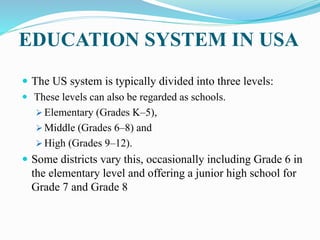
EDUCATION SYSTEM IN USA
 The US system is typically divided into three levels:
 These levels can also be regarded as schools.
 Elementary (Grades K–5),
 Middle (Grades 6–8) and
 High (Grades 9–12).
 Some districts vary this, occasionally including Grade 6 in
the elementary level and offering a junior high school for
Grade 7 and Grade 8
An Overview of Education in the
United States
 Learning Objectives
Explain why compulsory education arose during the
nineteenth century.
Summarize social class, gender, and racial and ethnic
differences in educational attainment.
Describe the impact that education has on income.
Explain how the US education system ranks
internationally.
Introduction
 Education is the social institution through which a society
teaches its members the skills, knowledge, norms, and
values they need to learn to become good, productive
members of their society.
 As this definition makes clear, education is an important
part of socialization.
 Education is both formal and informal.
 Formal education is often referred to as schooling, and as
this term implies, it occurs in schools under teachers,
principals, and other specially trained professionals.
 Informal education may occur almost anywhere, but for
young children it has traditionally occurred primarily in
the home, with their parents as their instructors.
 care has become an increasingly popular venue in
industrial societies for young children’s instruction, and
education from the early years of life is thus more formal
than it used to be.
Education in Nineteenth century.
 Education in early America was only rarely formal.
During the colonial period, the Puritans in what is now
Massachusetts required parents to teach their children to
read and also required larger towns to have an elementary
school, where children learned reading, writing, and
religion.
 In general, though, schooling was not required in the
colonies, and only about 10 percent of colonial children,
usually just the wealthiest, went to school, although others
became apprentices (Urban & Wagoner, 2008).
 To help unify the nation after the Revolutionary War,
textbooks were written to standardize spelling and
pronunciation and to instill patriotism and religious beliefs
in students.
 At the same time, these textbooks included negative
stereotypes of Native Americans and certain immigrant
groups. The children going to school continued primarily
to be those from wealthy families.
 By the mid-1800s, a call for free, compulsory education
had begun, and compulsory education became widespread
by the end of the century. This was an important
development, as children from all social classes could now
receive a free, formal education.
 Compulsory education was intended to further national
unity and to teach immigrants “American” values. It also
arose because of industrialization, as an industrial economy
demanded reading, writing, and math skills much more
than an agricultural economy had.
 Free, compulsory education, of course, applied only to
primary and secondary schools. Until the mid-1900s, very
few people went to college, and those who did typically
came from fairly wealthy families.
 After World War II, however, college enrollments soared,
and today more people are attending college than ever
before, even though college attendance is still related to
social class, as we shall discuss shortly.
 An important theme emerges from this brief history: Until
very recently in the record of history, formal schooling was
restricted to wealthy males.
 This means that boys who were not white and rich were
excluded from formal schooling, as were virtually all girls,
whose education was supposed to take place informally at
home.
 Today, as we will see, race, ethnicity, social class, and, to
some extent, gender continue to affect both educational
achievement and the amount of learning occurring in
schools.
Education in the United States
Today
 Education in the United States is a massive social
institution involving millions of people and billions of
dollars.
 More than 75 million people, almost one-fourth of the US
population, attend school at all levels.
 This number includes 40 million in grades pre-K through
eighth grade, 16 million in high school, and 20 million in
college (including graduate and professional school).
 They attend some 132,000 elementary and secondary
schools and about 4,200 two-year and four-year colleges
and universities and are taught by about 4.8 million
teachers and professors (US Census Bureau, 2012).
SOCIAL CLASS, GENDER AND
RACIAL AND ETHNIC
DIFFERENCES IN
EDUCATIONAL ATTAINMENT.
Correlates of Educational
Attainment
 About 65 percent of US high school graduates enroll in
college the following fall.
 This is a very high figure by international standards, as
college in many other industrial nations is reserved for the
very small percentage of the population who pass rigorous
entrance exams.
 They are the best of the brightest in their nations, whereas
higher education in the United States is open to all who
graduate high school.
 Even though that is true, our chances of achieving a college
degree are greatly determined at birth, as social class and
race and ethnicity substantially affect who goes to college.
They affect whether students drop out of high school, in
which case they do not go on to college;
They affect the chances of getting good grades in school
and good scores on college entrance exams;
They affect whether a family can afford to send its
children to college; and
They affect the chances of staying in college and obtaining
a degree versus dropping out.
For all these reasons, educational attainment—how far
one gets in school—depends heavily on family income
and race/ethnicity (Tavernise, 2012).
Family income, in fact, makes a much larger difference in
educational attainment than it did during the 1960s.
Racial/Ethnic Gap in
Educational Attainment(Factors)
(a) The underfunded and otherwise inadequate
schools that children in both groups often attend;
(b) The higher poverty of their families and lower
education of their parents that often leave children ill
prepared for school even before they enter
kindergarten;
(c) Racial discrimination; and
(d) The fact that African American and Latino
families are especially likely to live in very poor
neighborhoods (Ballantine & Hammack, 2012; Yeung
& Pfeiffer, 2009).
Gender
 Gender also affects educational attainment.
 If we do not take age into account, slightly more men than
women have a college degree: 30.3 percent of men and
29.6 percent of women.
 This difference reflects the fact that women were less
likely than men in earlier generations to go to college.
 But today there is a gender difference in the other
direction: Women now earn more than 57 percent of all
bachelor’s degrees, up from just 35 percent in 1960
Impact of Education on Income
 A high school or college degree (or beyond) indicates that
a person has acquired the needed knowledge and skills for
various jobs.
 A degree at some level is a requirement for most jobs. As
you know full well, a college degree today is a virtual
requirement for a decent-paying job.
 Today’s society increasingly requires skills and knowledge
that only a college education brings.
 A credential society also means that people with more
formal education achieve higher incomes.
 Annual earnings are indeed much higher for people with
more education
Impact of Education on
Mortality
 Beyond income, education also affects at what age people tend
to die.
 Simply put, people with higher levels of education tend to die
later in life, and those with lower levels tend to die earlier
(Miech, Pampel, Kim, & Rogers, 2011).
 The reasons are:
(a) More highly educated people are less likely to smoke
and engage in other unhealthy activities, and they are
more likely to exercise and to engage in other healthy
activities and also to eat healthy diets.
(b) They have better access to high-quality health care.
How the US Education System
Compares Internationally
 The United States has many of the top colleges and
universities and secondary schools in the world, and many
of the top professors and teachers. In these respects, the
US education system is “the best of systems.”
 But in other respects, it is “the worst of systems.” When
we compare educational attainment in the United States to
that in the world’s other democracies, the United States
lags behind its international peers.
 Differences in the educational systems of the world’s
democracies make exact comparisons difficult, but one
basic measure of educational attainment is the
percentage of a nation’s population that has graduated
high school. A widely cited comparison involves the
industrial nations that are members of the
Organisation for Economic Co-operation and
Development (OECD).
 Of the twenty-eight nations for which OECD has high
school graduation data, the United States ranks only
twenty-first, with a graduation rate of 76 percent
(Organisation for Economic Co-operation and
Development, 2011).
 In contrast, several nations, including Finland, Ireland,
Norway, Portugal, Switzerland, and the United Kingdom
have graduation rates of at least 90 percent.
 If we limit the comparison to the OECD nations that
compose the world’s wealthy democracies to which the
United States is most appropriately compared, the United
States ranks only thirteenth out of sixteen such nations.
 OECD also collects and publishes data on proficiency in
mathematics, reading, and science among 15-year-olds in
its member nations (Organization for Economic Co-
operation and Development, 2010).
 In reading and science, the United States ranks only at the
average for all OECD nations, while the US score for
mathematics ranks below the OECD average.
 Compared to their counterparts in other industrial nations,
then, American 15-year-olds are only average or below
average for these three important areas of study.
 Taking into account high school graduation rates and these
proficiency rankings, the United States is far from the
world leader in the quality of education.

EDUCATION SYSTEM IN USA.pptx

  • 1.
    POWER “A” PRESENTATIONS  GROUPONE  GROUP TWO  GROUP THREE  GROUP FOUR
  • 2.
    EDUCATION SYSTEM INUSA  The US system is typically divided into three levels:  These levels can also be regarded as schools.  Elementary (Grades K–5),  Middle (Grades 6–8) and  High (Grades 9–12).  Some districts vary this, occasionally including Grade 6 in the elementary level and offering a junior high school for Grade 7 and Grade 8
  • 3.
    An Overview ofEducation in the United States  Learning Objectives Explain why compulsory education arose during the nineteenth century. Summarize social class, gender, and racial and ethnic differences in educational attainment. Describe the impact that education has on income. Explain how the US education system ranks internationally.
  • 4.
    Introduction  Education isthe social institution through which a society teaches its members the skills, knowledge, norms, and values they need to learn to become good, productive members of their society.  As this definition makes clear, education is an important part of socialization.  Education is both formal and informal.
  • 5.
     Formal educationis often referred to as schooling, and as this term implies, it occurs in schools under teachers, principals, and other specially trained professionals.  Informal education may occur almost anywhere, but for young children it has traditionally occurred primarily in the home, with their parents as their instructors.  care has become an increasingly popular venue in industrial societies for young children’s instruction, and education from the early years of life is thus more formal than it used to be.
  • 6.
    Education in Nineteenthcentury.  Education in early America was only rarely formal. During the colonial period, the Puritans in what is now Massachusetts required parents to teach their children to read and also required larger towns to have an elementary school, where children learned reading, writing, and religion.  In general, though, schooling was not required in the colonies, and only about 10 percent of colonial children, usually just the wealthiest, went to school, although others became apprentices (Urban & Wagoner, 2008).
  • 7.
     To helpunify the nation after the Revolutionary War, textbooks were written to standardize spelling and pronunciation and to instill patriotism and religious beliefs in students.  At the same time, these textbooks included negative stereotypes of Native Americans and certain immigrant groups. The children going to school continued primarily to be those from wealthy families.  By the mid-1800s, a call for free, compulsory education had begun, and compulsory education became widespread by the end of the century. This was an important development, as children from all social classes could now receive a free, formal education.
  • 8.
     Compulsory educationwas intended to further national unity and to teach immigrants “American” values. It also arose because of industrialization, as an industrial economy demanded reading, writing, and math skills much more than an agricultural economy had.  Free, compulsory education, of course, applied only to primary and secondary schools. Until the mid-1900s, very few people went to college, and those who did typically came from fairly wealthy families.  After World War II, however, college enrollments soared, and today more people are attending college than ever before, even though college attendance is still related to social class, as we shall discuss shortly.
  • 9.
     An importanttheme emerges from this brief history: Until very recently in the record of history, formal schooling was restricted to wealthy males.  This means that boys who were not white and rich were excluded from formal schooling, as were virtually all girls, whose education was supposed to take place informally at home.  Today, as we will see, race, ethnicity, social class, and, to some extent, gender continue to affect both educational achievement and the amount of learning occurring in schools.
  • 10.
    Education in theUnited States Today  Education in the United States is a massive social institution involving millions of people and billions of dollars.  More than 75 million people, almost one-fourth of the US population, attend school at all levels.
  • 11.
     This numberincludes 40 million in grades pre-K through eighth grade, 16 million in high school, and 20 million in college (including graduate and professional school).  They attend some 132,000 elementary and secondary schools and about 4,200 two-year and four-year colleges and universities and are taught by about 4.8 million teachers and professors (US Census Bureau, 2012).
  • 12.
    SOCIAL CLASS, GENDERAND RACIAL AND ETHNIC DIFFERENCES IN EDUCATIONAL ATTAINMENT.
  • 13.
    Correlates of Educational Attainment About 65 percent of US high school graduates enroll in college the following fall.  This is a very high figure by international standards, as college in many other industrial nations is reserved for the very small percentage of the population who pass rigorous entrance exams.  They are the best of the brightest in their nations, whereas higher education in the United States is open to all who graduate high school.
  • 14.
     Even thoughthat is true, our chances of achieving a college degree are greatly determined at birth, as social class and race and ethnicity substantially affect who goes to college. They affect whether students drop out of high school, in which case they do not go on to college; They affect the chances of getting good grades in school and good scores on college entrance exams; They affect whether a family can afford to send its children to college; and
  • 15.
    They affect thechances of staying in college and obtaining a degree versus dropping out. For all these reasons, educational attainment—how far one gets in school—depends heavily on family income and race/ethnicity (Tavernise, 2012). Family income, in fact, makes a much larger difference in educational attainment than it did during the 1960s.
  • 16.
    Racial/Ethnic Gap in EducationalAttainment(Factors) (a) The underfunded and otherwise inadequate schools that children in both groups often attend; (b) The higher poverty of their families and lower education of their parents that often leave children ill prepared for school even before they enter kindergarten; (c) Racial discrimination; and (d) The fact that African American and Latino families are especially likely to live in very poor neighborhoods (Ballantine & Hammack, 2012; Yeung & Pfeiffer, 2009).
  • 17.
    Gender  Gender alsoaffects educational attainment.  If we do not take age into account, slightly more men than women have a college degree: 30.3 percent of men and 29.6 percent of women.  This difference reflects the fact that women were less likely than men in earlier generations to go to college.  But today there is a gender difference in the other direction: Women now earn more than 57 percent of all bachelor’s degrees, up from just 35 percent in 1960
  • 18.
    Impact of Educationon Income  A high school or college degree (or beyond) indicates that a person has acquired the needed knowledge and skills for various jobs.  A degree at some level is a requirement for most jobs. As you know full well, a college degree today is a virtual requirement for a decent-paying job.  Today’s society increasingly requires skills and knowledge that only a college education brings.  A credential society also means that people with more formal education achieve higher incomes.  Annual earnings are indeed much higher for people with more education
  • 19.
    Impact of Educationon Mortality  Beyond income, education also affects at what age people tend to die.  Simply put, people with higher levels of education tend to die later in life, and those with lower levels tend to die earlier (Miech, Pampel, Kim, & Rogers, 2011).  The reasons are: (a) More highly educated people are less likely to smoke and engage in other unhealthy activities, and they are more likely to exercise and to engage in other healthy activities and also to eat healthy diets. (b) They have better access to high-quality health care.
  • 20.
    How the USEducation System Compares Internationally  The United States has many of the top colleges and universities and secondary schools in the world, and many of the top professors and teachers. In these respects, the US education system is “the best of systems.”  But in other respects, it is “the worst of systems.” When we compare educational attainment in the United States to that in the world’s other democracies, the United States lags behind its international peers.
  • 21.
     Differences inthe educational systems of the world’s democracies make exact comparisons difficult, but one basic measure of educational attainment is the percentage of a nation’s population that has graduated high school. A widely cited comparison involves the industrial nations that are members of the Organisation for Economic Co-operation and Development (OECD).
  • 22.
     Of thetwenty-eight nations for which OECD has high school graduation data, the United States ranks only twenty-first, with a graduation rate of 76 percent (Organisation for Economic Co-operation and Development, 2011).  In contrast, several nations, including Finland, Ireland, Norway, Portugal, Switzerland, and the United Kingdom have graduation rates of at least 90 percent.  If we limit the comparison to the OECD nations that compose the world’s wealthy democracies to which the United States is most appropriately compared, the United States ranks only thirteenth out of sixteen such nations.
  • 23.
     OECD alsocollects and publishes data on proficiency in mathematics, reading, and science among 15-year-olds in its member nations (Organization for Economic Co- operation and Development, 2010).  In reading and science, the United States ranks only at the average for all OECD nations, while the US score for mathematics ranks below the OECD average.
  • 24.
     Compared totheir counterparts in other industrial nations, then, American 15-year-olds are only average or below average for these three important areas of study.  Taking into account high school graduation rates and these proficiency rankings, the United States is far from the world leader in the quality of education.