PRIVATE INSTITUTIONS
VS
GOVERNMENT INSTITUTIONS
Benchmarking Analysis
IT IS NOT ABOUT INVESTMENT ONLY, IT IS
BEYOND THAT
PRIVATE VS GOVERNMENT INSTITUTIONS-
STUDY ATMOSPHERE
 Private education is called as need of today's market as compare to the
government education. Yes, though various facilities like mess, canteen,
etc facilities are there but after much investment also no initiative like any
student welfare programs to make student able to survive in this cut
throat competition has been started anywhere.
 Excellent teaching staff with good salary and performance pressure for
students as well as teacher which bring best results out of them.
 Good infrastructure facilities like latest computer support equipment are
available but in government institutes still old modals are been used.
 Undertaking of personality development program are held only and only
in private institutions.
 Language classes to cope up with communication barriers.
PRIVATE VS GOVERNMENT INSTITUTIONS-
WHY PRIVATE?
 Class sizes are small and very competitive student stay
who come after qualifying toughest examz like CAT,
MAT, GMAT etc.
 Students generally build stronger, more personal
relationships with their professors and instructors, as
there are special programs designed to increase
communication and dialogue between the two. It is not
uncommon for a university to arrange for professors to
dine, correspond, and interact with students on a
personal, friendly level.
 Private universities also have a significantly higher
amount of extra-curricular activities and programs for
students to participate in, which can develop a stronger
sense of community.
PRIVATE VS GOVERNMENT INSTITUTIONS-
WHY PUBLIC?
 Tuition is much cheaper than that of a private university. For a
year of classes, public tuition is approximately $3,500 for a full
load of classes. Semester and quarter systems do not differ in
the total price of tuition.
 Students who do not get achieve high enough grades to gain
admittance into a private university (which can be extremely
exclusive) will have a much easier time attending a public
university. But while a public university may be easier to get into,
the curriculum may be just as difficult—or more difficult—than a
private university's.
 Public universities are much larger and more diverse than the
average private university, and students may feel more
comfortable around a larger student population that it offers.
 Students have more of a choice as to which area of the country
to attend school at when they select a public university. Since the
chances of being accepted at such a public school are greater,
the student can select a university in any climate, geographical
region, or city they desire.
PRIVATE VS GOVERNMENT INSTITUTIONS-
 Crores of investment in public institutions but no
result.
 Rs 10,000 crore investment in Medical Institution.
 Rs. 7500 crore investment for entrepreneur and
management institutions.
 Rs. 12000 crore investment on government
schools.
 Result is nill? How?
 Only 7% students go for government institutions.
 Every year GBTU, UPTECH, UPSEE seats go
empty.
PRIVATE VS GOVERNMENT INSTITUTIONS-
SWOT ANALYSIS
 Private Institutions- Strength
 Infrastructure.
 Students with competitive edge.
 Dedicated faculty
 Various initiatives for student’s development.
 Global Exposure
 Tie- ups with major foreign companies.
 Good Placement Records
 Weakness-
 Known for various mal practices
 Less investment
 Less government support
 Heavy taxation from government
 No initiative could be undertaken by own
 Heavy fees
 Don’t get attention from lower class people no matter how competitive their
children are.
 Opportunity-
 Can reserve seat for lower class level students who are
topper but cannot pay this huge amount.
 Reserve seats for disable students who are good in
studies.
 Cut down fees and get the best for their institutions.
 Can go for more and more tie-ups with many
government companies.
 Threats-
 Foreign institutions are opening branch in India with
collaboration with government institutions.
 Foreign universities in order to attract Indian toppers are
cutting down fees.
 Every foreign college have come with a scholarship
strategy in order to attract Indian students and in this
they also pay full semester fees.
GOVERNMENT INSTITUTIONS
 Government institutions have done good in
medical, law and agriculture field but in
management field, its contribution is nothing.
 No big companies have ever invested any amount
for placement in these business institutions.
 No global exposure has made these institution to
stay very back.
 Less than 11% was the placement record in year
2012-14 according to TOI.
PRIVATE VS GOVERNMENT
INSTITUTIONS-
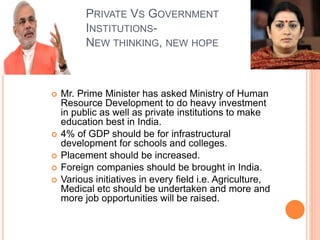
NEW THINKING, NEW HOPE
 Mr. Prime Minister has asked Ministry of Human
Resource Development to do heavy investment
in public as well as private institutions to make
education best in India.
 4% of GDP should be for infrastructural
development for schools and colleges.
 Placement should be increased.
 Foreign companies should be brought in India.
 Various initiatives in every field i.e. Agriculture,
Medical etc should be undertaken and more and
more job opportunities will be raised.
Education sector- benchmarking analysis

Education sector- benchmarking analysis

  • 1.
  • 2.
    IT IS NOTABOUT INVESTMENT ONLY, IT IS BEYOND THAT
  • 3.
    PRIVATE VS GOVERNMENTINSTITUTIONS- STUDY ATMOSPHERE  Private education is called as need of today's market as compare to the government education. Yes, though various facilities like mess, canteen, etc facilities are there but after much investment also no initiative like any student welfare programs to make student able to survive in this cut throat competition has been started anywhere.  Excellent teaching staff with good salary and performance pressure for students as well as teacher which bring best results out of them.  Good infrastructure facilities like latest computer support equipment are available but in government institutes still old modals are been used.  Undertaking of personality development program are held only and only in private institutions.  Language classes to cope up with communication barriers.
  • 4.
    PRIVATE VS GOVERNMENTINSTITUTIONS- WHY PRIVATE?  Class sizes are small and very competitive student stay who come after qualifying toughest examz like CAT, MAT, GMAT etc.  Students generally build stronger, more personal relationships with their professors and instructors, as there are special programs designed to increase communication and dialogue between the two. It is not uncommon for a university to arrange for professors to dine, correspond, and interact with students on a personal, friendly level.  Private universities also have a significantly higher amount of extra-curricular activities and programs for students to participate in, which can develop a stronger sense of community.
  • 5.
    PRIVATE VS GOVERNMENTINSTITUTIONS- WHY PUBLIC?  Tuition is much cheaper than that of a private university. For a year of classes, public tuition is approximately $3,500 for a full load of classes. Semester and quarter systems do not differ in the total price of tuition.  Students who do not get achieve high enough grades to gain admittance into a private university (which can be extremely exclusive) will have a much easier time attending a public university. But while a public university may be easier to get into, the curriculum may be just as difficult—or more difficult—than a private university's.  Public universities are much larger and more diverse than the average private university, and students may feel more comfortable around a larger student population that it offers.  Students have more of a choice as to which area of the country to attend school at when they select a public university. Since the chances of being accepted at such a public school are greater, the student can select a university in any climate, geographical region, or city they desire.
  • 6.
    PRIVATE VS GOVERNMENTINSTITUTIONS-  Crores of investment in public institutions but no result.  Rs 10,000 crore investment in Medical Institution.  Rs. 7500 crore investment for entrepreneur and management institutions.  Rs. 12000 crore investment on government schools.  Result is nill? How?  Only 7% students go for government institutions.  Every year GBTU, UPTECH, UPSEE seats go empty.
  • 7.
    PRIVATE VS GOVERNMENTINSTITUTIONS- SWOT ANALYSIS  Private Institutions- Strength  Infrastructure.  Students with competitive edge.  Dedicated faculty  Various initiatives for student’s development.  Global Exposure  Tie- ups with major foreign companies.  Good Placement Records  Weakness-  Known for various mal practices  Less investment  Less government support  Heavy taxation from government  No initiative could be undertaken by own  Heavy fees  Don’t get attention from lower class people no matter how competitive their children are.
  • 8.
     Opportunity-  Canreserve seat for lower class level students who are topper but cannot pay this huge amount.  Reserve seats for disable students who are good in studies.  Cut down fees and get the best for their institutions.  Can go for more and more tie-ups with many government companies.  Threats-  Foreign institutions are opening branch in India with collaboration with government institutions.  Foreign universities in order to attract Indian toppers are cutting down fees.  Every foreign college have come with a scholarship strategy in order to attract Indian students and in this they also pay full semester fees.
  • 9.
    GOVERNMENT INSTITUTIONS  Governmentinstitutions have done good in medical, law and agriculture field but in management field, its contribution is nothing.  No big companies have ever invested any amount for placement in these business institutions.  No global exposure has made these institution to stay very back.  Less than 11% was the placement record in year 2012-14 according to TOI.
  • 10.
    PRIVATE VS GOVERNMENT INSTITUTIONS- NEWTHINKING, NEW HOPE  Mr. Prime Minister has asked Ministry of Human Resource Development to do heavy investment in public as well as private institutions to make education best in India.  4% of GDP should be for infrastructural development for schools and colleges.  Placement should be increased.  Foreign companies should be brought in India.  Various initiatives in every field i.e. Agriculture, Medical etc should be undertaken and more and more job opportunities will be raised.