GRACE COLLEGE OFEDUCATION
PADANTHALUMOODU
SEMINAR
SUBJECT:- CONTEMPORARY IN INDIA
TOPIC:- EDUCATION IN CONCURRENT LIST AND ITS IMPLICATION
SUBMITTED BY
AZIDA.A
DEPT OF MATHEMATICS
2.
INTRODUCTION
• The 42ndAmendment, 1976 changed the status of education by shifting it
from the State List to the Concurrent List.
• • The implications of this Amendment is that both the Centre and States can
legislate on any aspect of education from the primary to the University level.
• • In case of any dispute, legislation framed by the Central Government will
have overriding authority.
3.
MEANING OF CONSTITUTION
•THE CONSTITUTION OF THE COUNTRY IS THE LEGAL DOCUMENT
ACCORDING TO WHICH THE GOVERNMENT WORKS AND FUNCTIONS.
• A CONSTITUTION IS CONSIDERED THE SOURCE OF POWERS AND AUTHORITY
OF GOVERNMENT.
4.
CONCURRENT LIST
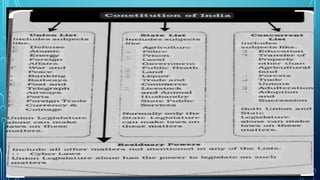
• TheConcurrent List or List-III(Seventh Schedule) is a list of 52 items. (though the
last item is numbered 47) given in the Seventh Schedule to the Constitution of
India. It includes the power to be considered by both the central and state
government. The legislative section is divided into three lists: Union List, State
List and Concurrent List. Unlike the federal governments of the United States,
Switzerland or Australia, residual powers remain with the Union Government,
as with the Canadian federal government.
6.
EDUCATION ON THE
CONCURRENTLIST
• Concurrent list encompasses items of concerns of both the
centre and the states. Both will legislate for items in the
concurrent List. Education is part of the concurrent List. This
means policies related to education are legislated by
central and state governments in the form of a meaningful
partnership.list
list
7.
GOALS OF EDUCATIONENVISAGED IN THE
CONSTITUTION
• Training the citizens
• Inculcation of social and moral values
• Achieving social and national integration
• Providing education for all
• Equalising educational opportunities
• Achieving socio cultural development
• Achieving the modernization of Indian society
• Achieving human resource development
9.
For creating equalitarianpolicies
• Our constitution provides equal rights to each and every citizen in the society.
For achieving equity and equality in society education must be provided to all,
as the constitution gives the right to education to all.
Improvement in Standards
• As a result of education is a concurrent subject, research will advance
throughout the nation. Due to this research studies are going to be utilized
better at both state and national level.
10.
For better Discipline
•Central government has the power to overrule the decisions of state
governments in case of disagreements. This power is given to the central
government for maintaining better discipline when it comes to maintaining
standards of education and better emotional integration throughout the
country.
Proper and better utilization of funds
• The state receives funding from the center for education but sometimes they
spend it elsewhere, as has been noted. The center must have a say in its use
when the funds are distributed by the central government for the betterment
of schools and the education infrastructure of states.
11.
Education for EmotionalIntegration
• Education is the key force for the production of emotional integration between all of
the country. Educational curriculum, strategies, goals, and priorities, etc. can include
guidelines to both teachers and learners so that they can use them towards the purpose
of emotional integration of the nation as a whole.
Quality Leadership from Central Government
• Sometimes central government is able to provide quality leadership in the form of
direction and supervision when it comes to the matters of education
Better implementation of education policies
•Better implementation of policies related to education means the better implementation
of education policies in a systematic way for better results. If education is on the
concurrent list, the center will ensure that state governments are correctly implementing it.
12.
CONCLUSION
• Until 1976,education was a state subject with some provisions at the central level. The 42nd
amendment, 1976, was an about major and important changes to the Indian constitution. It
also affected the status of education by putting it on the concurrent list. Making education a
concurrent subject ensures that both the centre and state can legislate on any aspect of
education from primary to the university level.
• In case of any dispute, legislation formed by the central government will have overriding
authority. By having education in the concurrent list, the centre can directly implement any
policy decisions in the states. So, the concurrent status of education means that there is a
partnership between the State government and central government when it comes to
Education policy making and implementation. This is a meaningful and yet challenging task
to accomplish.