




The Gap between 
Education and Business Needs
By 
Mark 
Lukens 
Source 
Ar(cle: 
How 
Educa*on 
is 
Failing 
To 
Serve 
Business 
Needs 
www.marklukens.com 
@marklukens 
Presenta(on 
Design 
By: 
Ramon 
Monteiro 
www.Iwillvisualize.com
Education is one of the triumphs of 
modern civilization.
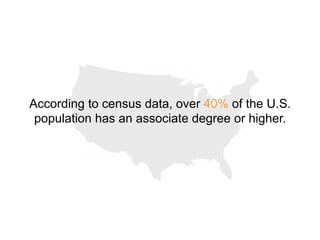
According to census data, over 40% of the U.S. 
population has an associate degree or higher.
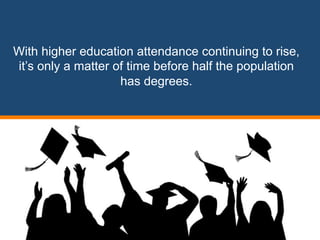
With higher education attendance continuing to rise, 
it’s only a matter of time before half the population 
has degrees.
But is all of this education really serving 
our needs, either as a society or as a 
business community?
Approximately one in four employers (24%) at a 
global level report that general lack of experiences 
at the root of the talent shortages they face,
while nearly one in five employers (19%) say 
candidates lack the required employability 
skills or “soft skills”
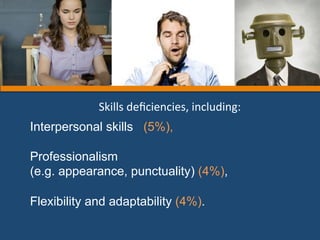
Skills 
deficiencies, 
including: 
Interpersonal skills (5%), 
Professionalism 
(e.g. appearance, punctuality) (4%), 
Flexibility and adaptability (4%).
This is not an issue confined within the borders of 
the U.S.; it can be seen across multiple developed 
countries and regions.
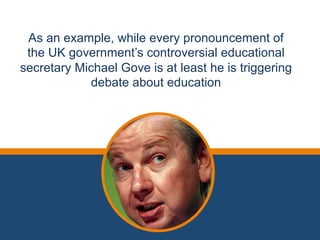
As an example, while every pronouncement of 
the UK government’s controversial educational 
secretary Michael Gove is at least he is triggering 
debate about education
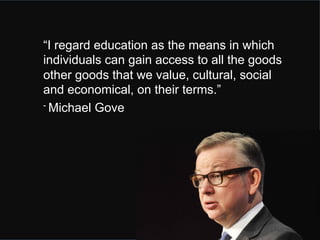
“I regard education as the means in which 
individuals can gain access to all the goods 
other goods that we value, cultural, social 
and economical, on their terms.” 
- Michael Gove
as in the U.S., no one is asking…
as in the U.S., no one is asking 
? 
what the education system is for
When we set up a process 
within a business we ask…
When we set up a process 
within a business we ask 
what is it meant to do?
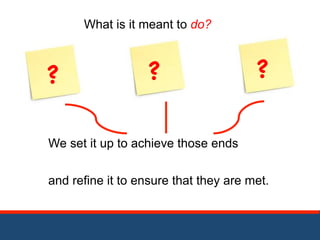
What is it meant to do? 
? ? ? 
We set it up to achieve those ends...
What is it meant to do? 
? ? ? 
We set it up to achieve those ends 
and refine it to ensure that they are met.
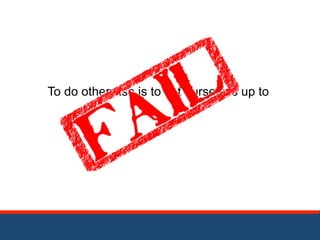
To do otherwise is to set ourselves up to…
To do otherwise is to set ourselves up to
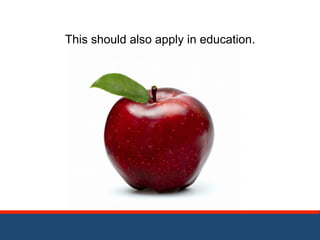
This should also apply in education.
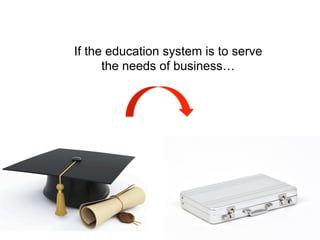
If the education system is to serve 
the needs of business…
What are those needs? 
?
needs
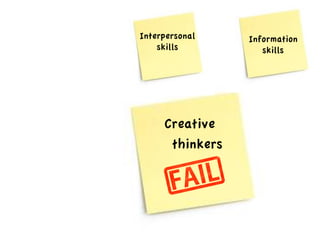
Creative 
thinkers
Creative 
thinkers 
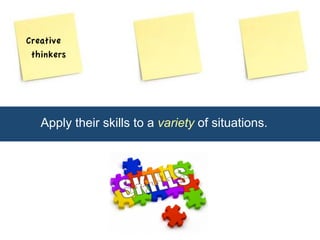
Apply their skills to a variety of situations.
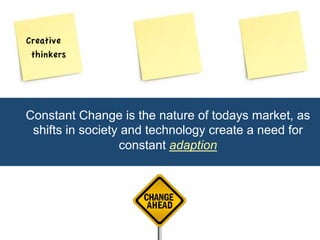
Constant Change is the nature of todays market, as 
shifts in society and technology create a need for 
constant adaption 
Creative 
thinkers
Creative 
thinkers 
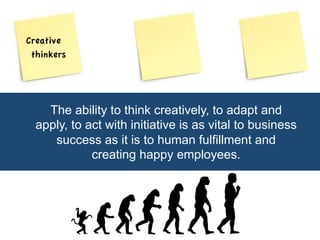
The ability to think creatively, to adapt and 
apply, to act with initiative is as vital to business 
success as it is to human fulfillment and 
creating happy employees.
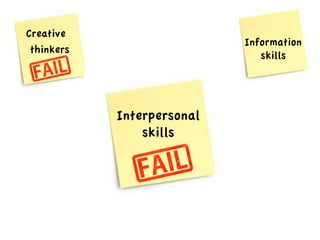
Interpersonal 
skills 
Creative 
thinkers
Creative 
thinkers 
Interpersonal 
skills 
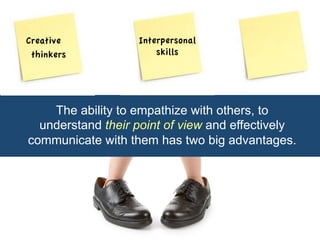
The ability to empathize with others, to 
understand their point of view and effectively 
communicate with them has two big advantages.
Creative 
thinkers 
Interpersonal 
skills 
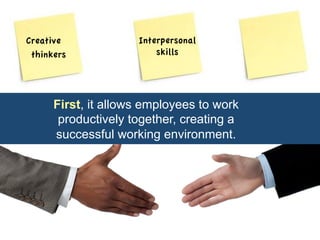
First, it allows employees to work 
productively together, creating a 
successful working environment.
Second, it allows employees to understand 
and communicate with their customers, to hear 
their needs and to meet them. 
Creative 
thinkers 
Interpersonal 
skills
information 
Skills 
Creative 
thinkers 
Interpersonal 
skills
Creative 
thinkers 
Interpersonal 
skills 
Information 
skills 
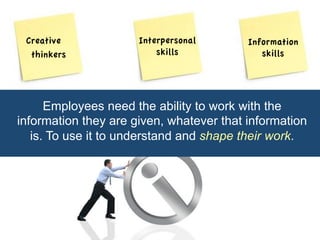
Employees need the ability to work with the 
information they are given, whatever that information 
is. To use it to understand and shape their work.
Creative 
thinkers 
Interpersonal 
skills 
Information 
skills 
? 
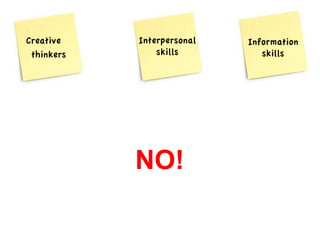
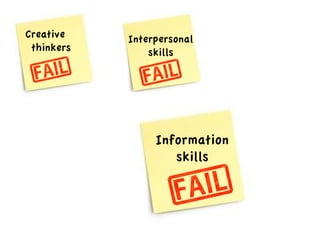
Is the current education system 
providing these skills?
NO! 
Creative 
thinkers 
Interpersonal 
skills 
Information 
skills
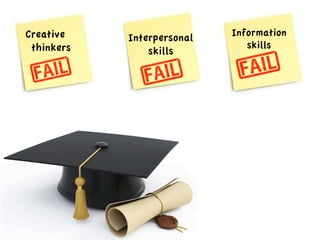
Another brick in the wall!
Creative 
thinkers 
Interpersonal 
skills 
Information 
skills 
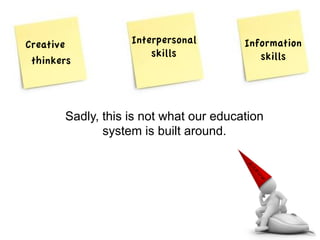
Sadly, this is not what our education 
system is built around.
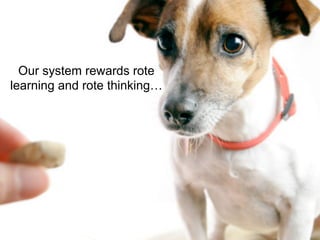
Our system rewards rote 
learning and rote thinking…
…not using the ideas and solutions of 
others rather than creating your own.
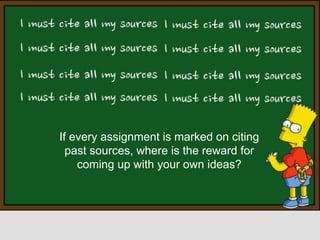
If every assignment is marked on citing 
past sources, where is the reward for 
coming up with your own ideas?
Interpersonal 
skills 
Creative 
thinkers 
Information 
skills
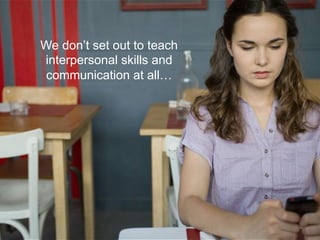
We don’t set out to teach 
interpersonal skills and 
communication at all…
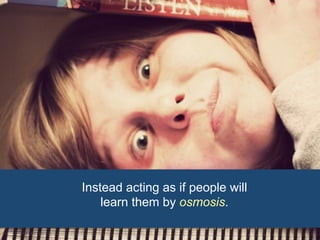
Instead acting as if people will 
learn them by osmosis.
Employers identified a number of soft 
skills deficiencies, including enthusiasm/ 
motivation (5%), interpersonal skills (4%)
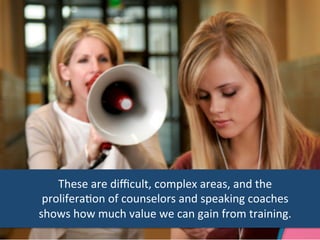
These 
are 
difficult, 
complex 
areas, 
and 
the 
proliferaAon 
of 
counselors 
and 
speaking 
coaches 
shows 
how 
much 
value 
we 
can 
gain 
from 
training.
Creative 
thinkers 
Interpersonal 
skills 
Information 
skills
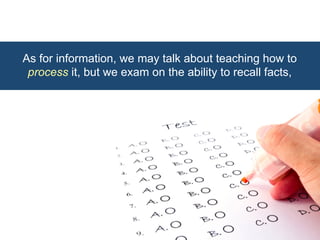
As for information, we may talk about teaching how to 
process it, but we exam on the ability to recall facts,
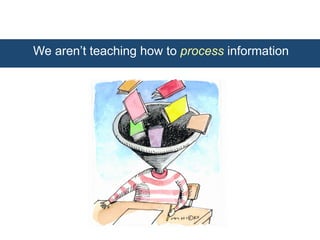
We aren’t teaching how to process information
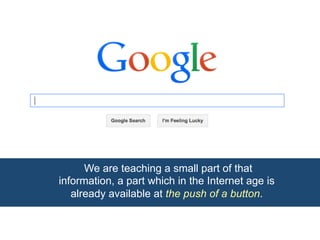
We are teaching a small part of that 
information, a part which in the Internet age is 
already available at the push of a button.
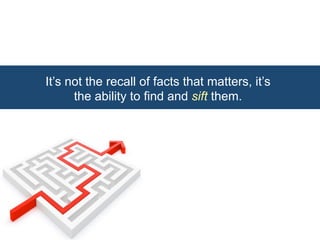
It’s not the recall of facts that matters, it’s 
the ability to find and sift them.
Creative 
thinkers 
Interpersonal 
skills 
Information 
skills
Creative 
thinkers 
Interpersonal 
skills 
Information 
skills
Creative 
thinkers 
Interpersonal 
skills 
Information 
skills 
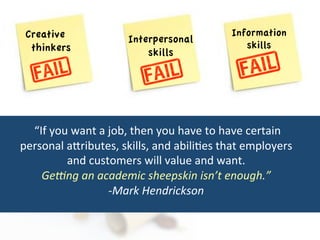
“If 
you 
want 
a 
job, 
then 
you 
have 
to 
have 
certain 
personal 
aFributes, 
skills, 
and 
abiliAes 
that 
employers 
and 
customers 
will 
value 
and 
want. 
Ge9ng 
an 
academic 
sheepskin 
isn’t 
enough.” 
-­‐Mark 
Hendrickson
There 
are 
many 
implicaAons 
and 
assumpAons 
behind 
our 
current 
educaAon 
system.
Some of them are old fashioned, some 
have emerged over time…
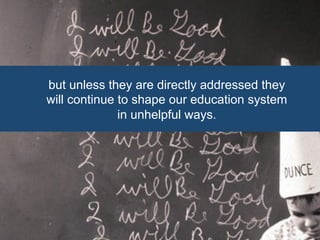
but unless they are directly addressed they 
will continue to shape our education system 
in unhelpful ways.
If we want education to me 
et the needs of business…
then we need to state, clearly and explicitly: 
what 
those 
needs 
are
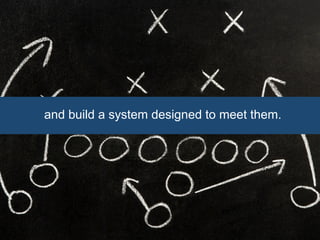
and build a system designed 
to meet them. 
and build a system de 
sig ned to meet them.
References: 
Mark 
Lukens 
How 
EducaAon 
is 
Failing 
To 
Serve 
Business 
Needs. 
Mark 
Hendrickson 
MythbusAng 
101: 
Uncomfortable 
Traths 
Your 
College 
Won’t 
Tell 
You 
(forbes.com) 
2012 
Talent 
Shortage 
Survey 
Results
@iwillvisualize 
Iwillvisualize.com 
@marklukens 
www.marklukens.com

The Gap Between Education Business Needs

  • 1.
    The Gap between Education and Business Needs
  • 2.
    By Mark Lukens Source Ar(cle: How Educa*on is Failing To Serve Business Needs www.marklukens.com @marklukens Presenta(on Design By: Ramon Monteiro www.Iwillvisualize.com
  • 3.
    Education is oneof the triumphs of modern civilization.
  • 4.
    According to censusdata, over 40% of the U.S. population has an associate degree or higher.
  • 5.
    With higher educationattendance continuing to rise, it’s only a matter of time before half the population has degrees.
  • 6.
    But is allof this education really serving our needs, either as a society or as a business community?
  • 7.
    Approximately one infour employers (24%) at a global level report that general lack of experiences at the root of the talent shortages they face,
  • 8.
    while nearly onein five employers (19%) say candidates lack the required employability skills or “soft skills”
  • 9.
    Skills deficiencies, including: Interpersonal skills (5%), Professionalism (e.g. appearance, punctuality) (4%), Flexibility and adaptability (4%).
  • 10.
    This is notan issue confined within the borders of the U.S.; it can be seen across multiple developed countries and regions.
  • 11.
    As an example,while every pronouncement of the UK government’s controversial educational secretary Michael Gove is at least he is triggering debate about education
  • 12.
    “I regard educationas the means in which individuals can gain access to all the goods other goods that we value, cultural, social and economical, on their terms.” - Michael Gove
  • 13.
    as in theU.S., no one is asking…
  • 14.
    as in theU.S., no one is asking ? what the education system is for
  • 15.
    When we setup a process within a business we ask…
  • 16.
    When we setup a process within a business we ask what is it meant to do?
  • 17.
    What is itmeant to do? ? ? ? We set it up to achieve those ends...
  • 18.
    What is itmeant to do? ? ? ? We set it up to achieve those ends and refine it to ensure that they are met.
  • 19.
    To do otherwiseis to set ourselves up to…
  • 20.
    To do otherwiseis to set ourselves up to
  • 21.
    This should alsoapply in education.
  • 22.
    If the educationsystem is to serve the needs of business…
  • 23.
  • 24.
  • 25.
  • 26.
    Creative thinkers Applytheir skills to a variety of situations.
  • 27.
    Constant Change isthe nature of todays market, as shifts in society and technology create a need for constant adaption Creative thinkers
  • 28.
    Creative thinkers Theability to think creatively, to adapt and apply, to act with initiative is as vital to business success as it is to human fulfillment and creating happy employees.
  • 29.
  • 30.
    Creative thinkers Interpersonal skills The ability to empathize with others, to understand their point of view and effectively communicate with them has two big advantages.
  • 31.
    Creative thinkers Interpersonal skills First, it allows employees to work productively together, creating a successful working environment.
  • 32.
    Second, it allowsemployees to understand and communicate with their customers, to hear their needs and to meet them. Creative thinkers Interpersonal skills
  • 33.
    information Skills Creative thinkers Interpersonal skills
  • 34.
    Creative thinkers Interpersonal skills Information skills Employees need the ability to work with the information they are given, whatever that information is. To use it to understand and shape their work.
  • 35.
    Creative thinkers Interpersonal skills Information skills ? Is the current education system providing these skills?
  • 36.
    NO! Creative thinkers Interpersonal skills Information skills
  • 37.
  • 38.
    Creative thinkers Interpersonal skills Information skills Sadly, this is not what our education system is built around.
  • 39.
    Our system rewardsrote learning and rote thinking…
  • 40.
    …not using theideas and solutions of others rather than creating your own.
  • 41.
    If every assignmentis marked on citing past sources, where is the reward for coming up with your own ideas?
  • 42.
    Interpersonal skills Creative thinkers Information skills
  • 43.
    We don’t setout to teach interpersonal skills and communication at all…
  • 44.
    Instead acting asif people will learn them by osmosis.
  • 45.
    Employers identified anumber of soft skills deficiencies, including enthusiasm/ motivation (5%), interpersonal skills (4%)
  • 46.
    These are difficult, complex areas, and the proliferaAon of counselors and speaking coaches shows how much value we can gain from training.
  • 47.
    Creative thinkers Interpersonal skills Information skills
  • 48.
    As for information,we may talk about teaching how to process it, but we exam on the ability to recall facts,
  • 49.
    We aren’t teachinghow to process information
  • 50.
    We are teachinga small part of that information, a part which in the Internet age is already available at the push of a button.
  • 51.
    It’s not therecall of facts that matters, it’s the ability to find and sift them.
  • 52.
    Creative thinkers Interpersonal skills Information skills
  • 53.
    Creative thinkers Interpersonal skills Information skills
  • 54.
    Creative thinkers Interpersonal skills Information skills “If you want a job, then you have to have certain personal aFributes, skills, and abiliAes that employers and customers will value and want. Ge9ng an academic sheepskin isn’t enough.” -­‐Mark Hendrickson
  • 56.
    There are many implicaAons and assumpAons behind our current educaAon system.
  • 57.
    Some of themare old fashioned, some have emerged over time…
  • 58.
    but unless theyare directly addressed they will continue to shape our education system in unhelpful ways.
  • 59.
    If we wanteducation to me et the needs of business…
  • 60.
    then we needto state, clearly and explicitly: what those needs are
  • 61.
    and build asystem designed to meet them. and build a system de sig ned to meet them.
  • 62.
    References: Mark Lukens How EducaAon is Failing To Serve Business Needs. Mark Hendrickson MythbusAng 101: Uncomfortable Traths Your College Won’t Tell You (forbes.com) 2012 Talent Shortage Survey Results
  • 63.