AKLAN STATE UNIVERSITY
COLLEGE OF INDUSTRIAL TECHNOLOGY
TEACHER EDUCATION
Andagao, Kalibo, Aklan
EDUC. 12
PRINCIPLES OF TEACHING I
LEARNING STYLES
Prepared by:
LEOCARIO, VEA D.
BSEd II-A
Prof. ANNILYN C. FLORES
INSTRUCTOR
Another factor that makes your students
differ from one another is LEARNING
STYLE.
INTRODUCTION
 Why Learning Styles? Understand the basis
of learning styles
Your learning styles have more influence
than you may realize. Your preferred styles
guide the way you learn. They also change
the way you internally represent
experiences, the way you recall information,
and even the words you choose. We explore
more of these features in this chapter.
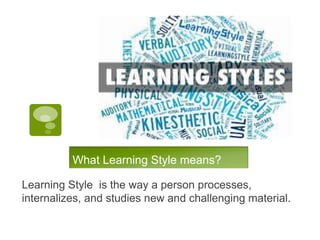
What Learning Style means?
Learning Style is the way a person processes,
internalizes, and studies new and challenging material.
Dunn and Dunn: School-
Based Learning Styles
One of the oldest and most widely used
approaches to learning styles is that
proposed by Rita and Kenneth Dunn (1978,
1992a, 1992b, and Dunn, 1986). Through
their work in schools, they observed distinct
differences in the ways students responded
to instructional materials. Some liked to learn
alone, while others preferred learning in
groups or from a teacher.
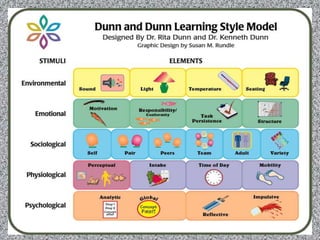
Dunn and Dunn presents different learning
styles according to five (5) groups of stimuli.
(Dunn, 2000)
Out of this preliminary work, they
identified five key dimensions on which
student learning styles differed:
1) environmental,
2) emotional support,
3) sociological composition,
4) physiological, and
5) psychological elements.
The environmental strand refers to
these elements:
lighting
sound
temperature, and
seating arrangement.
LIGHTING
SOUND
TEMPERATURE
SEATING
ARRANGEMANET
EMOTIONAL SUPPORT
This strands includes the
following elements:
motivation
persistence
responsibility, and
structure.
MOTIVATION
PERSISTENCE
RESPONSIBILITY
STRUCTURE
SOCIOLOGICAL COMPOSITION
The sociological strands represents to
elements related to how individuals learn
in association with other people:
alone or with peers,
an authoritative adult or with a collegial
colleague,
learning in a variety of ways or in routine
patterns.
ALONE
With
PEERS
With
AUTHORITATIVE
ADULT or
COLLEGIAL
COLLEAGUES
Learning in a variety of
ways or in routine patterns.
PSYSIOLOGICAL ELEMENTS
The elements in this strand are:
 perceptual,
Time-of-day energy levels,
intake, and
mobility.
PERCEPTUAL
Time-of-day energy
levels
INTAKE
MOBILITY
PSYCHOLOGICAL
The elements in this strand correspond to
the following types of psychological
processing:
 hemispheric elements
impulsive or reflective style
and global learners and
Analytic learners.
The hemispheric elements refers to left and right brain
processing models;
the impulsive versus reflective styledescribes how some
people leap before thinking and others scrutinize the
situation before moving an inch.
Global learnersprefer to work in an environment with soft
lighting and informal seating. People with the processing
style need breaks, snacking, mobility and sound.
Analytic learnersprefer to work in an environment with
bright light and formal seating. They work best with few
or no interruptions, in a quiet environment, and little or
no snacking.
IMPULSIVE vs. REFLECSIVE
Global learners vs. Analytic
REFERENCES:
EXERCISES:
1. The scholastic formulated this principle:
“Nihilestintellectu quod non priusfuerit in sensu” :
There is nothing in the mind which was not first in
some manner in the senses” What does this mean?
2. Do imperfections in the functioning of the sense
organs affect learning? Explain your answer.
3. How do feelings and emotions affect the
learner’s learning?
4. Does this student have all of these multiple
intelligences? Explain your answer
5. Do you believe that every child is a potential
genius?
TAKING IT TO THE NET…
1. Read recent researches on the memory and
imagination. Write at least one recent finding
about the power of memory and imagination.
2. Research on the following learning styles
given by Harvey F. Silver:
a. Mastery
b. Interpersonal
c. Understanding
d. Self-expressions
Thank you..
-Vhey

Educ 12. learning style

  • 1.
    AKLAN STATE UNIVERSITY COLLEGEOF INDUSTRIAL TECHNOLOGY TEACHER EDUCATION Andagao, Kalibo, Aklan EDUC. 12 PRINCIPLES OF TEACHING I LEARNING STYLES Prepared by: LEOCARIO, VEA D. BSEd II-A Prof. ANNILYN C. FLORES INSTRUCTOR
  • 3.
    Another factor thatmakes your students differ from one another is LEARNING STYLE.
  • 4.
    INTRODUCTION  Why LearningStyles? Understand the basis of learning styles Your learning styles have more influence than you may realize. Your preferred styles guide the way you learn. They also change the way you internally represent experiences, the way you recall information, and even the words you choose. We explore more of these features in this chapter.
  • 5.
    What Learning Stylemeans? Learning Style is the way a person processes, internalizes, and studies new and challenging material.
  • 6.
    Dunn and Dunn:School- Based Learning Styles One of the oldest and most widely used approaches to learning styles is that proposed by Rita and Kenneth Dunn (1978, 1992a, 1992b, and Dunn, 1986). Through their work in schools, they observed distinct differences in the ways students responded to instructional materials. Some liked to learn alone, while others preferred learning in groups or from a teacher.
  • 7.
    Dunn and Dunnpresents different learning styles according to five (5) groups of stimuli. (Dunn, 2000)
  • 8.
    Out of thispreliminary work, they identified five key dimensions on which student learning styles differed: 1) environmental, 2) emotional support, 3) sociological composition, 4) physiological, and 5) psychological elements.
  • 10.
    The environmental strandrefers to these elements: lighting sound temperature, and seating arrangement.
  • 11.
  • 12.
  • 13.
  • 14.
  • 15.
    EMOTIONAL SUPPORT This strandsincludes the following elements: motivation persistence responsibility, and structure.
  • 16.
  • 17.
  • 18.
  • 19.
  • 20.
    SOCIOLOGICAL COMPOSITION The sociologicalstrands represents to elements related to how individuals learn in association with other people: alone or with peers, an authoritative adult or with a collegial colleague, learning in a variety of ways or in routine patterns.
  • 21.
  • 22.
  • 23.
  • 24.
    Learning in avariety of ways or in routine patterns.
  • 25.
    PSYSIOLOGICAL ELEMENTS The elementsin this strand are:  perceptual, Time-of-day energy levels, intake, and mobility.
  • 26.
  • 27.
  • 28.
  • 29.
  • 30.
    PSYCHOLOGICAL The elements inthis strand correspond to the following types of psychological processing:  hemispheric elements impulsive or reflective style and global learners and Analytic learners.
  • 31.
    The hemispheric elementsrefers to left and right brain processing models; the impulsive versus reflective styledescribes how some people leap before thinking and others scrutinize the situation before moving an inch. Global learnersprefer to work in an environment with soft lighting and informal seating. People with the processing style need breaks, snacking, mobility and sound. Analytic learnersprefer to work in an environment with bright light and formal seating. They work best with few or no interruptions, in a quiet environment, and little or no snacking.
  • 32.
  • 33.
  • 34.
  • 36.
    EXERCISES: 1. The scholasticformulated this principle: “Nihilestintellectu quod non priusfuerit in sensu” : There is nothing in the mind which was not first in some manner in the senses” What does this mean? 2. Do imperfections in the functioning of the sense organs affect learning? Explain your answer.
  • 37.
    3. How dofeelings and emotions affect the learner’s learning? 4. Does this student have all of these multiple intelligences? Explain your answer 5. Do you believe that every child is a potential genius?
  • 38.
    TAKING IT TOTHE NET… 1. Read recent researches on the memory and imagination. Write at least one recent finding about the power of memory and imagination. 2. Research on the following learning styles given by Harvey F. Silver: a. Mastery b. Interpersonal c. Understanding d. Self-expressions
  • 39.