RESEARCHING EDUCATIONAL RADIO IN SOUTH AFRICA :  "FINANCIAL FREEDOM" RADIO DRAMA  AND THE MEASUREMENT OF IMPACT ON FINANCIAL LITERACY SKILLS KNOWLEDGE AND BEHAVIOUR  IN ADULT AUDIENCES Presentation to the EduLearn Conference 2011 Ingrid Bruynse  University of KwaZulu Natal  Barcelona - 4 July 2011
Background Gap analysis: need for research showing the impact of educational radio on learning. Funded project to measure if radio can educate. Selection of 4 broadcast stations and one control station.
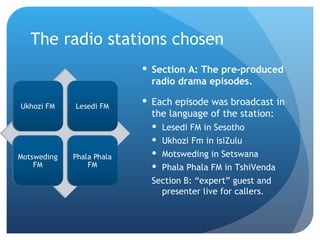
The radio stations chosen Section A: The pre-produced radio drama episodes.  Each episode was broadcast in the language of the station:  Lesedi FM in Sesotho Ukhozi Fm in isiZulu Motsweding in Setswana Phala Phala FM in TshiVenda Section B: “expert” guest and presenter live for callers.
Station reach Ukhozi FM:  with 6.6 million Zulu speakers, Ukhozi is the second largest radio station in the world, the largest in Africa (second to China Lesedi FM:  This station has the 4th largest listening audience of 3.37 million Sotho speakers.  Motsweding FM:   with 3 million Tswana speaking audience, in central and north west South Africa. PhalaPhala FM : This minority language station, for 837,000 listeners, broadcasting in Tshivenda.
Research Objectives Purpose of the evaluation in terms of scope  This project aims to both implement a successful radio education project for financial literacy and to pilot this through precise monitoring and evaluation of the project in this phase, to develop a replicable model for future use in Southern Africa and elsewhere if possible.  We measure d  levels of knowledge, skills, attitudes and behaviour ,  as well as changes in these levels  from the Benchmark Stage, three waves of qualitative research and a final impact research elements of the  project.
Drama background Meet the characters.....
Objectives Key  outcome and impact indicators: Budgeting Indicator:  The % increase in the number of people   who can develop a budget/budgets for money management  Budgeting Indicator:  The % increase in the number of people who take actions aligned to their budget and plan  Generic Saving Indicator:  A % increase in people who plan to save  Saving Indicator:  A % increase in people who make choices / take action and save  Knowledge Indicator : The % increase in understanding of various financial products  Insurance Indicator:  The % increase in knowledge of various types of insurance: life insurance; short-term insurance; Consumer Credit, Legal insurance and Education insurance  Cumulative Project Indicator:  An increase in people who make take actions / make choices for better financial life (behaviour)
Methodology Recruitment of Listening Groups in second phase   In each broadcast area where the research was conducted, contact is  has been  established with local community forums, such youth groups, food garden groups, faith based groups, etc, to become a research panel for each radio station,  First discussions to take part at beginning of Wave 2 on Wave 1 topics, followed by quantitative Wave 2, and then groups reconvened to conduct second discussions on Wave 2 topics. To  contextualise the radio programmes in a more tailored way for the individual community groups covered by the different radio stations
Main Findings Measurement of Indicators Budgeting Indicator – the % number of people who can develop a budget for money management Knowledge of basic building blocks of budgeting is good I know how much money I have right now – 51%  I know what money I will have to pay bills – 51% I know how to work out how to pay bills and still have money to live on – 45% I CAN work out what money I have left after I have paid my bills – 45%
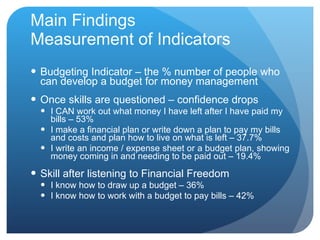
Main Findings Measurement of Indicators Budgeting Indicator – the % number of people who can develop a budget for money management Once skills are questioned – confidence drops I CAN work out what money I have left after I have paid my bills – 53% I make a financial plan or write down a plan to pay my bills and costs and plan how to live on what is left  – 37.7% I write an income / expense sheet or a budget plan, showing money coming in and needing to be paid out  – 19.4% Skill after listening to Financial Freedom I know how to draw up a budget – 36% I know how to work with a budget to pay bills – 42%
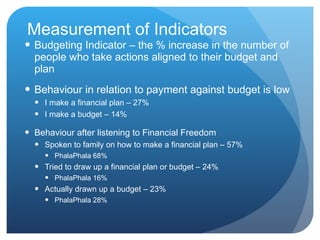
Measurement of Indicators Budgeting Indicator – the %  increase in the number of people who take actions aligned to their budget and plan  Behaviour in relation to payment against budget is low I make a financial plan – 27% I make a budget – 14% Behaviour after listening to Financial Freedom Spoken to family on how to make a financial plan – 57% PhalaPhala 68% Tried to draw up a financial plan or budget – 24% PhalaPhala 16% Actually drawn up a budget – 23% PhalaPhala 28%
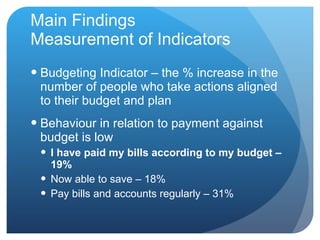
Main Findings Measurement of Indicators Budgeting Indicator – the %  increase in the number of people who take actions aligned to their budget and plan  Behaviour in relation to payment against budget is low I have paid my bills according to my budget  – 19% Now able to save – 18% Pay bills and accounts regularly – 31%
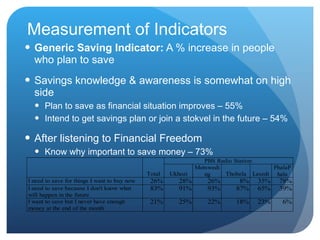
Measurement of Indicators Generic Saving Indicator:  A % increase in people who plan to save  Savings knowledge & awareness is somewhat on high side P lan to save as financial situation improves  – 55% Intend to  get  savings plan or join a stokvel in the future  – 54% After listening to Financial Freedom  Know why important to save money – 73%
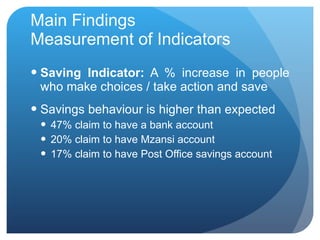
Main Findings Measurement of Indicators Saving Indicator:  A % increase in people who make choices / take action and save Savings behaviour is higher than expected 47 % claim to have a bank account 20% claim to have Mzansi account 17% claim to have Post Office savings account
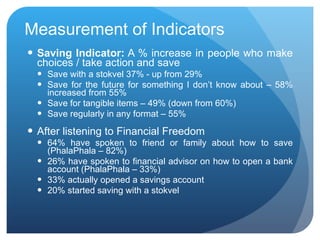
Measurement of Indicators Saving Indicator:  A % increase in people who make choices / take action and save Save with a stokvel 37% - up from 29% Save for the future for something I don’t know about – 58% increased from 55% Save for tangible items – 49% (down from 60%) Save regularly in any format – 55% After listening to Financial Freedom 64% have spoken to friend or family about how to save (PhalaPhala – 82%) 26% have spoken to financial advisor on how to open a bank account (PhalaPhala – 33%) 33% actually opened a savings account 20% started saving with a stokvel
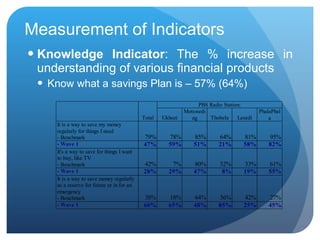
Measurement of Indicators Knowledge Indicator : The % increase in understanding of various financial products Know what a savings Plan is – 57% (64%)
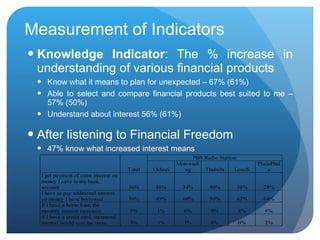
Measurement of Indicators Knowledge Indicator : The % increase in understanding of various financial products Know what it means to plan for unexpected – 67% (61%) Able to select and compare financial products best suited to me – 57% (50%) Understand about interest 56% (61%) After listening to Financial Freedom 47% know what increased interest means
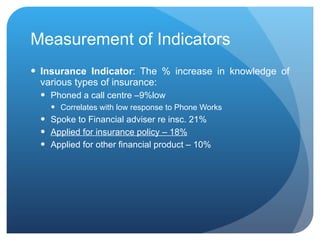
Measurement of Indicators Insurance Indicator : The % increase in knowledge of various types of insurance: Phoned a call centre –9%low Correlates with low response to Phone Works Spoke to Financial adviser re insc. 21% Applied for insurance policy – 18% Applied for other financial product – 10%
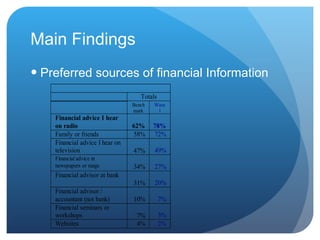
Main Findings Preferred sources of financial Information
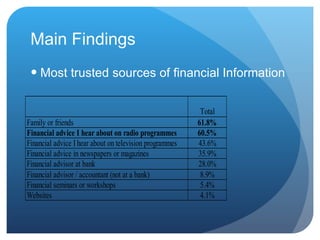
Main Findings Most trusted sources of financial Information
Conclusions Intentional educational media  can  promote new knowledge acquisition, skills development and behaviour change.  More than awareness. More than marketing My future research will write up the process of making educational media, as a model for use. Full findings available from: Ingrid Bruynse [email_address] www.brightmedia.co.za
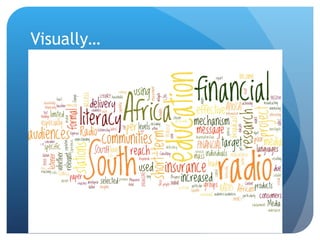
Visually…

Edu learn11

  • 1.
    RESEARCHING EDUCATIONAL RADIOIN SOUTH AFRICA : "FINANCIAL FREEDOM" RADIO DRAMA AND THE MEASUREMENT OF IMPACT ON FINANCIAL LITERACY SKILLS KNOWLEDGE AND BEHAVIOUR IN ADULT AUDIENCES Presentation to the EduLearn Conference 2011 Ingrid Bruynse University of KwaZulu Natal Barcelona - 4 July 2011
  • 2.
    Background Gap analysis:need for research showing the impact of educational radio on learning. Funded project to measure if radio can educate. Selection of 4 broadcast stations and one control station.
  • 3.
    The radio stationschosen Section A: The pre-produced radio drama episodes. Each episode was broadcast in the language of the station: Lesedi FM in Sesotho Ukhozi Fm in isiZulu Motsweding in Setswana Phala Phala FM in TshiVenda Section B: “expert” guest and presenter live for callers.
  • 4.
    Station reach UkhoziFM: with 6.6 million Zulu speakers, Ukhozi is the second largest radio station in the world, the largest in Africa (second to China Lesedi FM: This station has the 4th largest listening audience of 3.37 million Sotho speakers. Motsweding FM: with 3 million Tswana speaking audience, in central and north west South Africa. PhalaPhala FM : This minority language station, for 837,000 listeners, broadcasting in Tshivenda.
  • 5.
    Research Objectives Purposeof the evaluation in terms of scope This project aims to both implement a successful radio education project for financial literacy and to pilot this through precise monitoring and evaluation of the project in this phase, to develop a replicable model for future use in Southern Africa and elsewhere if possible. We measure d levels of knowledge, skills, attitudes and behaviour , as well as changes in these levels from the Benchmark Stage, three waves of qualitative research and a final impact research elements of the project.
  • 6.
    Drama background Meetthe characters.....
  • 7.
    Objectives Key outcome and impact indicators: Budgeting Indicator: The % increase in the number of people who can develop a budget/budgets for money management Budgeting Indicator: The % increase in the number of people who take actions aligned to their budget and plan Generic Saving Indicator: A % increase in people who plan to save Saving Indicator: A % increase in people who make choices / take action and save Knowledge Indicator : The % increase in understanding of various financial products Insurance Indicator: The % increase in knowledge of various types of insurance: life insurance; short-term insurance; Consumer Credit, Legal insurance and Education insurance Cumulative Project Indicator: An increase in people who make take actions / make choices for better financial life (behaviour)
  • 8.
    Methodology Recruitment ofListening Groups in second phase In each broadcast area where the research was conducted, contact is has been established with local community forums, such youth groups, food garden groups, faith based groups, etc, to become a research panel for each radio station, First discussions to take part at beginning of Wave 2 on Wave 1 topics, followed by quantitative Wave 2, and then groups reconvened to conduct second discussions on Wave 2 topics. To contextualise the radio programmes in a more tailored way for the individual community groups covered by the different radio stations
  • 9.
    Main Findings Measurementof Indicators Budgeting Indicator – the % number of people who can develop a budget for money management Knowledge of basic building blocks of budgeting is good I know how much money I have right now – 51% I know what money I will have to pay bills – 51% I know how to work out how to pay bills and still have money to live on – 45% I CAN work out what money I have left after I have paid my bills – 45%
  • 10.
    Main Findings Measurementof Indicators Budgeting Indicator – the % number of people who can develop a budget for money management Once skills are questioned – confidence drops I CAN work out what money I have left after I have paid my bills – 53% I make a financial plan or write down a plan to pay my bills and costs and plan how to live on what is left – 37.7% I write an income / expense sheet or a budget plan, showing money coming in and needing to be paid out – 19.4% Skill after listening to Financial Freedom I know how to draw up a budget – 36% I know how to work with a budget to pay bills – 42%
  • 11.
    Measurement of IndicatorsBudgeting Indicator – the % increase in the number of people who take actions aligned to their budget and plan Behaviour in relation to payment against budget is low I make a financial plan – 27% I make a budget – 14% Behaviour after listening to Financial Freedom Spoken to family on how to make a financial plan – 57% PhalaPhala 68% Tried to draw up a financial plan or budget – 24% PhalaPhala 16% Actually drawn up a budget – 23% PhalaPhala 28%
  • 12.
    Main Findings Measurementof Indicators Budgeting Indicator – the % increase in the number of people who take actions aligned to their budget and plan Behaviour in relation to payment against budget is low I have paid my bills according to my budget – 19% Now able to save – 18% Pay bills and accounts regularly – 31%
  • 13.
    Measurement of IndicatorsGeneric Saving Indicator: A % increase in people who plan to save Savings knowledge & awareness is somewhat on high side P lan to save as financial situation improves – 55% Intend to get savings plan or join a stokvel in the future – 54% After listening to Financial Freedom Know why important to save money – 73%
  • 14.
    Main Findings Measurementof Indicators Saving Indicator: A % increase in people who make choices / take action and save Savings behaviour is higher than expected 47 % claim to have a bank account 20% claim to have Mzansi account 17% claim to have Post Office savings account
  • 15.
    Measurement of IndicatorsSaving Indicator: A % increase in people who make choices / take action and save Save with a stokvel 37% - up from 29% Save for the future for something I don’t know about – 58% increased from 55% Save for tangible items – 49% (down from 60%) Save regularly in any format – 55% After listening to Financial Freedom 64% have spoken to friend or family about how to save (PhalaPhala – 82%) 26% have spoken to financial advisor on how to open a bank account (PhalaPhala – 33%) 33% actually opened a savings account 20% started saving with a stokvel
  • 16.
    Measurement of IndicatorsKnowledge Indicator : The % increase in understanding of various financial products Know what a savings Plan is – 57% (64%)
  • 17.
    Measurement of IndicatorsKnowledge Indicator : The % increase in understanding of various financial products Know what it means to plan for unexpected – 67% (61%) Able to select and compare financial products best suited to me – 57% (50%) Understand about interest 56% (61%) After listening to Financial Freedom 47% know what increased interest means
  • 18.
    Measurement of IndicatorsInsurance Indicator : The % increase in knowledge of various types of insurance: Phoned a call centre –9%low Correlates with low response to Phone Works Spoke to Financial adviser re insc. 21% Applied for insurance policy – 18% Applied for other financial product – 10%
  • 19.
    Main Findings Preferredsources of financial Information
  • 20.
    Main Findings Mosttrusted sources of financial Information
  • 21.
    Conclusions Intentional educationalmedia can promote new knowledge acquisition, skills development and behaviour change. More than awareness. More than marketing My future research will write up the process of making educational media, as a model for use. Full findings available from: Ingrid Bruynse [email_address] www.brightmedia.co.za
  • 22.