Transformational localism in the Thames Gateway James Kennell Graham Symon Economic Development Resource Centre
Context Economic / Fiscal Crisis Developing policy discourses Regionalism to  Localism New governance arrangements for economic development
The ‘New Localism’ We’ve been here before? Rhetoric of: decentralisation / devolution ‘ empowerment’ Reality:  de facto  centralisation of administrative control marginalisation of local government?
The New Localism What’s new? Necessity; the mother of invention? Innovation less reliance on public sector manufacturing / export? Real solutions to crisis/decline can only be found locally Local communities: policy, business, civil society, citizens partnerships
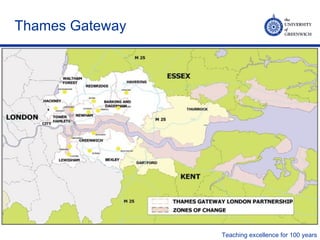
Thames Gateway
Options / Models for the Thames Gateway Archetypes: ‘ Bureaucratic’ ‘ Rentier’ ‘ Insurgency’ ‘ Transformationalism’
‘ Bureaucratic’ – state-driven Classic social democratic scenario State expansion post-1945 Keynesian, Berevidge Paternalist? Corporatist? Top-down ‘ Steering’  and  ‘rowing’
‘ Rentier’ – corporate driven Rhetoric of ‘what business needs/wants’ Attracting / incentivising investment Public funds grants (within what European law permits!) tax breaks Social externalities? How much licence should industry be allowed? Diversity?
‘ Insurgency’ – community driven Economic decline / transition resulting in social problems Manifested in resistance, disaffection Citizen action hallmark of healthy democracy ‘ Bottom-up’ Coalitions of civil society, faith, ethnic, labour organisations, campaigning, seeking change North America (‘Rust Belt’) South America (various) UK (TELCO, community unionism) Energy can be harnessed under the right circumstances
‘ Transformational’ – the integrated approach Allowing the conditions to prevail that enable complementary contributions from stakeholders State: robust but not overbearing; as local as possible Industry: investment / entrepreneurialism / sustainable economic activity crucial; social externalities should be optimised Communities: cynicism / alienation must be overcome; rhetoric must meet reality Policy makers should not fear collective action Ultimately, what works locally is down to contingent factors: Arms-length central state Responsible business Engaged communities
Some practical interventions for the Thames Gateway Localising finance a Thames Gateway Investment Bond Local currency? Localising ownership assets / resources / capacity freed from central state control .... but beware the ‘Rentier’ Localising opportunity Reinstating historic role of municipality in economic governance matters Production and consumption brought into proximity Partnerships: skills / labour markets Localising accountability Not only local action, but local control Local Development Index (LDI) Informatting
Concluding thoughts Thames Gateway faces challenges (in common with many geographies) Localism may provide key opportunities Must develop institutions that foster innovation and trust between stakeholders Radical action may be necessary

Edrec thames gateway localism

  • 1.
    Transformational localism inthe Thames Gateway James Kennell Graham Symon Economic Development Resource Centre
  • 2.
    Context Economic /Fiscal Crisis Developing policy discourses Regionalism to Localism New governance arrangements for economic development
  • 3.
    The ‘New Localism’We’ve been here before? Rhetoric of: decentralisation / devolution ‘ empowerment’ Reality: de facto centralisation of administrative control marginalisation of local government?
  • 4.
    The New LocalismWhat’s new? Necessity; the mother of invention? Innovation less reliance on public sector manufacturing / export? Real solutions to crisis/decline can only be found locally Local communities: policy, business, civil society, citizens partnerships
  • 5.
  • 6.
    Options / Modelsfor the Thames Gateway Archetypes: ‘ Bureaucratic’ ‘ Rentier’ ‘ Insurgency’ ‘ Transformationalism’
  • 7.
    ‘ Bureaucratic’ –state-driven Classic social democratic scenario State expansion post-1945 Keynesian, Berevidge Paternalist? Corporatist? Top-down ‘ Steering’ and ‘rowing’
  • 8.
    ‘ Rentier’ –corporate driven Rhetoric of ‘what business needs/wants’ Attracting / incentivising investment Public funds grants (within what European law permits!) tax breaks Social externalities? How much licence should industry be allowed? Diversity?
  • 9.
    ‘ Insurgency’ –community driven Economic decline / transition resulting in social problems Manifested in resistance, disaffection Citizen action hallmark of healthy democracy ‘ Bottom-up’ Coalitions of civil society, faith, ethnic, labour organisations, campaigning, seeking change North America (‘Rust Belt’) South America (various) UK (TELCO, community unionism) Energy can be harnessed under the right circumstances
  • 10.
    ‘ Transformational’ –the integrated approach Allowing the conditions to prevail that enable complementary contributions from stakeholders State: robust but not overbearing; as local as possible Industry: investment / entrepreneurialism / sustainable economic activity crucial; social externalities should be optimised Communities: cynicism / alienation must be overcome; rhetoric must meet reality Policy makers should not fear collective action Ultimately, what works locally is down to contingent factors: Arms-length central state Responsible business Engaged communities
  • 11.
    Some practical interventionsfor the Thames Gateway Localising finance a Thames Gateway Investment Bond Local currency? Localising ownership assets / resources / capacity freed from central state control .... but beware the ‘Rentier’ Localising opportunity Reinstating historic role of municipality in economic governance matters Production and consumption brought into proximity Partnerships: skills / labour markets Localising accountability Not only local action, but local control Local Development Index (LDI) Informatting
  • 12.
    Concluding thoughts ThamesGateway faces challenges (in common with many geographies) Localism may provide key opportunities Must develop institutions that foster innovation and trust between stakeholders Radical action may be necessary