1
WHAT IS STOCK ?
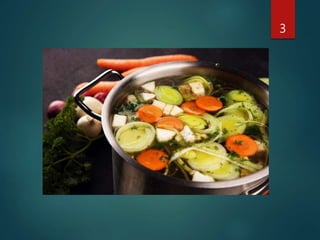
 A stock may be defined as a nutritious, flavorful clear thin liquid that is
obtained (extracted) by careful simmering of meat, poultry, or fish bones
and vegetables, along with flavorings for a pre-determined period of time.
 Termed as “Fond” in French cuisine( foundation or base).
 History of serving stocks/broths as soup.
 Stock is flavored liquid which forms the base for many dishes particularly
soups & sauces.
E.g: Indian yakhni stock, Japanese dashi stock, French beef stock
2
3
What is mirepoix? Bouquet garnie? Sachet d’ epices
?
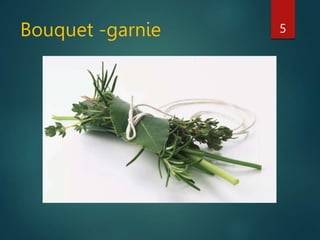
 Bouquet -garnie Bunch of herbs used to flavor western stock
is called as bouquet -garnie.
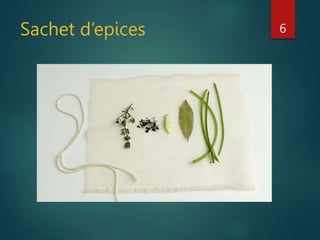
 Sachet d’epices Certain spices such as pepper corn, bay leaf
along with herbs are used to spice up stock are known as
sachet d’epices. literally means bag of spice in French.
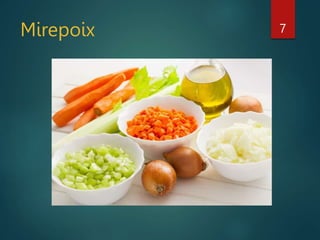
 Mirepoix - The French flavor base called mirepoix is a
combination of onion, carrot and celery generally cut to the
same size. It's used in a ratio that's 2 parts onion to 1 part
celery and carrot.
4
Bouquet -garnie 5
Sachet d’epices 6
Mirepoix 7
Types of stock
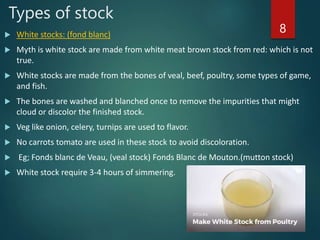
 White stocks: (fond blanc)
 Myth is white stock are made from white meat brown stock from red: which is not
true.
 White stocks are made from the bones of veal, beef, poultry, some types of game,
and fish.
 The bones are washed and blanched once to remove the impurities that might
cloud or discolor the finished stock.
 Veg like onion, celery, turnips are used to flavor.
 No carrots tomato are used in these stock to avoid discoloration.
 Eg; Fonds blanc de Veau, (veal stock) Fonds Blanc de Mouton.(mutton stock)
 White stock require 3-4 hours of simmering.
8
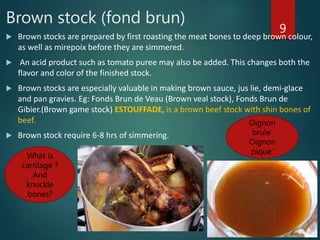
Brown stock (fond brun)
 Brown stocks are prepared by first roasting the meat bones to deep brown colour,
as well as mirepoix before they are simmered.
 An acid product such as tomato puree may also be added. This changes both the
flavor and color of the finished stock.
 Brown stocks are especially valuable in making brown sauce, jus lie, demi-glace
and pan gravies. Eg: Fonds Brun de Veau (Brown veal stock), Fonds Brun de
Gibier.(Brown game stock) ESTOUFFADE, is a brown beef stock with shin bones of
beef.
 Brown stock require 6-8 hrs of simmering.
9
Oignon
brule’
Oignon
pique’
What is
cartilage ?
And
knuckle
bones?
Shin Bones for brown stock 10
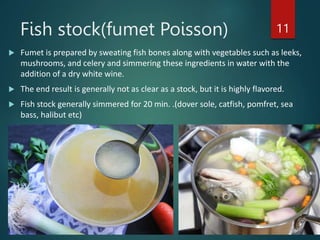
Fish stock(fumet Poisson)
 Fumet is prepared by sweating fish bones along with vegetables such as leeks,
mushrooms, and celery and simmering these ingredients in water with the
addition of a dry white wine.
 The end result is generally not as clear as a stock, but it is highly flavored.
 Fish stock generally simmered for 20 min. .(dover sole, catfish, pomfret, sea
bass, halibut etc)
11
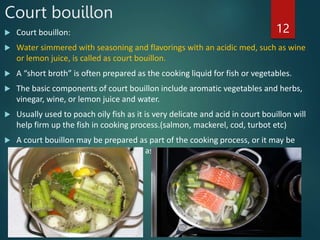
Court bouillon
 Court bouillon:
 Water simmered with seasoning and flavorings with an acidic med, such as wine
or lemon juice, is called as court bouillon.
 A “short broth” is often prepared as the cooking liquid for fish or vegetables.
 The basic components of court bouillon include aromatic vegetables and herbs,
vinegar, wine, or lemon juice and water.
 Usually used to poach oily fish as it is very delicate and acid in court bouillon will
help firm up the fish in cooking process.(salmon, mackerel, cod, turbot etc)
 A court bouillon may be prepared as part of the cooking process, or it may be
prepared in large batches and used as required, in the same way as stocks.
12
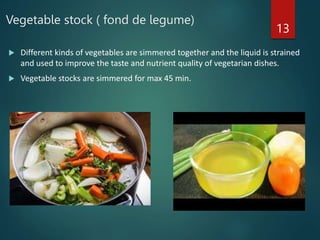
Vegetable stock ( fond de legume)
 Different kinds of vegetables are simmered together and the liquid is strained
and used to improve the taste and nutrient quality of vegetarian dishes.
 Vegetable stocks are simmered for max 45 min.
13
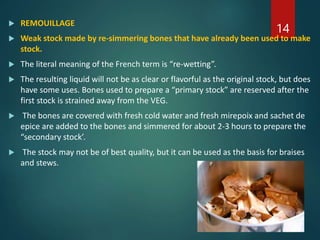
 REMOUILLAGE
 Weak stock made by re-simmering bones that have already been used to make
stock.
 The literal meaning of the French term is “re-wetting”.
 The resulting liquid will not be as clear or flavorful as the original stock, but does
have some uses. Bones used to prepare a “primary stock” are reserved after the
first stock is strained away from the VEG.
 The bones are covered with fresh cold water and fresh mirepoix and sachet de
epice are added to the bones and simmered for about 2-3 hours to prepare the
“secondary stock’.
 The stock may not be of best quality, but it can be used as the basis for braises
and stews.
14
POT LIQUOR
 Pot liquor is the water in which meat, poultry, fish, vegetables, pasta etc. have been
boiled where the purpose is to retain as much nutrients and flavor in the solids as
possible.
 This liquid can be used as a substitute for stock if it is not readily available.
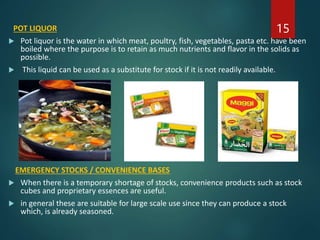
EMERGENCY STOCKS / CONVENIENCE BASES
 When there is a temporary shortage of stocks, convenience products such as stock
cubes and proprietary essences are useful.
 in general these are suitable for large scale use since they can produce a stock
which, is already seasoned.
15
16
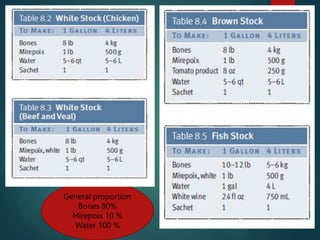
General proportion
Bones 80%
Mirepoix 10 %
Water 100 %
Tips for good quality stock
 Always use good quality of bones that are free from foul smell.
 All fat should be removed from bones as the stock becomes very
greasy and becomes rancid soon.
 Always use cold water for stock. This promotes the extraction of
collagen, which may be sealed in by hot water.
 For chicken stock always use neck and carcass, for lamb/beef stock
shin or shoulder of beef or veal are commonly recommended
 Never use oily fish for fish stock as it makes oily as well as very
strong flavored stock.(salmon, mackerel, cod, turbot)
 Pork is considered unsuitable for stock in European cooking due to
its greasiness.
17
Tips for good quality stock
 Never boil the stock always simmer it. Stocks are simmered gently, with bubbles
just breaking the surface, and not boiled. If a stock is boiled, it will be cloudy.
 Always blanch bones and then make stock.
 Salt is usually not added to a stock, as this causes it to become too salty, since
most stocks are reduced to make soups and sauces.
 Meat is added to stock before vegetables, and the “scum” that rises to the
surface is skimmed off before further ingredients are added.
 Skim the scum that keeps rising at top, as these impurities if mixed with stock, it
makes stock cloudy.
 Always add mirepoix during last one hour and sachet during last 30 min.
 Strain the stock and immediately cool it, store at 4-5 c.
 For longer use make small batches, vacuum pack them and store in deep freezer
at -18 c for about month.
 Stocks can be frozen and kept indefinitely but are better fresh.
18
THANK YOU !!!
19

CH_5._STOCKS.pptx

  • 1.
  • 2.
    WHAT IS STOCK?  A stock may be defined as a nutritious, flavorful clear thin liquid that is obtained (extracted) by careful simmering of meat, poultry, or fish bones and vegetables, along with flavorings for a pre-determined period of time.  Termed as “Fond” in French cuisine( foundation or base).  History of serving stocks/broths as soup.  Stock is flavored liquid which forms the base for many dishes particularly soups & sauces. E.g: Indian yakhni stock, Japanese dashi stock, French beef stock 2
  • 3.
  • 4.
    What is mirepoix?Bouquet garnie? Sachet d’ epices ?  Bouquet -garnie Bunch of herbs used to flavor western stock is called as bouquet -garnie.  Sachet d’epices Certain spices such as pepper corn, bay leaf along with herbs are used to spice up stock are known as sachet d’epices. literally means bag of spice in French.  Mirepoix - The French flavor base called mirepoix is a combination of onion, carrot and celery generally cut to the same size. It's used in a ratio that's 2 parts onion to 1 part celery and carrot. 4
  • 5.
  • 6.
  • 7.
  • 8.
    Types of stock White stocks: (fond blanc)  Myth is white stock are made from white meat brown stock from red: which is not true.  White stocks are made from the bones of veal, beef, poultry, some types of game, and fish.  The bones are washed and blanched once to remove the impurities that might cloud or discolor the finished stock.  Veg like onion, celery, turnips are used to flavor.  No carrots tomato are used in these stock to avoid discoloration.  Eg; Fonds blanc de Veau, (veal stock) Fonds Blanc de Mouton.(mutton stock)  White stock require 3-4 hours of simmering. 8
  • 9.
    Brown stock (fondbrun)  Brown stocks are prepared by first roasting the meat bones to deep brown colour, as well as mirepoix before they are simmered.  An acid product such as tomato puree may also be added. This changes both the flavor and color of the finished stock.  Brown stocks are especially valuable in making brown sauce, jus lie, demi-glace and pan gravies. Eg: Fonds Brun de Veau (Brown veal stock), Fonds Brun de Gibier.(Brown game stock) ESTOUFFADE, is a brown beef stock with shin bones of beef.  Brown stock require 6-8 hrs of simmering. 9 Oignon brule’ Oignon pique’ What is cartilage ? And knuckle bones?
  • 10.
    Shin Bones forbrown stock 10
  • 11.
    Fish stock(fumet Poisson) Fumet is prepared by sweating fish bones along with vegetables such as leeks, mushrooms, and celery and simmering these ingredients in water with the addition of a dry white wine.  The end result is generally not as clear as a stock, but it is highly flavored.  Fish stock generally simmered for 20 min. .(dover sole, catfish, pomfret, sea bass, halibut etc) 11
  • 12.
    Court bouillon  Courtbouillon:  Water simmered with seasoning and flavorings with an acidic med, such as wine or lemon juice, is called as court bouillon.  A “short broth” is often prepared as the cooking liquid for fish or vegetables.  The basic components of court bouillon include aromatic vegetables and herbs, vinegar, wine, or lemon juice and water.  Usually used to poach oily fish as it is very delicate and acid in court bouillon will help firm up the fish in cooking process.(salmon, mackerel, cod, turbot etc)  A court bouillon may be prepared as part of the cooking process, or it may be prepared in large batches and used as required, in the same way as stocks. 12
  • 13.
    Vegetable stock (fond de legume)  Different kinds of vegetables are simmered together and the liquid is strained and used to improve the taste and nutrient quality of vegetarian dishes.  Vegetable stocks are simmered for max 45 min. 13
  • 14.
     REMOUILLAGE  Weakstock made by re-simmering bones that have already been used to make stock.  The literal meaning of the French term is “re-wetting”.  The resulting liquid will not be as clear or flavorful as the original stock, but does have some uses. Bones used to prepare a “primary stock” are reserved after the first stock is strained away from the VEG.  The bones are covered with fresh cold water and fresh mirepoix and sachet de epice are added to the bones and simmered for about 2-3 hours to prepare the “secondary stock’.  The stock may not be of best quality, but it can be used as the basis for braises and stews. 14
  • 15.
    POT LIQUOR  Potliquor is the water in which meat, poultry, fish, vegetables, pasta etc. have been boiled where the purpose is to retain as much nutrients and flavor in the solids as possible.  This liquid can be used as a substitute for stock if it is not readily available. EMERGENCY STOCKS / CONVENIENCE BASES  When there is a temporary shortage of stocks, convenience products such as stock cubes and proprietary essences are useful.  in general these are suitable for large scale use since they can produce a stock which, is already seasoned. 15
  • 16.
  • 17.
    Tips for goodquality stock  Always use good quality of bones that are free from foul smell.  All fat should be removed from bones as the stock becomes very greasy and becomes rancid soon.  Always use cold water for stock. This promotes the extraction of collagen, which may be sealed in by hot water.  For chicken stock always use neck and carcass, for lamb/beef stock shin or shoulder of beef or veal are commonly recommended  Never use oily fish for fish stock as it makes oily as well as very strong flavored stock.(salmon, mackerel, cod, turbot)  Pork is considered unsuitable for stock in European cooking due to its greasiness. 17
  • 18.
    Tips for goodquality stock  Never boil the stock always simmer it. Stocks are simmered gently, with bubbles just breaking the surface, and not boiled. If a stock is boiled, it will be cloudy.  Always blanch bones and then make stock.  Salt is usually not added to a stock, as this causes it to become too salty, since most stocks are reduced to make soups and sauces.  Meat is added to stock before vegetables, and the “scum” that rises to the surface is skimmed off before further ingredients are added.  Skim the scum that keeps rising at top, as these impurities if mixed with stock, it makes stock cloudy.  Always add mirepoix during last one hour and sachet during last 30 min.  Strain the stock and immediately cool it, store at 4-5 c.  For longer use make small batches, vacuum pack them and store in deep freezer at -18 c for about month.  Stocks can be frozen and kept indefinitely but are better fresh. 18
  • 19.