Presented By Alfred Odden
The Effect of Technology on Student Achievement Slide one Slide two Slide three Slide four Slide five Slide six Slide seven Slide eight Slide nine
Slide one Chalk and chalkboards are “old school”
Slide two The need is here to  move beyond chalk and chalkboards, pencils and pads of paper.
Slide three What do today’s  tools look like ?
Slide four How is this new  technology impacting students?
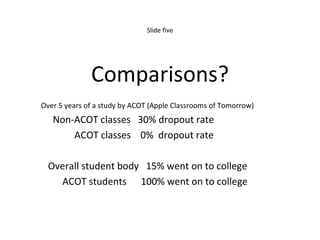
Slide five Comparisons? Over 5 years of a study by ACOT (Apple Classrooms of Tomorrow) Non-ACOT classes  30% dropout rate ACOT classes  0%  dropout rate Overall student body  15% went on to college ACOT students  100% went on to college
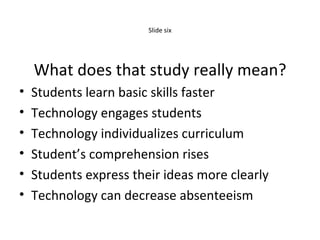
Slide six What does that study really mean? Students learn basic skills faster Technology engages students Technology individualizes curriculum Student’s comprehension rises Students express their ideas more clearly Technology can decrease absenteeism
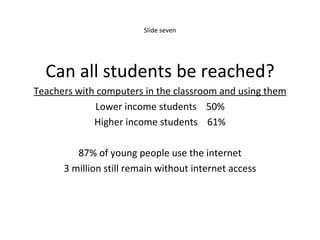
Slide seven Can all students be reached? Teachers with computers in the classroom and using them Lower income students  50% Higher income students  61% 87% of young people use the internet 3 million still remain without internet access
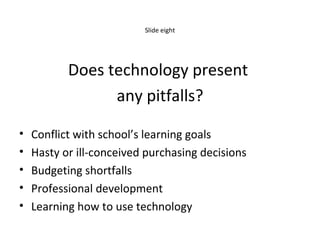
Slide eight Does technology present  any pitfalls? Conflict with school’s learning goals Hasty or ill-conceived purchasing decisions Budgeting shortfalls Professional development Learning how to use technology
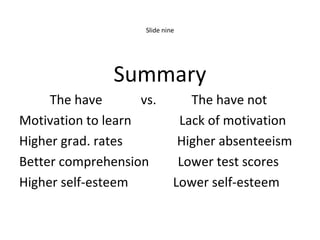
Slide nine Summary The have  vs.  The have not  Motivation to learn  Lack of motivation Higher grad. rates  Higher absenteeism Better comprehension  Lower test scores Higher self-esteem  Lower self-esteem

Ed 633technologyineducation

  • 1.
  • 2.
    The Effect ofTechnology on Student Achievement Slide one Slide two Slide three Slide four Slide five Slide six Slide seven Slide eight Slide nine
  • 3.
    Slide one Chalkand chalkboards are “old school”
  • 4.
    Slide two Theneed is here to move beyond chalk and chalkboards, pencils and pads of paper.
  • 5.
    Slide three Whatdo today’s tools look like ?
  • 6.
    Slide four Howis this new technology impacting students?
  • 7.
    Slide five Comparisons?Over 5 years of a study by ACOT (Apple Classrooms of Tomorrow) Non-ACOT classes 30% dropout rate ACOT classes 0% dropout rate Overall student body 15% went on to college ACOT students 100% went on to college
  • 8.
    Slide six Whatdoes that study really mean? Students learn basic skills faster Technology engages students Technology individualizes curriculum Student’s comprehension rises Students express their ideas more clearly Technology can decrease absenteeism
  • 9.
    Slide seven Canall students be reached? Teachers with computers in the classroom and using them Lower income students 50% Higher income students 61% 87% of young people use the internet 3 million still remain without internet access
  • 10.
    Slide eight Doestechnology present any pitfalls? Conflict with school’s learning goals Hasty or ill-conceived purchasing decisions Budgeting shortfalls Professional development Learning how to use technology
  • 11.
    Slide nine SummaryThe have vs. The have not Motivation to learn Lack of motivation Higher grad. rates Higher absenteeism Better comprehension Lower test scores Higher self-esteem Lower self-esteem

Editor's Notes

  • #4 Schools are no longer simply chalk and chalkboards. Though we still need to evaluate in terms of cost and effect when measuring any level of technology presented to students, the ante is continually upped as new hardware and software leaves the designers drawing boards.
  • #5 We now need to add a component that a report at http://techknowlogia.org/TKL_Articles/PDF/17.pdf calls the surrounding conditions. Students can no longer go to class armed with the simple tools that generations past have used.
  • #6 These surrounding conditions take the form of a new set of tools such as computers, smartboards, animations, and personal response systems for quizzes and exams.
  • #7 An article at http://www.oten.info/conferences/jukes/ResearchSummary.pdf reports that students learn even the basic skills faster when they have access to technology, and at-risk students show substantial improvement when technology is introduced into their curriculum. Using web browsers, databases, and spreadsheets students are able to find information much faster, and then organize and evaluate that information.
  • #8 ACOT (Apple Classrooms of Tomorrow) has compared statistics during a 5 year study. The figures shown reflect a change in student’s attitudes toward learning as well as their success in school. Technology can motivate students to higher levels of achievement, we really owe it to them to help them get all out of school that they possibly can.
  • #9 Basic skills are practiced more efficiently using technology. When students are engaged they spend more time on basic learning. The needs of individual students, some of them with special needs, learn better with curriculum customized for them, technology makes this much easier and faster. Students with a higher level of comprehension show a greater likelihood of using what they learn later in life. Students can express themselves more clearly and accurately using a variety of means of communication such as is found in technology. With increased pride and interest in their work, students can be expected to miss less school, have lower dropout rates, have greater confidence in their abilities, and develop higher levels of self-esteem.
  • #10 The challenge to achieve technological literacy is still the most difficult in areas serving low-socioeconomic, minority students. The “digital divide” must be breached to present a level playing field to all students, this is the only way that employment can be equally available to all. Low-SES schools have been found to use technology more for reinforcement and remediation of skills, while higher-SES schools use it more for presenting and analyzing information.
  • #11 Defining the learning goals needs to be done effectively so there are no expectation gaps between teachers, parents, students, administration, and the community. Careful planning is a must to ensure that the technology needed is what is actually purchased, and that later budgeting problems aren’t the result. Professional development must be a part of the planning so that the proper use of technology can be passed from teachers to students.
  • #12 The studies and the numbers speak for themselves, when students have technology available they learn the basics better and move on more quickly to a higher level of learning. To have any chance of competing in an ever harder employment sector, students need to have a level playing field or they will simply be left behind. There was a time when paper and pencils, blackboards and chalk, and textbooks were enough, those days are gone. To show respect for students by equipping them with the tools they need enables them to respect themselves more through higher achievement.