‘Square Foot’ Garden
If you haven’t got much space to grow
vegetables at home or at school why not try
‘square foot’ gardening?
The ‘square foot’ garden is an American
method of growing as many vegetables as
you can in, as small a space as possible, using a plot 120cm x 120cm (4ft x 4ft).
This space is all you need to grow a wide
variety of crops. If you have more space you
could double the area.
However, the 120cm x 120cm (4ft x 4ft) is
enough to get you started.

Avoid using creosote as it may possibly damage plants, soil dwelling creatures, and humans.
Improve the soil inside the bed with garden
compost mixed with some well-rotted
manure. Make sure that the soil is weed
free and remove as many stones as possible.
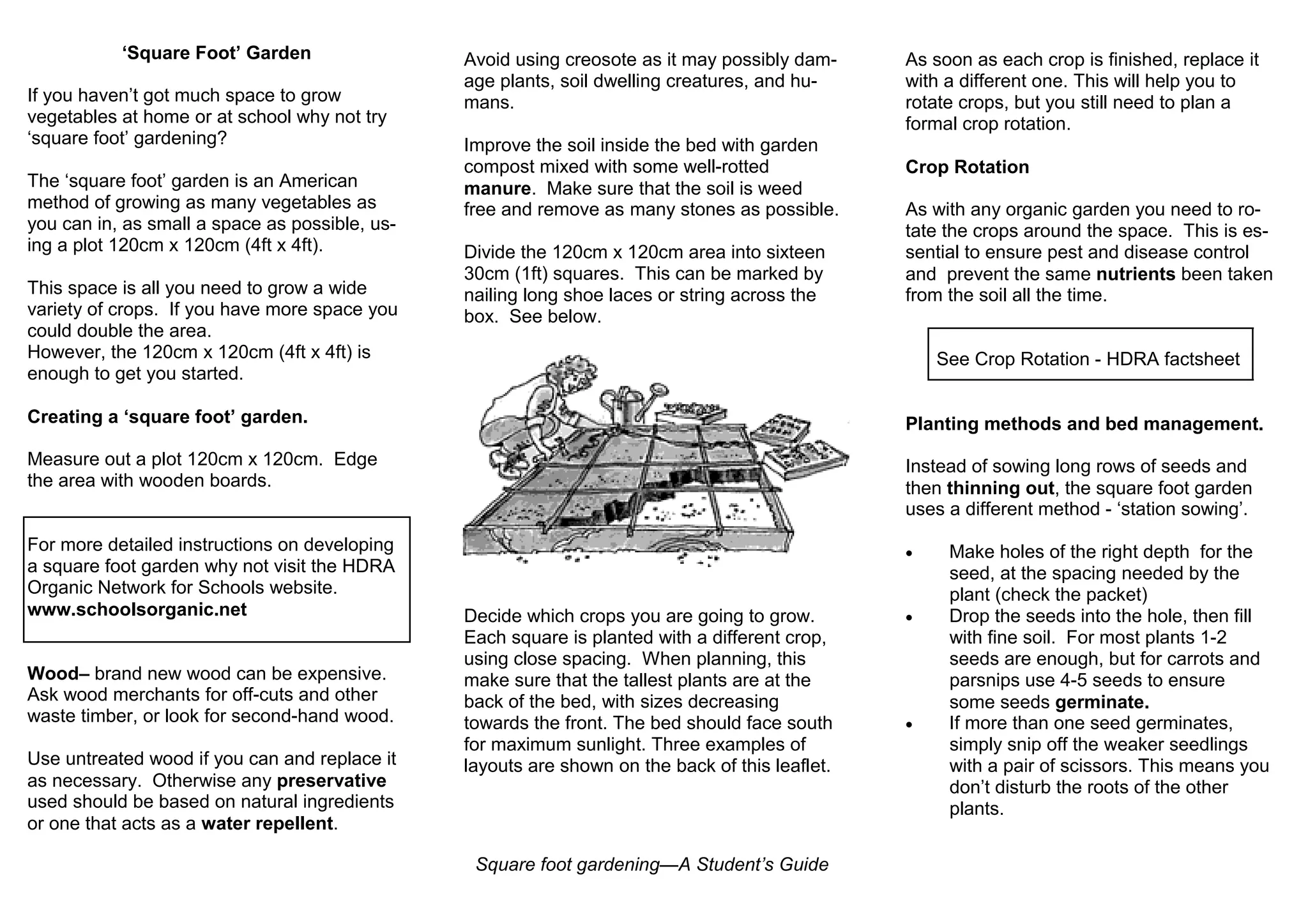
Divide the 120cm x 120cm area into sixteen
30cm (1ft) squares. This can be marked by
nailing long shoe laces or string across the
box. See below.

As soon as each crop is finished, replace it
with a different one. This will help you to
rotate crops, but you still need to plan a
formal crop rotation.
Crop Rotation
As with any organic garden you need to rotate the crops around the space. This is essential to ensure pest and disease control
and prevent the same nutrients been taken
from the soil all the time.
See Crop Rotation - HDRA factsheet

Creating a ‘square foot’ garden.

Planting methods and bed management.

Measure out a plot 120cm x 120cm. Edge
the area with wooden boards.

Instead of sowing long rows of seeds and
then thinning out, the square foot garden
uses a different method - ‘station sowing’.

For more detailed instructions on developing
a square foot garden why not visit the HDRA
Organic Network for Schools website.
www.schoolsorganic.net
Wood– brand new wood can be expensive.
Ask wood merchants for off-cuts and other
waste timber, or look for second-hand wood.
Use untreated wood if you can and replace it
as necessary. Otherwise any preservative
used should be based on natural ingredients
or one that acts as a water repellent.

•

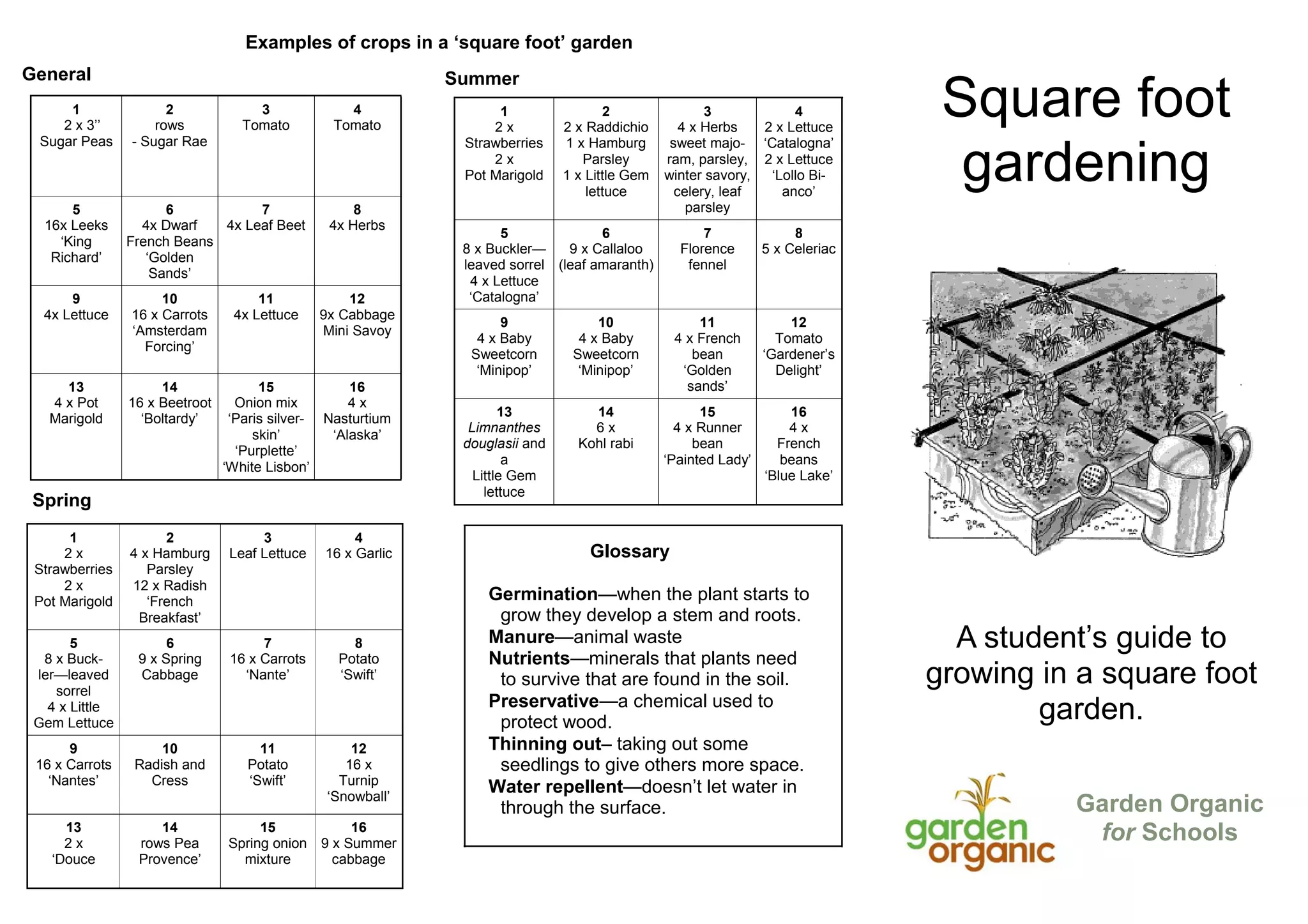
Decide which crops you are going to grow.
Each square is planted with a different crop,
using close spacing. When planning, this
make sure that the tallest plants are at the
back of the bed, with sizes decreasing
towards the front. The bed should face south
for maximum sunlight. Three examples of
layouts are shown on the back of this leaflet.

Square foot gardening—A Student’s Guide

•

•

Make holes of the right depth for the
seed, at the spacing needed by the
plant (check the packet)
Drop the seeds into the hole, then fill
with fine soil. For most plants 1-2
seeds are enough, but for carrots and
parsnips use 4-5 seeds to ensure
some seeds germinate.
If more than one seed germinates,
simply snip off the weaker seedlings
with a pair of scissors. This means you
don’t disturb the roots of the other
plants.
Examples of crops in a ‘square foot’ garden
General
1
2 x 3’’
Sugar Peas

5
16x Leeks
‘King
Richard’

Summer
2
rows
- Sugar Rae

3
Tomato

6
7
4x Dwarf
4x Leaf Beet
French Beans
‘Golden
Sands’

9
4x Lettuce

10
16 x Carrots
‘Amsterdam
Forcing’

13
4 x Pot
Marigold

14
16 x Beetroot
‘Boltardy’

11
4x Lettuce

4
Tomato

8
4x Herbs

12
9x Cabbage
Mini Savoy

15
16
Onion mix
4x
‘Paris silver- Nasturtium
skin’
‘Alaska’
‘Purplette’
‘White Lisbon’

Spring
1
2x
Strawberries
2x
Pot Marigold

2
4 x Hamburg
Parsley
12 x Radish
‘French
Breakfast’

3
Leaf Lettuce

4
16 x Garlic

5
8 x Buckler—leaved
sorrel
4 x Little
Gem Lettuce

6
9 x Spring
Cabbage

7
16 x Carrots
‘Nante’

8
Potato
‘Swift’

9
16 x Carrots
‘Nantes’

10
Radish and
Cress

11
Potato
‘Swift’

12
16 x
Turnip
‘Snowball’

13
2x
‘Douce

14
rows Pea
Provence’

15
Spring onion
mixture

16
9 x Summer
cabbage

1
2x
Strawberries
2x
Pot Marigold

2
2 x Raddichio
1 x Hamburg
Parsley
1 x Little Gem
lettuce

3
4
4 x Herbs
2 x Lettuce
sweet majo- ‘Catalogna’
ram, parsley, 2 x Lettuce
winter savory,
‘Lollo Bicelery, leaf
anco’
parsley

5
6
8 x Buckler—
9 x Callaloo
leaved sorrel (leaf amaranth)
4 x Lettuce
‘Catalogna’

7
Florence
fennel

Square foot
gardening

8
5 x Celeriac

9
4 x Baby
Sweetcorn
‘Minipop’

10
4 x Baby
Sweetcorn
‘Minipop’

11
4 x French
bean
‘Golden
sands’

12
Tomato
‘Gardener’s
Delight’

13
Limnanthes
douglasii and
a
Little Gem
lettuce

14
6x
Kohl rabi

15
4 x Runner
bean
‘Painted Lady’

16
4x
French
beans
‘Blue Lake’

Glossary
Germination—when the plant starts to
grow they develop a stem and roots.
Manure—animal waste
Nutrients—minerals that plants need
to survive that are found in the soil.
Preservative—a chemical used to
protect wood.
Thinning out– taking out some
seedlings to give others more space.
Water repellent—doesn’t let water in
through the surface.

A student’s guide to
growing in a square foot
garden.
Garden Organic
for Schools
‘Square Foot’ Gardening
Finding the space in school grounds to grow
vegetables is not always easy. This, together
with the inexperience of some teachers and
many
students, can make growing vegetables seem
like a daunting task. However, it is these
factors that make ‘square foot’ gardening
ideal.

Dig out and remove any weeds and stones
from the area. Improve the soil inside the
bed with garden compost or some wellrotted manure.
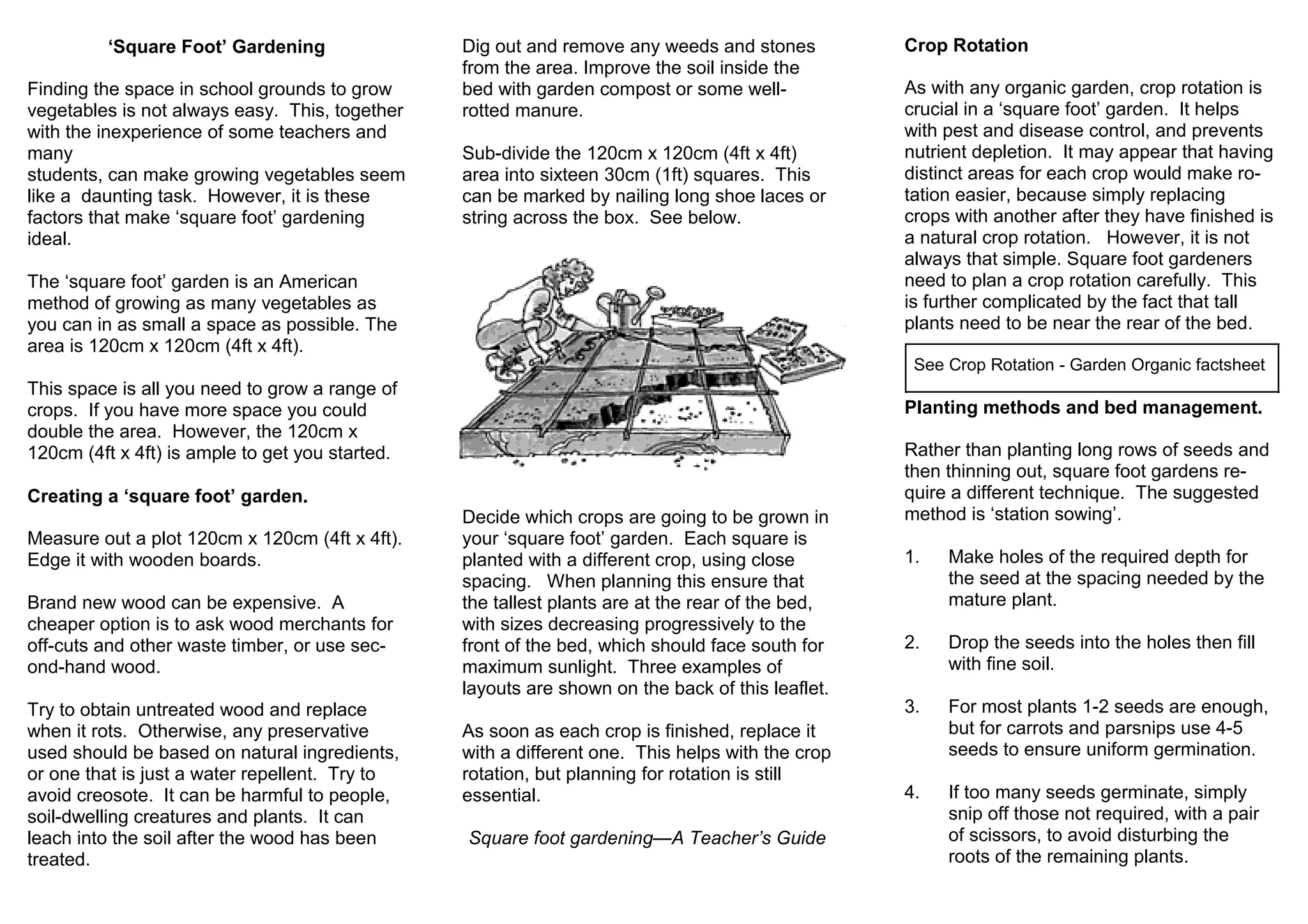
Sub-divide the 120cm x 120cm (4ft x 4ft)
area into sixteen 30cm (1ft) squares. This
can be marked by nailing long shoe laces or
string across the box. See below.

The ‘square foot’ garden is an American
method of growing as many vegetables as
you can in as small a space as possible. The
area is 120cm x 120cm (4ft x 4ft).

Planting methods and bed management.

Creating a ‘square foot’ garden.

Brand new wood can be expensive. A
cheaper option is to ask wood merchants for
off-cuts and other waste timber, or use second-hand wood.
Try to obtain untreated wood and replace
when it rots. Otherwise, any preservative
used should be based on natural ingredients,
or one that is just a water repellent. Try to
avoid creosote. It can be harmful to people,
soil-dwelling creatures and plants. It can
leach into the soil after the wood has been
treated.

As with any organic garden, crop rotation is
crucial in a ‘square foot’ garden. It helps
with pest and disease control, and prevents
nutrient depletion. It may appear that having
distinct areas for each crop would make rotation easier, because simply replacing
crops with another after they have finished is
a natural crop rotation. However, it is not
always that simple. Square foot gardeners
need to plan a crop rotation carefully. This
is further complicated by the fact that tall
plants need to be near the rear of the bed.
See Crop Rotation - Garden Organic factsheet

This space is all you need to grow a range of
crops. If you have more space you could
double the area. However, the 120cm x
120cm (4ft x 4ft) is ample to get you started.

Measure out a plot 120cm x 120cm (4ft x 4ft).
Edge it with wooden boards.

Crop Rotation

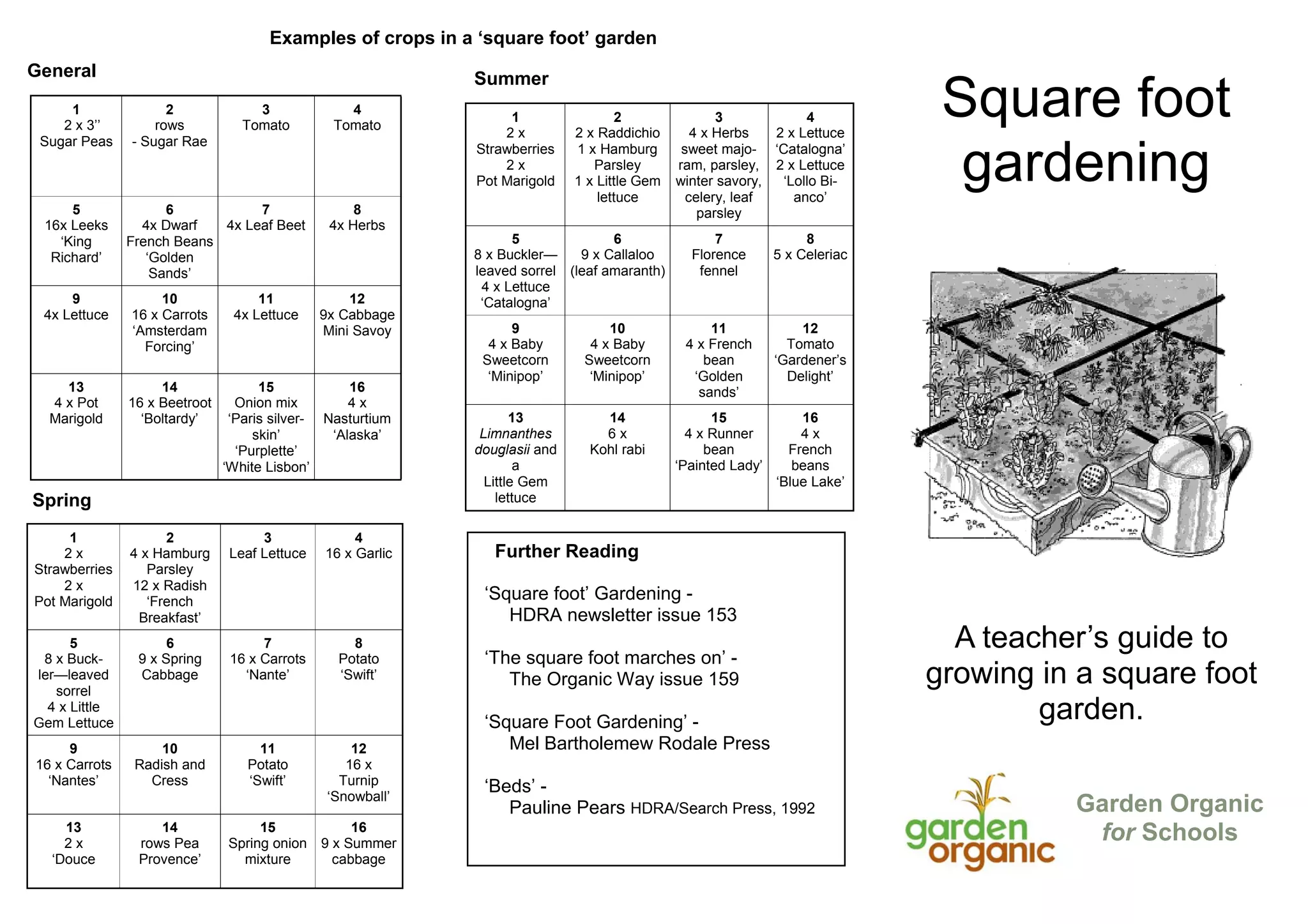
Decide which crops are going to be grown in
your ‘square foot’ garden. Each square is
planted with a different crop, using close
spacing. When planning this ensure that
the tallest plants are at the rear of the bed,
with sizes decreasing progressively to the
front of the bed, which should face south for
maximum sunlight. Three examples of
layouts are shown on the back of this leaflet.
As soon as each crop is finished, replace it
with a different one. This helps with the crop
rotation, but planning for rotation is still
essential.
Square foot gardening—A Teacher’s Guide

Rather than planting long rows of seeds and
then thinning out, square foot gardens require a different technique. The suggested
method is ‘station sowing’.
1.

Make holes of the required depth for
the seed at the spacing needed by the
mature plant.

2.

Drop the seeds into the holes then fill
with fine soil.

3.

For most plants 1-2 seeds are enough,
but for carrots and parsnips use 4-5
seeds to ensure uniform germination.

4.

If too many seeds germinate, simply
snip off those not required, with a pair
of scissors, to avoid disturbing the
roots of the remaining plants.
Examples of crops in a ‘square foot’ garden
General
1
2 x 3’’
Sugar Peas

5
16x Leeks
‘King
Richard’

Summer
2
rows
- Sugar Rae

3
Tomato

6
7
4x Dwarf
4x Leaf Beet
French Beans
‘Golden
Sands’

9
4x Lettuce

10
16 x Carrots
‘Amsterdam
Forcing’

13
4 x Pot
Marigold

14
16 x Beetroot
‘Boltardy’

11
4x Lettuce

4
Tomato

8
4x Herbs

12
9x Cabbage
Mini Savoy

15
16
Onion mix
4x
‘Paris silver- Nasturtium
skin’
‘Alaska’
‘Purplette’
‘White Lisbon’

Spring
1
2x
Strawberries
2x
Pot Marigold

2
4 x Hamburg
Parsley
12 x Radish
‘French
Breakfast’

3
Leaf Lettuce

4
16 x Garlic

5
8 x Buckler—leaved
sorrel
4 x Little
Gem Lettuce

6
9 x Spring
Cabbage

7
16 x Carrots
‘Nante’

9
16 x Carrots
‘Nantes’

10
Radish and
Cress

11
Potato
‘Swift’

12
16 x
Turnip
‘Snowball’

13
2x
‘Douce

14
rows Pea
Provence’

15
Spring onion
mixture

16
9 x Summer
cabbage

1
2x
Strawberries
2x
Pot Marigold

2
2 x Raddichio
1 x Hamburg
Parsley
1 x Little Gem
lettuce

5
6
8 x Buckler—
9 x Callaloo
leaved sorrel (leaf amaranth)
4 x Lettuce
‘Catalogna’

3
4
4 x Herbs
2 x Lettuce
sweet majo- ‘Catalogna’
ram, parsley, 2 x Lettuce
winter savory,
‘Lollo Bicelery, leaf
anco’
parsley
7
Florence
fennel

8
5 x Celeriac

9
4 x Baby
Sweetcorn
‘Minipop’

10
4 x Baby
Sweetcorn
‘Minipop’

11
4 x French
bean
‘Golden
sands’

12
Tomato
‘Gardener’s
Delight’

13
Limnanthes
douglasii and
a
Little Gem
lettuce

14
6x
Kohl rabi

15
4 x Runner
bean
‘Painted Lady’

16
4x
French
beans
‘Blue Lake’

Further Reading
‘Square foot’ Gardening HDRA newsletter issue 153

8
Potato
‘Swift’

Square foot
gardening

‘The square foot marches on’ The Organic Way issue 159
‘Square Foot Gardening’ Mel Bartholemew Rodale Press
‘Beds’ Pauline Pears HDRA/Search Press, 1992

A teacher’s guide to
growing in a square foot
garden.
Garden Organic
for Schools

Square Foot Gardening - Teacher + Student Guide

  • 1.
    ‘Square Foot’ Garden Ifyou haven’t got much space to grow vegetables at home or at school why not try ‘square foot’ gardening? The ‘square foot’ garden is an American method of growing as many vegetables as you can in, as small a space as possible, using a plot 120cm x 120cm (4ft x 4ft). This space is all you need to grow a wide variety of crops. If you have more space you could double the area. However, the 120cm x 120cm (4ft x 4ft) is enough to get you started. Avoid using creosote as it may possibly damage plants, soil dwelling creatures, and humans. Improve the soil inside the bed with garden compost mixed with some well-rotted manure. Make sure that the soil is weed free and remove as many stones as possible. Divide the 120cm x 120cm area into sixteen 30cm (1ft) squares. This can be marked by nailing long shoe laces or string across the box. See below. As soon as each crop is finished, replace it with a different one. This will help you to rotate crops, but you still need to plan a formal crop rotation. Crop Rotation As with any organic garden you need to rotate the crops around the space. This is essential to ensure pest and disease control and prevent the same nutrients been taken from the soil all the time. See Crop Rotation - HDRA factsheet Creating a ‘square foot’ garden. Planting methods and bed management. Measure out a plot 120cm x 120cm. Edge the area with wooden boards. Instead of sowing long rows of seeds and then thinning out, the square foot garden uses a different method - ‘station sowing’. For more detailed instructions on developing a square foot garden why not visit the HDRA Organic Network for Schools website. www.schoolsorganic.net Wood– brand new wood can be expensive. Ask wood merchants for off-cuts and other waste timber, or look for second-hand wood. Use untreated wood if you can and replace it as necessary. Otherwise any preservative used should be based on natural ingredients or one that acts as a water repellent. • Decide which crops you are going to grow. Each square is planted with a different crop, using close spacing. When planning, this make sure that the tallest plants are at the back of the bed, with sizes decreasing towards the front. The bed should face south for maximum sunlight. Three examples of layouts are shown on the back of this leaflet. Square foot gardening—A Student’s Guide • • Make holes of the right depth for the seed, at the spacing needed by the plant (check the packet) Drop the seeds into the hole, then fill with fine soil. For most plants 1-2 seeds are enough, but for carrots and parsnips use 4-5 seeds to ensure some seeds germinate. If more than one seed germinates, simply snip off the weaker seedlings with a pair of scissors. This means you don’t disturb the roots of the other plants.
  • 2.
    Examples of cropsin a ‘square foot’ garden General 1 2 x 3’’ Sugar Peas 5 16x Leeks ‘King Richard’ Summer 2 rows - Sugar Rae 3 Tomato 6 7 4x Dwarf 4x Leaf Beet French Beans ‘Golden Sands’ 9 4x Lettuce 10 16 x Carrots ‘Amsterdam Forcing’ 13 4 x Pot Marigold 14 16 x Beetroot ‘Boltardy’ 11 4x Lettuce 4 Tomato 8 4x Herbs 12 9x Cabbage Mini Savoy 15 16 Onion mix 4x ‘Paris silver- Nasturtium skin’ ‘Alaska’ ‘Purplette’ ‘White Lisbon’ Spring 1 2x Strawberries 2x Pot Marigold 2 4 x Hamburg Parsley 12 x Radish ‘French Breakfast’ 3 Leaf Lettuce 4 16 x Garlic 5 8 x Buckler—leaved sorrel 4 x Little Gem Lettuce 6 9 x Spring Cabbage 7 16 x Carrots ‘Nante’ 8 Potato ‘Swift’ 9 16 x Carrots ‘Nantes’ 10 Radish and Cress 11 Potato ‘Swift’ 12 16 x Turnip ‘Snowball’ 13 2x ‘Douce 14 rows Pea Provence’ 15 Spring onion mixture 16 9 x Summer cabbage 1 2x Strawberries 2x Pot Marigold 2 2 x Raddichio 1 x Hamburg Parsley 1 x Little Gem lettuce 3 4 4 x Herbs 2 x Lettuce sweet majo- ‘Catalogna’ ram, parsley, 2 x Lettuce winter savory, ‘Lollo Bicelery, leaf anco’ parsley 5 6 8 x Buckler— 9 x Callaloo leaved sorrel (leaf amaranth) 4 x Lettuce ‘Catalogna’ 7 Florence fennel Square foot gardening 8 5 x Celeriac 9 4 x Baby Sweetcorn ‘Minipop’ 10 4 x Baby Sweetcorn ‘Minipop’ 11 4 x French bean ‘Golden sands’ 12 Tomato ‘Gardener’s Delight’ 13 Limnanthes douglasii and a Little Gem lettuce 14 6x Kohl rabi 15 4 x Runner bean ‘Painted Lady’ 16 4x French beans ‘Blue Lake’ Glossary Germination—when the plant starts to grow they develop a stem and roots. Manure—animal waste Nutrients—minerals that plants need to survive that are found in the soil. Preservative—a chemical used to protect wood. Thinning out– taking out some seedlings to give others more space. Water repellent—doesn’t let water in through the surface. A student’s guide to growing in a square foot garden. Garden Organic for Schools
  • 3.
    ‘Square Foot’ Gardening Findingthe space in school grounds to grow vegetables is not always easy. This, together with the inexperience of some teachers and many students, can make growing vegetables seem like a daunting task. However, it is these factors that make ‘square foot’ gardening ideal. Dig out and remove any weeds and stones from the area. Improve the soil inside the bed with garden compost or some wellrotted manure. Sub-divide the 120cm x 120cm (4ft x 4ft) area into sixteen 30cm (1ft) squares. This can be marked by nailing long shoe laces or string across the box. See below. The ‘square foot’ garden is an American method of growing as many vegetables as you can in as small a space as possible. The area is 120cm x 120cm (4ft x 4ft). Planting methods and bed management. Creating a ‘square foot’ garden. Brand new wood can be expensive. A cheaper option is to ask wood merchants for off-cuts and other waste timber, or use second-hand wood. Try to obtain untreated wood and replace when it rots. Otherwise, any preservative used should be based on natural ingredients, or one that is just a water repellent. Try to avoid creosote. It can be harmful to people, soil-dwelling creatures and plants. It can leach into the soil after the wood has been treated. As with any organic garden, crop rotation is crucial in a ‘square foot’ garden. It helps with pest and disease control, and prevents nutrient depletion. It may appear that having distinct areas for each crop would make rotation easier, because simply replacing crops with another after they have finished is a natural crop rotation. However, it is not always that simple. Square foot gardeners need to plan a crop rotation carefully. This is further complicated by the fact that tall plants need to be near the rear of the bed. See Crop Rotation - Garden Organic factsheet This space is all you need to grow a range of crops. If you have more space you could double the area. However, the 120cm x 120cm (4ft x 4ft) is ample to get you started. Measure out a plot 120cm x 120cm (4ft x 4ft). Edge it with wooden boards. Crop Rotation Decide which crops are going to be grown in your ‘square foot’ garden. Each square is planted with a different crop, using close spacing. When planning this ensure that the tallest plants are at the rear of the bed, with sizes decreasing progressively to the front of the bed, which should face south for maximum sunlight. Three examples of layouts are shown on the back of this leaflet. As soon as each crop is finished, replace it with a different one. This helps with the crop rotation, but planning for rotation is still essential. Square foot gardening—A Teacher’s Guide Rather than planting long rows of seeds and then thinning out, square foot gardens require a different technique. The suggested method is ‘station sowing’. 1. Make holes of the required depth for the seed at the spacing needed by the mature plant. 2. Drop the seeds into the holes then fill with fine soil. 3. For most plants 1-2 seeds are enough, but for carrots and parsnips use 4-5 seeds to ensure uniform germination. 4. If too many seeds germinate, simply snip off those not required, with a pair of scissors, to avoid disturbing the roots of the remaining plants.
  • 4.
    Examples of cropsin a ‘square foot’ garden General 1 2 x 3’’ Sugar Peas 5 16x Leeks ‘King Richard’ Summer 2 rows - Sugar Rae 3 Tomato 6 7 4x Dwarf 4x Leaf Beet French Beans ‘Golden Sands’ 9 4x Lettuce 10 16 x Carrots ‘Amsterdam Forcing’ 13 4 x Pot Marigold 14 16 x Beetroot ‘Boltardy’ 11 4x Lettuce 4 Tomato 8 4x Herbs 12 9x Cabbage Mini Savoy 15 16 Onion mix 4x ‘Paris silver- Nasturtium skin’ ‘Alaska’ ‘Purplette’ ‘White Lisbon’ Spring 1 2x Strawberries 2x Pot Marigold 2 4 x Hamburg Parsley 12 x Radish ‘French Breakfast’ 3 Leaf Lettuce 4 16 x Garlic 5 8 x Buckler—leaved sorrel 4 x Little Gem Lettuce 6 9 x Spring Cabbage 7 16 x Carrots ‘Nante’ 9 16 x Carrots ‘Nantes’ 10 Radish and Cress 11 Potato ‘Swift’ 12 16 x Turnip ‘Snowball’ 13 2x ‘Douce 14 rows Pea Provence’ 15 Spring onion mixture 16 9 x Summer cabbage 1 2x Strawberries 2x Pot Marigold 2 2 x Raddichio 1 x Hamburg Parsley 1 x Little Gem lettuce 5 6 8 x Buckler— 9 x Callaloo leaved sorrel (leaf amaranth) 4 x Lettuce ‘Catalogna’ 3 4 4 x Herbs 2 x Lettuce sweet majo- ‘Catalogna’ ram, parsley, 2 x Lettuce winter savory, ‘Lollo Bicelery, leaf anco’ parsley 7 Florence fennel 8 5 x Celeriac 9 4 x Baby Sweetcorn ‘Minipop’ 10 4 x Baby Sweetcorn ‘Minipop’ 11 4 x French bean ‘Golden sands’ 12 Tomato ‘Gardener’s Delight’ 13 Limnanthes douglasii and a Little Gem lettuce 14 6x Kohl rabi 15 4 x Runner bean ‘Painted Lady’ 16 4x French beans ‘Blue Lake’ Further Reading ‘Square foot’ Gardening HDRA newsletter issue 153 8 Potato ‘Swift’ Square foot gardening ‘The square foot marches on’ The Organic Way issue 159 ‘Square Foot Gardening’ Mel Bartholemew Rodale Press ‘Beds’ Pauline Pears HDRA/Search Press, 1992 A teacher’s guide to growing in a square foot garden. Garden Organic for Schools