1
OPTIMIZATION PROCESS FOR INCREASING THE YIELD OF
CRUDE ALKALOID FROM Litsea polyantha JUSS. BARK
Manik Ghosh1
*, Barij N. Sinha1
, Julio A. Seijas2
*, M. Pilar Vázquez-Tato2
, Xesús Feás2
1
Department of Pharmaceutical Sciences and Technology, Birla Institute of Technology,
Mesra, Ranchi, Jharkhand (835215), INDIA
2
Departamento de Química Orgánica, Facultad de Ciencias, Universidad de Santiago de
Compostela, Campus de Lugo. 27080-Lugo, SPAIN
*Corresponding Authors’ E-mail: manik@bitmesra.ac.in; julioa.seijas@usc.es
ABSTRACT
Litsea polyantha Juss. (Lauraceae) also known as Litsea monopetala Roxb. is a small to
medium sized evergreen tree distributed chiefly in tropical and subtropical Asia, Australia
and the Pacific Islands. The bark of Litsea polyantha Juss. has a long history of medicinal
use among the traditional healers of Oraon and Munda community of Jharkhand (India). In
this work, optimization process for increasing the yield of crude alkaloid from Litsea
polyantha Juss. bark was performed by taking pH and temperature as the factors influencing
the yield. With the help of yield optimization by 22
factorial design the percentage yield of
crude alkaloid was increased from 3.8% w/w to 17.3% w/w.
Keywords: factorial design; Litsea polyantha; alkaloids; plant extracts; ethnopharmacology.
2
1. Introduction
India is one of the world’s 12 leading biodiversity centers having 45,000 different
plant species. Out of these, about 7,000-7,500 plants are being used for their medicinal values
[1]. The use of herbal drugs as complementary medicine is prevalent and gaining world wide
popularity. Many drugs are derived directly from plants; while the others are chemically
modified natural products [2]. Litsea polyantha Juss. (Lauraceae) also known as Litsea
monopetala Roxb. is a small to medium sized evergreen tree. The bark of L. polyantha Juss.
has a long history of medicinal use among the traditional healers of Oraon and Munda
community of Jharkhand. It is known by the popular names of Pojo, Kakuri, Munga and
Barkukuchita. The bark of L. polyantha Juss. is mildly astringent and is reported to be used
for diarrhea. Powdered bark and roots are used for pains, bruises and contusions and for
fractures in animals. Previous chemical investigation of this plant has revealed the presence
of beta-sitosterol and actinodaphnine in the bark, an arabinoxylan containing D-xylose and L-
arabinose in a molar ratio of 1:2 in leaves and chalcones & eugenol in the bark [3]. In this
work, optimization process for increasing the yield of crude alkaloid from Litsea polyantha
Juss. bark was performed by taking pH and temperature as the factors influencing the yield.
2. Material and methods
2.1 Plant material
The bark of L. polyantha Juss. was collected from BIT, Mesra of Ranchi with the help
of tribal. The bark was authenticated and the voucher specimen (BIT 417; 2008-09) was
preserved in the Department of Pharmaceutical Sciences, BIT, Mesra.
2.2 Extract Preparation
Harbone’s method was used to isolate crude alkaloid from the plant. MELP was
extracted with 10% v/v acetic acid and was allowed to stand for at least 4 h. The extract was
concentrated to one-quarter of the original volume and the crude alkaloid was precipitated by
drop wise addition of concentrated NH4OH. The alkaloid was collect by centrifugation,
washed with 1% w/v NH4OH and then dissolved in chloroform. The percentage yield of
crude alkaloid was around 4% w/w. To increase the percentage yield of crude alkaloid, the
Harbone’s method was modified using 22
Factorial Design, taking pH and temperature as the
factors influencing the yield.
2.3 22
Factorial Design Method
Isolation of alkaloid was carried out by taking pH and temperature as the factors
influencing the yield. The initial pH of the extract was 6 and the isolation of crude alkaloid
was carried out in the room temperature (30 °C). The percentage yield of crude alkaloid was
3.8%. In the factorial design the initial experiments were carried out at four different levels of
pH and temperature viz. pH 5 and temperature 20 °C; pH 5 and Temperature 40 °C; pH 7 and
temperature 20 °C and pH 7 and temperature 40 °C.
3
2.4 Statistical Analysis
The statistical analysis is carried out with help of ANOVA. The Null hypothesis is taken that
there is no significant change on the overall experiment on either changing the pH or
temperature or both. Also, there is no interaction between pH and temperature. The sources
of variation are A: pH, B: temperature, AB: interaction between pH & temperature and
Errors. The sums of squares are calculated by the following equations:
4n
(l)]-b-a[ab
SS
2
A


4n
(l)]-a-b[ab
SS
2
B


4n
b]-a-(l)[ab
SS
2
AB


4n
y
ySS
2
...
n
1i
n
1j
n
1k
2
ijkT    
SSE= SST – SSA – SSB – SSAB
Where, SSA: sums of squares pH; SSB: sums of squares temperature
SSAB: sums of squares interaction; SSE: sums of squares of errors
SST: sums of squares total
3. Results and Discussion
The result of the 22
Factorial Design represented in Table 1 indicates that better yield
is obtained if the pH is at low level and the temperature is at high level. At pH 5 and 40 °C
the percentage yield of crude alkaloid was 7.9% w/w, which is twice of the initial yield of
crude alkaloid at pH 6 and 30 °C (3.8% w/w). The Main effect of A (pH) was negative.
Increasing pH from the low level to high level decreased the yield. The Main effect of B
(temperature) was positive. Increasing temperature from the low level to high level increased
the yield. There was some negative interaction between A and B, but its effect appears to be
smaller relative to the main effects of A & B.
Statistical analysis using ANOVA for the factorial experiment is represented in Table
2. By comparing the calculated F values with the tabulated F values it was observed that both
pH and temperature has significant effect on the yield of alkaloid and there is no significant
interaction between pH and temperature at any level.
Table 1: 22
Factorial Design to increase the percentage yield (w/w) of crude alkaloid from Litsea
polyantha Juss. bark
Treatments
Factors
Treatment Combination
Replicates
% yield
Sum
Average
% yield
(w/w)A B I (i) II (j) III (k)
l - - A Low 5 B Low 20 5.2 4.6 6.1 15.9 5.3
a + - A High 7 B Low 20 3.1 4.5 2.8 10.4 3.5
b - + A Low 5 B High 40 8.9 7.2 7.6 23.7 7.9
ab + + A High 7 B High 40 4.2 3.9 5.1 13.2 4.4
B at High Level and A at Low Level gives Better Yield
Where, A = pH and B = Temperature (°C); a: Represents treatment combination of A at High Level & B at Low
Level; b: Represents treatment combination of B at High Level & A at Low Level; ab: Represents treatment
combination of both A & B at High Level; 1: Represents treatment combination of both A & B at Low Level
4
Table 2: ANOVA of factorial experiment for increasing the percentage yield (w/w) of crude
alkaloid from Litsea polyantha Juss. bark
Sources of Variation Sum of Squares Degree of Freedom Mean Square F0
A SSA = 21.33 1 21.33 33.16
B SSB = 9.36 1 9.36 14.55
AB SSAB = 2.08 1 2.08 3.24
ERROR SSE = 5.15 8 0.64
TOTAL SST = 37.92 11 F 0.05 (1,8) = 5.32
SS: Sum of Squares; A: pH; B: Temperature; AB: Interaction between pH & Temperature
It was obtained that by decreasing the pH (5) and increasing the temperature (40 °C)
from the starting pH (6) and temperature (30 °C), the percentage yield of the crude alkaloid
increases. Therefore, for the next step of optimization of the percentage yield by factorial
design, pH 5 and 40 °C temperature was considered as the midpoint. Regarding the yield
optimization by 22
factorial design, the result once again indicates that better yield is obtained
if the pH is kept at low level and the temperature at high level. At pH 4 and 50 °C the
percentage yield of crude alkaloid was 12.8% w/w, at pH 3 and 60 °C the percentage yield of
crude alkaloid was 15.4% w/w and at pH 2 and 70 °C the percentage yield of crude alkaloid
was 17.3% w/w. With the help of yield optimization by 22
Factorial Design the percentage
yield of crude alkaloid was increased from 3.8% w/w to 17.3% w/w. The Main effect of A
(pH) in all of the optimization steps was negative. Increasing pH from the low level to high
level decreased the yield. The Main effect of B (temperature) was positive. Increasing
temperature from the low level to high level increased the percentage yield. Some negative
interaction has been seen between A and B, but its effect appears to be smaller relative to the
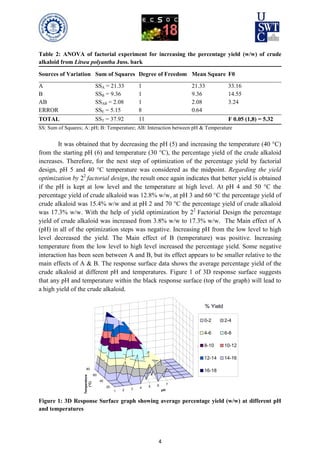
main effects of A & B. The response surface data shows the average percentage yield of the
crude alkaloid at different pH and temperatures. Figure 1 of 3D response surface suggests
that any pH and temperature within the black response surface (top of the graph) will lead to
a high yield of the crude alkaloid.
1 2 3 4 5 6 7
20
40
60
80
% Yield
pH
Temperature
(°C)
0-2 2-4
4-6 6-8
8-10 10-12
12-14 14-16
16-18
Figure 1: 3D Response Surface graph showing average percentage yield (w/w) at different pH
and temperatures
% Yield
5
Acknowledgements
Xesús Feás would also like to thank the Xunta de Galicia (Isidro Parga Pondal Program for
young researchers, Grant No. IPP-020).
4. References
[1] Chaudhri RD. Herbal Drug Industry. New Delhi: Eastern Publishers; 1996, p. 1.
[2] Ahmad A, Husain A, Mujeeb M, Khan SA, Najmi AK, Siddique NA, et al. A review on
therapeutic potential of Nigella sativa: A miracle herb. Asian Pac J Trop Biomed 2013;
3(5): 337-352.
[3] Ghosh M, Sinha, BN. GC-MS Studies on the Bark Extracts of Litsea polyantha JUSS.
Middle-East Journal of Scientific Research 01/2010; 5(6):441-444.

OPTIMIZATION PROCESS FOR INCREASING THE YIELD OF CRUDE ALKALOID FROM Litsea polyantha JUSS. BARK

  • 1.
    1 OPTIMIZATION PROCESS FORINCREASING THE YIELD OF CRUDE ALKALOID FROM Litsea polyantha JUSS. BARK Manik Ghosh1 *, Barij N. Sinha1 , Julio A. Seijas2 *, M. Pilar Vázquez-Tato2 , Xesús Feás2 1 Department of Pharmaceutical Sciences and Technology, Birla Institute of Technology, Mesra, Ranchi, Jharkhand (835215), INDIA 2 Departamento de Química Orgánica, Facultad de Ciencias, Universidad de Santiago de Compostela, Campus de Lugo. 27080-Lugo, SPAIN *Corresponding Authors’ E-mail: manik@bitmesra.ac.in; julioa.seijas@usc.es ABSTRACT Litsea polyantha Juss. (Lauraceae) also known as Litsea monopetala Roxb. is a small to medium sized evergreen tree distributed chiefly in tropical and subtropical Asia, Australia and the Pacific Islands. The bark of Litsea polyantha Juss. has a long history of medicinal use among the traditional healers of Oraon and Munda community of Jharkhand (India). In this work, optimization process for increasing the yield of crude alkaloid from Litsea polyantha Juss. bark was performed by taking pH and temperature as the factors influencing the yield. With the help of yield optimization by 22 factorial design the percentage yield of crude alkaloid was increased from 3.8% w/w to 17.3% w/w. Keywords: factorial design; Litsea polyantha; alkaloids; plant extracts; ethnopharmacology.
  • 2.
    2 1. Introduction India isone of the world’s 12 leading biodiversity centers having 45,000 different plant species. Out of these, about 7,000-7,500 plants are being used for their medicinal values [1]. The use of herbal drugs as complementary medicine is prevalent and gaining world wide popularity. Many drugs are derived directly from plants; while the others are chemically modified natural products [2]. Litsea polyantha Juss. (Lauraceae) also known as Litsea monopetala Roxb. is a small to medium sized evergreen tree. The bark of L. polyantha Juss. has a long history of medicinal use among the traditional healers of Oraon and Munda community of Jharkhand. It is known by the popular names of Pojo, Kakuri, Munga and Barkukuchita. The bark of L. polyantha Juss. is mildly astringent and is reported to be used for diarrhea. Powdered bark and roots are used for pains, bruises and contusions and for fractures in animals. Previous chemical investigation of this plant has revealed the presence of beta-sitosterol and actinodaphnine in the bark, an arabinoxylan containing D-xylose and L- arabinose in a molar ratio of 1:2 in leaves and chalcones & eugenol in the bark [3]. In this work, optimization process for increasing the yield of crude alkaloid from Litsea polyantha Juss. bark was performed by taking pH and temperature as the factors influencing the yield. 2. Material and methods 2.1 Plant material The bark of L. polyantha Juss. was collected from BIT, Mesra of Ranchi with the help of tribal. The bark was authenticated and the voucher specimen (BIT 417; 2008-09) was preserved in the Department of Pharmaceutical Sciences, BIT, Mesra. 2.2 Extract Preparation Harbone’s method was used to isolate crude alkaloid from the plant. MELP was extracted with 10% v/v acetic acid and was allowed to stand for at least 4 h. The extract was concentrated to one-quarter of the original volume and the crude alkaloid was precipitated by drop wise addition of concentrated NH4OH. The alkaloid was collect by centrifugation, washed with 1% w/v NH4OH and then dissolved in chloroform. The percentage yield of crude alkaloid was around 4% w/w. To increase the percentage yield of crude alkaloid, the Harbone’s method was modified using 22 Factorial Design, taking pH and temperature as the factors influencing the yield. 2.3 22 Factorial Design Method Isolation of alkaloid was carried out by taking pH and temperature as the factors influencing the yield. The initial pH of the extract was 6 and the isolation of crude alkaloid was carried out in the room temperature (30 °C). The percentage yield of crude alkaloid was 3.8%. In the factorial design the initial experiments were carried out at four different levels of pH and temperature viz. pH 5 and temperature 20 °C; pH 5 and Temperature 40 °C; pH 7 and temperature 20 °C and pH 7 and temperature 40 °C.
  • 3.
    3 2.4 Statistical Analysis Thestatistical analysis is carried out with help of ANOVA. The Null hypothesis is taken that there is no significant change on the overall experiment on either changing the pH or temperature or both. Also, there is no interaction between pH and temperature. The sources of variation are A: pH, B: temperature, AB: interaction between pH & temperature and Errors. The sums of squares are calculated by the following equations: 4n (l)]-b-a[ab SS 2 A   4n (l)]-a-b[ab SS 2 B   4n b]-a-(l)[ab SS 2 AB   4n y ySS 2 ... n 1i n 1j n 1k 2 ijkT     SSE= SST – SSA – SSB – SSAB Where, SSA: sums of squares pH; SSB: sums of squares temperature SSAB: sums of squares interaction; SSE: sums of squares of errors SST: sums of squares total 3. Results and Discussion The result of the 22 Factorial Design represented in Table 1 indicates that better yield is obtained if the pH is at low level and the temperature is at high level. At pH 5 and 40 °C the percentage yield of crude alkaloid was 7.9% w/w, which is twice of the initial yield of crude alkaloid at pH 6 and 30 °C (3.8% w/w). The Main effect of A (pH) was negative. Increasing pH from the low level to high level decreased the yield. The Main effect of B (temperature) was positive. Increasing temperature from the low level to high level increased the yield. There was some negative interaction between A and B, but its effect appears to be smaller relative to the main effects of A & B. Statistical analysis using ANOVA for the factorial experiment is represented in Table 2. By comparing the calculated F values with the tabulated F values it was observed that both pH and temperature has significant effect on the yield of alkaloid and there is no significant interaction between pH and temperature at any level. Table 1: 22 Factorial Design to increase the percentage yield (w/w) of crude alkaloid from Litsea polyantha Juss. bark Treatments Factors Treatment Combination Replicates % yield Sum Average % yield (w/w)A B I (i) II (j) III (k) l - - A Low 5 B Low 20 5.2 4.6 6.1 15.9 5.3 a + - A High 7 B Low 20 3.1 4.5 2.8 10.4 3.5 b - + A Low 5 B High 40 8.9 7.2 7.6 23.7 7.9 ab + + A High 7 B High 40 4.2 3.9 5.1 13.2 4.4 B at High Level and A at Low Level gives Better Yield Where, A = pH and B = Temperature (°C); a: Represents treatment combination of A at High Level & B at Low Level; b: Represents treatment combination of B at High Level & A at Low Level; ab: Represents treatment combination of both A & B at High Level; 1: Represents treatment combination of both A & B at Low Level
  • 4.
    4 Table 2: ANOVAof factorial experiment for increasing the percentage yield (w/w) of crude alkaloid from Litsea polyantha Juss. bark Sources of Variation Sum of Squares Degree of Freedom Mean Square F0 A SSA = 21.33 1 21.33 33.16 B SSB = 9.36 1 9.36 14.55 AB SSAB = 2.08 1 2.08 3.24 ERROR SSE = 5.15 8 0.64 TOTAL SST = 37.92 11 F 0.05 (1,8) = 5.32 SS: Sum of Squares; A: pH; B: Temperature; AB: Interaction between pH & Temperature It was obtained that by decreasing the pH (5) and increasing the temperature (40 °C) from the starting pH (6) and temperature (30 °C), the percentage yield of the crude alkaloid increases. Therefore, for the next step of optimization of the percentage yield by factorial design, pH 5 and 40 °C temperature was considered as the midpoint. Regarding the yield optimization by 22 factorial design, the result once again indicates that better yield is obtained if the pH is kept at low level and the temperature at high level. At pH 4 and 50 °C the percentage yield of crude alkaloid was 12.8% w/w, at pH 3 and 60 °C the percentage yield of crude alkaloid was 15.4% w/w and at pH 2 and 70 °C the percentage yield of crude alkaloid was 17.3% w/w. With the help of yield optimization by 22 Factorial Design the percentage yield of crude alkaloid was increased from 3.8% w/w to 17.3% w/w. The Main effect of A (pH) in all of the optimization steps was negative. Increasing pH from the low level to high level decreased the yield. The Main effect of B (temperature) was positive. Increasing temperature from the low level to high level increased the percentage yield. Some negative interaction has been seen between A and B, but its effect appears to be smaller relative to the main effects of A & B. The response surface data shows the average percentage yield of the crude alkaloid at different pH and temperatures. Figure 1 of 3D response surface suggests that any pH and temperature within the black response surface (top of the graph) will lead to a high yield of the crude alkaloid. 1 2 3 4 5 6 7 20 40 60 80 % Yield pH Temperature (°C) 0-2 2-4 4-6 6-8 8-10 10-12 12-14 14-16 16-18 Figure 1: 3D Response Surface graph showing average percentage yield (w/w) at different pH and temperatures % Yield
  • 5.
    5 Acknowledgements Xesús Feás wouldalso like to thank the Xunta de Galicia (Isidro Parga Pondal Program for young researchers, Grant No. IPP-020). 4. References [1] Chaudhri RD. Herbal Drug Industry. New Delhi: Eastern Publishers; 1996, p. 1. [2] Ahmad A, Husain A, Mujeeb M, Khan SA, Najmi AK, Siddique NA, et al. A review on therapeutic potential of Nigella sativa: A miracle herb. Asian Pac J Trop Biomed 2013; 3(5): 337-352. [3] Ghosh M, Sinha, BN. GC-MS Studies on the Bark Extracts of Litsea polyantha JUSS. Middle-East Journal of Scientific Research 01/2010; 5(6):441-444.