ECP-201
Egyptian Code for Loads
Prepared By
Eng: Mohamed Ismail Kotb
Email: m.ismailkotb@gmial.com
Tel: 01121549164
Eng. Mohamed Ismail Kotb
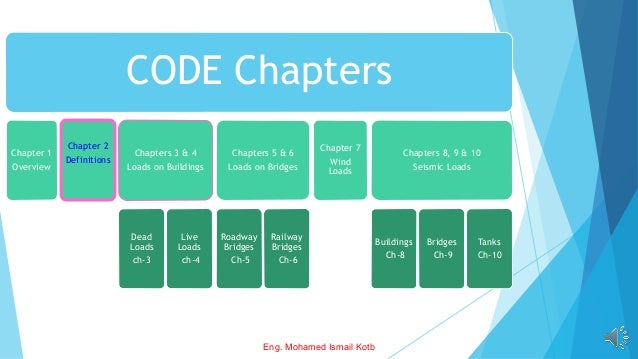
CODE Chapters
Chapter 1
Overview
Chapter 2
Definitions
Chapters 3 & 4
Loads on Buildings
Dead
Loads
ch-3
Live
Loads
ch-4
Chapters 5 & 6
Loads on Bridges
Roadway
Bridges
Ch-5
Railway
Bridges
Ch-6
Chapter 7
Wind
Loads
Chapters 8, 9 & 10
Seismic Loads
Buildings
Ch-8
Bridges
Ch-9
Tanks
Ch-10
Eng. Mohamed Ismail Kotb
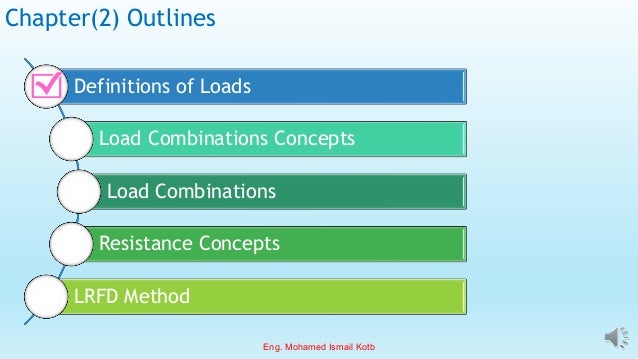
Chapter(2) Outlines
Definitions of Loads
Load Combinations Concepts
Load Combinations
Resistance Concepts
LRFD Method
Eng. Mohamed Ismail Kotb
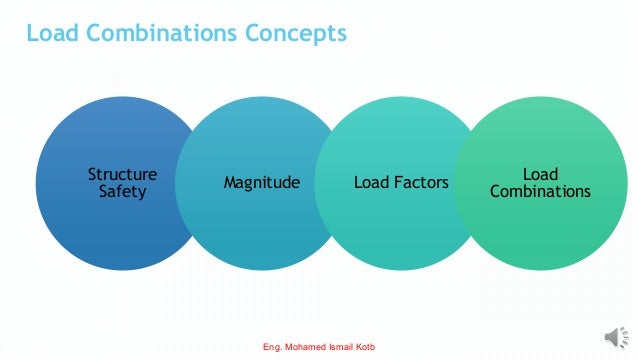
Load Combinations Concepts
Structure
Safety
Magnitude Load Factors
Load
Combinations
Eng. Mohamed Ismail Kotb
Load Combinations Concepts
 Structures and structural members must always be designed
to carry some reserve load above what is expected under
normal use.
 There are three main reasons why some sort of safety factor
is necessary in structural design.
[1] Variability in resistance.
[2] Variability in loading.
[3] Consequences of failure
Eng. Mohamed Ismail Kotb
Load Combinations Concepts
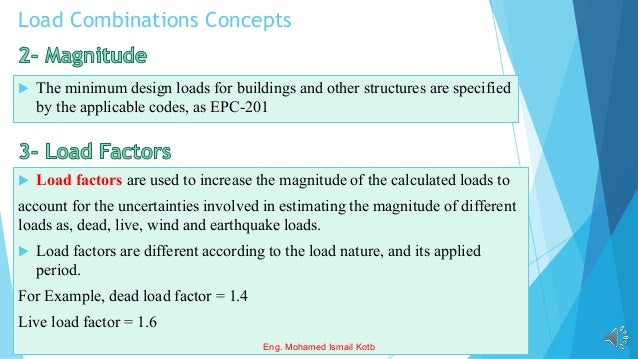
 The minimum design loads for buildings and other structures are specified
by the applicable codes, as EPC-201
 Load factors are used to increase the magnitude of the calculated loads to
account for the uncertainties involved in estimating the magnitude of different
loads as, dead, live, wind and earthquake loads.
 Load factors are different according to the load nature, and its applied
period.
For Example, dead load factor = 1.4
Live load factor = 1.6
Eng. Mohamed Ismail Kotb
Load Combinations Concepts
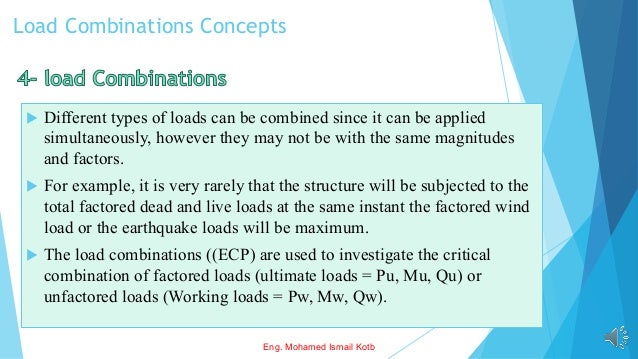
 Different types of loads can be combined since it can be applied
simultaneously, however they may not be with the same magnitudes
and factors.
 For example, it is very rarely that the structure will be subjected to the
total factored dead and live loads at the same instant the factored wind
load or the earthquake loads will be maximum.
 The load combinations ((ECP) are used to investigate the critical
combination of factored loads (ultimate loads = Pu, Mu, Qu) or
unfactored loads (Working loads = Pw, Mw, Qw).
Eng. Mohamed Ismail Kotb
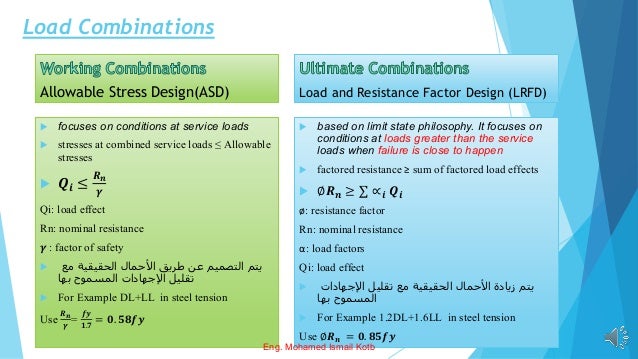
Load Combinations
Allowable Stress Design(ASD)
 focuses on conditions at service loads
 stresses at combined service loads ≤ Allowable
stresses
 𝑸𝒊 ≤
𝑹𝒏
𝜸
Qi: load effect
Rn: nominal resistance
𝜸 : factor of safety
 ‫مع‬ ‫الحقيقية‬ ‫األحمال‬ ‫طريق‬ ‫عن‬ ‫التصميم‬ ‫يتم‬
‫بها‬ ‫المسموح‬ ‫اإلجهادات‬ ‫تقليل‬
 For Example DL+LL in steel tension
Use
𝑹𝒏
𝜸
=
𝒇𝒚
𝟏.𝟕
= 𝟎. 𝟓𝟖𝒇𝒚
Load and Resistance Factor Design (LRFD)
 based on limit state philosophy. It focuses on
conditions at loads greater than the service
loads when failure is close to happen
 factored resistance ≥ sum of factored load effects
 ∅𝑹𝒏 ≥ σ ∝𝒊 𝑸𝒊
ø: resistance factor
Rn: nominal resistance
α: load factors
Qi: load effect
 ‫اإلجهادات‬ ‫تقليل‬ ‫مع‬ ‫الحقيقية‬ ‫األحمال‬ ‫زيادة‬ ‫يتم‬
‫بها‬ ‫المسموح‬
 For Example 1.2DL+1.6LL in steel tension
Use ∅𝑹𝒏 = 𝟎. 𝟖𝟓𝒇𝒚
Eng. Mohamed Ismail Kotb
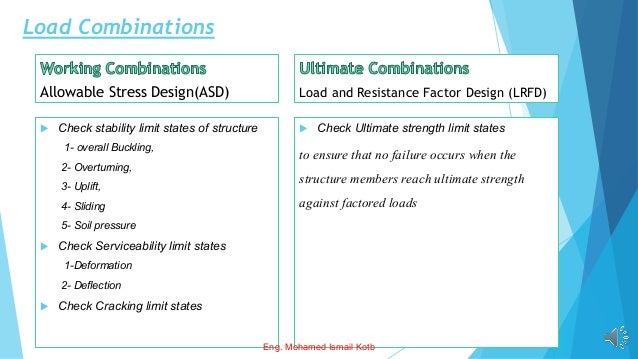
Load Combinations
Allowable Stress Design(ASD)
 Check stability limit states of structure
1- overall Buckling,
2- Overturning,
3- Uplift,
4- Sliding
5- Soil pressure
 Check Serviceability limit states
1-Deformation
2- Deflection
 Check Cracking limit states
Load and Resistance Factor Design (LRFD)
 Check Ultimate strength limit states
to ensure that no failure occurs when the
structure members reach ultimate strength
against factored loads
Eng. Mohamed Ismail Kotb
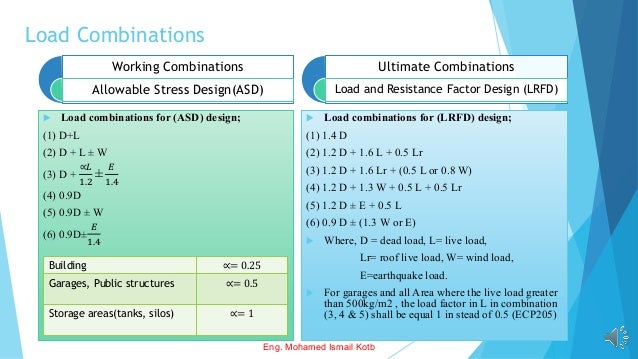
Load Combinations
Working Combinations
Allowable Stress Design(ASD)
 Load combinations for (ASD) design;
(1) D+L
(2) D + L ± W
(3) D +
∝𝐿
1.2
±
𝐸
1.4
(4) 0.9D
(5) 0.9D ± W
(6) 0.9D±
𝐸
1.4
Ultimate Combinations
Load and Resistance Factor Design (LRFD)
 Load combinations for (LRFD) design;
(1) 1.4 D
(2) 1.2 D + 1.6 L + 0.5 Lr
(3) 1.2 D + 1.6 Lr + (0.5 L or 0.8 W)
(4) 1.2 D + 1.3 W + 0.5 L + 0.5 Lr
(5) 1.2 D ± E + 0.5 L
(6) 0.9 D ± (1.3 W or E)
 Where, D = dead load, L= live load,
Lr= roof live load, W= wind load,
E=earthquake load.
 For garages and all Area where the live load greater
than 500kg/m2 , the load factor in L in combination
(3, 4 & 5) shall be equal 1 in stead of 0.5 (ECP205)
Building ∝= 0.25
Garages, Public structures ∝= 0.5
Storage areas(tanks, silos) ∝= 1
Eng. Mohamed Ismail Kotb

ECP-201_ Ch.2 Load combinations (ASD & LRFD )_Lecture 2.pdf

  • 1.
    ECP-201 Egyptian Code forLoads Prepared By Eng: Mohamed Ismail Kotb Email: m.ismailkotb@gmial.com Tel: 01121549164 Eng. Mohamed Ismail Kotb
  • 2.
    CODE Chapters Chapter 1 Overview Chapter2 Definitions Chapters 3 & 4 Loads on Buildings Dead Loads ch-3 Live Loads ch-4 Chapters 5 & 6 Loads on Bridges Roadway Bridges Ch-5 Railway Bridges Ch-6 Chapter 7 Wind Loads Chapters 8, 9 & 10 Seismic Loads Buildings Ch-8 Bridges Ch-9 Tanks Ch-10 Eng. Mohamed Ismail Kotb
  • 3.
  • 4.
    Chapter(2) Outlines Definitions ofLoads Load Combinations Concepts Load Combinations Resistance Concepts LRFD Method Eng. Mohamed Ismail Kotb
  • 5.
    Load Combinations Concepts Structure Safety MagnitudeLoad Factors Load Combinations Eng. Mohamed Ismail Kotb
  • 6.
    Load Combinations Concepts Structures and structural members must always be designed to carry some reserve load above what is expected under normal use.  There are three main reasons why some sort of safety factor is necessary in structural design. [1] Variability in resistance. [2] Variability in loading. [3] Consequences of failure Eng. Mohamed Ismail Kotb
  • 7.
    Load Combinations Concepts The minimum design loads for buildings and other structures are specified by the applicable codes, as EPC-201  Load factors are used to increase the magnitude of the calculated loads to account for the uncertainties involved in estimating the magnitude of different loads as, dead, live, wind and earthquake loads.  Load factors are different according to the load nature, and its applied period. For Example, dead load factor = 1.4 Live load factor = 1.6 Eng. Mohamed Ismail Kotb
  • 8.
    Load Combinations Concepts Different types of loads can be combined since it can be applied simultaneously, however they may not be with the same magnitudes and factors.  For example, it is very rarely that the structure will be subjected to the total factored dead and live loads at the same instant the factored wind load or the earthquake loads will be maximum.  The load combinations ((ECP) are used to investigate the critical combination of factored loads (ultimate loads = Pu, Mu, Qu) or unfactored loads (Working loads = Pw, Mw, Qw). Eng. Mohamed Ismail Kotb
  • 9.
    Load Combinations Allowable StressDesign(ASD)  focuses on conditions at service loads  stresses at combined service loads ≤ Allowable stresses  𝑸𝒊 ≤ 𝑹𝒏 𝜸 Qi: load effect Rn: nominal resistance 𝜸 : factor of safety  ‫مع‬ ‫الحقيقية‬ ‫األحمال‬ ‫طريق‬ ‫عن‬ ‫التصميم‬ ‫يتم‬ ‫بها‬ ‫المسموح‬ ‫اإلجهادات‬ ‫تقليل‬  For Example DL+LL in steel tension Use 𝑹𝒏 𝜸 = 𝒇𝒚 𝟏.𝟕 = 𝟎. 𝟓𝟖𝒇𝒚 Load and Resistance Factor Design (LRFD)  based on limit state philosophy. It focuses on conditions at loads greater than the service loads when failure is close to happen  factored resistance ≥ sum of factored load effects  ∅𝑹𝒏 ≥ σ ∝𝒊 𝑸𝒊 ø: resistance factor Rn: nominal resistance α: load factors Qi: load effect  ‫اإلجهادات‬ ‫تقليل‬ ‫مع‬ ‫الحقيقية‬ ‫األحمال‬ ‫زيادة‬ ‫يتم‬ ‫بها‬ ‫المسموح‬  For Example 1.2DL+1.6LL in steel tension Use ∅𝑹𝒏 = 𝟎. 𝟖𝟓𝒇𝒚 Eng. Mohamed Ismail Kotb
  • 10.
    Load Combinations Allowable StressDesign(ASD)  Check stability limit states of structure 1- overall Buckling, 2- Overturning, 3- Uplift, 4- Sliding 5- Soil pressure  Check Serviceability limit states 1-Deformation 2- Deflection  Check Cracking limit states Load and Resistance Factor Design (LRFD)  Check Ultimate strength limit states to ensure that no failure occurs when the structure members reach ultimate strength against factored loads Eng. Mohamed Ismail Kotb
  • 11.
    Load Combinations Working Combinations AllowableStress Design(ASD)  Load combinations for (ASD) design; (1) D+L (2) D + L ± W (3) D + ∝𝐿 1.2 ± 𝐸 1.4 (4) 0.9D (5) 0.9D ± W (6) 0.9D± 𝐸 1.4 Ultimate Combinations Load and Resistance Factor Design (LRFD)  Load combinations for (LRFD) design; (1) 1.4 D (2) 1.2 D + 1.6 L + 0.5 Lr (3) 1.2 D + 1.6 Lr + (0.5 L or 0.8 W) (4) 1.2 D + 1.3 W + 0.5 L + 0.5 Lr (5) 1.2 D ± E + 0.5 L (6) 0.9 D ± (1.3 W or E)  Where, D = dead load, L= live load, Lr= roof live load, W= wind load, E=earthquake load.  For garages and all Area where the live load greater than 500kg/m2 , the load factor in L in combination (3, 4 & 5) shall be equal 1 in stead of 0.5 (ECP205) Building ∝= 0.25 Garages, Public structures ∝= 0.5 Storage areas(tanks, silos) ∝= 1 Eng. Mohamed Ismail Kotb