Economics Recession 
Alternative Solutions 
September 7th, 2014 
Prepared by Ivan F Rodriguez 
MBA & MEng
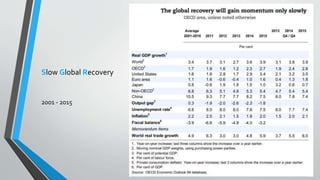
Slow Global Recovery 
2001 - 2015
Objective #1: 
Fight Unemployment 
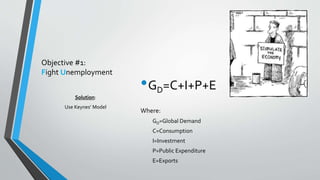
•GD=C+I+P+E 
Where: 
GD=Global Demand 
C=Consumption 
I=Investment 
P=Public Expenditure 
E=Exports 
Solution: 
Use Keynes’ Model
Objective #1: (cont.): 
Fight Unemployment 
Applying Keynes’ Model, Unemployment is Minimized by: 
Maximizing Global Demand [GD] which implies: 
1) Reduced Taxes to Promote Consumption [C] 
2) Reduce Interest Rates to Promote Investment [I] 
3) Increase Public Expenditure to assist Population needs [P] 
4) Reduce Exchange Rate to Stimulate Exports [E] 
Solution: 
Use Keynes’ Model
Perverse Demand Effect and 
Unemployment (Carlin & 
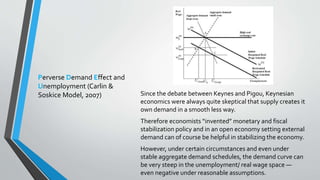
Soskice Model, 2007) Since the debate between Keynes and Pigou, Keynesian 
economics were always quite skeptical that supply creates it 
own demand in a smooth less way. 
Therefore economists “invented” monetary and fiscal 
stabilization policy and in an open economy setting external 
demand can of course be helpful in stabilizing the economy. 
However, under certain circumstances and even under 
stable aggregate demand schedules, the demand curve can 
be very steep in the unemployment/ real wage space — 
even negative under reasonable assumptions.
Objective #2: 
Reduce Public Deficit 
Reducing Unemployment is some times against reducing 
Public Deficit. 
Unfortunately this path is not helping those countries with 
high unemployment rates (e.g. Greece [27.2%], Spain 
[25.6%], Portugal [15.3%], Italy [13%]) 
Germany is following this path and forcing the Euro Zone to 
shadow this route. 
Solution: 
Increase Taxes and Reduce Public 
Expenditure 
GD=C+I+P+E
Optimal Monetary Zone 
Mundell Model 
[1999]
Optimal Monetary Zone 
(cont.) 
Robert Mundell´s Model 
[1999] 
Mundell´s optimal monetary zone model calls for two 
mandatory requirements: 
1] Convergence of the macroeconomic magnitudes (e.g., 
Maastricht Agreement: Similar Inflation Rates, Similar 
Interest Rates, Public Debt below 60% of the GDP, and 
Public Deficit below 3% of the GDP). 
2] Productive factors free movement (particularly, labor 
force and capital). 
This second obligatory requirement is the what mostly the 
Euro Zone is lacking of, economic reality differs between 
member countries (e.g., Spain with more than 25% of 
unemployment vs. Germany with lest than 5% as of June 
2014).
Conclusion: 
Fight Unemployment 
Under the Keynesian model, when unemployment rate 
domains the economy, increasing taxes and reducing public 
expenditure is simply against economic recovery. 
This solution paired with Salary Flexibility can yield the best 
results. By salary flexibility we meant linking salary to 
productivity rates and not to inflation. 
This is key to keep competitiveness without invisible or visible 
hands from government or any other economic actor. 
Employees must be inspired to reach higher productivity by the 
continuously applying their knowledge and deliver the highest 
quality in their respective jobs. This is by creating value. 
Solution: 
Use Keynes’ Model + Implement Salary 
Flexibility

Economics keynes & salary flexibility

  • 1.
    Economics Recession AlternativeSolutions September 7th, 2014 Prepared by Ivan F Rodriguez MBA & MEng
  • 3.
  • 5.
    Objective #1: FightUnemployment •GD=C+I+P+E Where: GD=Global Demand C=Consumption I=Investment P=Public Expenditure E=Exports Solution: Use Keynes’ Model
  • 7.
    Objective #1: (cont.): Fight Unemployment Applying Keynes’ Model, Unemployment is Minimized by: Maximizing Global Demand [GD] which implies: 1) Reduced Taxes to Promote Consumption [C] 2) Reduce Interest Rates to Promote Investment [I] 3) Increase Public Expenditure to assist Population needs [P] 4) Reduce Exchange Rate to Stimulate Exports [E] Solution: Use Keynes’ Model
  • 8.
    Perverse Demand Effectand Unemployment (Carlin & Soskice Model, 2007) Since the debate between Keynes and Pigou, Keynesian economics were always quite skeptical that supply creates it own demand in a smooth less way. Therefore economists “invented” monetary and fiscal stabilization policy and in an open economy setting external demand can of course be helpful in stabilizing the economy. However, under certain circumstances and even under stable aggregate demand schedules, the demand curve can be very steep in the unemployment/ real wage space — even negative under reasonable assumptions.
  • 9.
    Objective #2: ReducePublic Deficit Reducing Unemployment is some times against reducing Public Deficit. Unfortunately this path is not helping those countries with high unemployment rates (e.g. Greece [27.2%], Spain [25.6%], Portugal [15.3%], Italy [13%]) Germany is following this path and forcing the Euro Zone to shadow this route. Solution: Increase Taxes and Reduce Public Expenditure GD=C+I+P+E
  • 10.
    Optimal Monetary Zone Mundell Model [1999]
  • 11.
    Optimal Monetary Zone (cont.) Robert Mundell´s Model [1999] Mundell´s optimal monetary zone model calls for two mandatory requirements: 1] Convergence of the macroeconomic magnitudes (e.g., Maastricht Agreement: Similar Inflation Rates, Similar Interest Rates, Public Debt below 60% of the GDP, and Public Deficit below 3% of the GDP). 2] Productive factors free movement (particularly, labor force and capital). This second obligatory requirement is the what mostly the Euro Zone is lacking of, economic reality differs between member countries (e.g., Spain with more than 25% of unemployment vs. Germany with lest than 5% as of June 2014).
  • 12.
    Conclusion: Fight Unemployment Under the Keynesian model, when unemployment rate domains the economy, increasing taxes and reducing public expenditure is simply against economic recovery. This solution paired with Salary Flexibility can yield the best results. By salary flexibility we meant linking salary to productivity rates and not to inflation. This is key to keep competitiveness without invisible or visible hands from government or any other economic actor. Employees must be inspired to reach higher productivity by the continuously applying their knowledge and deliver the highest quality in their respective jobs. This is by creating value. Solution: Use Keynes’ Model + Implement Salary Flexibility