 Introduction
 Meaning
 Importance of Agriculture in Rural Economy
 Nature and Scope of Agricultural Economics
 Agriculture is the Backbone of Indian Economy. Agriculture
is the most important occupation for most of the Indian
families.
 In India, Agriculture contributes about 16% of total GDP and
10% of total exports.
 That’s reason India secured Second position worldwide in
terms of farm output. About 75% people are living in rural
areas and are still dependent on Agriculture.
 About 43% of India’s geographical area is used for
Agricultural activity.
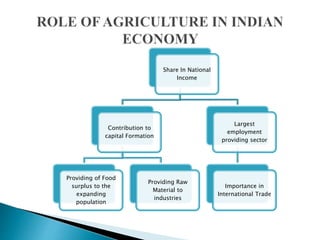
Share In National
Income
Contribution to
capital Formation
Providing of Food
surplus to the
expanding
population
Providing Raw
Material to
industries
Largest
employment
providing sector
Importance in
International Trade
 Economics is the science of the administration of scare
resources( Land, Labour, Capital and Management),Which
are needed in order to produce goods and services that
satisfy human wants.
 The field of Agricultural Economics is delineated by the
application of Economics Science tools to the Agricultural
sector.
 Agricultural Economics refers to all Economic activities
connected with the control of living organisms, Such as
plants and Animals.
 Agricultural Economics is an applied field of Economics in which
the Principles of Choice are applied in the use of scarce resources
such as land, labour, capital and management in farming activities.
 It Deals with the principles that help the farmer in the efficient use
of land,labour and capital.
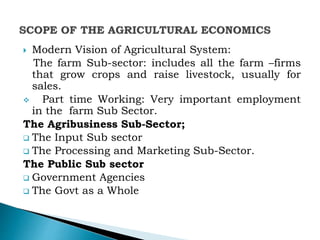
 Modern Vision of Agricultural System:
The farm Sub-sector: includes all the farm –firms
that grow crops and raise livestock, usually for
sales.
 Part time Working: Very important employment
in the farm Sub Sector.
The Agribusiness Sub-Sector;
 The Input Sub sector
 The Processing and Marketing Sub-Sector.
The Public Sub sector
 Government Agencies
 The Govt as a Whole
 Agricultural Economics makes use of the principles of
general Economics.
 Is Agricultural Economics an Applied Science?
 Agricultural Economics is both a science as well as an art.
 Agricultural Economics finds to seek relevance between cause and
effect in Agriculture.
 It uses theoretical encourages of Economics Concept.
 Knowledge regarding problem in Production, Finance, Marketing
and Govt Policies and their impact on production and Distribution
is very essential to find out suitable solutions for the farm Problems.

 Agricultural Economics is provide the Food grains production.
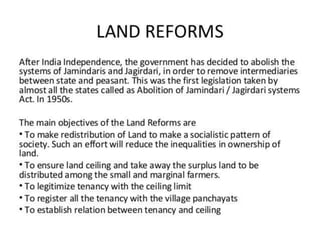
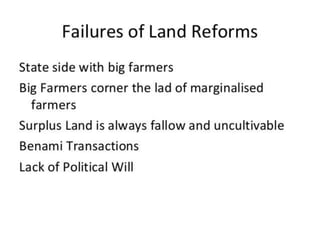
 Land reform, a purposive change in the way
in which agricultural land is held or owned,
the methods of cultivation that are employed,
or the relation of agriculture to the rest of the
economy. Reforms such as these may be
proclaimed by a government, by interested
groups, or by revolution.
 The concept of land reform has varied over time
according to the range of functions
which land itself has performed: as a factor of
production, a store of value and wealth, a status
symbol, or a source of social and political
influence. Land value reflects its relative scarcity,
which in a market economy usually depends on
the ratio between the area of usable land and the
size of that area’s population. As the per capita
land area declines, the relative value of land rises,
and land becomes increasingly a source of conflict
among economic and social groups within
the community.
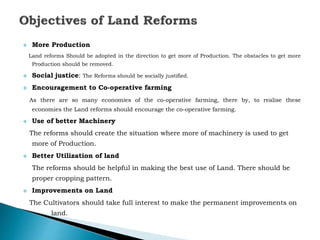
 More Production
Land reforms Should be adopted in the direction to get more of Production. The obstacles to get more
Production should be removed.
 Social justice: The Reforms should be socially justified.
 Encouragement to Co-operative farming
As there are so many economies of the co-operative farming, there by, to realise these
economies the Land reforms should encourage the co-operative farming.
 Use of better Machinery
The reforms should create the situation where more of machinery is used to get
more of Production.
 Better Utilization of land
The reforms should be helpful in making the best use of Land. There should be
proper cropping pattern.
 Improvements on Land
The Cultivators should take full interest to make the permanent improvements on
land.
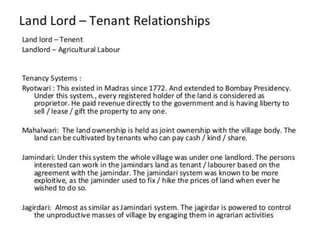
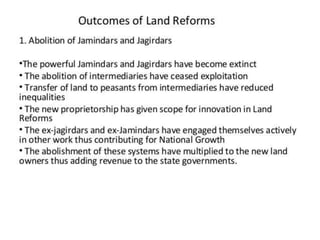
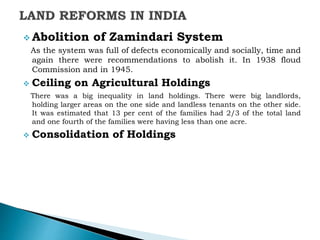
 Abolition of Zamindari System
As the system was full of defects economically and socially, time and
again there were recommendations to abolish it. In 1938 floud
Commission and in 1945.
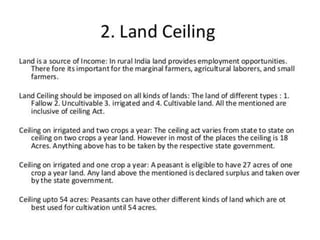
 Ceiling on Agricultural Holdings
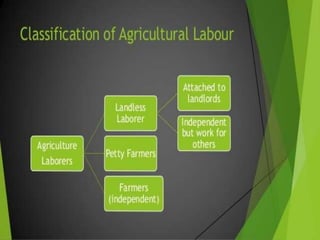
There was a big inequality in land holdings. There were big landlords,

holding larger areas on the one side and landless tenants on the other side.
It was estimated that 13 per cent of the families had 2/3 of the total land
and one fourth of the families were having less than one acre.
 Consolidation of Holdings
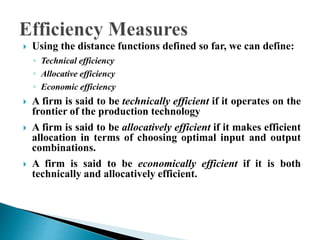
 Using the distance functions defined so far, we can define:
◦ Technical efficiency
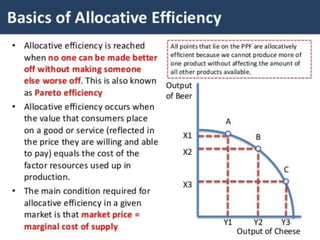
◦ Allocative efficiency
◦ Economic efficiency
 A firm is said to be technically efficient if it operates on the
frontier of the production technology
 A firm is said to be allocatively efficient if it makes efficient
allocation in terms of choosing optimal input and output
combinations.

 A firm is said to be economically efficient if it is both
technically and allocatively efficient.