Final Accounts of Banking
Companies
Advanced Accounting
Prof.U.K.Teke
DEFINITION
Section 5(b) of banking regulation act defines
banking as “the accepting, for the purpose of
lending or investment, of deposit of money
from the public repayable on demand or
otherwise and withdrawable by cheque, draft,
order or otherwise.
Features of banking company
• The borrowing,raising,or taking up of money.
• The lending or advancing of money either upon or without security.
• The granting and issuing of letters of credit,travellers cheques .
• The buying and selling of bullion.
• The buying and selling of foreign exchange including foreign bank notes.
• Contracting for public and private loans negotiating and issuing the
same.
• Undertaking and executing trust.
Continued . . . . .
• The acquisition, constructing, maintenance and alternation of any
building or works necessary or convenient for the purpose of the
company.
• Carrying on and transacting every kind of guarantee and indemnity
business.
• The collecting and transmitting of money and securities.
• Undertaking the administration of estates as executor, trustee or
otherwise
General Information
• No banking company can carry on business in India unless its subscribed capital is not less than
one- half of the authorized capital and its paid up capital is not less than one – half of
subscribed capital.
• A banking company cannot create any charge upon its uncalled capital.
• Every banking co. shall transfer a sum equal to 25% of profits to statutory reserve.
• A bank can open a branch only at the permission or reserve bank
• Payment of Commission, Brokerage etc. (Sec. 13): According to Sec. 13, a banking company is
not permitted to pay directly or indirectly by way of commission, brokerage, discount or
remuneration on issues of its shares in excess of 2½ of the paid-up value of such shares.
• Payment of Dividend (Sec. 15): According to Sec. 15, no banking company shall pay any
dividend on its shares until all its capital expense (including preliminary expenses, organization
expenses, share selling commission, brokerage, amount of losses incurred and other items of
expenditure not represented by tangible assets) have been completely written off.
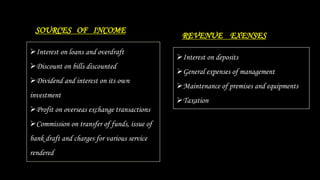
SOURCES OF INCOME
Interest on loans and overdraft
Discount on bills discounted
Dividend and interest on its own
investment
Profit on overseas exchange transactions
Commission on transfer of funds, issue of
bank draft and charges for various service
rendered
REVENUE EXENSES
Interest on deposits
General expenses of management
Maintenance of premises and equipments
Taxation
Accounting System
The accounting system of a banking company is
different from that of a trading or manufacturing
company. A bank has a large number of customers
whose acct’s are to be maintained in such a way so that
these should be kept upto date.
Special Features of bank Accounting
• Posting :entries are posted in the personal ledger directly from slips i.e pay in slip, withdrawal
slips and cheques. This system is known as slip system. The slips themselves act as loose journal
entries.
• Daily Trial Balance : T.B. is prepared every day from the balance of accounts in the general
ledger.
• Self balancing : personal ledgers are kept under self balancing system
• Daily Summary Sheets : the slips posted into different personal ledgers are summarised on daily
summary sheets totals of which are posted to the control accounts in the general ledger.
• Continuous Check : All entries in the personal ledgers and summary sheets are checked by
persons other than those who have recorded entries.
• Double Voucher System : Two vouchers are prepared for non cash transactions. They are debit
voucher and credit voucher.
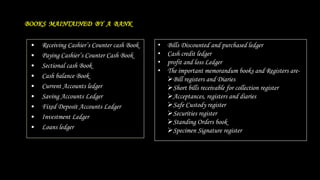
BOOKS MAINTAINED BY A BANK
• Receiving Cashier’s Counter cash Book
• Paying Cashier’s Counter Cash Book
• Sectional cash Book
• Cash balance Book
• Current Accounts ledger
• Saving Accounts Ledger
• Fixed Deposit Accounts Ledger
• Investment Ledger
• Loans ledger
• Bills Discounted and purchased ledger
• Cash credit ledger
• profit and loss Ledger
• The important memorandum books and Registers are-
Bill registers and Diaries
Short bills receivable for collection register
Acceptances, registers and diaries
Safe Custody register
Securities register
Standing Orders book
Specimen Signature register
BANKS PREPARE THEIR ACCOUNTS ACCORDING TO BANKING REGULATION
ACT, 1949 SEC 29. THE FINAL ACCOUNTS OF BANK ARE IN VERTICAL FORMAT
SETS OUT IN THE THIRD SCHEDULE OF THE ACT. THE FINAL ACCOUNTS
CONSIST OF :-
A) BALANCE SHEET (FORM-A)
B) PROFIT AND LOSS ACCOUNT(FORM-B)
THERE ARE 16 SCHEDULES IN THE FINAL ACCOUNTS OF BANKS.
BALANCE SHEET OF XYZ BANK AS ON 31ST MARCH ……
PARTICULARS SCHEDULE NO. AMT.
Capital 1.
Reserves and surplus 2.
Deposits 3.
Borrowings 4.
Other liabilities 5.
TOTAL
Cash in hand and with RBI 6.
Bal. with other banks and money at
Call and short notice 7.
Investments 8.
Advances 9.
Fixed assets 10.
Other assets 11.
TOTAL
Contingent Liabilities 12.
PROFIT AND LOSS ACCOUNT FOR THE YEAR ENDING 31ST MARCH…
PARTICULARS SCHEDULE NO. AMOUNT
INCOMES:-
Interest earned 13
Other incomes 14
TOTAL(A)
EXPENDITURE:-
Interest expanded 15
Operating expenses 16
Provision and contingencies -
TOTAL (B)
Net profit during the year (A-B)
Profit of the last year
TOTAL PROFIT AVAILABLE FOR APPROPRIATION
Statutory reserve
General reserves or other reserves
Dividends
SURPLUS TO BALANCE SHEET
WORKING NOTES
Schedule 1-Capital
Schedule 2 Reserves And Surplus
Particulars Amt.
1. Statutory Reserves
Opening balance
Additions during the year
Deductions during the year
2. Capital reserves
Opening balance
Additions during the year
Deductions during the year
3. Share premium
Opening balance
Additions during the year
Deductions during the year
4. Revenue and Other reserves
Opening balance
Additions during the year
Deductions during the year
5. Balance in profit & loss A/C
Total
-------------
Particulars Amt.
1. For Nationalized banks
capital (fully owned by central Govt)
2. For banks incorporated outside India
capital (the amt brought by banks as start up
capital as prescribed by RBI)
Amount of deposit kept with RBI u/s1(2)of
the Act
Total
3. For other banks
Authorized capital (---shares of Rs --- each)
issued Capital (---shares of Rs --- each)
Subscribed capital (---shares of Rs --- each)
Called up Capital (---shares of Rs----each)
less calls unpaid
Add forfeited shares
Total
------
------
-----
------
------
------
-----
-----
Schedule 3 Deposits
Particulars Amt.
A. 1. Demand Deposits
(i) From banks
(ii) from Others
2. Savings bank Deposits
3. term Deposits
(i) From banks
(ii) from Others
Total
B. 1. Deposits of Branches in India
2. Deposits of Branches outside India
Total
Schedule 4 Borrowings
Particulars Amt.
A. Borrowings in India
1. Reserve Bank of India
2. Other banks
3. Other Institutions and Agencies
B. Borrowings Outside India
Total ------------
Schedule 5 Other liabilities and Provisions
Particulars Amt.
1.Bills payable
2. Inter Office Adjustments (Net)
3. Interest Accrued
4. Others (including provisions)
Total --------
Schedule 6 -Cash and balances with RBI
Particulars Amt
1.Cash in hand (including foreign currency notes)
2.Balance with RBI
(i) In current account
(ii) In other accounts
Total
Schedule 7- Balance with banks & Money at call &
Short notice
Particulars Amt
1.In India
(i) Balance with banks
(a) In current accounts
(b) In other deposit accounts
(ii) Money at call and short notice
(a) With banks
(b) With other institutions
Total
2.Outside India
(i) In current accounts
(ii) In other deposit accounts
(iii) Money at call and short notice
Total
Total
Schedule 8- Investment
Particulars Amt
1.Investments in India in
(i) Government securities
(ii) Other approved securities
(iii) Shares
(iv) Debentures & Bonds
(v) Subsidiaries and /or joint ventures
(vi) Others (to be specified)
Total
2.Investments outside India in
(i) Government securities (including local authorities)
(ii) Subsidiaries and /or joint ventures
(iii) Others Investments (to be specified)
Total
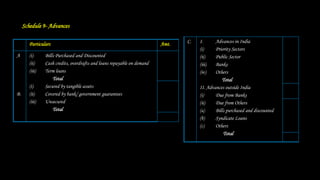
Schedule 9- Advances
Particulars Amt.
A
B.
(i) Bills Purchased and Discounted
(ii) Cash credits, overdrafts and loans repayable on demand
(iii) Term loans
Total
(i) Secured by tangible assets
(ii) Covered by bank/ government guarantees
(iii) Unsecured
Total
C. I. Advances in India
(i) Priority Sectors
(ii) Public Sector
(iii) Banks
(iv) Others
Total
II. Advances outside India
(i) Due from Banks
(ii) Due from Others
(a) Bills purchased and discounted
(b) Syndicate Loans
(c) Others
Total
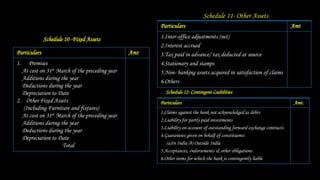
Schedule 10 -Fixed Assets
Particulars Amt
1. Premises
At cost on 31st March of the preceding year
Additions during the year
Deductions during the year
Depreciation to Date
2. Other Fixed Assets
(Including Furniture and fixtures)
At cost on 31st March of the preceding year
Additions during the year
Deductions during the year
Depreciation to Date
Total
Schedule 11- Other Assets
Particulars Amt
1.Inter-office adjustments (net)
2.Interest accrued
3.Tax paid in advance/ tax deducted at source
4.Stationary and stamps
5.Non- banking assets acquired in satisfaction of claims
6.Others
Schedule 12- Contingent Liabilities
Particulars Amt.
1.Claims against the bank not acknowledged as debts
2.Liability for partly paid investments
3.Liability on account of outstanding forward exchange contracts
4.Guarantees given on behalf of constituents
(a)In India (b) Outside India
5.Acceptances, endorsements & other obligations
6.Other items for which the bank is contingently liable
Schedule 13-Interest earned
Particulars Amt.
1.Interest/ discount on advance/ bills
2.Income on investments
3.Interest on balances with RBI and other inter bank funds
4.Others
Total
Schedule 14- Other Income
Particulars Amt.
1.Commission, exchange & brokerage
2.Profit on sale of investments
Less: Loss on sale of investment
3.Profit on revaluation of investments
Less: Loss on revaluation of investments
4.Profit on sale of land, buildings and other assets
Less: Loss on sale of land, buildings and other assets
5.Profit on exchange transactions
Less: Loss on exchange transactions
6.Income earned by way of dividends etc. from
subsidiaries/ companies and/or joint ventures abroad /in
India
7.Miscellaneous Income
Total
Schedule 15- Interest Expended
Particulars Amt
1.Interest on deposits
2.Interest on RBI/ inter-bank borrowings
3.Others
Total
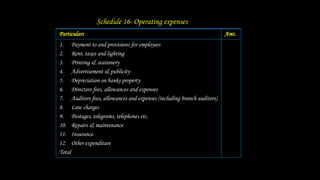
Schedule 16- Operating expenses
Particulars Amt.
1. Payment to and provisions for employees
2. Rent, taxes and lighting
3. Printing & stationery
4. Advertisement & publicity
5. Depreciation on banks property
6. Directors fees, allowances and expenses
7. Auditors fees, allowances and expenses (including branch auditors)
8. Law charges
9. Postages, telegrams, telephones etc.
10. Repairs & maintenance
11. Insurance
12. Other expenditure
Total
Statutory Reserve
Under section 17, every banking company incorporated in India is required to transfer at least 25% of its
current profits to its reserve fund. It is known as statutory reserve. Only those banks get exemption
from this legal condition, whose reserve along with share premium if any become equal to paid up
capital.
Accounting treatment:
(i) It is shown in the P&L A/c under the heading ‘Appropriations’.
(ii) In the B/S it is disclosed as a separate item under the heading ‘ R & S’ under Schedule 2.
Non- Banking Asset
Any asset which does not come in the ordinary course of business of a bank is called non-banking asset. The bank is not allowed to
deal in such assets. But a bank can always lend against the security of the assets. The bank may have to take possession of
the asset given as security, if the loanee fails to repay the loans. Such asset is a non-banking asset. It appears on the asset
side of the B/S under the head ‘Other Asset’. Such assets have to be disposed off within a period of seven years from the
date of acquiring these assets.
Accounting treatment:
(i) Any profit or loss on sale of such asset must be shown in the P&L A/c under Schedule 14.
(ii) Non- Banking assets acquired in satisfaction of claims must be disclosed as separate item in B/S under Schedule -11 under
the head ‘Other Assets’.
Rebate on Bills Discounted
It represents unearned discount for those bills which will mature after the closing of financial accounts. It is possible that the
maturity dates of some bills may fall after the date of preparation of final accounts, the total discount credited in respect
of such bills cannot be treated as earned during the current year. So discount for the unexpired period is debited to
discount account to cancel the credit given previously and credited to Rebate on Bills Discounted Account or Unexpired
Discount Account.
Accounting treatment:
(i) At the end of the year-
Discount A/c Dr.
To Rebate on Bills Discounted A/c
(ii) At the beginning of the year-
Rebate on bills discounted A/c Dr.
To Discount A/c
Cash Reserve: (Sec 18) Banks are required to maintain with RBI a cash reserve of at least 3% of its deposits. At
present it is ---%. RBI can raise CRR up to 15%
Statutory Liquidity ratio: banks are required to maintain at least 25% of its time and demand liabilities in the
form of liquid assets such as gold etc. SLR may vary between 25% to 40%.
NON-PERFORMING ASSETS
Non-performing Assets (NPA) means a credit facility in respect of which the interest and/or
instalments has remained past due for a specified period. Thus, a credit facility that ceases to
generate income for the bank is termed as Non-performing Assets.
Accordingly, any loan facility which is overdue for interest or instalment for a period of 180 days is
considered as NPA. This period applies for term loan, overdraft as well as other advances. However,
for agricultural loans, overdue for two harvest seasons is considered as NPA. With effect from March
2004, banks have to classify their assets as NPAs if they fail to recover either a portion of principal or
interest within 90 days instead of 180 days applicable earlier.
Classification of Advances
As per prudential norms, the advances of a bank are classified as under:
(i) Standard Assets: The advance which is not NPA is called Performing Asset or Standard Asset.
Such an asset does not create any problem to the bank. It does not earn more than normal risk
attached to the business.
(ii) Sub-standard Assets: The amount of advance which is NPA for a period not exceeding 18 months is
considered as Sub-standard Asset. The security available to the bank is inadequate. There is a distinct possibility
that the bank will suffer some loss if deficiencies are not corrected immediately in future
(iii) Doubtful Asset: The amount of advance which is NPA for a period of exceeding 18 months is considered as
doubtful asset. This type of an asset is considered as weak because its collection is considered as highly
improbable. For this purpose, the unsecured and secured portions are to be considered separately. The unsecured
portion has to be fully provided. Provision is also to be made against secured portion as per certain percentages.
(iv) Loss Asset: The amount of advance which is identified by the bank or the auditor but which is not yet
written off. The bank must write it off even though there is remote possibility of recovery of certain amount.

Bank final accounts

  • 1.
    Final Accounts ofBanking Companies Advanced Accounting Prof.U.K.Teke
  • 2.
    DEFINITION Section 5(b) ofbanking regulation act defines banking as “the accepting, for the purpose of lending or investment, of deposit of money from the public repayable on demand or otherwise and withdrawable by cheque, draft, order or otherwise.
  • 3.
    Features of bankingcompany • The borrowing,raising,or taking up of money. • The lending or advancing of money either upon or without security. • The granting and issuing of letters of credit,travellers cheques . • The buying and selling of bullion. • The buying and selling of foreign exchange including foreign bank notes. • Contracting for public and private loans negotiating and issuing the same. • Undertaking and executing trust.
  • 4.
    Continued . .. . . • The acquisition, constructing, maintenance and alternation of any building or works necessary or convenient for the purpose of the company. • Carrying on and transacting every kind of guarantee and indemnity business. • The collecting and transmitting of money and securities. • Undertaking the administration of estates as executor, trustee or otherwise
  • 5.
    General Information • Nobanking company can carry on business in India unless its subscribed capital is not less than one- half of the authorized capital and its paid up capital is not less than one – half of subscribed capital. • A banking company cannot create any charge upon its uncalled capital. • Every banking co. shall transfer a sum equal to 25% of profits to statutory reserve. • A bank can open a branch only at the permission or reserve bank • Payment of Commission, Brokerage etc. (Sec. 13): According to Sec. 13, a banking company is not permitted to pay directly or indirectly by way of commission, brokerage, discount or remuneration on issues of its shares in excess of 2½ of the paid-up value of such shares. • Payment of Dividend (Sec. 15): According to Sec. 15, no banking company shall pay any dividend on its shares until all its capital expense (including preliminary expenses, organization expenses, share selling commission, brokerage, amount of losses incurred and other items of expenditure not represented by tangible assets) have been completely written off.
  • 6.
    SOURCES OF INCOME Intereston loans and overdraft Discount on bills discounted Dividend and interest on its own investment Profit on overseas exchange transactions Commission on transfer of funds, issue of bank draft and charges for various service rendered REVENUE EXENSES Interest on deposits General expenses of management Maintenance of premises and equipments Taxation
  • 7.
    Accounting System The accountingsystem of a banking company is different from that of a trading or manufacturing company. A bank has a large number of customers whose acct’s are to be maintained in such a way so that these should be kept upto date.
  • 8.
    Special Features ofbank Accounting • Posting :entries are posted in the personal ledger directly from slips i.e pay in slip, withdrawal slips and cheques. This system is known as slip system. The slips themselves act as loose journal entries. • Daily Trial Balance : T.B. is prepared every day from the balance of accounts in the general ledger. • Self balancing : personal ledgers are kept under self balancing system • Daily Summary Sheets : the slips posted into different personal ledgers are summarised on daily summary sheets totals of which are posted to the control accounts in the general ledger. • Continuous Check : All entries in the personal ledgers and summary sheets are checked by persons other than those who have recorded entries. • Double Voucher System : Two vouchers are prepared for non cash transactions. They are debit voucher and credit voucher.
  • 9.
    BOOKS MAINTAINED BYA BANK • Receiving Cashier’s Counter cash Book • Paying Cashier’s Counter Cash Book • Sectional cash Book • Cash balance Book • Current Accounts ledger • Saving Accounts Ledger • Fixed Deposit Accounts Ledger • Investment Ledger • Loans ledger • Bills Discounted and purchased ledger • Cash credit ledger • profit and loss Ledger • The important memorandum books and Registers are- Bill registers and Diaries Short bills receivable for collection register Acceptances, registers and diaries Safe Custody register Securities register Standing Orders book Specimen Signature register
  • 10.
    BANKS PREPARE THEIRACCOUNTS ACCORDING TO BANKING REGULATION ACT, 1949 SEC 29. THE FINAL ACCOUNTS OF BANK ARE IN VERTICAL FORMAT SETS OUT IN THE THIRD SCHEDULE OF THE ACT. THE FINAL ACCOUNTS CONSIST OF :- A) BALANCE SHEET (FORM-A) B) PROFIT AND LOSS ACCOUNT(FORM-B) THERE ARE 16 SCHEDULES IN THE FINAL ACCOUNTS OF BANKS.
  • 11.
    BALANCE SHEET OFXYZ BANK AS ON 31ST MARCH …… PARTICULARS SCHEDULE NO. AMT. Capital 1. Reserves and surplus 2. Deposits 3. Borrowings 4. Other liabilities 5. TOTAL Cash in hand and with RBI 6. Bal. with other banks and money at Call and short notice 7. Investments 8. Advances 9. Fixed assets 10. Other assets 11. TOTAL Contingent Liabilities 12.
  • 12.
    PROFIT AND LOSSACCOUNT FOR THE YEAR ENDING 31ST MARCH… PARTICULARS SCHEDULE NO. AMOUNT INCOMES:- Interest earned 13 Other incomes 14 TOTAL(A) EXPENDITURE:- Interest expanded 15 Operating expenses 16 Provision and contingencies - TOTAL (B) Net profit during the year (A-B) Profit of the last year TOTAL PROFIT AVAILABLE FOR APPROPRIATION Statutory reserve General reserves or other reserves Dividends SURPLUS TO BALANCE SHEET
  • 13.
    WORKING NOTES Schedule 1-Capital Schedule2 Reserves And Surplus Particulars Amt. 1. Statutory Reserves Opening balance Additions during the year Deductions during the year 2. Capital reserves Opening balance Additions during the year Deductions during the year 3. Share premium Opening balance Additions during the year Deductions during the year 4. Revenue and Other reserves Opening balance Additions during the year Deductions during the year 5. Balance in profit & loss A/C Total ------------- Particulars Amt. 1. For Nationalized banks capital (fully owned by central Govt) 2. For banks incorporated outside India capital (the amt brought by banks as start up capital as prescribed by RBI) Amount of deposit kept with RBI u/s1(2)of the Act Total 3. For other banks Authorized capital (---shares of Rs --- each) issued Capital (---shares of Rs --- each) Subscribed capital (---shares of Rs --- each) Called up Capital (---shares of Rs----each) less calls unpaid Add forfeited shares Total ------ ------ ----- ------ ------ ------ ----- -----
  • 14.
    Schedule 3 Deposits ParticularsAmt. A. 1. Demand Deposits (i) From banks (ii) from Others 2. Savings bank Deposits 3. term Deposits (i) From banks (ii) from Others Total B. 1. Deposits of Branches in India 2. Deposits of Branches outside India Total Schedule 4 Borrowings Particulars Amt. A. Borrowings in India 1. Reserve Bank of India 2. Other banks 3. Other Institutions and Agencies B. Borrowings Outside India Total ------------ Schedule 5 Other liabilities and Provisions Particulars Amt. 1.Bills payable 2. Inter Office Adjustments (Net) 3. Interest Accrued 4. Others (including provisions) Total --------
  • 15.
    Schedule 6 -Cashand balances with RBI Particulars Amt 1.Cash in hand (including foreign currency notes) 2.Balance with RBI (i) In current account (ii) In other accounts Total Schedule 7- Balance with banks & Money at call & Short notice Particulars Amt 1.In India (i) Balance with banks (a) In current accounts (b) In other deposit accounts (ii) Money at call and short notice (a) With banks (b) With other institutions Total 2.Outside India (i) In current accounts (ii) In other deposit accounts (iii) Money at call and short notice Total Total Schedule 8- Investment Particulars Amt 1.Investments in India in (i) Government securities (ii) Other approved securities (iii) Shares (iv) Debentures & Bonds (v) Subsidiaries and /or joint ventures (vi) Others (to be specified) Total 2.Investments outside India in (i) Government securities (including local authorities) (ii) Subsidiaries and /or joint ventures (iii) Others Investments (to be specified) Total
  • 16.
    Schedule 9- Advances ParticularsAmt. A B. (i) Bills Purchased and Discounted (ii) Cash credits, overdrafts and loans repayable on demand (iii) Term loans Total (i) Secured by tangible assets (ii) Covered by bank/ government guarantees (iii) Unsecured Total C. I. Advances in India (i) Priority Sectors (ii) Public Sector (iii) Banks (iv) Others Total II. Advances outside India (i) Due from Banks (ii) Due from Others (a) Bills purchased and discounted (b) Syndicate Loans (c) Others Total
  • 17.
    Schedule 10 -FixedAssets Particulars Amt 1. Premises At cost on 31st March of the preceding year Additions during the year Deductions during the year Depreciation to Date 2. Other Fixed Assets (Including Furniture and fixtures) At cost on 31st March of the preceding year Additions during the year Deductions during the year Depreciation to Date Total Schedule 11- Other Assets Particulars Amt 1.Inter-office adjustments (net) 2.Interest accrued 3.Tax paid in advance/ tax deducted at source 4.Stationary and stamps 5.Non- banking assets acquired in satisfaction of claims 6.Others Schedule 12- Contingent Liabilities Particulars Amt. 1.Claims against the bank not acknowledged as debts 2.Liability for partly paid investments 3.Liability on account of outstanding forward exchange contracts 4.Guarantees given on behalf of constituents (a)In India (b) Outside India 5.Acceptances, endorsements & other obligations 6.Other items for which the bank is contingently liable
  • 18.
    Schedule 13-Interest earned ParticularsAmt. 1.Interest/ discount on advance/ bills 2.Income on investments 3.Interest on balances with RBI and other inter bank funds 4.Others Total Schedule 14- Other Income Particulars Amt. 1.Commission, exchange & brokerage 2.Profit on sale of investments Less: Loss on sale of investment 3.Profit on revaluation of investments Less: Loss on revaluation of investments 4.Profit on sale of land, buildings and other assets Less: Loss on sale of land, buildings and other assets 5.Profit on exchange transactions Less: Loss on exchange transactions 6.Income earned by way of dividends etc. from subsidiaries/ companies and/or joint ventures abroad /in India 7.Miscellaneous Income Total Schedule 15- Interest Expended Particulars Amt 1.Interest on deposits 2.Interest on RBI/ inter-bank borrowings 3.Others Total
  • 19.
    Schedule 16- Operatingexpenses Particulars Amt. 1. Payment to and provisions for employees 2. Rent, taxes and lighting 3. Printing & stationery 4. Advertisement & publicity 5. Depreciation on banks property 6. Directors fees, allowances and expenses 7. Auditors fees, allowances and expenses (including branch auditors) 8. Law charges 9. Postages, telegrams, telephones etc. 10. Repairs & maintenance 11. Insurance 12. Other expenditure Total
  • 20.
    Statutory Reserve Under section17, every banking company incorporated in India is required to transfer at least 25% of its current profits to its reserve fund. It is known as statutory reserve. Only those banks get exemption from this legal condition, whose reserve along with share premium if any become equal to paid up capital. Accounting treatment: (i) It is shown in the P&L A/c under the heading ‘Appropriations’. (ii) In the B/S it is disclosed as a separate item under the heading ‘ R & S’ under Schedule 2. Non- Banking Asset Any asset which does not come in the ordinary course of business of a bank is called non-banking asset. The bank is not allowed to deal in such assets. But a bank can always lend against the security of the assets. The bank may have to take possession of the asset given as security, if the loanee fails to repay the loans. Such asset is a non-banking asset. It appears on the asset side of the B/S under the head ‘Other Asset’. Such assets have to be disposed off within a period of seven years from the date of acquiring these assets. Accounting treatment: (i) Any profit or loss on sale of such asset must be shown in the P&L A/c under Schedule 14. (ii) Non- Banking assets acquired in satisfaction of claims must be disclosed as separate item in B/S under Schedule -11 under the head ‘Other Assets’.
  • 21.
    Rebate on BillsDiscounted It represents unearned discount for those bills which will mature after the closing of financial accounts. It is possible that the maturity dates of some bills may fall after the date of preparation of final accounts, the total discount credited in respect of such bills cannot be treated as earned during the current year. So discount for the unexpired period is debited to discount account to cancel the credit given previously and credited to Rebate on Bills Discounted Account or Unexpired Discount Account. Accounting treatment: (i) At the end of the year- Discount A/c Dr. To Rebate on Bills Discounted A/c (ii) At the beginning of the year- Rebate on bills discounted A/c Dr. To Discount A/c Cash Reserve: (Sec 18) Banks are required to maintain with RBI a cash reserve of at least 3% of its deposits. At present it is ---%. RBI can raise CRR up to 15% Statutory Liquidity ratio: banks are required to maintain at least 25% of its time and demand liabilities in the form of liquid assets such as gold etc. SLR may vary between 25% to 40%.
  • 22.
    NON-PERFORMING ASSETS Non-performing Assets(NPA) means a credit facility in respect of which the interest and/or instalments has remained past due for a specified period. Thus, a credit facility that ceases to generate income for the bank is termed as Non-performing Assets. Accordingly, any loan facility which is overdue for interest or instalment for a period of 180 days is considered as NPA. This period applies for term loan, overdraft as well as other advances. However, for agricultural loans, overdue for two harvest seasons is considered as NPA. With effect from March 2004, banks have to classify their assets as NPAs if they fail to recover either a portion of principal or interest within 90 days instead of 180 days applicable earlier.
  • 23.
    Classification of Advances Asper prudential norms, the advances of a bank are classified as under: (i) Standard Assets: The advance which is not NPA is called Performing Asset or Standard Asset. Such an asset does not create any problem to the bank. It does not earn more than normal risk attached to the business. (ii) Sub-standard Assets: The amount of advance which is NPA for a period not exceeding 18 months is considered as Sub-standard Asset. The security available to the bank is inadequate. There is a distinct possibility that the bank will suffer some loss if deficiencies are not corrected immediately in future (iii) Doubtful Asset: The amount of advance which is NPA for a period of exceeding 18 months is considered as doubtful asset. This type of an asset is considered as weak because its collection is considered as highly improbable. For this purpose, the unsecured and secured portions are to be considered separately. The unsecured portion has to be fully provided. Provision is also to be made against secured portion as per certain percentages. (iv) Loss Asset: The amount of advance which is identified by the bank or the auditor but which is not yet written off. The bank must write it off even though there is remote possibility of recovery of certain amount.