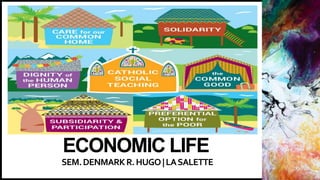
SEM.DENMARKR.HUGO|LASALETTE
ECONOMIC LIFE
FIRSTUP
CONSULTANTS 2
"A Catholic Framework for Economic Life"
offers ten key principles to help Catholics
reflect on the values that should shape our
participation in economic life. It was written by
the bishops of the United States based on the
Catechism of the Catholic Church, papal
encyclicals, the pastoral letter Economic Justice
for All, and other statements of the U.S.
Catholic bishops.
FIRSTUP
CONSULTANTS 3
These principles are drawn directly from Catholic
teaching on economic life.
1. The economy exists for the person, not the
person for the economy.
2. All economic life should be shaped by moral
principles. Economic choices and institutions
must be judged by how they protect or
undermine the life and dignity of the human
person, support the family and serve the
common good.
FIRSTUP
CONSULTANTS 4
3. A fundamental moral measure of any economy
is how the poor and vulnerable are faring.
4. All people have a right to life and to secure the
basic necessities of life, such as food, clothing,
shelter, education, health care, safe environment,
and economic security.
5. All people have the right to economic
initiative, to productive work, to just wages and
benefits, to decent working conditions as well as
to organize and join unions or other associations.
FIRSTUP
CONSULTANTS 5
6. All people, to the extent they are able, have a
corresponding duty to work, a responsibility to
provide for the needs of their families and an
obligation to contribute to the broader society.
7. In economic life, free markets have both clear
advantages and limits; government has essential
responsibilities and limitations; voluntary
groups have irreplaceable roles, but cannot
substitute for the proper working of the market
and the just policies of the state.
FIRSTUP
CONSULTANTS 6
8. Society has a moral obligation, including
governmental action where necessary, to assure
opportunity, meet basic human needs, and pursue
justice in economic life.
9. Workers, owners, managers, stockholders and
consumers are moral agents in economic life. By
our choices, initiative, creativity and investment,
we enhance or diminish economic opportunity,
community life and social justice.
FIRSTUP
CONSULTANTS 7
10. The global economy has moral dimensions
and human consequences. Decisions on
investment, trade, aid and development should
protect human life and promote human rights,
especially for those most in need wherever they
might live on this globe.
FIRSTUP
CONSULTANTS 8
According to Pope John Paul II in Centesimus
Annus , the Catholic tradition calls for a “society
of work, enterprise and participation” which “is
not directed against the market, but demands that
the market be appropriately controlled by the
forces of society and by the state to assure that
the basic needs of the whole society are
satisfied.” All of economic life should recognize
the fact that we all are God’s children and
members of one human family, called to exercise
a clear priority for “the least among us.”
FIRSTUP
CONSULTANTS
COMPENDIUM OF
THE SOCIAL
DOCTRINE OF THE
CHURCH,
CHAPTER 7
9
FIRSTUP
CONSULTANTS 10
BIBLICALASPECTS
A. Man, Poverty and Riches
323. In the Old Testament a twofold attitude towards economic goods and riches
is found. On one hand, an attitude of appreciation sees the availability of material
goods as necessary for life. Abundance — not wealth or luxury — is sometimes
seen as a blessing from God. In Wisdom Literature, poverty is described as a
negative consequence of idleness and of a lack of industriousness (cf. Prov 10:4),
but also as a natural fact (cf. Prov 22:2). On the other hand, economic goods and
riches are not in themselves condemned so much as their misuse. The prophetic
tradition condemns fraud, usury, exploitation and gross injustice, especially when
directed against the poor (cf. Is 58:3-11; Jer 7:4-7; Hos 4:1-2; Am 2:6-7; Mic 2:1-
2). This tradition, however, although looking upon the poverty of the oppressed,
the weak and the indigent as an evil, also sees in the condition of poverty a
symbol of the human situation before God, from whom comes every good as a
gift to be administered and shared.
FIRSTUP
CONSULTANTS 11
326. Economic activity and material progress must be placed at
the service of man and society. If people dedicate themselves to
these with the faith, hope and love of Christ's disciples, even the
economy and progress can be transformed into places of
salvation and sanctification. In these areas too it is possible to
express a love and a solidarity that are more than human, and to
contribute to the growth of a new humanity that anticipates the
world to come.[683] Jesus sums up all of revelation in calling
the believer to become rich before God (cf. Lk 12:21). The
economy too is useful to this end, when its function as an
instrument for the overall growth of man and society, of the
human quality of life, is not betrayed.
FIRSTUP
CONSULTANTS 12
B. Wealth exists to be shared
328. Goods, even when legitimately owned, always have a universal
destination; any type of improper accumulation is immoral, because it
openly contradicts the universal destination assigned to all goods by
the Creator. Christian salvation is an integral liberation of man, which
means being freed not only from need but also in respect to
possessions. “For the love of money is the root of all evils; it is
through this craving that some have wandered away from the faith”
(1 Tim 6:10). The Fathers of the Church insist more on the need for
the conversion and transformation of the consciences of believers
than on the need to change the social and political structures of their
day. They call on those who work in the economic sphere and who
possess goods to consider themselves administrators of the goods that
God has entrusted to them.
FIRSTUP
CONSULTANTS 13
ECONOMIC INSTITUTIONS
AT THE SERVICE OF MAN
A. Role of the free market
347. The free market is an institution of social importance because of its
capacity to guarantee effective results in the production of goods and
services. Historically, it has shown itself able to initiate and sustain
economic development over long periods. There are good reasons to hold
that, in many circumstances, “the free market is the most efficient
instrument for utilizing resources and effectively responding to
needs”.[726] The Church's social doctrine appreciates the secure
advantages that the mechanisms of the free market offer, making it
possible as they do to utilize resources better and facilitating the exchange
of products. These mechanisms “above all ... give central place to the
person's desires and preferences, which, in a contract, meet the desires and
preferences of another person”.
FIRSTUP
CONSULTANTS 14
MORALITY AND THE ECONOMY
330. The Church's social doctrine insists on the moral
connotations of the economy. Pope Pius XI, in a passage from
the Encyclical Quadragesimo Anno, speaks of the relationship
between the economy and morality. “Even though economics
and moral science employs each its own principles in its own
sphere, it is, nevertheless, an error to say that the economic and
moral orders are so distinct from and alien to each other that the
former depends in no way on the latter. Certainly the laws of
economics, as they are termed, being based on the very nature of
material things and on the capacities of the human body and
mind, determine the limits of what productive human effort
cannot, and of what it can attain in the economic field and by
what means.
FIRSTUP
CONSULTANTS
POPULORUM
PROGRESSIO
15
FIRSTUP
CONSULTANTS 16
The Use of Private Property
23. "He who has the goods of this world and sees his brother
in need and closes his heart to him, how does the love of God
abide in him?" (21) Everyone knows that the Fathers of the
Church laid down the duty of the rich toward the poor in no
uncertain terms. As St. Ambrose put it: "You are not making
a gift of what is yours to the poor man, but you are giving
him back what is his. You have been appropriating things that
are meant to be for the common use of everyone. The earth
belongs to everyone, not to the rich." (22) These words
indicate that the right to private property is not absolute and
unconditional.
FIRSTUP
CONSULTANTS
GAUDIUM ET SPES
17
FIRSTUP
CONSULTANTS 18
CHAPTER III
ECONOMIC AND SOCIAL LIFE
63. In the economic and social realms, too, the
dignity and complete vocation of the human
person and the welfare of society as a whole are
to be respected and promoted. For man is the
source, the center, and the purpose of all
economic and social life.
FIRSTUP
CONSULTANTS
CENTESIMUS
ANNUS
19
FIRSTUP
CONSULTANTS 20
IV. PRIVATE PROPERTYAND THE
UNIVERSAL DESTINATION OF MATERIAL
GOODS
30. In Rerum Novarum, Leo XIII strongly affirmed
the natural character of the right to private property,
using various arguments against the socialism of his
time. This right, which is fundamental for the
autonomy and development of the person, has always
been defended by the Church up to our own day
FIRSTUP
CONSULTANTS 21
Pope Leo wrote: "those whom fortune favours are
admonished ... that they should tremble at the
warnings of Jesus Christ ... and that a most strict
account must be given to the Supreme Judge for the
use of all they possess"; and quoting Saint Thomas
Aquinas, he added: "But if the question be asked, how
must one's possessions be used? the Church replies
without hesitation that man should not consider his
material possessions as his own, but as common to
all...", because "above the laws and judgments of men
stands the law, the judgment of Christ"
FIRSTUP
CONSULTANTS
CATECHISM OF
THE CATHOLIC
CHURCH
22
FIRSTUP
CONSULTANTS 23
2426. The development of economic activity and
growth in production are meant to provide for the
needs of human beings. Economic life is not meant
solely to multiply goods produced and increase profit
or power; it is ordered first of all to the service of
persons, of the whole man, and of the entire human
community. Economic activity, conducted according
to its own proper methods, is to be exercised within
the limits of the moral order, in keeping with social
justice so as to correspond to God's plan for man.
FIRSTUP
CONSULTANTS 24
2427. Human work proceeds directly from persons created in
the image of God and called to prolong the work of creation by
subduing the earth, both with and for one another. Hence work
is a duty: "If any one will not work, let him not eat." Work
honors the Creator's gifts and the talents received from him. It
can also be redemptive. By enduring the hardship of work in
union with Jesus, the carpenter of Nazareth and the one
crucified on Calvary, man collaborates in a certain fashion
with the Son of God in his redemptive work. He shows himself
to be a disciple of Christ by carrying the cross, daily, in the
work he is called to accomplish. Work can be a means of
sanctification and a way of animating earthly realities with the
Spirit of Christ
FIRSTUP
CONSULTANTS 25
2429. Everyone has the right of economic initiative;
everyone should make legitimate use of his talents
to contribute to the abundance that will benefit all
and to harvest the just fruits of his labor. He should
seek to observe regulations issued by legitimate
authority for the sake of the common good.
FIRSTUP
CONSULTANTS 26
2444. "The Church's love for the poor . . . is a
part of her constant tradition." This love is
inspired by the Gospel of the Beatitudes, of the
poverty of Jesus, and of his concern for the
poor. Love for the poor is even one of the
motives for the duty of working so as to "be
able to give to those in need." It extends not
only to material poverty but also to the many
forms of cultural and religious poverty.
FIRSTUP
CONSULTANTS 27

Economic life

  • 1.
  • 2.
    FIRSTUP CONSULTANTS 2 "A CatholicFramework for Economic Life" offers ten key principles to help Catholics reflect on the values that should shape our participation in economic life. It was written by the bishops of the United States based on the Catechism of the Catholic Church, papal encyclicals, the pastoral letter Economic Justice for All, and other statements of the U.S. Catholic bishops.
  • 3.
    FIRSTUP CONSULTANTS 3 These principlesare drawn directly from Catholic teaching on economic life. 1. The economy exists for the person, not the person for the economy. 2. All economic life should be shaped by moral principles. Economic choices and institutions must be judged by how they protect or undermine the life and dignity of the human person, support the family and serve the common good.
  • 4.
    FIRSTUP CONSULTANTS 4 3. Afundamental moral measure of any economy is how the poor and vulnerable are faring. 4. All people have a right to life and to secure the basic necessities of life, such as food, clothing, shelter, education, health care, safe environment, and economic security. 5. All people have the right to economic initiative, to productive work, to just wages and benefits, to decent working conditions as well as to organize and join unions or other associations.
  • 5.
    FIRSTUP CONSULTANTS 5 6. Allpeople, to the extent they are able, have a corresponding duty to work, a responsibility to provide for the needs of their families and an obligation to contribute to the broader society. 7. In economic life, free markets have both clear advantages and limits; government has essential responsibilities and limitations; voluntary groups have irreplaceable roles, but cannot substitute for the proper working of the market and the just policies of the state.
  • 6.
    FIRSTUP CONSULTANTS 6 8. Societyhas a moral obligation, including governmental action where necessary, to assure opportunity, meet basic human needs, and pursue justice in economic life. 9. Workers, owners, managers, stockholders and consumers are moral agents in economic life. By our choices, initiative, creativity and investment, we enhance or diminish economic opportunity, community life and social justice.
  • 7.
    FIRSTUP CONSULTANTS 7 10. Theglobal economy has moral dimensions and human consequences. Decisions on investment, trade, aid and development should protect human life and promote human rights, especially for those most in need wherever they might live on this globe.
  • 8.
    FIRSTUP CONSULTANTS 8 According toPope John Paul II in Centesimus Annus , the Catholic tradition calls for a “society of work, enterprise and participation” which “is not directed against the market, but demands that the market be appropriately controlled by the forces of society and by the state to assure that the basic needs of the whole society are satisfied.” All of economic life should recognize the fact that we all are God’s children and members of one human family, called to exercise a clear priority for “the least among us.”
  • 9.
  • 10.
    FIRSTUP CONSULTANTS 10 BIBLICALASPECTS A. Man,Poverty and Riches 323. In the Old Testament a twofold attitude towards economic goods and riches is found. On one hand, an attitude of appreciation sees the availability of material goods as necessary for life. Abundance — not wealth or luxury — is sometimes seen as a blessing from God. In Wisdom Literature, poverty is described as a negative consequence of idleness and of a lack of industriousness (cf. Prov 10:4), but also as a natural fact (cf. Prov 22:2). On the other hand, economic goods and riches are not in themselves condemned so much as their misuse. The prophetic tradition condemns fraud, usury, exploitation and gross injustice, especially when directed against the poor (cf. Is 58:3-11; Jer 7:4-7; Hos 4:1-2; Am 2:6-7; Mic 2:1- 2). This tradition, however, although looking upon the poverty of the oppressed, the weak and the indigent as an evil, also sees in the condition of poverty a symbol of the human situation before God, from whom comes every good as a gift to be administered and shared.
  • 11.
    FIRSTUP CONSULTANTS 11 326. Economicactivity and material progress must be placed at the service of man and society. If people dedicate themselves to these with the faith, hope and love of Christ's disciples, even the economy and progress can be transformed into places of salvation and sanctification. In these areas too it is possible to express a love and a solidarity that are more than human, and to contribute to the growth of a new humanity that anticipates the world to come.[683] Jesus sums up all of revelation in calling the believer to become rich before God (cf. Lk 12:21). The economy too is useful to this end, when its function as an instrument for the overall growth of man and society, of the human quality of life, is not betrayed.
  • 12.
    FIRSTUP CONSULTANTS 12 B. Wealthexists to be shared 328. Goods, even when legitimately owned, always have a universal destination; any type of improper accumulation is immoral, because it openly contradicts the universal destination assigned to all goods by the Creator. Christian salvation is an integral liberation of man, which means being freed not only from need but also in respect to possessions. “For the love of money is the root of all evils; it is through this craving that some have wandered away from the faith” (1 Tim 6:10). The Fathers of the Church insist more on the need for the conversion and transformation of the consciences of believers than on the need to change the social and political structures of their day. They call on those who work in the economic sphere and who possess goods to consider themselves administrators of the goods that God has entrusted to them.
  • 13.
    FIRSTUP CONSULTANTS 13 ECONOMIC INSTITUTIONS ATTHE SERVICE OF MAN A. Role of the free market 347. The free market is an institution of social importance because of its capacity to guarantee effective results in the production of goods and services. Historically, it has shown itself able to initiate and sustain economic development over long periods. There are good reasons to hold that, in many circumstances, “the free market is the most efficient instrument for utilizing resources and effectively responding to needs”.[726] The Church's social doctrine appreciates the secure advantages that the mechanisms of the free market offer, making it possible as they do to utilize resources better and facilitating the exchange of products. These mechanisms “above all ... give central place to the person's desires and preferences, which, in a contract, meet the desires and preferences of another person”.
  • 14.
    FIRSTUP CONSULTANTS 14 MORALITY ANDTHE ECONOMY 330. The Church's social doctrine insists on the moral connotations of the economy. Pope Pius XI, in a passage from the Encyclical Quadragesimo Anno, speaks of the relationship between the economy and morality. “Even though economics and moral science employs each its own principles in its own sphere, it is, nevertheless, an error to say that the economic and moral orders are so distinct from and alien to each other that the former depends in no way on the latter. Certainly the laws of economics, as they are termed, being based on the very nature of material things and on the capacities of the human body and mind, determine the limits of what productive human effort cannot, and of what it can attain in the economic field and by what means.
  • 15.
  • 16.
    FIRSTUP CONSULTANTS 16 The Useof Private Property 23. "He who has the goods of this world and sees his brother in need and closes his heart to him, how does the love of God abide in him?" (21) Everyone knows that the Fathers of the Church laid down the duty of the rich toward the poor in no uncertain terms. As St. Ambrose put it: "You are not making a gift of what is yours to the poor man, but you are giving him back what is his. You have been appropriating things that are meant to be for the common use of everyone. The earth belongs to everyone, not to the rich." (22) These words indicate that the right to private property is not absolute and unconditional.
  • 17.
  • 18.
    FIRSTUP CONSULTANTS 18 CHAPTER III ECONOMICAND SOCIAL LIFE 63. In the economic and social realms, too, the dignity and complete vocation of the human person and the welfare of society as a whole are to be respected and promoted. For man is the source, the center, and the purpose of all economic and social life.
  • 19.
  • 20.
    FIRSTUP CONSULTANTS 20 IV. PRIVATEPROPERTYAND THE UNIVERSAL DESTINATION OF MATERIAL GOODS 30. In Rerum Novarum, Leo XIII strongly affirmed the natural character of the right to private property, using various arguments against the socialism of his time. This right, which is fundamental for the autonomy and development of the person, has always been defended by the Church up to our own day
  • 21.
    FIRSTUP CONSULTANTS 21 Pope Leowrote: "those whom fortune favours are admonished ... that they should tremble at the warnings of Jesus Christ ... and that a most strict account must be given to the Supreme Judge for the use of all they possess"; and quoting Saint Thomas Aquinas, he added: "But if the question be asked, how must one's possessions be used? the Church replies without hesitation that man should not consider his material possessions as his own, but as common to all...", because "above the laws and judgments of men stands the law, the judgment of Christ"
  • 22.
  • 23.
    FIRSTUP CONSULTANTS 23 2426. Thedevelopment of economic activity and growth in production are meant to provide for the needs of human beings. Economic life is not meant solely to multiply goods produced and increase profit or power; it is ordered first of all to the service of persons, of the whole man, and of the entire human community. Economic activity, conducted according to its own proper methods, is to be exercised within the limits of the moral order, in keeping with social justice so as to correspond to God's plan for man.
  • 24.
    FIRSTUP CONSULTANTS 24 2427. Humanwork proceeds directly from persons created in the image of God and called to prolong the work of creation by subduing the earth, both with and for one another. Hence work is a duty: "If any one will not work, let him not eat." Work honors the Creator's gifts and the talents received from him. It can also be redemptive. By enduring the hardship of work in union with Jesus, the carpenter of Nazareth and the one crucified on Calvary, man collaborates in a certain fashion with the Son of God in his redemptive work. He shows himself to be a disciple of Christ by carrying the cross, daily, in the work he is called to accomplish. Work can be a means of sanctification and a way of animating earthly realities with the Spirit of Christ
  • 25.
    FIRSTUP CONSULTANTS 25 2429. Everyonehas the right of economic initiative; everyone should make legitimate use of his talents to contribute to the abundance that will benefit all and to harvest the just fruits of his labor. He should seek to observe regulations issued by legitimate authority for the sake of the common good.
  • 26.
    FIRSTUP CONSULTANTS 26 2444. "TheChurch's love for the poor . . . is a part of her constant tradition." This love is inspired by the Gospel of the Beatitudes, of the poverty of Jesus, and of his concern for the poor. Love for the poor is even one of the motives for the duty of working so as to "be able to give to those in need." It extends not only to material poverty but also to the many forms of cultural and religious poverty.
  • 27.