Variable Load on Power Station
 The load on a power station varies from time to time due to uncertain demands of the
consumers and is known as variable load on the station. A power station is designed to
meet the load requirements of the consumers.
 An ideal load on the station, from stand point of equipment needed and operating routine,
would be one of constant magnitude and steady duration.
 However, such a steady load on the station is never realized in actual practice. The
consumers require their small or large block of power in accordance with the demands of
their activities.
 Thus the load demand of one consumer at any time may be different from that of the
other consumer. The result is that load on the power station varies from time to time.
Effects of variable load. The variable load on a power station introduces many perplexities in
its operation. Some of the important effects of variable load on a power station are :
(i) Need of additional equipment:
 The variable load on a power station necessitates to have additional equipment.
 If the power demand on the plant increases, it must be followed by the increased flow of
coal, air and water to the boiler in order to meet the increased demand. Therefore,
additional equipment has to be installed to accomplish this job.
 As a matter of fact, in a modern power plant, there is much equipment devoted entirely
to adjust the rates of supply of raw materials in accordance with the power demand made
on the plant.
(ii) Increase in production cost:
 The variable load on the plant increases the cost of the production of electrical energy.
 If a single alternator is used, it will have poor efficiency during periods of light loads on
the plant. Therefore, in actual practice, a number of alternators of different capacities are
installed so that most of the alternators can be operated at nearly full load capacity.
 However, the use of a number of generating units increases the initial cost per kW of the
plant capacity as well as floor area required. This leads to the increase in production cost
of energy.
Important Terms
Mass Curve
This curve is plotted with units (kWh) as ordinate and time as abscissa. Thus a mass curve
gives the total energy consumed by the load up to a particular time in a day.
Connected Load:
The sum of continuous ratings of all the electrical equipment connected to the supply is known
as connected load.
Maximum Demand:
It is not necessary that all the connected load be switched to a system at a time. The greatest
of all short time interval averaged" (15 minutes or hour or 1 hour) during a given period (a
day, a month or a year), on the power station is called the maximum demand. It is sometimes
also called as system peak. It is the maximum demand which determines the size and cost of
the installation.
Cold Reserve:
It is that portion of the installed reserve kept in operable conditions and available for service,
but not normally ready for immediate loading.
Hot Reserve:
It usually refers to boiler excess capacity, which is kept hot and with steam pressure, ready
for use.
Operating Reserve :
It refers to capacity in service in excess of peak load.
Spinning Reserve :
It is the generating capacity connected to the bus and ready to take load.
Demand factor: It is the ratio of maximum demand on the power station to its connected load i.
Demand factor = Maximum demand / Connected load
 The value of demand factor is usually less than 1.
 It is expected because maximum demand on the power station is generally less than the
connected load.
 If the maximum demand on the power station is 80MWand the connected load
is 100MW, then demand factor = 80/100 = 0·8.
 The knowledge of demand factor is vital in determining the capacity of the plant
equipment.
Average load: The average of loads occurring on the power station in a given period (day or
month or year) is known as average load or average demand.
Daily average load = No. of units (kWh) generated in a day / 24 hours
Monthly average load = No. of units (kWh) generated in a month / Number of hours in a month
Yearly average load = No. of units (kWh) generated in a year / 8760 hours
Diversity factor: The ratio of the sum of individual maximum demands to the maximum
demand on power station is known as diversity factor i.e.,
Diversity factor = Sum of individual max. demands / Max. demand on power station
A power station supplies load to various types of consumers whose maximum demands generally
do not occur at the same time. Therefore, the maximum demand on the power station is always
less than the sum of individual maximum demands of the consumers. Obviously, diversity factor
will always be greater than 1. The greater the diversity factor, the lesser is the cost of generation
of power.
Note: 1. There is diversification in the individual maximum demands i.e., the maximum demand
of some consumers may occur at one time while that of others at some other time. Hence, the
name diversity factor.
2. Greater diversity factor means lesser maximum demand. This in turn means that lesser plant
capacity is required. Thus, the capital investment on the plant is reduced.
Load factor : The ratio of average load to the maximum demand during a given period is
known as load factor i.e.,
Load factor = Average load / Max. demand
If the plant is in operation for T hours,
Load factor = Average load × T / Max. demand × T
= Units generated in T hours / Max. demand × T hours
The load factor may be daily load factor, monthly load factor or annual load factor if the time
period considered is a day or month or year. Load factor is always less than 1 because average
load is smaller than the maximum demand. The load factor plays key role in determining the
overall cost per unit generated. Higher the load factor of the power station, lesser will be the cost
per unit generated.
Note: 1. It is because higher load factor factor means lesser maximum demand. The station
capacity is so selected that it must meet the maximum demand. Now, lower maximum demand
means lower capacity of the plant which, therefore, reduces the cost of the plant.
Plant capacity factor: It is the ratio of actual energy produced to the maximum possible
energy that could have been produced during a given period i.e.,
Plant capacity factor = Actual energy produced / Max. energy that could have been produced
= Average demand × T / Plant capacity × T
= Average demand / Plant capacity
Thus if the considered period is one year,
Annual plant capacity factor = Annual kWh output / Plant capacity × 8760
The plant capacity factor is an indication of the reserve capacity of the plant. A power station is
so designed that it has some reserve capacity for meeting the increased load demand in future.
Therefore, the installed capacity of the plant is always somewhat greater than the maximum
demand on the plant.
Reserve capacity = Plant capacity − Max.demand
It is interesting to note that difference between load factor and plant capacity factor is an
indication of reserve capacity. If the maximum demand on the plant is equal to the plant
capacity, then load factor and plant capacity factor will have the same value. In such a case, the
plant will have no reserve capacity.
Note: Suppose the period is T hours.
Plant use factor: It is ratio of kWh generated to the product of plant capacity and the number of
hours for which the plant was in operation i.e.
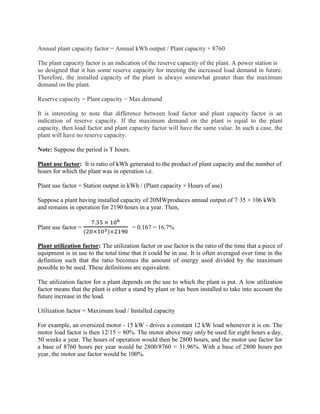
Plant use factor = Station output in kWh / (Plant capacity × Hours of use)
Suppose a plant having installed capacity of 20MWproduces annual output of 7·35 × 106 kWh
and remains in operation for 2190 hours in a year. Then,
Plant use factor =
7.35 × 10⁶
(20×103)×2190
= 0.167 = 16.7%
Plant utilization factor: The utilization factor or use factor is the ratio of the time that a piece of
equipment is in use to the total time that it could be in use. It is often averaged over time in the
definition such that the ratio becomes the amount of energy used divided by the maximum
possible to be used. These definitions are equivalent.
The utilization factor for a plant depends on the use to which the plant is put. A low utilization
factor means that the plant is either a stand by plant or has been installed to take into account the
future increase in the load.
Utilization factor = Maximum load / Installed capacity
For example, an oversized motor - 15 kW - drives a constant 12 kW load whenever it is on. The
motor load factor is then 12/15 = 80%. The motor above may only be used for eight hours a day,
50 weeks a year. The hours of operation would then be 2800 hours, and the motor use factor for
a base of 8760 hours per year would be 2800/8760 = 31.96%. With a base of 2800 hours per
year, the motor use factor would be 100%.
Loss factor: Loss factor is an expression of the average power factor over a given period of
time, and is used in the energy industry to express the losses in transmission and distribution
from heat, incomplete combustion of fuels and other inefficiencies.
Load-loss factor (LLF) is a factor which when multiplied by energy lost at time of peak and the
number of load periods will give overall average energy lost. It is calculated as the ratio of the
average load loss to the peak load loss. For electricity utilities, expect about 0.03.
Load Curve: The curve showing the variation of load on the power station with respect to time
is known as a load curve.
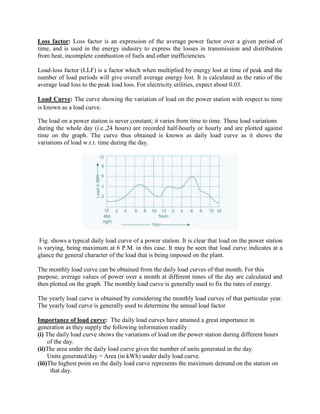
The load on a power station is never constant; it varies from time to time. These load variations
during the whole day (i.e.,24 hours) are recorded half-hourly or hourly and are plotted against
time on the graph. The curve thus obtained is known as daily load curve as it shows the
variations of load w.r.t. time during the day.
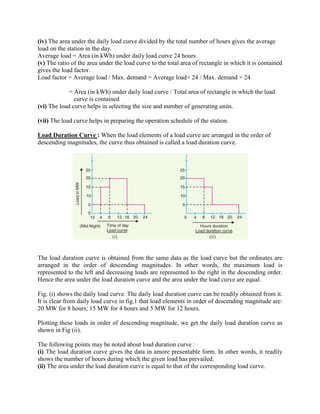
Fig. shows a typical daily load curve of a power station. It is clear that load on the power station
is varying, being maximum at 6 P.M. in this case. It may be seen that load curve indicates at a
glance the general character of the load that is being imposed on the plant.
The monthly load curve can be obtained from the daily load curves of that month. For this
purpose, average values of power over a month at different times of the day are calculated and
then plotted on the graph. The monthly load curve is generally used to fix the rates of energy.
The yearly load curve is obtained by considering the monthly load curves of that particular year.
The yearly load curve is generally used to determine the annual load factor
Importance of load curve: The daily load curves have attained a great importance in
generation as they supply the following information readily :
(i) The daily load curve shows the variations of load on the power station during different hours
of the day.
(ii)The area under the daily load curve gives the number of units generated in the day.
Units generated/day = Area (in kWh) under daily load curve.
(iii)The highest point on the daily load curve represents the maximum demand on the station on
that day.
(iv) The area under the daily load curve divided by the total number of hours gives the average
load on the station in the day.
Average load = Area (in kWh) under daily load curve 24 hours
(v) The ratio of the area under the load curve to the total area of rectangle in which it is contained
gives the load factor.
Load factor = Average load / Max. demand = Average load× 24 / Max. demand × 24
= Area (in kWh) under daily load curve / Total area of rectangle in which the load
curve is contained
(vi) The load curve helps in selecting the size and number of generating units.
(vii) The load curve helps in preparing the operation schedule of the station.
Load Duration Curve : When the load elements of a load curve are arranged in the order of
descending magnitudes, the curve thus obtained is called a load duration curve.
The load duration curve is obtained from the same data as the load curve but the ordinates are
arranged in the order of descending magnitudes. In other words, the maximum load is
represented to the left and decreasing loads are represented to the right in the descending order.
Hence the area under the load duration curve and the area under the load curve are equal.
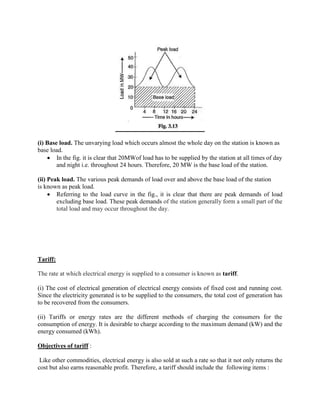
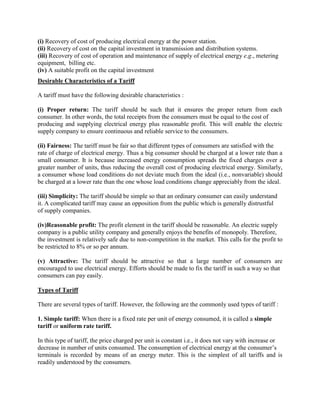
Fig. (i) shows the daily load curve. The daily load duration curve can be readily obtained from it.
It is clear from daily load curve in fig.1 that load elements in order of descending magnitude are:
20 MW for 8 hours; 15 MW for 4 hours and 5 MW for 12 hours.
Plotting these loads in order of descending magnitude, we get the daily load duration curve as
shown in Fig (ii).
The following points may be noted about load duration curve :
(i) The load duration curve gives the data in amore presentable form. In other words, it readily
shows the number of hours during which the given load has prevailed.
(ii) The area under the load duration curve is equal to that of the corresponding load curve.
Obviously, area under daily load duration curve (in kWh) will give the units generated on that
day.
(iii) The load duration curve can be extended to include any period of time. By laying out the
abscissa from 0 hour to 8760 hours, the variation and distribution of demand for an entire year
can be summarized in one curve. The curve thus obtained is called the annual load duration
curve.
Types of Loads : A device which taps electrical energy from the electric power system is called
a load on the system. The load may be resistive (e.g., electric lamp), inductive (e.g., induction
motor), capacitive or some combination of them. The various types of loads on the power system
are :
(i) Domestic load. Domestic load consists of lights, fans, refrigerators, heaters, television, small
motors for pumping water etc. Most of the residential load occurs only for some hours during the
day (i.e., 24 hours) e.g., lighting load occurs during night time and domestic appliance load
occurs for only a few hours. For this reason, the load factor is low (10% to 12%).
(ii) Commercial load. Commercial load consists of lighting for shops, fans and electric
appliances used in restaurants etc. This class of load occurs for more hours during the day as
compared to the domestic load. The commercial load has seasonal variations due to the extensive
use of air conditioners and space heaters.
(iii) Industrial load. Industrial load consists of load demand by industries. The magnitude of
industrial load depends upon the type of industry. Thus small scale industry requires load upto
25 kW, medium scale industry between 25kW and 100 kW and large-scale industry requires load
above 500 kW. Industrial loads are generally not weather dependent.
(iv) Municipal load. Municipal load consists of street lighting, power required for water supply
and drainage purposes. Street lighting load is practically constant throughout the hours of the
night. For water supply, water is pumped to overhead tanks by pumps driven by electric motors.
Pumping is carried out during the off-peak period, usually occurring during the night. This helps
to improve the load factor of the power system.
(v) Irrigation load. This type of load is the electric power needed for pumps driven by motors to
supply water to fields. Generally this type of load is supplied for 12 hours during night.
(vi) Traction load. This type of load includes tram cars, trolley buses, railways etc. This class of
load has wide variation. During the morning hour, it reaches peak value because people have to
go to their work place. After morning hours, the load starts decreasing and again rises during
evening since the people start coming to their homes.
Base Load and Peak Load on Power Station
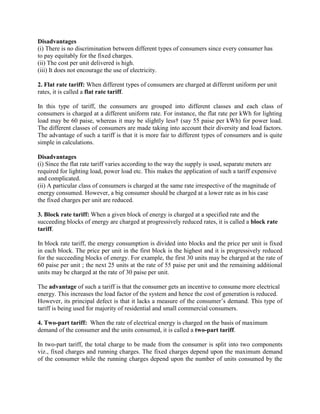
 The changing load on the power station makes its load curve of variable nature. Fig.
shows the typical load curve of a power station. It is clear that load on the power station
varies from time to time.
 It is clear in the fig. that load on the power station can be considered in two parts:
(i) Base load (ii) Peak load
(i) Base load. The unvarying load which occurs almost the whole day on the station is known as
base load.
 In the fig. it is clear that 20MWof load has to be supplied by the station at all times of day
and night i.e. throughout 24 hours. Therefore, 20 MW is the base load of the station.
(ii) Peak load. The various peak demands of load over and above the base load of the station
is known as peak load.
 Referring to the load curve in the fig., it is clear that there are peak demands of load
excluding base load. These peak demands of the station generally form a small part of the
total load and may occur throughout the day.
Tariff:
The rate at which electrical energy is supplied to a consumer is known as tariff.
(i) The cost of electrical generation of electrical energy consists of fixed cost and running cost.
Since the electricity generated is to be supplied to the consumers, the total cost of generation has
to be recovered from the consumers.
(ii) Tariffs or energy rates are the different methods of charging the consumers for the
consumption of energy. It is desirable to charge according to the maximum demand (kW) and the
energy consumed (kWh).
Objectives of tariff :
Like other commodities, electrical energy is also sold at such a rate so that it not only returns the
cost but also earns reasonable profit. Therefore, a tariff should include the following items :
(i) Recovery of cost of producing electrical energy at the power station.
(ii) Recovery of cost on the capital investment in transmission and distribution systems.
(iii) Recovery of cost of operation and maintenance of supply of electrical energy e.g., metering
equipment, billing etc.
(iv) A suitable profit on the capital investment.
Desirable Characteristics of a Tariff
A tariff must have the following desirable characteristics :
(i) Proper return: The tariff should be such that it ensures the proper return from each
consumer. In other words, the total receipts from the consumers must be equal to the cost of
producing and supplying electrical energy plus reasonable profit. This will enable the electric
supply company to ensure continuous and reliable service to the consumers.
(ii) Fairness: The tariff must be fair so that different types of consumers are satisfied with the
rate of charge of electrical energy. Thus a big consumer should be charged at a lower rate than a
small consumer. It is because increased energy consumption spreads the fixed charges over a
greater number of units, thus reducing the overall cost of producing electrical energy. Similarly,
a consumer whose load conditions do not deviate much from the ideal (i.e., nonvariable) should
be charged at a lower rate than the one whose load conditions change appreciably from the ideal.
(iii) Simplicity: The tariff should be simple so that an ordinary consumer can easily understand
it. A complicated tariff may cause an opposition from the public which is generally distrustful
of supply companies.
(iv)Reasonable profit: The profit element in the tariff should be reasonable. An electric supply
company is a public utility company and generally enjoys the benefits of monopoly. Therefore,
the investment is relatively safe due to non-competition in the market. This calls for the profit to
be restricted to 8% or so per annum.
(v) Attractive: The tariff should be attractive so that a large number of consumers are
encouraged to use electrical energy. Efforts should be made to fix the tariff in such a way so that
consumers can pay easily.
Types of Tariff
There are several types of tariff. However, the following are the commonly used types of tariff :
1. Simple tariff: When there is a fixed rate per unit of energy consumed, it is called a simple
tariff or uniform rate tariff.
In this type of tariff, the price charged per unit is constant i.e., it does not vary with increase or
decrease in number of units consumed. The consumption of electrical energy at the consumer’s
terminals is recorded by means of an energy meter. This is the simplest of all tariffs and is
readily understood by the consumers.
Disadvantages
(i) There is no discrimination between different types of consumers since every consumer has
to pay equitably for the fixed charges.
(ii) The cost per unit delivered is high.
(iii) It does not encourage the use of electricity.
2. Flat rate tariff: When different types of consumers are charged at different uniform per unit
rates, it is called a flat rate tariff.
In this type of tariff, the consumers are grouped into different classes and each class of
consumers is charged at a different uniform rate. For instance, the flat rate per kWh for lighting
load may be 60 paise, whereas it may be slightly less† (say 55 paise per kWh) for power load.
The different classes of consumers are made taking into account their diversity and load factors.
The advantage of such a tariff is that it is more fair to different types of consumers and is quite
simple in calculations.
Disadvantages
(i) Since the flat rate tariff varies according to the way the supply is used, separate meters are
required for lighting load, power load etc. This makes the application of such a tariff expensive
and complicated.
(ii) A particular class of consumers is charged at the same rate irrespective of the magnitude of
energy consumed. However, a big consumer should be charged at a lower rate as in his case
the fixed charges per unit are reduced.
3. Block rate tariff: When a given block of energy is charged at a specified rate and the
succeeding blocks of energy are charged at progressively reduced rates, it is called a block rate
tariff.
In block rate tariff, the energy consumption is divided into blocks and the price per unit is fixed
in each block. The price per unit in the first block is the highest and it is progressively reduced
for the succeeding blocks of energy. For example, the first 30 units may be charged at the rate of
60 paise per unit ; the next 25 units at the rate of 55 paise per unit and the remaining additional
units may be charged at the rate of 30 paise per unit.
The advantage of such a tariff is that the consumer gets an incentive to consume more electrical
energy. This increases the load factor of the system and hence the cost of generation is reduced.
However, its principal defect is that it lacks a measure of the consumer’s demand. This type of
tariff is being used for majority of residential and small commercial consumers.
4. Two-part tariff: When the rate of electrical energy is charged on the basis of maximum
demand of the consumer and the units consumed, it is called a two-part tariff.
In two-part tariff, the total charge to be made from the consumer is split into two components
viz., fixed charges and running charges. The fixed charges depend upon the maximum demand
of the consumer while the running charges depend upon the number of units consumed by the
consumer. Thus, the consumer is charged at a certain amount per kW of maximum†† demand
plus a certain amount per kWh of energy consumed i.e.,
Total charges = Rs (b × kW+ c × kWh)
where, b = charge per kW of maximum demand
c = charge per kWh of energy consumed
This type of tariff is mostly applicable to industrial consumers who have appreciable maximum
demand.
Advantages
(i) It is easily understood by the consumers.
(ii) It recovers the fixed charges which depend upon the maximum demand of the consumer but
are independent of the units consumed.
Disadvantages
(i) The consumer has to pay the fixed charges irrespective of the fact whether he has consumed
or not consumed the electrical energy.
(ii) There is always error in assessing the maximum demand of the consumer.
5. Maximum demand tariff. It is similar to two-part tariff with the only difference that the
maximum demand is actually measured by installing maximum demand meter in the premises of
the consumer. This removes the objection of two-part tariff where the maximum demand is
assessed merely on the basis of the rateable value. This type of tariff is mostly applied to big
consumers. However, it is not suitable for a small consumer (e.g., residential consumer) as a
separate maximum demand meter is required.
6. Power factor tariff. The tariff in which power factor of the consumer’s load is taken into
consideration is known as power factor tariff.
In an a.c. system, power factor plays an important role. A low power factor increases the rating
of station equipment and line losses. Therefore, a consumer having low power factor must be
penalised.
The following are the important types of power factor tariff :
(i) kVA maximum demand tariff : It is a modified form of two-part tariff. In this case, the
fixed charges are made on the basis of maximum demand in kVA and not in kW. As kVA is
inversely proportional to power factor, therefore, a consumer having low power factor has to
contribute more towards the fixed charges. This type of tariff has the advantage that it
encourages the consumers to operate their appliances and machinery at improved power
factor.
(ii) Sliding scale tariff : This is also known as average power factor tariff. In this case, an
average power factor, say 0·8 lagging, is taken as the reference. If the power factor of the
consumer falls below this factor, suitable additional charges are made. On the other hand, if the
power factor is above the reference, a discount is allowed to the consumer.
(iii) kW and kVAR tariff : In this type, both active power (kW) and reactive power (kVAR)
supplied are charged separately. A consumer having low power factor will draw more reactive
power and hence shall have to pay more charges.
7. Three-part tariff. When the total charge to be made from the consumer is split into three
parts viz., fixed charge, semi-fixed charge and running charge, it is known as a three-part tariff.
i.e.,
Total charge = Rs (a + b × kW+ c × kWh)
Where, a = fixed charge made during each billing period. It includes interest and depreciation on
the cost of secondary distribution and labour cost of collecting revenues,
b = charge per kW of maximum demand,
c = charge per kWh of energy consumed.
It may be seen that by adding fixed charge or consumer’s charge (i.e., a) to two-part tariff, it
becomes three-part tariff. The principal objection of this type of tariff is that the charges are split
into three components. This type of tariff is generally applied to big consumers.
8. Time-Of-Day tariff (TOD, peak-load): Rates vary depending on when the service is being
used.
For example, the operator would charge higher prices during peak use hours and lower prices
during off-peak hours to reflect the cost of generation. This structure requires sophisticated
measurement of customer usage, such as metering technologies. It encourages consumers to use
less power during peak hours. With decreasing costs of TOD meters, use of the TOD tariff
structure is becoming more common.
9. Seasonal tariff: These rates allow higher charges for electricity in summer and winter when
demand for cooling or heating is higher. Typically they are used in climates where utilities
experience significant seasonal cost differences. With traditional regulation, seasonal rates
reduce net revenue stability for utilities by concentrating revenue into the weather sensitive
seasons.
Numericals on Tariff:
1. A consumer has a maximum demand of 200 kW at 40%load factor. If the tariff is Rs. 100 per
kW of maximum demand plus 10 paise per kWh, find the overall cost per kWh.
Solution.
Units consumed/year = Max. demand × L.F. ×Hours in a year
= (200)×(0·4) ×8760 =7,00,800 kWh
Annual charges = Annual M.D. charges + Annual energy charges
= Rs (100 ×200 +0·1 × 7,00,800)
= Rs 90,080
∴ Overall cost/kWh = Rs 90,080/ 7,00,800
=Rs 0·1285 = 12·85 paise
2. The maximum demand of a consumer is 20 A at 220 V and his total energy consumption is
8760 kWh. If the energy is charged at the rate of 20 paise per unit for 500 hours use of the
maximum demand per annum plus 10 paise per unit for additional units, calculate :
(i) annual bill (ii) equivalent flat rate.
Solution.
Assume the load factor and power factor to be unity.
∴ Maximum demand = (220×20×1)/1000 = 4 ⋅4 kW
(i) Units consumed in 500 hrs = 4·4 × 500 = 2200 kWh
Charges for 2200 kWh = Rs 0·2 × 2200 =Rs 440
Remaining units = 8760 −2200 =6560kWh
Charges for 6560 kWh = Rs 0·1 × 6560 =Rs 656
∴ Total annual bill = Rs (440 + 656) = Rs. 1096
(ii) Equivalent flat rate = Rs 1096/8760
= Rs 0 ⋅125 = 12.5 paise
3. The following two tariffs are offered :
(a) Rs 100 plus 15 paise per unit ;
(b) A flat rate of 30 paise per unit ;
At what consumption is first tariff economical ?
Solution.
Let x be the number of units at which charges due to both tariffs become equal. Then,
100+0·15x = 0·3x
Or, 0·15x = 100
∴ x = 100/0·15 = 666·67 units
Therefore, tariff (a) is economical if consumption is more than 666·67 units.
4. A supply is offered on the basis of fixed charges of Rs 30 per annum plus 3 paise per
unit or alternatively, at the rate of 6 paise per unit for the first 400 units per annum and 5 paise
per unit for all the additional units. Find the number of units taken per annum for which the cost
under the two tariffs becomes the same.
Solution. Let x (> 400) be the number of units taken per annum for which the annual charges
due to both tariffs become equal.
Annual charges due to first tariff = Rs (30 + 0·03 x)
Annual charges due to second tariff = Rs [(0·06 × 400) +(x − 400) × 0·05]
= Rs (4 + 0·05 x)
As the charges in both cases are equal,
∴ 30 +0·03 x = 4 + 0·05 x
Or, x = (30 – 4)= (0.05- 0.03) = 1300 kWh
5. An electric supply company having a maximum load of 50 MW generates
18 × 107 units per annum and the supply consumers have an aggregate demand of 75 MW. The
annual expenses including capital charges are :
For fuel = Rs 90 lakhs
Fixed charges concerning generation = Rs 28 lakhs
Fixed charges concerning transmission= Rs 32 lakhs
and distribution.
Assuming 90% of the fuel cost is essential to running charges and the loss in transmission and
distribution as 15%of kWh generated, deduce a two part tariff to find the actual cost of supply to
the consumers.
Solution.
Annual fixed charges
For generation = Rs 28 × 105
For transmission and distribution = Rs 32 × 105
For fuel (10% only) = Rs 0·1 × 90 × 105
= Rs 9 × 10⁵
Total annual fixed charge = Rs (28 + 32 + 9) × 105
=Rs 69 × 105
This cost has to be spread over the aggregate maximum demand of all the consumers i.e.,75
MW.
∴ Cost per kW of maximum demand = Rs (69 ×105
) / = 75×103
= Rs. 92
Annual running charges.
Cost of fuel (90%) = Rs 0·9 × 90 × 105
=Rs 81 × 105
Units delivered to consumers = 85% of units generated
= 0·85 × 18 × 107
= 15·3 × 107
kWh
This cost is to be spread over the units delivered to the consumers.
∴ Cost/kWh = Rs (81 × 105
) / 15.3×107
= Re 0.053 = 5.3 paise
∴ Tariff is Rs 92 per kW of maximum demand plus 5·3 paise per kWh.
6. A generating station has a maximum demand of 75 MW and a yearly load factor of 40%.
Generating costs inclusive of station capital costs are Rs. 60 per annum per kW demand plus 4
paise per kWh transmitted. The annual capital charges for transmission system are Rs 20,00,000
and for distribution system Rs 15,00,000 ; the respective diversity factors being 1·2 and 1·25.
The efficiency of transmission system is 90% and that of the distribution system inclusive of
substation losses is 85%. Find the yearly cost per kW demand and cost per kWh supplied :
(i) at the substation (ii) at the consumers premises.
Solution.
Maximum demand = 75MW= 75,000 kW
Annual load factor = 40%= 0·4
(i) Cost at substation. The cost per kW of maximum demand is to be determined from the total
annual fixed charges associated with the supply of energy at the substation. The cost per kWh
shall be determined from the running charges.
(a) Annual fixed charges
Generation cost = Rs 60 × 75 × 103
=Rs 4·5 × 106
Transmission cost = Rs 2 × 10⁶
Total annual fixed charges at the substation
= Rs (4·5 + 2) × 106
=Rs 6·5 × 106
Aggregate of all maximum demands by the various substations
= Max. demand on generating station × Diversity factor
= (75 × 103
) × 1·2 = 90 × 103
kW
The total annual fixed charges have to be spread over the aggregate maximum demands by
various substations i.e., 90 × 103 kW.
Annual cost per kW of maximum demand = Rs (6⋅5 × 106
) / (90×103
) = Rs. 72.22
(b) Running Charges. It is given that cost of 1 kWh transmitted to substation is 4 paise. As the
transmission efficiency is 90%, therefore, for every kWh transmitted, 0·9 kWh reaches the
substation.
∴ Cost/kWh at substation = 4/0·9 = 4·45 paise
Hence at sub-station, the cost is Rs 72·22 per annum per kW maximum demand plus 4·45 paise
per kWh.
(ii) Cost at consumer’s premises. The total annual fixed charges at consumer’s premises is the
sum of annual fixed charges at substation (i.e. Rs 6·5 × 106
) and annual fixed charge for
distribution (i.e., Rs 1·5 × 106
).
∴ Total annual fixed charges at consumer’s premises
= Rs (6·5 + 1·5) × 106
=Rs 8 × 10⁶
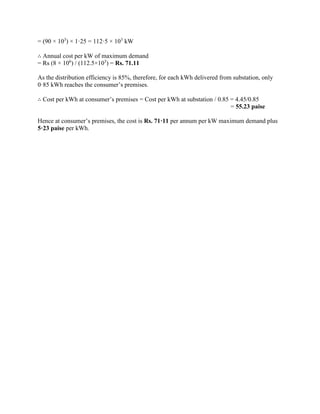
Aggregate of maximum demands of all consumers
= Max. demand on Substation × Diversity factor
= (90 × 103
) × 1·25 = 112·5 × 103
kW
∴ Annual cost per kW of maximum demand
= Rs (8 × 10⁶
) / (112.5×10³
) = Rs. 71.11
As the distribution efficiency is 85%, therefore, for each kWh delivered from substation, only
0·85 kWh reaches the consumer’s premises.
∴ Cost per kWh at consumer’s premises = Cost per kWh at substation / 0.85 = 4.45/0.85
= 55.23 paise
Hence at consumer’s premises, the cost is Rs. 71·11 per annum per kW maximum demand plus
5·23 paise per kWh.

Economic Aspects.docx

  • 1.
    Variable Load onPower Station  The load on a power station varies from time to time due to uncertain demands of the consumers and is known as variable load on the station. A power station is designed to meet the load requirements of the consumers.  An ideal load on the station, from stand point of equipment needed and operating routine, would be one of constant magnitude and steady duration.  However, such a steady load on the station is never realized in actual practice. The consumers require their small or large block of power in accordance with the demands of their activities.  Thus the load demand of one consumer at any time may be different from that of the other consumer. The result is that load on the power station varies from time to time. Effects of variable load. The variable load on a power station introduces many perplexities in its operation. Some of the important effects of variable load on a power station are : (i) Need of additional equipment:  The variable load on a power station necessitates to have additional equipment.  If the power demand on the plant increases, it must be followed by the increased flow of coal, air and water to the boiler in order to meet the increased demand. Therefore, additional equipment has to be installed to accomplish this job.  As a matter of fact, in a modern power plant, there is much equipment devoted entirely to adjust the rates of supply of raw materials in accordance with the power demand made on the plant. (ii) Increase in production cost:  The variable load on the plant increases the cost of the production of electrical energy.  If a single alternator is used, it will have poor efficiency during periods of light loads on the plant. Therefore, in actual practice, a number of alternators of different capacities are installed so that most of the alternators can be operated at nearly full load capacity.  However, the use of a number of generating units increases the initial cost per kW of the plant capacity as well as floor area required. This leads to the increase in production cost of energy. Important Terms Mass Curve This curve is plotted with units (kWh) as ordinate and time as abscissa. Thus a mass curve gives the total energy consumed by the load up to a particular time in a day. Connected Load:
  • 2.
    The sum ofcontinuous ratings of all the electrical equipment connected to the supply is known as connected load. Maximum Demand: It is not necessary that all the connected load be switched to a system at a time. The greatest of all short time interval averaged" (15 minutes or hour or 1 hour) during a given period (a day, a month or a year), on the power station is called the maximum demand. It is sometimes also called as system peak. It is the maximum demand which determines the size and cost of the installation. Cold Reserve: It is that portion of the installed reserve kept in operable conditions and available for service, but not normally ready for immediate loading. Hot Reserve: It usually refers to boiler excess capacity, which is kept hot and with steam pressure, ready for use. Operating Reserve : It refers to capacity in service in excess of peak load. Spinning Reserve : It is the generating capacity connected to the bus and ready to take load. Demand factor: It is the ratio of maximum demand on the power station to its connected load i. Demand factor = Maximum demand / Connected load  The value of demand factor is usually less than 1.  It is expected because maximum demand on the power station is generally less than the connected load.  If the maximum demand on the power station is 80MWand the connected load is 100MW, then demand factor = 80/100 = 0·8.  The knowledge of demand factor is vital in determining the capacity of the plant equipment. Average load: The average of loads occurring on the power station in a given period (day or month or year) is known as average load or average demand. Daily average load = No. of units (kWh) generated in a day / 24 hours Monthly average load = No. of units (kWh) generated in a month / Number of hours in a month Yearly average load = No. of units (kWh) generated in a year / 8760 hours Diversity factor: The ratio of the sum of individual maximum demands to the maximum
  • 3.
    demand on powerstation is known as diversity factor i.e., Diversity factor = Sum of individual max. demands / Max. demand on power station A power station supplies load to various types of consumers whose maximum demands generally do not occur at the same time. Therefore, the maximum demand on the power station is always less than the sum of individual maximum demands of the consumers. Obviously, diversity factor will always be greater than 1. The greater the diversity factor, the lesser is the cost of generation of power. Note: 1. There is diversification in the individual maximum demands i.e., the maximum demand of some consumers may occur at one time while that of others at some other time. Hence, the name diversity factor. 2. Greater diversity factor means lesser maximum demand. This in turn means that lesser plant capacity is required. Thus, the capital investment on the plant is reduced. Load factor : The ratio of average load to the maximum demand during a given period is known as load factor i.e., Load factor = Average load / Max. demand If the plant is in operation for T hours, Load factor = Average load × T / Max. demand × T = Units generated in T hours / Max. demand × T hours The load factor may be daily load factor, monthly load factor or annual load factor if the time period considered is a day or month or year. Load factor is always less than 1 because average load is smaller than the maximum demand. The load factor plays key role in determining the overall cost per unit generated. Higher the load factor of the power station, lesser will be the cost per unit generated. Note: 1. It is because higher load factor factor means lesser maximum demand. The station capacity is so selected that it must meet the maximum demand. Now, lower maximum demand means lower capacity of the plant which, therefore, reduces the cost of the plant. Plant capacity factor: It is the ratio of actual energy produced to the maximum possible energy that could have been produced during a given period i.e., Plant capacity factor = Actual energy produced / Max. energy that could have been produced = Average demand × T / Plant capacity × T = Average demand / Plant capacity Thus if the considered period is one year,
  • 4.
    Annual plant capacityfactor = Annual kWh output / Plant capacity × 8760 The plant capacity factor is an indication of the reserve capacity of the plant. A power station is so designed that it has some reserve capacity for meeting the increased load demand in future. Therefore, the installed capacity of the plant is always somewhat greater than the maximum demand on the plant. Reserve capacity = Plant capacity − Max.demand It is interesting to note that difference between load factor and plant capacity factor is an indication of reserve capacity. If the maximum demand on the plant is equal to the plant capacity, then load factor and plant capacity factor will have the same value. In such a case, the plant will have no reserve capacity. Note: Suppose the period is T hours. Plant use factor: It is ratio of kWh generated to the product of plant capacity and the number of hours for which the plant was in operation i.e. Plant use factor = Station output in kWh / (Plant capacity × Hours of use) Suppose a plant having installed capacity of 20MWproduces annual output of 7·35 × 106 kWh and remains in operation for 2190 hours in a year. Then, Plant use factor = 7.35 × 10⁶ (20×103)×2190 = 0.167 = 16.7% Plant utilization factor: The utilization factor or use factor is the ratio of the time that a piece of equipment is in use to the total time that it could be in use. It is often averaged over time in the definition such that the ratio becomes the amount of energy used divided by the maximum possible to be used. These definitions are equivalent. The utilization factor for a plant depends on the use to which the plant is put. A low utilization factor means that the plant is either a stand by plant or has been installed to take into account the future increase in the load. Utilization factor = Maximum load / Installed capacity For example, an oversized motor - 15 kW - drives a constant 12 kW load whenever it is on. The motor load factor is then 12/15 = 80%. The motor above may only be used for eight hours a day, 50 weeks a year. The hours of operation would then be 2800 hours, and the motor use factor for a base of 8760 hours per year would be 2800/8760 = 31.96%. With a base of 2800 hours per year, the motor use factor would be 100%.
  • 5.
    Loss factor: Lossfactor is an expression of the average power factor over a given period of time, and is used in the energy industry to express the losses in transmission and distribution from heat, incomplete combustion of fuels and other inefficiencies. Load-loss factor (LLF) is a factor which when multiplied by energy lost at time of peak and the number of load periods will give overall average energy lost. It is calculated as the ratio of the average load loss to the peak load loss. For electricity utilities, expect about 0.03. Load Curve: The curve showing the variation of load on the power station with respect to time is known as a load curve. The load on a power station is never constant; it varies from time to time. These load variations during the whole day (i.e.,24 hours) are recorded half-hourly or hourly and are plotted against time on the graph. The curve thus obtained is known as daily load curve as it shows the variations of load w.r.t. time during the day. Fig. shows a typical daily load curve of a power station. It is clear that load on the power station is varying, being maximum at 6 P.M. in this case. It may be seen that load curve indicates at a glance the general character of the load that is being imposed on the plant. The monthly load curve can be obtained from the daily load curves of that month. For this purpose, average values of power over a month at different times of the day are calculated and then plotted on the graph. The monthly load curve is generally used to fix the rates of energy. The yearly load curve is obtained by considering the monthly load curves of that particular year. The yearly load curve is generally used to determine the annual load factor Importance of load curve: The daily load curves have attained a great importance in generation as they supply the following information readily : (i) The daily load curve shows the variations of load on the power station during different hours of the day. (ii)The area under the daily load curve gives the number of units generated in the day. Units generated/day = Area (in kWh) under daily load curve. (iii)The highest point on the daily load curve represents the maximum demand on the station on that day.
  • 6.
    (iv) The areaunder the daily load curve divided by the total number of hours gives the average load on the station in the day. Average load = Area (in kWh) under daily load curve 24 hours (v) The ratio of the area under the load curve to the total area of rectangle in which it is contained gives the load factor. Load factor = Average load / Max. demand = Average load× 24 / Max. demand × 24 = Area (in kWh) under daily load curve / Total area of rectangle in which the load curve is contained (vi) The load curve helps in selecting the size and number of generating units. (vii) The load curve helps in preparing the operation schedule of the station. Load Duration Curve : When the load elements of a load curve are arranged in the order of descending magnitudes, the curve thus obtained is called a load duration curve. The load duration curve is obtained from the same data as the load curve but the ordinates are arranged in the order of descending magnitudes. In other words, the maximum load is represented to the left and decreasing loads are represented to the right in the descending order. Hence the area under the load duration curve and the area under the load curve are equal. Fig. (i) shows the daily load curve. The daily load duration curve can be readily obtained from it. It is clear from daily load curve in fig.1 that load elements in order of descending magnitude are: 20 MW for 8 hours; 15 MW for 4 hours and 5 MW for 12 hours. Plotting these loads in order of descending magnitude, we get the daily load duration curve as shown in Fig (ii). The following points may be noted about load duration curve : (i) The load duration curve gives the data in amore presentable form. In other words, it readily shows the number of hours during which the given load has prevailed. (ii) The area under the load duration curve is equal to that of the corresponding load curve.
  • 7.
    Obviously, area underdaily load duration curve (in kWh) will give the units generated on that day. (iii) The load duration curve can be extended to include any period of time. By laying out the abscissa from 0 hour to 8760 hours, the variation and distribution of demand for an entire year can be summarized in one curve. The curve thus obtained is called the annual load duration curve. Types of Loads : A device which taps electrical energy from the electric power system is called a load on the system. The load may be resistive (e.g., electric lamp), inductive (e.g., induction motor), capacitive or some combination of them. The various types of loads on the power system are : (i) Domestic load. Domestic load consists of lights, fans, refrigerators, heaters, television, small motors for pumping water etc. Most of the residential load occurs only for some hours during the day (i.e., 24 hours) e.g., lighting load occurs during night time and domestic appliance load occurs for only a few hours. For this reason, the load factor is low (10% to 12%). (ii) Commercial load. Commercial load consists of lighting for shops, fans and electric appliances used in restaurants etc. This class of load occurs for more hours during the day as compared to the domestic load. The commercial load has seasonal variations due to the extensive use of air conditioners and space heaters. (iii) Industrial load. Industrial load consists of load demand by industries. The magnitude of industrial load depends upon the type of industry. Thus small scale industry requires load upto 25 kW, medium scale industry between 25kW and 100 kW and large-scale industry requires load above 500 kW. Industrial loads are generally not weather dependent. (iv) Municipal load. Municipal load consists of street lighting, power required for water supply and drainage purposes. Street lighting load is practically constant throughout the hours of the night. For water supply, water is pumped to overhead tanks by pumps driven by electric motors. Pumping is carried out during the off-peak period, usually occurring during the night. This helps to improve the load factor of the power system. (v) Irrigation load. This type of load is the electric power needed for pumps driven by motors to supply water to fields. Generally this type of load is supplied for 12 hours during night. (vi) Traction load. This type of load includes tram cars, trolley buses, railways etc. This class of load has wide variation. During the morning hour, it reaches peak value because people have to go to their work place. After morning hours, the load starts decreasing and again rises during evening since the people start coming to their homes. Base Load and Peak Load on Power Station  The changing load on the power station makes its load curve of variable nature. Fig. shows the typical load curve of a power station. It is clear that load on the power station varies from time to time.  It is clear in the fig. that load on the power station can be considered in two parts: (i) Base load (ii) Peak load
  • 8.
    (i) Base load.The unvarying load which occurs almost the whole day on the station is known as base load.  In the fig. it is clear that 20MWof load has to be supplied by the station at all times of day and night i.e. throughout 24 hours. Therefore, 20 MW is the base load of the station. (ii) Peak load. The various peak demands of load over and above the base load of the station is known as peak load.  Referring to the load curve in the fig., it is clear that there are peak demands of load excluding base load. These peak demands of the station generally form a small part of the total load and may occur throughout the day. Tariff: The rate at which electrical energy is supplied to a consumer is known as tariff. (i) The cost of electrical generation of electrical energy consists of fixed cost and running cost. Since the electricity generated is to be supplied to the consumers, the total cost of generation has to be recovered from the consumers. (ii) Tariffs or energy rates are the different methods of charging the consumers for the consumption of energy. It is desirable to charge according to the maximum demand (kW) and the energy consumed (kWh). Objectives of tariff : Like other commodities, electrical energy is also sold at such a rate so that it not only returns the cost but also earns reasonable profit. Therefore, a tariff should include the following items :
  • 9.
    (i) Recovery ofcost of producing electrical energy at the power station. (ii) Recovery of cost on the capital investment in transmission and distribution systems. (iii) Recovery of cost of operation and maintenance of supply of electrical energy e.g., metering equipment, billing etc. (iv) A suitable profit on the capital investment. Desirable Characteristics of a Tariff A tariff must have the following desirable characteristics : (i) Proper return: The tariff should be such that it ensures the proper return from each consumer. In other words, the total receipts from the consumers must be equal to the cost of producing and supplying electrical energy plus reasonable profit. This will enable the electric supply company to ensure continuous and reliable service to the consumers. (ii) Fairness: The tariff must be fair so that different types of consumers are satisfied with the rate of charge of electrical energy. Thus a big consumer should be charged at a lower rate than a small consumer. It is because increased energy consumption spreads the fixed charges over a greater number of units, thus reducing the overall cost of producing electrical energy. Similarly, a consumer whose load conditions do not deviate much from the ideal (i.e., nonvariable) should be charged at a lower rate than the one whose load conditions change appreciably from the ideal. (iii) Simplicity: The tariff should be simple so that an ordinary consumer can easily understand it. A complicated tariff may cause an opposition from the public which is generally distrustful of supply companies. (iv)Reasonable profit: The profit element in the tariff should be reasonable. An electric supply company is a public utility company and generally enjoys the benefits of monopoly. Therefore, the investment is relatively safe due to non-competition in the market. This calls for the profit to be restricted to 8% or so per annum. (v) Attractive: The tariff should be attractive so that a large number of consumers are encouraged to use electrical energy. Efforts should be made to fix the tariff in such a way so that consumers can pay easily. Types of Tariff There are several types of tariff. However, the following are the commonly used types of tariff : 1. Simple tariff: When there is a fixed rate per unit of energy consumed, it is called a simple tariff or uniform rate tariff. In this type of tariff, the price charged per unit is constant i.e., it does not vary with increase or decrease in number of units consumed. The consumption of electrical energy at the consumer’s terminals is recorded by means of an energy meter. This is the simplest of all tariffs and is readily understood by the consumers.
  • 10.
    Disadvantages (i) There isno discrimination between different types of consumers since every consumer has to pay equitably for the fixed charges. (ii) The cost per unit delivered is high. (iii) It does not encourage the use of electricity. 2. Flat rate tariff: When different types of consumers are charged at different uniform per unit rates, it is called a flat rate tariff. In this type of tariff, the consumers are grouped into different classes and each class of consumers is charged at a different uniform rate. For instance, the flat rate per kWh for lighting load may be 60 paise, whereas it may be slightly less† (say 55 paise per kWh) for power load. The different classes of consumers are made taking into account their diversity and load factors. The advantage of such a tariff is that it is more fair to different types of consumers and is quite simple in calculations. Disadvantages (i) Since the flat rate tariff varies according to the way the supply is used, separate meters are required for lighting load, power load etc. This makes the application of such a tariff expensive and complicated. (ii) A particular class of consumers is charged at the same rate irrespective of the magnitude of energy consumed. However, a big consumer should be charged at a lower rate as in his case the fixed charges per unit are reduced. 3. Block rate tariff: When a given block of energy is charged at a specified rate and the succeeding blocks of energy are charged at progressively reduced rates, it is called a block rate tariff. In block rate tariff, the energy consumption is divided into blocks and the price per unit is fixed in each block. The price per unit in the first block is the highest and it is progressively reduced for the succeeding blocks of energy. For example, the first 30 units may be charged at the rate of 60 paise per unit ; the next 25 units at the rate of 55 paise per unit and the remaining additional units may be charged at the rate of 30 paise per unit. The advantage of such a tariff is that the consumer gets an incentive to consume more electrical energy. This increases the load factor of the system and hence the cost of generation is reduced. However, its principal defect is that it lacks a measure of the consumer’s demand. This type of tariff is being used for majority of residential and small commercial consumers. 4. Two-part tariff: When the rate of electrical energy is charged on the basis of maximum demand of the consumer and the units consumed, it is called a two-part tariff. In two-part tariff, the total charge to be made from the consumer is split into two components viz., fixed charges and running charges. The fixed charges depend upon the maximum demand of the consumer while the running charges depend upon the number of units consumed by the
  • 11.
    consumer. Thus, theconsumer is charged at a certain amount per kW of maximum†† demand plus a certain amount per kWh of energy consumed i.e., Total charges = Rs (b × kW+ c × kWh) where, b = charge per kW of maximum demand c = charge per kWh of energy consumed This type of tariff is mostly applicable to industrial consumers who have appreciable maximum demand. Advantages (i) It is easily understood by the consumers. (ii) It recovers the fixed charges which depend upon the maximum demand of the consumer but are independent of the units consumed. Disadvantages (i) The consumer has to pay the fixed charges irrespective of the fact whether he has consumed or not consumed the electrical energy. (ii) There is always error in assessing the maximum demand of the consumer. 5. Maximum demand tariff. It is similar to two-part tariff with the only difference that the maximum demand is actually measured by installing maximum demand meter in the premises of the consumer. This removes the objection of two-part tariff where the maximum demand is assessed merely on the basis of the rateable value. This type of tariff is mostly applied to big consumers. However, it is not suitable for a small consumer (e.g., residential consumer) as a separate maximum demand meter is required. 6. Power factor tariff. The tariff in which power factor of the consumer’s load is taken into consideration is known as power factor tariff. In an a.c. system, power factor plays an important role. A low power factor increases the rating of station equipment and line losses. Therefore, a consumer having low power factor must be penalised. The following are the important types of power factor tariff : (i) kVA maximum demand tariff : It is a modified form of two-part tariff. In this case, the fixed charges are made on the basis of maximum demand in kVA and not in kW. As kVA is inversely proportional to power factor, therefore, a consumer having low power factor has to contribute more towards the fixed charges. This type of tariff has the advantage that it encourages the consumers to operate their appliances and machinery at improved power factor. (ii) Sliding scale tariff : This is also known as average power factor tariff. In this case, an average power factor, say 0·8 lagging, is taken as the reference. If the power factor of the consumer falls below this factor, suitable additional charges are made. On the other hand, if the power factor is above the reference, a discount is allowed to the consumer.
  • 12.
    (iii) kW andkVAR tariff : In this type, both active power (kW) and reactive power (kVAR) supplied are charged separately. A consumer having low power factor will draw more reactive power and hence shall have to pay more charges. 7. Three-part tariff. When the total charge to be made from the consumer is split into three parts viz., fixed charge, semi-fixed charge and running charge, it is known as a three-part tariff. i.e., Total charge = Rs (a + b × kW+ c × kWh) Where, a = fixed charge made during each billing period. It includes interest and depreciation on the cost of secondary distribution and labour cost of collecting revenues, b = charge per kW of maximum demand, c = charge per kWh of energy consumed. It may be seen that by adding fixed charge or consumer’s charge (i.e., a) to two-part tariff, it becomes three-part tariff. The principal objection of this type of tariff is that the charges are split into three components. This type of tariff is generally applied to big consumers. 8. Time-Of-Day tariff (TOD, peak-load): Rates vary depending on when the service is being used. For example, the operator would charge higher prices during peak use hours and lower prices during off-peak hours to reflect the cost of generation. This structure requires sophisticated measurement of customer usage, such as metering technologies. It encourages consumers to use less power during peak hours. With decreasing costs of TOD meters, use of the TOD tariff structure is becoming more common. 9. Seasonal tariff: These rates allow higher charges for electricity in summer and winter when demand for cooling or heating is higher. Typically they are used in climates where utilities experience significant seasonal cost differences. With traditional regulation, seasonal rates reduce net revenue stability for utilities by concentrating revenue into the weather sensitive seasons. Numericals on Tariff: 1. A consumer has a maximum demand of 200 kW at 40%load factor. If the tariff is Rs. 100 per kW of maximum demand plus 10 paise per kWh, find the overall cost per kWh. Solution. Units consumed/year = Max. demand × L.F. ×Hours in a year = (200)×(0·4) ×8760 =7,00,800 kWh Annual charges = Annual M.D. charges + Annual energy charges = Rs (100 ×200 +0·1 × 7,00,800) = Rs 90,080
  • 13.
    ∴ Overall cost/kWh= Rs 90,080/ 7,00,800 =Rs 0·1285 = 12·85 paise 2. The maximum demand of a consumer is 20 A at 220 V and his total energy consumption is 8760 kWh. If the energy is charged at the rate of 20 paise per unit for 500 hours use of the maximum demand per annum plus 10 paise per unit for additional units, calculate : (i) annual bill (ii) equivalent flat rate. Solution. Assume the load factor and power factor to be unity. ∴ Maximum demand = (220×20×1)/1000 = 4 ⋅4 kW (i) Units consumed in 500 hrs = 4·4 × 500 = 2200 kWh Charges for 2200 kWh = Rs 0·2 × 2200 =Rs 440 Remaining units = 8760 −2200 =6560kWh Charges for 6560 kWh = Rs 0·1 × 6560 =Rs 656 ∴ Total annual bill = Rs (440 + 656) = Rs. 1096 (ii) Equivalent flat rate = Rs 1096/8760 = Rs 0 ⋅125 = 12.5 paise 3. The following two tariffs are offered : (a) Rs 100 plus 15 paise per unit ; (b) A flat rate of 30 paise per unit ; At what consumption is first tariff economical ? Solution. Let x be the number of units at which charges due to both tariffs become equal. Then, 100+0·15x = 0·3x Or, 0·15x = 100 ∴ x = 100/0·15 = 666·67 units Therefore, tariff (a) is economical if consumption is more than 666·67 units. 4. A supply is offered on the basis of fixed charges of Rs 30 per annum plus 3 paise per unit or alternatively, at the rate of 6 paise per unit for the first 400 units per annum and 5 paise per unit for all the additional units. Find the number of units taken per annum for which the cost under the two tariffs becomes the same. Solution. Let x (> 400) be the number of units taken per annum for which the annual charges due to both tariffs become equal. Annual charges due to first tariff = Rs (30 + 0·03 x)
  • 14.
    Annual charges dueto second tariff = Rs [(0·06 × 400) +(x − 400) × 0·05] = Rs (4 + 0·05 x) As the charges in both cases are equal, ∴ 30 +0·03 x = 4 + 0·05 x Or, x = (30 – 4)= (0.05- 0.03) = 1300 kWh 5. An electric supply company having a maximum load of 50 MW generates 18 × 107 units per annum and the supply consumers have an aggregate demand of 75 MW. The annual expenses including capital charges are : For fuel = Rs 90 lakhs Fixed charges concerning generation = Rs 28 lakhs Fixed charges concerning transmission= Rs 32 lakhs and distribution. Assuming 90% of the fuel cost is essential to running charges and the loss in transmission and distribution as 15%of kWh generated, deduce a two part tariff to find the actual cost of supply to the consumers. Solution. Annual fixed charges For generation = Rs 28 × 105 For transmission and distribution = Rs 32 × 105 For fuel (10% only) = Rs 0·1 × 90 × 105 = Rs 9 × 10⁵ Total annual fixed charge = Rs (28 + 32 + 9) × 105 =Rs 69 × 105 This cost has to be spread over the aggregate maximum demand of all the consumers i.e.,75 MW. ∴ Cost per kW of maximum demand = Rs (69 ×105 ) / = 75×103 = Rs. 92 Annual running charges. Cost of fuel (90%) = Rs 0·9 × 90 × 105 =Rs 81 × 105 Units delivered to consumers = 85% of units generated = 0·85 × 18 × 107 = 15·3 × 107 kWh This cost is to be spread over the units delivered to the consumers. ∴ Cost/kWh = Rs (81 × 105 ) / 15.3×107 = Re 0.053 = 5.3 paise ∴ Tariff is Rs 92 per kW of maximum demand plus 5·3 paise per kWh. 6. A generating station has a maximum demand of 75 MW and a yearly load factor of 40%. Generating costs inclusive of station capital costs are Rs. 60 per annum per kW demand plus 4 paise per kWh transmitted. The annual capital charges for transmission system are Rs 20,00,000
  • 15.
    and for distributionsystem Rs 15,00,000 ; the respective diversity factors being 1·2 and 1·25. The efficiency of transmission system is 90% and that of the distribution system inclusive of substation losses is 85%. Find the yearly cost per kW demand and cost per kWh supplied : (i) at the substation (ii) at the consumers premises. Solution. Maximum demand = 75MW= 75,000 kW Annual load factor = 40%= 0·4 (i) Cost at substation. The cost per kW of maximum demand is to be determined from the total annual fixed charges associated with the supply of energy at the substation. The cost per kWh shall be determined from the running charges. (a) Annual fixed charges Generation cost = Rs 60 × 75 × 103 =Rs 4·5 × 106 Transmission cost = Rs 2 × 10⁶ Total annual fixed charges at the substation = Rs (4·5 + 2) × 106 =Rs 6·5 × 106 Aggregate of all maximum demands by the various substations = Max. demand on generating station × Diversity factor = (75 × 103 ) × 1·2 = 90 × 103 kW The total annual fixed charges have to be spread over the aggregate maximum demands by various substations i.e., 90 × 103 kW. Annual cost per kW of maximum demand = Rs (6⋅5 × 106 ) / (90×103 ) = Rs. 72.22 (b) Running Charges. It is given that cost of 1 kWh transmitted to substation is 4 paise. As the transmission efficiency is 90%, therefore, for every kWh transmitted, 0·9 kWh reaches the substation. ∴ Cost/kWh at substation = 4/0·9 = 4·45 paise Hence at sub-station, the cost is Rs 72·22 per annum per kW maximum demand plus 4·45 paise per kWh. (ii) Cost at consumer’s premises. The total annual fixed charges at consumer’s premises is the sum of annual fixed charges at substation (i.e. Rs 6·5 × 106 ) and annual fixed charge for distribution (i.e., Rs 1·5 × 106 ). ∴ Total annual fixed charges at consumer’s premises = Rs (6·5 + 1·5) × 106 =Rs 8 × 10⁶ Aggregate of maximum demands of all consumers = Max. demand on Substation × Diversity factor
  • 16.
    = (90 ×103 ) × 1·25 = 112·5 × 103 kW ∴ Annual cost per kW of maximum demand = Rs (8 × 10⁶ ) / (112.5×10³ ) = Rs. 71.11 As the distribution efficiency is 85%, therefore, for each kWh delivered from substation, only 0·85 kWh reaches the consumer’s premises. ∴ Cost per kWh at consumer’s premises = Cost per kWh at substation / 0.85 = 4.45/0.85 = 55.23 paise Hence at consumer’s premises, the cost is Rs. 71·11 per annum per kW maximum demand plus 5·23 paise per kWh.