Unit 2 Study Guide
Match the following terms to the appropriate definition or description.
Consumer
Entrepreneur
Fixed Cost
Good
Greater
Human Capital
Incentive
Labor
Land
Need
Opportunity Cost
Physical capital
Producer
Productivity
Renewable Resource
Salary
Scarcity
Service
Total Cost
Trade-off
Underutilization
Variable Costs
Wage
1. ___________________________ A tangible object that can be bought and used to meet the needs and wants of
consumers.
2. _____________________________ Our goods and services are limited due to this economic problem.
3. _____________________________ Man-made objects that are used to make other goods and services.
4. _____________________________ A resource that can be naturally replenished.
5. _____________________________ A fixed income paid on a monthly basis.
6. _____________________________ An alternative that we sacrifice when we make a decision.
7. _____________________________ The act of choosing between two options
8. _____________________________ That which is necessary for survival.
9. _____________________________ Natural resources used to make goods and services.
10. ____________________________ The person who combines land, labor, and capital to make goods and services.
11. ____________________________ A person who works on an assembly line describes this factor of production.
12. ____________________________ The degree to which resources are being used efficiently
13. ____________________________ Knowledge and skill gained on the job that is used to make goods and services.
14. ____________________________ A reward that is offered to persuade people to take certain economic actions.
15. ____________________________ A person who buys or uses goods and services.
16. ____________________________ Using fewer resources than an economy is capable of using
17. ____________________________ A cost that remains the same no matter how many goods are produced.
18. ____________________________ The payment for the service of one unit of labor.
19. ____________________________ Fixed costs plus variable costs.
20. ____________________________ A person who makes goods and services.
21. ____________________________ The expenses that change with the number of goods produced.
22. ____________________________ When using the cost benefit analysis, you want your benefits to be ______ than your
costs.
23. ____________________________ Actions one person performs for another.
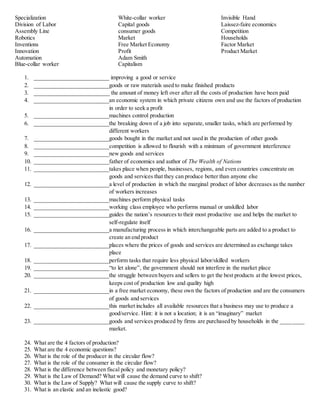
Specialization
Division of Labor
Assembly Line
Robotics
Inventions
Innovation
Automation
Blue-collar worker
White-collar worker
Capital goods
consumer goods
Market
Free Market Economy
Profit
Adam Smith
Capitalism
Invisible Hand
Laissez-faire economics
Competition
Households
Factor Market
Product Market
1. __________________________ improving a good or service
2. __________________________goods or raw materials used to make finished products
3. __________________________ the amount of money left over after all the costs of production have been paid
4. __________________________an economic system in which private citizens own and use the factors of production
in order to seek a profit
5. __________________________machines control production
6. __________________________the breaking down of a job into separate,smaller tasks, which are performed by
different workers
7. __________________________goods bought in the market and not used in the production of other goods
8. __________________________competition is allowed to flourish with a minimum of government interference
9. __________________________new goods and services
10. __________________________father of economics and author of The Wealth of Nations
11. __________________________takes place when people, businesses, regions, and even countries concentrate on
goods and services that they can produce better than anyone else
12. __________________________a level of production in which the marginal product of labor decreases as the number
of workers increases
13. __________________________machines perform physical tasks
14. __________________________working class employee who performs manual or unskilled labor
15. __________________________guides the nation’s resources to their most productive use and helps the market to
self-regulate itself
16. __________________________a manufacturing process in which interchangeable parts are added to a product to
create an end product
17. __________________________places where the prices of goods and services are determined as exchange takes
place
18. __________________________perform tasks that require less physical labor/skilled workers
19. __________________________“to let alone”, the government should not interfere in the market place
20. __________________________the struggle between buyers and sellers to get the best products at the lowest prices,
keeps cost of production low and quality high
21. __________________________in a free market economy, these own the factors of production and are the consumers
of goods and services
22. __________________________this market includes all available resources that a business may use to produce a
good/service. Hint: it is not a location; it is an “imaginary” market
23. __________________________goods and services produced by firms are purchased by households in the ________
market.
24. What are the 4 factors of production?
25. What are the 4 economic questions?
26. What is the role of the producer in the circular flow?
27. What is the role of the consumer in the circular flow?
28. What is the difference between fiscal policy and monetary policy?
29. What is the Law of Demand? What will cause the demand curve to shift?
30. What is the Law of Supply? What will cause the supply curve to shift?
31. What is an elastic and an inelastic good?

Econ study guide fill in blank

  • 1.
    Unit 2 StudyGuide Match the following terms to the appropriate definition or description. Consumer Entrepreneur Fixed Cost Good Greater Human Capital Incentive Labor Land Need Opportunity Cost Physical capital Producer Productivity Renewable Resource Salary Scarcity Service Total Cost Trade-off Underutilization Variable Costs Wage 1. ___________________________ A tangible object that can be bought and used to meet the needs and wants of consumers. 2. _____________________________ Our goods and services are limited due to this economic problem. 3. _____________________________ Man-made objects that are used to make other goods and services. 4. _____________________________ A resource that can be naturally replenished. 5. _____________________________ A fixed income paid on a monthly basis. 6. _____________________________ An alternative that we sacrifice when we make a decision. 7. _____________________________ The act of choosing between two options 8. _____________________________ That which is necessary for survival. 9. _____________________________ Natural resources used to make goods and services. 10. ____________________________ The person who combines land, labor, and capital to make goods and services. 11. ____________________________ A person who works on an assembly line describes this factor of production. 12. ____________________________ The degree to which resources are being used efficiently 13. ____________________________ Knowledge and skill gained on the job that is used to make goods and services. 14. ____________________________ A reward that is offered to persuade people to take certain economic actions. 15. ____________________________ A person who buys or uses goods and services. 16. ____________________________ Using fewer resources than an economy is capable of using 17. ____________________________ A cost that remains the same no matter how many goods are produced. 18. ____________________________ The payment for the service of one unit of labor. 19. ____________________________ Fixed costs plus variable costs. 20. ____________________________ A person who makes goods and services. 21. ____________________________ The expenses that change with the number of goods produced. 22. ____________________________ When using the cost benefit analysis, you want your benefits to be ______ than your costs. 23. ____________________________ Actions one person performs for another.
  • 2.
    Specialization Division of Labor AssemblyLine Robotics Inventions Innovation Automation Blue-collar worker White-collar worker Capital goods consumer goods Market Free Market Economy Profit Adam Smith Capitalism Invisible Hand Laissez-faire economics Competition Households Factor Market Product Market 1. __________________________ improving a good or service 2. __________________________goods or raw materials used to make finished products 3. __________________________ the amount of money left over after all the costs of production have been paid 4. __________________________an economic system in which private citizens own and use the factors of production in order to seek a profit 5. __________________________machines control production 6. __________________________the breaking down of a job into separate,smaller tasks, which are performed by different workers 7. __________________________goods bought in the market and not used in the production of other goods 8. __________________________competition is allowed to flourish with a minimum of government interference 9. __________________________new goods and services 10. __________________________father of economics and author of The Wealth of Nations 11. __________________________takes place when people, businesses, regions, and even countries concentrate on goods and services that they can produce better than anyone else 12. __________________________a level of production in which the marginal product of labor decreases as the number of workers increases 13. __________________________machines perform physical tasks 14. __________________________working class employee who performs manual or unskilled labor 15. __________________________guides the nation’s resources to their most productive use and helps the market to self-regulate itself 16. __________________________a manufacturing process in which interchangeable parts are added to a product to create an end product 17. __________________________places where the prices of goods and services are determined as exchange takes place 18. __________________________perform tasks that require less physical labor/skilled workers 19. __________________________“to let alone”, the government should not interfere in the market place 20. __________________________the struggle between buyers and sellers to get the best products at the lowest prices, keeps cost of production low and quality high 21. __________________________in a free market economy, these own the factors of production and are the consumers of goods and services 22. __________________________this market includes all available resources that a business may use to produce a good/service. Hint: it is not a location; it is an “imaginary” market 23. __________________________goods and services produced by firms are purchased by households in the ________ market. 24. What are the 4 factors of production? 25. What are the 4 economic questions? 26. What is the role of the producer in the circular flow? 27. What is the role of the consumer in the circular flow? 28. What is the difference between fiscal policy and monetary policy? 29. What is the Law of Demand? What will cause the demand curve to shift? 30. What is the Law of Supply? What will cause the supply curve to shift? 31. What is an elastic and an inelastic good?