Lowering the Cost of Heating Your Home

       a Green Roundtable Presentation
                     October 11, 2008


       EcoHeat Solutions LLC
      Presented by George Whiting, Founder
      29 Pleasant St, Medfield, MA 02052
      877-317-0700     gwhiting@EcoHeatSolutions.com
Overview

Until fairly recently, energy costs relative to other household expenses were
quite low. Today, energy use in the home is one of our major household
expenditures. Fortunately there are a number of actions we can take to reduce
energy costs in the home. Our focus for today is to look at how we heat our
homes and hot water, and consider what we can do to lessen the growing
financial burden of these energy-intensive necessities.


The relative importance of the forms of energy we use in our homes

>> Energy for Heating vs. Energy as Electricity (e.g. to run appliances, lights, etc.)

In New England, 78% of home energy use is for heating, and 22% for
electricity. Therefore, a marginal reduction in home heating energy use has a
greater impact in reducing energy use. Note however, that fuel for home
heating is much cheaper than the cost of electricity, so reducing electricity
usage is very important from a total cost savings perspective.
Overview

Until fairly recently, energy costs relative to other household expenses were
quite low. Today, energy use in the home is one of our major household
expenditures. Fortunately there are a number of actions we can take to reduce
energy costs in the home. Our focus for today is to look at how we heat our
homes and hot water, and consider what we can do to lessen the growing
financial burden of these energy-intensive necessities.


The relative importance of the forms of energy we use in our homes

>> Energy for Heating vs. Energy as Electricity (e.g. to run appliances, lights, etc.)

In New England, 78% of home energy use is for heating, and 22% for
electricity. Therefore, a marginal reduction in home heating energy use has a
greater impact in reducing energy use. Note however, that fuel for home
heating is much cheaper than the cost of electricity, so reducing electricity
usage is very important from a total cost savings perspective.

Conclusion: Reducing both types of energy use should be pursued with equal
zeal.
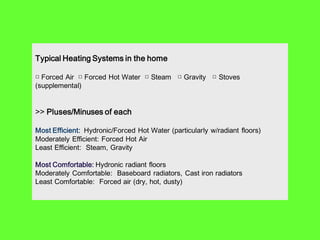
Typical Heating Systems in the home

â–ˇ Forced Air â–ˇ Forced Hot Water â–ˇ Steam â–ˇ Gravity â–ˇ Stoves
(supplemental)


>> Pluses/Minuses of each

Most Efficient: Hydronic/Forced Hot Water (particularly w/radiant floors)
Moderately Efficient: Forced Hot Air
Least Efficient: Steam, Gravity

Most Comfortable: Hydronic radiant floors
Moderately Comfortable: Baseboard radiators, Cast iron radiators
Least Comfortable: Forced air (dry, hot, dusty)
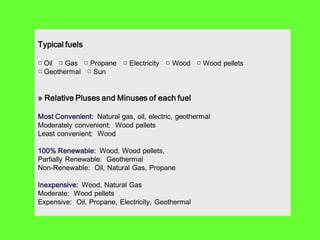
Typical fuels

â–ˇ Oil â–ˇ Gas â–ˇ Propane â–ˇ Electricity â–ˇ Wood â–ˇ Wood pellets
â–ˇ Geothermal â–ˇ Sun


» Relative Pluses and Minuses of each fuel

Most Convenient: Natural gas, oil, electric, geothermal
Moderately convenient: Wood pellets
Least convenient: Wood

100% Renewable: Wood, Wood pellets,
Partially Renewable: Geothermal
Non-Renewable: Oil, Natural Gas, Propane

Inexpensive: Wood, Natural Gas
Moderate: Wood pellets
Expensive: Oil, Propane, Electricity, Geothermal
Efficiency / Conservation / Fuel Costs

Home heating costs can be reduced by focusing on three areas: increasing our
heating system's efficiency, taking measures to conserve energy, and
choosing lower costs fuels. Reductions of 10% or more through improved
system efficiency, 10% or more through conservation, and more than 50%
through switching to lower cost fuels can be achieved for many homeowners.


Goal: Cost Reductions of 10% / 10% / 30%
Efficiency

The annual efficiency of heating systems in New England's homes ranges from less
than 70% to 95% and more. Therefore, if you have an old heating system, it would
be reasonable to attempt to raise your heating system efficiency by 10% or more. If
your heating oil use is 1000 gallons/year, and you improve your efficiency by 10%,
then you'll save 100 gallons or maybe $300-400 dollars/year.

Things you can do:
Easy - Change to Energy Star furnace or boiler. Possible upgrade to condensing
technology.
Harder - Insulate pipes or ducts
Hardest - Change system type from steam or gravity hot water to forced hot water.
Conservation

Conservation of fuel is another area where reductions of 10% or more can be
achieved, particularly if you're not currently in the habit of turning down your
thermostat at night

Things you can do:
Easy - Turn down thermostat at night and when leaving, to 55°F.
Easy - Turn down thermostat on water heater to 120°F, and shut off day in
advance when absent for more than a day.
Easy - Use low-flow shower head, or adjustable water flow shower head.
Easy - Close off rooms, don't heat uninsulated basement.
Harder - Insulate walls, ceilings. Target R-19 in walls, R-35 or higher in attic.
Harder - Replace windows with Energy Star windows.
Harder - Seal gaps around windows, doors and vents to reduce infiltration.
Hardest - Move to smaller home
Fuel Costs

The rising cost of oil has been the main driver of interest in finding
alternatives to the status quo. In real terms, oil has been trending higher for
10 years, and with declining domestic production, this trend is likely to
continue. Currently oil costs $.11/kWh ($3.60/g), Natural gas $.05/kWh
($1.23/therm), and Wood pellets $.07/kWh ($299/ton)

Things you can do:
Easy - Switch to natural gas. At the same level of efficiency, you will save
over 50% at today's prices.
Harder - Switch to wood pellets. You will save 30% on fuel
costs. Requires some maintenance.
Hardest - Switch to wood. Requires much labor and maintenance.
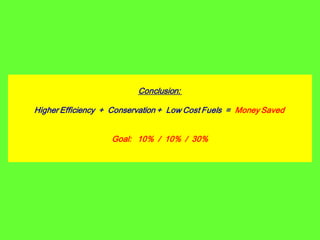
Conclusion:

Higher Efficiency + Conservation + Low Cost Fuels = Money Saved


                   Goal: 10% / 10% / 30%
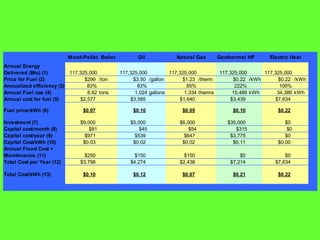
Wood-Pellet Boiler          Oil             Natural Gas       Geothermal HP     Electric Heat
Annual Energy
Delivered (Btu) (1)         117,325,000          117,325,000         117,325,000          117,325,000     117,325,000
Price for Fuel (2)                $299 /ton           $3.50 /gallon       $1.23 /therm         $0.22 /kWh      $0.22 /kWh
Annualized efficiency (3)          83%                  83%                 85%                 222%            100%
Annual Fuel use (4)                8.62 tons           1,024 gallons       1,334 therms        15,489 kWh      34,386 kWh
Annual cost for fuel (5)        $2,577               $3,585              $1,640               $3,439          $7,634

Fuel price/kWh (6)               $0.07                $0.10               $0.05                $0.10           $0.22

Investment (7)                  $9,000               $5,000              $6,000              $35,000              $0
Capital cost/month (8)              $81                  $45                 $54                $315               $0
Capital cost/year (9)             $971                 $539                $647               $3,775              $0
Capital Cost/kWh (10)            $0.03                $0.02               $0.02                $0.11           $0.00
Annual Fixed Cost +
Maintenance (11)                  $250                 $150                $150                   $0              $0
Total Cost per Year (12)        $3,798               $4,274              $2,438               $7,214          $7,634

Total Cost/kWh (13)              $0.10                $0.12               $0.07                $0.21           $0.22
Thank you

Lowering the Cost of Heating Your Home

  • 1.
    Lowering the Costof Heating Your Home a Green Roundtable Presentation October 11, 2008 EcoHeat Solutions LLC Presented by George Whiting, Founder 29 Pleasant St, Medfield, MA 02052 877-317-0700 gwhiting@EcoHeatSolutions.com
  • 2.
    Overview Until fairly recently,energy costs relative to other household expenses were quite low. Today, energy use in the home is one of our major household expenditures. Fortunately there are a number of actions we can take to reduce energy costs in the home. Our focus for today is to look at how we heat our homes and hot water, and consider what we can do to lessen the growing financial burden of these energy-intensive necessities. The relative importance of the forms of energy we use in our homes >> Energy for Heating vs. Energy as Electricity (e.g. to run appliances, lights, etc.) In New England, 78% of home energy use is for heating, and 22% for electricity. Therefore, a marginal reduction in home heating energy use has a greater impact in reducing energy use. Note however, that fuel for home heating is much cheaper than the cost of electricity, so reducing electricity usage is very important from a total cost savings perspective.
  • 3.
    Overview Until fairly recently,energy costs relative to other household expenses were quite low. Today, energy use in the home is one of our major household expenditures. Fortunately there are a number of actions we can take to reduce energy costs in the home. Our focus for today is to look at how we heat our homes and hot water, and consider what we can do to lessen the growing financial burden of these energy-intensive necessities. The relative importance of the forms of energy we use in our homes >> Energy for Heating vs. Energy as Electricity (e.g. to run appliances, lights, etc.) In New England, 78% of home energy use is for heating, and 22% for electricity. Therefore, a marginal reduction in home heating energy use has a greater impact in reducing energy use. Note however, that fuel for home heating is much cheaper than the cost of electricity, so reducing electricity usage is very important from a total cost savings perspective. Conclusion: Reducing both types of energy use should be pursued with equal zeal.
  • 4.
    Typical Heating Systemsin the home â–ˇ Forced Air â–ˇ Forced Hot Water â–ˇ Steam â–ˇ Gravity â–ˇ Stoves (supplemental) >> Pluses/Minuses of each Most Efficient: Hydronic/Forced Hot Water (particularly w/radiant floors) Moderately Efficient: Forced Hot Air Least Efficient: Steam, Gravity Most Comfortable: Hydronic radiant floors Moderately Comfortable: Baseboard radiators, Cast iron radiators Least Comfortable: Forced air (dry, hot, dusty)
  • 5.
    Typical fuels □ Oil□ Gas □ Propane □ Electricity □ Wood □ Wood pellets □ Geothermal □ Sun » Relative Pluses and Minuses of each fuel Most Convenient: Natural gas, oil, electric, geothermal Moderately convenient: Wood pellets Least convenient: Wood 100% Renewable: Wood, Wood pellets, Partially Renewable: Geothermal Non-Renewable: Oil, Natural Gas, Propane Inexpensive: Wood, Natural Gas Moderate: Wood pellets Expensive: Oil, Propane, Electricity, Geothermal
  • 6.
    Efficiency / Conservation/ Fuel Costs Home heating costs can be reduced by focusing on three areas: increasing our heating system's efficiency, taking measures to conserve energy, and choosing lower costs fuels. Reductions of 10% or more through improved system efficiency, 10% or more through conservation, and more than 50% through switching to lower cost fuels can be achieved for many homeowners. Goal: Cost Reductions of 10% / 10% / 30%
  • 7.
    Efficiency The annual efficiencyof heating systems in New England's homes ranges from less than 70% to 95% and more. Therefore, if you have an old heating system, it would be reasonable to attempt to raise your heating system efficiency by 10% or more. If your heating oil use is 1000 gallons/year, and you improve your efficiency by 10%, then you'll save 100 gallons or maybe $300-400 dollars/year. Things you can do: Easy - Change to Energy Star furnace or boiler. Possible upgrade to condensing technology. Harder - Insulate pipes or ducts Hardest - Change system type from steam or gravity hot water to forced hot water.
  • 8.
    Conservation Conservation of fuelis another area where reductions of 10% or more can be achieved, particularly if you're not currently in the habit of turning down your thermostat at night Things you can do: Easy - Turn down thermostat at night and when leaving, to 55°F. Easy - Turn down thermostat on water heater to 120°F, and shut off day in advance when absent for more than a day. Easy - Use low-flow shower head, or adjustable water flow shower head. Easy - Close off rooms, don't heat uninsulated basement. Harder - Insulate walls, ceilings. Target R-19 in walls, R-35 or higher in attic. Harder - Replace windows with Energy Star windows. Harder - Seal gaps around windows, doors and vents to reduce infiltration. Hardest - Move to smaller home
  • 9.
    Fuel Costs The risingcost of oil has been the main driver of interest in finding alternatives to the status quo. In real terms, oil has been trending higher for 10 years, and with declining domestic production, this trend is likely to continue. Currently oil costs $.11/kWh ($3.60/g), Natural gas $.05/kWh ($1.23/therm), and Wood pellets $.07/kWh ($299/ton) Things you can do: Easy - Switch to natural gas. At the same level of efficiency, you will save over 50% at today's prices. Harder - Switch to wood pellets. You will save 30% on fuel costs. Requires some maintenance. Hardest - Switch to wood. Requires much labor and maintenance.
  • 10.
    Conclusion: Higher Efficiency +Conservation + Low Cost Fuels = Money Saved Goal: 10% / 10% / 30%
  • 11.
    Wood-Pellet Boiler Oil Natural Gas Geothermal HP Electric Heat Annual Energy Delivered (Btu) (1) 117,325,000 117,325,000 117,325,000 117,325,000 117,325,000 Price for Fuel (2) $299 /ton $3.50 /gallon $1.23 /therm $0.22 /kWh $0.22 /kWh Annualized efficiency (3) 83% 83% 85% 222% 100% Annual Fuel use (4) 8.62 tons 1,024 gallons 1,334 therms 15,489 kWh 34,386 kWh Annual cost for fuel (5) $2,577 $3,585 $1,640 $3,439 $7,634 Fuel price/kWh (6) $0.07 $0.10 $0.05 $0.10 $0.22 Investment (7) $9,000 $5,000 $6,000 $35,000 $0 Capital cost/month (8) $81 $45 $54 $315 $0 Capital cost/year (9) $971 $539 $647 $3,775 $0 Capital Cost/kWh (10) $0.03 $0.02 $0.02 $0.11 $0.00 Annual Fixed Cost + Maintenance (11) $250 $150 $150 $0 $0 Total Cost per Year (12) $3,798 $4,274 $2,438 $7,214 $7,634 Total Cost/kWh (13) $0.10 $0.12 $0.07 $0.21 $0.22
  • 12.