Does an early implantation of extracorporeal membrane
oxygenator in high risk emergency open heart surgery
patients improve the outcome in comparison to elective
patients? a prospective cohort comparative study.
Yasser Mubarak *, Ahmed Abdeljawad**
*Minia University, Minia, Egypt. Madinah Cardiac Center, KSA.
** Cairo University, Cairo, Egypt. Clinic of cardiac surgery, Barmherzigen
Brüder Krankenhaus Trier, Trier, Germany.
Abstract
Extracorporeal Membrane Oxygenator (ECMO) has been implemented
in refractory post-cardiotomy cardiogenic shock (PCCS) patients to
maintain an excellent oxygenation and hemodynamic support.
Aim of this study is to compare the result of early ECMO implantation
to treat refractory PCCS in emergency vs. elective patients.
Patient and Method
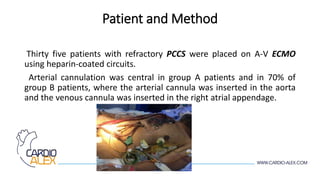
Thirty five patients with refractory PCCS were placed on A-V ECMO
using heparin-coated circuits.
Arterial cannulation was central in group A patients and in 70% of
group B patients, where the arterial cannula was inserted in the aorta
and the venous cannula was inserted in the right atrial appendage.
30% of the group B, peripheral cannulation have been performed;
arterial cannulation access through femoral artery in 80% of patients
and axillary artery 20%.
Group A that contains (18) patients who have been operated upon an
emergency base. This includes (10) patients of IHD, (3) patients with
severe IMR , (2) patients with VSR , (1) patient of redo IE on top of
biological aortic valve, and (2) patients of traumatic severe MR.
ECMO implantation in group A took place intra-operatively with
central cannulation.
Group B includes (17) patients who have been operated upon an
elective base.
Weaning strategy was based on establishing an ECMO flow for at least
72hr before starting the weaning process.
Weaning was based on the degree of improvement of the
hemodynamic and metabolic signs. TEE was performed daily.
ECMO weaning was discontinued when signs of metabolic acidosis
appeared during the weaning process. At this point weaning was
discontinued and ECMO flow was readjusted on the pre-weaning
ECMO flow level and kept for at least 36-48hr before any trial of
weaning.
Results
There were no statistically significant difference between the two
groups regarding the duration of mechanical ventilation, duration of
ICU stay, post ECMO weaning hospital stay or in-hospital mortality, and
one-year survival on follow up.
Secondary End Point
It is worthwhile to mention that at the beginning of our research we
postulated that there will be a statistically significant difference
between emergency operated and electively operated patients who
would receive ECMO implantation in regard to in-hospital mortality and
in the number of patients who would be discharged from the hospital.
However at the end of our study we did not record a significant
difference between two groups.
Conclusion
Early use of ECMO in high risk emergency cardiac surgery should be
taken in consideration when possible without hesitance. Many critical
emergency surgery patients can be saved and survived with early
ECMO implantation.
ECMO.pptx

ECMO.pptx

  • 2.
    Does an earlyimplantation of extracorporeal membrane oxygenator in high risk emergency open heart surgery patients improve the outcome in comparison to elective patients? a prospective cohort comparative study. Yasser Mubarak *, Ahmed Abdeljawad** *Minia University, Minia, Egypt. Madinah Cardiac Center, KSA. ** Cairo University, Cairo, Egypt. Clinic of cardiac surgery, Barmherzigen Brüder Krankenhaus Trier, Trier, Germany.
  • 3.
    Abstract Extracorporeal Membrane Oxygenator(ECMO) has been implemented in refractory post-cardiotomy cardiogenic shock (PCCS) patients to maintain an excellent oxygenation and hemodynamic support. Aim of this study is to compare the result of early ECMO implantation to treat refractory PCCS in emergency vs. elective patients.
  • 4.
    Patient and Method Thirtyfive patients with refractory PCCS were placed on A-V ECMO using heparin-coated circuits. Arterial cannulation was central in group A patients and in 70% of group B patients, where the arterial cannula was inserted in the aorta and the venous cannula was inserted in the right atrial appendage.
  • 5.
    30% of thegroup B, peripheral cannulation have been performed; arterial cannulation access through femoral artery in 80% of patients and axillary artery 20%.
  • 6.
    Group A thatcontains (18) patients who have been operated upon an emergency base. This includes (10) patients of IHD, (3) patients with severe IMR , (2) patients with VSR , (1) patient of redo IE on top of biological aortic valve, and (2) patients of traumatic severe MR. ECMO implantation in group A took place intra-operatively with central cannulation. Group B includes (17) patients who have been operated upon an elective base.
  • 7.
    Weaning strategy wasbased on establishing an ECMO flow for at least 72hr before starting the weaning process. Weaning was based on the degree of improvement of the hemodynamic and metabolic signs. TEE was performed daily.
  • 8.
    ECMO weaning wasdiscontinued when signs of metabolic acidosis appeared during the weaning process. At this point weaning was discontinued and ECMO flow was readjusted on the pre-weaning ECMO flow level and kept for at least 36-48hr before any trial of weaning.
  • 9.
    Results There were nostatistically significant difference between the two groups regarding the duration of mechanical ventilation, duration of ICU stay, post ECMO weaning hospital stay or in-hospital mortality, and one-year survival on follow up.
  • 10.
    Secondary End Point Itis worthwhile to mention that at the beginning of our research we postulated that there will be a statistically significant difference between emergency operated and electively operated patients who would receive ECMO implantation in regard to in-hospital mortality and in the number of patients who would be discharged from the hospital. However at the end of our study we did not record a significant difference between two groups.
  • 11.
    Conclusion Early use ofECMO in high risk emergency cardiac surgery should be taken in consideration when possible without hesitance. Many critical emergency surgery patients can be saved and survived with early ECMO implantation.