Metalearning & Algorithm
Selection
Pavel Brazdil, Joaquin Vanschoren, Christophe
Giraud-Carrier, Lars Kotthoff
07 September 2015
4. Algorithm selection and configuration in different
domains
Lars Kotthoff
University of British Columbia
Outline
Algorithm selection in other domains
Problem definition
Components of algorithm selection systems
Algorithm selection in specific domains
Example systems: SATzilla, LLAMA
System demonstration
The Algorithm Selection
Problem
Algorithm Selection
Given a problem, choose the best algorithm to solve it.
Definition
Definition goes back to Rice (1976):
“The objective is to determine S(x) [the mapping of
problems to algorithms] so as to have high algorithm
performance.”
x ∈ P
Problem space
A ∈ A
Algorithm space
p ∈ Rn
Performance
measure space
kpk = Algorithm
performance
S(x)
Selection
mapping
p(A, x)
Performance
mapping
Norm
mapping
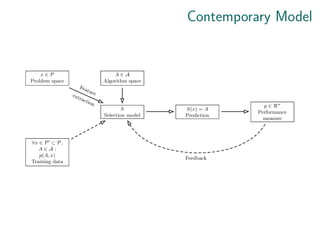
Contemporary Model
x ∈ P
Problem space
A ∈ A
Algorithm space
S
Selection model
S(x) = A
Prediction
p ∈ Rn
Performance
measure
∀x ∈ P′
⊂ P,
A ∈ A :
p(A, x)
Training data
Feature
extraction
Feedback
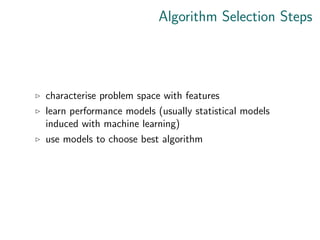
Algorithm Selection Steps
▷ characterise problem space with features
▷ learn performance models (usually statistical models
induced with machine learning)
▷ use models to choose best algorithm
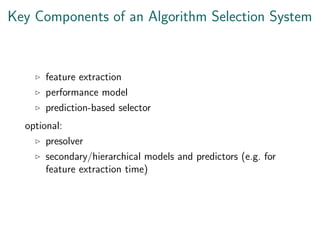
Key Components of an Algorithm Selection System
▷ feature extraction
▷ performance model
▷ prediction-based selector
optional:
▷ presolver
▷ secondary/hierarchical models and predictors (e.g. for
feature extraction time)
Portfolios
▷ instead of a single algorithm, use several complementary
algorithms
▷ idea from Economics – minimise risk by spreading it out
across several securities [Huberman, Lukose, and Hogg
(1997)]
▷ same for computational problems – minimise risk of
algorithm performing poorly [Gomes and Selman (2001)]
▷ in practice often constructed from competition winners
Features
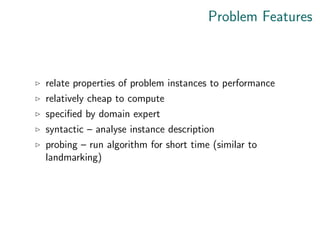
Problem Features
▷ relate properties of problem instances to performance
▷ relatively cheap to compute
▷ specified by domain expert
▷ syntactic – analyse instance description
▷ probing – run algorithm for short time (similar to
landmarking)
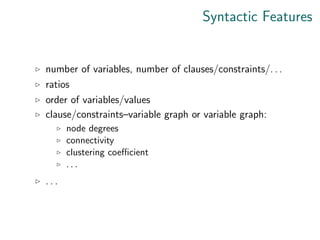
Syntactic Features
▷ number of variables, number of clauses/constraints/. . .
▷ ratios
▷ order of variables/values
▷ clause/constraints–variable graph or variable graph:
▷ node degrees
▷ connectivity
▷ clustering coefficient
▷ . . .
▷ . . .
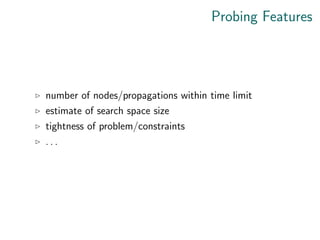
Probing Features
▷ number of nodes/propagations within time limit
▷ estimate of search space size
▷ tightness of problem/constraints
▷ . . .
Performance Models
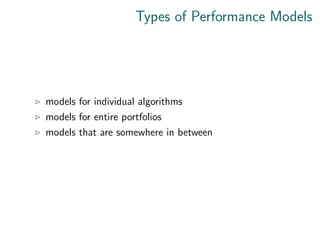
Types of Performance Models
▷ models for individual algorithms
▷ models for entire portfolios
▷ models that are somewhere in between
Models for individual Algorithms [e.g. Xu et al.
(2008) (SATzilla 2009)]
▷ predict the performance for each algorithm separately
▷ standard regression problem
▷ combine the predictions to choose the best one
▷ for example: predict the runtime for each algorithm,
choose the one with the lowest runtime
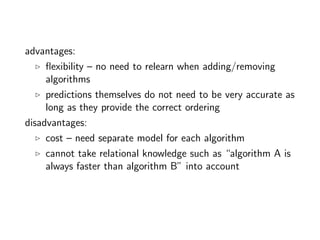
advantages:
▷ flexibility – no need to relearn when adding/removing
algorithms
▷ predictions themselves do not need to be very accurate as
long as they provide the correct ordering
disadvantages:
▷ cost – need separate model for each algorithm
▷ cannot take relational knowledge such as “algorithm A is
always faster than algorithm B” into account
Models for entire Portfolios [e.g. Gent et al.
(2010)]
▷ predict the best algorithm in the portfolio
▷ standard classification problem
▷ alternatively: cluster and assign best algorithms to
clusters [e.g. Kadioglu et al. (2010)]
optional (but important):
▷ attach a “weight” during learning (e.g. the difference
between best and worst solver) to bias model towards the
“important” instances
▷ special loss metric
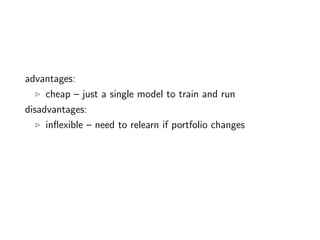
advantages:
▷ cheap – just a single model to train and run
disadvantages:
▷ inflexible – need to relearn if portfolio changes
Hybrid Models
▷ get the best of both worlds
▷ for example: consider pairs of algorithms to take relations
into account [Xu et al. (2011) (SATzilla 2012)]
▷ for each pair of algorithms, learn model that predicts
which one is faster
▷ or use meta-learning techniques such as stacking
[Kotthoff (2012)]
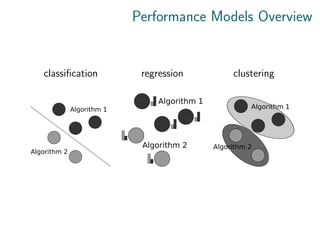
Performance Models Overview
classification regression clustering
Algorithm 1
Algorithm 2
Algorithm 2
Algorithm 1
Algorithm 2
Algorithm 1
Predictions
Types of Predictions/Algorithm Selectors
▷ best algorithm [e.g. Gomes and Selman (2001)]
▷ n best algorithms ranked [e.g. Kanda et al. (2012)]
▷ allocation of resources to n algorithms [e.g. Kadioglu
et al. (2011)]
▷ change the currently running algorithm? [e.g. Borrett,
Tsang, and Walsh (1996)]
Time of Prediction
before problem is being solved [e.g. O’Mahony et al. (2008)]
▷ select algorithm(s) once
▷ no recourse if predictions are bad
while problem is being solved [e.g. Stergiou (2009)]
▷ continuously monitor problem features and/or
performance
▷ can remedy bad initial choice or react to changing
problem
both [e.g. Pulina and Tacchella (2009)]
Types of Machine Learning
Lots!
▷ depends on the type of prediction to make (e.g. label –
classification, number – regression)
▷ in general, all kinds of machine learning applicable
▷ good results in practice with methods that use some kind
of meta-learning, e.g. random forests
. . . and the rest
Combination with Automatic Configuration
▷ configure algorithms for different parts of the problem
space [Kadioglu et al. (2010) (ISAC)]
▷ construct algorithm portfolios with complementary
configurations [Xu, Hoos, and Leyton-Brown (2010)
(Hydra)]
▷ configure selection model for best performance [Lindauer
et al. (2015) (Autofolio)]
Evaluation Measures
▷ penalized average runtime (PAR) – runtime of selected
algorithm, timeout value times factor if timeout
▷ number of instances solved within timeout
▷ misclassification penalty – how much additional time
needed to solve instances because of wrong predictions
▷ compare to single best solver and virtual best
Application Domains
▷ AI Planning [Garbajosa, Rosa, and Fuentetaja (2014)]
▷ Answer Set Programming [Hoos, Lindauer, and Schaub
(2014)]
▷ Mixed Integer Programming [Xu et al. (2011)]
▷ Software Design [Simon et al. (2013)]
▷ Travelling Salesperson [Kotthoff et al. (2015)]
Some concrete examples
SATzilla [Xu et al. (2008)]
▷ 7 SAT solvers, 4811 problem instances
▷ syntactic (33) and probing features (15)
▷ ridge regression to predict log runtime for each solver,
choose the solver with the best predicted performance
▷ later version uses random forests to predict better
algorithm for each pair, aggregation through simple
voting scheme
▷ pre-solving, feature computation time prediction,
hierarchical model
▷ won several competitions
Proteus [Hurley et al. (2014)]
▷ 4 CP solvers, 3 encodings CP to SAT, 6 SAT solvers,
1493 constraint problems
▷ 36 CSP features, 54 SAT features
▷ hierarchical tree of performance models – solve as CP or
SAT, if SAT, which encoding, which solver
▷ considered different types of performance models
Do try this at home
Systems
▷ SATzilla
http://www.cs.ubc.ca/labs/beta/Projects/SATzilla/
▷ LLAMA
https://bitbucket.org/lkotthoff/llama
▷ Claspfolio
http://www.cs.uni-potsdam.de/claspfolio/
LLAMA
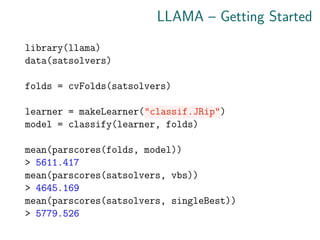
LLAMA – Getting Started
library(llama)
data(satsolvers)
folds = cvFolds(satsolvers)
learner = makeLearner("classif.JRip")
model = classify(learner, folds)
mean(parscores(folds, model))
> 5611.417
mean(parscores(satsolvers, vbs))
> 4645.169
mean(parscores(satsolvers, singleBest))
> 5779.526
LLAMA – Under the Hood
model$models[[1]]$learner.model
JRIP rules:
===========
(dyn_log_propags <= 3.169925) and (log_ranges >= 3.321928) and (sqrt_avg_domsiz
(log_values <= 8.366322) and (log_values >= 8.366322) and (dyn_log_nodes <= 6.0
(dyn_log_propags >= 23.653658) and (log_values <= 9.321928) => target=march_rw
(dyn_log_avg_weight <= 5.149405) and (percent_global <= 0.079239) and (sqrt_avg
(percent_global <= 0.048745) and (dyn_log_avg_weight <= 5.931328) and (sqrt_avg
(sqrt_avg_domsize <= 2.475884) and (log_constraints >= 11.920353) and (dyn_log_
(dyn_log_avg_weight <= 4.766713) and (log_constraints >= 8.686501) and (dyn_log
(dyn_log_avg_weight <= 5.422233) and (log_lists <= 6.72792) and (dyn_log_nodes
(percent_global >= 6.1207) and (dyn_log_nodes >= 5.285402) and (percent_avg_con
(log_values >= 10.643856) and (log_bits <= -1) and (dyn_log_avg_weight >= 7.939
(log_lists >= 8.214319) and (percent_global <= 0.022831) and (dyn_log_nodes >=
(log_lists >= 8.214319) and (log_constraints <= 12.005975) => target=cryptomini
(log_constraints <= 7.491853) and (log_values >= 10.643856) and (dyn_log_avg_we
=> target=clasp (1651.0/1161.0)
Number of Rules : 14
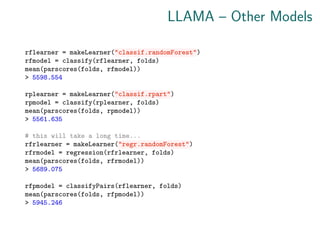
LLAMA – Other Models
rflearner = makeLearner("classif.randomForest")
rfmodel = classify(rflearner, folds)
mean(parscores(folds, rfmodel))
> 5598.554
rplearner = makeLearner("classif.rpart")
rpmodel = classify(rplearner, folds)
mean(parscores(folds, rpmodel))
> 5561.635
# this will take a long time...
rfrlearner = makeLearner("regr.randomForest")
rfrmodel = regression(rfrlearner, folds)
mean(parscores(folds, rfrmodel))
> 5689.075
rfpmodel = classifyPairs(rflearner, folds)
mean(parscores(folds, rfpmodel))
> 5945.246
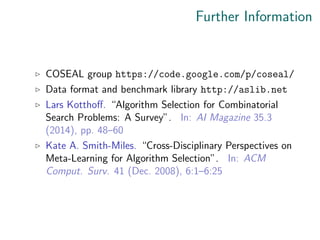
Further Information
▷ COSEAL group https://code.google.com/p/coseal/
▷ Data format and benchmark library http://aslib.net
▷ Lars Kotthoff. “Algorithm Selection for Combinatorial
Search Problems: A Survey”. In: AI Magazine 35.3
(2014), pp. 48–60
▷ Kate A. Smith-Miles. “Cross-Disciplinary Perspectives on
Meta-Learning for Algorithm Selection”. In: ACM
Comput. Surv. 41 (Dec. 2008), 6:1–6:25
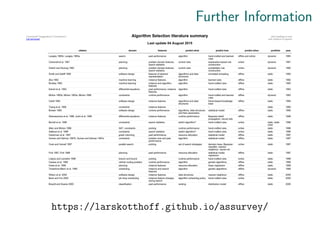
Further Information
https://larskotthoff.github.io/assurvey/
This just in!
▷ first challenge on algorithm selection just finished
▷ description and results at
http://challenge.icon-fet.eu/
References
James E. Borrett, Edward P. K. Tsang, and
Natasha R. Walsh. “Adaptive Constraint Satisfaction:
The Quickest First Principle”. In: ECAI. 1996,
pp. 160–164.
Alberto Garbajosa, Toms de la Rosa, and
Raquel Fuentetaja. “Planning with ensembles of
classifiers”. In: ECAI. 2014, pp. 1007–1008.
Ian P. Gent et al. “Learning When to Use Lazy Learning
in Constraint Solving”. In: 19th European Conference
on Artificial Intelligence. Aug. 2010, pp. 873–878.
Carla P. Gomes and Bart Selman. “Algorithm
Portfolios”. In: Artificial Intelligence 126.1-2 (2001),
pp. 43–62.
References
Holger Hoos, Marius Lindauer, and Torsten Schaub.
“claspfolio 2: Advances in Algorithm Selection for
Answer Set Programming”. In: TPLP 14.4-5 (2014),
pp. 569–585.
Bernardo A. Huberman, Rajan M. Lukose, and
Tad Hogg. “An Economics Approach to Hard
Computational Problems”. In: Science 275.5296
(1997), pp. 51–54.
Barry Hurley et al. “Proteus: A Hierarchical Portfolio of
Solvers and Transformations”. In: CPAIOR. May 2014.
Serdar Kadioglu et al. “Algorithm Selection and
Scheduling”. In: 17th International Conference on
Principles and Practice of Constraint Programming.
2011, pp. 454–469.
References
Serdar Kadioglu et al. “ISAC Instance-Specific
Algorithm Configuration”. In: Proceeding of the 2010
conference on ECAI 2010: 19th European Conference on
Artificial Intelligence. Amsterdam, The Netherlands, The
Netherlands: IOS Press, 2010, pp. 751–756.
Jorge Kanda et al. “A Meta-Learning Approach to
Select Meta-Heuristics for the Traveling Salesman
Problem Using MLP-Based Label Ranking”. In: 19th
International Conference on Neural Information
Processing. Berlin, Heidelberg: Springer-Verlag, 2012,
pp. 488–495.
Lars Kotthoff. “Algorithm Selection for Combinatorial
Search Problems: A Survey”. In: AI Magazine 35.3
(2014), pp. 48–60.
References
Lars Kotthoff. “Hybrid Regression-Classification Models
for Algorithm Selection”. In: 20th European Conference
on Artificial Intelligence. Aug. 2012, pp. 480–485.
Lars Kotthoff et al. “Improving the State of the Art in
Inexact TSP Solving using Per-Instance Algorithm
Selection”. In: LION 9. 2015.
Kevin Leyton-Brown et al. “A Portfolio Approach to
Algorithm Selection”. In: In IJCAI-03. 2003,
pp. 1542–1543.
Marius Lindauer et al. “AutoFolio: Algorithm
Configuration for Algorithm Selection”. In: Proceedings
of the Twenty-Ninth AAAI Workshops on Artificial
Intelligence. Jan. 2015.
References
Eoin O’Mahony et al. “Using Case-based Reasoning in
an Algorithm Portfolio for Constraint Solving”. In:
Proceedings of the 19th Irish Conference on Artificial
Intelligence and Cognitive Science. Jan. 2008.
Luca Pulina and Armando Tacchella. “A self-adaptive
multi-engine solver for quantified Boolean formulas”.
In: Constraints 14.1 (2009), pp. 80–116.
John R. Rice. “The Algorithm Selection Problem”. In:
Advances in Computers 15 (1976), pp. 65–118.
Douglas Simon et al. “Automatic Construction of
Inlining Heuristics Using Machine Learning”. In:
IEEE/ACM International Symposium on Code
Generation and Optimization (CGO). CGO ’13.
Washington, DC, USA: IEEE Computer Society, 2013,
pp. 1–12.
References
Kate A. Smith-Miles. “Cross-Disciplinary Perspectives
on Meta-Learning for Algorithm Selection”. In: ACM
Comput. Surv. 41 (Dec. 2008), 6:1–6:25.
Kostas Stergiou. “Heuristics for Dynamically Adapting
Propagation in Constraint Satisfaction Problems”. In:
AI Commun. 22.3 (2009), pp. 125–141.
Lin Xu, Holger H. Hoos, and Kevin Leyton-Brown.
“Hydra: Automatically Configuring Algorithms for
Portfolio-Based Selection”. In: Twenty-Fourth
Conference of the Association for the Advancement of
Artificial Intelligence. 2010, pp. 210–216.
Lin Xu et al. “Evaluating Component Solver
Contributions to Portfolio-Based Algorithm Selectors”.
In: International Conference on Theory and Applications
of Satisfiability Testing. 2012, pp. 228–241.
References
Lin Xu et al. “Hydra-MIP: Automated Algorithm
Configuration and Selection for Mixed Integer
Programming”. In: RCRA Workshop on Experimental
Evaluation of Algorithms for Solving Problems with
Combinatorial Explosion. 2011, pp. 16–30.
Lin Xu et al. “SATzilla: Portfolio-based Algorithm
Selection for SAT”. In: J. Artif. Intell. Res. 32 (2008),
pp. 565–606.

ecml15-tutorial_automation in machine learning

  • 1.
    Metalearning & Algorithm Selection PavelBrazdil, Joaquin Vanschoren, Christophe Giraud-Carrier, Lars Kotthoff 07 September 2015
  • 2.
    4. Algorithm selectionand configuration in different domains Lars Kotthoff University of British Columbia
  • 3.
    Outline Algorithm selection inother domains Problem definition Components of algorithm selection systems Algorithm selection in specific domains Example systems: SATzilla, LLAMA System demonstration
  • 4.
  • 5.
    Algorithm Selection Given aproblem, choose the best algorithm to solve it.
  • 6.
    Definition Definition goes backto Rice (1976): “The objective is to determine S(x) [the mapping of problems to algorithms] so as to have high algorithm performance.” x ∈ P Problem space A ∈ A Algorithm space p ∈ Rn Performance measure space kpk = Algorithm performance S(x) Selection mapping p(A, x) Performance mapping Norm mapping
  • 7.
    Contemporary Model x ∈P Problem space A ∈ A Algorithm space S Selection model S(x) = A Prediction p ∈ Rn Performance measure ∀x ∈ P′ ⊂ P, A ∈ A : p(A, x) Training data Feature extraction Feedback
  • 8.
    Algorithm Selection Steps ▷characterise problem space with features ▷ learn performance models (usually statistical models induced with machine learning) ▷ use models to choose best algorithm
  • 9.
    Key Components ofan Algorithm Selection System ▷ feature extraction ▷ performance model ▷ prediction-based selector optional: ▷ presolver ▷ secondary/hierarchical models and predictors (e.g. for feature extraction time)
  • 10.
    Portfolios ▷ instead ofa single algorithm, use several complementary algorithms ▷ idea from Economics – minimise risk by spreading it out across several securities [Huberman, Lukose, and Hogg (1997)] ▷ same for computational problems – minimise risk of algorithm performing poorly [Gomes and Selman (2001)] ▷ in practice often constructed from competition winners
  • 11.
  • 12.
    Problem Features ▷ relateproperties of problem instances to performance ▷ relatively cheap to compute ▷ specified by domain expert ▷ syntactic – analyse instance description ▷ probing – run algorithm for short time (similar to landmarking)
  • 13.
    Syntactic Features ▷ numberof variables, number of clauses/constraints/. . . ▷ ratios ▷ order of variables/values ▷ clause/constraints–variable graph or variable graph: ▷ node degrees ▷ connectivity ▷ clustering coefficient ▷ . . . ▷ . . .
  • 14.
    Probing Features ▷ numberof nodes/propagations within time limit ▷ estimate of search space size ▷ tightness of problem/constraints ▷ . . .
  • 15.
  • 16.
    Types of PerformanceModels ▷ models for individual algorithms ▷ models for entire portfolios ▷ models that are somewhere in between
  • 17.
    Models for individualAlgorithms [e.g. Xu et al. (2008) (SATzilla 2009)] ▷ predict the performance for each algorithm separately ▷ standard regression problem ▷ combine the predictions to choose the best one ▷ for example: predict the runtime for each algorithm, choose the one with the lowest runtime
  • 18.
    advantages: ▷ flexibility –no need to relearn when adding/removing algorithms ▷ predictions themselves do not need to be very accurate as long as they provide the correct ordering disadvantages: ▷ cost – need separate model for each algorithm ▷ cannot take relational knowledge such as “algorithm A is always faster than algorithm B” into account
  • 19.
    Models for entirePortfolios [e.g. Gent et al. (2010)] ▷ predict the best algorithm in the portfolio ▷ standard classification problem ▷ alternatively: cluster and assign best algorithms to clusters [e.g. Kadioglu et al. (2010)] optional (but important): ▷ attach a “weight” during learning (e.g. the difference between best and worst solver) to bias model towards the “important” instances ▷ special loss metric
  • 20.
    advantages: ▷ cheap –just a single model to train and run disadvantages: ▷ inflexible – need to relearn if portfolio changes
  • 21.
    Hybrid Models ▷ getthe best of both worlds ▷ for example: consider pairs of algorithms to take relations into account [Xu et al. (2011) (SATzilla 2012)] ▷ for each pair of algorithms, learn model that predicts which one is faster ▷ or use meta-learning techniques such as stacking [Kotthoff (2012)]
  • 22.
    Performance Models Overview classificationregression clustering Algorithm 1 Algorithm 2 Algorithm 2 Algorithm 1 Algorithm 2 Algorithm 1
  • 23.
  • 24.
    Types of Predictions/AlgorithmSelectors ▷ best algorithm [e.g. Gomes and Selman (2001)] ▷ n best algorithms ranked [e.g. Kanda et al. (2012)] ▷ allocation of resources to n algorithms [e.g. Kadioglu et al. (2011)] ▷ change the currently running algorithm? [e.g. Borrett, Tsang, and Walsh (1996)]
  • 25.
    Time of Prediction beforeproblem is being solved [e.g. O’Mahony et al. (2008)] ▷ select algorithm(s) once ▷ no recourse if predictions are bad while problem is being solved [e.g. Stergiou (2009)] ▷ continuously monitor problem features and/or performance ▷ can remedy bad initial choice or react to changing problem both [e.g. Pulina and Tacchella (2009)]
  • 26.
    Types of MachineLearning Lots! ▷ depends on the type of prediction to make (e.g. label – classification, number – regression) ▷ in general, all kinds of machine learning applicable ▷ good results in practice with methods that use some kind of meta-learning, e.g. random forests
  • 27.
    . . .and the rest
  • 28.
    Combination with AutomaticConfiguration ▷ configure algorithms for different parts of the problem space [Kadioglu et al. (2010) (ISAC)] ▷ construct algorithm portfolios with complementary configurations [Xu, Hoos, and Leyton-Brown (2010) (Hydra)] ▷ configure selection model for best performance [Lindauer et al. (2015) (Autofolio)]
  • 29.
    Evaluation Measures ▷ penalizedaverage runtime (PAR) – runtime of selected algorithm, timeout value times factor if timeout ▷ number of instances solved within timeout ▷ misclassification penalty – how much additional time needed to solve instances because of wrong predictions ▷ compare to single best solver and virtual best
  • 30.
    Application Domains ▷ AIPlanning [Garbajosa, Rosa, and Fuentetaja (2014)] ▷ Answer Set Programming [Hoos, Lindauer, and Schaub (2014)] ▷ Mixed Integer Programming [Xu et al. (2011)] ▷ Software Design [Simon et al. (2013)] ▷ Travelling Salesperson [Kotthoff et al. (2015)]
  • 31.
  • 32.
    SATzilla [Xu etal. (2008)] ▷ 7 SAT solvers, 4811 problem instances ▷ syntactic (33) and probing features (15) ▷ ridge regression to predict log runtime for each solver, choose the solver with the best predicted performance ▷ later version uses random forests to predict better algorithm for each pair, aggregation through simple voting scheme ▷ pre-solving, feature computation time prediction, hierarchical model ▷ won several competitions
  • 33.
    Proteus [Hurley etal. (2014)] ▷ 4 CP solvers, 3 encodings CP to SAT, 6 SAT solvers, 1493 constraint problems ▷ 36 CSP features, 54 SAT features ▷ hierarchical tree of performance models – solve as CP or SAT, if SAT, which encoding, which solver ▷ considered different types of performance models
  • 34.
    Do try thisat home
  • 35.
  • 36.
  • 37.
    LLAMA – GettingStarted library(llama) data(satsolvers) folds = cvFolds(satsolvers) learner = makeLearner("classif.JRip") model = classify(learner, folds) mean(parscores(folds, model)) > 5611.417 mean(parscores(satsolvers, vbs)) > 4645.169 mean(parscores(satsolvers, singleBest)) > 5779.526
  • 38.
    LLAMA – Underthe Hood model$models[[1]]$learner.model JRIP rules: =========== (dyn_log_propags <= 3.169925) and (log_ranges >= 3.321928) and (sqrt_avg_domsiz (log_values <= 8.366322) and (log_values >= 8.366322) and (dyn_log_nodes <= 6.0 (dyn_log_propags >= 23.653658) and (log_values <= 9.321928) => target=march_rw (dyn_log_avg_weight <= 5.149405) and (percent_global <= 0.079239) and (sqrt_avg (percent_global <= 0.048745) and (dyn_log_avg_weight <= 5.931328) and (sqrt_avg (sqrt_avg_domsize <= 2.475884) and (log_constraints >= 11.920353) and (dyn_log_ (dyn_log_avg_weight <= 4.766713) and (log_constraints >= 8.686501) and (dyn_log (dyn_log_avg_weight <= 5.422233) and (log_lists <= 6.72792) and (dyn_log_nodes (percent_global >= 6.1207) and (dyn_log_nodes >= 5.285402) and (percent_avg_con (log_values >= 10.643856) and (log_bits <= -1) and (dyn_log_avg_weight >= 7.939 (log_lists >= 8.214319) and (percent_global <= 0.022831) and (dyn_log_nodes >= (log_lists >= 8.214319) and (log_constraints <= 12.005975) => target=cryptomini (log_constraints <= 7.491853) and (log_values >= 10.643856) and (dyn_log_avg_we => target=clasp (1651.0/1161.0) Number of Rules : 14
  • 39.
    LLAMA – OtherModels rflearner = makeLearner("classif.randomForest") rfmodel = classify(rflearner, folds) mean(parscores(folds, rfmodel)) > 5598.554 rplearner = makeLearner("classif.rpart") rpmodel = classify(rplearner, folds) mean(parscores(folds, rpmodel)) > 5561.635 # this will take a long time... rfrlearner = makeLearner("regr.randomForest") rfrmodel = regression(rfrlearner, folds) mean(parscores(folds, rfrmodel)) > 5689.075 rfpmodel = classifyPairs(rflearner, folds) mean(parscores(folds, rfpmodel)) > 5945.246
  • 40.
    Further Information ▷ COSEALgroup https://code.google.com/p/coseal/ ▷ Data format and benchmark library http://aslib.net ▷ Lars Kotthoff. “Algorithm Selection for Combinatorial Search Problems: A Survey”. In: AI Magazine 35.3 (2014), pp. 48–60 ▷ Kate A. Smith-Miles. “Cross-Disciplinary Perspectives on Meta-Learning for Algorithm Selection”. In: ACM Comput. Surv. 41 (Dec. 2008), 6:1–6:25
  • 41.
  • 42.
    This just in! ▷first challenge on algorithm selection just finished ▷ description and results at http://challenge.icon-fet.eu/
  • 43.
    References James E. Borrett,Edward P. K. Tsang, and Natasha R. Walsh. “Adaptive Constraint Satisfaction: The Quickest First Principle”. In: ECAI. 1996, pp. 160–164. Alberto Garbajosa, Toms de la Rosa, and Raquel Fuentetaja. “Planning with ensembles of classifiers”. In: ECAI. 2014, pp. 1007–1008. Ian P. Gent et al. “Learning When to Use Lazy Learning in Constraint Solving”. In: 19th European Conference on Artificial Intelligence. Aug. 2010, pp. 873–878. Carla P. Gomes and Bart Selman. “Algorithm Portfolios”. In: Artificial Intelligence 126.1-2 (2001), pp. 43–62.
  • 44.
    References Holger Hoos, MariusLindauer, and Torsten Schaub. “claspfolio 2: Advances in Algorithm Selection for Answer Set Programming”. In: TPLP 14.4-5 (2014), pp. 569–585. Bernardo A. Huberman, Rajan M. Lukose, and Tad Hogg. “An Economics Approach to Hard Computational Problems”. In: Science 275.5296 (1997), pp. 51–54. Barry Hurley et al. “Proteus: A Hierarchical Portfolio of Solvers and Transformations”. In: CPAIOR. May 2014. Serdar Kadioglu et al. “Algorithm Selection and Scheduling”. In: 17th International Conference on Principles and Practice of Constraint Programming. 2011, pp. 454–469.
  • 45.
    References Serdar Kadioglu etal. “ISAC Instance-Specific Algorithm Configuration”. In: Proceeding of the 2010 conference on ECAI 2010: 19th European Conference on Artificial Intelligence. Amsterdam, The Netherlands, The Netherlands: IOS Press, 2010, pp. 751–756. Jorge Kanda et al. “A Meta-Learning Approach to Select Meta-Heuristics for the Traveling Salesman Problem Using MLP-Based Label Ranking”. In: 19th International Conference on Neural Information Processing. Berlin, Heidelberg: Springer-Verlag, 2012, pp. 488–495. Lars Kotthoff. “Algorithm Selection for Combinatorial Search Problems: A Survey”. In: AI Magazine 35.3 (2014), pp. 48–60.
  • 46.
    References Lars Kotthoff. “HybridRegression-Classification Models for Algorithm Selection”. In: 20th European Conference on Artificial Intelligence. Aug. 2012, pp. 480–485. Lars Kotthoff et al. “Improving the State of the Art in Inexact TSP Solving using Per-Instance Algorithm Selection”. In: LION 9. 2015. Kevin Leyton-Brown et al. “A Portfolio Approach to Algorithm Selection”. In: In IJCAI-03. 2003, pp. 1542–1543. Marius Lindauer et al. “AutoFolio: Algorithm Configuration for Algorithm Selection”. In: Proceedings of the Twenty-Ninth AAAI Workshops on Artificial Intelligence. Jan. 2015.
  • 47.
    References Eoin O’Mahony etal. “Using Case-based Reasoning in an Algorithm Portfolio for Constraint Solving”. In: Proceedings of the 19th Irish Conference on Artificial Intelligence and Cognitive Science. Jan. 2008. Luca Pulina and Armando Tacchella. “A self-adaptive multi-engine solver for quantified Boolean formulas”. In: Constraints 14.1 (2009), pp. 80–116. John R. Rice. “The Algorithm Selection Problem”. In: Advances in Computers 15 (1976), pp. 65–118. Douglas Simon et al. “Automatic Construction of Inlining Heuristics Using Machine Learning”. In: IEEE/ACM International Symposium on Code Generation and Optimization (CGO). CGO ’13. Washington, DC, USA: IEEE Computer Society, 2013, pp. 1–12.
  • 48.
    References Kate A. Smith-Miles.“Cross-Disciplinary Perspectives on Meta-Learning for Algorithm Selection”. In: ACM Comput. Surv. 41 (Dec. 2008), 6:1–6:25. Kostas Stergiou. “Heuristics for Dynamically Adapting Propagation in Constraint Satisfaction Problems”. In: AI Commun. 22.3 (2009), pp. 125–141. Lin Xu, Holger H. Hoos, and Kevin Leyton-Brown. “Hydra: Automatically Configuring Algorithms for Portfolio-Based Selection”. In: Twenty-Fourth Conference of the Association for the Advancement of Artificial Intelligence. 2010, pp. 210–216. Lin Xu et al. “Evaluating Component Solver Contributions to Portfolio-Based Algorithm Selectors”. In: International Conference on Theory and Applications of Satisfiability Testing. 2012, pp. 228–241.
  • 49.
    References Lin Xu etal. “Hydra-MIP: Automated Algorithm Configuration and Selection for Mixed Integer Programming”. In: RCRA Workshop on Experimental Evaluation of Algorithms for Solving Problems with Combinatorial Explosion. 2011, pp. 16–30. Lin Xu et al. “SATzilla: Portfolio-based Algorithm Selection for SAT”. In: J. Artif. Intell. Res. 32 (2008), pp. 565–606.