Vishwakarma Institute Of Technology,Pune
Comparison of Machine Learning
Algorithms
36-Darshan Chordiya
40-Gauri Deo
41-Pranav Deo
43-Samiksha Deokate
74-Chetna Ingle
Team:AI-A Group 7
Department of Artificial intelligence and Data Science
Guide: Prof.Amruta Mankawade
1. Introduction
• Machine learning enables computers to learn from data without explicit
programming.
• Widely used in predictive analytics, NLP, and image recognition.
• Key types: supervised, unsupervised, reinforcement learning.
• Comparing algorithms helps choose the best model for specific tasks.
• Consider performance, speed, scalability, interpretability, and complexity.
Why Compare ML
Algorithms?
• Machine learning algorithms differ in performance based on the type of data
and the specific problem.
• Choosing the right algorithm impacts model accuracy, efficiency, and
interpretability.
• We’ll compare algorithms based on real-world use cases to highlight their
strengths and limitations.
• Considerations for selecting an algorithm:
1.Type of problem (regression, classification, clustering)
2.Data size and quality
3.Model complexity and interpretability
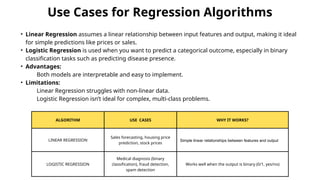
ALGORITHM USE CASES WHY IT WORKS?
LINEAR REGRESSION
Sales forecasting, housing price
prediction, stock prices
Simple linear relationships between features and output
LOGISTIC REGRESSION
Medical diagnosis (binary
classification), fraud detection,
spam detection
Works well when the output is binary (0/1, yes/no)
Use Cases for Regression Algorithms
• Linear Regression assumes a linear relationship between input features and output, making it ideal
for simple predictions like prices or sales.
• Logistic Regression is used when you want to predict a categorical outcome, especially in binary
classification tasks such as predicting disease presence.
• Advantages:
Both models are interpretable and easy to implement.
• Limitations:
Linear Regression struggles with non-linear data.
Logistic Regression isn’t ideal for complex, multi-class problems.
ALGORITHM USE CASES WHY IT WORKS?
DECISION TREES
Loan approval, customer
segmentation, medical diagnoses
Easy to interpret and explain to stakeholders
RANDOM FOREST
Fraud detection, credit scoring,
stock market predictions
Combines multiple trees for better accuracy and less
overfitting
Use Cases for Decision Trees and Random
Forest
• Decision Trees are highly interpretable, making them suitable for decision-making processes like loan
approvals or medical diagnoses where understanding the reasoning is critical.
• Random Forest reduces overfitting by using an ensemble of decision trees, making it more robust in
complex tasks like fraud detection and stock market predictions.
• Advantages:
Decision Trees are fast to train and easy to visualize.
Random Forest improves accuracy and handles large datasets well.
• Limitations:
Decision Trees can easily overfit, especially when the data is noisy.
Random Forest models are harder to interpret due to their complexity.
ALGORITHM USE CASES WHY IT WORKS?
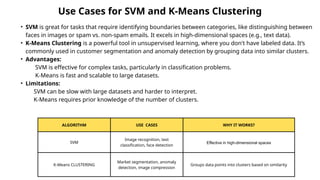
SVM
Image recognition, text
classification, face detection
Effective in high-dimensional spaces
K-Means CLUSTERING
Market segmentation, anomaly
detection, image compression
Groups data points into clusters based on similarity
Use Cases for SVM and K-Means Clustering
• SVM is great for tasks that require identifying boundaries between categories, like distinguishing between
faces in images or spam vs. non-spam emails. It excels in high-dimensional spaces (e.g., text data).
• K-Means Clustering is a powerful tool in unsupervised learning, where you don't have labeled data. It’s
commonly used in customer segmentation and anomaly detection by grouping data into similar clusters.
• Advantages:
SVM is effective for complex tasks, particularly in classification problems.
K-Means is fast and scalable to large datasets.
• Limitations:
SVM can be slow with large datasets and harder to interpret.
K-Means requires prior knowledge of the number of clusters.
ALGORITHM USE CASES WHY IT WORKS?
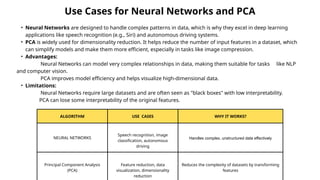
NEURAL NETWORKS
Speech recognition, image
classification, autonomous
driving
Handles complex, unstructured data effectively
Principal Component Analysis
(PCA)
Feature reduction, data
visualization, dimensionality
reduction
Reduces the complexity of datasets by transforming
features
Use Cases for Neural Networks and PCA
• Neural Networks are designed to handle complex patterns in data, which is why they excel in deep learning
applications like speech recognition (e.g., Siri) and autonomous driving systems.
• PCA is widely used for dimensionality reduction. It helps reduce the number of input features in a dataset, which
can simplify models and make them more efficient, especially in tasks like image compression.
• Advantages:
Neural Networks can model very complex relationships in data, making them suitable for tasks like NLP
and computer vision.
PCA improves model efficiency and helps visualize high-dimensional data.
• Limitations:
Neural Networks require large datasets and are often seen as "black boxes" with low interpretability.
PCA can lose some interpretability of the original features.
ALGORITHM USE CASES WHY IT WORKS?
REINFORCEMENT LEARNING
Game AI (AlphaGo), robotics,
autonomous systems
Learns by interacting with the environment, making it ideal
for decision-driven tasks
Use Cases for Reinforcement Learning
• Reinforcement Learning (RL) involves learning through trial and error, which makes it perfect for
environments that require sequential decision-making like robotics and game AI (e.g., AlphaGo).
• RL is also widely used in the development of self-driving cars, where the system learns from
interactions with its environment.
• Advantages:
RL handles real-time decision-making and adapts to new environments.
• Limitations:
Requires large amounts of data and can be difficult to train effectively.
• No single algorithm works best for all tasks.
• The choice depends on the problem, data, and specific needs.
• Factors to consider: accuracy, interpretability, scalability.
• Simple algorithms (e.g., Linear and Logistic Regression) work well for smaller,
interpretable problems.
• Complex algorithms (e.g., Neural Networks, SVM) handle high-dimensional or
unstructured data but need more resources.
• Clustering and PCA are useful for unlabeled data or reducing complexity.
• Always balance accuracy, training time, interpretability, and data availability
when selecting an algorithm.
Conclusion
Thank
You!!

comaprison of machine learning algorithms.pptx

  • 1.
    Vishwakarma Institute OfTechnology,Pune Comparison of Machine Learning Algorithms 36-Darshan Chordiya 40-Gauri Deo 41-Pranav Deo 43-Samiksha Deokate 74-Chetna Ingle Team:AI-A Group 7 Department of Artificial intelligence and Data Science Guide: Prof.Amruta Mankawade
  • 2.
    1. Introduction • Machinelearning enables computers to learn from data without explicit programming. • Widely used in predictive analytics, NLP, and image recognition. • Key types: supervised, unsupervised, reinforcement learning. • Comparing algorithms helps choose the best model for specific tasks. • Consider performance, speed, scalability, interpretability, and complexity.
  • 3.
    Why Compare ML Algorithms? •Machine learning algorithms differ in performance based on the type of data and the specific problem. • Choosing the right algorithm impacts model accuracy, efficiency, and interpretability. • We’ll compare algorithms based on real-world use cases to highlight their strengths and limitations. • Considerations for selecting an algorithm: 1.Type of problem (regression, classification, clustering) 2.Data size and quality 3.Model complexity and interpretability
  • 4.
    ALGORITHM USE CASESWHY IT WORKS? LINEAR REGRESSION Sales forecasting, housing price prediction, stock prices Simple linear relationships between features and output LOGISTIC REGRESSION Medical diagnosis (binary classification), fraud detection, spam detection Works well when the output is binary (0/1, yes/no) Use Cases for Regression Algorithms • Linear Regression assumes a linear relationship between input features and output, making it ideal for simple predictions like prices or sales. • Logistic Regression is used when you want to predict a categorical outcome, especially in binary classification tasks such as predicting disease presence. • Advantages: Both models are interpretable and easy to implement. • Limitations: Linear Regression struggles with non-linear data. Logistic Regression isn’t ideal for complex, multi-class problems.
  • 5.
    ALGORITHM USE CASESWHY IT WORKS? DECISION TREES Loan approval, customer segmentation, medical diagnoses Easy to interpret and explain to stakeholders RANDOM FOREST Fraud detection, credit scoring, stock market predictions Combines multiple trees for better accuracy and less overfitting Use Cases for Decision Trees and Random Forest • Decision Trees are highly interpretable, making them suitable for decision-making processes like loan approvals or medical diagnoses where understanding the reasoning is critical. • Random Forest reduces overfitting by using an ensemble of decision trees, making it more robust in complex tasks like fraud detection and stock market predictions. • Advantages: Decision Trees are fast to train and easy to visualize. Random Forest improves accuracy and handles large datasets well. • Limitations: Decision Trees can easily overfit, especially when the data is noisy. Random Forest models are harder to interpret due to their complexity.
  • 6.
    ALGORITHM USE CASESWHY IT WORKS? SVM Image recognition, text classification, face detection Effective in high-dimensional spaces K-Means CLUSTERING Market segmentation, anomaly detection, image compression Groups data points into clusters based on similarity Use Cases for SVM and K-Means Clustering • SVM is great for tasks that require identifying boundaries between categories, like distinguishing between faces in images or spam vs. non-spam emails. It excels in high-dimensional spaces (e.g., text data). • K-Means Clustering is a powerful tool in unsupervised learning, where you don't have labeled data. It’s commonly used in customer segmentation and anomaly detection by grouping data into similar clusters. • Advantages: SVM is effective for complex tasks, particularly in classification problems. K-Means is fast and scalable to large datasets. • Limitations: SVM can be slow with large datasets and harder to interpret. K-Means requires prior knowledge of the number of clusters.
  • 7.
    ALGORITHM USE CASESWHY IT WORKS? NEURAL NETWORKS Speech recognition, image classification, autonomous driving Handles complex, unstructured data effectively Principal Component Analysis (PCA) Feature reduction, data visualization, dimensionality reduction Reduces the complexity of datasets by transforming features Use Cases for Neural Networks and PCA • Neural Networks are designed to handle complex patterns in data, which is why they excel in deep learning applications like speech recognition (e.g., Siri) and autonomous driving systems. • PCA is widely used for dimensionality reduction. It helps reduce the number of input features in a dataset, which can simplify models and make them more efficient, especially in tasks like image compression. • Advantages: Neural Networks can model very complex relationships in data, making them suitable for tasks like NLP and computer vision. PCA improves model efficiency and helps visualize high-dimensional data. • Limitations: Neural Networks require large datasets and are often seen as "black boxes" with low interpretability. PCA can lose some interpretability of the original features.
  • 8.
    ALGORITHM USE CASESWHY IT WORKS? REINFORCEMENT LEARNING Game AI (AlphaGo), robotics, autonomous systems Learns by interacting with the environment, making it ideal for decision-driven tasks Use Cases for Reinforcement Learning • Reinforcement Learning (RL) involves learning through trial and error, which makes it perfect for environments that require sequential decision-making like robotics and game AI (e.g., AlphaGo). • RL is also widely used in the development of self-driving cars, where the system learns from interactions with its environment. • Advantages: RL handles real-time decision-making and adapts to new environments. • Limitations: Requires large amounts of data and can be difficult to train effectively.
  • 9.
    • No singlealgorithm works best for all tasks. • The choice depends on the problem, data, and specific needs. • Factors to consider: accuracy, interpretability, scalability. • Simple algorithms (e.g., Linear and Logistic Regression) work well for smaller, interpretable problems. • Complex algorithms (e.g., Neural Networks, SVM) handle high-dimensional or unstructured data but need more resources. • Clustering and PCA are useful for unlabeled data or reducing complexity. • Always balance accuracy, training time, interpretability, and data availability when selecting an algorithm. Conclusion
  • 10.