ECL provisions in relation to international conventions
and EU law

Lucie Guibault, Assistant professor, Institute for
Information Law
International conventions


                  Type the footer here   2   2
International Conventions
¢   Berne Convention for the Protection of Literary and
     Artistic Works
¢   WIPO Copyright Treaty
¢   Rome Convention for the Protection of Performers,
     Producers of Phonograms and Broadcasting
     Organisations
¢   WIPO Performances and Phonograms Treaty
     (WPPT)
¢   Agreement on Trade-Related Aspects of Intellectual
     Property Rights
                                  Type the footer here   3   3
National treatment/ Minimum protection
¢   Art 5(1) BC: Authors shall enjoy, (…) in countries of
     the Union other than the country of origin, the rights
     which their respective laws do now or may hereafter
     grant to their nationals, as well as the rights specially
     granted by this Convention.
      £ No contradiction with ECL provisions which all


       include the principle of equal treatment


                                    Type the footer here   4   4
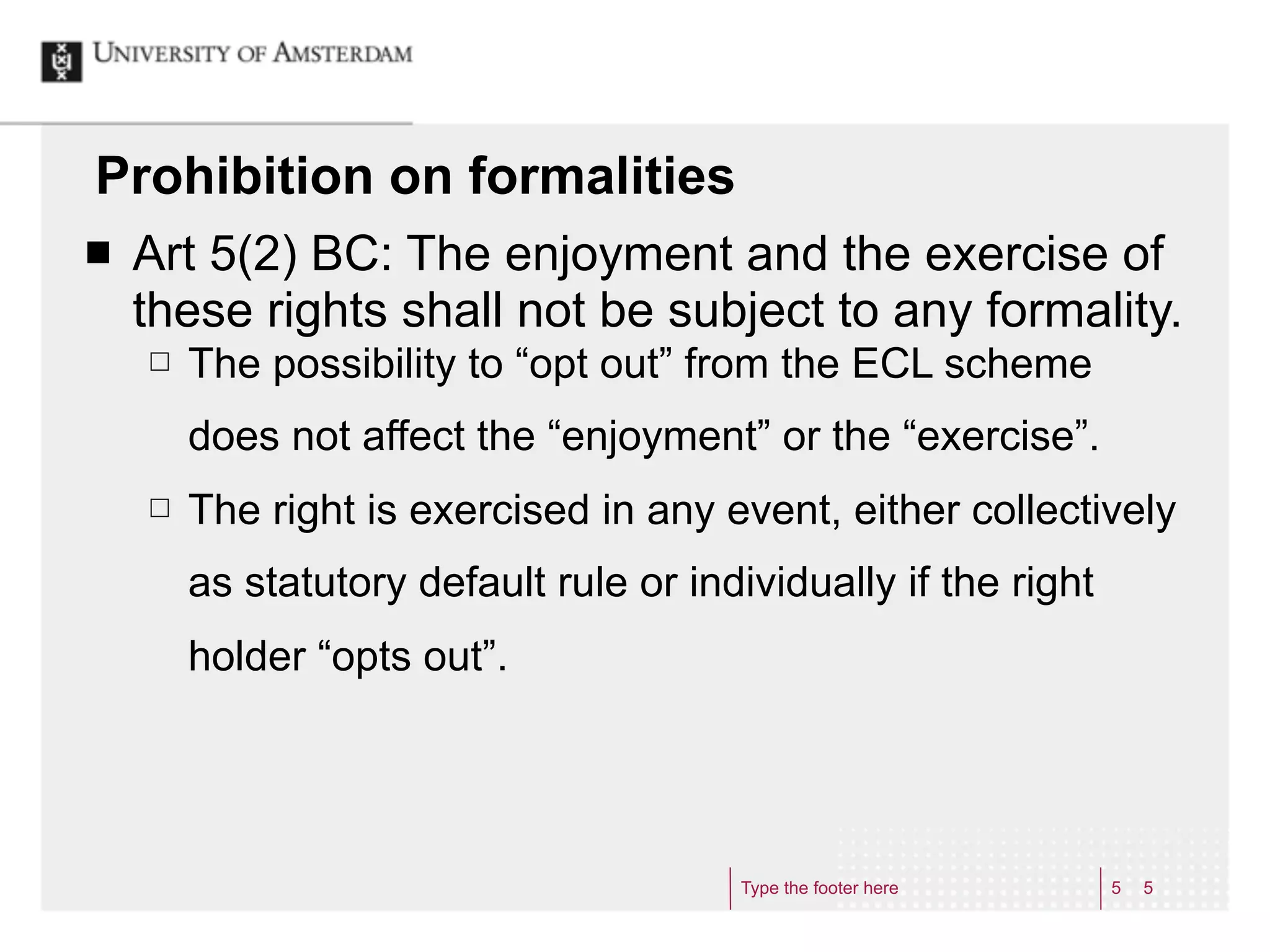
Prohibition on formalities
¢   Art 5(2) BC: The enjoyment and the exercise of
     these rights shall not be subject to any formality.
     £   The possibility to “opt out” from the ECL scheme
          does not affect the “enjoyment” or the “exercise”.
     £   The right is exercised in any event, either collectively
          as statutory default rule or individually if the right
          holder “opts out”.


                                          Type the footer here     5   5
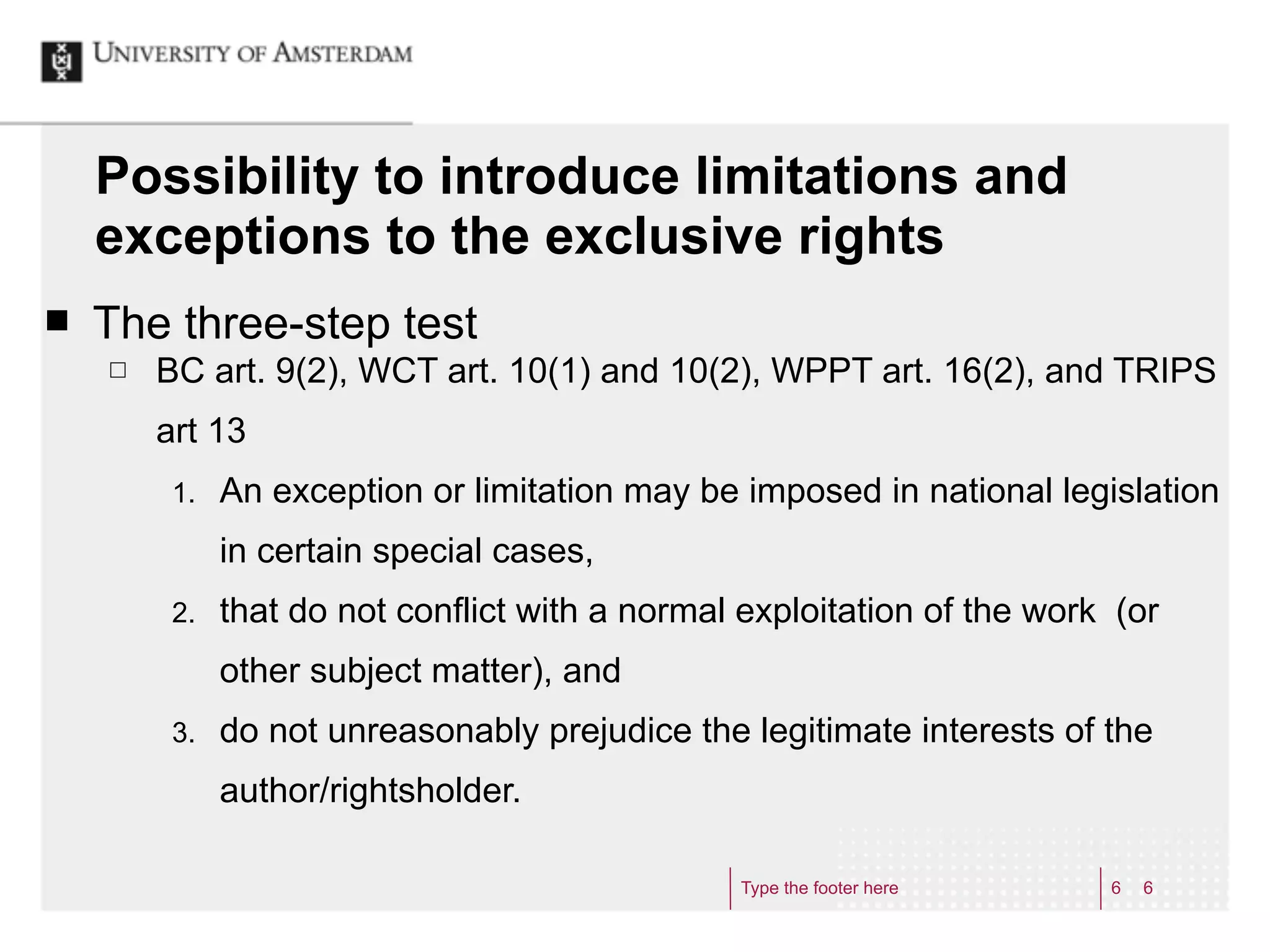
Possibility to introduce limitations and
     exceptions to the exclusive rights
¢   The three-step test
     £   BC art. 9(2), WCT art. 10(1) and 10(2), WPPT art. 16(2), and TRIPS
          art 13
           1.   An exception or limitation may be imposed in national legislation
                in certain special cases,
           2.   that do not conflict with a normal exploitation of the work (or
                other subject matter), and
           3.   do not unreasonably prejudice the legitimate interests of the
                author/rightsholder.

                                                  Type the footer here     6   6
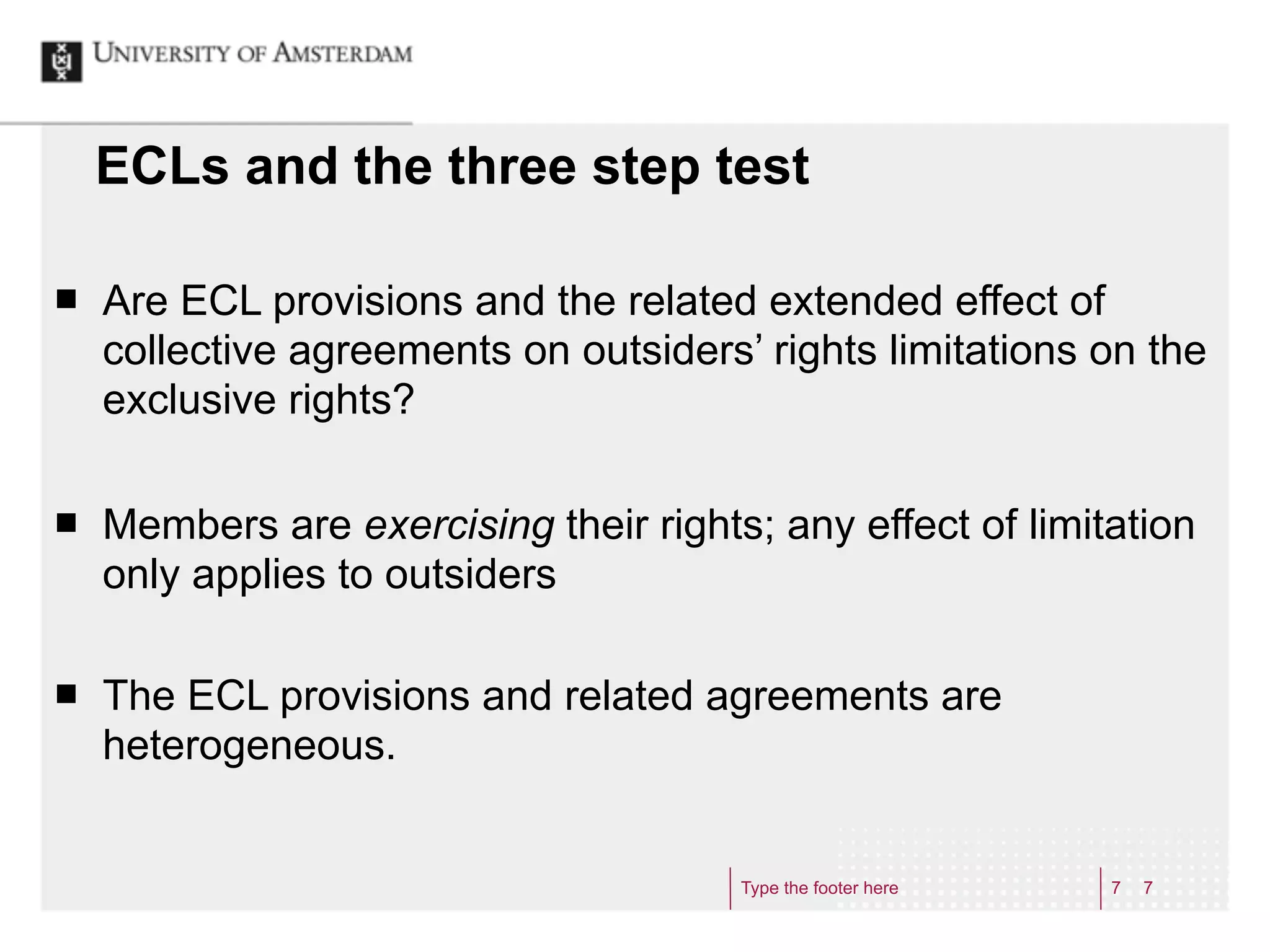
ECLs and the three step test

¢   Are ECL provisions and the related extended effect of
     collective agreements on outsiders’ rights limitations on the
     exclusive rights?

¢   Members are exercising their rights; any effect of limitation
     only applies to outsiders

¢   The ECL provisions and related agreements are
     heterogeneous.


                                        Type the footer here   7   7
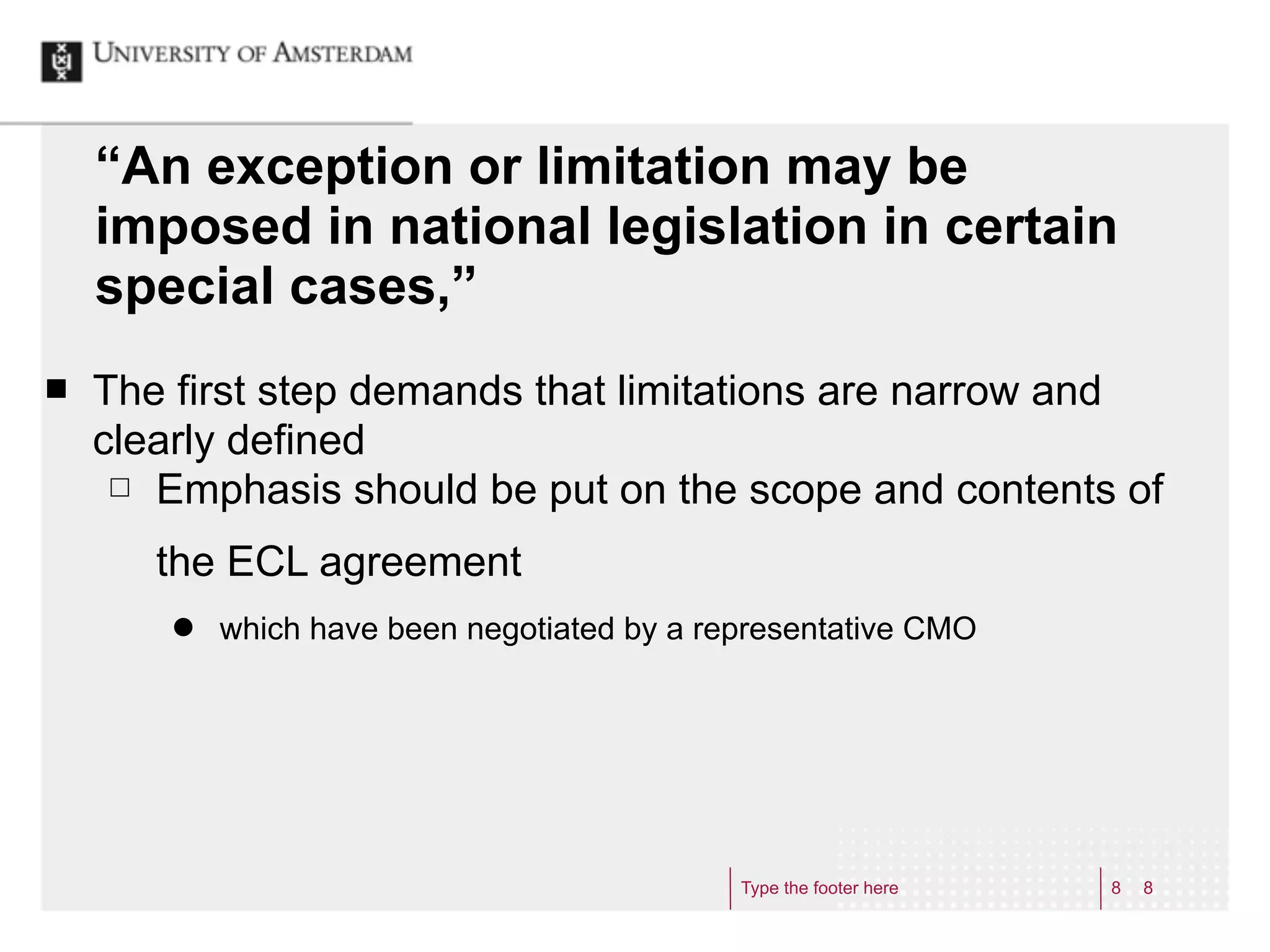
“An exception or limitation may be
     imposed in national legislation in certain
     special cases,”
¢   The first step demands that limitations are narrow and
     clearly defined
      £ Emphasis should be put on the scope and contents of


        the ECL agreement
         ˜   which have been negotiated by a representative CMO


                                                Type the footer here   8   8
” that do not conflict with a normal exploitation of
the work (or other subject matter)”
¢   The second step aims at prohibiting limitations which come
     into economic competition with the authors/right holders
     exploitation of their rights
     £   ECLs aims to solve the problem of market failure with non members:
          such areas cannot reasonably constitute areas of normal exploitation
     £   Emphasis should be put on the scope and contents of the ECL
          agreement
           ˜   which have been negotiated by a representative CMO


                                                   Type the footer here   9   9
” do not unreasonably prejudice the legitimate
interests of the author/rightsholder”

¢   The third step aims at mitigating the impact of
     limitations on the interests of rightsholders
     £   Payment of remuneration is accepted form of mitigation
     £   ECL includes safeguards for outsiders
          ˜   Opt-out (?)
          ˜   Equal treatment
          ˜   Right to individual remuneration
     £   ECLs are based on free negotiations (?)


                                                  Type the footer here   10 10
EU law


         Type the footer here   11 11
Limitations and exceptions at EU level

¢   Article 5 of Directive 2001/29/EC (Infosoc) includes a
     closed list of permissable limitations and exceptions
     to the exclusive rights

¢   Article 5.5 lays down the three-step test

¢   Preamble 18 of Directive 2001/29/EC: “This Directive
     is without prejudice to the arrangements in the
     Member States concerning the management of
     rights such as extended collective licences.”

                                      Type the footer here   12 12
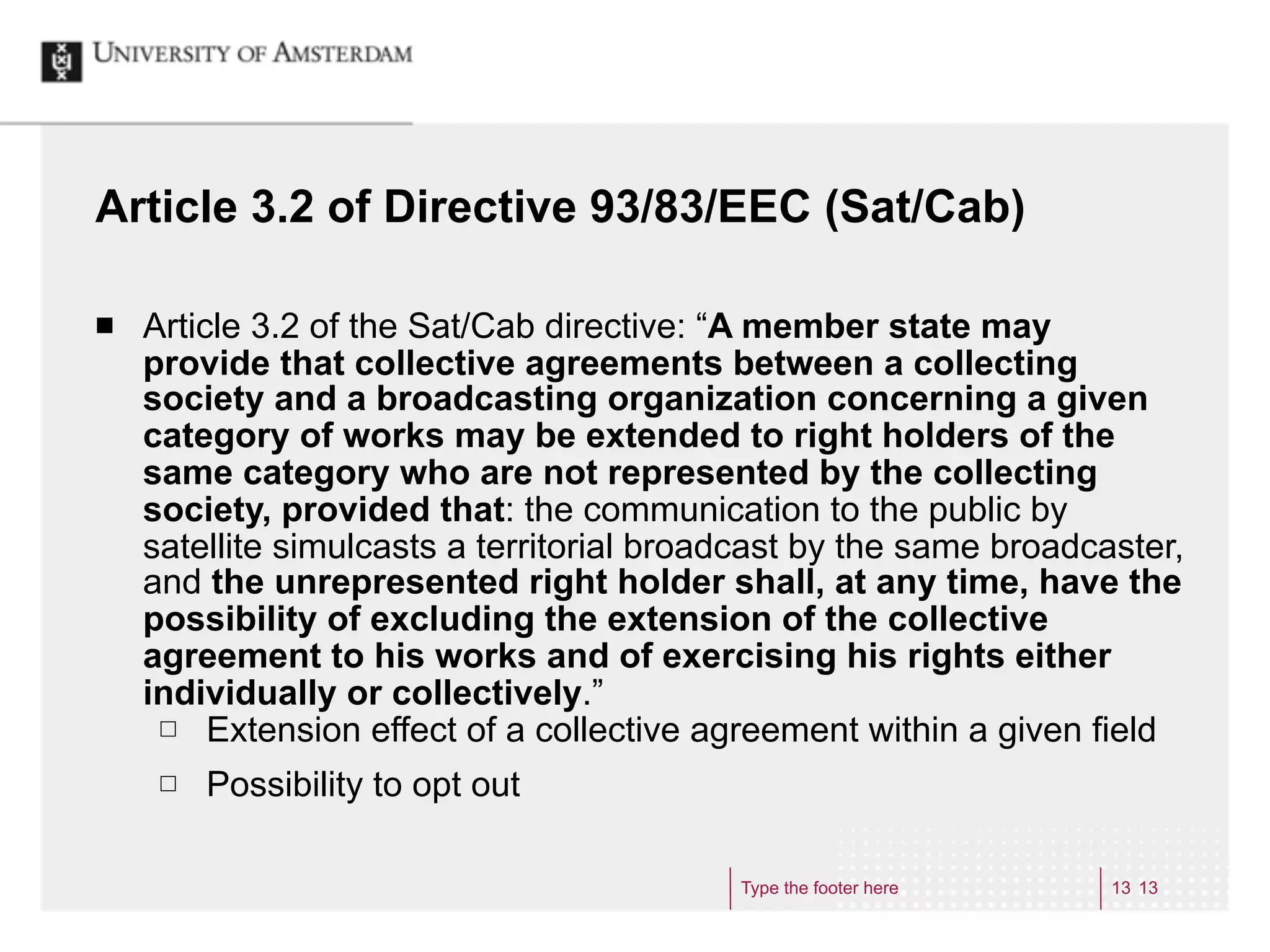
Article 3.2 of Directive 93/83/EEC (Sat/Cab)

¢   Article 3.2 of the Sat/Cab directive: “A member state may
     provide that collective agreements between a collecting
     society and a broadcasting organization concerning a given
     category of works may be extended to right holders of the
     same category who are not represented by the collecting
     society, provided that: the communication to the public by
     satellite simulcasts a territorial broadcast by the same broadcaster,
     and the unrepresented right holder shall, at any time, have the
     possibility of excluding the extension of the collective
     agreement to his works and of exercising his rights either
     individually or collectively.”
      £ Extension effect of a collective agreement within a given field

      £   Possibility to opt out

                                            Type the footer here     13 13
Coherence of the ECL model with EU law

¢   Reasonably ECLs are outside the scope of the
     “closed list” of exceptions and limitations in
     article 5 of the Infosoc directive as long as they
     fulfill the general criteria for ECLs as provided
     in article 3.2 of the Sat/Cab directive


                                    Type the footer here   14 14
Non-discrimination
¢   Article 18 TFEU: “Within the scope of application of the
     Treaties, and without prejudice to any special provisions
     contained therein, any discrimination on grounds of
     nationality shall be prohibited.”
      £ Principle of equal treatment in the ECL provisions

     £   The CMO shall represent “a substantial part of
          authors of works used in the relevant territory”
          ˜   Prior wording: “a substantial number of national authors..”


                                                                             15
Conclusion
¢   ECL agreements must comply with the three
     step test
      £ More leeway than compulsory licenses


¢   ECLs must, to be regarded as ECLs, fulfill the
     general criteria in article 3.2 of the Sat/Cab
     directive
¢   ECLs are not in contradiction with the
     prohibition on formalities and the principles of
     national treatment and anti-discrimination

                                                        16

ECL provisions in relation to international conventions and EU law

  • 1.
    ECL provisions inrelation to international conventions and EU law Lucie Guibault, Assistant professor, Institute for Information Law
  • 2.
    International conventions Type the footer here 2 2
  • 3.
    International Conventions ¢ Berne Convention for the Protection of Literary and Artistic Works ¢ WIPO Copyright Treaty ¢ Rome Convention for the Protection of Performers, Producers of Phonograms and Broadcasting Organisations ¢ WIPO Performances and Phonograms Treaty (WPPT) ¢ Agreement on Trade-Related Aspects of Intellectual Property Rights Type the footer here 3 3
  • 4.
    National treatment/ Minimumprotection ¢ Art 5(1) BC: Authors shall enjoy, (…) in countries of the Union other than the country of origin, the rights which their respective laws do now or may hereafter grant to their nationals, as well as the rights specially granted by this Convention. £ No contradiction with ECL provisions which all include the principle of equal treatment Type the footer here 4 4
  • 5.
    Prohibition on formalities ¢ Art 5(2) BC: The enjoyment and the exercise of these rights shall not be subject to any formality. £ The possibility to “opt out” from the ECL scheme does not affect the “enjoyment” or the “exercise”. £ The right is exercised in any event, either collectively as statutory default rule or individually if the right holder “opts out”. Type the footer here 5 5
  • 6.
    Possibility to introducelimitations and exceptions to the exclusive rights ¢ The three-step test £ BC art. 9(2), WCT art. 10(1) and 10(2), WPPT art. 16(2), and TRIPS art 13 1. An exception or limitation may be imposed in national legislation in certain special cases, 2. that do not conflict with a normal exploitation of the work (or other subject matter), and 3. do not unreasonably prejudice the legitimate interests of the author/rightsholder. Type the footer here 6 6
  • 7.
    ECLs and thethree step test ¢ Are ECL provisions and the related extended effect of collective agreements on outsiders’ rights limitations on the exclusive rights? ¢ Members are exercising their rights; any effect of limitation only applies to outsiders ¢ The ECL provisions and related agreements are heterogeneous. Type the footer here 7 7
  • 8.
    “An exception orlimitation may be imposed in national legislation in certain special cases,” ¢ The first step demands that limitations are narrow and clearly defined £ Emphasis should be put on the scope and contents of the ECL agreement ˜ which have been negotiated by a representative CMO Type the footer here 8 8
  • 9.
    ” that donot conflict with a normal exploitation of the work (or other subject matter)” ¢ The second step aims at prohibiting limitations which come into economic competition with the authors/right holders exploitation of their rights £ ECLs aims to solve the problem of market failure with non members: such areas cannot reasonably constitute areas of normal exploitation £ Emphasis should be put on the scope and contents of the ECL agreement ˜ which have been negotiated by a representative CMO Type the footer here 9 9
  • 10.
    ” do notunreasonably prejudice the legitimate interests of the author/rightsholder” ¢ The third step aims at mitigating the impact of limitations on the interests of rightsholders £ Payment of remuneration is accepted form of mitigation £ ECL includes safeguards for outsiders ˜ Opt-out (?) ˜ Equal treatment ˜ Right to individual remuneration £ ECLs are based on free negotiations (?) Type the footer here 10 10
  • 11.
    EU law Type the footer here 11 11
  • 12.
    Limitations and exceptionsat EU level ¢ Article 5 of Directive 2001/29/EC (Infosoc) includes a closed list of permissable limitations and exceptions to the exclusive rights ¢ Article 5.5 lays down the three-step test ¢ Preamble 18 of Directive 2001/29/EC: “This Directive is without prejudice to the arrangements in the Member States concerning the management of rights such as extended collective licences.” Type the footer here 12 12
  • 13.
    Article 3.2 ofDirective 93/83/EEC (Sat/Cab) ¢ Article 3.2 of the Sat/Cab directive: “A member state may provide that collective agreements between a collecting society and a broadcasting organization concerning a given category of works may be extended to right holders of the same category who are not represented by the collecting society, provided that: the communication to the public by satellite simulcasts a territorial broadcast by the same broadcaster, and the unrepresented right holder shall, at any time, have the possibility of excluding the extension of the collective agreement to his works and of exercising his rights either individually or collectively.” £ Extension effect of a collective agreement within a given field £ Possibility to opt out Type the footer here 13 13
  • 14.
    Coherence of theECL model with EU law ¢ Reasonably ECLs are outside the scope of the “closed list” of exceptions and limitations in article 5 of the Infosoc directive as long as they fulfill the general criteria for ECLs as provided in article 3.2 of the Sat/Cab directive Type the footer here 14 14
  • 15.
    Non-discrimination ¢ Article 18 TFEU: “Within the scope of application of the Treaties, and without prejudice to any special provisions contained therein, any discrimination on grounds of nationality shall be prohibited.” £ Principle of equal treatment in the ECL provisions £ The CMO shall represent “a substantial part of authors of works used in the relevant territory” ˜ Prior wording: “a substantial number of national authors..” 15
  • 16.
    Conclusion ¢ ECL agreements must comply with the three step test £ More leeway than compulsory licenses ¢ ECLs must, to be regarded as ECLs, fulfill the general criteria in article 3.2 of the Sat/Cab directive ¢ ECLs are not in contradiction with the prohibition on formalities and the principles of national treatment and anti-discrimination 16