EXPORT
CREDITINSURANCE
EXPORT-IMPORT BANK
OF THE UNITED STATES
GUIDETO
2Export-Import Bank of the United States
For U.S. businesses, international markets can represent
both tremendous opportunity and daunting risk. The
Export-Import Bank of the United States’ (EXIM)
Export Credit Insurance equips U.S. companies to win
international sales while taking risk out of the
export equation.
While businesses are well acquainted with the concept
of insurance and the importance of managing risk, ac-
counts receivable are often the largest uninsured asset
on a company’s balance sheet. Export Credit Insurance
allows exporters to safeguard their foreign receivables,
transferring the risk of nonpayment by overseas
customers to EXIM. Like any insurance policy, the
exporter pays a premium and gets protection in return.
In this case, if a foreign buyer purchases on credit terms
and fails to pay, EXIM pays the exporter up to 95% of the
invoice value.
The benefits of Export Credit Insurance can be
significant. The protection of a policy gives businesses
the confidence necessary to enter new markets and
chart a path forward with margins they can depend on.
With this security in hand, exporters can increase their
global competitiveness by offering the credit terms
needed to win sales. Moreover, Export Credit Insurance
empowers companies to overcome cash flow obstacles,
by borrowing against their insured receivables.
The nuts and bolts of a policy are simpler than one
might imagine. This guide will offer a snapshot of the
value, process, and applicability of EXIM’s Export Credit
Insurance options.
Introduction to Export Credit Insurance
The Value of an Export Credit Insurance Policy
How Export Credit Insurance Works
Case Study-Los Kitos Produce
EXIM Eligibility and Regulations
Pricing Details on Small Business Multi-buyer Polices and Express Insurance
2
3
5
7
8
9
IntroductiontoExportCreditInsurance
Table of Contents
The Export-Import Bank of the United States
(EXIM) is the official export credit agency of the
United States. It empowers U.S.
companies–large and small–to turn export
opportunities into real sales that help to
maintain and create U.S. jobs and contribute to
a stronger national economy.
EXIM does not compete with the private sector,
but rather provides export financing support
that fills the gaps in trade financing. No
transaction or firm is too small. On average,
more than 85% of EXIM transactions directly
benefit U.S. small businesses.
3Export-Import Bank of the United States
Safeguard Against Risk
Foreign market risk is on every exporter’s mind. Export
Credit Insurance transfers the risk of credit and
counterparty exposure to EXIM, protecting against
liquidity shortages arising from delayed payments or
nonpayment from overseas customers. A policy can
reduce an exporter’s earnings volatility, providing
certainty and peace of mind.
Increase and Expand Sales
Export Credit Insurance can support exporters to win
more sales and grow their business overseas. Insured
exporters can extend competitive credit terms to
customers, rather than demanding payment in advance.
Insured Exporters Can Increase Their Sales
in Two Ways:
1.	 Expand Into New Markets
With an insurance policy, exporters can safely enter
new markets. Many potential customers buy only on
credit, yet some markets might present a prohibitive
repayment risk. Export Credit Insurance protects
an exporter’s bottom line and allows them to make
sales that would otherwise be out of reach.
2.	 Boost Sales with Existing Customers
Many exporters have existing customers that would
buy more with an extension of credit terms, or an
increase in the credit line offered. A safety net for a
business’ foreign receivables allows it to seize
opportunities and increase sales.
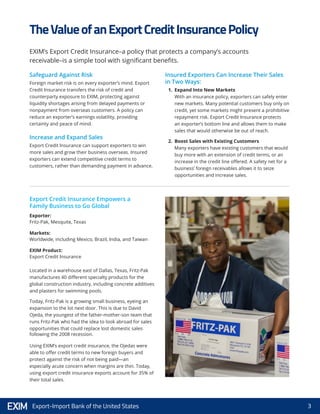
Located in a warehouse east of Dallas, Texas, Fritz-Pak
manufactures 40 different specialty products for the
global construction industry, including concrete additives
and plasters for swimming pools.
Today, Fritz-Pak is a growing small business, eyeing an
expansion to the lot next door. This is due to David
Ojeda, the youngest of the father-mother-son team that
runs Fritz-Pak who had the idea to look abroad for sales
opportunities that could replace lost domestic sales
following the 2008 recession.
Using EXIM’s export credit insurance, the Ojedas were
able to offer credit terms to new foreign buyers and
protect against the risk of not being paid—an
especially acute concern when margins are thin. Today,
using export credit insurance exports account for 35% of
their total sales.
Exporter:
Fritz-Pak, Mesquite, Texas
Markets:
Worldwide, including Mexico, Brazil, India, and Taiwan
EXIM Product:
Export Credit Insurance
TheValueofanExportCreditInsurancePolicy
EXIM’s Export Credit Insurance–a policy that protects a company’s accounts
receivable–is a simple tool with significant benefits.
Export Credit Insurance Empowers a
Family Business to Go Global
4Export-Import Bank of the United States
Unlock More Attractive Bank Financing
Cash flow concerns reign supreme for exporters. EXIM’s
Export Credit Insurance can help businesses access the
liquidity needed to fulfill orders and pay for day-to-day
operations. With a policy in hand, insured exporters
have greater borrowing power. Some banks require
Export Credit Insurance to lend against foreign
receivables. In other instances, banks will offer higher
advance rates for insured receivables. In both cases,
Export Credit Insurance turns the same collateral into a
greater borrowing base. In essence: same receivables,
but better cash flow.
Transfer the Burden of Credit Management
Exporters have enough on their plates: seeking sales,
navigating logistics, managing employees, making
products, and so on. The one thing they don’t have is
time. Export Credit Insurance can help by easing the
burden of credit risk management that prevents
businesses from focusing on their core operations.
A relationship with EXIM and its credit management
expertise can improve receivables management from
buyer assessment to protection to collection. With EXIM
in their corner, exporters can have more productive
days and restful nights.
Realize Tax Benefits
Companies offering credit terms generally account for
a “bad debt” or “loss” reserve–that is, an account set
aside to offset anticipated nonpayment on outstanding
accounts receivable. Unlike bad debt reserves, however,
the premium paid for an Export Credit Insurance policy
is tax-deductible*. With insured receivables, companies
can lower bad debt reserves and taxable income,
decreasing risk and increasing their bottom line.
TheValueofanExportCreditInsurancePolicy
(continued)
EXIM has experienced export finance
professionals located throughout the
United States. To get in touch, call
1-800-565-EXIM (3946) or request a free
consultation today1
* Not all companies are eligible for the aforementioned
tax deduction. Please check with your tax professional
to determine your company’s eligibility for
this deduction.
1. grow.exim.gov/contact-a-trade-finance-specialist
5Export-Import Bank of the United States
EXIM’s policies cover both commercial risk (e.g.,
bankruptcy) as well as political risk (e.g., war or the
inconvertibility of currency).
•	 Commercial risk means an exporter’s buyer went
	 insolvent or bankrupt, or there is a protracted
	 default on payment.
•	 Political risks include actions taken by a
	 government that prevents an exporter from
	 receiving payment and/or recovering goods. This
could be war, insurrection, cancellation of licenses,
or inconvertibility of currency.
HowExportCreditInsuranceWorks
What Credit Insurance Actually Covers
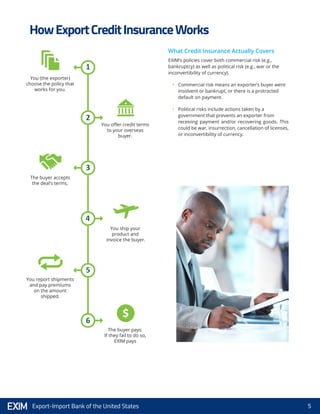
1
2
3
4
5
6
You (the exporter)
choose the policy that
works for you.
The buyer accepts
the deal’s terms.
You offer credit terms
to your overseas
buyer.
You report shipments
and pay premiums
on the amount
shipped.
You ship your
product and
invoice the buyer.
The buyer pays.
If they fail to do so,
EXIM pays
6Export-Import Bank of the United States
HowExportCreditInsuranceWorks(continued)
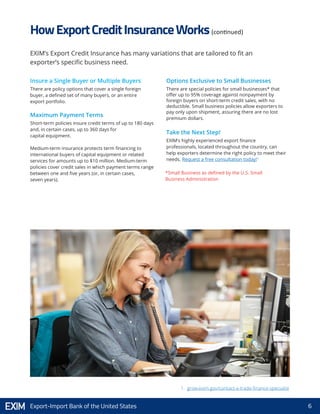
EXIM’s Export Credit Insurance has many variations that are tailored to fit an
exporter’s specific business need.
Insure a Single Buyer or Multiple Buyers
There are policy options that cover a single foreign
buyer, a defined set of many buyers, or an entire
export portfolio.
Maximum Payment Terms
Short-term policies insure credit terms of up to 180 days
and, in certain cases, up to 360 days for
capital equipment.
Medium-term insurance protects term financing to
international buyers of capital equipment or related
services for amounts up to $10 million. Medium-term
policies cover credit sales in which payment terms range
between one and five years (or, in certain cases,
seven years).
Options Exclusive to Small Businesses
There are special policies for small businesses* that
offer up to 95% coverage against nonpayment by
foreign buyers on short-term credit sales, with no
deductible. Small business policies allow exporters to
pay only upon shipment, assuring there are no lost
premium dollars.
Take the Next Step!
EXIM’s highly experienced export finance
professionals, located throughout the country, can
help exporters determine the right policy to meet their
needs. Request a free consultation today!1
*Small Business as defined by the U.S. Small
Business Administration
1. grow.exim.gov/contact-a-trade-finance-specialist
7Export-Import Bank of the United States
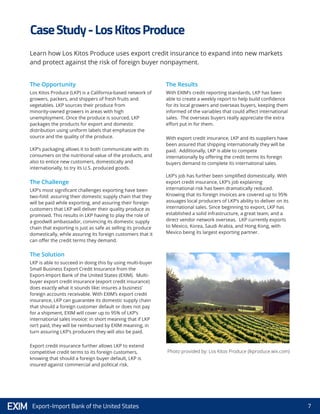
Photo provided by: Los Kitos Produce (lkproduce.wix.com)
Learn how Los Kitos Produce uses export credit insurance to expand into new markets
and protect against the risk of foreign buyer nonpayment.
The Opportunity
Los Kitos Produce (LKP) is a California-based network of
growers, packers, and shippers of fresh fruits and
vegetables. LKP sources their produce from
minority-owned growers in areas with high
unemployment. Once the produce is sourced, LKP
packages the products for export and domestic
distribution using uniform labels that emphasize the
source and the quality of the produce.
LKP’s packaging allows it to both communicate with its
consumers on the nutritional value of the products, and
also to entice new customers, domestically and
internationally, to try its U.S. produced goods.
The Challenge
LKP’s most significant challenges exporting have been
two-fold: assuring their domestic supply chain that they
will be paid while exporting, and assuring their foreign
customers that LKP will deliver their quality produce as
promised. This results in LKP having to play the role of
a goodwill ambassador, convincing its domestic supply
chain that exporting is just as safe as selling its produce
domestically, while assuring its foreign customers that it
can offer the credit terms they demand.
The Solution
LKP is able to succeed in doing this by using multi-buyer
Small Business Export Credit Insurance from the
Export-Import Bank of the United States (EXIM). Multi-
buyer export credit insurance (export credit insurance)
does exactly what it sounds like: insures a business’
foreign accounts receivable. With EXIM’s export credit
insurance, LKP can guarantee its domestic supply chain
that should a foreign customer default or does not pay
for a shipment, EXIM will cover up to 95% of LKP’s
international sales invoice: in short meaning that if LKP
isn’t paid, they will be reimbursed by EXIM meaning, in
turn assuring LKP’s producers they will also be paid.
Export credit insurance further allows LKP to extend
competitive credit terms to its foreign customers,
knowing that should a foreign buyer default, LKP is
insured against commercial and political risk.
The Results
With EXIM’s credit reporting standards, LKP has been
able to create a weekly report to help build confidence
for its local growers and overseas buyers, keeping them
informed of the variables that could affect international
sales. The overseas buyers really appreciate the extra
effort put in for them.
With export credit insurance, LKP and its suppliers have
been assured that shipping internationally they will be
paid. Additionally, LKP is able to compete
internationally by offering the credit terms its foreign
buyers demand to complete its international sales.
LKP’s job has further been simplified domestically. With
export credit insurance, LKP’s job explaining
international risk has been dramatically reduced.
Knowing that its foreign invoices are covered up to 95%
assuages local producers of LKP’s ability to deliver on its
international sales. Since beginning to export, LKP has
established a solid infrastructure, a great team, and a
direct vendor network overseas. LKP currently exports
to Mexico, Korea, Saudi Arabia, and Hong Kong, with
Mexico being its largest exporting partner.
CaseStudy-LosKitosProduce
8Export-Import Bank of the United States
Eligibility for EXIM Support
Businesses meet basic eligibility requirements to
receive EXIM support if they:
•	 Have been in business for at least one year
•	 Have at least one person working in the firm
full-time
•	 Have a positive net worth
•	 Export products and/or services that have more
than 50% U.S. content based on all direct and
indirect costs (e.g. labor, materials, and
administrative costs)
Additional Requirements and Restrictions
Goods and services must be exported from the U.S.
EXIM does not provide support for content shipped
from foreign ports.
Export destinations must not be restricted countries
EXIM can support exports to most markets. There are
some export destinations, however, that are not
eligible for support. EXIM’s Country Limitation
Schedule2
provides an up-to-date listing of
approved countries.
Exports must be non-military in nature
EXIM is prohibited from financing the export of
defense articles and services. There are exceptions for
“dual use” items (that is, items used for both military
and commercial or civilian applications). More details
are available at www.exim.gov.
What EXIM Does Not Support
EXIM does not provide support for:
•	 Imports
•	 Grants
•	 Early stage start-ups
•	 Crude oil
•	 Direct investment
•	 Personal loans
•	 The purchase of land
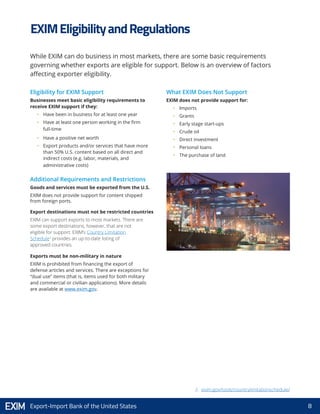
EXIMEligibilityandRegulations
While EXIM can do business in most markets, there are some basic requirements
governing whether exports are eligible for support. Below is an overview of factors
affecting exporter eligibility.
2. exim.gov/tools/countrylimitationschedule/
9Export-Import Bank of the United States
EXIM has experienced export finance
professionals located throughout the United
States. To get in touch, call 1-800-565-EXIM
(3946) or request a free consultation today1
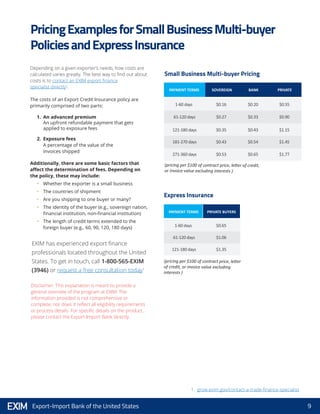
Depending on a given exporter’s needs, how costs are
calculated varies greatly. The best way to find out about
costs is to contact an EXIM export finance
specialist directly1
.
The costs of an Export Credit Insurance policy are
primarily comprised of two parts:
1.	 An advanced premium
	 An upfront refundable payment that gets
	 applied to exposure fees
2.	 Exposure fees
	 A percentage of the value of the
	 invoices shipped
Additionally, there are some basic factors that
affect the determination of fees. Depending on
the policy, these may include:
•	 Whether the exporter is a small business
•	 The countries of shipment
•	 Are you shipping to one buyer or many?
•	 The identity of the buyer (e.g., sovereign nation,
financial institution, non-financial institution)
•	 The length of credit terms extended to the
foreign buyer (e.g., 60, 90, 120, 180 days)
PricingExamplesforSmallBusinessMulti-buyer
PoliciesandExpressInsurance
Small Business Multi-buyer Pricing
Express Insurance
(pricing per $100 of contract price, letter of credit,
or invoice value excluding interests )
(pricing per $100 of contract price, letter
of credit, or invoice value excluding
interests )
PAYMENT TERMS
PAYMENT TERMS PRIVATE BUYERS
SOVEREIGN BANK PRIVATE
Disclaimer: This explanation is meant to provide a
general overview of the program at EXIM. The
information provided is not comprehensive or
complete, nor does it reflect all eligibility requirements
or process details. For specific details on the product,
please contact the Export-Import Bank directly.
1. grow.exim.gov/contact-a-trade-finance-specialist
1-60 days
1-60 days
$0.16
$0.65
$0.20 $0.55
61-120 days
61-120 days
$0.27
$1.06
$0.33 $0.90
121-180 days
121-180 days
$0.35
$1.35
$0.43 $1.15
181-270 days $0.43 $0.54 $1.45
271-360 days $0.53 $0.65 $1.77

Eci e book

  • 1.
  • 2.
    2Export-Import Bank ofthe United States For U.S. businesses, international markets can represent both tremendous opportunity and daunting risk. The Export-Import Bank of the United States’ (EXIM) Export Credit Insurance equips U.S. companies to win international sales while taking risk out of the export equation. While businesses are well acquainted with the concept of insurance and the importance of managing risk, ac- counts receivable are often the largest uninsured asset on a company’s balance sheet. Export Credit Insurance allows exporters to safeguard their foreign receivables, transferring the risk of nonpayment by overseas customers to EXIM. Like any insurance policy, the exporter pays a premium and gets protection in return. In this case, if a foreign buyer purchases on credit terms and fails to pay, EXIM pays the exporter up to 95% of the invoice value. The benefits of Export Credit Insurance can be significant. The protection of a policy gives businesses the confidence necessary to enter new markets and chart a path forward with margins they can depend on. With this security in hand, exporters can increase their global competitiveness by offering the credit terms needed to win sales. Moreover, Export Credit Insurance empowers companies to overcome cash flow obstacles, by borrowing against their insured receivables. The nuts and bolts of a policy are simpler than one might imagine. This guide will offer a snapshot of the value, process, and applicability of EXIM’s Export Credit Insurance options. Introduction to Export Credit Insurance The Value of an Export Credit Insurance Policy How Export Credit Insurance Works Case Study-Los Kitos Produce EXIM Eligibility and Regulations Pricing Details on Small Business Multi-buyer Polices and Express Insurance 2 3 5 7 8 9 IntroductiontoExportCreditInsurance Table of Contents The Export-Import Bank of the United States (EXIM) is the official export credit agency of the United States. It empowers U.S. companies–large and small–to turn export opportunities into real sales that help to maintain and create U.S. jobs and contribute to a stronger national economy. EXIM does not compete with the private sector, but rather provides export financing support that fills the gaps in trade financing. No transaction or firm is too small. On average, more than 85% of EXIM transactions directly benefit U.S. small businesses.
  • 3.
    3Export-Import Bank ofthe United States Safeguard Against Risk Foreign market risk is on every exporter’s mind. Export Credit Insurance transfers the risk of credit and counterparty exposure to EXIM, protecting against liquidity shortages arising from delayed payments or nonpayment from overseas customers. A policy can reduce an exporter’s earnings volatility, providing certainty and peace of mind. Increase and Expand Sales Export Credit Insurance can support exporters to win more sales and grow their business overseas. Insured exporters can extend competitive credit terms to customers, rather than demanding payment in advance. Insured Exporters Can Increase Their Sales in Two Ways: 1. Expand Into New Markets With an insurance policy, exporters can safely enter new markets. Many potential customers buy only on credit, yet some markets might present a prohibitive repayment risk. Export Credit Insurance protects an exporter’s bottom line and allows them to make sales that would otherwise be out of reach. 2. Boost Sales with Existing Customers Many exporters have existing customers that would buy more with an extension of credit terms, or an increase in the credit line offered. A safety net for a business’ foreign receivables allows it to seize opportunities and increase sales. Located in a warehouse east of Dallas, Texas, Fritz-Pak manufactures 40 different specialty products for the global construction industry, including concrete additives and plasters for swimming pools. Today, Fritz-Pak is a growing small business, eyeing an expansion to the lot next door. This is due to David Ojeda, the youngest of the father-mother-son team that runs Fritz-Pak who had the idea to look abroad for sales opportunities that could replace lost domestic sales following the 2008 recession. Using EXIM’s export credit insurance, the Ojedas were able to offer credit terms to new foreign buyers and protect against the risk of not being paid—an especially acute concern when margins are thin. Today, using export credit insurance exports account for 35% of their total sales. Exporter: Fritz-Pak, Mesquite, Texas Markets: Worldwide, including Mexico, Brazil, India, and Taiwan EXIM Product: Export Credit Insurance TheValueofanExportCreditInsurancePolicy EXIM’s Export Credit Insurance–a policy that protects a company’s accounts receivable–is a simple tool with significant benefits. Export Credit Insurance Empowers a Family Business to Go Global
  • 4.
    4Export-Import Bank ofthe United States Unlock More Attractive Bank Financing Cash flow concerns reign supreme for exporters. EXIM’s Export Credit Insurance can help businesses access the liquidity needed to fulfill orders and pay for day-to-day operations. With a policy in hand, insured exporters have greater borrowing power. Some banks require Export Credit Insurance to lend against foreign receivables. In other instances, banks will offer higher advance rates for insured receivables. In both cases, Export Credit Insurance turns the same collateral into a greater borrowing base. In essence: same receivables, but better cash flow. Transfer the Burden of Credit Management Exporters have enough on their plates: seeking sales, navigating logistics, managing employees, making products, and so on. The one thing they don’t have is time. Export Credit Insurance can help by easing the burden of credit risk management that prevents businesses from focusing on their core operations. A relationship with EXIM and its credit management expertise can improve receivables management from buyer assessment to protection to collection. With EXIM in their corner, exporters can have more productive days and restful nights. Realize Tax Benefits Companies offering credit terms generally account for a “bad debt” or “loss” reserve–that is, an account set aside to offset anticipated nonpayment on outstanding accounts receivable. Unlike bad debt reserves, however, the premium paid for an Export Credit Insurance policy is tax-deductible*. With insured receivables, companies can lower bad debt reserves and taxable income, decreasing risk and increasing their bottom line. TheValueofanExportCreditInsurancePolicy (continued) EXIM has experienced export finance professionals located throughout the United States. To get in touch, call 1-800-565-EXIM (3946) or request a free consultation today1 * Not all companies are eligible for the aforementioned tax deduction. Please check with your tax professional to determine your company’s eligibility for this deduction. 1. grow.exim.gov/contact-a-trade-finance-specialist
  • 5.
    5Export-Import Bank ofthe United States EXIM’s policies cover both commercial risk (e.g., bankruptcy) as well as political risk (e.g., war or the inconvertibility of currency). • Commercial risk means an exporter’s buyer went insolvent or bankrupt, or there is a protracted default on payment. • Political risks include actions taken by a government that prevents an exporter from receiving payment and/or recovering goods. This could be war, insurrection, cancellation of licenses, or inconvertibility of currency. HowExportCreditInsuranceWorks What Credit Insurance Actually Covers 1 2 3 4 5 6 You (the exporter) choose the policy that works for you. The buyer accepts the deal’s terms. You offer credit terms to your overseas buyer. You report shipments and pay premiums on the amount shipped. You ship your product and invoice the buyer. The buyer pays. If they fail to do so, EXIM pays
  • 6.
    6Export-Import Bank ofthe United States HowExportCreditInsuranceWorks(continued) EXIM’s Export Credit Insurance has many variations that are tailored to fit an exporter’s specific business need. Insure a Single Buyer or Multiple Buyers There are policy options that cover a single foreign buyer, a defined set of many buyers, or an entire export portfolio. Maximum Payment Terms Short-term policies insure credit terms of up to 180 days and, in certain cases, up to 360 days for capital equipment. Medium-term insurance protects term financing to international buyers of capital equipment or related services for amounts up to $10 million. Medium-term policies cover credit sales in which payment terms range between one and five years (or, in certain cases, seven years). Options Exclusive to Small Businesses There are special policies for small businesses* that offer up to 95% coverage against nonpayment by foreign buyers on short-term credit sales, with no deductible. Small business policies allow exporters to pay only upon shipment, assuring there are no lost premium dollars. Take the Next Step! EXIM’s highly experienced export finance professionals, located throughout the country, can help exporters determine the right policy to meet their needs. Request a free consultation today!1 *Small Business as defined by the U.S. Small Business Administration 1. grow.exim.gov/contact-a-trade-finance-specialist
  • 7.
    7Export-Import Bank ofthe United States Photo provided by: Los Kitos Produce (lkproduce.wix.com) Learn how Los Kitos Produce uses export credit insurance to expand into new markets and protect against the risk of foreign buyer nonpayment. The Opportunity Los Kitos Produce (LKP) is a California-based network of growers, packers, and shippers of fresh fruits and vegetables. LKP sources their produce from minority-owned growers in areas with high unemployment. Once the produce is sourced, LKP packages the products for export and domestic distribution using uniform labels that emphasize the source and the quality of the produce. LKP’s packaging allows it to both communicate with its consumers on the nutritional value of the products, and also to entice new customers, domestically and internationally, to try its U.S. produced goods. The Challenge LKP’s most significant challenges exporting have been two-fold: assuring their domestic supply chain that they will be paid while exporting, and assuring their foreign customers that LKP will deliver their quality produce as promised. This results in LKP having to play the role of a goodwill ambassador, convincing its domestic supply chain that exporting is just as safe as selling its produce domestically, while assuring its foreign customers that it can offer the credit terms they demand. The Solution LKP is able to succeed in doing this by using multi-buyer Small Business Export Credit Insurance from the Export-Import Bank of the United States (EXIM). Multi- buyer export credit insurance (export credit insurance) does exactly what it sounds like: insures a business’ foreign accounts receivable. With EXIM’s export credit insurance, LKP can guarantee its domestic supply chain that should a foreign customer default or does not pay for a shipment, EXIM will cover up to 95% of LKP’s international sales invoice: in short meaning that if LKP isn’t paid, they will be reimbursed by EXIM meaning, in turn assuring LKP’s producers they will also be paid. Export credit insurance further allows LKP to extend competitive credit terms to its foreign customers, knowing that should a foreign buyer default, LKP is insured against commercial and political risk. The Results With EXIM’s credit reporting standards, LKP has been able to create a weekly report to help build confidence for its local growers and overseas buyers, keeping them informed of the variables that could affect international sales. The overseas buyers really appreciate the extra effort put in for them. With export credit insurance, LKP and its suppliers have been assured that shipping internationally they will be paid. Additionally, LKP is able to compete internationally by offering the credit terms its foreign buyers demand to complete its international sales. LKP’s job has further been simplified domestically. With export credit insurance, LKP’s job explaining international risk has been dramatically reduced. Knowing that its foreign invoices are covered up to 95% assuages local producers of LKP’s ability to deliver on its international sales. Since beginning to export, LKP has established a solid infrastructure, a great team, and a direct vendor network overseas. LKP currently exports to Mexico, Korea, Saudi Arabia, and Hong Kong, with Mexico being its largest exporting partner. CaseStudy-LosKitosProduce
  • 8.
    8Export-Import Bank ofthe United States Eligibility for EXIM Support Businesses meet basic eligibility requirements to receive EXIM support if they: • Have been in business for at least one year • Have at least one person working in the firm full-time • Have a positive net worth • Export products and/or services that have more than 50% U.S. content based on all direct and indirect costs (e.g. labor, materials, and administrative costs) Additional Requirements and Restrictions Goods and services must be exported from the U.S. EXIM does not provide support for content shipped from foreign ports. Export destinations must not be restricted countries EXIM can support exports to most markets. There are some export destinations, however, that are not eligible for support. EXIM’s Country Limitation Schedule2 provides an up-to-date listing of approved countries. Exports must be non-military in nature EXIM is prohibited from financing the export of defense articles and services. There are exceptions for “dual use” items (that is, items used for both military and commercial or civilian applications). More details are available at www.exim.gov. What EXIM Does Not Support EXIM does not provide support for: • Imports • Grants • Early stage start-ups • Crude oil • Direct investment • Personal loans • The purchase of land EXIMEligibilityandRegulations While EXIM can do business in most markets, there are some basic requirements governing whether exports are eligible for support. Below is an overview of factors affecting exporter eligibility. 2. exim.gov/tools/countrylimitationschedule/
  • 9.
    9Export-Import Bank ofthe United States EXIM has experienced export finance professionals located throughout the United States. To get in touch, call 1-800-565-EXIM (3946) or request a free consultation today1 Depending on a given exporter’s needs, how costs are calculated varies greatly. The best way to find out about costs is to contact an EXIM export finance specialist directly1 . The costs of an Export Credit Insurance policy are primarily comprised of two parts: 1. An advanced premium An upfront refundable payment that gets applied to exposure fees 2. Exposure fees A percentage of the value of the invoices shipped Additionally, there are some basic factors that affect the determination of fees. Depending on the policy, these may include: • Whether the exporter is a small business • The countries of shipment • Are you shipping to one buyer or many? • The identity of the buyer (e.g., sovereign nation, financial institution, non-financial institution) • The length of credit terms extended to the foreign buyer (e.g., 60, 90, 120, 180 days) PricingExamplesforSmallBusinessMulti-buyer PoliciesandExpressInsurance Small Business Multi-buyer Pricing Express Insurance (pricing per $100 of contract price, letter of credit, or invoice value excluding interests ) (pricing per $100 of contract price, letter of credit, or invoice value excluding interests ) PAYMENT TERMS PAYMENT TERMS PRIVATE BUYERS SOVEREIGN BANK PRIVATE Disclaimer: This explanation is meant to provide a general overview of the program at EXIM. The information provided is not comprehensive or complete, nor does it reflect all eligibility requirements or process details. For specific details on the product, please contact the Export-Import Bank directly. 1. grow.exim.gov/contact-a-trade-finance-specialist 1-60 days 1-60 days $0.16 $0.65 $0.20 $0.55 61-120 days 61-120 days $0.27 $1.06 $0.33 $0.90 121-180 days 121-180 days $0.35 $1.35 $0.43 $1.15 181-270 days $0.43 $0.54 $1.45 271-360 days $0.53 $0.65 $1.77