An eHealth Business Model  for Independent Living Systems Ghent University - IBBT Jan Van Ooteghem
Outline Introduction Methodology Two generic business models Elaborated model for the Flemish situation Conclusions & future work
eHealth definition “A consumer-centred model of health care  where stakeholders collaborate,  utilizing ICT, including Internet technologies,  to manage health, arrange, deliver and account for care,  and manage the health care system” Source: H. Oh & al, “What Is eHealth”
Objectives Is there a market for implementing new technologies and services in the current health sector?  What are the needs of the potential end users?  Which actors will participate in the value chain?  Can a profitable system be developed?
Value added functionalities Supporting organisational health care processes Combination of all current/new information systems All systems seamlessly connected + data exchange Full proof authentication system Personal network for each user Accessible anytime, anywhere Supporting community aspects Purpose: decrease social isolation Different services: video communication, entertainment, … Additionally: Observation of the patient
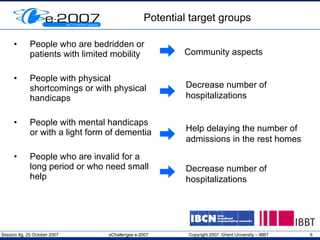
Potential target groups People who are bedridden or patients with limited mobility People with physical shortcomings or with physical handicaps People with mental handicaps or with a light form of dementia People who are invalid for a long period or who need small help Community aspects Help delaying the number of admissions in the rest homes Decrease number of hospitalizations Decrease number of hospitalizations
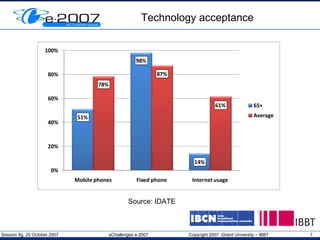
Technology acceptance Source: IDATE
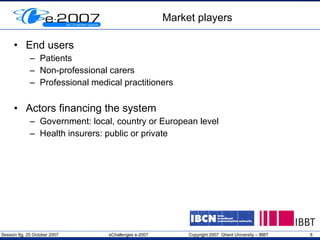
Market players End users Patients Non-professional carers  Professional medical practitioners Actors financing the system Government: local, country or European level Health insurers: public or private
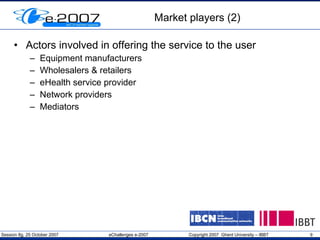
Market players (2) Actors involved in offering the service to the user Equipment manufacturers Wholesalers & retailers eHealth service provider Network providers Mediators
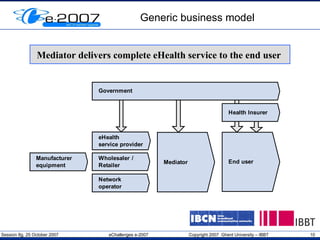
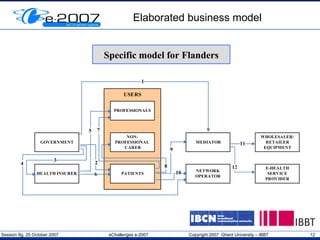
Generic business model Mediator delivers complete eHealth service to the end user
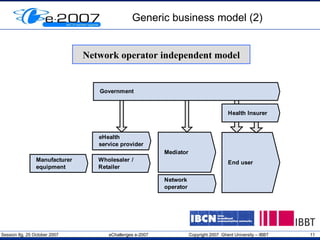
Generic business model (2) Network operator independent model
Elaborated business model Specific model for Flanders
Conclusions & future work Conclusions: Current health sector will have to reorganize The introduction of eHealth services could be a solution to keep control of the overall health care budget Especially the government will have to take initiatives to create a market through legislative changes and financial contributions  Value will be created throughout the system and benefits will outrun the overall costs in the long term Future work Further elaboration of the current model Cost based study of the introduction of eHealth services IBBT TranseCare project
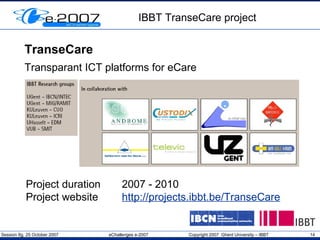
IBBT TranseCare project TranseCare Transparant ICT platforms for eCare Project duration 2007 - 2010 Project website http://projects.ibbt.be/TranseCare
Personal details: Name: Company: Phone: E-mail: Jan Van Ooteghem Ghent University – IBBT +32 9 331 49 81 [email_address] Thank you for your attention Questions?

eChallenges 2007 Van Ooteghem

  • 1.
    An eHealth BusinessModel for Independent Living Systems Ghent University - IBBT Jan Van Ooteghem
  • 2.
    Outline Introduction MethodologyTwo generic business models Elaborated model for the Flemish situation Conclusions & future work
  • 3.
    eHealth definition “Aconsumer-centred model of health care where stakeholders collaborate, utilizing ICT, including Internet technologies, to manage health, arrange, deliver and account for care, and manage the health care system” Source: H. Oh & al, “What Is eHealth”
  • 4.
    Objectives Is therea market for implementing new technologies and services in the current health sector? What are the needs of the potential end users? Which actors will participate in the value chain? Can a profitable system be developed?
  • 5.
    Value added functionalitiesSupporting organisational health care processes Combination of all current/new information systems All systems seamlessly connected + data exchange Full proof authentication system Personal network for each user Accessible anytime, anywhere Supporting community aspects Purpose: decrease social isolation Different services: video communication, entertainment, … Additionally: Observation of the patient
  • 6.
    Potential target groupsPeople who are bedridden or patients with limited mobility People with physical shortcomings or with physical handicaps People with mental handicaps or with a light form of dementia People who are invalid for a long period or who need small help Community aspects Help delaying the number of admissions in the rest homes Decrease number of hospitalizations Decrease number of hospitalizations
  • 7.
  • 8.
    Market players Endusers Patients Non-professional carers Professional medical practitioners Actors financing the system Government: local, country or European level Health insurers: public or private
  • 9.
    Market players (2)Actors involved in offering the service to the user Equipment manufacturers Wholesalers & retailers eHealth service provider Network providers Mediators
  • 10.
    Generic business modelMediator delivers complete eHealth service to the end user
  • 11.
    Generic business model(2) Network operator independent model
  • 12.
    Elaborated business modelSpecific model for Flanders
  • 13.
    Conclusions & futurework Conclusions: Current health sector will have to reorganize The introduction of eHealth services could be a solution to keep control of the overall health care budget Especially the government will have to take initiatives to create a market through legislative changes and financial contributions Value will be created throughout the system and benefits will outrun the overall costs in the long term Future work Further elaboration of the current model Cost based study of the introduction of eHealth services IBBT TranseCare project
  • 14.
    IBBT TranseCare projectTranseCare Transparant ICT platforms for eCare Project duration 2007 - 2010 Project website http://projects.ibbt.be/TranseCare
  • 15.
    Personal details: Name:Company: Phone: E-mail: Jan Van Ooteghem Ghent University – IBBT +32 9 331 49 81 [email_address] Thank you for your attention Questions?

Editor's Notes

  • #5 A good analysis of the market, profiles of the potential users and costs/benefits for implementing an eHealth system are essential.
  • #7 Slide toevoegen met redenen van de opsplitsing: mobiliteit, monitoring, controleren medische waarden, … (zie paper)
  • #8 Belgium? IDATE rapport bekijken