Business Modelling to advance the development
and implementation of eHealth technologies
                                  Maarten van Limburg, MSc, BEng
                                  Elly Kloeze, MSc


                                  30 November 2010, Maastricht
MAARTEN VAN LIMBURG, MSC, BENG

 Background in Business IT and Innovation Management


 MSc project: Business model for a Dutch PHR service


 PhD Student: “eHealth Business Modelling”
 Eursafety Health-net project


                                              Business Modelling in eHealth   06/12/2010   2
IN THIS TALK

 Why the implementation requires attention
 Explanation on business models and business modelling
 Why business modelling in eHealth
 Introduction of CeHRes Roadmap


 Example case: Business Modelling for a teledermatology project


 Current projects and future research


                                              Business Modelling in eHealth   06/12/2010   3
IMPROVING eHEALTH TECHNOLOGIES

 More focus on how to improve eHealth technologies


 User-/Human-Centered Design
   Involving the users of the technology
   Improving usability
   eHealth technologies reflect users needs and behaviour better
   Persuasive technology


                                            Business Modelling in eHealth   06/12/2010   4
IMPLEMENTATION OF eHEALTH TECHNOLOGIES

 Implementation of eHealth technologies still problematic:
   eHealth technologies don’t catch on in practice
   Lacking support from insurance companies, health professionals, etc
   No self-sustaining revenue model
   Fragmented – difficult to scale up
   Too technology-driven


                                             Business Modelling in eHealth   06/12/2010   5
STAKEHOLDERS

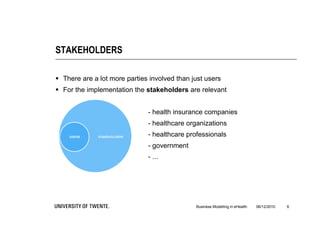
 There are a lot more parties involved than just users
 For the implementation the stakeholders are relevant


                              - health insurance companies
                              - healthcare organizations
                              - healthcare professionals
                              - government
                              - ...


                                              Business Modelling in eHealth   06/12/2010   6
STAKEHOLDERS

 Stakeholders aren’t neccesarily users of the technology
 “Anyone who affects or gets affected by the technology” (Freeman)


 Stakeholder types: policymakers, vendors, insurers, healthcare
  organizations and providers, home care, employers and patients (Cain)


 Every eHealth technology will have its own, specific stakeholder network
  (sometimes also refered to as ecosystem)


                                             Business Modelling in eHealth   06/12/2010   7
STAKEHOLDERS EXPECT VALUE

 Stakeholders expect certain benefits in return for participating in the
  eHealth technology.
   “one good turn deserves another” (Proverb)
   Something valuable


   How can we make the implementation value-driven?


                                                Business Modelling in eHealth   06/12/2010   8
BUSINESS MODELS

 “a business model is the rationale of how an organization creates,
  delivers and captures value” (Osterwalder)


 Used in strategic management to assess innovations
 Basis for implementing an eHealth technology:
   Assessing the implementation a priori
   Guideline for operationalizing the technology in practice


                                              Business Modelling in eHealth   06/12/2010   9
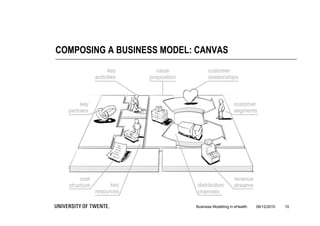
COMPOSING A BUSINESS MODEL: CANVAS


                           Business Modelling in eHealth   06/12/2010   10
BUSINESS MODELLING

 Involving stakeholders in composing the business model, they need to
  accept the implementation after all.
   Discovering what value they want
   Consensus, finding a fit (HOT-fit)
   Co-creation
   Continuous process


                                            Business Modelling in eHealth   06/12/2010   11
SO WHY BUSINESS MODELLING IN EHEALTH?

 As said, it can help the implementation:
   Sustainability
   Cost-effectiveness


 Holistic approach
 Value-driven
 Co-creation and collaboration
 Flexible and reflective


                                             Business Modelling in eHealth   06/12/2010   12
DEVELOPING IS IMPLEMENTING

 Makes the whole development process value-driven
   If stakeholders find something valuable, make it, implement it
   And if they don’t, don’t!


 Implementation influences development
 Development influences implementation


 The environment determines, not only one party (outside-in)


                                              Business Modelling in eHealth   06/12/2010   13
DEALING WITH MULTIDISCIPLINARITY

 eHealth is multidisciplinary (Pagliari)
   Brings different types of stakeholders together
   Diverse values
   “Value” can act as a common ground:
      # of patients
      $$$
      Quality
   Work to a consensus or fit


                                              Business Modelling in eHealth   06/12/2010   14
STAKEHOLDER NETWORK BECOMES A PLATFORM

 Multidisciplinary nature means that collaboration is important


 Getting the group who need to eventually collaboration together whilst
  implementing
   If it doesn’t work now, it won’t work later either
   Finding the context of the problem


                                                Business Modelling in eHealth   06/12/2010   15
OPENNESS

 Collaboration requires openness
   Open business models (Chesbrough)
      Disease Management -> Organizational barriers fade
   Willingness to co-create
   Using standards


 Avoid problems from fragmentation


                                           Business Modelling in eHealth   06/12/2010   16
FLEXIBILITY AND EVALUATION

 Formative evaluation
   A business model grows:
      Discovery driven (McGrath)
      Evaluate assumptions
   Environment is dynamic


 Summative evaluation
   Technologies and implementations aren’t forever
   Still feasible/sustainable/cost-effective? Or re-design?


                                               Business Modelling in eHealth   06/12/2010   17
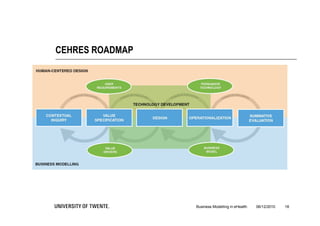
CEHRES ROADMAP


                 Business Modelling in eHealth   06/12/2010   18
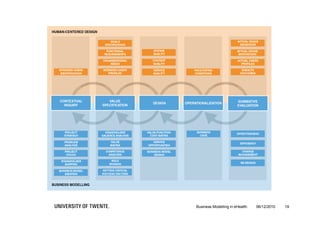
CEHRES ROADMAP - INSTRUMENTS


                           Business Modelling in eHealth   06/12/2010   19
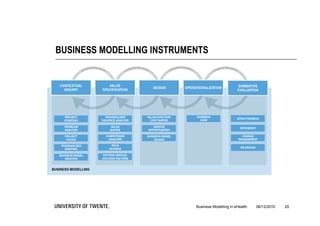
BUSINESS MODELLING INSTRUMENTS


                           Business Modelling in eHealth   06/12/2010   20
ELLY KLOEZE, MSC

 Background in Health Science & Policy


 MSc project: Business model for a Teledermatology project


 Researcher on business modelling for diabetic foot care and Pal4.


                                             Business Modelling in eHealth   06/12/2010   21
EXAMPLE CASE: Teledermatology

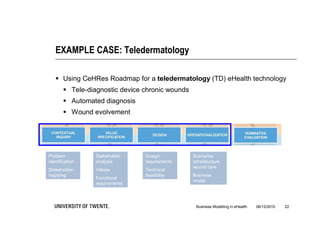
    Using CeHRes Roadmap for a teledermatology (TD) eHealth technology
         Tele-diagnostic device chronic wounds
         Automated diagnosis
         Wound evolvement


Problem           Stakeholder    Design           Scenarios
identification    analysis       requirements     Infrastructure
                                                  wound care
Stakeholder-      Values         Technical
mapping                          feasibility      Business
                  Functional
                                                  model
                  requirements


                                                   Business Modelling in eHealth   06/12/2010   22
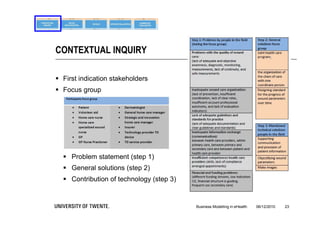
CONTEXTUAL INQUIRY

 First indication stakeholders
 Focus group


   Problem statement (step 1)
   General solutions (step 2)
   Contribution of technology (step 3)


                                          Business Modelling in eHealth   06/12/2010   23
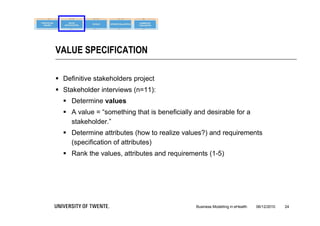
VALUE SPECIFICATION

 Definitive stakeholders project
 Stakeholder interviews (n=11):
   Determine values
   A value = “something that is beneficially and desirable for a
    stakeholder.”
   Determine attributes (how to realize values?) and requirements
    (specification of attributes)
   Rank the values, attributes and requirements (1-5)


                                              Business Modelling in eHealth   06/12/2010   24
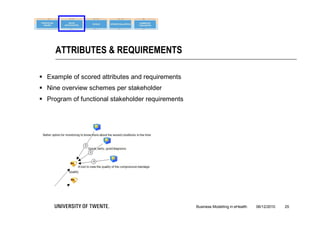
ATTRIBUTES & REQUIREMENTS

 Example of scored attributes and requirements
 Nine overview schemes per stakeholder
 Program of functional stakeholder requirements


                                                   Business Modelling in eHealth   06/12/2010   25
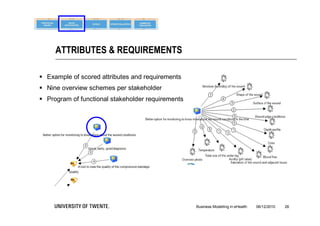
ATTRIBUTES & REQUIREMENTS

 Example of scored attributes and requirements
 Nine overview schemes per stakeholder
 Program of functional stakeholder requirements


                                                   Business Modelling in eHealth   06/12/2010   26
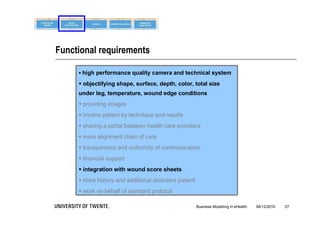
Functional requirements

      high performance quality camera and technical system

      objectifying shape, surface, depth, color, total size
     under leg, temperature, wound edge conditions
      providing images
      involve patient by technique and results
      sharing a portal between health care providers
      more alignment chain of care
      transparency and uniformity of communication
      financial support
      integration with wound score sheets
      store history and additional disorders patient
      work on behalf of standard protocol

                                                        Business Modelling in eHealth   06/12/2010   27
DESIGN

 More specific information about the characteristics of the design and
  format of the TD device
   Examples: handy, disinfection option, stand alone device etc.


 Match stakeholder requirements with technical requirements


                                             Business Modelling in eHealth   06/12/2010   28
OPERATIONALIZATION

 Different scenarios:
   Role of the TD service provider
   Scenario 1: the General Practioner (GP) takes an image of the wound
    and sends the image to the dermatologist
   Scenario 2: the home care nurse takes an image of the wound and
    send the image to the GP


 Interaction networks
   Who pays for which service? Who benefits? Who have a contract with
    whom?


                                           Business Modelling in eHealth   06/12/2010   29
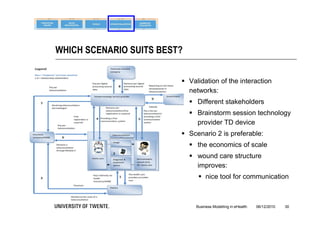
WHICH SCENARIO SUITS BEST?


                          Validation of the interaction
                           networks:
                              Different stakeholders
                              Brainstorm session technology
                               provider TD device
                          Scenario 2 is preferable:
                              the economics of scale
                              wound care structure
                               improves:
                                 nice tool for communication


                               Business Modelling in eHealth   06/12/2010   30
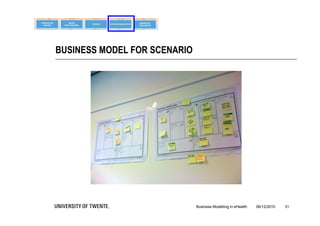
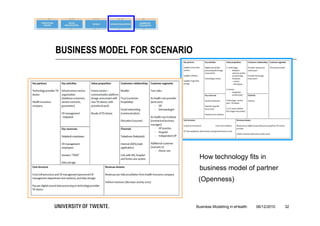
BUSINESS MODEL FOR SCENARIO


                              Business Modelling in eHealth   06/12/2010   31
BUSINESS MODEL FOR SCENARIO


                               How technology fits in
                               business model of partner
                               (Openness)


                              Business Modelling in eHealth   06/12/2010   32
SUMMATIVE EVALUATION

 Can take place after the TD device is deployed


     Test first prototype in clinical setting
     Test advanced prototype
     Results unknown for now
     Robustness roadmap
     Reflect on participatory development process
     Cost effectiveness


                                                 Business Modelling in eHealth   06/12/2010   33
CURRENT PROJECTS AND FUTURE RESEARCH

 Different case settings:
   Eursafety Health-net
   Personal Assistant for life (PAL4)
   Diabetes Interactive Education Program (DIEP)


 Refine and test roadmap, improve robustness


 Added value for the development of eHealth technologies


                                            Business Modelling in eHealth   06/12/2010   34
THANK YOU


E-mail : a.h.m.vanlimburg@utwente.nl
      : e.kloeze@utwente.nl


www : www.ehealthresearchcenter.org


                                       Business Modelling in eHealth   06/12/2010   35

Medicine2.0'10: Business Modelling to advance the development and implementation of eHealth technologies

  • 1.
    Business Modelling toadvance the development and implementation of eHealth technologies Maarten van Limburg, MSc, BEng Elly Kloeze, MSc 30 November 2010, Maastricht
  • 2.
    MAARTEN VAN LIMBURG,MSC, BENG  Background in Business IT and Innovation Management  MSc project: Business model for a Dutch PHR service  PhD Student: “eHealth Business Modelling”  Eursafety Health-net project Business Modelling in eHealth 06/12/2010 2
  • 3.
    IN THIS TALK Why the implementation requires attention  Explanation on business models and business modelling  Why business modelling in eHealth  Introduction of CeHRes Roadmap  Example case: Business Modelling for a teledermatology project  Current projects and future research Business Modelling in eHealth 06/12/2010 3
  • 4.
    IMPROVING eHEALTH TECHNOLOGIES More focus on how to improve eHealth technologies  User-/Human-Centered Design  Involving the users of the technology  Improving usability  eHealth technologies reflect users needs and behaviour better  Persuasive technology Business Modelling in eHealth 06/12/2010 4
  • 5.
    IMPLEMENTATION OF eHEALTHTECHNOLOGIES  Implementation of eHealth technologies still problematic:  eHealth technologies don’t catch on in practice  Lacking support from insurance companies, health professionals, etc  No self-sustaining revenue model  Fragmented – difficult to scale up  Too technology-driven Business Modelling in eHealth 06/12/2010 5
  • 6.
    STAKEHOLDERS  There area lot more parties involved than just users  For the implementation the stakeholders are relevant - health insurance companies - healthcare organizations - healthcare professionals - government - ... Business Modelling in eHealth 06/12/2010 6
  • 7.
    STAKEHOLDERS  Stakeholders aren’tneccesarily users of the technology  “Anyone who affects or gets affected by the technology” (Freeman)  Stakeholder types: policymakers, vendors, insurers, healthcare organizations and providers, home care, employers and patients (Cain)  Every eHealth technology will have its own, specific stakeholder network (sometimes also refered to as ecosystem) Business Modelling in eHealth 06/12/2010 7
  • 8.
    STAKEHOLDERS EXPECT VALUE Stakeholders expect certain benefits in return for participating in the eHealth technology.  “one good turn deserves another” (Proverb)  Something valuable  How can we make the implementation value-driven? Business Modelling in eHealth 06/12/2010 8
  • 9.
    BUSINESS MODELS  “abusiness model is the rationale of how an organization creates, delivers and captures value” (Osterwalder)  Used in strategic management to assess innovations  Basis for implementing an eHealth technology:  Assessing the implementation a priori  Guideline for operationalizing the technology in practice Business Modelling in eHealth 06/12/2010 9
  • 10.
    COMPOSING A BUSINESSMODEL: CANVAS Business Modelling in eHealth 06/12/2010 10
  • 11.
    BUSINESS MODELLING  Involvingstakeholders in composing the business model, they need to accept the implementation after all.  Discovering what value they want  Consensus, finding a fit (HOT-fit)  Co-creation  Continuous process Business Modelling in eHealth 06/12/2010 11
  • 12.
    SO WHY BUSINESSMODELLING IN EHEALTH?  As said, it can help the implementation:  Sustainability  Cost-effectiveness  Holistic approach  Value-driven  Co-creation and collaboration  Flexible and reflective Business Modelling in eHealth 06/12/2010 12
  • 13.
    DEVELOPING IS IMPLEMENTING Makes the whole development process value-driven  If stakeholders find something valuable, make it, implement it  And if they don’t, don’t!  Implementation influences development  Development influences implementation  The environment determines, not only one party (outside-in) Business Modelling in eHealth 06/12/2010 13
  • 14.
    DEALING WITH MULTIDISCIPLINARITY eHealth is multidisciplinary (Pagliari)  Brings different types of stakeholders together  Diverse values  “Value” can act as a common ground:  # of patients  $$$  Quality  Work to a consensus or fit Business Modelling in eHealth 06/12/2010 14
  • 15.
    STAKEHOLDER NETWORK BECOMESA PLATFORM  Multidisciplinary nature means that collaboration is important  Getting the group who need to eventually collaboration together whilst implementing  If it doesn’t work now, it won’t work later either  Finding the context of the problem Business Modelling in eHealth 06/12/2010 15
  • 16.
    OPENNESS  Collaboration requiresopenness  Open business models (Chesbrough)  Disease Management -> Organizational barriers fade  Willingness to co-create  Using standards  Avoid problems from fragmentation Business Modelling in eHealth 06/12/2010 16
  • 17.
    FLEXIBILITY AND EVALUATION Formative evaluation  A business model grows:  Discovery driven (McGrath)  Evaluate assumptions  Environment is dynamic  Summative evaluation  Technologies and implementations aren’t forever  Still feasible/sustainable/cost-effective? Or re-design? Business Modelling in eHealth 06/12/2010 17
  • 18.
    CEHRES ROADMAP Business Modelling in eHealth 06/12/2010 18
  • 19.
    CEHRES ROADMAP -INSTRUMENTS Business Modelling in eHealth 06/12/2010 19
  • 20.
    BUSINESS MODELLING INSTRUMENTS Business Modelling in eHealth 06/12/2010 20
  • 21.
    ELLY KLOEZE, MSC Background in Health Science & Policy  MSc project: Business model for a Teledermatology project  Researcher on business modelling for diabetic foot care and Pal4. Business Modelling in eHealth 06/12/2010 21
  • 22.
    EXAMPLE CASE: Teledermatology  Using CeHRes Roadmap for a teledermatology (TD) eHealth technology  Tele-diagnostic device chronic wounds  Automated diagnosis  Wound evolvement Problem Stakeholder Design Scenarios identification analysis requirements Infrastructure wound care Stakeholder- Values Technical mapping feasibility Business Functional model requirements Business Modelling in eHealth 06/12/2010 22
  • 23.
    CONTEXTUAL INQUIRY  Firstindication stakeholders  Focus group  Problem statement (step 1)  General solutions (step 2)  Contribution of technology (step 3) Business Modelling in eHealth 06/12/2010 23
  • 24.
    VALUE SPECIFICATION  Definitivestakeholders project  Stakeholder interviews (n=11):  Determine values  A value = “something that is beneficially and desirable for a stakeholder.”  Determine attributes (how to realize values?) and requirements (specification of attributes)  Rank the values, attributes and requirements (1-5) Business Modelling in eHealth 06/12/2010 24
  • 25.
    ATTRIBUTES & REQUIREMENTS Example of scored attributes and requirements  Nine overview schemes per stakeholder  Program of functional stakeholder requirements Business Modelling in eHealth 06/12/2010 25
  • 26.
    ATTRIBUTES & REQUIREMENTS Example of scored attributes and requirements  Nine overview schemes per stakeholder  Program of functional stakeholder requirements Business Modelling in eHealth 06/12/2010 26
  • 27.
    Functional requirements  high performance quality camera and technical system  objectifying shape, surface, depth, color, total size under leg, temperature, wound edge conditions  providing images  involve patient by technique and results  sharing a portal between health care providers  more alignment chain of care  transparency and uniformity of communication  financial support  integration with wound score sheets  store history and additional disorders patient  work on behalf of standard protocol Business Modelling in eHealth 06/12/2010 27
  • 28.
    DESIGN  More specificinformation about the characteristics of the design and format of the TD device  Examples: handy, disinfection option, stand alone device etc.  Match stakeholder requirements with technical requirements Business Modelling in eHealth 06/12/2010 28
  • 29.
    OPERATIONALIZATION  Different scenarios:  Role of the TD service provider  Scenario 1: the General Practioner (GP) takes an image of the wound and sends the image to the dermatologist  Scenario 2: the home care nurse takes an image of the wound and send the image to the GP  Interaction networks  Who pays for which service? Who benefits? Who have a contract with whom? Business Modelling in eHealth 06/12/2010 29
  • 30.
    WHICH SCENARIO SUITSBEST?  Validation of the interaction networks:  Different stakeholders  Brainstorm session technology provider TD device  Scenario 2 is preferable:  the economics of scale  wound care structure improves:  nice tool for communication Business Modelling in eHealth 06/12/2010 30
  • 31.
    BUSINESS MODEL FORSCENARIO Business Modelling in eHealth 06/12/2010 31
  • 32.
    BUSINESS MODEL FORSCENARIO How technology fits in business model of partner (Openness) Business Modelling in eHealth 06/12/2010 32
  • 33.
    SUMMATIVE EVALUATION  Cantake place after the TD device is deployed  Test first prototype in clinical setting  Test advanced prototype  Results unknown for now  Robustness roadmap  Reflect on participatory development process  Cost effectiveness Business Modelling in eHealth 06/12/2010 33
  • 34.
    CURRENT PROJECTS ANDFUTURE RESEARCH  Different case settings:  Eursafety Health-net  Personal Assistant for life (PAL4)  Diabetes Interactive Education Program (DIEP)  Refine and test roadmap, improve robustness  Added value for the development of eHealth technologies Business Modelling in eHealth 06/12/2010 34
  • 35.
    THANK YOU E-mail :a.h.m.vanlimburg@utwente.nl : e.kloeze@utwente.nl www : www.ehealthresearchcenter.org Business Modelling in eHealth 06/12/2010 35