Modeling Market Shares of  Competing (e)Care Providers J. Van Ooteghem , T. Tesch, S. Verbrugge,  A. Ackaert, D. Colle, M. Pickavet, P. Demeester eHealth2009, Istanbul September 24th 2009
IBBT TranseCare project Transparant ICT platforms for eCare Project duration 2007 - 2010 Project website http://projects.ibbt.be/TranseCare
CONCEPTUAL FRAMEWORK AND MODEL MECHANISMS Modeling Market Shares of Competing (e)Care Providers
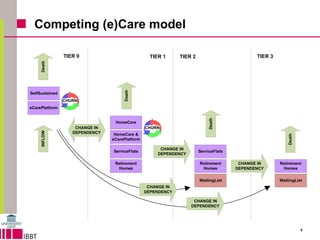
Competing (e)Care model
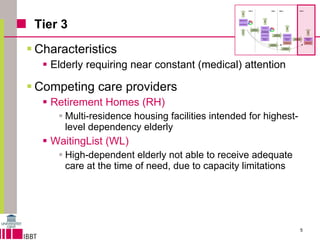
Tier 3 Characteristics  Elderly requiring near constant (medical) attention Competing care providers Retirement Homes (RH) Multi-residence housing facilities intended for highest-level dependency elderly WaitingList (WL)  High-dependent elderly not able to receive adequate care at the time of need, due to capacity limitations
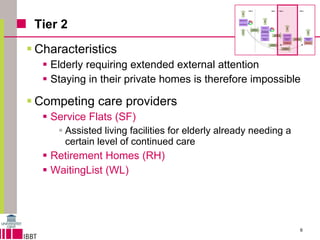
Tier 2 Characteristics  Elderly requiring extended external attention Staying in their private homes is therefore impossible Competing care providers Service Flats (SF) Assisted living facilities for elderly already needing a certain level of continued care   Retirement Homes (RH)  WaitingList (WL)
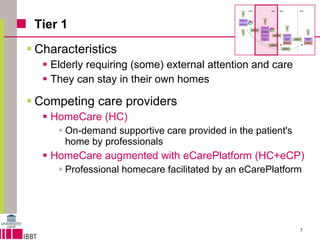
Tier 1 Characteristics  Elderly requiring (some) external attention and care They can stay in their own homes Competing care providers HomeCare (HC)   On-demand supportive care provided in the patient's home by professionals HomeCare augmented with eCarePlatform (HC+eCP)  Professional homecare facilitated by an eCarePlatform
Tier 0 Characteristics  Elderly still living in their private homes  No need for (professional) homecare Competing care providers SelfSustained (SS) Independent living eCarePlatform (eCP)  Own initiative for subscribing to an eCarePlatform
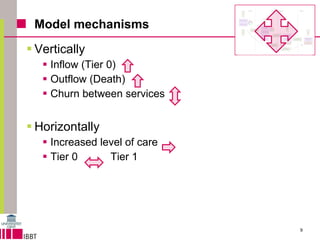
Model mechanisms Vertically Inflow (Tier 0) Outflow (Death) Churn between services Horizontally Increased level of care Tier 0  Tier 1
SIMULATION RESULTS Modeling Market Shares of Competing (e)Care Providers
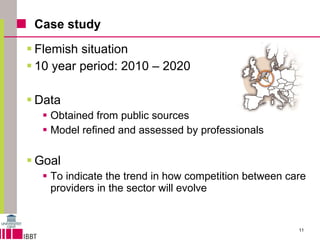
Case study Flemish situation 10 year period: 2010 – 2020 Data Obtained from public sources Model refined and assessed by professionals  Goal To indicate the trend in how competition between care providers in the sector will evolve
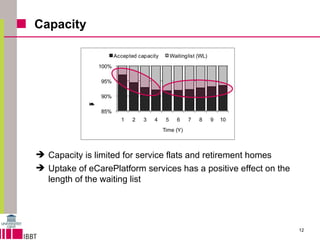
Capacity Capacity is limited for service flats and retirement homes Uptake of eCarePlatform services has a positive effect on the length of the waiting list
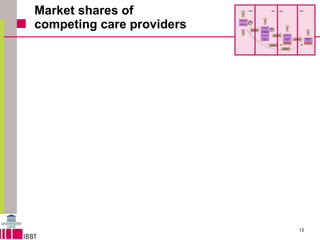
Market shares of  competing care providers Tier 3 Tier 1 Tier 2 Tier 0
CONCLUSIONS FUTURE WORK Modeling Market Shares of Competing (e)Care Providers
Conclusions Conceptual framework Allows forecasting evolution of market shares of competing care providers Market mechanisms Based on the dependency level of the elderly Competition within tiers (churn) Capacity Tier 3 capacity always needs to be guaranteed Waiting list problem situated in Tier 2  Market shares eCarePlatform will gain market share as soon as efficiency and added value has been proved.
Future work Techno-economic analysis of eCare platform business cases Input from the presented model eCare value network models Quantitative cost/benefit model Multi-actor analysis
CTTE 2010 Ghent, Belgium June 16-18, 2010 Conference of Telecommunication, Media  and Internet Techno-Economics Call for papers: user and service adoption pricing strategies for new services value network analysis and competition opportunities regulatory impacts on industry structure and competition OPEX and CAPEX models for network and service providers direct and indirect revenue modeling comparison of novel versus classic investment decision techniques sensitivity studies, risk analysis and real options  multi-actor analysis game theoretic analysis http://www.ctte-conference.org/
Thank you for  your attention Questions ? Jan Van Ooteghem [email_address] www.ibcn.intec.ugent.be/te INTEC Broadband Communication Networks (IBCN) Department of Information Technology (INTEC) Ghent University - IBBT

Ehealth 2009 Van Ooteghem

  • 1.
    Modeling Market Sharesof Competing (e)Care Providers J. Van Ooteghem , T. Tesch, S. Verbrugge, A. Ackaert, D. Colle, M. Pickavet, P. Demeester eHealth2009, Istanbul September 24th 2009
  • 2.
    IBBT TranseCare projectTransparant ICT platforms for eCare Project duration 2007 - 2010 Project website http://projects.ibbt.be/TranseCare
  • 3.
    CONCEPTUAL FRAMEWORK ANDMODEL MECHANISMS Modeling Market Shares of Competing (e)Care Providers
  • 4.
  • 5.
    Tier 3 Characteristics Elderly requiring near constant (medical) attention Competing care providers Retirement Homes (RH) Multi-residence housing facilities intended for highest-level dependency elderly WaitingList (WL) High-dependent elderly not able to receive adequate care at the time of need, due to capacity limitations
  • 6.
    Tier 2 Characteristics Elderly requiring extended external attention Staying in their private homes is therefore impossible Competing care providers Service Flats (SF) Assisted living facilities for elderly already needing a certain level of continued care Retirement Homes (RH) WaitingList (WL)
  • 7.
    Tier 1 Characteristics Elderly requiring (some) external attention and care They can stay in their own homes Competing care providers HomeCare (HC) On-demand supportive care provided in the patient's home by professionals HomeCare augmented with eCarePlatform (HC+eCP) Professional homecare facilitated by an eCarePlatform
  • 8.
    Tier 0 Characteristics Elderly still living in their private homes No need for (professional) homecare Competing care providers SelfSustained (SS) Independent living eCarePlatform (eCP) Own initiative for subscribing to an eCarePlatform
  • 9.
    Model mechanisms VerticallyInflow (Tier 0) Outflow (Death) Churn between services Horizontally Increased level of care Tier 0 Tier 1
  • 10.
    SIMULATION RESULTS ModelingMarket Shares of Competing (e)Care Providers
  • 11.
    Case study Flemishsituation 10 year period: 2010 – 2020 Data Obtained from public sources Model refined and assessed by professionals Goal To indicate the trend in how competition between care providers in the sector will evolve
  • 12.
    Capacity Capacity islimited for service flats and retirement homes Uptake of eCarePlatform services has a positive effect on the length of the waiting list
  • 13.
    Market shares of competing care providers Tier 3 Tier 1 Tier 2 Tier 0
  • 14.
    CONCLUSIONS FUTURE WORKModeling Market Shares of Competing (e)Care Providers
  • 15.
    Conclusions Conceptual frameworkAllows forecasting evolution of market shares of competing care providers Market mechanisms Based on the dependency level of the elderly Competition within tiers (churn) Capacity Tier 3 capacity always needs to be guaranteed Waiting list problem situated in Tier 2 Market shares eCarePlatform will gain market share as soon as efficiency and added value has been proved.
  • 16.
    Future work Techno-economicanalysis of eCare platform business cases Input from the presented model eCare value network models Quantitative cost/benefit model Multi-actor analysis
  • 17.
    CTTE 2010 Ghent,Belgium June 16-18, 2010 Conference of Telecommunication, Media and Internet Techno-Economics Call for papers: user and service adoption pricing strategies for new services value network analysis and competition opportunities regulatory impacts on industry structure and competition OPEX and CAPEX models for network and service providers direct and indirect revenue modeling comparison of novel versus classic investment decision techniques sensitivity studies, risk analysis and real options multi-actor analysis game theoretic analysis http://www.ctte-conference.org/
  • 18.
    Thank you for your attention Questions ? Jan Van Ooteghem [email_address] www.ibcn.intec.ugent.be/te INTEC Broadband Communication Networks (IBCN) Department of Information Technology (INTEC) Ghent University - IBBT