Theo Hug & Reinhold Madritsch | ECER 2021 in Geneva (Online): Education and Society: expectations, prescriptions, reconciliations │September 6-10, 2021
Global Education Industry – Exploring the state of affairs in Austria
SY Media Education and Digital Capitalism (06 SES 17) – September 10, 2021
Global Education Industry
Exploring the state of affairs in Austria
Theo Hug & Reinhold Madritsch
Theo Hug & Reinhold Madritsch | ECER 2021 in Geneva (Online): Education and Society: expectations, prescriptions, reconciliations │September 6-10, 2021
Global Education Industry – Exploring the state of affairs in Austria
Table of Content
▪ Introduction & Overview
▪ Points of Departure
▪ The Global Education Industry and the Notion of an „Education-
industrial complex“
▪ Explorations using the example of Austria
▪ Conclusion
Theo Hug & Reinhold Madritsch | ECER 2021 in Geneva (Online): Education and Society: expectations, prescriptions, reconciliations │September 6-10, 2021
Global Education Industry – Exploring the state of affairs in Austria
Points of Departure
▪ digitization and digitalization as most important „educationalization
formula“ today (Pädagogisierungsformel sensu Veith, 2003)
▪ typical rhetoric of “digital education”, “digital competences” and “future
skills” (cf. Haugsbakk & Nordkvelle 2007)
▪ corona-induced developmental boosts of “digital education” (Williamson &
Hogan 2020) tendencies of mechanization (Technisierung) of schooling,
education and instruction
▪ tendencies normalization of dealing with technical infrastructures, support
services, advertising in contexts of formal education
▪ shifts in authority and responsibility aligned with new education-industrial
developments
Theo Hug & Reinhold Madritsch | ECER 2021 in Geneva (Online): Education and Society: expectations, prescriptions, reconciliations │September 6-10, 2021
Global Education Industry – Exploring the state of affairs in Austria
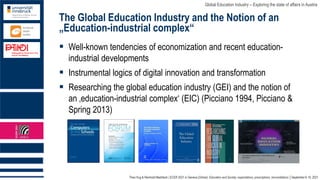
The Global Education Industry and the Notion of an
„Education-industrial complex“
▪ Well-known tendencies of economization and recent education-
industrial developments
▪ Instrumental logics of digital innovation and transformation
▪ Researching the global education industry (GEI) and the notion of
an ‚education-industrial complex‘ (EIC) (Picciano 1994, Picciano &
Spring 2013)
Theo Hug & Reinhold Madritsch | ECER 2021 in Geneva (Online): Education and Society: expectations, prescriptions, reconciliations │September 6-10, 2021
Global Education Industry – Exploring the state of affairs in Austria
Education-industrial Complex - Components and Strategies
(cf. Picciano & Spring 2013)
TECHNOLOGY
IDEOLOGY
PROFIT
Theo Hug & Reinhold Madritsch | ECER 2021 in Geneva (Online): Education and Society: expectations, prescriptions, reconciliations │September 6-10, 2021
Global Education Industry – Exploring the state of affairs in Austria
Ideology
▪ State curricula are specified by the Federal Ministry of Education, Science and
Research
▪ companies talk about societal and cultural interests but follow profit goals
▪ Big players and their strategies to position their products
▪ Conventional advertising
▪ Direct marketing addressed to students
▪ Indirectly via parents and teachers
▪ Lobbying activities with the federal ministry
▪ clarification of techno-economic connections, contemporary educational intents,
ethical questions and technological alternatives of free software are missing
Theo Hug & Reinhold Madritsch | ECER 2021 in Geneva (Online): Education and Society: expectations, prescriptions, reconciliations │September 6-10, 2021
Global Education Industry – Exploring the state of affairs in Austria
Profit
▪ Digital capitalism
„platform – communicative – surveillance capitalism“
▪ Data instead of money?
„free-of-charge offers in exchange for data”
▪ Deep learning and learning analytics in school context
Theo Hug & Reinhold Madritsch | ECER 2021 in Geneva (Online): Education and Society: expectations, prescriptions, reconciliations │September 6-10, 2021
Global Education Industry – Exploring the state of affairs in Austria
Technology
▪ Usage of technologies changed in schools
▪ Focus changed from hardware to learning environments & services
▪ School autonomy is not „freedom of choice“ for schools
▪ Austrian College and High School Agreement (MS-ACH) –
a contract with Microsoft creates de facto monopoly
Theo Hug & Reinhold Madritsch | ECER 2021 in Geneva (Online): Education and Society: expectations, prescriptions, reconciliations │September 6-10, 2021
Global Education Industry – Exploring the state of affairs in Austria
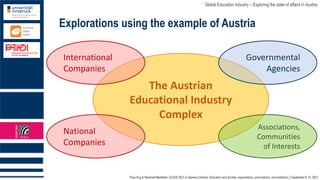
The Austrian
Educational Industry
Complex
Explorations using the example of Austria
International
Companies
National
Companies
Governmental
Agencies
Associations,
Communities
of Interests
Theo Hug & Reinhold Madritsch | ECER 2021 in Geneva (Online): Education and Society: expectations, prescriptions, reconciliations │September 6-10, 2021
Global Education Industry – Exploring the state of affairs in Austria
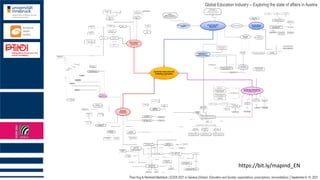
https://bit.ly/mapind_EN
Interwovenness of company shares and management functions – example of a structure
Managing Director
Theo Hug & Reinhold Madritsch | ECER 2021 in Geneva (Online): Education and Society: expectations, prescriptions, reconciliations │September 6-10, 2021
Global Education Industry – Exploring the state of affairs in Austria
Conclusion
▪ During the pandemic, an intensive promotion of the global education industry has taken
place without broad public debate in Austria.
▪ Well-known concerns regarding democratic control, public debate and participatory design
of schooling and education continue to be relevant.
▪ Media and education research can contribute to the visibilization of contingencies within
the ongoing transformation processes and to pointing out various paths of digital and
educational innovation beyond reductionist understandings of “digital education”.
▪ The subordination of processes of education planning and design under the quasi-
monopolist interests of a global education industry corresponds with interlinked
dependencies which in the long run create more problems than solutions.
▪ An ethics of the commons, of digital sovereignty and informational self-determination can
provide media educational directions beyond data-based behavioral modification and
eduveillance.
Theo Hug & Reinhold Madritsch | ECER 2021 in Geneva (Online): Education and Society: expectations, prescriptions, reconciliations │September 6-10, 2021
Global Education Industry – Exploring the state of affairs in Austria
https://cdn.pixabay.com/photo/2013/12/03/07/58/exchange-of-ideas-222789_960_720.jpg
Thanks for listening
now it’s time for…
Theo Hug & Reinhold Madritsch | ECER 2021 in Geneva (Online): Education and Society: expectations, prescriptions, reconciliations │September 6-10, 2021
Global Education Industry – Exploring the state of affairs in Austria
References
▪ Brightman, H.J. & Gutmore, D. (2002). The Educational-Industrial Complex, The Educational Forum, 66:4, 302-308, DOI: 10.1080/00131720208984848.
▪ Förschler, A. (2018). Das ‚Who is who?‘ der deutschen Bildungs-Digitalisierungsagenda – eine kritische Politiknetzwerk-Analyse. In: Pädagogische Korrespondenz, 58(2): 31-52.
▪ Haugsbakk, G., & Nordkvelle, Y. (2007). The Rhetoric of ICT and the New Language of Learning: A critical analysis of the use of ICT in the curricular field. European Educational
Research Journal, 6(1). https://doi.org/10.2304/eerj.2007.6.1.1
▪ Hug, T., & Madritsch, R. (2021). Global Education Industry - Exploring the state of affairs in Austria. Seminar.net, 17(2). https://doi.org/10.7577/seminar.4254
▪ Münch, R. (2018): Der bildungsindustrielle Komplex. Schule und Unterricht im Wettbewerbsstaat. Weinheim: Beltz Juventa.
▪ Niesyto, Horst (2017): Medienpädagogik und digitaler Kapitalismus. Für die Stärkung einer gesellschafts- und medienkritischen Perspektive. In: MedienPädagogik: Zeitschrift für
Theorie und Praxis der Medienbildung 27 (Spannungsfelder & blinde Flecken), S. 1–29. DOI: 10.21240/mpaed/27/2017.01.13.X
▪ Parreira do Amaral, M. P., Steiner-Khamsi, G. & Thompson, C. (eds.) (2019). Researching the global education industry: commodification, the market and business involvement.
Cham: Palgrave, Macmillan.
▪ Picciano, A. G. (1994). Technology and the Evolving Educational-Industrial Complex. Computers in the Schools, 11(2), 85-102 (republished in 2008, DOI: 10.1300/J025v11n02_08).
▪ Picciano, A. G., & Spring, J. H. (2013). The great American education-industrial complex: Ideology, technology, and profit. New York: Routledge.
▪ Reheis, F. (2004). Käufliche Bildung. Zur Problematik der Kommerzialisierung im Bildungsbereich. ZEP - Zeitschrift für internationale Bildungsforschung und Entwicklungspädagogik,
27(3), 9-13. URN:urn:nbn:de:0111-opus-92599.
▪ Schiller, D. (1999). Digital Capitalism. Cambridge/MA: MIT Press.
▪ Staab, P. (2019): Digitaler Kapitalismus. Markt und Herrschaft in der Ökonomie der Unknappheit. Berlin: Suhrkamp
▪ Veith, H. (2003): Lernkultur, Kompetenz, Kompetenzentwicklung und Selbstorganisation. Begriffshistorische Untersuchungen zur gesellschaftlichen und pädagogischen Konstruktion
von Erziehungswirklichkeiten in Theorie und Praxis. In: Arbeitsgemeinschaft Betriebliche Weiterbildungsforschung e.V./Projekt Qualifikations-Entwicklungs-Management (Ed.): Was
kann ich wissen? Theorie und Geschichte von Lernkultur und Kompetenzentwicklung. Berlin, pp. 179-229. Online document:
http://www.abwf.de/content/main/publik/report/2003/Report-82.pdf.
▪ Verger, A., Lubienski, C., & Steiner-Khamsi, G. (2016). The Emergence and Structuring of the Global Education Industry: Towards an Analytical Framework. In A. Verger, C.
Lubienski & G. Steiner- Khamsi (Eds.), World Yearbook of Education 2016: The Global Education Industry (pp. 3-24). New York/Abingdon: Routledge.
▪ Verger, A., Lubienski, C., & Steiner-Khamsi, G. (Eds.). (2016). World Yearbook of Education 2016: The Global Education Industry. New York/Abingdon: Routledge.
▪ Williamson, B., & Hogan, A. (2020). Commercialisation and privatisation in/of education in the context of Covid-19. Brussels: Education International. Retrieved August 15, 2020 from
https://issuu.com/educationinternational/docs/2020_eiresearch_gr_commercialisation_privatis ation?fr=sZDJkYjE1ODA2MTQ
▪ Zuboff, S. (2019). The age of surveillance capitalism: The fight for a human future at the new frontier of power. New York: PublicAffairs.

Ecer2021-SY-Presentation

  • 1.
    Theo Hug &Reinhold Madritsch | ECER 2021 in Geneva (Online): Education and Society: expectations, prescriptions, reconciliations │September 6-10, 2021 Global Education Industry – Exploring the state of affairs in Austria SY Media Education and Digital Capitalism (06 SES 17) – September 10, 2021 Global Education Industry Exploring the state of affairs in Austria Theo Hug & Reinhold Madritsch
  • 2.
    Theo Hug &Reinhold Madritsch | ECER 2021 in Geneva (Online): Education and Society: expectations, prescriptions, reconciliations │September 6-10, 2021 Global Education Industry – Exploring the state of affairs in Austria Table of Content ▪ Introduction & Overview ▪ Points of Departure ▪ The Global Education Industry and the Notion of an „Education- industrial complex“ ▪ Explorations using the example of Austria ▪ Conclusion
  • 3.
    Theo Hug &Reinhold Madritsch | ECER 2021 in Geneva (Online): Education and Society: expectations, prescriptions, reconciliations │September 6-10, 2021 Global Education Industry – Exploring the state of affairs in Austria Points of Departure ▪ digitization and digitalization as most important „educationalization formula“ today (Pädagogisierungsformel sensu Veith, 2003) ▪ typical rhetoric of “digital education”, “digital competences” and “future skills” (cf. Haugsbakk & Nordkvelle 2007) ▪ corona-induced developmental boosts of “digital education” (Williamson & Hogan 2020) tendencies of mechanization (Technisierung) of schooling, education and instruction ▪ tendencies normalization of dealing with technical infrastructures, support services, advertising in contexts of formal education ▪ shifts in authority and responsibility aligned with new education-industrial developments
  • 4.
    Theo Hug &Reinhold Madritsch | ECER 2021 in Geneva (Online): Education and Society: expectations, prescriptions, reconciliations │September 6-10, 2021 Global Education Industry – Exploring the state of affairs in Austria The Global Education Industry and the Notion of an „Education-industrial complex“ ▪ Well-known tendencies of economization and recent education- industrial developments ▪ Instrumental logics of digital innovation and transformation ▪ Researching the global education industry (GEI) and the notion of an ‚education-industrial complex‘ (EIC) (Picciano 1994, Picciano & Spring 2013)
  • 5.
    Theo Hug &Reinhold Madritsch | ECER 2021 in Geneva (Online): Education and Society: expectations, prescriptions, reconciliations │September 6-10, 2021 Global Education Industry – Exploring the state of affairs in Austria Education-industrial Complex - Components and Strategies (cf. Picciano & Spring 2013) TECHNOLOGY IDEOLOGY PROFIT
  • 6.
    Theo Hug &Reinhold Madritsch | ECER 2021 in Geneva (Online): Education and Society: expectations, prescriptions, reconciliations │September 6-10, 2021 Global Education Industry – Exploring the state of affairs in Austria Ideology ▪ State curricula are specified by the Federal Ministry of Education, Science and Research ▪ companies talk about societal and cultural interests but follow profit goals ▪ Big players and their strategies to position their products ▪ Conventional advertising ▪ Direct marketing addressed to students ▪ Indirectly via parents and teachers ▪ Lobbying activities with the federal ministry ▪ clarification of techno-economic connections, contemporary educational intents, ethical questions and technological alternatives of free software are missing
  • 7.
    Theo Hug &Reinhold Madritsch | ECER 2021 in Geneva (Online): Education and Society: expectations, prescriptions, reconciliations │September 6-10, 2021 Global Education Industry – Exploring the state of affairs in Austria Profit ▪ Digital capitalism „platform – communicative – surveillance capitalism“ ▪ Data instead of money? „free-of-charge offers in exchange for data” ▪ Deep learning and learning analytics in school context
  • 8.
    Theo Hug &Reinhold Madritsch | ECER 2021 in Geneva (Online): Education and Society: expectations, prescriptions, reconciliations │September 6-10, 2021 Global Education Industry – Exploring the state of affairs in Austria Technology ▪ Usage of technologies changed in schools ▪ Focus changed from hardware to learning environments & services ▪ School autonomy is not „freedom of choice“ for schools ▪ Austrian College and High School Agreement (MS-ACH) – a contract with Microsoft creates de facto monopoly
  • 9.
    Theo Hug &Reinhold Madritsch | ECER 2021 in Geneva (Online): Education and Society: expectations, prescriptions, reconciliations │September 6-10, 2021 Global Education Industry – Exploring the state of affairs in Austria The Austrian Educational Industry Complex Explorations using the example of Austria International Companies National Companies Governmental Agencies Associations, Communities of Interests
  • 10.
    Theo Hug &Reinhold Madritsch | ECER 2021 in Geneva (Online): Education and Society: expectations, prescriptions, reconciliations │September 6-10, 2021 Global Education Industry – Exploring the state of affairs in Austria https://bit.ly/mapind_EN
  • 11.
    Interwovenness of companyshares and management functions – example of a structure Managing Director
  • 12.
    Theo Hug &Reinhold Madritsch | ECER 2021 in Geneva (Online): Education and Society: expectations, prescriptions, reconciliations │September 6-10, 2021 Global Education Industry – Exploring the state of affairs in Austria Conclusion ▪ During the pandemic, an intensive promotion of the global education industry has taken place without broad public debate in Austria. ▪ Well-known concerns regarding democratic control, public debate and participatory design of schooling and education continue to be relevant. ▪ Media and education research can contribute to the visibilization of contingencies within the ongoing transformation processes and to pointing out various paths of digital and educational innovation beyond reductionist understandings of “digital education”. ▪ The subordination of processes of education planning and design under the quasi- monopolist interests of a global education industry corresponds with interlinked dependencies which in the long run create more problems than solutions. ▪ An ethics of the commons, of digital sovereignty and informational self-determination can provide media educational directions beyond data-based behavioral modification and eduveillance.
  • 13.
    Theo Hug &Reinhold Madritsch | ECER 2021 in Geneva (Online): Education and Society: expectations, prescriptions, reconciliations │September 6-10, 2021 Global Education Industry – Exploring the state of affairs in Austria https://cdn.pixabay.com/photo/2013/12/03/07/58/exchange-of-ideas-222789_960_720.jpg Thanks for listening now it’s time for…
  • 14.
    Theo Hug &Reinhold Madritsch | ECER 2021 in Geneva (Online): Education and Society: expectations, prescriptions, reconciliations │September 6-10, 2021 Global Education Industry – Exploring the state of affairs in Austria References ▪ Brightman, H.J. & Gutmore, D. (2002). The Educational-Industrial Complex, The Educational Forum, 66:4, 302-308, DOI: 10.1080/00131720208984848. ▪ Förschler, A. (2018). Das ‚Who is who?‘ der deutschen Bildungs-Digitalisierungsagenda – eine kritische Politiknetzwerk-Analyse. In: Pädagogische Korrespondenz, 58(2): 31-52. ▪ Haugsbakk, G., & Nordkvelle, Y. (2007). The Rhetoric of ICT and the New Language of Learning: A critical analysis of the use of ICT in the curricular field. European Educational Research Journal, 6(1). https://doi.org/10.2304/eerj.2007.6.1.1 ▪ Hug, T., & Madritsch, R. (2021). Global Education Industry - Exploring the state of affairs in Austria. Seminar.net, 17(2). https://doi.org/10.7577/seminar.4254 ▪ Münch, R. (2018): Der bildungsindustrielle Komplex. Schule und Unterricht im Wettbewerbsstaat. Weinheim: Beltz Juventa. ▪ Niesyto, Horst (2017): Medienpädagogik und digitaler Kapitalismus. Für die Stärkung einer gesellschafts- und medienkritischen Perspektive. In: MedienPädagogik: Zeitschrift für Theorie und Praxis der Medienbildung 27 (Spannungsfelder & blinde Flecken), S. 1–29. DOI: 10.21240/mpaed/27/2017.01.13.X ▪ Parreira do Amaral, M. P., Steiner-Khamsi, G. & Thompson, C. (eds.) (2019). Researching the global education industry: commodification, the market and business involvement. Cham: Palgrave, Macmillan. ▪ Picciano, A. G. (1994). Technology and the Evolving Educational-Industrial Complex. Computers in the Schools, 11(2), 85-102 (republished in 2008, DOI: 10.1300/J025v11n02_08). ▪ Picciano, A. G., & Spring, J. H. (2013). The great American education-industrial complex: Ideology, technology, and profit. New York: Routledge. ▪ Reheis, F. (2004). Käufliche Bildung. Zur Problematik der Kommerzialisierung im Bildungsbereich. ZEP - Zeitschrift für internationale Bildungsforschung und Entwicklungspädagogik, 27(3), 9-13. URN:urn:nbn:de:0111-opus-92599. ▪ Schiller, D. (1999). Digital Capitalism. Cambridge/MA: MIT Press. ▪ Staab, P. (2019): Digitaler Kapitalismus. Markt und Herrschaft in der Ökonomie der Unknappheit. Berlin: Suhrkamp ▪ Veith, H. (2003): Lernkultur, Kompetenz, Kompetenzentwicklung und Selbstorganisation. Begriffshistorische Untersuchungen zur gesellschaftlichen und pädagogischen Konstruktion von Erziehungswirklichkeiten in Theorie und Praxis. In: Arbeitsgemeinschaft Betriebliche Weiterbildungsforschung e.V./Projekt Qualifikations-Entwicklungs-Management (Ed.): Was kann ich wissen? Theorie und Geschichte von Lernkultur und Kompetenzentwicklung. Berlin, pp. 179-229. Online document: http://www.abwf.de/content/main/publik/report/2003/Report-82.pdf. ▪ Verger, A., Lubienski, C., & Steiner-Khamsi, G. (2016). The Emergence and Structuring of the Global Education Industry: Towards an Analytical Framework. In A. Verger, C. Lubienski & G. Steiner- Khamsi (Eds.), World Yearbook of Education 2016: The Global Education Industry (pp. 3-24). New York/Abingdon: Routledge. ▪ Verger, A., Lubienski, C., & Steiner-Khamsi, G. (Eds.). (2016). World Yearbook of Education 2016: The Global Education Industry. New York/Abingdon: Routledge. ▪ Williamson, B., & Hogan, A. (2020). Commercialisation and privatisation in/of education in the context of Covid-19. Brussels: Education International. Retrieved August 15, 2020 from https://issuu.com/educationinternational/docs/2020_eiresearch_gr_commercialisation_privatis ation?fr=sZDJkYjE1ODA2MTQ ▪ Zuboff, S. (2019). The age of surveillance capitalism: The fight for a human future at the new frontier of power. New York: PublicAffairs.