Electronic textbooks
Reported by: Apple Grace F. Diaz
• Define what an e-textbook is and how it works.
• Know the importance of e-textbooks in education.
• Identify its implications for teaching and learning.
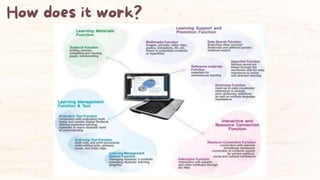
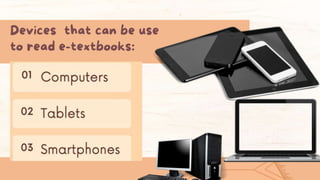
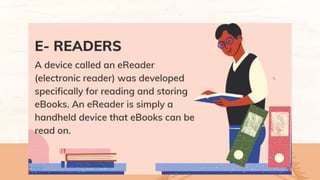
• Electronic textbooks, commonly referred to as e-textbooks,
digital textbooks, or e-texts, are electronic versions of a text
that can be read on a desktop, mobile device, or e-reader
device.
• Electronic textbooks may include part or all of the printed text
version.
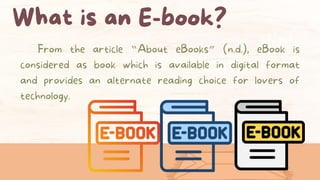
E-textbooks, or the paperless books, is an electronic
version of a book that can be downloaded into computer,
laptop or phone and later can be read using a software
program or dedicated eBook device, better known as
eReader (Whyley, 2010, p. 8).
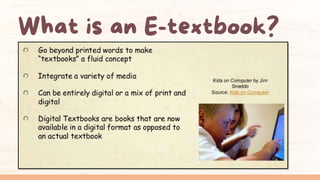
• It may also include additional content, such as multimedia
content and hyperlinks, that would be impossible to render in
a printed text.
• Some electronic textbooks may also include interactive
content, self-assessments, or guided questions that provide
real-time feedback. Interactive course content is often
proprietary to the publisher and can include resources such as
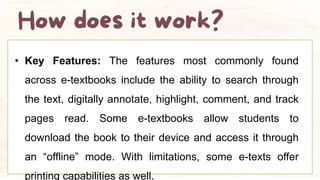
• Key Features: The features most commonly found
across e-textbooks include the ability to search through
the text, digitally annotate, highlight, comment, and track
pages read. Some e-textbooks allow students to
download the book to their device and access it through
an “offline” mode. With limitations, some e-texts offer
printing capabilities as well.
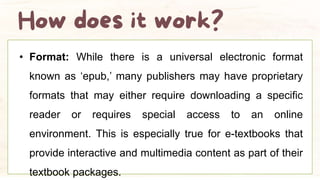
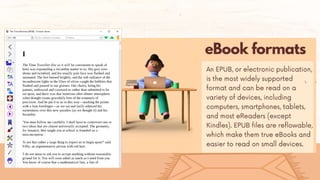
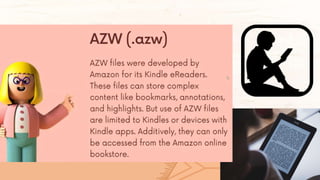
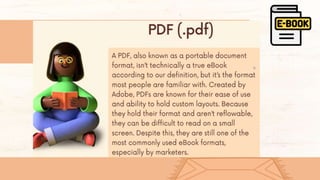
• Format: While there is a universal electronic format
known as ‘epub,’ many publishers may have proprietary
formats that may either require downloading a specific
reader or requires special access to an online
environment. This is especially true for e-textbooks that
provide interactive and multimedia content as part of their
textbook packages.
• Purchasing: Students can choose to buy, rent, or check
out e-textbooks from a variety of sources -- namely, their
campus bookstore, book retailers and renters, and
libraries. Book rentals and library loans restrict the
amount of time that a student can gain access to an e-
text.
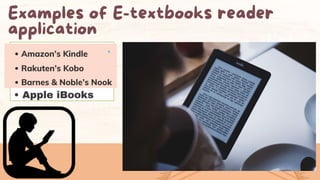
• Apple iBooks
•Students
•Faculty
•Institutions
’
E-textbooks have become very popular
nowadays especially in the education field.
There are lots of advantages of using eBooks
in schools and among the students and
teacher. Looney & Sheehan (2001, p.38)
stated that e-textbooks can be printed,
loaned, or given away to others with the
permission of the publisher or the author.
Secondly, the use of e-textbooks is also very
economical not only for teachers, but for the
students as well. Students would not have to buy
the real book which can cost them a fortune, and
just buy the exact book from the eBooks which
costs much less than the exact price.
Furthermore, e-textbook can also function
way better than the real book. From having the
same content, graphics, layout, and illustrations as
the printed book, it also has the text to speech and
other text- to- speech and other audio options
which is very beneficial for vision impaired
students or for international students who are
struggling in learning English (Looney & Sheehan,
2001).
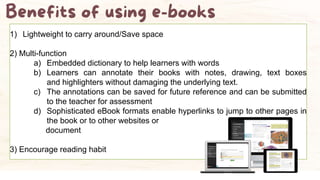
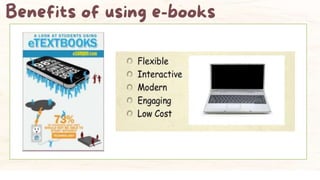
1) Lightweight to carry around/Save space
2) Multi-function
a) Embedded dictionary to help learners with words
b) Learners can annotate their books with notes, drawing, text boxes
and highlighters without damaging the underlying text.
c) The annotations can be saved for future reference and can be submitted
to the teacher for assessment
d) Sophisticated eBook formats enable hyperlinks to jump to other pages in
the book or to other websites or
document
3) Encourage reading habit
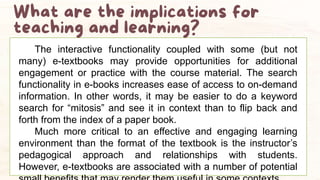
The interactive functionality coupled with some (but not
many) e-textbooks may provide opportunities for additional
engagement or practice with the course material. The search
functionality in e-books increases ease of access to on-demand
information. In other words, it may be easier to do a keyword
search for “mitosis” and see it in context than to flip back and
forth from the index of a paper book.
Much more critical to an effective and engaging learning
environment than the format of the textbook is the instructor’s
pedagogical approach and relationships with students.
However, e-textbooks are associated with a number of potential
In conclusion, with thousands of books that can be accessed through e-textbook, we can say
that eBook is a very successful device that can be used in education, especially for students
where they can purchase the electronic textbook at a very cheap price and all of the books can be
accessed just with the tip of their fingers only. Less money would be spent and less time would be
taken in searching for all the materials needed. Schools should be encouraged to provide e-
textbooks for students as it gives a lot of benefits to each and every one of them. This device is
very convenient, practical, and flexible for everyone.
• https://sites.google.com/a/myport.ac.uk/learning-using-ict/ict-tools/e-
-books
• https://sites.google.com/a/myport.ac.uk/ict-and-the-secondary-
classroom-esliarozhi/project-definition/e-reader
♥
“ ”

E-book.pptx

  • 2.
  • 3.
    • Define whatan e-textbook is and how it works. • Know the importance of e-textbooks in education. • Identify its implications for teaching and learning.
  • 4.
    • Electronic textbooks,commonly referred to as e-textbooks, digital textbooks, or e-texts, are electronic versions of a text that can be read on a desktop, mobile device, or e-reader device. • Electronic textbooks may include part or all of the printed text version.
  • 5.
    E-textbooks, or thepaperless books, is an electronic version of a book that can be downloaded into computer, laptop or phone and later can be read using a software program or dedicated eBook device, better known as eReader (Whyley, 2010, p. 8).
  • 7.
    • It mayalso include additional content, such as multimedia content and hyperlinks, that would be impossible to render in a printed text. • Some electronic textbooks may also include interactive content, self-assessments, or guided questions that provide real-time feedback. Interactive course content is often proprietary to the publisher and can include resources such as
  • 11.
    • Key Features:The features most commonly found across e-textbooks include the ability to search through the text, digitally annotate, highlight, comment, and track pages read. Some e-textbooks allow students to download the book to their device and access it through an “offline” mode. With limitations, some e-texts offer printing capabilities as well.
  • 12.
    • Format: Whilethere is a universal electronic format known as ‘epub,’ many publishers may have proprietary formats that may either require downloading a specific reader or requires special access to an online environment. This is especially true for e-textbooks that provide interactive and multimedia content as part of their textbook packages.
  • 18.
    • Purchasing: Studentscan choose to buy, rent, or check out e-textbooks from a variety of sources -- namely, their campus bookstore, book retailers and renters, and libraries. Book rentals and library loans restrict the amount of time that a student can gain access to an e- text.
  • 19.
  • 20.
  • 21.
    E-textbooks have becomevery popular nowadays especially in the education field. There are lots of advantages of using eBooks in schools and among the students and teacher. Looney & Sheehan (2001, p.38) stated that e-textbooks can be printed, loaned, or given away to others with the permission of the publisher or the author.
  • 22.
    Secondly, the useof e-textbooks is also very economical not only for teachers, but for the students as well. Students would not have to buy the real book which can cost them a fortune, and just buy the exact book from the eBooks which costs much less than the exact price.
  • 23.
    Furthermore, e-textbook canalso function way better than the real book. From having the same content, graphics, layout, and illustrations as the printed book, it also has the text to speech and other text- to- speech and other audio options which is very beneficial for vision impaired students or for international students who are struggling in learning English (Looney & Sheehan, 2001).
  • 24.
    1) Lightweight tocarry around/Save space 2) Multi-function a) Embedded dictionary to help learners with words b) Learners can annotate their books with notes, drawing, text boxes and highlighters without damaging the underlying text. c) The annotations can be saved for future reference and can be submitted to the teacher for assessment d) Sophisticated eBook formats enable hyperlinks to jump to other pages in the book or to other websites or document 3) Encourage reading habit
  • 26.
    The interactive functionalitycoupled with some (but not many) e-textbooks may provide opportunities for additional engagement or practice with the course material. The search functionality in e-books increases ease of access to on-demand information. In other words, it may be easier to do a keyword search for “mitosis” and see it in context than to flip back and forth from the index of a paper book. Much more critical to an effective and engaging learning environment than the format of the textbook is the instructor’s pedagogical approach and relationships with students. However, e-textbooks are associated with a number of potential
  • 33.
    In conclusion, withthousands of books that can be accessed through e-textbook, we can say that eBook is a very successful device that can be used in education, especially for students where they can purchase the electronic textbook at a very cheap price and all of the books can be accessed just with the tip of their fingers only. Less money would be spent and less time would be taken in searching for all the materials needed. Schools should be encouraged to provide e- textbooks for students as it gives a lot of benefits to each and every one of them. This device is very convenient, practical, and flexible for everyone.
  • 34.
  • 35.
  • 36.

Editor's Notes

  • #2 Let us close our eyes and feel the presence of the Lord. In the name of the Father, the Son and the Holy Spirit. Prayer: Lord God Jesus Christ, our heavenly father. Lord, we thank you for this wonderful day you have given to us. Thank you for the gift of life. Lord God, as we start our day today, may you bless our teacher and our fellow classmates, may YOU guide us and help us and make this class lesson successful. In Jesus name we pray, Amen. Before I start my report. I want you to guess what the kind of educational technological tools/learning material is shown in the picture.
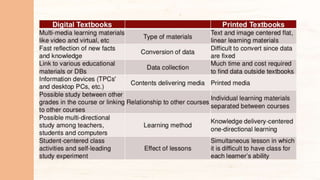
  • #13 A digital textbook is an electronic form of a traditional, printed textbook.
  • #19 Teachers and students can use them in any learning environment, whether face-to-face or remote. Students can download a digital textbook or access it online on devices like Chromebooks, iPads, computers and their phones. books are simply digitized versions of printed books, while others have interactive features that increase engagement and comprehension. For example, a student who chooses to rent a math e-textbook through their campus bookstore will receive an individualized access code which will then be used to login and access their online textbook environment. The access code is only valid for a limited time (for example, one or two semesters), after which the student will lose access to their e-textbook.
  • #21 Students: As e-textbook use in the K-12 level is growing, students may enter the higher education environment with the expectation of using e-textbooks. For example, Florida counties have set aside half of materials funding toward the purchase of digital materials Faculty: Generally, faculty members who want to integrate e-textbooks in their courses, either exclusively or as an alternative to paper-based books, can select the option in the textbook adoption process. At the University of Miami, faculty members can adopt textbooks through the university bookstore’s online textbook option system once registering for an account. Intitutions: Some colleges and universities have pursued institution-wide e-textbook adoption. These initiatives typically approach the integration of reduced-cost e-textbooks through publisher partnerships and multi‐institutional e-textbook pilots. Modelled on an e-textbook pilot at Indiana University. In a low-cost e-textbook approach, OpenStax develops free, peer-reviewed, openly licensed textbooks for introductory college courses; their Institutional Partnership Program annually recognizes universities who use free, peer-reviewed textbooks on campus.
  • #22    This is good for the students as lots of materials are needed in every teaching where it can help teachers by supporting their lessons. Teachers can easily print the material from the eBooks and distribute it to their students and there is no need for teachers to buy the exact book and do the photocopy.     
  • #23 For example a 30 pounds book would only be 2-4 pounds if students buy the electronic version of the book. This would save a lot of money and more books can be purchased by them. The content would be the same and students would get the same benefit as buying the real book. All of the textbooks used in school would be no longer necessary as students can easily get access through it by using eBooks. This would help the school in reducing the money spent on books. eBook is also small and mobile, thus students can  get access to those books whenever and wherever they are for example in the library, off-campus, at home, in the restaurants, etc.     
  • #24 For the vision impaired students, they would just have to listen to the audio in order to understand what the text is all about without having to put much effort in reading the text. The text can also be zoomed in thus it would make the font size bigger and would help students to read the text better. As for those who are learning English, the audio would help them in learning about the correct pronunciation of English. Foreign materials are easily accessible and international students can make full use of it in improving their level of English The dictionary included in the eBooks is also very helpful for them as students can easily find the meaning of the word in the eBook. A lot of embedded media are provided in the eBooks such as animations, audio, video, links to the Web, and links to other related eBooks. These would develop the students’ imagination and interest, and also are very helpful in explaining the lesson to students who work best by using the visual and auditory ways.   
  • #25 1) Lightweight to carry around/Save space     eBooks are much more lightweight then the real books.  Students do not have to carry books      instead, the materials namely short stories or novels particularly for Literature lessons can be uploaded into the tools and     later can be used in the classrooms. Classrooms which have store or cupboard to keep students' reading materials can be      used for other purposes. 3) Multi-function     So much like Interactive Whiteboard, eBooks allows the users to be proactive, creative and innovative, especially if the      paperless books are read by using eReaders.  These are achieved by manipulating the functions of eReaders for instances     as listed below (Whyley, 2010, p. 19) :     a)  Embedded dictionary to help learners with words          This helps students to easily enhance their vocabulary knowledge.     b)  Learners can annotate their books with notes, drawing, text boxes and highlighters without damaging the           underlying text.          Students might this very helpful in helping them to focus on the various types of sentence structure, reminding them          on particular difficult or new words, as well as highlighting key points to be used in writing or reading task.     c)  The annotations can be saved for future reference and can be submitted to the teacher for assessment                 d)  Sophisticated eBook formats enable hyperlinks to jump to other pages in the book or to other websites or          document          This is very helpful in writing, reading, grammar and vocabulary tasks.  While reading on eReaders, students have the           opportunity to extend their knowledge in related given task by jumping to other pages in the book.  For example, in            writing task, students will be able to do research for ideas that can be included in their writing or looking for various            formats or samples in essay writing.  3) Encourage reading habit     In an eBook project in Wolverhampton in 2003, the usage of eBook has been proven to improve reading habits      among young people and also has shown positive outcomes in national tests (Whyley, 2010, p. 8).   Children from     digital era have been widely exposed to the fast-evolving technology until it has become part and parcel of their     life, hence, arguing the effectiveness of ICT in digital natives education might not be worthwhile without      scrutinizing how cognitive development of children in the digital world differ with non-digital natives.  In Japan,      this has also becoming increasingly popular, where the trend indicates that reading eBooks through mobile      phones is not uncommon.
  • #26 1) Lightweight to carry around/Save space     eBooks are much more lightweight then the real books.  Students do not have to carry books      instead, the materials namely short stories or novels particularly for Literature lessons can be uploaded into the tools and     later can be used in the classrooms. Classrooms which have store or cupboard to keep students' reading materials can be      used for other purposes. 3) Multi-function     So much like Interactive Whiteboard, eBooks allows the users to be proactive, creative and innovative, especially if the      paperless books are read by using eReaders.  These are achieved by manipulating the functions of eReaders for instances     as listed below (Whyley, 2010, p. 19) :     a)  Embedded dictionary to help learners with words          This helps students to easily enhance their vocabulary knowledge.     b)  Learners can annotate their books with notes, drawing, text boxes and highlighters without damaging the           underlying text.          Students might this very helpful in helping them to focus on the various types of sentence structure, reminding them          on particular difficult or new words, as well as highlighting key points to be used in writing or reading task.     c)  The annotations can be saved for future reference and can be submitted to the teacher for assessment                 d)  Sophisticated eBook formats enable hyperlinks to jump to other pages in the book or to other websites or          document          This is very helpful in writing, reading, grammar and vocabulary tasks.  While reading on eReaders, students have the           opportunity to extend their knowledge in related given task by jumping to other pages in the book.  For example, in            writing task, students will be able to do research for ideas that can be included in their writing or looking for various            formats or samples in essay writing.  3) Encourage reading habit     In an eBook project in Wolverhampton in 2003, the usage of eBook has been proven to improve reading habits      among young people and also has shown positive outcomes in national tests (Whyley, 2010, p. 8).   Children from     digital era have been widely exposed to the fast-evolving technology until it has become part and parcel of their     life, hence, arguing the effectiveness of ICT in digital natives education might not be worthwhile without      scrutinizing how cognitive development of children in the digital world differ with non-digital natives.  In Japan,      this has also becoming increasingly popular, where the trend indicates that reading eBooks through mobile      phones is not uncommon.
  • #27 1) Lightweight to carry around/Save space     eBooks are much more lightweight then the real books.  Students do not have to carry books      instead, the materials namely short stories or novels particularly for Literature lessons can be uploaded into the tools and     later can be used in the classrooms. Classrooms which have store or cupboard to keep students' reading materials can be      used for other purposes. 3) Multi-function     So much like Interactive Whiteboard, eBooks allows the users to be proactive, creative and innovative, especially if the      paperless books are read by using eReaders.  These are achieved by manipulating the functions of eReaders for instances     as listed below (Whyley, 2010, p. 19) :     a)  Embedded dictionary to help learners with words          This helps students to easily enhance their vocabulary knowledge.     b)  Learners can annotate their books with notes, drawing, text boxes and highlighters without damaging the           underlying text.          Students might this very helpful in helping them to focus on the various types of sentence structure, reminding them          on particular difficult or new words, as well as highlighting key points to be used in writing or reading task.     c)  The annotations can be saved for future reference and can be submitted to the teacher for assessment                 d)  Sophisticated eBook formats enable hyperlinks to jump to other pages in the book or to other websites or          document          This is very helpful in writing, reading, grammar and vocabulary tasks.  While reading on eReaders, students have the           opportunity to extend their knowledge in related given task by jumping to other pages in the book.  For example, in            writing task, students will be able to do research for ideas that can be included in their writing or looking for various            formats or samples in essay writing.  3) Encourage reading habit     In an eBook project in Wolverhampton in 2003, the usage of eBook has been proven to improve reading habits      among young people and also has shown positive outcomes in national tests (Whyley, 2010, p. 8).   Children from     digital era have been widely exposed to the fast-evolving technology until it has become part and parcel of their     life, hence, arguing the effectiveness of ICT in digital natives education might not be worthwhile without      scrutinizing how cognitive development of children in the digital world differ with non-digital natives.  In Japan,      this has also becoming increasingly popular, where the trend indicates that reading eBooks through mobile      phones is not uncommon.