(eBook PDF) M: Organizational Behavior 4th
Edition download
https://ebookluna.com/product/ebook-pdf-m-organizational-
behavior-4th-edition/
Download more ebook from https://ebookluna.com
We believe these products will be a great fit for you. Click
the link to download now, or visit ebookluna.com
to discover even more!
M: Organizational Behavior 4th Edition Steven Mcshane - eBook PDF
https://ebookluna.com/download/m-organizational-behavior-ebook-pdf/
(eBook PDF) M: Organizational Behavior 3rd Edition by Steven McShane
https://ebookluna.com/product/ebook-pdf-m-organizational-behavior-3rd-
edition-by-steven-mcshane/
(eBook PDF) Organizational Behavior 7th Edition
https://ebookluna.com/product/ebook-pdf-organizational-behavior-7th-
edition/
(eBook PDF) Organizational Behavior 8th Edition
https://ebookluna.com/product/ebook-pdf-organizational-behavior-8th-
edition/
Organizational Behavior, 13th Edition (eBook PDF)
https://ebookluna.com/product/organizational-behavior-13th-edition-ebook-
pdf/
Organizational Behavior 17th Edition (eBook PDF)
https://ebookluna.com/product/organizational-behavior-17th-edition-ebook-
pdf/
Organizational Behavior 18th Edition (eBook PDF)
https://ebookluna.com/product/organizational-behavior-18th-edition-ebook-
pdf/
(eBook PDF) Organizational Behavior: Human Behavior at Work 14th Edition
https://ebookluna.com/product/ebook-pdf-organizational-behavior-human-
behavior-at-work-14th-edition/
(eBook PDF) Organizational Behavior Interactive 2nd Edition
https://ebookluna.com/product/ebook-pdf-organizational-behavior-
interactive-2nd-edition/
McSHANE | VON GLINOW
4th Edition
ORGANIZATIONAL
BEHAVIOR
IN WHICH COUNTRIES
DO EMPLOYEES
HAVE THE HIGHEST
ORGANIZATIONAL
COMMITMENT?
CH 4
WHAT IS YOUR
PREFERRED
MANAGERIAL
LEADERSHIP STYLE?
CH 11
INTROVERTS CAN
BE EFFECTIVE SOCIAL
NETWORKERS, TOO!
CH 9
is Motivation. is Momentum. is Moving Forward. is McGraw-Hill.
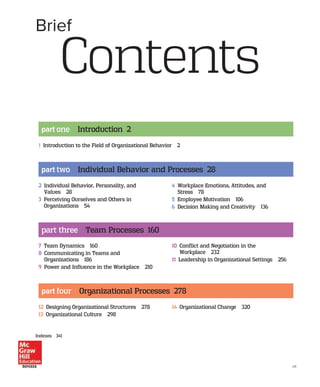
part one Introduction 2
1 Introduction to the Field of Organizational Behavior 2
part two Individual Behavior and Processes 28
2 
Individual Behavior, Personality, and
Values 28
3 
Perceiving Ourselves and Others in
Organizations 54
4 
Workplace Emotions, Attitudes, and
Stress 78
5 Employee Motivation 106
6 Decision Making and Creativity 136
part three Team Processes 160
7 Team Dynamics 160
8 
Communicating in Teams and
Organizations 186
9 Power and Influence in the Workplace 210
10 
Conflict and Negotiation in the
Workplace 232
11 Leadership in Organizational Settings 256
part four Organizational Processes 278
Contents
Brief
Indexes 341
12 Designing Organizational Structures 278
13 Organizational Culture 298
14 Organizational Change 320
vii
viii
ANCHORS OF ORGANIZATIONAL
BEHAVIOR KNOWLEDGE 10
The Systematic Research Anchor 11
The Multidisciplinary Anchor 11
The Contingency Anchor 12
The Multiple Levels of Analysis
Anchor 12
PERSPECTIVES OF ORGANIZATIONAL
EFFECTIVENESS 12
Open Systems Perspective 12
Organizational Learning Perspective 14
High-Performance Work Practices
Perspective 16
Stakeholder Perspective 18
Connecting the Dots: An Integrative
Model of Organizational
Behavior 20
THE JOURNEY BEGINS 21
1 Introduction to the
Field of Organizational
Behavior 2
THE FIELD OF ORGANIZATIONAL
BEHAVIOR 3
Historical Foundations of
Organizational Behavior 4
Why Study Organizational
Behavior? 5
CONTEMPORARY DEVELOPMENTS
FACING ORGANIZATIONS 6
Technological Change 6
Globalization 7
Emerging Employment
Relationships 7
Increasing Workforce Diversity 9
Consequences of Diversity 9
Contents
part one Introduction 2
©Robert Kneschke/Shutterstock
2 Individual Behavior,
Personality, and
Values 28
MARS MODEL OF INDIVIDUAL
BEHAVIOR AND PERFORMANCE 29
Employee Motivation 29
Ability 30
Role Perceptions 30
Situational Factors 32
TYPES OF INDIVIDUAL BEHAVIOR 32
Task Performance 32
Organizational Citizenship 32
Counterproductive Work Behaviors 33
Joining and Staying with the
Organization 33
Maintaining Work Attendance 33
PERSONALITY IN ORGANIZATIONS 34
Personality Determinants: Nature
versus Nurture 35
Five-Factor Model of Personality 35
Jungian Personality Theory
and the Myers-Briggs Type
Indicator 38
VALUES IN THE WORKPLACE 39
Types of Values 40
Values and Individual Behavior 41
Values Congruence 42
ETHICAL VALUES AND BEHAVIOR 42
Three Ethical Principles 43
part two Individual Behavior and Processes 28
CONTENTS ix
ORGANIZATIONAL COMMITMENT 91
Consequences of Affective and
Continuance Commitment 91
Building Organizational Commitment 92
WORK-RELATED STRESS AND ITS
MANAGEMENT 93
General Adaptation Syndrome 93
Consequences of Distress 94
Stressors: The Causes of Stress 94
Individual Differences in Stress 96
Managing Work-Related Stress 96
5 Employee Motivation 106
EMPLOYEE ENGAGEMENT 107
EMPLOYEE DRIVES AND NEEDS 108
Individual Differences in Needs 109
Four-Drive Theory 110
Maslow’s Needs Hierarchy Theory 111
Intrinsic and Extrinsic Motivation 112
Learned Needs Theory 113
EXPECTANCY THEORY OF
MOTIVATION 114
Applying Expectancy Theory 114
ORGANIZATIONAL BEHAVIOR
MODIFICATION AND SOCIAL
COGNITIVE THEORY 116
Organizational Behavior
Modification 116
Social Cognitive Theory 117
GOAL SETTING AND FEEDBACK 118
Characteristics of Effective Feedback 119
Sources of Feedback 120
Evaluating Goal Setting and
Feedback 121
ORGANIZATIONAL JUSTICE 121
Equity Theory 121
Procedural Justice 123
Attribution Theory 65
Self-Fulfilling Prophecy 67
Other Perceptual Effects 68
IMPROVING PERCEPTIONS 69
Awareness of Perceptual Biases 69
Improving Self-Awareness 69
Meaningful Interaction 70
GLOBAL MINDSET: DEVELOPING
PERCEPTIONS ACROSS BORDERS 71
Developing a Global Mindset 72
4 Workplace Emotions,
Attitudes, and Stress 78
EMOTIONS IN THE WORKPLACE 79
Types of Emotions 80
Emotions, Attitudes, and Behavior 81
Cognitive Dissonance 83
Emotions and Personality 84
MANAGING EMOTIONS AT WORK 85
Emotional Display Norms across
Cultures 85
Emotional Dissonance 85
EMOTIONAL INTELLIGENCE 86
Emotional Intelligence Outcomes and
Development 87
JOB SATISFACTION 88
Job Satisfaction and Work Behavior 88
Job Satisfaction and Performance 89
Job Satisfaction and Customer
Satisfaction 90
Job Satisfaction and Business Ethics 91
Moral Intensity, Moral Sensitivity, and
Situational Influences 43
Supporting Ethical Behavior 44
VALUES ACROSS CULTURES 45
Individualism and Collectivism 45
Power Distance 47
Uncertainty Avoidance 47
Achievement-Nurturing
Orientation 47
Caveats about Cross-Cultural
Knowledge 47
3 Perceiving Ourselves
and Others in
Organizations 54
SELF-CONCEPT: HOW WE PERCEIVE
OURSELVES 55
Self-Concept Complexity, Consistency,
and Clarity 55
Self-Enhancement 57
Self-Verification 58
Self-Evaluation 58
The Social Self 59
Self-Concept and Organizational
Behavior 60
PERCEIVING THE WORLD
AROUND US 61
Perceptual Organization and
Interpretation 62
SPECIFIC PERCEPTUAL PROCESSES
AND PROBLEMS 63
Stereotyping in Organizations 63
©PeopleImages/Digital Vision/Getty Images
©Elnur/Shutterstock
x CONTENTS
EVALUATING DECISIONS 146
Escalation of Commitment 147
Evaluating Decision Outcomes More
Effectively 148
CREATIVITY 148
The Creative Process 148
Characteristics of Creative People 149
Organizational Conditions Supporting
Creativity 151
Activities That Encourage
Creativity 151
EMPLOYEE INVOLVEMENT IN
DECISION MAKING 152
Benefits of Employee Involvement 153
Contingencies of Employee
Involvement 153
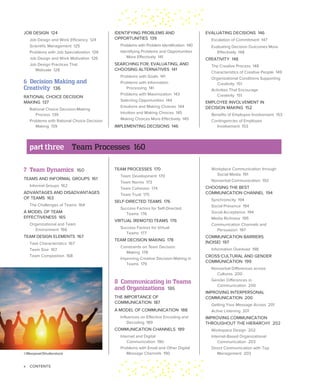
IDENTIFYING PROBLEMS AND
OPPORTUNITIES 139
Problems with Problem Identification 140
Identifying Problems and Opportunities
More Effectively 141
SEARCHING FOR, EVALUATING, AND
CHOOSING ALTERNATIVES 141
Problems with Goals 141
Problems with Information
Processing 141
Problems with Maximization 143
Selecting Opportunities 144
Emotions and Making Choices 144
Intuition and Making Choices 145
Making Choices More Effectively 145
IMPLEMENTING DECISIONS 146
JOB DESIGN 124
Job Design and Work Efficiency 124
Scientific Management 125
Problems with Job Specialization 126
Job Design and Work Motivation 126
Job Design Practices That
Motivate 128
6 Decision Making and
Creativity 136
RATIONAL CHOICE DECISION
MAKING 137
Rational Choice Decision-Making
Process 139
Problems with Rational Choice Decision
Making 139
7 Team Dynamics 160
TEAMS AND INFORMAL GROUPS 161
Informal Groups 162
ADVANTAGES AND DISADVANTAGES
OF TEAMS 163
The Challenges of Teams 164
A MODEL OF TEAM
EFFECTIVENESS 165
Organizational and Team
Environment 166
TEAM DESIGN ELEMENTS 167
Task Characteristics 167
Team Size 167
Team Composition 168
Workplace Communication through
Social Media 191
Nonverbal Communication 192
CHOOSING THE BEST
COMMUNICATION CHANNEL 194
Synchronicity 194
Social Presence 194
Social Acceptance 194
Media Richness 195
Communication Channels and
Persuasion 197
COMMUNICATION BARRIERS
(NOISE) 197
Information Overload 198
CROSS-CULTURAL AND GENDER
COMMUNICATION 199
Nonverbal Differences across
Cultures 200
Gender Differences in
Communication 200
IMPROVING INTERPERSONAL
COMMUNICATION 200
Getting Your Message Across 201
Active Listening 201
IMPROVING COMMUNICATION
THROUGHOUT THE HIERARCHY 202
Workspace Design 202
Internet-Based Organizational
Communication 203
Direct Communication with Top
Management 203
TEAM PROCESSES 170
Team Development 170
Team Norms 173
Team Cohesion 174
Team Trust 175
SELF-DIRECTED TEAMS 176
Success Factors for Self-Directed
Teams 176
VIRTUAL (REMOTE) TEAMS 176
Success Factors for Virtual
Teams 177
TEAM DECISION MAKING 178
Constraints on Team Decision
Making 178
Improving Creative Decision Making in
Teams 179
8 Communicating in Teams
and Organizations 186
THE IMPORTANCE OF
COMMUNICATION 187
A MODEL OF COMMUNICATION 188
Influences on Effective Encoding and
Decoding 189
COMMUNICATION CHANNELS 189
Internet and Digital
Communication 190
Problems with Email and Other Digital
Message Channels 190
©Moopixel/Shutterstock
part three Team Processes 160
CONTENTS xi
TRANSFORMATIONAL LEADERSHIP
PERSPECTIVE 258
Develop and Communicate a Strategic
Vision 259
Model the Vision 260
Encourage Experimentation 260
Build Commitment toward the
Vision 261
Transformational Leadership and
Charisma 261
Evaluating the Transformational
Leadership Perspective 261
MANAGERIAL LEADERSHIP
PERSPECTIVE 262
Interdependence of Managerial and
Transformational Leadership 262
Task-Oriented and People-Oriented
Leadership 263
Servant Leadership 263
PATH–GOAL AND LEADERSHIP
SUBSTITUTES THEORIES 264
Path–Goal Leadership Theory 264
Leadership Substitutes Theory 266
IMPLICIT LEADERSHIP
PERSPECTIVE 267
Prototypes of Effective
Leaders 267
The Romance of Leadership 268
PERSONAL ATTRIBUTES PERSPECTIVE
OF LEADERSHIP 268
Most Important Leadership
Attributes 268
Authentic Leadership 270
Personal Attributes Perspective
Limitations and Practical
Implications 271
CROSS-CULTURAL AND GENDER
ISSUES IN LEADERSHIP 271
Gender and Leadership 271
10 Conflict and Negotiation
in the Workplace 232
THE MEANING AND CONSEQUENCES
OF CONFLICT 233
Is Conflict Good or Bad? 233
THE EMERGING VIEW: TASK AND
RELATIONSHIP CONFLICT 235
Task Conflict 235
Relationship Conflict 235
Separating Task from Relationship
Conflict 235
CONFLICT PROCESS MODEL 236
STRUCTURAL SOURCES OF CONFLICT
IN ORGANIZATIONS 237
Incompatible Goals 237
Differentiation 237
Interdependence 238
Scarce Resources 238
Ambiguous Rules 238
Communication Problems 238
INTERPERSONAL CONFLICT-
HANDLING STYLES 239
Choosing the Best Conflict-Handling
Style 240
Cultural and Gender Differences in
Conflict-Handling Styles 242
STRUCTURAL APPROACHES TO
CONFLICT MANAGEMENT 242
Emphasizing Superordinate Goals 242
Reducing Differentiation 243
Improving Communication and Mutual
Understanding 243
Reducing Interdependence 244
Increasing Resources 244
Clarifying Rules and Procedures 244
THIRD-PARTY CONFLICT
RESOLUTION 245
Choosing the Best Third-Party
Intervention Strategy 245
RESOLVING CONFLICT THROUGH
NEGOTIATION 246
Distributive versus Integrative
Approaches to Negotiation 246
Preparing to Negotiate 247
The Negotiation Process 248
The Negotiation Setting 249
Gender and Negotiation 250
11 Leadership in
Organizational Settings 256
WHAT IS LEADERSHIP? 257
Shared Leadership 257
COMMUNICATING THROUGH THE
GRAPEVINE 204
Grapevine Characteristics 204
Grapevine Benefits and
Limitations 204
9 Power and Influence in
the Workplace 210
THE MEANING OF POWER 211
SOURCES OF POWER IN
ORGANIZATIONS 212
Legitimate Power 213
Reward Power 214
Coercive Power 214
Expert Power 214
Referent Power 215
CONTINGENCIES OF POWER 215
Substitutability 215
Centrality 216
Visibility 216
Discretion 216
THE POWER OF SOCIAL
NETWORKS 216
Social Capital and Sources of
Power 217
Gaining Power through Social
Networks 218
CONSEQUENCES OF POWER 220
INFLUENCING OTHERS 221
Types of Influence Tactics 221
Consequences and Contingencies of
Influence Tactics 224
ORGANIZATIONAL POLITICS 226
Minimizing Organizational
Politics 226
©Hero Images/Getty Images
©EllisDon Corporation
xii CONTENTS
DECIPHERING ORGANIZATIONAL
CULTURE THROUGH ARTIFACTS 302
Organizational Stories and
Legends 303
Organizational Language 303
Rituals and Ceremonies 304
Physical Structures and
Symbols 304
IS ORGANIZATIONAL CULTURE
IMPORTANT? 305
Meaning and Potential Benefits of a
Strong Culture 305
Contingencies of Organizational
Culture and Effectiveness 305
Organizational Culture and Business
Ethics 307
MERGING ORGANIZATIONAL
CULTURES 308
Bicultural Audit 308
Strategies for Merging Different
Organizational Cultures 308
CHANGING AND STRENGTHENING
ORGANIZATIONAL CULTURE 310
Model Desired Culture through the
Actions of Founders and
Leaders 310
Align Artifacts with the Desired
Culture 311
Introduce Culturally Consistent
Rewards and Recognition 311
Support Workforce Stability and
Communication 312
Use Attraction, Selection, and
Socialization for Cultural Fit 312
ORGANIZATIONAL
SOCIALIZATION 313
Learning and Adjustment
Process 313
Stages of Organizational
Socialization 313
Improving the Socialization
Process 314
14 Organizational
Change 320
LEWIN’S FORCE FIELD ANALYSIS
MODEL 321
UNDERSTANDING RESISTANCE TO
CHANGE 322
Why Employees Resist
Change 323
UNFREEZING, CHANGING, AND
REFREEZING 325
Creating an Urgency for
Change 325
Reducing the Restraining
Forces 327
Refreezing the Desired
Conditions 329
LEADERSHIP, COALITIONS, AND
PILOT PROJECTS 329
Transformational Leadership and
Change 329
Coalitions, Social Networks, and
Change 329
Pilot Projects and Diffusion of
Change 331
TWO APPROACHES TO
ORGANIZATIONAL CHANGE 331
Action Research Approach 332
Appreciative Inquiry Approach 333
CROSS-CULTURAL AND ETHICAL
ISSUES IN ORGANIZATIONAL
CHANGE 335
ORGANIZATIONAL BEHAVIOR: THE
JOURNEY CONTINUES 335
Organization Index 341
Name Index 343
Glossary/Subject Index 356
12 Designing Organizational
Structures 278
DIVISION OF LABOR AND
COORDINATION 279
Division of Labor 279
Coordination of Work Activities 280
ELEMENTS OF ORGANIZATIONAL
STRUCTURE 282
Span of Control 282
Centralization and Decentralization 284
Formalization 285
Mechanistic versus Organic
Structures 285
FORMS OF DEPARTMENTALIZATION 286
Simple Structure 286
Functional Structure 286
Divisional Structure 287
Team-Based Structure 289
Matrix Structure 290
CONTINGENCIES OF
ORGANIZATIONAL DESIGN 292
External Environment 292
Organizational Size 293
Technology 293
Organizational Strategy 293
13 Organizational Culture 298
ELEMENTS OF ORGANIZATIONAL
CULTURE 299
Espoused versus Enacted Values 299
Content of Organizational Culture 300
Organizational Subcultures 302
part four Organizational Processes 278
©Jacob Lund/Shutterstock
xiii
M: Organizational Behavior, Fourth Edition, has been significantly
revised, guided by useful feedback from reviewers and our active
monitoring of evidence-based literature. All chapters have new
examples and either new or revised factoids; most chapters have
new conceptual content or literature foundation. The most
substantial changes have occurred in Chapter 1 (introduction to OB),
Chapter 4 (workplace emotions, attitudes, and stress), Chapter 6
(decision making and creativity), Chapter 8 (communication), and
Chapter 10 (conflict and negotiation). The authors personally
researched, selected, and wrote all of this content, thereby
providing superior integration of knowledge and ensuring that the
examples are relevant and recent. Here are the key changes we’ve
made to this fourth edition, broken out by chapter:
Chapter 1: Introduction to the Field of
Organizational Behavior
Technological change has been added in the section on
contemporary developments facing organizations. The section on
perspectives of organizational effectiveness has been streamlined.
Most topics have updated content, particularly the text on the four
contemporary developments, why study OB, and several aspects of
organizational effectiveness.
Chapter 2: Individual Behavior, Personality,
and Values
Several topics in this chapter have been updated, particularly
coverage of the five-factor model of personality and work
performance, values and individual behavior, and moral
sensitivity.
Chapter 3: Perceiving Ourselves and Others
in Organizations
This book pioneered the full model of self-concept and its
relevance to organizational behavior. This edition further
develops this important topic and provides new information on
the opposing motives for distinctiveness and inclusion. The
section on stereotyping also incorporates the concept of
stereotype threat.
What’s New
in the Fourth Edition
Chapter 4: Workplace Emotions, Attitudes,
and Stress
This edition significantly revises and updates discussion on four key
workplace stressors, with new writing about organizational
constraints and interpersonal conflict as stressors. In addition, there
is new content on attitude–behavior contingencies.
Chapter 5: Employee Motivation
New to this edition is the topic of intrinsic and extrinsic motivation,
as well as the question of whether introducing extrinsic sources of
motivation reduces intrinsic motivation. We also have reorganized
and refined the writing on drives and needs, Maslow’s needs
hierarchy, and four-drive theory. The previous edition introduced
the social and information processing characteristics of jobs. This
edition further refines that emerging topic.
Chapter 6: Decision Making and Creativity
This chapter has been substantially revised and updated in several
ways. Design thinking now receives more attention as a concept
and practice to improve workplace creativity. ­
The topic of problems
with information processing when choosing alternatives also has
been substantially updated. Additional updates have been made to
solution-focused problems, problems with goals, implicit favorite
bias, and satisficing (problems with maximization).
Chapter 7: Team Dynamics
This edition refines discussion introduced in the previous edition
on the three characteristics that distinguish types of teams. It
also offers more detail about social loafing, team mental models
(as part of team development), and team development through
team building.
Chapter 8: Communicating in Teams and
Organizations
This edition substantially revises and updates the important topic of
choosing the best communication medium. Specifically, this topic
xiv
Chapter 11: Leadership in Organizational
Settings
This chapter, substantially revised in the previous edition, includes
updates on the topics of transformational leadership, comparing
transformational with managerial leadership, and evaluating
path–goal theory.
Chapter 12: Designing Organizational
Structures
This chapter has been revised to include updates on span of
control, problems with flatter structures, and types of divisional
structure. It also includes numerous new in-text examples of
companies that apply various forms of departmentalization.
Chapter 13: Organizational Culture
In addition to replacing most examples and updating references, this
chapter has revised content on the topics of espoused versus enacted
values, content of organizational culture, types of organizational culture
artifacts, adaptive cultures, the integration strategy for merging
cultures, and how founders and leaders shape and strengthen culture.
Chapter 14: Organizational Change
This edition includes updates on understanding resistance to
change, social networks and viral change, and appreciative inquiry.
As with other chapters, it also has several new real-world examples.
discusses four key factors (synchronicity, social presence, social
acceptance, and media richness) as well as associated
contingencies to consider when choosing a communication
channel. This edition continues to shift the focus toward various
forms of digital communication (less focus on email alone). Another
noticeable change is the updated discussion on the characteristics
and benefits of enterprise social media.
Chapter 9: Power and Influence
in the Workplace
This chapter contains updates on topics including legitimate power,
visibility, and organizational politics.
Chapter 10: Conflict and Negotiation
in the Workplace
This edition substantially reorganizes and updates the entire
section on resolving conflict through negotiation. The new or
revised topics include distributive and integrative approaches
to bargaining, understanding needs, bargaining zone dynamics,
how BATNA increases bargaining power, the importance of
listening, and strategies for making concessions. This edition
also introduces recent evidence about gender differences in
negotiation. Elsewhere in this chapter, we update the topics of
task and relationship conflict and problems resulting from
relationship conflict. We also revised portions on the topic of
whether conflict is good or bad.
Organizational
Behavior
2
1
PART
1
Introduction to the Field of
Organizational Behavior
©Robert
Kneschke/Shutterstock
After you read this chapter, you should be able to:
LO1-3 Discuss the anchors on which
organizational behavior knowledge is
based.
LO1-4 Compare and contrast the four
perspectives of organizational
effectiveness.
Learning Objectives
LO1-1 Define organizational behavior and
organizations, and discuss the importance
of this field of inquiry.
LO1-2 Debate the organizational
opportunities and challenges of
technological change, globalization,
emerging employment relationships, and
workforce diversity.
CHAPTER 1 | Introduction to the Field of Organizational Behavior 3
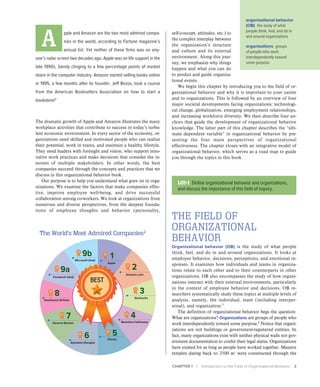
A
pple and Amazon are the two most admired compa-
nies in the world, according to Fortune magazine’s
annual list. Yet neither of these firms was on any-
one’s radar screen two decades ago. Apple was on life support in the
late 1990s, barely clinging to a few percentage points of market
share in the computer industry. Amazon started selling books online
in 1995, a few months after its founder, Jeff Bezos, took a course
from the American Booksellers Association on how to start a
bookstore!1
The dramatic growth of Apple and Amazon illustrates the many
workplace activities that contribute to success in today’s turbu-
lent economic environment. In every sector of the economy, or-
ganizations need skilled and motivated people who can realize
their potential, work in teams, and maintain a healthy lifestyle.
They need leaders with foresight and vision, who support inno-
vative work practices and make decisions that consider the in-
terests of multiple stakeholders. In other words, the best
companies succeed through the concepts and practices that we
discuss in this organizational behavior book.
Our purpose is to help you understand what goes on in orga-
nizations. We examine the factors that make companies effec-
tive, improve employee well-being, and drive successful
collaboration among co-workers. We look at organizations from
numerous and diverse perspectives, from the deepest founda-
tions of employee thoughts and behavior (personality,
self-concept, attitudes, etc.) to
the complex interplay between
the organization’s structure
and culture and its external
environment. Along this jour-
ney, we emphasize why things
happen and what you can do
to predict and guide organiza-
tional events.
We begin this chapter by introducing you to the field of or-
ganizational behavior and why it is important to your career
and to organizations. This is followed by an overview of four
major societal developments facing organizations: technologi-
cal change, globalization, emerging employment relationships,
and increasing workforce diversity. We then describe four an-
chors that guide the development of organizational behavior
knowledge. The latter part of this chapter describes the “ulti-
mate dependent variable” in organizational behavior by pre-
senting the four main perspectives of organizational
effectiveness. The chapter closes with an integrative model of
organizational behavior, which serves as a road map to guide
you through the topics in this book.
The World’s Most
Admired Companies
1
2
3
4
5
6
7
8
9a
9b
Apple
Amazon.com
Starbucks
Berkshire Hathaway
Disney
Alphabet (Google)
General Electric
Southwest Airlines
Facebook (tied)
Microsoft (tied)
THE FIELD OF
ORGANIZATIONAL
BEHAVIOR
Organizational behavior (OB) is the study of what people
think, feel, and do in and around organizations. It looks at
employee behavior, decisions, perceptions, and emotional re-
sponses. It examines how individuals and teams in organiza-
tions relate to each other and to their counterparts in other
organizations. OB also encompasses the study of how organi-
zations interact with their external environments, particularly
in the context of employee behavior and decisions. OB re-
searchers systematically study these topics at multiple levels of
analysis, namely, the individual, team (including interper-
sonal), and organization.3
The definition of organizational behavior begs the question:
What are organizations? Organizations are groups of people who
work interdependently toward some purpose.4
Notice that organi-
zations are not buildings or government-registered entities. In
fact, many organizations exist with neither physical walls nor gov-
ernment documentation to confer their legal status. Organizations
have existed for as long as people have worked together. Massive
temples dating back to 3500 bc were constructed through the
LO1-1 Define organizational behavior and organizations,
and discuss the importance of this field of inquiry.
organizational behavior
(OB) the study of what
people think, feel, and do in
and around organizations
organizations groups
of people who work
interdependently toward
some purpose
The World’s Most Admired Companies2
4 PART 1 | Introduction
organized actions of multitudes of
people. Craftspeople and mer-
chants in ancient Rome formed
guilds, complete with elected man-
agers. More than 1,000 years ago,
Chinese factories were producing
125,000 tons of iron each year.5
One key feature of all organi-
zations throughout history is that
they are collective entities.6
They
consist of human beings—typically,
but not necessarily, employees—
who interact with each other in
an organized way. This organized
relationship requires communica-
tion, coordination, and collabora-
tion to achieve organizational
objectives. As such, all organiza-
tional members have degrees of
interdependence; they accom-
plish goals by sharing materials,
information, or expertise with
coworkers.
A second key feature of orga-
nizations is that their members
have a collective sense of pur-
pose. This collective purpose isn’t always well defined or agreed
on. Most companies have vision and mission statements, but
they are sometimes out of date or don’t describe what employ-
ees actually try to achieve. Still, imagine an organization without
a collective sense of purpose. It would be an assemblage of
had changed the name of its MBA human relations course to
“Organizational Behavior.”
Although the field of OB is recent, experts in other fields
have been studying organizations for many centuries. The Greek
philosopher Plato (400 bc) wrote about the essence of
leadership, and the Chinese philosopher Confucius (500 bc)
extolled the virtues of ethics and leadership. Economist Adam
Smith (late 1700s) discussed the benefits of job specialization
and division of labor. German sociologist Max Weber (early
1900s) wrote about rational organizations, the work ethic, and
charismatic leadership. Around the same time, industrial engi-
neer Frederick Winslow Taylor proposed systematic ways to or-
ganize work processes and motivate employees through goal
setting and rewards.9
Political scientist Mary Parker Follett (1920s) offered new
ways of thinking about constructive conflict, team dynamics,
power, and leadership. Harvard professor Elton Mayo and his
colleagues (1930s and 1940s) established the “human relations”
One key feature of all organizations is that they consist of human beings who interact with each
other in an organized way.
©Image Source
A company is one of humanity’s most amazing
inventions. . . . [It’s] this abstract construct we’ve
invented, and it’s incredibly powerful.7
—Steve Jobs, Apple and Pixar Animation cofounder
people without direction or unifying force. So, whether they are
designing and marketing the latest communication technology
at Apple or selling almost anything on the Internet at Amazon,
people working in organizations do have some sense of collec-
tive purpose.
Historical Foundations of
Organizational Behavior
Organizational behavior emerged as a distinct field sometime
around the early 1940s.8
During that decade, a few researchers
began describing their research as organizational (rather than
sociological or psychological). And by the late 1940s, Harvard
CHAPTER 1 | Introduction to the Field of Organizational Behavior 5
school of management, which pioneered re-
search on employee attitudes, formal team
dynamics, informal groups, and supervisor
leadership style. American executive and Harvard
associate Chester Barnard (1930s) wrote insight-
ful views regarding organizational communica-
tion, coordination, leadership and authority,
organizations as open systems, and team dynam-
ics.10
This brief historical tour indicates that OB
has been around for a long time; it just wasn’t
organized into a unified discipline until around
World War II.
Why Study Organizational
Behavior?
In all likelihood, you are reading this book as
part of a required course in organizational be-
havior. Apart from degree or diploma require-
ments, why should you learn the ideas and
practices discussed in this book? After all, who
ever heard of a career path leading to a “vice
president of OB” or a “chief OB officer”? Our
answer to this question begins with survey findings that stu-
dents who have been in the workforce for some time typically
point to OB as one of their most valuable courses. Why? Be-
cause they have learned through experience that OB does make
a difference to one’s career success.11
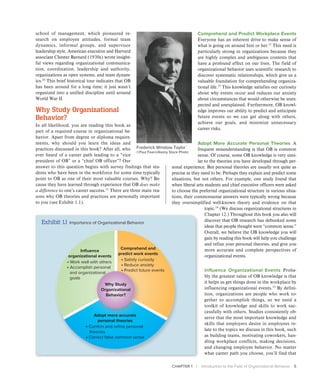
There are three main rea-
sons why OB theories and practices are personally important
to you (see Exhibit 1.1).
Comprehend and Predict Workplace Events
Everyone has an inherent drive to make sense of
what is going on around him or her.12
This need is
particularly strong in organizations because they
are highly complex and ambiguous contexts that
have a profound effect on our lives. The field of
organizational behavior uses scientific research to
discover systematic relationships, which give us a
valuable foundation for comprehending organiza-
tional life.13
This knowledge satisfies our curiosity
about why events occur and reduces our anxiety
about circumstances that would otherwise be unex-
pected and unexplained. Furthermore, OB knowl-
edge improves our ability to predict and anticipate
future events so we can get along with others,
achieve our goals, and minimize unnecessary
career risks.
Adopt More Accurate Personal Theories A
frequent misunderstanding is that OB is common
sense. Of course, some OB knowledge is very simi-
lar to the theories you have developed through per-
sonal experience. But personal theories are usually not quite as
precise as they need to be. Perhaps they explain and predict some
situations, but not others. For example, one study found that
when liberal arts students and chief executive officers were asked
to choose the preferred organizational structure in various situa-
tions, their commonsense answers were typically wrong because
they oversimplified well-known theory and evidence on that
topic.14
(We discuss organizational structures in
Chapter 12.) Throughout this book you also will
discover that OB research has debunked some
ideas that people thought were “common sense.”
Overall, we believe the OB knowledge you will
gain by reading this book will help you challenge
and refine your personal theories, and give you
more accurate and complete perspectives of
organizational events.
Influence Organizational Events Proba-
bly the greatest value of OB knowledge is that
it helps us get things done in the workplace by
influencing organizational events.15
By defini-
tion, organizations are people who work to-
gether to accomplish things, so we need a
toolkit of knowledge and skills to work suc-
cessfully with others. Studies consistently ob-
serve that the most important knowledge and
skills that employers desire in employees re-
late to the topics we discuss in this book, such
as building teams, motivating coworkers, han-
dling workplace conflicts, making decisions,
and changing employee behavior. No matter
what career path you choose, you’ll find that
Frederick Winslow Taylor
©Paul Fearn/Alamy Stock Photo
Exhibit 1.1 Importance of Organizational Behavior
• Satisfy curiosity
• Reduce anxiety
• Predict future events
Comprehend and
predict work events
• Work well with others
• Accomplish personal
and organizational
goals
Influence
organizational events
• Confirm and refine personal
theories
• Correct false common sense
Adopt more accurate
personal theories
Why Study
Organizational
Behavior?
6 PART 1 | Introduction
CONTEMPORARY
DEVELOPMENTS
FACING ORGANIZATIONS
Organizations are experiencing unprecedented change. Techno-
logical developments, consumer expectations, global competi-
tion, and many other factors have substantially altered business
strategy and everyday workplace activities. The field of organiza-
tional behavior plays a vital role in guiding organizations
through this continuous turbulence. As we will explain in more
detail later in this chapter, organizations are deeply affected by
the external environment. Consequently, they need to maintain
a good organization–environment fit by anticipating and adjust-
ing to changes in society. Over the next few pages, we introduce
four major environmental developments facing organizations:
technological change, globalization, emerging employment rela-
tionships, and increasing workforce diversity.
Technological Change
Technological change has always been a disruptive force in orga-
nizations, as well as in society.19
Waterwheels, cotton gins, steam
engines, microprocessors (such as in automated systems and
artificial intelligence), and many other innovations dramatically
boost productivity, but also usually displace employees and ren-
der obsolete entire occupational groups. Other technologies,
OB concepts play an important
role in performing your job and
working more effectively within
organizations.
Organizational Behavior Is
for Everyone Organizational
behavior is discussed by some
writers as a topic for managers.
Effective management does de-
pend on OB concepts and prac-
tices, but this book pioneered the
broader view that OB is valuable
for everyone who works in and
around organizations. Whether
you are a software engineer, cus-
tomer service representative, for-
eign exchange analyst, or chief
executive officer, you need to
understand and apply the many
organizational behavior topics
that are discussed in this book. In fact, OB knowledge is probably
more valuable than ever before because employees increas-
ingly need to be proactive, self-motivated, and able to work
effectively with coworkers without management intervention.
In the words of one forward-thinking OB writer more than four
decades ago: Everyone is a manager.16
OB and the Bottom Line Up to this point, our answer to
the question “Why study OB?” has focused on how organiza-
tional behavior knowledge benefits you as an individual.
However, OB is also vital to the organization’s survival and
success.17
For instance, the best 100 companies to work for in
America (i.e., companies with the highest levels of employee
satisfaction) enjoy significantly higher financial performance
than other businesses within the same industry. Companies
with higher levels of employee engagement have higher sales
and profitability (see Chapter 5). OB practices also are asso-
ciated with various indicators of hospital performance, such
as lower patient mortality rates and higher patient satisfac-
tion. Other studies have consistently found a positive rela-
tionship between the quality of leadership and the company’s
financial performance.
The bottom-line value of organizational behavior is
supported by research into the best predictors of investment
portfolio performance. These investigations suggest that
leadership, performance-based rewards, employee develop-
ment, employee attitudes, and other specific OB characteris-
tics are important “positive screens” for selecting companies
with the highest and most consistent long-term investment
gains.18
Overall, the organizational behavior concepts, theo-
ries, and practices presented throughout this book make a
positive difference to you personally, to the organization, and
ultimately to society.
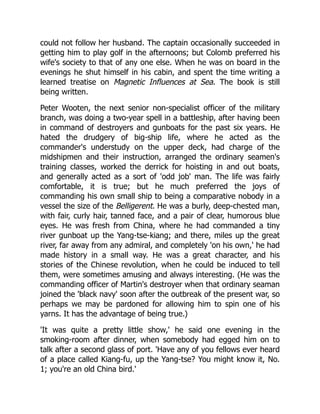
Probably the greatest value of OB knowledge is that it helps us get things done in the workplace
by influencing organizational events.
©ColorBlind Images/Blend Images LLC
LO1-2 Debate the organizational opportunities and
challenges of technological change, globalization, emerging
employment relationships, and workforce diversity.
Discovering Diverse Content Through
Random Scribd Documents
could not follow her husband. The captain occasionally succeeded in
getting him to play golf in the afternoons; but Colomb preferred his
wife's society to that of any one else. When he was on board in the
evenings he shut himself in his cabin, and spent the time writing a
learned treatise on Magnetic Influences at Sea. The book is still
being written.
Peter Wooten, the next senior non-specialist officer of the military
branch, was doing a two-year spell in a battleship, after having been
in command of destroyers and gunboats for the past six years. He
hated the drudgery of big-ship life, where he acted as the
commander's understudy on the upper deck, had charge of the
midshipmen and their instruction, arranged the ordinary seamen's
training classes, worked the derrick for hoisting in and out boats,
and generally acted as a sort of 'odd job' man. The life was fairly
comfortable, it is true; but he much preferred the joys of
commanding his own small ship to being a comparative nobody in a
vessel the size of the Belligerent. He was a burly, deep-chested man,
with fair, curly hair, tanned face, and a pair of clear, humorous blue
eyes. He was fresh from China, where he had commanded a tiny
river gunboat up the Yang-tse-kiang; and there, miles up the great
river, far away from any admiral, and completely 'on his own,' he had
made history in a small way. He was a great character, and his
stories of the Chinese revolution, when he could be induced to tell
them, were sometimes amusing and always interesting. (He was the
commanding officer of Martin's destroyer when that ordinary seaman
joined the 'black navy' soon after the outbreak of the present war, so
perhaps we may be pardoned for allowing him to spin one of his
yarns. It has the advantage of being true.)
'It was quite a pretty little show,' he said one evening in the
smoking-room after dinner, when somebody had egged him on to
talk after a second glass of port. 'Have any of you fellows ever heard
of a place called Kiang-fu, up the Yang-tse? You might know it, No.
1; you're an old China bird.'
Chase shook his head. 'Sorry I don't, Peter. But let's have the yarn,
all the same.'
Wooten lit his pipe. 'Kiang-fu,' he started, 'is one of their walled
towns on the banks of the river. It's a beastly place, full of stinks and
bugs and abominations generally; and the only white people there
are the consul and his wife, a couple of missionaries, and two
merchants. Well, one morning my old Kingfisher was lying about
twenty miles downstream, and a Chinaman from the consulate at
Kiang-fu arrived in a sampan with a note from the consul to say that
five thousand rebels had arrived before the place, and that there
was going to be some scrapping. There were about a thousand
Imperial troops inside the town, Johnson the consul said, and he
was in a bit of a funk as to what would happen when the rebels took
the place. They'd have butchered every one, of course, Europeans
included. My orders were to protect British interests, but not to fight,
so I upped killick[11] and steamed for Kiang-fu for all I was worth.
We got about six and an onion[12] out of the old bus, I remember,
and reached there about noon.' He paused and sucked thoughtfully
at his pipe.
'And what happened then?' queried some one.
'I found the bally battle in full swing,' Wooten went on. 'Guy Fawkes
Day wasn't in it, and both sides were blazing away for all they were
worth, and making a hell of a row. However, they weren't doing
much damage to each other. I anchored my hooker about a couple
of hundred yards from the shore, where we could get a decent view
of what went on, manned my two six-pounders and the Maxim, and
hoisted an ensign and a large white flag—wardroom tablecloth it
was—in a boat, and then went ashore to see Johnson. Things were
pretty lively, and shells were bursting and bullets were whistling all
over the place. The rebel attack was to come off that night, and as
there could be only one end to it, I took Johnson and his missus, the
two missionaries, the two shopkeepers, and Heaven alone knows
how many Christian Chinese off to my ship. The upper deck was
fairly packed with 'em. Then we sat down to watch the sport. One of
the shopkeepers, I may say, was a Scotsman, and the other a Yank,
and they wanted me to order the rebs. to shove off out of it and
leave Kiang-fu alone. They had a lot of valuable stuff in their
godowns[13] waiting to be shipped down the river, and said the
whole lot of it 'u'd be looted if the city fell.
'I cursed them for a couple of tizzy-snatchers,' he resumed, grinning
at the recollection; 'I told 'em they ought to be jolly thankful to have
got off with their lives; and asked 'em how the dooce I could dictate
to five thousand ruddy cut-throats with Mauser rifles and Lord knows
how many field guns—decent guns, too; none of your clap-trap
rubbish. I had exactly thirty men all told, a broken-winded eighty-ton
gun-boat, two six-pounders, and one Maxim. Pretty tall order, wasn't
it? However, I was still yapping to 'em on deck when I heard a sort
of phut, and a bally bullet buried itself in the deck about a foot off
my leg. It came from the direction of the rebel trenches, about five
hundred yards off, and some silly blighter had evidently eased off a
rifle at us for the fun of the thing. I heard one or two more bullets
come whistling overhead—damned bad shooting they made—so sent
all the refugees over to the lee side of the deck out of harm's way.
Then I trained my guns on the rebs., and hoisted all the ensigns I
had. They knocked off firing then, so I got into the boat with the
consul, the wardroom tablecloth, and the largest ensign I could find,
and pulled ashore.' He paused.
'Had you any weapons with you?' somebody asked.
'Lord, no!' said Wooten. 'Doesn't do to let a Chinaman see you're
frightened of him. I took a walking-stick, and Johnson had a white
umbrella. I was in a dooce of a funk, though, and when we landed
we found a whole bally company of soldiers waiting to receive us.'
'What! a guard of honour?' asked Chase.
'Don't you believe it. They had fixed bayonets and loaded rifles, and
I felt rather nervous as to what was going to happen. You see, there
wasn't another British ship within a hundred miles of us. However, I
landed with the consul, and a Chinese officer with a drawn sword
came forward to receive us. He wasn't a bad fellow, and talked quite
decent English, with an American accent. I asked him what the
dooce they meant by having the troops there as if they wanted to
scupper us, and told him who the consul was, and that I was the
C.O. of the man-of-war, and that, on behalf of his Britannic Majesty,
we wished to see his General. He said the old bloke was having his
afternoon caulk, and that they daren't wake him. I said he'd better
roust the old josser out, and be damned smart about it. He hummed
and hawed a bit over that, and then said that if we'd come along
with him he'd take us to the headquarters, and see if we could have
an interview. I wasn't going to kow-tow to any bally Chinaman,
though, so I told him that if he didn't take steps to have the General
brought to us in less than half-an-hour I'd raise hell's delight. It's no
use being anything but dictatorial with Chinamen,' he went on to
explain; 'and if you can bluff 'em into believing that you've got the
whip-hand they generally knuckle under. We had some more talkee-
talkee, and then he did go off with his men, and jolly glad I was to
see the last of 'em. Twenty minutes later the General arrived. He
was rather a fine-looking old boy, with no pigtail, and was dressed
up in khaki and a sword. He had a couple of A.D.C.'s with him. He
couldn't talk English, so I asked him through the consul what he
meant by allowing his troops to fire on my ship, and said that I
should have to report it, and so on. He said they hadn't done it. I
said they had, and that if he came on board I'd jolly soon prove it.
Well, after a lot of jawbation we got him into the boat, with the
A.D.C.'s, took him off to the ship, and showed him the bullet-mark in
the deck. He got in a bit of a funk then, so Johnson and I drew up a
document in Chinese and English, in which he said he was sorry for
what had occurred, and so on. It went on to say that he agreed to
abandon the siege of Kiang-fu, as British interests were at stake, so
we'd more or less cornered him. He signed like a lamb, wily old
devil; but then we remembered that no document is valid in China
unless it's stamped with the official seal of the man who signed it.
We asked him where the seal was, but he hadn't got it on him.
Johnson asked him where it was, and he said he'd got it in his old
headquarters, about ten miles downstream. He volunteered to go
and fetch it, but we weren't having any. The upshot of the whole
affair was that we sent one of the A.D.C.'s ashore to order the siege
to be stopped, and the rebels to retire, and took the General and the
other A.D.C. down the river. Then we sent the A.D.C. ashore to get
the seal, and had the document properly stamped. That's all, I
think.'
'But did the rebels retire?' asked the commander.
Wooten nodded. 'Yes,' he said. 'They left the place like lambs, and
the Imperialist colonel inside nearly fell on my neck and wept. The
two shopkeepers gave me a box of a hundred cigars between them!
Damned nasty cigars, too!'
His listeners laughed.
'And what happened to you?' asked Chase.
'Oh,' smiled Wooten, 'I sent the document to the admiral, with a
covering letter, and jolly nearly got badly scrubbed for exceeding my
duty and abducting the General. However, it was all right in the end,
and I believe the old man was secretly rather pleased with what I'd
done.'
'So he jolly well ought to have been,' remarked one of the watch-
keepers.
'M'yes, but he was a man who didn't say much. However, a month
later a British colonel and a couple of other officers came down from
Pekin to confer with me about putting Kiang-fu in a state of defence
in case the rebels came again, for by that time the powers that be
had come to the conclusion that if they did capture it, it wouldn't do
us any good. The colonel and I went ashore together, he with his
two officers, and I with a sheet of paper and a pencil.
'You'd better loophole that wall, he started off, pointing at a solid
stone affair about three feet thick. This house had better be
demolished, and you'll have to dig a trench along here, with decent
sand-bag head-cover. I should think a hundred and fifty rifles will be
enough to man it, provided you have a couple of Maxims at each
corner. Over there we'll have an emplacement for a field-gun, and
there another trench.
'He went on like that the whole of one grilling forenoon, and by the
time he'd finished I'd totted up my figures, and found he'd used the
best part of a thousand men.
'That's all right, sir, said I; and when may I expect the regiment?
'Regiment! he said, rather surprised. What regiment d'you mean?
'The regiment for doing all this work and garrisoning the place, sir,
said I innocently. You've been talking about knocking down houses,
erecting barricades, and digging trenches right and left. I've only got
thirty men.
'The deuce you have! he said thoughtfully. We'd better——
'Go and have lunch, sir, I chipped in.
'Excellent idea, said he, mopping his face.
'So off we went, had a top-hole tiffin, and that was the last we ever
heard of it. Kiang-fu never was put in a state of defence so far as I
know. However, the rebels never came there again, so every one
was quite happy. I tell you,' Wooten concluded with a grin, 'one
occasionally has some pretty rummy times up the Yang-tse.'
One had, apparently, and Peter Wooten was an officer of great
initiative and resource, who had served his country well, and had
upheld the dignity of her flag on more than one occasion. Chinese
generals, mandarins, and other Celestial potentates were nothing to
him. He bullied or bluffed them all into doing what he wanted, and
they used to walk in terror of 'the red-faced devil with the loud
voice,' as they called him. No wonder, then, that Peter felt himself
tied by the leg in a battleship, where, to use his own expression, he
was a 'mere dog's body.'
The watch-keeping lieutenants were George English, Aubrey
Plantagenet Fitz-Johnson (usually known in the wardroom as 'the
Dook'), Henry Archer Boyle, and Tobias Tickle.
English was a mild, inoffensive little man, whose chief ambition in
life was to retire from the navy while he was still young, marry a
wife, live in a small whitewashed cottage miles away from any sea,
rear pigs and chickens, and collect butterflies. For all his lack of
ambition, however, he was a good and zealous officer. He never
made a bad mistake; but never, on the other hand, did anything very
brilliant. He was a conscientious plodder.
'The Dook' was a tall, dashing, immaculate person, with sleek and
shiny hair. He had a wonderful taste in dress, and how many
different suits of plain clothes he possessed nobody but himself and
his servant knew. How much he owed his tailor and his haberdasher
nobody was aware of but those long-suffering tradesmen
themselves, for Fitz-Johnson cast all his bills into the fire immediately
on their receipt. His garments were always fashionable and well cut;
his ties, collars, shirts, and socks of the newest and most exclusive
pattern. His uniform frock-coat fitted his svelte figure like a glove;
his trousers were always perfectly creased; and on Sundays he
always appeared at 'divisions' with a brand-new pair of kid gloves—
he never wore the same pair twice. The men called him Algy. He
looked it. He was essentially a lady-killer. His cabin was full of
autographed photographs of feminine admirers and mementoes in
the shape of faded dance-programmes and little knots and bows of
ribbon. His bedspread, a wonderful creation in blue silk, embroidered
with his crest and monogram, had been worked by one set of fair
fingers; his door and scuttle curtains, of chintz, by some one else;
and a little bag for his hairbrushes by a third lady. When the mail
arrived his letter-rack in the wardroom was crammed with bills, and
letters in feminine handwriting. He kept up a voluminous
correspondence, but was wise enough never to have more than one
ardent admirer in any one place. He was a regular 'devyl with the
girls,' there was no doubt about that; and if the ship arrived at some
new place, and the wardroom took it into its head it would like to
give a tea-fight, 'the Dook' was immediately sent ashore to prospect.
How he did it nobody quite knew; but at the end of twenty-four
hours he would be on friendly terms not only with all the young and
pretty girls in the place, but also with their mothers, aunts, and
female cousins. He was always on the verge of being engaged to be
married, but never quite pulled it off. His host of unpaid bills, and
the fact that he had little or no money besides his pay, probably
frightened him. But, at any rate, he was a valuable acquisition as a
messmate, for he sang well, and could play almost any musical
instrument under the sun.
His chief failing was that he was never less than a quarter of an hour
late for his watch. 'I'm deuced sorry, old chap,' was his usual excuse
to the officer he had to relieve. 'The fella didn't call me properly.'
'Oh, to hell with you and your rotten excuses!' would growl the
irritated watch-keeper who had been kept up. 'You're about the
frozen limit! The corporal of the watch was hammering on your
cabin door for at least a quarter of an hour!'
'It really wasn't my fault, though,' Fitz-Johnson would protest mildly.
'Please don't get shirty, old chap.'
It was impossible to be really angry with him; but he continued to
relieve late until the other watch-keepers hit upon a scheme of
keeping him up for an extra half-hour at the end of his own watch.
That cured him eventually.
Boyle, the next in seniority, was a young, enthusiastic, and very
energetic officer, who wished one day to become a gunnery officer.
He had charge of the after-turret, with its pair of twelve-inch guns,
and spent much of his time in a suit of oily overalls scrambling about
in the depths of the hydraulic machinery. He was of an inventive turn
of mind too, and even at the comparatively early age of twenty-four
had already designed a self-stabilising seaplane, a non-capsizable
boat, a patent razor-stropper, and an adjustable chair. This last,
which he used in his cabin, was really most ingenious. It had hidden
springs all over it, and you pushed a button and it did the rest. You
could use it for anything, from an operating-table to a trousers-
press; and it was often brought into the wardroom after dinner on
guest-nights for its various uses to be demonstrated. It worked
beautifully, until one night the padre, who was reclining gracefully at
full length, pressed the wrong button in a sudden fit of exuberance.
The chair promptly bucked like a kicking mule. The front shot up and
the back fell down, and the reverend occupant hurtled adroitly
backwards straight into the arms of an astonished marine servant
with a tray full of whiskies and sodas. He came to the ground with a
crash, with the marine and the liquid on top of him, and everybody
laughed.
The servant, drenched through, retired grumbling to change his
garments; and the Rev. Stephen Holiman scrambled to his feet,
surveyed the mess of broken glass and liquor on the deck, and then
felt his pulped collar and examined his clothes.
'Boyle, you silly ass!' he expostulated, justifiably annoyed, and trying
to mop himself dry with a handkerchief, 'why the d-dickens couldn't
you tell me the thing was going to pitch me over backwards like
that?'
'I'm awfully sorry, padre,' spluttered the inventor, weak with
laughing. 'You must have pressed the wrong button; but even then
I've never known it do that before. Perhaps it wants oiling.'
'Take the rotten thing away and drown it!' retorted the padre, as
angry as he ever got. 'It oughtn't to be allowed on board. It's ruined
my clothes!' But the padre was a sportsman with a sense of humour,
and after a little more grumbling, during which he got no sympathy
from his messmates, cheered up and went off to change. Ever
afterwards, when the chair appeared, he endeavoured to make it
play the same trick on some unsuspecting guest. But it never would.
Tobias Tickle, commonly known as 'Toby,' was the officer of Martin's
division, whom we have already met. He had married very young,
and had a rich and pretty wife, who was as popular as himself; but
this did not prevent Toby from being a very riotous member of
society on occasions. He was loved by his men; for, while very strict,
he took a great interest in them and their affairs. He knew the
surname and Christian name of every bluejacket in his division;
knew whether they were married, engaged to be married, courting,
or single; and always gave them good advice when they asked for it.
They often did. On more than one occasion he or his wife had
helped them in other ways.
Once, when Mrs Buttings, the wife of an able seaman, had been
ailing, and had had to undergo a rather serious operation, Mrs Toby
heard of it through her husband. She promptly visited the patient,
found her living in a miserable little dwelling in a back street in
Landport, with four children between the ages of six months and five
years, and nobody to look after her except the neighbours. This
would not do for Mrs Tickle. She promptly engaged a trained nurse,
sent the children off to a farmhouse in the country, visited the invalid
daily, saw that she had a proper diet, and provided her with many
sovereigns' worth of coal and luxuries.
Buttings himself, when he went ashore and saw the transformation
in his usually rather slovenly home, was furious. Like most
bluejackets, he hated the idea of charity in any form, and went
straight off to see Tickle.
'Look 'ere, sir,' he said; 'with orl my doo respects to you, it ain't
playin' the game!'
'Not playing the game!' answered the lieutenant, quite at a loss to
understand what the man was driving at. 'What d'you mean?'
'Well, sir, it's like this 'ere. I goes 'ome an' finds my 'ouse rigged up
like a bloomin' 'orspitle, an' the missus lyin' in bed with flowers, an'
beef-tea, an' port wine, an' sich like. I finds another 'ooman there a-
lookin' 'arter 'er—dressed up like a 'orspitle nurse, she wus—an' w'en
I arsks 'er wot she done with the kids, she sez as 'ow they'd bin sent
to the country. W'en I wants to know 'oo's done it, she sezs Mrs
Tickle. It ain't fair on a man, sir, doin' a thing like that, an' habductin'
of 'is kids. S'welp me, it ain't!' Buttings paused for breath.
'I'm sorry you think that, Buttings,' said Tickle gently. 'Your wife has
been very ill, and what she wants is good food and proper
treatment. She's getting that now. The children, too, are out in the
country having an excellent time. After all, my wife didn't do it
without asking Mrs Buttings.'
'Yessir. That's all werry well; but I pays the rent o' the bally 'ouse.'
'Of course I understand that. But surely you don't grudge your wife
a little comfort after she's been so ill?'
'No, sir, o' course not,' said the seaman, scratching his head. 'But
'oo's goin' to pay for orl this 'ere? Port wine an' chicken jelly ain't got
for nothin'.'
Tickle felt half-inclined to tell him outright that he, or, rather, his
wife, was prepared to pay for everything; but if he had, the able
seaman would at once have been in open rebellion. The nurse alone
came to two guineas a week, and the food and little luxuries for the
invalid to as much again. 'Well, Buttings,' he said, pretending to
consider, 'suppose it costs about seven-and-six a week. That's about
it, I should imagine.'
Buttings seemed rather relieved. 'Seven an' a tanner,' he said, more
happily. 'I kin manage that, sir. I ain't got much money to splosh
abart, o' course,' he hastened to explain; 'but I don't like ter think as
'ow I ain't payin' for what my old 'ooman's gettin'.'
And so, for the time being, the matter ended, and both parties were
satisfied.
Mrs Buttings recovered in due course, and became her old buxom
self, and then it was that she enlightened her husband as to what
the Tickles had really done. Buttings was speechless with rage.
But Christmas came soon afterwards, and on the morning itself, as
Tickle was having his bath, there came a knock at his cabin door.
'Hallo, what is it?' he asked, springing up and wrapping a towel
round himself.
'It's Buttings, sir,' said the seaman, pulling aside the curtain. 'I've got
this 'ere for you, sir, from my missus an' meself; an' this, sir, is for
your lady. We both wishes you an' your lady a 'Appy Christmas, sir.'
There was a suspicious huskiness in his voice; and, after pushing
two small parcels into the astonished officer's hands, he fled before
Tickle could say so much as 'Thank you.'
One package contained a highly ornamental silver cigarette-case,
and the other a small gold brooch of impossible design.
Accompanying each gift was a flamboyant card with a chaste design
of clasped hands, wreaths and sprigs of forget-me-nots, and true-
lovers' knots. Below were the words: 'In friendship we are united.'
Inside, in very laborious handwriting, came the inscription: 'With
great gratitude from Able Seaman and Mrs Reuben Buttings.'
'Well, I'm damned!' muttered the lieutenant, gazing at the presents,
deeply touched. The little gifts, which had cost Buttings and his wife
many of their hard-earned shillings, were their way of showing that
they had not forgotten.
Mrs Toby was so overcome when she received her brooch that she
nearly wept with emotion. 'Dear, dear people!' she murmured gently;
'I love them!'
And still some folk have the effrontery to say that there is no bond
of sympathy between the officers and men of the Royal Navy.
CHAPTER VI.
'THE 'ORRIBLE DEN.'
I.
From the quarterdeck one climbed down a steep ladder, walked aft
along the maindeck past the wardroom, descended another ladder,
and finally emerged into a large flat lit by electricity. To starboard
was a bulkhead with rifles in racks, their blued barrels gleaming dully
in the glare of the electric bulbs. Behind the rifle-racks came some of
the officers' cabins, through the open doorways of which one was
vouchsafed an occasional fleeting glimpse of sea and sky framed in
the circular opening of a scuttle in the ship's side.
The small habitations seemed to reflect the personalities and tastes
of their several occupants. Some were gay with pictures,
photographs, brightly coloured bedspreads and curtains, and had
easy-chairs, well-filled bookcases, and a glittering array of silver-
backed brushes, photograph-frames, and ornaments on the chests
of drawers serving as toilet-tables. In others there was little or no
attempt at decoration, and they were furnished with almost Spartan
simplicity, with nothing but what the Admiralty allowed. This
consisted of a bunk with drawers underneath, a solid mahogany
chest of drawers, a book-shelf, a folding washstand, a minute
writing-table, a straight-backed cane-bottomed chair, a small strip of
carpet, ugly maroon-coloured scuttle and door curtains, and, by way
of decoration, the inevitable shallow circular tin bath suspended from
the roof.
Amidships in the flat, in ordered rows, came the midshipmen's sea-
chests. They were painted white, with black lids, and bore their
owners' names on small brass plates. Each was exactly three feet six
inches long, one foot eight and a half inches broad, and three feet
seven and three-quarter inches high, neither more nor less.
Admiralty regulations are explicit and precise, even on the subject of
midshipmen's sea-chests. In these receptacles the 'snotties'[14] kept,
or were supposed to keep, all their worldly belongings, and woe
betide them if the first lieutenant discovered their clothes or boots
lying about when he went his rounds twice a day! The garments
were promptly impounded and placed in the scran-bag, which was
opened only once a week. Moreover, one inch of soap—which went
toward cleaning the ship—had to be paid for each article claimed.
On the opposite side of the flat were more rifle-racks and two
curtained doorways. One of these gave access to a pantry, the other
to what the commander called 'the 'Orrible Den,' otherwise the
gunroom. It was the habitat of the junior officers, and provided
accommodation for two sub-lieutenants, an assistant-paymaster, ten
midshipmen, and Mr Hubert Green, the assistant-clerk.
Imagine an apartment about thirty feet long by twenty feet wide,
with plenty of head-room. It ran fore and aft, and on the ship's side
opposite to the door were four circular scuttles. They were about six
feet above the water-line, and could be left open in harbour or in the
calmest weather at sea. If it was blowing at all hard, however, they
had to be kept tight shut to prevent the entry of the water. On these
occasions the atmosphere, well impregnated with the smell of food
from the pantry, could be cut with a knife. The sub-lieutenant,
complaining bitterly of the 'fug' or 'frowst,' sometimes ordered a
junior midshipman to carry out what was known as 'scuttle drill.'
This meant that the unfortunate youth had to open the port gingerly
to let in the air, but that he must bang it to again whenever a sea
came rushing past. If he allowed water or spray to enter he was
chastised. He generally was, but not really hard. Underneath the
scuttles, and along the after bulkhead, were narrow cushioned
settees serving as seats. Then came two long tables, with, outside
them again, padded forms. Altogether there was seating
accommodation for about twenty-four people at meals.
On the inner bulkhead near the door was a stove, and beyond this
again a small piano. This instrument had been quite a good one
once upon a time, but, owing to an accumulation of foreign matter
in its interior, caused no doubt by a youthful officers' steward, who
found it a convenient receptacle for dirty cotton-waste, polishing-
paste, bathbrick, and emery-paper, was long past its palmy days.
However, it still made a noise, and was useful for sing-songs.
On the foremost bulkhead was a small hatch with a sliding door
communicating with the pantry, and underneath it a mahogany
sideboard. The appointments were completed by three wicker arm-
chairs, provided by the occupants themselves, a sofa, a rack for the
midshipmen's dirks, a mahogany letter-rack and notice-board, and
rows of small lockers, just under the ceiling, round two sides over
the settees. In these the 'snotties' kept their small personal
belongings, books, and pots of jam or potted meat. But we have
forgotten the beer-barrel. It occupied a conspicuous position near
the sideboard.
Pictures and prints hung on the white enamelled walls, rugs were
scattered about the floor, and the two long tables were covered with
crimson cloths of the usual Admiralty pattern, and were adorned
with palms in pots and vases of flowers. So, taking it all round, 'the
'Orrible Den' was not quite so bad as it was painted. In fact, it was
quite a cheerful apartment.
Sub-Lieutenant Archibald Bertrain Cook—commonly known as
Alphabetical Cook—was the senior member of the mess and ex
officio president. He was a lusty, riotous, red-faced fellow of twenty-
two, and ruled the midshipmen with a rod of iron. The other sub was
Roger More, six months junior to him. Wilfrid Shilling, the A.P.,[15]
was a tall, anæmic-looking officer, with an incipient beard and rather
long hair. He wore glasses, and was deeply in love with a young lady
at Weymouth. He went by the name of Blinkers.
Next came the senior midshipmen, Antony Charles Trevelyan,
Roderick MacDonald, William Augustus Trevor, and Henry Taut. They
varied in age between eighteen and a half and nineteen and a half;
and the first, on account of his rather blue chin and heavy growth of
hair, went by the elegant name of Whiskers. MacDonald, who was
short and had rather a barrel-like appearance, was nicknamed
Shorty or Tubby; while Trevor, a small youth, sometimes answered to
Winkle. Taut, the midshipman of Martin's division, was the Long
Slab. He was tall and very thin, rather like a lighthouse.
Then came the six junior 'snotties,' whose names do not really
matter. They were all under eighteen, and had only just joined the
ship from the training-cruiser. They were, in consequence, very small
beer indeed—mere excrescences on the face of the earth.
Collectively they were referred to as the Warts, Crabs, or Dogs'
Bodies, and had to do what everybody else chose to tell them.
The Wart of all the Warts was Mr Hubert Green, the assistant-clerk.
He was a small, freckle-faced youth, with a squeaky voice and ginger
hair, and had only just come to sea. He was only seventeen and a
half, the baby of the gunroom, and on account of his youth and
general ignorance of the navy and naval affairs, spent his life having
his leg pulled by the midshipmen.
Both the subs and the A.P. had cabins of their own. The midshipmen
'lived in chests,' as the saying is; slept in hammocks in the gunroom
flat; and performed their ablutions in a small tiled bathroom farther
forward. Publicity was a thing they had no qualms about whatsoever,
and between seven o'clock and seven-forty-five in the morning,
when they were dressing or parading about with or without towels,
waiting for their turns to wash, the flat was no fit place for the
general public.
Except on Sundays, when they lay in till seven o'clock, the 'snotties'
turned out at six-fifteen, and from six-forty till seven were on deck at
physical drill. At seven, therefore, came the rush for baths, the usual
exaggerated tin saucers, of which there were only six. The
bandsmen servants procured their respective masters' hot water
beforehand; but it was always a case of first come first served, and
nobody hesitated to use anybody else's belongings if he were big
and strong enough to do so with impunity. Such things as hot water,
sponges, soap, and nail-brushes were regarded as common property
unless their owners chose to retain them by force. Towels and
toothbrushes alone were sacred to the individual.
The subs and the senior midshipmen bathed first, and woe betide
any Crab who was discovered in the bathroom when they arrived!
He was promptly hurled out. Then came the junior 'snotties,' and
lastly the assistant-clerk, who, poor wight, usually had to be content
with cold water. But they were all quite happy, and made a great
deal of noise.
Pay of one shilling and ninepence per diem, plus a compulsory
allowance of fifty pounds a year from one's people, which was what
the midshipmen received, is not great affluence, even in the navy,
where living is comparatively cheap. It amounts in all to six pounds
fifteen shillings and tenpence per month of thirty days.
Mr Tubbs, the long-suffering gunroom-messman, and a bit of a
villain, undertook to provide breakfast, luncheon, and dinner for the
sum of thirty shillings a month a head from each member; but in
addition to this he also took the ten-pence per diem allowed to each
officer by the Government in lieu of rations. Afternoon tea, cake,
bread-and-butter, tins of biscuits, potted meat, jam, fruit, and other
extraneous edibles were charged for as extras, in which category
also came such things as soap, bootlaces, drawing-paper, pens, ink,
pencils, c. The sum of ten shillings per mensem was supposed, by
Admiralty regulation, to suffice for the midshipmen's needs in the
way of extras; but the most of them, with the connivance of the
messman, ran what they called 'extra-extra bills.' It was on the profit
made on these that Mr Tubbs was able to make two ends meet at
all, for one and tenpence a day is not much wherewith to satisfy the
food capacity of a young and lusty lad with a healthy appetite.
'Snotties' over eighteen were allowed to expend fifteen shillings a
month on wine, and those under this age five shillings less; but
nobody under twenty was permitted to touch spirits. The mess fund
—for newspapers, breakages, washing, and other small incidental
expenses—came to a nominal five shillings a month, but generally
exceeded it; servant's wages were ten shillings; personal washing,
say, ten shillings; and tobacco—if the officer was over eighteen, and
allowed to smoke—about seven shillings and sixpence or half-a-
sovereign. The monthly balance-sheet, omitting all extravagances,
therefore, worked out somewhat as follows:
RECEIPTS.
1s. 9d. a day for 30 days £ 2 12 6
One-twelfth of £50 4 3 4
Total £ 6 15 10
DEBITS.
30 days' messing at 1s. a day £ 1 10 0
Mess Fund 0 5 0
Wine 0 15 0
Tobacco 0 7 6
Extras 0 10 0
Servant 0 10 0
Washing 0 10 0
Total £ 4 7 6
This, omitting the 'extra-extra,' left a nominal credit balance of two
pounds eight shillings and fourpence wherewith to last out the
month. Only one or two of the 'snotties' received anything extra in
the way of allowances from their people, though their outfitters' bills
for all necessaries in the way of clothing were usually met by their
parents. But even this did not improve matters to any great extent,
and not one of the young officers was ever known to have much in
the way of money unless parents or relations behaved handsomely
on birthdays or at Christmas. Even then the gift dwindled rapidly, for
if one of them did receive a windfall of an odd pound or two, he took
care that his messmates shared his good fortune. The clothes they
had, too, were in a perpetual state of being lost; and if one of them
was asked out to dine in another ship, everybody contributed
something towards his attire. One provided a shirt, and others
handkerchief, collar, tie, and evening shoes; but in spite of it all they
somehow always managed to look smart and well-dressed.
This state of chronic hardupness is hereditary in midshipmen.
History relates that a youth once came home from China, and landed
at Portsmouth with no soles to his boots, a hole in the crown of his
straw hat—it had been eaten by cockroaches—the seat of his
trousers darned by himself with sail-makers' twine, and no tails to
any of his shirts. With the ready resource of the sailor, he had
removed these for use as pocket-handkerchiefs.
The Royal Navy is essentially a poor man's service, and
comparatively few of its officers have anything considerable in the
way of means over and beyond their pay. It is sometimes difficult to
keep out of debt, for they are expected to go everywhere and do
everything, while uniform is expensive, and the cost of living is
always increasing. It seems to be part of a midshipman's job to be
poor, and one would as soon expect to find a dustman with a gold-
mounted shaving-set as a 'snotty' with more than half-a-crown in his
pocket on the 28th of the month.
The 'snotties' of the Belligerent were no exception to the general
rule. They were quite irrepressible, and were as happy and cheerful
as they could be, though sometimes they did complain bitterly that
they were half-starved. On occasions, to the accompaniment of
spoons beaten on the table, they chanted a mournful dirge anent
the iniquities of the messman. It was long and rather ribald, but the
last two lines of the chorus ran:
We're starving! we're starving!
And the messman's name is Mr Tubbs!
They weren't really so famished as they pretended to be, but Tubbs
certainly was an old rogue. One celebrated morning, when the
senior sub-lieutenant was absent, he peered through the pantry
hatch at breakfast-time.
'Now, gennelmen,' he said, 'wot we 'ave for breakfast is 'ot sardines
an' 'am. Sardines is a bit orf, the 'am is tainted, an' fruit is extra.
Wot'll you 'ave?'
The ship was half-way across the Bay of Biscay at the time, and had
been at sea for several days, so perhaps there was some slight
excuse for the inadequacies of the morning meal. But Tubbs had
tried this game before; and, headed by Roger More, the junior sub-
lieutenant, the members of the mess rose en bloc and hastily armed
themselves with dirks.
The messman, scenting trouble, promptly fled from the pantry with
his satellites after him, while the hungry officers rushed in, broke
open various cupboards, and helped themselves liberally to Tubbs's
private store of tinned kippers and haddock. He complained bitterly,
but got no redress.
Another time the members of the mess were sitting round the table
waiting impatiently for lunch. Noon was the proper time for the
meal; but at twelve-ten nothing had appeared on the table except
the vegetables. The hungry officers commenced to bang on the
table with eating implements, and started the inevitable dirge, and
in the middle of it Tubbs's face appeared framed in the pantry hatch.
'I'm sorry, gennelmen,' he said when he could make himself heard in
the uproar. 'The boy's fallen down the 'atch with the joint, an' it ain't
fit be to seen. I've some werry nice corned beef'——
A chorus of groans drowned his utterance. 'Let's see the joint,' some
one demanded.
'It's bin thrown overboard, sir,' the messman explained glibly,
disappearing from view.
Several of the junior midshipmen and the assistant-clerk were
despatched to visit the scene of the alleged accident, and to report
on what traces they found. There were none. There never had been
any joint.
'Tubbs!' they yelled in unison when the spies came back.
The messman's head appeared, and the minute it bobbed up into
sight it was greeted with a volley of vegetables. On the whole the
shooting was good, and Tubbs made an excellent Aunt Sally.
Potatoes baked in their jackets spattered and burst all round the
pantry hatch like a rafale of shrapnel-shell, while some, passing
through, exploded on impact with the messman's head. The pièce de
résistance was a cauliflower. It struck the ledge and detonated like a
high-explosive projectile, and the messman received its disintegrated
stickiness full in the face. He slammed the hatch up with a bang, and
rushed into the mess with his face, beard, and hair dripping with
vegetable products; while the culprits, wildly excited, shrieked with
laughter. The bombardment would have continued, but the available
ammunition was expended.
Tubbs was furious. 'I'll 'ave the law on yer!' he shouted wildly,
waving his fists. 'I'll report yer to the commander, and 'ave yer court-
Welcome to our website – the ideal destination for book lovers and
knowledge seekers. With a mission to inspire endlessly, we offer a
vast collection of books, ranging from classic literary works to
specialized publications, self-development books, and children's
literature. Each book is a new journey of discovery, expanding
knowledge and enriching the soul of the reade
Our website is not just a platform for buying books, but a bridge
connecting readers to the timeless values of culture and wisdom. With
an elegant, user-friendly interface and an intelligent search system,
we are committed to providing a quick and convenient shopping
experience. Additionally, our special promotions and home delivery
services ensure that you save time and fully enjoy the joy of reading.
Let us accompany you on the journey of exploring knowledge and
personal growth!
ebookluna.com


(eBook PDF) M: Organizational Behavior 4th Edition

  • 1.
    (eBook PDF) M:Organizational Behavior 4th Edition download https://ebookluna.com/product/ebook-pdf-m-organizational- behavior-4th-edition/ Download more ebook from https://ebookluna.com
  • 2.
    We believe theseproducts will be a great fit for you. Click the link to download now, or visit ebookluna.com to discover even more! M: Organizational Behavior 4th Edition Steven Mcshane - eBook PDF https://ebookluna.com/download/m-organizational-behavior-ebook-pdf/ (eBook PDF) M: Organizational Behavior 3rd Edition by Steven McShane https://ebookluna.com/product/ebook-pdf-m-organizational-behavior-3rd- edition-by-steven-mcshane/ (eBook PDF) Organizational Behavior 7th Edition https://ebookluna.com/product/ebook-pdf-organizational-behavior-7th- edition/ (eBook PDF) Organizational Behavior 8th Edition https://ebookluna.com/product/ebook-pdf-organizational-behavior-8th- edition/
  • 3.
    Organizational Behavior, 13thEdition (eBook PDF) https://ebookluna.com/product/organizational-behavior-13th-edition-ebook- pdf/ Organizational Behavior 17th Edition (eBook PDF) https://ebookluna.com/product/organizational-behavior-17th-edition-ebook- pdf/ Organizational Behavior 18th Edition (eBook PDF) https://ebookluna.com/product/organizational-behavior-18th-edition-ebook- pdf/ (eBook PDF) Organizational Behavior: Human Behavior at Work 14th Edition https://ebookluna.com/product/ebook-pdf-organizational-behavior-human- behavior-at-work-14th-edition/ (eBook PDF) Organizational Behavior Interactive 2nd Edition https://ebookluna.com/product/ebook-pdf-organizational-behavior- interactive-2nd-edition/
  • 5.
    McSHANE | VONGLINOW 4th Edition ORGANIZATIONAL BEHAVIOR IN WHICH COUNTRIES DO EMPLOYEES HAVE THE HIGHEST ORGANIZATIONAL COMMITMENT? CH 4 WHAT IS YOUR PREFERRED MANAGERIAL LEADERSHIP STYLE? CH 11 INTROVERTS CAN BE EFFECTIVE SOCIAL NETWORKERS, TOO! CH 9 is Motivation. is Momentum. is Moving Forward. is McGraw-Hill.
  • 6.
    part one Introduction2 1 Introduction to the Field of Organizational Behavior 2 part two Individual Behavior and Processes 28 2 Individual Behavior, Personality, and Values 28 3 Perceiving Ourselves and Others in Organizations 54 4 Workplace Emotions, Attitudes, and Stress 78 5 Employee Motivation 106 6 Decision Making and Creativity 136 part three Team Processes 160 7 Team Dynamics 160 8 Communicating in Teams and Organizations 186 9 Power and Influence in the Workplace 210 10 Conflict and Negotiation in the Workplace 232 11 Leadership in Organizational Settings 256 part four Organizational Processes 278 Contents Brief Indexes 341 12 Designing Organizational Structures 278 13 Organizational Culture 298 14 Organizational Change 320 vii
  • 7.
    viii ANCHORS OF ORGANIZATIONAL BEHAVIORKNOWLEDGE 10 The Systematic Research Anchor 11 The Multidisciplinary Anchor 11 The Contingency Anchor 12 The Multiple Levels of Analysis Anchor 12 PERSPECTIVES OF ORGANIZATIONAL EFFECTIVENESS 12 Open Systems Perspective 12 Organizational Learning Perspective 14 High-Performance Work Practices Perspective 16 Stakeholder Perspective 18 Connecting the Dots: An Integrative Model of Organizational Behavior 20 THE JOURNEY BEGINS 21 1 Introduction to the Field of Organizational Behavior 2 THE FIELD OF ORGANIZATIONAL BEHAVIOR 3 Historical Foundations of Organizational Behavior 4 Why Study Organizational Behavior? 5 CONTEMPORARY DEVELOPMENTS FACING ORGANIZATIONS 6 Technological Change 6 Globalization 7 Emerging Employment Relationships 7 Increasing Workforce Diversity 9 Consequences of Diversity 9 Contents part one Introduction 2 ©Robert Kneschke/Shutterstock 2 Individual Behavior, Personality, and Values 28 MARS MODEL OF INDIVIDUAL BEHAVIOR AND PERFORMANCE 29 Employee Motivation 29 Ability 30 Role Perceptions 30 Situational Factors 32 TYPES OF INDIVIDUAL BEHAVIOR 32 Task Performance 32 Organizational Citizenship 32 Counterproductive Work Behaviors 33 Joining and Staying with the Organization 33 Maintaining Work Attendance 33 PERSONALITY IN ORGANIZATIONS 34 Personality Determinants: Nature versus Nurture 35 Five-Factor Model of Personality 35 Jungian Personality Theory and the Myers-Briggs Type Indicator 38 VALUES IN THE WORKPLACE 39 Types of Values 40 Values and Individual Behavior 41 Values Congruence 42 ETHICAL VALUES AND BEHAVIOR 42 Three Ethical Principles 43 part two Individual Behavior and Processes 28
  • 8.
    CONTENTS ix ORGANIZATIONAL COMMITMENT91 Consequences of Affective and Continuance Commitment 91 Building Organizational Commitment 92 WORK-RELATED STRESS AND ITS MANAGEMENT 93 General Adaptation Syndrome 93 Consequences of Distress 94 Stressors: The Causes of Stress 94 Individual Differences in Stress 96 Managing Work-Related Stress 96 5 Employee Motivation 106 EMPLOYEE ENGAGEMENT 107 EMPLOYEE DRIVES AND NEEDS 108 Individual Differences in Needs 109 Four-Drive Theory 110 Maslow’s Needs Hierarchy Theory 111 Intrinsic and Extrinsic Motivation 112 Learned Needs Theory 113 EXPECTANCY THEORY OF MOTIVATION 114 Applying Expectancy Theory 114 ORGANIZATIONAL BEHAVIOR MODIFICATION AND SOCIAL COGNITIVE THEORY 116 Organizational Behavior Modification 116 Social Cognitive Theory 117 GOAL SETTING AND FEEDBACK 118 Characteristics of Effective Feedback 119 Sources of Feedback 120 Evaluating Goal Setting and Feedback 121 ORGANIZATIONAL JUSTICE 121 Equity Theory 121 Procedural Justice 123 Attribution Theory 65 Self-Fulfilling Prophecy 67 Other Perceptual Effects 68 IMPROVING PERCEPTIONS 69 Awareness of Perceptual Biases 69 Improving Self-Awareness 69 Meaningful Interaction 70 GLOBAL MINDSET: DEVELOPING PERCEPTIONS ACROSS BORDERS 71 Developing a Global Mindset 72 4 Workplace Emotions, Attitudes, and Stress 78 EMOTIONS IN THE WORKPLACE 79 Types of Emotions 80 Emotions, Attitudes, and Behavior 81 Cognitive Dissonance 83 Emotions and Personality 84 MANAGING EMOTIONS AT WORK 85 Emotional Display Norms across Cultures 85 Emotional Dissonance 85 EMOTIONAL INTELLIGENCE 86 Emotional Intelligence Outcomes and Development 87 JOB SATISFACTION 88 Job Satisfaction and Work Behavior 88 Job Satisfaction and Performance 89 Job Satisfaction and Customer Satisfaction 90 Job Satisfaction and Business Ethics 91 Moral Intensity, Moral Sensitivity, and Situational Influences 43 Supporting Ethical Behavior 44 VALUES ACROSS CULTURES 45 Individualism and Collectivism 45 Power Distance 47 Uncertainty Avoidance 47 Achievement-Nurturing Orientation 47 Caveats about Cross-Cultural Knowledge 47 3 Perceiving Ourselves and Others in Organizations 54 SELF-CONCEPT: HOW WE PERCEIVE OURSELVES 55 Self-Concept Complexity, Consistency, and Clarity 55 Self-Enhancement 57 Self-Verification 58 Self-Evaluation 58 The Social Self 59 Self-Concept and Organizational Behavior 60 PERCEIVING THE WORLD AROUND US 61 Perceptual Organization and Interpretation 62 SPECIFIC PERCEPTUAL PROCESSES AND PROBLEMS 63 Stereotyping in Organizations 63 ©PeopleImages/Digital Vision/Getty Images ©Elnur/Shutterstock
  • 9.
    x CONTENTS EVALUATING DECISIONS146 Escalation of Commitment 147 Evaluating Decision Outcomes More Effectively 148 CREATIVITY 148 The Creative Process 148 Characteristics of Creative People 149 Organizational Conditions Supporting Creativity 151 Activities That Encourage Creativity 151 EMPLOYEE INVOLVEMENT IN DECISION MAKING 152 Benefits of Employee Involvement 153 Contingencies of Employee Involvement 153 IDENTIFYING PROBLEMS AND OPPORTUNITIES 139 Problems with Problem Identification 140 Identifying Problems and Opportunities More Effectively 141 SEARCHING FOR, EVALUATING, AND CHOOSING ALTERNATIVES 141 Problems with Goals 141 Problems with Information Processing 141 Problems with Maximization 143 Selecting Opportunities 144 Emotions and Making Choices 144 Intuition and Making Choices 145 Making Choices More Effectively 145 IMPLEMENTING DECISIONS 146 JOB DESIGN 124 Job Design and Work Efficiency 124 Scientific Management 125 Problems with Job Specialization 126 Job Design and Work Motivation 126 Job Design Practices That Motivate 128 6 Decision Making and Creativity 136 RATIONAL CHOICE DECISION MAKING 137 Rational Choice Decision-Making Process 139 Problems with Rational Choice Decision Making 139 7 Team Dynamics 160 TEAMS AND INFORMAL GROUPS 161 Informal Groups 162 ADVANTAGES AND DISADVANTAGES OF TEAMS 163 The Challenges of Teams 164 A MODEL OF TEAM EFFECTIVENESS 165 Organizational and Team Environment 166 TEAM DESIGN ELEMENTS 167 Task Characteristics 167 Team Size 167 Team Composition 168 Workplace Communication through Social Media 191 Nonverbal Communication 192 CHOOSING THE BEST COMMUNICATION CHANNEL 194 Synchronicity 194 Social Presence 194 Social Acceptance 194 Media Richness 195 Communication Channels and Persuasion 197 COMMUNICATION BARRIERS (NOISE) 197 Information Overload 198 CROSS-CULTURAL AND GENDER COMMUNICATION 199 Nonverbal Differences across Cultures 200 Gender Differences in Communication 200 IMPROVING INTERPERSONAL COMMUNICATION 200 Getting Your Message Across 201 Active Listening 201 IMPROVING COMMUNICATION THROUGHOUT THE HIERARCHY 202 Workspace Design 202 Internet-Based Organizational Communication 203 Direct Communication with Top Management 203 TEAM PROCESSES 170 Team Development 170 Team Norms 173 Team Cohesion 174 Team Trust 175 SELF-DIRECTED TEAMS 176 Success Factors for Self-Directed Teams 176 VIRTUAL (REMOTE) TEAMS 176 Success Factors for Virtual Teams 177 TEAM DECISION MAKING 178 Constraints on Team Decision Making 178 Improving Creative Decision Making in Teams 179 8 Communicating in Teams and Organizations 186 THE IMPORTANCE OF COMMUNICATION 187 A MODEL OF COMMUNICATION 188 Influences on Effective Encoding and Decoding 189 COMMUNICATION CHANNELS 189 Internet and Digital Communication 190 Problems with Email and Other Digital Message Channels 190 ©Moopixel/Shutterstock part three Team Processes 160
  • 10.
    CONTENTS xi TRANSFORMATIONAL LEADERSHIP PERSPECTIVE258 Develop and Communicate a Strategic Vision 259 Model the Vision 260 Encourage Experimentation 260 Build Commitment toward the Vision 261 Transformational Leadership and Charisma 261 Evaluating the Transformational Leadership Perspective 261 MANAGERIAL LEADERSHIP PERSPECTIVE 262 Interdependence of Managerial and Transformational Leadership 262 Task-Oriented and People-Oriented Leadership 263 Servant Leadership 263 PATH–GOAL AND LEADERSHIP SUBSTITUTES THEORIES 264 Path–Goal Leadership Theory 264 Leadership Substitutes Theory 266 IMPLICIT LEADERSHIP PERSPECTIVE 267 Prototypes of Effective Leaders 267 The Romance of Leadership 268 PERSONAL ATTRIBUTES PERSPECTIVE OF LEADERSHIP 268 Most Important Leadership Attributes 268 Authentic Leadership 270 Personal Attributes Perspective Limitations and Practical Implications 271 CROSS-CULTURAL AND GENDER ISSUES IN LEADERSHIP 271 Gender and Leadership 271 10 Conflict and Negotiation in the Workplace 232 THE MEANING AND CONSEQUENCES OF CONFLICT 233 Is Conflict Good or Bad? 233 THE EMERGING VIEW: TASK AND RELATIONSHIP CONFLICT 235 Task Conflict 235 Relationship Conflict 235 Separating Task from Relationship Conflict 235 CONFLICT PROCESS MODEL 236 STRUCTURAL SOURCES OF CONFLICT IN ORGANIZATIONS 237 Incompatible Goals 237 Differentiation 237 Interdependence 238 Scarce Resources 238 Ambiguous Rules 238 Communication Problems 238 INTERPERSONAL CONFLICT- HANDLING STYLES 239 Choosing the Best Conflict-Handling Style 240 Cultural and Gender Differences in Conflict-Handling Styles 242 STRUCTURAL APPROACHES TO CONFLICT MANAGEMENT 242 Emphasizing Superordinate Goals 242 Reducing Differentiation 243 Improving Communication and Mutual Understanding 243 Reducing Interdependence 244 Increasing Resources 244 Clarifying Rules and Procedures 244 THIRD-PARTY CONFLICT RESOLUTION 245 Choosing the Best Third-Party Intervention Strategy 245 RESOLVING CONFLICT THROUGH NEGOTIATION 246 Distributive versus Integrative Approaches to Negotiation 246 Preparing to Negotiate 247 The Negotiation Process 248 The Negotiation Setting 249 Gender and Negotiation 250 11 Leadership in Organizational Settings 256 WHAT IS LEADERSHIP? 257 Shared Leadership 257 COMMUNICATING THROUGH THE GRAPEVINE 204 Grapevine Characteristics 204 Grapevine Benefits and Limitations 204 9 Power and Influence in the Workplace 210 THE MEANING OF POWER 211 SOURCES OF POWER IN ORGANIZATIONS 212 Legitimate Power 213 Reward Power 214 Coercive Power 214 Expert Power 214 Referent Power 215 CONTINGENCIES OF POWER 215 Substitutability 215 Centrality 216 Visibility 216 Discretion 216 THE POWER OF SOCIAL NETWORKS 216 Social Capital and Sources of Power 217 Gaining Power through Social Networks 218 CONSEQUENCES OF POWER 220 INFLUENCING OTHERS 221 Types of Influence Tactics 221 Consequences and Contingencies of Influence Tactics 224 ORGANIZATIONAL POLITICS 226 Minimizing Organizational Politics 226 ©Hero Images/Getty Images ©EllisDon Corporation
  • 11.
    xii CONTENTS DECIPHERING ORGANIZATIONAL CULTURETHROUGH ARTIFACTS 302 Organizational Stories and Legends 303 Organizational Language 303 Rituals and Ceremonies 304 Physical Structures and Symbols 304 IS ORGANIZATIONAL CULTURE IMPORTANT? 305 Meaning and Potential Benefits of a Strong Culture 305 Contingencies of Organizational Culture and Effectiveness 305 Organizational Culture and Business Ethics 307 MERGING ORGANIZATIONAL CULTURES 308 Bicultural Audit 308 Strategies for Merging Different Organizational Cultures 308 CHANGING AND STRENGTHENING ORGANIZATIONAL CULTURE 310 Model Desired Culture through the Actions of Founders and Leaders 310 Align Artifacts with the Desired Culture 311 Introduce Culturally Consistent Rewards and Recognition 311 Support Workforce Stability and Communication 312 Use Attraction, Selection, and Socialization for Cultural Fit 312 ORGANIZATIONAL SOCIALIZATION 313 Learning and Adjustment Process 313 Stages of Organizational Socialization 313 Improving the Socialization Process 314 14 Organizational Change 320 LEWIN’S FORCE FIELD ANALYSIS MODEL 321 UNDERSTANDING RESISTANCE TO CHANGE 322 Why Employees Resist Change 323 UNFREEZING, CHANGING, AND REFREEZING 325 Creating an Urgency for Change 325 Reducing the Restraining Forces 327 Refreezing the Desired Conditions 329 LEADERSHIP, COALITIONS, AND PILOT PROJECTS 329 Transformational Leadership and Change 329 Coalitions, Social Networks, and Change 329 Pilot Projects and Diffusion of Change 331 TWO APPROACHES TO ORGANIZATIONAL CHANGE 331 Action Research Approach 332 Appreciative Inquiry Approach 333 CROSS-CULTURAL AND ETHICAL ISSUES IN ORGANIZATIONAL CHANGE 335 ORGANIZATIONAL BEHAVIOR: THE JOURNEY CONTINUES 335 Organization Index 341 Name Index 343 Glossary/Subject Index 356 12 Designing Organizational Structures 278 DIVISION OF LABOR AND COORDINATION 279 Division of Labor 279 Coordination of Work Activities 280 ELEMENTS OF ORGANIZATIONAL STRUCTURE 282 Span of Control 282 Centralization and Decentralization 284 Formalization 285 Mechanistic versus Organic Structures 285 FORMS OF DEPARTMENTALIZATION 286 Simple Structure 286 Functional Structure 286 Divisional Structure 287 Team-Based Structure 289 Matrix Structure 290 CONTINGENCIES OF ORGANIZATIONAL DESIGN 292 External Environment 292 Organizational Size 293 Technology 293 Organizational Strategy 293 13 Organizational Culture 298 ELEMENTS OF ORGANIZATIONAL CULTURE 299 Espoused versus Enacted Values 299 Content of Organizational Culture 300 Organizational Subcultures 302 part four Organizational Processes 278 ©Jacob Lund/Shutterstock
  • 12.
    xiii M: Organizational Behavior,Fourth Edition, has been significantly revised, guided by useful feedback from reviewers and our active monitoring of evidence-based literature. All chapters have new examples and either new or revised factoids; most chapters have new conceptual content or literature foundation. The most substantial changes have occurred in Chapter 1 (introduction to OB), Chapter 4 (workplace emotions, attitudes, and stress), Chapter 6 (decision making and creativity), Chapter 8 (communication), and Chapter 10 (conflict and negotiation). The authors personally researched, selected, and wrote all of this content, thereby providing superior integration of knowledge and ensuring that the examples are relevant and recent. Here are the key changes we’ve made to this fourth edition, broken out by chapter: Chapter 1: Introduction to the Field of Organizational Behavior Technological change has been added in the section on contemporary developments facing organizations. The section on perspectives of organizational effectiveness has been streamlined. Most topics have updated content, particularly the text on the four contemporary developments, why study OB, and several aspects of organizational effectiveness. Chapter 2: Individual Behavior, Personality, and Values Several topics in this chapter have been updated, particularly coverage of the five-factor model of personality and work performance, values and individual behavior, and moral sensitivity. Chapter 3: Perceiving Ourselves and Others in Organizations This book pioneered the full model of self-concept and its relevance to organizational behavior. This edition further develops this important topic and provides new information on the opposing motives for distinctiveness and inclusion. The section on stereotyping also incorporates the concept of stereotype threat. What’s New in the Fourth Edition Chapter 4: Workplace Emotions, Attitudes, and Stress This edition significantly revises and updates discussion on four key workplace stressors, with new writing about organizational constraints and interpersonal conflict as stressors. In addition, there is new content on attitude–behavior contingencies. Chapter 5: Employee Motivation New to this edition is the topic of intrinsic and extrinsic motivation, as well as the question of whether introducing extrinsic sources of motivation reduces intrinsic motivation. We also have reorganized and refined the writing on drives and needs, Maslow’s needs hierarchy, and four-drive theory. The previous edition introduced the social and information processing characteristics of jobs. This edition further refines that emerging topic. Chapter 6: Decision Making and Creativity This chapter has been substantially revised and updated in several ways. Design thinking now receives more attention as a concept and practice to improve workplace creativity. ­ The topic of problems with information processing when choosing alternatives also has been substantially updated. Additional updates have been made to solution-focused problems, problems with goals, implicit favorite bias, and satisficing (problems with maximization). Chapter 7: Team Dynamics This edition refines discussion introduced in the previous edition on the three characteristics that distinguish types of teams. It also offers more detail about social loafing, team mental models (as part of team development), and team development through team building. Chapter 8: Communicating in Teams and Organizations This edition substantially revises and updates the important topic of choosing the best communication medium. Specifically, this topic
  • 13.
    xiv Chapter 11: Leadershipin Organizational Settings This chapter, substantially revised in the previous edition, includes updates on the topics of transformational leadership, comparing transformational with managerial leadership, and evaluating path–goal theory. Chapter 12: Designing Organizational Structures This chapter has been revised to include updates on span of control, problems with flatter structures, and types of divisional structure. It also includes numerous new in-text examples of companies that apply various forms of departmentalization. Chapter 13: Organizational Culture In addition to replacing most examples and updating references, this chapter has revised content on the topics of espoused versus enacted values, content of organizational culture, types of organizational culture artifacts, adaptive cultures, the integration strategy for merging cultures, and how founders and leaders shape and strengthen culture. Chapter 14: Organizational Change This edition includes updates on understanding resistance to change, social networks and viral change, and appreciative inquiry. As with other chapters, it also has several new real-world examples. discusses four key factors (synchronicity, social presence, social acceptance, and media richness) as well as associated contingencies to consider when choosing a communication channel. This edition continues to shift the focus toward various forms of digital communication (less focus on email alone). Another noticeable change is the updated discussion on the characteristics and benefits of enterprise social media. Chapter 9: Power and Influence in the Workplace This chapter contains updates on topics including legitimate power, visibility, and organizational politics. Chapter 10: Conflict and Negotiation in the Workplace This edition substantially reorganizes and updates the entire section on resolving conflict through negotiation. The new or revised topics include distributive and integrative approaches to bargaining, understanding needs, bargaining zone dynamics, how BATNA increases bargaining power, the importance of listening, and strategies for making concessions. This edition also introduces recent evidence about gender differences in negotiation. Elsewhere in this chapter, we update the topics of task and relationship conflict and problems resulting from relationship conflict. We also revised portions on the topic of whether conflict is good or bad.
  • 14.
  • 15.
    2 1 PART 1 Introduction to theField of Organizational Behavior ©Robert Kneschke/Shutterstock After you read this chapter, you should be able to: LO1-3 Discuss the anchors on which organizational behavior knowledge is based. LO1-4 Compare and contrast the four perspectives of organizational effectiveness. Learning Objectives LO1-1 Define organizational behavior and organizations, and discuss the importance of this field of inquiry. LO1-2 Debate the organizational opportunities and challenges of technological change, globalization, emerging employment relationships, and workforce diversity.
  • 16.
    CHAPTER 1 |Introduction to the Field of Organizational Behavior 3 A pple and Amazon are the two most admired compa- nies in the world, according to Fortune magazine’s annual list. Yet neither of these firms was on any- one’s radar screen two decades ago. Apple was on life support in the late 1990s, barely clinging to a few percentage points of market share in the computer industry. Amazon started selling books online in 1995, a few months after its founder, Jeff Bezos, took a course from the American Booksellers Association on how to start a bookstore!1 The dramatic growth of Apple and Amazon illustrates the many workplace activities that contribute to success in today’s turbu- lent economic environment. In every sector of the economy, or- ganizations need skilled and motivated people who can realize their potential, work in teams, and maintain a healthy lifestyle. They need leaders with foresight and vision, who support inno- vative work practices and make decisions that consider the in- terests of multiple stakeholders. In other words, the best companies succeed through the concepts and practices that we discuss in this organizational behavior book. Our purpose is to help you understand what goes on in orga- nizations. We examine the factors that make companies effec- tive, improve employee well-being, and drive successful collaboration among co-workers. We look at organizations from numerous and diverse perspectives, from the deepest founda- tions of employee thoughts and behavior (personality, self-concept, attitudes, etc.) to the complex interplay between the organization’s structure and culture and its external environment. Along this jour- ney, we emphasize why things happen and what you can do to predict and guide organiza- tional events. We begin this chapter by introducing you to the field of or- ganizational behavior and why it is important to your career and to organizations. This is followed by an overview of four major societal developments facing organizations: technologi- cal change, globalization, emerging employment relationships, and increasing workforce diversity. We then describe four an- chors that guide the development of organizational behavior knowledge. The latter part of this chapter describes the “ulti- mate dependent variable” in organizational behavior by pre- senting the four main perspectives of organizational effectiveness. The chapter closes with an integrative model of organizational behavior, which serves as a road map to guide you through the topics in this book. The World’s Most Admired Companies 1 2 3 4 5 6 7 8 9a 9b Apple Amazon.com Starbucks Berkshire Hathaway Disney Alphabet (Google) General Electric Southwest Airlines Facebook (tied) Microsoft (tied) THE FIELD OF ORGANIZATIONAL BEHAVIOR Organizational behavior (OB) is the study of what people think, feel, and do in and around organizations. It looks at employee behavior, decisions, perceptions, and emotional re- sponses. It examines how individuals and teams in organiza- tions relate to each other and to their counterparts in other organizations. OB also encompasses the study of how organi- zations interact with their external environments, particularly in the context of employee behavior and decisions. OB re- searchers systematically study these topics at multiple levels of analysis, namely, the individual, team (including interper- sonal), and organization.3 The definition of organizational behavior begs the question: What are organizations? Organizations are groups of people who work interdependently toward some purpose.4 Notice that organi- zations are not buildings or government-registered entities. In fact, many organizations exist with neither physical walls nor gov- ernment documentation to confer their legal status. Organizations have existed for as long as people have worked together. Massive temples dating back to 3500 bc were constructed through the LO1-1 Define organizational behavior and organizations, and discuss the importance of this field of inquiry. organizational behavior (OB) the study of what people think, feel, and do in and around organizations organizations groups of people who work interdependently toward some purpose The World’s Most Admired Companies2
  • 17.
    4 PART 1| Introduction organized actions of multitudes of people. Craftspeople and mer- chants in ancient Rome formed guilds, complete with elected man- agers. More than 1,000 years ago, Chinese factories were producing 125,000 tons of iron each year.5 One key feature of all organi- zations throughout history is that they are collective entities.6 They consist of human beings—typically, but not necessarily, employees— who interact with each other in an organized way. This organized relationship requires communica- tion, coordination, and collabora- tion to achieve organizational objectives. As such, all organiza- tional members have degrees of interdependence; they accom- plish goals by sharing materials, information, or expertise with coworkers. A second key feature of orga- nizations is that their members have a collective sense of pur- pose. This collective purpose isn’t always well defined or agreed on. Most companies have vision and mission statements, but they are sometimes out of date or don’t describe what employ- ees actually try to achieve. Still, imagine an organization without a collective sense of purpose. It would be an assemblage of had changed the name of its MBA human relations course to “Organizational Behavior.” Although the field of OB is recent, experts in other fields have been studying organizations for many centuries. The Greek philosopher Plato (400 bc) wrote about the essence of leadership, and the Chinese philosopher Confucius (500 bc) extolled the virtues of ethics and leadership. Economist Adam Smith (late 1700s) discussed the benefits of job specialization and division of labor. German sociologist Max Weber (early 1900s) wrote about rational organizations, the work ethic, and charismatic leadership. Around the same time, industrial engi- neer Frederick Winslow Taylor proposed systematic ways to or- ganize work processes and motivate employees through goal setting and rewards.9 Political scientist Mary Parker Follett (1920s) offered new ways of thinking about constructive conflict, team dynamics, power, and leadership. Harvard professor Elton Mayo and his colleagues (1930s and 1940s) established the “human relations” One key feature of all organizations is that they consist of human beings who interact with each other in an organized way. ©Image Source A company is one of humanity’s most amazing inventions. . . . [It’s] this abstract construct we’ve invented, and it’s incredibly powerful.7 —Steve Jobs, Apple and Pixar Animation cofounder people without direction or unifying force. So, whether they are designing and marketing the latest communication technology at Apple or selling almost anything on the Internet at Amazon, people working in organizations do have some sense of collec- tive purpose. Historical Foundations of Organizational Behavior Organizational behavior emerged as a distinct field sometime around the early 1940s.8 During that decade, a few researchers began describing their research as organizational (rather than sociological or psychological). And by the late 1940s, Harvard
  • 18.
    CHAPTER 1 |Introduction to the Field of Organizational Behavior 5 school of management, which pioneered re- search on employee attitudes, formal team dynamics, informal groups, and supervisor leadership style. American executive and Harvard associate Chester Barnard (1930s) wrote insight- ful views regarding organizational communica- tion, coordination, leadership and authority, organizations as open systems, and team dynam- ics.10 This brief historical tour indicates that OB has been around for a long time; it just wasn’t organized into a unified discipline until around World War II. Why Study Organizational Behavior? In all likelihood, you are reading this book as part of a required course in organizational be- havior. Apart from degree or diploma require- ments, why should you learn the ideas and practices discussed in this book? After all, who ever heard of a career path leading to a “vice president of OB” or a “chief OB officer”? Our answer to this question begins with survey findings that stu- dents who have been in the workforce for some time typically point to OB as one of their most valuable courses. Why? Be- cause they have learned through experience that OB does make a difference to one’s career success.11 There are three main rea- sons why OB theories and practices are personally important to you (see Exhibit 1.1). Comprehend and Predict Workplace Events Everyone has an inherent drive to make sense of what is going on around him or her.12 This need is particularly strong in organizations because they are highly complex and ambiguous contexts that have a profound effect on our lives. The field of organizational behavior uses scientific research to discover systematic relationships, which give us a valuable foundation for comprehending organiza- tional life.13 This knowledge satisfies our curiosity about why events occur and reduces our anxiety about circumstances that would otherwise be unex- pected and unexplained. Furthermore, OB knowl- edge improves our ability to predict and anticipate future events so we can get along with others, achieve our goals, and minimize unnecessary career risks. Adopt More Accurate Personal Theories A frequent misunderstanding is that OB is common sense. Of course, some OB knowledge is very simi- lar to the theories you have developed through per- sonal experience. But personal theories are usually not quite as precise as they need to be. Perhaps they explain and predict some situations, but not others. For example, one study found that when liberal arts students and chief executive officers were asked to choose the preferred organizational structure in various situa- tions, their commonsense answers were typically wrong because they oversimplified well-known theory and evidence on that topic.14 (We discuss organizational structures in Chapter 12.) Throughout this book you also will discover that OB research has debunked some ideas that people thought were “common sense.” Overall, we believe the OB knowledge you will gain by reading this book will help you challenge and refine your personal theories, and give you more accurate and complete perspectives of organizational events. Influence Organizational Events Proba- bly the greatest value of OB knowledge is that it helps us get things done in the workplace by influencing organizational events.15 By defini- tion, organizations are people who work to- gether to accomplish things, so we need a toolkit of knowledge and skills to work suc- cessfully with others. Studies consistently ob- serve that the most important knowledge and skills that employers desire in employees re- late to the topics we discuss in this book, such as building teams, motivating coworkers, han- dling workplace conflicts, making decisions, and changing employee behavior. No matter what career path you choose, you’ll find that Frederick Winslow Taylor ©Paul Fearn/Alamy Stock Photo Exhibit 1.1 Importance of Organizational Behavior • Satisfy curiosity • Reduce anxiety • Predict future events Comprehend and predict work events • Work well with others • Accomplish personal and organizational goals Influence organizational events • Confirm and refine personal theories • Correct false common sense Adopt more accurate personal theories Why Study Organizational Behavior?
  • 19.
    6 PART 1| Introduction CONTEMPORARY DEVELOPMENTS FACING ORGANIZATIONS Organizations are experiencing unprecedented change. Techno- logical developments, consumer expectations, global competi- tion, and many other factors have substantially altered business strategy and everyday workplace activities. The field of organiza- tional behavior plays a vital role in guiding organizations through this continuous turbulence. As we will explain in more detail later in this chapter, organizations are deeply affected by the external environment. Consequently, they need to maintain a good organization–environment fit by anticipating and adjust- ing to changes in society. Over the next few pages, we introduce four major environmental developments facing organizations: technological change, globalization, emerging employment rela- tionships, and increasing workforce diversity. Technological Change Technological change has always been a disruptive force in orga- nizations, as well as in society.19 Waterwheels, cotton gins, steam engines, microprocessors (such as in automated systems and artificial intelligence), and many other innovations dramatically boost productivity, but also usually displace employees and ren- der obsolete entire occupational groups. Other technologies, OB concepts play an important role in performing your job and working more effectively within organizations. Organizational Behavior Is for Everyone Organizational behavior is discussed by some writers as a topic for managers. Effective management does de- pend on OB concepts and prac- tices, but this book pioneered the broader view that OB is valuable for everyone who works in and around organizations. Whether you are a software engineer, cus- tomer service representative, for- eign exchange analyst, or chief executive officer, you need to understand and apply the many organizational behavior topics that are discussed in this book. In fact, OB knowledge is probably more valuable than ever before because employees increas- ingly need to be proactive, self-motivated, and able to work effectively with coworkers without management intervention. In the words of one forward-thinking OB writer more than four decades ago: Everyone is a manager.16 OB and the Bottom Line Up to this point, our answer to the question “Why study OB?” has focused on how organiza- tional behavior knowledge benefits you as an individual. However, OB is also vital to the organization’s survival and success.17 For instance, the best 100 companies to work for in America (i.e., companies with the highest levels of employee satisfaction) enjoy significantly higher financial performance than other businesses within the same industry. Companies with higher levels of employee engagement have higher sales and profitability (see Chapter 5). OB practices also are asso- ciated with various indicators of hospital performance, such as lower patient mortality rates and higher patient satisfac- tion. Other studies have consistently found a positive rela- tionship between the quality of leadership and the company’s financial performance. The bottom-line value of organizational behavior is supported by research into the best predictors of investment portfolio performance. These investigations suggest that leadership, performance-based rewards, employee develop- ment, employee attitudes, and other specific OB characteris- tics are important “positive screens” for selecting companies with the highest and most consistent long-term investment gains.18 Overall, the organizational behavior concepts, theo- ries, and practices presented throughout this book make a positive difference to you personally, to the organization, and ultimately to society. Probably the greatest value of OB knowledge is that it helps us get things done in the workplace by influencing organizational events. ©ColorBlind Images/Blend Images LLC LO1-2 Debate the organizational opportunities and challenges of technological change, globalization, emerging employment relationships, and workforce diversity.
  • 20.
    Discovering Diverse ContentThrough Random Scribd Documents
  • 21.
    could not followher husband. The captain occasionally succeeded in getting him to play golf in the afternoons; but Colomb preferred his wife's society to that of any one else. When he was on board in the evenings he shut himself in his cabin, and spent the time writing a learned treatise on Magnetic Influences at Sea. The book is still being written. Peter Wooten, the next senior non-specialist officer of the military branch, was doing a two-year spell in a battleship, after having been in command of destroyers and gunboats for the past six years. He hated the drudgery of big-ship life, where he acted as the commander's understudy on the upper deck, had charge of the midshipmen and their instruction, arranged the ordinary seamen's training classes, worked the derrick for hoisting in and out boats, and generally acted as a sort of 'odd job' man. The life was fairly comfortable, it is true; but he much preferred the joys of commanding his own small ship to being a comparative nobody in a vessel the size of the Belligerent. He was a burly, deep-chested man, with fair, curly hair, tanned face, and a pair of clear, humorous blue eyes. He was fresh from China, where he had commanded a tiny river gunboat up the Yang-tse-kiang; and there, miles up the great river, far away from any admiral, and completely 'on his own,' he had made history in a small way. He was a great character, and his stories of the Chinese revolution, when he could be induced to tell them, were sometimes amusing and always interesting. (He was the commanding officer of Martin's destroyer when that ordinary seaman joined the 'black navy' soon after the outbreak of the present war, so perhaps we may be pardoned for allowing him to spin one of his yarns. It has the advantage of being true.) 'It was quite a pretty little show,' he said one evening in the smoking-room after dinner, when somebody had egged him on to talk after a second glass of port. 'Have any of you fellows ever heard of a place called Kiang-fu, up the Yang-tse? You might know it, No. 1; you're an old China bird.'
  • 22.
    Chase shook hishead. 'Sorry I don't, Peter. But let's have the yarn, all the same.' Wooten lit his pipe. 'Kiang-fu,' he started, 'is one of their walled towns on the banks of the river. It's a beastly place, full of stinks and bugs and abominations generally; and the only white people there are the consul and his wife, a couple of missionaries, and two merchants. Well, one morning my old Kingfisher was lying about twenty miles downstream, and a Chinaman from the consulate at Kiang-fu arrived in a sampan with a note from the consul to say that five thousand rebels had arrived before the place, and that there was going to be some scrapping. There were about a thousand Imperial troops inside the town, Johnson the consul said, and he was in a bit of a funk as to what would happen when the rebels took the place. They'd have butchered every one, of course, Europeans included. My orders were to protect British interests, but not to fight, so I upped killick[11] and steamed for Kiang-fu for all I was worth. We got about six and an onion[12] out of the old bus, I remember, and reached there about noon.' He paused and sucked thoughtfully at his pipe. 'And what happened then?' queried some one. 'I found the bally battle in full swing,' Wooten went on. 'Guy Fawkes Day wasn't in it, and both sides were blazing away for all they were worth, and making a hell of a row. However, they weren't doing much damage to each other. I anchored my hooker about a couple of hundred yards from the shore, where we could get a decent view of what went on, manned my two six-pounders and the Maxim, and hoisted an ensign and a large white flag—wardroom tablecloth it was—in a boat, and then went ashore to see Johnson. Things were pretty lively, and shells were bursting and bullets were whistling all over the place. The rebel attack was to come off that night, and as there could be only one end to it, I took Johnson and his missus, the two missionaries, the two shopkeepers, and Heaven alone knows
  • 23.
    how many ChristianChinese off to my ship. The upper deck was fairly packed with 'em. Then we sat down to watch the sport. One of the shopkeepers, I may say, was a Scotsman, and the other a Yank, and they wanted me to order the rebs. to shove off out of it and leave Kiang-fu alone. They had a lot of valuable stuff in their godowns[13] waiting to be shipped down the river, and said the whole lot of it 'u'd be looted if the city fell. 'I cursed them for a couple of tizzy-snatchers,' he resumed, grinning at the recollection; 'I told 'em they ought to be jolly thankful to have got off with their lives; and asked 'em how the dooce I could dictate to five thousand ruddy cut-throats with Mauser rifles and Lord knows how many field guns—decent guns, too; none of your clap-trap rubbish. I had exactly thirty men all told, a broken-winded eighty-ton gun-boat, two six-pounders, and one Maxim. Pretty tall order, wasn't it? However, I was still yapping to 'em on deck when I heard a sort of phut, and a bally bullet buried itself in the deck about a foot off my leg. It came from the direction of the rebel trenches, about five hundred yards off, and some silly blighter had evidently eased off a rifle at us for the fun of the thing. I heard one or two more bullets come whistling overhead—damned bad shooting they made—so sent all the refugees over to the lee side of the deck out of harm's way. Then I trained my guns on the rebs., and hoisted all the ensigns I had. They knocked off firing then, so I got into the boat with the consul, the wardroom tablecloth, and the largest ensign I could find, and pulled ashore.' He paused. 'Had you any weapons with you?' somebody asked. 'Lord, no!' said Wooten. 'Doesn't do to let a Chinaman see you're frightened of him. I took a walking-stick, and Johnson had a white umbrella. I was in a dooce of a funk, though, and when we landed we found a whole bally company of soldiers waiting to receive us.' 'What! a guard of honour?' asked Chase.
  • 24.
    'Don't you believeit. They had fixed bayonets and loaded rifles, and I felt rather nervous as to what was going to happen. You see, there wasn't another British ship within a hundred miles of us. However, I landed with the consul, and a Chinese officer with a drawn sword came forward to receive us. He wasn't a bad fellow, and talked quite decent English, with an American accent. I asked him what the dooce they meant by having the troops there as if they wanted to scupper us, and told him who the consul was, and that I was the C.O. of the man-of-war, and that, on behalf of his Britannic Majesty, we wished to see his General. He said the old bloke was having his afternoon caulk, and that they daren't wake him. I said he'd better roust the old josser out, and be damned smart about it. He hummed and hawed a bit over that, and then said that if we'd come along with him he'd take us to the headquarters, and see if we could have an interview. I wasn't going to kow-tow to any bally Chinaman, though, so I told him that if he didn't take steps to have the General brought to us in less than half-an-hour I'd raise hell's delight. It's no use being anything but dictatorial with Chinamen,' he went on to explain; 'and if you can bluff 'em into believing that you've got the whip-hand they generally knuckle under. We had some more talkee- talkee, and then he did go off with his men, and jolly glad I was to see the last of 'em. Twenty minutes later the General arrived. He was rather a fine-looking old boy, with no pigtail, and was dressed up in khaki and a sword. He had a couple of A.D.C.'s with him. He couldn't talk English, so I asked him through the consul what he meant by allowing his troops to fire on my ship, and said that I should have to report it, and so on. He said they hadn't done it. I said they had, and that if he came on board I'd jolly soon prove it. Well, after a lot of jawbation we got him into the boat, with the A.D.C.'s, took him off to the ship, and showed him the bullet-mark in the deck. He got in a bit of a funk then, so Johnson and I drew up a document in Chinese and English, in which he said he was sorry for what had occurred, and so on. It went on to say that he agreed to abandon the siege of Kiang-fu, as British interests were at stake, so
  • 25.
    we'd more orless cornered him. He signed like a lamb, wily old devil; but then we remembered that no document is valid in China unless it's stamped with the official seal of the man who signed it. We asked him where the seal was, but he hadn't got it on him. Johnson asked him where it was, and he said he'd got it in his old headquarters, about ten miles downstream. He volunteered to go and fetch it, but we weren't having any. The upshot of the whole affair was that we sent one of the A.D.C.'s ashore to order the siege to be stopped, and the rebels to retire, and took the General and the other A.D.C. down the river. Then we sent the A.D.C. ashore to get the seal, and had the document properly stamped. That's all, I think.' 'But did the rebels retire?' asked the commander. Wooten nodded. 'Yes,' he said. 'They left the place like lambs, and the Imperialist colonel inside nearly fell on my neck and wept. The two shopkeepers gave me a box of a hundred cigars between them! Damned nasty cigars, too!' His listeners laughed. 'And what happened to you?' asked Chase. 'Oh,' smiled Wooten, 'I sent the document to the admiral, with a covering letter, and jolly nearly got badly scrubbed for exceeding my duty and abducting the General. However, it was all right in the end, and I believe the old man was secretly rather pleased with what I'd done.' 'So he jolly well ought to have been,' remarked one of the watch- keepers. 'M'yes, but he was a man who didn't say much. However, a month later a British colonel and a couple of other officers came down from Pekin to confer with me about putting Kiang-fu in a state of defence in case the rebels came again, for by that time the powers that be
  • 26.
    had come tothe conclusion that if they did capture it, it wouldn't do us any good. The colonel and I went ashore together, he with his two officers, and I with a sheet of paper and a pencil. 'You'd better loophole that wall, he started off, pointing at a solid stone affair about three feet thick. This house had better be demolished, and you'll have to dig a trench along here, with decent sand-bag head-cover. I should think a hundred and fifty rifles will be enough to man it, provided you have a couple of Maxims at each corner. Over there we'll have an emplacement for a field-gun, and there another trench. 'He went on like that the whole of one grilling forenoon, and by the time he'd finished I'd totted up my figures, and found he'd used the best part of a thousand men. 'That's all right, sir, said I; and when may I expect the regiment? 'Regiment! he said, rather surprised. What regiment d'you mean? 'The regiment for doing all this work and garrisoning the place, sir, said I innocently. You've been talking about knocking down houses, erecting barricades, and digging trenches right and left. I've only got thirty men. 'The deuce you have! he said thoughtfully. We'd better—— 'Go and have lunch, sir, I chipped in. 'Excellent idea, said he, mopping his face. 'So off we went, had a top-hole tiffin, and that was the last we ever heard of it. Kiang-fu never was put in a state of defence so far as I know. However, the rebels never came there again, so every one was quite happy. I tell you,' Wooten concluded with a grin, 'one occasionally has some pretty rummy times up the Yang-tse.'
  • 27.
    One had, apparently,and Peter Wooten was an officer of great initiative and resource, who had served his country well, and had upheld the dignity of her flag on more than one occasion. Chinese generals, mandarins, and other Celestial potentates were nothing to him. He bullied or bluffed them all into doing what he wanted, and they used to walk in terror of 'the red-faced devil with the loud voice,' as they called him. No wonder, then, that Peter felt himself tied by the leg in a battleship, where, to use his own expression, he was a 'mere dog's body.' The watch-keeping lieutenants were George English, Aubrey Plantagenet Fitz-Johnson (usually known in the wardroom as 'the Dook'), Henry Archer Boyle, and Tobias Tickle. English was a mild, inoffensive little man, whose chief ambition in life was to retire from the navy while he was still young, marry a wife, live in a small whitewashed cottage miles away from any sea, rear pigs and chickens, and collect butterflies. For all his lack of ambition, however, he was a good and zealous officer. He never made a bad mistake; but never, on the other hand, did anything very brilliant. He was a conscientious plodder. 'The Dook' was a tall, dashing, immaculate person, with sleek and shiny hair. He had a wonderful taste in dress, and how many different suits of plain clothes he possessed nobody but himself and his servant knew. How much he owed his tailor and his haberdasher nobody was aware of but those long-suffering tradesmen themselves, for Fitz-Johnson cast all his bills into the fire immediately on their receipt. His garments were always fashionable and well cut; his ties, collars, shirts, and socks of the newest and most exclusive pattern. His uniform frock-coat fitted his svelte figure like a glove; his trousers were always perfectly creased; and on Sundays he always appeared at 'divisions' with a brand-new pair of kid gloves— he never wore the same pair twice. The men called him Algy. He looked it. He was essentially a lady-killer. His cabin was full of
  • 28.
    autographed photographs offeminine admirers and mementoes in the shape of faded dance-programmes and little knots and bows of ribbon. His bedspread, a wonderful creation in blue silk, embroidered with his crest and monogram, had been worked by one set of fair fingers; his door and scuttle curtains, of chintz, by some one else; and a little bag for his hairbrushes by a third lady. When the mail arrived his letter-rack in the wardroom was crammed with bills, and letters in feminine handwriting. He kept up a voluminous correspondence, but was wise enough never to have more than one ardent admirer in any one place. He was a regular 'devyl with the girls,' there was no doubt about that; and if the ship arrived at some new place, and the wardroom took it into its head it would like to give a tea-fight, 'the Dook' was immediately sent ashore to prospect. How he did it nobody quite knew; but at the end of twenty-four hours he would be on friendly terms not only with all the young and pretty girls in the place, but also with their mothers, aunts, and female cousins. He was always on the verge of being engaged to be married, but never quite pulled it off. His host of unpaid bills, and the fact that he had little or no money besides his pay, probably frightened him. But, at any rate, he was a valuable acquisition as a messmate, for he sang well, and could play almost any musical instrument under the sun. His chief failing was that he was never less than a quarter of an hour late for his watch. 'I'm deuced sorry, old chap,' was his usual excuse to the officer he had to relieve. 'The fella didn't call me properly.' 'Oh, to hell with you and your rotten excuses!' would growl the irritated watch-keeper who had been kept up. 'You're about the frozen limit! The corporal of the watch was hammering on your cabin door for at least a quarter of an hour!' 'It really wasn't my fault, though,' Fitz-Johnson would protest mildly. 'Please don't get shirty, old chap.'
  • 29.
    It was impossibleto be really angry with him; but he continued to relieve late until the other watch-keepers hit upon a scheme of keeping him up for an extra half-hour at the end of his own watch. That cured him eventually. Boyle, the next in seniority, was a young, enthusiastic, and very energetic officer, who wished one day to become a gunnery officer. He had charge of the after-turret, with its pair of twelve-inch guns, and spent much of his time in a suit of oily overalls scrambling about in the depths of the hydraulic machinery. He was of an inventive turn of mind too, and even at the comparatively early age of twenty-four had already designed a self-stabilising seaplane, a non-capsizable boat, a patent razor-stropper, and an adjustable chair. This last, which he used in his cabin, was really most ingenious. It had hidden springs all over it, and you pushed a button and it did the rest. You could use it for anything, from an operating-table to a trousers- press; and it was often brought into the wardroom after dinner on guest-nights for its various uses to be demonstrated. It worked beautifully, until one night the padre, who was reclining gracefully at full length, pressed the wrong button in a sudden fit of exuberance. The chair promptly bucked like a kicking mule. The front shot up and the back fell down, and the reverend occupant hurtled adroitly backwards straight into the arms of an astonished marine servant with a tray full of whiskies and sodas. He came to the ground with a crash, with the marine and the liquid on top of him, and everybody laughed. The servant, drenched through, retired grumbling to change his garments; and the Rev. Stephen Holiman scrambled to his feet, surveyed the mess of broken glass and liquor on the deck, and then felt his pulped collar and examined his clothes. 'Boyle, you silly ass!' he expostulated, justifiably annoyed, and trying to mop himself dry with a handkerchief, 'why the d-dickens couldn't
  • 30.
    you tell methe thing was going to pitch me over backwards like that?' 'I'm awfully sorry, padre,' spluttered the inventor, weak with laughing. 'You must have pressed the wrong button; but even then I've never known it do that before. Perhaps it wants oiling.' 'Take the rotten thing away and drown it!' retorted the padre, as angry as he ever got. 'It oughtn't to be allowed on board. It's ruined my clothes!' But the padre was a sportsman with a sense of humour, and after a little more grumbling, during which he got no sympathy from his messmates, cheered up and went off to change. Ever afterwards, when the chair appeared, he endeavoured to make it play the same trick on some unsuspecting guest. But it never would. Tobias Tickle, commonly known as 'Toby,' was the officer of Martin's division, whom we have already met. He had married very young, and had a rich and pretty wife, who was as popular as himself; but this did not prevent Toby from being a very riotous member of society on occasions. He was loved by his men; for, while very strict, he took a great interest in them and their affairs. He knew the surname and Christian name of every bluejacket in his division; knew whether they were married, engaged to be married, courting, or single; and always gave them good advice when they asked for it. They often did. On more than one occasion he or his wife had helped them in other ways. Once, when Mrs Buttings, the wife of an able seaman, had been ailing, and had had to undergo a rather serious operation, Mrs Toby heard of it through her husband. She promptly visited the patient, found her living in a miserable little dwelling in a back street in Landport, with four children between the ages of six months and five years, and nobody to look after her except the neighbours. This would not do for Mrs Tickle. She promptly engaged a trained nurse, sent the children off to a farmhouse in the country, visited the invalid
  • 31.
    daily, saw thatshe had a proper diet, and provided her with many sovereigns' worth of coal and luxuries. Buttings himself, when he went ashore and saw the transformation in his usually rather slovenly home, was furious. Like most bluejackets, he hated the idea of charity in any form, and went straight off to see Tickle. 'Look 'ere, sir,' he said; 'with orl my doo respects to you, it ain't playin' the game!' 'Not playing the game!' answered the lieutenant, quite at a loss to understand what the man was driving at. 'What d'you mean?' 'Well, sir, it's like this 'ere. I goes 'ome an' finds my 'ouse rigged up like a bloomin' 'orspitle, an' the missus lyin' in bed with flowers, an' beef-tea, an' port wine, an' sich like. I finds another 'ooman there a- lookin' 'arter 'er—dressed up like a 'orspitle nurse, she wus—an' w'en I arsks 'er wot she done with the kids, she sez as 'ow they'd bin sent to the country. W'en I wants to know 'oo's done it, she sezs Mrs Tickle. It ain't fair on a man, sir, doin' a thing like that, an' habductin' of 'is kids. S'welp me, it ain't!' Buttings paused for breath. 'I'm sorry you think that, Buttings,' said Tickle gently. 'Your wife has been very ill, and what she wants is good food and proper treatment. She's getting that now. The children, too, are out in the country having an excellent time. After all, my wife didn't do it without asking Mrs Buttings.' 'Yessir. That's all werry well; but I pays the rent o' the bally 'ouse.' 'Of course I understand that. But surely you don't grudge your wife a little comfort after she's been so ill?' 'No, sir, o' course not,' said the seaman, scratching his head. 'But 'oo's goin' to pay for orl this 'ere? Port wine an' chicken jelly ain't got for nothin'.'
  • 32.
    Tickle felt half-inclinedto tell him outright that he, or, rather, his wife, was prepared to pay for everything; but if he had, the able seaman would at once have been in open rebellion. The nurse alone came to two guineas a week, and the food and little luxuries for the invalid to as much again. 'Well, Buttings,' he said, pretending to consider, 'suppose it costs about seven-and-six a week. That's about it, I should imagine.' Buttings seemed rather relieved. 'Seven an' a tanner,' he said, more happily. 'I kin manage that, sir. I ain't got much money to splosh abart, o' course,' he hastened to explain; 'but I don't like ter think as 'ow I ain't payin' for what my old 'ooman's gettin'.' And so, for the time being, the matter ended, and both parties were satisfied. Mrs Buttings recovered in due course, and became her old buxom self, and then it was that she enlightened her husband as to what the Tickles had really done. Buttings was speechless with rage. But Christmas came soon afterwards, and on the morning itself, as Tickle was having his bath, there came a knock at his cabin door. 'Hallo, what is it?' he asked, springing up and wrapping a towel round himself. 'It's Buttings, sir,' said the seaman, pulling aside the curtain. 'I've got this 'ere for you, sir, from my missus an' meself; an' this, sir, is for your lady. We both wishes you an' your lady a 'Appy Christmas, sir.' There was a suspicious huskiness in his voice; and, after pushing two small parcels into the astonished officer's hands, he fled before Tickle could say so much as 'Thank you.' One package contained a highly ornamental silver cigarette-case, and the other a small gold brooch of impossible design. Accompanying each gift was a flamboyant card with a chaste design of clasped hands, wreaths and sprigs of forget-me-nots, and true-
  • 33.
    lovers' knots. Belowwere the words: 'In friendship we are united.' Inside, in very laborious handwriting, came the inscription: 'With great gratitude from Able Seaman and Mrs Reuben Buttings.' 'Well, I'm damned!' muttered the lieutenant, gazing at the presents, deeply touched. The little gifts, which had cost Buttings and his wife many of their hard-earned shillings, were their way of showing that they had not forgotten. Mrs Toby was so overcome when she received her brooch that she nearly wept with emotion. 'Dear, dear people!' she murmured gently; 'I love them!' And still some folk have the effrontery to say that there is no bond of sympathy between the officers and men of the Royal Navy.
  • 34.
    CHAPTER VI. 'THE 'ORRIBLEDEN.' I. From the quarterdeck one climbed down a steep ladder, walked aft along the maindeck past the wardroom, descended another ladder, and finally emerged into a large flat lit by electricity. To starboard was a bulkhead with rifles in racks, their blued barrels gleaming dully in the glare of the electric bulbs. Behind the rifle-racks came some of the officers' cabins, through the open doorways of which one was vouchsafed an occasional fleeting glimpse of sea and sky framed in the circular opening of a scuttle in the ship's side. The small habitations seemed to reflect the personalities and tastes of their several occupants. Some were gay with pictures, photographs, brightly coloured bedspreads and curtains, and had easy-chairs, well-filled bookcases, and a glittering array of silver- backed brushes, photograph-frames, and ornaments on the chests of drawers serving as toilet-tables. In others there was little or no attempt at decoration, and they were furnished with almost Spartan simplicity, with nothing but what the Admiralty allowed. This consisted of a bunk with drawers underneath, a solid mahogany chest of drawers, a book-shelf, a folding washstand, a minute writing-table, a straight-backed cane-bottomed chair, a small strip of carpet, ugly maroon-coloured scuttle and door curtains, and, by way of decoration, the inevitable shallow circular tin bath suspended from the roof. Amidships in the flat, in ordered rows, came the midshipmen's sea- chests. They were painted white, with black lids, and bore their
  • 35.
    owners' names onsmall brass plates. Each was exactly three feet six inches long, one foot eight and a half inches broad, and three feet seven and three-quarter inches high, neither more nor less. Admiralty regulations are explicit and precise, even on the subject of midshipmen's sea-chests. In these receptacles the 'snotties'[14] kept, or were supposed to keep, all their worldly belongings, and woe betide them if the first lieutenant discovered their clothes or boots lying about when he went his rounds twice a day! The garments were promptly impounded and placed in the scran-bag, which was opened only once a week. Moreover, one inch of soap—which went toward cleaning the ship—had to be paid for each article claimed. On the opposite side of the flat were more rifle-racks and two curtained doorways. One of these gave access to a pantry, the other to what the commander called 'the 'Orrible Den,' otherwise the gunroom. It was the habitat of the junior officers, and provided accommodation for two sub-lieutenants, an assistant-paymaster, ten midshipmen, and Mr Hubert Green, the assistant-clerk. Imagine an apartment about thirty feet long by twenty feet wide, with plenty of head-room. It ran fore and aft, and on the ship's side opposite to the door were four circular scuttles. They were about six feet above the water-line, and could be left open in harbour or in the calmest weather at sea. If it was blowing at all hard, however, they had to be kept tight shut to prevent the entry of the water. On these occasions the atmosphere, well impregnated with the smell of food from the pantry, could be cut with a knife. The sub-lieutenant, complaining bitterly of the 'fug' or 'frowst,' sometimes ordered a junior midshipman to carry out what was known as 'scuttle drill.' This meant that the unfortunate youth had to open the port gingerly to let in the air, but that he must bang it to again whenever a sea came rushing past. If he allowed water or spray to enter he was chastised. He generally was, but not really hard. Underneath the scuttles, and along the after bulkhead, were narrow cushioned settees serving as seats. Then came two long tables, with, outside
  • 36.
    them again, paddedforms. Altogether there was seating accommodation for about twenty-four people at meals. On the inner bulkhead near the door was a stove, and beyond this again a small piano. This instrument had been quite a good one once upon a time, but, owing to an accumulation of foreign matter in its interior, caused no doubt by a youthful officers' steward, who found it a convenient receptacle for dirty cotton-waste, polishing- paste, bathbrick, and emery-paper, was long past its palmy days. However, it still made a noise, and was useful for sing-songs. On the foremost bulkhead was a small hatch with a sliding door communicating with the pantry, and underneath it a mahogany sideboard. The appointments were completed by three wicker arm- chairs, provided by the occupants themselves, a sofa, a rack for the midshipmen's dirks, a mahogany letter-rack and notice-board, and rows of small lockers, just under the ceiling, round two sides over the settees. In these the 'snotties' kept their small personal belongings, books, and pots of jam or potted meat. But we have forgotten the beer-barrel. It occupied a conspicuous position near the sideboard. Pictures and prints hung on the white enamelled walls, rugs were scattered about the floor, and the two long tables were covered with crimson cloths of the usual Admiralty pattern, and were adorned with palms in pots and vases of flowers. So, taking it all round, 'the 'Orrible Den' was not quite so bad as it was painted. In fact, it was quite a cheerful apartment. Sub-Lieutenant Archibald Bertrain Cook—commonly known as Alphabetical Cook—was the senior member of the mess and ex officio president. He was a lusty, riotous, red-faced fellow of twenty- two, and ruled the midshipmen with a rod of iron. The other sub was Roger More, six months junior to him. Wilfrid Shilling, the A.P.,[15] was a tall, anæmic-looking officer, with an incipient beard and rather
  • 37.
    long hair. Hewore glasses, and was deeply in love with a young lady at Weymouth. He went by the name of Blinkers. Next came the senior midshipmen, Antony Charles Trevelyan, Roderick MacDonald, William Augustus Trevor, and Henry Taut. They varied in age between eighteen and a half and nineteen and a half; and the first, on account of his rather blue chin and heavy growth of hair, went by the elegant name of Whiskers. MacDonald, who was short and had rather a barrel-like appearance, was nicknamed Shorty or Tubby; while Trevor, a small youth, sometimes answered to Winkle. Taut, the midshipman of Martin's division, was the Long Slab. He was tall and very thin, rather like a lighthouse. Then came the six junior 'snotties,' whose names do not really matter. They were all under eighteen, and had only just joined the ship from the training-cruiser. They were, in consequence, very small beer indeed—mere excrescences on the face of the earth. Collectively they were referred to as the Warts, Crabs, or Dogs' Bodies, and had to do what everybody else chose to tell them. The Wart of all the Warts was Mr Hubert Green, the assistant-clerk. He was a small, freckle-faced youth, with a squeaky voice and ginger hair, and had only just come to sea. He was only seventeen and a half, the baby of the gunroom, and on account of his youth and general ignorance of the navy and naval affairs, spent his life having his leg pulled by the midshipmen. Both the subs and the A.P. had cabins of their own. The midshipmen 'lived in chests,' as the saying is; slept in hammocks in the gunroom flat; and performed their ablutions in a small tiled bathroom farther forward. Publicity was a thing they had no qualms about whatsoever, and between seven o'clock and seven-forty-five in the morning, when they were dressing or parading about with or without towels, waiting for their turns to wash, the flat was no fit place for the general public.
  • 38.
    Except on Sundays,when they lay in till seven o'clock, the 'snotties' turned out at six-fifteen, and from six-forty till seven were on deck at physical drill. At seven, therefore, came the rush for baths, the usual exaggerated tin saucers, of which there were only six. The bandsmen servants procured their respective masters' hot water beforehand; but it was always a case of first come first served, and nobody hesitated to use anybody else's belongings if he were big and strong enough to do so with impunity. Such things as hot water, sponges, soap, and nail-brushes were regarded as common property unless their owners chose to retain them by force. Towels and toothbrushes alone were sacred to the individual. The subs and the senior midshipmen bathed first, and woe betide any Crab who was discovered in the bathroom when they arrived! He was promptly hurled out. Then came the junior 'snotties,' and lastly the assistant-clerk, who, poor wight, usually had to be content with cold water. But they were all quite happy, and made a great deal of noise. Pay of one shilling and ninepence per diem, plus a compulsory allowance of fifty pounds a year from one's people, which was what the midshipmen received, is not great affluence, even in the navy, where living is comparatively cheap. It amounts in all to six pounds fifteen shillings and tenpence per month of thirty days. Mr Tubbs, the long-suffering gunroom-messman, and a bit of a villain, undertook to provide breakfast, luncheon, and dinner for the sum of thirty shillings a month a head from each member; but in addition to this he also took the ten-pence per diem allowed to each officer by the Government in lieu of rations. Afternoon tea, cake, bread-and-butter, tins of biscuits, potted meat, jam, fruit, and other extraneous edibles were charged for as extras, in which category also came such things as soap, bootlaces, drawing-paper, pens, ink, pencils, c. The sum of ten shillings per mensem was supposed, by Admiralty regulation, to suffice for the midshipmen's needs in the
  • 39.
    way of extras;but the most of them, with the connivance of the messman, ran what they called 'extra-extra bills.' It was on the profit made on these that Mr Tubbs was able to make two ends meet at all, for one and tenpence a day is not much wherewith to satisfy the food capacity of a young and lusty lad with a healthy appetite. 'Snotties' over eighteen were allowed to expend fifteen shillings a month on wine, and those under this age five shillings less; but nobody under twenty was permitted to touch spirits. The mess fund —for newspapers, breakages, washing, and other small incidental expenses—came to a nominal five shillings a month, but generally exceeded it; servant's wages were ten shillings; personal washing, say, ten shillings; and tobacco—if the officer was over eighteen, and allowed to smoke—about seven shillings and sixpence or half-a- sovereign. The monthly balance-sheet, omitting all extravagances, therefore, worked out somewhat as follows: RECEIPTS. 1s. 9d. a day for 30 days £ 2 12 6 One-twelfth of £50 4 3 4 Total £ 6 15 10 DEBITS. 30 days' messing at 1s. a day £ 1 10 0 Mess Fund 0 5 0 Wine 0 15 0 Tobacco 0 7 6 Extras 0 10 0 Servant 0 10 0 Washing 0 10 0 Total £ 4 7 6
  • 40.
    This, omitting the'extra-extra,' left a nominal credit balance of two pounds eight shillings and fourpence wherewith to last out the month. Only one or two of the 'snotties' received anything extra in the way of allowances from their people, though their outfitters' bills for all necessaries in the way of clothing were usually met by their parents. But even this did not improve matters to any great extent, and not one of the young officers was ever known to have much in the way of money unless parents or relations behaved handsomely on birthdays or at Christmas. Even then the gift dwindled rapidly, for if one of them did receive a windfall of an odd pound or two, he took care that his messmates shared his good fortune. The clothes they had, too, were in a perpetual state of being lost; and if one of them was asked out to dine in another ship, everybody contributed something towards his attire. One provided a shirt, and others handkerchief, collar, tie, and evening shoes; but in spite of it all they somehow always managed to look smart and well-dressed. This state of chronic hardupness is hereditary in midshipmen. History relates that a youth once came home from China, and landed at Portsmouth with no soles to his boots, a hole in the crown of his straw hat—it had been eaten by cockroaches—the seat of his trousers darned by himself with sail-makers' twine, and no tails to any of his shirts. With the ready resource of the sailor, he had removed these for use as pocket-handkerchiefs. The Royal Navy is essentially a poor man's service, and comparatively few of its officers have anything considerable in the way of means over and beyond their pay. It is sometimes difficult to keep out of debt, for they are expected to go everywhere and do everything, while uniform is expensive, and the cost of living is always increasing. It seems to be part of a midshipman's job to be poor, and one would as soon expect to find a dustman with a gold- mounted shaving-set as a 'snotty' with more than half-a-crown in his pocket on the 28th of the month.
  • 41.
    The 'snotties' ofthe Belligerent were no exception to the general rule. They were quite irrepressible, and were as happy and cheerful as they could be, though sometimes they did complain bitterly that they were half-starved. On occasions, to the accompaniment of spoons beaten on the table, they chanted a mournful dirge anent the iniquities of the messman. It was long and rather ribald, but the last two lines of the chorus ran: We're starving! we're starving! And the messman's name is Mr Tubbs! They weren't really so famished as they pretended to be, but Tubbs certainly was an old rogue. One celebrated morning, when the senior sub-lieutenant was absent, he peered through the pantry hatch at breakfast-time. 'Now, gennelmen,' he said, 'wot we 'ave for breakfast is 'ot sardines an' 'am. Sardines is a bit orf, the 'am is tainted, an' fruit is extra. Wot'll you 'ave?' The ship was half-way across the Bay of Biscay at the time, and had been at sea for several days, so perhaps there was some slight excuse for the inadequacies of the morning meal. But Tubbs had tried this game before; and, headed by Roger More, the junior sub- lieutenant, the members of the mess rose en bloc and hastily armed themselves with dirks. The messman, scenting trouble, promptly fled from the pantry with his satellites after him, while the hungry officers rushed in, broke open various cupboards, and helped themselves liberally to Tubbs's private store of tinned kippers and haddock. He complained bitterly, but got no redress. Another time the members of the mess were sitting round the table waiting impatiently for lunch. Noon was the proper time for the meal; but at twelve-ten nothing had appeared on the table except
  • 42.
    the vegetables. Thehungry officers commenced to bang on the table with eating implements, and started the inevitable dirge, and in the middle of it Tubbs's face appeared framed in the pantry hatch. 'I'm sorry, gennelmen,' he said when he could make himself heard in the uproar. 'The boy's fallen down the 'atch with the joint, an' it ain't fit be to seen. I've some werry nice corned beef'—— A chorus of groans drowned his utterance. 'Let's see the joint,' some one demanded. 'It's bin thrown overboard, sir,' the messman explained glibly, disappearing from view. Several of the junior midshipmen and the assistant-clerk were despatched to visit the scene of the alleged accident, and to report on what traces they found. There were none. There never had been any joint. 'Tubbs!' they yelled in unison when the spies came back. The messman's head appeared, and the minute it bobbed up into sight it was greeted with a volley of vegetables. On the whole the shooting was good, and Tubbs made an excellent Aunt Sally. Potatoes baked in their jackets spattered and burst all round the pantry hatch like a rafale of shrapnel-shell, while some, passing through, exploded on impact with the messman's head. The pièce de résistance was a cauliflower. It struck the ledge and detonated like a high-explosive projectile, and the messman received its disintegrated stickiness full in the face. He slammed the hatch up with a bang, and rushed into the mess with his face, beard, and hair dripping with vegetable products; while the culprits, wildly excited, shrieked with laughter. The bombardment would have continued, but the available ammunition was expended. Tubbs was furious. 'I'll 'ave the law on yer!' he shouted wildly, waving his fists. 'I'll report yer to the commander, and 'ave yer court-
  • 43.
    Welcome to ourwebsite – the ideal destination for book lovers and knowledge seekers. With a mission to inspire endlessly, we offer a vast collection of books, ranging from classic literary works to specialized publications, self-development books, and children's literature. Each book is a new journey of discovery, expanding knowledge and enriching the soul of the reade Our website is not just a platform for buying books, but a bridge connecting readers to the timeless values of culture and wisdom. With an elegant, user-friendly interface and an intelligent search system, we are committed to providing a quick and convenient shopping experience. Additionally, our special promotions and home delivery services ensure that you save time and fully enjoy the joy of reading. Let us accompany you on the journey of exploring knowledge and personal growth! ebookluna.com