Read Anytime AnywhereEasy Ebook Downloads at ebookluna.com
(eBook PDF) Organizational Behavior 7th Edition
https://ebookluna.com/product/ebook-pdf-organizational-
behavior-7th-edition/
OR CLICK HERE
DOWLOAD EBOOK
Visit and Get More Ebook Downloads Instantly at https://ebookluna.com
2.
Instant digital products(PDF, ePub, MOBI) available
Download now and explore formats that suit you...
(eBook PDF) Organizational Behavior 8th Edition
https://ebookluna.com/product/ebook-pdf-organizational-behavior-8th-
edition/
ebookluna.com
Organizational Behavior, 13th Edition (eBook PDF)
https://ebookluna.com/product/organizational-behavior-13th-edition-
ebook-pdf/
ebookluna.com
Organizational Behavior 17th Edition (eBook PDF)
https://ebookluna.com/product/organizational-behavior-17th-edition-
ebook-pdf/
ebookluna.com
Organizational Behavior 18th Edition (eBook PDF)
https://ebookluna.com/product/organizational-behavior-18th-edition-
ebook-pdf/
ebookluna.com
3.
(eBook PDF) OrganizationalBehavior: Human Behavior at
Work 14th Edition
https://ebookluna.com/product/ebook-pdf-organizational-behavior-human-
behavior-at-work-14th-edition/
ebookluna.com
(eBook PDF) Organizational Behavior: Improving Performance
and Commitment in the Workplace 7th Edition
https://ebookluna.com/product/ebook-pdf-organizational-behavior-
improving-performance-and-commitment-in-the-workplace-7th-edition-2/
ebookluna.com
(eBook PDF) Organizational Behavior: Improving Performance
and Commitment in the Workplace 7th Edition
https://ebookluna.com/product/ebook-pdf-organizational-behavior-
improving-performance-and-commitment-in-the-workplace-7th-edition/
ebookluna.com
(eBook PDF) M: Organizational Behavior 4th Edition
https://ebookluna.com/product/ebook-pdf-m-organizational-behavior-4th-
edition/
ebookluna.com
(eBook PDF) Organizational Behavior Interactive 2nd
Edition
https://ebookluna.com/product/ebook-pdf-organizational-behavior-
interactive-2nd-edition/
ebookluna.com
6.
Dedicated with loveand devotion to Donna, and to our wonderful
daughters, Bryton and Madison
—S.L.M.
Dedicated to Zack, Emma, Googun, Blue, Lucky, Chloe, and Grazia
—M.A.V.G.
dedication
7.
viii
4
brief CONTENTS
1
2
3
INTRODUCTION
Chapter 1Introduction to the Field of Organizational
Behavior 2
INDIVIDUAL BEHAVIOR AND
PROCESSES
Chapter 2 Individual Behavior, Personality, and
Values 30
Chapter 3 Perceiving Ourselves and Others in
Organizations 62
Chapter 4 Workplace Emotions, Attitudes, and
Stress 92
Chapter 5 Foundations of Employee Motivation 122
Chapter 6 Applied Performance Practices 156
Chapter 7 Decision Making and Creativity 186
TEAM PROCESSES
Chapter 8 Team Dynamics 218
Chapter 9 Communicating in Teams and
Organizations 252
Chapter 10 Power and Influence in the Workplace 282
Chapter 11 Conflict and Negotiation in the
Workplace 310
Chapter 12 Leadership in Organizational Settings 340
ORGANIZATIONAL PROCESSES
Chapter 13 Designing Organizational Structures 368
Chapter 14 Organizational Culture 396
Chapter 15 Organizational Change 424
ADDITIONAL CASES
Case 1 A MIR Kiss? 452
Case 2 Arctic Mining Consultants 453
Case 3 Chengdu Bus Group 455
Case 4 Fran Hayden Joins Dairy Engineering 456
Case 5 From Lippert-Johanson Incorporated to
Fenway Waste Management 458
Case 6 From REO to Nuclear to Nucor 459
Case 7 Going to the X-Stream 462
Case 8 The Regency Grand Hotel 464
Case 9 Simmons Laboratories 465
Case 10 Star Enterprises—Rita’s Issues at Work 469
Case 11 Tamarack Industries 470
Case 12 The Outstanding Faculty Award 471
Appendix A
Theory Building and Systematic Research Methods 473
Appendix B
Scoring Keys for Self-Assessment Activities (available online at
www.mhhe.com/mcshane7e) B1
Endnotes EN-1
Photo Credits PC-1
Organization Index I-1
Name Index I-3
Glossary/Subject Index I-24
8.
ix
2
contents
INDIVIDUAL BEHAVIOR
AND PROCESSES
CHAPTER2 Individual Behavior,
Personality, andValues 30
MARS Model of Individual Behavior and
Performance 32
Employee Motivation 33
Ability 33
Role Perceptions 34
Situational Factors 35
Types of Individual Behavior 35
Task Performance 35
Organizational Citizenship 36
CounterproductiveWork Behaviors 37
Joining and Staying with the
Organization 37
MaintainingWork Attendance 38
Personality in Organizations 38
Personality Determinants: Nature versus
Nurture 39
Five-Factor Model of Personality 40
Jungian PersonalityTheory and the Myers-Briggs
Type Indicator 42
PersonalityTesting in Organizations 44
Debating Point: Should Companies Use Personality
Tests to Select Job Applicants? 44
Values in the Workplace 45
Types of Values 45
Values and Individual Behavior 47
Values Congruence 47
Ethical Values and Behavior 48
Three Ethical Principles 49
Moral Intensity, Moral Sensitivity, and Situational
Influences 49
Supporting Ethical Behavior 51
Values Across Cultures 52
Individualism and Collectivism 52
Power Distance 53
Uncertainty Avoidance 54
Achievement-Nurturing Orientation 54
Preface xvi
1
INTRODUCTION
CHAPTER 1 Introduction to the
Field of Organizational Behavior 2
Welcome to the Field of Organizational
Behavior! 4
The Field of Organizational Behavior 4
Historical Foundations of Organizational Behavior 5
Why Study Organizational Behavior? 6
Perspectives of Organizational
Effectiveness 7
Open Systems Perspective 8
Global Connections 1.1: Zara Relies on Open
Systems Thinking for Fast Fashion 9
Organizational Learning Perspective 10
High-PerformanceWork Practices (HPWP)
Perspective 13
Stakeholder Perspective 14
Connecting the Dots: Organizational Effectiveness and
Organizational Behavior 16
Contemporary Challenges for
Organizations 17
Globalization 17
IncreasingWorkforce Diversity 18
Emerging Employment Relationships 20
Anchors of Organizational Behavior
Knowledge 22
The Systematic Research Anchor 23
Debating Point: Is There Enough Evidence to Support
Evidence-Based Management? 24
The Multidisciplinary Anchor 24
The Contingency Anchor 25
The Multiple Levels of Analysis Anchor 25
The Journey Begins 25
Chapter Summary 26
KeyTerms 26
CriticalThinking Questions 27
Case Study: Improving Health by Getting Lean 27
Web Exercise: Diagnosing Organizational
Stakeholders 28
Self-Assessment: It all Makes Sense? 28
9.
x Contents
Team Exercise:Personal and Organizational Strategies for
Developing a Global Mindset 89
Self-Assessment: How Much Does Work Define Your
Self-Concept? 90
CHAPTER 4 Workplace Emotions,Attitudes,
and Stress 92
Emotions in the Workplace 94
Types of Emotions 94
Emotions, Attitudes, and Behavior 95
Debating Point: Is Having Fun at Work Really
a Good Idea? 98
Managing Emotions at Work 99
Emotional Display Norms Across Cultures 100
Emotional Dissonance 100
Emotional Intelligence 101
Emotional Intelligence Outcomes andTraining 102
Job Satisfaction 103
Job Satisfaction andWork Behavior 105
Job Satisfaction and Performance 106
Job Satisfaction and Customer Satisfaction 106
Job Satisfaction and Business Ethics 107
Organizational Commitment 108
Consequences of Affective and
Continuance Commitment 109
Building Organizational Commitment 109
Work-Related Stress and Its Management 110
General Adaptation Syndrome 110
Consequences of Distress 111
Stressors:The Causes of Stress 112
Global Connections 4.1: Working to Death in
China 113
Individual Differences in Stress 114
ManagingWork-Related Stress 114
Chapter Summary 116
KeyTerms 117
Case Study: Rough Seas on the LINK650 117
Class Exercise: Strengths-Based Coaching 118
Team Exercise: Ranking Jobs on Their Emotional
Labor 119
Self-Assessment: Are You in Touch with
Your Emotions? 120
CHAPTER 5 Foundations of Employee
Motivation 122
Employee Engagement 124
Employee Drives and Needs 125
Individual Differences in Needs 126
Maslow’s Needs HierarchyTheory 127
Global Connections 2.1: Working with High Power
Distance in China 54
Caveats About Cross-Cultural Knowledge 55
Cultural DiversityWithin the United States 55
Chapter Summary 56
KeyTerms 56
CriticalThinking Questions 57
Case Study: Pushing Papers Can Be Fun 57
Class Exercise: Test Your Knowledge
of Personality 58
Class Exercise: Personal Values Exercise 59
Team Exercise: Ethics Dilemma Vignettes 59
Self-Assessment: Are You Introverted
or Extroverted? 60
CHAPTER 3 Perceiving Ourselves and Others
in Organizations 62
Self-Concept: How We Perceive Ourselves 64
Self-Concept Complexity, Consistency, and Clarity 64
Self-Enhancement 66
Self-Verification 67
Self-Evaluation 67
The Social Self 68
Self-Concept and Organizational Behavior 69
Perceiving the World Around Us 70
Perceptual Organization and Interpretation 72
Specific Perceptual Processes and Problems 73
Stereotyping in Organizations 73
AttributionTheory 76
Self-Fulfilling Prophecy 78
Other Perceptual Effects 79
Improving Perceptions 81
Awareness of Perceptual Biases 81
Debating Point: Do We Need Diversity Training
Programs? 81
Improving Self-Awareness 82
Meaningful Interaction 83
Global Connections 3.1: Experiencing Meaningful
Interaction on the Front Line 84
Global Mindset: Developing Perceptions Across
Borders 84
Developing a Global Mindset 85
Developing a Global MindsetThrough Immersion 86
Chapter Summary 86
KeyTerms 87
CriticalThinking Questions 87
Case Study: Hy Dairies, Inc. 88
Web Exercise: Diversity & Stereotyping on Display in
Corporate Websites 89
10.
Contents xi
Job DesignPractices 167
Job Design andWork Efficiency 167
Scientific Management 168
Problems with Job Specialization 168
Job Design and Work Motivation 169
Core Job Characteristics 170
Global Connections 6.2: Customer Talks Raise Task
Significance and Identity 171
Critical Psychological States 171
Individual Differences 171
Social and Predictability Job Characteristics 172
Job Design Practices that Motivate 172
Job Rotation 172
Job Enlargement 173
Job Enrichment 173
Empowerment Practices 175
Supporting Empowerment 175
Global Connections 6.3: Svenska Handelsbanken
Branch-Level Empowerment 176
Self-Leadership Practices 176
Self-Leadership Strategies 177
Effectiveness of Self-Leadership 179
Personal and Situational Predictors of Self-Leadership 179
Chapter Summary 180
KeyTerms 181
CriticalThinking Questions 181
Case Study: Yakkatech, Inc. 181
Team Exercise: Is Student Work Enriched? 182
Self-Assessment: What Is Your Attitude Toward Money? 184
CHAPTER 7 Decision Making and Creativity 186
Rational Choice Paradigm of Decision Making 188
Rational Choice Decision-Making Process 189
Problems with the Rational Choice Paradigm 190
Identifying Problems and Opportunities 190
Problems with Problem Identification 191
Global Connections 7.1: Famous Missed
Opportunities 192
Identifying Problems and Opportunities More Effectively 193
Searching for, Evaluating, and Choosing
Alternatives 193
Problems with Goals 193
Problems with Information Processing 193
Problems with Maximization 195
Evaluating Opportunities 196
Emotions and Making Choices 196
Intuition and Making Choices 198
Making Choices More Effectively 198
Implementing Decisions 199
Learned NeedsTheory 128
Four-DriveTheory 130
Expectancy Theory of Motivation 133
ExpectancyTheory in Practice 134
Organizational Behavior Modification and Social
Cognitive Theory 136
Organizational Behavior Modification 136
Global Connections 5.1: Reinforcing Work Behavior
Through Gamification 138
Social CognitiveTheory 138
Goal Setting and Feedback 139
Balanced Scorecard 141
Characteristics of Effective Feedback 141
Sources of Feedback 143
Evaluating Goal Setting and Feedback 144
Organizational Justice 144
EquityTheory 144
Debating Point: Does Equity Motivate More than
Equality? 145
Procedural Justice 147
Chapter Summary 148
KeyTerms 149
CriticalThinking Questions 149
Case Study: Predicting Harry’s Work Effort 150
Case Study: Cincinnati Super Subs 151
Class Exercise: Needs Priority Exercise 152
Class Exercise: The Learning Exercise 153
Team Exercise: Bonus Decision Exercise 153
Self-Assessment: Need Strength Questionnaire 154
CHAPTER 6 Applied Performance
Practices 156
The Meaning of Money in the Workplace 158
Financial Reward Practices 159
Membership- and Seniority-Based Rewards 160
Job Status–Based Rewards 160
Competency-Based Rewards 161
Performance-Based Rewards 161
Improving Reward Effectiveness 163
Debating Point: Is It Time to Ditch the Performance
Review? 164
Link Rewards to Performance 164
EnsureThat Rewards Are Relevant 165
UseTeam Rewards for Interdependent Jobs 165
EnsureThat Rewards AreValued 165
Watch Out for Unintended Consequences 165
Global Connections 6.1: When Rewards Go
Wrong 166
11.
xii Contents
3
Virtual Teams239
Debating Point: Are Virtual Teams More Trouble
Than They’re Worth? 240
Success Factors forVirtualTeams 241
Team Decision Making 241
Constraints onTeam Decision Making 242
Improving Creative Decision Making inTeams 243
Brainstorming 243
Chapter Summary 245
KeyTerms 245
CriticalThinking Questions 246
Case Study: ArbreCorp Ltée 246
Team Exercise: Team Tower Power 247
Team Exercise: Human Checkers 248
Team Exercise: Mist Ridge 249
Self-Assessment: What Team Roles Do You
Prefer? 250
CHAPTER 9 Communicating in Teams
and Organizations 252
The Importance of Communication 254
A Model of Communication 255
Influences on Effective Encoding and Decoding 256
Communication Channels 257
Internet-Based Communication 257
Problems with E-Mail 258
Global Connections 9.1: Good-Bye E-Mail, Hello
Social Media! 259
Workplace CommunicationThrough Social Media 260
Nonverbal Communication 261
Choosing the Best Communication Channel 262
Social Acceptance 262
Media Richness 263
Communication Channels and Persuasion 265
Communication Barriers (Noise) 266
Information Overload 267
Cross-Cultural and Gender Communication 268
Nonverbal Differences Across Cultures 268
Global Connections 9.2: Politely Waiting for Some
Silence 269
Gender Differences in Communication 269
Improving Interpersonal Communication 270
GettingYour Message Across 270
Active Listening 271
Improving Communication Throughout the
Hierarchy 272
Workspace Design 272
Internet-Based Organizational Communication 272
Direct CommunicationWithTop Management 273
Evaluating Decision Outcomes 199
Escalation of Commitment 200
Evaluating Decision Outcomes More Effectively 201
Creativity 201
The Creative Process 202
Characteristics of Creative People 203
Organizational Conditions Supporting Creativity 205
ActivitiesThat Encourage Creativity 205
Employee Involvement in Decision Making 206
Debating Point: Should Organizations Practice
Democracy? 207
Global Connections 7.2: Brasilata, the Ideas
Company 208
Benefits of Employee Involvement 208
Contingencies of Employee Involvement 209
Chapter Summary 210
KeyTerms 211
CriticalThinking Questions 211
Case Study: Employee Involvement Cases 212
Team Exercise: Where in the World Are We? 213
Class Exercise: The Hopping Orange 216
Class Exercise: Creativity Brainbusters 216
Self-Assessment: Measuring Your Creative Personality 216
TEAM PROCESSES
CHAPTER 8 Team Dynamics 218
Teams and Informal Groups 220
Informal Groups 222
Advantages and Disadvantages of Teams 223
The Challenges ofTeams 224
A Model of Team Effectiveness 225
Organizational andTeam Environment 225
Team Design Elements 226
Task Characteristics 226
Team Size 228
Team Composition 228
Global Connections 8.1: Finding Team Players at
Menlo Innovations 229
Team Processes 231
Team Development 231
DevelopingTeam Identities and Mental Models 232
Team Norms 234
Team Cohesion 234
TeamTrust 237
Self-Directed Teams 238
Success Factors for Self-DirectedTeams 239
12.
Contents xiii
CHAPTER 11Conflict and Negotiation
in the Workplace 310
The Meaning and Consequences of Conflict 312
Is Conflict Good or Bad? 312
The EmergingView:Task and Relationship Conflict 313
Global Connections 11.1: High Cost of On-Board
Conflicts 314
Conflict Process Model 316
Structural Sources of Conflict in Organizations 317
Incompatible Goals 317
Differentiation 317
Interdependence 318
Scarce Resources 319
Ambiguous Rules 319
Communication Problems 319
Interpersonal Conflict Handling Styles 319
Choosing the Best Conflict Handling Style 321
Cultural and Gender Differences in
Conflict Handling Styles 323
Structural Approaches to Conflict Management 323
Emphasizing Superordinate Goals 323
Reducing Differentiation 324
Improving Communication and Mutual Understanding 324
Reducing Interdependence 325
Increasing Resources 326
Clarifying Rules and Procedures 326
Third-Party Conflict Resolution 326
Choosing the BestThird-Party Intervention Strategy 327
Resolving Conflict through Negotiation 327
Bargaining Zone Model of Negotiations 328
Debating Point: Is Creating Value Such a Good
Negotiation Strategy? 329
Strategies for ClaimingValue 329
Strategies for CreatingValue 330
Situational Influences on Negotiations 331
Chapter Summary 332
KeyTerms 333
CriticalThinking Questions 333
Case Study: Car Wars at Wolfsburg 334
Class Exercise: The Contingencies of Conflict Handling 335
Team Exercise: Ugli Orange Role Play 338
Self-Assessment: What Is Your Preferred Conflict Handling
Style? 338
CHAPTER 12 Leadership in Organizational
Settings 340
What Is Leadership? 342
Shared Leadership 342
Communicating Through the Grapevine 274
Grapevine Characteristics 274
Grapevine Benefits and Limitations 274
Debating Point: Should Management Use the
Grapevine to Communicate to Employees? 275
Chapter Summary 276
KeyTerms 276
CriticalThinking Questions 277
Case Study: Communicating with the Millennials 277
Team Exercise: Active Listening Exercise 278
Team Exercise: Cross-Cultural Communication Game 279
Self-Assessment: Are You an Active Listener? 280
CHAPTER 10 Power and Influence
in the Workplace 282
The Meaning of Power 284
Sources of Power in Organizations 286
Legitimate Power 286
Reward Power 288
Coercive Power 288
Expert Power 288
Referent Power 289
Contingencies of Power 290
Substitutability 290
Centrality 290
Visibility 291
Discretion 291
Debating Point: How Much Power Do CEOs Really
Possess? 292
The Power of Social Networks 293
Social Capital and Sources of Power 293
Gaining PowerThrough Social Networks 294
Consequences of Power 296
Influencing Others 296
Global Connections 10.1: The Art and Science of
Managing Your Boss 297
Types of InfluenceTactics 298
Consequences and Contingencies of InfluenceTactics 301
Organizational Politics 303
Minimizing Organizational Politics 303
Chapter Summary 304
KeyTerms 305
CriticalThinking Questions 305
Case Study: Resonus Corporation 306
Team Exercise: Deciphering the Network 307
Team Exercise: Managing Your Boss 308
Self-Assessment: How Do You Influence Coworkers and
Other Peers? 308
13.
xiv Contents
Forms ofDepartmentalization 379
Simple Structure 380
Functional Structure 380
Global Connections 13.1: Toyota Shifts Gears from a
Functional to Regional Structure 381
Divisional Structure 381
Team-Based Structure 384
Matrix Structure 385
Network Structure 387
Contingencies of Organizational Design 389
External Environment 389
Organizational Size 390
Technology 391
Organizational Strategy 391
Chapter Summary 391
KeyTerms 392
CriticalThinking Questions 392
Case Study: Merritt’s Bakery 393
Team Exercise: The Club Ed Exercise 394
Self-Assessment: What Organizational Structure Do You
Prefer? 394
CHAPTER 14 Organizational Culture 396
Elements of Organizational Culture 398
Espoused vs. Enacted Values 399
Global Connections 14.1: BP’s Espoused vs. Enacted
Values 400
Content of Organizational Culture 400
Organizational Subcultures 401
Deciphering Organizational Culture Through
Artifacts 402
Organizational Stories and Legends 403
Organizational Language 403
Rituals and Ceremonies 403
Physical Structures and Symbols 404
Is Organizational Culture Important? 404
Contingencies of Organizational Culture and
Effectiveness 405
Debating Point: Is Corporate Culture an Overused
Phrase? 407
Organizational Culture and Business Ethics 408
Merging Organizational Cultures 408
Bicultural Audit 409
Strategies for Merging Different Organizational Cultures 409
Changing and Strengthening Organizational
Culture 411
Actions of Founders and Leaders 411
Align Artifacts with the Desired Culture 412
Introduce Culturally Consistent Rewards and
Recognition 412
Transformational Leadership Perspective 344
Develop and Communicate a StrategicVision 344
Model theVision 346
Encourage Experimentation 346
Build CommitmentToward theVision 347
Transformational Leadership and Charisma 347
Evaluating theTransformational Leadership Perspective 348
Managerial Leadership Perspective 348
Task-Oriented and People-Oriented Leadership 350
Servant Leadership 350
Path-Goal LeadershipTheory 351
Other Managerial LeadershipTheories 354
Leadership Substitutes 355
Implicit Leadership Perspective 356
Prototypes of Effective Leaders 356
The Romance of Leadership 356
Competency Perspective of Leadership 357
Authentic Leadership 359
Competency Perspective Limitations and
Practical Implications 360
Cross-Cultural and Gender Issues in
Leadership 360
Debating Point: Should Leaders Really Be Authentic
All the Time? 361
Gender and Leadership 362
Chapter Summary 362
KeyTerms 363
CriticalThinking Questions 363
Case Study: A Window on Life 364
Team Exercise: Leadership Diagnostic Analysis 365
Self-Assessment: Do Leaders Make a Difference? 365
ORGANIZATIONAL
PROCESSES
CHAPTER 13 Designing
Organizational Structures 368
Division of Labor and Coordination 370
Division of Labor 370
CoordinatingWork Activities 371
Elements of Organizational Structure 373
Span of Control 374
Debating Point: Should Organizations Cut Back
Middle Management? 376
Centralization and Decentralization 377
Formalization 377
Mechanistic versus Organic Structures 378
4
14.
Contents xv
Debating Point:What’s the Best Speed for
Organizational Change? 442
Large Group Intervention Approach 445
Parallel Learning Structure Approach 446
Cross-Cultural and Ethical Issues in Organizational
Change 446
Organizational Behavior: The Journey Continues 447
Chapter Summary 447
KeyTerms 448
CriticalThinking Questions 448
Case Study: TransAct Insurance Corporation 449
Team Exercise: Strategic Change Incidents 450
Self-Assessment: Are You Tolerant of Change? 450
ADDITIONAL CASES
Case 1: A MIR Kiss? 452
Case 2: Arctic Mining Consultants 453
Case 3: Chengdu Bus Group 455
Case 4: Fran Hayden Joins Dairy Engineering 456
Case 5: From Lippert-Johanson Incorporated to Fenway
Waste Management 458
Case 6: From REO to Nuclear to Nucor 459
Case 7: Going to the X-Stream 462
Case 8: The Regency Grand Hotel 464
Case 9: Simmons Laboratories 465
Case 10: Star Enterprises—Rita’s Issues at Work 469
Case 11: Tamarack Industries 470
Case 12: The Outstanding Faculty Award 471
Appendix A
Theory Building and Systematic Research Methods 473
Appendix B
Scoring Keys for Self-Assessment Activities (available online at
www.mhhe.com/mcshane7e) B1
Endnotes EN-1
Photo Credits PC-1
Organization Index I-1
Name Index I-3
Glossary/Subject Index I-24
SupportWorkforce Stability and Communication 412
Use Attraction, Selection, and Socialization for
Cultural “Fit” 413
Organizational Socialization 414
Organizational Socialization as a Learning and Adjustment
Process 415
Organizational Socialization and Psychological
Contracts 415
Stages of Organizational Socialization 416
Improving the Socialization Process 417
Chapter Summary 419
KeyTerms 419
CriticalThinking Questions 420
Case Study: Hillton’s Transformation 420
Team Exercise: Organizational Culture Metaphors 421
Class Exercise: Diagnosing Corporate Culture
Proclamations 422
Self-Assessment: Which Corporate Culture Do You
Prefer? 423
CHAPTER 15 Organizational Change 424
Lewin’s Force Field Analysis Model 426
Understanding Resistance to Change 427
Why Employees Resist Change 428
Unfreezing, Changing, and Refreezing 431
Creating an Urgency for Change 431
Reducing the Restraining Forces 433
Global Connections 15.1: Communicate, Involve, or
Change Your People 435
Refreezing the Desired Conditions 436
Leadership, Coalitions, and Pilot Projects 436
Transformational Leadership and Change 436
Global Connections 15.2: Driving Change Through a
“One Ford” Vision 437
Coalitions, Social Networks, and Change 437
Pilot Projects and Diffusion of Change 438
Four Approaches to Organizational Change 440
Action Research Approach 440
Appreciative Inquiry Approach 441
Welcome to thedynamic world of organizational behavior! Knowledge is replacing infra-
structure. Social media and virtual teams are transforming the way employees interact and
accomplish organizational objectives. Values and self-leadership are replacing command-
and-control management. Companies are looking for employees with emotional intelli-
gence and team competencies, not just technical smarts.
Organizational Behavior, Seventh Edition, is written in the context of these emerging
workplace realities. This edition explains how emotions are the foundation of employee
motivation, attitudes, and decisions; how social networks generate power and shape com-
munication patterns; how self-concept influences individual behavior, team cohesion, and
leadership; and how adopting a global mindset has become an important employee charac-
teristic in this increasingly interconnected world. This book also presents the reality that
organizational behavior is not just for managers; it is relevant and valuable to anyone who
works in and around organizations.
Linking Theory With Reality
Every chapter of Organizational Behavior is filled with examples to make OB knowledge
more meaningful and reflect the relevance and excitement of this field. These stories about
real people and organizations translate academic theories into relevant knowledge and real-
life applications. For example, we describe how Hilcorp Energy Company has become one
of the most successful oil and gas companies in the United States through job design and
organization-level rewards; how JCPenney’s sales dropped by one-third after its incoming
CEO and fellow executives made a series of decision blunders; how Michigan software
company Menlo Innovations has an intensive team-based “pair programming” work ar-
rangement; how Telstra CEO David Thodey orchestrated a remarkable turnaround of the
Australian telecommunications giant; how Deloitte Touche Tohmatsu employees are mo-
tivated through innovative game-based positive reinforcement to document client visits
and attend online courses; and how online shoe retailer Zappos thrives on a strong corpo-
rate culture.
These real-life stories appear in many forms. Every chapter is filled with photo captions
and in-text anecdotes about work life. Lengthier examples appear in Global Connections
features, which “connect” OB concepts with real organizational incidents and situations.
Case studies in each chapter also connect OB concepts to the emerging workplace realities.
These stories provide representation across the United States and around the planet, cover-
ing a wide range of industries—from software to government, and from small businesses to
the largest global organizations.
Global Focus
From its first edition, this book has been crafted around the reality that we live in a world of
increasing globalization. The Seventh Edition continues this global focus by introducing the
theme in the first chapter and by discussing global and cross-cultural issues in many other
chapters. Furthermore, every chapter includes truly global examples, not just how American
companies operate in other parts of the world. Some examples include how Tencent founder
and CEO “Pony” Ma Huateng relies on transformational leadership rather than charisma to
lead China’s social media revolution; how the MARS model of individual behavior helps
Iceland Foods Group in the United Kingdom create a high-performing workforce; how
Brasilata in Sao Paulo, Brazil, succeeds through employee involvement and creativity; how
the CEO of Alcoa Russia fended off corruption by emphasizing the company’s values; and
how DHL Express in Africa succeeds through high employee engagement.
preface
xvi
17.
Preface xvii
Contemporary TheoryFoundation
Organizational Behavior has a solid foundation in contemporary and classic research and
writing, as reflected in the references. Each chapter is based on dozens of articles, books, and
other sources. The most recent literature receives thorough coverage, resulting in what we
believe is the most up-to-date organizational behavior textbook available. The topics in this
book reflect our strong belief that organizational behavior is multi-disciplinary, not aligned
mainly with one social science field. This book’s references also reveal that we reach out to
marketing, information management, human resource management, and other business dis-
ciplines for new ideas. Our approach is also to focus information that readers value, namely
OB knowledge and practices. Consequently, with a few classic exceptions, we avoid writing
a “who’s who” book; most scholars are named in the references, not in the main text.
One of the driving forces for writing Organizational Behavior is to provide a faster con-
duit for emerging OB knowledge to reach students, practitioners, and fellow scholars. To its
credit, this is apparently the first major OB book to discuss the full self-concept model (not
just core self-evaluation), workplace emotions, social identity theory, global mindset, four-
drive theory, specific elements of social networks, appreciative inquiry, affective events the-
ory (but without the jargon), somatic marker theory (also without the jargon), virtual teams,
mindfulness in ethical behavior, Schwartz’s values model, employee engagement, learning
orientation, workaholism, and several other groundbreaking topics. This edition continues
this leadership by introducing the latest knowledge on predictors of moral intensity, distin-
guishing the two main types of matrix organizational structure, the degrees of virtuality
(ranging from in-situ to virtual teams), task interdependence as a contingency in the team
cohesion-performance relationship, communicator characteristics that influence coding and
decoding, and the social characteristics of job design.
Organizational Behavior Knowledge
for Everyone
Another distinctive feature of Organizational Behavior is that it is written for everyone in
organizations, not just managers. The philosophy of this book is that everyone who works in
and around organizations needs to understand and make use of organizational behavior
knowledge. People throughout the organization—systems analysts, production employees,
accounting professionals—are taking on more responsibilities as companies remove layers of
management and give the rest of us more autonomy and accountability for our work out-
comes. This book helps everyone to make sense of organizational behavior, and provides the
conceptual tools to work more effectively in the workplace.
Active Learning and Critical Thinking Support
We teach organizational behavior, so we understand how important it is to use a textbook that
offers deep support for active learning and critical thinking. Business school accreditation asso-
ciations also emphasize the importance of the learning experience, which further reinforces our
attention on classroom activities. This Seventh Edition includes almost three dozen case stud-
ies in various forms and levels of complexity, as well as four dozen self-assessments, most of
which have been empirically tested and validated. This book is also a rich resource for in-class
activities, some of which are not available in other organizational behavior books, such as the
Employee Involvement Cases, Deciphering the (Social) Network, Test Your Knowledge of
Personality, Mist Ridge, and the Cross-Cultural Communication Game.
18.
xviii Preface
Changes tothe Seventh Edition
In response to reviews by dozens of organizational behavior instructors and researchers in
several countries, there are numerous improvements throughout the book. Chapter 8
(teams) and Chapter 12 (leadership) have been significantly revised, and almost every other
chapter has noticeable updates and revisions. Along with dozens of conceptual improve-
ments, this edition has substantially revised the examples. All chapter-opening case studies
are new or revised. Most captioned photos and Global Connections features are new or
updated. We have also added more than 100 new in-text examples. Here are the main con-
ceptual improvements in Organizational Behavior, Seventh Edition:
• Chapter 1: Introduction to the Field of Organizational Behavior—This opening chap-
ter received considerable revision in the previous edition, so this edition has relatively
minor refinements and updates, notably regarding the four perspectives of
organizational effectiveness.
• Chapter 2: Individual Behavior, Personality, and Values—This edition updates several
topics in this chapter, including new information about organizational citizenship
behaviors, elements of task performance, the importance of role clarity, predictors
of moral intensity, and mindfulness in ethical behavior. The sections on personality
and personal values have also been further refined in several places.
• Chapter 3: Perceiving Ourselves and Others in Organizations—This book was appar-
ently the first to discuss the full model of self-concept and its relevance to organiza-
tional behavior. This edition further refines this important topic, including a new
exhibit that illustrates the full set of self-concept characteristics and processes.
Other improvements to this chapter are found in the topics on attribution rules,
fundamental attribution error, and improving perceptions through meaningful
interaction.
• Chapter 4: Workplace Emotions, Attitudes, and Stress—This was the first OB book to
discuss theories of emotion (i.e., affective events theory, somatic marker hypothesis,
and affect infusion model) and to integrate those concepts with attitudes, motivation,
decision making, and other topics. This edition continues this tradition by updating
information on types of emotions, the relationship between emotions and attitudes,
and emotional labor. The topics of cognitive dissonance and emotional intelligence
outcomes and training have also been updated.
• Chapter 5: Foundations of Employee Motivation—This chapter has relatively minor
updating, including some rewriting on employee drives and Maslow’s needs hierarchy.
• Chapter 6: Applied Performance Practices—This edition introduces recent job design
knowledge about the social characteristics of jobs as well as the predictability or
information processing demands of jobs.
• Chapter 7: Decision Making and Creativity—The most noticeable change in this
chapter is that the topic of escalation of commitment is significantly rewritten and
updated. You will also find minor rewriting and updating on subjective expected
utility, problems with problem identification, and a few other topics.
• Chapter 8: Team Dynamics—This chapter has been substantially revised and updated.
The types of teams are now discussed around the emerging taxonomy of team
permanence, skill differentiation, and authority differentiation. The team decision-
making section has been substantially rewritten, including the addition of brainwriting
as a team structure to improve creative decisions in teams. The team environment
topic has been rewritten to distinguish environmental resources from drivers of
change within teams. The task characteristics discussion now points out the tension
between task complexity and task ambiguity. The virtual teams topic incorporates
the emerging concept of virtuality. The chapter now outlines two key contingencies
19.
Preface xix
(task interdependenceand team norms) in the team cohesion-performance relation-
ship. The outdated “groupthink” concept has been replaced with overconfidence as a
team decision-making constraint. The topics of team diversity and team development
processes (team identities and mental models) have also been revised.
• Chapter 9: Communicating in Teams and Organizations—Along with almost
complete replacement or updating of examples throughout this chapter, this edition
refines and updates the topic of effective coding and decoding. There is also minor
rewriting on the topics of direct communication with top management and work-
place communication through social media.
• Chapter 10: Power and Influence in the Workplace—The previous edition substantially
revised this chapter (particularly on social networks), whereas this edition has
relatively minor changes. In particular, the topics of impression management and
ingratiation as well as minimizing organizational politics have been rewritten.
• Chapter 11: Conflict and Negotiation in the Workplace—This chapter has minor
changes and updated content, particularly on task conflict, emotional stability as a fac-
tor that minimizes the link with relationship conflict, and conflict avoidance strategies.
• Chapter 12: Leadership in Organizational Settings—This chapter has been completely
reorganized and substantially rewritten. Transformational leadership is widely con-
sidered the core perspective on this subject, so we now begin the chapter with the
transformational leadership perspective (after the chapter introduction, which also
describes shared leadership). The transformational leadership perspective also now
includes “encourage experimentation” as one of its four elements. The second per-
spective, managerial leadership, is described and contrasted with transformational
leadership. The managerial leadership perspective incorporates earlier behavioral
leadership concepts, contemporary contingency leadership theories, and servant
leadership. The other two leadership perspectives—implicit leadership and leader-
ship competencies—have minor updates from the previous edition.
• Chapter 13: Designing Organizational Structures—This chapter revises and updates
the matrix structure topic, including the two main forms of this structure (divisional-
based and project-based), and specific problems with matrix structures. Other parts
of this chapter, such as organic structures, received more subtle updating and revision.
• Chapter 14: Organizational Culture—The section on changing and strengthening
organizational culture has been revised, particularly with the addition of supporting
workforce stability and communication. The issue of espoused versus enacted values
is more clearly highlighted.
• Chapter 15: Organizational Change—This edition streamlines the discussion on
resistance to change and updates the discussion of why employees resist change.
20.
acknowledgments
Organizational behavior isa fascinating subject. It is also incredibly relevant and valuable,
which becomes apparent while developing a world-class book such as Organizational Behav-
ior, Seventh Edition. Throughout this project, we witnessed the power of teamwork, the ex-
citement of creative thinking, and the motivational force of the vision that we collectively
held as our aspiration. The tight coordination and innovative synergy was evident through-
out this venture. Our teamwork is even more amazing when you consider that most team
members on this project are scattered throughout the United States, and the lead co-author
(Steve) spends most of his time on the other side of the planet!
Executive brand manager Mike Ablassmeir led the development of Organizational Behav-
ior with unwavering enthusiasm and foresight. Managing development editor Laura Hurst
Spell orchestrated the daily process with superhuman skill and determination, which is par-
ticularly important given the magnitude of this revision, the pressing deadlines, and the
24-hour time zones in which we operated. Jennifer Blankenship, our photo researcher, con-
tinues to amaze us. She tracked down photos that we sought from every corner of the globe.
Debra Kubiak created a refreshing book design that elegantly incorporated the writing, ex-
hibits, anecdotes, photos, and many other resources that we pack into this volume. We also
extend our thanks to Elisabeth Nevins Caswell for superb copy editing, Katie Klochan for
leading the production process like a precision timepiece, and Elizabeth Trepkowski for her
excellent marketing and sales development work. Thanks to you all. This has been a truly
wonderful journey!
Several dozen instructors around the world reviewed parts or all of Organizational Behavior,
Seventh Edition, or related editions in other countries over the past few years. Their compli-
ments were energizing, and their suggestions significantly improved the final product. The
following people from U.S. colleges and universities provided the most recent feedback for
improvements specifically for this edition:
Brenda Bradford
Missouri Baptist University
Tristan Davison
Daytona State College
Ruben Delgado
California State Polytechnic University, Pomona
Steven Elias
New Mexico State University
Nathan Heller
Tarleton State University
Avan Jassawalla
SUNY Geneseo
Rusty Juban
Southeastern Louisiana University
Douglas McCabe
Georgetown University
Antoinette Phillips
Southeastern Louisiana State University
Vana Prewitt
Mount Olive College
Joy Smith
Elizabeth City State University
Grady Meeks
Daytona State College
Jody Fry
Texas A&M Central Texas
MeeraVenkatachalam
University of New Hampshire, Durham
Angela Murphy
Florida A&M University
xx
Milan steadfastly foughtagainst him, even when most of her fellows
had been induced by fear or self-interest to desert the good cause.
Late in 1237 her army, which had marched to the aid of the
Brescians, was surprised by the imperial host at Cortenuova and
suffered a crushing defeat. Multitudes of her soldiers perished, and
the Sacred Car itself, stuck fast in morasses, had to be abandoned in
the retreat. Its defenders were able, however, to save the Cross and
Banner, and break the car to pieces. Frederick’s exultation over these
fragments, upon which he bound the captive Podestà of Milan, Pietro
Tiepolo, son of the Doge of Venice, and dragged him, in imitation of
a Roman triumph, through the streets of Cremona, is a measure of
the importance which he attached to his victory over the Lombard
city.
With the defeat of Cortenuova the cause of the Communes seemed
lost. All trembled beneath the heel of the conqueror, save Milan and
the ‘lioness’ Brescia, and one or two others. To the Emperor’s
summons to surrender at discretion the Milanese returned messages
of defiance. They had the support of the Pope, whose emissaries,
the mendicant friars, mingled everywhere with the masses of the
people, exhorting them to resistance. In 1239, Gregory proclaimed a
crusade against the oppressor, whose destruction thus became a
sacred obligation upon the faithful. The Cross and the Sceptre,
irreconcilable emblems, now confronted each other with a clear and
definite issue.
A year and a half passed after Cortenuova before Frederick actually
invaded the Milanese territory. The Republic, heartened by the
magnificent example of Brescia, whose successful resistance to a
nine months’ siege had delayed the Emperor’s designs against the
chief city and greatly dimmed his military glory, went boldly forth to
meet him. A noble of gigantic stature, named Ottobello da Mandello,
towering in his mail of proof over friends and foes alike, led the
citizen knights undauntedly against Frederick’s Saracen troops from
Sicily, whose dark faces and infidel garb, joined to ferocious courage,
made them a name of terror throughout Italy. With the Milanese
fought Gregorio da Montelungo, papal legate, and the Franciscan Fra
23.
Leone da Perego,afterwards Archbishop of Milan, besides a great
number of friars, Minor, Preaching and Umiliati, who not only, girding
themselves with swords and putting on helmets, displayed the false
image of soldiers, but also excited the citizens to the conflict by
promising absolution to all who offended the person of the Emperor
or of any of his followers, as Frederick himself complained in a letter
to the King of England. No regular pitched battle, however, took
place. The Republicans fought with the stratagem of those attacked
in their own country, and by cunningly entangling the enemy amid
their streams and canals, opening dams and loosing the waters upon
him, plunging him into hidden pitfalls, and surprising him with
sudden attacks in his most embarrassed moments, drove him by the
aid of sword and flood out of their territory.
Six years later (1245) the Emperor again invaded the Milanese
country, which in the meanwhile had been laid bare by a desolating
war of several years with his ally, Pavia. But fortune was still against
him. His son Enzo, newly created King of Sardinia, encountering a
citizen force one day, ventured himself too boldly in single combat
with a Republican knight, and was overthrown and made prisoner.
Frederick, having obtained his release, withdrew his army, and made
no further attempt to subdue the great Lombard city.
Thus was Milan’s account with the House of Suabia closed for ever.
With the failure of Frederick’s fortunes and his death in 1250 was
extinguished the last appearance of that great mediæval idea—the
Holy Roman Empire—as a dangerous element in Italian politics. The
imperial tradition might linger on and cause a temporary disturbance
from time to time in the peninsula, influencing the vicissitudes of its
internal quarrels, but it had no longer power to revolutionise or
molest the settled constitution of the free Lombard Communes. The
mediæval triumph of Italy over the foreigner was accomplished. In
the course of the last two centuries, Milan, in whose development is
mirrored that of all Lombardy, had completely asserted and defined
her nationality. In her Church, in her constitution, law and
sentiment, she was now one at last with the rest of Italy. It
remained for her, leader in the long struggle now happily
24.
determined, to producein the epoch of Strong Men which was about
to succeed the epoch of the People, the man strong enough to
overthrow all rivals and to weld the many independent cities and
States of the peninsula into a united Italy under an Italian king. How
she tried to do this and failed will be seen later.
25.
S
CHAPTER IV
The Reignof Faction
“Factions alone are the cause of our great ills.”—Prato.
o wrote a Milanese chronicler in the sixteenth century. Had the
people but one mind, he adds, assuredly no city would be more
pleasant and fortunate than theirs. His complaint holds equally good
for the thirteenth century. The presence of a foreign invader did
indeed produce a temporary union of heart and hand, and so far the
earlier generations show a noble contrast to their descendants of
three hundred years later. But even while Frederick II. was still in the
land, and in response to opportunities of selfish advantage offered
by alliance with him, there were constant defections from the
League, and we find the whole of North Italy seething with the
warfare of city against city. After his death, when the mutual rage
and hate was no longer checked by any fear of a general oppressor,
the strife was continued with worse fury under the diabolical names
of Guelf and Ghibelline, to use the expression of a contemporary
writer, the divisions between city and city being repeated within each
community itself. The Lombard scene dissolves into a whirling
confusion of fratricidal war, in which beneath the cross-currents and
blind purposes of individual passion and greed, we may distinguish
the two steady principles of the Church and democracy on the one
side, and the aristocratic and feudal element, deriving its right from
the Empire, on the other. In Milan the issue, which had long before
defined itself as a struggle between nobles and people, remains
fairly clear. The plebeians had forced their way more and more into
the government. Their right to share in the election of the Consuls
26.
had been longconceded, and some among them had even taken a
place in that august body. In 1198 they had acquired the strength of
union and organisation by forming themselves into an association
calling itself the Credenza di Saint Ambrogio, with elective
magistrates and officers of its own, and a certain share in the
government and the revenues of the community. This body
consisted of the lesser trades and guilds, but excluded the mass of
poorer artisans and labourers. The merchants, bankers, traders in
wool, etc., had their corporation also; the lesser nobles were banded
in a society called the Motta, and the great nobles formed the
Società dei Gagliardi, so that no less than four factions existed in
Milan at the opening of the thirteenth century, besides the populace,
which threw its weight on one side or another, with the quick
inconsistency of irresponsibility and impulse. Each faction had its
separate claims and ambitions, but the tendency of the three lower
ones was to unite against the great nobles, who, amid continual
uproar and conflict, were gradually stripped of their exclusive power
and privileges. And in 1258 the last and most sacred enclosure of
their caste was stormed and carried by the Vulgar: a decree of the
Republic threw open the highest offices of the Ambrosian Church to
plebeians. The twelfth and thirteenth centuries were, in fact, the
Epoch of the People, and though all classes, high and low, fought
loyally together against Barbarossa and Frederick II., it was the
democratic preponderance in the city which determined its steady
opposition to the imperial pretensions. The same principle threw
Milan on the Guelf side, which she upheld with ardour in the general
Lombard warfare, manifesting her party zeal especially in a fierce
intermittent war with Pavia. That city was as necessarily Ghibelline,
though the party cry on either side was but the excuse for the
efforts of the one to hasten and the other to delay the inevitable
absorption of the lesser by the greater.
With the power of the people was associated as of old the
predominance of papal influence in the city and the depression of
the archiepiscopal See. St. Peter had now completely subjected St.
Ambrose. The assumption of supremacy in temporal as well as
27.
spiritual matters onthe part of the Popes, their constant interference
by means of legates, the activity of their innumerable and ubiquitous
agents, the friars, had indeed reduced the seat of Ariberto to
comparative insignificance, while the decay of feudal power and the
depression of the aristocracy had robbed it of its wealth. But even
assisted by the Pope, and at the height of their strength and
triumph, the popular forces were impotent to establish any enduring
order in the city. The nobles were still too powerful to submit
peaceably to political inferiority. Moreover, as the offices and honours
once confined to them became open to all, the successful and
wealthy plebeians tended to join the upper class, which began to
lose distinction of race in that of wealth and ability. The aristocracy,
thus continually replenished with new blood, received fresh vigour
and life, and the old divisions gradually merged into two classes, the
milites, who fought on horseback and in armour, and the plebs, or
general mass of citizens, who, little trained and lightly armed,
accompanied the horsemen into battle on foot. The struggle
between these two radical orders transformed Milan’s short period of
republican liberty into a scene of anarchy and civil warfare, leading
to the inevitable end of faction and strife, the tyranny of an
individual.
Already by the end of the twelfth century the struggle of the factions
over the annual election of the Consuls occasioned so much tumult
and bloodshed, that the citizens in despair agreed with one accord
to submit themselves to the government of a Podestà chosen from
outside. But this device for peace ended by aggravating the strife.
The faction uppermost for the time appointed a fierce partisan from
another city, perhaps the leader of an exiled faction, who embroiled
Milan with his own Commune, and exalted his sympathisers within
her walls at the expense of the other party. The general discontent
and disorder was reflected in constant changes in the Constitution.
In the absence of any stable principle of government the power
tended to fall into the hands of individuals. This was the opportunity
of the nobles, from whose order the leaders of men naturally sprang.
Taking advantage of the forces ready to their hands, these put
28.
themselves at thehead of aristocrats or plebs, without much regard
for principle, and in so doing resumed their ancient pre-eminence in
the community, and initiated the new Epoch of Great Men, which
was to succeed the failing Epoch of the People.
This process, at work throughout Lombardy, is shown in the second
half of the thirteenth century in Milan by the gradual narrowing of
the general party issue into a struggle for predominance between
two great Houses, who represent and sum up in their mutual quarrel
the diverse aims of the factions, and divide the community into two
sharply defined and bitterly hostile bands, which fall inevitably,
though by no means very precisely, into the wide general division of
Guelf and Ghibelline. These were the Houses of the Della Torre, or
Torriani, and of the Visconti.
In the race for supremacy the first far outstripped the second. The
Della Torre were country nobles, who had, however, long been
subjects and citizens of Milan, and though living usually on their
estates in the Valsassina, they often appeared in the city and took
part in its government and politics. They are named among the
Capitani—the great secular nobles of Milan—from early in the twelfth
century. They had from the first aided and protected the cause of
the people against their own order, and it was this sympathy which
lifted them to greatness on the democratic wave of the thirteenth
century.
The power of this House in Milan arose first out of the gratitude of
the city for the compassionate succour which Pagano della Torre,
head of the House in 1237, gave to the wounded and starving
fugitives from the disastrous battle of Cortenuova, whom he
sheltered and tended in the Valsassina, and afterwards helped to get
back safely to Milan. The Commune rewarded him with offices and
with gifts of houses, and from that time the Torriani became regular
inhabitants of the city and the principal leaders of the people’s
faction.
Pagano the Good himself died in 1241, but left a numerous kindred
to inherit his popularity. In this year Frate Leone da Perego was
29.
elected Archbishop ofMilan. The new Primate secretly aspired to
raise his See to its old power and importance, and to shake off the
tutelage of the Pope, and though but a year or two before he had
fought loyally, as we have seen, beside the papal legate in the ranks
marshalled against Frederick II., he now put himself at the head of
the aristocratic party, and even invoked, it may be suspected, the aid
of the powerful forces of heresy. But against the nobles was ranged
Martino della Torre, nephew of Pagano, as leader of the people,
who, in 1249, elected him their head with the title of Anziano,—
Ancient—of the Credenza, and the Franciscan Leone was more than
matched by the Dominican Pietro da Verona, whose zeal, sanctity,
and awful inquisitorial powers were the strongest support of the
Papacy in Milan. The murder of the Inquisitor in 1252 was almost
certainly prompted by partisan motives. But it failed signally in its
political as in its sectarian purpose, and for Papacy, people, and the
Dominican Order alike, the bloody crown of the Martyr became an
emblem of united strength and triumph. His death was followed by
insurrections of the people. After a few years of comparative peace
under the strong Podestà Manfredo Lancia, the feud between the
two parties broke out afresh, and the Archbishop and nobles were
driven out of the city. The following year a reconciliation took place
(1257), and was solemnly confirmed in a treaty called the ‘Peace of
St. Ambrose.’ In this the privileges already won by the popular party
were formally conceded to them. All dignities and offices in the
Commune, from the highest minister down to the town-trumpeter,
were to be equally divided between the nobles and the Plebeians.
Both sides swore to observe the peace in perpetuity. Yet two months
later it was broken, and the nobles once more banished by the all-
powerful Della Torre. They united with the Ghibellines of the other
cities, and even treated with the terrible Ezzelino da Romano, whom
the trembling populations of North Italy believed to be the son of the
Devil. They promised him the Lordship of Milan if he would aid them,
and in 1259, the last desperate year of his evil course, the Trevisan
chief, issuing forth from Brescia, made a sudden stealthy dash with
his famous horsemen upon the city. Martino della Torre, deceived as
to the invader’s movements, had led the Milanese to meet him in
30.
another direction, andthe city was undefended for the moment, and
must have fallen into Ezzelino’s hands had not warning reached
Martino just in time for him to hasten home and man the walls, thus
defeating Ezzelino’s purpose.
The growing power of the Della Torre began before long to rouse
suspicion and distrust in Rome, in spite of their steady championship
of the popular cause. The hold of the Papacy upon Milan was in fact
somewhat uncertain. The people still remembered with pride the
ancient tradition of their Church, and were inclined at times to resent
the constant interference of the Pope and his inquisitorial friars. In
this feeling lay the possibility of a union between the Archbishop and
the democratic party, which it was the policy of Rome to avert, even
at the cost of prolonging and aggravating the miserable state of civil
war in Milan. On the death of Frate Leone in 1257, the Della Torre
sought to raise Raimondo, a son of Pagano the Good, to the
archiepiscopal throne. Their intention was defeated by the
opposition of the nobles, secretly instigated by Urban IV., and after
some years of controversy over the vacant seat, Urban, thinking to
hold the balance of parties in his own hands, appointed to it Otto
Visconte (1263). The paradoxical spectacle of the Pope raising a
Ghibelline noble to power, and the noble accepting it from the Pope
—one of those strange eddies constantly occurring in the political
current of the day—was completed by the alliance of the Della Torre
with the celebrated Captain, Oberto da Pellavicino, protector of
heretics, close comrade once of Ezzelino and the Ghibellines, and
mortal foe of the Church. Into the hands of this typical figure of the
North Italian drama, Martino, pressed by the hostility of the nobles
and the secret machinations of the Pope, had in 1259 surrendered
the Lordship of Milan for five years. Under his leadership the Torriani
oppressed the friars, drove out the papal legate, Cardinal Ottaviano
da Ubaldino, and on the elevation of Otto Visconte to the See, seized
upon all the episcopal territories and revenues, and kept the new
prelate for years out of his ecclesiastical capital. Pope Urban
retaliated with spiritual thunders, and Milan lay long under the heavy
spell of the papal interdict.
31.
The Visconti andthe Torriani were already deadly foes. The House of
the Snake, which in Archbishop Otto, was now about to begin its
great ascent, to the overthrow and destruction of the Tower of its
rivals, probably derived its origin and name from one of the
Viscounts of the Carlovingian rule, who had succeeded in converting
the territory entrusted to his administration into an hereditary
appanage. It was, in any case, of great antiquity in the city. The
famous cognizance which its later career invested with a peculiar
terror, is said to have been won by a noble crusader of the House,
also an Otto, in single combat with a Saracen, who carried a shield
emblazoned with the device of a seven-coiled serpent devouring a
child. Otto slew the Saracen and adopted the device, which he
transmitted to his descendants, and with it who knows what
mysterious and persistent curse of guile and cruelty?
It is with Archbishop Otto, however, that the real fortunes of the
House begin. Strong, crafty and determined, with a power of biding
his time observable in a singular degree in all the notable members
of his race, Otto was the right man to foster and direct the gradually
reviving power of the nobles in Milan and lead them to victory over
the Della Torre and the people. But for fifteen years he fought and
intrigued in vain, leading his fellow-exiles and the forlorn hope of the
Ghibelline party in Lombardy against the swelling tide of Guelf
success, which the death of Ezzelino da Romano, the overthrow of
the House of Suabia in Manfred and Corradino, and the ascendency
of Anjou in the South, had brought to the full. The domination of the
Torriani seemed to become every day more assured. Heads of the
Lombard League, Martino and his family were all-powerful in North
Italy. They drove the Ghibellines out of the surrounding cities, and
established their own sympathisers in power everywhere. Many of
the Communes accepted the actual sway of the great House.
Martino died in 1263, and was buried in the Monastery of
Chiaravalle. He was succeeded by his brother Filippo, on whose
death, two years later, Napo, a son of the good Pagano, assumed
the chieftainship.
32.
CHIARAVALLE
Meanwhile the capitalitself, spared, under the protection of these
great lords, the bloody succession of sieges and captures which laid
waste its neighbours, where the more evenly balanced parties
caused revolutions with bewildering frequency, increased rapidly in
wealth and luxury. The narrow, tortuous streets overflowed with the
full, rich-coloured, sharply chequered life of the thirteenth century.
Some terrible scene of Ghibelline prisoners slaughtered in the
market-place, and dragged, mangled and bleeding, at the tails of
horses through the streets, with yelling crowds of children after
them, is succeeded by a May-Day holiday, when the most illustrious
youths and maidens of the city, splendidly adorned, ‘weave joyful
dances’ beneath pavilions spread in all the open spaces. And the
blue sky roofing the sunny squares is suddenly darkened by the
smoke ascending from the death-pyre of a heretic, while lean
33.
mendicant Brothers lookon with triumph, certain that the cry which
comes from that breaking chrysalis is the voice of the Devil
discomfited. Now troops, knights and men-at-arms in clanking
armour, with tattered banners held high, trample in over the
drawbridge, returning from some exploit against the Ghibellines. Or
it is a multitude of moaning Flagellants, in white shrouds stained
with blood, whose self-inflicted lashes can scarcely fall fast enough
to keep time with the pangs of their guilty consciences, as they hurl
themselves against the gates, which the stout captains of the city
keep shut, judging that fifteen different sects within their walls are
enough, without admitting these crazy penitents to upset the
unsteady minds of the people.
The narrow streets were filled with the hum of busy industries. Fine
palaces and comfortable dwellings abounded, with wells and mills
and all the necessaries of a prosperous existence. But wealth and its
pleasant habits were causing the Milanese to forget the liberty for
which they had once made all sacrifice. That word of sinister omen—
Signore—was heard without protest among them. They had granted
the title voluntarily to Martino della Torre, and both he and Filippo
called themselves Perpetual Lords of Milan. The people preferred a
domination which at least secured them peace, to the loss and
suffering caused by continual civil struggles. Moreover, absorbed in
trade and in peaceful industry, they had no time or inclination for the
rapidly developing art of war, and a class of highly trained
professional soldiers, fully equipped with weapons and armour, who
engaged themselves for hire to any Commune, were superseding
more and more the old city militia, composed of all the able-bodied
men. These mercenaries, who owned no allegiance except to the
master who paid them, lent enormous power to the ruler of a city,
who, by means of them, was able to overawe discontent in the
people. Thus, aided by the conditions of the times, the Torriani
gradually established a virtual despotism over Milan, though careful
not to alarm the popular mind by any grander sounding titles. It was
not long, however, before they abandoned even this degree of
caution, and in 1273 Napo persuaded the Emperor Rudolph to grant
34.
him the titleof Imperial Vicar of Milan, thus obtaining a legal
sanction for his usurpation.
VIA DEL PESCE
Napo was a wise and prudent man, but in this step he went too far.
The Della Torre fortune was even then on the wane. The Milanese
might rejoice in the peace which despotism bestowed, but they
loudly resented being called upon to pay for it by new and heavy
taxation, and all the lovers of liberty feared the novel and arrogant
title of Imperial Vicar. Among the supporters of the ruling House
themselves, the long course of power enjoyed by the Torriani had
bred envy and enmity. Dissensions arose, and the discontented were
punished by spoliation and banishment. Numbers abandoned the
party and joined Otto Visconte. Tumults shook the city once more,
and sedition secretly gathered head. Napo, feeling his power slipping
35.
from him, usedthe cruel and tyrannous measures of despair to save
himself and his House. Otto and the exiles, on the other hand,
braced by adversity and clinging together in a determined band,
were daily gaining strength. They were aided by the other
Ghibellines of Lombardy, especially by the Pavesi, and with continual
attacks and raids upon the Milanese territory they strove to vex and
weaken the party in power. Nevertheless, for some years still their
cause seemed hopeless. The Della Torre, who had cast off Oberto da
Pellavicino when they were strong enough to do without him, had
reconciled themselves with the Papacy in 1274, and their great
prestige was apparently strong enough to defy defections and
subdue discontent.
But time and circumstance were steadily undermining the great
House, and with a sudden crash it fell. On a certain January night in
1277, the wife of Matteo Visconte was delivered, we are told, of her
first son, who, because he was born ad cantu galli, as the cocks
were crowing—heralding a false dawn, as their habit is in winter
midnights—was named Galeazzo, first of the many of that name who
were to crow over Milan. It was at this very moment that Otto
Visconte—who, with his great-nephew, father of the new-born babe,
and the rest of his kinsmen, had been making desperate attacks
upon various points in the Milanese country, with little success so far
—was creeping stealthily in the darkness, at the head of a strong
body of fighting men, towards Desio, a village ten miles from Milan,
where the Della Torre, disdainful of their oft-beaten foe, were
sleeping encamped, with but a small force and under a careless
watch. Awakened by the noise of attack, these latter rushed to
arms; but too late. The enemy was in their midst. Francesco della
Torre, son of Napo, fell pierced with wounds. The chief himself,
overthrown in his weighty armour, lay grieving helplessly upon the
ground, and with a crowd of sons and kinsmen was made captive.
All was over. Otto Visconte rode victorious at last into Milan, where
the citizens, who had heard of the discomfiture of their lords as they
were starting with the Caroccio to the rescue, suited their faith to
36.
the occasion, andwith immense applause and jubilee proclaimed the
prelate Lord of Milan.
Thus, by the hazard of a moment’s battle, the long supremacy of the
Torriani was overthrown. Napo was imprisoned in the terrible Tower
of Baradello, whose ruins still crest a hill a mile or two on the
Milanese side of Como. Here, within the bars of a cage, the once
mighty chief languished for a year and a half till he died.
Meanwhile, the change of ruler had brought the city none of the
relief from war and its burdensome cost, which the people had
fondly expected. The kinsmen and adherents of the exiled family in
the city were very numerous and strong, and the whole Guelf party
in Lombardy was anxious to bring about the restoration of the
Torriani. The new Lord of Milan was attacked with fury, and could
only maintain himself by the energetic use of the sword, and by
those same methods of proscription and banishment with which his
predecessors had made themselves odious.
Otto was now, however, an old man, and worn out by the ceaseless
struggles of his life. His mind was beset with the fears and
suspicions of one who, under the stress of ambition, had himself
practised overmuch deceit and treachery, and some years before his
death, in 1295, he had surrendered the chieftainship to the young
and ambitious Matteo. With extraordinary prudence and sagacity,
Matteo steered his way amid the rocks and stormy waves of his
course, beating back the open attacks of his enemies, matching their
plots and snares with an invincible subtlety, and so ingratiating
himself with the citizens by a show of moderation, piety and
benevolence, that in a few years his somewhat unstable authority
had transmuted itself, in accordance with the apparent will of the
people, into virtual sovereignty. By force of craft rather than arms he
had made himself master in Como, Alexandria, Novara and the
Montferrat territory, and his conciliatory policy towards the opposite
party won for him enormous influence as arbitrator in the disputes
which ever racked Lombardy. He even propitiated Pope Boniface
VIII. by politic concessions, which in no way lessened his own
37.
power. In 1294his gifts and flattery prevailed upon the Emperor
Adolfo to grant him the potent title of Imperial Vicar of Lombardy.
But the stealthy march of the Visconte’s ambition did not go
unchecked. His pretensions roused the Guelf party to new efforts
against him, and the impetuosity and recklessness of his sons as
they grew up wrecked his careful plans, and excited once more to
fiery heat those party passions which it was his aim to smooth and
allay. His love for the splendid Galeazzo, born at the cock-crow of the
Viscontean day, was the father’s undoing. In pursuance of his policy
of tranquillising the party strife which forbade all stable and settled
government in North Italy, Matteo made a marriage for this son with
Beatrice d’Este, widow of Nino Visconte, Judge of Gallura, and sister
of the Marquis of Ferrara, recognised chief of the Guelf party in
Lombardy. The marriage was of evil omen for the Visconti. We all
know those sad words on the little durability of woman’s love which
fall from the ghost of the forgotten husband in the Purgatorio.[1]
1. Canto viii., vv. 73-81.
The foreboding of disaster which they contain was justified; for
though in the end the Viper was able to give Beatrice as fine a
sepulture as the Cock of Gallura could have done, yet the events
which soon fell out might well have made her regret the bende
bianche which she had exchanged for the bridal garland. The
marriage, far from reconciling the two political parties, had only
thrown together a pair of extremely hot and indiscreet heads in
Galeazzo and Azzo VIII. of Ferrara. The vast ambitions which both
were suspected of nourishing roused the fear of Guelfs and
Ghibellines alike. Appointed Captain of the Milanese people,
Galeazzo only succeeded in alienating the citizens and strengthening
his enemies by his injudicious and unfortunate military enterprises.
The Torriani and their partisans, who had long suffered eclipse, had
begun to regain influence and allies, and a formidable league was
formed in Lombardy to overthrow the Visconti. A long struggle
followed, and day by day Matteo’s power waned in the city. The
people, whose inveterate distrust of the nobles his sagacity and
38.
conciliatory measures hadbeen unable to overcome, grew more and
more discontented. Jealousy of the Visconte’s power, and
resentment at his policy towards the Guelfs, had alienated many of
the nobles themselves. The day came when Matteo perceived that
his position was no longer tenable. Without waiting for a catastrophe
which might have ruined his House for ever, he quietly abandoned
the city to his foes and took his departure (1302).
The Guelf supporters of the Della Torre now entered Milan, and were
received with a great outburst of popular joy. A short period of
anarchy followed, caused by the nobles, who had helped to drive out
the Visconti, but had no desire to see the Della Torre in their place.
After a few months, however, the sons of Napo succeeded by the
favour of the lower classes, to whom their name was still dear, in
restoring themselves to power, while in all the surrounding cities,
whose fortunes were always bound up with Milan’s, their partisans
drove out the Ghibellines and reinstated the Guelfs.
Mosca, Guido, and Enrico della Torre now ruled the city, at first with
a show of deference to the will of the Republic, but after a few years
with a sovereignty fuller than that which the Visconti had enjoyed.
The people were, in fact, accustoming themselves to a single rule. In
1307 Mosca died, and Guido assumed sole authority. Meanwhile the
Visconti were dispersed in various directions. Galeazzo and his wife
Beatrice had taken refuge with her kindred at Ferrara, and the other
sons of Matteo had found places of safety where the powerful
alliances of the family secured them from pursuit by the Della Torre.
The shrewd chief himself, after vainly attempting to reverse the
fortune of war, had withdrawn to a remote country villa on the Lake
of Garda, and having apparently renounced all public activity, was
passing his time in the innocent pastimes of fishing and thinking. But
his keen eye watched every movement on the field of politics. He
had spies and agents everywhere, and was but waiting the moment
for a spring upon his foes. With cynical satisfaction he noted the
inevitable course of the new tyranny in Milan; the jealousy and
suspicion awaking within the city itself, and in the subjects and allied
communities around at the growth of Guido’s despotism, the
39.
disloyalty of hisnear kindred and dependants, greedy for a share of
power, and all the embarrassments of a chief in whom a noble and
generous temper was not seconded by the sagacity and self-control
which distinguished the observer himself. An oft-told story relates
that Guido, at the height of his prosperity, sent a messenger to his
fallen rival to ask him derisively how he fared, and when he hoped to
see Milan again. Matteo was wandering beside the lake, discoursing
with a companion. ‘You see how I live,’ he said to the envoy, ‘suiting
myself to my fortunes. Tell your Lord that I am waiting till the sins of
the Torriani have reached the measure of mine to return to my
country.’ The expectation of the philosopher was justified as time
went on, and Guido began to resort to cruel and oppressive means
of preserving his power. In 1309 he imprisoned his cousin Cassone,
Archbishop of Milan, and his nephews, the sons of Mosca, on
suspicion of plotting against him, and was only withheld from further
revenge by the protests of his own friends. The subsequent
banishment of these kinsmen, who thenceforth sought his ruin,
helped to prepare the disasters which were soon to fall upon his
House.
The Guelf party was indeed fast losing its hold once more on
Lombardy, owing to the hostile feeling in the cities towards King
Robert of Naples, who, as champion of the Church and head of the
Guelfs, was seeking to establish his sovereignty over North Italy. At
the same time a new turn of the wheel was preparing in Germany,
where, in 1310, Henry of Luxemburg was elected Emperor, and
immediately manifested his intention of descending into Italy to
exercise the imperial authority for the purpose of restoring order and
peace in the factious Communes.
Matteo Visconte in his hut of exile saw that his moment was come.
With characteristic insight he gauged the noble soul of the new
Emperor, with its lofty ideals and conviction of a divine mission as
peacemaker. His agent, Francesco Garbagnate, made his way to the
imperial Court, where he insinuated himself into Henry’s favour, and
ever at his ear whispered of the woes of Lombardy, and of Milan, the
splendid city, groaning under a despotic oppressor; of thousands of
40.
exiles languishing inpoverty; of their chief, patiently enduring his
evil fortunes without attempting retaliation or revenge.
The anticipation of the Emperor’s coming was by no means so
pleasing to Guido della Torre and his friends. The mere thought of
this spectre of imperialism, which, when men believed it was well
laid at last, ever rose to disturb the settlement of the turbid
elements of Italian life, seems to have stirred the Republican chief to
uncontrollable indignation. ‘What have I to do with Henry of
Luxemburg?’ he cried, stamping furiously, in a great assembly of his
party convoked to deal with the situation. To his experienced and
unillusioned mind the Emperor’s purpose was simply the exaltation
of the Ghibellines and the destruction of the Guelfs. With passionate
entreaties and prophecies of impending peril, he sought to raise a
league against Henry, but nearly all his former supporters and allies,
tired of his ascendency and afraid of the King of Naples, had pledged
themselves to welcome the new-comer.
In November 1310 the Emperor arrived at Asti, whither almost all
the magnates of North Italy, both Guelf and Ghibelline, hastened to
do him homage. One day there entered the Court a man who, by the
simplicity of his attire and following, appeared a person of little
consequence. Throwing off his hood and cloak, he ran and knelt
before the Emperor, and kissing his feet, saluted him as the longed-
for peacemaker and consolation of the exiles, and implored his
compassion. The suppliant was Matteo Visconte, who, for fear of his
enemies, had come thus disguised and secretly. Henry welcomed
him with the greatest kindness, and having listened earnestly to his
recital of the wrongs which he and his had suffered, promised to
give them speedy relief. Matteo then turned to some of the Guelf
nobles present, his fiercest enemies, and with the most admirable
display of a meek and forgiving spirit, offered to embrace them. But
they, knowing well the perfidy of his fair seeming, repulsed him with
scorn and heaped revilements upon him. To all of which the Visconte
replied with perfect mildness and goodwill, pointing to the Emperor
—‘Here is our king, who is come to give us peace; the end of all our
woes is at hand.’ His foes, perceiving how completely he had put
41.
them in thewrong and won the Emperor’s confidence by his show of
magnanimity, began to misdoubt them of the future and wish that
they had heeded Guido della Torre’s warnings. The game was now,
in fact, despite Henry’s good intentions, in the hands of the wily
Ghibelline chief. Besides all the barons and magnates of his own
faction, the exiled Archbishop Cassone della Torre and a number of
other Milanese Guelfs, whom Guido had offended by his tyranny,
ranged themselves under Matteo’s leadership, and by the advice of
this greatly preponderating section of his Italian vassals, Henry was
persuaded to turn his steps early towards Milan.
He sent officers before him to prepare for his reception in the ruler’s
palace, which as sovereign he expected to occupy. But he had
forgotten Milan’s traditional privilege of keeping the Emperor outside
her gates. Relying upon this, Guido della Torre refused to give up the
palace. Nevertheless Henry proceeded on his way, and as he neared
the city, the Milanese, who had heard the rumour of his great
goodness, came forth in multitudes to meet him. At his right hand
rode Matteo Visconte. The obsequious bearing of the Ghibelline chief
contrasted strangely with the grudging welcome offered by the Lord
of the city, who appeared last of all to greet the monarch, and forgot
to lower his standard before the Imperial Eagles. This omission was
roughly remedied by some of the German soldiers, who seized the
defiant banner and flung it in the mud. His pride met only a mild
rebuke from the Emperor, who, having entered in state with his
queen, took up his abode in the archiepiscopal palace. At first all
went well. The Archbishop and all the other exiles were restored to
their homes and possessions, and Henry made the Visconti and
Torriani swear perpetual peace. The reconciliation was celebrated in
the eyes of all the people by a ceremony in the Piazza of St.
Ambrogio, where the Emperor appeared seated on a great throne,
with the members of the two rival Houses placed side by side at his
feet. An Imperial Vicar was appointed to keep peace in the city, and
the factions in the neighbouring Communes having been pacified in
like manner, Henry was crowned in Milan by Archbishop Cassone,
amid extraordinary joy and festivity.
42.
Not for long,however, did the lion and the lamb thus couch together.
Even while the Emperor still lingered in Milan, suspicion and
discontent began to seethe among the citizens. The old fear and
hatred of the Empire, which still lived in the descendants of
Barbarossa’s victims, was fanned by the heavy exactions of the
imperial officers, who demanded an enormous sum as a coronation
gift from the already exhausted citizens. The German troops were
also a continual vexation to the people. The Torriani did all they
could to foster the growing spirit of revolt. Guido and his cousin the
Archbishop forgot their feud in their common desire to get rid of the
Emperor, and the Visconti themselves were found ready to
sympathise with the general discontent. It was rumoured in the
imperial palace that Galeazzo Visconte and Francesco della Torre had
been seen joining hands in sign of amity at a meeting outside the
gates. But whatever the other members of his House might be
doing, the Head of the Visconti sat aloof, peacefully unconscious,
apparently, of what was going forward.
Henry and his ministers grew uneasy, as the hostility of the city
became ever more visible and menacing. At last, on a day in
February, the storm burst. The whole of Milan rose suddenly in wild
tumult, crowding and clamouring round their old leaders, the
Torriani, who appeared with all their followers in full armour in the
market-place. Before long Galeazzo Visconte also arrived upon the
scene, mounted on his war-horse and arrayed for battle. But to the
surprise and dismay of the conspirators he ranged himself with the
imperial troops, who came charging down upon the Torriani and
their disorderly host. Meanwhile, at the first sound of tumult, the
Emperor, suspecting treachery, had despatched officers to arrest
Matteo Visconte. They found that veteran sitting in the quiet loggia
of his palace, most innocently occupied in reading a book. Hastening
with them to the Court, he cast himself down before the Emperor,
protesting his perfect loyalty and innocence of all offence, and
offered his best services to aid in subduing the rebellion. The
adherence of the Visconti was the Emperor’s salvation. By the
powerful assistance of Galeazzo and his followers, the Germans,
43.
after a brief,fierce battle, completely overcame the rebels. The
Torriani perceived too late that they had been outwitted and ruined
by the cunning of the rival House, on whose help they had been led
to depend. Simone and Francesco, Guido’s sons, fled at a gallop out
of the city, while the old chief himself rose with difficulty from a bed
of sickness and crept over a garden wall into the precincts of a
nunnery, whence he was able after a while to escape into safety.
Their adherents were put to the sword, and their houses were
sacked and utterly destroyed by the Germans, who with vindictive
fury, swept through the streets, slaying and spoiling without mercy.
Thus was the power of the Della Torre in Milan for ever overthrown.
The Visconti, having cleverly disposed of their rivals, had now to rid
themselves of the Emperor, in order to regain their old sovereignty.
Henry, vexed at the bloodshed which had already stained his fair
white banner of peace, and beginning to realise the secret strength
of the spirit of faction, sent Matteo and Galeazzo into exile, lest he
should appear to have favoured the Ghibellines in the late affair. But
the fall of the Torriani had filled the Guelfs with distrust and fear of
him. He passed on his way, to find the cities of Lombardy arming
against him and his task of peace-making growing more and more
difficult of accomplishment. Hardly was he gone from Milan before
the Visconti returned, and in a very short time Matteo succeeded in
making himself once more all-powerful. A year later the wisdom of
the Milanese Serpent appeared to have completely charmed the
Imperial Eagle, when in return for a timely supply of gold to support
the Emperor’s enterprise, Matteo won the legal confirmation of his
authority over the city, with the title of Imperial Vicar of Milan.
44.
T
CHAPTER V
The Visconti
“Maudirela puissance, c’est blasphémer l’humanité.”
he Visconti had now firmly established their dominion in Milan, a
dominion destined, in the story of the unstable mediæval
governments of Italy, to be equalled by few in duration, and by none
in extent. For good or for evil the great city, with her command of
the chief passes of the Alps for war and commerce, her wealth as
the capital of the vast alluvial plain of Lombardy, was delivered into
the hands of a race singularly fitted to use these natural advantages
for the creation of a mighty State. The Visconti, as a family, were
characterised by exceptional ability and tenacity, and above all, by a
subtlety of brain and suppleness of conscience which, under the
stress of ambition or necessity, induced a perfidy so quiet and so
effectual that the Snake upon their shields became for all Italy a
symbol of their political methods, and an object of horror and fear.
The vices and weaknesses which ruined other Italian dynasties
seemed to have little power over these Milanese princes. Hot and
rash of blood in the earlier generations, they rarely allowed passion
to override prudence; those of them who did were quickly rooted
out. Even that most fruitful disorder in a reigning House, the jealous
rivalry of its own members, could not avail to overcome their political
coolness or sagacity, or sunder their union against a common
enemy. With time this self-control became a habit of cold and
passionless judgment, all-powerful in the management of men and
States. Even the fatal weakness of remorse and superstitious fear, to
which they were all prone, could not undermine them; they were
45.
able to parrytheir consciences, and delay repentance until their
successors were old enough to carry on their unscrupulous policy.
Nor did the arrogance and cruelty which tyranny bred in this
sovereign race prove their overthrow. In spite of its record of crime,
no retributive catastrophe ended the dynasty. It died out of itself,
and we shall see the last of the Visconti sink into the grave under
the burden of an empire greater almost than any other in Italy.
Il Gran Matteo, as posterity named the founder of the dynasty, was
the prototype in character of all the great sovereigns who were to
follow him. He ruled from the cabinet rather than from the saddle.
Statecraft was his victorious weapon, and his calculating and
passionless nature had its complement in a humanity remarkable for
his time. But it needed not only his incomparable prudence and
foresight, but also the strong arms of his three elder sons, Galeazzo,
Marco, and Luchino, to assure his dominion and restore it to its old
extent. The remaining years of the chief, as head of the Ghibelline
party in North Italy, were spent in a constant warfare with the Guelfs
and their allies, King Robert of Naples, and the Church. The awful
papal ban fell again and again upon the Visconte and his subjects.
Nevertheless Piacenza, Bergamo, Lodi, Como, Cremona, Alexandria,
Tortona, Pavia, Vercelli, and Novara were brought one by one
beneath his sway by the victory of diplomacy or arms. His success
was embittered, however, by estrangement from his beloved first-
born, Galeazzo, who coveted his father’s supremacy, and jealously
resented the rivalry of his brother Marco. But Galeazzo’s hot temper
had been chastened by exile and time, and in spite of their mutual
anger, he supported his father’s policy with a wise loyalty.
The fortunes of the Guelf party sank low before the rapid growth of
the Viscontean power. Its hereditary leaders in North Italy, the
Marquises of Este, were entangled in an unnatural struggle with the
Papacy, which was itself enfeebled by the exile of Avignon, and by
the operations of its own selfish greed. But in 1319 the party
gathered itself together once more for a mighty effort to overthrow
the Ghibelline domination in Milan. The Cardinal Legate, Beltrando
del Poggetto, in the name of Pope John XXII., formed a great league
46.
of the Guelfsagainst the Visconti, and hurled at them afresh the
spiritual weapons of the Church. Matteo was summoned repeatedly
to answer for his sins at the feet of the Pope. In 1322 he was cited
finally before a tribunal of the Inquisition at Alexandria. Instead of
him, his son Marco appeared there at the head of an army with
banners spread. The Inquisitors hastily retreated to Valenza, where
in security they solemnly cursed Matteo for twenty and five different
crimes and heresies, and invoked every conceivable penalty upon
him and his House, even to the fourth generation. Full remission of
sins was offered to all who took arms against them.
The old Ghibelline chief, weakened by age and bodily infirmity,
quailed before this onslaught. Many of his own adherents and
kinsmen were deserting him. Milan, trembling under the ban of the
Church and excited by the papal agents, was verging on revolt.
Matteo summoned the offending Galeazzo, forgave him, and
resigned to him the chieftainship. Retiring to a village at a little
distance from the city, he died shortly after, full of years and sorrow.
Galeazzo and his brother Marco, bitter rivals, forgot for the time their
mutual wrongs, and with the other sons of Matteo stood up in
manful union against their foes. For fourteen days they concealed
their father’s death from the Milanese, while Galeazzo calmed the
city by conciliatory measures, and assumed the supreme power. The
storm broke heavily upon them now. Immense numbers from all
North Italy joined the standard of the Legate, which, impiously
displaying the Cross in a worldly quarrel was carried towards Milan,
with the avowed purpose of overthrowing the Visconti and restoring
the Torriani. Monza and Piacenza fell (1323), and the capital itself
was attacked, the suburbs sacked, and the walls closely blockaded.
The straits of the Visconti appeared desperate. But the brothers
fought with invincible spirit, and they were supported by the
Emperor, Louis of Bavaria, who sent succour from Germany. The
papal army itself began to dissolve through rivalries and dissensions,
and sickness. The siege was soon raised, and early in the following
year (1324) the Visconti took the offensive and inflicted a signal
defeat upon the allies at Vaprio. Their fortunes now revived. Within
47.
the next fewyears they recovered many of the lost cities of their
father’s State, and the Pope, realising the impossibility of
overthrowing them, began to listen to emissaries from Galeazzo with
suggestions for peace and reconciliation.
But the desire of the Visconte for a settlement of the long and
exhausting strife was baffled by his own party and his own
household. The other Ghibelline chiefs, especially the great Can
Grande della Scala, viewed unwillingly the increase of the Milanese
power. Marco Visconte, a splendid warrior, more skilled and daring in
arms than any other Lombard of his day, but unlike the rest of his
House none too wise—savio non fu troppo, says Villani—could not
brook his elder brother’s supremacy. Their kinsman Lodrisio fiercely
resented his own subordinate position. The citizens groaned under
the heavy taxes exacted to pay Galeazzo’s great army of German
mercenaries. Complaints of the Visconte’s arrogance, and
information of his negotiations with the Pope, were carried by
intriguers to the Emperor.
Louis descended into Italy early in 1327, at the general call of the
Ghibellines. Galeazzo Visconte alone was silent, foreseeing that the
Emperor’s appearance would inflame anew the partisan strife. Louis
appeared shortly in Milan, followed by the Ghibelline lords of North
Italy, chief among them Can Grande. He was received with great
homage and ceremony and crowned in St. Ambrogio by two
schismatic bishops, who alone dared to anoint his excommunicated
head. The Visconti appeared to enjoy his full favour, and as vassals
of the Empire were confirmed by him in various honours and
privileges. But intrigue was busy at work, and the fair seeming was
suddenly broken by a tragic event, if the chroniclers tell us true.
Stefano, the youngest of Galeazzo’s brothers, as he was offering the
cup to the Emperor at the banquet one night, was called upon by
the suspicious monarch to taste the wine. Having put his lips
tremblingly to it, he was struck with mortal sickness, and died
shortly after. This evidence of intended treachery naturally inflamed
Louis’ resentment against his hosts. The next day he summoned
Galeazzo to a council, and seizing as a pretext the refusal of the
48.
prince to demandan enormous coronation gift from the almost
revolting citizens, he arrested him, with his son Azzo and his
brothers, all except Marco. The Visconti, surprised, could make no
defence, and were carried off to Monza and thrown into the
dungeons of the Castle there which Galeazzo himself had lately built.
Thus did the Visconti once more lose Milan. A governor, appointed
by Louis, reigned in their stead. Marco, if he owed his escape to
disloyalty, soon rued his mistake. The ruin of his house involved him
too, and he wandered in poverty and exile. Louis’ high-handed act
was, however, displeasing to many of his Ghibelline supporters, and
he found it prudent to release Galeazzo at the end of a year, at the
request of Castruccio, Lord of Lucca, the most powerful member of
the Ghibelline party at that time. The Visconte, broken by his
sufferings in prison, and unable to recover his State, joined his friend
Castruccio, and died a few months later. His son and brothers
succeeded soon after, through the intervention of Castruccio, in
making their peace with the Emperor. For the promise of sixty
thousand golden florins, Louis granted to Azzo, the dead prince’s
heir, the title of Imperial Vicar of Milan, and the Visconti once more
took possession of the city with the full approval of the people
(1329).
Once restored to power, they were at little pains to pay the
stipulated sum to the Emperor, who by this time was fast losing
prestige in Italy. They reconciled themselves with the Church
instead, and when the enraged Louis presented himself with an
army beneath the walls of Milan, he was received with derision and
jeers. The Emperor, enfeebled by the contempt and desertion of
nearly all his partisans, was helpless against the renewed strength of
the great Milanese House. He was glad to compound with Azzo and
to reconfirm him in the position of Imperial Vicar.
From this moment began the unbroken prosperity of Matteo
Visconte’s sons and of the great city which they ruled. Secure in the
weakness of both Empire and Church from further interference, Azzo
was able to devote himself to the expansion and development of his
49.
State. The shortreign of this prince, who had won great fame for his
prowess in the Tuscan wars with Castruccio, was wholly fortunate.
The menace offered to its prosperity by the rebellious attempts of
his uncle Marco was overcome by the death of that turbulent warrior,
who was killed in 1329 apparently by a fall from a window in his
nephew’s palace, though it was generally believed that he had been
first strangled and then flung out by order of his kinsmen. The other
enemy within the House, Lodrisio Visconte, was not so easily
disposed of. Abandoning Milan, he allied himself with the Scaligeri of
Verona, with whom the Visconti had come into inevitable collision,
now that the weakness of their common Guelf foe had left the field
of North Italy open to the rival ambition of these two great
Ghibelline powers. In 1339 Lodrisio, with forces supplied by Martino
della Scala, invaded the Milanese territory, and approaching the
capital, spread terror and desolation everywhere. At Parabiago they
encountered the Milanese, under Luchino Visconte, who, after a
tremendous struggle, won a complete victory. Lodrisio was captured
with his two sons, and imprisoned in a strong castle. A few months
later Azzo died of gout, at the age of thirty-seven. In the brief years
of his reign he had completely restored the power and prestige of
his House. He left Milan fortified by new walls, beautified by new
palaces, churches and towers, a city fairer and greater than that
ruined by Barbarossa, and full of a rich, industrious and joyous life.
Azzo had no heir. He was succeeded by his uncles, Luchino, and the
ecclesiastic Giovanni, who was now Archbishop of Milan. The two
brothers thus held the whole dominion, spiritual as well as temporal.
They worked together with rare unanimity for the aggrandisement of
their House and State. Luchino pressed with his arms energetically
against the Scaligeri, whose empire was fast receding before the
attacks of the rest of the Ghibelline powers of North Italy, who in
uniting with the Visconti to crush this predominant member of the
party, were but smoothing the way for the rise of a State destined to
be far greater than Verona ever was. The Milanese prince added
many cities to the dominion of his House, and was the first to carry
the fear of the Visconti across the Apennines into Tuscany, where he
50.
had almost acquiredPisa when recalled to Lombardy by the
outbreak of war there.
TOWER OF S. GOTTARDO FROM
THE CATHEDRAL
Luchino was a careful ruler, thoughtful for the welfare and progress
of his subjects, and just towards the lower classes. He promulgated
new laws for the protection of the poor and weak, and for the
encouragement of industry, and refrained from excessive taxation.
Nevertheless, he had the same violent temper as his elder brothers,
Galeazzo and Marco, and soon developed the characteristic vices of
tyranny—lust, cruelty and suspicion. In Giovanni, on the contrary, all
the rarer qualities of the Visconti appeared, the subtle brain, the
self-control and power of biding their time, combined with a
benignity which was never disturbed except to good purpose, so that
51.
while steadily pursuingends as vast and ambitious as his brothers’,
he still kept the respect and love of the people. He well knew how to
influence the course of events without falling foul of his suspicious
brother.
The younger princes of the House, however, the three sons of the
dead Stefano, were less cautious, and soon incurred the wrath of
their despotic uncle. He discovered, or perhaps invented, a
conspiracy on their part to oust him from power, and drove them
mercilessly into exile and poverty. The eldest, Matteo, took refuge
with his wife’s family, the powerful Gonzaga of Mantua, but Bernabò
and Galeazzo had to fly to France to escape from the tyrant’s snares.
A confederate in their plot, Francesco della Pusterla, head of one of
the great Milanese Houses, whose wealth and influence were
necessarily a menace to the power of the Visconti, was betrayed into
Luchino’s hands and beheaded, with his sons and his beautiful wife
Margherita, who, according to the chroniclers, had rejected the
unlawful love of the tyrant.
Luchino is said to have come himself to an unnatural death in his old
age, through poison administered to him by his third wife, the young
and lively Elisabetta della Fiesca, in whose hearing the suspicious
husband, enraged by a report of light conduct on her part, had
declared that he would light a fine fire and do the greatest act of
justice which he had ever done in Milan. The accusations against this
lady may, however, have been trumped up to justify the persecution
which she and her son, Luchino Novello, and all the dead tyrant’s
children, who had grown too arrogant for the peace of the State,
had to suffer from the Archbishop after their father’s death. Giovanni
imprisoned or banished them all. Towards his other nephews, the
banished sons of Stefano, whom misfortune had chastened, Giovanni
used a different policy. He won their loyalty and obedience by
recalling them from exile, granting them lands and honours and
making them his heirs, and about this time he obtained a solemn act
from the General Council of the people, still nominally the ultimate
authority in the community, recognising him and his nephews after
him as the true, legitimate and natural Lords of the city, district,
52.
diocese and jurisdictionof Milan. Thus was the hereditary dominion
of the Visconti—already an established fact—formally legalised by
the will of the Commune.
Under the able rule of the Archbishop the power of the Visconti
advanced steadily, but more by the gentle pressure of a scheming
and cunning statesmanship than by the brute force of arms. His
apparently peaceful temper had lulled the jealousy and fear of the
other powers, when in 1350 they were thunderstruck by his secret
acquisition of Bologna—the great object of contention between the
two parties in North Italy—which Giovanni de’ Pepoli sold to him for
a large sum. Corio, the fifteenth century historian, relates that
Clement VI. sent a legate to the Visconte to demand its restoration
to the Holy See, and to bid him renounce either the spiritual or
temporal jurisdiction of Milan, since his exercise of both together
was a scandal to Christians. The high-hearted Archbishop for answer
unsheathed his sword in the midst of the Cathedral, and raising the
Cross in his other hand, cried—This is my spiritual weapon, and with
this sword will I defend my temporal empire undiminished.
Summoned to defend his contumacy before the Pope, he sent his
people to Avignon to provide lodgings and victuals for twelve
thousand horsemen and six thousand foot soldiers. But when
Clement heard of these preparations he called the envoys, and
hastily reimbursing them with their charges, sent them back with a
message to Giovanni excusing him from coming. Later historians
throw doubt upon this circumstantial tale. And certainly it seems
strange that the Pope should condemn the union of spiritual and
temporal dominion. There is no doubt, however, that the Papacy was
powerless to check Giovanni’s ambition, and was glad to confirm him
in possession of Bologna for a price.
Giovanni’s method was to inflame by unseen agencies the party
spirit in the cities which he coveted, and when both factions were
exhausted, to step in with his money-bags and quietly establish his
own dominion. Thus by a skilful manipulation of the vast wealth with
which Milan supplied him he succeeded with little expenditure of
blood in embracing more and more territory within his coil. In 1353
53.
Genoa was yieldedto him, and Milan for a short time became a
naval power, defying the fleets of Venice. The importance of securing
maritime outlets for a commercial community turned the
Archbishop’s attention on the seaport of Pisa also. But here Florence
interposed a barrier against both fraud and force, and though he
plagued the Tuscan Republic grievously by invading her territories,
raising the Barons of the Apennines against her and intriguing with
her foes in Pisa and Lucca, she successfully prevented him from
gaining a footing in Tuscany.
While the Visconti were thus extending their dominion far and wide
and creating a sovereignty more powerful than any in Italy, the
capital itself was making corresponding strides in wealth and
civilisation. The strong and single government, though involving so
much cruel sacrifice of rival interests and pride, and carried on by
crafty and often iniquitous means, was for the general advantage of
the people. The citizens lacked only freedom, and this very lack
saved them from the awful faction struggles which hindered the
progress of the neighbouring Communes. Under Azzo, Luchino and
Giovanni Visconte, the city enjoyed an unexampled length of peace.
No hostile banner was seen from the walls, no blood was spilt in
fratricidal strife within. The Visconti employed foreign and
professional troops in their wars, thus weaning their subjects from
the habit of arms, dangerous to a tyrannic supremacy, and sparing
them for more profitable work. All classes, noble and plebeian,
engaged in commerce and industrial arts, and produced an ever
increasing flow of wealth, wherewith these princes were able to pay
handsomely for the hired support of their tyranny. Finding no
opportunities of sedition or turbulence, the more restless spirits
abandoned the city, and, joining the bands of military adventurers
which roamed the country, they fought for any prince or community
that chose to hire them. The general security of life and property in
the Milanese State was assured by the severe and, on the whole,
impartial justice of Luchino and his brother, and the wise statutes
which they formed aided the development of trade and industry.
Safe from depredating troops and robber bands, the fertile territory
54.
was brought tohigh cultivation, and wildernesses, untilled before,
now submitted to the husbandman. The engineering art was actively
practised in draining and irrigating the country and connecting the
city by canals with the great river waterways.
One of the chief sources of Milanese wealth was the breeding of
war-horses in the rich and well-watered pastures round the city. At
the same time the Milanese merchants were travelling all over
England, France and Flanders, buying fine wool, ‘with which in this
city,’ says the fourteenth century chronicler Fiamma, ‘very fine and
beautiful clothes are woven in great quantities and dyed with every
different colour and sent to all parts of Italy.’ Silk was also
manufactured here after 1314, when the silk-weavers of Lucca,
disturbed by the invasions of Uguccione da Faggiuola and of
Castruccio, abandoned their city for Milan. The constant wars abroad
encouraged the armourer’s craft, of which Milan became one of the
greatest centres in Europe. With wealth, a love of luxury and the
soft pleasures of life grew in the people. Fiamma notes with
disapproval the changes in the antique costume, the superfluous
embroideries, the gold and silver and pearls, and the broad fringes
used in dress, the richness of the meats, and the esteem in which
masters of the culinary art were held, things conducive, according to
him, of the soul’s damnation.
Both Luchino and Giovanni lived much in the sight of their subjects,
keeping open Court and sharing in the public feasts and pleasures.
The benevolent Archbishop was much beloved. One of his first acts
of undivided sovereignty had been to release Lodrisio Visconte from
the dungeon in which he had dwelt ever since Parabiago, a
resounding generosity which covered many quiet deeds of harshness
and oppression. He died in 1354, leaving his dominions to Matteo,
Bernabò and Galeazzo II., to the entire exclusion of Luchino’s sons.
The new sovereigns had much ado at first to preserve their great
heritage. Many cities, patient under the Archbishop’s yoke, rebelled
against his successors, including Bologna. The Guelf enemies of
Milan tried to enlist the new Emperor Charles of Bohemia against the
55.
Welcome to ourwebsite – the ideal destination for book lovers and
knowledge seekers. With a mission to inspire endlessly, we offer a
vast collection of books, ranging from classic literary works to
specialized publications, self-development books, and children's
literature. Each book is a new journey of discovery, expanding
knowledge and enriching the soul of the reade
Our website is not just a platform for buying books, but a bridge
connecting readers to the timeless values of culture and wisdom. With
an elegant, user-friendly interface and an intelligent search system,
we are committed to providing a quick and convenient shopping
experience. Additionally, our special promotions and home delivery
services ensure that you save time and fully enjoy the joy of reading.
Let us accompany you on the journey of exploring knowledge and
personal growth!
ebookluna.com





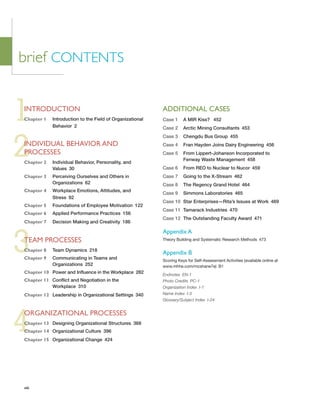



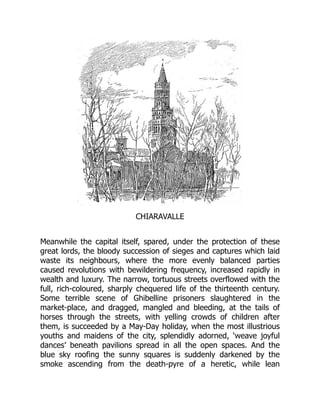
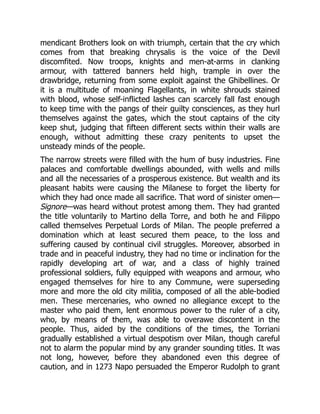
![power. In 1294 his gifts and flattery prevailed upon the Emperor
Adolfo to grant him the potent title of Imperial Vicar of Lombardy.
But the stealthy march of the Visconte’s ambition did not go
unchecked. His pretensions roused the Guelf party to new efforts
against him, and the impetuosity and recklessness of his sons as
they grew up wrecked his careful plans, and excited once more to
fiery heat those party passions which it was his aim to smooth and
allay. His love for the splendid Galeazzo, born at the cock-crow of the
Viscontean day, was the father’s undoing. In pursuance of his policy
of tranquillising the party strife which forbade all stable and settled
government in North Italy, Matteo made a marriage for this son with
Beatrice d’Este, widow of Nino Visconte, Judge of Gallura, and sister
of the Marquis of Ferrara, recognised chief of the Guelf party in
Lombardy. The marriage was of evil omen for the Visconti. We all
know those sad words on the little durability of woman’s love which
fall from the ghost of the forgotten husband in the Purgatorio.[1]
1. Canto viii., vv. 73-81.
The foreboding of disaster which they contain was justified; for
though in the end the Viper was able to give Beatrice as fine a
sepulture as the Cock of Gallura could have done, yet the events
which soon fell out might well have made her regret the bende
bianche which she had exchanged for the bridal garland. The
marriage, far from reconciling the two political parties, had only
thrown together a pair of extremely hot and indiscreet heads in
Galeazzo and Azzo VIII. of Ferrara. The vast ambitions which both
were suspected of nourishing roused the fear of Guelfs and
Ghibellines alike. Appointed Captain of the Milanese people,
Galeazzo only succeeded in alienating the citizens and strengthening
his enemies by his injudicious and unfortunate military enterprises.
The Torriani and their partisans, who had long suffered eclipse, had
begun to regain influence and allies, and a formidable league was
formed in Lombardy to overthrow the Visconti. A long struggle
followed, and day by day Matteo’s power waned in the city. The
people, whose inveterate distrust of the nobles his sagacity and](https://image.slidesharecdn.com/1898-250306031206-cb9850e0/85/eBook-PDF-Organizational-Behavior-7th-Edition-37-320.jpg)