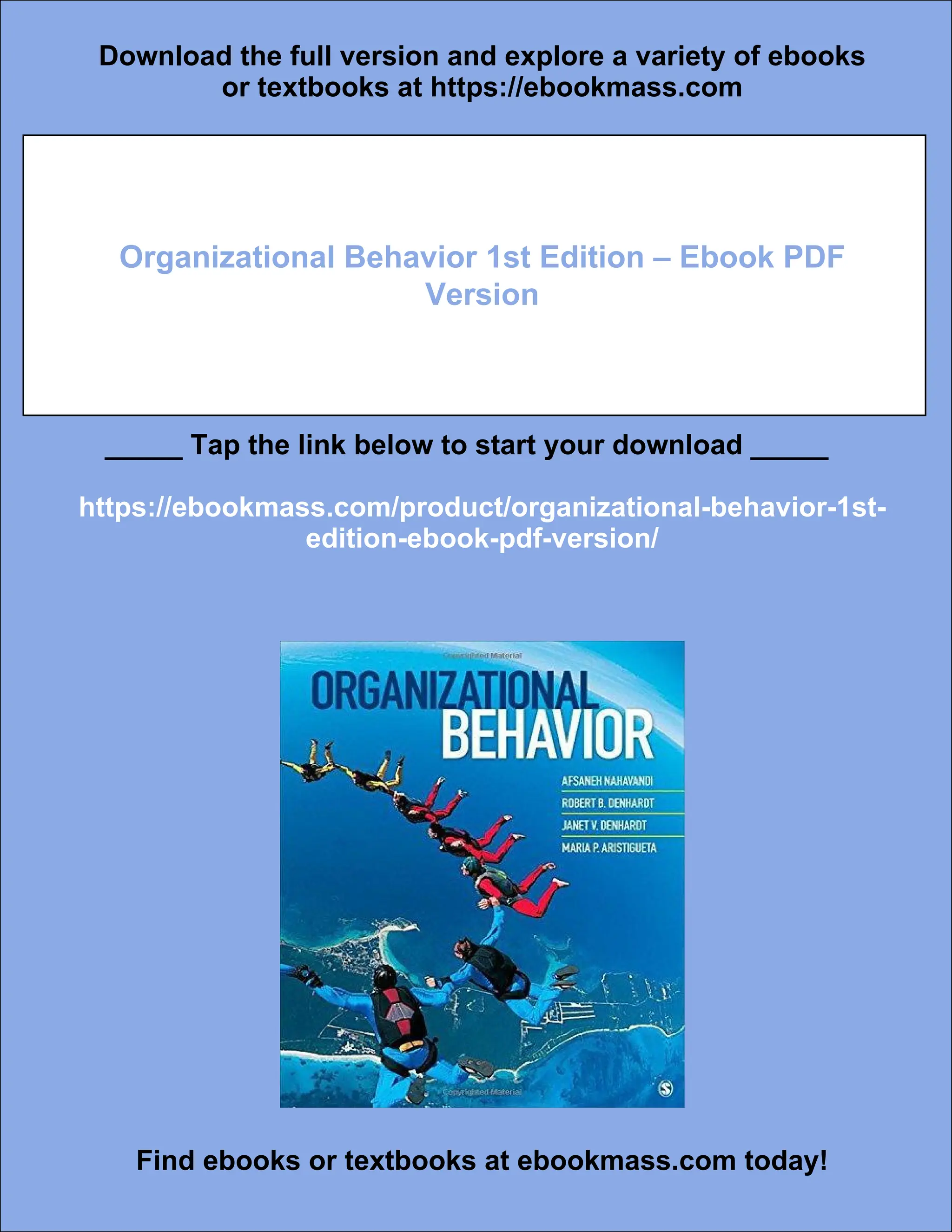
Organizational Behavior 1st Edition – Ebook PDF Version
Organizational Behavior 1st Edition – Ebook PDF Version
Organizational Behavior 1st Edition – Ebook PDF Version
Organizational Behavior 1st Edition – Ebook PDF Version
Organizational Behavior 1st Edition – Ebook PDF Version
1.
Download the fullversion and explore a variety of ebooks
or textbooks at https://ebookmass.com
Organizational Behavior 1st Edition – Ebook PDF
Version
_____ Tap the link below to start your download _____
https://ebookmass.com/product/organizational-behavior-1st-
edition-ebook-pdf-version/
Find ebooks or textbooks at ebookmass.com today!
2.
We have selectedsome products that you may be interested in
Click the link to download now or visit ebookmass.com
for more options!.
Essentials of Organizational Behavior – Ebook PDF Version
https://ebookmass.com/product/essentials-of-organizational-behavior-
ebook-pdf-version/
Essentials of Organizational Behavior 14th Edition – Ebook
PDF Version
https://ebookmass.com/product/essentials-of-organizational-
behavior-14th-edition-ebook-pdf-version/
Organizational Behavior: Human Behavior at Work: Human
Behavior at Work 14th Edition – Ebook PDF Version
https://ebookmass.com/product/organizational-behavior-human-behavior-
at-work-human-behavior-at-work-14th-edition-ebook-pdf-version/
Organizational Behavior 17th Edition, (Ebook PDF)
https://ebookmass.com/product/organizational-behavior-17th-edition-
ebook-pdf/
3.
Organizational Behavior 8thEdition, (Ebook PDF)
https://ebookmass.com/product/organizational-behavior-8th-edition-
ebook-pdf/
International Organizational Behavior: Transcending
Borders and Cultures 2nd Edition – Ebook PDF Version
https://ebookmass.com/product/international-organizational-behavior-
transcending-borders-and-cultures-2nd-edition-ebook-pdf-version/
Understanding and Managing Organizational Behavior 6th
Edition, (Ebook PDF)
https://ebookmass.com/product/understanding-and-managing-
organizational-behavior-6th-edition-ebook-pdf/
(eBook PDF) Organizational Behavior by Mitchell J. Neubert
https://ebookmass.com/product/ebook-pdf-organizational-behavior-by-
mitchell-j-neubert/
Organizational Behavior (18th Edition) (Whatu2019s New in
Management) (eBook PDF)
https://ebookmass.com/product/organizational-behavior-18th-edition-
whats-new-in-management-ebook-pdf/
• Audio Resources
•Additional Web Resources
• Chapter Outlines
• SAGE Journal Articles
• Real-World Research Articles From Pacific Standard Magazine
• SAGE Reference Articles
8.
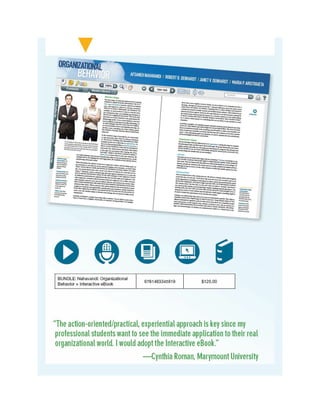
TAKE ACTION WithSAGE’s Multimedia-Rich
INTERACTIVE eBook
Improves Student Performance—Fully Searchable, Fully
Assignable
This dynamic new Interactive eBook version of Organizational
Behavior is ideal for students in online and traditional courses who
prefer a more contemporary, multimedia-integrated presentation for
learning. Fully searchable, it provides students with integrated links to
engaging video and audio as well as access to complete academic and
professional articles, all from the same pages found in the printed text.
Students will also have immediate access to study tools such as
highlighting, bookmarking, note-taking, and more!
FOR INFORMATION:
SAGE Publications,Inc.
2455 Teller Road
Thousand Oaks, California 91320
E-mail: order@sagepub.com
SAGE Publications Ltd.
1 Oliver’s Yard
55 City Road
London EC1Y 1SP
United Kingdom
SAGE Publications India Pvt. Ltd.
B 1/I 1 Mohan Cooperative Industrial Area
Mathura Road, New Delhi 110 044
India
SAGE Publications Asia-Pacific Pte. Ltd.
3 Church Street
#10-04 Samsung Hub
Singapore 049483
Acquisitions Editor: Patricia Quinlin
Associate Editor: Maggie Stanley
Digital Content Editor: Katie Guarino
Editorial Assistant: Dori Zweig
Production Editor: Jane Haenel
Copy Editor: Kristin Bergstad
Typesetter: C&M Digitals (P) Ltd.
Proofreader: Susan Schon
Indexer: Terri Corry
Designer: Scott Van Atta
Marketing Manager: Liz Thornton
15.
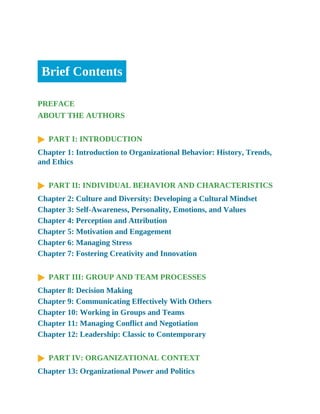
Brief Contents
PREFACE
ABOUT THEAUTHORS
PART I: INTRODUCTION
Chapter 1: Introduction to Organizational Behavior: History, Trends,
and Ethics
PART II: INDIVIDUAL BEHAVIOR AND CHARACTERISTICS
Chapter 2: Culture and Diversity: Developing a Cultural Mindset
Chapter 3: Self-Awareness, Personality, Emotions, and Values
Chapter 4: Perception and Attribution
Chapter 5: Motivation and Engagement
Chapter 6: Managing Stress
Chapter 7: Fostering Creativity and Innovation
PART III: GROUP AND TEAM PROCESSES
Chapter 8: Decision Making
Chapter 9: Communicating Effectively With Others
Chapter 10: Working in Groups and Teams
Chapter 11: Managing Conflict and Negotiation
Chapter 12: Leadership: Classic to Contemporary
PART IV: ORGANIZATIONAL CONTEXT
Chapter 13: Organizational Power and Politics
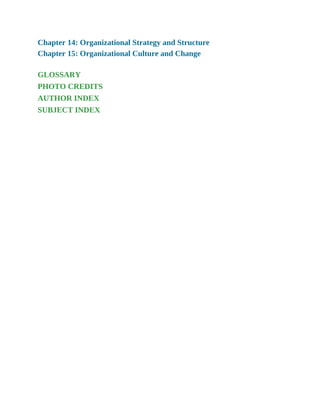
16.
Chapter 14: OrganizationalStrategy and Structure
Chapter 15: Organizational Culture and Change
GLOSSARY
PHOTO CREDITS
AUTHOR INDEX
SUBJECT INDEX
17.
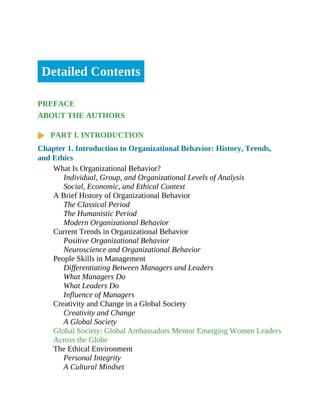
Detailed Contents
PREFACE
ABOUT THEAUTHORS
PART I. INTRODUCTION
Chapter 1. Introduction to Organizational Behavior: History, Trends,
and Ethics
What Is Organizational Behavior?
Individual, Group, and Organizational Levels of Analysis
Social, Economic, and Ethical Context
A Brief History of Organizational Behavior
The Classical Period
The Humanistic Period
Modern Organizational Behavior
Current Trends in Organizational Behavior
Positive Organizational Behavior
Neuroscience and Organizational Behavior
People Skills in Management
Differentiating Between Managers and Leaders
What Managers Do
What Leaders Do
Influence of Managers
Creativity and Change in a Global Society
Creativity and Change
A Global Society
Global Society: Global Ambassadors Mentor Emerging Women Leaders
Across the Globe
The Ethical Environment
Personal Integrity
A Cultural Mindset
18.
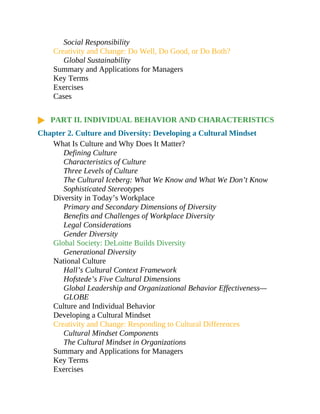
Social Responsibility
Creativity andChange: Do Well, Do Good, or Do Both?
Global Sustainability
Summary and Applications for Managers
Key Terms
Exercises
Cases
PART II. INDIVIDUAL BEHAVIOR AND CHARACTERISTICS
Chapter 2. Culture and Diversity: Developing a Cultural Mindset
What Is Culture and Why Does It Matter?
Defining Culture
Characteristics of Culture
Three Levels of Culture
The Cultural Iceberg: What We Know and What We Don’t Know
Sophisticated Stereotypes
Diversity in Today’s Workplace
Primary and Secondary Dimensions of Diversity
Benefits and Challenges of Workplace Diversity
Legal Considerations
Gender Diversity
Global Society: DeLoitte Builds Diversity
Generational Diversity
National Culture
Hall’s Cultural Context Framework
Hofstede’s Five Cultural Dimensions
Global Leadership and Organizational Behavior Effectiveness—
GLOBE
Culture and Individual Behavior
Developing a Cultural Mindset
Creativity and Change: Responding to Cultural Differences
Cultural Mindset Components
The Cultural Mindset in Organizations
Summary and Applications for Managers
Key Terms
Exercises
19.
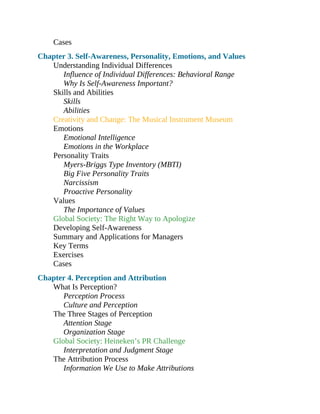
Cases
Chapter 3. Self-Awareness,Personality, Emotions, and Values
Understanding Individual Differences
Influence of Individual Differences: Behavioral Range
Why Is Self-Awareness Important?
Skills and Abilities
Skills
Abilities
Creativity and Change: The Musical Instrument Museum
Emotions
Emotional Intelligence
Emotions in the Workplace
Personality Traits
Myers-Briggs Type Inventory (MBTI)
Big Five Personality Traits
Narcissism
Proactive Personality
Values
The Importance of Values
Global Society: The Right Way to Apologize
Developing Self-Awareness
Summary and Applications for Managers
Key Terms
Exercises
Cases
Chapter 4. Perception and Attribution
What Is Perception?
Perception Process
Culture and Perception
The Three Stages of Perception
Attention Stage
Organization Stage
Global Society: Heineken’s PR Challenge
Interpretation and Judgment Stage
The Attribution Process
Information We Use to Make Attributions
20.
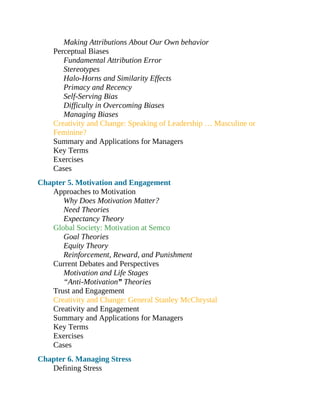
Making Attributions AboutOur Own behavior
Perceptual Biases
Fundamental Attribution Error
Stereotypes
Halo-Horns and Similarity Effects
Primacy and Recency
Self-Serving Bias
Difficulty in Overcoming Biases
Managing Biases
Creativity and Change: Speaking of Leadership … Masculine or
Feminine?
Summary and Applications for Managers
Key Terms
Exercises
Cases
Chapter 5. Motivation and Engagement
Approaches to Motivation
Why Does Motivation Matter?
Need Theories
Expectancy Theory
Global Society: Motivation at Semco
Goal Theories
Equity Theory
Reinforcement, Reward, and Punishment
Current Debates and Perspectives
Motivation and Life Stages
“Anti-Motivation” Theories
Trust and Engagement
Creativity and Change: General Stanley McChrystal
Creativity and Engagement
Summary and Applications for Managers
Key Terms
Exercises
Cases
Chapter 6. Managing Stress
Defining Stress
21.
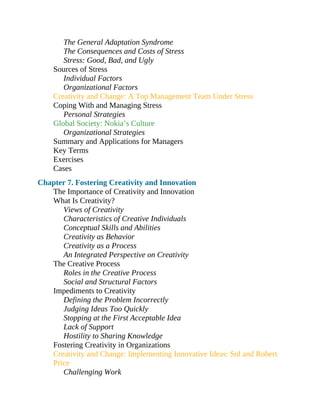
The General AdaptationSyndrome
The Consequences and Costs of Stress
Stress: Good, Bad, and Ugly
Sources of Stress
Individual Factors
Organizational Factors
Creativity and Change: A Top Management Team Under Stress
Coping With and Managing Stress
Personal Strategies
Global Society: Nokia’s Culture
Organizational Strategies
Summary and Applications for Managers
Key Terms
Exercises
Cases
Chapter 7. Fostering Creativity and Innovation
The Importance of Creativity and Innovation
What Is Creativity?
Views of Creativity
Characteristics of Creative Individuals
Conceptual Skills and Abilities
Creativity as Behavior
Creativity as a Process
An Integrated Perspective on Creativity
The Creative Process
Roles in the Creative Process
Social and Structural Factors
Impediments to Creativity
Defining the Problem Incorrectly
Judging Ideas Too Quickly
Stopping at the First Acceptable Idea
Lack of Support
Hostility to Sharing Knowledge
Fostering Creativity in Organizations
Creativity and Change: Implementing Innovative Ideas: Sol and Robert
Price
Challenging Work
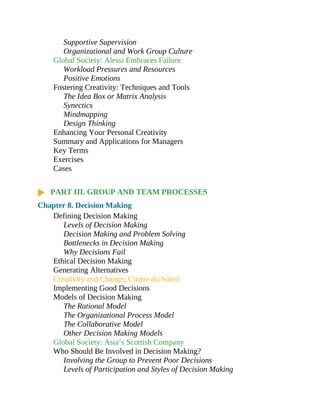
22.
Supportive Supervision
Organizational andWork Group Culture
Global Society: Alessi Embraces Failure
Workload Pressures and Resources
Positive Emotions
Fostering Creativity: Techniques and Tools
The Idea Box or Matrix Analysis
Synectics
Mindmapping
Design Thinking
Enhancing Your Personal Creativity
Summary and Applications for Managers
Key Terms
Exercises
Cases
PART III. GROUP AND TEAM PROCESSES
Chapter 8. Decision Making
Defining Decision Making
Levels of Decision Making
Decision Making and Problem Solving
Bottlenecks in Decision Making
Why Decisions Fail
Ethical Decision Making
Generating Alternatives
Creativity and Change: Cirque du Soleil
Implementing Good Decisions
Models of Decision Making
The Rational Model
The Organizational Process Model
The Collaborative Model
Other Decision Making Models
Global Society: Asia’s Scottish Company
Who Should Be Involved in Decision Making?
Involving the Group to Prevent Poor Decisions
Levels of Participation and Styles of Decision Making
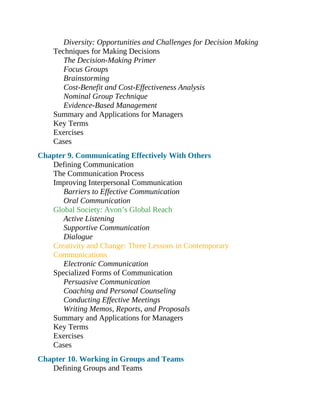
23.
Diversity: Opportunities andChallenges for Decision Making
Techniques for Making Decisions
The Decision-Making Primer
Focus Groups
Brainstorming
Cost-Benefit and Cost-Effectiveness Analysis
Nominal Group Technique
Evidence-Based Management
Summary and Applications for Managers
Key Terms
Exercises
Cases
Chapter 9. Communicating Effectively With Others
Defining Communication
The Communication Process
Improving Interpersonal Communication
Barriers to Effective Communication
Oral Communication
Global Society: Avon’s Global Reach
Active Listening
Supportive Communication
Dialogue
Creativity and Change: Three Lessons in Contemporary
Communications
Electronic Communication
Specialized Forms of Communication
Persuasive Communication
Coaching and Personal Counseling
Conducting Effective Meetings
Writing Memos, Reports, and Proposals
Summary and Applications for Managers
Key Terms
Exercises
Cases
Chapter 10. Working in Groups and Teams
Defining Groups and Teams
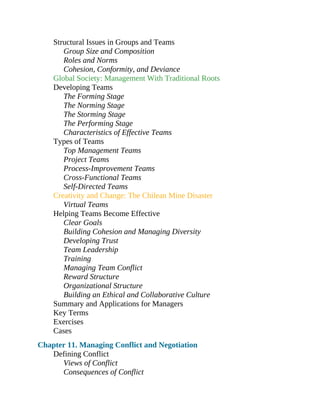
24.
Structural Issues inGroups and Teams
Group Size and Composition
Roles and Norms
Cohesion, Conformity, and Deviance
Global Society: Management With Traditional Roots
Developing Teams
The Forming Stage
The Norming Stage
The Storming Stage
The Performing Stage
Characteristics of Effective Teams
Types of Teams
Top Management Teams
Project Teams
Process-Improvement Teams
Cross-Functional Teams
Self-Directed Teams
Creativity and Change: The Chilean Mine Disaster
Virtual Teams
Helping Teams Become Effective
Clear Goals
Building Cohesion and Managing Diversity
Developing Trust
Team Leadership
Training
Managing Team Conflict
Reward Structure
Organizational Structure
Building an Ethical and Collaborative Culture
Summary and Applications for Managers
Key Terms
Exercises
Cases
Chapter 11. Managing Conflict and Negotiation
Defining Conflict
Views of Conflict
Consequences of Conflict
25.
Types and Levelsof Conflict
Culture and Conflict
Sources of Conflict
Personal Sources of Conflict
Organizational Sources of Conflict
Creativity and Change: Helping Relationships
Managing Conflict
Two General Approaches
Individual Conflict Management Styles
Preventing and Reducing Conflict
Increasing or Stimulating Conflict
Negotiating
The Negotiation Process
Ethics and Negotiation
Culture and Negotiation
Global Society: Cross-Cultural Negotiations
Common Mistakes in Negotiation
Negotiation Strategies
Summary and Applications for Managers
Key Terms
Exercises
Cases
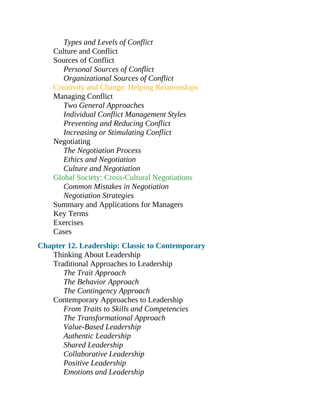
Chapter 12. Leadership: Classic to Contemporary
Thinking About Leadership
Traditional Approaches to Leadership
The Trait Approach
The Behavior Approach
The Contingency Approach
Contemporary Approaches to Leadership
From Traits to Skills and Competencies
The Transformational Approach
Value-Based Leadership
Authentic Leadership
Shared Leadership
Collaborative Leadership
Positive Leadership
Emotions and Leadership
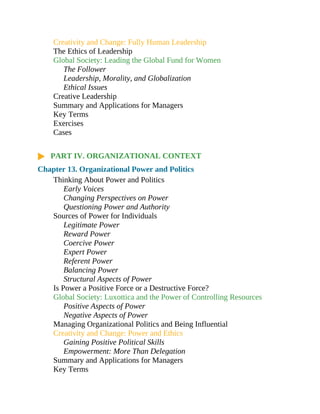
26.
Creativity and Change:Fully Human Leadership
The Ethics of Leadership
Global Society: Leading the Global Fund for Women
The Follower
Leadership, Morality, and Globalization
Ethical Issues
Creative Leadership
Summary and Applications for Managers
Key Terms
Exercises
Cases
PART IV. ORGANIZATIONAL CONTEXT
Chapter 13. Organizational Power and Politics
Thinking About Power and Politics
Early Voices
Changing Perspectives on Power
Questioning Power and Authority
Sources of Power for Individuals
Legitimate Power
Reward Power
Coercive Power
Expert Power
Referent Power
Balancing Power
Structural Aspects of Power
Is Power a Positive Force or a Destructive Force?
Global Society: Luxottica and the Power of Controlling Resources
Positive Aspects of Power
Negative Aspects of Power
Managing Organizational Politics and Being Influential
Creativity and Change: Power and Ethics
Gaining Positive Political Skills
Empowerment: More Than Delegation
Summary and Applications for Managers
Key Terms
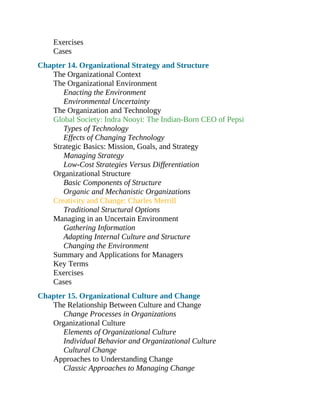
27.
Exercises
Cases
Chapter 14. OrganizationalStrategy and Structure
The Organizational Context
The Organizational Environment
Enacting the Environment
Environmental Uncertainty
The Organization and Technology
Global Society: Indra Nooyi: The Indian-Born CEO of Pepsi
Types of Technology
Effects of Changing Technology
Strategic Basics: Mission, Goals, and Strategy
Managing Strategy
Low-Cost Strategies Versus Differentiation
Organizational Structure
Basic Components of Structure
Organic and Mechanistic Organizations
Creativity and Change: Charles Merrill
Traditional Structural Options
Managing in an Uncertain Environment
Gathering Information
Adapting Internal Culture and Structure
Changing the Environment
Summary and Applications for Managers
Key Terms
Exercises
Cases
Chapter 15. Organizational Culture and Change
The Relationship Between Culture and Change
Change Processes in Organizations
Organizational Culture
Elements of Organizational Culture
Individual Behavior and Organizational Culture
Cultural Change
Approaches to Understanding Change
Classic Approaches to Managing Change
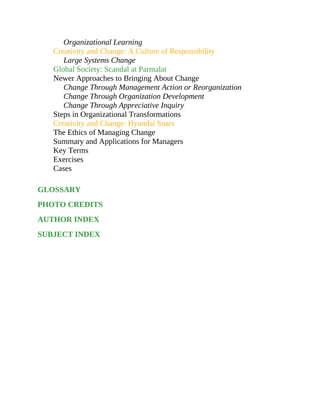
28.
Organizational Learning
Creativity andChange: A Culture of Responsibility
Large Systems Change
Global Society: Scandal at Parmalat
Newer Approaches to Bringing About Change
Change Through Management Action or Reorganization
Change Through Organization Development
Change Through Appreciative Inquiry
Steps in Organizational Transformations
Creativity and Change: Hyundai Soars
The Ethics of Managing Change
Summary and Applications for Managers
Key Terms
Exercises
Cases
GLOSSARY
PHOTO CREDITS
AUTHOR INDEX
SUBJECT INDEX
29.
Preface
Failure is simplythe opportunity to begin again, this time more
intelligently.
—Henry Ford
The greatest danger in times of turbulence is not the turbulence; it is to
act with yesterday’s logic.
—Peter Drucker
Our Approach: Knowledge and Action
We believe organizational behavior is not just a field of study. Organizational
behavior is a practical discipline that enables us to act effectively and
responsibly. Our text provides an action orientation that demonstrates how
organizational behavior is a way of thinking and acting that is of critical
importance to leaders, to managers, to their employees, and to their
customers.
This book is about helping students understand, manage, and change their
own behavior, as well as influence the behavior of others. We believe that the
ability to lead and manage effectively requires knowledge, creativity, and
practice. No matter what organizational setting students encounter, there are
certain skills they will need to address the “people” challenges they will face.
Questions of motivation, power and authority, communications, group
dynamics, and leadership arise in organizations large and small and in all
sectors. Whether managing the corner store, a large manufacturing firm, a
major league baseball team, a nonprofit foundation, a city department, or a
day spa, questions about managing people may be the most important ones
future leaders face.
30.
Many organizational behaviortexts focus on the study of organizational
behavior rather than the practical application of these lessons, that is, how
you can more effectively manage human behavior in real-world
circumstances. This book has a distinctive “action orientation” that is
reflected in our pedagogy. The book is designed with three concepts in mind:
1. The importance of understanding the behavior, motivations, and actions
of individuals in organizations
2. A focus on building the knowledge, self-awareness, and skills
appropriate and necessary for leadership and organizational change
3. An emphasis on students learning not only from readings and
discussions but also from their own experiences
We are not only concerned with students learning about organizational
behavior; we also want them to be able to acquire practical skills and develop
habits of mind that will support continued learning from their experiences. To
develop the capacity for action, a different style of learning is necessary,
something that goes beyond just reading about a topic. Learning the practical
skills to support effective and responsible action requires not only discussing
new material but also improving students’ capacity to act in pursuit of ideas.
In looking for people to hire, you look for three qualities:
integrity, intelligence, and energy. And if they don’t have the
first, the other two will kill you.
—Warren Buffet, CEO, Berkshire Hathaway
Target Audience
Organizational Behavior is a core text for organizational behavior courses in
schools of business as well as in public administration, nonprofit
management, educational administration, and health care management. While
the text is primarily oriented toward undergraduates, it is also suitable for
graduate-level courses. The book covers all the topics in organizational
31.
behavior and theall-important “people skills,” but does so with a practical
focus on how students, as future managers and leaders, can think and act
creatively to motivate employees, address change, and overcome challenges
in today’s interconnected global society.
Our Goals
Our intent is to provide lessons and perspectives that will enhance students’
understanding of their own behavior and their ability to influence the
behavior of others. To that end, this book examines the knowledge and skills
acquired by the most successful leaders and managers, draws from the
research and observations of scholars from various fields, and provides
opportunities for students to develop both the skills and the habits of mind
that will allow them to learn now and to continue to learn throughout their
careers. Accordingly, the goals of this book are as follows:
1. To explore some of the most contemporary approaches to leading and
managing people
2. To understand the importance and impact of the global context and of
culture on people and organizations
3. To examine the factors that affect human behavior in organizations
4. To understand human behavior from multiple levels: individual, group,
and organizational
5. To develop critical management and leadership skills and provide
students with the capacity to act effectively and responsibly given the
stress, complexity, and uncertainty of the “real world”
The book is organized into four parts titled Introduction, Individual Behavior
and Characteristics, Group and Team Processes, and Organizational Context.
Note that in contrast to other texts that discuss the individual, the group, and
the organization, we emphasize the interaction between these levels. For
example, the topic of emotions is introduced in Chapter 3, then revisited in
Chapters 8 and 11.
32.
Themes
To be effective,leaders and managers must understand their global and
cultural contexts and their impact on people and organizations. They must
use their knowledge, skills, and creativity to motivate others, function well in
groups and teams, communicate clearly, manage conflict, and navigate
change successfully. They must cope with their own and their employees’
stress, be self-reflective and open to learning and growth, and maintain their
commitment to their work in spite of sometimes unreachable goals and
limited resources.
We present organizational behavior topics by weaving four themes
throughout the chapters and integrate them in cases, examples, exercises,
self-assessments, and application-oriented questions.
Global and Cultural Perspective
Organizations today function in a global environment where culture plays a
central role. AACSB International, the business school accrediting body,
considers global and cultural forces and cultural diversity among the key
challenges managers will face in the future. Whether working across national
boundaries or with diverse populations within a country, today’s managers
and leaders must have an appreciation and understanding of the importance
and impact of culture. Chapter 1 introduces students to the concept of
globalization, explaining how our global society affects individual
engagements, social relationships, and social institutions. Chapter 2 focuses
on workplace diversity, explaining how culture, ethnicity, gender, and age
influence behavior in organizations.
Creativity and Change
The complexity, interconnectedness, and dynamic nature of today’s
organizations requires managers and leaders who can think and act creatively
to navigate the ever-changing organizational landscape. The 2010 IBM
Global CEO Study, based on face-to-face interviews with 1,541 CEOs,
general managers, and senior public sector leaders around the world,
concluded that the single most important attribute of future leaders will be
creativity. “Creative leaders invite disruptive innovation, encourage others to
drop outdated approaches and take balanced risks. They are open-minded and
33.
inventive in expandingtheir management and communication styles,
particularly to engage with a new generation of employees, partners, and
customers.” Chapter 7 helps students understand the creative process and
common impediments to creativity as well as how to overcome those
challenges, and introduces techniques for enhancing their own and their
employees’ creativity. Creativity and Change boxes illustrate how
organizations around the globe react to change creatively.
Thinking and Acting Ethically
Integrity and acting in an ethical manner are essential to effective leadership
and the survival of our organizations. Chapter 1 frames organizational
behavior using an ethical context. Ethics is then incorporated in subsequent
chapters, showing students how ethics relates to topics such as decision
making, teams, negotiation, leadership, and managing change.
Positive Psychology and Strength-Based Approach
We wrote this text with a strong emphasis on positive psychology. We
believe that effective managers must be aware of their values and their
strengths. We focus on teaching students to build self-awareness and the
importance of investing in followers’ and employees’ strengths rather than
weaknesses as a way to enhance individual and organizational success and
create even more positive conditions. The importance of positive psychology
and self-awareness are introduced in Chapters 1 and 2, then echoed in the
following chapters.
Action-Orientation
In each chapter, we present a review of the relevant material related to each
of the topics, and we provide some specific and immediate ideas and tools
that will help students aspire to be managers and leaders. The presentation of
various topics in this ordered and pedagogically sound manner engages
students immediately in the material as a personal concern, acquaints them
with the relevant and important thinking on the topic, gives them immediate
and practical guidelines for action, and then leads them through case analysis,
critical thinking questions, and exercises to test and improve their skills and
This ebook isfor the use of anyone anywhere in the United
States and most other parts of the world at no cost and with
almost no restrictions whatsoever. You may copy it, give it away
or re-use it under the terms of the Project Gutenberg License
included with this ebook or online at www.gutenberg.org. If you
are not located in the United States, you will have to check the
laws of the country where you are located before using this
eBook.
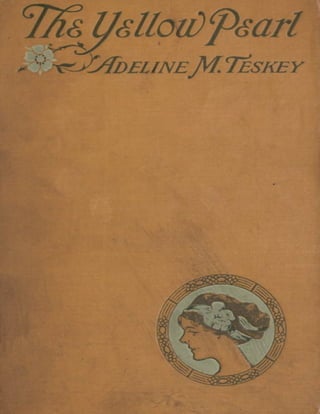
Title: The Yellow Pearl: A Story of the East and the West
Author: Adeline M. Teskey
Release date: July 9, 2018 [eBook #57473]
Language: English
Credits: E-text prepared by Mary Glenn Krause, Martin Pettit,
and the Online Distributed Proofreading Team
(http://www.pgdp.net) from page images generously
made available by Internet Archive
(https://archive.org)
*** START OF THE PROJECT GUTENBERG EBOOK THE YELLOW
PEARL: A STORY OF THE EAST AND THE WEST ***
40.
E-text prepared byMary Glenn Krause, Martin Pettit,
and the Online Distributed Proofreading Team
(http://www.pgdp.net)
from page images generously made available by
Internet Archive
(https://archive.org)
Note: Images of the original pages are available through Internet
Archive. See
https://archive.org/details/yellowpearlstory00tesk
43.
THE YELLOW
PEARL
A STORYOF THE EAST AND
THE WEST
BY
ADELINE M. TESKEY
Author of "Where the Sugar Maple
Grows," etc.
HODDER AND STOUGHTON
NEW YORK
GEORGE H. DORAN COMPANY
Copyright, 1911,
By George H. Doran Company
March 1st, 1——
HereI am in this strange country about which I have learned in the
geography and history, and about which I heard my father talk. The
daughter of an American man and a Chinese woman, I suppose I am
what is called a mongrel. My father was a Commissioner of Customs
in China, and living for years in that country he fell in love with my
mother and married her—as was natural. Who could help falling in
love with my dear, yellow, winsome, little mother? My name is
Margaret, called after my father's mother; my father said that the
word Margaret means a pearl, so he gave me the pet name "Pearl."
Dear father!
"It was a monstrous thing for Brother George to marry away there,"
I overheard my Aunt Gwendolin remark a short time after my arrival.
"Why could he not have come back home to his own country and
found a wife?—And above all to have married a heathen Chinese!"
"Not a heathen," said my grandmother, reproachfully, "she had
previously embraced the faith of Europeans; so my dear George
wrote me from that far-away country."
"Oh, they are all heathens in my estimation," cried my Aunt
Gwendolin, scornfully; "what faith they embrace does not change
the fact that they belong to the yellow people."
My mother died while I was yet a child, and my father has died and
left me alone in the world within the last year. Grandmother, my
father's mother, when she learned about her son's death, sent at
once for me.
"I cannot leave a granddaughter of mine in that country, and among
that heathen, if not barbarous, people," she wrote to the American
46.
consul, "and Iask your services to assist her to come to my home in
America."
The consul, absent-minded, gave me my grandmother's letter to
read, and thus I learned her feeling about my mother's people and
country. I never would have come to this horrible America if I could
have helped myself; but I am scarcely of age, and by my father's will
grandmother is appointed my guardian.
The result of it all is, that having crossed the intervening waters, I
am here in the home of my grandmother, my Aunt Gwendolin and
my Uncle Theodore Morgan.
When I arrived this morning I was ushered into the sitting-room by a
maid, and the first one I beheld was my grandmother, sitting in a
rocking-chair. She called me to her, and crossing the room, I
kotowed to her, that is I went down on my hands and knees and
touched my forehead to the floor, as my Chinese nurse had taught
me when I was yet a baby that I should always do when I came into
the presence of an elderly woman, a mother of children.
"My dear grandchild!" cried my grandmother, "do get up. All you
should do is to kiss me—your grandmother!" And she put out her
hand and assisted me from the floor.
Grandmother is the dearest, prettiest little woman I ever saw, with
white hair and the brightest of eyes, and I have to love her, although
I had made up my mind to hate everything in America. A moment
after she had lifted me from the floor, my Aunt Gwendolin came in.
She is tall and thin, not nearly so beautiful a woman as my Chinese
mother. She wears skirts that drag on the floor, and her hair is built
up into a sort of a mountain on top of her head. I am reminded
every time I look at her of a certain peak in the Thian Shan
mountains. I very much prefer little women, like my own dear
mother, like the women of my own country.
My Uncle Theodore is long-armed, long-legged, long-bodied. He
looks a little like my father, and for that reason I hate him a little less
47.
than my AuntGwendolin.
After my mother's death, my father brought into our home a French
governess, daughter of a French consul, to teach me. Father seemed
to be lost in his business, or his grief at the loss of my mother, and
paid very little heed to me after the arrival of the governess.
"She is an educated woman," he told me when he had engaged her,
"and I want her to teach you all you could learn in a first-class girls'
school in Europe or America."
After that the French governess spent hours with me every day, and
I saw my father only at intervals. How much we talked about, that
French lady and I! Everything, almost, except religion; that my
father vetoed, as her faith was not the one he wished me to
embrace. "I'll take you over to your grandmother by and by," he
used to say, "to get the proper religious instruction."
The governess said that I inherited more from my father's side of
the house than my mother's; that although I was born in China, I
was more of an Occidental than an Oriental; more than once she
said that my American mannerisms and tricks of speech were really
remarkable, and that I was a living example of the power of
heredity. But I am never going back on my mother's people, never,
my dear little oval-faced mother whose grave is under a spreading
camphor tree at the heart of the world.
Does it not mean something that China is at the centre of the world
—the kernel?
"The girl is not bad to look at, in fact I think she is a beauty—a face
filled with the indescribable dash of the Orient," said my Uncle
Theodore, when they were talking me over in the sitting-room after
I had retired to my chamber upstairs. Evidently they had forgotten
the opening in the floor which had been left by the workmen while
making some changes in the plumbing. And they did not know my
extraordinary keenness of hearing, which my governess said was an
Oriental trait.
48.
It seemed togive my governess some pleasure to talk about that
keen sense of the Orientals, and to speculate as to how they had
acquired it. "They have lived in a country where it is necessary, for
self-protection, to hear all that is being plotted and planned," she
said, "a country of conspiracies and intrigues, of plots and
counterplots. Centuries of this have developed abnormal hearing."
"She has a superb figure," said my uncle, continuing to talk about
me, "and that oval face of hers, with her creamy complexion, is
really bewitching."
"Yellow! you mean, yellow!" interrupted my Aunt Gwendolin; "she's
entirely too yellow for beauty. I'm terribly afraid that some of our set
will discover her nationality. That's one thing you must remember,
Theodore, nobody on this continent is ever to learn anything about
her Chinese blood. They are so despised here as a race. She is our
brother's daughter, with some foreign strain inherited from her
mother; that is enough; never, never, let us acknowledge the
Chinese. The Italians and Spanish are yellowish too,—I have it!" she
exclaimed, "Spanish!—Spanish will do!—Some of those are our
people now, you know! It will be quite interesting to have her a
native of one of our Dependencies—a descendant of some old
Spanish family!"
"Do not be foolish, Gwendolin," said my grandmother.
"I could not endure the thought of introducing a Celestial,"
continued my aunt. "None must know that we have introduced the
Yellow Peril into the country!"
"Why, Gwendolin, how you do talk," said my grandmother; "the
child's father was an American, and she was admitted into this
country as an American."
"You must talk with the girl to-morrow, Theodore," continued my
aunt, ignoring my grandmother's remark, "and tell her to keep
sacred her progenitors. She speaks such perfect English no one
would suspect that there was much foreign about her."
49.
"She has astriking, unusual air that would attract a second glance
from most people," said my uncle. "If you can keep her nationality
from Professor Ballington you will do better than I think you can; he
is a great ethnologist; it is his life-work to make discoveries in that
line."
"Well it must be kept, no matter what means we resort to," returned
my Aunt Gwendolin, with a ring of determination in her voice.
"Poor child," said my dear old grandmother, "she is my
granddaughter, and I love her already, my George's child. She looks
beautiful to me whether yellow or no."
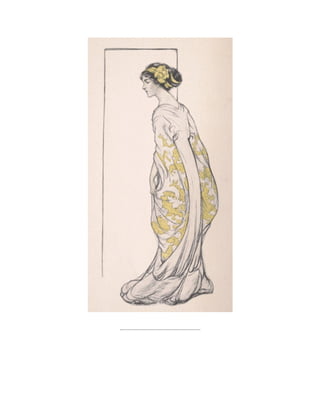
I had gone down to dinner on this first evening in a soft yellow silk,
with long flowing sleeves trimmed with dragons, I know I looked
well in it. Governess always said I did. It was partly Chinese and
partly European in design. Governess planned it herself, and she said
the French were born with a knowledge how to dress artistically; she
boasted that she made it to suit my peculiar style.
"Did you notice that China silk she had on at dinner?" said Aunt
Gwendolin; "there must be an end to all that; a ban must be put on
everything Chinese."
"It was rather becoming I thought," said Uncle Theodore, "in
harmony with the clear yellow of her skin. Let her dress alone, she
seems to know how to put it. That is a born gift with some women,
and if it is not, they never seem to acquire it. There is great
elegance in the straight lines of the Oriental dress."
"Let her alone," said Aunt Gwendolin scornfully, "and let the whole
city know we have introduced the Yellow Per——"
"Gwendolin, dear," interrupted grandmother, "do not speak so."
"Those Chinese silks, of which she seems to have gowns galore—I
was at the unpacking of her trunks—must be tabooed," said my
aunt. "Her father has evidently intended her to dress like an
50.
European or American;she has some waist line, and does not wear
the sacque the women wear in China; but her sleeves are years old."
"The dear child may object to having her attire changed at once,"
said my grandmother. "She is used to those soft clinging silks, and
may not want to give them up. And sleeves are of little
consequence. Let her alone for awhile."
"Let her alone!" again retorted Aunt Gwendolin, "and let Professor
Ballington see her? He'd know her nationality at once in that yellow
silk covered with sprawling dragons, as almost anybody might. I
cannot have anything so mortifying occur when the girl is calling me
'aunt'!"
"Ballington is a curious kind of a chap, and values people on their
own merits; he'd think none the less of the girl because she has
some Chinese blood in her," returned Uncle Theodore.
"I'll take her out to-morrow," continued my aunt, "and buy her some
taffeta silks and French muslins, and dress her up as a Christian
should be dressed."
Grandmother said no more. The mother is not the head of the house
in America as she is in dear old China. I suppose it is the daughter
who rules in this country.
I am so sleepy I cannot listen any longer, even to talk about myself.
My governess has taught me that eavesdropping is not honourable,
but I cannot avoid hearing so long as I stay in my room, and I have
nowhere else to go. I will turn out the electric light, throw myself on
the bed, yellow silk and all, and cry myself asleep. I wonder is that
an American or a Chinese act? My governess was continually tracing
my actions to one or other of the nations.
51.
March 2, 1——
Ithappened this morning! That man Aunt Gwendolin thought would
be so sure to know that I was the Yellow Pearl, came to the house,
and was ushered into my uncle's den by the maid, a few moments
after I had been sent in there to have the "talk" with him which was
spoken about the night before.
"He is a tall man, very, very white," were my thoughts regarding
him, as he bowed politely before me, when my uncle introduced us;
and I suppose his thoughts regarding me were: "She is a short
woman, very, very, yellow."
He left after a few moments' conversation with my uncle; and
turning to me the latter said, "That gentleman who has just gone is
professor of ethnology in the State University. He knows all about
the peculiarities of all the peoples and tribes that ever have graced
or disgraced the face of this planet we call the world—— Has your
aunt told you that she thinks it better that you should say nothing
about your Chinese ancestry?" he added hastily and awkwardly.
"Have the Chinese done anything disgraceful?" I asked him.
"No, no, I don't suppose they really have," he answered with an air
of annoyance. "A girl like you cannot understand; you had better
simply follow instructions. I hope it will not be necessary to mention
this subject again," he added meaningly.
I could not mistake him; I must not dare tell Professor Ballington or
any one else in this great country that my mother was a Chinese
woman.
In the afternoon Aunt Gwendolin took me down into the shops of
the city, "to select an outfit," she said.
52.
We stood forhours, it seemed to me, over counters laden with silks
and muslins of every colour in the rainbow. Aunt Gwendolin held the
various shades up against my face to see which best became my
"Spanish complexion." This was said, I suppose, for the ears of the
sales-people, and the fashionable customers standing around.
When selections were made among the goods, I was taken to the
establishment of a "Parisienne modiste," where I was pinched,
puckered, and pulled until I was nearly numb. A sort of a steel waist
was put on me, which my aunt and the modiste called a "corset,"
and was so tightly pulled I could scarcely breathe.
"I can't stand it, Aunt Gwendolin," I whisperingly gasped.
"Yes, you can!" she returned peremptorily, "you'll get used to it;
that's nothing like as tight as the girls all wear them in this country."
"I can't breathe," I gasped again, when the modiste had turned her
back; (Aunt Gwendolin had signed to me the first time not to let her
hear me).
"Hush!" said my aunt; "for pity sake do not let the modiste know
that you never had a corset on before."
"I'd rather have my feet bound like the women do in Chi——"
Aunt Gwendolin placed her jewelled fingers over my mouth before I
had finished the sentence.
Just as I was through being "fitted," one of Aunt Gwendolin's
fashionable friends came in. "Arabella," my aunt called her, but the
modiste called her Mrs. Delaney. I was not noticed, and slipped off
into a corner, and this newcomer and my relative fell into a deep and
absorbing talk about the new style of sleeve. I saw my opportunity
and slipped unnoticed out the front door, which fortunately was
behind them.
Hurrying down a few blocks I reached a bookseller's window. With
one glance I had noticed, when my aunt and I were passing the
53.
window on theway to the establishment of the Parisienne modiste,
the word China on the cover of a book. "I'll buy that book," I had
said to myself, "and learn what there is about China that makes
Americans despise her people."
Entering the store, I found a number of books about China and the
Chinese: "One of China's Scholars," "How the Chinese Think," "The
Greatest Novels of China," "Chinese Life." I paid for them all and
ordered them sent to my grandmother's house.
The bookseller looked at me very curiously for several moments, and
then ventured, "You speak English very well."
"Of course I do," I said, tossing my head and trying to act saucily, as
my governess had told me the American girls did. I would not have
dared to treat a man that way in China.
He did not venture to speak again. It is funny to be able in this
America to frighten a man! Confucius says that women should "be
always modest and respectful in demeanour, and prefer others to
themselves"; but I have not to mind Confucius any longer; I am now
in the "sweet land of liberty," as they sing in their national anthem. I
heard my father say once that the gentleness and modesty of
Oriental women was really beautiful; but it would not be beautiful in
America.
I hurried back to the establishment of the Parisienne modiste, and
found my aunt and her friend still talking about sleeves. They had
never noticed my absence. How very important sleeves are in
America! I never heard them talked about in China.
The talkers had evidently forgotten me, so I slipped out again, and
walked several blocks, watching the manners, and catching snatches
of the conversation of Americans.
"I'm going to have mine eighteen gores——"
"Pleating down the front, frills at the side——"
54.
"Pocahontas hat, andPrince Chap suit——"
"Front panel, and revers turned——"
"Frills and pipings all around——"
"Gored, or cut in one piece——"
"Oh, pompadour, by all means, with——"
These were the snatches of conversation which I caught from the
women as they passed me. The men were mostly silent and glum.
This curious country, that Aunt Gwendolin says has gone away
ahead of the rest of the world, why do its women talk more about
dress than anything else? And why have its men such pushing,
hurrying, knock-you-down-if-you-stand-in-my-way faces?
When I got back to the establishment of the Parisienne modiste I
found my aunt ready to take me to the milliner's to be "outfitted
with hats."
Walking a block or two we entered a much-decorated room, and at
my aunt's request an attendant brought several hats for our
inspection—curious-looking things like straw bee-hives, or huge
wasps' nests, covered over largely with wings and the heads of poor
little dead birds, ends and loops of ribbon, roses and leaves, looking
as if they were only half sewed on and liable to tumble off if
touched, and long feathers, buckles, and pins. My aunt selected
several, fitted them on my head, and declared they were very
becoming to my Spanish style of beauty. I, almost in tears,
whispered into her ear, so the attendant would not hear me, "I shall
not have to wear them where any one can see me, shall I?" Aunt
Gwendolin smiled (the attendant was looking) and replied sweetly,
"Yes, they are very pretty, indeed."
We in China could never kill our birds and wear them on our heads—
the breasts of our beautiful mandarin ducks, the wings of our gold
and silver pheasants, the heads of our pretty parrakeets—we never
55.
could do it—wewould feel like murderers. Our majestic-looking wild
geese, that fly over our heads in flocks sometimes thirty miles in
length, going south in the autumn and north in the spring, we never
molest them. The Buddhists believe that all geese perform an aerial
pilgrimage to the holiest of the lakes in the mountains every year,
transporting the sins of the neighbourhood, returning to the valley
with a new stock of inspiration for the people in the locality where
they choose to alight. Here in this civilised country—I have been
reading in one of their magazines that grandmother loaned me—
they catch the beautiful water-fowls, kill them, and hack off their
downy breasts to make ladies' hats. And the little young birds starve
in the nest, because the mother never returns to feed them. Ugh!
Civilised countries are dreadful!
When the hats were selected my aunt conducted me to the furrier's.
"The cold weather is not over yet," she said, "and while we are
about it I shall select some necessary furs."
I had noticed as we were passing through the streets that the ladies
had curious looking things around their necks and shoulders, capes
trimmed with heads of animals, and tails and paws of the same. I
wondered the dogs did not bark at them. They looked like some
hunters who had been out shooting and had thrown their dead
game over their shoulders.
The furrier whose shop we had entered seemed to know my aunt,
and as soon as she said, "I want you to show me some of your best
fur garments suitable for a young lady," he brought down from some
shelves the greatest quantity of fur articles, ermine, mink, seal,
sable, all covered with heads, tails, paws, claws, eyes, mouths,
teeth, whiskers. I shuddered and drew back when my aunt went to
place one around my neck.
"Oh, auntie!" I cried, "don't touch it to me!"
"Ha, ha, ha," softly and politely laughed the shopkeeper, "the young
lady has not become acquainted with the newest thing in furs, so
56.
beautiful and realistic—socharming!"
Aunt Gwendolin frowned. She evidently did not like my display of
nerves, and resolutely fastened around my throat an ermine scarf
with seven or eight heads, and twice as many tails. "There!" she
said, "that will do nicely, it is very becoming to her creamy Spanish."
"It could not be better," said the polite shopkeeper.
A muff was then chosen to match the scarf, with just as many
horrible grinning heads, and little snaky tails; and paying for them,
my aunt ordered them sent home.
On my return home I dropped a silver coin into the housemaid's
hand, and told her when the parcel of books arrived she was to
carry it up to my room and say nothing about it. She seemed to
understand, and asked no questions.
An hour later she came to my door with the books in her arms, and
found me examining my new set of furs.
"Betty," I cried, throwing wide the door of my room, "come in and
tell me all about my furs—how the man that sells them gets all those
little heads and tails. Where do they get them? And how do they
catch them? I want to know it all."
"Oh, miss," said Betty, stepping briskly into the room, nothing loath
to accept the invitation to examine the new furs, "they lives out in
the wild woods—these little critters, an' men poisons 'em, an' traps
'em. An' when they is dead, they skins 'em, tans the skins, an'
makes 'em up into muffs, an' boas, an' tippets, an' fur coats, an' so
forth, an' so forth."
"Poison and trap them!" I cried, "doesn't that make the little
creatures suffer?"
"You bet!" said Betty.
"How cruel!" I added.
57.
"Yes, miss, ain'tit awful?" returned Betty, making a wry face. "They's
a book just been throwed in at the door to-day telling all as to how it
is done. The American Humane Association has wrote the book—
they don't approve of killin' things. I'll bring it up an' let you read it."
Suiting the action to the thought Betty rushed away down to the
kitchen for the book.
She returned in a few moments with a small pamphlet, and thrust it
hastily into my hand—my aunt was calling her—and hastened away.
I glanced down at a picture on the front page—a hare caught by the
hind leg in a trap. A most agonised expression was on the little
animal's face. Below the picture was the title of the story, "The Cost
of a Skin." I dropped into a rocking-chair and read the story:
"Furs are luxuries, and it cannot be said in apology for the
wrongs done in obtaining them that they are essential to human
life. Skins and dead birds are not half so beautiful as flowers, or
ribbons, or velvets, or mohair. They are popular because they
are barbaric. They appeal to the vulgarians. Our ideas of art,
like our impulses, and like human psychology generally, are still
largely in the savage state of evolution. No one but a vulgarian
would attempt to adorn herself by putting the dead bodies of
birds on her head, or muffling her shoulders in grinning
weasels, and dangling mink-tails. Indeed, to one who sees
things as they are, in the full light of adult understanding, a
woman rigged out in such cemeterial appurtenances is
repulsive. She is a concourse of unnecessary funerals; she is
about as fascinating, about as choice and ingenious in her
decorations, as she would be, embellished with a necklace of
human scalps. She should excite pity and contempt. She is a
pathetic example of a being trying to add to her charms by high
crimes and misdemeanours, and succeeding only in advertising
her indifference to feeling.
58.
"Of all theaccessories gathered from every quarter of the earth
to garnish human vanity, furs are the most expensive; for in no
way does man show such complete indifference to the feelings
of his victims as he does in the fur trade.
"The most of the skins used for furs are obtained by catching
their owners in traps, and death in such cases comes usually at
the close of hours, or even days, of the most intense suffering
and terror. The principal device used by professional trappers is
the steel-trap, the most villanous instrument of arrest that was
ever invented by the human mind. It is not an uncommon thing
for the savage jaws of this monstrous instrument to bite off the
leg of their would-be captive at a single stroke. If the leg is not
completely amputated by the snap of the terrible steel, it is
likely to be so deeply cut as to encourage the animal to gnaw or
twist it off. This latter is the common road to escape of many
animals. Trappers say that on an average one animal in every
five caught has only three legs."
"We'd never do it in China—never!" I cried, throwing the leaflet from
me. "It is only this horrid, civilised America that could be so terribly
cruel! I shall never wear my furs—never! I shall beg grandmother—
she seems to be the only civilised being I know that has any heart—
to allow me to go without them!"
I looked again at my leaflet, which I had picked from the floor, and
continued to read the words of the author:
"I would rather be an insect—a bee or a butterfly—and float in
dim dreams among the wild flowers of summer than be a man
and feel the wrongs of this wretched world."
I rose from my chair and thrust my headed and tailed ermine scarf
and muff into a box, and pushed them far back on the closet shelf.
"Stay there! Stay there!" I cried. "The Yellow Pearl will have nothing
to do with civilisation!"
59.
"Yellow Pearl," Isaid to myself, accusingly, half an hour later, "you
know that they have fur in China, that the rich wear fur-lined
garments." "Yes," I replied to that accusing I, "the rich wear fur-
lined garments, but they procure the fur from animals that have to
be killed for food, or for man's self-preservation. They are not caught
in the cruel steely traps of America. Linings, mind you, linings," I
reiterated, "to keep them warm, not the heads, tails, paws, claws,
eyes, teeth of the little animals to bedizen their persons."
60.
March 9th, 1——
Theresult of all the pinching, puckering, fitting, which I underwent
at the establishment of the Parisienne modiste is that I am walking
around arrayed in taffeta silk, and squeezed out of all my natural
shape by the steel waist. My sleeves are made so that my shoulders
appear very much nearer my ears than nature intended them to be.
My hair is done up in a quarter hundred—more or less—little puffs,
and a quarter hundred hairpins are scratching my scalp. I have had
to lay aside my nice soft shoes, and pretty Chinese slippers, and am
gyrating around in tight shoes, with a French heel somewhere about
the middle of the sole. I almost fell downstairs the first day I wore
them; and when I wanted to take them off my Aunt Gwendolin was
indignant.
"You'll learn to walk in them soon," she said; "you are in a civilised
country now, and must do as the people do here. You cannot pad
around without heels any more."
I look ugly, and I feel cross. I have reached the land of bondage!
Oh, for my beautiful China silks, thick, soft, lustrous, and loose
enough to be comfortable—which have been bundled up and put in
a large cedar chest in the attic. Oh, for my own country, my heathen
China, with its dress thousands of years old in fashion! What frights
some of the women in this stuck-up country look—in their tight
waists, showing their figures! That may be pretty enough—if really
modest, which my country denies—when they are young, slender,
lithe; but fancy a great stout woman in a "shirt waist," as they call it,
with a belt defining her girth, and perhaps a tight skirt making her
look positively vulgar. Ugh!
Grandmother has had me in her room; indeed, she took me in a
couple of days after my arrival, and locking the door to keep out all
61.
intruders, she talkedlong and solemnly to me. She was shocked
when she learned that I had scarcely heard of Christ, and that I had
never read the Bible.
"My dear child," she cried, "what was your father thinking about?
Why did he so neglect your religious education?"
"He always said that he was going to bring me over to you,
grandmother, to teach me religion," I replied. "I know all about
Confucius and Buddha, my nurses used to talk about them; but they
never mentioned Christ."
The result of this conversation is, that grandmother has me go into
her room for a half-hour every day to study the Bible. We began at
the first chapter of Genesis, and already we have got as far as
Abraham.
Between times I am reading the Chinese books in my own room
upstairs, and I learn from one of them that more than a century
before the birth of Abraham, China had two great and good men;
fully as good as Abraham I should think,—Yao and Shun—who
framed laws that govern the nation to-day. Why did not Yao and
Shun get a "call" as Abraham did? I think they deserved one fully as
well.
After we get through our study of Genesis and Abraham,
grandmother usually has a little talk about that great and beautiful
man, Christ; telling me how kind and gentle he was, and how he
always considered the good of others rather than his own good.
"The Princely Man!" I cried the first time she mentioned him.
She wanted to know what I meant, and I told her that my nurses
had told me about China's ideal and model, the "Princely Man," and
I thought the Christ must be he.
"More, much more than Confucius, the Princely Man," returned my
grandmother. "It is my sincere hope, my dear granddaughter, that
your mind may become illumined as you proceed with your study,
62.
until you understandthe vast difference between the Princely Man
and Christ."
"There is a pretty legend about Christ," she added, "which says that
as He walked the earth sweet flowers grew in the path behind Him.
The legend is true in a spiritual sense—wherever His steps have
pressed the earth all these centuries, flowers have sprung up,
flowers of love, kindness, gentleness, thoughtfulness." Then
grandmother began to sing softly, in the sweetest old trembly
soprano voice one ever heard, asking me to join her:
"Let every kindred, every tribe
On this terrestrial ball,
To Him all majesty ascribe,
And crown Him Lord of all."
63.
March 10th, 1——
Wewent to church this morning, it being Sunday—Aunt Gwendolin,
Uncle Theodore, and I. Grandmother was indisposed and did not go.
It was my first attendance at church, for Aunt Gwendolin said I had
nothing fit to wear until she dressed me up.
"Are you going, Theodore?" I heard my aunt, through the opening in
the floor, say in a surprised tone, as if she were not accustomed to
seeing him go.
"I think I'll go this morning," returned my uncle, continuing to brush
his coat, which act had prompted my aunt's question. "I want to see
how our fashionable way of worshipping God will impress the little
Celestial. It will be her first attendance at church."
Aunt Gwendolin came up to my room and selected the gown I was
to wear, in fact my whole outfit. She took from the wardrobe a white
French cloth costume (it was very much in harmony with my feelings
that I should appear in America's church for the first time in the
colour which China uses for mourning), and one of the beehive hats
with several birds on it.
"Oh, I can't wear that if anybody is going to see me," I cried when
she brought out the hat.
"Well, if you are going to make a scene," said my aunt curtly, "wear
this," and she brought from its bandbox a "sailor" covered with white
drooping ostrich feathers. "You'll look sweet in that," she added;
"and when you get more used to civilised head-gear you can wear
the others."
"Do we go to church to look sweet?" I inquired.
64.
"Oh, dear, no,"she answered impatiently, "but there is nothing
gained in being a fright—were there no Christians in your country to
hold meetings?"
Without waiting for my reply, she dived into the closet and brought
out my fur tippet, but I begged so hard not to wear it, that she said
as the day was mild I need not.
I'll have to see grandmother and have it disposed of before another
churchgoing time.
Aunt Gwendolin herself was beautifully dressed in a light blue-gray;
at a glance she looked like a passing cloud dropped down from the
sky, but a closer inspection revealed a mystery of shirrings, tuckings,
smockings, frillings never seen in a cloud. In reply to my questions
she had told me the name of all the strange puckerings. I'd like the
cloud-gown better without the puckerings.
"What do we go to church for?" I asked as we were being whirled
along in the automobile, which was controlled by a very good-
looking young man whom they called "Chauffeur."
"Why—Why—What a heathen you are! To worship God, of course,"
said my aunt shortly.
"Does God require us to wear such fashionable clothes to worship
Him?" I asked, feeling wearied with the effort of dressing—collars,
belts, buckles, pins, gloves, corsets, shoes, hats, buttonings, and
lacings.
Uncle Theodore laughed, and Aunt Gwendolin frowned, and looked
carefully round to see whether her white taffeta petticoat was
touching the ground—we were by this time at the church and
walking from the automobile to the church door.
Following Aunt Gwendolin's lead, we were soon in a front seat.
We were there but a few moments when a number of young men
and women, dressed in black robes, with white ties under their
65.
chins, came inthrough some back door behind the gallery where
they afterwards stood, and began to sing.
"Lead me to the Li-i-i-i-i-i-i-i-i-ight," sang one young woman, all in a
tremble.
"Lead me to the Li-i-i-i-i-i-i-i-i-ight," sang a man in a heavy voice.
Then the woman screeched in as high notes as her voice could
reach, I am sure, and the man ran away down to a growl.
After the whole company had repeated "Lead me to the Light," they
began to sing against each other, all in a jumble; they seemed to
finish the song in some foreign language. I did not know a word of
it. I suppose as it was for the worship of God it did not matter
whether any one else understood it or not.
After the singing was done, a man—the minister they call him—
Uncle Theodore has since told me—stood up before the people and
read a verse from the Bible—one of the verses I have not got to yet
in my reading with grandmother. Then he began to talk about the
hardships of poor missionaries out in what he called "the
unchristianised West of our own country," and the awful need of the
natives. It was "missionary Sunday;" a bulletin lying in the seat
acquainted us with the fact, and the music and the sermon were to
be of a missionary character.
The minister told a story about a young man who had gone out as a
missionary to the Indians, who was living in a shack, twelve by
fourteen, cooking his own meals, and eating and sleeping in the one
room. He had not salary enough to pay his board.
When the minister had talked half an hour, and had us all wrought
up about the woes of the missionary, and the needs of the heathen,
he closed his sermon. And we leaned back in our seats and were
lulled into forgetfulness of the grievous story, by low-toned, dreamy,
soothing music, from the echo organ. Aunt Gwendolin has told me
since that the organ cost seventy thousand dollars.
66.
Christians are mostextraordinary people; they rouse one all up to
the pitch of being willing to do most anything by a heart-rending
address, and then scatter all the impression by their music. When
the organist had finished, I wasn't the least worried about the ills of
the missionary or the Indians. Indeed all the people looked relieved,
as if a burden had been lifted from them.
When we were again in the automobile Aunt Gwendolin said: "Didn't
the church look well this morning? It has been undergoing some
repairs, and three thousand dollars' worth of cathedral oak has been
added to the wainscoting."
"That would pay the board of the young missionary among the
Indians for a long time," I said.
"Hush!" said Aunt Gwendolin impatiently, "do not talk foolishness!"
Perhaps Uncle Theodore thought she shut me up too peremptorily,
for he said: "Paying that young man's board out in the West would
never be noticed or talked about, my dear; other denominations
would pay no attention to it, while this cathedral oak wainscoting—
Oh my! Oh my! will excite the admiration and jealousy of the whole
city."
"I love beautiful churches," returned my Aunt Gwendolin poutingly.
"I shall take Pearl around to see St. George's, where the altar cost
five thousand dollars. It will be an education to the girl. A man gave
it in memory of his wife, which was a very beautiful thing to do."
"Pooh!" exclaimed my uncle, "why didn't he do something for some
poor wretches who need it, in memory of his wife?"
While they had been talking I was looking at the curious, high-
crowned, black, shiny hats (a stove-pipe, Uncle Theodore has since
told me they ought to be called) which the men all were wearing.
They seem to be as essential in America as the queue is in China.
In the afternoon grandmother invited me into her private room to
have a quiet talk with her, she said.
67.
"Everything is verynew to you, my dear Margaret—Pearl I believe
your father called you—in this country, and you must come to me
with all your troubling problems. I feel for you, my dear grandchild,
and do not fear to say anything, anything at all you feel like saying
to me."
She took my small yellow hands in hers, and looked at me lovingly,
saying as she gently chafed them that they were very pretty and
plump.
There were things puzzling me, had puzzled me that very day, and I
felt inclined to place them before my kind granny.
"What are Christians, grandmother?" I asked.
"My dear child," said my grandmother, "the word simply means the
followers of Christ."
"Oh, it cannot mean that!" I cried, then stopped, abashed.
Grandmother raised her glasses from her eyes, placed them on her
forehead, and stared at me in a puzzled way for a few seconds, then
she said:
"My dear Pearl, why do you say that?"
She was looking at me and I must answer, although fearing that I
had hurt her feelings in some way by my abrupt contradiction.
"You said that the man, Christ, was very kind and gentle, and that
He always thought of the good of others before His own," I
continued. "Would He pay thousands upon thousands for a grand
church, in which to sit and be happy, and feel rich; and thousands
upon thousands for a great organ to play sweet music and make
Him forget the world's sorrows, while His brothers were too poor to
pay for their board——?"
"No, he would not!" said grandmother, tears welling into her blue
eyes.
68.
Welcome to ourwebsite – the perfect destination for book lovers and
knowledge seekers. We believe that every book holds a new world,
offering opportunities for learning, discovery, and personal growth.
That’s why we are dedicated to bringing you a diverse collection of
books, ranging from classic literature and specialized publications to
self-development guides and children's books.
More than just a book-buying platform, we strive to be a bridge
connecting you with timeless cultural and intellectual values. With an
elegant, user-friendly interface and a smart search system, you can
quickly find the books that best suit your interests. Additionally,
our special promotions and home delivery services help you save time
and fully enjoy the joy of reading.
Join us on a journey of knowledge exploration, passion nurturing, and
personal growth every day!
ebookmasss.com







![This ebook is for the use of anyone anywhere in the United
States and most other parts of the world at no cost and with
almost no restrictions whatsoever. You may copy it, give it away
or re-use it under the terms of the Project Gutenberg License
included with this ebook or online at www.gutenberg.org. If you
are not located in the United States, you will have to check the
laws of the country where you are located before using this
eBook.
Title: The Yellow Pearl: A Story of the East and the West
Author: Adeline M. Teskey
Release date: July 9, 2018 [eBook #57473]
Language: English
Credits: E-text prepared by Mary Glenn Krause, Martin Pettit,
and the Online Distributed Proofreading Team
(http://www.pgdp.net) from page images generously
made available by Internet Archive
(https://archive.org)
*** START OF THE PROJECT GUTENBERG EBOOK THE YELLOW
PEARL: A STORY OF THE EAST AND THE WEST ***](https://image.slidesharecdn.com/5234-250403040158-e7d5a7e5/85/Organizational-Behavior-1st-Edition-Ebook-PDF-Version-39-320.jpg)