(eBook PDF) Compressed Sensing in Radar Signal Processing
(eBook PDF) Compressed Sensing in Radar Signal Processing
(eBook PDF) Compressed Sensing in Radar Signal Processing
(eBook PDF) Compressed Sensing in Radar Signal Processing
(eBook PDF) Compressed Sensing in Radar Signal Processing
1.
(eBook PDF) CompressedSensing in Radar Signal
Processing download
https://ebookluna.com/product/ebook-pdf-compressed-sensing-in-
radar-signal-processing/
Download full version ebook from https://ebookluna.com
2.
We believe theseproducts will be a great fit for you. Click
the link to download now, or visit ebookluna.com
to discover even more!
(Original PDF) Signal Processing in Auditory Neuroscience: Temporal and
Spatial
https://ebookluna.com/product/original-pdf-signal-processing-in-auditory-
neuroscience-temporal-and-spatial/
Radar Remote Sensing: Applications and Challenges 1st Edition- eBook PDF
https://ebookluna.com/download/radar-remote-sensing-applications-and-
challenges-ebook-pdf/
(Original PDF) Applied Digital Signal Processing Theory and Practice
https://ebookluna.com/product/original-pdf-applied-digital-signal-
processing-theory-and-practice/
(eBook PDF) Digital Signal Processing First, eBook, Global Edition
https://ebookluna.com/product/ebook-pdf-digital-signal-processing-first-
ebook-global-edition/
3.
Signal processing forneuroscientists 2nd ed Edition Drongelen - eBook PDF
https://ebookluna.com/download/signal-processing-for-neuroscientists-ebook-
pdf/
Multiresolution and Multirate Signal Processing: Introduction, Principles
and Applications 1st Edition - eBook PDF
https://ebookluna.com/download/multiresolution-and-multirate-signal-
processing-introduction-principles-and-applications-ebook-pdf/
(eBook PDF) Translational Medicine in CNS Drug Development, Volume 29
https://ebookluna.com/product/ebook-pdf-translational-medicine-in-cns-drug-
development-volume-29/
Progress in Heterocyclic Chemistry Volume 29 1st Edition - eBook PDF
https://ebookluna.com/download/progress-in-heterocyclic-chemistry-ebook-
pdf/
(eBook PDF) Image Operators: Image Processing in Python
https://ebookluna.com/product/ebook-pdf-image-operators-image-processing-
in-python/
7.
Contents
List of Contributorspage xi
Introduction xiv
List of Symbols xx
1 Sub-Nyquist Radar: Principles and Prototypes 1
Kumar Vijay Mishra and Yonina C. Eldar
1.1 Introduction 1
1.2 Prior Art and Historical Notes 3
1.3 Temporal Sub-Nyquist Radar 5
1.4 Doppler Sub-Nyquist Radar 15
1.5 Cognitive Sub-Nyquist Radar and Spectral Coexistence 18
1.6 Spatial Sub-Nyquist: Application to MIMO Radar 29
1.7 Sub-Nyquist SAR 39
1.8 Summary 43
References 44
2 Clutter Rejection and Adaptive Filtering in Compressed Sensing Radar 49
Peter B. Tuuk
2.1 Introduction 49
2.2 Problem Formulation 50
2.3 Interference Sources 53
2.4 Signal Processing Treatment of Clutter 55
2.5 Measurement Compression 58
2.6 Estimating Interference Statistics from Compressed Measurements 59
2.7 Mitigating Clutter in Compressed Sensing Estimation 66
2.8 Summary 68
References 69
3 RFI Mitigation Based on Compressive Sensing Methods for UWB Radar Imaging 72
Tianyi Zhang, Jiaying Ren, Jian Li, David J. Greene, Jeremy A. Johnston, and Lam H. Nguyen
3.1 Introduction 72
3.2 RPCA for RFI Mitigation 75
3.3 CLEAN-BIC for RFI Mitigation 82
vii
8.
viii Contents
3.4 EnhancedAlgorithms for RFI Mitigation 91
3.5 Performance Evaluations 92
3.6 Conclusions 101
3.7 Acknowledgment 102
References 102
4 Compressed CFAR Techniques 105
Laura Anitori and Arian Maleki
4.1 Introduction 105
4.2 Radar Signal Model 105
4.3 Classical Radar Detection 106
4.4 CS Radar Detection 110
4.5 Complex Approximate Message Passing (CAMP) Algorithm 112
4.6 Target Detection Using CAMP 115
4.7 Adaptive CAMP Algorithm 118
4.8 Simulation Results 120
4.9 Experimental Results 127
4.10 Conclusions 131
References 132
5 Sparsity-Based Methods for CFAR Target Detection in STAP Random Arrays 135
Haley H. Kim and Alexander M. Haimovich
5.1 Introduction 135
5.2 STAP Radar Concepts 137
5.3 STAP Detection Problem 145
5.4 Compressive Sensing CFAR Detection 148
5.5 Numerical Results 157
5.6 Summary 161
References 162
6 Fast and Robust Sparsity-Based STAP Methods for Nonhomogeneous Clutter 165
Xiaopeng Yang, Yuze Sun, Xuchen Wu, Teng Long, and Tanpan K. Sarkar
6.1 Introduction 165
6.2 Signal Models 166
6.3 Sparsity Principle Analysis of STAP 168
6.4 Fast and Robust Sparsity-Based STAP Methods 172
6.5 Conclusions 190
References 190
7 Super-Resolution Radar Imaging via Convex Optimization 193
Reinhard Heckel
7.1 Introduction 193
9.
Contents ix
7.2 SignalModel and Problem Statement 195
7.3 Atomic Norm Minimization and Associated Performance Guarantees 199
7.4 Super-Resolution Radar on a Fine Grid 204
7.5 Proof Outline 207
7.6 MIMO Radar 211
7.7 Discussion and Current and Future Research Directions 219
References 222
8 Adaptive Beamforming via Sparsity-Based Reconstruction of Covariance Matrix 225
Yujie Gu, Nathan A. Goodman, and Yimin D. Zhang
8.1 Introduction 225
8.2 Adaptive Beamforming Criterion 228
8.3 Covariance Matrix Reconstruction-Based Adaptive Beamforming 234
8.4 Simulation Results 240
8.5 Conclusion 252
References 252
9 Spectrum Sensing for Cognitive Radar via Model Sparsity Exploitation 257
Augusto Aubry, Vincenzo Carotenuto, Antonio De Maio, and Mark A. Govoni
9.1 Introduction 257
9.2 System Model and Problem Formulation 259
9.3 2-D Radio Environmental Map Recovery Strategies 263
9.4 Performance Analyses 270
9.5 Conclusions 280
References 280
10 Cooperative Spectrum Sharing between Sparse Sensing-Based
Radar and Communication Systems 284
Bo Li and Athina P. Petropulu
10.1 Introduction 284
10.2 MIMO Radars Using Sparse Sensing 286
10.3 Coexistence System Model 293
10.4 Cooperative Spectrum Sharing 297
10.5 Numerical Results 309
10.6 Conclusions 315
References 316
11 Compressed Sensing Methods for Radar Imaging in the Presence of Phase Errors
and Moving Objects 321
Ahmed Shaharyar Khwaja, Naime Ozben Onhon, and Mujdat Cetin
11.1 Introduction and Outline of the Chapter 321
11.2 Compressed Sensing and Radar Imaging 322
10.
x Contents
11.3 SyntheticAperture Radar Autofocus and Compressed Sensing 328
11.4 Synthetic Aperture Radar Moving Target Imaging and Compressed Sensing 333
11.5 Inverse Synthetic Aperture Radar Imaging and Compressed Sensing 341
11.6 Conclusions 349
References 349
Index 355
11.
Contributors
Laura Anitori
Netherlands Organisationfor Applied Scientific Research (TNO)
Augusto Aubry
University of Naples Federico II
Vincenzo Carotenuto
University of Naples Federico II
Mujdat Cetin
University of Rochester; Sabanci University
Antonio De Maio
University of Naples Federico II
Yonina C. Eldar
Weizmann Institute of Science
David J. Greene
University of Florida
Nathan A. Goodman
University of Oklahoma
Mark A. Govoni
US Army Research Laboratory
Yujie Gu
Temple University
Alexander M. Haimovich
New Jersey Institute of Technology
xi
12.
xii List ofContributors
Reinhard Heckel
Rice University
Jeremy A. Johnston
University of Florida
Ahmed Shaharyar Khwaja
Sabanci University
Haley H. Kim
New Jersey Institute of Technology
Bo Li
Qualcomm
Jian Li
University of Florida
Teng Long
Beijing Institute of Technology
Arian Maleki
Columbia University
Kumar Vijay Mishra
Technion Israel Institute of Technology
Lam H. Nguyen
US Army Research Laboratory
Naime Ozben Onhon
Turkish-German University
Athina P. Petropulu
Rutgers, State University of New Jersey
Jiaying Ren
University of Florida
Tapan K. Sarkar
Syracuse University
Yuze Sun
Tsinghua University
13.
List of Contributorsxiii
Peter B. Tuuk
Georgia Tech Research Institute
Xuchen Wu
Beijing Institute of Technology
Xiaopeng Yang
Beijing Institute of Technology
Tianyi Zhang
University of Florida
Yimin D. Zhang
Temple University
14.
Introduction
Digital signal processing(DSP) is a revolutionary paradigm shift that enables processing
of physical data in the digital domain, where design and implementation are consider-
ably simplified. The success of DSP has driven the development of sensing and pro-
cessing systems that are more robust, flexible, cheaper, and, consequently, more widely
used than their analog counterparts. As a result of this success, the amount of data gener-
ated by sensing systems has grown considerably. Furthermore, in modern applications,
signals of wider bandwidth are used in order to convey more information and to enable
high resolution in the context of imaging. Unfortunately, in many important and emerg-
ing applications, the resulting sampling rate is so high that far too many samples need to
be transmitted, stored, and processed. In addition, in applications involving very wide-
band inputs it is often very costly, and sometimes even physically impossible, to build
devices capable of acquiring samples at the necessary rate. Thus, despite extraordinary
advances in sampling theory and computational power, the acquisition and processing
of signals in application areas such as radar, wideband communications, imaging, and
medical imaging continue to pose a tremendous challenge.
Recent advances in compressed sensing (CS) and sampling theory provide a frame-
work to acquire a wide class of analog signals at rates below the Nyquist rate, and
to perform processing at this lower rate as well. Together with the theory, various
prototypes have been developed that demonstrate the feasibility of sampling and pro-
cessing signals at sub-Nyquist rates in a robust and cost-effective fashion. More specif-
ically, CS is a framework that enables acquisition and recovery of sparse vectors from
underdetermined linear systems. This research area has seen enormous growth over the
past decade and has been explored in many areas of applied mathematics, computer
science, statistics, and electrical engineering. At its core, CS enables recovery of sparse
high-dimensional vectors from highly incomplete measurements using very efficient
optimization algorithms. More specifically, consider a vector x of length n. The vector
is said to be k-sparse if it has at most k nonzero components. More generally, CS results
apply to signals that are sparse in an appropriate basis or overcomplete representation.
The main idea underlying CS is that the vector x can be recovered from measurements
y = Ax, where y is of length m n as long as A satisfies certain mathematical
properties that render it a suitable CS matrix. The number of measurements m can be
chosen on the order of k log n, which in general is much smaller than the length of
the vector x. A large body of work has been published on a variety of optimization
algorithms that can recover x efficiently and robustly when m ≈ k log n. Loosely
xiv
15.
Introduction xv
speaking, thetheory of CS deals with conditions under which the recovery of informa-
tion has vanishing or small errors. The mathematical framework of CS has inspired new
acquisition methods and new signal processing applications in a large variety of areas,
including image processing, analog to digital conversion, communication systems, and
radar processing. In many of these examples the basic ideas underlying CS need to be
extended to include, for example, continuous-time inputs, practical sampling methods,
other forms of structure on the input, computational aspects, noise affects, different
metrics for recovery performance, nonlinear acquisition methods, and more.
Two books devoted to this topic have been published recently, which focus on
many of these aspects, as well as on the underlying mathematical results [1,2]. Their
main emphasis is on the basic underlying theory and its generalizations, optimization
methods, as well as applications primarily to image processing and analog-to-digital
conversion. The latter is also covered in depth in [3].
Radar signal processing represents a fertile field for CS applications. By their very
nature, radars collect data about surveillance volumes (search radars), targets (tracking
radars), terrain and ground targets (imaging radars), or buried objects (radar tomogra-
phy). From radar’s early days in World War II, through the emergence of digital radar in
the 1970s, to today’s advanced systems, the amount of data a radar system has to handle
has increased by orders of magnitude. While early digital radars had to contend with 10s
and 100s of kbps, today’s radars may be faced with data rates in the Gbps range or more,
leading to demanding requirements in cost, hardware, data storage, and processing. The
implications of applying CS to radar are potentially enormous: sampling rates could
be lowered, the number of antenna elements in large arrays might be reduced and the
computers required to handle the data may be downsized.
This book aims to present the latest theoretical and practical advances in radar signal
processing using tools from CS. In particular, this book offers an up-to-date review of
fundamental and practical aspects of sparse reconstruction in radar and remote sensing,
demonstrating the potential benefits achievable with the CS paradigm. We take a wider
scope than previous edited books on CS-based radars: we do not restrict ourselves to
specific disciplines (such as earth observation as in [4]) or applications (such as urban
sensing as in [5]), but discuss a variety of diverse application fields, including clutter
rejection, constant false alarm rate (CFAR) processing, adaptive beamforming, random
arrays for radar, space–time adaptive processing (STAP), multiple input multiple output
(MIMO) systems, radar super-resolution, cognitive radar [6] applications involving sub-
Nyquist sampling and spectrum sensing, radio frequency interference (RFI) suppres-
sion, and synthetic aperture radar (SAR).
The book is aimed at postgraduate students, PhD students, researchers, and engi-
neers working on signal processing and its applications to radar systems, as well as
researchers in other fields seeking an understanding of the potential applications of
CS. To read and fully understand the content it is assumed that the reader has some
background in probability theory and random processes, matrix theory, linear algebra,
and optimization theory, as well as radar systems. The book is organized into eleven
chapters broadly cathegorized into five areas: sub-Nyquist radar (Chapter 1); detection,
clutter/interference mitigation, and CFAR techniques (Chapters 2–6); super-resolution
16.
xvi Introduction
and beamforming(Chapters 7 and 8); radar spectrum sensing/sharing (Chapters 9 and
10); radar imaging (Chapter 11). Each chapter is self-contained and typically covers
three main aspects: fundamental theoretical principles, overview of the current state of
the art, and emerging/future research directions. Some chapters are also complemented
with analyses on real data. Since the chapters are independent, there is flexibility in
selecting material both for university courses and short seminars.
In Chapter 1, the authors review several sub-Nyquist pulse-Doppler radar systems
based on the Xampling framework. Contrary to other CS-based designs, their formu-
lations directly address the reduced-rate analog sampling in space and time, avoid a
prohibitive dictionary size, and are robust in the face of noise and clutter. The chapter
begins by introducing temporal sub-Nyquist processing for estimating the target loca-
tions using less bandwidth than conventional systems. This paves the way to cognitive
radars, which share their transmit spectrum with other communication services, thereby
providing a robust solution for coexistence in spectrally crowded environments. Next,
without impairing Doppler resolution, the authors reduce the dwell time by transmitting
interleaved radar pulses in a scarce manner within a coherent processing interval or
slow time. Then, they consider MIMO array radars and demonstrate spatial sub-Nyquist
processing, which allows the use of few antenna elements without degradation in
angular resolution. Finally, they demonstrate application of sub-Nyquist and cognitive
radars to imaging systems such as SAR. For each setting, the authors present a state-
of-the-art hardware prototype designed to demonstrate the real-time feasibility of
sub-Nyquist radars.
Chapter 2 discusses the problem of clutter mitigation, which has posed challenges to
radar designers and engineers since the early days of radar. Early techniques matured to
current approaches like STAP, which use a coherently processed data cube to estimate
clutter statistics and to perform adaptive filtering. This chapter examines CS techniques
for the mitigation of structured interference, such as clutter. The author first introduces
the relevant sensing model and describes results in uncompressed adaptive filtering.
This paves the way to the development of models for measurement compression of the
coherent data cube and of approaches to estimate and filter clutter from compressed
measurements. The chapter includes recent results showing how clutter second-order
statistics can be reliably estimated from compressed measurements if the clutter has
well-controlled eigenspectrum. Additionally, the covariance of the interference can be
incorporated into the CS estimation process to improve performance.
RFIs pose serious threats to the proper operations of ultra wideband (UWB) radar
systems due to severely degrading their imaging and target detection capabilities. RFI
mitigation is a challenging problem, since dynamic RFI sources utilize diverse mod-
ulation schemes, hence they are difficult to model precisely. Fortunately, RFI sources
possess certain unique properties that can be exploited for their mitigation. In Chapter 3
the authors propose several sparse signal recovery methods for effective RFI mitigation.
They first show that the RFI sources possess a low rank property and are sparse in the
frequency domain, while in contrast the desired UWB radar echoes are sparse in the time
domain. Therefore, robust principal component analysis (RPCA) can be used to simul-
taneously exploit these properties for effective RFI mitigation. RPCA, however, requires
17.
Introduction xvii
a finetuning of a user parameter, which is dependent on the signal-to-interference ratio
(SIR). This parameter tuning is not straightforward in practice due to the lack of prior
knowledge on the RFI sources and on the desired UWB radar echoes. To avoid the
user parameter tuning problem, the authors consider modeling the RFI sources within
a pulse repetition interval (PRI) as a sum of sinusoids. The CLEAN algorithm can
then be used with the Bayesian information criterion (BIC) to determine the number
of sinusoids and to estimate their parameters. They show that CLEAN-BIC is user-
parameter-free and can be used to remove dominant RFI sources effectively. However,
since the sparse property of the UWB radar echoes are not utilized by CLEAN-BIC, the
resulting SAR images appear noisy, especially for low SIR values. To take advantage
of the merits of both RPCA and CLEAN-BIC algorithms, the authors consider using
CLEAN-BIC to estimate SIR, and the estimated SIR value is then used to determine
the user parameter for the RPCA algorithm. Finally, the algorithms are applied to both
simulated and experimentally measured data for performance evaluation.
Chapter 4 is focused on target detection from a set of compressive radar measure-
ments corrupted by additive white Gaussian noise. The complications in the calculation
of false alarm and detection probabilities that are caused by the nonlinear nature of target
recovery schemes in CS have impeded the application of such systems in practice. In
this chapter, the authors aim to show how recent advances in the asymptotic analysis of
CS recovery algorithms help to overcome this challenge. Fully adaptive and practical
CS target detection schemes are provided together with a detailed analysis of their
performance through extensive simulated and experimental data.
In Chapter 5, the authors present CFAR detectors for STAP random arrays. The
problem is formulated as detection of sparse targets given space–time observations
from thinned random arrays. The observations are corrupted by colored Gaussian noise
of an unknown covariance matrix, but secondary data are available for estimating the
covariance matrix. It is shown that the number of elements required to constrain the
peak sidelobe level scales logarithmically with the array aperture, whereas the number
of elements of a uniform linear array (ULA) scales linearly with the array aperture. New
adaptive detectors are developed that cope with the high sidelobes of random arrays.
Performance and complexity analysis demonstrate high performance at a reasonable
computation cost with significantly fewer elements than a ULA.
In Chapter 6, sparse-based STAP methods are developed by exploiting the intrinsic
sparsity of the clutter spatial-temporal power spectrum and of the space–time adaptive
weight vectors. First, the signal model of received space–time data for an airborne
phased array radar is introduced, and the intrinsic model sparsity for radar STAP is
analyzed. Second, leveraging on the sparsity of clutter spatial-temporal power spectrum,
a robust and fast iterative sparse recovery method is introduced. It can not only alleviate
the effect of noise and dictionary mismatch but can also reduce the computational com-
plexity via recursive inverse matrix calculation. Finally, based on the sparsity of space–
time adaptive weight vectors, a fast STAP method based on projection approximation
subspace tracking (PAST) with a sparse constraint is discussed. It provides a robust
and stable estimation of the clutter subspace when a small set of training samples is
available. Based on both the simulated and actual airborne phased array radar data, it is
18.
xviii Introduction
verified thatthe developed methods can provide satisfactory performance with a small
training sample support in a practical complex nonhomogeneous environment.
Chapter 7 considers the use of CS techniques for the resolution of multiple targets.
Estimating the relative angles, delays, and Doppler shifts from the received signals
allows for the determination of the locations and velocities of objects. However, due to
practical constraints, the probing signals have finite bandwidth B, the received signals
are observed over a finite time interval of length T only, and in addition, a radar typically
has only one or a few transmit and receive antennas. Those constraints fundamentally
limit the resolution up to which objects can be localized: the delay and Doppler reso-
lution is proportional to 1/B and 1/T, and a radar with NT transmit and NR receive
antennas can only achieve an angular resolution proportional to 1/(NT NR). The author
shows that the continuous angle-delay-Doppler triplets and the corresponding attenua-
tion factors can be resolved at much finer resolution, using ideas from CS. Specifically,
provided the angle-delay-Doppler triplets are separated either by factors proportional
to 1/(NT NR − 1) in angle, 1/B in delay, or 1/T in Doppler direction, they can be
recovered at significantly smaller scale or higher resolution.
Traditional adaptive beamformers are very sensitive to model mismatch, especially
when the training samples for adaptive beamformer design are contaminated by the
desired signal. In Chapter 8, the authors propose a strategy to reconstruct a signal-
free interference-plus-noise covariance matrix for adaptive beamformer design. Using
the sparsity of sources, the interference covariance matrix can be reconstructed as a
weighted sum of the tensor outer products of the interference steering vectors, and the
corresponding parameters are estimated from a sparsity-constrained covariance matrix
fitting problem. In contrast to classical CS and sparse reconstruction problems, the for-
mulated sparsity-constrained covariance matrix fitting problem can be effectively solved
by using the a priori information on array structure rather than using convex relaxation.
Simulation results demonstrate that the proposed adaptive beamformer almost always
provides near-optimal performance.
Chapter 9 deals with two-dimensional (2-D) spectrum sensing in the context of a
cognitive radar to gather real-time space–frequency electromagnetic awareness. Assum-
ing a sensor equipped with multiple receive antennas, a formal discrete-time sensing
signal model is developed, and two signal processing techniques capable of recovering
the space–frequency occupancy map via block sparsity exploitation are presented. The
former relies on the iterative adaptive algorithm (IAA) and incorporates a BIC-based
stage to foster block-sparsity in the recovery process. The latter resorts to the regularized
maximum likelihood (RML) estimation paradigm, which automatically promotes block-
sparsity in the 2-D profile evaluation. Some illustrative examples (both on simulated and
real data) are provided to compare the different strategies and highlight the effectiveness
of the developed approaches.
In Chapter 10, a cooperative spectrum-sharing scheme for a MIMO communication
system and a sparse sensing-based MIMO radar is presented. Both the radar and the
communication systems use transmit precoding. The radar transmit precoder, the radar
subsampling scheme, and the communication transmit covariance matrix are jointly
designed in order to maximize the radar SIR, while meeting certain communication
19.
Introduction xix
rate andpower constraints. The joint design is implemented at a control center, which
is a node with which both systems share physical layer information, and which also
performs data fusion for the radar. Efficient algorithms for solving the correspond-
ing optimization problem are presented. The cooperative design significantly improves
spectrum sharing performance, and the sparse sensing provides opportunities to control
interference.
Chapter 11 discusses applications of CS to radar imaging problems with reference
to SAR and inverse synthetic aperture radar (ISAR) sensors. The authors first provide
the relevant mathematical expressions for CS and SAR necessary to formulate the prob-
lem of CS SAR imaging. Thereafter, they consider the case where unknown motion
errors are present during the SAR acquisition process. Autofocusing, i.e., the blind
compensation of the aforementioned errors, is discussed, and general CS solutions are
presented. The chapter ends with a survey of CS methods for ISAR imaging of targets
with unknown motion.
References
[1] Y. C. Eldar and G. Kutyniok, Compressed Sensing: Theory and Applications. Cambridge
University Press, 2012.
[2] S. Foucart and H. Rauhut, A Mathematical Introduction to Compressive Sensing. Birkhäuser
Basel, 2013, vol. 1, no. 3.
[3] Y. C. Eldar, Sampling Theory: Beyond Bandlimited Systems. Cambridge University Press,
2015.
[4] C.-H. Chen, Compressive Sensing of Earth Observations. CRC Press, 2017.
[5] M. Amin, Compressive Sensing for Urban Radar. CRC Press, 2014.
[6] A. Farina, A. De Maio, and S. Haykin, The Impact of Cognition on Radar Technology. Scitech
Publishing, Radar, Sonar Navigation, 2017.
20.
Symbols
A unified notationis used throughout the book.
z column vector (lower case)
Z matrix (upper case)
zi ith element of z
Zi,l (i,l)-th entry of Z
A sensing matrix
sparsity matrix
= A product
y observed measurement vector
x original signal vector
k sparsity
n ambient dimension
m number of measurements
· p p-norm
(·)T transpose operator
(·)∗ conjugate operator
(·)H conjugate transpose operator
(·)† pseudo inverse of the matrix argument
tr (·) trace of the square matrix argument
Rank (·) rank of the square matrix argument
λmax(·) maximum eigenvalue of the square matrix argument
λmin(·) minimum eigenvalue of the square matrix argument
diag(x) N-dimensional diagonal matrix whose ith diagonal element
is xi, i = 1,. . .,N, with x ∈ CN
Range (A) range span of the column vectors of the matrix A
I identity matrix (its size is determined from the context)
0 matrix with zero entries (its size is determined from the context)
RN set of N-dimensional vectors of real numbers
CN set of N-dimensional vectors of complex numbers
HN set of N × N Hermitian matrices
for any A ∈ HN , A 0 means that A is a positive semidefinite matrix
for any A ∈ HN , A 0 means that A is a positive definite matrix
xx
21.
List of Symbolsxxi
T standard notation for sets (uppercase letter)
|T | cardinality of a set T
x̂ result of 1 minimization/recovery algorithm
supp(x) support of vector x
I standard notation for subset of indices
xT length-|T | sub-vector containing the elements of x
corresponding to the indices in T
AT m × |T | sub-matrix containing the columns of
the m × n matrix A indexed by T
j imaginary unit
Re(x) real part of the complex number x
Im(x) imaginary part of the complex number x
|x| modulus of the complex number x
arg(x) argument of the complex number x
E [·] statistical expectation
Hadamard product
⊗ Kronecker product
ẏ, ∂y
∂x , dy
dx first derivative of y with respect to variable x
ÿ, ∂2y
∂x2 , d2y
dx2 second derivative of y with respect to variable x
P[·] probability measure
x(t) continuous time signal
h(t) pulse shape
xi measurements of x(t)
δk = δk(A) restricted isometry constant.
Statement of restricted isometry property (RIP): a matrix A satisfies the RIP of order
K if
(1 − δk)x2 ≤ Ax2 ≤ (1 + δk)x2
for all x with x0 ≤ K.
23.
1 Sub-Nyquist Radar:Principles
and Prototypes
Kumar Vijay Mishra∗ and Yonina C. Eldar∗∗
1.1 Introduction
Radar remote sensing has advanced tremendously since 1950 and is now applied to
diverse areas such as military surveillance, meteorology, geology, collision avoidance,
and imaging [1]. In monostatic pulse-Doppler radar systems, an antenna transmits a
periodic train of known narrowband pulses within a defined coherent processing interval
(CPI). When the radiated wave from the radar interacts with moving targets, the ampli-
tude, frequency, and polarization states of the scattered wave change. By monitoring this
change, it is possible to infer the targets’ size, location, and radial Doppler velocity. The
reflected signal received by the radar antenna is a linear combination of echoes from
multiple targets; each of these is an attenuated, time-delayed, and frequency-modulated
version of the transmit signal. The delay in the received signal is linearly proportional
to the target’s range or its distance from the radar. The frequency modulation encodes
the Doppler velocity of the target. The complex amplitude or target’s reflectivity is a
function of the target’s size, geometry, propagation, and scattering mechanism. Radar
signal processing is aimed at detecting the targets and estimating their parameters from
the output of this linear, time-varying system.
Traditional radar signal processing employs matched filtering (MF) or pulse com-
pression [2] in the digital domain, wherein the sampled received signal is correlated
with a replica of the transmit signal in the delay-Doppler plane. The MF maximizes
the signal-to-noise ratio (SNR) in the presence of additive white Gaussian noise. In
some specialized systems, this stage is replaced by a mismatched filter with a different
optimization metric such as minimization of peak-to-sidelobe ratio of the output. Here,
the received signal is correlated with a signal that is close but not identical to the
transmit signal [3–5]. While all of these techniques reliably estimate target parameters,
their resolution is inversely proportional to the support of the ambiguity function of the
transmit pulse, thereby restricting ability to super-resolve targets that are closely spaced.
The digital MF operation requires the signal to be sampled at or above the Nyquist
sampling rate, which guarantees perfect reconstruction of a bandlimited analog signal
[6]. Many modern radar systems use wide bandwidths, typically ranging from hundreds
∗ K.V.M. acknowledges partial support via the Andrew and Erna Finci Viterbi Postdoctoral Fellowship and
the Lady Davis Postdoctoral Fellowship.
∗∗ This work is supported by the European Union’s Horizon 2020 research and innovation program under
grant agreement no. 646804-ERC-COG-BNYQ.
1
became so nearlyblind, that he could distinguish nothing except
very large letters marked with chalk on a slate. In this state he
continued for the remainder of his life; and by constant exercise he
acquired a power of recollection, whether of mathematical formulæ
or figures, which would be totally incredible, if it were not supported
by strong evidence. He formed in his head, and retained in his
memory, a table of the first six powers of all numbers up to 100,
containing about 3000 figures. Two of his pupils had summed
seventeen terms of a converging series, and differed by a unit in the
fiftieth decimal of the result; Euler decided between them correctly
by a mental calculation[8]
. His chief amusement during his
deprivation was the formation of artificial magnets, and the
instruction of one of his grandchildren in mathematics. His studies
were in no degree relaxed by it. In 1771 Euler’s house was
destroyed by fire, together with a considerable part of the city. He
was himself saved by a fellow-countryman named Grimm, and his
manuscripts were also rescued. In 1776 he married the aunt of his
first wife. No other event worthy of special notice occurred before
his death, which took place suddenly, September 7, 1783. He had
been employed in calculating the laws of the ascent of balloons,
which were then newly introduced; he afterwards dined with his
family and M. Lexell, his pupil, conversed with them on the newly-
discovered planet of Herschel, and was amusing himself with one of
his grandchildren; suddenly the pipe which he held in his hand
dropped on the ground, and it was found that[9]
“life and calculation
were at an end.” He had thirteen children, of whom only three
survived him; one of them, John Albert Euler, was known as a
mathematician.
8. We suspect some mistake in this account, which is constantly
given. A very surprising story ought to be consistent: now it is
difficult to believe that any series which was actually employed
in practice (and people do not sum series to fifty places for
amusement) would converge so quickly, as to give fifty places
in seventeen terms. The well-known series for the base of
Napier’s logarithms is called a rapidly converging series, and
26.
gives about fifteenplaces in seventeen terms. We cannot help
thinking, either that Euler settled one disputed term only, or
that there is some mistake about the number of figures.
9. Il cessa de calculer et de vivre.—Condorcet.
Of the scientific character of Euler it is impossible to speak in detail,
since even the resumé of M. Condorcet, which is much longer than
any account we can here insert, is meagre in the extreme; and we
imagine that the reader would form no idea whatsoever of the man
we are describing, from any brief enumeration of discoveries for
which we should be able to allow room. In more than fifty years of
incessant thought, Euler wrote thirty separate works and more than
seven hundred memoirs: which could not altogether be contained in
forty large quarto volumes. These writings embrace every existing
branch of mathematics, and almost every conceivable application of
them, to such an extent, that there is no one among
mathematicians, past or present, who can be placed near to Euler in
the enormous variety of the subjects which he treated. And the
contents of these volumes are without exception the original fruit of
his own brain; seeing that he left no subject as he found it. He is not
a diffuse writer, except in giving a large number of examples, and
this renders him in some respects the most instructive of all writers.
His works are full of the most original thoughts developed in the
most original manner; so that they have been a mine of information
for his successors, which is even now far from being exhausted. Let
a student be employed upon any subject connected with
mathematics, however remotely, and he has discovered but little if
he has not found out that Euler was there before him.
Of all mathematical writers, Euler is one of the most simple, and this
in a manner which renders his writings not by any means a sound
preparation for future investigations. Difficulties seem to have
disappeared in the progress, or never to have been encountered;
and the student is rather made to feel that Euler could take him
anywhere, than furnished with the means of providing for himself,
when his guide shall have left him. Hence the writings of others, in
27.
every way inferiorto Euler in elegance and simplicity, are to be
preferred, and have been preferred, for the formation of
mathematical power.
Euler is to be measured by the assistance which he gave to his
immediate successors, and here it is well known that he paved the
way for the research of others in a more effectual manner than any
of his contemporaries. The incessant repetition of his name in later
authors is sufficient authority for this assertion. His writings are the
first in which the modern analysis is uniformly the instrument of
investigation. His predecessors, James and John Bernouilli, had
perhaps the largest share in bringing the infinitesimal analysis of
Newton and Leibnitz to the state of power required for extensive
application. To Euler (besides important extensions) belongs the
distinct merit of showing how to apply it to physical investigations, in
conjunction with D’Alembert, who ran a splendid and contemporary
career of a similar character in this respect. But though it would be
perhaps admitted that there are individual results of the latter which
exceed anything done by the former, in generality of application,
there is no comparison whatsoever between the extent of the
labours of the two.
Euler was a man of a simple, reserved, and benevolent mind; with a
strong sense of devotion, and a decided religious habit, according to
the Calvinism of the Established Church of his country. At the court
of Frederic, he himself conducted the devotions of his family every
evening; a practice which then and there implied much moral
courage, and insensibility to ridicule. But he possessed humour, for
when he was asked to calculate the horoscope of one of the Russian
princes, he quietly suggested that it was the official duty of the
astronomer, and imposed the duty upon a colleague, who doubtless
did not feel very much flattered by the application.
There are few men whom the usual biographical formulæ as to
moral character and habits would better fit than Euler, according to
every account which has appeared of him. But such praises are no
distinction; and it will be more to the purpose to state that the only
28.
occasion in whichhe was betrayed into printing a word which his
eulogists have regretted, was in the dispute between Maupertuis and
himself against others on the principle known by the name of least
action, one of the warmest and most angry discussions which ever
took place.
Perhaps it is to the quiet abstraction of his life that he owed the
perpetuity of his tenure of investigation. Many eminent mathematical
discoverers have run the brilliant part of their career while
comparatively young. Euler “ceased to calculate and to live” at once.
But it may be that this was a part of his natural constitution, and a
distinct feature of his mind. The nature of his writings rather
confirms the latter supposition. There is the same difference
between them and those of others, that there is between
conversation and oratory. He seems to be moving in his natural
element, where others are swimming for their lives.
The best works of Euler for a young mathematician to read, in order
to get an idea of his style and methods, are the ‘Analysis
Infinitorum,’ and the ‘Treatise on the Integral Calculus.’
29.
SIR W. JONES.
WilliamJones, the most accomplished Oriental scholar of the last
century, an upright magistrate, and eminent benefactor of the native
subjects of our Indian dominions, was born in London on
Michaelmas Eve, 1746. His father, a man esteemed by his
contemporaries, a skilful mathematician, and the friend of Newton,
died in July, 1749. His mother then devoted herself entirely to the
education of this her only surviving son; and to her careful and
judicious culture of his infant years, bestowed indeed upon a happy
soil, is to be ascribed the early development of that thirst for
learning and faculty of profitable application, which enabled Jones to
accumulate in a short and busy life a quantity and variety of
abstruse knowledge, such as the same age does not often see
equalled. To the end of her life he acknowledged and repaid her care
and affection by ardent love and unchanging filial respect. When
only seven years old, he was sent to Harrow. His progress, slow at
first, afterwards became most rapid; and the head master, Dr.
Thackeray, a man not given to praise, spoke of him as “a boy of so
active a mind, that if he were left naked and friendless on Salisbury
Plain he would find the way to fame and riches.”
At the time of his quitting school, besides a much deeper
acquaintance with the classical languages than usually falls to the lot
of a schoolboy, Jones had acquired the French and Italian
languages, had commenced the study of Hebrew, and (a thing only
worth mention as indicative of his tastes) had made himself
acquainted with the Arabic letters. Botany, the collection of fossils,
and composition in English verse, were his favourite amusements at
this period. March 16, 1764, he was entered as a student of
30.
University College, Oxford.He was elected a scholar on the Bennett
foundation, October 30, 1764; and fellow on the same foundation,
August 7, 1766, before he was of standing to proceed to the degree
of B.A., which he took in 1768. At an early period of his residence he
applied in earnest
Engraved by J. Posselwhite.
SIR WILLIAM JONES.
From the Picture in the Hall
of University College,
Oxford.
Under the Superintendence
of the Society for the
Diffusion of Useful
Knowledge.
London, Published by
Charles Knight, Ludgate
Street.
31.
to the studyof Arabic; and his zeal was such, that, though habitually
self-denying, and anxious not to trespass on his mother’s slender
income, he maintained at Oxford, at his own expense, a Syrian, with
whom he had become acquainted in London, for the benefit to be
derived from his instruction. From the Arabic he proceeded to learn
the Persian language.
His residence was varied, though his favourite studies do not appear
to have been interrupted, by an invitation to undertake the care of
the late Lord Spencer, then a boy of seven years old. This was in
1765. The next five years he spent with his pupil chiefly at Harrow,
and occasionally at Althorp, or in London, or on the continent. It
appears from the college books that he resided at Oxford very little
in the years 1766, 1767, and 1768. Wherever he was, his time was
diligently employed, not only in his severer studies, but in the pursuit
of personal accomplishments and the cultivation of valuable
acquaintances, especially with those who, like himself, were attached
to the investigation of Eastern languages and science. In 1768 he
received a high, but an unprofitable compliment, in being selected to
render into French a Persian Life of Nadir Shah, transmitted to the
English government by the King of Denmark for the purpose of
translation. To this performance, which was printed in 1770, Mr.
Jones added a ‘Treatise on Oriental Poetry,’ in which several of the
odes of Hafiz are translated into verse. This also was written in
French; and it has justly been observed by a French writer in the
‘Biographie Universelle,’ that the occurrence of some imperfections of
style ought not to interfere with our forming a high estimate of the
talents of a man who, at the age of twenty-two, possessed the
varied qualifications and recondite acquirements displayed in this
work. By the end of the same year, 1770, the author finished his
‘Commentaries on Asiatic Poetry,’ a Latin treatise, which for its style
is commended by the competent authority of Dr. Parr; and which has
also obtained high praise for the taste and judgment displayed in
selecting and translating the passages by which the text is
illustrated. It was not printed till 1774.
32.
Not the leaststriking part of Mr. Jones’s character was an ardent
love of liberty, and a high and honourable feeling of independence in
his own person. The former was displayed in his open and fearless
advocacy of opinions calculated to close the road to preferment,
such as an entire disapprobation of the American war, and a strong
feeling of the necessity of reform in Parliament. It should also be
noticed that at an early period he denounced in energetic language
the abomination of the Slave Trade. His personal love of
independence was at this time manifested in his resolution to quit
the certain road to ease and competence which his connexion with
the noble family of Spencer laid before him, to embark in the brilliant
but uncertain course of legal adventure. Ambition was a prominent
feature in Jones’s character; and it was his hope and his earnest
wish to distinguish himself in the House of Commons as well as at
the bar. He was admitted of the Middle Temple November 19, 1770;
and his Oriental studies, though not entirely abandoned, especially
at first, were thenceforth much curtailed until the prospect of being
appointed to a judicial office in India furnished an adequate reason
for the resumption of them. But he gave a proof that his devotion to
Oriental had not destroyed his taste for Grecian learning, by
publishing in 1778 a translation of the ‘Orations of Isæus,’ relative to
the laws of succession to property in Athens. The subject appears to
have interested him; for in 1782, when his attention was again
directed to the East, he published translations of two Arabian
poems; one on the Mohammedan law of succession to the property
of intestates, the other on the Mohammedan law of inheritance.
About the same time he translated the seven ancient Arabian
poems, called Moallakat, or ‘Suspended,’ because they had been
hung up, in honour of their merit, in the Temple of Mecca; and to
show, perhaps, that his attention had not been withdrawn from his
immediate profession, he wrote an ‘Essay on the Law of Bailments.’
Mr. Jones was called to the bar in 1774. Within two years’ space he
obtained a commissionership of bankrupts; by what influence does
not appear: it could not be from any professional eminence. A letter
written to Lord Althorp so early as October, 1778, intimates a wish to
33.
obtain some judicialappointment in India, not only in consequence
of the interest which he had felt from an early age in every thing
connected with the East, but from a motive which has sent other
eminent men to the same unhealthy climate; a feeling that
pecuniary independence was almost essential to success in political
life, and the hope of returning in the prime of manhood with an
honourable competence.
In 1780 Mr. Jones became a candidate to represent the University of
Oxford. His political opinions were not calculated to win the favour of
that learned body, and though respectably supported, he did not find
encouragement to warrant him in coming to a poll. From this time
forward Mr. Jones’s mind was much occupied by the thought of
going to India. His letters contain frequent allusions to the subject,
and express doubt whether, notwithstanding the personal friendship
of Lord North, his own known views of politics, especially his often
and strongly-declared reprobation of the American war, would not
interfere with his obtaining the desired promotion. The event proved
him to be right, for it was not until after the formation of the
Shelburne ministry that he received information of his appointment
to a seat in the Supreme Court of Judicature at Calcutta, March 3,
1783. For this he was indebted to the friendship of Lord Ashburton
(Mr. Dunning). The state of uncertainty in which he was so long
retained interfered considerably with his attention to his legal
practice, which was rapidly increasing. He was the more anxious on
this subject, because he had been long attached to Miss Shipley,
daughter of the Bishop of St. Asaph; and his union with her was only
deferred until professional success should place him in a fit station to
support a family. His marriage took place in April, and in the same
month he embarked for India. It remains to be noticed, that in 1782
Mr. Jones had written an essay, entitled ‘The Principles of
Government,’ in a dialogue between a farmer and country
gentleman, intended to express in a cheap and simple form his own
views on constitutional questions. This was first printed by the
Society for Constitutional Information, of which Mr. Jones was a
member: it was reprinted by his brother-in-law, the Dean of St.
34.
Asaph, who wasin consequence indicted for libel. In the prosecution
which ensued, Mr. Erskine made one of his first and most remarkable
appearances, and the series of speeches which he delivered in this
case prepared the way for the Libel Bill of 1792.
Sir William Jones arrived in Calcutta in September, and entered on
his judicial functions in December, 1783. One of his first
employments was the organization of a scientific association, under
the title of the Asiatic Society. The Governor-general, Warren
Hastings, was requested to become president; and on his declining
to accept, as an honorary distinction, an office the real duties of
which he was unable to fulfil, Sir William Jones was fitly placed at
the head of that institution, which, but for him, probably would not
have existed. The transactions of that society, under the name of
‘Asiatic Researches,’ were published under his superintendence, and
owe a large portion of their interest to the labours of his pen.
Another work, the ‘Asiatic Miscellany,’ was also indebted to him for
several valuable contributions. But the perfect acquisition of the
Sanscrit language was the chief employment of that time which
could be spared from his judicial labours; a task indeed subsidiary to
those labours, and performed with the benevolent design of insuring
to the Indian subjects of Britain a pure administration of justice, by
rendering the knowledge of their laws accessible to British
magistrates. Bound to adjudicate between the natives according to
their own native laws, and ignorant for the most part of the very
language in which those laws were written, the judges were obliged
to have recourse to native lawyers, called Pundits, who were
regularly attached to the courts as a species of assessors. Of these
men Sir W. Jones, no harsh or hasty reprover, says, “It would be
unjust and absurd to pass indiscriminate censure on so considerable
a body of men; but my experience justifies me in declaring that I
could not, with an easy conscience, concur in a decision merely on
the written opinion of native lawyers, in a case in which they could
have the remotest interest in misleading the court.” The obvious
remedy was to obtain a trustworthy digest of the Hindoo laws, which
should then be accurately translated into English. The scheme
35.
indeed had beenalready undertaken in part at the desire of Mr.
Hastings, by Mr. Halhed: but as the code of Hindoo law, compiled by
that gentleman, was merely a translation from a defective Persian
version of the original Sanscrit, it did not possess the requisite
correctness, or authority. It appears from Sir W. Jones’s
correspondence, that at an early period he had contemplated
supplying this great desideratum by his own labour and expense.
But prudence did not warrant such an uncalled-for act of liberality;
and he addressed a letter to Lord Cornwallis, dated March 19, 1788,
in which the necessity for such a work, and the means by which it
might be executed, are fully laid down. It was to be compiled by the
Mohammedan or Hindoo lawyers, working under the
superintendence of a director and translator, who should be qualified
to check and correct intentional or careless error: and a chief
difficulty, in Sir W. Jones’s own words, was “to find a person who,
with a competent knowledge of the Sanscrit and Arabic, has a
general acquaintance with the principles of jurisprudence, and a
sufficient share even of legislative spirit, to arrange the plan of a
digest, superintend the compilation of it, and render the whole, as it
proceeds, into perspicuous English. Now (he continues), though I
am truly conscious of possessing a very moderate portion of those
talents which I should require in the superintendent of such a work,
yet I may without vanity profess myself equal to the labour of it;—
and I cannot but know that the qualifications required, even in the
low degree in which I possess them, are not often found united in
the same person.” The proposal of course was eagerly accepted.
That he should have acquired the necessary acquaintance, first with
the language, then with the law, in the space of four years and a
half, is sufficiently remarkable; and the method in which he
proposed to execute it will startle those who know the enervating
influence of a tropical climate. “I should be able,” he says, “if my
health continued firm, to translate every morning, before any other
business is begun, as much as the lawyers could compile, and the
writers copy, in the preceding day.” The quantity of work which
Jones did in India was indeed astonishing; but he was a severe
economist of time, and even his hours of recreation were rendered
36.
serviceable to theincrease of knowledge. Botany especially was a
favourite pursuit of his more leisure hours; and his correspondence
with Banks and others shows at once the zeal with which, when duty
would permit, he followed that fascinating science, and the
readiness with which he communicated his own discoveries to his
friends, and laboured to answer their inquiries. Nor did he neglect
poetry. Several odes to Hindoo deities, originally published in the
Asiatic Miscellany, will be found in his works; and these, with an
elegant and cultivated fancy, display considerable power of
composition. He projected a more serious undertaking,—an epic
poem, of which a Phœnician colonist of Britain was to be the hero,
and the Hindoo mythology was to furnish the machinery: the whole
being an allegorical panegyric on the British constitution, and
furnishing the character of a perfect King of England. But the
extravagant fictions of the Hindoo religion have never proved
permanently popular in an English dress; and there is no reason to
regret that this scheme never advanced beyond its first sketch. The
author made a more acceptable present to European literature in
translating ‘Sacontala, or the Fatal Ring,’ a very ancient Indian
drama, which contains a lively, simple, and pleasing picture of the
manners of Hindustan at a remote age. It is ascribed to the first
century before Christ.
For a catalogue of Sir W. Jones’s works, we must refer to the edition
published by Lady Jones. We have only noticed a few of the most
important: to which are to be added, the series of anniversary
discourses addressed to the Asiatic Society, and the translation of
the ‘Ordinances of Menu.’ The former, eleven in number, treat of the
History, Antiquities, Arts, c. of Asia, and more especially of the
origin and connection of the chief nations among whom that quarter
of the globe is divided. His last work was the translation of the
‘Ordinances of Menu,’ “a system of duties” (we quote from the
translator’s preface) “religious and civil, and of law in all its
branches, which the Hindoos firmly believe to have been promulged
in the beginning of time by Menu, son or grandson of Brahma, or, in
plain language, the first of created beings, and not the oldest only,
37.
but the holiestof legislators: a system so comprehensive, and so
minutely exact, that it may be considered as the Institutes of Hindoo
law, preparatory to the copious Digest which has lately been
compiled by Pundits of eminent learning.” This was his last work. It
was begun in 1786, though not completed and published till 1794, a
short time before the author’s death.
The private history of Sir William Jones, during the period of his life
which was spent in India, affords very little scope for narration.
During his first summer he nearly fell a victim to the climate; but an
absence of seven months spent in travelling recruited his strength,
and after his return to Calcutta, in February, 1785, he seemed to be
acclimated, and suffered little from serious illness till his last fatal
attack. His domestic habits are thus described by his biographer,
Lord Teignmouth. “The largest portion of each year was devoted to
his professional duties and studies; and all the time that could be
saved from these important avocations was dedicated to the
cultivation of science and literature. While business required the
daily attendance of Sir W. Jones in Calcutta, his usual residence was
on the banks of the Ganges, at the distance of five miles from the
court; to this spot he returned every evening after sunset, and in the
morning rose so early as to reach his apartments in town by
walking, at the first appearance of the dawn. The intervening period
of each morning, until the opening of the court, was regularly
allotted and applied to distinct studies. He passed the months of
vacation at his retirement at Crishnagur (a villa about fifty miles from
Calcutta) in his usual pursuits.” Those portions of his correspondence
which are preserved in Lord Teignmouth’s life may be read with
pleasure; and indeed constitute the chief interest of the latter part of
the work. Busy, tranquil, and cheerful, his life afforded little of
material for the biographer: and but for the impaired health of his
wife, his residence in India would have been one of almost unmixed
happiness. Lady Jones was compelled to embark for England in
December, 1793. The mere desire of increasing a fortune, which he
professed to find already large enough for his moderate wishes,
would not have tempted Sir William Jones to remain alone in Bengal:
38.
but he feltan earnest desire to complete the great work on Hindoo
Law, which he had originated; and no apprehension was felt on his
account, as his constitution seemed to have become inured to the
climate. But in the following spring he was attacked by inflammation
of the liver, which ran its fatal course with unusual rapidity. He died,
April 27, 1794. The ‘Digest,’ to which he had thus sacrificed his life,
was completed by Mr. Colebrooke, and published in 1800.
Blameless in his domestic relations, consistent and enlightened in his
political views, an honest and indefatigable magistrate, few men
have gone through life with more credit, or as far as it is possible to
form an opinion, with more happiness than Sir William Jones. As a
scholar, the circumstances of his life being considered, his
acquirements were extraordinary; and in this light the most
remarkable feature of his character was his singular facility in
learning languages. A list, preserved in his own handwriting, thus
classes those with which he was in any degree acquainted; they are
twenty-eight in number. “Eight languages studied critically—English,
Latin, French, Italian, Greek, Arabic, Persian, Sanscrit. Eight studied
less perfectly, but all intelligible with a dictionary—Spanish,
Portuguese, German, Runic, Hebrew, Bengali, Hindi, Turkish. Twelve
studied less perfectly, but all attainable: Thibetian, Pâli, Pahlair, Deri,
Russian, Syriac, Ethiopic, Coptic, Welsh, Swedish, Dutch, Chinese.”
Besides law, which as his profession, was his chief business through
life, his writings embrace a vast variety of subjects in the several
classes of philology, botany, zoology, poetry original and translated,
political discussion, geography, mythology, astronomy as applied to
chronology, and history, especially that of the Asiatic nations. And
the praise of ‘adorning everything that he touched’ is singularly due
to him, for the elegance of his style, and his power of throwing
interest over the dry and uncertain inquiries in which he took such
delight. As far as England is concerned, he was our great pioneer in
Eastern learning; and if later scholars, profiting in part by his
labours, have found reason to dissent from his opinions, it is to be
recollected, as far as our estimate of his powers is concerned, that
most men, who have obtained eminence in this recondite
39.
department of literature,have done so by the devotion of their
undivided powers: what Jones accomplished was performed, on the
contrary, in the intervals of those official labours, to which the best
hours and energies of his life were, as his first point of duty,
devoted. What he had meditated, if life and leisure had been
granted, may be inferred from the list of ‘Desiderata,’ which his
biographer (vol. ii., p. 301, it is not said on what authority) regards
as exhibiting his own literary projects. The following emphatic
panegyric, conceived in the warm language which affection naturally
indulges in on such an occasion, has been pronounced on him by his
friend and school-fellow, Dr. Bennet, Bishop of Cloyne. “I knew him
from the early age of eight or nine, and he was always an
uncommon boy. Great abilities, great particularity of thinking,
fondness for writing verses and plays of various kinds, and a degree
of integrity and manly courage, of which I remember many
instances, distinguished him even at that period. I loved and revered
him, and though one or two years older than he was, was always
instructed by him from my earliest age. In a word, I can only say of
this wonderful man, that he had more virtues and less faults than I
ever yet saw in any human being; and that the goodness of his
head, admirable as it was, was exceeded by that of his heart. I have
never ceased to admire him from the moment I first saw him, and
my esteem for his great qualities and regret for his loss will only end
with my life.”
Due honours were paid after death to this great man. The Court of
Directors placed a statue of him in St. Paul’s cathedral; and Lady
Jones erected a monument to him in the ante-chapel of University
College, Oxford. In conformity with his own expressed opinion, that
“the best monument that can be erected to a man of literary talent,
is a good edition of his works,” she caused them to be collected and
printed in 1799, in six quarto volumes. They have been reprinted in
octavo. A life of Sir William Jones was afterwards written by Lord
Teignmouth, his intimate friend in India, at Lady Jones’s request.
There is a memoir in the Annual Obituary for 1817, which is chiefly
40.
devoted to setforth the political opinions of Sir William Jones, in a
stronger light than seemed fitting to his noble biographer.
[Statue of Sir W. Jones, by
John Bacon, R.A., in St.
Paul’s.]
41.
Engraved by Robt
.Hart.
ROUSSEAU.
From an original Picture by
Latour, in the possession of
M. Bordes, at Paris.
Under the Superintendance
of the Society for the
Diffusion of Useful
Knowledge.
London, Published by
Charles Knight, Ludgate
Street.
43.
ROUSSEAU.
Jean Jacques Rousseau,the son of a watch-maker at Geneva, was
born June 28, 1712. His mother dying while he was yet a child, his
father took a second wife; and he himself was placed at school at
the village of Bossey, near Geneva, where he learnt but little, and
was afterwards apprenticed to an engraver, a coarse, brutal man,
whose treatment of him tended to sour a temper already wilful and
morose. He became addicted to idleness, pilfering, and lying. The
fear of punishment for some act of especial misconduct induced him
to run away from his master, and he wandered into Savoy, where
finding himself totally destitute, he applied to the Bishop of Annecy,
on the plea of wishing to be instructed in the Catholic religion. The
bishop recommended him to Madame de Warens, a Swiss lady,
herself a convert to Catholicism, who lived at Annecy. She received
the boy kindly, relieved his present wants, and afforded him the
means of proceeding to Turin, where he entered the College of
Catechumens, and after going through a preparatory course of
instruction, abjured the reformed religion, and became a Catholic.
But as he refused to enter into holy orders, on leaving the college he
was again thrown upon his own resources. He became a domestic
servant; but his want of self-control and discretion rendered him
very unfit for his employment: and in 1730 he returned to the house
of Madame de Warens, who received him kindly, and afforded him
support and protection during the next ten years. Of his foolish,
profligate, and ungrateful course of life during this period, we have
neither space nor wish to give an account: after many absences, and
many returns, Rousseau quitted her finally in 1740, receiving letters
of introduction to some persons at Lyons. Tutor, musician, and
44.
private secretary tothe French Ambassador, his restless temper and
versatile mind led him successively from Lyons to Paris and Venice.
From the last-named city he returned to Paris in 1745; and alighting
at an obscure inn, met with a servant girl, Therese Levasseur, with
whom he formed a connexion which lasted all the rest of his life. He
tried to compose music for the stage, but did not succeed in his
attempts. He was next employed as a clerk in the office of M. Dupin,
Fermier-général, but did not remain long in his new employment. In
1748 he became acquainted with Madame d’Epinay, who proved
afterwards one of his steadiest and kindest friends. He frequented
the society also of D’Alembert, Diderot, and Condillac, and he was
engaged to write the articles on music for the Encyclopédie, which
he did very ill, as he himself acknowledges. One day he saw by
chance in an advertisement, that a prize had been offered by the
Academy of Dijon, for the best essay on the question, Whether the
progress of sciences and of the arts has been favourable to the
morals of mankind? He at once resolved to write for the prize, and
apparently without having ever before considered the subject, made
up his mind to take the negative side of the question. Diderot
encouraged, but did not, as has been commonly said, originate this
determination. He supported his position, that science, literature,
and art, have been fatal to the virtues and happiness of mankind,
with a glowing eloquence; and the Academy awarded him the prize.
His success confirmed him in a turn for paradox and exaggeration;
and he seems to have adopted, as a general principle, the doctrine
that the extreme opposite to wrong must necessarily be right. At the
same time his reputation as an author became established, and in a
few years after his first essay, he was acknowledged to be one of
the most, or rather the most, eloquent writer among his
contemporaries. Meantime he persevered in his attempts at musical
composition, and wrote ‘Le Devin du Village,’ an opera which was
played before the king at the Court Theatre of Fontainebleau, and
met with the royal approbation. Rousseau was in one of the boxes
with a gentleman belonging to the court. The king having expressed
a desire to see the composer of the opera, Rousseau became
alarmed or ashamed at the slovenly condition of his dress, and
45.
instead of repairingto the royal presence, he ran out of the house
and hastened back to Paris. Naturally shy, he possessed neither ease
of manners nor facility of address, and he could never throughout
life subdue his own acute feeling of these deficiencies; a feeling
which of course tended to perpetuate and increase his
awkwardness. This was the secret spring of most of his
eccentricities. In order to hide his imperfections, he resorted to the
plan of affecting to disregard manners altogether; he put on the
appearance of a cynic, of a misanthropist, which he was not in
reality.
It was about the year 1750, soon after writing his dissertation for
the Dijon prize, that he made a total change in his habits and mode
of living. He gave up all refinement about his dress, laid aside his
sword, bag, and silk stockings, sold his watch, but kept his linen
apparel, which, however, was stolen from him shortly after. He spent
one half of the day in copying music as a means of subsistence, and
he found constant employment. Several persons who knew his
circumstances offered him three or four times the value of his labour,
but he would never accept more than the usual remuneration. In
1753 he wrote his ‘Lettre sur la Musique Française,’ in which he
asserted that the French had no music deserving the name, that
they could not possibly have any, and then added, that “were they
ever to have any it would be all the worse for them;” a sentence
unintelligible to his readers, and probably to himself also. When
years after this he heard Gluck, with whose music he was delighted,
he observed to some one, “this man is setting French words to very
good music, as if on purpose to contradict me;” and upon this
reflection he broke off acquaintance with Gluck. However, his letter
on French music sorely wounded the national vanity, and he was
exposed to a sort of petty persecution in consequence of it.
Rousseau wrote next his letter to D’Alembert, ‘sur les Spectacles,’
which led to a controversy between them. He wrote also the
‘Discours sur l’Origine de l’Inégalité parmi les Hommes,’ for another
prize of the Academy of Dijon, with a dedication to the magistrates
of his native town Geneva, which was much admired as a specimen
46.
of dignified eloquence.The discourse itself is composed in his
accustomed paradoxical vein. He maintains that men are not
intended to be sociable beings; that they have a natural bias for a
solitary existence; that the condition of the savage, untutored and
free in his native wilds, is the natural and proper state of man; and
that every system of society is an infraction of man’s rights, and a
subversion of the order of nature. He assumes that men are all born
equal by nature, disregarding the daily evidence of the contrary, in
respect both of their physical and moral powers. His idea of the
equal rights of men, which he afterwards developed in the ‘Contrat
Social,’ instead of being founded upon enlightened reason, religion,
and morality, rests upon the base of his favourite theory, of man’s
equality in a state of nature; while we know from experience, that
those savage tribes who approach nearest to this imaginary natural
state, acknowledge no other right than that of the strongest. Most of
Rousseau’s paradoxes proceed from the false position assumed in his
first dissertation, that a savage, unsocial state, is the very perfection
of man’s existence.
After the publication of this discourse Rousseau repaired to Geneva,
where he was well received by his countrymen. He there abjured
Catholicism and resumed the profession of the reformed religion. But
he soon returned to Paris; and, at the invitation of Madame d’Epinay,
in 1756, took up his residence at the house called L’Hermitage, in
the valley of Montmorency, near Paris. It was in this pleasant
retirement that he began his celebrated novel ‘Julie, ou la Nouvelle
Heloïse,’ which he finished in 1759. As a work of imagination and
invention it is little worth; but as a model of impassioned eloquence,
it will be admired as long as the French language shall continue to
be spoken or read by men. Rousseau, while he wrote it, was himself
under the influence of a passion which he had conceived for the
beautiful Madame d’Houdetot, Madame d’Epinay’s sister-in-law, a
love totally hopeless and ridiculous on his part, but which no doubt
inspired him while engaged in the composition of this work. When it
appeared, many people, especially women, thought that Julie was a
real living object of his attachment, and the supposition being
47.
favourable to thepopularity of the book and its author, Rousseau
was not very anxious to undeceive them. He esteemed the fourth
portion of the work the best. “The first two parts are but the
desultory verbiage of feverish excitement, and yet I could never alter
them after I had once written them. The fifth and the sixth are
comparatively weak, but I let them remain out of consideration of
their moral utility.... My imagination cannot embellish the objects I
see; it must create its own objects. If I am to paint the spring, I
must do it in winter; if to describe a landscape, I must be shut up
within walls: were I confined in the Bastille, I should then write best
on the charms of liberty. I never could write as a matter of business,
I can only do it through impulse or passion.” (Rousseau’s ‘Notes to
the Nouvelle Heloïse,’ in Mercier and Le Tourneur’s edition.) He had
great difficulty in constructing his periods; he turned them and he
altered them repeatedly in his head, often while in bed, before he
attempted to put them on paper.
La Nouvelle Heloïse has been censured for the dangerous example it
affords, and for the interest it throws upon seduction and frailty. The
character of St. Preux is decidedly faulty, and even base, in spite of
all his sophistry, which however has probably led other young men
placed in a similar situation to forget the relative duties of society,
and the obligations of hospitality. Here we perceive also the
influence of Rousseau’s favourite paradox; for in a state of nature,
such as Rousseau has fancied it, the intimacy of St. Preux and Julie
would have been unobjectionable. But then the relative position of
the teacher, his pupil, and her parents, would not have been the
same as in the novel, for they would have been all savages together.
Rousseau has however redeemed the character of Julie after she
becomes a wife, and he has thus paid a sincere homage to the
sacredness of the marriage bond, and to the importance of conjugal
duties, the basis of all society. Rousseau was not a contemner of
virtue; he felt its beauty, though his practice was by no means
modelled on its dictates. He tells us himself the workings of his mind
on this subject. “After much observation I thought I perceived
nothing but error and folly among philosophers, oppression and
48.
misery in thesocial order. In the delusion of my foolish pride I
fancied myself born to dissipate all prejudices; but then I thought
that, in order to have my advice listened to, my conduct ought to
correspond to my principles. I had been till then good-hearted, I
now became virtuous. Whoever has the courage of showing himself
such as he is, must, if he be not totally depraved, become such as
he ought to be.” It was probably in compliance with his growing
sense of moral duty, that he married at last the woman he had so
long been living with, when she was forty-seven years of age, and,
as he himself acknowledges, was not possessed of any attractions of
either mind or person, having nothing to recommend her except her
attention to him, especially in his frequent fits of illness or
despondency. He seems also to have bitterly repented, in the latter
years of his life, having in his youth sent his illegitimate children to
the foundling hospital.
Rousseau’s next work was the ‘Emile, ou de l’Education,’ which
appeared in 1762. It contains many excellent precepts, especially in
the first part, although, as a whole system, it may be considered as
impracticable, at least in any state of society which has yet been
formed upon the earth. It was remarked at the time, that the author,
after having brought up his Emile to manhood, ought to create a
new world for him to live in. Rousseau himself seems to have been
of this opinion, for when a Mr. Angar introduced to him his son,
whom he said he had educated according to the principles of the
Emile, Rousseau quickly replied, “So much the worse for you, and
for your son too.” The ‘Emile,’ however, introduced some beneficial
changes in the early treatment of children. It discredited the absurd
practice of swaddling infants like mummies, to the manifest injury of
their tender limbs; it induced mothers of the higher ranks to suckle
their children, instead of committing them to the care of nurses; it
corrected several wrong principles of early education, such as that of
ruling children through fear, of considering them as slaves having no
will of their own, and of terrifying them by absurd stories and fables;
it inculcated freedom of body and mind, the necessity of amusement
and relaxation, of appealing to the feelings of children, of treating
49.
them like rationalbeings. Rousseau may be truly called the
benefactor of children. As he proceeded, however, in his plan for
boys grown older, Rousseau became involved in some of his
favourite speculations about religion and metaphysics, which gave
offence to both Catholics and Protestants. The Parliament of Paris
condemned the work. The Archbishop issued a mandement against
it. The States-General of Holland likewise proscribed the book. At
Geneva, it was publicly burnt by the hand of the executioner. The
publication of the ‘Contrat Social, ou Principes du Droit Politique,’
which appeared soon after, added to the storm against the author. It
contains much speculative truth, combined with much ignorance of
men’s nature and passions. The idea of a perfect and universal
model of government, without regard to local circumstances, seems
chimerical. It is a curious fact that Rousseau, after reading Bernardin
de St. Pierre’s political works, observed that they contained projects
which were impracticable on account of a fundamental error, out of
which the author was unable to extricate himself, namely, “that of
supposing that men in general and in all cases will conduct
themselves according to the dictates of reason and virtue, rather
than according to their passions.” Rousseau, in uttering these words,
passed judgment on his own ‘Contrat Social,’ which he afterwards
also acknowledged having written, “not for men but for angels.” In
fact, he never meant it for anything but a speculative treatise, and in
his ‘Considérations sur le Gouvernement de la Pologne,’ published
some years after, having to write for a practical purpose, he
considerably modified his former principles.
In consequence of the excitement produced by these works,
Rousseau left Paris for Switzerland in 1762. He went first to Yverdun,
but the Senate of Berne enjoined him to leave its territory. He then
repaired to Neuchatel, which was subject to the King of Prussia, and
of which the old Marshal Keith was Governor. Keith received him very
kindly, and Rousseau took up his residence at the village of Motiers,
in the Val de Travers. There he wrote a Reply to the Archbishop of
Paris, and a Letter to the Magistrates of Geneva, in which he
renounced his rights of citizenship. He next wrote the “Lettres de la
50.
Montagne,” which isa series of severe strictures on the political
government and church of Geneva. It is curious as a sketch of the
old institutions of that republic, written by one of its own citizens.
This work increased the existing irritation against its author, a feeling
which spread even to the villagers of Motiers, who are said to have
annoyed their eccentric visiter in various ways. Rousseau, however,
is suspected of having greatly magnified, if not invented, some of
the acts of aggression of which he complains. He spoke of them as
amounting to a regular conspiracy against his person, and removed
his abode to the little island of St. Pierre, on the lake of Bienne.
Thence, after a time, as if to court notice, he wrote a letter to the
Senate of Berne, requesting permission to remain on the island. For
answer he received an order to quit the territory of the canton in
twenty-four hours. At the invitation of his former friend Marshal
Keith, he meditated a visit to Berlin. But the advice of some friends
in Paris induced him to change his mind, and accept the friendly
offer of our historian Hume, who was anxious to procure for him a
safe asylum in England, where he might quietly attend to his studies
and live in peace. Rousseau arrived in London in January, 1766; and
in the following March, went to his intended home at Wootton in
Derbyshire. Knowing the man he had to deal with, Hume, with the
real kindness of character which he possessed, had sought by every
means to avoid shocking the irritable delicacy or vanity of his
protégé: and the residence which he procured for him in the house
of a man of fortune, Mr. Davenport, is said to have been
unexceptionable. But before long he quarrelled with both Hume and
Davenport, left Wootton abruptly, and returned to France. The
ostensible cause of all this was the publication of a letter in the
newspapers, bearing the King of Prussia’s name, and reflecting
severely upon Rousseau’s weaknesses and eccentricities. Rousseau
accused Hume, or some of his friends, of having written it. Hume
protested in vain that he knew nothing of the matter. At last Horace
Walpole acknowledged himself to be the author. Rousseau, however,
would not be pacified, and attributed to Hume the blackest designs
against him. The correspondence that passed between the parties
on the subject is curious, and is given in the complete editions of our
51.
author’s works. Heafterwards seemed to say that during his
residence in England he had been subject to fits of insanity.
Returning to France, Rousseau led an unsettled life, with frequent
changes in his place of residence, until June, 1770. He then returned
to Paris, and took lodgings in the Rue Plâtrière, which has since
been called Rue J. J. Rousseau. It is to be noticed that in the interim
he had published his ‘Dictionnaire de Musique,’ a work which has the
reputation of being both imperfect and obscure. Indeed,
notwithstanding his passionate fondness for the art, he never
attained to a profound acquaintance with it. Passing through Lyons
on his way to Paris, he subscribed his mite towards the erection of a
statue to Voltaire: thus avenging himself for the coarse abuse which
the latter had on many occasions poured upon him, and which
Rousseau never returned. Voltaire is said to have been exceedingly
annoyed at this. After his return to the capital, he was overwhelmed
with visits and invitations to dinner. Though there was a prosecution
pending against him for his ‘Emile,’ he was left undisturbed: but at
the same time he was cautioned not to exhibit himself too
conspicuously in public; advice which he utterly disregarded. He
soon relapsed into his former misanthropy, and became subject to
convulsive fits, which fearfully disfigured his features, and gave a
haggard expression to his looks. He fancied that every body was
conspiring against him, and he also complained of inward moral
sufferings which tortured his mind.
Among other imaginary grievances he thought that the French
ministers had imposed restrictions upon him with respect to his
writings. One of his friends applied to the Duc de Choiseuil to
ascertain the fact. The Duke’s answer, dated 1772, is as follows: “If
ever I have engaged M. Rousseau not to publish anything without
my previous knowledge, of which fact however I have no
remembrance, it could only have been in order to save him from
fresh squabbles and annoyance. However, now that I have no longer
the power of protecting him (the Duke had resigned his
premiership), I fully acquit him of any engagement of the kind.”
52.
As Rousseau waswalking one day in the street Menil Montant, a
large dog that was running before the carriage of the President Saint
Fargeau tripped his legs, and he fell. The President alighted,
expressed his regret at the accident, and begged the sufferer to
accept of his carriage to return home. Rousseau, however, refused.
The next day the President sent to inquire after his health. “Tell your
master to chain up his dog,” was the only reply.
Being old and infirm, the labour of copying music had become too
irksome for him: still he would accept of no assistance from his
friends, though all his income consisted of an annuity of 1450 livres.
His wife was also in bad health, and provisions were very dear at the
time; he therefore began to look out for a country residence. A
friend mentioned this to the Marquis de Girardin, who immediately
offered Rousseau a permanent habitation at his château of
Ermenonville, near Chantilly. Rousseau accepted the proposal, and
chose for his residence a detached cottage near the family mansion.
He removed to it in May, 1778, and appeared more calm and
contented in his new abode. He was fond of botany, and used to
take long walks in quest of flowers with one of M. de Girardin’s sons.
On July 1st he went out as usual, but returned home fatigued and
ill: he however slept quietly that night. Next morning he rose early
according to his custom, and went out to see the sun rise; he came
back to breakfast, after which he went to his room to dress, as he
intended to pay a visit to Madame de Girardin. His wife happening to
enter his room shortly after, found him sitting with his elbow leaning
on a chest of drawers. He said he was very ill, and complained of
cold shivering and of violent pain in his head. Madame de Girardin
being informed of this, came at once to visit him; but Rousseau,
thanking her for all her kindness to him, begged of her to return
home and leave him alone for the present. He then having
requested his wife to sit by him, begged her forgiveness for any pain
or displeasure of which he might have been the cause, and said that
his end was approaching, that he died in peace, as he never had
intended or wished evil to any human being, and that he hoped in
the mercy of God. He begged that M. de Girardin would allow him to
53.
be buried inhis park. He gave directions to his wife about his
papers, and requested her particularly to have his body opened, that
the cause of his death might be ascertained. He then asked her to
open the window, “that he might once more behold the beautiful
green of the fields.” “How pure and beautiful is the sky!” he then
observed, “there is not a cloud. I trust the Almighty will receive me
there above.” In so saying, he fell on his face to the floor, and on
raising him, life was found to be extinct. On opening the body, a
considerable quantity of serum was found between the brain and its
integuments. His sudden death was attributed by many persons to
suicide: but there is no direct evidence of which we know to prove
this. On the other side there is the positive assertion of the physician
who examined the body, that his death was natural. Rousseau was
buried in an island shaded by poplars, on the little lake of the park of
Ermenonville. A plain marble monument was raised to his memory.
The first part of his ‘Confessions,’ which he had begun to write while
at Wootton, was published in 1781. He had himself fixed the year
1800 for the publication of the second part, judging that, by that
time, the persons mentioned in the work would be dead; but,
through an abuse of confidence on the part of the depositories of
the MSS., it was published in 1788. His autobiography does not
include the latter years of his life.
Rousseau was temperate and frugal in his habits, disinterested and
warm-hearted, and impressed with strong feelings against
oppression and injustice. He was not envious of the fame or success
of his brother authors. He never sneered at religion like Voltaire and
others of his contemporaries, although in his speculative works he
expressed his doubts concerning revelation, and brought forth the
arguments that occurred to him on that side of the question: but he
had none of the fanaticism of incredulity against Christianity. Of the
morality of the Gospel he was a sincere admirer, and a most
eloquent eulogist. “I acknowledge,” he says in his ‘Emile,’ “that the
majesty of the Scriptures astonishes me, that the holiness of the
Gospel speaks to my heart. Look at the books of the philosophers;
with all their pomp, how little they appear by the side of that one
54.
book! Can abook so sublime, and yet so simple, be the work of
man? How prejudiced, how blind that man must be, who can
compare the son of Sophroniscus (Socrates) to the son of Mary!”
With such sentiments Rousseau could not long agree with Helvetius,
Diderot, D’Holbach, and their coterie. They, on their side, ridiculed
and abused him, because he was too sincere and independent for
them. “I have spent my life,” says Rousseau, “among infidels,
without being seduced by them; I loved and esteemed several of
them, and yet their doctrine was to me insufferable. I told them
repeatedly that I could not believe them.... I leave to my friends the
task of constructing the world by chance. I find in the very architects
of this new-fangled world, and in spite of themselves and their
arguments, fresh proofs of the existence of a God, a Creator of all.”
A very good collection of the moral maxims scattered about
Rousseau’s works was published under the title of ‘Esprit, Maximes
et Principes de J. J. Rousseau,’ 8vo., Neuchatel, 1774.
Rousseau set to music about 100 French romances, which he called
‘Consolations des Misères de ma Vie.’ Several editions of all his works
have been made at different times: that by Mercier and Le Tourneur,
38 vols. 4to., has been long considered as one of the best. The
edition of Lefevre, 22 vols. 8vo., 1819–20, and that of Lequien, 21
vols. 8vo., 1821–2, are now preferred to all former ones.
55.
Engraved by W.Holl.
JOHN HARRISON.
From an Engraving by
Tassaerts published in 1708
after a Painting by King.
Under the Superintendance
of the Society for the
Diffusion of Useful
Knowledge.
London, Published by
Charles Knight, Ludgate
Street.
57.
HARRISON.
John Harrison wasborn in May, 1693, at Foulby, in Yorkshire. His
father, who was a joiner, trained him from an early age to the same
business; but he soon began to study machinery. He turned his
attention to the mechanism of clocks; and, to obviate the
irregularities produced in their rate of going by variations of
temperature, he invented the method of compensation, employed in
what is now called the gridiron pendulum, before the year 1720.
This contrivance consisted in constructing a pendulum with bars of
different metals, having different rates of expansion so as to correct
each other: it is described in all popular treatises on physics. By this
means it is stated that he had, before the year above-mentioned,
constructed two clocks which agreed with each other within a
second a month, and one of which did not vary, on the whole, more
than a minute in ten years.[10]
10. Folke’s Address to the Royal Society, Nov. 30, 1749.
This success induced him to turn his attention to watches, or rather
to time-keepers for naval purposes. It would be impossible without
the help of plates to render intelligible the rise and progress of his
methods, for which we must refer the reader to treatises of
Horology. His first instrument was tried upon the Humber, in rough
weather, and succeeded so well that he was recommended to carry
it to London, for the inspection of the Commissioners of Longitude.
The question of the discovery of the longitude had been considered
of national importance since the year 1714, when an Act was passed
offering 10,000l., 15,000l., and 20,000l. for any method of
58.
discovering the longitudewithin 60, 40, or 30 miles respectively. In
1735 Harrison arrived in London with his time-piece, and showed it
to several members of the Royal Society. He obtained a certificate of
its goodness, signed by Halley, Smith, Bradley, Machin, and Graham,
in consequence of which he was allowed to proceed with it to
Lisbon, in a king’s ship, in 1736. The watch was found to correct the
ship’s reckoning a degree and a half; and the commissioners
thereupon gave Harrison 500l., to enable him to proceed. He
finished a second time-piece in 1739, and a third in 1758, each
nearer to perfection than the former, and both abounding in
ingenious contrivances to overcome the effects of temperature, and
of the motion of a vessel at sea. In 1741 he obtained another
certificate, signed by almost every name of eminence in English
science of the time. In 1749 the gold medal of the Royal Society was
awarded to him. In 1761, having then a fourth time-piece in hand,
but being convinced that the third was sufficiently correct to come
within the limits of the act of parliament, he applied to the
Commissioners for a trial of it. Accordingly, in 1761 (Nov. 18), his
son, William Harrison, was sent in a king’s ship to Jamaica with the
watch, and returned to Portsmouth, March 26, 1762. On arrival at
Port Royal, Jan. 19, 1762, the watch was found wrong only 5 ⅒
seconds; and at its return, only 1 minute 54½ seconds. This was
sufficient to determine the longitude within 18 miles; and Harrison
accordingly claimed 20,000l., in a petition to the House of Commons,
presented early in 1763. The Commissioners had awarded him
1,500l., and promised 1,000l. more after another voyage. Owing to
some doubt as to the method of equal altitudes employed in finding
the time at Port Royal, they do not appear to have been of opinion
that the first voyage was conclusive. In 1763 an act passed, by
which, firstly, no other person could become entitled to the reward
until Harrison’s claim was settled; and, secondly, 5,000l. was
awarded to him on his discovery of the structure of the instrument.
But the Commissioners not agreeing about the payment, another
voyage was resolved on, and Mr. William Harrison sailed again for
Barbadoes, with Dr. Maskelyne, afterwards the Astronomer Royal.
The result was yet more satisfactory than before; and in 1765 a new
59.
act was passed,awarding to Harrison the whole sum of 20,000l.: the
first moiety upon the discovery of his construction; the second, so
soon as it should be found that others could be made like it. In this
act it is stated that the watch did not lose more than ten miles of the
longitude. But Harrison had by this time been rendered unduly
suspicious of the intentions of the Commissioners. He imagined that
Dr. Maskelyne had treated him unfairly, and was desirous of having
no method of finding the longitude except that of lunar observations.
An account of the subsequent proceedings, of which the following is
an abstract, was printed in self-defence by the Commissioners:—
May 28, 1765, Mr. Harrison’s son informs the Commissioners that he
is ready to deliver the drawings and explanations, and expects a
certificate that he is entitled to receive the first moiety of the
reward. The Commissioners are unanimously of opinion that verbal
explanations and experiments, in the presence of such persons as
they may appoint, will be necessary. May 30, Mr. Harrison attends in
person, and consents to the additional explanation; and certain men
of science, as well as watchmakers, are instructed to receive them.
June 13, Mr. Harrison, being present, is informed that the Board is
ready to fix a time to proceed, on which he denies ever having given
his assent, and refers to a letter which he had delivered at the last
meeting. The letter had not, says the Commissioners’ Minute, been
delivered, but had been left upon the table, unnoticed by any one. It
was to the effect that Harrison was willing to give further verbal
explanation, but requires to know to whom it must be given; “for,”
says he, “I will never attempt to explain it to the satisfaction of the
Commissioners, and who they may appoint; nor will I ever come
under the directions of men of theory.” He further refuses to make
any experimental exhibition, and ends by complaining of the usage
he has received. He was then told by the Board that he would only
be asked for experiments in cases where there were operations
which could not be fully explained by words, such, for instance, as
the tempering of the springs; on which he left the Board abruptly,
declaring, “that he never would consent to it, as long as he had a
60.
Welcome to ourwebsite – the ideal destination for book lovers and
knowledge seekers. With a mission to inspire endlessly, we offer a
vast collection of books, ranging from classic literary works to
specialized publications, self-development books, and children's
literature. Each book is a new journey of discovery, expanding
knowledge and enriching the soul of the reade
Our website is not just a platform for buying books, but a bridge
connecting readers to the timeless values of culture and wisdom. With
an elegant, user-friendly interface and an intelligent search system,
we are committed to providing a quick and convenient shopping
experience. Additionally, our special promotions and home delivery
services ensure that you save time and fully enjoy the joy of reading.
Let us accompany you on the journey of exploring knowledge and
personal growth!
ebookluna.com





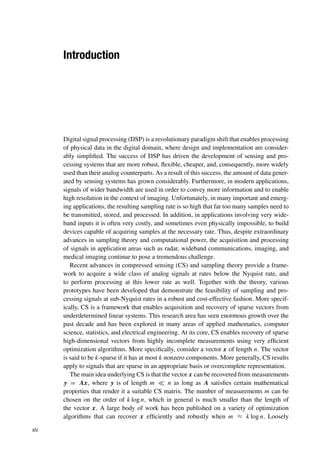
![Introduction xv
speaking, the theory of CS deals with conditions under which the recovery of informa-
tion has vanishing or small errors. The mathematical framework of CS has inspired new
acquisition methods and new signal processing applications in a large variety of areas,
including image processing, analog to digital conversion, communication systems, and
radar processing. In many of these examples the basic ideas underlying CS need to be
extended to include, for example, continuous-time inputs, practical sampling methods,
other forms of structure on the input, computational aspects, noise affects, different
metrics for recovery performance, nonlinear acquisition methods, and more.
Two books devoted to this topic have been published recently, which focus on
many of these aspects, as well as on the underlying mathematical results [1,2]. Their
main emphasis is on the basic underlying theory and its generalizations, optimization
methods, as well as applications primarily to image processing and analog-to-digital
conversion. The latter is also covered in depth in [3].
Radar signal processing represents a fertile field for CS applications. By their very
nature, radars collect data about surveillance volumes (search radars), targets (tracking
radars), terrain and ground targets (imaging radars), or buried objects (radar tomogra-
phy). From radar’s early days in World War II, through the emergence of digital radar in
the 1970s, to today’s advanced systems, the amount of data a radar system has to handle
has increased by orders of magnitude. While early digital radars had to contend with 10s
and 100s of kbps, today’s radars may be faced with data rates in the Gbps range or more,
leading to demanding requirements in cost, hardware, data storage, and processing. The
implications of applying CS to radar are potentially enormous: sampling rates could
be lowered, the number of antenna elements in large arrays might be reduced and the
computers required to handle the data may be downsized.
This book aims to present the latest theoretical and practical advances in radar signal
processing using tools from CS. In particular, this book offers an up-to-date review of
fundamental and practical aspects of sparse reconstruction in radar and remote sensing,
demonstrating the potential benefits achievable with the CS paradigm. We take a wider
scope than previous edited books on CS-based radars: we do not restrict ourselves to
specific disciplines (such as earth observation as in [4]) or applications (such as urban
sensing as in [5]), but discuss a variety of diverse application fields, including clutter
rejection, constant false alarm rate (CFAR) processing, adaptive beamforming, random
arrays for radar, space–time adaptive processing (STAP), multiple input multiple output
(MIMO) systems, radar super-resolution, cognitive radar [6] applications involving sub-
Nyquist sampling and spectrum sensing, radio frequency interference (RFI) suppres-
sion, and synthetic aperture radar (SAR).
The book is aimed at postgraduate students, PhD students, researchers, and engi-
neers working on signal processing and its applications to radar systems, as well as
researchers in other fields seeking an understanding of the potential applications of
CS. To read and fully understand the content it is assumed that the reader has some
background in probability theory and random processes, matrix theory, linear algebra,
and optimization theory, as well as radar systems. The book is organized into eleven
chapters broadly cathegorized into five areas: sub-Nyquist radar (Chapter 1); detection,
clutter/interference mitigation, and CFAR techniques (Chapters 2–6); super-resolution](https://image.slidesharecdn.com/14976-250502060956-a74a0a7e/85/eBook-PDF-Compressed-Sensing-in-Radar-Signal-Processing-15-320.jpg)
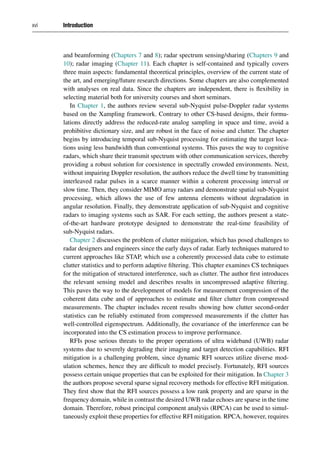
![Introduction xix
rate and power constraints. The joint design is implemented at a control center, which
is a node with which both systems share physical layer information, and which also
performs data fusion for the radar. Efficient algorithms for solving the correspond-
ing optimization problem are presented. The cooperative design significantly improves
spectrum sharing performance, and the sparse sensing provides opportunities to control
interference.
Chapter 11 discusses applications of CS to radar imaging problems with reference
to SAR and inverse synthetic aperture radar (ISAR) sensors. The authors first provide
the relevant mathematical expressions for CS and SAR necessary to formulate the prob-
lem of CS SAR imaging. Thereafter, they consider the case where unknown motion
errors are present during the SAR acquisition process. Autofocusing, i.e., the blind
compensation of the aforementioned errors, is discussed, and general CS solutions are
presented. The chapter ends with a survey of CS methods for ISAR imaging of targets
with unknown motion.
References
[1] Y. C. Eldar and G. Kutyniok, Compressed Sensing: Theory and Applications. Cambridge
University Press, 2012.
[2] S. Foucart and H. Rauhut, A Mathematical Introduction to Compressive Sensing. Birkhäuser
Basel, 2013, vol. 1, no. 3.
[3] Y. C. Eldar, Sampling Theory: Beyond Bandlimited Systems. Cambridge University Press,
2015.
[4] C.-H. Chen, Compressive Sensing of Earth Observations. CRC Press, 2017.
[5] M. Amin, Compressive Sensing for Urban Radar. CRC Press, 2014.
[6] A. Farina, A. De Maio, and S. Haykin, The Impact of Cognition on Radar Technology. Scitech
Publishing, Radar, Sonar Navigation, 2017.](https://image.slidesharecdn.com/14976-250502060956-a74a0a7e/85/eBook-PDF-Compressed-Sensing-in-Radar-Signal-Processing-19-320.jpg)
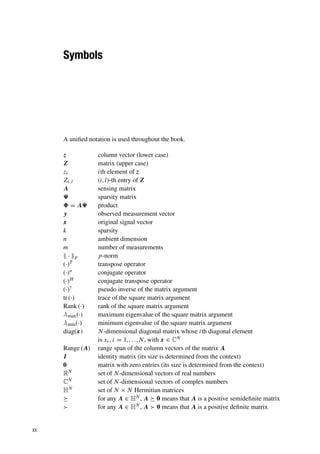
![List of Symbols xxi
T standard notation for sets (uppercase letter)
|T | cardinality of a set T
x̂ result of 1 minimization/recovery algorithm
supp(x) support of vector x
I standard notation for subset of indices
xT length-|T | sub-vector containing the elements of x
corresponding to the indices in T
AT m × |T | sub-matrix containing the columns of
the m × n matrix A indexed by T
j imaginary unit
Re(x) real part of the complex number x
Im(x) imaginary part of the complex number x
|x| modulus of the complex number x
arg(x) argument of the complex number x
E [·] statistical expectation
Hadamard product
⊗ Kronecker product
ẏ, ∂y
∂x , dy
dx first derivative of y with respect to variable x
ÿ, ∂2y
∂x2 , d2y
dx2 second derivative of y with respect to variable x
P[·] probability measure
x(t) continuous time signal
h(t) pulse shape
xi measurements of x(t)
δk = δk(A) restricted isometry constant.
Statement of restricted isometry property (RIP): a matrix A satisfies the RIP of order
K if
(1 − δk)x2 ≤ Ax2 ≤ (1 + δk)x2
for all x with x0 ≤ K.](https://image.slidesharecdn.com/14976-250502060956-a74a0a7e/85/eBook-PDF-Compressed-Sensing-in-Radar-Signal-Processing-21-320.jpg)

![1 Sub-Nyquist Radar: Principles
and Prototypes
Kumar Vijay Mishra∗ and Yonina C. Eldar∗∗
1.1 Introduction
Radar remote sensing has advanced tremendously since 1950 and is now applied to
diverse areas such as military surveillance, meteorology, geology, collision avoidance,
and imaging [1]. In monostatic pulse-Doppler radar systems, an antenna transmits a
periodic train of known narrowband pulses within a defined coherent processing interval
(CPI). When the radiated wave from the radar interacts with moving targets, the ampli-
tude, frequency, and polarization states of the scattered wave change. By monitoring this
change, it is possible to infer the targets’ size, location, and radial Doppler velocity. The
reflected signal received by the radar antenna is a linear combination of echoes from
multiple targets; each of these is an attenuated, time-delayed, and frequency-modulated
version of the transmit signal. The delay in the received signal is linearly proportional
to the target’s range or its distance from the radar. The frequency modulation encodes
the Doppler velocity of the target. The complex amplitude or target’s reflectivity is a
function of the target’s size, geometry, propagation, and scattering mechanism. Radar
signal processing is aimed at detecting the targets and estimating their parameters from
the output of this linear, time-varying system.
Traditional radar signal processing employs matched filtering (MF) or pulse com-
pression [2] in the digital domain, wherein the sampled received signal is correlated
with a replica of the transmit signal in the delay-Doppler plane. The MF maximizes
the signal-to-noise ratio (SNR) in the presence of additive white Gaussian noise. In
some specialized systems, this stage is replaced by a mismatched filter with a different
optimization metric such as minimization of peak-to-sidelobe ratio of the output. Here,
the received signal is correlated with a signal that is close but not identical to the
transmit signal [3–5]. While all of these techniques reliably estimate target parameters,
their resolution is inversely proportional to the support of the ambiguity function of the
transmit pulse, thereby restricting ability to super-resolve targets that are closely spaced.
The digital MF operation requires the signal to be sampled at or above the Nyquist
sampling rate, which guarantees perfect reconstruction of a bandlimited analog signal
[6]. Many modern radar systems use wide bandwidths, typically ranging from hundreds
∗ K.V.M. acknowledges partial support via the Andrew and Erna Finci Viterbi Postdoctoral Fellowship and
the Lady Davis Postdoctoral Fellowship.
∗∗ This work is supported by the European Union’s Horizon 2020 research and innovation program under
grant agreement no. 646804-ERC-COG-BNYQ.
1](https://image.slidesharecdn.com/14976-250502060956-a74a0a7e/85/eBook-PDF-Compressed-Sensing-in-Radar-Signal-Processing-23-320.jpg)

![became so nearly blind, that he could distinguish nothing except
very large letters marked with chalk on a slate. In this state he
continued for the remainder of his life; and by constant exercise he
acquired a power of recollection, whether of mathematical formulæ
or figures, which would be totally incredible, if it were not supported
by strong evidence. He formed in his head, and retained in his
memory, a table of the first six powers of all numbers up to 100,
containing about 3000 figures. Two of his pupils had summed
seventeen terms of a converging series, and differed by a unit in the
fiftieth decimal of the result; Euler decided between them correctly
by a mental calculation[8]
. His chief amusement during his
deprivation was the formation of artificial magnets, and the
instruction of one of his grandchildren in mathematics. His studies
were in no degree relaxed by it. In 1771 Euler’s house was
destroyed by fire, together with a considerable part of the city. He
was himself saved by a fellow-countryman named Grimm, and his
manuscripts were also rescued. In 1776 he married the aunt of his
first wife. No other event worthy of special notice occurred before
his death, which took place suddenly, September 7, 1783. He had
been employed in calculating the laws of the ascent of balloons,
which were then newly introduced; he afterwards dined with his
family and M. Lexell, his pupil, conversed with them on the newly-
discovered planet of Herschel, and was amusing himself with one of
his grandchildren; suddenly the pipe which he held in his hand
dropped on the ground, and it was found that[9]
“life and calculation
were at an end.” He had thirteen children, of whom only three
survived him; one of them, John Albert Euler, was known as a
mathematician.
8. We suspect some mistake in this account, which is constantly
given. A very surprising story ought to be consistent: now it is
difficult to believe that any series which was actually employed
in practice (and people do not sum series to fifty places for
amusement) would converge so quickly, as to give fifty places
in seventeen terms. The well-known series for the base of
Napier’s logarithms is called a rapidly converging series, and](https://image.slidesharecdn.com/14976-250502060956-a74a0a7e/85/eBook-PDF-Compressed-Sensing-in-Radar-Signal-Processing-25-320.jpg)
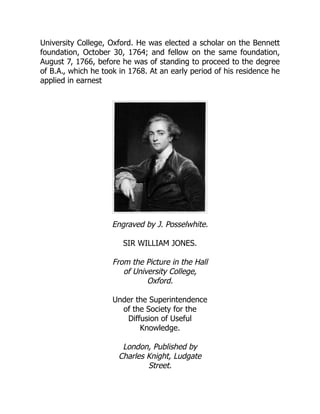
![devoted to set forth the political opinions of Sir William Jones, in a
stronger light than seemed fitting to his noble biographer.
[Statue of Sir W. Jones, by
John Bacon, R.A., in St.
Paul’s.]](https://image.slidesharecdn.com/14976-250502060956-a74a0a7e/85/eBook-PDF-Compressed-Sensing-in-Radar-Signal-Processing-40-320.jpg)
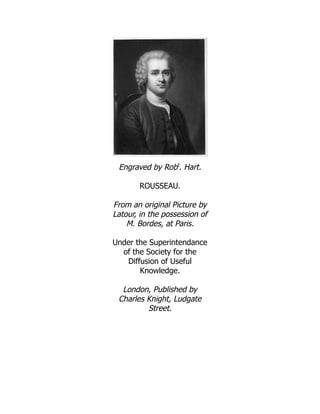

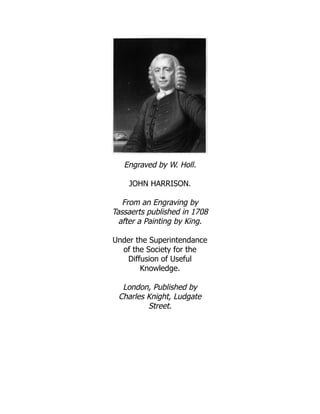
![HARRISON.
John Harrison was born in May, 1693, at Foulby, in Yorkshire. His
father, who was a joiner, trained him from an early age to the same
business; but he soon began to study machinery. He turned his
attention to the mechanism of clocks; and, to obviate the
irregularities produced in their rate of going by variations of
temperature, he invented the method of compensation, employed in
what is now called the gridiron pendulum, before the year 1720.
This contrivance consisted in constructing a pendulum with bars of
different metals, having different rates of expansion so as to correct
each other: it is described in all popular treatises on physics. By this
means it is stated that he had, before the year above-mentioned,
constructed two clocks which agreed with each other within a
second a month, and one of which did not vary, on the whole, more
than a minute in ten years.[10]
10. Folke’s Address to the Royal Society, Nov. 30, 1749.
This success induced him to turn his attention to watches, or rather
to time-keepers for naval purposes. It would be impossible without
the help of plates to render intelligible the rise and progress of his
methods, for which we must refer the reader to treatises of
Horology. His first instrument was tried upon the Humber, in rough
weather, and succeeded so well that he was recommended to carry
it to London, for the inspection of the Commissioners of Longitude.
The question of the discovery of the longitude had been considered
of national importance since the year 1714, when an Act was passed
offering 10,000l., 15,000l., and 20,000l. for any method of](https://image.slidesharecdn.com/14976-250502060956-a74a0a7e/85/eBook-PDF-Compressed-Sensing-in-Radar-Signal-Processing-57-320.jpg)