Eating Behaviour
Ella Warwick
Specification
• Explanations for food preferences: the evolutionary explanation, including
reference to neophobia and taste aversion; the role of learning in food
preference, including social and cultural influences.
• Neural and hormonal mechanisms involved in the control of eating behaviour,
including the role of the hypothalamus, ghrelin and leptin.
• Biological explanations for anorexia nervosa, including genetic and neural
explanations.
• Psychological explanations for anorexia nervosa: family systems theory, including
enmeshment, autonomy and control; social learning theory, including modelling,
reinforcement and media; cognitive theory, including distortions and irrational
beliefs.
• Biological explanations for obesity, including genetic and neural explanations.
• Psychological explanations for obesity, including restraint theory, disinhibition
and the boundary model. Explanations for the success and failure of dieting.
Explanations for food preferences -
evolutionary
• Evolution explains preference through the adaptive behaviors we acquired in our ancestral past through natural selection.
• Preferences are shown for survival benefits in an ‘environment of evolutionary adaption’ (EEA) in hunter gatherer times:
• Sweet – high energy
• Salt – needed for bodily function
• Fat – high in calories
• Prefer high fat food in times of stress (survival advantage for fight or flight response).
• Evidence shown in real life – binging in stressful times.
• Neophobia – innate unwillingness to try new foods as they may be potentially dangerous.
• Now considered maladaptive – limiting modern safe diets.
• Taste aversion – innate ability to quickly learn to dislike foods.
• Rats acquired aversions to sweet water when paired with poison but not with electric shocks.
• Ethics?
• Point against classical conditioning?
• Bitter food is a sign of toxins.
• Babies make negative facial expressions
• Been helpful in understanding food avoidance during chemotherapy (nausea and food are wrongly paired).
• Ignores cultural influences – Jewish people may feel revolted at the idea of eating shrimp.
• Individual differences – e.g some babies enjoy lemon.
• Microbes theory – preferences evolved as an adaptive response to microbes that influence a parents feeding behavior through
colic.
Explanations for food preferences - learning
• Flavour-flavour learning – through classical conditioning we develop a preference through associating one flavour with another.
(porridge + sugar = preference -over time- porridge = nice).
• Children are operantly reinforced for their preferences by rewards (if you eat all your dinner you can have pudding).
• Social influences – mainly to do with role models and vicarious reinforcement (SLT).
• Family – the gatekeepers of children's eating
• Peers - Study sat children next to children with different preferences and preferences changed.
• Media – certain advertisement makes foods more interesting.
• Cultural influences – most reliable indicator of food preferences.
• Norms – e.g. main Sunday meal in Britain is a roast dinner.
• Meat eating – some parts of the world it is normal to eat every part of the animal, in the US a lot of people have strong aversions.
• Culture and learning – what foods are presented to children. Established by vicarious reinforcement and flavour-flavour learning.
• Evidence is much stronger for aversion learning than preference learning.
• The effects of media are short term (follow up studies).
• Family and cultural influences can switch innate food aversions to preferences - ‘almost everyone is converted from a chilli hater to
a chilli liker by the age of 6”.
• Evidence for SLT – children watching a teacher enjoy a drink were more likely to prefer it (vicarious reinforcement).
Mechanisms in control of eating behaviour
• The hypothalamus regulates levels of glucose in the blood, and glucose levels influences eating behaviour.
The glucose sensing neurons detects fluctuations and directs insulin (encourages uptake of glucose from the
blood stream) and glucagon in the pancreas accordingly. This maintains homeostasis.
• Dual center model:
• Lateral hypothalamus (LH (loves hunger)) on switch – activated when glucose levels are low which causes NPY to turn on the
LH and causes hunger.
• When NPY is injected in rats it causes obesity.
• Ventromedial hypothalamus (VMH) off switch – activated when glucose levels are high to cause satiety.
• Lesioning the VMH of rats leads to overeating in rats.
• No replication and conflicting conclusions (may be due to other damage).
• Model is too simplified (certain other hormones and nerves are not considered).
• Ignores social and cultural influences (we eat due to social cues, not necessarily hunger as we aren't in a hunter gatherer
society).
• Mostly based on animal research so generalisations are invalid due to social and cultural differences.
• Is valid for understanding neural and hormonal mechanisms as most structures in rat brain are in human brain (hypothalamus)
• Successful treatments for obesity.
• Hormonal mechanisms:
• Ghrelin – the emptier the stomach the more is released. This is detected in the hypothalamus which signals LH.
• Leptin – leptin increases with fat level and is detected by the VMH when leptin increases past a set point.
• Inability to produce leptin is associated with severe obesity.
Biological explanations for anorexia
• Genetic explanation:
• Runs in families – twin studies (Holland found MZ concordance rate 56%, DZ concordance rate 5%)
• Limitation of twin studies – studies comparing MZ and DZ twins assume equal environments in both, DZ twins are treated
differently. May be partly environmental differences not so greatly by nature.
• Candidate genes – 152 candidate genes but 1 found significantly associated that codes for cholesterol (severe
AN patients have abnormally high cholesterol)
• Genome-wide association studies – looks at entire collection of genes not just individual ones, 72 found, none
were found significantly related to AN (not sensitive enough to detect them).
• Limitation of gene studies – no one gene can be responsible for anorexia, so must be polygenic due to all the symptoms etc.
• Cannot be understood by genes alone - Diathesis stress explanation – vulnerability to AN that only
expresses itself under a stressor (e.g trying to lose weight).
• Biological explanations are still valid but not entirely alone.
• Neural explanation (measured by levels of metabolite in blood):
• Serotonin (5-HIAA) – low levels return to normal after weight gain.
• Dopamine (HVA) – eating increases dopamine levels, after being given amphetamine to increase dopamine,
healthy patients experience pleasure, AN experience anxiety. Maybe they avoid eating to avoid the anxiety
produced.
• Dopamine is also lower in recovered AN patients than normal – as it persists after recovery it is likely to be a cause and not an
effect. – validity.
• Serotonin alone doesn't account for all features, it is better understood with the interaction of other neurotransmitters as well
(neurotransmitter systems do not act alone).
Psychological explanations for anorexia
nervosa - FST
• Family systems theory (psychodynamic) – the AN symptoms distract the family from impersonal
conflicts.
1. Enmeshment – members of the family are too involved with each other and invade each others privacy.
Independence is asserted by a refusal to eat.
2. Overprotectiveness – no room for independence. Mother blames the daughter if anything goes wrong as
the mother “does everything for her”.
3. Rigidity – the family deny the need for change (as it would lead to crisis) and work to maintain what they
have.
4. Conflict avoidance – the problem is ignored and change is refused, so the original reason for conflict is
continued and the starving is also continued.
• Studies have different outcomes so results are inconsistent and research has failed to identify a ’typical anorexic family”.
• Order of cause and effect – could be consequences of AN chid.
• Therapies based on it have been successful.
• Reflects and explains why the majority of anorexic patients are female.
• Has trouble accounting for AN males.
• Autonomy – suggested that anorexia is caused by adolescent desire for autonomy, and the mother doesn’t
accept the daughters need for independence. The thinner she gets the greater degree of control she has.
• Proven that anorexic patients have a greater desire for autonomy than control group.
Psychological explanations for anorexia
nervosa - SLT
• SLT – involves direct (classical and operant conditioning) and indirect (modelling –
vicariously reinforced)
• Modelling – provides template, especially influential if child identifies with the model
• Vicarious reinforcement – sees reward and copies
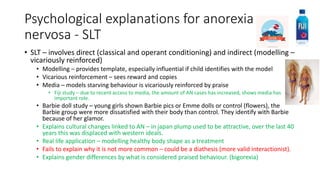
• Media – models starving behaviour is vicariously reinforced by praise
• Fiji study – due to recent access to media, the amount of AN cases has increased, shows media has
important role.
• Barbie doll study – young girls shown Barbie pics or Emme dolls or control (flowers), the
Barbie group were more dissatisfied with their body than control. They identify with Barbie
because of her glamor.
• Explains cultural changes linked to AN – in japan plump used to be attractive, over the last 40
years this was displaced with western ideals.
• Real life application – modelling healthy body shape as a treatment
• Fails to explain why it is not more common – could be a diathesis (more valid interactionist).
• Explains gender differences by what is considered praised behaviour. (bigorexia)
Psychological explanations for anorexia
nervosa - cognitive
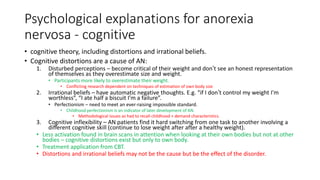
• cognitive theory, including distortions and irrational beliefs.
• Cognitive distortions are a cause of AN:
1. Disturbed perceptions – become critical of their weight and don’t see an honest representation
of themselves as they overestimate size and weight.
• Participants more likely to overestimate their weight.
• Conflicting research dependent on techniques of estimation of own body size
2. Irrational beliefs – have automatic negative thoughts. E.g. “if I don’t control my weight I'm
worthless”, “I ate half a biscuit I’m a failure”.
• Perfectionism – need to meet an ever-raising impossible standard.
• Childhood perfectionism is an indicator of later development of AN.
• Methodological issues as had to recall childhood + demand characteristics.
3. Cognitive inflexibility – AN patients find it hard switching from one task to another involving a
different cognitive skill (continue to lose weight after after a healthy weight).
• Less activation found in brain scans in attention when looking at their own bodies but not at other
bodies – cognitive distortions exist but only to own body.
• Treatment application from CBT.
• Distortions and irrational beliefs may not be the cause but be the effect of the disorder.
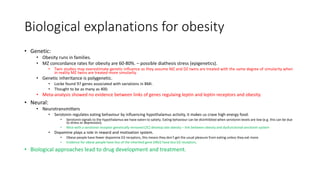
Biological explanations for obesity
• Genetic:
• Obesity runs in families.
• MZ concordance rates for obesity are 60-80%. – possible diathesis stress (epigenetics).
• Twin studies may overestimate genetic influence as they assume MZ and DZ twins are treated with the same degree of simularity when
in reality MZ twins are treated more simularliy.
• Genetic inheritance is polygenetic.
• Locke found 97 genes associated with variations in BMI.
• Thought to be as many as 400.
• Meta-analysis showed no evidence between links of genes regulaing leptin and leptin receptors and obesity.
• Neural:
• Neurotransmitters
• Serotonin regulates eating behaviour by influencing hypothalamus activity, it makes us crave high energy food.
• Serotonin signals to the hypothalamus we have eaten to satiety. Eating behaviour can be disinhibited when serotonin levels are low (e.g. this can be due
to stress or depression).
• Mice with a serotonin receptor genetically removed (2C) develop late obesity – link between obesity and dysfunctional serotonin system
• Dopamine plays a role in reward and motivation system.
• Obese people have fewer dopamine D2 receptors, this means they don’t get the usual pleasure from eating unless they eat more.
• Evidence for obese people have less of the inherited gene DRD2 have less D2 receptors.
• Biological approaches lead to drug development and treatment.
Psychological explanations for obesity -
explanations
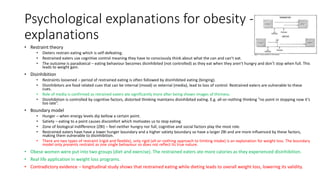
• Restraint theory
• Dieters restrain eating which is self-defeating.
• Restrained eaters use cognitive control meaning they have to consciously think about what the can and can’t eat.
• The outcome is paradoxical – eating behaviour becomes disinhibited (not controlled) as they eat when they aren’t hungry and don’t stop when full. This
leads to weight gain.
• Disinhibition
• Restraints loosened – period of restrained eating is often followed by disinhibited eating (binging).
• Disinhibitors are food related cues that can be internal (mood) or external (media), lead to loss of control. Restrained eaters are vulnerable to these
cues.
• Role of media is confirmed as retrained eaters ate significantly more after being shown images of thinness.
• Disinhibition is controlled by cognitive factors, distorted thinking maintains disinhibited eating. E.g. all-or-nothing thinking ”no point in stopping now it’s
too late”.
• Boundary model
• Hunger – when energy levels dip bellow a certain point.
• Satiety – eating to a point causes discomfort which motivates us to stop eating.
• Zone of biological indifference (ZBI) – feel neither hungry nor full, cognitive and social factors play the most role.
• Restrained eaters have have a lower hunger boundary and a higher satiety boundary so have a larger ZBI and are more influenced by these factors,
making them vulnerable to disinhibition.
• There are two types of restraint (rigid and flexible), only rigid (all-or-nothing approach to limiting intake) is an explanation for weight loss. The boundary
model only presents restraint as one single behaviour so does not reflect its true nature.
• Obese women were put into two groups (diet and exercise). The restrained eaters ate more calories as they experienced disinhibition.
• Real life application in weight loss programs.
• Contradictory evidence – longitudinal study shows that restrained eating while dieting leads to overall weight loss, lowering its validity.
Psychological explanations for obesity -
dieting
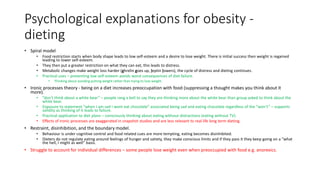
• Spiral model
• Food restriction starts when body shape leads to low self-esteem and a desire to lose weight. There is initial success then weight is regained
leading to lower self-esteem.
• They then put a greater restriction on what they can eat, this leads to distress.
• Metabolic changes make weight loss harder (ghrelin goes up, leptin lowers), the cycle of distress and dieting continues.
• Practical uses – preventing low self-esteem avoids worst consequences of diet failure.
• Thinking about avoiding putting weight rather than trying to lose weight.
• Ironic processes theory - being on a diet increases preoccupation with food (suppressing a thought makes you think about it
more).
• “don’t think about a white bear” – people rang a bell to say they are thinking more about the white bear than group asked to think about the
white bear.
• Exposure to statement “when I am sad I wont eat chocolate” associated being sad and eating chocolate regardless of the “won’t” – supports
validity as thinking of it leads to failure.
• Practical application to diet plans – consciously thinking about eating without distractions (eating without TV).
• Effects of ironic processes are exaggerated in snapshot studies and are less relevant to real life long term dieting.
• Restraint, disinhibition, and the boundary model.
• Behaviour is under cognitive control and food related cues are more tempting, eating becomes disinhibited.
• Dieters do not regulate eating around feelings of hunger and satiety, they make conscious limits and if they pass it they keep going on a “what
the hell, I might as well” basis.
• Struggle to account for individual differences – some people lose weight even when preoccupied with food e.g. anorexics.

Eating Behaviour - AQA A level Psychology Revision

  • 1.
  • 2.
    Specification • Explanations forfood preferences: the evolutionary explanation, including reference to neophobia and taste aversion; the role of learning in food preference, including social and cultural influences. • Neural and hormonal mechanisms involved in the control of eating behaviour, including the role of the hypothalamus, ghrelin and leptin. • Biological explanations for anorexia nervosa, including genetic and neural explanations. • Psychological explanations for anorexia nervosa: family systems theory, including enmeshment, autonomy and control; social learning theory, including modelling, reinforcement and media; cognitive theory, including distortions and irrational beliefs. • Biological explanations for obesity, including genetic and neural explanations. • Psychological explanations for obesity, including restraint theory, disinhibition and the boundary model. Explanations for the success and failure of dieting.
  • 3.
    Explanations for foodpreferences - evolutionary • Evolution explains preference through the adaptive behaviors we acquired in our ancestral past through natural selection. • Preferences are shown for survival benefits in an ‘environment of evolutionary adaption’ (EEA) in hunter gatherer times: • Sweet – high energy • Salt – needed for bodily function • Fat – high in calories • Prefer high fat food in times of stress (survival advantage for fight or flight response). • Evidence shown in real life – binging in stressful times. • Neophobia – innate unwillingness to try new foods as they may be potentially dangerous. • Now considered maladaptive – limiting modern safe diets. • Taste aversion – innate ability to quickly learn to dislike foods. • Rats acquired aversions to sweet water when paired with poison but not with electric shocks. • Ethics? • Point against classical conditioning? • Bitter food is a sign of toxins. • Babies make negative facial expressions • Been helpful in understanding food avoidance during chemotherapy (nausea and food are wrongly paired). • Ignores cultural influences – Jewish people may feel revolted at the idea of eating shrimp. • Individual differences – e.g some babies enjoy lemon. • Microbes theory – preferences evolved as an adaptive response to microbes that influence a parents feeding behavior through colic.
  • 4.
    Explanations for foodpreferences - learning • Flavour-flavour learning – through classical conditioning we develop a preference through associating one flavour with another. (porridge + sugar = preference -over time- porridge = nice). • Children are operantly reinforced for their preferences by rewards (if you eat all your dinner you can have pudding). • Social influences – mainly to do with role models and vicarious reinforcement (SLT). • Family – the gatekeepers of children's eating • Peers - Study sat children next to children with different preferences and preferences changed. • Media – certain advertisement makes foods more interesting. • Cultural influences – most reliable indicator of food preferences. • Norms – e.g. main Sunday meal in Britain is a roast dinner. • Meat eating – some parts of the world it is normal to eat every part of the animal, in the US a lot of people have strong aversions. • Culture and learning – what foods are presented to children. Established by vicarious reinforcement and flavour-flavour learning. • Evidence is much stronger for aversion learning than preference learning. • The effects of media are short term (follow up studies). • Family and cultural influences can switch innate food aversions to preferences - ‘almost everyone is converted from a chilli hater to a chilli liker by the age of 6”. • Evidence for SLT – children watching a teacher enjoy a drink were more likely to prefer it (vicarious reinforcement).
  • 5.
    Mechanisms in controlof eating behaviour • The hypothalamus regulates levels of glucose in the blood, and glucose levels influences eating behaviour. The glucose sensing neurons detects fluctuations and directs insulin (encourages uptake of glucose from the blood stream) and glucagon in the pancreas accordingly. This maintains homeostasis. • Dual center model: • Lateral hypothalamus (LH (loves hunger)) on switch – activated when glucose levels are low which causes NPY to turn on the LH and causes hunger. • When NPY is injected in rats it causes obesity. • Ventromedial hypothalamus (VMH) off switch – activated when glucose levels are high to cause satiety. • Lesioning the VMH of rats leads to overeating in rats. • No replication and conflicting conclusions (may be due to other damage). • Model is too simplified (certain other hormones and nerves are not considered). • Ignores social and cultural influences (we eat due to social cues, not necessarily hunger as we aren't in a hunter gatherer society). • Mostly based on animal research so generalisations are invalid due to social and cultural differences. • Is valid for understanding neural and hormonal mechanisms as most structures in rat brain are in human brain (hypothalamus) • Successful treatments for obesity. • Hormonal mechanisms: • Ghrelin – the emptier the stomach the more is released. This is detected in the hypothalamus which signals LH. • Leptin – leptin increases with fat level and is detected by the VMH when leptin increases past a set point. • Inability to produce leptin is associated with severe obesity.
  • 6.
    Biological explanations foranorexia • Genetic explanation: • Runs in families – twin studies (Holland found MZ concordance rate 56%, DZ concordance rate 5%) • Limitation of twin studies – studies comparing MZ and DZ twins assume equal environments in both, DZ twins are treated differently. May be partly environmental differences not so greatly by nature. • Candidate genes – 152 candidate genes but 1 found significantly associated that codes for cholesterol (severe AN patients have abnormally high cholesterol) • Genome-wide association studies – looks at entire collection of genes not just individual ones, 72 found, none were found significantly related to AN (not sensitive enough to detect them). • Limitation of gene studies – no one gene can be responsible for anorexia, so must be polygenic due to all the symptoms etc. • Cannot be understood by genes alone - Diathesis stress explanation – vulnerability to AN that only expresses itself under a stressor (e.g trying to lose weight). • Biological explanations are still valid but not entirely alone. • Neural explanation (measured by levels of metabolite in blood): • Serotonin (5-HIAA) – low levels return to normal after weight gain. • Dopamine (HVA) – eating increases dopamine levels, after being given amphetamine to increase dopamine, healthy patients experience pleasure, AN experience anxiety. Maybe they avoid eating to avoid the anxiety produced. • Dopamine is also lower in recovered AN patients than normal – as it persists after recovery it is likely to be a cause and not an effect. – validity. • Serotonin alone doesn't account for all features, it is better understood with the interaction of other neurotransmitters as well (neurotransmitter systems do not act alone).
  • 7.
    Psychological explanations foranorexia nervosa - FST • Family systems theory (psychodynamic) – the AN symptoms distract the family from impersonal conflicts. 1. Enmeshment – members of the family are too involved with each other and invade each others privacy. Independence is asserted by a refusal to eat. 2. Overprotectiveness – no room for independence. Mother blames the daughter if anything goes wrong as the mother “does everything for her”. 3. Rigidity – the family deny the need for change (as it would lead to crisis) and work to maintain what they have. 4. Conflict avoidance – the problem is ignored and change is refused, so the original reason for conflict is continued and the starving is also continued. • Studies have different outcomes so results are inconsistent and research has failed to identify a ’typical anorexic family”. • Order of cause and effect – could be consequences of AN chid. • Therapies based on it have been successful. • Reflects and explains why the majority of anorexic patients are female. • Has trouble accounting for AN males. • Autonomy – suggested that anorexia is caused by adolescent desire for autonomy, and the mother doesn’t accept the daughters need for independence. The thinner she gets the greater degree of control she has. • Proven that anorexic patients have a greater desire for autonomy than control group.
  • 8.
    Psychological explanations foranorexia nervosa - SLT • SLT – involves direct (classical and operant conditioning) and indirect (modelling – vicariously reinforced) • Modelling – provides template, especially influential if child identifies with the model • Vicarious reinforcement – sees reward and copies • Media – models starving behaviour is vicariously reinforced by praise • Fiji study – due to recent access to media, the amount of AN cases has increased, shows media has important role. • Barbie doll study – young girls shown Barbie pics or Emme dolls or control (flowers), the Barbie group were more dissatisfied with their body than control. They identify with Barbie because of her glamor. • Explains cultural changes linked to AN – in japan plump used to be attractive, over the last 40 years this was displaced with western ideals. • Real life application – modelling healthy body shape as a treatment • Fails to explain why it is not more common – could be a diathesis (more valid interactionist). • Explains gender differences by what is considered praised behaviour. (bigorexia)
  • 9.
    Psychological explanations foranorexia nervosa - cognitive • cognitive theory, including distortions and irrational beliefs. • Cognitive distortions are a cause of AN: 1. Disturbed perceptions – become critical of their weight and don’t see an honest representation of themselves as they overestimate size and weight. • Participants more likely to overestimate their weight. • Conflicting research dependent on techniques of estimation of own body size 2. Irrational beliefs – have automatic negative thoughts. E.g. “if I don’t control my weight I'm worthless”, “I ate half a biscuit I’m a failure”. • Perfectionism – need to meet an ever-raising impossible standard. • Childhood perfectionism is an indicator of later development of AN. • Methodological issues as had to recall childhood + demand characteristics. 3. Cognitive inflexibility – AN patients find it hard switching from one task to another involving a different cognitive skill (continue to lose weight after after a healthy weight). • Less activation found in brain scans in attention when looking at their own bodies but not at other bodies – cognitive distortions exist but only to own body. • Treatment application from CBT. • Distortions and irrational beliefs may not be the cause but be the effect of the disorder.
  • 10.
    Biological explanations forobesity • Genetic: • Obesity runs in families. • MZ concordance rates for obesity are 60-80%. – possible diathesis stress (epigenetics). • Twin studies may overestimate genetic influence as they assume MZ and DZ twins are treated with the same degree of simularity when in reality MZ twins are treated more simularliy. • Genetic inheritance is polygenetic. • Locke found 97 genes associated with variations in BMI. • Thought to be as many as 400. • Meta-analysis showed no evidence between links of genes regulaing leptin and leptin receptors and obesity. • Neural: • Neurotransmitters • Serotonin regulates eating behaviour by influencing hypothalamus activity, it makes us crave high energy food. • Serotonin signals to the hypothalamus we have eaten to satiety. Eating behaviour can be disinhibited when serotonin levels are low (e.g. this can be due to stress or depression). • Mice with a serotonin receptor genetically removed (2C) develop late obesity – link between obesity and dysfunctional serotonin system • Dopamine plays a role in reward and motivation system. • Obese people have fewer dopamine D2 receptors, this means they don’t get the usual pleasure from eating unless they eat more. • Evidence for obese people have less of the inherited gene DRD2 have less D2 receptors. • Biological approaches lead to drug development and treatment.
  • 11.
    Psychological explanations forobesity - explanations • Restraint theory • Dieters restrain eating which is self-defeating. • Restrained eaters use cognitive control meaning they have to consciously think about what the can and can’t eat. • The outcome is paradoxical – eating behaviour becomes disinhibited (not controlled) as they eat when they aren’t hungry and don’t stop when full. This leads to weight gain. • Disinhibition • Restraints loosened – period of restrained eating is often followed by disinhibited eating (binging). • Disinhibitors are food related cues that can be internal (mood) or external (media), lead to loss of control. Restrained eaters are vulnerable to these cues. • Role of media is confirmed as retrained eaters ate significantly more after being shown images of thinness. • Disinhibition is controlled by cognitive factors, distorted thinking maintains disinhibited eating. E.g. all-or-nothing thinking ”no point in stopping now it’s too late”. • Boundary model • Hunger – when energy levels dip bellow a certain point. • Satiety – eating to a point causes discomfort which motivates us to stop eating. • Zone of biological indifference (ZBI) – feel neither hungry nor full, cognitive and social factors play the most role. • Restrained eaters have have a lower hunger boundary and a higher satiety boundary so have a larger ZBI and are more influenced by these factors, making them vulnerable to disinhibition. • There are two types of restraint (rigid and flexible), only rigid (all-or-nothing approach to limiting intake) is an explanation for weight loss. The boundary model only presents restraint as one single behaviour so does not reflect its true nature. • Obese women were put into two groups (diet and exercise). The restrained eaters ate more calories as they experienced disinhibition. • Real life application in weight loss programs. • Contradictory evidence – longitudinal study shows that restrained eating while dieting leads to overall weight loss, lowering its validity.
  • 12.
    Psychological explanations forobesity - dieting • Spiral model • Food restriction starts when body shape leads to low self-esteem and a desire to lose weight. There is initial success then weight is regained leading to lower self-esteem. • They then put a greater restriction on what they can eat, this leads to distress. • Metabolic changes make weight loss harder (ghrelin goes up, leptin lowers), the cycle of distress and dieting continues. • Practical uses – preventing low self-esteem avoids worst consequences of diet failure. • Thinking about avoiding putting weight rather than trying to lose weight. • Ironic processes theory - being on a diet increases preoccupation with food (suppressing a thought makes you think about it more). • “don’t think about a white bear” – people rang a bell to say they are thinking more about the white bear than group asked to think about the white bear. • Exposure to statement “when I am sad I wont eat chocolate” associated being sad and eating chocolate regardless of the “won’t” – supports validity as thinking of it leads to failure. • Practical application to diet plans – consciously thinking about eating without distractions (eating without TV). • Effects of ironic processes are exaggerated in snapshot studies and are less relevant to real life long term dieting. • Restraint, disinhibition, and the boundary model. • Behaviour is under cognitive control and food related cues are more tempting, eating becomes disinhibited. • Dieters do not regulate eating around feelings of hunger and satiety, they make conscious limits and if they pass it they keep going on a “what the hell, I might as well” basis. • Struggle to account for individual differences – some people lose weight even when preoccupied with food e.g. anorexics.