EASTERN HOPHORNBEAM
Ostrya virginiana (Mill.) K. Koch.
OTHER COMMON NAMES: American hophornbeam, Hornbeam, Ironwood.
FORM: Usually 20-40 feet high with a short trunk 8-15 inches in diameter, occasionally 70
feet tall with a diameter of 2 feet; crown rather high, open, broad round-topped, formed by
widely spreading, often drooping, branches with ascending branchlets.
BARK: Grayish-brown, thin, roughened by flattish scales which are loose at the end and
give a shreddy appearance to the bole.
TWIGS: At first slender, hairy, green, later smooth, lustrous, dark brown.
LEAVES: Alternate, simple, ovate-oblong to ovate-lanceolate, 3-5 inches long, 1l/2-2
inches wide, acuminate or acute at the apex, rounded or cordate and inequilateral at the
base, finely doubly serrate.
FLOWERS: Appear with leaves, monoecious, in aments; staminate aments preformed
preceding season in about threes at end of twigs, about 2 inches long in the spring;
pistillate flowers in erect aments, each enclosed in a hairy bladder-like bract.
FRUIT: A long, pendulous, creamy-white, cone-like body 1 l/2-21/.2 inches long, 2/3-l
inch wide, consisting of bladder-like involucres forming’ a hop-like fruit; fruiting involucre
3/4 inch long, stiff, stinging hairs at base, enclosing a flattened, chestnut-brown nutlet.
WINTER BUDS: Alternate, ovate, l/4 inch long, sharp-pointed, divergent, slightly
pubescent, gummy, covered with 8 visible, longitudinally striated, 4-ranked scales; terminal
b u d a b s e n t .
WOOD: Very heavy, hard, strong, tough, close-grained, light brown, reddish-brown or
nearly white, with thick pale white sapwood.
USES: Tool handles, fuel.
HABITAT: Dry, gravelly, and stony soils, occasionally moist situations.
DISTINGUISHING CHARACTERISTICS: Hop-like fruit; grayish-brown bark peels in narrow
flat scales; 2-ranked leaf scars with 3-bundle scars; hardness of wood.
DISTRIBUTION IN ALABAMA: Fairly well distributed over the state.
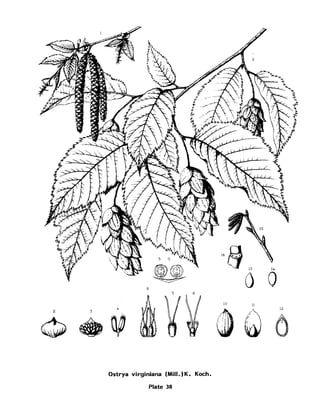
EXPLANATION OF PLATE
1. A flowering branch
2. A scale of the staminate ament,
rear view
3. A staminate flower with its
scale, front view
4. A stamen
5. Diagram of a pistillate flower
6. Pistillate flower
7. A pistillate flower enclosed in
its bract and bractlets
8. A pistillate flower with its
bract and bractlets laid open
9. A fruiting branch
10. A fruiting involucre
11. Vertical section of a fruiting
involucre, showing the nut
12. Vertical section of a nut
13. A seed
14. An embryo
15. A winter branch with staminate
aments
16. A leaf scar
30
Y
.
9.
This information is provided by the
Alabama Forestry Commission
www.forestry.state.al.us

Eastern hophornbeam

  • 1.
    EASTERN HOPHORNBEAM Ostrya virginiana(Mill.) K. Koch. OTHER COMMON NAMES: American hophornbeam, Hornbeam, Ironwood. FORM: Usually 20-40 feet high with a short trunk 8-15 inches in diameter, occasionally 70 feet tall with a diameter of 2 feet; crown rather high, open, broad round-topped, formed by widely spreading, often drooping, branches with ascending branchlets. BARK: Grayish-brown, thin, roughened by flattish scales which are loose at the end and give a shreddy appearance to the bole. TWIGS: At first slender, hairy, green, later smooth, lustrous, dark brown. LEAVES: Alternate, simple, ovate-oblong to ovate-lanceolate, 3-5 inches long, 1l/2-2 inches wide, acuminate or acute at the apex, rounded or cordate and inequilateral at the base, finely doubly serrate. FLOWERS: Appear with leaves, monoecious, in aments; staminate aments preformed preceding season in about threes at end of twigs, about 2 inches long in the spring; pistillate flowers in erect aments, each enclosed in a hairy bladder-like bract. FRUIT: A long, pendulous, creamy-white, cone-like body 1 l/2-21/.2 inches long, 2/3-l inch wide, consisting of bladder-like involucres forming’ a hop-like fruit; fruiting involucre 3/4 inch long, stiff, stinging hairs at base, enclosing a flattened, chestnut-brown nutlet. WINTER BUDS: Alternate, ovate, l/4 inch long, sharp-pointed, divergent, slightly pubescent, gummy, covered with 8 visible, longitudinally striated, 4-ranked scales; terminal b u d a b s e n t . WOOD: Very heavy, hard, strong, tough, close-grained, light brown, reddish-brown or nearly white, with thick pale white sapwood. USES: Tool handles, fuel. HABITAT: Dry, gravelly, and stony soils, occasionally moist situations. DISTINGUISHING CHARACTERISTICS: Hop-like fruit; grayish-brown bark peels in narrow flat scales; 2-ranked leaf scars with 3-bundle scars; hardness of wood. DISTRIBUTION IN ALABAMA: Fairly well distributed over the state. EXPLANATION OF PLATE 1. A flowering branch 2. A scale of the staminate ament, rear view 3. A staminate flower with its scale, front view 4. A stamen 5. Diagram of a pistillate flower 6. Pistillate flower 7. A pistillate flower enclosed in its bract and bractlets 8. A pistillate flower with its bract and bractlets laid open 9. A fruiting branch 10. A fruiting involucre 11. Vertical section of a fruiting involucre, showing the nut 12. Vertical section of a nut 13. A seed 14. An embryo 15. A winter branch with staminate aments 16. A leaf scar 30
  • 2.
    Y . 9. This information isprovided by the Alabama Forestry Commission www.forestry.state.al.us