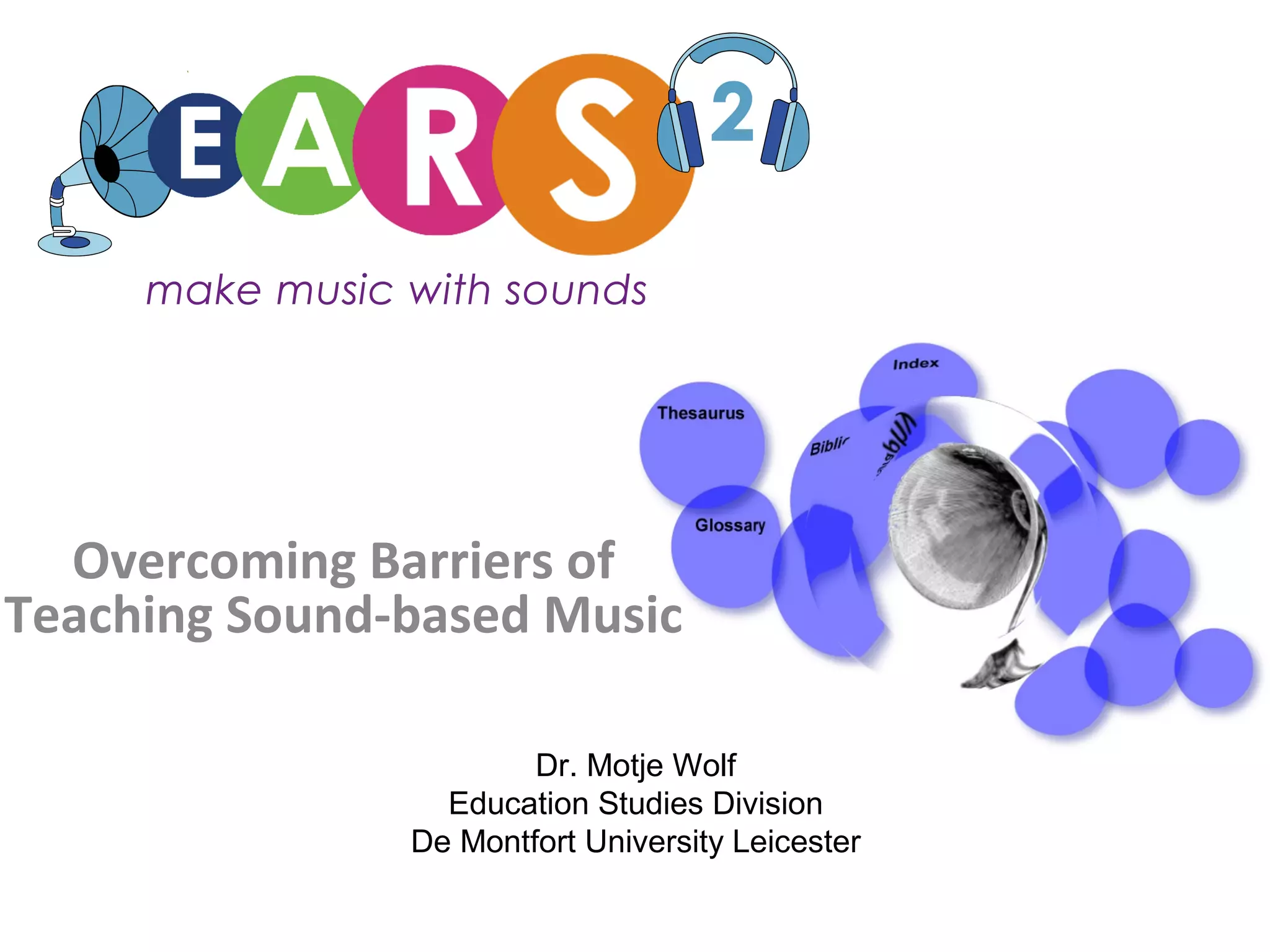
Overcoming Barriers of
Teaching Sound-based Music
Dr. Motje Wolf
Education Studies Division
De Montfort University Leicester
Overview
• ElectroAcoustic… what?!
• The EARS Story
• My PhD
• My Current Research
08/09/16 Motje Wolf, mwolf@dmu.ac.uk 2
ELECTROACOUSTIC WHAT?!
08/09/16 Motje Wolf, mwolf@dmu.ac.uk 3
Sound-based Music
• Term coined by Leigh Landy
• Note-based vs Sound-based Music
• http://ears2.dmu.ac.uk/project/music-of-
sounds-introduction/1/
08/09/16 Motje Wolf, mwolf@dmu.ac.uk 4
Let’s listen…
08/09/16 Motje Wolf, mwolf@dmu.ac.uk 5
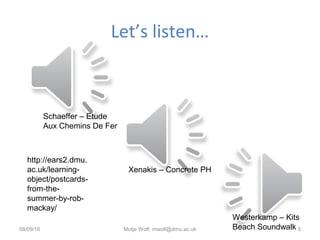
Schaeffer – Etude
Aux Chemins De Fer
Xenakis – Concrete PH
Westerkamp – Kits
Beach Soundwalk
http://ears2.dmu.
ac.uk/learning-
object/postcards-
from-the-
summer-by-rob-
mackay/
Why teaching music with sounds?
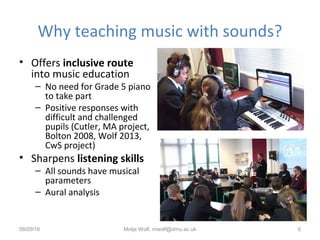
• Offers inclusive route
into music education
– No need for Grade 5 piano
to take part
– Positive responses with
difficult and challenged
pupils (Cutler, MA project,
Bolton 2008, Wolf 2013,
CwS project)
• Sharpens listening skills
– All sounds have musical
parameters
– Aural analysis
08/09/16 Motje Wolf, mwolf@dmu.ac.uk 6
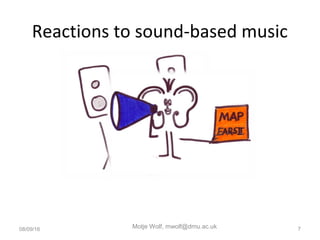
Reactions to sound-based music
08/09/16 Motje Wolf, mwolf@dmu.ac.uk 7
08/09/16 Motje Wolf, mwolf@dmu.ac.uk 8
08/09/16 Motje Wolf, mwolf@dmu.ac.uk 9
What I’ll forget to mention…
• Many more people work in the EARS 2 project
• Many people have started PhDs in this field at
the Music, Technology and Innovation
Research Centre since
• Part of the project includes a bespoke
composition software for children… but there
had to be a cut somewhere.
08/09/16 Motje Wolf, mwolf@dmu.ac.uk 10
THE EARS STORY
08/09/16 Motje Wolf, mwolf@dmu.ac.uk 11
Once upon the time there was an idea…
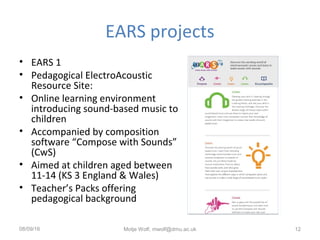
EARS projects
• EARS 1
• Pedagogical ElectroAcoustic
Resource Site:
• Online learning environment
introducing sound-based music to
children
• Accompanied by composition
software “Compose with Sounds”
(CwS)
• Aimed at children aged between
11-14 (KS 3 England & Wales)
• Teacher’s Packs offering
pedagogical background
08/09/16 Motje Wolf, mwolf@dmu.ac.uk 12
My PhD project
• Development of the prototype of the
curriculum and the learning environment
• Research looking at enhancement of
appreciation of electroacoustic music when
learning with curriculum.
• Motje Wolf (2013) The Appreciation of Electroacoustic Music – An
Empirical Study with Inexperienced Listeners, PhD thesis. Available from:
https://www.dora.dmu.ac.uk/xmlui/handle/2086/8680
08/09/16 Motje Wolf, mwolf@dmu.ac.uk 13
Findings from PhD
• Concept-based teaching helped the students
to access e/a music.
• Participants show the potential to develop an
understanding of e/a music
• Learning listening strategies key to enhanced
appreciation
• Developing cognitive prototype of e/a music
places e/a music for the listener into an art
context.
08/09/16 Motje Wolf, mwolf@dmu.ac.uk 14
New Phase for EARS 2
• Much bigger site was build, developed by
Andrew Hill, based on my prototype.
• I worked on the pedagogical background of his
content and wrote teacher’s packs.
• This is how it currently looks:
• http://ears2.dmu.ac.uk/
08/09/16 Motje Wolf, mwolf@dmu.ac.uk 15
Current Research
• Research with Dr. Sarah Younie
• Post doc
• Focus on the teachers:
– What kind of resources do they need? (User-
needs analysis)
– User-centred design of teacher packs to help using
the site in varied ways
– How do they actually use the site (Pilot Study in
March 14)
08/09/16 Motje Wolf, mwolf@dmu.ac.uk 16
EARS 2 TEACHER’S PACK STUDY
08/09/16 17Motje Wolf, mwolf@dmu.ac.uk
Testing and Developing Teacher’s Packs
• 1) User-centred design
– Iterative cycles of feedback
and changes developed
with target group
(soundscape)
• 2) Classroom trial
– Teacher received online
project, teacher’s pack and
software to teach new
genre (acousmatic music)
– First lesson successful
08/09/16 Motje Wolf, mwolf@dmu.ac.uk 18
Critical Incident
• Technical bug – music not playable for teacher
• Teacher cancelled and dropped out
• Research team finished teaching
• Additional Analysis using Critical Incident
Technique (Flanagan 1954, Hughes 2007)
08/09/16 Motje Wolf, mwolf@dmu.ac.uk 19
What happened?
• Teacher
– Liked project
– Was helpful in development
– Interested in contemporary music
– Interested in music technology
• What went wrong?
08/09/16 Motje Wolf, mwolf@dmu.ac.uk 20
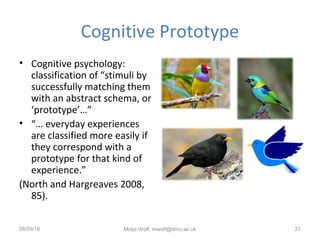
Cognitive Prototype
• Cognitive psychology:
classification of “stimuli by
successfully matching them
with an abstract schema, or
‘prototype’…”
• “… everyday experiences
are classified more easily if
they correspond with a
prototype for that kind of
experience.”
(North and Hargreaves 2008,
85).
08/09/16 Motje Wolf, mwolf@dmu.ac.uk 21
Cognitive Prototype – Wolf (2013)
• For my PhD I studied appreciation of sound-
based music with 11-14 year old pupils
• Pupils received listening training at the beginning
of a 5 week workshop (1h/week).
• Results: building of a cognitive prototype
happened (able to use new vocabulary, less
comparing to other listening experience).
• Development of cognitive prototype through
factual knowledge, through listening training and
applying this to pieces.
08/09/16 Motje Wolf, mwolf@dmu.ac.uk 22
Cognitive Prototype
EARS 2 Teacher’s Pack Study
• This training was not completed with the
teacher
• Teacher might not have developed a strong
enough cognitive prototype to scaffold her
own learning with the resources that were
provided.
• (She could not swap the piece for another
one.)
08/09/16 Motje Wolf, mwolf@dmu.ac.uk 23
Listening as Threshold Skill
• Meyer and Land: Threshold Concepts
• “akin to a portal, opening up a new and previously
inaccessible way of thinking about something. It
represents a transformed way of understanding, or
interpreting, or viewing something without which the
learner cannot progress. As a consequence of
comprehending a threshold concept there may thus
be a transformed internal view of subject matter,
subject landscape, or even world view.”
(Meyer and Land, 2003, p. 1)
08/09/16 Motje Wolf, mwolf@dmu.ac.uk 24
Listening as Threshold Skill
• “The results have shown
that the listening training,
and with it the grasping
and adopting of strategies
for listening to
electroacoustic music, is
the key to a greater
appreciation.”
Wolf 2013, p. 220
• Conscious application of
listening strategy:
metacognitive
knowledge
• Being able to do this
becomes a threshold to
new understanding
• Listening skill –
paradigm shift
(Wolf 2016,
unpublished paper)08/09/16 Motje Wolf, mwolf@dmu.ac.uk 25
Shulman’s Knowledge Types
(Shulman 1986, 1987)
• Content knowledge: website,
Compose with Sounds and
teacher’s packs
• Research team explained the
teacher different activities and
software (CPD)
• Feedback very positive; no
room for assuming that the
learning of the teacher had
not been successful.
– Teacher offered the classroom
trial
08/09/16 Motje Wolf, mwolf@dmu.ac.uk 26
7 Categories
content knowledge,
curriculum knowledge,
general pedagogical
knowledge,
pedagogical content
knowledge,
knowledge of learners and
their characteristics,
knowledge of educational
contexts,
knowledge of educational
values.
Teacher-specific knowledge
7 Categories
content knowledge,
curriculum knowledge,
general pedagogical knowledge,
pedagogical content knowledge,
knowledge of learners and their
characteristics,
knowledge of educational
contexts,
knowledge of educational values.
• Unreflected Assumption:
teacher uses own
pedagogical content
knowledge to teach
herself the content.
• We need to provide:
Content knowledge,
Pedagogical content
knowledge,
Curricular knowledge,
Case knowledge
Knowledge of educational
contexts
08/09/16 Motje Wolf, mwolf@dmu.ac.uk 27
Community of Practice
• Community of Practice not
available
• Only music teacher at
school (isolation)
• Dialogic learning through
reflective discussions
cannot happen.
• Leask and Younie (2001)
Communal constructivism
“Teachers working in
isolation are left with
limited resources for
the kinds of
professional
development required
to assist them in
achieving
transformative
outcomes for their
students.”
(Rosenholtz 1989 in Borg 2012, p. 315).
08/09/16 Motje Wolf, mwolf@dmu.ac.uk 28
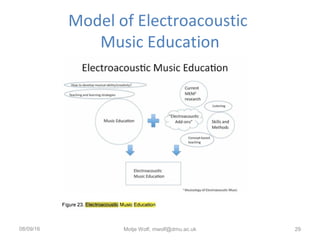
Model of Electroacoustic
Music Education
08/09/16 Motje Wolf, mwolf@dmu.ac.uk 29
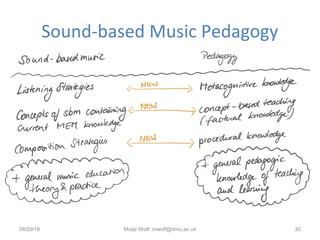
Sound-based Music Pedagogy
08/09/16 Motje Wolf, mwolf@dmu.ac.uk 30
Theoretical Framework of Teacher CPD
for sound-based music
• Step 1: Development of cognitive prototype.
• Step 2: Development of listening strategies
(threshold skill), this step includes the
development of metacognitive knowledge.
08/09/16 Motje Wolf, mwolf@dmu.ac.uk 31
Theoretical Framework of Teacher CPD
for sound-based music
• Step 3: Development of
– content knowledge
– pedagogical content knowledge.
– Curricular knowledge
– Case knowledge
• Step 4: Building a Community of Practice for
Teachers teaching sound-based music.
08/09/16 Motje Wolf, mwolf@dmu.ac.uk 32
What’s next?
• Study continues in larger scale with following
changes:
• Community of Practice
– Anticipating a researcher-practitioner network
supporting teachers
• CPD – cognitive prototype development
• CPD – listening strategy development
• CPD – different types of knowledge
08/09/16 Motje Wolf, mwolf@dmu.ac.uk 33
References
Borg, T., (2012). The evolution of a teacher community of practice: Identifying facilitating and constraining factors.
Studies in Continuing Education, 34(3), pp.301–317.
Flanagan, J.C. (1954) The critical incident technique. Psychological Bulletin, 51(4), pp.327–358.
Hughes, H. (2007) Critical Incident Technique. In Exploring methods in information literacy research. Topics in
Australasian Library and Information Studies. pp. 49–66.
Leask, M. and Younie, S. (2001) Communal Constructivist Theory: pedagogy of information and communications
technology & internationalisation of the curriculum. Journal of Information Technology for Teacher Education, 10
(1-2), pp. 117-134.
Meyer, J. and Land, R. (2003) Threshold Concepts and Troublesome Knowledge: Linkages to Ways of Thinking and
Practising within the Disciplines. Occasional Report 4, ETL Project, Universities of Edinburgh, Coventry and
Durham.
North, A. and Hargreaves, D. (2008) The social and applied psychology of music, Oxford: Oxford University press.
Shulman, L.S. (1986) Those Who Understand: Knowledge Growth in Teaching. Educational Researcher, 15(2), pp.4–14.
Shulman, L. S. (1987) Knowledge and Teaching: Foundations of the New Reform, Harvard Educational Review, 57(1), 1-
22.
Wolf, M. (2013) The Appreciation of Electroacoustic Music – An Empirical Study with Inexperienced Listeners, PhD E-
thesis. Available from:
https://www.dora.dmu.ac.uk/xmlui/handle/2086/8680
Wolf, M. (2016) Threshold Skills. A development of the Threshold Concept Theory. Unpublished Paper.
08/09/16 Motje Wolf, mwolf@dmu.ac.uk 34
Thank you for listening!
Dr. Motje Wolf: mwolf@dmu.ac.uk
Dr. Sarah Younie: syounie@dmu.ac.uk
Prof. Leigh Landy: llandy@dmu.ac.uk
http://ears2.dmu.ac.uk
http://cws.dmu.ac.uk
08/09/16 35Motje Wolf, mwolf@dmu.ac.uk
Tonight!
'Spaces and Singularities’
Curated by Kevin Dahan - 7pm in PACE:
World premiere of new work from Kevin Dahan
and works by two of the grand masters of
electroacoustic music: Horacio Vaggione's
'Mécanique des fluides' (2014) and John
Chowning's 'Stria'. (1977)
Free entry
08/09/16 Motje Wolf, mwolf@dmu.ac.uk 36

EARS 2 Research Talk March 2016

  • 1.
    Overcoming Barriers of TeachingSound-based Music Dr. Motje Wolf Education Studies Division De Montfort University Leicester
  • 2.
    Overview • ElectroAcoustic… what?! •The EARS Story • My PhD • My Current Research 08/09/16 Motje Wolf, mwolf@dmu.ac.uk 2
  • 3.
  • 4.
    Sound-based Music • Termcoined by Leigh Landy • Note-based vs Sound-based Music • http://ears2.dmu.ac.uk/project/music-of- sounds-introduction/1/ 08/09/16 Motje Wolf, mwolf@dmu.ac.uk 4
  • 5.
    Let’s listen… 08/09/16 MotjeWolf, mwolf@dmu.ac.uk 5 Schaeffer – Etude Aux Chemins De Fer Xenakis – Concrete PH Westerkamp – Kits Beach Soundwalk http://ears2.dmu. ac.uk/learning- object/postcards- from-the- summer-by-rob- mackay/
  • 6.
    Why teaching musicwith sounds? • Offers inclusive route into music education – No need for Grade 5 piano to take part – Positive responses with difficult and challenged pupils (Cutler, MA project, Bolton 2008, Wolf 2013, CwS project) • Sharpens listening skills – All sounds have musical parameters – Aural analysis 08/09/16 Motje Wolf, mwolf@dmu.ac.uk 6
  • 7.
    Reactions to sound-basedmusic 08/09/16 Motje Wolf, mwolf@dmu.ac.uk 7
  • 8.
    08/09/16 Motje Wolf,mwolf@dmu.ac.uk 8
  • 9.
    08/09/16 Motje Wolf,mwolf@dmu.ac.uk 9
  • 10.
    What I’ll forgetto mention… • Many more people work in the EARS 2 project • Many people have started PhDs in this field at the Music, Technology and Innovation Research Centre since • Part of the project includes a bespoke composition software for children… but there had to be a cut somewhere. 08/09/16 Motje Wolf, mwolf@dmu.ac.uk 10
  • 11.
    THE EARS STORY 08/09/16Motje Wolf, mwolf@dmu.ac.uk 11 Once upon the time there was an idea…
  • 12.
    EARS projects • EARS1 • Pedagogical ElectroAcoustic Resource Site: • Online learning environment introducing sound-based music to children • Accompanied by composition software “Compose with Sounds” (CwS) • Aimed at children aged between 11-14 (KS 3 England & Wales) • Teacher’s Packs offering pedagogical background 08/09/16 Motje Wolf, mwolf@dmu.ac.uk 12
  • 13.
    My PhD project •Development of the prototype of the curriculum and the learning environment • Research looking at enhancement of appreciation of electroacoustic music when learning with curriculum. • Motje Wolf (2013) The Appreciation of Electroacoustic Music – An Empirical Study with Inexperienced Listeners, PhD thesis. Available from: https://www.dora.dmu.ac.uk/xmlui/handle/2086/8680 08/09/16 Motje Wolf, mwolf@dmu.ac.uk 13
  • 14.
    Findings from PhD •Concept-based teaching helped the students to access e/a music. • Participants show the potential to develop an understanding of e/a music • Learning listening strategies key to enhanced appreciation • Developing cognitive prototype of e/a music places e/a music for the listener into an art context. 08/09/16 Motje Wolf, mwolf@dmu.ac.uk 14
  • 15.
    New Phase forEARS 2 • Much bigger site was build, developed by Andrew Hill, based on my prototype. • I worked on the pedagogical background of his content and wrote teacher’s packs. • This is how it currently looks: • http://ears2.dmu.ac.uk/ 08/09/16 Motje Wolf, mwolf@dmu.ac.uk 15
  • 16.
    Current Research • Researchwith Dr. Sarah Younie • Post doc • Focus on the teachers: – What kind of resources do they need? (User- needs analysis) – User-centred design of teacher packs to help using the site in varied ways – How do they actually use the site (Pilot Study in March 14) 08/09/16 Motje Wolf, mwolf@dmu.ac.uk 16
  • 17.
    EARS 2 TEACHER’SPACK STUDY 08/09/16 17Motje Wolf, mwolf@dmu.ac.uk
  • 18.
    Testing and DevelopingTeacher’s Packs • 1) User-centred design – Iterative cycles of feedback and changes developed with target group (soundscape) • 2) Classroom trial – Teacher received online project, teacher’s pack and software to teach new genre (acousmatic music) – First lesson successful 08/09/16 Motje Wolf, mwolf@dmu.ac.uk 18
  • 19.
    Critical Incident • Technicalbug – music not playable for teacher • Teacher cancelled and dropped out • Research team finished teaching • Additional Analysis using Critical Incident Technique (Flanagan 1954, Hughes 2007) 08/09/16 Motje Wolf, mwolf@dmu.ac.uk 19
  • 20.
    What happened? • Teacher –Liked project – Was helpful in development – Interested in contemporary music – Interested in music technology • What went wrong? 08/09/16 Motje Wolf, mwolf@dmu.ac.uk 20
  • 21.
    Cognitive Prototype • Cognitivepsychology: classification of “stimuli by successfully matching them with an abstract schema, or ‘prototype’…” • “… everyday experiences are classified more easily if they correspond with a prototype for that kind of experience.” (North and Hargreaves 2008, 85). 08/09/16 Motje Wolf, mwolf@dmu.ac.uk 21
  • 22.
    Cognitive Prototype –Wolf (2013) • For my PhD I studied appreciation of sound- based music with 11-14 year old pupils • Pupils received listening training at the beginning of a 5 week workshop (1h/week). • Results: building of a cognitive prototype happened (able to use new vocabulary, less comparing to other listening experience). • Development of cognitive prototype through factual knowledge, through listening training and applying this to pieces. 08/09/16 Motje Wolf, mwolf@dmu.ac.uk 22
  • 23.
    Cognitive Prototype EARS 2Teacher’s Pack Study • This training was not completed with the teacher • Teacher might not have developed a strong enough cognitive prototype to scaffold her own learning with the resources that were provided. • (She could not swap the piece for another one.) 08/09/16 Motje Wolf, mwolf@dmu.ac.uk 23
  • 24.
    Listening as ThresholdSkill • Meyer and Land: Threshold Concepts • “akin to a portal, opening up a new and previously inaccessible way of thinking about something. It represents a transformed way of understanding, or interpreting, or viewing something without which the learner cannot progress. As a consequence of comprehending a threshold concept there may thus be a transformed internal view of subject matter, subject landscape, or even world view.” (Meyer and Land, 2003, p. 1) 08/09/16 Motje Wolf, mwolf@dmu.ac.uk 24
  • 25.
    Listening as ThresholdSkill • “The results have shown that the listening training, and with it the grasping and adopting of strategies for listening to electroacoustic music, is the key to a greater appreciation.” Wolf 2013, p. 220 • Conscious application of listening strategy: metacognitive knowledge • Being able to do this becomes a threshold to new understanding • Listening skill – paradigm shift (Wolf 2016, unpublished paper)08/09/16 Motje Wolf, mwolf@dmu.ac.uk 25
  • 26.
    Shulman’s Knowledge Types (Shulman1986, 1987) • Content knowledge: website, Compose with Sounds and teacher’s packs • Research team explained the teacher different activities and software (CPD) • Feedback very positive; no room for assuming that the learning of the teacher had not been successful. – Teacher offered the classroom trial 08/09/16 Motje Wolf, mwolf@dmu.ac.uk 26 7 Categories content knowledge, curriculum knowledge, general pedagogical knowledge, pedagogical content knowledge, knowledge of learners and their characteristics, knowledge of educational contexts, knowledge of educational values.
  • 27.
    Teacher-specific knowledge 7 Categories contentknowledge, curriculum knowledge, general pedagogical knowledge, pedagogical content knowledge, knowledge of learners and their characteristics, knowledge of educational contexts, knowledge of educational values. • Unreflected Assumption: teacher uses own pedagogical content knowledge to teach herself the content. • We need to provide: Content knowledge, Pedagogical content knowledge, Curricular knowledge, Case knowledge Knowledge of educational contexts 08/09/16 Motje Wolf, mwolf@dmu.ac.uk 27
  • 28.
    Community of Practice •Community of Practice not available • Only music teacher at school (isolation) • Dialogic learning through reflective discussions cannot happen. • Leask and Younie (2001) Communal constructivism “Teachers working in isolation are left with limited resources for the kinds of professional development required to assist them in achieving transformative outcomes for their students.” (Rosenholtz 1989 in Borg 2012, p. 315). 08/09/16 Motje Wolf, mwolf@dmu.ac.uk 28
  • 29.
    Model of Electroacoustic MusicEducation 08/09/16 Motje Wolf, mwolf@dmu.ac.uk 29
  • 30.
    Sound-based Music Pedagogy 08/09/16Motje Wolf, mwolf@dmu.ac.uk 30
  • 31.
    Theoretical Framework ofTeacher CPD for sound-based music • Step 1: Development of cognitive prototype. • Step 2: Development of listening strategies (threshold skill), this step includes the development of metacognitive knowledge. 08/09/16 Motje Wolf, mwolf@dmu.ac.uk 31
  • 32.
    Theoretical Framework ofTeacher CPD for sound-based music • Step 3: Development of – content knowledge – pedagogical content knowledge. – Curricular knowledge – Case knowledge • Step 4: Building a Community of Practice for Teachers teaching sound-based music. 08/09/16 Motje Wolf, mwolf@dmu.ac.uk 32
  • 33.
    What’s next? • Studycontinues in larger scale with following changes: • Community of Practice – Anticipating a researcher-practitioner network supporting teachers • CPD – cognitive prototype development • CPD – listening strategy development • CPD – different types of knowledge 08/09/16 Motje Wolf, mwolf@dmu.ac.uk 33
  • 34.
    References Borg, T., (2012).The evolution of a teacher community of practice: Identifying facilitating and constraining factors. Studies in Continuing Education, 34(3), pp.301–317. Flanagan, J.C. (1954) The critical incident technique. Psychological Bulletin, 51(4), pp.327–358. Hughes, H. (2007) Critical Incident Technique. In Exploring methods in information literacy research. Topics in Australasian Library and Information Studies. pp. 49–66. Leask, M. and Younie, S. (2001) Communal Constructivist Theory: pedagogy of information and communications technology & internationalisation of the curriculum. Journal of Information Technology for Teacher Education, 10 (1-2), pp. 117-134. Meyer, J. and Land, R. (2003) Threshold Concepts and Troublesome Knowledge: Linkages to Ways of Thinking and Practising within the Disciplines. Occasional Report 4, ETL Project, Universities of Edinburgh, Coventry and Durham. North, A. and Hargreaves, D. (2008) The social and applied psychology of music, Oxford: Oxford University press. Shulman, L.S. (1986) Those Who Understand: Knowledge Growth in Teaching. Educational Researcher, 15(2), pp.4–14. Shulman, L. S. (1987) Knowledge and Teaching: Foundations of the New Reform, Harvard Educational Review, 57(1), 1- 22. Wolf, M. (2013) The Appreciation of Electroacoustic Music – An Empirical Study with Inexperienced Listeners, PhD E- thesis. Available from: https://www.dora.dmu.ac.uk/xmlui/handle/2086/8680 Wolf, M. (2016) Threshold Skills. A development of the Threshold Concept Theory. Unpublished Paper. 08/09/16 Motje Wolf, mwolf@dmu.ac.uk 34
  • 35.
    Thank you forlistening! Dr. Motje Wolf: mwolf@dmu.ac.uk Dr. Sarah Younie: syounie@dmu.ac.uk Prof. Leigh Landy: llandy@dmu.ac.uk http://ears2.dmu.ac.uk http://cws.dmu.ac.uk 08/09/16 35Motje Wolf, mwolf@dmu.ac.uk
  • 36.
    Tonight! 'Spaces and Singularities’ Curatedby Kevin Dahan - 7pm in PACE: World premiere of new work from Kevin Dahan and works by two of the grand masters of electroacoustic music: Horacio Vaggione's 'Mécanique des fluides' (2014) and John Chowning's 'Stria'. (1977) Free entry 08/09/16 Motje Wolf, mwolf@dmu.ac.uk 36

Editor's Notes

  • #8 Imagine New world Houses, streets Missing prototype