Why Musique concrète?!

  The music we are dealing with at the moment is called “Musique Concrète”. As you have
  probably already guessed, this is French and means concrete music. Why ‘concrete’?
  Pierre Schaeffer explained it that way: There are two ways of composing:


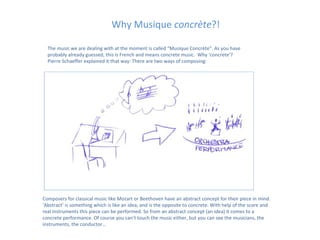
Composers for classical music like Mozart or Beethoven have an abstract concept for their piece in mind.
‘Abstract’ is something which is like an idea, and is the opposite to concrete. With help of the score and
real instruments this piece can be performed. So from an abstract concept (an idea) it comes to a
concrete performance. Of course you can’t touch the music either, but you can see the musicians, the
instruments, the conductor…
Why Musique concrète?!

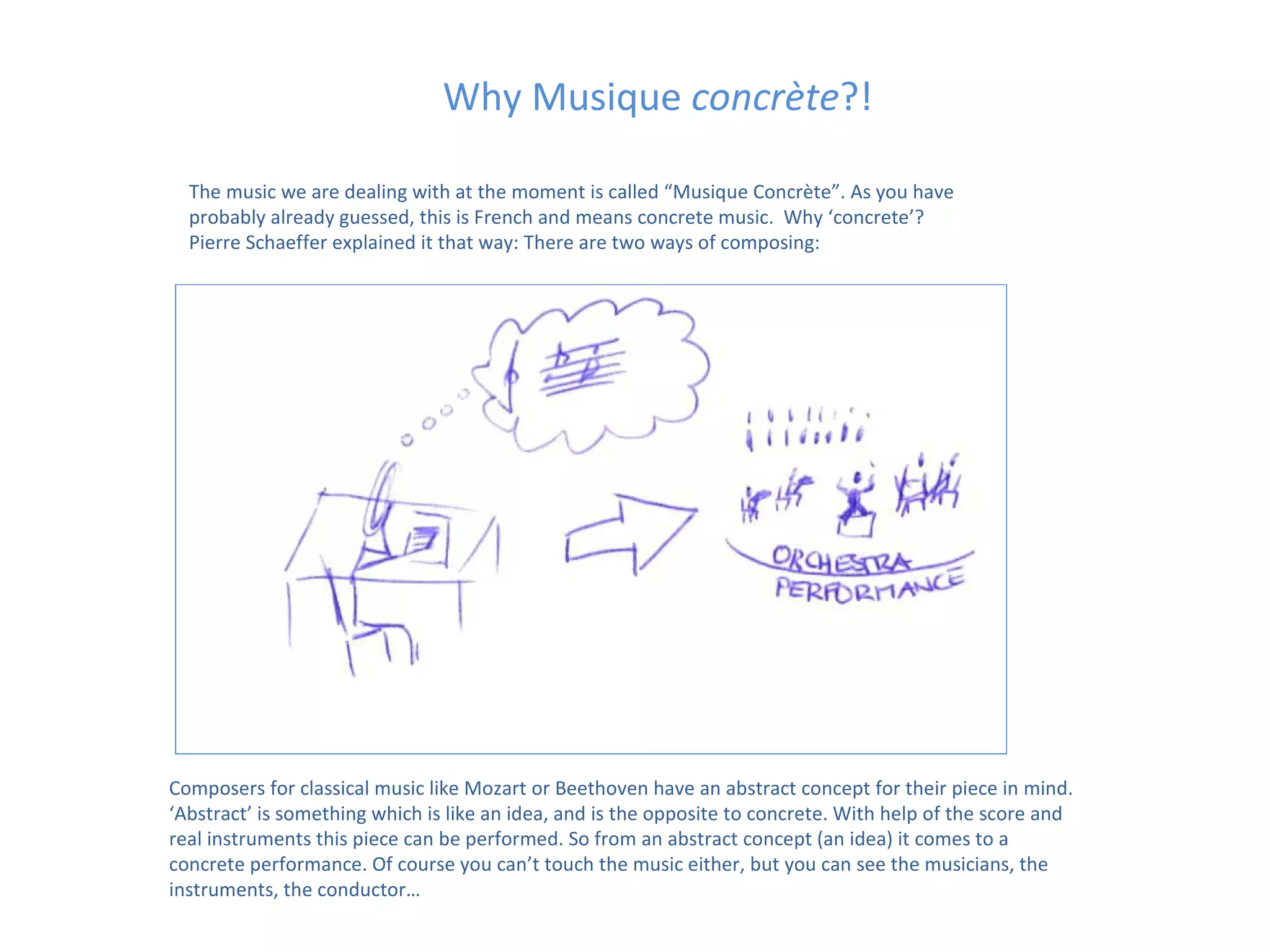
  Composers of Musique Concrète work a bit differently: They have recordings of concrete sounds on their
  computer (or whatever device they use for composing), for example the barking of a dog. However, they
  don’t choose the dog’s barking because they want to do a piece about barking dogs.


Instead they think that the barking of a dog (or any sound) has a musical value. So they use concrete sounds in
their pieces, but they use them because of their abstract/musical value and create a piece of Musique Concrète.
The performance, by the way, is also more or less abstract: Instead of musicians there are only loudspeakers on
stage.
Why Musique concrète?!


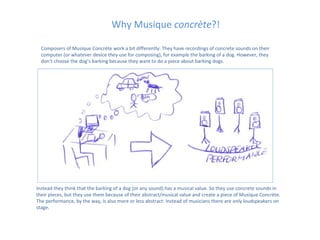
An abstract concept leads to a concrete music.   Concrete sounds lead to abstract music.
                                                  Musique concrète.
Why Musique concrète?!

                                                                        n.
                                                              om positio y use to
                                                  idea for a c hich the
                                         ab stract e sounds, w
                           rs h ave an e concret
                 l co mpose ncrète hav tract piece.
       lassica usique Co                   ab s
     C
               of M        comp   o s e an
      o s e rs
 Comp


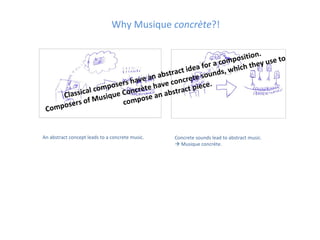
An abstract concept leads to a concrete music.   Concrete sounds lead to abstract music.
                                                  Musique concrète.

Why musconcr120430

  • 1.
    Why Musique concrète?! The music we are dealing with at the moment is called “Musique Concrète”. As you have probably already guessed, this is French and means concrete music. Why ‘concrete’? Pierre Schaeffer explained it that way: There are two ways of composing: Composers for classical music like Mozart or Beethoven have an abstract concept for their piece in mind. ‘Abstract’ is something which is like an idea, and is the opposite to concrete. With help of the score and real instruments this piece can be performed. So from an abstract concept (an idea) it comes to a concrete performance. Of course you can’t touch the music either, but you can see the musicians, the instruments, the conductor…
  • 2.
    Why Musique concrète?! Composers of Musique Concrète work a bit differently: They have recordings of concrete sounds on their computer (or whatever device they use for composing), for example the barking of a dog. However, they don’t choose the dog’s barking because they want to do a piece about barking dogs. Instead they think that the barking of a dog (or any sound) has a musical value. So they use concrete sounds in their pieces, but they use them because of their abstract/musical value and create a piece of Musique Concrète. The performance, by the way, is also more or less abstract: Instead of musicians there are only loudspeakers on stage.
  • 3.
    Why Musique concrète?! Anabstract concept leads to a concrete music. Concrete sounds lead to abstract music.  Musique concrète.
  • 4.
    Why Musique concrète?! n. om positio y use to idea for a c hich the ab stract e sounds, w rs h ave an e concret l co mpose ncrète hav tract piece. lassica usique Co ab s C of M comp o s e an o s e rs Comp An abstract concept leads to a concrete music. Concrete sounds lead to abstract music.  Musique concrète.