





The Roleof Metacognitive Processes in DesireThinkingGabriele Caselli1,2, Marcantonio M. Spada1,31 London South BankUniversity, London, UK2 Studi Cognitivi, Cognitive PsychotherapySchool, Milano, Italy3North East London NHS Foundation Trust, London, UK
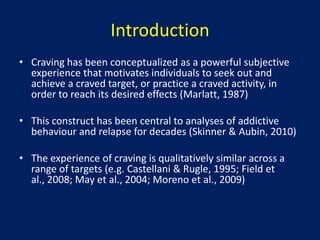
IntroductionCraving has been conceptualized as a powerful subjective experience that motivates individuals to seek out and achieve a craved target, or practice a craved activity, in order to reach its desired effects (Marlatt, 1987)
This construct has been central to analyses of addictive behaviour and relapse for decades (Skinner & Aubin, 2010)
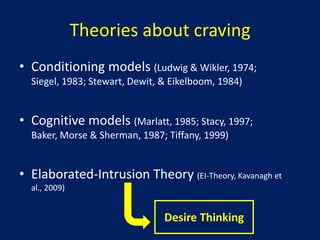
The experience of craving is qualitatively similar across a range of targets (e.g. Castellani & Rugle, 1995; Field et al., 2008; May et al., 2004; Moreno et al., 2009)TheoriesaboutcravingConditioning models (Ludwig & Wikler, 1974; Siegel, 1983; Stewart, Dewit, & Eikelboom, 1984)
Cognitive models (Marlatt, 1985; Stacy, 1997; Baker, Morse & Sherman, 1987; Tiffany, 1999)
Elaborated-Intrusion Theory (EI-Theory, Kavanagh et al., 2009)DesireThinking
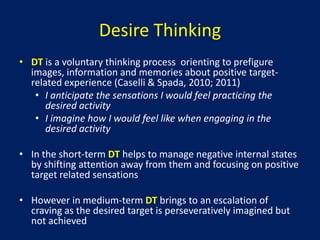
DesireThinkingDT is a voluntary thinking process  orienting to prefigure images, information and memories about positive target-related experience (Caselli & Spada, 2010; 2011)
I anticipate the sensations I would feel practicing the desired activity
I imagine how I would feel like when engaging in the desired activity
In the short-term DT helps to manage negative internal states by shifting attention away from them and focusing on positive target related sensations
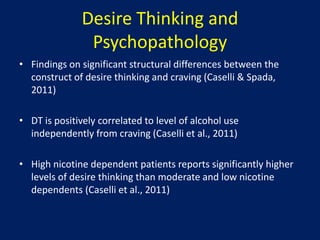
However in medium-term DT brings to an escalation of craving as the desired target is perseveratively imagined but not achievedDesireThinking and PsychopathologyFindings on significant structural differences between the construct of desire thinking and craving (Caselli & Spada, 2011)DT is positively correlated to level of alcohol use independently from craving (Caselli et al., 2011)High nicotine dependent patients reports significantly higher levels of desire thinking than moderate and low nicotine dependents (Caselli et al., 2011)
S-REF Theory(Wells & Matthews, 1994)A set of metacognitive beliefs act as control components of information processing modesThey are responsible for psychological disturbance by developing and maintaining a maladaptive mode of processingThis maladaptive mode of processing (Cognitive-Attentional Syndrome or CAS) is constituted by perseverative thinking, threat monitoring, avoidance or safety behaviours)
The Applicationof S-REF toDesireThinking and CravingDT maybe a maladaptive and perseverative cognitive controlstrategy (suchasworry or rumination)Accordingto S-REF Theoryitwouldbe part of the CAS mode thatsustains the experienceofcravingIndividualswithaddiction and impulsecontroldisorderswouldpossessboth positive and negative metacognitionsaboutdesirethinkingAIMSthe presence and content of desire thinking during a desire experiencethe presence of metacognitive beliefs in desire thinking
Participants & MaterialsThe sample comprised of 24 participants (10 men and 14 women) seeking outpatient treatment for desire related problems from the local Mental Health Service of Modena, Italy
Primary diagnosis:

EABCT 2011 - Metacognitive Processes in Desire Thinking 2

  • 1.
    The Roleof MetacognitiveProcesses in DesireThinkingGabriele Caselli1,2, Marcantonio M. Spada1,31 London South BankUniversity, London, UK2 Studi Cognitivi, Cognitive PsychotherapySchool, Milano, Italy3North East London NHS Foundation Trust, London, UK
  • 2.
    IntroductionCraving has beenconceptualized as a powerful subjective experience that motivates individuals to seek out and achieve a craved target, or practice a craved activity, in order to reach its desired effects (Marlatt, 1987)
  • 3.
    This construct hasbeen central to analyses of addictive behaviour and relapse for decades (Skinner & Aubin, 2010)
  • 4.
    The experience ofcraving is qualitatively similar across a range of targets (e.g. Castellani & Rugle, 1995; Field et al., 2008; May et al., 2004; Moreno et al., 2009)TheoriesaboutcravingConditioning models (Ludwig & Wikler, 1974; Siegel, 1983; Stewart, Dewit, & Eikelboom, 1984)
  • 5.
    Cognitive models (Marlatt,1985; Stacy, 1997; Baker, Morse & Sherman, 1987; Tiffany, 1999)
  • 6.
    Elaborated-Intrusion Theory (EI-Theory,Kavanagh et al., 2009)DesireThinking
  • 7.
    DesireThinkingDT is avoluntary thinking process orienting to prefigure images, information and memories about positive target-related experience (Caselli & Spada, 2010; 2011)
  • 8.
    I anticipate thesensations I would feel practicing the desired activity
  • 9.
    I imagine howI would feel like when engaging in the desired activity
  • 10.
    In the short-termDT helps to manage negative internal states by shifting attention away from them and focusing on positive target related sensations
  • 11.
    However in medium-termDT brings to an escalation of craving as the desired target is perseveratively imagined but not achievedDesireThinking and PsychopathologyFindings on significant structural differences between the construct of desire thinking and craving (Caselli & Spada, 2011)DT is positively correlated to level of alcohol use independently from craving (Caselli et al., 2011)High nicotine dependent patients reports significantly higher levels of desire thinking than moderate and low nicotine dependents (Caselli et al., 2011)
  • 12.
    S-REF Theory(Wells &Matthews, 1994)A set of metacognitive beliefs act as control components of information processing modesThey are responsible for psychological disturbance by developing and maintaining a maladaptive mode of processingThis maladaptive mode of processing (Cognitive-Attentional Syndrome or CAS) is constituted by perseverative thinking, threat monitoring, avoidance or safety behaviours)
  • 13.
    The Applicationof S-REFtoDesireThinking and CravingDT maybe a maladaptive and perseverative cognitive controlstrategy (suchasworry or rumination)Accordingto S-REF Theoryitwouldbe part of the CAS mode thatsustains the experienceofcravingIndividualswithaddiction and impulsecontroldisorderswouldpossessboth positive and negative metacognitionsaboutdesirethinkingAIMSthe presence and content of desire thinking during a desire experiencethe presence of metacognitive beliefs in desire thinking
  • 14.
    Participants & MaterialsThesample comprised of 24 participants (10 men and 14 women) seeking outpatient treatment for desire related problems from the local Mental Health Service of Modena, Italy
  • 15.