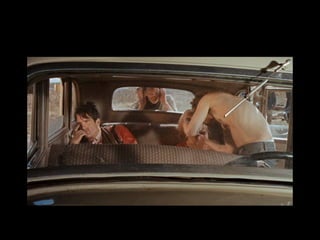
The technology of death has hung like a sword over the lives of this post-modern generation…. To summarize a complex thesis
in a few words: the issue of violence is to this generation what the issue of sex was to the Victorian world.”
                           Kenneth Keniston, Young Radicals (1968)


“To be white and a radical in America this summer is to see horror and feel impotence.”
                           Andrew Kopkind, New York Review of Books, Sept. 28, 1967


       “[N]ow,   the students are responding with real fervor to works of art (and movies most often) only when they can somehow relate the movies to their
own outside experiences, ideas, life. They bring outside interpretations to films or force films to correspond with preconceived notions, and then, if it seems
to work, they dig the movie. The advantage of this to the film maker is that he can’t do anything about (if he does, it will probably look forced) and so much
just be as good and inventive as he can, send the picture out into the world and see what the reverberations are.” Newman and Benton


“Warren got down on his hands and knees and crawled across the office, saying ‘You’ve got to let me make this picture. We can
do it for almost nothing, and it’ll be a big hit.’ Benny Kalmanson [the studio’s unofficial CEO], thought he was nuts and he yelled
at him, ‘Get off the floor, you crazy bastard.’ But he called Warner in L.A. and when he was done, he told Warren to go to L.A.
and see Warner and maybe they could make the picture.”
Dick Lederer, Head of Publicity at Warner Bros, re winter 1966


“A raw and unmitigated campaign of sheer press agentry has been trying to put across the notion that Warner
Brothers’ Bonnie and Clyde is a faithful representation of the desperado careers of Clyde Barrow and Bonnie Parker. . . It is
nothing of the sort. It is a piece of bald-faced slapstick comedy that treats the hideous depredations of that sleezy, moronic pair
as though they were as full of fun and folic as the jazz-age cut-ups in Thoroughly Modern Millie.”Bosley Crowther, NYT, August
1967


                                  “Everybody there looked like me!”
                                              Faye Dunaway re London opening of Bonnie and Clyde, Jan. 1968
KAEL, PUT-ON


It is a peculiarity of our times—perhaps it is one of the few specifically modern characteristics—that we don’t
take our stories straight any more. This isn’t necessarily bad. Bonnie and Clyde is the first film demonstration
that the put-on can be used for the purposes of art. . .[Fill this in] . Bonnie and Clyde keeps the audience in a
kind of eager, nervous imbalance—holds our attention by throwing our disbelief back in our faces. To be put on
is to be put on the spot, put on the stage, made the stooge in a comedy act. People in the audience at Bonnie
and Clyde are laughing, demonstrating that they’re not stooges—that they appreciate the joke—when they catch
the first bullet right in the face. The movie keeps them off balance to the end. . . . Instead of the movie spoof,
which tells the audience that it doesn’t need to feel or care, that it’s all just in fun, that ‘we were only kidding,’
Bonnie and Clyde disrupts us with ‘And you thought we were only kidding.’ .
Holt: Cultural Branding


Icon: “A person or thing regarded as a representative symbol, esp. of a culture or
 movement; a person, institution, etc., considered worthy of admiration or respect.”

Iconic Brands: “Brands become iconic when they perform identity myths: simple
fictions that address cultural anxieties from afar, from imaginary worlds rather than from
the worlds that consumers regularly encounter in their everyday lives.”

“Iconic brands function like cultural activists, encouraging people to think differently about themselves. The

most powerful iconic brands are prescient, addressing the leading edges of cultural change. These brands

don’t simply evoke benefits, personalities or emotions. Rather, their myths prod people to reconsider accepted

ideas about themselves. The value of a particular myth resides not in the myth itself, but in its alignment with

society’s incipient identity desires”
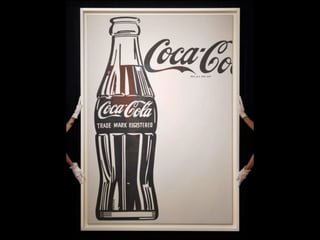
“One night . . . I went over and had a bunch of drinks and he put two large paintings next to each other against the

  wall. Usually he showed me his work more casually, so I realized this was a presentation. He had painted two

  pictures of Coke bottles about six feet tall. One was just a pristine black-and-white Coke bottle. The other had a lot

  of abstract expressionist marks on it. I said, “Come on, Andy, the abstract one is a piece of shit, the other one is

  remarkable. It’s our society, it’s who we are, it’s absolutely beautiful and naked and you ought to destroy the first

  one and show the other.”

  Emilio D’Antonio, Experimental filmmaker and documentarian:


“From where the impulse arose, to colossalize the Coke bottle, is one of the deep questions in the
social history of modern times. The Coke bottle is one of the classic shapes of modern sensibility,
and archaeologists of the future will surely see inscribed in its silhouette the narrow-waisted female
form, and infer from its form its function, to hold some sweet elixir of arousal and fulfillment.
Nothing a mere painter could create was as rich with meaning as this.”

Arthur Danto, Beyond the Brillo Box
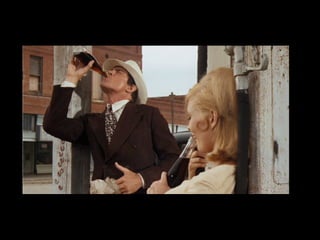
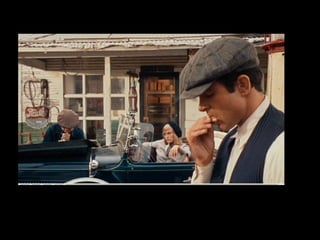
“Bonnie and Clyde is about style and people who have style. It is about
people whose style set them apart from their time and place so that they
seemed odd and aberrant to the general run of society. Most importantly,
they did this by choice. What first attracted us in the mythology was
hearing about the photos Bonnie and Clyde took of each other and mailed to
the newspapers, the doggerel poetry that Bonnie wrote, the business of
Bonnie posing with a cigar, and so on. It was, I still believe, one of the first
examples of the now ubiquitous element of American life in which people
become famous merely by being famous. It was Andy Warhol’s ‘fifteen
minutes of fame’ long ahead of its time, for surely their skill as bank robbers
was pathetic. But their skill at creating ‘images’ for the public could have
gotten them the Coca-Cola account today.”

David Newman and Robert Benton, 2000
[Bonnie and Clyde’s] celluloid lives make no real criticism of the status quo that
supposedly oppresses them. It is a myth of pop nihilism; it is Andy Warhol’s serial put-ons
packaged in a dramatic context with all of Hollywood’s savvy behind it […] Periodically, the
gang meets up with people who have the slack-jawed bewilderment and gutted stares of the
faces in a Dorothea Lange photo album; there is even a fleeting attempt to suggest Clyde’s
sympathy for those dispossessed and vicariously broken by Wall Street, heading West to
stagnate in despairing Hoovervilles. It is all there – but as window-dressing for fantasia. It is
not Dorothea Lange, not even close, and it does no justice at all to the suffering she
chronicled. History enters Bonnie and Clyde as a flippant background to make the already
gorgeous characters also sympathetic, to provide a seemingly real milieu as a frame for their
attempts to escape the mediocrity of a shattered world. The setting is used in much the same
way that the world of advertising uses backgrounds: to create more or less subliminal
presumptions in favor of what they’re trying to sell. […] (Peter Collier, Ramparts, May 1968
quoted in Cawelti).”
The New Criticism and Iconic Brandinig

                                       William K. Wimsatt, “The Concrete Universal” and Steven Knapp, Literary Interest

Wimsatt: “literary theorists have from early times to the present persisted in making statements which in their contexts
eem to mean that work of literary art is in some peculiar sense a very individual thing or a very universal thing or both.”


Knapp on Wimsatt:
 any individual thing will monopolize reference; any universal will be a generalization, a matter of the literary representation’s
 reference to some shared idea or attribute—the same kind of reference that is also performed by the languages of science and
 sociology and the everyday. The concreteness of the literary object or symbol or poem as symbol, therefore, must involve a
 detachment from reference, and literary interest will entail an interest in the representation. To the literary symbol as a concrete
 universal requires that we understand “what it means to be more interested in a representation than in what it represents.”


 Wimsatt on the “a rounded character” as a Shakespearean symbol: “A kind of awareness of self with a pleasure in the
 fact, is perhaps the central principle which instead of simplifying the attributes gives each one a special function in the
 whole, a double or reflex value. Falstaff or such a character of self-conscious ‘infinite variety’ as Cleopatra are concrete
 universals because they have no class names, only their own proper ones, yet are structures of such precise variety and
 centrality that each demands a special interpretation in the realm of human values”


 Knapp: “to imagine the existence of a concrete universal in Wimsatt’s sense might consequently be to treat a symbol as if
 it could itself have—or perhaps as if it could be—an experience, which would amount to treating it as if it could have or
 be a body.”
Four levels in “the evolution” of the brand.
1) unbranded commodities that lack any differentiation (soap, Lords, cellophane,
Officers, mouthwash, Carriers, Travelers, and Attendants) to 2) the use of the brand as
“differentiation of products primarily along functional lines, identifying their utilitarian
benefits with a distinctive name: windex, Westmoreland, scotch tape, Mortimer,
bromo seltzer, Poins, Listerine, Gadshill,; that phase is subordinate to the process of 3)
deliberately building “emotional appeal into their brands, endowing them with
personalities of their own and fleshing them out in advertising: Chevrolet, Hotspur, Mr
Clean, Hal, Lucky Strikes, Owen Glendower, Charmin, Dame Quickley). In that stage
“a closer affinity starts to develop between consumer and brand, with the consumer
becoming an active participant in the relationship and the molding of the brand’s
meaning.” 4) “With time and consistency some brands become meaningful symbols
to large groups of people. They become iconic brands” (Falstaff, Coca-Cola,
Cleopatra, McDonald’s).

 “Icons are beacons of meaning within a society. Responding to dynamic motivational
drives like loving, winning, or searching, iconic brands tap into the higher-order values
of a society, in some cases the global society. Brands can become symbols of freedom
or symbols of individuality or rebelliousness or masculinity. By the time this stage is
reached, where the brand has come to represent something bigger than itself and its
meaning is predominantly symbolic, the brand has effectively become decoupled from
the product life cycle as traditionally defined.” Batey, Brand Meaning
E+103+bonnie+and+clyde+slides

E+103+bonnie+and+clyde+slides

  • 1.
    The technology ofdeath has hung like a sword over the lives of this post-modern generation…. To summarize a complex thesis in a few words: the issue of violence is to this generation what the issue of sex was to the Victorian world.” Kenneth Keniston, Young Radicals (1968) “To be white and a radical in America this summer is to see horror and feel impotence.” Andrew Kopkind, New York Review of Books, Sept. 28, 1967 “[N]ow, the students are responding with real fervor to works of art (and movies most often) only when they can somehow relate the movies to their own outside experiences, ideas, life. They bring outside interpretations to films or force films to correspond with preconceived notions, and then, if it seems to work, they dig the movie. The advantage of this to the film maker is that he can’t do anything about (if he does, it will probably look forced) and so much just be as good and inventive as he can, send the picture out into the world and see what the reverberations are.” Newman and Benton “Warren got down on his hands and knees and crawled across the office, saying ‘You’ve got to let me make this picture. We can do it for almost nothing, and it’ll be a big hit.’ Benny Kalmanson [the studio’s unofficial CEO], thought he was nuts and he yelled at him, ‘Get off the floor, you crazy bastard.’ But he called Warner in L.A. and when he was done, he told Warren to go to L.A. and see Warner and maybe they could make the picture.” Dick Lederer, Head of Publicity at Warner Bros, re winter 1966 “A raw and unmitigated campaign of sheer press agentry has been trying to put across the notion that Warner Brothers’ Bonnie and Clyde is a faithful representation of the desperado careers of Clyde Barrow and Bonnie Parker. . . It is nothing of the sort. It is a piece of bald-faced slapstick comedy that treats the hideous depredations of that sleezy, moronic pair as though they were as full of fun and folic as the jazz-age cut-ups in Thoroughly Modern Millie.”Bosley Crowther, NYT, August 1967 “Everybody there looked like me!” Faye Dunaway re London opening of Bonnie and Clyde, Jan. 1968
  • 2.
    KAEL, PUT-ON It isa peculiarity of our times—perhaps it is one of the few specifically modern characteristics—that we don’t take our stories straight any more. This isn’t necessarily bad. Bonnie and Clyde is the first film demonstration that the put-on can be used for the purposes of art. . .[Fill this in] . Bonnie and Clyde keeps the audience in a kind of eager, nervous imbalance—holds our attention by throwing our disbelief back in our faces. To be put on is to be put on the spot, put on the stage, made the stooge in a comedy act. People in the audience at Bonnie and Clyde are laughing, demonstrating that they’re not stooges—that they appreciate the joke—when they catch the first bullet right in the face. The movie keeps them off balance to the end. . . . Instead of the movie spoof, which tells the audience that it doesn’t need to feel or care, that it’s all just in fun, that ‘we were only kidding,’ Bonnie and Clyde disrupts us with ‘And you thought we were only kidding.’ .
  • 7.
    Holt: Cultural Branding Icon:“A person or thing regarded as a representative symbol, esp. of a culture or movement; a person, institution, etc., considered worthy of admiration or respect.” Iconic Brands: “Brands become iconic when they perform identity myths: simple fictions that address cultural anxieties from afar, from imaginary worlds rather than from the worlds that consumers regularly encounter in their everyday lives.” “Iconic brands function like cultural activists, encouraging people to think differently about themselves. The most powerful iconic brands are prescient, addressing the leading edges of cultural change. These brands don’t simply evoke benefits, personalities or emotions. Rather, their myths prod people to reconsider accepted ideas about themselves. The value of a particular myth resides not in the myth itself, but in its alignment with society’s incipient identity desires”
  • 8.
    “One night .. . I went over and had a bunch of drinks and he put two large paintings next to each other against the wall. Usually he showed me his work more casually, so I realized this was a presentation. He had painted two pictures of Coke bottles about six feet tall. One was just a pristine black-and-white Coke bottle. The other had a lot of abstract expressionist marks on it. I said, “Come on, Andy, the abstract one is a piece of shit, the other one is remarkable. It’s our society, it’s who we are, it’s absolutely beautiful and naked and you ought to destroy the first one and show the other.” Emilio D’Antonio, Experimental filmmaker and documentarian: “From where the impulse arose, to colossalize the Coke bottle, is one of the deep questions in the social history of modern times. The Coke bottle is one of the classic shapes of modern sensibility, and archaeologists of the future will surely see inscribed in its silhouette the narrow-waisted female form, and infer from its form its function, to hold some sweet elixir of arousal and fulfillment. Nothing a mere painter could create was as rich with meaning as this.” Arthur Danto, Beyond the Brillo Box
  • 9.
    “Bonnie and Clydeis about style and people who have style. It is about people whose style set them apart from their time and place so that they seemed odd and aberrant to the general run of society. Most importantly, they did this by choice. What first attracted us in the mythology was hearing about the photos Bonnie and Clyde took of each other and mailed to the newspapers, the doggerel poetry that Bonnie wrote, the business of Bonnie posing with a cigar, and so on. It was, I still believe, one of the first examples of the now ubiquitous element of American life in which people become famous merely by being famous. It was Andy Warhol’s ‘fifteen minutes of fame’ long ahead of its time, for surely their skill as bank robbers was pathetic. But their skill at creating ‘images’ for the public could have gotten them the Coca-Cola account today.” David Newman and Robert Benton, 2000
  • 11.
    [Bonnie and Clyde’s]celluloid lives make no real criticism of the status quo that supposedly oppresses them. It is a myth of pop nihilism; it is Andy Warhol’s serial put-ons packaged in a dramatic context with all of Hollywood’s savvy behind it […] Periodically, the gang meets up with people who have the slack-jawed bewilderment and gutted stares of the faces in a Dorothea Lange photo album; there is even a fleeting attempt to suggest Clyde’s sympathy for those dispossessed and vicariously broken by Wall Street, heading West to stagnate in despairing Hoovervilles. It is all there – but as window-dressing for fantasia. It is not Dorothea Lange, not even close, and it does no justice at all to the suffering she chronicled. History enters Bonnie and Clyde as a flippant background to make the already gorgeous characters also sympathetic, to provide a seemingly real milieu as a frame for their attempts to escape the mediocrity of a shattered world. The setting is used in much the same way that the world of advertising uses backgrounds: to create more or less subliminal presumptions in favor of what they’re trying to sell. […] (Peter Collier, Ramparts, May 1968 quoted in Cawelti).”
  • 13.
    The New Criticismand Iconic Brandinig William K. Wimsatt, “The Concrete Universal” and Steven Knapp, Literary Interest Wimsatt: “literary theorists have from early times to the present persisted in making statements which in their contexts eem to mean that work of literary art is in some peculiar sense a very individual thing or a very universal thing or both.” Knapp on Wimsatt: any individual thing will monopolize reference; any universal will be a generalization, a matter of the literary representation’s reference to some shared idea or attribute—the same kind of reference that is also performed by the languages of science and sociology and the everyday. The concreteness of the literary object or symbol or poem as symbol, therefore, must involve a detachment from reference, and literary interest will entail an interest in the representation. To the literary symbol as a concrete universal requires that we understand “what it means to be more interested in a representation than in what it represents.” Wimsatt on the “a rounded character” as a Shakespearean symbol: “A kind of awareness of self with a pleasure in the fact, is perhaps the central principle which instead of simplifying the attributes gives each one a special function in the whole, a double or reflex value. Falstaff or such a character of self-conscious ‘infinite variety’ as Cleopatra are concrete universals because they have no class names, only their own proper ones, yet are structures of such precise variety and centrality that each demands a special interpretation in the realm of human values” Knapp: “to imagine the existence of a concrete universal in Wimsatt’s sense might consequently be to treat a symbol as if it could itself have—or perhaps as if it could be—an experience, which would amount to treating it as if it could have or be a body.”
  • 20.
    Four levels in“the evolution” of the brand. 1) unbranded commodities that lack any differentiation (soap, Lords, cellophane, Officers, mouthwash, Carriers, Travelers, and Attendants) to 2) the use of the brand as “differentiation of products primarily along functional lines, identifying their utilitarian benefits with a distinctive name: windex, Westmoreland, scotch tape, Mortimer, bromo seltzer, Poins, Listerine, Gadshill,; that phase is subordinate to the process of 3) deliberately building “emotional appeal into their brands, endowing them with personalities of their own and fleshing them out in advertising: Chevrolet, Hotspur, Mr Clean, Hal, Lucky Strikes, Owen Glendower, Charmin, Dame Quickley). In that stage “a closer affinity starts to develop between consumer and brand, with the consumer becoming an active participant in the relationship and the molding of the brand’s meaning.” 4) “With time and consistency some brands become meaningful symbols to large groups of people. They become iconic brands” (Falstaff, Coca-Cola, Cleopatra, McDonald’s). “Icons are beacons of meaning within a society. Responding to dynamic motivational drives like loving, winning, or searching, iconic brands tap into the higher-order values of a society, in some cases the global society. Brands can become symbols of freedom or symbols of individuality or rebelliousness or masculinity. By the time this stage is reached, where the brand has come to represent something bigger than itself and its meaning is predominantly symbolic, the brand has effectively become decoupled from the product life cycle as traditionally defined.” Batey, Brand Meaning