Report of the
Integrated Design Charrette
Conducted
2–5 February 2003
This document may be reprinted with proper credit
to Rocky Mountain Institute (RMI).
Please visit www.rmi.org/sitepages/pid626.php.
.for the report, addenda, and ongoing corrections and updates.
This report was written, edited, and designed by
Huston Eubank, Joel Swisher, Cameron Burns, Jen Seal,
and Ben Emerson, with funding from
Pacific Gas & Electric Energy Design Resources program.
Hardware photos throughout the report are courtesy
Chris Hipp, charrette photos are by Cameron Burns.
Published by Rocky Mountain Institute
1739 Snowmass Creek Road
Snowmass, CO 81654-9199, USA
phone: 1.970.927.3851
fax: 1.970.927.4178
www.rmi.org
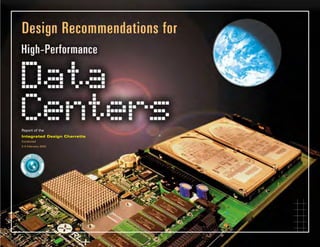
Cover: 2001 RLX TechnologiesTM
ServerBlade 667—originally designed
by RLX founder Chris Hipp.
Type: Palatino (body text) and Univers (supporting text elements).
Paper: New LeafTM
Reincarnation Matte 95#, 100% recycled, 50% PCW, PCF (cover).
and New LeafTM
Eco Offset 60#, 100% PCW, PCF (text).
Printed with vegetable-based ink and bound with biodegradable glue
Printed in the United States of America
© 2003 Rocky Mountain Institute (RMI) or other copyright holders.
The trademarks contained in this report are owned and/or controlled by
Rocky Mountain Institute or by other parties and are the property of
their respective owners. It is possible that some elements of this report
may be the subject of patent rights. Rocky Mountain Institute shall not be held
responsible for identifying any such patent rights.
Whether, how, and to what extent the recommendations in this report
are properly or fully implemented is at the discretion of individual users of
this report. Therefore RMI cannot be held liable for any consequences or
damages that may arise from implementation or non-implementation
of these recommendations or from reliance on
any information contained in this report.
Report of the
Integrated Design Charrette
Conducted
February 2–5, 2003
Appendices
A Wu-chun Feng: Bladed Beowulf: Cost Effective Alternatives to Traditional Beowulfs
B Panel Discussion: “Issues in the Design of Data Centers”
C Jon Koomey/Bill Tschudi Presentation
D Peter Rumsey Presentation
E Chris Hipp Presentation: Blade Computing: How Did We Get Here? Where Are We Going?
MS Word doc (1), MS Power Point (2)
F Piers Heath Presentation
G Amory Lovins Presentation
H B. Aebischer and A. Huser, Energy Efficiency of Computer Power Supplies,
(abstract in English) November 2002
I NRDC Report: Power Supplies: A Hidden Opportunity for Energy Savings
J Thermal Considerations in Cooling Large Scale High Compute Density Data Centers,
by Chandrakant Patel et al. (1); and Computational Fluid Dynamics Modeling of High Compute Density
Data Centers by Chandrakant Patel et al. (2)
K Cool Chips Overview, by Jim Magdych of Cool Chips, Inc.
L Notes from Heat Sources and Transfer (breakout) Group
M Data Center Energy Characterization Study, Rumsey Engineers, February 2001
N “N1’s Computing-on-Demand to Drive Network Services” by Greg Papadopolous,
Network Computing Asia, 1 February 2003
O “Transmeta Announces Features of Next Generation TM8000 Processor for Energy Efficient
Computing,” Transmeta press release, 10 March 2003
P “Dockable Server Concepts,” WillBerry and Stephen W. Montgomery, Intel Labs, 25 February 2003
Q “Powering the Internet, Datacom Equipment in Telecom Facilities: The Need for a DC Powering Option,”
by the Technical Subgroup on Telecommunications Energy Systems of the Power Electronics Society
of the Institute of Electrical and Electronics Engineers, Inc., 1998
R Energy Performance Contracting for New Buildings
S Energy- and Eco-Efficiency of Data Centres: A study commissioned by DIAE1 / ScanE2
of the Canton of Geneva, by B. Aebischer et al., 5 January 5 2003
T “DARPA funds power-aware architecture development” by Stephan Ohr, EE Times,17 August 2003
U “Cooling and Power Considerations for Semiconductors Into the Next Century,” by Christian Belady
Table of Contents
Part 1: Native Loads: CPUs, Servers, Software, etc.
Part 2: Computer Power Supplies
Part 3: Next Generation Cooling
Part 4: Cooling
Part 5: Facility Power Supply
Part 6: Operations
Parts 1–6 include 62 total recommendations
outlined on next page
Design Recommendations for
High-Performance
Data Centers
5 Acknowledgments
9 Introduction
14 Summary
25 Matrix of Recommendations
32 Recommendations
83 Conclusion
85 About Rocky Mountain Institute (RMI)
86 RMI Team Directory and Bios
90 Participant List and Bios
100 Sponsors
<< Appendices
Table of Appendices accompanies the CD-ROM on inside front cover
Appendices are furnished in electronic format only.
Contact orders@rmi.org for additional copies.
Part 1: Native Loads (CPUs, Servers, Software, etc.) 33
.1 New design paradigm 34
.2 Define operating envelope 36
.3 Reduce or eliminate heat sources 37
.4 High efficiency CPUs 37
.5 Remove disk drives from servers 38
.6 Power supplies 38
.7 Remove power supplies from servers 39
.8 Dynamically allocate resources 39
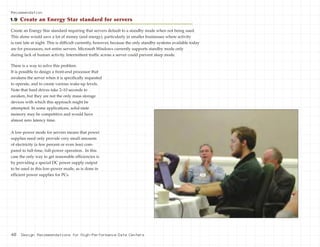
.9 Create an Energy Star standard for servers 40
Part 2: Computer Power Supplies . . . . . . . . . . . . . . 41
.1 Recognize and account for the full cost
of each watt of power delivered to the server 43
.2 Create clear connections between power supply design,
system efficiency, and power cost,
with incentives to support efficient solutions 43
.3 Focus on finding continuous, not intermittent,
power savings 45
.4 Establish industry standards to increase
power supply efficiency 45
.5 Improve power supply design 45
Part 3: Next Generation Cooling . . . . . . . . . . . . . . 47
.1 Create system standards 49
.2 General 49
.3 Hybrid approaches for near term 49
.4 Conductive thermal path to liquid for future 50
Part 4 Cooling . . . . . . . . . . . . . . . . . . . . . . . . . . . . . 51
a: Low Energy Ventilation and Cooling . . . . . . . . . . 52
.1 Increase the temperature range of cooling air 52
.2 Manage airflow to reduce
energy required for cooling and ventilation 52
.3 Minimize air-side static pressure 54
.4 Maximize use of free cooling 55
.5 Natural ventilation 56
.6 Demand-controlled ventilation 56
.7 Additional ideas 57
.8 Wish list for manufacturers 57
b: Efficient Heat Rejection
in Large Data Centers . . . . . . . . . . . . . . . . . . . . . . . . 58
.1 Tune humidification and dehumidification cycles
on existing systems 58
.2 Evaporative condensers/cooling 58
.3 Design and install chilled water systems greater than
200 tons to operate at a total of 0.62 kW per ton 58
.4 Design and install chilled water systems
greater than 60 and less than 200 tons to operate
at a total of 0.83 kW per ton 59
.5 Microclimate-specific recommendations
for northern U.S. and cold climates 59
.6 Use waste heat from on-site cogeneration
to drive HVAC system 59
.7 Desiccant cooling 60
.8 Thermal storage 60
.9 Wish list for manufacturers 60
c: Control Strategies . . . . . . . . . . . . . . . . . . . . . . . . . . . 61
.1 General low-/no-cost optimizations 61
.2 Establish environmental standards
for mechanical and electrical systems by room type,
and control to least energy-intensive values 61
.3 Low-/no-cost solutions: CRAC optimization 62
.4 Low-/no-cost solutions:
reconfigure controls on central air handlers 62
.5 Low-/no-cost solutions:
reconfigure controls on central plants 62
.6 Mid- to high-cost solutions 62
.7 Future control systems 63
Part 5: Facility Power Supply . . . . . . . . . . . . . . . . . . 64
.1 AC power distribution system 66
.2 On-site power generation 70
.3 Interconnect with utility 71
.4 Address barriers to self-generation 71
Part 6: Operations . . . . . . . . . . . . . . . . . . . . . . . . . . . 73
.1 Intelligent resource allocation 75
.2 Improve information available 75
.3 Align incentives with desired performance 76
.4 Benchmarking 76
.5 Write more efficient code 77
.6 Submetering 77
.7 Measurement and verification (M&V) 77
.8 Continuous commissioning 78
.9 Create self-diagnosing/healing systems 78
.10 Virtual servers 78
.11 Optimization tools 78
.12 Miscellaneous 78
.13 Education, outreach and training 79
.14 Demonstrations 79
.15 Energy Star and LEED ratings 80
.16 Create an independent organization to provide
testing, experimentation,
education, and demonstrations 81
Table of Contents
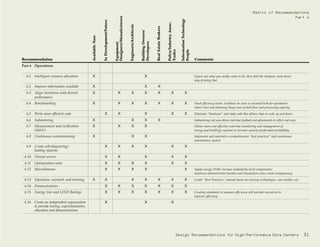
R e c o m m e n d a t i o n s
A three-day transdisciplinary workshop with ~90 industry experts synthesized ways to design, build, and operate data centers that would use approximately tenfold less energy, improve uptime, reduce capital cost, speed construction, and enhance the
value proposition. Some of the >50 integrated recommendations can also be applied to existing data centers.
Ackn
Our sponsors, to whom we at RMI are deeply grateful, include:
• Pacific Gas & Electric Company
(www.pge.com)
• California Energy Commission
(www.energy.ca.gov)
• New York State Energy Research and Development Authority (NYSERDA)
(www.nyserda.org)
• Agence de l’Environnement et de la Maîtrise de l’Énergie (ADEME)
(www.ademe.fr)
• Southern California Edison Company
(www.edison.com)
• BC Hydro Power Smart
(www.bchydro.com)
• Canton de Genève (Switzerland), Département de l’Intérieur, de l’Agriculture et de l’Environnement (DIAE)
(www.geneve.ch/diae/welcome.asp)
• The Service Cantonal de l’Énergie (ScanE )
(www.geneve.ch/scane/home/welcome.asp)
• Center for Energy Policy & Economics (CEPE), Zurich, Switzerland
(www.cepe.ethz.ch)
• California Independent System Operator Corporation (ISO)
(www.caiso.com)
Département de l'intérieur, de l'agriculture,
et de l'environnement
S
TATE OF CALIFORNI
A
ENERGY COMMISSION
This event was organized, facilitated,
and partially funded by Rocky Mountain Institute (RMI).
Initial organizational efforts were funded by RMI.
Subsequently, many sponsors made it
possible to hold this unique event.
Without the tireless fundraising efforts of Tom Watanabe,
charrette co-organizer
and business development consultant to RMI,
this charrette would not
have taken place.
5
AcknowledgmentsDesign Recommendations for High-Performance Data Centers
6 Design Recommendations for High-Performance Data Centers
nowl
Acknowledgments
In addition to our sponsors,
the charrette received significant industry/participant support from:
• American Power Conversion
(www.apcc.com)
• RealEnergy, Inc.
(www.realenergy.com)
• S&C Electric Company’s Power Quality Products Division
(www.sandc.com)
• EYP Mission Critical Facilities, Inc.
(www.eypae.com)
• Glumac International
(www.glumac.com)
• Jones Lang LaSalle Americas, Inc.
(www.joneslanglasalle.com)
• The Engineering Enterprise
(www.engent.com)
A full directory of sponsors is included on the back cover of this report.
w w w . a p c . c o m
To open the charrette RMI organized a panel discussion
on “Issues in the Design of Data Centers.”
Thanks to our panelists for providing a lively, informed,
and enlightening discussion:
Dan Baer—VP, Environmental Products, Leibert;
member of Telcordia Committee on Thermal
Management in DCs; member of European
Colocation & Hosting Association;
Ken Brill—Executive Director, Uptime Institute;
Grant Duhon—Savings By Design Program,
Pacific Gas and Electric Company;
Chris Hipp—Founder and former CTO,
RLX Technologies;
KC Mares—Director, Data Center Operations,
Redundant Networks; former co-chair SVMG Energy
Committee; former Director of Electrical Energy,
Utilities, and Special Projects at Exodus;
Chandrakant Patel—Principal Scientist,
Internet Systems and Storage Laboratory, Hewlett-
Packard Laboratories;
Joe Stolarski—SVP, Director of Engineering &
Operations, Jones Lang LaSalle; and
Jim Warren—EYP Mission Critical Facilities, Inc.
edgm
Design Recommendations for High-Performance Data Centers 7
Acknowledgments
Native Loads Group
Facilitator: Devra Bachrach.
Recorder: Onno Koelman.
Participants: Clark Bisel, Marty Hagen, Jim Magdych,
Peter Rumsey, Bob Seese, Geoff Wood.
Later: Neil Rasmussen and Tom Croda.
Computer Power Supplies Group
Recorder: Greg McBeth.
Participants: Bernard Aebischer, Tom Croda,
Neil Rasmussen, J.B. Straubel.
Cooling Group
Facilitator: Bill Browning.
Recorders: Ann Hushagen, Corey Griffin,
and Joanie Henderson.
Participants: Barry Abramson, Dan Baer, Dick Bourne,
David Coup, Piers Heath, Ernie Jensen, K.C. Mares,
Henry Lau, John Pappas, Ron Perkins, Neil Rasmussen,
Bill True, Bill Tschudi, Tim Xu, Malcolm Lewis.
Facility Power Supply Group
Facilitators: Odd-Even Bustnes and Joel Swisher.
Recorders: Craig Collins and Greg McBeth.
Participants: Bernard Aebischer,
Tom Croda, Michael Daish, Joe Daniels,
Tom Ditoro, Gary Engle, Steven Greenberg,
Joe Griffith, Peter Gross, Greg Mears,
Peter Mikhail, Neil Rasmussen, Brad Roberts,
Art Rosenfeld, Mike Steinman, J.B. Straubel,
Stephen Torres, James Warren,
Bill Westbrock, Scott Wheeler, Ron Wilson.
Operations Group
Facilitators: Greg Kats, Dale Sartor.
Recorders: Gautam Barua and Cody Taylor.
Participants: Eric Adrian, Kevin Best, Ken Brill,
Patsy Dugger, Steve Greenberg, Peter Gross,
Ron Hughes, Peter Spark, Ron Kalich, Jon Koomey,
Bob Perrault, Jen Seal, Steve Strauss,
David Schirmacher, Joe Stolarski,
Tom Watanabe.
Many participants were not tied to
any specific breakout group:
Adrian Altenberg, Chris Chouteau,
Tom Coulard, Grant Duhon,
Huston Eubank, Stephen Fok, Rafael Friedman,
Jerry Hutchinson, Steve Jurvetson,
Mukesh Khattar, Donald Lee,
Amory Lovins, Ben Mehta, Bruce Nordman,
Paul Roggensack, Roland Schoettle,
Steve Schumer, Harold J. Stewart,
Richard Williams, and John Wilson.
Several of our facilitators and recorders volunteered
their time to support this effort.
We would like to thank them
and the organizations that support them:
Greg McBeth and Cody Taylor,
currently undergraduate students at Stanford;
J.B. Straubel of Volacom;
Ann Hushagen of the Oregon Office of Energy;
Corey Griffin, a former RMI Intern and currently
a graduate student at U.C. Berkeley;
Devra Bachrach of the Natural Resources Defense Council (NRDC);
Dale Sartor of Lawrence Berkeley National Laboratory;
and Gautam Barua of The Natural Step.
A broad range of industry experts accepted the challenge and participated in the charrette, bringing an unusually wide variety of perspectives, tremendous enthusiasm, and
refreshing willingness to go beyond conventional thinking. A full directory of participants is included on p. 86. RMI contracted with other specialist consultants listed in
Appendix D to provide facilitation of the discussions and special expertise in integrated, whole-systems design. The facilitators and participants in each breakout group
were crucial to the cultivation of innovative ideas and out-of-the-box thinking. We would like to recognize and thank them all here.
1 A new company that is building extremely long-endurance
high altitude aircraft using completely composite air-frames
and completely electric propulsion systems that use
liquid hydrogen as a fuel.
1
ment
Acknowledgments
The following speakers deserve special thanks:
John Gage, Chief Scientist, Sun Microsystems, for his
overview of issues facing the industry and creative
approaches to resolving them.
Wu-chun Feng, for setting the tone for the entire
charrette with his keynote presentation on the Green
Destiny computer at Los Alamos National Laboratory.
Chris Hipp, for his presentation on blade servers and
innovative solutions to equipment requirements in
data centers.
Peter Rumsey, for his presentation on “Energy Efficiency
Strategies for Data Center HVAC Systems.”
Piers Heath, for his presentation on “Data Centres:
A Design Approach and Methods of Climate Control.”
Bernard Aebischer of the Centre for Energy Policy
and Economics (CEPE), Swiss Federal Institute of
Technology (ETH), for his presentation on “Energy-
and Eco-Efficiency of Data Centres: Past Activities
and Future Plans in Geneva.”
Chandrakant Patel, for his presentation on the work
of Hewlett-Packard Laboratories on“Smart Data Centers.”
Jon Koomey and Bill Tschudi of Lawrence Berkeley
National Laboratory (LBNL), for their review of available
data from field measurements and utility bills on how
much electricity is actually used by data centers,
and with what end-use structure.
Jim Magdych, Chief Information Officer, Cool Chips
PLC, for his presentation of the development of
computer chips using thermotunneling technology.
Dale Sartor of LBNL, who led a special discussion
about “next steps.”
RMI staff wrote this charrette summary report,
which has been reviewed by all participants prior
to publication. RMI writers include Huston Eubank,
Joel Swisher, Cameron Burns, and Jen Seal.
Amory Lovins and Jonathan Koomey provided special
technical reviews. Layout and graphics are by
Ben Emerson of RMI, unless otherwise noted.
Many charrette participants were especially helpful
in reviewing and interpreting this report: thanks to
Chris Hipp, Tom Croda, Ron Perkins, Geoff Wood,
Neil Rasmussen, Bernard Aebischer, J.B. Straubel,
Bill True, Brad Roberts, Greg Kats, Ken Brill,
Dick Bourne, Jon Koomey, Dale Sartor, Tim Xu,
Clark Bisel, Dave Coup, John Pappas, and Will Clift.
Onno Koelman’s notes on the Native Loads breakout
group, included in Appendix L, are stellar.
Any remaining errors are the authors’ responsibility
and should kindly be notified to huston@rmi.org,
as should further suggestions and achievements.
Errata and addenda will be posted from time to time
at www.rmi.org/sitepages/pid626.php.
Finally, project manager Huston Eubank would like
especially to acknowledge RMI cofounder and CEO
Amory Lovins for his presentations, his determination
and optimism, and his visionary leadership, all of which
made this event and our continued efforts possible.
Special thanks to California Energy Commissioner Art Rosenfeld for refocusing our attention and efforts early on
the important role of equipment power supplies in the overall equation. His intuition was correct.
Also special thanks to Ken Brill, Executive Director of the Uptime Institute, for his energetic participation
and valuable insights.
Rocky Mountain Institute
1739 Snowmass Creek Road
Snowmass, CO 81654
970-927-3851
970-927-4510 fax
www.rmi.org
8 Design Recommendations for High-Performance Data Centers
s
The world has become dependent upon reliable data manipulation, storage, retrieval, exchange,
and safe-keeping. We use data for most of our modern telecommunications, commercial,
financial, national security, military, academic, and government systems, among other things.
The central issue regarding data is the reliability of the systems housing and powering them.
In 1965 Gordon Moore, cofounder of Intel, found that “the number of transistors per square
inch on integrated circuits had doubled every year since the integrated circuit was invented.”
Moore predicted that this trend would continue for the foreseeable future. In subsequent years,
the pace slowed down a bit, but data density has doubled approximately every 18 months, and
this is the current definition of Moore’s Law, which Moore himself has blessed. Most experts,
including Moore himself, expect Moore’s Law to hold for at least another two decades.1
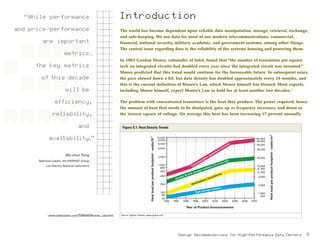
The problem with concentrated transistors is the heat they produce. The power required, hence
the amount of heat that needs to be dissipated, goes up as frequency increases, and down as
the inverse square of voltage. On average this heat has been increasing 17 percent annually
Introduction
1
www.webopedia.com/TERM/M/Moores_Law.html.
“While performance
and price/performance
are important
metrics…
the key metrics
of this decade
will be
efficiency,
reliability,
and
availability.”
Wu-chun Feng
Technical Leader, the RADIANT Group
Los Alamos National Laboratory
Design Recommendations for High-Performance Data Centers 9
10,000
8,000
6,000
4,000
2,000
1,000
800
600
400
200
100
80
60
1992 2006200420022000199819961994 20102008
Year of Product Announcement
Heatloadperproductfootprint-watts/ft2
100,000
80,000
60,000
40,000
20,000
10,000
8, 000
6, 000
4,000
2,000
1,000
800
Heatloadperproductfootprint-watts/m2
Communication equipment (frames)
Servers & disk storage systems (1.8–2.2m tall)
Workstations (standalone)
Tape storage systems
Figure S.1: Heat Density Trends
Source: Uptime Institute; www.uptime.com.
(see Figures S.1 and 1.4, Recommendation
1.4). As components shrink, this growth is
compounded. Heat is beginning to threaten
chips’ existence—indeed, some chips threaten
to melt themselves. Some researchers and
experts even expect that within a few years,
the heat produced by some chips will rival
the heat density found on the surface of a
nuclear reactor core.2
Thus a major challenge
for the high-tech sector becomes keeping
data powered while keeping chips temperate.
Today, for every watt being consumed by a
computer, roughly two to three additional
watts are being drawn from the utility to cool
the computer and provide it with protected
power. In RMI’s opinion, this formula is
unsustainable: as computers become hotter
and hotter, HVAC engineers will be forever
“chasing their tails,” as one engineer has
described the situation, in an effort to keep
CPUs from destroying themselves. In addition
to wasting energy, increasing power density
also increases the risks of system failure
and highly expensive downtime, and increases
capital costs and construction delays.
As Dr, Wu-chun Feng noted: “The more power
a CPU draws, the hotter it gets. The hotter a
CPU gets, the more likely it will fail (or clock
down), and likely, cause other components
to fail. More concretely, Arrenhius’ equation
(when applied to microelectronics) predicts
that the failure rate of a given system doubles
with every 10˚ C (18˚ F) increase in tempera-
ture. And in fact, unpublished empirical data
from two leading vendors indicates that the
failure rate of a compute node does indeed
double with every 10˚ C increase.”3
Society can no longer afford “brute power”
solutions. The maxim “if brute force isn’t
working, you aren’t using enough of it” is
outdated and inappropriate. If our species is
to survive on the planet at anything like our
current standard of living, we must learn to
use energy and other resources as efficiently
as nature does. This is a central goal of
RMI’s work.
It is important to note that while nature is
incredibly efficient, it also routinely provides
performance significantly in excess of compa-
rable human systems. For example, human
brains possess impressive capabilities, yet
they are elegantly frugal.
Our ability to emulate natural energy systems
is still very primitive. Energy consumption
is usually a secondary or tertiary considera-
tion in designing modern mechanical and
electrical systems. The use of massive quanti-
ties of energy to force functionality is rarely,
if ever, questioned. Greater performance at
the cost of energy efficiency and system relia-
bility does not make sense; there are better
ways to achieve high performance. As Dr.
Feng4
said, “While performance and price/
performance are important metrics…the key
metrics of this decade will be efficiency, relia-
bility, and availability.” These goals must, of
course, be achieved within the context of reli-
ably providing needed services and achieving
needed goals.
Introduction
10 Design Recommendations for High-Performance Data Centers
2
It is important to note that this number has not been verified by RMI.
The number has been passed through the computer community, and appears to have originated with Pat Gelsinger, Senior Vice President, Chief Technology Officer, Intel Corporation, who referred to the surface of a
reactor in a presentation at the Intel Developer Forum, 28 February 2002 (see www.intel.com/pressroom/archive/speeches/gelsinger20020228.htm). Although the comment is viewed by some as figurative or garbled (reactor
power densities are normally expressed per cm3
, not cm2
), the fact that many leading computer designers use it as a representative figure is illustrative of how accurate they believe it will prove to be.
3
“The Bladed Beowulf: A Cost-Effective Alternative to Traditional Beowulfs” by W. Feng_, M. Warren_, and E. Weigle (feng, msw, ehw_@lanl.gov), Advanced Computing Laboratory and the Theoretical Astrophysics Group,
Los Alamos National Laboratory, Los Alamos, NM 87545, undated, p. 3.
4
Technical Leader, the RADIANT Group, Los Alamos National Laboratory. See Appendix A for a summary of his presentation.
5
Charrette: a very intensive, highly integrative, trans-disciplinary, roundtable workshop that brings together stakeholders and experts at
Design Recommendations for High-Performance Data Centers 11
On 2–5 February 2003, Rocky Mountain
Institute (RMI—see www.rmi.org and p. 85)
convened an innovative whole-system design
charrette5
to challenge the current model for
data centers and develop a groundbreaking
data center design—a clean-sheet model with
no compromises. We brought together about
ninety high-level, broad-thinking, technically
deep industry experts with strategic visions
in engineering, computer design, energy, data
management, business, real estate, and facilities
design to consider the challenge of data center
energy consumption. Our goal was to leapfrog
past incremental and individual efficiency
improvements to advanced whole-systems
design models—models that ultimately cost less
to build, work better, and save astonishing
amounts of electricity (or are even net generators
of electricity).
By digging deeply into questions of technology
choice, system integration, and business strategy,
we discovered numerous and significant benefits
for owners, developers, and designers of data
centers, manufacturers of site infrastructure,
computing equipment and components, utilities,
and related industries.
Introduction
The charrette addressed several important issues:
• Unnecessarily high energy bills.
By following the recommendations in this report, data centers can reduce their energy require-
ments by as much as 89 percent in the future. Using existing technology a 75 percent reduction of
power consumption is feasible. Part of this potential can be captured in existing facilities.
• Unnecessarily high capital cost.
Applying whole-system design principles can increase energy efficiency while reducing capital
cost—due to the complementary effects of integrated design and the correct sizing of systems.
• Grid dependence.
Whole-system design improves power quality and reliability, reduces dependence on the utility
grid, and significantly increases overall efficiency. The ultra-reliable onsite power generation
system recommended at the charrette relegates the utility grid to back-up status and makes possi-
ble the sale of net power and ancillary services back to the grid, while ensuring high reliability.
This is a key competitive advantage.6
• Utility distribution charges and delays.
The systems recommended at this charrette can substantially reduce project lead times and com-
pletion risks. Rather than waiting for the utility to strengthen distribution capacity to serve new
facilities or expansions, developers can offer the utility a compelling proposition—and generate
net revenue by selling power and ancillary services back to the grid when and where they’re most
valuable. Utilities and data center operators’ contracts often require certain availability of power
on demand. Reducing this “holding capacity” will free resources, lower costs, and eliminate
potential grid bottlenecks.
The result of this charrette was a data center design concept that reduces energy demand
by an order of magnitude (89 percent) compared to today’s standard designs, while providing
equivalent computing power and greater reliability.
the very outset of a design or problem-solving process. It yields an ambitious design product, typically conceptual with some extension
into early schematic design.
6
Review comment from Joel Swisher: “Utilities resist allowing both functions, due to protection and interconnection complexities,
especially in networked (rather than radial) urban distribution systems.” See Recommendation 4.4 for a discussion of this point,
and www.smallisprofitable.org.
High-Performance Data Center Charrette 4
Important issues (continued)...
RMI’s charrettes are usually client-driven—clients pay for an in-depth exploration of
their issues. This charrette was unique in that it was not organized around
a specific client, a specific location, or a specific process.
• Risks for the owner/developer.
Using the optimized designs recommended
at this charrette, data centers can be
cheaper and faster to build. Modular design
allows construction of only the capacity
currently required, while making future
expansion simple and reliable. Lower
operating costs and facilities boost the
whole industry.
• Community opposition.
Breakthrough energy-efficient design solu-
tions and benign onsite power generation
can improve the environment, minimize
community concerns, and expedite
approvals.
• Uncaptured opportunities for
product sales for equipment that con-
tributes to implementing these integrated
design solutions.
RMI’s charrettes are a design process developed
by RMI and the American Institute of Architects
(AIA) for the Greening of the White House.
Charrettes apply a comprehensive and whole-sys-
tem approach to design. This leads to integrated
solutions with improved economic, energy, and
environmental performance, simultaneously and
without compromise. Charrettes have subsequent-
ly been used for numerous large-scale projects of
many kinds, ranging from vehicles to process
plants and from buildings to refugee camps.
This three-day integrated design charrette, orches-
trated by RMI, focused on capturing energy and
environmental performance improvements for
each aspect of data center operations. The char-
rette emphasized facilitated dialogue in the areas
of innovative and functional energy-saving design
and engineering, and strategies to improve envi-
ronmental results of design decisions. Innovative
design of system components and integrated sys-
tems should significantly lower operating costs,
and has the potential to reduce first costs as well.
RMI saw the need to host a forum on creating
ultra-efficient data centers. The timing was right.
A broad range of industry experts accepted the
challenge and participated in the charrette bring-
ing an enthusiasm and willingness to go beyond
conventional thinking that far exceeded that of a
single client-focused event.
In the conventional, linear design process, key
people are often left out of the decision-making
process, or brought in too late to make a full con-
tribution. In this charrette, the participants
brought an unusually wide variety of perspec-
tives. Some were computer chip experts, others
were HVAC specialists; we had server engineers
and real estate specialists. This diversity con-
tributed to the success of this trans-disciplinary
re-think process. The fact that there was no client
allowed participants to explore deeply the best
possible scenario for each of the issues raised
while minimizing proprietary concerns.
Charrette Process
12 Design Recommendations for High-Performance Data Centers: Introduction
This report summarizes the discussions that took
place and actions recommended. It is organized
to follow the compounding savings from the
native loads back up-stream toward the power
source. Participants narrowed their focus to six
topic areas:
Part 1: Native Loads (CPUs, Servers, etc.)
Part 2: Computer Power Supplies
Part 3: Next Generation Cooling
Part 4: Cooling (Heat Removal)
Part 5: Facility Power Supply
Part 6: Operations
There are more than fifty major recommendations.
One goal of this report is to stimulate further
examination of the various components of
data centers and the energy they consume.
It is essential that these components be designed
and combined in an integrated—
or whole-systems—fashion.
Whole-systems thinking is a process that actively
considers interconnections between systems and
seeks solutions that address multiple problems
at the same time. Some refer to this process as
the search for “solution multipliers” via a “vision
across boundaries.”
The process of integrated planning and design,
identifying the performance goals up front, is
critical to achieving a good design. This allows
the team to capture multiple benefits from single
design features and to optimize overall data
center performance.
It is important to recognize this unique integration
process and whole-systems way of thinking when
considering the use of the recommendations
in this report. Many of them cannot be considered
in isolation because their success and cost savings
rely on the successful implementation of other
recommendations.
The Internet has become an increasingly important
factor in our economy. At this charrette we were
able to take advantage of the current business
slowdown to step back and critically examine
current practices. We can expect aggressive
growth of Internet-related facilities to resume in
the future. When that happens, no doubt the
ideas developed at this charrette and presented in
this report will help to ensure orderly, profitable,
and environmentally responsible growth.
How quickly will the Data Center of the Future be
realized? We don’t know, but the early 21st century
lull in the economy and the bursting of the late
1990s technology bubble have provided all who
work with data centers, computers, and high-tech
real estate a chance to do data centers right.
We hope that readers will use this report as inspi-
ration to challenge conventional designs of build-
ings, servers, CPUs, and support systems. But
most importantly, we hope that you use it to chal-
lenge conventional thinking about energy con-
sumption, and how we design and build systems
around bits and bytes.
Introduction
Design Recommendations for High-Performance Data Centers 13
About This Report
Question (Dale Sartor): Does the system designed
by the Power Team use off-the-shelf technology,
and if so, why is it not being used?
Answer (Brad Roberts): In the boom of building,
I asked one of the building firms, ‘Why don’t you
do this?’ They said, ‘We don’t have time to do that.’
In other words, they don’t have time to do it right.
Perhaps now, Roberts posited, we have the time.
Time to DoThings Right
14 Design Recommendations for High-Performance Data Centers
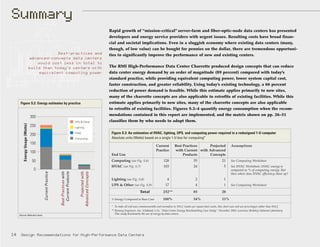
Rapid growth of “mission-critical” server-farm and fiber-optic-node data centers has presented
developers and energy service providers with urgent issues. Resulting costs have broad finan-
cial and societal implications. Even in a sluggish economy where existing data centers (many,
though, of low value) can be bought for pennies on the dollar, there are tremendous opportuni-
ties to significantly improve the performance of new and existing centers.
The RMI High-Performance Data Center Charrette produced design concepts that can reduce
data center energy demand by an order of magnitude (89 percent) compared with today’s
standard practice, while providing equivalent computing power, lower system capital cost,
faster construction, and greater reliability. Using today’s existing technology, a 66 percent
reduction of power demand is feasible. While this estimate applies primarily to new sites,
many of the charrette concepts are also applicable to retrofits of existing facilities. While this
estimate applies primarily to new sites, many of the charrette concepts are also applicable
to retrofits of existing facilities. Figures S.2–4 quantify energy consumption when the recom-
mendations contained in this report are implemented, and the matrix shown on pp. 26–31
classifies them by who needs to adopt them.
300
250
200
150
100
50
0
CurrentPractice
EnergyUsage(Watts)
BestPracticeswith
CurrentProducts
Projectedwith
AdvancedConcepts
Projectedwith
AdvancedConcepts
UPS & Other
Lighting
HVAC
Computing
Figure S.2: Energy estimates by practice
Source: Malcolm Lewis
Best-practices and
advanced-concepts data centers
would cost less in total to
build than today’s centers with
equivalent computing power
Current Best Practices Projected Assumptions
Practice with Current with Advanced
End Use Products Concepts
Computing (see Fig. S.6) 128 55 21 See Computing Worksheet
HVAC (see Fig. S.7) 103 24 5 See HVAC Worksheet; HVAC energy is
computed as % of computing energy. But
then where does HVAC efficiency show up?
Lighting (see Fig. S.8) 4 2 1
UPS & Other (see Fig. S.9) 17 4 1 See Computing Worksheet
Total 252** 85 28
% Energy Compared to Base Case 100% 34% 11%
* To make all end-uses commensurable and normalize to W/s.f. (watts per square foot) units, this chart uses end-use percentages rather than W/s.f.
** Rumsey Engineers, Inc. (Oakland, CA), “Data Center Energy Benchmarking Case Study,” December 2002, Lawrence Berkeley National Laboratory.
This study benchmarks the use of energy by data centers.
Figure S.3: An estimation of HVAC, lighting, UPS, and computing power required in a redesigned 1-U computer
Absolute units (Watts) based on a single 1-U box for computing*
Summary
Malcolm Lewis1
created Figures S.2–3 at the
charrette to integrate the potential energy
savings identified by the various working
groups. The various components that make
up these results are tabulated in the support-
ing charts on the following pages and are
discussed in the summary text related
to each group. The graph identifies scenarios
for energy consumption reduction in existing
data centers, data centers using best practices
with current products (currently available
technology combined in smarter ways),
and a projection for advanced concepts not
yet “on the shelf.” Each of these three scenar-
ios provides the same computing power.
Best Practices” and “Advanced Concepts” refer to
the practices identified at this charrette and listed
in this report. The first uses technology that exists
today; the second uses new technology that must
be invented or that exists but has not yet been put
into common practice. The matrix shown in
Figure S.3 assigns each recommendation to one of
these two categories, and further categorizes them
according to professional interests or disciplines.
One metric for comparing the efficiency of data
centers proposed at the charrette is total utility
power delivered to the facility divided by the net
power that goes directly into computing equip-
ment. Using this metric for each scenario yields
the results shown in Figure S.4.
The numbers shown in Figure S.3 show what
Lewis called an obvious and expected “double-
whammy” benefit of best practices and of
advanced concepts. Because the energy required
for data processing drops significantly as the
efficiency of the computing devices themselves
improves, the heat generated and the need to cool
them decreases, often exponentially. Also impor-
tant is pervasive oversizing, currently standard
practice. It can cause the cooling-energy require-
ment to be as much as three times greater than is
what actually required by empirical analysis.
Thus, right-sizing of many kinds of equipment
represents a huge opportunity. “Best practices”
assumes that variable cooling infrastructure is
in place—systems and controls that adjust equip-
ment use according to a user’s needs, as well
as that equipment’s supporting infrastructure
(chillers, fans, etc.).
The capital cost (new and retrofit) of these effi-
cient systems was not formally estimated; however,
the cooling team calculated that an annual return
on investment (ROI) of 35–400 percent is achiev-
able through improvements to HVAC systems
alone (see Figure 4.1.1: Cooling cost benefits,
p. 51), and Lewis shares the view of many partici-
pants that both best-practices and advanced-
concepts data centers would cost less in total
to build than today’s centers with equivalent com-
puting power.
Integrated planning and whole-systems design
require that performance goals be identified
at the beginning of the process. This allows the team
to capture multiple benefits from individual
expenditures and to optimize overall data center
performance. It is important to recognize this
unique integration process and way of thinking
when considering the use of the recommendations
in this report. Many of them cannot be considered
in isolation because their success and their cost
savings rely on the successful implementation
of other recommendations.
1
President and Founder, Constructive Technologies Group. Dr. Lewis
is a consulting engineer who specializes in design, energy analysis,
and forensics of mechanical, electrical, and energy systems for
buildings and industrial processes.
Total Power / Computing Power = With Current Improvements Holding Computer Power
in Computing Constant
Current Practice: 1.97 1.97
Best Practice with Current Products: 1.54 0.38
Projected with Advanced Concepts: 1.36 0.13
Figure S.4
Design Recommendations for High-Performance Data Centers: Summary 15
“
To achieve the greatest possible energy savings
in a data center, it is best to begin with native
loads. This report is organized so that the reader
can follow the compounding savings from these
native loads back “up-stream” toward the electric
power source. As Natural Capitalism states about
reducing flow or friction in the pipes of a standard
industrial pumping system:
Saving one unit of energy furthest down-
stream…avoids enough compounding losses...
to save about ten units of fuel, cost, and pollution
back at the power plant. Those compounding
savings represent significant economic and
environmental leverage…[enabling] each
successive component, as you go back upstream,
to become smaller, simpler, and cheaper.
This…means that downstream savings merit
the greatest emphasis.2
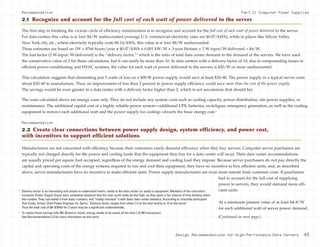
The first step in increasing efficiency is to recog-
nize and account for the full cost of each watt of
power delivered to the server. For data centers, pay-
ing average U.S. commercial electricity rates of
$0.07/kWh, this value is at least $4/W—or twice
that at least $8/W, in places like Silicon Valley,
New York city, etc., where electricity typically
costs $0.14/kWh. In particularly inefficient data
centers, the value of each watt delivered to the
servers can be as high as $20/W. Note that power
always saved (continuously) is generally worth
several times as much as power saved intermit-
tently, unless the intermittent savings come when
power is especially expensive to deliver and this
is reflected in its price.
16 Design Recommendations for High-Performance Data Centers: Summary
Native Loads
Whole-systems thinking actively considers the interconnections between systems and solutions
that address multiple problems at the same time. Some refer to this process as the search
for “solution multipliers.” It requires a “vision across boundaries” and “solving for pattern.”
Comprehensively integrating topical recommendations is critical to achieving the best results.
Design teams frequently use a value-engineering approach, instead of a whole-systems
approach, for system or product selection. Value engineering is piecemeal; it prices design
elements one by one to find the cheapest available product. But it fails to capture
the benefits that can be achieved by recognizing that even though certain parts of the design
may be more expensive, offsetting savings can make the whole project cost less and create
greater value. Rocky Mountain Institute calls this phenomenon “tunneling through the
cost barrier” (see Figure S.5). It is explained in detail in Natural Capitalism, especially in
Chapter Six.
Reliability is the main critical element in data center facilities.
Therefore, efficiency cannot compromise reliability, and success will be facilitated if efficiency
is shown to increase reliability.
The following paragraphs summarize the
major findings of each working group at the
charrette. This summary and the pages that
follow describe how practicing energy
efficiency can be achieved through combina-
tions of advanced CPU and server technolo-
gies, smarter facilities, better HVAC system
and power supply design, and more sensible
metrics of what things really cost.
diminishi
ngreturns
cumulative
resource savings
(+)
(–)
DETOUR
“tunnelling through
the cost barrier”…
…to even BIGGER
and cheaper
energy savings
marginalcostof
efficiencyimprovement
cost-effectiveness
limit
cost-effectiveness
limit
0
Figure S.5: Tunneling Through the Cost Barrier
Source: Rocky Mountain Institute 2
Loosely quoted from Natural Capitalism, pp. 121–22.
Today’s typical 1-U3
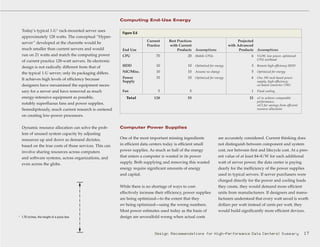
rack-mounted server uses
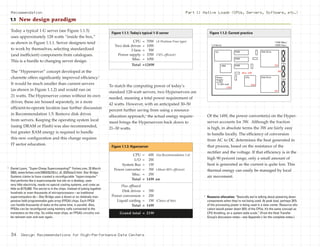
approximately 128 watts. The conceptual “Hyper-
server” developed at the charrette would be
much smaller than current servers and would
run on 21 watts and match the computing power
of current practice 128-watt servers. Its electronic
design is not radically different from that of
the typical 1-U server; only its packaging differs.
It achieves high levels of efficiency because
designers have reexamined the equipment neces-
sary for a server and have removed as much
energy-intensive equipment as possible,
notably superfluous fans and power supplies.
Serendipitously, much current research is centered
on creating low-power processors.
Dynamic resource allocation can solve the prob-
lem of unused system capacity by adjusting
resources up and down as demand dictates,
based on the true costs of those services. This can
involve sharing resources across computers
and software systems, across organizations, and
even across the globe.
One of the most important missing ingredients
in efficient data centers today is efficient small
power supplies. As much as half of the energy
that enters a computer is wasted in its power
supply. Both supplying and removing this wasted
energy require significant amounts of energy
and capital.
While there is no shortage of ways to cost-
effectively increase their efficiency, power supplies
are being optimized—to the extent that they
are being optimized—using the wrong numbers.
Most power estimates used today as the basis of
design are severalfold wrong when actual costs
are accurately considered. Current thinking does
not distinguish between component and system
cost, nor between first and lifecycle cost. At a pres-
ent value of at least $4–8/W for each additional
watt of server power, the data center is paying
dearly for the inefficiency of the power supplies
used in typical servers. If server purchasers were
charged directly for the power and cooling loads
they create, they would demand more efficient
units from manufacturers. If designers and manu-
facturers understood that every watt saved is worth
dollars per watt instead of cents per watt, they
would build significantly more efficient devices.
3
1.75 inches, the height of a pizza box.
Computing End-Use Energy
Design Recommendations for High-Performance Data Centers: Summary 17
Current Best Practices Projected
Practice with Current with Advanced
End Use Products Assumptions Products Assumptions
CPU 70 20 Mobile CPUs 6 VLIW, low power, optimized
CPU workload
HDD 10 10 Optimized for energy 3 Remote high-efficiency HDD
NIC/Misc. 10 10 Assume no change 5 Optimized for energy
Power 33 10 Optimized for energy 6 One 3W rack-based power
Supply supply, high-efficiency;
on-board converter (3W)
Fan 5 5 1 Fluid cooling
Total 128 55 21 ×2 to achieve comparable
performance,
×0.5 for savings from efficient
resource allocation
Figure S.6
Computer Power Supplies
Water can conduct 3,467 times as much heat as
the same volume of air and requires an order of
magnitude less energy to move a given volume.
As temperatures on chips continue to rise and
equipment loads continue to increase in density,
liquid cooling becomes increasingly necessary.
The first companies to move to liquid cooling will
realize huge cooling-energy savings.
Resistance to liquid cooling may be greatly
reduced if the liquid is kept well away from the
chips by using non-liquid techniques to move
heat from electronic components to liquid located
off the board or even outside the rack. Changing
the thermal path from convective (air) to conduc-
tive (liquid) eliminates the need for fans and
minimizes the number of heat transfer steps in
the thermal path. Successful implementation of
liquid cooling systems requires standardization
of plug-and-play cooling connections, locations,
and methods for heat removal.
One alternative to liquid cooling is to use more
real estate to reduce the compaction, or spatial
density of heat sources, without necessarily
changing HVAC technologies in a radical way.
This can also save money (see Operations, p. 21).
A 50–100 % increase cooling efficiency, correspon-
ding to a 30–50% reduction in cooling energy cost,
can be achieved with a ~40–400 percent annual
return on investment (ROI)—with no decrease
in reliability. Onsite cogeneration can improve
reliability and increase chiller efficiency (by using
waste heat) for larger data centers.
Higher levels of efficiency are achieved by more
elegant and lower-cost solutions, such as air-side
or water-side economizers and dry cooling.
These solutions rely on the cooling potential of
outside air whenever possible, minimizing use of
vapor-compression equipment. Other high-
efficiency solutions include evaporative cooling
in dry climates (where data centers typically
need humidification) and thermal-based cooling
systems that use waste heat from onsite cogenera-
tion to drive the heat removal process.
Equipment failure rates are three times higher
at the top of the rack than at the bottom because
that’s where the heat collects. It would therefore
make sense to put the most heat-producing units
near the top of mixed racks.
Instead of operating data centers in the historically
mandated 55–75˚F range, improving the manage-
ment of airflow and using new technology make
it possible to raise the supply air temperature—
to as high as 70–90ºF—while increasing reliability
and cooling system efficiency.
In large, densely populated data centers, the
return air may embody larger total cooling loads
(sensible + latent) than the outside air. In these
cases, using outside air economizers will lower
peak and average cooling loads. Data centers
located in cool- and dry-climate regions can use
natural cooling—which is free—by employing
various techniques much of the year, including
direct, indirect, and direct-indirect evaporative
cooling, radiative or groundwater cooling,
and euthalpy-controlled economizers.
Typically, data center ventilation systems are
designed, installed, and operated at a constant
rate for 8,766 hours per year. As a result, these
systems frequently introduce far more outside
air—that has to be conditioned—than is required.
Except for command centers, few people continu-
ously occupy data center critical space. Evaluating
and minimizing ventilation rates can return big
dividends in efficiency.
Chilled water systems with a capacity greater
than 200 tons should operate at a total (supply
fans through cooling towers) of 0.62 kW per ton.
Systems greater than 60 and less than 200 tons
should operate at a total of 0.83 kW per ton.
These levels of performance have been achieved
in real-world facilities. However, the full inclusion
and commitment of all members of the design,
construction, and development team are required
to realize them.
Next Generation Cooling Cooling
18 Design Recommendations for High-Performance Data Centers: Summary
Optimizing existing control systems can provide
a 20 percent reduction in total HVAC energy
use on a typical system using only near-term,
no-cost/low-cost solutions. A 30 percent reduction
in total energy use is possible using variable
frequency drives (which has a capital cost) +
low-cost/no-cost. One of the simplest ideas—
yet a concept with multiple benefits—is to network
CRAC unit controls in order to optimize and
economize cooling efforts, and to allow the
CRAC units to cool selected zones independently
of other areas.
In the future, self-correcting, truly fault-tolerant
control algorithms with automated adjustments
based on measured data could remove human
error and lack of human responses to data.
Building automation systems (BAS) could monitor
rack/chip temperatures and return air tempera-
tures to optimize operating conditions and
energy use. And dynamic management tools
could deliver cooling where the data-processing
load is, and/or move the data processing load
where the cooling is optimal.
Current Practice Best Practices Projected
(as % Computing with Current with Advanced
End Use Energy) Assumptions Products Assumptions Products Assumptions
Heat Transfer 0 Included in computing data 0 Included in computing data 0 Included in computing data
out of Rack for now for now for now
Heat Transfer 0.23 Air-based CRACs, constant 0.11 Ducted from racks to plenum, VAV, 0.11 Fluid cooling or heat pipe to central
out of Room volume, (2 W/cfm) auto-rebalancing (1 W/cfm) fluid cooling system (assume 50%
efficiency improvement over air)
Heat Rejection 0.58 Air-cooled, DX, poor part-load 0.32 Water-cooled, chilled water, 0.15 Fluid cooling or heat pipe to central
performance (2 kW/ton) high delta T, optimized part-load fluid cooling system (assume 50%
performance, water-side economizer efficiency improvement over air)
(0.62 kW/ton)
Utilization of 0 None BHCP with absorption cooling Use waste heat to drive absorption
Waste Heat cooling, plus BHCP
Total 0.81 0.43 0.26
Question: How to handle recursion? Best-practice computing will have less heat load and have higher-efficiency HVAC.
This table does not fully capture such interactions, and thus underestimates potential savings.
Figure S.7
Design Recommendations for High-Performance Data Centers: Summary 19
HVAC
Cooling (continued)
The facility electrical supply system is a critical
part of data center design, as it drives capital cost,
operating cost, and the essential criterion of sys-
tem availability.
The standard industry measure of reliability—five
to six “nines”—is an incomplete measure. In data
centers, even short interruptions can result in long
computer downtime, data loss, and significant
revenue penalties. Thus the rate of failure or
MTBF could be far more important than the
power supply availability or duration of outages.
It is important to note that the results of this char-
rette indicate that a data center could operate
from a utility or onsite-generator supply voltage
of 600V AC or less.
The charrette’s Power Supply Team recommended
an onsite AC power distribution system. The
choice of AC over DC appears to be as much a
cultural as a technical partiality, however, and
the group analyzed both AC and DC options.
A differently composed group with more telecom-
munications switch experience might have
recommended a DC solution.
The primary power supply should be an onsite
generation system with minimum double redun-
dancy, using the grid as backup. The recommend-
ed design eliminates 50 percent of the losses of
today’s systems. More efficient than the grid, this
system uses its waste heat to power a thermal-
based cooling system, further reducing overall
electrical demand. The synergy between the data
center’s requirement for reliable, onsite power
and the ability of onsite generation to satisfy
the data center’s tremendous cooling requirement
simultaneously is a key strategy for reducing
overall power consumption.To add capacity as
the size of the data center increases (modularly),
single modules can be added as necessary.
At least at present, the recommended system
should be connected to the grid to ensure reliabili-
ty. Ideally, unused capacity could be sold back onto
the grid to keep generators running at full load,
thus making them optimally efficient and shorten-
ing the payback period of the total investment.
Unfortunately, the combination of power export
and high-reliability operation is problematic.
Current Practice Best Practices Projected
(as % Computing with Current with Advanced
End Use Energy) Assumptions Products Assumptions Products Assumptions
Lighting 4.0 Over-lit, uncontrolled, in 1.0 Reduced lighting levels, occupancy 0.5 Assumed further improvements
lightly-loaded data center sensor controls; modern lighting in lighting efficiency. Visual
equipment; zone to illuminate only effectiveness can improve with lower
areas of data center being used; lighting levels through better lighting
in fully-loaded data center design (less veiling reflection and
discomfort glare)
Figure S.8
Lighting Energy
Facility Power Supply
20 Design Recommendations for High-Performance Data Centers: Summary
An optimally cost-effective system requires the
capture of both the reliability benefits of standby
operation and the energy savings of parallel oper-
ation. Although technically possible, it is difficult
under present conditions to design both for power
export to the grid and for premium reliability by
island-mode operation during grid outages. Most
distribution utilities will strongly discourage such
a configuration. Thus, it is more practical today to
design for premium reliability by island-mode
operation during grid outages, and for parallel
operation under normal conditions without the
capacity to export to the grid.
There are as many opportunities to improve the
performance of data centers by correcting the
perverse incentives governing space, power, and
cost relationships as there are by improving
equipment and systems. The way to capture these
opportunities is to “make true performance and
costs transparent, and get the incentives right.”
Incentives must be powerful and relevant, educa-
tion must be a part of all data center considera-
tions, and disconnected sectors need to work
in unison.
Agents all along the value chain need to measure
and to pay for the costs of the resources that they
demand. The current system of charging users
only on the basis of square feet encourages higher
density of use and hence energy consumption
well beyond the optimum. Current real estate
models (design and construction relationships,
lease and incentives) generate perverse signals
because they do not reflect the true cost of the
capital and operating expenses necessary to deliv-
er electricity of the requisite reliability to the serv-
er. Aligning market incentives with desired per-
formance should eliminate today’s perverse incen-
tive structures. Instead of charging on a per-
square-foot basis, data center developers, design-
ers, and managers need to select from a diverse
menu of interrelated incentives: per watt, per
power density, per teraflop, etc.—whatever met-
rics are practical and efficient.
A major misconception in space-to-power-density
ratios is that cost per unit of computation comes
down as power density increases. If properly cal-
culated, as briefly discussed above, the present-
valued cost of supplying energy can be as high as
$20,000 per kilowatt. The major cost is in the infra-
Current Practice Best Practices Projected
(as % Computing with Current with Advanced
End Use Energy) Assumptions Products Assumptions Products Assumptions
UPS 13 7 Reduce over-sizing inefficiency 5 Adopt different technology for
Conversion conversion and storage
Losses
Figure S.9
UPS & Other End-Uses
Design Recommendations for High-Performance Data Centers: Summary 21
(Operations is continued on p. 24.)
OperationsFacility Power Supply (continued)
Editor’s Guide to Translation
High-k: k=dielectric constant. “With the difficult integra-
tion of copper largely complete and the onerous effort to
bring low-k dielectrics to the interconnect stack well under
way, technologists are moving to what could be an even
more challenging task: replacing silicon dioxide with
high-k dielectrics as the gate insulator. High-k materials
such as hafnium oxide and zirconium oxide exhibit a ten-
dency to “trap” electrons. At the International Reliability
Physics Symposium here last week, technologists engaged
in a furious debate over whether mobility degradation
and threshold voltage instability are problems intrinsic to
all metallic high-k materials.”
Source: www.eetimes.com/story/OEG20030408S0047.
Voltage islands: the voltage island concept can reduce
power consumption substantially by allowing designers
to build processors that vary their voltages across a chip.
A single system-on-a-chip processor could be built to run
one voltage in one area, such as a processor core, and
a different voltage in the other chip components. It could
also switch off areas that aren’t in use.
Source: http://news.zdnet.co.uk/story/0,,t269-s2111576,00.html.
VLIW: very long instruction word. Describes an instruc-
tion-set philosophy in which the compiler packs a number
of simple, noninterdependent operations into the same
instruction word. When fetched from cache or memory into
the processor, these words are easily broken up and the
operations dispatched to independent execution units.
VLIW can perhaps best be described as a software- or
compiler-based superscalar technology.
Source: www.byte.com/art/9411/sec12/art2.htm.
ICE: internal combustion engine
SiGe: silicon germanium: There is a 4% difference in the
lattice constants of Si and Ge, so if one is grown on the
other, the layer is strained and must be grown below the
critical thickness. This strain may be used to vary the
bandgap energy, band discontinuities, and effective masses,
split the valley degeneracy, and adjust numerous other
properties of the material. SiGe material has substantially
higher mobility than Si material. The major advantage of
SiGe is that it is compatible with CMOS and hence devices
may be designed which may be fabricated on a Si chip
alongside CMOS and bipolar. Hence SiGe devices can
have substantially faster performance than conventional Si
transistors while still being produced on Si production
lines. As the cost of production lines increases as line
widths shrink, SiGe may be able to provide some solutions.
Source: www.sp.phy.cam.ac.uk/%7Edp109/SiGeBackground.html.
Si/ins: silicon/insulator. Some advanced integrated cir-
cuits are fabricated as silicon-on-insulator structures,
which facilitate faster operating speeds, closer component
spacing, lower power consumption, and so forth.
Source: http://eecs.oregonstate.edu/~flf/6309950.html.
Negafans: no fans.
MEMS: microelectromechanical systems, reproducing
conventional moving-part functions at a microscopic scale,
typically using silicon-photoetching techniques.
Source: http://mems.colorado.edu/c1.gen.intro/mems.shtml.
VFD: variable frequency drive, using variable-frequency
inverters to adjust the speed of motors. This can be a
major energy-saver in pumps and fans, because fluid flow
varies with speed while energy consumption varies at the
cube of speed.
3,467× heat cap/vol + 101
× movement ∆ :
on reasonable assumptions, water has 3,467 as much heat
capacity per unit volume, and requires an order of magni-
tude less energy per unit volume to move it, than air does.
101
: “about ten.” Ten to the power one means “on the
order of ten,” i.e. (since it’s logarithmic) from approximately
3 to approximately 30. Writing it this way avoids implying
greater precision than is known.
PAX: see footnote #7 on p. 57.
α, ε: absorption and emissivity. Absorptivity measures
how well a material absorbs solar energy. Emissivity is the
ability of a surface to emit radiant energy compared
to that of a black body at the same temperature and with
the same area; high-ε surfaces radiate infrared rays better,
hence dissipate more heat.
DARPA PACT: Defense Advanced Research Projects
Agency. See Appendix T: “DARPA funds power-aware
architecture development” by Stephan Ohr, EE Times,
17 August 2000.
NEBS: network equipment-building system requirements.
Refers to a family of documents that apply to telecommuni-
cations equipment located in a central office. The “NEBS
Criteria,” originally developed by Bell Telephone Labora-
tories in the 1970s, are a set of specifications for network
facilities equipment. Their purpose is to assure that equip-
ment is easy to install, operates reliably, and efficiently
occupies building space. The expectation is that physical
configurations and compatibility of equipment with a
set of environmental conditions will help to reduce product
installation and maintenance costs.
Source: www.ul.com/nebs and www.arcelect.com/NEBS.htm.
22 Design Recommendations for High-Performance Data Centers: Summary
by Amory Lovins
Editor’s note: This jargon-heavy series of bullet points is
part of a powerpoint slideshow delivered by Amory B.
Lovins at the charrette. The intent of the visually delightful
presentation was to outline entertainingly—but comprehen-
sively—the correct approach for reducing the power
required by a data center, using the consumption of a
lobster as a metaphor. The presentation is reproduced
with the benefit of a translation guide, and in the spirit in
which it was offered at the charrette.
Eating the Atlantic lobster
• Big, obvious chunks of meat in the tail
and the front claws
• A roughly equal quantity of tasty morsels hidden in
crevices, requiring skill and persistence to recover
• Go for both
• Mmmmm!
The tail:
power consumption
• What’s it worth to avoid a watt of power
consumption and heat generation in a data
center? ~$10.3PV el + ~$9.6–16.5 capital;
say $20–27/W4
—more than for solar kWh
• Low-V (≤1 V), high-k, voltage islands,
VLIW, SiGe, Cu, Si/ins; RLX now gets ~5–8× saving
• Dynamic power management like laptops
• Superefficient power supplies; DC bus?
•• Could greatly improve uptime and reduce heat
•• Aebischer et al., Canton Genève, 11/02: 2001
data centers used about half as much
electricity/m2
for telco on a DC bus as for
internet applications on an AC bus, perhaps
partly due to that difference5
The front claws:
heat transfer & cooling
• Innovative heat removal from devices
•• Negafans, VFD fans,
MEMS fans, PAX
laminar-vortex-flow
fans (2× eff.) (see fig-
ure S.10), inkjets,
micro-Stirlings, quan-
tum-tunneling thermal
diodes,6
…
•• Diamond like film,
carbon fiber,
carbon nanotubes,…
• Water cooling? (could be dry-chip, plug-and-play;
3,467× heat cap/vol + 101
× movement ∆)
• At least thoughtfully designed airflow!
• Extremely efficient air-handling and cooling
•• Passive, then semiactive, then active
•• Economizers, passive latent heat exchangers
• Heat-driven HVAC based on onsite power,
system efficiency ~0.90–0.92, ultrareliable
The morsels, scraps,
and broth
• Building envelope, α, ε, shading, elevators
• Lighting (~1–3 W/m2
when occupied, lights-off
when just machines are present)
• What temperature and humidity range does the
equipment actually require?
(e.g., NEBS-compliant blades handle >>50±5%)
• Load diversity, thermal time constants.
Hottest/most heat-tolerant units on top?
• Lots of little savings multiply: e.g., 0.910
= 0.35
The whole lobster:
a fantasy
• Optimized system architecture/compilation:
DARPA PACT aims at ~10–100× savings
• De-bloated code and pared overhead: more useful
operations per instruction executed
• Optimally share/spread real-time workload, as with
multiplexed chillers; why is total data-center load
constant while work varies ≥3×?
(e.g., Tadpole/Platform Computing)
• Comprehensive, radical device efficiency
• Superefficient heat transfer at each stage
• Onsite trigeneration (turbines, fuel cells,…)
•• Heat-driven HVAC; eliminate UPS and its losses
•• Just a simple gas-fired-ICE single-effect
absorption chiller makes data center a net
exporter of electricity
Crustacean Eater’s Guide to High-Performance Data Centers
4
See update to this discussion in Part 2.2, p. 43.
5
See Sidebar: “No Straightforward Answer” on p. 67.
6
See Appendix K: Cool Chips Overview, by Jim Magdych of
Cool Chips, Inc.
Figure S.10: PAX fan
Source: PAX Scientific
Design Recommendations for High-Performance Data Centers: Summary 23
structure to supply the cooling and power. This
leads to radically different conclusions about the
economics of further technology compaction. This
is mainly a cost of power density, so pricing per
square foot and per watt can help spread the costs
and power density optimally.
There are myriad disconnects between the narrow
foci and missions of the individual sector special-
ists—real estate, facilities, finance, vendors, IT,
and end users—and the best interests of the data
center as a whole. All individuals involved in
the planning, designing, siting, construction,
operation, and maintenance of data centers need
to share goals and information and any “pain”
throughout all stages of the process. One sector
should not be penalized so that other sectors
might be rewarded; all should share in successes
and failures related to energy consumption.
If people don’t know what something costs and
do not have to pay for it, they cannot be expected
to optimize it. Thus, it is important that we devel-
op full and disaggregated cost assessments for
equipment and electricity, and give them to
agents/users/customers all along the supply
chain. It is also important that we develop meth-
ods to calculate lifecycle cost/total cost of owner-
ship. Using this information, private and public
entities can make good decisions about comput-
ing, electricity, and other resources.
Performance-based design fees provide incentives
that encourage design teams to create buildings
and equipment that are optimally efficient by
rewarding the team for the savings they generate
from the savings they generate. Creating standards to
measure efficiency provides incentives to improve
efficiency.
Gathering and benchmarking operating data is
another key recommendation of this charrette.
Feedback on costs is essential both for operations
(short run) and for planning (long run). Compre-
hensible and useful metrics must be developed and
benchmarked. A list of recommended metrics
was developed at the charrette.
Measurement and verification capabilities contin-
ue to improve rapidly while costs decline, allow-
ing more cost-effective real-time monitoring and
management of energy and buildings systems
that can increase systems performance (including
energy savings), improve system reliability, and
increase mean time to failure.
Creating an independent organization to provide
testing, experimentation, education, and demon-
strations could produce significant improvements
in cost-effective data center efficiencies. Many
functions that such an organization could provide
are discussed in this report. If necessary, it should
be jump-started by state energy agencies that
manage public-goods fees.
Operations (continued)
24 Design Recommendations for High-Performance Data Centers: Summary
Conclusion
The charrette results clearly pointed out how quickly the value of saving one watt compounds throughout the entire data center. We detailed a reduction of 83.5
percent in the computing equipment itself. This translated into a 94 percent reduction in all the other building system loads that support the equipment loads.
This amplification illustrates how the savings in one system cascades into numerous related systems, not only saving energy but also reducing equipment size,
complexity, capital cost, and causes of downtime. Additionally, simply looking at energy consumption does not measure other operational costs, such as human
costs and the lost revenue from downtime and unreliable performance—not to mention the simple cost of maintaining the systems. Finally, in the case of data
centers, efficient design massively reduces the quantity of material resources needed to provide computing services.
Matrix of Recommendations
Design Recommendations for High-Performance Data Centers 25
A three-day transdisciplinary workshop with
~90 industry experts synthesized ways to design, build, and
operate data centers that would use approximately tenfold
less energy, improve uptime, reduce capital cost, speed
construction, and enhance the value proposition.
Some of the >50 integrated recommendations
can also be applied to
existing data centers.
26 Design Recommendations for High-Performance Data Centers
Matrix of Recommendations
Part 1
Part 1 Native Loads
(CPUs, Servers, Software)
1.1 New design paradigm: X X X X The “Hyperserver” concept developed at the charrette offers significantly
“Hyperserver” offers signifi- Specify improved efficiency. It would be much smaller than current servers and
cantly improved efficiency would run on at total of 21 watts for equivalent computing power
1.2 Define operating envelope X X X X X Nameplate data is essentially useless from a practical design standpoint.
It grossly overstates HVAC load and the maximum peak electrical requirement of the
electrical power supply, fully loaded. Manufacturers should report actual loads for both
electrical and mechanical for a “standard” operating configuration
1.3 Reduce or eliminate heat sources X X X X X Push X Push Rethink what goes into a server and remove as much energy intensive
and improve heat management Specify develop- develop- equipment as possible, notably fans, disk drives, and power supplies.
ment ment Develop alternative chip cooling strategies
1.4 High efficiency CPUs X X X X X X X Continue progress on new chips that use software to make hardware
Specify run more efficiently
1.5 Remove disk drives from servers X X X Disk drives do not need to be on the “motherboard” or within the server.
Operating systems can be kept in a computer’s RAM
1.6 Right-size optimally efficient X X X X X X
power supplies.
1.7 Remove power supplies from server X X X X X Either remove them from the computer room altogether or put on top of
rack where their heat can be quickly exhausted
1.8 Dynamically allocate resources X X X X X X There is currently a problem of unused system capacity. Improve use of
hardware, OS, application, and storage systems by throttling resources up and
down as demand dictates based on the true costs of those services. This can
involve sharing resources
1.9 Create an Energy Star standard X X X X Push X Create an Energy Star standard requiring that servers default to a standby
for servers develop- mode when not being used
ment
AvailableNow
InDevelopment/Future
Equipment
Designers/Manufacturers
Engineers/Architects
BuildingOwners/
Developers
RealEstateBrokers
Policy/IndustryAssoc.
Trades
InformationTechnology
People
Recommendation Comments
Matrix of Recommendations
Parts 2–3
Design Recommendations for High-Performance Data Centers 27
Part 2 Computer Power Supplies
2.1 Recognize and account for the full X X X Perf.- X X X X
cost of each watt of power delivered based
to the server fees
2.2 Create clear connections between X X X X X Align X
power supply design, system incentives
efficiency, and power cost, with
incentives to support efficient
solutions
2.3 Focus on finding continuous, not X X X X Power always (continuously) saved is worth roughly three times as much
intermittent, power savings as power saved intermittently
2.4 Establish industry standards to X X X X X This could be a non-proprietary rating system administered by an
increase power supply efficiency independent national organization such as IEEE or national labs
2.5 Improve power supply design X X X X
Part 3 Next Generation Cooling
3.1 Create system standards X X X X X Successful implementation of liquid cooling systems—both near-term and
long-term—requires standardization of plug and play cooling connection
locations and methods for heat removal
3.2A Convective cooling operating in X X X X
conjunction with liquid cooling
3.2B Cool the entire rack rather than X X X X X X
each server
3.3 Hybrid approaches for near term X X X X X Scheme 1: heat pipe connects the processor to a liquid column cooling “bus”;
the remainder of the server is air-cooled. Scheme 2: transforms an
entire 1-U server's fan based cooling into liquid cooling
3.4 Conductive thermal path to liquid X X X X X X Changing the thermal path from convective (air) to conductive (liquid)
for future would eliminate the need for fans and minimize the number of heat
transfer steps in the thermal path—reducing cooling system
AvailableNow
InDevelopment/Future
Equipment
Designers/Manufacturers
Engineers/Architects
BuildingOwners/
Developers
RealEstateBrokers
Policy/IndustryAssoc.
Trades
InformationTechnology
People
Recommendation Comments
Matrix of Recommendations
Part 4
28 Design Recommendations for High-Performance Data Centers
Part 4 Cooling A 35–95 percent efficiency improvement can be achieved with a
40–400 percent/y ROI—with no decrease in reliability
4.A Low Energy Ventilation
& Cooling
4.A.1 Increase the temperature range of X X X X Systems that boost air temperature differentials increase cooling system efficiency
cooling air
4.A.2 Manage airflow to reduce energy X X X X X X
required for cooling and ventilation
4.A.3 Minimize air side static pressure X X Reduce system resistances by making detailed improvements in dynamic
flow paths and efficiencies
4.A.4 Maximize use of free cooling X X Bringing in cold-climate outside air instead of cooling return air from
inside the data center reduces cooling loads
4.A.5 Natural ventilation X X X X X Natural ventilation is suitable for data centers located in dry climates—
either hot or cold
4.A.6 Demand-controlled ventilation X X X
4.A.7 Additional ideas X X X X X X Look for opportunities to combine developments with other activities that
can use excess heat; use high-efficiency fans; keep motors out of airstream;
place air handlers on top of racks; convert CRAC units to VFD;
duct CRACs to return plenum; balance supply flow to match load
4.A.8 Wish list for manufacturers X X X X Variable speed fans on enclosed servers; more efficient fans on boards and
in CRACs; more efficient CRAC units; better managed, dynamically
balanced air paths within server boxes and racks; ability to run at higher
temperatures; servers that have laptop-type power supplies on board each box
AvailableNow
InDevelopment/Future
Equipment
Designers/Manufacturers
Engineers/Architects
BuildingOwners/
Developers
RealEstateBrokers
Policy/IndustryAssoc.
Trades
InformationTechnology
People
Recommendation Comments
Matrix of Recommendations
Part 4
Design Recommendations for High-Performance Data Centers 29
4.B Efficient Heat Rejection
in Large Data Centers
4.B.1 Tune humidification and dehumi- X X
dification cycles on existing systems
4.B.2 Evaporative condensers/cooling X X
4.B.3 Design and install chilled water X X
systems greater than 200 tons to
operate at a total of 0.62 kW per ton
4.B.4 Design and install chilled water X X
systems greater than 60 and less
than 200 tons to operate at a total
of 0.83 kW per ton
4.B.5 Microclimate specific recommen- X X
dations for northern US and
cold climates
4.B.6 Use waste heat from on-site X X
cogeneration to drive HVAC system
4.B.7 Dessicant cooling X X
4.B.8 Thermal storage X X Thermal storage is recommended only when all other methods have failed
to provide the desired and required load reductions (>10KSF)
4.B.9 Wish list for manufacturers X X More efficient coils, fans; substitute polypropylene for PVC fill-in cooling
towers; efficient counterflow cooling towers; more efficient pumps; controls
that work; more accurate and stable humidity sensors
AvailableNow
InDevelopment/Future
Equipment
Designers/Manufacturers
Engineers/Architects
BuildingOwners/
Developers
RealEstateBrokers
Policy/IndustryAssoc.
Trades
InformationTechnology
People
Recommendation Comments
30 Design Recommendations for High-Performance Data Centers
4.C Control Strategies
4.C.1 General low/no cost optimizations X X X X Shut off reheat and modify humidity set-points; continuous commissioning
generate maintenance alerts; raised-floor housekeeping/maintenance
4.C.2 Establish environmental standards X X X X X X
for mechanical and electrical
systems by room type, and control
to least energy-intensive values.
4.C.3 Low/no cost solutions: X X Connect or network CRAC unit controls
CRAC optimization
4.C.4 Low/no cost solutions: reconfigure X X Duct static pressure control: optimal point(s); supply air reset;
controls on central air handlers fully utilize economizer, where applicable; minimize ventilation during
non-economizer conditions
4.C.5 Low/no cost solutions: reconfigure X X Optimize chiller sequence; apply condenser water reset control schedule;
controls on central plants cooling tower sequence; for conditions below 45˚F wetbulb, fully utilize
water side economizer; fully utilize variable-volume pumping
4.C.6 Mid-level to high cost solutions X X Network CRACs; add low-energy humidification; for VFD-controlled
CRAC’s: match air-side output to load; etc
4.C.7 Future control systems X X X X X X Self-correcting, truly fault-tolerant control algorithms with automated
adjustments; dynamically manage cooling capacity to deliver cooling
Part 5 Facility Power Supply
5.1 AC power distribution system X X X X AC supply is traditional in data centers, DC in telecom switching centers.
(But cultural rather than technical issue.)
5.2 On-site power generation X X X The primary power supply should be an on-site generation system with
minimum double redundancy, with the grid as backup
5.3 Interconnect with utility X X X
5.4 Address barriers to self-generation X X X X An optimally cost-effective system requires both the reliability benefits of standby
operation and the energy savings of parallel operation. (Institute of Electrical and
Electronic Engineers (IEEE) is working to develop a national standard for
interconnecting distributed resources with electric power systems.)
AvailableNow
InDevelopment/Future
Equipment
Designers/Manufacturers
Engineers/Architects
BuildingOwners/
Developers
RealEstateBrokers
Policy/IndustryAssoc.
Trades
InformationTechnology
People
Recommendation Comments
Matrix of Recommendations
Parts 4–5
Design Recommendations for High-Performance Data Centers 31
Part 6 Operations
6.1 Intelligent resource allocation X X Figure out what you really want to do, then find the cheapest, most direct
way of doing that
6.2 Improve information available X X X
6.3 Align incentives with desired X X X X X X X
performance
6.4 Benchmarking X X X X X X X Track efficiency levels. Feedback on costs is essential both for operations
(short run) and planning (long run) of data flow and processing capacity
6.5 Write more efficient code X X X X X Eliminate “bloatware” and make code that allows chips to scale up and down
6.6 Submetering X X X X Submetering end uses allows real-time feedback and adjustments to reflect real costs
6.7 Measurement and verification X X X X Allows more cost-effective real-time monitoring and management of
(M&V) energy and buildings systems to increase systems performance/reliability
6.8 Continuous commissioning X X X Implement and maintain a comprehensive “best practices” and continuous
maintenance system
6.9 Create self-diagnosing/ X X X X X X
healing systems
6.10 Virtual servers X X X X X
6.11 Optimization tools X X X X X X
6.12 Miscellaneous X X X X X Apply energy DSM; increase modularity of all components;
minimize administrative burden and transaction costs; create transparency
6.13 Education, outreach, and training X X X X X X X Create “Best Practices” manual based on existing technologies, case studies, etc.
6.14 Demonstrations X X X X X X X
6.15 Energy Star and LEED Ratings X X X X X X X Creating standards to measure efficiency will provide incentives to
improve efficiency
6.16 Create an independent organization X X X
to provide testing, experimentation,
education and demonstrations
AvailableNow
InDevelopment/Future
Equipment
Designers/Manufacturers
Engineers/Architects
BuildingOwners/
Developers
RealEstateBrokers
Policy/IndustryAssoc.
Trades
InformationTechnology
People
Recommendation Comments
Matrix of Recommendations
Part 6
Design Recommendations for High-Performance Data Centers
DesignRecommendationsforHigh-PerformanceData Centers
Recommendations
Efficient individual components on the Hyperserver, when
combined, optimize the entire system’s efficiency.
Their designs are not radically different from the
typical 1-U server; only their packaging differs.
The overall system is much more efficient, however, as our
new energy requirement of ~28W is doing the same work as
our previous requirement of 128W.
This ~100W reduction also reduces all
the resulting loads.
The compounded value of these savings
is tremendous.
To achieve the greatest possible energy savings in
a data center, it is best to begin with an examina-
tion of the native loads. The following quotation
from Natural Capitalism explains why. This report
is organized to follow the compounding savings
from these native loads “upstream” toward
the power source. As Natural Capitalism states:
TO LEAP FORWARD, THINK BACKWARD: Much of the
art of engineering for advanced resource efficiency involves
harnessing helpful interactions between specific measures so
that, like loaves and fishes, the savings keep on multiplying.
The most basic way to do this is to “think backward,” from
downstream to upstream in a system. A typical industrial
pumping system, for example, contains so many compound-
ing losses that about a hundred units of fossil fuel at a typical
power station will deliver enough electricity to the controls
and motor to deliver enough torque to the pump to deliver
only ten units of flow out of the pipe—a loss factor of
about ten-fold.
But turn those ten-to-one compounding losses around back-
ward…and they generate a one-to-ten compounding saving.
That is, saving one unit of energy furthest downstream (such
as by reducing flow or friction in pipes) avoids enough com-
pounding losses from power plant to end use to save about
ten units of fuel, cost, and pollution back at the power plant.
Those compounding savings represent significant economic
and environmental leverage... [enabling] each successive
component, as you go back upstream, to become smaller,
simpler, and cheaper. This in turn means that downstream
savings merit the greatest emphasis. The reason is simple.
In a chain of successive improvements, all the savings will
multiply, so they appear all to have equal arithmetic impor-
tance. However, the economic importance of an energy-saving
measure will depend on its position in the chain. Savings
furthest downstream will have the greatest leverage in
making the upstream equipment smaller, and this saves not
just energy but also capital cost. Downstream savings should
therefore be done first in order to save the most money.
Downstream-to-upstream thinking is thus a special case of
a more general rule: Do the right things in the right order.
For example, if you’re going to retrofit your lights and your
air conditioner, do the lights first so you can make the air
conditioner smaller. If you did the opposite, you’d pay for
more cooling capacity than you’d need after the lighting
retrofit, and you’d also make the air conditioner less efficient
because it would either run at part-load or cycle on and off
too much…Once you’ve done the right things in the right
order, so as to maximize their favorable interactions, you’ll
have very little energy use left: Successive steps will have
nibbled away at it a piece at a time, with each improvement
saving part of what’s left after the previous steps.
The arithmetic of these multiplying terms is powerful.”2
Part 1: Native Loads1
(CPUs, Servers, Software, etc.)
Design Recommendations for High-Performance Data Centers 33
Fuelinput=100
70%Powerplantlosses
9%Transmissionanddistributionlosses
10% Motor losses
2% Drivetrain losses
25% Pump losses
33% Throttle losses
20% Pipe losses
9.5 Units of energy output
Source: E SOURCE. Drivepower Technology Atlas (www.esource.com).
1
Native loads are those loads that carry out the critical functioning
of a system, as opposed to ancillary equipment that supports those
loads by providing such services as cooling or power conditioning.
In the case of a data center, native loads include the computers and
telecommunications equipment that provide services to customers.
2
From Natural Capitalism.
Today a typical 1-U server (see Figure 1.1.5)
uses approximately 128 watts “inside the box,”
as shown in Figure 1.1.1. Server designers tend
to work by themselves, selecting standardized
(and inefficient) components from catalogues.
This is a hurdle to changing server design.
The “Hyperserver” concept developed at the
charrette offers significantly improved efficiency.3
It would be much smaller than current servers
(as shown in Figure 1.1.2) and would run on
21 watts. The Hyperserver comes without its own
drives; these are housed separately, in a more
efficient-to-operate location (see further discussion
in Recommendation 1.5: Remove disk drives
from servers. Keeping the operating system local
(using DRAM or Flash) was also recommended,
but greater RAM energy is required to handle
this new configuration and this change requires
IT sector education.
To match the computing power of today’s
standard 128-watt servers, two Hyperservers are
needed, meaning a total power requirement of
42 watts. However, with an anticipated 30–50
percent further saving from using a resource
allocation approach,4
the actual energy require-
ment brings the Hyperservers back down to
21–30 watts.
Of the 14W, the power converter(s) on the Hyper-
server accounts for 3W. Although the fraction
is high, in absolute terms the 3W are fairly easy
to handle locally. The efficiency of conversion
from AC to DC determines the heat generated in
that process, based on the resistance of the
rectifier and the voltage. If that efficiency is in the
high 90 percent range, only a small amount of
heat is generated as the current is quite low. This
thermal energy can easily be managed by local
air movement.
Part 1: Native Loads (CPUs, Servers, Software, etc.)Recommendation
1.1 New design paradigm
CPU = 70W (A Pentium Four-type)
Two disk drives = 10W
3 fans = 5W
Power supply = 33W (74% efficient)
Misc. = 10W
Total =128W
Figure 1.1.1: Today’s typical 1-U server
I/O
VRM
RAM
Fans
33W
RAM
RAM
Power
Supply
η=70%
@ 50% load
Misc. 10W
CPU
70W
Disk Drive
5W
Disk Drive
5W
Fans
5W
1-U Server
170W (Max.)
128W (Typ.)
Figure 1.1.2: Current practice
4
Resource allocation: “Basically we’re talking about powering down
components when they’re not being used. At peak load, perhaps 20%
of the processing power is being used in a data center. Resource allo-
cation would power down 50% of the CPUs. It’s the same concept as
CPU throttling, on a system wide scale.” (From the Heat Transfer
Group’s discussion notes—see Appendix L for the complete notes.)
3
Daniel Lyons, “Super-Cheap Supercomputing?” Forbes.com, 25 March
2003, www.forbes.com/2003/03/25/cz_dl_0325star2.html. Star Bridge
Systems claims to have created a reconfigurable “hypercomputer”
that performs like a supercomputer but sits on a desktop, uses
very little electricity, needs no special cooling systems, and costs as
little as $175,000. The secret is in the chips. Instead of yoking together
hundreds or even thousands of microprocessors—as traditional
supercomputers do—Star Bridge uses a dozen or so relatively inex-
pensive field-programmable gate array (FPGA) chips. Each FPGA
can handle thousands of tasks at the same time, in parallel. Also,
FPGAs can be reconfigured using memory cells connected to the
transistors on the chip. So unlike most chips, an FPGA’s circuitry can
be redrawn over and over again.
CPU = 6W (See Recommendation 1.4)
I/O = 2W
System Bus = 1W
Power converter = 3W (About 80% efficient)
Misc. = 2W
Total = 14W on
Plus offboard
Disk drives = 3W
Power conversion = 2W
Liquid cooling = 1W (Choice of this)
Total = 14W
Grand total = 21W
Figure 1.1.3: Hyperserver
34 Design Recommendations for High-Performance Data Centers
Efficient individual components on the Hyperserver, when combined, optimize the entire system’s efficiency. Their designs are not radically different from
the typical 1-U server; only their packaging differs. The overall system is much more efficient, however, as our new energy requirement of ~28W is doing
the same work as our previous requirement of 128W. This ~100W reduction also reduces all the resulting loads. The compounded value of these savings is
tremendous. (See the discussion of the value of saving one watt in Part 2: Computer Power Supplies in this report.)
In his keynote presentation at the charrette, Dr. Wu-chun Feng remarked that even with an initially 50–75 percent higher cost per blade server, the 7–8×
greater energy efficiency of the Green Destiny supercomputer yielded a ~90 percent saving on power, cooling, space, downtime, and system administra-
tion. This, in turn, yielded a ~65–75 percent lower total cost of ownership—exactly what this report is inviting data center developers to achieve.
In order to implement such a clever new solution, showcasing this new arrangement to IT people as well as consumers (education) is key.
In particular, it is important to show the sector and consumers that off-server disks are just as fast and reliable as CPUs with on-server disks, and that
system security issues can be addressed. System security issues are easily handled today in the banking world. Here, the real issue that we are dealing
with is the mindset that most data managers must have their own “unit.”
Recommendation 1.1: New Design Paradigm
Figure 1.1.5: The Intel Itanium server
Source: Chris Hipp
Part 1: Native Loads (CPUs, Servers, Software, etc.)
Design Recommendations for High-Performance Data Centers 35
I/O
S.B.
Power
Converter
RAM
RAM
RAM
CPU
2W
1W
3W
Misc.
CPU
Heat
Transfer
2W
6W
In Data Center
Disk–3W
Power Supply–3W
Fluid Cooling–1W
Server 14
In D.C. 7
2xTotal 42W
30–50% Savings
Power down with
resource allocation
21W
Figure 1.1.4: Hyperserver
Nameplate”5
data are essentially useless from a
practical design standpoint. They grossly over-
state HVAC load and the maximum peak electrical
ability of the electrical power supply, fully loaded
(not realistic). Manufacturers should be encour-
aged to report actual loads for both electrical and
mechanical systems for a “standard” operating
configuration. This non-technical issue sounds
simple, but is a very important step that should
be accomplished before anything else—
keeping in mind that there are a lot of other
technical improvements noted in this report.
There are several steps to the redefinition of the
operating envelope:
• Determine the characteristics of operating
conditions on the chip.
• Equip boards or racks with diagnostic
tools that sense variations in temperature,
humidity, and other critical conditions.
• Create better specifications for each compo-
nent and system—including idling, median
load, and maximum load—to replace
exaggerated nameplate-based design and
sizing errors.
• Define reliability as a function of operating
characteristics and under varying loads.
Reliability metrics include heat rejection, ambi-
ent temperature range, humidity, altitude,
and voltage.
• Experiment with components’ configuration—
they might be better left outside the server
or even the data center. This could go a long
way toward improving the way data centers
are designed.
Implementation
Foster development of an independent testing
program (see Recommendations 6.15 –16.)
A typical standalone low-end server normally has
several fans. They are built into the power supply
and also blow on the main processors. In the HP
Netserver E800 model, for example, these fans
have a total electrical power of 9.8 W. The power
consumption corresponds to about 10% of the total
power consumption of the server. In flat-built rack
servers, the air for heat evacuation flows usually
from the front to the rear. Highly loaded sections
(processors) are often ventilated by air ducts.
Several small fans (up to 10 or even more) are
used for heat transport. For example, in a rack-opti-
mized server (model IBM of xSeries 330) there are
nine small fans with an electrical power of 2.5 W
each. This results in a total electrical power of 22
W, which corresponds to about 25% of the power
consumption of the server. The higher proportion in
the rack-optimized server is due to its flat and com-
pact construction with only small air ducts.
Source: Energy- and Eco-Efficiency of Data Centres: A study
commissioned by DIAE1 / ScanE2 of the Canton of Geneva, by
B. Aebischer et al., 5 January 2003, p. 33. See Appendix S.
Fan Energy
Recommendation
1.2 Define operating envelope
“
5
Nameplate data: The technical characteristics for equipment, as provided by the manufacturer.
For computers and servers, nameplate energy data greatly exceed the power demand in typical actual operation.
Part 1: Native Loads (CPUs, Servers, Software, etc.)
It is important to show the sector and consumers that
off-server disks are just as fast and reliable as CPUs with
on-server disks, and that system security issues
can be addressed.
36 Design Recommendations for High-Performance Data Centers
• Rethink what goes into a server and remove
as much energy-intensive equipment as
possible, notably fans and power supplies.
• Develop alternative chip cooling strategies
(see Part 3 of this report).
• Operate external fans in conjunction with
liquid cooling (see Part 3 of this report). This
could eliminate the current need for numerous,
less efficient, internal fans.
• Optimize heat sinks by using the appropriate
fin orientation and design. (Charrette participant
Chris Hipp told a story about having to rip out
every other fin in a server rack because the fins
were spaced incorrectly and were simply radiat-
ing and absorbing heat to/from each other, mak-
ing heat rejection less effective.)
• Remove server box enclosures to
increase airflow.
• Equipment failure rates are three times higher
at top of rack than at bottom because that’s
where the heat collects. Most heat-intensive
and -tolerant systems should be placed on top.
At present, equipment is placed at random
vertical locations.
• As much as 25 percent of the heat dissipated
by a typical server is created by its numerous
little fans (see Sidebar: Fan Energy, p. 36). RLX
and similarly efficient servers have no fans.
See further discussion of fan-less cooling
options in Part 3: Next Generation Cooling.
Implementation
Research chips that can withstand higher tem-
peratures and facilitate heat rejection. Note that
the recommended improvements inside the
server box make air temperatures tolerable. If
these changes are adopted and the equipment
loads are significantly reduced, there will be less
incentive to switch to next-generation cooling,
especially if a lower density real estate model is
developed (see Part 6).
At idle, a Transmeta TM5600 CPU by itself gener-
ates less than a watt of power while a typical
Pentium 4…generates as high as 75 watts. At load,
the Transmeta TM5600 and Pentium 4 generate
approximately 6 and 75 watts, respectively, while
an Intel IA-64 generates over 130 watts! If the
traditional mantra of “performance at any cost”
continues, and hence, Moore’s Law continues, the
microprocessor of 2010 will have over one billion
transistors and will dissipate over one kilowatt of
thermal energy (see Figure 1.4)....”6
Much current research is centered on creating
low-power processors.
• Continued development of chips that use
software to make hardware run more efficiency
(for example, Transmeta Crusoe and its
successors)7
should be encouraged.
• Use laptop-style power management software.
• Reduce the power that the chip requires.
Implementation
Customers need to make it clear to chip manufac-
turers that power is a concern to them. Chip man-
ufacturers need to produce convincing demon-
strations to help customers get beyond the “faster-
cycle-speed-is-better” mentality, showcase efficient
chips to prove reliability, and create better metrics,
including “FLOPS8
/cycle,” rather than clock speed.
Recommendation
1.3 Reduce or eliminate heat sources and improve heat management
Recommendation
1.4 High efficiency CPUs
“
Design Recommendations for High-Performance Data Centers 37
6
See Appendix A: Wu-chun Feng, M. Warren, and E. Weigle
(feng_, msw_, and ehw_@lanl.gov), “The Bladed Beowulf: A Cost-
Effective Alternative to Traditional Beowulfs” by W. Feng, Advanced
Computing Laboratory and the Theoretical Astrophysics Group,
Los Alamos National Laboratory, Los Alamos, NM 87545, undated p. 3.
7
See Appendix O: Transmeta press release: “Transmeta
Announces Features of Next Generation TM8000 Processor for
Energy Efficient Computing.”
(See http://investor.transmeta.com/news/20030310-103475.cfm.)
8
Floating operations (computations) per second.
10
100
1000
1
1.5µ 1µ 0.7µ 0.5µ 0.35µ 0.25µ 0.18µ 0.13µ 0.1µ 0.07µ
1985 1995 2001 Year
ChipMaximumPower(Watts/cm2)
I386—1 watt
I486—2 watts
Pentium—14 watts
Pentium Pro—30 watts
Pentium II—35 watts
Pentium III—35 watts
Pentium 4—75 watts
Itanium 4—130 watts
TM5600—6 watts
TM5800+NB—4 watts
TM6000+NB+SB—
4 watts
Not too long to reach
Nuclear Reactor
Surpassed
Heating Plate
Figure 1.4: Moore’s Law for power dissipation
Source: Chris Hipp
Recommendation
1.5 Remove disk drives from servers
Part 1: Native Loads (CPUs, Servers, Software, etc.)
9
Review comment from Tom Croda: “The systems view may optimize efficiency by using more small supplies that are distributed within a
system. Each one runs a function and operates at maximum efficiency. Redundancy is gained by parallel processing with many processors.
The loss of a power supply will result in the loss of a processor, but since there are many running in parallel, the loss of one will not
cause a major failure.”
38 Design Recommendations for High-Performance Data Centers
Disk drives do not need to be on the “motherboard,” or within the server. Operating systems can
be kept in a computer’s RAM. These facts lead to important space- and energy-saving opportunities for
servers that should be explored for data centers.
• Remove two drives per server and one power supply.
• Keep operating systems local (DRAM or Flash).
• Create a security system for shared resources. Shared larger drives are more efficient and more reliable.
To do this successfully requires creating a security system that works with shared drives.
Implementation
Designers need to prove to the IT sector that servers with off-server disks are as fast, reliable, and secure
as conventional servers. Performance standards for drives that specify watts per gigabyte might be one
way to compare the devices.
Recommendation
1.6 Power supplies
• Right-size power supplies.
• Select optimally efficient models: select for the desired typical operating performance of the
power supply integrated over its expected load range, not the full-load performance, and certainly
not the nameplate load.
• Use two (or more) power supplies of different sizes to maximize efficiency for a given load.9
• Make supplies modular so they are hot-swappable; also, design them so they can be
individually activated or de-energized, based on the total load, to optimize efficiency further.
PhotocourtesyChrisHipp
• higher efficiency in a direct-bus approach;
• supply power at required capacity rather than
overstated nameplate ratings;
• a more efficient power supply that can be
custom-designed, improved, and optimized for
lifecycle cost;
• removal of a major heat source from
the board;
• cheaper equipment: buy fewer,
far more efficient supplies;
• more reliable equipment: moves power, fans,
and heat offboard;
• quieter: fans removed;
• size reductions, as removing components
makes the board smaller; and
• reduces the need for redundancy by concen-
trating it; currently every server has redundant,
low load (20–25 percent of nameplate), low-effi-
ciency power supplies.
Currently, there is a problem of unused system
capacity in most data centers. Dynamic resource
allocation can improve the efficiency of hardware,
the operating system (OS), applications, and stor-
age systems by throttling resources up and down
(in the short and long runs) as demand dictates,
based on the true costs of those services. This can
involve sharing resources across computers and
software systems. Load shifting in the short term
matches electricity needed with time of use, and
in the long term optimizes computer resource
acquisition and design. More specifically, dynami-
cally allocating resources includes:
• Creating new software to optimize resource
allocation across the board;
• Using demand forecasting to enable efficient
management of processing and memory use
on two levels:
•• Enterprise: easier to forecast demand, and
•• Internet: need “instant on” capability;
• Shifting computing load within the center or
between centers;
• Scaling CPU power to data/load;
• Powering down CPUs (and other associated
resources, including power supplies and fans)
not in use;
• Sharing resources among users:
CPU, disk drive, memory;
• Dynamically controlling HVAC and other
end uses;
• Using variable speed, temperature-signaled
server fan operation; and
• Optimizing servers and power supplies for
estimated time-integrated loads.
Part 1: Native Loads (CPUs, Servers, Software, etc.)Recommendation
1.7 Remove power supplies from servers
Recommendation
1.8 Dynamically allocate resources10
Remove power supplies from the servers, and either remove them from the computer room altogether, or put them on top of the rack(s) where the heat they
produce can be promptly removed. The cost efficiency and modularity of the system may be better preserved by using a common DC bus voltage, with all
conversions taking place on the board. Intuitively, one common supply voltage is preferable; then the board can step up to the two or more voltages needed.
The multiple benefits to be gained by removing the power supplies from the servers include:
Design Recommendations for High-Performance Data Centers 39
10
Review comment from Geoff Wood: “Sun announced this very system within a couple weeks of the conclusion of the charrette, based on newly designed optimization software.”
See Appendix N—Greg Papadopoulos, Chief Technology Officer, Sun Microsystems, “N1’s Computing-on-Demand to Drive Network Services.” Network Computing Asia, 1 February 2003.
(See www.ncasia.com/ViewArt.cfm?Magid=3&Artid=18548&Catid=5&subcat=46.)
40 Design Recommendations for High-Performance Data Centers
There is a way to solve this problem.
It is possible to design a front-end processor that
awakens the server when it is specifically requested
to operate, and to create various wake-up levels.
Note that hard drives take 2–10 seconds to
awaken, but they are not the only mass storage
devices with which this approach might be
attempted. In some applications, solid-state
memory may be competitive and would have
almost zero latency time.
A low-power mode for servers means that power
supplies need only provide very small amounts
of electricity (a few percent or even less) com-
pared to full-time, full-power operation. In this
case the only way to get reasonable efficiencies is
by providing a special DC power supply output
to be used in this low-power mode, as is done in
efficient power supplies for PCs.
Recommendation
1.9 Create an Energy Star standard for servers
Create an Energy Star standard requiring that servers default to a standby mode when not being used.
This alone would save a lot of money (and energy), particularly in smaller businesses where activity
is rare late at night. This is difficult currently, however, because the only standby systems available today
are for processors, not entire servers. Microsoft Windows currently supports standby mode only
during lack of human activity. Intermittent traffic across a server could prevent sleep mode.
Design Recommendations for High-Performance Data Centers 41
A central finding of the charrette is that the most
important missing ingredients in data centers
today are efficient small-scale power supplies
(devices that transform electricity—delivered in
bulk—into small amounts, useable by small
machines). Power supplies are being optimized—
to the extent that they are being optimized—
using the wrong numbers. Most power estimates
used today as the basis of design are severalfold
wrong when actual costs are accurately consid-
ered. Current thinking does not distinguish
between component and system cost, nor between
first and lifecycle cost. If designers and manufac-
turers understood that every watt saved is worth
(in present value) many dollars instead of cents,
they would specify and build significantly more
efficient devices.
Power supplies feed servers, fans, and routers.
Servers generally use two power supplies, one of
which provides backup in case the other fails.
This parallel operation means that each power
supply runs at a low load, decreasing its efficiency.
Single power supplies in PCs typically run at
30–50 percent of their maximum design load,
while coupled power supplies in servers run at
only 15–30 percent load. This yields efficiencies
around 50 percent, because power supplies are
designed to run most efficiently at well above
30 percent of full load (see Figure 2.1.1.). The out-
put DC voltage of modern power supplies for
servers is commonly 12 V. Further DC-DC trans-
formation is needed to supply the required DC
supply voltage for the equipment—e.g., 1.5 V for
modern processors—with further loss of efficiency.
The overall efficiency of the power supply system
is, therefore, typically less than 50 percent. Fans
are generally required to cool power supplies
larger than 50 watts. This adds to their power
demand, and increases the heat load to the space
by the fanpower plus any net increase in power-
supply losses.
Recommendations
Part 2: Computer Power Supplies
45
50
55
60
65
70
75
80
40
0 10 20 30 40 50 60 70 80 90 100
Efficiency(%)
Load (%)
Rush 200W
Rush PFC 200W
Rush 2 220W
Rush 2 PFC 220W
Shrimp 50W
Shrimp 80W
Cobra 175W
Prowler 250W
Figure 2.1.1: Computer power supply efficiencies
Efficiency (%) as a function of load (%) of a modern power supply for servers (maximal load = 400 W)
Source: NRDC report by Chris Calwell and Travis Reeder, 22 May 2002.
Despite the highly technological nature of a data
center, power supplies for computers used in data
centers are alarmingly inefficient. Most achieve,
at best, a mediocre level efficiency, roughly
70–75 percent, at full load. However, as we have
seen, they typically operate at only 15–40 percent
of full load, a condition for which they are not
designed or tested. At these load levels the effi-
ciency is about 50–65 percent or lower (see Figure
2.1.1). In other words, as much as half of the ener-
gy that enters the computer is lost in the power
supply. Supplying this lost energy requires a larg-
er than necessary on-site power system, while
removing this lost energy, which takes the form of
heat, requires a larger-than-necessary HVAC sys-
tem. Thus, both the power supply system and the
HVAC system waste significant amounts of ener-
gy and capital.
To the extent that power supplies are designed
for and tested at efficiency, they are typically
designed and tested for maximum load rather
than the part-load conditions under which most
units operate. Power loss is considered at maxi-
mum load only so that designers may determine
the size and cost of the heat sink. Ironically, that
criterion is usually irrelevant because the average
load is only around 20–25 percent of the maxi-
mum rating, so power supplies rarely operate at
the full-load condition for which they are usually
designed. Efficiency at actual, typical operating
conditions is not considered and does not drive
the design. Lowest initial component cost is
the goal, not the lowest system operating cost or
lifecycle cost. It appears that very few people
even consider optimizing whole-system cost.1
This is a major business opportunity.
There are many technical solutions for increasing
power supply efficiency. Beyond a certain level of
efficiency, these solutions can increase size and
cost (see sidebar: “Size, Weight, and Cost”), but
power supplies used in data centers rarely reach
that point. Manufacturers design and build power
supplies in large volumes to achieve the lowest
initial cost. Because server purchasers are seldom
concerned about or even aware of energy effi-
ciency, cooling system costs, or site power supply
costs, manufacturers do not design power sup-
plies for efficiency, even when the cost premium
would be minor.
While there is no shortage of ways to increase the
efficiency of “power inside the server box,” there
are some surprisingly important barriers to imple-
menting efficiency measures. These barriers merit
special attention.
For more discussions of the opportunities
represented by power supplies see Appendix H:
B. Aebischer and A. Huser, Energy Efficiency of
Computer Power Supplies, and Appendix I: NRDC
Report: Power Supplies: A Hidden Opportunity for
Energy Savings.
42 Design Recommendations for High-Performance Data Centers
1
Whole-system cost is the integrated lifecycle cost associated with all of the components or elements in a system that affect each other;
cost and performance. Costs are evaluated under expected operating conditions over the system’s lifetime, and the evaluation considers their
integrated functions. For example, high-performance components may cost more than standard components, but they may enable offsetting
savings elsewhere in the system. Current thinking does not distinguish between component and system cost, nor between first and lifecycle cost.
Part 2: Computer Power Supplies
Because server purchasers are seldom concerned about energy efficiency,
cooling system costs, or site power supply costs,
manufacturers do not design power supplies for efficiency
Design Recommendations for High-Performance Data Centers 43
The first step in breaking the vicious circle of efficiency minimization is to recognize and account for the full cost of each watt of power delivered to the server.
For data centers this value is at least $4/W undiscounted (average U.S. commercial electricity rates are $0.07/kWh), while in places like Silicon Valley,
New York city, etc., where electricity typically costs $0.14/kWh, this value is at least $8/W undiscounted.
These estimates are based on 1W × 8766 hours/year x $0.07/kWh × 0.001 kW/W × 3-year lifetime × 2 W-input/W-delivered = $4/W.
The last factor (2 W-input/W-delivered) is the “delivery factor,”2
which is the ratio of total data center demand to the demand of the servers. We have used
the conservative value of 2 for these calculations, but it can easily be more than 10. In data centers with a delivery factor of 10, due to compounding losses in
efficient power-conditioning and HVAC systems, the value for each watt of power delivered to the servers is $20/W or more undiscounted.
This calculation suggests that eliminating just 5 watts of loss on a 400-W power supply would save at least $20–40. The power supply in a typical server costs
about $20–40 to manufacture. Thus, an improvement of less than 2 percent in power supply efficiency could save more than the cost of the power supply.
The savings would be even greater in a data center with a delivery factor higher than 2, which is not uncommon (but should be).
The costs calculated above are energy costs only. They do not include any system costs such as cooling capacity, power distribution, site power supplies, or
maintenance. The additional capital cost of a highly reliable power system—additional UPS, batteries, switchgear, emergency generation, as well as the cooling
equipment to remove each additional watt and the power supply for cooling—dwarfs the basic energy cost.3
Recommendation
2.2 Create clear connections between power supply design, system efficiency, and power cost,
with incentives to support efficient solutions
Manufacturers are not concerned with efficiency because their customers rarely demand efficiency when they buy servers. Computer server purchasers are
typically not charged directly for the power and cooling loads that the equipment they buy for a data center will incur. Their data center accommodations
are usually priced per square foot occupied, regardless of the energy demand and cooling load they impose. Because server purchasers do not pay directly the
capital and operating costs of the energy systems required to run and cool their equipment, they have no incentive to buy efficient units, and, as described
above, server manufacturers have no incentive to make efficient units. Power supply manufacturers are even more remote from customer costs. If purchasers
had to account for the full cost of supplying
power to servers, they would demand more effi-
cient units.
At a minimum present value of at least $4–8/W
for each additional watt of server power demand,
2
Delivery factor is an interesting and simple-to-understand metric: watts to the data center vs. watts to equipment. Members of the charrette’s
computer Power Supply Group were somewhat skeptical that the cost could really be this high, so they spent a fair amount of time thinking about
this number. They calculated it from basic numbers, and “reality checked” it with basic data center statistics. According to charrette participant
Tom Croda, former Chief Power Engineer for Sprint, “Delivery factor ranges from about 1.5 at the best facility to 13 at the worst.”
Thus the total cost of $4–8/Watt for 3 years may be a significant underestimate.
3
To realize these savings fully ($4–8/watt or more), energy needs to be saved all the time (~8,766 hours/year).
See Recommendation 2.3 for more information on this point.
Recommendation
2.1 Recognize and account for the full cost of each watt of power delivered to the server
Part 2: Computer Power Supplies
(Continued on next page.)
44 Design Recommendations for High-Performance Data Centers
the data center is paying dearly for the inefficiency
of power supplies used in typical servers. This
cost is passed through to data center customers,
so owners and operators do not see the need to
care about inefficiency. Since server purchasers
seldom consider the economic benefits of power
supply efficiency, power supplies are being
designed using the wrong criteria.
If server purchasers were charged directly for the
power and cooling loads they create, they would
demand more efficient units from the manufactur-
ers. Once server manufacturers learn that every
watt saved is worth not pennies but many dollars,
they will begin buying, integrating, and selling
more efficient devices.
Recommendation 2.2 (continued): Create clear connections between power supply design, system efficiency, and power cost,
with incentives to support efficient solutions
by Neil Rasmussen
A significant part of no-load losses can be eliminated without adding cost, weight, or size. They are a result
of inattention to the design. Some circuits simply waste power for no reason. I have eliminated losses from
existing production designs with no negative effect. When original designers are confronted, they invariably
say, “I could have eliminated that loss but there was no reason to.”
But after the “free” loss reduction, cost and size increases will start to occur. Making copper traces4
and
wires larger on printed circuit boards and coils takes up valuable space. Adding additional capacitors to
reduce capacitor heating increases cost and size. Designing low-loss current and voltage snubber circuits, or
circuits that recover energy that might otherwise be wasted, increases cost and size.
A detailed analysis could provide good cost data on light-load efficiency. One simple method for estimating
the result, however, is to examine the variations between standard production power supplies. Assuming that
the mean value from survey data is the average and that the best light-load efficiency supply is achieved
with a reasonable design, then the best compared to the average is probably a good [minimum] estimate of
what is available for free. If you are willing to spend $1 per watt beyond that, in my engineering judgment,
you could reduce the loss by 30% without difficulty. [The whole-system lifecycle value of saving a watt can be
$10–20/W. —Ed.]
Size, Weight, and Cost
4
See “Tradeoffs between Copper and Core Loss,” p. 46.
Design Recommendations for High-Performance Data Centers 45
Power always saved (continuously) is worth several times as much as power saved intermittently. Intermittent power savings occur when certain equipment
is switched off. However, even when some equipment might be turned off, support equipment (including power distribution, HVAC, UPS, chillers, fans, etc.),
required to cool it when running, is likely to keep operating undiminished. To the data center operator, these systems represent significant costs.
Eliminating a power requirement altogether (continuously) saves not only the cost of the power itself; it also saves the capital and operating costs of the
support systems that are no longer necessary. This principle of whole-system or “integrated” design, developed by Rocky Mountain Institute many years ago,
permits “tunneling through the cost barrier”5
so that very large savings often cost less than small or no savings.
Recommendation
2.4 Establish industry standards to increase power supply efficiency
Develop broad-based requirements and standards for industry declaration of power supply performance statistics, including efficiency-versus-load charts to
show part-load performance. This could be an Energy Star standard, or it could be a non-proprietary rating system administered by an independent national
organization such as IEEE or one of the national labs. Standards educate consumers about the performance of power supplies and help them appreciate the
importance of no-load and part-load loss, not just full-load loss.
Recommendation
2.5 Improve power supply design
Recommendation
2.3 Focus on finding continuous, not just intermittent, power savings
Part 2: Computer Power Supplies
Under normal conditions (very low loads) the
copper losses in a switching power supply are
only a small fraction of the total loss. Increasing
copper (wire) size has a more positive impact on
the high-load efficiency of the power supply than
on the low-load efficiency. Therefore, increasing
copper size is not an important issue when priori-
tizing changes to improve efficiency design is.
(See sidebar: “Tradeoffs between Copper and
Core Loss.”)
Making improvements in the no-load losses would
increase the efficiency 0–25 percent. Reductions of
up to 50 percent in no-load loss can be achieved
very cheaply while realizing a profit over the life
of the power supply.
While size and weight are not always related to
efficiency, there are some obvious situations in
which increasing the efficiency of a certain part of
the power supply will result in a weight increase
(see sidebar: “Size, Weight, and Cost”). For exam-
ple, most of the losses in the low power range are
created during switching operations. Every time
transistors in the power supply switch on or off,
a small amount of energy is expended in both
the transistor and the transformer core. As the
switching frequency of power supply increases,
this small amount of energy is expended more
times per second and results in larger and larger
power losses. The loss in the transistor depends
on the voltage and current present when it switch-
es, how fast it turns on or off, and the characteris-
tics of the device itself. The losses in the core are
related to the physical size of the core and the
material it is made of. Efficiency improvements
can be linked to weight increases in some cases
5
See www.rmi.org/sitepages/pid116.php. (Continued on next page.)
46 Design Recommendations for High-Performance Data Centers
and not in others. However, to achieve maximum
efficiency gains from all sources, data center
developers should accept higher total-system
weights.
One way to increase efficiency would be to lower
the frequency. However, this requires a larger
transformer core to handle the same amount of
power. It would also require larger capacitors and
other filter components. In some applications, a
small size increase will not have a large impact;
in others it will be infeasible.
Another way to increase efficiency is to design
the supply so that the transistors only turn on or
off when there is no current and/or voltage across
them. This is called resonant switching, and it
can achieve lower losses without increasing size.
Higher-quality materials for the transformer core
increase its efficiency at a given frequency without
changing the size. Amorphous iron can virtually
eliminate core losses.
These four approaches (larger transformer core,
lower-loss core materials, lower frequency, and
resonant switching) are largely independent and
could be implemented together for maximum sav-
ings. The application will dictate how sensitive
the design is to size increases.
Using small “point-of-use” DC-to-DC converters
on each circuit pack and distributing redundant
DC power to them (at, say, 54 VDC) will improve
overall system efficiency. In this way, each card
has a converter operating at maximum efficiency
and the main 54 VDC converters can operate in
a range of 75–100 percent of rated load, offering
both redundancy and efficiency.
(See sidebar: “A Preference for DC Power Supply”
on p. 69)
Recommendation 2.5: Improve power supply design
Tradeoffs between copper and core losses occur in linear and switching power supplies.
A transformer designed for lowest component (not system) capital cost will not offer the lowest loss.
An investment greater than the lowest component capital cost design can gain efficiency at full load, or at
fractional loads, but typically not both. Copper loss drives full-load efficiency, while core loss drives light-load
efficiency.
Optimizing on system (not component) capital and operating (not just capital) cost can yield a dramatically
different outcome, however.
Because cost and heat at full load are the assumed design drivers, designers typically design the lowest-cost
transformer that meets the full-load efficiency requirement. Such a design does not consider core loss unless
it is a substantial fraction of the copper loss. Design algorithms in this case always attempt to move losses to
the core. This results in a transformer with poor light-load performance. A very small change in the objectives
of the optimization results in significant reductions in core loss for a small power-supply incremental cost.
Whole-system cost to the customer may go well go down.
Iron losses in transformers at tens or hundreds of Hz frequency can be reduced by more than an order of mag-
nitude simply by using amorphous iron transformer laminations, as is commonly done in efficient power distribu-
tion transformers.
We have not calculated the quantitative watt savings possible per dollar spent, but transformer losses are a sig-
nificant contributor to part-load inefficiency. This effect is present both in switching power supplies and in lin-
ear (so called “wall wart”) power supplies, but it is larger in linear supplies.
Tradeoffs between Copper and Core Loss
Recommendations
Water can conduct about 3,500 times1
as much
heat as the same volume of air. While this obvi-
ously gives water a huge advantage in heat
removal efficiency, use of liquid cooling is a hotly
debated concept for facilities where critical elec-
tronic data are stored. As temperatures on the
chips continue to rise and equipment loads con-
tinue to increase in density, however, liquid cool-
ing becomes increasingly attractive, even inevit-
able (see sidebar: “Panel Comments on Cooling”).
While the industry’s reluctance to move to liquid
cooling remains very strong, the first companies
to do so will realize huge relative cooling-energy
savings and other whole-system savings—such as
reduced equipment failures—resulting from
cooling improvements.2
The key issue is whether
innovative design can overcome traditional con-
cerns about leakage.
Resistance to liquid cooling may be greatly reduced if the liquid is kept well away from the chips
by using various non-liquid-based methods to move heat from the electronics to the liquid in an
off-board or even outside-the-rack location. Heat pipes, carbon fibers, and a few other non-liquid
media can transfer heat to a backplane liquid system, eliminating the need to have the water near
the chip. Separating the two helps to relieve anxieties about water and electricity mixing.
At the charrette we learned that at least one major company—Intel—has seriously evaluated this
concept3
(see sidebar: “Water Cooling Developments”). Intel’s design closely parallels
the ideas discussed at this charrette.
A direct benefit of liquid cooling is the elimination of fans and their associated loads and costs.
With design optimization it may be possible to have a primary liquid cooling system for the chipsets and
power sources, with free airflow (evaporative cooling) operating in parallel for a synergistic effect.
One alternative to liquid cooling is to use more real estate to reduce the compaction, or spatial density of
heat sources, without necessarily changing HVAC technologies in a radical way (see further discussion
in Part 6: Operations.)
Regardless of cooling system design, however, the first step remains reducing heat output. Improvements
inside the server box and in the power supply recommended in Parts 1 and 2 of this report put less
demand on air-cooling. Updating components could decrease heat output by as much as 40–45 percent
(see discussion of “cool chips” in Appendix K). It may be that if these changes are adopted and the equip-
ment loads are significantly reduced, there will be little incentive to switch to next-generation cooling.
Part 3: Next Generation Cooling
Design Recommendations for High-Performance Data Centers 47
1
The heat capacity of water is 1 Btu/lbm-Fº * 62.4 lbm/ft3
= 62.4 Btu/ft3
-Fº.
The heat capacity of air is 0.24 Btu/lbm-Fº * 0.075 lbm/ft3
= 0.018 Btu/ft3
-Fº
at sea level. Water-to-air heat capacity ratio is 62.4/0.018 = 3,467 at sea level (4,000 in Denver).
2
A suggested value was 60%.
3
See Will Berry, ME, and Stephen W. Montgomery, Ph.D., “Dockable Server Concepts,” Intel Labs, 25 February 2002.
(Available online at: www.securitytechnet.com/resource/rsc-center/presentation/intel/spring2002/VSWS188.pdf.)
Dick Bourne: I just did a little calculation. If you’re willing to accept that a seven-[ºF-]degree temperature rise is
reasonable for water going through one of these racks, then one gallon per minute will cool a kW. That means
11 GPM to cool an 11 kW rack. That’s not a very large water flow, and it probably can be warmish water.
Ken Brill: There’s no free lunch. If energy density continues going up, we’re going to have to embrace some
things. Liquid cooling is coming. If we’re headed to 400 watts a square foot, [then] instantaneous, uninterrupted
cooling systems will be essential because one temperature excursion can destroy a room’s worth of equipment.
That has not happened yet, but when it does and a customer has to write out a check for $15 million for new
computer equipment, this change will occur. We are in an industry that reacts to things.
David Schirmacher: I think you can get past reluctance to water. Obviously, IT people are inherently concerned
about water in their data centers. The real problem is that there are ideas coming from all over the place. If you
come up with a water-based or fluid-based solution that people believe is the future, and you can document the
benefits of it, and include steps that mitigate risks, then maybe you can push this idea through. These solutions
are very expensive, and they are usually short-lived solutions. Consistency is the limiting factor.
Ron Perkins: Maybe we ought to get out of this little box. When the cooling load exceeds fourteen watts a
square foot, don’t cool it, get rid of it. Remove most of the heat—three-quarters of it—with once-through air and
throw it out the stack. After that, providing enough spot cooling to satisfy the rack plus a really efficient exhaust
fan eliminate the need for all the little fans. This strategy requires a high ceiling space so that the hot air can
move away from the machine, stratify, and be easily removed. This would be much cheaper than trying to cool
400 watts of thermal energy per square foot.
Panel Comments on Cooling
48 Design Recommendations for High-Performance Data Centers
Customers of collocation data centers tend to
use compact rack servers in order to reduce
costs for rented floor area. In these flat built
rack servers, electricity to drive fans for heat
evacuation becomes more important, e.g. 25%
of the power consumption of the server.
This higher percentage of power consumption
for fans of the rack-optimized server is due to
the flat and compact construction of the
device with only small air ducts. Operators of
managed data centers could think about using
water for heat evacuation. Indeed, with
increasing power density of processors,
manufacturers of servers and racks envisage
direct water-cooling. A leading rack producer
has developed a bus system for cooling water,
which feeds coolers of different processors
(Reference: Wasserkühlung für Server.
Magazin für Computertechnik, www.heise.de/ct,
October 2002). With this direct water-cooling
system it is possible to dissipate much more
heat with less auxiliary transport energy than
by air ventilation. But using water in an elec-
tronic system is critical in terms of security, and
therefore will be avoided as long as possible.
Source: Energy- and Eco-Efficiency of Data Centres: A
study commissioned by DIAE1 / ScanE2 of the Canton of
Geneva, by B. Aebischer et al., 5 January 2003, p. 36.
See Appendix S.
Water Cooling Developments
Part 3: Next Generation Cooling
Airless cooling (liquid) systems offer the potential to place racks back to
back, and thereby utilize a single wall system for cooling.
Alternating the hot and cold aisles thus becomes unnecessary;
heat is removed via the liquid, not by airflow.
The successful application of liquid cooling
systems—both near-term and long-term—requires
standardization of plug-and-play cooling connec-
tions, locations, and methods for heat removal
that allow manufacturers to standardize interfaces
between servers and liquid thermal buses. There
are multiple ways to design liquid-cooling sys-
tems and to connect servers to cooling systems.
If different manufacturers create their own
proprietary connections, it will be difficult—if not
impossible—to install a mix of servers into any
given rack. Setting standards for all combinations
of conditions is required before wide adoption
of liquid cooling can be practical.
Recommendation
3.2 General
• Combine convective cooling with liquid cool-
ing. For example, this can be done by using
large, external fans instead of many inefficient
internal fans.
• Cool the entire rack, not individual servers.
For instance, a small plenum could be
designed into the back of the rack by covering
it with a single panel. A single large, efficient
fan in the panel would ventilate all of the
equipment on that rack, replacing the multi-
tude of small, inefficient fans in each piece
of equipment (see further discussion in
Recommendation 4.A.2).
• In the first scheme shown in Figure 3.3.1,
a heat pipe connects the processor to a liquid
column cooling “bus”; the remainder of the
server is air-cooled. Quick-connect couplings
at the top or base of the column allow fast,
efficient heat removal. Possible energy savings
for this initial step are 10 percent for the
removal of the processor fans and an addition-
al 12 percent for the cooling of the whole unit.
• The second near-term design (a.k.a. “Near-
term airless,” Fig. 3.3.2) transforms an entire
1-U server’s fan-based cooling system into a
liquid cooling system. This would be done
using a horizontal heat transfer plate that is
enlarged around the processor. This plate would
attach to the liquid column cooling “bus.”
Possible energy savings generated by this
measure are 20 percent for the removal of all
fans and 25 percent for energy savings in the
cooling system.
Design Recommendations for High-Performance Data Centers 49
Recommendation
3.1 Create system standards
Dry plug-In
connection
Server
Heat pipe
connects
processor
to column
Quick-connect
fluid couplings
at top or bottom
Processor
Rack
Figure 3.3.1: Near-term solution
Hybrid: Cools processor with fluid remainder air-cooled
Pizza Boxes:
Horizontal
al. plates
with heat pipe
(or H2O?)
connection to
fluid column
Blades plug
into transition
Blade
transition
connector
Fluid Column
Blade
Section
Rack
Figure 3.3.2: Near-term airless
• Works with pizza boxes or blades
• Horizontal transition accessory for blades
• As in hybrid—fluid column connects at top or bottom
Recommendation
3.3 Hybrid approaches for near term
Part 3: Next Generation Cooling
Changing the thermal path from convective (using
air) to conductive (using liquid) would eliminate
the need for fans and minimize the number of heat
transfer steps in the thermal path. The elimination
of fans could reduce cooling system power con-
sumption by 20–30 percent. Removing heat to a
liquid loop might increase the efficiency of the
cooling system by 15–20 percent. The physical
size of the servers should also be reduced because
the fans have been removed and the heat sinks
are smaller.
The recommended long-term solution, shown in
Figure 3.4, is based on a “cool wall” located near
or on the back wall of the rack. “Hot spots” (e.g.,
processors) would be located close to or against
that wall. Whatever heat conveyance system is
then used must carry heat only a short distance. If
blade-type servers come to dominate data centers,
each blade could be manufactured with an
onboard heat transfer fin that plugs into the cool
wall (“plug and play”). Airless cooling (liquid)
systems offer the potential to place racks back to
back, and thereby utilize a single wall system for
cooling. Alternating the hot and cold aisles thus
becomes unnecessary; heat is removed via the
liquid, not by airflow. Layouts could become
considerably more compact if desired.
Figure 3.4 demonstrates possible methods of
practically implementing this concept.
Design elements for a long-term recommended
solution include:
• Redesign boxes and blades so that major
heat sources, such as power supplies and pro-
cessors, are located as close as possible to
vertical cooling elements such as “cool walls”
or liquid column cooling “buses.”
• If power supplies remain on servers, locate
them near the plug-in base to shorten the heat
transfer path. If power supplies are concentrat-
ed on the rack, rather than on individual
servers, locate them at the “leaving side” of
the liquid cooling loop, be it air or water.
• Provide radiative and conductive metal fins
to transfer heat from processors and other
hot components to the “plug-and-play” heat
risers. These fins could be water-cooled to
eliminate fans, so that servers radiate heat to
the cooling fins and water removes the heat
from the fins.
• Integrate cooling systems with server control.
• Completely eliminate forced air; consider a
free convection strategy in which servers are
placed in a vertical or sloping position on
the racks to allow free convection as air is
warmed and rises from contact with server
component surfaces.
• Improve components.
Recommendation
3.4 Conductive thermal path to liquid for future
Coolant
Couldberackscabinet
Plug & play
various blades
• processor close to bases
• processor constant w/fins
• conductive & radiant
Figure 3.4: Long-term blade cooling
Airless: conductive and/or radiant “powerless”:
modular/separate from racks
50 Design Recommendations for High-Performance Data Centers
PhotocourtesyChrisHipp
Design Recommendations for High-Performance Data Centers 51
A 50–100 percent increase in cooling efficiency, corresponding to a 30–50% reduction in cooling energy
cost, can be achieved with a ~40–400 percent annual return on investment (ROI)—with no decrease in
reliability (see Figure 4.1.1). Onsite cogeneration can improve reliability and increase chiller efficiency
(by using waste heat) for larger data centers. Figure 4.1.1 compares the efficiency of different heat-
removal systems and indicates the efficiency that each can achieve.
Higher levels of efficiency are achieved by more “elegant” and lower cost solutions, such as air-side or
water-side economizers and dry cooling. These solutions rely on the cooling potential of ambient air
whenever possible (as a result of differential temperatures) with minimum use of vapor compression
equipment. Other high-efficiency solutions include evaporative cooling in dry climates (where data
centers typically need humidification) and thermal-based cooling systems, such as absorption or desiccant
cooling cycles, which use the waste heat from onsite co-generation to drive the heat removal process.
These options can be far more efficient than the conventional ones shown (see 4b.9) but their character-
istics will be very site- and design-specific.
Recommendations
Part 4: Cooling
2.5
2
1.5
1
0.5
0
CRAC(1.4)
evaporativecond.(0.9)
screw(0.83)
centrifugal(0.68)
adsorption(0.26)
desicant(0.24)
drycooling(0.2)
outsideaireconomizer(0.15)
watersideeconomizer(0.12)
kW/tonconsumption
Typical Performance (2.4)
Figure 4.1.1: Cooling cost benefits
Cooling Annual Annual Savings
Investment kW/ton System Operating Cost Cooling Op. in Cooling
Technology $/ton First Cost Premium (COP) Efficiency for Cooling Cost Savings Op. Cost ROI%
CRAC 1,600 $480,000 $0 1.4 (2.5) 0% $331,000 $0 0% 0%
Water-cooled CRAC or 1,680 $504,000 $24,000 0.9 (3.9) 56% $213,000 $118,000 36% 492%
Evaporative Condenser Chiller*
Rotary Screw Chiller 2,400 $720,000 $240,000 0.83 (4.2) 69% $196,000 $135,000 41% 56%
Centrifugal Chiller 2,800 $840,000 $360,000 0.68 (5.2) 106% $161,000 $170,000 51% 47%
* A water-cooled CRAC (computer room air conditioner) includes a remote cooling tower and a cooling water supply, often groundwater. A compressor is typically located in a floor-mounted unit with an evaporator fan and cooling coil.
An evaporative condenser chiller is usually located on a roof or outside and produces chilled water that ultimately flows through a fan coil unit in the computer room. What makes the evaporative condenser efficient is an elimination of one heat-
exchange process. The hot gas from the compressor is condensed in a coil located in an adjacent cooling-tower-like enclosure, where recirculated water flows directly over the hot gas coils while a fan pulls ambient air through the enclosure,
evaporating and cooling the recirculating water. In this way, heat exchange losses in the shell-and-tube condenser of the CRAC are eliminated.
Figure 4.1.2: Cooling cost savings from more efficient conventional cooling systems
For a normal 10,000-sq.-ft. facility, including all cooling equipment (not just the chiller) operated 8,766 h/y and paying $0.09/kW/h, with a 300-ton cooling load (1 ton = 3.52 kW thermal = 12,000 btu/h)
Recommendation
4a.1 Increase the temperature
range of cooling air
Systems that boost air temperature differentials
increase cooling system efficiency. Instead of oper-
ating data centers in the historically mandated
55–75˚F-range, a 70–90˚F range is reasonable using
new technology. This significantly lowers the
power draw for cooling and increases overall effi-
ciency. In cool and/or dry climates, economizer1
operating hours and effectiveness would improve
greatly at these higher operating temperatures.
Because data centers require less latent cooling
than office space, economizer cooling should also
be attractive in a wider range of climates and for
more hours of the year than for offices. Higher air
temperatures would increase economizer poten-
tial even further.
Approximately 80 percent of all computer rooms
are small installations that occupy ~200–1,000 sq.
ft. Typically these small spaces are served by
overhead HVAC systems. As we have previously
learned, equipment failure rates are three times
higher at the top of a rack than at the bottom
because that’s where the heat collects. Improving
the management of airflow in these rooms can
reduce this concentration of heat and make it
possible to raise the supply air temperature—
possibly from the 55–75ºF range to 70–90ºF—
thereby improving efficiency and increasing
the opportunities for economizer operations.
Improving airflow through the equipment racks
Part 4: Cooling
1
An [air-side] economizer is simply an airflow control scheme that
detects those times when it is more efficient to use ambient (outside)
air directly to cool the space rather than using HVAC equipment. This
requires an ambient air temperature or enthalpy sensor and control
logic to decide if the ambient air is cool and/or dry enough to provide
useful cooling, and then increasing the makeup ventilation air flow
rate to deliver this cool air to the space.
Part 4a: Low-Energy Ventilation and Cooling
90ºF
90ºF
90ºF
70ºF
PLAN
90ºF
70ºF
Figure 4a.2.1
Recommendation
4a.2 Manage airflow to reduce energy required for cooling
and ventilation
Overhead ducted supply & return
(return could be plenum)
52 Design Recommendations for High-Performance Data Centers
Design Recommendations for High-Performance Data Centers 53
will increase reliability. This recommendation
discusses some ideas for accomplishing these
goals, many of which are equally applicable to
large and small data centers.
Alternating hot and cold aisles: Figures 4a.2.1–4
illustrate various methods for establishing alter-
nate hot and cold aisles that provide the tempera-
ture differentials necessary to draw heat efficiently
through the computer equipment to the return
air plenum. This arrangement also avoids mixing
hot and cold air before the air passes through
the equipment.
Flexible barriers for airflow management:
Using flexible clear-plastic barriers, such as super-
market refrigeration covers, to seal the space
between the tops of the racks and the ceiling or air
return location can control airflow while allowing
flexibility in accessing, operating, and maintaining
the computer equipment below. Figure 4a.2.2
shows cool air being supplied through an under-
floor plenum to and through the racks, into a sepa-
rated, semi-sealed area for return to an overhead
plenum. This displacement system does not
require superchilled air, nor that air be accurately
directed. This approach uses a baffle panel or bar-
rier above the top of the rack and at the ends of
the cold aisles (seeFigure 4a.2.1) to eliminate “short-
circuiting” (mixing of hot with cold air). These
changes should reduce fan energy requirements
by 20–25 percent, and could also save 20 percent of
chiller energy. With an upflow CRAC unit as
shown in Figure 4a.2.1, combining pairs of racks
with a permeable barrier allows hot air to be
immediately exhausted to the plenum. Unfortu-
nately, if the hot-cool aisle placement is reversed,
as shown in Figure 4a.2.3 (with the cold aisles
Part 4: CoolingRecommendation 4a.2: Manage airflow to reduce energy required for cooling and ventilation
CRAC
HOT HOTCOLD
Flexible air barrier
Plenum return
Figure 4.a.2.2: Flexible barriers
90ºF
COLD
COLD
70ºF
90ºF
COLD 70ºF
Figure 4a.2.3: Reversed aisles
(Continued on next page.)
being the ducted aisles), the working (human)
spaces would be hot—at temperatures up to
~90˚F—so that error should be avoided.
APC offers a rack that draws air from the front to
the back and collects it in ductwork. This is the
ideal airflow design, as equipment manufacturers
are embracing front-to-back airflow. For existing
racks, a ducting array could be positioned to draw
rack exhaust air (overhead) and minimize bypass
air losses. For new rack systems, a simpler (and
less costly) configuration—a collection plenum
and discharge collar at the back of the rack—is
recommended. A centralized exhaust air system,
configured as negative-pressure VAV, could be
connected to each rack collar. A metered flow of
air would be extracted from each enclosure and
ducted directly to the HVAC return. This would
greatly improve cooling psychometrics (avoiding
unnecessary humidification and dehumidifica-
tion), eliminate bypass air issues, eliminate the
need for small fans in each rack, and leverage
larger and more efficient fans.
Figure 4a.2.4 addresses the issue of data centers
that lack front-to-back airflow potential, so the
hot-cold aisle concept doesn’t work. Here, the rec-
ommendation is to provide flexible barriers to cre-
ate a “cabinet,” or enclosure, around the racks. A
gap at the base of the unit allows inflowing air to
be controlled; overall, this system mimics a chim-
ney, as it exhausts heat out the top.
Issues associated with stratification and pressure
balancing inside and across server racks are possi-
ble downsides to these approaches. Large or
numerous fans are typically needed to maintain
the required airflow through all racks. Since racks
contain different kinds of equipment and, more
notably, different wiring and connections, paths of
least resistance to airflows must generally be over-
come with fanpower and additional heat/energy
loads. However, it may be possible to reduce and
help equalize airflow resistance by rearranging
equipment or cabling.
Part 4a: Low-Energy Ventilation and CoolingRecommendations 4a.2–3
90ºF
70ºF
Figure 4.a.2.4
Roller air flow barriers
Generic non-flow-specific rack
Recommendation
4a.3 Minimize air-side static pressure
Reduce system resistances by making detailed improvements in dynamic flow paths and efficiencies
(this can also apply in part to short-term efficiency improvements). Specific recommendations include
using oversized ducting, sweet bends, larger coils and heat exchangers, bypass coils, low-face-velocity
coils (<200 fpm or <1 m/s), high-efficiency fans, premium-efficiency motors mounted outside the
airstream, localized main plant, short paths, and VFDs2
on CRACs/AHUs. Note that it may be necessary
to increase the dynamic pressure in order to limit the cross-flow of supply air into the return air stream.
54 Design Recommendations for High-Performance Data Centers
2
VFDs = variable frequency drives; CRACs = computer room air conditioners; AHUs = air handling units.
3
Design Day: The set of weather conditions within a 24-hr. period corresponding to the worst-case scenario in which an HVAC system is designed
to operate.
4
For further information see http://davisenergy.com/_prod.htm.
Design Recommendations for High-Performance Data Centers 55
Most data centers seem to be designed as self-sustaining boxes without regard to the climate in which they are located. In today’s typical large, dense data cen-
ters, the return air may embody larger total cooling loads (sensible + latent) than outside air. In these cases, using outside air economizers with differential
enthalpy controls will lower both peak and average cooling loads. Data centers located in cool and dry climates can use “free” cooling from air-side economiz-
ers much of the year. Bringing in cold-climate outside air instead of cooling return air from inside the data center reduces cooling loads, even on the design
day.3
In relatively dry climates, put evaporative pads on condensers, and even use direct evaporative cooling as the next stage after partial economizer cooling.
A related concept is the “night spray”4
system, which comprises a piping grid and water spray nozzles installed on a roof surface. The system chills water to
approximately 5–10 ºF below the minimum night air temperature for use in cooling operations the next day. The water is cooled first by evaporation as it is
sprayed, and then by radiation as it sits on the roof and radiates heat to the cool night air. In Sacramento, Calif., for instance, this system can provide 250
Btu/s.f. per night of cooling capacity, plus the advantage of washing a PV array or a “cool roof” to keep it clean. The roof also lasts indefinitely, and fire-insur-
ance premiums may be reduced. Other approaches to free cooling, such as using an economizer on the water side, are discussed below and in the sidebar
“Adiabatic Humidification.”
Recommendation
4a.4 Maximize use of free cooling
by Jeff Sloan, P.E. 5
I am the design manager for McKinstry Co, the
largest design-build mechanical contractor in the
Pacific Northwest. We build computer facilities and
operate them 24x7 for owners such as Microsoft.
Technologies exist to use adiabatic humidifiers to
provide free cooling in cooler weather while efficient-
ly providing desired humidification for computer
rooms. This is not generally understood or put into
practice. In our climate the annual air conditioning
cost of a large server site can be trimmed 50% to
75% by direct use of outside air when the weather
is favorable. The savings come from turning off the
refrigeration compressors at those times. This
method should be considered whenever the outside
air gets cooler than the air that can be removed
from the room. If the air can be taken from the rack,
it would have universal application.
Air conditioning engineers have lots of experience
with cooling and with humidification, but very little
experience doing both at the same time. Assuming
humidification is required, adiabatic humidification is
the answer to the problem of how to humidify dry
winter air.
Most manufacturers of computer room cooling equip-
ment only sell isothermal humidifiers that boil water
like a tea kettle. Using steam to humidify cool outdoor
air is a net energy loss—one step forward, two steps
back. Adiabatic humidifiers use the heat from the
servers to evaporate water. McKinstry has lots of
experience in applying them, but every job is custom
and the product is not commonly available.
A “hyper-airconditioner” for server farms would use
high-efficiency mechanical cooling in the summer,
direct adiabatic humidifier (blowthrough, with down-
stream sensor to control economizer), and VAV fans.
A “hyper-computer rack” would have VAV exhaust
fans ducted for single-pass cooling with the airflow
controlled by the servers themselves.
Adiabatic Humidification
5
Unfortunately, Jeff was not a charrette participant.
Contact information: jeffs@mckinstry.com, P.O. Box 24567,
Seattle WA 98124-0567, (206) 832 8342, www.mckinstry.com.
Part 4: Cooling
Natural ventilation is suitable for data centers located in dry climates—hot or cold. As shown in Figure 4a.5.1, raising the building off the ground allows “ground”
cooling to occur. Hot and cold aisles (managed airflow), combined with tall solar- and/or wind-driven chimneys, create temperature differentials that, in turn,
create natural drafts that pull cool air into the system at ground level and exhaust hot air through stacks at the top of the building. Evaporative spray, as in
classical Persian draft towers, could provide supplemental cooling when natural temperature conditions aren’t sufficient to create a differential. In very humid
or hot and/or hot-and-humid climates, additional mechanical cooling might be necessary.
Recommendation
4a.6 Demand-controlled
ventilation
Typically, data center ventilation systems are
designed, installed, and operated at a constant
rate 24x7. As a result, these systems frequently
introduce far-more-conditioned outside air than is
required. Except for command centers, few people
continuously occupy data center critical space.
Excessive ventilation imposes an additional cool-
ing load on data center spaces during hot, humid
weather, and can displace pre-conditioned air
during the winter months (in colder climates)
with drier air requiring additional humidification.
Therefore, evaluating and minimizing ventilation
rates can produce big dividends in efficiency.
Ventilation systems can run at very low rates
[0.1–0.5 ACH6
] and be triggered to increase when
elevated carbon dioxide (more occupants/respira-
tion) or VOC (from IT refresh or other contami-
nants) levels are detected. It is important to main-
tain a slight “positive pressurization,” however, to
prevent air infiltration from adjacent areas.
56 Design Recommendations for High-Performance Data Centers
Ambient
Option evap
spray
Solar/wind
chimney
Plant option
in extreme
climates
Natural Approach C
S
SW
SE
Cool incoming air
by landscaping
Figure 4a.5.1: Natural ventilation
Figure 4a.5.2
Source: Battle McCarthy
6
ACH: air changes per hour.
Recommendation
4a.5 Natural ventilation
Part 4a: Low-Energy Ventilation and Cooling
Recommendation
4a.7 Additional ideas
Recommendation
4a.8 Wish list for manufacturers
Part 4: Cooling
• Look for opportunities to combine heating/
cooling activities with other buildings or
projects that can use waste heat generated by
a data center. Examples include agriculture,
laundry, restaurants, greenhouse, and swim-
ming-pool heating and cooling activities.
• Use high efficiency fans, such as vaneaxial or
mixed-flow fans. Watch for PAX impellers,7
a highly efficient new type of “propeller” that
will be entering the commercial market in the
next few years, initially (≤200y) in miniature
computer fans.
• Keep motors out of airstreams, and buy the
most efficient motor on the market (Motor-
Master software from DOE shows no efficiency/
price correlation up to at least 300 hp).
• Place air handlers on top of racks, next to the
supply aisle to reduce ducting.
• Convert CRAC units to VFD.
• Duct CRACs to return plenum.
• Balance supply flow to match load.
• Variable speed fans on enclosed servers.
• More efficient fans on boards and in CRACs
(see 4a.7 above).
• More efficient CRAC units.
• Better managed, dynamically-balanced air
paths within server boxes and racks.
• Ability to run at higher temperatures.
• Servers that have laptop-type power supplies
in each box.
Design Recommendations for High-Performance Data Centers 57
7
For further information see www.paxscientific.com and
RMI Solutions (www.rmi.org/sitepages/art7036.php). PAX Fan IT
is rapidly commercializing the “biomimetic” PAX rotor for
replacements on the small fans used in IT systems. RMI’s brief
mention of this technology at the data center charrette may be
well behind actual developments in the marketplace.
PhotocourtesyChrisHipp
Recommendation
4b.1 Tune humidification
and dehumidification cycles
on existing systems
• Remove the obvious inefficiencies:
•• eliminate bypass flow;
•• eliminate exhaust air entering equipment;
•• eliminate unnecessary latent cooling,
since dry air is a greater problem for
servers than humid air;
•• establish reasonable room temperature
setpoints based on actual equipment and
comfort requirements not mere habit;
•• ensure proper setpoints and calibration.
• Coordinate controls to ensure that one unit
is not fighting with the other. Correcting
this dismayingly common condition—easily
detectable by measurement—can reduce
power intensity from 2.4 (this may even be
understated) to 1.4 kW per ton.
Recommendation
4b.2 Evaporative
condensers/cooling
Retrofit existing air-cooled condensers and new
chillers with evaporative coolers or cooling tow-
ers. There are no climate restrictions on this strate-
gy; water always outperforms air, although the
size of the savings will vary from cold climates
to hot climates, and from arid to humid ones.
Recommendation
4b.3 Design and install chilled-
water systems greater than
200 tons to operate at a total of
0.62 kW per ton
• Centrifugal chiller: 0.48 kW per ton,
variable speed drive (York or Trane);
• Condenser water pump: 0.021 kW per ton
(3 gpm/ton, 30’ TDH, 0.85 eff. pump,
0.92 eff. motor);
• Chilled water pump: 0.021 kW per ton
(2.4gpm/ton, 60’ TDH, 0.85 eff. pump,
0.92 eff. motor);
• Cooling tower: 0.011 kW per ton
(Ceramic, Tower Tech, or Shinwa cooling towers);
• Air handling unit: 0.098 kW per ton
(400 cfm/ton, 1.5”TSP, 0.80 eff. fan,
0.90 eff. motor);
• Total = 0.62 kW per ton.8
These levels of performance have been achieved
on real-world facilities. However, the full commit-
ment of all members of the design, construction,
and development team is necessary to realize
them. Careful negotiations with manufacturers are
necessary to convince them to deliver equipment
that performs at these levels, and to provide it at
the lowest cost. Component and system perform-
ance must be specified, measured, and monitored
using accurate sensors.
These values depend on achieving some specific
objectives in terms of air and chilled water flow
configuration, pipes and pumps, static pressure in
each loop, etc. Some of the more critical assumed
values are stated in parentheses after the target
performance above. See E SOURCE (www.esource.com),
Space Cooling Technology Atlas, for details.
Part 4: Cooling
Part 4b: Efficient Heat Rejection in Large Data Centers
58 Design Recommendations for High-Performance Data Centers
8
Review comment from Amory Lovins: “Use MotorMaster
(http://mm3.energy.wsu.edu/mmplus/default.stm) or Motor
TechAtlas to select cost-effectively the most efficient motors
possible. Do not oversize the motors. Use direct drive or high-
performance belts (e.g., Gates PolyChain GT with soft start or
Habisat without).”
• Water cooled/water screw chillers:
0.68 kW/ton;
• Condenser water pump: 0.026 kW/ton;
• Chilled water pump: 0.021 kW/ton;
• Cooling tower: 0.012 kW/ton;
• Air handling unit: 0.086 kW/ton;
• Total = 0.83 kW/ton.8
Comments from Recommendation 4.B.3 above
also apply here.
Recommendation
4b.5 Microclimate specific
recommendations for northern US
and cold climates
• Outside air economizer with heat recovery
efficiency assumptions: 0.15 kW/ton (0.05 is
the best noted in this design).
• At ambient temperatures below 55°F, it is
possible to use a water-side economizer,9
possibly combined with thermal storage.
Efficiency assumptions: chilled water pump
0.021; fan 0.1; cooling tower 0.02 = 0.14
kW/ton.
• At ambient temperatures below 40°F, it is
possible to use a dry cooler-glycol/water
system efficiency assumptions: 0.2 kW/ton.
Reject heat to outside ambient by taking cold
outside air to make 40°F glycol water; fan at
the intake and at the discharge (used in
cleanrooms of the northern United States).
• Earth-coupled vapor compression (ground
source heat pump) efficiency assumptions:
0.02 for the pump, 0.9 for vapor compression,
0.1 for the fans = 1.02 kW/ton. A potential
exists for eliminating the vapor compression
(0.9) if 50–55°F (10–13°C) water is returned.
If earth-cooled water (direct ground water)
is taken directly to a coil, the result is
0.12 kW/ton.
• Eliminate the need for a chiller as a conse-
quence of other measures, such as load
reduction, outside air economizer use,
ground water cooling, evaporative cooling, etc.
• Preheat outside air with recovered
exhaust air (60°F).
• Use evaporative cooling/humidification
(mist of de-ionized water).
By making use of waste heat, onsite cogeneration
can improve reliability and increase chiller effi-
ciency for larger data centers. For example, a sin-
gle, small (by data center requirements) 60-kW
Capstone microturbine unit produces about
450,000 Btu/h, most but not all of which is recov-
erable. Converting that to cooling at a COP of a
little less than 1.0 would provide about 37 tons
of chilling.10
• An adsorber is a liquid-desiccant cooling
system that uses waste heat to regenerate des-
iccant, and cooling towers to dissipate heat. It’s
like the absorption process, but better.
Adsorbers have automatic load matching capa-
bility: chilling produced is directly proportion-
al to waste heat generated.
• Absorbers produce steam and are less efficient
than adsorbers in converting waste heat
to cooling.
• If not using cogeneration, it is possible to shift
the load through thermal storage devices, which
can take advantage of off-peak utility rate struc-
tures (see next page).
Recommendation
4b.4 Design and install chilled
water systems greater than 60
and less than 200 tons to operate
at a total of 0.83 kW per ton
Recommendation
4b.6 Use waste heat from
onsite cogeneration to drive
HVAC system
9
A water-side economizer detects those times when ambient air
is cool and/or dry enough to cool the chilled water directly
using the cooling tower, rather than relying on vapor-compression
equipment. The energy management control system decides if
the ambient air is cool and/or dry enough to provide useful cooling. If it cannot, it then diverts chilled water to/from the cooling tower,
increasing the flow when necessary, and bypassing the chiller compressor.
10
Review comment from Ron Perkins: “I would think that of the 450,000 Btu waste, we could recover about 80% of it, say 360,000 Btu/hour of it
as 200ºF hot water. This could drive an adsorption chiller to produce 21 tons of cooling at a COP of 0.7 (including cooling tower).
You could boost the recovery efficiency to 90% and get a capacity of 24 tons cooling. Please note this the adsorption not absorption process.
The more common absorption process gets a system efficiency of only 0.5 COP.”
Design Recommendations for High-Performance Data Centers 59
Desiccant cooling dries the air, then humidity is
added through evaporative cooling. It is applica-
ble only to new designs, not retrofits. A disadvan-
tage is that some excess heat is transferred into
the incoming air. However the phase change of
the water in the evaporative step can compensate
for this. Efficiency assumptions: fan 78 percent;
motor 94 percent = 0.24 kW/ton.
Recommendation
4b.8 Thermal storage
Thermal storage is recommended only when all
other methods have failed to provide the desired
and required load reductions. Its use applies pre-
dominantly to facilities larger than 10,000 sq. ft.
Water storage is preferred over ice because water
is simpler, cheaper, and more reliable, although
it requires more space. Use multiple tanks for
system redundancy and emergency backup cool-
ing potential.
Thermal storage could be linked to wet free cool-
ing systems such as nighttime evaporative heat
removal, bore holes, cooling towers, thermal
ground or foundation coupling, and winter intake
air path heat exchangers.
• More efficient coils and fans.
• Substitute polypropylene for PVC fill in
cooling towers.
• Efficient counterflow cooling towers.
• More efficient pumps: the challenge is to get
combinations of efficient pumps (84 percent)
and motors (95 percent). The barrier isn’t the
technology; it’s the failure to recognize and
integrate the technology available.
• Controls that work: controls consistently fail
to function as sensors drift out of calibration.
Air conditioning manufacturers are starting
to use better sensors. Presently the problem is
that data center customers don’t commission
for efficiency/calibration (see Recommend-
ation 6.8).
• More accurate and stable humidity sensors.
Recommendation
4b.7 Dessicant cooling
Recommendation
4b.9 Wish list for manufacturers
The above suggestions will yield the following
percentage savings in cooling energy, using
1.4 kW/ton as the base case (air-cooled unitary
CRACs):
• Water cooling the unitary equipment yields
a 35% reduction in cooling energy demand;
• Chilled water system with water-cooled
screw chillers between 60 and 200 tons=40%
(Centrifugal chillers are the best but are more
expensive, screw chillers next-best and lower
cost, reciprocating compressors last choice but
still water-cooled.);
• Chilled water systems with centrifugal
chillers greater than 200 tons save 51%;
• Cogen. on the cooling side only saves 81%
[absorption chillers];
• Desiccant cooling = 83%;
• Dry cooler glycol/water saves 85%;
• Cold climate: outside air economizer with
heat recovery saves 89%;
• Water-side economizer of the chilled water
system saves 90%;
• Earth-coupled direct water saves 91%.
60 Design Recommendations for High-Performance Data Centers
Part 4: Cooling
Recommendation
4c.2 Establish environmental standards for mechanical and electrical
systems by room type, and control to least energy-intensive values
• Temperature;
• Humidity;
• Ventilation rate; and
• Lighting level.
Improvements in control systems can provide a 20 percent reduction in total energy use on a typical unoptimized HVAC system using only near-term solutions
(no-cost, low-cost) such as educating about and optimizing existing systems. A 30 percent reduction in total energy use is possible by adding VFD (which
incurs a capital cost). For the most part, the recommendations listed next are near-term solutions using current technology.
Recommendation
4c.1 General low-/no-cost optimizations
• Shut off reheat and modify humidity set points (up to 3–5 percent savings on consumption
at no cost).
• Continuous commissioning (track benchmarks); generate maintenance alerts when
inefficiencies occur.
• Raised-floor housekeeping/maintenance: place tiles in right spot as required for proper airflow,
eliminate unnecessary openings.
Part 4c: Control Strategies
Design Recommendations for High-Performance Data Centers 61
PhotocourtesyChrisHipp
One of the simplest ideas—yet a concept with
multiple benefits—is to connect or network
CRAC unit controls (e.g., loop control) in order to
optimize and economize cooling efforts, and
give them the ability to work in zones. All CRAC
units currently have the option of network con-
nections. Networking would match the CRACs’
collective output to demand and reduce “infight-
ing” between units (i.e., simultaneous heating
and cooling in the same zone). Provide on-off
setpoint control.11
Recommendation
4c.4 Low-/no-cost solutions:
reconfigure controls
on central air handlers
• Duct static pressure control: optimal point(s);
• Supply air temperature reset;
• Fully utilize economizer cooling,
where applicable; and
• Minimize ventilation during non-economizer
conditions.
• Optimize chiller sequence. This is usually
adjusted manually in existing data centers.
Load and necessary cooling should
be matched.
• Apply condenser water reset control schedule.
• Cooling tower sequence
(i.e., one chiller, two cells).
• For conditions below 45˚F wetbulb, fully
utilize water-side economizer.
• Fully utilize variable-volume pumping.
Condenser water reset greatly reduces both con-
sumption (kWh) and demand (kW) on chillers
and CRAC units with compressors. Based on
measurements from a reliable wetbulb transmitter
sensing outdoor conditions, and following a tabu-
lar set of values, condenser water reset requires
the tower (or fluid cooler or glycol cooler) water
supply temperature setpoint to reduce (according
to the reset schedule) as cooler, drier weather
occurs. For example, when there is a wetbulb
temperature of 50˚F outside, the condenser water
setpoint should be brought down to 65ºF—which
minimizes compressor energy—lowering energy
consumption and peak demand in chilled-water
or compression-cooled systems.
• Network CRACs (i.e., loop control) to work in
unison with on/off of unnecessary or redun-
dant HVAC units.
• Add VFDs to all appropriate air-side and
water-side devices throughout the HVAC
system.
• Add low-energy humidification: replace
electric steam generators with ultrasonic
humidifiers, microdroplet spray, or other low-
energy technologies. This is evaporative cool-
ing with no reheat; it provides evaporative
cooling on the way to reaching the humidity
setpoint. Most importantly, this eliminates the
parasitic heat gain of generating steam to
humidify the space while providing “free cool-
ing” in the process of reaching the humidity
setpoint. (See also sidebar: Adiabatic
Humidification, p. 55.)
Recommendation
4c.3 Low-/no-cost solutions:
CRAC optimization
Recommendation
4c.5 Low-/no-cost solutions:
reconfigure controls
on central plants
Recommendation
4c.6 Mid- to high-cost solutions
62 Design Recommendations for High-Performance Data Centers
11
Group members were unsure whether or not this is typically done.
Recommendation 4c.6 Recommendation
4c.7 Future control systems
Part 4: Cooling
• For VFD-controlled CRACs, match air-side
output to load.
• Install sensor/controls matrix, including
temperature and relative humidity sensors,
with sensors in-rack at inlets, to match load
fully to HVAC output.
• For air-source DX12
condensers:
apply parallel VFD control of condenser fans.
• Install automated lighting controls:
occupancy sensors (ultrasonic, not infrared),
photocell-controlled dimmers, timers.
• Network controls to coordinate all these
systems; fully utilize Ethernet and web-based
platforms.
The energy-savings from VFD chillers are
well-known. Coupling VFD chillers with reset-
controlled condenser water (CTW) yields lower
combined system power demand than can be
anticipated from the manufacturer selection data.
Caution: if CTW supply is too cold (e.g., 55–60˚F),
the controls will speed up the VFD to compen-
sate for low refrigerant head pressure, negating
the “bottom-end” energy savings. Experience
points to 65ºF as the practical low setpoint.
• Self-correcting, truly fault-tolerant control
algorithms with automated adjustments based
on measured data. Remove human error and
lack of human responses to data.
• Provide networked IT temperature sensing at
chip level as control point for HVAC.
• Take building automation systems (BAS) to
the next level: monitor rack/chip temperatures
and return air temperatures, and design the
system to optimize operating conditions and
energy use.
• Dynamically manage cooling capacity to
deliver cooling “where the data-processing
load is” and/or dynamically manage data
processing to move the load “where the cool-
ing is optimal.”
12
Direct expansion—packaged air-cooled air conditioning units.
Design Recommendations for High-Performance Data Centers 63
PhotocourtesyChrisHipp
The facility electrical supply system includes the UPS system, the backup generation units, and the switchgear and power delivery equipment.
This equipment represents a significant share of the data center’s total capital cost. It also is a major contributor to the electrical and HVAC energy losses,
which represent a significant share of a data center’s operating cost. Finally, the power supply system is one of the key failure modes, and it can place
limitations on the availability of the data center. If power supply to either the computing equipment or the HVAC equipment is interrupted, a failure and
downtime will occur. Thus, the power supply is a critical part of data center design, as it drives capital cost, operating cost, and the essential criterion of
system availability.
Today, the industry standard is to maintain five to six
“nines” (0.5–5 minutes of interruption per year—
see Figure 5a) of reliability at the wall socket or its
equivalent. Yet this is a very incomplete, even
misleading, measure of reliability. In some industries,
many short interruptions are tolerable but a single
extended outage could be catastrophic. In data
centers, however, the reverse is true. Even short inter-
ruptions, on the order of a few alternating-current
cycles totalling much less than one second, can result
in much longer computer downtime, data loss, and
significant revenue penalties. Given the choice,
a data center operator would far rather have one
five-minute interruption per year than 300 one-second
interruptions.1
Recommendations
Part 5: Facility Power Supply
1
For further discussion of reliability, see Small Is Profitable by Amory Lovins et al.
(Rocky Mountain Institute, 2002), pp. 274–279, notably the last paragraph on p. 275;
www.smallisprofitable.org.
64 Design Recommendations for High-Performance Data Centers
There are more complete ways to measure availability and reliability.2
Availability depends on both the frequency and the duration of failures:
Availability (A) = 1 – MTTR/MTBF, where MTTR = mean time to repair (duration of outage) = 1/r (r = rate of repair)
and MTBF = mean time between failures = 1/r + 1/f (f = rate of failure).
Therefore, A = 1 – f / (f + r) = r / (f + r), and Reliability (R) = 1 – probability of failure = exp(–ft), assuming the failure rate f is constant.
For example, if r = 1/12 hours and f = 1/ 20 years, then R over one year is exp (–0.05) = 95% (5% chance of a failure during one year);
R over 10 years is exp (-0.5) = 60% (40% chance of a failure during 10 years); and A = 1/12 / {1/12 + (1 / [20 * 8766])} = 0.99993 (4.5 “nines”).
In data centers, the duration of a power outage (1/r) might be very short but still cause intolerable losses in terms of data and business.
In other words, the MTTR for the data center could be much longer than the MTTR of the power supply. This suggests that the rate of failure or MTBF
could be far more important to data center performance than the power supply availability or the duration of outages.
Other metrics and indices are employed to characterize electric service reliability from a utility perspective, addressing frequency, duration, or extent of outages.
The indices use customer interruptions, the sum of all customers experiencing all interruptions (customers with multiple events get counted each time)
and customer minutes (the total of the product of customers interrupted times the duration of each interruption for all events). The most common indices in
use are the system-wide average indices SAIDI, SAIFI, CAIDI, and CAIFI, all summarized in Figure 5b.3
The key for data centers is ensuring that even very
brief interruptions are counted and minimized.
Part 5: Facility Power Supply
2
See Allen, Whit, “Championing Power Quality and Reliability,”
Energy User News, December 2002.
See www.energyusernews.com/CDA/ArticleInformation/features/
BNP__Features__Item/0,2584,88122,00.html.
3
A thorough discussion of these indices can be found in Billinton &
Allan (1996). A good discussion of their relationship (or lack of it) for
DG planning is presented in Willis & Scott (2000).
Average Interruption Time Cumulative 24 Interrupted
Availability per Year Hours Every
0.99 (2 nines) 3 days, 15 hours, 36 minutes 98 days
0.999 (3 nines) 8 hours, 46 minutes 2.7 years
0.9999 (4 nines) 53 minutes 27 years
0.99999 (5 nines) 5 minutes 274 years
0.999999 (6 nines) 32 seconds 2,740 years
0.9999999 (7 nines) 3 seconds 27,400 years
Figure 5a: Industry standard “nines”—a common but inappropriate measure of availability
Design Recommendations for High-Performance Data Centers 65
In addition to reliability, the design recommenda-
tions in this section support the following design
criteria for facility power supplies:
• scalability/modularity to allow easy additions
to capacity without oversizing the initial design;
• doubled energy efficiency (reduce system
and component losses by at least 50 percent);
and
• competitive capital cost while reducing
operating costs.
The model for these recommendations is a
10,000-sq.-ft. data center. It is important to note
that the results of the “low power,” integrated,
whole-system design championed at this
charrette mean that the center could operate
at an input voltage of 600V or less.
After thoroughly exploring and evaluating numer-
ous options, the charrette’s Power Supply Team
eventually agreed to recommend an onsite AC
(alternating-current) power distribution system—
as opposed to DC (direct-current)—with short and
simple distribution paths. AC supply is traditional
in data centers, while DC is traditional in telecom
switching centers. The Power Supply Team’s AC
preference reflected its composition of nearly all
AC experts; there was only one telecoms-oriented
DC expert on the team. This appears to be as
much a cultural as a technical issue. Despite the
cultural preference, the group attempted to analyze
both AC and DC options, but see sidebars: “No
Straightforward Answer,” (p. 67) and “A Prefer-
ence for DC Power Supply” (p. 69).
While DC is potentially more reliable, it is slightly
less efficient when supplied from AC power,4
and
is less widely understood than AC. DC is more
practical at the personal-computer level, but less
so at higher power levels. It is more difficult to
provide DC circuit protection during faults or
short-circuits. For example, the DC system’s asso-
ciated with large UPS installations are very expen-
sive and difficult to protect. DC can be more diffi-
cult to distribute, as the various DC-DC voltage
changes require equipment that is not as familiar
and inexpensive as conventional AC transformers
Part 5: Facility Power Supply Recommendation
5.1 AC power distribution system
4
DC distribution is probably more efficient if its supply comes from a
DC power source such as fuel cells.
66 Design Recommendations for High-Performance Data Centers
Metric Computation Description
SAIDI sum of all customer interruption durations Average annual outage time
System Average Interruption total customers in the system per utility customer
Duration Index
SAIFI number of customer interruptions Average annual number of
System Average Interruption total customers in the system interruptions per utility customer
Frequency Index
CAIDI sum of all customer interruptions Average interruption duration.
Customer Average number of customer interruptions Sometimes referred to as average
Interruption Duration Index restoration time (ART)
CAIFI number of customer interruptions Average number of interruptions for
Customer Average customers with at least one interruption customers experiencing an interruption.
Interruption Frequency Index All customer interruptions are included,
but customers experiencing more than
one interruption are counted only once
Availability service available time Time fraction or probability that service
total time is present
LOLP time that load exceeds capacity Possibility that load will exceed
Loss of Load Probability total time supply capacity
LOLE expected time that load exceeds capacity, LOLP in days per year time units,
Loss of Load Expectation per year expected time that some interruptions
will take place. Sometimes used instead
to denote probability of experiencing
at least one interruption per year
EUE expected quantity of energy that would Sometimes referred to as “energy
Expected Unserved Energy have been supplied during interruption not supplied” (ENS) when used in
historical reporting
Figure 5b: System and customer metrics
and AC-DC power supplies. Some of the DC
converters needed don’t exist today, but could
be developed. In the group’s opinion, the larger
wires and unconventional components would
probably increase capital costs significantly.
However, a whole-system analysis was not per-
formed and might support a different conclusion,
especially if time were allowed for the develop-
ment of new components tailored to DC systems.5
In principle, an all-DC system could avoid many
back-and-forth power conversions; its wide-
spread use for telecoms switching centers cannot
be assumed to be irrational; and its relative attrac-
tiveness may increase as efficient computing
equipment decreases loads. Despite the group’s
conclusion, therefore, RMI considers the strategic
choice of AC vs. DC distribution an open question
ripe for further research.
See Recommendation 5.2 (on pp. 70–71) for a
description of the recommended AC system.
In the process of discussion, the team also dia-
grammed a possible DC system; this is shown in
Figure 5.1.1 and discussed in the sidebars “Direct
Current Facility” (at right) and “A Preference
for DC Power Supply”6
(on p. 69). Its arguments
appear to be unrebutted.
Part 5: Facility Power SupplyRecommendation 5.1
5
Some of the inefficiencies of DC use in data centers are not known because no data exist.
6
See also Appendix Q: “Powering the Internet, Datacom Equipment in Telecom Facilities: The Need for a DC Powering Option,”
Copyright © 1998 by the Technical Subgroup on Telecommunications Energy Systems of the Power Electronics Society of the Institute of
Electrical and Electronics Engineers, Inc.
Design Recommendations for High-Performance Data Centers 67
• 540V DC on main buses of a dual-bus system;
• extremely high reliability;
• ultracapacitors at the rack level provide
secondary backup;
• more efficient, in the dissenting opinion of the
sole DC expert in the group (see sidebar: “A Pref-
erence for DC Power Supply”);
• more costly (capital cost);
• having a DC power source increases efficiency
globally and at the site (eliminates some ineffi-
cient equipment);
• mass market exists for DC components in the
telecommunications industry.
Direct Current Facility
~
FC FC FC Micro
Turbine
PV
500V DC
Utility
~
=
=
~
Lights REC=
=
LOAD
DC
=
~
A/C
Computer
Voltage
Stabilizer
Flywheel
Supercaps
Figure 5.1.1: DC system of the future
The typical electric load of a data center (equip-
ment rooms only) is of the order of 400 W/m2
for
internet applications and 200 W/m2
only for telco
applications. Aside from different ICT equipment,
another big difference is the way that the electric
power is distributed among the individual ICT
equipment. In a typical telco environment we find a
central AC/DC transformation and DC-distribution,
whereas in an internet environment most of the
individual equipment have its own AC/DC trans-
former. This may be one of the reasons why telcos
have a lower power load. Following Kolar (2002)
there is no straightforward answer to the question
of whether losses in power transformation could
be substantially reduced by systematically using
central AC/DC transformation. Further research is
needed to evaluate the advantage of central AC/DC
transformation and the disadvantage of higher
transmission losses of DC-distribution.
Source: Energy- and Eco-Efficiency of Data Centres: A study
commissioned by DIAE1 / ScanE2 of the Canton of Geneva,
by B. Aebischer et al., 5 January 2003, p. 36. See Appendix S.
No Straightforward Answer
68 Design Recommendations for High-Performance Data Centers Recommendation 5.1
Figure 5.1.3: 540-VDC system
Figure 5.1.2: 48-VDC system
Design Recommendations for High-Performance Data Centers 69
by Tom Croda
In my opinion, DC is a more reliable architecture
because it’s simple. Multiple paths for redundancy
are provided via diodes, not complex switching
systems. DC could also be more efficient if all players
worked together at a systems level. If functions
were served in a redundant manner with a power
converter at the point of use, each converter (power
supply) could be optimized for the load. Large tele-
com systems are developed and operated this way.
A large data center could be served by a two-level
DC distribution system. Level One would run at
540V DC, the working voltage of 240-cell lead-acid
batteries. The primary conversion would be expand-
able without interruption as the load grew. Energy
storage would be done centrally at this level. The pri-
mary AC to Level One DC conversion—assuming an
AC power source—could be done at 94% efficiency
with full transformer isolation. In addition, DC power
sources such as fuel cells, certain microturbines,
photovoltaics, or wind turbines could input power
directly to the 540-VDC bus, increasing efficiency and
helping reduce peak load. Common bus architecture
at Level One would operate at 60–80%, eliminating
the need for primary converters to operate at 30–40%
maximum load.
Level Two would run at the 54-VDC level, the work-
ing voltage of most telecom equipment. Conversion
to Level Two would occur very close to the load
equipment to reduce wire size, and could be
85–90% efficient.
With DC electricity, power can be provided to indi-
vidual power supplies using diodes from multiple
distribution paths. Distributing redundant DC power
(at 54 VDC) to small “point of use” DC-to-DC convert-
ers on each circuit pack would improve overall
system efficiency. In this way, each card has a con-
verter operating at maximum efficiency. When a
protective device fails, the total power drain stays
the same; the distribution path simply changes.
The primary converters operate within a high effi-
ciency range regardless of the distribution path.
The final “point of use” power supplies always oper-
ate at the same high-efficiency point.
Much, if not all, of the mechanical system could be
supported by VSDs, which are DC devices with
the rectifiers removed. Where needed, AC power
could be provided via “point-of-use” high-efficiency,
modular inverters distributed across the equipment
floor near the load equipment.
This architecture could increase efficiency and
seriously improve reliability because of its simplicity.
It also provides several other advantages in reduced
electrical noise and improved transient protection.
While such systems are new and will challenge
business-as-usual at many conventional equipment
providers, most UPS companies already provide
chargers and inverters that operate at 540 VDC.
The changes described here would only require
repackaging.
In terms of efficiency, scalability seems to be the key.
In the site efficiency measurements I have taken, that
is the most important factor and can be applied now.
Figure 5.1.2 (on p. 68) is a simple diagram of a 48-VDC
conventional system. Figure 5.1.3 (on p. 68) is a
quickly adapted version showing a 540-VDC front end.
The 540-VDC diagram needs much refinement but it
conveys the idea.
Part 5: Facility Power Supply
Why are telecommunications switching facilities DC and Internet facilities AC?
The reason telecommunications switching facilities are DC is that they always have been.
The reason that the Internet is AC is that it always was.
There is much inertia resisting change.
A Preference for DC Power Supply
70 Design Recommendations for High-Performance Data Centers
The primary power supply should be an on-site
generation system with, at a minimum, double
redundancy, with the grid as backup. Today, in a
typical dual-pad, double-redundant system, there
are two completely independent buses, each of
which have two redundant generators. Because
each half of the load runs on two separate redun-
dant systems, however, each generator runs at
~25 percent load. This system is highly inefficient
and causes excess heat generation at the generator
location, and it is an inefficient use of capital.
Figure 5.2.1 (right) shows a typical data center
power system used today.
A greatly improved dual-bus system is shown in
the circuit diagram in Figure 5.2.2 (on p. 71).
This recommended design is scalable, modular,
diverse, reliable, and able to load-match. More
efficient than the grid, this system uses its waste
heat to power a thermal-based cooling system,
and reduces overall electrical demand on the sys-
tem. Rather than using an electrically-driven
vapor-compression cycle to drive the heat
removal process, a thermal-based cooling system
uses the generator’s waste heat to drive an
absorption, desiccant, or other thermal cooling-
cycle technology. This reduces the electricity load
for cooling to only the auxiliary loads required to
move the necessary air and liquid streams.
Moreover, the needs for electrical backup systems
and the corresponding losses are also reduced.
This synergy between the data center’s requirement
for reliable onsite power and its tremendous—but
readily reduced—cooling requirement offers a key
strategy for reducing overall power consumption.
To simplify the path of power to the computers,
the dual-redundant, online UPS systems shown in
Figure 5.2.1 are replaced with simpler, self-stabi-
lizing buffer/transient technology systems (e.g.,
flywheels, new high-power batteries, or ultraca-
pacitors), powered by a clean, reliable onsite
power source (e.g., turbines, fuel cells, etc.). Each
generator is designed to run at optimal capacity,
not the ~25 percent load at which most UPS sys-
tems now operate. Ideally, excess power and
ancillary services can be sold back to the utility.
Recommendation
5.2 On-site power generation
Part 5: Facility Power Supply
A/C
Chiller UPS UPS UPS
STS STS
UPS UPS UPS
A/C
Chiller
Transformer Transformer
Low Voltage Bus 'A' Low Voltage Bus 'B'
MEDIUM VOLTAGE
UTILITY SERVICE
Back-up Generator Room
Diesel Diesel Diesel Diesel
STS
PDU
STS
PDU
STS
PDU
STS
PDU
A/C A/C A/C A/C
UPS
Room
UPS
Room
Typical Server Room
W/ Central UPS Feed
Typical Server Room
W/ Central UPS Feed
Typical Server Room
W/ Central UPS Feed
Typical Server Room
W/ Central UPS Feed
Figure 5.2.1: Typical AC system
Due to the simpler path, the number and capacity
of batteries are significantly reduced, as is the need
for breakers and switches. The design eliminates 50
percent of the losses that occur in today’s systems.
The system is completely scalable and modular.
The basic building block is two double-redundant
modules, e.g., designed to supply a 100-W/sq.ft.
load in a 10,000-sq.-ft. facility with 1 MW of
power, while saving at least 500 kW over today’s
conventional designs. To add capacity as the size
of the data center increases (modularly), single
modules can be added as necessary. It would be
possible to make the individual modules smaller
(e.g., 4 × 250 kW). The capacity of the module
then determines the minimum increment by
which capacity can be increased.
For the present,7
the recommended system
should be connected to the grid to ensure relia-
bility and to improve payback. The key to success-
ful connection with the utility is two very fast
circuit breakers or static switches on each generat-
ing bus8
to disconnect the onsite generator quickly
and prevent any possible damage associated
with reverse fault flows during times of grid
failure, when the onsite generator must operate
in an “island” mode.
Ideally, an important benefit of interconnection
with the utility would be that unused capacity
from the redundant generation system’s total
capacity could be sold back onto the grid.
This would allow the flexibility to keep generators
running at full load, thus making them optimally
efficient (globally more fossil-fuel-efficient).
The export of spare power could be an additional
revenue source, shortening the payback period
of the total investment. Unfortunately, the combi-
nation of power export and high-reliability opera-
tion is problematic, as discussed in the following
recommendation. It may be possible to do this
today, however, in an area with an innovative
and cooperative distribution utility.
Barriers to self-generation include:
• Complex utility contracts that take much
time and effort to complete;
• State Public Utility Commission (PUC)
requirements;
• Lack of financial incentives in most areas;
• Lack of standard rules for interconnection;
• Cost of maintenance increases by an
estimated 1 cent per kWh;
• Utility resistance, requiring case-by-case
negotiation;
• Independent cogenerators’ expectation of
a “take-or-pay” contract (assuming the data
center owner/operator is not interested in
owning and/or operating these assets itself).
An optimally cost-effective system requires both
the reliability benefits of standby operation and
the energy savings of parallel operation. A critical
issue for DG sources is the possibility of “island-
ing,” when a fault in the grid separates a generat-
ing source from the rest of the system, creating
an electrical “island.”9
Islanding is essential for
Recommendation 5.2 Recommendation
5.3 Interconnect with utility
Recommendation
5.4 Address barriers
to self-generation
STS
UTILITY
Service
Transf.
Building
Block
≈1000 KVA
1/4 Cycle
Disconnect
from Utility STS
G G G G
Heat Exchange
ChilledWater
Heat Exchange
ChilledWater
480–690V
Voltage
Stabilizer
PDU
Rack(s)Air
Distribution
Bldg
Power
Voltage
Stabilizer
PDU
Rack(s) Air
Distribution
Bldg
Power
Computer(s)
Figure 5.2.2: Proposed AC system
Design Recommendations for High-Performance Data Centers 71
7
If in the future there will be very cheap, clean, distributed generation technologies (e.g., cheap fuel cells), then the grid connection
becomes unnecessary.
8
Several companies make low-voltage “static switches” that operate at power levels from 480 volts to 4000 amps. Others have attempted to do it
at medium voltage (5–25kV). S&C Electric claims to be the only one with a true production product. For more information, contact Brad Roberts
(see participant directory, pp. 90–99).
(Continued on next page.)
providing premium customer reliability during
grid outages, although current utility practice
discourages it.10
To maintain local power supply
during a grid outage, the control system must
detect the outage, disconnect from the grid, drop
sufficient non-critical load to meet local genera-
tion capacity, operate during the outage, and
resynchronize with the grid when service returns.
Although technically possible, it is difficult under
present conditions to design for both power export
to the grid and for premium reliability by island-
mode operation during grid outages. Most distri-
bution utilities will discourage such a configura-
tion. Thus, it is more practical today to design
for premium reliability by island-mode operation
during grid outages, and for parallel operation
under normal conditions without the capacity
to export to the grid.11
To help reduce connection and protection costs
by making the requirements more predictable,
the Institute of Electrical and Electronic Engineers
(IEEE) is working to develop a national standard
for interconnecting distributed resources with
electric power systems, which is expected to be
published in 2003.12
Capturing the potential relia-
bility benefits of onsite generation, without sacri-
ficing the benefits of parallel operation, requires
further development of standard practices, in
cooperation with distribution utilities. This goal
is achievable with existing technology, and this
has been demonstrated in practice, including a
small number of systems that export power to the
grid. However, the capability to both export and
island increases system complexity and cost, due
to the need to avoid system instability in case of
a grid outage, and this type of design is generally
discouraged by most distribution utilities.13
The emergence of net-metering laws or policies
in at least 38 states should help to reduce this
resistance and to educate utilities about the
valuable system benefits of distributed generation.
Recommendation 5.4:
Address barriers to self-generation
72 Design Recommendations for High-Performance Data Centers
9
An island is “any part of the distribution system, consisting of both generation and load, that operates without interconnection with the bulk power system.” Dugan, R. and G. Ball, 1995.
Engineering Handbook for Dispersed Energy Systems on Utility Distribution Systems. Final Report, Electric Power Research Institute. EPRI TR-105589.
10
For further discussion of islanding, see Small Is Profitable by Amory Lovins et al. (Rocky Mountain Institute, 2002), p. 249; www.smallisprofitable.org.
11
National Renewable Energy Laboratory (NREL), 2000. Making Connections: Case Studies of Interconnection Barriers and their Impact on Distributed Power Projects, NREL/SR-200-28053.
12
This standard, IEEE SCC 21 P1547, will include requirements for the performance, operation, testing, safety, and maintenance of DG interconnections.
13
A compromise solution might involve separate generation sources, one sized and designed not to export power but to island during a grid outage, and the other designed to export normally and to trip in case of an outage.
There are as many opportunities to improve performance of data centers by correcting the perverse systems governing space, power, and cost as there are by
improving power supplies, CPUs, and cooling systems. To improve data center design and operations, incentives must be powerful and relevant, education
must be a part of all data center considerations, and disconnected sectors need to work in unison.
Agents all along the value chain need to measure and to pay for the costs of the resources that they demand. The current system of charging users only on
the basis of square feet encourages higher density of use and hence higher energy consumption, well beyond the optimum. Current real estate models
(design + construction relationships, lease + incentives) generate perverse signals because they do not reflect the true cost of computing power.
More importantly, the real estate models don’t reflect the true cost of the capital and operating expenses necessary to deliver electricity of the requisite reliability
to the server. Thus electricity and capital are used inefficiently. The cost of electric service is the key issue here.
The current real estate model is inappropriate for
a data center. A major misconception in space-to-
power density ratios is that cost per unit of com-
putation necessarily decreases as power density
increases. This is untrue except in certain real
estate-oriented pricing structures. As a result of
this misconception, many people advocate “com-
paction,” or cramming more power into smaller
and smaller spaces. If properly measured, howev-
er, the cost of supplying energy—which includes
a huge amount of infrastructure cost and ineffi-
ciencies—can be more than $8,000 per kilowatt.
This number represents power density, however
(see panel discussion in Appendix B), so pricing
per square foot and per watt can help more opti-
mally reflect costs and spread power density.
Recommendations
Part 6: Operations
Design Recommendations for High-Performance Data Centers 73
6
5
4
3
2
1
0
0 87654321 9 10
W/sq. ft. (lights plus plug loads, as well)
$/sq.ft.-y
at $0.12/kW-h
electric
at 10% cap rate, $2.4k/t
rent
NYC mkt demand: 8–10 W/sq. ft.
Assumed project target: 6 W/sq. ft.
vs. measured data:
NYC financial servs.: ~3–4 W/sq. ft.
Av. measured office: ~1.8 W/sq. ft.
Good NYC examples: <1.5 W/sq. ft.
State-of-the-art: ~0.5 W/sq. ft.
Figure 6a: Educating office owners to charge by the kW as well as by the sq. ft.
How tenant load affects occupancy cost: Class A NYC office in the late 1990s
Ken Brill, Executive Director of The Uptime
Institute comments: “What is the ‘true’ cost of
providing power, cooling, and space for a cabinet
of computer equipment? There are two different
ways of charging for occupancy and construction.
The current method considers only investment
cost and operating cost. In order to calculate the
real cost, however, the equation needs to deal
with the cost of space separately from the cost of
power and cooling. This method points out that
minimizing space is stupid; the major cost ele-
ment is supplying the cooling and power, which
leads to radically different conclusions about
the economics of further technology compaction.”
There are myriad disconnects between the narrow foci and missions of the individual sector specialists—
real estate, facilities, finance, vendors, IT, and end users—and the best interests of the data center as a
whole. As Mr. Brill notes, “Real estate professionals get paid to keep costs low; IT guys get paid to make
computing space available.” As a result, while minimizing cost, real estate people may unintentionally
create unavailability by incentivizing an inherently less reliable infrastructure for which they are not
penalized. They are focused on first cost, not operating cost or reliability. Because availability falters,
however, the IT professionals are penalized.
The industry will be much better served if it can heal these disconnects and create tight feedbacks
between costs and demand. Real estate and IT people need to be better connected to achieve a mature
real estate model that serves both. Figure 6a.1 shows one example of a simple tool used for analagous
education of landlords and tenants in Manhattan a decade ago, when many leasing brokers and tenants’
agents insisted on wiring and cooling capacity an order of magnitude greater than were actually needed
to serve lighting and plug loads—not realizing that extra watts imposed extra costs and thus raised rents
The disconnect is worse with data centers because the added costs are far higher and the price distortion
drives high densities that severely compromise the most mission-critical parameter—computer uptime.
Part 6: Operations
74 Design Recommendations for High-Performance Data Centers
Power density
(W/sq. ft.)
Cost/unitofcomputing
Perceived cost curve
Power density
(W/sq. ft.)
Cost/unitofcomputing
Real (full-cost) curve
Liquid
cooling
Air cooling
Figure 6b.2: Perception vs. reality
Perception and reality are very different
with regard to costs
Computing power
Cost/unitofcomputing
Current demand curve
Computing power
Cost/unitofcomputing
Demand w/signals
Figure 6b.3: Demand vs. price signals
Demand for computing will change
with price signals
Availability
Reliability
High
High
Low
Low
Lower
cost
Higher
cost
Figure 6b.1: Availability vs. reliability
Users should consider tradeoffs of cost, availability,
and reliability
Design Recommendations for High-Performance Data Centers 75
Reliability is the most critical element in data
center facilities and is the easiest to sell. Therefore,
efficiency can not compromise reliability, and suc-
cess will be facilitated if efficiency is shown to
increase reliability. To promote efficiency success-
fully, it is important to understand its impacts
on availability and apply this test to all measures.
The way to capture these opportunities is to make
true performance and costs transparent, and get
the incentives right. Specific techniques include
minimizing idle resources, ensuring there are no
excesses and no insufficiencies and “just-in-time
computing.”
Part 6: Operations
by Greg Kats
Lifecycle costing is never done correctly because those doing it never have complete data. Still, it’s the right tool
for many things and it’s advocated here. Some of the standard language is described on the LCA websites listed
at right. The list of issues considered does not need to be exhaustive. The elements to focus on are those likely
to have significant costs/benefits within the defined timeframe (e.g., 10 years). A lifecycle assessment (LCA)
approach to evaluating and integrating benefits and costs associated with sustainable buildings generally
involves accounting for all upstream and downstream costs of a particular activity, and integrating them through
a consistent application of financial discounting. The result—if data are available—is a current “cradle-to-grave”
inventory, impact assessment, and interpretation (e.g., a net present value estimate).
For an extensive international listing of green
building evaluation and lifecycle-related tools and
programs with related URLs, visit
http://buildlca.rmit.edu.au/links.html.
For a good overview of international lifecycle
development, see “Evolution and Development of
the Conceptual Framework and Methodology
of Life-Cycle Assessment,” SETAC Press, January
1998. Available as an addendum to a “Life-Cycle
Impact Assessment: The State-of-the-Art.”
See www.setac.org.
Lifecycle Costing
Work from demand side to supply side to maximize cumulative upstream benefits and to right-size
equipment. This is a guiding tenet: figure out what you really want to do, then find the cheapest,
most direct way of doing that. Usually, it’s the safest and most reliable way as well.
Recommendation
6.2 Improve information available
• Develop full and disaggregated cost assessments and give them to agents/users/customers all along
the supply chain for equipment and electricity. Private and public entities can then make optimized
decisions about computing, electricity, and other resources. If people don’t know what something
costs and do not have to pay for it, they cannot be expected to optimize its design or use it efficiently.
• Develop methods to calculate lifecycle cost/total cost of ownership. Lifecycle cost should include
building and operating costs, renovations, management overhead, maintenance contracts, property
taxes, insurance, equipment, energy, software licenses, and anything else that is an expense, including
energy (see sidebar: “Lifecycle Costing”). It must also properly reflect uptime by including the cost
of downtime; otherwise the optimization will fail.
• Develop success-story case studies of charging on a per-watt basis or other appropriate metric.
Recommendation
6.1 Intelligent resource allocation
76 Design Recommendations for High-Performance Data Centers
• Eliminate today’s perverse incentive structures
by aligning market incentives with desired
performance. Instead of charging on a per-
square-foot basis, select from a diverse menu
of interrelated incentives: per watt, per unit of
power density, per teraflop, etc.—whatever
metrics are practical, efficient, and indicative
of key costs and benefits.
• Use performance-based fees to provide incen-
tives to encourage design teams to create
buildings and equipment that are optimally
efficient. Performance-based fees reward
the team from the savings generated by
better design.
• To increase reliability, the pain of failures must
be shared. One sector should not be penalized
so that other sectors might be rewarded; all
should share in successes and failures in terms
of energy consumption. One way to achieve
this is to create service agreements to link
IT and real estate functions, and deal with:
•• Crises;
•• Price and economic motivation;
•• Risk management concerns; and
•• Service level agreements.
Recommendation
6.3 Align incentives with
desired performance
Gathering and benchmarking operating data about computing facilities and data centers is essential,
and is a key recommendation of the charrette. Feedback on costs is essential both for operations (short
run) and planning (long run) of data flow and processing capacity. The data must be globally available,
transparent, and translatable across boundaries. The collection and distribution of these data may
well be most-appropriately web-based.
To facilitate understanding of data center power and costs, comprehensible and useful metrics must be
developed and benchmarked. Some of these metrics are not yet in use; others are easily calculated from
existing data.1
Recommended metrics include:
• Metric of computational output2
—kW per unit of computational output;
• kW per rack equivalent—allows tracking of “packing factor”;
• UPS efficiency or losses—ratio of total kW in to UPS power output, kW of HVAC/kW of UPS;
• Plug-process load W—W/ft2
nameplate energy labeling for peak, end use, idle, power supply efficiency;
• Total kW demand per kW provided to the servers (a measure of parasitic power demand) or to all
IT equipment, or the ratio of electrical computer equipment load to the total building or data center
load (this would be a measure of the infrastructural energy efficiency);3
• Cooling—kW/ton, ft2
/ton, unit of cooling per unit of data-processing;
• Air recirculation—cfm/ft2
, W/cfm, air changes per hour in computer room;
• Power transformer efficiency—percent efficient;
• Lighting—W/ft2
as used (net of any control savings); and
• Effective air infiltration or leakage area effect.
Recommendation
6.4 Benchmarking
Part 6: Operations
1
Possible data sources include: Uptime Institute, 7X24 Exchange, PG&E, LBNL (see http://datacenters.lbl.gov), utility audits,
Energy Star Data Center Rating (in process), and measurements from commissioning reports that capture 100% load data.
2
Review comment from Eng Lock Lee: “Dividing the energy by MIPS yields joules/instruction, i.e., (joules/sec) / (i/sec).
This is one measure of the energy efficiency of the CPU; one could also use I/O or flops or some other metric. I wonder if someone has done
the exercise and worked out the net efficiency of the CPU and supporting devices on typical problem types, e.g., to simulate collision of pro-
tons it takes 100,000 Btu of electrical energy to the semi-conductor devices, and also 50,000 Btu of HVAC support.”
3
Review comment from Bernard Aebischer: “In the nineties, energy efficiency of the central infrastructure of a group of computer centers in
Switzerland was benchmarked using the ratio of energy used by the computers divided by total electricity used in the computer center.
The Canton of Geneva is proposing to use this coefficient ‘C1’ in the construction authorization process for new data centers and for defining
targets in a voluntary commitment process applicable for new and existing data centers.”
Design Recommendations for High-Performance Data Centers 77
Eliminate “bloatware” and make code that allows
chips to scale up and down. Bloatware refers
to the drive to make continually larger, fancier
applications4
that results in users’ continually
upgrading equipment to run those applications.
Recommendation
6.6 Submetering
Submetering end-uses allows real time feedback
and adjustments to reflect real costs. Its use is
important for Energy Star building level and
LEED ratings. Effective submetering requires
accurate, distributed sensors. Today, very little
submetering is done. More conducive utility
rules, and utility rebates based on submetering,
would encourage this practice.
Recommendation
6.7 Measurement
and verification (M&V)
M&V capabilities continue to improve rapidly
while costs decline, allowing more cost-effective
real-time monitoring and management of energy
and buildings systems to increase systems per-
formance (including energy savings) improve
system reliability, and reduce mean time to failure.
Part 6: OperationsRecommendation
6.5 Write more efficient code
“You cannot manage what you do not measure.”
—Jack Welch, CEO of General Electric
Working with industry to overcome existing barriers
to efficiency, the U.S. Department of Energy devel-
oped a consensus approach to measuring and
verifying efficiency investments. The International
Performance Measurement and Verification Protocol
(IPMVP) was first published in 1996. North America’s
energy service companies have adopted the IPMVP
as the industry standard approach to measurement
and verification (M&V).
The International Performance Measurement and
Verification Protocol (MVP) provides an overview of
current best practice techniques available for verify-
ing results of energy efficiency, water efficiency,
and renewable energy projects. It may also be used
by facility operators to assess and improve facility
performance. Energy conservation measures covered
include: fuel saving measures, water efficiency
measures, load shifting and energy reductions
through installation or retrofit of equipment, and/or
modification of operating procedures.
Simply put, the purpose of the IPMVP is to increase
investment in energy efficiency and renewable ener-
gy. When firms invest in energy efficiency, their exec-
utives naturally want to know how much they have
saved and how long their savings will last. The deter-
mination of energy savings requires both accurate
measurement and replicable methodology, known as
a measurement and verification protocol.
The key to unlocking the enormous potential for
energy efficiency worldwide is securing financing.
This requires confidence that energy efficiency invest-
ments will result in a savings stream sufficient to
make debt payments. Measurement and verification
practices allow project performance risks to be under-
stood, managed, and allocated among the parties.
The Protocol:
• Provides a common set of terms and establishes
methods which can be used in energy performance
contracts.
• Defines broad techniques for determining savings.
• Applies to a variety of facilities.
• Provides internationally accepted, impartial, and
reliable outline procedures.
• Provides a comprehensive approach to building
indoor environmental quality issues.
• Creates a living document.
For information on M&V see www.ipmvp.org.
Measurement and Verification
4
Example: how much better does the typical word processing software
run now—for the small percentage of its functionality you actually
use—than it did 10 years ago?
78 Design Recommendations for High-Performance Data Centers
Implement and maintain a comprehensive “best
practices” and continuous maintenance system.
Continuous commissioning can:5
• optimize operation of existing systems;
• improve building comfort within the
capabilities of the installed system;
• reduce building energy cost;
• reduce operational and maintenance costs;
• help to ensure continuous optimal operation
for years to come;
• improve technical knowledge of operating
personnel; and
• usually pay back in less than two years.
The continuous commissioning process:
• investigates and documents the condition of
the mechanical systems;
• solves existing problems in the building within
the capabilities of the installed system;
• optimizes building energy systems and
formalizes operational procedures;
• measures and documents the energy savings
and comfort improvements; and
• provides ongoing monitoring of system
operation.
• Computing: Systems sense faults, make corrections, and self-allocate hardware resources to meet
demand. Smart systems would be able to draw from all data center resources for free RAM, available
CPU capacity, storage, etc.
• HVAC: Use RAIS (Redundant Array of Inexpensive Sensors) to measure thermal conditions
throughout the data center and trigger appropriate dynamic responses to changing conditions.
Recommendation
6.10 Virtual servers
A large mainframe that hosts many virtual servers appears to the outside world to be many different
servers. To the owner it’s one big machine. There are many advantages to this arrangement, and it solves
many of today’s issues. Operators are likely to move more towards this approach in the future.
Recommendation
6.11 Optimization tools
Create distributed planning, forecasting, and design tools for data center end users and designers to pro-
vide price signals that reflect true costs, as well as dynamic tools that simplify design and construction of
efficient devices.
Recommendation
6.12 Miscellaneous
• Apply the experience and knowledge gained from energy demand side management (DSM)
programs for the cost-effective management of computer resources.
• Increase modularity of all components, especially large equipment in data centers.
• Minimize administrative burdens and transaction costs.
Recommendation
6.8 Continuous commissioning
Recommendation
6.9 Create self-diagnosing/healing systems
5
Source: Energy Systems Laboratory, Texas A&M University Energy Systems Opportunity Assessment. See http://energy.opp.psu.edu/engy/CCommiss/CComHome.htm.
Design Recommendations for High-Performance Data Centers 79
• To educate properly about energy efficiency, data center users, developers, and owners need to
define the end users who need education, and define their motivations (IT, facilities management,
consulting engineers, enterprise level CIO, CTO, IT consultant, etc.).
• Knowing this, create customized curriculum and delivery mechanisms for each group.
• Create “best practices” manual based on existing technologies.
• Prepare and disseminate case studies.
• Define commissioning program.
• Best practice center/testing lab/education center—a location where various technologies can be
tested, tinkered with, and showcased; similar to the existing Hewlett-Packard data center test lab.
• Find collaborative funding for and operation of educational programs (industry sponsors,
DOE, OIT, EPA, utilities, CEC, DOD, etc.).
• Create a market for reliability through energy efficiency.
• Work with consultants to publish/recommend.
Mechanisms for the delivery of education include:
• Utility DSM programs such as audits and incentives funded by a public goods charge.
These might be offered free or at a negotiated cost based on energy savings.
• Create a “Data Center for Excellence” program, possibly in affiliation with groups such as the
USGBC, EPRI, or the Silicon Valley Manufacturing Group.
• Organizations with related interests (e.g., ASHRAE, 7X24, Uptime Institute, AFCOM, SHARE,
BOMA, IFMA, etc.)
• Create a “Data Centers for the 21st Century” similar to the existing “Labs for the 21st Century.”
This could include a LEED-type rating system for data centers.
• The Collaborative for High-Performance Schools was suggested as a model for data centers.
It includes nonprofits, governments, and the private sector.
IT people are risk-averse; they need to be shown
how well low-power data centers and their com-
ponents can perform, how secure they can be, and
that risks are likely to decrease with these types of
data centers. These recommendations may be best
proven and demonstrated via a pilot project data
center or some other type of showcase project—
which should be in a green building.
Recommendation
6.13 Education, outreach and training
Recommendation
6.14 Demonstrations
80 Design Recommendations for High-Performance Data Centers
Creating standards to measure efficiency provides
incentives to improve efficiency. Standards for effi-
ciency and for comparing data center energy use
prompt companies to design data centers to
achieve high performance. Efficiency requirements
encourage manufacturers to modify their systems
to live up to at least the minimum requirements.
These are not hypothetical statements. The Energy
Star program and LEED system for “green” build-
ings (see sidebars) are demonstrating that these
things actually do happen.
Establishing Energy Star ratings for servers and
data center cooling systems will build consensus
on both what the real heat loads and efficiencies
of components are and which system architectures
offer optimum energy efficiency. With industry
buy-in, Energy Star ratings can be established rel-
atively quickly and implemented voluntarily.
Recommendation
6.15 Energy Star and LEED ratings
Implementation
Implementation: Several things are needed before Energy Star ratings can be applied to servers and
data centers.These include:
• numerical, quantifiable statements about energy usage;
• good metrics (flops/W, calculations/cycle, etc.); and
• good baselines (find a good model somewhere).
As a first step, consider creating an Energy Star rating that focuses only on power supply and fan
efficiency.This avoids the problem of defining performance metrics because these measures are
independent of the processor that is used in the server.
The U.S. Green Building Council (USGBC) is a leading national organization
that promotes the construction of and creates standards for energy- and
resource-efficient buildings. LEEDTM
(Leadership in Energy and Environ-
mental Design) is a voluntary, consensus-based national standard developed by the USGBC for developing high-
performance, sustainable buildings. It provides a comprehensive framework for assessing building performance
and meeting sustainability goals. Based on well-founded scientific standards, LEED emphasizes state-of-the-art
strategies for sustainable site development, water efficiency, energy efficiency, materials selection, and indoor
environmental quality. LEED recognizes achievements and promotes expertise in green building and offers
project certification, professional accreditation, training, and practical resources. Council members work
together to develop LEED “products” and resources, policy guidance, and educational and marketing tools that
support the adoption of sustainable building. About 8% of all new commercial buildings in the United States
in 2003 are being LEED-certified, and market demand for such certification is strongly influencing designers’
skill sets and marketing. For more information and to download the free guideline matrix, see www.usgbc.org.
LEED
Part 6: Operations
Design Recommendations for High-Performance Data Centers 81
This could be a nonprofit organization run by a
consortium of utilities, manufacturers, data center
operators, state energy research agencies, and
other interested parties. It could take the shape of
a subscription service provider. It could grow out
of existing trade organizations that currently have
a narrower focus. If necessary, it should be created
and jump-started by state energy efficiency agen-
cies that manage public goods fees.
Many functions that such an organization could
provide are discussed in this report. These include:
• Performing essential benchmarking upon
which to base all other actions. Gathering and
benchmarking information about computing
facilities and data centers is essential, and is a
key recommendation of this charrette;
• Developing broad-based requirements and
standards for industry declaration of power
supply performance statistics, including effi-
ciency versus load curves, to show part-load
performance;
• Organizing collaborative funding for and
operation of educational programs;
Recommendation
6.16 Create an independent organization to provide testing, experimentation, education, and demonstrations
(Continued on next page.)
ENERGY STAR is a government-
supported program that promotes
energy efficiency.
In 1992, the U.S. Environmental
Protection Agency (EPA) intro-
duced ENERGY STAR as a voluntary labeling program
to identify and promote energy-efficient products
with low greenhouse gas emissions. Computers and
monitors were the first labeled products. Between
1992 and 1995, EPA expanded the label to additional
office equipment and residential heating and cooling
equipment. In 1996, the EPA partnered with the U.S.
Department of Energy (DOE) for particular product
categories. The ENERGY STAR label is now on major
appliances, office equipment, lighting, home electron-
ic devices, and other items. The EPA has also extend-
ed the label to cover new homes and commercial
and industrial buildings.
Through its partnerships with more than 7,000 private
and public sector organizations, the ENERGY STAR
program delivers the technical information and tools
that organizations and consumers need to choose
energy-efficient products and best management
practices. Over the past decade, ENERGY STAR has
been a driving force behind the widespread use of
such technological innovations as LED traffic lights,
efficient fluorescent lighting, power management
systems for office equipment, and low standby
energy use.
EPA provides an innovative energy performance rating
system that businesses have used for more than
10,000 buildings across the country. EPA recognizes
top performing buildings with the ENERGY STAR.
Because a strategic approach to energy management
can produce twice the savings—for the bottom line
and the environment—as typical approaches, the
EPA’s ENERGY STAR partnership offers a proven
energy management strategy that helps in measuring
current energy performance, setting goals, tracking
savings, and rewarding improvements.
Results are adding up. Last year alone, Americans,
with the help of ENERGY STAR, saved enough energy
to power 10 million homes and avoid greenhouse
gas emissions from 12 million cars—all while saving
$6 billion.
For more information see www.energystar.gov.
ENERGY STAR
82 Design Recommendations for High-Performance Data Centers
• Showcasing new technologies to IT profes-
sionals and consumers to prove that such
things as off-server disks are fast and reliable,
and that system security issues can be
addressed;
• Making it clear to power supply, processor,
HVAC equipment, and other manufacturers
and suppliers that power and efficiency are
major concerns to data center owners/operators;
• Helping create LEED standards for data
centers and Energy Star ratings for servers and
data centers;
• Defining operating envelopes and establishing
environmental standards for mechanical and
electrical systems;
• Developing full and disaggregated cost assess-
ments for equipment and electricity. Private
and public entities can then make optimized
decisions about computing, electricity, and
other resources;
• Overseeing the development of standards for
connections to electrical and liquid cooling sys-
tems. Lack of standardization is the principal
barrier to the widespread adoption of both
blade servers and liquid cooling; and
• Addressing barriers to self-generation,
interconnection, and power export.
Recommendation 6.16:
Create an independent organization to provide testing, experimentation, education, and demonstrations
The Uptime Institute, Inc. is establishing a product verification and testing program
for mission-critical equipment. The program’s mission is to accelerate the adoption of
new technology and encourage the enhancement of existing technology in mission-
critical facility products. The program does this by reducing performance and reliability
uncertainties that end users and those in the engineering community face when
making purchasing and deployment decisions.
The program will comply with American National Standards Institute (ANSI) guidelines for testing and certify-
ing bodies. The principal tenets of these guidelines are neutrality, independence, openness, and free access
to information by all affected parties, including product manufacturers, end users, consulting engineers,
and other interested individuals and companies.
Specific Program goals include:
• Developing and maintaining industry accepted standard measurement and evaluation methods applicable to
different classes of products used in mission-critical facilities. These criteria will be established utilizing the
collective experience and wisdom of recognized industry leaders (end-users, consulting engineers, and sub-
ject matter experts).
• Conducting independent, rigorous, and verifiable performance testing of similar products from multiple vendors.
• Publishing test reports, allowing prospective purchasers to make decisions based on standard measurement
and evaluation methods.
Uptime Institute’s Mission-Critical Product Certification (MCPC) Program
• Low power data centers (with low power
servers and CPUs) can be created using current
technology, as can all the individual items rec-
ommended in this report: less-energy-intensive
components (batteries, CPUs, chillers, fans,
etc.), conductive cooling (water), natural venti-
lation, redesigned servers (with fans, OS, etc.
off the rack), etc.
• Gathering and benchmarking data about
computing facilities and data centers is essen-
tial. The data must be globally available,
transparent, and translatable across bound-
aries. The collection and distribution of the
data will probably best be web-based.
• All individuals involved in the planning,
designing, siting, construction, operation, and
maintenance of data centers need to share
goals and information and any pain through-
out all stages of the process. One sector should
not be penalized so that other sectors might
be rewarded; all should share in energy effi-
ciency’s successes and failures so that all actors
can learn quickly and continuously improve
industry practice.
• A significant amount of education is required
for the creation of more efficient data centers.
This needs to starts with the simple fact that
data centers are necessary for modern life, and
that current computing systems, through defi-
cient design, threaten the vital information that
they process.
• Efforts at data center redesign need to be
realistic, scalable, geographically repeatable,
economically sensible, and as transparent
as possible.
So what are the next steps in the evolution of data
centers? Many of them are outlined in this report.
Certainly, the steps taken by Lawrence Berkeley
National Laboratory have indicated that there
is both interest and room for a great deal of
improvement. LBNL is already working with CEC
and NYSERDA on various pilot projects, notably
a roadmapping project and an air management
project, aimed at energy consumption reduction.
Additionally, Pacific Gas & Electric plans to share
a variant of this report with developers, designers,
and architects involved in energy-efficient design
via the Energy Design Resources website.1
One goal of this report is to stimulate further
examination of the various components of data
centers and the energy they consume. At the
same time, the report points out why these
components must be designed and combined in
an integrated—whole-systems—fashion.
The charrette results clearly pointed out how
quickly the value of saving one watt compounds
throughout the total data center system.
We detailed a reduction of 83.5 percent in the
computing equipment itself. This translated into
a 94 percent reduction in all the other building
system loads that support the equipment loads.
This illustrates how the savings in one system
cascades into numerous related systems.
Additionally, looking only at energy consumption
does not reveal other operational costs, such as
human costs and the lost revenue from downtime
and unreliable performance and the simple costs
of maintaining the systems. Finally, in the case
of data centers, efficient design massively reduces
the quantity of material resources needed to
provide computing services.
A handful of broad conclusions emerged from
this charrette. They include:
Recommendations
Conclusion
Design Recommendations for High-Performance Data Centers 83
1
www.energydesignresources.com.
The Internet has become an increasingly impor-
tant factor in the national and global economy.
At this charrette we were able to take advantage of
the current business slowdown to step back and
critically examine current practices. We can expect
aggressive growth of Internet-related facilities to
resume. When that happens, we hope that the
ideas developed at this charrette and presented by
our report will help to ensure orderly, profitable,
and environmentally responsible growth.
How quickly will the data center of the future be
realized? We don’t know, but the early-21st-centu-
ry lull in the economy and the bursting of the late-
1990s technology bubble have provided all who
work with data centers, computers, and high-tech
real estate an important chance to do data centers
right the second time.
We hope that readers will use this report as inspi-
ration to challenge conventional designs of build-
ings, servers, CPUs, and support systems. But
most importantly, we hope you will use it to chal-
lenge conventional thinking about energy con-
sumption, and how we design and build systems
around bits and bytes.
Recommendations: Conclusion
84 Design Recommendations for High-Performance Data Centers
by Greg Papadopoulos
The next big thing for Sun, and the industry, is the
N1 architecture, which will simply treat the network
as a computer.
Since we entered the business 20 years ago, the
definition of a system has remained constant amid
rapid refinements. The components have always
included processors, disks, memory, and network I/O.
For the next 20 years, things will look much different.
In the N1 architecture, the components will include
computers, storage systems, and IP networks.
In the current view of computer systems, the units
of work are known as processes. Moving forward,
the units of work will be web services. N1 is
designed to create a single pool of resources that
can be dynamically provisioned to meet the needs
of a whole list of services. Yousef Khalidi, a Sun
Microsystems engineer and principle architect
behind N1, said that the idea behind N1 is to
match resources to services on the fly. “Whenever
demand for a service goes up or down, the N1 archi-
tecture adjusts to it automatically,” he said.
One key result is that change-management will be
automated, complexity reduced, resources better
utilized, and total cost of ownership lowered.
N1 is an open architecture that will provide a means
to virtualize the elements of the network—“the
servers, the storage, even the cabling”—so that
they can be easily managed. Further, N1’s dynamic
resource allocation means redundancy and high
availability are already built in and need not be
added as an afterthought.
Systems based on N1 will be designed according
to its guidelines that redefine how systems
resources “processing, persistence, communica-
tions” are used and organized. With N1, computers
don’t just attach to networks, they are built from
networks. This shift enables radically higher-scale
10,000-plus processors, exabytes of storage, terabits
of bandwidth, and millions of IP connections, all of
which will be imperative as we move forward.
N1 represents an extension of grid computing
and the whole utility model for delivering services
on demand.
N1’s computing-on-demand to drive network services
Design Recommendations for High-Performance Data Centers 85
Rocky Mountain Institute (www.rmi.org), founded by Amory and Hunter Lovins in 1982, is an
independent, entrepreneurial, nonpartisan, nonprofit applied research center.
Its ~50 staff foster the efficient and restorative use of natural, human, and other capital to help make the world secure, just, prosperous, and life sustaining.
The Institute’s ~$6-million annual budget comes roughly half from programmatic enterprise earnings, chiefly private-sector consultancy,
and half from grants and donations.
RMI is known worldwide for its work in advanced resource productivity, business innovations related to natural capitalism,
and highly original transdisciplinary syntheses at the nexus of
energy, resources, environment,
development, and
security.
About Rocky Mountain Institute (RMI)
86 Design Recommendations for High-Performance Data Centers
William Browning,
principal and founder of RMI’s Green Development Services
970.927.7304 / browning@rmi.org
Cameron Burns, RMI writer and editor
970.927.7338 / cameron@rmi.org
Odd-Even Bustnes, special aide to Amory Lovins
970.927.7343 / oebustnes@rmi.org
Craig Collins, RMI Energy & Resources Services
craigcollins@rmi.org
Huston Eubank, AIA, principal and charrette co-organizer,
a member of RMI’s Green Development Services
970.927.7317 / huston@rmi.org
Corey Griffin, Former RMI/GDS Konheim Intern
cgriffin@uclink.berkeley.edu
Marty Hagen, RMI information systems manager
970.927.7314 / mhagen@rmi.org
Onno Koelman,
RMI’s Mineral Acquisitions Partnership Fellowship intern
970.927.7301 / okoelman@rmi.org
Amory Lovins, Convener, chief executive officer of RMI
970.927.3851 / ablovins@rmi.org
Jenifer Seal,
principal, a member of RMI’s Green Development Services team
970.927.7322 / jenseal@rmi.org
Joel Swisher, PhD, PE, principal and team leader of RMI’s Energy &
Resources Services 303.245.1003 / jswisher@rmi.org
Tom Watanabe,
charrette co-organizer, RMI business development director
510.526.5644 / tomwatanabe@rmi.org
Devra Bachrach
Natural Resources Defense Council (NRDC)
71 Stevenson St., #1825
San Francisco, CA 94105
415-777-0220
dbachrach@nrdc.org
Dick Bourne
Davis Energy Group, Inc.
123 C St.
Davis, CA 95616
530.753.1100
dbourne@davisenergy.com
Malcolm Lewis
Constructive Technologies Group (CTG)
16 Technology Dr., Suite 109
Irvine, CA 92618
949-790-0010
mlewis@ctg-net.com
Piers Heath
Battle McCarthy
Dog and Duck Yard
Princeton St.
London WC1R 4BH
+44 (0)20 7 440 8261
pheath@battlemccarthy.com
Gregory Kats
Capital E
1828 L. St. NW
Suite 1046
Washington, DC 20003
202-463-8469
www.cap-e.com
gkats@cap-e.com
Ron Perkins
Supersymmetry USA, Inc.
4509 Evergreen Forest Lane
Navasota, TX 77868
936-894-2819
ronaldperkins@msn.com
Peter Rumsey
Rumsey Engineers, Inc.
99 Linden St.
Oakland, CA 94607-2508
510-663-2070
prumsey@rumseyengineers.com
Dale Sartor
Environmental Energy Technologies Division
Building Technologies Department
Lawrence Berkeley Nat. Lab (LBNL)
MS 90- 3136
Berkeley, CA 94720
510-486-5988
http://eetd.lbl.gov/btp/ateam/ateamweb/tea
m/dale.htm
DASartor@lbl.gov
J.B. Straubel
Volacom
1509 East Garfield Ave.
Glendale, CA 91205
650-996-4355
straubel@stanfordalumni.org
Geoff Wood
Profile Composites, Inc.
1416 Lands End Rd.
Sidney, BC V8L 5K1
250-655-7142
GMWood@aol.com
—
Gautam Barua
The Natural Step
116 New Montgomery St.
Suite 800
San Francisco, CA 94105
415-531-5317
gbarua@naturalstep.org
Michael Daish
616 Pomeroy Ave.
Santa Clara Ca 95051
408-455-3145
mdaish@email.com
Ann Hushagen
Oregon Office of Energy
625 Marion St. N.E.
Salem, OR 97301
503-373-7804
Ann.Hushagen@state.or.us
Greg McBeth
piguy@Stanford.EDU
Cody Taylor
P.O. Box 13698
Stanford CA 94309
cody1984@stanford.edu
VolunteersRMI Staff and Consultant team
Design Recommendations for High-Performance Data Centers 87
Devra Bachrach is a scientist with NRDC’s energy program. Based in
the San Francisco office, she works on promoting energy efficiency
and renewable energy resources through research and advocacy in
local, state, and regional forums. Prior to joining NRDC in 2002, Devra
worked on energy policy at the California Energy Commission during
the 2001 energy crisis, and conducted research on renewable energy
and long-term power contracts at Lawrence Berkeley National
Laboratory. She received her master’s degree in energy and resources
from the University of California at Berkeley, and a bachelor of science
degree in engineering from UC Berkeley.
Richard Bourne, PE, with the Davis Energy Group, earned a master’s
degree in mechanical engineering from Stanford in 1968 and special-
izes in the design, development, and performance prediction of energy-
efficient projects and components for buildings. A former Associate
Professor at the University of Nebraska, Mr. Bourne has presented
more than 150 special lectures, workshops, and technical papers on
energy subjects since 1974. He served as Chairman of ASHRAE’s radi-
ant heating/cooling technical committee, and holds 14 U.S. patents. Mr.
Bourne is co-founder of Davis Energy Group, served as President from
1981 to 1997, and currently leads their team in development of emerg-
ing technologies.
William D. Browning is a Principal with Rocky Mountain Institute’s
Green Development Services team. Browning has a bachelor’s degree
in environmental design from the University of Colorado, and a master’s
degree in science in real estate development from the Massachusetts
Institute of Technology. In 1991, Browning founded Rocky Mountain
Institute’s Green Development Services, a program that researches
and provides consulting on environmentally-responsive real estate
development. Green Development Services was awarded the 1999
President’s Council for Sustainable Development/Renew America
Prize. Browning has given numerous lectures and workshops for archi-
tectural and environmental organizations throughout the world. He is a
coauthor of Green Development: Integrating Ecology and Real Estate,
a companion CD-ROM, Green Developments: A Primer on Sustainable
Building, and Greening the Building and the Bottom Line. In 2001 he
was selected as an honorary member of the American Institute of
Architects, and in 2002 was brought onto the national steering group
for the AIA Committee on the Environment. He serves on numerous
boards, including the Trust for Public Land and USGBC, and is a princi-
pal in the development of Haymount, a new town in Virginia.
Cameron Burns is Staff Editor at Rocky Mountain Institute. A longtime
Colorado-based writer, photographer, designer, and communications
specialist, Burns received a bachelor’s degree in environmental design
from the University of Colorado, with an emphasis on architecture and
urban design. After graduating, he took up writing, photography and
design full-time. As a writer, he has authored or co-authored 17 books,
and several thousand magazine, newspaper, journal, and Internet arti-
cles. A former environment writer/correspondent for the Aspen Times
and the Rocky Mountain News, much of his writing has focused on ener-
gy- and resource-related issues. He has written for many energy maga-
zines, including Solar Today, Nikkei Ecology (Japan), Greenbiz.com, and
EnergyPulse.net.
Odd-Even Bustnes is Special Aide to Rocky Mountain Institute CEO
Amory Lovins and a consultant advising selected RMI clients in the
energy and commercial-industrial sectors. Before joining RMI, Mr.
Bustnes was an associate with McKinsey & Company, Inc., a
Washington, DC consulting firm. He worked there with middle and
upper management of major corporations on operational and strategic
issues, principally in energy, telecommunications, and private equity.
In 1998, Mr. Bustnes analyzed companies in the shipping industry for
the Union Bank of Norway Securities, in Oslo. In 1997, as an analyst for
UNICEF in Lima and Cuzco, he evaluated water systems in 37 Andean
communities. Mr. Bustnes received his MSc in chemical engineering
from University College, Oxford University, in 2002. He earned his 1999
MPA in economics from Princeton University’s Woodrow Wilson
School. He graduated with high honors from Dartmouth College in 1994
with a BA in engineering and government. He speaks fluent
Norwegian, English, and Spanish. He achieved the rank of corporal in
the Norwegian Army Special Forces and graduated among the top 10
in an elite paratrooper platoon. Mr. Bustnes was a member of the
Norwegian Olympic Rowing Team, finishing eighth in the straight fours
event in the 1996 Games. He has taught ice and rock climbing and
cross-county skiing in Norway. He is a member of the American
Council for Renewable Energy and the American Alpine Club.
Huston Eubank is a Principal with Rocky Mountain Institute’s Green
Development Services team. He is a registered architect with 30 years’
diverse experience, both inside and outside the construction industry.
His recent consulting projects for GDS have included Lucasfilm’s
Letterman Digital Center, the Boston Convention Center, Bulmers (the
world’s largest maker of hard cider), Greening the California State
Capitol, and environmental design for schools in Brazil. Prior to joining
RMI, he was Director of Building Futures Services at Gottfried
Technology, Inc., where he helped develop and implement energy-effi-
cient and environmentally-responsible solutions for new commercial
construction. Earlier, as the “Earth Smart Ambassador” for
Enron/Portland General Electric in Portland, OR, he managed an innova-
tive energy-efficiency utility program. He was a founding member of the
Oregon Natural Step network, liaison to the NW Regional Council of the
President’s Council on Sustainability, Chair of the Los Angeles CSI
Technical and Environmental Committees, Chair of the Oahu Citizen’s
Advisory Committee on Coastal Zone Management, on the Board of
Envirosense, and an advisor for the Architecture+Energy Award pro-
gram. He is LEED-accredited and the recipient of a bachelor of architec-
ture degree from Cornell University. He has served as a senior project
architect at Gensler, a certified construction specifier, a developer, a
contractor, a U.S. Navy officer, and the proprietor of his own firms.
Marty Hagen, Team Leader and Information Systems Manager at
Rocky Mountain Institute, graduated magna cum laude with a BS from
California Polytechnic State University. He was a senior field techni-
cian at CompuCom, in California, where he provided Macintosh and
Windows 95 technical support for Adobe Systems employees.
At Kenetech Windpower, he simulated structural loads on wind tur-
bines and developed a computer program to predict wind turbine
energy production. With NASA, he conducted aerodynamics, turbu-
lence, and acoustics measurements of helicopter rotors and worked
on other aspects of rotorcraft aerodynamics. In the U.S. Army, he
repaired anti-tank guided missile systems, worked in nuclear, biologi-
cal, and chemical defense, installation security, and counter terror-
ism, and received the Army Commendation Medal. His technical
papers have been published in the Journal of the American Helicopter
Society and in NASA journals.
RMI Staff and Consultant Team Biosspeakers/panelists are denoted in red
88 Design Recommendations for High-Performance Data Centers
Piers Heath is Principal Mechanical Project Engineer and leads Battle
McCarthy’s Environmental Simulation Group. Battle McCarthy
Consulting Engineers (a London-based office) leads holistic engineer-
ing design teams covering all building and infrastructure design with
priority of integrating the design process. Mr. Heath has worked as a
building services engineer for over 18 years. He has worked in a num-
ber of major and internationally-renowned engineering firms including
Ove Arup & Partners and Brown and Root. He specializes in the design
of low-energy environmentally-responsive buildings and has extensive
hands-on knowledge of very sophisticated computer modeling tech-
niques, including CFD and Dynamic Thermal Modeling. He has previ-
ously been involved in a number of major buildings including the refur-
bishment/change of use for the Pearl Insurance building in Holborn to
a five star hotel, which included careful design of systems acceptable
to English Heritage using CFD modeling as a proving method. He also
worked on a natural ventilation scheme for a 19-story office tower in
Kenya, using TAS for modeling. The building was designed without air
conditioning and with a minimal dependence on mechanically-con-
trolled components.
Joanie Henderson is currently working in the Commercial and
Industrial Services group of Rocky Mountain Institute. Recent projects
have been the creation and presentation of Innovation Labs for Royal
Dutch Shell. She has worked with Global Partners for Development and
World Neighbors. She has also worked with Habitat for Humanity
(H4H), educating the members on issues of environmental responsibil-
ity, ranging from the compilation of alternative building materials and
local availability, to designing for energy efficiency and the principles
of passive solar. She has experience teaching and installing small-
scale energy sources including biomass, wind, photovoltaic, solar-
thermal, and hydro. Her experience also includes working with distrib-
uted generation, independent power producers, and co-generation
facilities.
Gregory Kats is cofounder and Principal with Capital E (www.cap-
e.com), a national provider of integrated intelligence, strategic consult-
ing, technology assessment, and investment advisory services in the
distributed energy industry. Capital E clients include Fortune 100 com-
panies, venture capital firms, clean energy technology start-ups, and
public sector clients. Mr. Kats served as the Director of Financing for
the $1.2 billion dollar Office of Energy Efficiency and Renewable Energy
at the U.S. Department of Energy. He initiated and managed the devel-
opment of large-scale, innovative financing initiatives to support clean
energy projects, including a national green power insurance/financing
initiative that the Financial Times described as “remarkably high lever-
age.” Mr. Kats co-founded and, from 1995 to 2001, served as Chairman
of the International Performance Measurement & Verification Protocol
(www.ipmvp.org), which involves hundreds of corporations and finan-
cial and energy-related institutions. The IPMVP is now the de-facto U.S.
standard, has served as a technical basis for over $3 billion in compre-
hensive building energy upgrades, and has been translated into
10 languages.
Onno Koelman graduated from Stanford University with a bachelor’s
degree in mechanical engineering. He has worked as an efficiency
expert for a waste collection company, and won a MAP fellowship to do
research at Rocky Mountain Institute on the subjects of biomimicry, bio-
philia, and also an energy resource plan for the city of San Francisco.
Malcolm Lewis, PE, is President and Founder of Constructive
Technologies Group. Dr. Lewis is a consulting engineer who specializes
in mechanical, electrical, and energy systems for buildings and indus-
trial processes. He has a vast amount of specialized experience in the
introduction of innovative building technologies and design processes.
These technologies and processes include energy efficiency, sustain-
able building design, daylighting, thermal energy storage, and cogener-
ation facilities. Dr. Lewis has over 25 years’ of experience in engineer-
ing design and the analysis of energy-using systems in buildings. He is
the engineer of record for hundreds of new construction and renovation
projects for both public- and private-sector facilities. These facilities
total over 25 million square feet. Dr. Lewis has been responsible for the
design of energy-efficient facilities including central plants with thermal
energy storage up to 20,000 ton-hours, cogeneration, and power gener-
ation facilities up to 2.5 megawatts, and buildings up to 250,000-square-
foot that incorporate daylighting and high-efficiency HVAC and lighting
systems. His past project work has included such diverse technologies
as fuel cells, active and passive solar heating and cooling, wind power,
and photovoltaic power. Dr. Lewis has served as peer reviewer for
numerous energy-conscious design projects throughout the United
States and abroad. He has been an energy consultant to the State of
California Office of Energy Assessments, The World Bank, Southern
California Edison Co., Los Angeles Department of Water and Power, and
Southern California Gas Co.
Amory Lovins is cofounder and CEO of Rocky Mountain Institute
(www.rmi.org), a 20-year-old, ~50-person, independent, entrepreneurial,
nonprofit applied research center in Old Snowmass, Colorado. RMI fos-
ters the efficient and restorative use of natural and human capital to cre-
ate a secure, prosperous, and life-sustaining world. Mr. Lovins also
founded and chairs RMI’s fourth for-profit spinoff, Hypercar, Inc.
(www.hypercar.com), and cofounded its third, E SOURCE (www.esource.
com), which was sold to the Financial Times group in 1999. A consultant
physicist educated at Harvard and Oxford, he has received an Oxford
MA (by virtue of being a don), eight honorary doctorates, a MacArthur
Fellowship, the Heinz, Lindbergh, World Technology, and Hero for the
Planet Awards, the Happold Medal, and the Nissan, Mitchell,
“Alternative Nobel,” Shingo, and Onassis Prizes; held visiting academic
chairs; briefed 16 heads of state; published 28 books and several hun-
dred papers; and consulted for scores of industries and governments
worldwide. The Wall Street Journal’s Centennial Issue named him
among 39 people in the world most likely to change the course of busi-
ness in the 1990s, and Car magazine, the 22nd most powerful person in
the global automotive industry. His work focuses on transforming the
car, real-estate, electricity, water, semiconductor, and several other sec-
tors of the economy toward advanced resource productivity. His latest
books are Natural Capitalism: Creating the Next Industrial Revolution
(with Paul Hawken and L. Hunter Lovins, 1999, www.natcap.org) and
Small Is Profitable: The Hidden Economic Benefits of Making Electrical
Resources the Right Size (RMI, August 2002).
Ron Perkins has been involved in the design, construction and opera-
tion of commercial and light industrial facilities for the past 30 years.
He has a BS in industrial arts from Sam Houston State University with
a minor in mathematics. He has worked for Todd Shipyards
Corporation, Offshore Power Systems, Texas Instruments, Inc., and
Compaq Computer Corporation before co-founding Supersymmetry
USA. For eight years, ending in July 1990, Ron Perkins held the position
speakers/panelists are denoted in redRMI Staff and Consultant Team Bios
Design Recommendations for High-Performance Data Centers 89
of Facilities Resource Development Manager at Compaq Computer
Corporation. He managed a 50-member design team of architects,
engineers, contractors and scientists designing over 3,000,000 square
feet of state-of-the-art, commercial office and factory space, housing
Compaq Computer Corporation’s World Headquarters in Houston,
Texas. Perkins formed a team, to research and apply energy efficient
technologies. As the result of the team’s efforts, Compaq’s new build-
ings cost less to build and are 30% more efficient. For the last 12 years,
Ron Perkins has served as president of Supersymmetry USA, Inc., a
sustainable mechanical design-consulting firm located near Houston,
Texas. Working with design teams on diverse projects ranging from
guided missile cruisers to office buildings, Perkins brings integrated
design methodology, real-time performance measurement, and whole-
systems thinking to the design process.
Peter Rumsey, PE, CEM, is founder and Principal of Rumsey Engineers,
an HVAC engineering, design, and consulting firm in Oakland, CA. Peter
has over 20 years’ experience in the building design field. Peter is a
graduate of UC Berkeley with a mechanical engineering degree and is
a registered mechanical engineer in six states, a certified energy man-
ager, and a member of the Association of Energy Engineers and
ASHRAE. Peter joined Supersymmetry USA in 1996 and worked close-
ly under the guidance of Lee Eng Lock, a world leader in efficient
design of mechanical systems. Peter ran and owned Supersymmetry‘s
West Coast office and in 2000 renamed it Rumsey Engineers. Peter is
an up-and-coming leader in the HVAC design field. Recently he has
received a national award from ASHRAE and was named the energy
engineer of the year for the San Francisco Bay area. He specializes in
the design of efficient mechanical systems for office buildings, public
sector buildings, and critical environments such as cleanrooms, data
centers, and laboratories. He has worked on numerous sustainable
design and green building projects including buildings designed to
meet the LEED rating system. Peter is currently a member of the
ASHRAE Clean Spaces (Cleanrooms) Technical Committee 9.11. He is
playing an important role in redefining how the mechanical systems in
buildings are designed and built. Some of his clients include Netscape,
Applied Materials, Intel, LoudCloud, the Carnegie Institution, the City of
San Francisco, and Lawrence Berkeley National Laboratory.
Dale Sartor, PE, heads the LBNL Building Technologies Applications
Team which assists in the transfer of new and underutilized technolo-
gy through project focused multi-disciplinary teams. Mr. Sartor has an
AB in architecture, and a master’s degree in business administration.
He is a licensed mechanical engineer, and a licensed general building
contractor. He has over 25 years of professional experience in energy
efficiency and renewable energy applications including 10 years as a
principal of an architecture and engineering company, and seven
years as the head of LBNL’s in-house energy management program.
Jenifer Seal, principal, is a member of Rocky Mountain Institute’s
Green Development Services team. She holds a master’s degree in real
estate development from Massachusetts Institute of Technology, a
bachelor of architecture and a B.S. in environmental design from Ball
State University. Ms. Seal is a consultant on green development and
energy-efficient building. She is a senior coauthor of RMI’s 525-page
book, Green Development: Integrating Ecology and Real Estate and
Green Developments CD-ROM, and has managed and participated in a
number of projects such as the Pentagon renovation charrette and the
Pittsburgh Nine Mile Run stormwater charrette. Jenifer was also a
managing director of RMI’s Natural Capitalism Practice, in which
capacity she designed business workshops and seminars and played
a key role in the Institute’s strategic planning.
Joel Swisher, PhD, PE, is a Principal and Team Leader of Energy &
Resources Services at Rocky Mountain Institute. Dr. Swisher is a reg-
istered professional engineer and holds a Ph.D. in energy and environ-
mental engineering from Stanford University. With 25 years’ experi-
ence in research and consulting on many aspects of clean energy
technology, Dr. Swisher is an internationally recognized expert in the
analysis, design, and evaluation of utility energy efficiency, distributed
generation and emission reduction programs, and the development
and finance of carbon offset projects. He is currently leading RMI’s
consulting work with the City of San Francisco to develop a sustainable
energy plan and implementation strategy. During the first half of 2003,
he is teaching a graduate course in greenhouse gas management in
the Civil and Environmental Engineering Dept. at Stanford University.
Tom Watanabe, adjunct marketing specialist, received his BS in busi-
ness administration and computer science from the University of
Southern California. As business development director for RMI’s Data
Center Charrette, Mr. Watanabe led the effort to make business contacts
for this unique workshop, which is being convened to brainstorm the
radical reduction of energy use by large server rooms and data process-
ing hubs. Previously, as senior account executive for Forrester
Research, Inc. of San Francisco, he brought in new business clients for
Forrester’s eBusiness research and advisory services. Much of Mr.
Watanabe’s marketing career has been spent in Asia. He was North Asia
Sales Manager and Asia Business Development Manager for MOD-
TAP/Molex Premise Networks, working in Japan, China, Hong Kong, and
the Philippines. For the same company, as Asia Sales Administrator,
based in Melbourne, he overhauled company policies to achieve better
customer satisfaction. He was Sales Team Leader, based in Japan, for
Linc Computer, and held marketing positions with Tandon Corporation
and Moore/Businessland/Sears in the United States.
Geoff Wood is a native of Trinidad and Tobago, currently residing in
Sidney, BC, Canada. His company, Profile Composites, is a design and
development firm specializing in applications of advanced materials
and processes. Their portfolio includes clients in transportation,
advanced energy, marine, electronics housings, and aerospace. Prior
to this Geoff worked for the Oak Ridge National Laboratory in
Tennessee. Efforts there focused on researching and managing proj-
ects in a) advanced materials for the DOE automotive lightweight mate-
rials program and Partnership for A New Generation of Vehicles
(PNGV), b) specialty materials applications for military space-based
hardware, and c) advanced low-signature ground structures. Geoff
has a bachelor’s degree in chemical engineering from Cornell, a mas-
ter’s degree in materials science from the University of British
Columbia, and is currently pursuing a Ph.D. in mechanical engineering
at the University of Victoria.
RMI Staff and Consultant Team Bios
90 Design Recommendations for High-Performance Data Centers
Barry Abramson
Sr. Vice President, Engineering
Servidyne Systems
LLC 1350 Spring St., NW, Suite 200
Atlanta, GA 30309
404-352-2050 X 255
barry.abramson@servidyne.com
Eric Adrian
Jones Lang LaSalle
200 East Randolph
Chicago, IL 60601
eric.adrian@am.joneslanglasalle.com
Bernard Aebischer
Centre for Energy Policy & Economics (CEPE)
ETH Zentrum, WEC
8092 Zurich
+41-1-632 41 95
www.cepe.ethz.ch
bernard.aebischer@cepe.mavt.ethz.ch
Adrian Altenberg
Anstein+Walhert AG
Leutschenbachstrasse 45, 8050
Zürich Switzerland
+41 305 91 11
www.amstein-walthert.ch
adrian.altenburger@amstein-walthert.ch
Dan Baer
VP, Environmental Products
Member of Telcordia Comm. on Thermal Mgmt.
in DCs
Liebert Corporation
1050 Dearborn Drive
Columbus, OH 43085-1544
614-841-5723
www.Liebert.com
www.cha-portal.com/
Dan.Baer@liebert.com
Kevin Best
Director of Sales & Marketing
RealEnergy, Inc.
300 Capitol Mall, Suite 120
Sacramento, CA 95814
916-325-2500 X 109
707-426-3300
kbest@realenergy.com
Clark Bisel
Senior Vice President
Flack + Kurtz Consulting Engineers
343 Sansome St., Suite 450
San Francisco, CA 94104
415-402-2231
Clark.Bisel@sf.fk.com
Kenneth Brill
Executive Director
The Uptime Institute, Inc.
1347 Tano Ridge Rd.
Santa Fe, NM 87506
505-982-0514
505-577-2098 cell
www.upsite.com
tui@upsite.com
Chris Chouteau
Senior Vice President
Pacific Gas & Electric
P.O. Box 770000
San Francisco, CA 94177
415-972-5239
wcc2@pge.com
Tom Coulard
Data Support Associates, Inc.
P.O. Box 220
Brookfield, CT 06804
203.740.4222
516-236-9198
tcoulard@datasupportassociates.com
Dave Coup
Project Manager
New York State Energy Research and
Development Authority
(NYSERDA)
17 Columbia Circle
Albany, NY 12203-6399
518-862-1090 X 3379
jdc@nyserda.org
Tom Croda
Principal Engineer
ClearBlue Technologies
100 First St., Suite 2000
San Francisco, CA 94105
415-869-7100
tom.croda@clearblue.com
Joe Daniels
Engineer, Facilities Group, Power Section
Department of Defense / National Security Agency
301-688-5560
joedaniels711@netscape.net
Tom Ditoro
HDR Architects
8404 Indian Hills Drive
Omaha, NE 68144
402-399-1169
www.hdrinc.com
tditoro@hdrinc.com
Patsy Dugger
Program Manager
Industrial and Agricultural New Construction
Customer Energy Management
Savings By Design Program
Pacific Gas and Electric Company
P.O. Box 770000
San Francisco, CA 94177
415-973-1019
pwd2@pge.com
Grant Duhon
Program Manager Supervisor
Customer Energy Management
Savings By Design Program
Pacific Gas and Electric Company
Mail Code: N6G
P.O. Box 770000
San Francisco, CA 94177
415-972-5695
gxd7@pge.com
Participant List
Design Recommendations for High-Performance Data Centers 91
Gary Engle
California ISO
151 Blue Ravine
Folsom, CA 95630
916-608-5974
gengle@caiso.com
Wu-chun Feng
Los Alamos National Lab
CCS-1 MS-D451
LANL
Los Alamos, NM 87545
505-665-2730
feng@lanl.gov
Stephen Fok
Senior Program Engineer
Technical Application Services
Customer Energy Management
Savings By Design Program
Pacific Gas and Electric Company
415-973-4735
SKF2@pge.com
Rafael Friedman
Senior Project Manager
Customer Energy Management
Mail Code N6G
Pacific Gas & Electric Company
P.O.Box 770000
San Francisco, CA 94177-0001
415-972-5799
415-972-4799
RAFi@pge.com
John Gage
Chief Scientist
Sun Microsystems
P.O. Box 2065
Burlingame, CA 94011
650-786-3400
Ass’t: Tricia Fitzgerald
patricia.fitzgerald@sun.com
www.johngage.com
john.gage@sun.com
Steve Greenberg
President
Thin Client Computing
34522 N. Scottsdale Rd. D8453
Scottsdale, AZ 85282
602-432-8649
www.thinclient.net
steveg@thinclient.net
Steven Greenberg
Senior Energy Officer
RealEnergy, Inc.
5957 Variel Ave.
Woodland Hills, CA 91367
818-610-2300
sgreenberg@realenergy.com
John Griffiths
ARUP
901 Market St., Suite 260
San Francisco, CA 94103
415-946-0298 direct
415-994-0754 cell
415-957-9445 switchboard
415-957-9096 fax
john.griffiths@arup.com
www.arup.com
Peter Gross
CEO
EYP Mission Critical Facilities Inc.
11845 W. Olympic Blvd.
Suite 850 West
Los Angeles, CA 90064
310-914-3442
www.eypae.com
pgross@eypmcf.com
Don Hall
Account Services Supervisor
Pacific Gas and Electric Company
111 Almaden Blvd
San Jose, CA
408-282-7444
DJH5@pge.com
Chris Hipp
Founder and former CTO
RLX Technologies
founding member
Server Blade Trade Association
1590 Stockbridge Ave.
Redwood City, CA 94061-4222
650-455-8881
chris@hippster.com
Ron Hughes
Principal
California Data Center Design Group
14925 Lago Dr.
Rancho Murieta, CA 95683
916-531-7396
rhughes@cdcdg.com
Jerry Hutchinson
Major Account Rep - Data Centers
Account Services
Pacific Gas and Electric Company
111 Almaden Blvd.
San Jose, CA
408-282-7345
JAHo@pge.com
Ernie Jensen
Utility Manager
Telus Communications
12040-107 St.
Edmonton, Alberta, Canada T5G 2S7
780-493-7610
ernie.jensen@telus.com
www.telus.com
Steve Jurvetson
Managing Director
Draper Fisher Jurvetson
400 Seaport Ct., Suite 250
Redwood City, CA 94063
650-599-9000
www.drapervc.com
SJ@dfj.com
Ron Kalich
Director, Facilities
ClearBlue Technologies
100 First St., Suite 2000
San Francisco, CA 94105
415-869-7116
ron.kalich@clearblue.com
Participant ListA–K
92 Design Recommendations for High-Performance Data Centers
Ray Keane
ARUP
901 Market St., Suite 260
San Francisco CA 94103
415-957-9445
415-957-9096 fax
ray.keane@arup.com
www.arup.com
Mukesh Khattar
Energy Director
Oracle Corporation
500 Oracle Parkway, MS LGN-2
Redwood Shores, CA 94065
650-506-6980
mukesh.khattar@oracle.com
Jonathan Koomey
Staff Scientist, End-use Forecasting Group
Lawrence Berkeley Nat. Lab (LBNL)
1 Cyclotron Rd., Building 90-4000
Berkeley, CA 94720
510-486-5974
http://enduse.lbl.gov
JGKoomey@lbl.gov
Henry Lau
PE, Design and Engineering Services
Southern California Edison
6042 N. Irwindale Ave., Ste. B
Irwindale, CA 91702
626-633-7179
lauh@sce.com
Donald Lee
Senior Vice President
Bank of America
#10609
CA5-701-10-07
1455 Market St., 10th
Floor
San Francisco, CA 94103
donald.t.lee@bankofamerica.com
Jim Magdych
CIO
Cool Chips, plc.
408-621-6125
jmagdych@coolchips.gi
KC Mares
Director, Data Center Operations
Redundant Networks
9408 Double R Blvd., Suite B
Reno, NV 89521
775-850-4222 X 2237
www.redundant.com
kcmares@redundant.com
Greg Mears
VP, Engineering
Invensys Powerware
8609 Six Forks Rd.
Raleigh, NC 27615
919-878-1003
greg.mears@invensys.com
Ben Mehta
Major Account Rep - Cleanrooms
Account Services
Pacific Gas and Electric Company
111 Almaden Blvd.
San Jose, CA
408-725-2062
DJH5@pge.com
Bruce Nordman
Lawrence Berkeley Nat. Lab (LBNL)
1 Cyclotron Rd.
90-4000
Berkeley, CA 94720-8136
510-486-7089
BNordman@lbl.gov
John Pappas
Principal
Mazzetti and Associates
530 Bush St., 3rd Floor
San Francisco, CA 94108
415-362-3266
www.mazzetti.com
johnp@mazzetti.com
Chandrakant Patel
P.E., Principal Scientist
Internet Systems and Storage Laboratory
Hewlett-Packard Laboratories
1501 Page Mill Rd.
Palo Alto, CA94304
650-857-7140
650-743-1599 cell
chandrakant_patel@hp.com
Bob Perreault
Caliber Facilities Mgt. Ltd.
1801 Broadview Rd. NW
Calgary, AB Canada T2N 3H6
403-270-3223
calfac@telusplanet.net
Neil Rasmussen
SVP, Chief Technical Officer
American Power Conversion
85 Rangeway Rd., Bldg. 2
North Billerica, MA 01862
www.apcc.com
neil.rasmussen@apcc.com
Brad Roberts
S&C Electric Co.
Power Quality Products Division
5251 West Franklin Dr.
Franklin, WI 53132
414-423-8776 X 109
broberts@sandc.com
Paul Roggensack
Mechanical Engineer
California Energy Commission
1516 9th St., MS 43
Sacramento, CA 95814-5504
916-654-6560
Proggens@energy.state.ca.us
Art Rosenfeld
Commissioner
California Energy Commission
1516 9th St., MS-35
Sacramento, CA 95814
916-654-4930,
Arosenfe@energy.state.ca.us
David Schirmacher
Goldman Sachs
180 Maiden Lane
15th Floor
New York, NY 10038
212-357-7482
david.schirmacher@gs.com
K–WParticipant List
Design Recommendations for High-Performance Data Centers 93
Roland Schoettle
Chief Executive Officer
Optimal Technologies International, Inc.
1513 Spyglass Parkway
Vallejo, CA 94591
707-557-1788
916-718-9274 cell
rolands@otii.com
Steve Schumer
VP, Technology
Cupertino Electric Energy Group (CEI Energy
Group)
1132 North Seventh St.
San Jose, CA 95112
408-808-8173
408-966-9550 cell
Steve_Schumer@cei.com
Bob Seese
Manager, Data Center Services
Loudcloud
599 N. Mathilda
Sunnyvale, CA 94085
408-212-4630
www.loudcloud.com
bseese@loudcloud.com
Peter Spark
Principal
Ecsponent
RO9022
Flat 8, 37-39
Great Ormond Street
London WC1N3HZ
pspark.ocs2000@london.edu
Mike Steinmann
General Manager, San Francisco
Glumac International
10419 Old Placerville Rd. # 250
San Francisco, CA 94107
415-398-7667
msteinmann@glumac.com
www.Glumac.com
Joe Stolarski
SVP, Director of Engineering and Operations
Jones Lang LaSalle
200 East Randolph
Chicago, IL 60601
312-228-2091
joe.stolarski@am.joneslanglasalle.com
Steve Strauss
President
Glumac International
320 SW Washington, Suite 200
Portland, OR 97204
503-227-5280
www.Glumac.com
sstraus@glumac.com
Harold J. Stewart
Principal
Keen Engineering Co. Ltd.
116 - 930 West 1st St.
North Vancouver, BC
Canada V7P 3N4
604-986-5336
604-983-4034 direct
604-219-8385 cell
harold.stewart@keen.ca
Stephen Torres
VP, Western Region
Fuel Cell Energy, Inc.
225 South Lake Ave., Suite 300
Pasadena, CA 91101
626-432-5410
626-818-4647 cell
storres@fce.com
William L True
FCRE Corporate Engineering
82 Devonshire St., W3B
Boston, MA 02109
617-563-7349
bill.true@fmr.com
William Tschudi
Lawrence Berkeley Nat. Lab (LBNL)
1 Cyclotron Rd. Ms 90R3111
Berkeley, CA 94720
510-486-5988
wftschudi@lbl.gov
Ashlee Vance
IDG News Service
San Francisco Bureau
San Francisco, CA 94107
415-974-7391
Ashlee_Vance@idg.com
James Warren
Atlantic Regional Director
EYP Mission Critical Facilities, Inc.
54 State St., 3rd Floor
Albany, NY 12207
518-337-2013
jwarren@eypmcf.com
Bill Westbrock
Business Development Manager
Power Measurement USA
1099 D St. Suite 208
San Rafael CA 94901
877-476-5872
415-457-9040 direct
415-595-6716 mobile
bill_westbrock@pml.com
Scott Wheeler
Principal
The Engineering Enterprise Consulting Engineers
853 Lincoln Way, Suite 109
Auburn, CA 95603
530-886-8556
tee-sw@pacbell.net
www.engent.com
Richard Williams
Jones Lang LaSalle
200 East Randolph
Chicago, IL 60601
richard.williams@am.joneslanglasalle.com
John Wilson
Special Ass’t to Art Rosenfeld
California Energy Commission
1516 9th St.
Sacramento, CA 95814-5512
916-654-5056
jwilson@energy.state.ca.us
Participant List
94 Design Recommendations for High-Performance Data Centers
Ron Wilson
Office Director
M&A SiliconValley
452 South First St.
San Jose, CA 95113
408-279-2390
RonW@mazzetti.com
Tim Xu
Project Manager, Building Technologies Department
Environmental Energy Technologies Division
Lawrence Berkeley Nat. Lab (LBNL)
One Cyclotron Road
BLDG 90R3111
Berkeley, CA 94720-8134
510-486-7810
ttxu@lbl.gov
W–ZParticipant List
Design Recommendations for High-Performance Data Centers 95
Barry Abramson, PE, has devoted his professional life to improving the
energy efficiency, environmental impact, and economic performance
of buildings. As Sr. Vice President of Servidyne Systems, LLC, based in
Atlanta, Georgia, he manages an engineering staff that provides tech-
nical consulting services for commercial and institutional facilities.
Specializing for over 20 years in building energy efficiency, he has con-
sulted for the California Energy Commission, Equity Office Properties,
Lend Lease Real Estate, Time-Warner, the Sears Tower, Ritz-Carlton
Hotels, and many other government and private-sector organizations
throughout the United States. Abramson graduated Phi Beta Kappa
with a degree in energy and environmental engineering from Stanford
University in 1978. Before joining Servidyne in 1981, he worked for the
City of Palo Alto municipal utility, helping develop its energy conserva-
tion programs. He is a registered professional engineer in 12 states.
Bernard Aebischer earned a Ph.D. in physics and has worked for more
than 20 years as an energy analyst and policy consultant. For over 10
years he has served as a senior scientist with the Swiss Federal Institute
of Technology in Zurich and staff member of CEPE—the Centre for
Energy Policy and Economics (www.cepe.ethz.ch)—since its foundation
in 1999. Past and future energy use and energy efficiency in the tertiary
sector and by ICT-equipment are his first research fields. On behalf of
the Swiss Federal Office of Energy, he is leading the competence center
“Energy and Information Technology.” In January 2003 together with
engineers and policy analysts he published the report “Energy- and Eco-
Efficiency of Data Centres,” a study commissioned by the Canton of
Geneva (15 Jan 2003). www.cepe.ethz.ch/news/news/index.html
Adrian Altenburger is Partner and Head of the HVAC Department at
Amstein+Walthert Ltd., an independent engineering company with 265
employees in the field of HVAC and electrical engineering, consultants
for security, facility management and building physics, based in Zurich,
Switzerland. His specialization includes: HVAC and energy system
Concepts in the field of data centers and office buildings project man-
agement for M&E. In 2000, Adrian earned a diploma in general building
project management from the Swiss Federal Institute of Technology
ETH, Department of Architecture, in Zurich, Switzerland.
Dan Baer is Vice President for Environmental Products, specializing in
telecom and server solutions for Liebert Corp. Mr. Baer has been a
Liebert Associate for over 26 years. He has held several key leadership
positions within Liebert, including Vice President of Environmental
Products, Vice President Communications Technology Group, Vice
President of Product Management, and Director of Engineering. Mr.
Baer has a BS in mechanical engineering from Marquette University in
Milwaukee, WI. Other degrees and accomplishments include a bachelor
of management engineering degree from Rensselaer Polytechnic
Institute in Troy, NY, certification as a registered professional engineer in
the state of Ohio, and the holder of two U.S. patents.
Kevin D. Best, Principal, is a founding partner of RealEnergy, with over
25 years in real estate and energy development. He has lead several
energy efficiency and distributed generation developments for institu-
tional investors throughout their facility portfolios. Mr. Best develops,
owns and operates energy generation assets; sells power priced
below future retail rates; provides solutions for power reliability, quality,
price risk management, environmental stewardship goals or process
enhancement. Mr. Best is a well-known authority on distributed gener-
ation, energy efficiency and competitive electric issues.
Clark Bisel has over 20 years’ of experience with Flack + Kurtz. As an
industry leader in sustainable design, his projects have been recog-
nized by their uniqueness in approach and for their energy perform-
ance results. Mr. Bisel is also actively involved in the analysis and
implementation state-of-the-art technology such as thermal storage,
daylighting, passive solar and central heat pump design, and building
systems automation. Mr. Bisel’s completed design projects exceed 50
million square feet of space in various building types and systems.
These include government, mixed-use, high-rise commercial develop-
ments, data centers, museums, and hospitality facilities.
Kenneth G. Brill is a management consultant, executive director of The
Uptime Institute, and president of Computersite Engineering. He is the
originator of the Business Case for Site Infrastructure Reliability. Mr.
Brill’s effective approach focuses on the managerial, engineering and
strategic differences between systems that “work” and complex infra-
structures that never fail, or fail transparently without affecting users.
His expert-systems reliability rules and analytical processes systemat-
ically identify infrastructure vulnerabilities, which are normally discov-
ered only in the aftermath of a downtime disaster. Mr. Brill is the cre-
ator of the site uptime reliability matrix, the articulator of needed site
infrastructure capabilities, including permanently imbedding intelli-
gence within equipment, the automatic execution of manual process-
es, and virtual infrastructure training simulators. He holds a patent on
dual power technology, and has received several industry awards.
David Coup has served as a project manager for the New York State
Energy and Research and Development Authority (NYSERDA) since
1999. There, he develops public benefit programs that help electric
service customers and providers manage peak electricity demand.
These programs lend stability to the electric grid, and its market pric-
ing, during periods of high demand. Also, Mr. Coup develops programs
to demonstrate the next generation of energy efficient, end-use tech-
nologies, and markets them to various stakeholders in New York state,
including those involved with data centers. Prior to NYSERDA, Mr.
Coup spent 11 years leading programs to increase productivity,
enhance financial management processes, and improve environmental
practices within several divisions of the General Electric Company. Mr.
Coup holds a bachelor’s degree in industrial and systems engineering
from Ohio State University, and a master’s degree in environmental
management and policy from Rensselaer Polytechnic Institute.
Participant Biosnote: not all participants submitted bios
speakers/panelists are denoted in red
96 Design Recommendations for High-Performance Data Centers
Thomas (Tom) G. Croda, Principal Engineer for Navisite, has more than
34 years’ experience in telecommunications and is responsible for
standards related to DC and AC power and other common systems
areas. He was Principal Engineer for Sprint Long Distance for 17 years,
responsible for standards related to DC and AC power and other com-
mon systems areas. He majored in electronic engineering at California
State Polytechnic College. He is the recipient of numerous commenda-
tions for distinctive innovations and the developer of various products
contributing to connectorization, improved grounding techniques, and
DC power plant design. He was instrumental in establishing equipment
designs for solar power plant components. The past Vice Chairman of
Technical Sub-committees T1E1 and T1Y1, he is the present Convener
of Working Group T1E1.5 Telecom Power. He is a member of the IEEE
Power Engineering Society Committee on Stationary Batteries and an
advisory Board Member of the Protection Engineers Group.
Grant Duhon is Pacific Gas & Electric’s Supervising Program Manager
for nonresidential new construction programs. Since 1993, Mr. Duhon
has served the customers of Pacific Gas & Electric by promoting con-
servation, energy efficiency, and integrated building and systems
design. He feels fortunate to have been involved with projects that have
advanced the science of integrated design. Grant was part of the
statewide team that developed the Savings By Design and Energy
Design Resources programs. Grant has worked in the new construction
industry since 1976, entering the industry through the trades. After
receiving his undergraduate degree in Nevada, he continued his
involvement in the industry as an HVAC sales engineer and consultant,
working for the Trane Company and Lennox Industries, among others.
Grant’s first contact with the value of energy efficiency in commercial
construction came in 1980 with the design and installation of a major
project which paid for itself in energy savings in less than 90 days.
Excited by this success, Grant has since promoted energy and resource
efficiency as a central consideration in design and construction.
Thomas Ditoro is a registered electrical engineer in the state of
Nebraska, and is a Project Electrical Engineer for HDR, Inc. Mr. Ditoro
has extensive mission-critical facility design experience. Representative
projects have included fuel-cell-powered data centers, colocation data
centers, nanotechnology facilities, and healthcare facilities. Before join-
ing HDR, Inc., he was Facilities Engineering Manager for Southwestern
Bell’s data centers in Dallas and Houston, Texas. He also served as the
Chief Technology Officer of 7X24 Facilities, a start-up colocation data
center company. He currently is a member of the Gerson-Lehrman
Council of Advisors for fuel cell and distributed generation technologies.
Wu-chun Feng received a BS degree in computer engineering and a BS
(honors) degree in music from Penn State University in 1988; an MS
degree in computer engineering from Penn State University in 1990; and
a Ph.D. degree in computer science from the University of Illinois at
Urbana-Champaign in 1996. Dr. Feng is currently a technical staff mem-
ber and team leader of RADIANT (Research & Development in
Advanced Network Technology) at Los Alamos National Laboratory and
an adjunct assistant professor at Ohio State University. He is a fellow of
the Los Alamos Computer Science Institute and the founder and director
of the Advanced Summer Curriculum for Emerging Network
Technologies (ASCENT). Before joining LANL in 1998, Dr. Feng had previ-
ous professional stints at Purdue University, the University of Illinois,
NASA Ames Research Center, and IBM’s T.J. Watson Research Center.
John Gage is the Chief Researcher and Director of the Science Office,
for Sun Microsystems, Inc. He is responsible for Sun’s relationships
with world scientific and technical organizations, for international pub-
lic policy and governmental relations in the areas of scientific and tech-
nical policy, and for alliances with the world’s leading research institu-
tions. Gage attended the University of California, Berkeley, the Harvard
Kennedy School of Government, and the Harvard Graduate School of
Business. He did doctoral work in mathematics and economics at the
University of California, Berkeley. He is a member of the Mathematical
Association of America, the Association for Computing Machinery
(ACM) the Institute of Electrical and Electronics Engineers (IEEE), and
the Board of Trustees of the Internet Society (ISOC).
Steve Greenberg is the founder and President of Thin Client Computing
in Scottsdale, Arizona. He is the author of a recent study “Power to the
People: Comparing Power Usage for PCs and Thin Clients in an Office
Network Environment.” A leading expert in server-based computing
solutions he has designed mission-critical solutions for various
Fortune 500 companies.
Steven A. Greenberg is Chief Operating and Senior Energy Officer for
RealEnergy of which he is also a founder. As COO/SEO he is responsi-
ble for the company’s design, construction, plant operations, and gov-
ernment and regulatory affairs. He has 18 years’ of experience in the
electric energy and utility industry. He started his career at PG&E,
where he held a variety of positions in power plant operations, busi-
ness development, government relations, and power contracts. Prior to
founding RealEnergy, Mr. Greenberg was a cofounder and managing
director of Intergy, LLC, a predecessor of RealEnergy. Other industry
experience includes employment as a senior consultant at Henwood
Energy Services where he had primary responsibility for the firm’s
qualifying facility and new project generation development practice, as
well as substantial tenure at a large investor-owned utility where he
held positions in power plant operations, project manage-ment, busi-
ness management, government relations, and power contracts. Mr.
Greenberg has extensive experience dealing with government, utility,
and industry trade groups within the energy sector and can often be
found speaking before state and national organizations regarding the
restructuring of the utility industry and the advancement of distributed
generation. He is an Executive Board member of the U.S. Combined
Heat and Power Association and has served on the CADER Executive
and Steering Committees and the Executive Board of the Distributed
Power Coalition of America. Mr. Greenberg has a BS in Business
Administration from California Polytechnic Institute.
speakers/panelists are denoted in redParticipant Bios
Design Recommendations for High-Performance Data Centers 97
Peter Gross has over 24 years of experience in the engineering, design
and operational support of high-reliability infrastructure systems. He
currently serves as Chief Executive Officer and Chief Technology
Officer of EYP Mission Critical Facilities, Inc., one of the largest engi-
neering and consulting firms focused on the design and construction of
data centers, trading floors, communication, and broadcasting facili-
ties. Since joining the firm in 1997, he has been actively involved in the
development and the rapid growth of the Mission Critical Engineering
practice. His present responsibilities include strategic planning, tech-
nical oversight, and business development. In the past 10 years, Mr.
Gross has managed various projects for numerous Fortune 500
Companies such as AOL, Exodus Communications, AT&T, American
Airlines, Bankers Trust, IBM, Wells Fargo Bank, Intel, Pacific Bell,
Shell, Merrill Lynch, Charles Schwab, Fidelity Investments, IRS, Fox
Television, WorldCom MCI, Southwestern Bell, Citigroup/Salomon
Smith Barney, JP Morgan Chase, Bank One, and Sprint.
Chris Hipp, cofounded RLX Technologies with Messrs. Harkey and
Cracken in December 1999. Mr. Hipp invented the concept of the
“serverblade” and the patented architecture of the original RLX System
324. Mr. Hipp served as RLX’s Chief Technology Officer through the
Spring of 2001. More recently, Mr. Hipp served as a market and technol-
ogy evangelist for RLX. In May 2001, RLX Technologies beat everyone to
the punch by bringing the first ultra-dense bladed server solution to
market. By creating both ServerBlades and the software required to
manage them, RLX has become the leader in the emerging “blade”
computing market.
Ron Hughes has been involved in the design, operation, construction,
testing, and commissioning of data centers for over 20 years. In the last
five years alone, as owner/principal of California Data Center Design
Group, Mr. Hughes has supervised the design of over 1,200,000 square
feet of state-of-the-art data centers in six different countries. The data
centers Mr. Hughes has designed include corporate, governmental,
financial-grade, and collocation data centers. Prior to his full-time focus
on data center design and construction supervision, Mr. Hughes served
as the Manager of Facilities, Engineering and Technical Planning for a
160,000-s.f. data center in Sacramento, California. A frequent speaker at
national conferences, Mr. Hughes recently presented his views on build-
ing data centers in foreign countries at the 2002 7X24 Spring conference
in Orlando, Florida. He is also the author of numerous technical articles
including: “Designing Data Centers for the 21st Century, Reliability
Studies, What Should a Client Expect?,” “The Top Ten Ways to Keep Your
Data Center Online,” “Protecting Your Data Center or Critical Facility
from Terrorist Attack,” “The 100 Watts Per Square Foot Data Center,
Reality or Myth?,” and “Data Center Disasters and How to Avoid Them.”
Steve Jurvetson is a Managing Director of Draper Fisher Jurvetson. He
was the founding VC investor in Hotmail (MSFT), Interwoven (IWOV),
and Kana (KANA). He also led the firm’s investments in Tradex (acquired
by Ariba for $6B) and Cyras (acquired by Ciena for $2B), and most
recently, in pioneering companies in nanotechnology and molecular
electronics. Mr. Jurvetson was an R&D engineer at Hewlett-Packard,
where seven of his communications chip designs were fabricated. His
prior technical experience also includes programming, materials sci-
ence research (TEM atomic imaging of GaAs), and computer design at
HP’s PC Division, the Center for Materials Research, and Mostek. At
Stanford University, he finished his BSEE in 2.5 years and graduated first
in his class, as the Henry Ford Scholar. Mr. Jurvetson also holds an MS
in electrical engineering from Stanford. He received his MBA from the
Stanford Business School, where he was an Arjay Miller Scholar. Mr.
Jurvetson also serves on the Merrill Lynch Technical Advisory Board
and is Co-Chair of the NanoBusiness Alliance. He was recently honored
as “The Valley’s Sharpest VC” on the cover of Business 2.0 and chosen
by the San Francisco Chronicle and San Francisco Examiner as one of
“the ten people expected to have the greatest impact on the Bay Area
in the early part of the 21st century.”
Ron Kalich has over 15 years’ experience in the information systems,
communications, power, and—now converged—data center indus-
tries. Ron has worked for Ameritech, Pacific Gas & Electric, and most
recently several data center operating companies in finance, regulato-
ry, engineering, and operating positions. He’s been responsible for the
design, construction, and operation of more than 30 data centers in the
United States and abroad. Ron currently works for Navisite as Director-
Facilities Engineering, overseeing the operations of 16 diverse data
centers in the United States.
Jonathan Koomey is a Staff Scientist and Group Leader at Lawrence
Berkeley National Laboratory, in Berkeley, California. He holds MS and
Ph.D. degrees from the Energy and Resources Group at the University
of California at Berkeley, and an A.B. in History of Science from
Harvard University. He is the author or coauthor of seven books and
more than one hundred and thirty articles and reports. His latest book
is Turning Numbers into Knowledge: Mastering the Art of Problem
Solving (www.numbersintoknowledge.com). Koomey serves on the
Editorial Board of the journal Contemporary Economic Policy, and has
appeared on Nova/Frontline, BBC radio, CNBC, All Things Considered,
Marketplace, Tech Nation, On the Media, the California Report, KPIX
TV (SF), CNET radio, and KQED radio. He has been quoted in the Wall
Street Journal, Barron’s, the Washington Post, Science, Science
News, American Scientist, Dow Jones News Wires, USA Today, San
Francisco Chronicle, the Oakland Tribune, Interactive Week, Business
2.0, Salon.com, and Network Magazine.
Participant BiosC–K
98 Design Recommendations for High-Performance Data Centers
Henry Lau received his Ph.D. in mechanical engineering from Duke
University in 1973. He moved to California in 1994 to practice in the
design of energy-efficient systems for buildings. He is a licensed pro-
fessional engineer in California. He was in private practice for 19 years.
During those years, he was a consultant to the California Energy
Commission in the development of the California Energy Standards,
known as the Title-24 Building Energy Standards. In 1992, Dr. Lau joined
the Energy Efficiency Division of Southern California Edison. He spent
his entire time there working on demand side management (DSM). His
work included assisting SCE customers to reduce their utility bill by uti-
lizing the latest energy technologies in building energy systems. In
1997, Dr. Lau went to China to represent SCE and spent two weeks lec-
turing on DSM to the Chinese Ministry of Electric Power. Currently, he
is field-demonstrating emerging technologies of energy-efficient build-
ings and building energy systems.
Jim Magdych is CIO of Cool Chips. Cool Chips, plc. has devised “Cool
Chips,” which use electrons to carry heat from one side of a vacuum
diode to the other. The system, which is currently under development,
contains no moving parts or motors and can be miniaturized for use in
micro-electronic applications. In almost every electronics cooling
application, an active cooling system powered by Cool Chips
Technology will be far superior to the more conventional passive solu-
tions. (See www.coolchips.com.)
K.C. Mares is Director of Operations for Redundant Networks, a sec-
ond-generation data center company. He is responsible for all security
and physical infrastructure services, assets, and operations. As a
member of the Executive Team, he develops strategic company direc-
tion, products, and services. Mr. Mares was previously the Director of
Energy and Special Projects at Exodus, a Cable & Wireless service.
While at Cable & Wireless, Mr. Mares reported key company metrics
to the Cable & Wireless Executive Team, negotiated large customer
contracts, and led outsourcing arrangements for utility and accounting
services while managing all utility operations.
Bruce Nordman has been with LBNL since 1986, and has focused since
1995 on energy implications of IT equipment. In addition to estimating
equipment operating patterns, annual consumption, and savings poten-
tials, he has studied the energy flows embodied in office paper use and
more recently how improved user interfaces can save electricity.
John Pappas was educated at California Polytechnic State University
in environment engineering with an emphasis in HVAC and solar
design, and is a registered engineer in 47 states. Presently, he is a
Principal of Mazzetti & Associates in San Francisco, a 100-person
engineering design and consulting firm with offices in Minneapolis and
California, and practicing worldwide. He has had the pleasure of work-
ing in both the construction and consulting engineering fields for the
past 23 years. During his career, John has developed and implemented
substantial and complex work for a broad range of clients in the corpo-
rate, mission-critical, health care, laboratory, and higher education
industries, with projects totaling over $300M in construction. For the
past 10 years, John has focused his efforts on the conception, business
case justification, design, implementation, testing and operation of
mission-critical facilities. He has served such clients as MasterCard,
Microsoft, EDS, Goldman Sachs, Visa International, Equinix,
Washington Mutual, Intuit, Kaiser Foundation Hospitals, Silicon
Graphics, and 3Com. John has pioneered the development of cooling
systems for high-density data centers exceeding 200 watts/sf. He is a
regular participant and speaker at the 7X24 conferences. He is also a
member of the 7X24 Exchange Server Work Group, exploring future
trends in server technologies and alternative cooling systems.
Chandrakant Patel is a principal scientist at Hewlett-Packard
Laboratories responsible for strategically engaging in thermo-mechani-
cal research for future microprocessors, servers, and data centers at
Hewlett-Packard Laboratories. His current interest is research in data
center cooling energy consumption at a global level through the HP Labs
Smart Cooling Proposition. The Smart Cooling vision is to provision cool-
ing commensurate with the heat loads in a data center, and to provision
computing, and thus the heat loads, based on the available cooling
resources. The vision is to realize a savings of 50% in cooling energy
costs in the global data center network of tomorrow through combination
of mechanical thermo-fluids engineering and computer science.
Bob Perreault, of Caliber Facilities Mgt, Ltd is a registered Architect
specializing in the design and construction of data centers, server
rooms, and communications infrastructure. Rooms range from simple
to N+1 complexity. In addition, he provides server reviews and recom-
mendations for established sites (server rooms ranging in size from a
few hundred sq. ft., to several thousand sq. ft.). Bob’s past experience
includes facilities management, data center management, and building
construction. Clients include the private sector, utilities, government,
and the oil and gas industry.
Neil Rasmussen is Senior VP, CTO, and founder of American Power
Conversion Corp. APC is a $1.5B company focused on power, cooling,
and rack infrastructure for critical networks, and is the world largest
supplier of Uninterruptible Power Systems. Neil directs the R&D effort
at APC and the next-generation data-center design initiative at APC.
Neil received his BS and MS degrees from MIT, with a specialty in
power electronics. Before starting APC in 1981, he worked at MIT’s
Lincoln Laboratory on solar-electric power systems and high speed fly-
wheel storage systems.
Bradford (Brad) Roberts, Director of Marketing, S&C Electric Company
Power Quality Products Division, has over 30 years’ experience in the
design and operation of critical power systems, ranging from single-
phase UPS systems to medium-voltage applications. He began his
engineering work as a systems reliability engineer in the Apollo Lunar
Module Program at Cape Kennedy. He held senior management posi-
tions with two of the major UPS manufacturers during his career. Brad
is a member of IEEE and has published over 30 technical journal arti-
cles on critical power system design. Brad is a registered professional
engineer and has a BSEE (Bachelor of Science in Electrical
Engineering) degree from the University of Florida. He is Vice Chairman
of the IEEE Power Engineering Society’s Emerging Technologies
Committee and a member of the Board of Directors for the Electricity
Storage Association.
speakers/panelists are denoted in redParticipant Bios
Design Recommendations for High-Performance Data Centers 99
Paul Roggensack is a mechanical engineer at present at the California
Energy Commission working on the Public Interest Energy Research
(PIER) program. The PIER program funds research, development, and
demonstration projects to promote environmentally-safe, affordable, and
reliable energy products and services for the State of California. Among
the PIER projects he manages is “Energy Efficient Data Centers” (with
Lawrence Berkeley National Laboratories) to benchmark energy end use
and develop a roadmap to guide future research to enhance energy effi-
ciency at data centers. Other projects include developing distributed
generation at oil fields, acoustic stimulation at aluminum foundries,
advanced distillation at oil refineries, and a roadmap for energy efficien-
cy at water and wastewater utilities. Prior to joining the Energy
Commission, he was a water resources control engineer at the State
Water Resources Control Board working on treatment and public works
projects to address water pollution. He has also worked as a technician
at National Semiconductor in Santa Clara, CA and Acurex Corporation in
Mountain View, CA. He has a BS in chemical engineering from San Jose
State University.
Joe Stolarski is Senior Vice President Head of Engineering &
Operations with Jones Lang LaSalle Americas, Inc., the world’s leading
real estate services and investment management firm (www.joneslang-
lasalle.com).
Stephen Torres is the Vice-President of the Western Region for
FuelCell Energy. FuelCell Energy is a world leader in the development
of fuel cell generators for stationary applications—a power generation
technology that is among the cleanest and most efficient available for
the 21st century. In this role, Mr. Torres is responsible for all FuelCell
Energy’s activities in the western United States. He focuses on devel-
oping strategic alliances with large energy service providers that want
to play a significant role in commercializing FuelCell Energy’s fuel cell
power plants and creating a regulatory environment conducive to wide
scale deployment of FuelCell Energy power plants. Prior to joining
FuelCell Energy, Mr. Torres spent three years at Capstone Turbine
Corporation, a leading developer of low-emission, compact power gen-
erating MicroTurbine systems, as its Director of Distribution Channels.
Earlier in his career, Mr. Torres worked for Deloitte Consulting, a lead-
ing worldwide management consulting firm, advising primarily manu-
facturing clients on supply chain and sales management issues. He
has also held marketing and sales positions with Procter and Gamble
and General Electric. Mr. Torres received a mechanical engineering
degree from the University of Washington and an MBA from the
Anderson School of Management at UCLA.
Bill True is in the engineering group at Fidelity Corp. Real Estate work-
ing on support base-building and mission-critical operations, capital
projects, emergency response, troubleshooting, corporate standards,
and new initiatives. He previously managed engineering operations for
Boston for five years. He serves as President of the Boston Chapter of
7X24 Exchange. Bill has expert-level experience in HVAC, BAS, electri-
cal, fire protection, and plumbing.
William Tschudi is with Lawrence Berkeley National Laboratory’s
Environmental Energy Technologies Division, Energy Analysis
Department. His most recent projects include Energy Efficiencies in
Laboratory Type Facilities—Clean Rooms (http://ateam.lbl.gov/clean-
room/) and Benchmarking Energy Use in Cleanrooms. Mr. Tschudi is a
licensed professional engineer with 20 years in the power industry and
10 years’ high-tech facilities design. He is a member of ASME and
ASHRAE.
Ron Wilson has been the director of the San Jose office of Mazzetti &
Associates since 1998. He is a Principal in the firm which totals 100 peo-
ple and includes offices in San Francisco, San Jose, Sacramento, Los
Angeles, and Minneapolis. Ron has 22 years of experience in electrical
engineering with emphasis on design, construction, and management of
complex projects. With a degree in construction management from
California Polytechnic State University in San Luis Obispo he brings a
unique and practical approach to design and construction. Through the
course of his career, Ron has been involved in all phases of mission-crit-
ical, higher education, commercial, industrial, institutional, military, and
health care construction. In the past eight years, Ron has been respon-
sible for programming and design of data center facilities including: the
Western Operations Center Facility for AOL/Netscape; Replacement and
upgrade of the electrical plant at EDS’s Service Management Center in
Rancho Cordova, California; the new telephone switch and colocation
facility for MCI-WorldCom in Milpitas; the new Campus telecommuni-
cations center for California State University at Bakersfield; and pro-
gramming of the 2.2 million-square-foot, mission-critical campus for US
DataPort in North San Jose. In addition to project design and construc-
tion, Ron is regularly engaged to evaluate facilities as part of due dili-
gence efforts and to investigate failures in critical facilities. Clients
served in this capacity include Sun Microsystems, Kaiser Foundation
Hospitals, MCI-WorldCom, Washington Mutual, and Amdocs.
Participant BiosL–Z
Report of the
Integrated Design Charrette
Conducted
February 2–5, 2003
100 Design Recommendations for High-Performance Data Centers
Sponsors
Industry/Participant Support
American Power Conversion
www.apcc.com
RealEnergy, Inc.
www.realenergy.com
S&C Electric Company
Power Quality Products Division
www.sandc.com
Wu-chun Feng
Los Alamos National Lab
EYP Mission Critical Facilities, Inc.
www.eypae.com
Glumac International
www.Glumac.com
Jones Lang LaSalle Americas, Inc.
www.joneslanglasalle.com
The Engineering Enterprise
www.engent.com
General
Pacific Gas & Electric
www.pge.com
California Energy Commission
www.energy.ca.gov
New York State Energy Research and Development
Authority (NYSERDA)
www.nyserda.org
ADEME
(Agence de l’Environnement et de la
Maîtrise de l’Energie)
Vanbonne, France
www.ademe.fr
Southern California Edison Company
www.edison.com
BC Hydro Power Smart
www.bchydro.com
The Canton of Geneva (Switzerland)
• Département de l’intérieur, de l’agriculture et de
l’environnement (DIAE)
www.geneve.ch/diae/welcome.asp
• Service cantonal de l’énergie (ScanE )
www.geneve.ch/scane/home/welcome.asp
Centre for Energy Policy & Economics (CEPE)
Zurich, Switzerland
www.cepe.ethz.ch
California Independent System Operators (ISO)
www.caiso.com
In Kind
Lawrence Berkeley National Lab
(LBNL)
John Gage, Sun Microsystems
www.johngage.com
Oregon Office of Energy
www.state.or.us
The Natural Step
www.naturalstep.org
Natural Resources Defense Council (NRDC)
www.nrdc.org
The Uptime Institute, Inc.
www.upsite.com

E03-08_HighPerformanceDataCenters

  • 1.
    Report of the IntegratedDesign Charrette Conducted 2–5 February 2003
  • 2.
    This document maybe reprinted with proper credit to Rocky Mountain Institute (RMI). Please visit www.rmi.org/sitepages/pid626.php. .for the report, addenda, and ongoing corrections and updates. This report was written, edited, and designed by Huston Eubank, Joel Swisher, Cameron Burns, Jen Seal, and Ben Emerson, with funding from Pacific Gas & Electric Energy Design Resources program. Hardware photos throughout the report are courtesy Chris Hipp, charrette photos are by Cameron Burns. Published by Rocky Mountain Institute 1739 Snowmass Creek Road Snowmass, CO 81654-9199, USA phone: 1.970.927.3851 fax: 1.970.927.4178 www.rmi.org Cover: 2001 RLX TechnologiesTM ServerBlade 667—originally designed by RLX founder Chris Hipp. Type: Palatino (body text) and Univers (supporting text elements). Paper: New LeafTM Reincarnation Matte 95#, 100% recycled, 50% PCW, PCF (cover). and New LeafTM Eco Offset 60#, 100% PCW, PCF (text). Printed with vegetable-based ink and bound with biodegradable glue Printed in the United States of America © 2003 Rocky Mountain Institute (RMI) or other copyright holders. The trademarks contained in this report are owned and/or controlled by Rocky Mountain Institute or by other parties and are the property of their respective owners. It is possible that some elements of this report may be the subject of patent rights. Rocky Mountain Institute shall not be held responsible for identifying any such patent rights. Whether, how, and to what extent the recommendations in this report are properly or fully implemented is at the discretion of individual users of this report. Therefore RMI cannot be held liable for any consequences or damages that may arise from implementation or non-implementation of these recommendations or from reliance on any information contained in this report. Report of the Integrated Design Charrette Conducted February 2–5, 2003 Appendices A Wu-chun Feng: Bladed Beowulf: Cost Effective Alternatives to Traditional Beowulfs B Panel Discussion: “Issues in the Design of Data Centers” C Jon Koomey/Bill Tschudi Presentation D Peter Rumsey Presentation E Chris Hipp Presentation: Blade Computing: How Did We Get Here? Where Are We Going? MS Word doc (1), MS Power Point (2) F Piers Heath Presentation G Amory Lovins Presentation H B. Aebischer and A. Huser, Energy Efficiency of Computer Power Supplies, (abstract in English) November 2002 I NRDC Report: Power Supplies: A Hidden Opportunity for Energy Savings J Thermal Considerations in Cooling Large Scale High Compute Density Data Centers, by Chandrakant Patel et al. (1); and Computational Fluid Dynamics Modeling of High Compute Density Data Centers by Chandrakant Patel et al. (2) K Cool Chips Overview, by Jim Magdych of Cool Chips, Inc. L Notes from Heat Sources and Transfer (breakout) Group M Data Center Energy Characterization Study, Rumsey Engineers, February 2001 N “N1’s Computing-on-Demand to Drive Network Services” by Greg Papadopolous, Network Computing Asia, 1 February 2003 O “Transmeta Announces Features of Next Generation TM8000 Processor for Energy Efficient Computing,” Transmeta press release, 10 March 2003 P “Dockable Server Concepts,” WillBerry and Stephen W. Montgomery, Intel Labs, 25 February 2003 Q “Powering the Internet, Datacom Equipment in Telecom Facilities: The Need for a DC Powering Option,” by the Technical Subgroup on Telecommunications Energy Systems of the Power Electronics Society of the Institute of Electrical and Electronics Engineers, Inc., 1998 R Energy Performance Contracting for New Buildings S Energy- and Eco-Efficiency of Data Centres: A study commissioned by DIAE1 / ScanE2 of the Canton of Geneva, by B. Aebischer et al., 5 January 5 2003 T “DARPA funds power-aware architecture development” by Stephan Ohr, EE Times,17 August 2003 U “Cooling and Power Considerations for Semiconductors Into the Next Century,” by Christian Belady
  • 3.
    Table of Contents Part1: Native Loads: CPUs, Servers, Software, etc. Part 2: Computer Power Supplies Part 3: Next Generation Cooling Part 4: Cooling Part 5: Facility Power Supply Part 6: Operations Parts 1–6 include 62 total recommendations outlined on next page Design Recommendations for High-Performance Data Centers 5 Acknowledgments 9 Introduction 14 Summary 25 Matrix of Recommendations 32 Recommendations 83 Conclusion 85 About Rocky Mountain Institute (RMI) 86 RMI Team Directory and Bios 90 Participant List and Bios 100 Sponsors << Appendices Table of Appendices accompanies the CD-ROM on inside front cover Appendices are furnished in electronic format only. Contact orders@rmi.org for additional copies.
  • 4.
    Part 1: NativeLoads (CPUs, Servers, Software, etc.) 33 .1 New design paradigm 34 .2 Define operating envelope 36 .3 Reduce or eliminate heat sources 37 .4 High efficiency CPUs 37 .5 Remove disk drives from servers 38 .6 Power supplies 38 .7 Remove power supplies from servers 39 .8 Dynamically allocate resources 39 .9 Create an Energy Star standard for servers 40 Part 2: Computer Power Supplies . . . . . . . . . . . . . . 41 .1 Recognize and account for the full cost of each watt of power delivered to the server 43 .2 Create clear connections between power supply design, system efficiency, and power cost, with incentives to support efficient solutions 43 .3 Focus on finding continuous, not intermittent, power savings 45 .4 Establish industry standards to increase power supply efficiency 45 .5 Improve power supply design 45 Part 3: Next Generation Cooling . . . . . . . . . . . . . . 47 .1 Create system standards 49 .2 General 49 .3 Hybrid approaches for near term 49 .4 Conductive thermal path to liquid for future 50 Part 4 Cooling . . . . . . . . . . . . . . . . . . . . . . . . . . . . . 51 a: Low Energy Ventilation and Cooling . . . . . . . . . . 52 .1 Increase the temperature range of cooling air 52 .2 Manage airflow to reduce energy required for cooling and ventilation 52 .3 Minimize air-side static pressure 54 .4 Maximize use of free cooling 55 .5 Natural ventilation 56 .6 Demand-controlled ventilation 56 .7 Additional ideas 57 .8 Wish list for manufacturers 57 b: Efficient Heat Rejection in Large Data Centers . . . . . . . . . . . . . . . . . . . . . . . . 58 .1 Tune humidification and dehumidification cycles on existing systems 58 .2 Evaporative condensers/cooling 58 .3 Design and install chilled water systems greater than 200 tons to operate at a total of 0.62 kW per ton 58 .4 Design and install chilled water systems greater than 60 and less than 200 tons to operate at a total of 0.83 kW per ton 59 .5 Microclimate-specific recommendations for northern U.S. and cold climates 59 .6 Use waste heat from on-site cogeneration to drive HVAC system 59 .7 Desiccant cooling 60 .8 Thermal storage 60 .9 Wish list for manufacturers 60 c: Control Strategies . . . . . . . . . . . . . . . . . . . . . . . . . . . 61 .1 General low-/no-cost optimizations 61 .2 Establish environmental standards for mechanical and electrical systems by room type, and control to least energy-intensive values 61 .3 Low-/no-cost solutions: CRAC optimization 62 .4 Low-/no-cost solutions: reconfigure controls on central air handlers 62 .5 Low-/no-cost solutions: reconfigure controls on central plants 62 .6 Mid- to high-cost solutions 62 .7 Future control systems 63 Part 5: Facility Power Supply . . . . . . . . . . . . . . . . . . 64 .1 AC power distribution system 66 .2 On-site power generation 70 .3 Interconnect with utility 71 .4 Address barriers to self-generation 71 Part 6: Operations . . . . . . . . . . . . . . . . . . . . . . . . . . . 73 .1 Intelligent resource allocation 75 .2 Improve information available 75 .3 Align incentives with desired performance 76 .4 Benchmarking 76 .5 Write more efficient code 77 .6 Submetering 77 .7 Measurement and verification (M&V) 77 .8 Continuous commissioning 78 .9 Create self-diagnosing/healing systems 78 .10 Virtual servers 78 .11 Optimization tools 78 .12 Miscellaneous 78 .13 Education, outreach and training 79 .14 Demonstrations 79 .15 Energy Star and LEED ratings 80 .16 Create an independent organization to provide testing, experimentation, education, and demonstrations 81 Table of Contents R e c o m m e n d a t i o n s A three-day transdisciplinary workshop with ~90 industry experts synthesized ways to design, build, and operate data centers that would use approximately tenfold less energy, improve uptime, reduce capital cost, speed construction, and enhance the value proposition. Some of the >50 integrated recommendations can also be applied to existing data centers.
  • 5.
    Ackn Our sponsors, towhom we at RMI are deeply grateful, include: • Pacific Gas & Electric Company (www.pge.com) • California Energy Commission (www.energy.ca.gov) • New York State Energy Research and Development Authority (NYSERDA) (www.nyserda.org) • Agence de l’Environnement et de la Maîtrise de l’Énergie (ADEME) (www.ademe.fr) • Southern California Edison Company (www.edison.com) • BC Hydro Power Smart (www.bchydro.com) • Canton de Genève (Switzerland), Département de l’Intérieur, de l’Agriculture et de l’Environnement (DIAE) (www.geneve.ch/diae/welcome.asp) • The Service Cantonal de l’Énergie (ScanE ) (www.geneve.ch/scane/home/welcome.asp) • Center for Energy Policy & Economics (CEPE), Zurich, Switzerland (www.cepe.ethz.ch) • California Independent System Operator Corporation (ISO) (www.caiso.com) Département de l'intérieur, de l'agriculture, et de l'environnement S TATE OF CALIFORNI A ENERGY COMMISSION This event was organized, facilitated, and partially funded by Rocky Mountain Institute (RMI). Initial organizational efforts were funded by RMI. Subsequently, many sponsors made it possible to hold this unique event. Without the tireless fundraising efforts of Tom Watanabe, charrette co-organizer and business development consultant to RMI, this charrette would not have taken place. 5 AcknowledgmentsDesign Recommendations for High-Performance Data Centers
  • 6.
    6 Design Recommendationsfor High-Performance Data Centers nowl Acknowledgments In addition to our sponsors, the charrette received significant industry/participant support from: • American Power Conversion (www.apcc.com) • RealEnergy, Inc. (www.realenergy.com) • S&C Electric Company’s Power Quality Products Division (www.sandc.com) • EYP Mission Critical Facilities, Inc. (www.eypae.com) • Glumac International (www.glumac.com) • Jones Lang LaSalle Americas, Inc. (www.joneslanglasalle.com) • The Engineering Enterprise (www.engent.com) A full directory of sponsors is included on the back cover of this report. w w w . a p c . c o m To open the charrette RMI organized a panel discussion on “Issues in the Design of Data Centers.” Thanks to our panelists for providing a lively, informed, and enlightening discussion: Dan Baer—VP, Environmental Products, Leibert; member of Telcordia Committee on Thermal Management in DCs; member of European Colocation & Hosting Association; Ken Brill—Executive Director, Uptime Institute; Grant Duhon—Savings By Design Program, Pacific Gas and Electric Company; Chris Hipp—Founder and former CTO, RLX Technologies; KC Mares—Director, Data Center Operations, Redundant Networks; former co-chair SVMG Energy Committee; former Director of Electrical Energy, Utilities, and Special Projects at Exodus; Chandrakant Patel—Principal Scientist, Internet Systems and Storage Laboratory, Hewlett- Packard Laboratories; Joe Stolarski—SVP, Director of Engineering & Operations, Jones Lang LaSalle; and Jim Warren—EYP Mission Critical Facilities, Inc.
  • 7.
    edgm Design Recommendations forHigh-Performance Data Centers 7 Acknowledgments Native Loads Group Facilitator: Devra Bachrach. Recorder: Onno Koelman. Participants: Clark Bisel, Marty Hagen, Jim Magdych, Peter Rumsey, Bob Seese, Geoff Wood. Later: Neil Rasmussen and Tom Croda. Computer Power Supplies Group Recorder: Greg McBeth. Participants: Bernard Aebischer, Tom Croda, Neil Rasmussen, J.B. Straubel. Cooling Group Facilitator: Bill Browning. Recorders: Ann Hushagen, Corey Griffin, and Joanie Henderson. Participants: Barry Abramson, Dan Baer, Dick Bourne, David Coup, Piers Heath, Ernie Jensen, K.C. Mares, Henry Lau, John Pappas, Ron Perkins, Neil Rasmussen, Bill True, Bill Tschudi, Tim Xu, Malcolm Lewis. Facility Power Supply Group Facilitators: Odd-Even Bustnes and Joel Swisher. Recorders: Craig Collins and Greg McBeth. Participants: Bernard Aebischer, Tom Croda, Michael Daish, Joe Daniels, Tom Ditoro, Gary Engle, Steven Greenberg, Joe Griffith, Peter Gross, Greg Mears, Peter Mikhail, Neil Rasmussen, Brad Roberts, Art Rosenfeld, Mike Steinman, J.B. Straubel, Stephen Torres, James Warren, Bill Westbrock, Scott Wheeler, Ron Wilson. Operations Group Facilitators: Greg Kats, Dale Sartor. Recorders: Gautam Barua and Cody Taylor. Participants: Eric Adrian, Kevin Best, Ken Brill, Patsy Dugger, Steve Greenberg, Peter Gross, Ron Hughes, Peter Spark, Ron Kalich, Jon Koomey, Bob Perrault, Jen Seal, Steve Strauss, David Schirmacher, Joe Stolarski, Tom Watanabe. Many participants were not tied to any specific breakout group: Adrian Altenberg, Chris Chouteau, Tom Coulard, Grant Duhon, Huston Eubank, Stephen Fok, Rafael Friedman, Jerry Hutchinson, Steve Jurvetson, Mukesh Khattar, Donald Lee, Amory Lovins, Ben Mehta, Bruce Nordman, Paul Roggensack, Roland Schoettle, Steve Schumer, Harold J. Stewart, Richard Williams, and John Wilson. Several of our facilitators and recorders volunteered their time to support this effort. We would like to thank them and the organizations that support them: Greg McBeth and Cody Taylor, currently undergraduate students at Stanford; J.B. Straubel of Volacom; Ann Hushagen of the Oregon Office of Energy; Corey Griffin, a former RMI Intern and currently a graduate student at U.C. Berkeley; Devra Bachrach of the Natural Resources Defense Council (NRDC); Dale Sartor of Lawrence Berkeley National Laboratory; and Gautam Barua of The Natural Step. A broad range of industry experts accepted the challenge and participated in the charrette, bringing an unusually wide variety of perspectives, tremendous enthusiasm, and refreshing willingness to go beyond conventional thinking. A full directory of participants is included on p. 86. RMI contracted with other specialist consultants listed in Appendix D to provide facilitation of the discussions and special expertise in integrated, whole-systems design. The facilitators and participants in each breakout group were crucial to the cultivation of innovative ideas and out-of-the-box thinking. We would like to recognize and thank them all here. 1 A new company that is building extremely long-endurance high altitude aircraft using completely composite air-frames and completely electric propulsion systems that use liquid hydrogen as a fuel. 1
  • 8.
    ment Acknowledgments The following speakersdeserve special thanks: John Gage, Chief Scientist, Sun Microsystems, for his overview of issues facing the industry and creative approaches to resolving them. Wu-chun Feng, for setting the tone for the entire charrette with his keynote presentation on the Green Destiny computer at Los Alamos National Laboratory. Chris Hipp, for his presentation on blade servers and innovative solutions to equipment requirements in data centers. Peter Rumsey, for his presentation on “Energy Efficiency Strategies for Data Center HVAC Systems.” Piers Heath, for his presentation on “Data Centres: A Design Approach and Methods of Climate Control.” Bernard Aebischer of the Centre for Energy Policy and Economics (CEPE), Swiss Federal Institute of Technology (ETH), for his presentation on “Energy- and Eco-Efficiency of Data Centres: Past Activities and Future Plans in Geneva.” Chandrakant Patel, for his presentation on the work of Hewlett-Packard Laboratories on“Smart Data Centers.” Jon Koomey and Bill Tschudi of Lawrence Berkeley National Laboratory (LBNL), for their review of available data from field measurements and utility bills on how much electricity is actually used by data centers, and with what end-use structure. Jim Magdych, Chief Information Officer, Cool Chips PLC, for his presentation of the development of computer chips using thermotunneling technology. Dale Sartor of LBNL, who led a special discussion about “next steps.” RMI staff wrote this charrette summary report, which has been reviewed by all participants prior to publication. RMI writers include Huston Eubank, Joel Swisher, Cameron Burns, and Jen Seal. Amory Lovins and Jonathan Koomey provided special technical reviews. Layout and graphics are by Ben Emerson of RMI, unless otherwise noted. Many charrette participants were especially helpful in reviewing and interpreting this report: thanks to Chris Hipp, Tom Croda, Ron Perkins, Geoff Wood, Neil Rasmussen, Bernard Aebischer, J.B. Straubel, Bill True, Brad Roberts, Greg Kats, Ken Brill, Dick Bourne, Jon Koomey, Dale Sartor, Tim Xu, Clark Bisel, Dave Coup, John Pappas, and Will Clift. Onno Koelman’s notes on the Native Loads breakout group, included in Appendix L, are stellar. Any remaining errors are the authors’ responsibility and should kindly be notified to huston@rmi.org, as should further suggestions and achievements. Errata and addenda will be posted from time to time at www.rmi.org/sitepages/pid626.php. Finally, project manager Huston Eubank would like especially to acknowledge RMI cofounder and CEO Amory Lovins for his presentations, his determination and optimism, and his visionary leadership, all of which made this event and our continued efforts possible. Special thanks to California Energy Commissioner Art Rosenfeld for refocusing our attention and efforts early on the important role of equipment power supplies in the overall equation. His intuition was correct. Also special thanks to Ken Brill, Executive Director of the Uptime Institute, for his energetic participation and valuable insights. Rocky Mountain Institute 1739 Snowmass Creek Road Snowmass, CO 81654 970-927-3851 970-927-4510 fax www.rmi.org 8 Design Recommendations for High-Performance Data Centers
  • 9.
    s The world hasbecome dependent upon reliable data manipulation, storage, retrieval, exchange, and safe-keeping. We use data for most of our modern telecommunications, commercial, financial, national security, military, academic, and government systems, among other things. The central issue regarding data is the reliability of the systems housing and powering them. In 1965 Gordon Moore, cofounder of Intel, found that “the number of transistors per square inch on integrated circuits had doubled every year since the integrated circuit was invented.” Moore predicted that this trend would continue for the foreseeable future. In subsequent years, the pace slowed down a bit, but data density has doubled approximately every 18 months, and this is the current definition of Moore’s Law, which Moore himself has blessed. Most experts, including Moore himself, expect Moore’s Law to hold for at least another two decades.1 The problem with concentrated transistors is the heat they produce. The power required, hence the amount of heat that needs to be dissipated, goes up as frequency increases, and down as the inverse square of voltage. On average this heat has been increasing 17 percent annually Introduction 1 www.webopedia.com/TERM/M/Moores_Law.html. “While performance and price/performance are important metrics… the key metrics of this decade will be efficiency, reliability, and availability.” Wu-chun Feng Technical Leader, the RADIANT Group Los Alamos National Laboratory Design Recommendations for High-Performance Data Centers 9 10,000 8,000 6,000 4,000 2,000 1,000 800 600 400 200 100 80 60 1992 2006200420022000199819961994 20102008 Year of Product Announcement Heatloadperproductfootprint-watts/ft2 100,000 80,000 60,000 40,000 20,000 10,000 8, 000 6, 000 4,000 2,000 1,000 800 Heatloadperproductfootprint-watts/m2 Communication equipment (frames) Servers & disk storage systems (1.8–2.2m tall) Workstations (standalone) Tape storage systems Figure S.1: Heat Density Trends Source: Uptime Institute; www.uptime.com.
  • 10.
    (see Figures S.1and 1.4, Recommendation 1.4). As components shrink, this growth is compounded. Heat is beginning to threaten chips’ existence—indeed, some chips threaten to melt themselves. Some researchers and experts even expect that within a few years, the heat produced by some chips will rival the heat density found on the surface of a nuclear reactor core.2 Thus a major challenge for the high-tech sector becomes keeping data powered while keeping chips temperate. Today, for every watt being consumed by a computer, roughly two to three additional watts are being drawn from the utility to cool the computer and provide it with protected power. In RMI’s opinion, this formula is unsustainable: as computers become hotter and hotter, HVAC engineers will be forever “chasing their tails,” as one engineer has described the situation, in an effort to keep CPUs from destroying themselves. In addition to wasting energy, increasing power density also increases the risks of system failure and highly expensive downtime, and increases capital costs and construction delays. As Dr, Wu-chun Feng noted: “The more power a CPU draws, the hotter it gets. The hotter a CPU gets, the more likely it will fail (or clock down), and likely, cause other components to fail. More concretely, Arrenhius’ equation (when applied to microelectronics) predicts that the failure rate of a given system doubles with every 10˚ C (18˚ F) increase in tempera- ture. And in fact, unpublished empirical data from two leading vendors indicates that the failure rate of a compute node does indeed double with every 10˚ C increase.”3 Society can no longer afford “brute power” solutions. The maxim “if brute force isn’t working, you aren’t using enough of it” is outdated and inappropriate. If our species is to survive on the planet at anything like our current standard of living, we must learn to use energy and other resources as efficiently as nature does. This is a central goal of RMI’s work. It is important to note that while nature is incredibly efficient, it also routinely provides performance significantly in excess of compa- rable human systems. For example, human brains possess impressive capabilities, yet they are elegantly frugal. Our ability to emulate natural energy systems is still very primitive. Energy consumption is usually a secondary or tertiary considera- tion in designing modern mechanical and electrical systems. The use of massive quanti- ties of energy to force functionality is rarely, if ever, questioned. Greater performance at the cost of energy efficiency and system relia- bility does not make sense; there are better ways to achieve high performance. As Dr. Feng4 said, “While performance and price/ performance are important metrics…the key metrics of this decade will be efficiency, relia- bility, and availability.” These goals must, of course, be achieved within the context of reli- ably providing needed services and achieving needed goals. Introduction 10 Design Recommendations for High-Performance Data Centers 2 It is important to note that this number has not been verified by RMI. The number has been passed through the computer community, and appears to have originated with Pat Gelsinger, Senior Vice President, Chief Technology Officer, Intel Corporation, who referred to the surface of a reactor in a presentation at the Intel Developer Forum, 28 February 2002 (see www.intel.com/pressroom/archive/speeches/gelsinger20020228.htm). Although the comment is viewed by some as figurative or garbled (reactor power densities are normally expressed per cm3 , not cm2 ), the fact that many leading computer designers use it as a representative figure is illustrative of how accurate they believe it will prove to be. 3 “The Bladed Beowulf: A Cost-Effective Alternative to Traditional Beowulfs” by W. Feng_, M. Warren_, and E. Weigle (feng, msw, ehw_@lanl.gov), Advanced Computing Laboratory and the Theoretical Astrophysics Group, Los Alamos National Laboratory, Los Alamos, NM 87545, undated, p. 3. 4 Technical Leader, the RADIANT Group, Los Alamos National Laboratory. See Appendix A for a summary of his presentation. 5 Charrette: a very intensive, highly integrative, trans-disciplinary, roundtable workshop that brings together stakeholders and experts at
  • 11.
    Design Recommendations forHigh-Performance Data Centers 11 On 2–5 February 2003, Rocky Mountain Institute (RMI—see www.rmi.org and p. 85) convened an innovative whole-system design charrette5 to challenge the current model for data centers and develop a groundbreaking data center design—a clean-sheet model with no compromises. We brought together about ninety high-level, broad-thinking, technically deep industry experts with strategic visions in engineering, computer design, energy, data management, business, real estate, and facilities design to consider the challenge of data center energy consumption. Our goal was to leapfrog past incremental and individual efficiency improvements to advanced whole-systems design models—models that ultimately cost less to build, work better, and save astonishing amounts of electricity (or are even net generators of electricity). By digging deeply into questions of technology choice, system integration, and business strategy, we discovered numerous and significant benefits for owners, developers, and designers of data centers, manufacturers of site infrastructure, computing equipment and components, utilities, and related industries. Introduction The charrette addressed several important issues: • Unnecessarily high energy bills. By following the recommendations in this report, data centers can reduce their energy require- ments by as much as 89 percent in the future. Using existing technology a 75 percent reduction of power consumption is feasible. Part of this potential can be captured in existing facilities. • Unnecessarily high capital cost. Applying whole-system design principles can increase energy efficiency while reducing capital cost—due to the complementary effects of integrated design and the correct sizing of systems. • Grid dependence. Whole-system design improves power quality and reliability, reduces dependence on the utility grid, and significantly increases overall efficiency. The ultra-reliable onsite power generation system recommended at the charrette relegates the utility grid to back-up status and makes possi- ble the sale of net power and ancillary services back to the grid, while ensuring high reliability. This is a key competitive advantage.6 • Utility distribution charges and delays. The systems recommended at this charrette can substantially reduce project lead times and com- pletion risks. Rather than waiting for the utility to strengthen distribution capacity to serve new facilities or expansions, developers can offer the utility a compelling proposition—and generate net revenue by selling power and ancillary services back to the grid when and where they’re most valuable. Utilities and data center operators’ contracts often require certain availability of power on demand. Reducing this “holding capacity” will free resources, lower costs, and eliminate potential grid bottlenecks. The result of this charrette was a data center design concept that reduces energy demand by an order of magnitude (89 percent) compared to today’s standard designs, while providing equivalent computing power and greater reliability. the very outset of a design or problem-solving process. It yields an ambitious design product, typically conceptual with some extension into early schematic design. 6 Review comment from Joel Swisher: “Utilities resist allowing both functions, due to protection and interconnection complexities, especially in networked (rather than radial) urban distribution systems.” See Recommendation 4.4 for a discussion of this point, and www.smallisprofitable.org. High-Performance Data Center Charrette 4
  • 12.
    Important issues (continued)... RMI’scharrettes are usually client-driven—clients pay for an in-depth exploration of their issues. This charrette was unique in that it was not organized around a specific client, a specific location, or a specific process. • Risks for the owner/developer. Using the optimized designs recommended at this charrette, data centers can be cheaper and faster to build. Modular design allows construction of only the capacity currently required, while making future expansion simple and reliable. Lower operating costs and facilities boost the whole industry. • Community opposition. Breakthrough energy-efficient design solu- tions and benign onsite power generation can improve the environment, minimize community concerns, and expedite approvals. • Uncaptured opportunities for product sales for equipment that con- tributes to implementing these integrated design solutions. RMI’s charrettes are a design process developed by RMI and the American Institute of Architects (AIA) for the Greening of the White House. Charrettes apply a comprehensive and whole-sys- tem approach to design. This leads to integrated solutions with improved economic, energy, and environmental performance, simultaneously and without compromise. Charrettes have subsequent- ly been used for numerous large-scale projects of many kinds, ranging from vehicles to process plants and from buildings to refugee camps. This three-day integrated design charrette, orches- trated by RMI, focused on capturing energy and environmental performance improvements for each aspect of data center operations. The char- rette emphasized facilitated dialogue in the areas of innovative and functional energy-saving design and engineering, and strategies to improve envi- ronmental results of design decisions. Innovative design of system components and integrated sys- tems should significantly lower operating costs, and has the potential to reduce first costs as well. RMI saw the need to host a forum on creating ultra-efficient data centers. The timing was right. A broad range of industry experts accepted the challenge and participated in the charrette bring- ing an enthusiasm and willingness to go beyond conventional thinking that far exceeded that of a single client-focused event. In the conventional, linear design process, key people are often left out of the decision-making process, or brought in too late to make a full con- tribution. In this charrette, the participants brought an unusually wide variety of perspec- tives. Some were computer chip experts, others were HVAC specialists; we had server engineers and real estate specialists. This diversity con- tributed to the success of this trans-disciplinary re-think process. The fact that there was no client allowed participants to explore deeply the best possible scenario for each of the issues raised while minimizing proprietary concerns. Charrette Process 12 Design Recommendations for High-Performance Data Centers: Introduction
  • 13.
    This report summarizesthe discussions that took place and actions recommended. It is organized to follow the compounding savings from the native loads back up-stream toward the power source. Participants narrowed their focus to six topic areas: Part 1: Native Loads (CPUs, Servers, etc.) Part 2: Computer Power Supplies Part 3: Next Generation Cooling Part 4: Cooling (Heat Removal) Part 5: Facility Power Supply Part 6: Operations There are more than fifty major recommendations. One goal of this report is to stimulate further examination of the various components of data centers and the energy they consume. It is essential that these components be designed and combined in an integrated— or whole-systems—fashion. Whole-systems thinking is a process that actively considers interconnections between systems and seeks solutions that address multiple problems at the same time. Some refer to this process as the search for “solution multipliers” via a “vision across boundaries.” The process of integrated planning and design, identifying the performance goals up front, is critical to achieving a good design. This allows the team to capture multiple benefits from single design features and to optimize overall data center performance. It is important to recognize this unique integration process and whole-systems way of thinking when considering the use of the recommendations in this report. Many of them cannot be considered in isolation because their success and cost savings rely on the successful implementation of other recommendations. The Internet has become an increasingly important factor in our economy. At this charrette we were able to take advantage of the current business slowdown to step back and critically examine current practices. We can expect aggressive growth of Internet-related facilities to resume in the future. When that happens, no doubt the ideas developed at this charrette and presented in this report will help to ensure orderly, profitable, and environmentally responsible growth. How quickly will the Data Center of the Future be realized? We don’t know, but the early 21st century lull in the economy and the bursting of the late 1990s technology bubble have provided all who work with data centers, computers, and high-tech real estate a chance to do data centers right. We hope that readers will use this report as inspi- ration to challenge conventional designs of build- ings, servers, CPUs, and support systems. But most importantly, we hope that you use it to chal- lenge conventional thinking about energy con- sumption, and how we design and build systems around bits and bytes. Introduction Design Recommendations for High-Performance Data Centers 13 About This Report Question (Dale Sartor): Does the system designed by the Power Team use off-the-shelf technology, and if so, why is it not being used? Answer (Brad Roberts): In the boom of building, I asked one of the building firms, ‘Why don’t you do this?’ They said, ‘We don’t have time to do that.’ In other words, they don’t have time to do it right. Perhaps now, Roberts posited, we have the time. Time to DoThings Right
  • 14.
    14 Design Recommendationsfor High-Performance Data Centers Rapid growth of “mission-critical” server-farm and fiber-optic-node data centers has presented developers and energy service providers with urgent issues. Resulting costs have broad finan- cial and societal implications. Even in a sluggish economy where existing data centers (many, though, of low value) can be bought for pennies on the dollar, there are tremendous opportuni- ties to significantly improve the performance of new and existing centers. The RMI High-Performance Data Center Charrette produced design concepts that can reduce data center energy demand by an order of magnitude (89 percent) compared with today’s standard practice, while providing equivalent computing power, lower system capital cost, faster construction, and greater reliability. Using today’s existing technology, a 66 percent reduction of power demand is feasible. While this estimate applies primarily to new sites, many of the charrette concepts are also applicable to retrofits of existing facilities. While this estimate applies primarily to new sites, many of the charrette concepts are also applicable to retrofits of existing facilities. Figures S.2–4 quantify energy consumption when the recom- mendations contained in this report are implemented, and the matrix shown on pp. 26–31 classifies them by who needs to adopt them. 300 250 200 150 100 50 0 CurrentPractice EnergyUsage(Watts) BestPracticeswith CurrentProducts Projectedwith AdvancedConcepts Projectedwith AdvancedConcepts UPS & Other Lighting HVAC Computing Figure S.2: Energy estimates by practice Source: Malcolm Lewis Best-practices and advanced-concepts data centers would cost less in total to build than today’s centers with equivalent computing power Current Best Practices Projected Assumptions Practice with Current with Advanced End Use Products Concepts Computing (see Fig. S.6) 128 55 21 See Computing Worksheet HVAC (see Fig. S.7) 103 24 5 See HVAC Worksheet; HVAC energy is computed as % of computing energy. But then where does HVAC efficiency show up? Lighting (see Fig. S.8) 4 2 1 UPS & Other (see Fig. S.9) 17 4 1 See Computing Worksheet Total 252** 85 28 % Energy Compared to Base Case 100% 34% 11% * To make all end-uses commensurable and normalize to W/s.f. (watts per square foot) units, this chart uses end-use percentages rather than W/s.f. ** Rumsey Engineers, Inc. (Oakland, CA), “Data Center Energy Benchmarking Case Study,” December 2002, Lawrence Berkeley National Laboratory. This study benchmarks the use of energy by data centers. Figure S.3: An estimation of HVAC, lighting, UPS, and computing power required in a redesigned 1-U computer Absolute units (Watts) based on a single 1-U box for computing* Summary
  • 15.
    Malcolm Lewis1 created FiguresS.2–3 at the charrette to integrate the potential energy savings identified by the various working groups. The various components that make up these results are tabulated in the support- ing charts on the following pages and are discussed in the summary text related to each group. The graph identifies scenarios for energy consumption reduction in existing data centers, data centers using best practices with current products (currently available technology combined in smarter ways), and a projection for advanced concepts not yet “on the shelf.” Each of these three scenar- ios provides the same computing power. Best Practices” and “Advanced Concepts” refer to the practices identified at this charrette and listed in this report. The first uses technology that exists today; the second uses new technology that must be invented or that exists but has not yet been put into common practice. The matrix shown in Figure S.3 assigns each recommendation to one of these two categories, and further categorizes them according to professional interests or disciplines. One metric for comparing the efficiency of data centers proposed at the charrette is total utility power delivered to the facility divided by the net power that goes directly into computing equip- ment. Using this metric for each scenario yields the results shown in Figure S.4. The numbers shown in Figure S.3 show what Lewis called an obvious and expected “double- whammy” benefit of best practices and of advanced concepts. Because the energy required for data processing drops significantly as the efficiency of the computing devices themselves improves, the heat generated and the need to cool them decreases, often exponentially. Also impor- tant is pervasive oversizing, currently standard practice. It can cause the cooling-energy require- ment to be as much as three times greater than is what actually required by empirical analysis. Thus, right-sizing of many kinds of equipment represents a huge opportunity. “Best practices” assumes that variable cooling infrastructure is in place—systems and controls that adjust equip- ment use according to a user’s needs, as well as that equipment’s supporting infrastructure (chillers, fans, etc.). The capital cost (new and retrofit) of these effi- cient systems was not formally estimated; however, the cooling team calculated that an annual return on investment (ROI) of 35–400 percent is achiev- able through improvements to HVAC systems alone (see Figure 4.1.1: Cooling cost benefits, p. 51), and Lewis shares the view of many partici- pants that both best-practices and advanced- concepts data centers would cost less in total to build than today’s centers with equivalent com- puting power. Integrated planning and whole-systems design require that performance goals be identified at the beginning of the process. This allows the team to capture multiple benefits from individual expenditures and to optimize overall data center performance. It is important to recognize this unique integration process and way of thinking when considering the use of the recommendations in this report. Many of them cannot be considered in isolation because their success and their cost savings rely on the successful implementation of other recommendations. 1 President and Founder, Constructive Technologies Group. Dr. Lewis is a consulting engineer who specializes in design, energy analysis, and forensics of mechanical, electrical, and energy systems for buildings and industrial processes. Total Power / Computing Power = With Current Improvements Holding Computer Power in Computing Constant Current Practice: 1.97 1.97 Best Practice with Current Products: 1.54 0.38 Projected with Advanced Concepts: 1.36 0.13 Figure S.4 Design Recommendations for High-Performance Data Centers: Summary 15 “
  • 16.
    To achieve thegreatest possible energy savings in a data center, it is best to begin with native loads. This report is organized so that the reader can follow the compounding savings from these native loads back “up-stream” toward the electric power source. As Natural Capitalism states about reducing flow or friction in the pipes of a standard industrial pumping system: Saving one unit of energy furthest down- stream…avoids enough compounding losses... to save about ten units of fuel, cost, and pollution back at the power plant. Those compounding savings represent significant economic and environmental leverage…[enabling] each successive component, as you go back upstream, to become smaller, simpler, and cheaper. This…means that downstream savings merit the greatest emphasis.2 The first step in increasing efficiency is to recog- nize and account for the full cost of each watt of power delivered to the server. For data centers, pay- ing average U.S. commercial electricity rates of $0.07/kWh, this value is at least $4/W—or twice that at least $8/W, in places like Silicon Valley, New York city, etc., where electricity typically costs $0.14/kWh. In particularly inefficient data centers, the value of each watt delivered to the servers can be as high as $20/W. Note that power always saved (continuously) is generally worth several times as much as power saved intermit- tently, unless the intermittent savings come when power is especially expensive to deliver and this is reflected in its price. 16 Design Recommendations for High-Performance Data Centers: Summary Native Loads Whole-systems thinking actively considers the interconnections between systems and solutions that address multiple problems at the same time. Some refer to this process as the search for “solution multipliers.” It requires a “vision across boundaries” and “solving for pattern.” Comprehensively integrating topical recommendations is critical to achieving the best results. Design teams frequently use a value-engineering approach, instead of a whole-systems approach, for system or product selection. Value engineering is piecemeal; it prices design elements one by one to find the cheapest available product. But it fails to capture the benefits that can be achieved by recognizing that even though certain parts of the design may be more expensive, offsetting savings can make the whole project cost less and create greater value. Rocky Mountain Institute calls this phenomenon “tunneling through the cost barrier” (see Figure S.5). It is explained in detail in Natural Capitalism, especially in Chapter Six. Reliability is the main critical element in data center facilities. Therefore, efficiency cannot compromise reliability, and success will be facilitated if efficiency is shown to increase reliability. The following paragraphs summarize the major findings of each working group at the charrette. This summary and the pages that follow describe how practicing energy efficiency can be achieved through combina- tions of advanced CPU and server technolo- gies, smarter facilities, better HVAC system and power supply design, and more sensible metrics of what things really cost. diminishi ngreturns cumulative resource savings (+) (–) DETOUR “tunnelling through the cost barrier”… …to even BIGGER and cheaper energy savings marginalcostof efficiencyimprovement cost-effectiveness limit cost-effectiveness limit 0 Figure S.5: Tunneling Through the Cost Barrier Source: Rocky Mountain Institute 2 Loosely quoted from Natural Capitalism, pp. 121–22.
  • 17.
    Today’s typical 1-U3 rack-mountedserver uses approximately 128 watts. The conceptual “Hyper- server” developed at the charrette would be much smaller than current servers and would run on 21 watts and match the computing power of current practice 128-watt servers. Its electronic design is not radically different from that of the typical 1-U server; only its packaging differs. It achieves high levels of efficiency because designers have reexamined the equipment neces- sary for a server and have removed as much energy-intensive equipment as possible, notably superfluous fans and power supplies. Serendipitously, much current research is centered on creating low-power processors. Dynamic resource allocation can solve the prob- lem of unused system capacity by adjusting resources up and down as demand dictates, based on the true costs of those services. This can involve sharing resources across computers and software systems, across organizations, and even across the globe. One of the most important missing ingredients in efficient data centers today is efficient small power supplies. As much as half of the energy that enters a computer is wasted in its power supply. Both supplying and removing this wasted energy require significant amounts of energy and capital. While there is no shortage of ways to cost- effectively increase their efficiency, power supplies are being optimized—to the extent that they are being optimized—using the wrong numbers. Most power estimates used today as the basis of design are severalfold wrong when actual costs are accurately considered. Current thinking does not distinguish between component and system cost, nor between first and lifecycle cost. At a pres- ent value of at least $4–8/W for each additional watt of server power, the data center is paying dearly for the inefficiency of the power supplies used in typical servers. If server purchasers were charged directly for the power and cooling loads they create, they would demand more efficient units from manufacturers. If designers and manu- facturers understood that every watt saved is worth dollars per watt instead of cents per watt, they would build significantly more efficient devices. 3 1.75 inches, the height of a pizza box. Computing End-Use Energy Design Recommendations for High-Performance Data Centers: Summary 17 Current Best Practices Projected Practice with Current with Advanced End Use Products Assumptions Products Assumptions CPU 70 20 Mobile CPUs 6 VLIW, low power, optimized CPU workload HDD 10 10 Optimized for energy 3 Remote high-efficiency HDD NIC/Misc. 10 10 Assume no change 5 Optimized for energy Power 33 10 Optimized for energy 6 One 3W rack-based power Supply supply, high-efficiency; on-board converter (3W) Fan 5 5 1 Fluid cooling Total 128 55 21 ×2 to achieve comparable performance, ×0.5 for savings from efficient resource allocation Figure S.6 Computer Power Supplies
  • 18.
    Water can conduct3,467 times as much heat as the same volume of air and requires an order of magnitude less energy to move a given volume. As temperatures on chips continue to rise and equipment loads continue to increase in density, liquid cooling becomes increasingly necessary. The first companies to move to liquid cooling will realize huge cooling-energy savings. Resistance to liquid cooling may be greatly reduced if the liquid is kept well away from the chips by using non-liquid techniques to move heat from electronic components to liquid located off the board or even outside the rack. Changing the thermal path from convective (air) to conduc- tive (liquid) eliminates the need for fans and minimizes the number of heat transfer steps in the thermal path. Successful implementation of liquid cooling systems requires standardization of plug-and-play cooling connections, locations, and methods for heat removal. One alternative to liquid cooling is to use more real estate to reduce the compaction, or spatial density of heat sources, without necessarily changing HVAC technologies in a radical way. This can also save money (see Operations, p. 21). A 50–100 % increase cooling efficiency, correspon- ding to a 30–50% reduction in cooling energy cost, can be achieved with a ~40–400 percent annual return on investment (ROI)—with no decrease in reliability. Onsite cogeneration can improve reliability and increase chiller efficiency (by using waste heat) for larger data centers. Higher levels of efficiency are achieved by more elegant and lower-cost solutions, such as air-side or water-side economizers and dry cooling. These solutions rely on the cooling potential of outside air whenever possible, minimizing use of vapor-compression equipment. Other high- efficiency solutions include evaporative cooling in dry climates (where data centers typically need humidification) and thermal-based cooling systems that use waste heat from onsite cogenera- tion to drive the heat removal process. Equipment failure rates are three times higher at the top of the rack than at the bottom because that’s where the heat collects. It would therefore make sense to put the most heat-producing units near the top of mixed racks. Instead of operating data centers in the historically mandated 55–75˚F range, improving the manage- ment of airflow and using new technology make it possible to raise the supply air temperature— to as high as 70–90ºF—while increasing reliability and cooling system efficiency. In large, densely populated data centers, the return air may embody larger total cooling loads (sensible + latent) than the outside air. In these cases, using outside air economizers will lower peak and average cooling loads. Data centers located in cool- and dry-climate regions can use natural cooling—which is free—by employing various techniques much of the year, including direct, indirect, and direct-indirect evaporative cooling, radiative or groundwater cooling, and euthalpy-controlled economizers. Typically, data center ventilation systems are designed, installed, and operated at a constant rate for 8,766 hours per year. As a result, these systems frequently introduce far more outside air—that has to be conditioned—than is required. Except for command centers, few people continu- ously occupy data center critical space. Evaluating and minimizing ventilation rates can return big dividends in efficiency. Chilled water systems with a capacity greater than 200 tons should operate at a total (supply fans through cooling towers) of 0.62 kW per ton. Systems greater than 60 and less than 200 tons should operate at a total of 0.83 kW per ton. These levels of performance have been achieved in real-world facilities. However, the full inclusion and commitment of all members of the design, construction, and development team are required to realize them. Next Generation Cooling Cooling 18 Design Recommendations for High-Performance Data Centers: Summary
  • 19.
    Optimizing existing controlsystems can provide a 20 percent reduction in total HVAC energy use on a typical system using only near-term, no-cost/low-cost solutions. A 30 percent reduction in total energy use is possible using variable frequency drives (which has a capital cost) + low-cost/no-cost. One of the simplest ideas— yet a concept with multiple benefits—is to network CRAC unit controls in order to optimize and economize cooling efforts, and to allow the CRAC units to cool selected zones independently of other areas. In the future, self-correcting, truly fault-tolerant control algorithms with automated adjustments based on measured data could remove human error and lack of human responses to data. Building automation systems (BAS) could monitor rack/chip temperatures and return air tempera- tures to optimize operating conditions and energy use. And dynamic management tools could deliver cooling where the data-processing load is, and/or move the data processing load where the cooling is optimal. Current Practice Best Practices Projected (as % Computing with Current with Advanced End Use Energy) Assumptions Products Assumptions Products Assumptions Heat Transfer 0 Included in computing data 0 Included in computing data 0 Included in computing data out of Rack for now for now for now Heat Transfer 0.23 Air-based CRACs, constant 0.11 Ducted from racks to plenum, VAV, 0.11 Fluid cooling or heat pipe to central out of Room volume, (2 W/cfm) auto-rebalancing (1 W/cfm) fluid cooling system (assume 50% efficiency improvement over air) Heat Rejection 0.58 Air-cooled, DX, poor part-load 0.32 Water-cooled, chilled water, 0.15 Fluid cooling or heat pipe to central performance (2 kW/ton) high delta T, optimized part-load fluid cooling system (assume 50% performance, water-side economizer efficiency improvement over air) (0.62 kW/ton) Utilization of 0 None BHCP with absorption cooling Use waste heat to drive absorption Waste Heat cooling, plus BHCP Total 0.81 0.43 0.26 Question: How to handle recursion? Best-practice computing will have less heat load and have higher-efficiency HVAC. This table does not fully capture such interactions, and thus underestimates potential savings. Figure S.7 Design Recommendations for High-Performance Data Centers: Summary 19 HVAC Cooling (continued)
  • 20.
    The facility electricalsupply system is a critical part of data center design, as it drives capital cost, operating cost, and the essential criterion of sys- tem availability. The standard industry measure of reliability—five to six “nines”—is an incomplete measure. In data centers, even short interruptions can result in long computer downtime, data loss, and significant revenue penalties. Thus the rate of failure or MTBF could be far more important than the power supply availability or duration of outages. It is important to note that the results of this char- rette indicate that a data center could operate from a utility or onsite-generator supply voltage of 600V AC or less. The charrette’s Power Supply Team recommended an onsite AC power distribution system. The choice of AC over DC appears to be as much a cultural as a technical partiality, however, and the group analyzed both AC and DC options. A differently composed group with more telecom- munications switch experience might have recommended a DC solution. The primary power supply should be an onsite generation system with minimum double redun- dancy, using the grid as backup. The recommend- ed design eliminates 50 percent of the losses of today’s systems. More efficient than the grid, this system uses its waste heat to power a thermal- based cooling system, further reducing overall electrical demand. The synergy between the data center’s requirement for reliable, onsite power and the ability of onsite generation to satisfy the data center’s tremendous cooling requirement simultaneously is a key strategy for reducing overall power consumption.To add capacity as the size of the data center increases (modularly), single modules can be added as necessary. At least at present, the recommended system should be connected to the grid to ensure reliabili- ty. Ideally, unused capacity could be sold back onto the grid to keep generators running at full load, thus making them optimally efficient and shorten- ing the payback period of the total investment. Unfortunately, the combination of power export and high-reliability operation is problematic. Current Practice Best Practices Projected (as % Computing with Current with Advanced End Use Energy) Assumptions Products Assumptions Products Assumptions Lighting 4.0 Over-lit, uncontrolled, in 1.0 Reduced lighting levels, occupancy 0.5 Assumed further improvements lightly-loaded data center sensor controls; modern lighting in lighting efficiency. Visual equipment; zone to illuminate only effectiveness can improve with lower areas of data center being used; lighting levels through better lighting in fully-loaded data center design (less veiling reflection and discomfort glare) Figure S.8 Lighting Energy Facility Power Supply 20 Design Recommendations for High-Performance Data Centers: Summary
  • 21.
    An optimally cost-effectivesystem requires the capture of both the reliability benefits of standby operation and the energy savings of parallel oper- ation. Although technically possible, it is difficult under present conditions to design both for power export to the grid and for premium reliability by island-mode operation during grid outages. Most distribution utilities will strongly discourage such a configuration. Thus, it is more practical today to design for premium reliability by island-mode operation during grid outages, and for parallel operation under normal conditions without the capacity to export to the grid. There are as many opportunities to improve the performance of data centers by correcting the perverse incentives governing space, power, and cost relationships as there are by improving equipment and systems. The way to capture these opportunities is to “make true performance and costs transparent, and get the incentives right.” Incentives must be powerful and relevant, educa- tion must be a part of all data center considera- tions, and disconnected sectors need to work in unison. Agents all along the value chain need to measure and to pay for the costs of the resources that they demand. The current system of charging users only on the basis of square feet encourages higher density of use and hence energy consumption well beyond the optimum. Current real estate models (design and construction relationships, lease and incentives) generate perverse signals because they do not reflect the true cost of the capital and operating expenses necessary to deliv- er electricity of the requisite reliability to the serv- er. Aligning market incentives with desired per- formance should eliminate today’s perverse incen- tive structures. Instead of charging on a per- square-foot basis, data center developers, design- ers, and managers need to select from a diverse menu of interrelated incentives: per watt, per power density, per teraflop, etc.—whatever met- rics are practical and efficient. A major misconception in space-to-power-density ratios is that cost per unit of computation comes down as power density increases. If properly cal- culated, as briefly discussed above, the present- valued cost of supplying energy can be as high as $20,000 per kilowatt. The major cost is in the infra- Current Practice Best Practices Projected (as % Computing with Current with Advanced End Use Energy) Assumptions Products Assumptions Products Assumptions UPS 13 7 Reduce over-sizing inefficiency 5 Adopt different technology for Conversion conversion and storage Losses Figure S.9 UPS & Other End-Uses Design Recommendations for High-Performance Data Centers: Summary 21 (Operations is continued on p. 24.) OperationsFacility Power Supply (continued)
  • 22.
    Editor’s Guide toTranslation High-k: k=dielectric constant. “With the difficult integra- tion of copper largely complete and the onerous effort to bring low-k dielectrics to the interconnect stack well under way, technologists are moving to what could be an even more challenging task: replacing silicon dioxide with high-k dielectrics as the gate insulator. High-k materials such as hafnium oxide and zirconium oxide exhibit a ten- dency to “trap” electrons. At the International Reliability Physics Symposium here last week, technologists engaged in a furious debate over whether mobility degradation and threshold voltage instability are problems intrinsic to all metallic high-k materials.” Source: www.eetimes.com/story/OEG20030408S0047. Voltage islands: the voltage island concept can reduce power consumption substantially by allowing designers to build processors that vary their voltages across a chip. A single system-on-a-chip processor could be built to run one voltage in one area, such as a processor core, and a different voltage in the other chip components. It could also switch off areas that aren’t in use. Source: http://news.zdnet.co.uk/story/0,,t269-s2111576,00.html. VLIW: very long instruction word. Describes an instruc- tion-set philosophy in which the compiler packs a number of simple, noninterdependent operations into the same instruction word. When fetched from cache or memory into the processor, these words are easily broken up and the operations dispatched to independent execution units. VLIW can perhaps best be described as a software- or compiler-based superscalar technology. Source: www.byte.com/art/9411/sec12/art2.htm. ICE: internal combustion engine SiGe: silicon germanium: There is a 4% difference in the lattice constants of Si and Ge, so if one is grown on the other, the layer is strained and must be grown below the critical thickness. This strain may be used to vary the bandgap energy, band discontinuities, and effective masses, split the valley degeneracy, and adjust numerous other properties of the material. SiGe material has substantially higher mobility than Si material. The major advantage of SiGe is that it is compatible with CMOS and hence devices may be designed which may be fabricated on a Si chip alongside CMOS and bipolar. Hence SiGe devices can have substantially faster performance than conventional Si transistors while still being produced on Si production lines. As the cost of production lines increases as line widths shrink, SiGe may be able to provide some solutions. Source: www.sp.phy.cam.ac.uk/%7Edp109/SiGeBackground.html. Si/ins: silicon/insulator. Some advanced integrated cir- cuits are fabricated as silicon-on-insulator structures, which facilitate faster operating speeds, closer component spacing, lower power consumption, and so forth. Source: http://eecs.oregonstate.edu/~flf/6309950.html. Negafans: no fans. MEMS: microelectromechanical systems, reproducing conventional moving-part functions at a microscopic scale, typically using silicon-photoetching techniques. Source: http://mems.colorado.edu/c1.gen.intro/mems.shtml. VFD: variable frequency drive, using variable-frequency inverters to adjust the speed of motors. This can be a major energy-saver in pumps and fans, because fluid flow varies with speed while energy consumption varies at the cube of speed. 3,467× heat cap/vol + 101 × movement ∆ : on reasonable assumptions, water has 3,467 as much heat capacity per unit volume, and requires an order of magni- tude less energy per unit volume to move it, than air does. 101 : “about ten.” Ten to the power one means “on the order of ten,” i.e. (since it’s logarithmic) from approximately 3 to approximately 30. Writing it this way avoids implying greater precision than is known. PAX: see footnote #7 on p. 57. α, ε: absorption and emissivity. Absorptivity measures how well a material absorbs solar energy. Emissivity is the ability of a surface to emit radiant energy compared to that of a black body at the same temperature and with the same area; high-ε surfaces radiate infrared rays better, hence dissipate more heat. DARPA PACT: Defense Advanced Research Projects Agency. See Appendix T: “DARPA funds power-aware architecture development” by Stephan Ohr, EE Times, 17 August 2000. NEBS: network equipment-building system requirements. Refers to a family of documents that apply to telecommuni- cations equipment located in a central office. The “NEBS Criteria,” originally developed by Bell Telephone Labora- tories in the 1970s, are a set of specifications for network facilities equipment. Their purpose is to assure that equip- ment is easy to install, operates reliably, and efficiently occupies building space. The expectation is that physical configurations and compatibility of equipment with a set of environmental conditions will help to reduce product installation and maintenance costs. Source: www.ul.com/nebs and www.arcelect.com/NEBS.htm. 22 Design Recommendations for High-Performance Data Centers: Summary
  • 23.
    by Amory Lovins Editor’snote: This jargon-heavy series of bullet points is part of a powerpoint slideshow delivered by Amory B. Lovins at the charrette. The intent of the visually delightful presentation was to outline entertainingly—but comprehen- sively—the correct approach for reducing the power required by a data center, using the consumption of a lobster as a metaphor. The presentation is reproduced with the benefit of a translation guide, and in the spirit in which it was offered at the charrette. Eating the Atlantic lobster • Big, obvious chunks of meat in the tail and the front claws • A roughly equal quantity of tasty morsels hidden in crevices, requiring skill and persistence to recover • Go for both • Mmmmm! The tail: power consumption • What’s it worth to avoid a watt of power consumption and heat generation in a data center? ~$10.3PV el + ~$9.6–16.5 capital; say $20–27/W4 —more than for solar kWh • Low-V (≤1 V), high-k, voltage islands, VLIW, SiGe, Cu, Si/ins; RLX now gets ~5–8× saving • Dynamic power management like laptops • Superefficient power supplies; DC bus? •• Could greatly improve uptime and reduce heat •• Aebischer et al., Canton Genève, 11/02: 2001 data centers used about half as much electricity/m2 for telco on a DC bus as for internet applications on an AC bus, perhaps partly due to that difference5 The front claws: heat transfer & cooling • Innovative heat removal from devices •• Negafans, VFD fans, MEMS fans, PAX laminar-vortex-flow fans (2× eff.) (see fig- ure S.10), inkjets, micro-Stirlings, quan- tum-tunneling thermal diodes,6 … •• Diamond like film, carbon fiber, carbon nanotubes,… • Water cooling? (could be dry-chip, plug-and-play; 3,467× heat cap/vol + 101 × movement ∆) • At least thoughtfully designed airflow! • Extremely efficient air-handling and cooling •• Passive, then semiactive, then active •• Economizers, passive latent heat exchangers • Heat-driven HVAC based on onsite power, system efficiency ~0.90–0.92, ultrareliable The morsels, scraps, and broth • Building envelope, α, ε, shading, elevators • Lighting (~1–3 W/m2 when occupied, lights-off when just machines are present) • What temperature and humidity range does the equipment actually require? (e.g., NEBS-compliant blades handle >>50±5%) • Load diversity, thermal time constants. Hottest/most heat-tolerant units on top? • Lots of little savings multiply: e.g., 0.910 = 0.35 The whole lobster: a fantasy • Optimized system architecture/compilation: DARPA PACT aims at ~10–100× savings • De-bloated code and pared overhead: more useful operations per instruction executed • Optimally share/spread real-time workload, as with multiplexed chillers; why is total data-center load constant while work varies ≥3×? (e.g., Tadpole/Platform Computing) • Comprehensive, radical device efficiency • Superefficient heat transfer at each stage • Onsite trigeneration (turbines, fuel cells,…) •• Heat-driven HVAC; eliminate UPS and its losses •• Just a simple gas-fired-ICE single-effect absorption chiller makes data center a net exporter of electricity Crustacean Eater’s Guide to High-Performance Data Centers 4 See update to this discussion in Part 2.2, p. 43. 5 See Sidebar: “No Straightforward Answer” on p. 67. 6 See Appendix K: Cool Chips Overview, by Jim Magdych of Cool Chips, Inc. Figure S.10: PAX fan Source: PAX Scientific Design Recommendations for High-Performance Data Centers: Summary 23
  • 24.
    structure to supplythe cooling and power. This leads to radically different conclusions about the economics of further technology compaction. This is mainly a cost of power density, so pricing per square foot and per watt can help spread the costs and power density optimally. There are myriad disconnects between the narrow foci and missions of the individual sector special- ists—real estate, facilities, finance, vendors, IT, and end users—and the best interests of the data center as a whole. All individuals involved in the planning, designing, siting, construction, operation, and maintenance of data centers need to share goals and information and any “pain” throughout all stages of the process. One sector should not be penalized so that other sectors might be rewarded; all should share in successes and failures related to energy consumption. If people don’t know what something costs and do not have to pay for it, they cannot be expected to optimize it. Thus, it is important that we devel- op full and disaggregated cost assessments for equipment and electricity, and give them to agents/users/customers all along the supply chain. It is also important that we develop meth- ods to calculate lifecycle cost/total cost of owner- ship. Using this information, private and public entities can make good decisions about comput- ing, electricity, and other resources. Performance-based design fees provide incentives that encourage design teams to create buildings and equipment that are optimally efficient by rewarding the team for the savings they generate from the savings they generate. Creating standards to measure efficiency provides incentives to improve efficiency. Gathering and benchmarking operating data is another key recommendation of this charrette. Feedback on costs is essential both for operations (short run) and for planning (long run). Compre- hensible and useful metrics must be developed and benchmarked. A list of recommended metrics was developed at the charrette. Measurement and verification capabilities contin- ue to improve rapidly while costs decline, allow- ing more cost-effective real-time monitoring and management of energy and buildings systems that can increase systems performance (including energy savings), improve system reliability, and increase mean time to failure. Creating an independent organization to provide testing, experimentation, education, and demon- strations could produce significant improvements in cost-effective data center efficiencies. Many functions that such an organization could provide are discussed in this report. If necessary, it should be jump-started by state energy agencies that manage public-goods fees. Operations (continued) 24 Design Recommendations for High-Performance Data Centers: Summary Conclusion The charrette results clearly pointed out how quickly the value of saving one watt compounds throughout the entire data center. We detailed a reduction of 83.5 percent in the computing equipment itself. This translated into a 94 percent reduction in all the other building system loads that support the equipment loads. This amplification illustrates how the savings in one system cascades into numerous related systems, not only saving energy but also reducing equipment size, complexity, capital cost, and causes of downtime. Additionally, simply looking at energy consumption does not measure other operational costs, such as human costs and the lost revenue from downtime and unreliable performance—not to mention the simple cost of maintaining the systems. Finally, in the case of data centers, efficient design massively reduces the quantity of material resources needed to provide computing services.
  • 25.
    Matrix of Recommendations DesignRecommendations for High-Performance Data Centers 25 A three-day transdisciplinary workshop with ~90 industry experts synthesized ways to design, build, and operate data centers that would use approximately tenfold less energy, improve uptime, reduce capital cost, speed construction, and enhance the value proposition. Some of the >50 integrated recommendations can also be applied to existing data centers.
  • 26.
    26 Design Recommendationsfor High-Performance Data Centers Matrix of Recommendations Part 1 Part 1 Native Loads (CPUs, Servers, Software) 1.1 New design paradigm: X X X X The “Hyperserver” concept developed at the charrette offers significantly “Hyperserver” offers signifi- Specify improved efficiency. It would be much smaller than current servers and cantly improved efficiency would run on at total of 21 watts for equivalent computing power 1.2 Define operating envelope X X X X X Nameplate data is essentially useless from a practical design standpoint. It grossly overstates HVAC load and the maximum peak electrical requirement of the electrical power supply, fully loaded. Manufacturers should report actual loads for both electrical and mechanical for a “standard” operating configuration 1.3 Reduce or eliminate heat sources X X X X X Push X Push Rethink what goes into a server and remove as much energy intensive and improve heat management Specify develop- develop- equipment as possible, notably fans, disk drives, and power supplies. ment ment Develop alternative chip cooling strategies 1.4 High efficiency CPUs X X X X X X X Continue progress on new chips that use software to make hardware Specify run more efficiently 1.5 Remove disk drives from servers X X X Disk drives do not need to be on the “motherboard” or within the server. Operating systems can be kept in a computer’s RAM 1.6 Right-size optimally efficient X X X X X X power supplies. 1.7 Remove power supplies from server X X X X X Either remove them from the computer room altogether or put on top of rack where their heat can be quickly exhausted 1.8 Dynamically allocate resources X X X X X X There is currently a problem of unused system capacity. Improve use of hardware, OS, application, and storage systems by throttling resources up and down as demand dictates based on the true costs of those services. This can involve sharing resources 1.9 Create an Energy Star standard X X X X Push X Create an Energy Star standard requiring that servers default to a standby for servers develop- mode when not being used ment AvailableNow InDevelopment/Future Equipment Designers/Manufacturers Engineers/Architects BuildingOwners/ Developers RealEstateBrokers Policy/IndustryAssoc. Trades InformationTechnology People Recommendation Comments
  • 27.
    Matrix of Recommendations Parts2–3 Design Recommendations for High-Performance Data Centers 27 Part 2 Computer Power Supplies 2.1 Recognize and account for the full X X X Perf.- X X X X cost of each watt of power delivered based to the server fees 2.2 Create clear connections between X X X X X Align X power supply design, system incentives efficiency, and power cost, with incentives to support efficient solutions 2.3 Focus on finding continuous, not X X X X Power always (continuously) saved is worth roughly three times as much intermittent, power savings as power saved intermittently 2.4 Establish industry standards to X X X X X This could be a non-proprietary rating system administered by an increase power supply efficiency independent national organization such as IEEE or national labs 2.5 Improve power supply design X X X X Part 3 Next Generation Cooling 3.1 Create system standards X X X X X Successful implementation of liquid cooling systems—both near-term and long-term—requires standardization of plug and play cooling connection locations and methods for heat removal 3.2A Convective cooling operating in X X X X conjunction with liquid cooling 3.2B Cool the entire rack rather than X X X X X X each server 3.3 Hybrid approaches for near term X X X X X Scheme 1: heat pipe connects the processor to a liquid column cooling “bus”; the remainder of the server is air-cooled. Scheme 2: transforms an entire 1-U server's fan based cooling into liquid cooling 3.4 Conductive thermal path to liquid X X X X X X Changing the thermal path from convective (air) to conductive (liquid) for future would eliminate the need for fans and minimize the number of heat transfer steps in the thermal path—reducing cooling system AvailableNow InDevelopment/Future Equipment Designers/Manufacturers Engineers/Architects BuildingOwners/ Developers RealEstateBrokers Policy/IndustryAssoc. Trades InformationTechnology People Recommendation Comments
  • 28.
    Matrix of Recommendations Part4 28 Design Recommendations for High-Performance Data Centers Part 4 Cooling A 35–95 percent efficiency improvement can be achieved with a 40–400 percent/y ROI—with no decrease in reliability 4.A Low Energy Ventilation & Cooling 4.A.1 Increase the temperature range of X X X X Systems that boost air temperature differentials increase cooling system efficiency cooling air 4.A.2 Manage airflow to reduce energy X X X X X X required for cooling and ventilation 4.A.3 Minimize air side static pressure X X Reduce system resistances by making detailed improvements in dynamic flow paths and efficiencies 4.A.4 Maximize use of free cooling X X Bringing in cold-climate outside air instead of cooling return air from inside the data center reduces cooling loads 4.A.5 Natural ventilation X X X X X Natural ventilation is suitable for data centers located in dry climates— either hot or cold 4.A.6 Demand-controlled ventilation X X X 4.A.7 Additional ideas X X X X X X Look for opportunities to combine developments with other activities that can use excess heat; use high-efficiency fans; keep motors out of airstream; place air handlers on top of racks; convert CRAC units to VFD; duct CRACs to return plenum; balance supply flow to match load 4.A.8 Wish list for manufacturers X X X X Variable speed fans on enclosed servers; more efficient fans on boards and in CRACs; more efficient CRAC units; better managed, dynamically balanced air paths within server boxes and racks; ability to run at higher temperatures; servers that have laptop-type power supplies on board each box AvailableNow InDevelopment/Future Equipment Designers/Manufacturers Engineers/Architects BuildingOwners/ Developers RealEstateBrokers Policy/IndustryAssoc. Trades InformationTechnology People Recommendation Comments
  • 29.
    Matrix of Recommendations Part4 Design Recommendations for High-Performance Data Centers 29 4.B Efficient Heat Rejection in Large Data Centers 4.B.1 Tune humidification and dehumi- X X dification cycles on existing systems 4.B.2 Evaporative condensers/cooling X X 4.B.3 Design and install chilled water X X systems greater than 200 tons to operate at a total of 0.62 kW per ton 4.B.4 Design and install chilled water X X systems greater than 60 and less than 200 tons to operate at a total of 0.83 kW per ton 4.B.5 Microclimate specific recommen- X X dations for northern US and cold climates 4.B.6 Use waste heat from on-site X X cogeneration to drive HVAC system 4.B.7 Dessicant cooling X X 4.B.8 Thermal storage X X Thermal storage is recommended only when all other methods have failed to provide the desired and required load reductions (>10KSF) 4.B.9 Wish list for manufacturers X X More efficient coils, fans; substitute polypropylene for PVC fill-in cooling towers; efficient counterflow cooling towers; more efficient pumps; controls that work; more accurate and stable humidity sensors AvailableNow InDevelopment/Future Equipment Designers/Manufacturers Engineers/Architects BuildingOwners/ Developers RealEstateBrokers Policy/IndustryAssoc. Trades InformationTechnology People Recommendation Comments
  • 30.
    30 Design Recommendationsfor High-Performance Data Centers 4.C Control Strategies 4.C.1 General low/no cost optimizations X X X X Shut off reheat and modify humidity set-points; continuous commissioning generate maintenance alerts; raised-floor housekeeping/maintenance 4.C.2 Establish environmental standards X X X X X X for mechanical and electrical systems by room type, and control to least energy-intensive values. 4.C.3 Low/no cost solutions: X X Connect or network CRAC unit controls CRAC optimization 4.C.4 Low/no cost solutions: reconfigure X X Duct static pressure control: optimal point(s); supply air reset; controls on central air handlers fully utilize economizer, where applicable; minimize ventilation during non-economizer conditions 4.C.5 Low/no cost solutions: reconfigure X X Optimize chiller sequence; apply condenser water reset control schedule; controls on central plants cooling tower sequence; for conditions below 45˚F wetbulb, fully utilize water side economizer; fully utilize variable-volume pumping 4.C.6 Mid-level to high cost solutions X X Network CRACs; add low-energy humidification; for VFD-controlled CRAC’s: match air-side output to load; etc 4.C.7 Future control systems X X X X X X Self-correcting, truly fault-tolerant control algorithms with automated adjustments; dynamically manage cooling capacity to deliver cooling Part 5 Facility Power Supply 5.1 AC power distribution system X X X X AC supply is traditional in data centers, DC in telecom switching centers. (But cultural rather than technical issue.) 5.2 On-site power generation X X X The primary power supply should be an on-site generation system with minimum double redundancy, with the grid as backup 5.3 Interconnect with utility X X X 5.4 Address barriers to self-generation X X X X An optimally cost-effective system requires both the reliability benefits of standby operation and the energy savings of parallel operation. (Institute of Electrical and Electronic Engineers (IEEE) is working to develop a national standard for interconnecting distributed resources with electric power systems.) AvailableNow InDevelopment/Future Equipment Designers/Manufacturers Engineers/Architects BuildingOwners/ Developers RealEstateBrokers Policy/IndustryAssoc. Trades InformationTechnology People Recommendation Comments Matrix of Recommendations Parts 4–5
  • 31.
    Design Recommendations forHigh-Performance Data Centers 31 Part 6 Operations 6.1 Intelligent resource allocation X X Figure out what you really want to do, then find the cheapest, most direct way of doing that 6.2 Improve information available X X X 6.3 Align incentives with desired X X X X X X X performance 6.4 Benchmarking X X X X X X X Track efficiency levels. Feedback on costs is essential both for operations (short run) and planning (long run) of data flow and processing capacity 6.5 Write more efficient code X X X X X Eliminate “bloatware” and make code that allows chips to scale up and down 6.6 Submetering X X X X Submetering end uses allows real-time feedback and adjustments to reflect real costs 6.7 Measurement and verification X X X X Allows more cost-effective real-time monitoring and management of (M&V) energy and buildings systems to increase systems performance/reliability 6.8 Continuous commissioning X X X Implement and maintain a comprehensive “best practices” and continuous maintenance system 6.9 Create self-diagnosing/ X X X X X X healing systems 6.10 Virtual servers X X X X X 6.11 Optimization tools X X X X X X 6.12 Miscellaneous X X X X X Apply energy DSM; increase modularity of all components; minimize administrative burden and transaction costs; create transparency 6.13 Education, outreach, and training X X X X X X X Create “Best Practices” manual based on existing technologies, case studies, etc. 6.14 Demonstrations X X X X X X X 6.15 Energy Star and LEED Ratings X X X X X X X Creating standards to measure efficiency will provide incentives to improve efficiency 6.16 Create an independent organization X X X to provide testing, experimentation, education and demonstrations AvailableNow InDevelopment/Future Equipment Designers/Manufacturers Engineers/Architects BuildingOwners/ Developers RealEstateBrokers Policy/IndustryAssoc. Trades InformationTechnology People Recommendation Comments Matrix of Recommendations Part 6
  • 32.
    Design Recommendations forHigh-Performance Data Centers DesignRecommendationsforHigh-PerformanceData Centers Recommendations Efficient individual components on the Hyperserver, when combined, optimize the entire system’s efficiency. Their designs are not radically different from the typical 1-U server; only their packaging differs. The overall system is much more efficient, however, as our new energy requirement of ~28W is doing the same work as our previous requirement of 128W. This ~100W reduction also reduces all the resulting loads. The compounded value of these savings is tremendous.
  • 33.
    To achieve thegreatest possible energy savings in a data center, it is best to begin with an examina- tion of the native loads. The following quotation from Natural Capitalism explains why. This report is organized to follow the compounding savings from these native loads “upstream” toward the power source. As Natural Capitalism states: TO LEAP FORWARD, THINK BACKWARD: Much of the art of engineering for advanced resource efficiency involves harnessing helpful interactions between specific measures so that, like loaves and fishes, the savings keep on multiplying. The most basic way to do this is to “think backward,” from downstream to upstream in a system. A typical industrial pumping system, for example, contains so many compound- ing losses that about a hundred units of fossil fuel at a typical power station will deliver enough electricity to the controls and motor to deliver enough torque to the pump to deliver only ten units of flow out of the pipe—a loss factor of about ten-fold. But turn those ten-to-one compounding losses around back- ward…and they generate a one-to-ten compounding saving. That is, saving one unit of energy furthest downstream (such as by reducing flow or friction in pipes) avoids enough com- pounding losses from power plant to end use to save about ten units of fuel, cost, and pollution back at the power plant. Those compounding savings represent significant economic and environmental leverage... [enabling] each successive component, as you go back upstream, to become smaller, simpler, and cheaper. This in turn means that downstream savings merit the greatest emphasis. The reason is simple. In a chain of successive improvements, all the savings will multiply, so they appear all to have equal arithmetic impor- tance. However, the economic importance of an energy-saving measure will depend on its position in the chain. Savings furthest downstream will have the greatest leverage in making the upstream equipment smaller, and this saves not just energy but also capital cost. Downstream savings should therefore be done first in order to save the most money. Downstream-to-upstream thinking is thus a special case of a more general rule: Do the right things in the right order. For example, if you’re going to retrofit your lights and your air conditioner, do the lights first so you can make the air conditioner smaller. If you did the opposite, you’d pay for more cooling capacity than you’d need after the lighting retrofit, and you’d also make the air conditioner less efficient because it would either run at part-load or cycle on and off too much…Once you’ve done the right things in the right order, so as to maximize their favorable interactions, you’ll have very little energy use left: Successive steps will have nibbled away at it a piece at a time, with each improvement saving part of what’s left after the previous steps. The arithmetic of these multiplying terms is powerful.”2 Part 1: Native Loads1 (CPUs, Servers, Software, etc.) Design Recommendations for High-Performance Data Centers 33 Fuelinput=100 70%Powerplantlosses 9%Transmissionanddistributionlosses 10% Motor losses 2% Drivetrain losses 25% Pump losses 33% Throttle losses 20% Pipe losses 9.5 Units of energy output Source: E SOURCE. Drivepower Technology Atlas (www.esource.com). 1 Native loads are those loads that carry out the critical functioning of a system, as opposed to ancillary equipment that supports those loads by providing such services as cooling or power conditioning. In the case of a data center, native loads include the computers and telecommunications equipment that provide services to customers. 2 From Natural Capitalism.
  • 34.
    Today a typical1-U server (see Figure 1.1.5) uses approximately 128 watts “inside the box,” as shown in Figure 1.1.1. Server designers tend to work by themselves, selecting standardized (and inefficient) components from catalogues. This is a hurdle to changing server design. The “Hyperserver” concept developed at the charrette offers significantly improved efficiency.3 It would be much smaller than current servers (as shown in Figure 1.1.2) and would run on 21 watts. The Hyperserver comes without its own drives; these are housed separately, in a more efficient-to-operate location (see further discussion in Recommendation 1.5: Remove disk drives from servers. Keeping the operating system local (using DRAM or Flash) was also recommended, but greater RAM energy is required to handle this new configuration and this change requires IT sector education. To match the computing power of today’s standard 128-watt servers, two Hyperservers are needed, meaning a total power requirement of 42 watts. However, with an anticipated 30–50 percent further saving from using a resource allocation approach,4 the actual energy require- ment brings the Hyperservers back down to 21–30 watts. Of the 14W, the power converter(s) on the Hyper- server accounts for 3W. Although the fraction is high, in absolute terms the 3W are fairly easy to handle locally. The efficiency of conversion from AC to DC determines the heat generated in that process, based on the resistance of the rectifier and the voltage. If that efficiency is in the high 90 percent range, only a small amount of heat is generated as the current is quite low. This thermal energy can easily be managed by local air movement. Part 1: Native Loads (CPUs, Servers, Software, etc.)Recommendation 1.1 New design paradigm CPU = 70W (A Pentium Four-type) Two disk drives = 10W 3 fans = 5W Power supply = 33W (74% efficient) Misc. = 10W Total =128W Figure 1.1.1: Today’s typical 1-U server I/O VRM RAM Fans 33W RAM RAM Power Supply η=70% @ 50% load Misc. 10W CPU 70W Disk Drive 5W Disk Drive 5W Fans 5W 1-U Server 170W (Max.) 128W (Typ.) Figure 1.1.2: Current practice 4 Resource allocation: “Basically we’re talking about powering down components when they’re not being used. At peak load, perhaps 20% of the processing power is being used in a data center. Resource allo- cation would power down 50% of the CPUs. It’s the same concept as CPU throttling, on a system wide scale.” (From the Heat Transfer Group’s discussion notes—see Appendix L for the complete notes.) 3 Daniel Lyons, “Super-Cheap Supercomputing?” Forbes.com, 25 March 2003, www.forbes.com/2003/03/25/cz_dl_0325star2.html. Star Bridge Systems claims to have created a reconfigurable “hypercomputer” that performs like a supercomputer but sits on a desktop, uses very little electricity, needs no special cooling systems, and costs as little as $175,000. The secret is in the chips. Instead of yoking together hundreds or even thousands of microprocessors—as traditional supercomputers do—Star Bridge uses a dozen or so relatively inex- pensive field-programmable gate array (FPGA) chips. Each FPGA can handle thousands of tasks at the same time, in parallel. Also, FPGAs can be reconfigured using memory cells connected to the transistors on the chip. So unlike most chips, an FPGA’s circuitry can be redrawn over and over again. CPU = 6W (See Recommendation 1.4) I/O = 2W System Bus = 1W Power converter = 3W (About 80% efficient) Misc. = 2W Total = 14W on Plus offboard Disk drives = 3W Power conversion = 2W Liquid cooling = 1W (Choice of this) Total = 14W Grand total = 21W Figure 1.1.3: Hyperserver 34 Design Recommendations for High-Performance Data Centers
  • 35.
    Efficient individual componentson the Hyperserver, when combined, optimize the entire system’s efficiency. Their designs are not radically different from the typical 1-U server; only their packaging differs. The overall system is much more efficient, however, as our new energy requirement of ~28W is doing the same work as our previous requirement of 128W. This ~100W reduction also reduces all the resulting loads. The compounded value of these savings is tremendous. (See the discussion of the value of saving one watt in Part 2: Computer Power Supplies in this report.) In his keynote presentation at the charrette, Dr. Wu-chun Feng remarked that even with an initially 50–75 percent higher cost per blade server, the 7–8× greater energy efficiency of the Green Destiny supercomputer yielded a ~90 percent saving on power, cooling, space, downtime, and system administra- tion. This, in turn, yielded a ~65–75 percent lower total cost of ownership—exactly what this report is inviting data center developers to achieve. In order to implement such a clever new solution, showcasing this new arrangement to IT people as well as consumers (education) is key. In particular, it is important to show the sector and consumers that off-server disks are just as fast and reliable as CPUs with on-server disks, and that system security issues can be addressed. System security issues are easily handled today in the banking world. Here, the real issue that we are dealing with is the mindset that most data managers must have their own “unit.” Recommendation 1.1: New Design Paradigm Figure 1.1.5: The Intel Itanium server Source: Chris Hipp Part 1: Native Loads (CPUs, Servers, Software, etc.) Design Recommendations for High-Performance Data Centers 35 I/O S.B. Power Converter RAM RAM RAM CPU 2W 1W 3W Misc. CPU Heat Transfer 2W 6W In Data Center Disk–3W Power Supply–3W Fluid Cooling–1W Server 14 In D.C. 7 2xTotal 42W 30–50% Savings Power down with resource allocation 21W Figure 1.1.4: Hyperserver
  • 36.
    Nameplate”5 data are essentiallyuseless from a practical design standpoint. They grossly over- state HVAC load and the maximum peak electrical ability of the electrical power supply, fully loaded (not realistic). Manufacturers should be encour- aged to report actual loads for both electrical and mechanical systems for a “standard” operating configuration. This non-technical issue sounds simple, but is a very important step that should be accomplished before anything else— keeping in mind that there are a lot of other technical improvements noted in this report. There are several steps to the redefinition of the operating envelope: • Determine the characteristics of operating conditions on the chip. • Equip boards or racks with diagnostic tools that sense variations in temperature, humidity, and other critical conditions. • Create better specifications for each compo- nent and system—including idling, median load, and maximum load—to replace exaggerated nameplate-based design and sizing errors. • Define reliability as a function of operating characteristics and under varying loads. Reliability metrics include heat rejection, ambi- ent temperature range, humidity, altitude, and voltage. • Experiment with components’ configuration— they might be better left outside the server or even the data center. This could go a long way toward improving the way data centers are designed. Implementation Foster development of an independent testing program (see Recommendations 6.15 –16.) A typical standalone low-end server normally has several fans. They are built into the power supply and also blow on the main processors. In the HP Netserver E800 model, for example, these fans have a total electrical power of 9.8 W. The power consumption corresponds to about 10% of the total power consumption of the server. In flat-built rack servers, the air for heat evacuation flows usually from the front to the rear. Highly loaded sections (processors) are often ventilated by air ducts. Several small fans (up to 10 or even more) are used for heat transport. For example, in a rack-opti- mized server (model IBM of xSeries 330) there are nine small fans with an electrical power of 2.5 W each. This results in a total electrical power of 22 W, which corresponds to about 25% of the power consumption of the server. The higher proportion in the rack-optimized server is due to its flat and com- pact construction with only small air ducts. Source: Energy- and Eco-Efficiency of Data Centres: A study commissioned by DIAE1 / ScanE2 of the Canton of Geneva, by B. Aebischer et al., 5 January 2003, p. 33. See Appendix S. Fan Energy Recommendation 1.2 Define operating envelope “ 5 Nameplate data: The technical characteristics for equipment, as provided by the manufacturer. For computers and servers, nameplate energy data greatly exceed the power demand in typical actual operation. Part 1: Native Loads (CPUs, Servers, Software, etc.) It is important to show the sector and consumers that off-server disks are just as fast and reliable as CPUs with on-server disks, and that system security issues can be addressed. 36 Design Recommendations for High-Performance Data Centers
  • 37.
    • Rethink whatgoes into a server and remove as much energy-intensive equipment as possible, notably fans and power supplies. • Develop alternative chip cooling strategies (see Part 3 of this report). • Operate external fans in conjunction with liquid cooling (see Part 3 of this report). This could eliminate the current need for numerous, less efficient, internal fans. • Optimize heat sinks by using the appropriate fin orientation and design. (Charrette participant Chris Hipp told a story about having to rip out every other fin in a server rack because the fins were spaced incorrectly and were simply radiat- ing and absorbing heat to/from each other, mak- ing heat rejection less effective.) • Remove server box enclosures to increase airflow. • Equipment failure rates are three times higher at top of rack than at bottom because that’s where the heat collects. Most heat-intensive and -tolerant systems should be placed on top. At present, equipment is placed at random vertical locations. • As much as 25 percent of the heat dissipated by a typical server is created by its numerous little fans (see Sidebar: Fan Energy, p. 36). RLX and similarly efficient servers have no fans. See further discussion of fan-less cooling options in Part 3: Next Generation Cooling. Implementation Research chips that can withstand higher tem- peratures and facilitate heat rejection. Note that the recommended improvements inside the server box make air temperatures tolerable. If these changes are adopted and the equipment loads are significantly reduced, there will be less incentive to switch to next-generation cooling, especially if a lower density real estate model is developed (see Part 6). At idle, a Transmeta TM5600 CPU by itself gener- ates less than a watt of power while a typical Pentium 4…generates as high as 75 watts. At load, the Transmeta TM5600 and Pentium 4 generate approximately 6 and 75 watts, respectively, while an Intel IA-64 generates over 130 watts! If the traditional mantra of “performance at any cost” continues, and hence, Moore’s Law continues, the microprocessor of 2010 will have over one billion transistors and will dissipate over one kilowatt of thermal energy (see Figure 1.4)....”6 Much current research is centered on creating low-power processors. • Continued development of chips that use software to make hardware run more efficiency (for example, Transmeta Crusoe and its successors)7 should be encouraged. • Use laptop-style power management software. • Reduce the power that the chip requires. Implementation Customers need to make it clear to chip manufac- turers that power is a concern to them. Chip man- ufacturers need to produce convincing demon- strations to help customers get beyond the “faster- cycle-speed-is-better” mentality, showcase efficient chips to prove reliability, and create better metrics, including “FLOPS8 /cycle,” rather than clock speed. Recommendation 1.3 Reduce or eliminate heat sources and improve heat management Recommendation 1.4 High efficiency CPUs “ Design Recommendations for High-Performance Data Centers 37 6 See Appendix A: Wu-chun Feng, M. Warren, and E. Weigle (feng_, msw_, and ehw_@lanl.gov), “The Bladed Beowulf: A Cost- Effective Alternative to Traditional Beowulfs” by W. Feng, Advanced Computing Laboratory and the Theoretical Astrophysics Group, Los Alamos National Laboratory, Los Alamos, NM 87545, undated p. 3. 7 See Appendix O: Transmeta press release: “Transmeta Announces Features of Next Generation TM8000 Processor for Energy Efficient Computing.” (See http://investor.transmeta.com/news/20030310-103475.cfm.) 8 Floating operations (computations) per second. 10 100 1000 1 1.5µ 1µ 0.7µ 0.5µ 0.35µ 0.25µ 0.18µ 0.13µ 0.1µ 0.07µ 1985 1995 2001 Year ChipMaximumPower(Watts/cm2) I386—1 watt I486—2 watts Pentium—14 watts Pentium Pro—30 watts Pentium II—35 watts Pentium III—35 watts Pentium 4—75 watts Itanium 4—130 watts TM5600—6 watts TM5800+NB—4 watts TM6000+NB+SB— 4 watts Not too long to reach Nuclear Reactor Surpassed Heating Plate Figure 1.4: Moore’s Law for power dissipation Source: Chris Hipp
  • 38.
    Recommendation 1.5 Remove diskdrives from servers Part 1: Native Loads (CPUs, Servers, Software, etc.) 9 Review comment from Tom Croda: “The systems view may optimize efficiency by using more small supplies that are distributed within a system. Each one runs a function and operates at maximum efficiency. Redundancy is gained by parallel processing with many processors. The loss of a power supply will result in the loss of a processor, but since there are many running in parallel, the loss of one will not cause a major failure.” 38 Design Recommendations for High-Performance Data Centers Disk drives do not need to be on the “motherboard,” or within the server. Operating systems can be kept in a computer’s RAM. These facts lead to important space- and energy-saving opportunities for servers that should be explored for data centers. • Remove two drives per server and one power supply. • Keep operating systems local (DRAM or Flash). • Create a security system for shared resources. Shared larger drives are more efficient and more reliable. To do this successfully requires creating a security system that works with shared drives. Implementation Designers need to prove to the IT sector that servers with off-server disks are as fast, reliable, and secure as conventional servers. Performance standards for drives that specify watts per gigabyte might be one way to compare the devices. Recommendation 1.6 Power supplies • Right-size power supplies. • Select optimally efficient models: select for the desired typical operating performance of the power supply integrated over its expected load range, not the full-load performance, and certainly not the nameplate load. • Use two (or more) power supplies of different sizes to maximize efficiency for a given load.9 • Make supplies modular so they are hot-swappable; also, design them so they can be individually activated or de-energized, based on the total load, to optimize efficiency further. PhotocourtesyChrisHipp
  • 39.
    • higher efficiencyin a direct-bus approach; • supply power at required capacity rather than overstated nameplate ratings; • a more efficient power supply that can be custom-designed, improved, and optimized for lifecycle cost; • removal of a major heat source from the board; • cheaper equipment: buy fewer, far more efficient supplies; • more reliable equipment: moves power, fans, and heat offboard; • quieter: fans removed; • size reductions, as removing components makes the board smaller; and • reduces the need for redundancy by concen- trating it; currently every server has redundant, low load (20–25 percent of nameplate), low-effi- ciency power supplies. Currently, there is a problem of unused system capacity in most data centers. Dynamic resource allocation can improve the efficiency of hardware, the operating system (OS), applications, and stor- age systems by throttling resources up and down (in the short and long runs) as demand dictates, based on the true costs of those services. This can involve sharing resources across computers and software systems. Load shifting in the short term matches electricity needed with time of use, and in the long term optimizes computer resource acquisition and design. More specifically, dynami- cally allocating resources includes: • Creating new software to optimize resource allocation across the board; • Using demand forecasting to enable efficient management of processing and memory use on two levels: •• Enterprise: easier to forecast demand, and •• Internet: need “instant on” capability; • Shifting computing load within the center or between centers; • Scaling CPU power to data/load; • Powering down CPUs (and other associated resources, including power supplies and fans) not in use; • Sharing resources among users: CPU, disk drive, memory; • Dynamically controlling HVAC and other end uses; • Using variable speed, temperature-signaled server fan operation; and • Optimizing servers and power supplies for estimated time-integrated loads. Part 1: Native Loads (CPUs, Servers, Software, etc.)Recommendation 1.7 Remove power supplies from servers Recommendation 1.8 Dynamically allocate resources10 Remove power supplies from the servers, and either remove them from the computer room altogether, or put them on top of the rack(s) where the heat they produce can be promptly removed. The cost efficiency and modularity of the system may be better preserved by using a common DC bus voltage, with all conversions taking place on the board. Intuitively, one common supply voltage is preferable; then the board can step up to the two or more voltages needed. The multiple benefits to be gained by removing the power supplies from the servers include: Design Recommendations for High-Performance Data Centers 39 10 Review comment from Geoff Wood: “Sun announced this very system within a couple weeks of the conclusion of the charrette, based on newly designed optimization software.” See Appendix N—Greg Papadopoulos, Chief Technology Officer, Sun Microsystems, “N1’s Computing-on-Demand to Drive Network Services.” Network Computing Asia, 1 February 2003. (See www.ncasia.com/ViewArt.cfm?Magid=3&Artid=18548&Catid=5&subcat=46.)
  • 40.
    40 Design Recommendationsfor High-Performance Data Centers There is a way to solve this problem. It is possible to design a front-end processor that awakens the server when it is specifically requested to operate, and to create various wake-up levels. Note that hard drives take 2–10 seconds to awaken, but they are not the only mass storage devices with which this approach might be attempted. In some applications, solid-state memory may be competitive and would have almost zero latency time. A low-power mode for servers means that power supplies need only provide very small amounts of electricity (a few percent or even less) com- pared to full-time, full-power operation. In this case the only way to get reasonable efficiencies is by providing a special DC power supply output to be used in this low-power mode, as is done in efficient power supplies for PCs. Recommendation 1.9 Create an Energy Star standard for servers Create an Energy Star standard requiring that servers default to a standby mode when not being used. This alone would save a lot of money (and energy), particularly in smaller businesses where activity is rare late at night. This is difficult currently, however, because the only standby systems available today are for processors, not entire servers. Microsoft Windows currently supports standby mode only during lack of human activity. Intermittent traffic across a server could prevent sleep mode.
  • 41.
    Design Recommendations forHigh-Performance Data Centers 41 A central finding of the charrette is that the most important missing ingredients in data centers today are efficient small-scale power supplies (devices that transform electricity—delivered in bulk—into small amounts, useable by small machines). Power supplies are being optimized— to the extent that they are being optimized— using the wrong numbers. Most power estimates used today as the basis of design are severalfold wrong when actual costs are accurately consid- ered. Current thinking does not distinguish between component and system cost, nor between first and lifecycle cost. If designers and manufac- turers understood that every watt saved is worth (in present value) many dollars instead of cents, they would specify and build significantly more efficient devices. Power supplies feed servers, fans, and routers. Servers generally use two power supplies, one of which provides backup in case the other fails. This parallel operation means that each power supply runs at a low load, decreasing its efficiency. Single power supplies in PCs typically run at 30–50 percent of their maximum design load, while coupled power supplies in servers run at only 15–30 percent load. This yields efficiencies around 50 percent, because power supplies are designed to run most efficiently at well above 30 percent of full load (see Figure 2.1.1.). The out- put DC voltage of modern power supplies for servers is commonly 12 V. Further DC-DC trans- formation is needed to supply the required DC supply voltage for the equipment—e.g., 1.5 V for modern processors—with further loss of efficiency. The overall efficiency of the power supply system is, therefore, typically less than 50 percent. Fans are generally required to cool power supplies larger than 50 watts. This adds to their power demand, and increases the heat load to the space by the fanpower plus any net increase in power- supply losses. Recommendations Part 2: Computer Power Supplies 45 50 55 60 65 70 75 80 40 0 10 20 30 40 50 60 70 80 90 100 Efficiency(%) Load (%) Rush 200W Rush PFC 200W Rush 2 220W Rush 2 PFC 220W Shrimp 50W Shrimp 80W Cobra 175W Prowler 250W Figure 2.1.1: Computer power supply efficiencies Efficiency (%) as a function of load (%) of a modern power supply for servers (maximal load = 400 W) Source: NRDC report by Chris Calwell and Travis Reeder, 22 May 2002.
  • 42.
    Despite the highlytechnological nature of a data center, power supplies for computers used in data centers are alarmingly inefficient. Most achieve, at best, a mediocre level efficiency, roughly 70–75 percent, at full load. However, as we have seen, they typically operate at only 15–40 percent of full load, a condition for which they are not designed or tested. At these load levels the effi- ciency is about 50–65 percent or lower (see Figure 2.1.1). In other words, as much as half of the ener- gy that enters the computer is lost in the power supply. Supplying this lost energy requires a larg- er than necessary on-site power system, while removing this lost energy, which takes the form of heat, requires a larger-than-necessary HVAC sys- tem. Thus, both the power supply system and the HVAC system waste significant amounts of ener- gy and capital. To the extent that power supplies are designed for and tested at efficiency, they are typically designed and tested for maximum load rather than the part-load conditions under which most units operate. Power loss is considered at maxi- mum load only so that designers may determine the size and cost of the heat sink. Ironically, that criterion is usually irrelevant because the average load is only around 20–25 percent of the maxi- mum rating, so power supplies rarely operate at the full-load condition for which they are usually designed. Efficiency at actual, typical operating conditions is not considered and does not drive the design. Lowest initial component cost is the goal, not the lowest system operating cost or lifecycle cost. It appears that very few people even consider optimizing whole-system cost.1 This is a major business opportunity. There are many technical solutions for increasing power supply efficiency. Beyond a certain level of efficiency, these solutions can increase size and cost (see sidebar: “Size, Weight, and Cost”), but power supplies used in data centers rarely reach that point. Manufacturers design and build power supplies in large volumes to achieve the lowest initial cost. Because server purchasers are seldom concerned about or even aware of energy effi- ciency, cooling system costs, or site power supply costs, manufacturers do not design power sup- plies for efficiency, even when the cost premium would be minor. While there is no shortage of ways to increase the efficiency of “power inside the server box,” there are some surprisingly important barriers to imple- menting efficiency measures. These barriers merit special attention. For more discussions of the opportunities represented by power supplies see Appendix H: B. Aebischer and A. Huser, Energy Efficiency of Computer Power Supplies, and Appendix I: NRDC Report: Power Supplies: A Hidden Opportunity for Energy Savings. 42 Design Recommendations for High-Performance Data Centers 1 Whole-system cost is the integrated lifecycle cost associated with all of the components or elements in a system that affect each other; cost and performance. Costs are evaluated under expected operating conditions over the system’s lifetime, and the evaluation considers their integrated functions. For example, high-performance components may cost more than standard components, but they may enable offsetting savings elsewhere in the system. Current thinking does not distinguish between component and system cost, nor between first and lifecycle cost. Part 2: Computer Power Supplies Because server purchasers are seldom concerned about energy efficiency, cooling system costs, or site power supply costs, manufacturers do not design power supplies for efficiency
  • 43.
    Design Recommendations forHigh-Performance Data Centers 43 The first step in breaking the vicious circle of efficiency minimization is to recognize and account for the full cost of each watt of power delivered to the server. For data centers this value is at least $4/W undiscounted (average U.S. commercial electricity rates are $0.07/kWh), while in places like Silicon Valley, New York city, etc., where electricity typically costs $0.14/kWh, this value is at least $8/W undiscounted. These estimates are based on 1W × 8766 hours/year x $0.07/kWh × 0.001 kW/W × 3-year lifetime × 2 W-input/W-delivered = $4/W. The last factor (2 W-input/W-delivered) is the “delivery factor,”2 which is the ratio of total data center demand to the demand of the servers. We have used the conservative value of 2 for these calculations, but it can easily be more than 10. In data centers with a delivery factor of 10, due to compounding losses in efficient power-conditioning and HVAC systems, the value for each watt of power delivered to the servers is $20/W or more undiscounted. This calculation suggests that eliminating just 5 watts of loss on a 400-W power supply would save at least $20–40. The power supply in a typical server costs about $20–40 to manufacture. Thus, an improvement of less than 2 percent in power supply efficiency could save more than the cost of the power supply. The savings would be even greater in a data center with a delivery factor higher than 2, which is not uncommon (but should be). The costs calculated above are energy costs only. They do not include any system costs such as cooling capacity, power distribution, site power supplies, or maintenance. The additional capital cost of a highly reliable power system—additional UPS, batteries, switchgear, emergency generation, as well as the cooling equipment to remove each additional watt and the power supply for cooling—dwarfs the basic energy cost.3 Recommendation 2.2 Create clear connections between power supply design, system efficiency, and power cost, with incentives to support efficient solutions Manufacturers are not concerned with efficiency because their customers rarely demand efficiency when they buy servers. Computer server purchasers are typically not charged directly for the power and cooling loads that the equipment they buy for a data center will incur. Their data center accommodations are usually priced per square foot occupied, regardless of the energy demand and cooling load they impose. Because server purchasers do not pay directly the capital and operating costs of the energy systems required to run and cool their equipment, they have no incentive to buy efficient units, and, as described above, server manufacturers have no incentive to make efficient units. Power supply manufacturers are even more remote from customer costs. If purchasers had to account for the full cost of supplying power to servers, they would demand more effi- cient units. At a minimum present value of at least $4–8/W for each additional watt of server power demand, 2 Delivery factor is an interesting and simple-to-understand metric: watts to the data center vs. watts to equipment. Members of the charrette’s computer Power Supply Group were somewhat skeptical that the cost could really be this high, so they spent a fair amount of time thinking about this number. They calculated it from basic numbers, and “reality checked” it with basic data center statistics. According to charrette participant Tom Croda, former Chief Power Engineer for Sprint, “Delivery factor ranges from about 1.5 at the best facility to 13 at the worst.” Thus the total cost of $4–8/Watt for 3 years may be a significant underestimate. 3 To realize these savings fully ($4–8/watt or more), energy needs to be saved all the time (~8,766 hours/year). See Recommendation 2.3 for more information on this point. Recommendation 2.1 Recognize and account for the full cost of each watt of power delivered to the server Part 2: Computer Power Supplies (Continued on next page.)
  • 44.
    44 Design Recommendationsfor High-Performance Data Centers the data center is paying dearly for the inefficiency of power supplies used in typical servers. This cost is passed through to data center customers, so owners and operators do not see the need to care about inefficiency. Since server purchasers seldom consider the economic benefits of power supply efficiency, power supplies are being designed using the wrong criteria. If server purchasers were charged directly for the power and cooling loads they create, they would demand more efficient units from the manufactur- ers. Once server manufacturers learn that every watt saved is worth not pennies but many dollars, they will begin buying, integrating, and selling more efficient devices. Recommendation 2.2 (continued): Create clear connections between power supply design, system efficiency, and power cost, with incentives to support efficient solutions by Neil Rasmussen A significant part of no-load losses can be eliminated without adding cost, weight, or size. They are a result of inattention to the design. Some circuits simply waste power for no reason. I have eliminated losses from existing production designs with no negative effect. When original designers are confronted, they invariably say, “I could have eliminated that loss but there was no reason to.” But after the “free” loss reduction, cost and size increases will start to occur. Making copper traces4 and wires larger on printed circuit boards and coils takes up valuable space. Adding additional capacitors to reduce capacitor heating increases cost and size. Designing low-loss current and voltage snubber circuits, or circuits that recover energy that might otherwise be wasted, increases cost and size. A detailed analysis could provide good cost data on light-load efficiency. One simple method for estimating the result, however, is to examine the variations between standard production power supplies. Assuming that the mean value from survey data is the average and that the best light-load efficiency supply is achieved with a reasonable design, then the best compared to the average is probably a good [minimum] estimate of what is available for free. If you are willing to spend $1 per watt beyond that, in my engineering judgment, you could reduce the loss by 30% without difficulty. [The whole-system lifecycle value of saving a watt can be $10–20/W. —Ed.] Size, Weight, and Cost 4 See “Tradeoffs between Copper and Core Loss,” p. 46.
  • 45.
    Design Recommendations forHigh-Performance Data Centers 45 Power always saved (continuously) is worth several times as much as power saved intermittently. Intermittent power savings occur when certain equipment is switched off. However, even when some equipment might be turned off, support equipment (including power distribution, HVAC, UPS, chillers, fans, etc.), required to cool it when running, is likely to keep operating undiminished. To the data center operator, these systems represent significant costs. Eliminating a power requirement altogether (continuously) saves not only the cost of the power itself; it also saves the capital and operating costs of the support systems that are no longer necessary. This principle of whole-system or “integrated” design, developed by Rocky Mountain Institute many years ago, permits “tunneling through the cost barrier”5 so that very large savings often cost less than small or no savings. Recommendation 2.4 Establish industry standards to increase power supply efficiency Develop broad-based requirements and standards for industry declaration of power supply performance statistics, including efficiency-versus-load charts to show part-load performance. This could be an Energy Star standard, or it could be a non-proprietary rating system administered by an independent national organization such as IEEE or one of the national labs. Standards educate consumers about the performance of power supplies and help them appreciate the importance of no-load and part-load loss, not just full-load loss. Recommendation 2.5 Improve power supply design Recommendation 2.3 Focus on finding continuous, not just intermittent, power savings Part 2: Computer Power Supplies Under normal conditions (very low loads) the copper losses in a switching power supply are only a small fraction of the total loss. Increasing copper (wire) size has a more positive impact on the high-load efficiency of the power supply than on the low-load efficiency. Therefore, increasing copper size is not an important issue when priori- tizing changes to improve efficiency design is. (See sidebar: “Tradeoffs between Copper and Core Loss.”) Making improvements in the no-load losses would increase the efficiency 0–25 percent. Reductions of up to 50 percent in no-load loss can be achieved very cheaply while realizing a profit over the life of the power supply. While size and weight are not always related to efficiency, there are some obvious situations in which increasing the efficiency of a certain part of the power supply will result in a weight increase (see sidebar: “Size, Weight, and Cost”). For exam- ple, most of the losses in the low power range are created during switching operations. Every time transistors in the power supply switch on or off, a small amount of energy is expended in both the transistor and the transformer core. As the switching frequency of power supply increases, this small amount of energy is expended more times per second and results in larger and larger power losses. The loss in the transistor depends on the voltage and current present when it switch- es, how fast it turns on or off, and the characteris- tics of the device itself. The losses in the core are related to the physical size of the core and the material it is made of. Efficiency improvements can be linked to weight increases in some cases 5 See www.rmi.org/sitepages/pid116.php. (Continued on next page.)
  • 46.
    46 Design Recommendationsfor High-Performance Data Centers and not in others. However, to achieve maximum efficiency gains from all sources, data center developers should accept higher total-system weights. One way to increase efficiency would be to lower the frequency. However, this requires a larger transformer core to handle the same amount of power. It would also require larger capacitors and other filter components. In some applications, a small size increase will not have a large impact; in others it will be infeasible. Another way to increase efficiency is to design the supply so that the transistors only turn on or off when there is no current and/or voltage across them. This is called resonant switching, and it can achieve lower losses without increasing size. Higher-quality materials for the transformer core increase its efficiency at a given frequency without changing the size. Amorphous iron can virtually eliminate core losses. These four approaches (larger transformer core, lower-loss core materials, lower frequency, and resonant switching) are largely independent and could be implemented together for maximum sav- ings. The application will dictate how sensitive the design is to size increases. Using small “point-of-use” DC-to-DC converters on each circuit pack and distributing redundant DC power to them (at, say, 54 VDC) will improve overall system efficiency. In this way, each card has a converter operating at maximum efficiency and the main 54 VDC converters can operate in a range of 75–100 percent of rated load, offering both redundancy and efficiency. (See sidebar: “A Preference for DC Power Supply” on p. 69) Recommendation 2.5: Improve power supply design Tradeoffs between copper and core losses occur in linear and switching power supplies. A transformer designed for lowest component (not system) capital cost will not offer the lowest loss. An investment greater than the lowest component capital cost design can gain efficiency at full load, or at fractional loads, but typically not both. Copper loss drives full-load efficiency, while core loss drives light-load efficiency. Optimizing on system (not component) capital and operating (not just capital) cost can yield a dramatically different outcome, however. Because cost and heat at full load are the assumed design drivers, designers typically design the lowest-cost transformer that meets the full-load efficiency requirement. Such a design does not consider core loss unless it is a substantial fraction of the copper loss. Design algorithms in this case always attempt to move losses to the core. This results in a transformer with poor light-load performance. A very small change in the objectives of the optimization results in significant reductions in core loss for a small power-supply incremental cost. Whole-system cost to the customer may go well go down. Iron losses in transformers at tens or hundreds of Hz frequency can be reduced by more than an order of mag- nitude simply by using amorphous iron transformer laminations, as is commonly done in efficient power distribu- tion transformers. We have not calculated the quantitative watt savings possible per dollar spent, but transformer losses are a sig- nificant contributor to part-load inefficiency. This effect is present both in switching power supplies and in lin- ear (so called “wall wart”) power supplies, but it is larger in linear supplies. Tradeoffs between Copper and Core Loss
  • 47.
    Recommendations Water can conductabout 3,500 times1 as much heat as the same volume of air. While this obvi- ously gives water a huge advantage in heat removal efficiency, use of liquid cooling is a hotly debated concept for facilities where critical elec- tronic data are stored. As temperatures on the chips continue to rise and equipment loads con- tinue to increase in density, however, liquid cool- ing becomes increasingly attractive, even inevit- able (see sidebar: “Panel Comments on Cooling”). While the industry’s reluctance to move to liquid cooling remains very strong, the first companies to do so will realize huge relative cooling-energy savings and other whole-system savings—such as reduced equipment failures—resulting from cooling improvements.2 The key issue is whether innovative design can overcome traditional con- cerns about leakage. Resistance to liquid cooling may be greatly reduced if the liquid is kept well away from the chips by using various non-liquid-based methods to move heat from the electronics to the liquid in an off-board or even outside-the-rack location. Heat pipes, carbon fibers, and a few other non-liquid media can transfer heat to a backplane liquid system, eliminating the need to have the water near the chip. Separating the two helps to relieve anxieties about water and electricity mixing. At the charrette we learned that at least one major company—Intel—has seriously evaluated this concept3 (see sidebar: “Water Cooling Developments”). Intel’s design closely parallels the ideas discussed at this charrette. A direct benefit of liquid cooling is the elimination of fans and their associated loads and costs. With design optimization it may be possible to have a primary liquid cooling system for the chipsets and power sources, with free airflow (evaporative cooling) operating in parallel for a synergistic effect. One alternative to liquid cooling is to use more real estate to reduce the compaction, or spatial density of heat sources, without necessarily changing HVAC technologies in a radical way (see further discussion in Part 6: Operations.) Regardless of cooling system design, however, the first step remains reducing heat output. Improvements inside the server box and in the power supply recommended in Parts 1 and 2 of this report put less demand on air-cooling. Updating components could decrease heat output by as much as 40–45 percent (see discussion of “cool chips” in Appendix K). It may be that if these changes are adopted and the equip- ment loads are significantly reduced, there will be little incentive to switch to next-generation cooling. Part 3: Next Generation Cooling Design Recommendations for High-Performance Data Centers 47 1 The heat capacity of water is 1 Btu/lbm-Fº * 62.4 lbm/ft3 = 62.4 Btu/ft3 -Fº. The heat capacity of air is 0.24 Btu/lbm-Fº * 0.075 lbm/ft3 = 0.018 Btu/ft3 -Fº at sea level. Water-to-air heat capacity ratio is 62.4/0.018 = 3,467 at sea level (4,000 in Denver). 2 A suggested value was 60%. 3 See Will Berry, ME, and Stephen W. Montgomery, Ph.D., “Dockable Server Concepts,” Intel Labs, 25 February 2002. (Available online at: www.securitytechnet.com/resource/rsc-center/presentation/intel/spring2002/VSWS188.pdf.)
  • 48.
    Dick Bourne: Ijust did a little calculation. If you’re willing to accept that a seven-[ºF-]degree temperature rise is reasonable for water going through one of these racks, then one gallon per minute will cool a kW. That means 11 GPM to cool an 11 kW rack. That’s not a very large water flow, and it probably can be warmish water. Ken Brill: There’s no free lunch. If energy density continues going up, we’re going to have to embrace some things. Liquid cooling is coming. If we’re headed to 400 watts a square foot, [then] instantaneous, uninterrupted cooling systems will be essential because one temperature excursion can destroy a room’s worth of equipment. That has not happened yet, but when it does and a customer has to write out a check for $15 million for new computer equipment, this change will occur. We are in an industry that reacts to things. David Schirmacher: I think you can get past reluctance to water. Obviously, IT people are inherently concerned about water in their data centers. The real problem is that there are ideas coming from all over the place. If you come up with a water-based or fluid-based solution that people believe is the future, and you can document the benefits of it, and include steps that mitigate risks, then maybe you can push this idea through. These solutions are very expensive, and they are usually short-lived solutions. Consistency is the limiting factor. Ron Perkins: Maybe we ought to get out of this little box. When the cooling load exceeds fourteen watts a square foot, don’t cool it, get rid of it. Remove most of the heat—three-quarters of it—with once-through air and throw it out the stack. After that, providing enough spot cooling to satisfy the rack plus a really efficient exhaust fan eliminate the need for all the little fans. This strategy requires a high ceiling space so that the hot air can move away from the machine, stratify, and be easily removed. This would be much cheaper than trying to cool 400 watts of thermal energy per square foot. Panel Comments on Cooling 48 Design Recommendations for High-Performance Data Centers Customers of collocation data centers tend to use compact rack servers in order to reduce costs for rented floor area. In these flat built rack servers, electricity to drive fans for heat evacuation becomes more important, e.g. 25% of the power consumption of the server. This higher percentage of power consumption for fans of the rack-optimized server is due to the flat and compact construction of the device with only small air ducts. Operators of managed data centers could think about using water for heat evacuation. Indeed, with increasing power density of processors, manufacturers of servers and racks envisage direct water-cooling. A leading rack producer has developed a bus system for cooling water, which feeds coolers of different processors (Reference: Wasserkühlung für Server. Magazin für Computertechnik, www.heise.de/ct, October 2002). With this direct water-cooling system it is possible to dissipate much more heat with less auxiliary transport energy than by air ventilation. But using water in an elec- tronic system is critical in terms of security, and therefore will be avoided as long as possible. Source: Energy- and Eco-Efficiency of Data Centres: A study commissioned by DIAE1 / ScanE2 of the Canton of Geneva, by B. Aebischer et al., 5 January 2003, p. 36. See Appendix S. Water Cooling Developments Part 3: Next Generation Cooling Airless cooling (liquid) systems offer the potential to place racks back to back, and thereby utilize a single wall system for cooling. Alternating the hot and cold aisles thus becomes unnecessary; heat is removed via the liquid, not by airflow.
  • 49.
    The successful applicationof liquid cooling systems—both near-term and long-term—requires standardization of plug-and-play cooling connec- tions, locations, and methods for heat removal that allow manufacturers to standardize interfaces between servers and liquid thermal buses. There are multiple ways to design liquid-cooling sys- tems and to connect servers to cooling systems. If different manufacturers create their own proprietary connections, it will be difficult—if not impossible—to install a mix of servers into any given rack. Setting standards for all combinations of conditions is required before wide adoption of liquid cooling can be practical. Recommendation 3.2 General • Combine convective cooling with liquid cool- ing. For example, this can be done by using large, external fans instead of many inefficient internal fans. • Cool the entire rack, not individual servers. For instance, a small plenum could be designed into the back of the rack by covering it with a single panel. A single large, efficient fan in the panel would ventilate all of the equipment on that rack, replacing the multi- tude of small, inefficient fans in each piece of equipment (see further discussion in Recommendation 4.A.2). • In the first scheme shown in Figure 3.3.1, a heat pipe connects the processor to a liquid column cooling “bus”; the remainder of the server is air-cooled. Quick-connect couplings at the top or base of the column allow fast, efficient heat removal. Possible energy savings for this initial step are 10 percent for the removal of the processor fans and an addition- al 12 percent for the cooling of the whole unit. • The second near-term design (a.k.a. “Near- term airless,” Fig. 3.3.2) transforms an entire 1-U server’s fan-based cooling system into a liquid cooling system. This would be done using a horizontal heat transfer plate that is enlarged around the processor. This plate would attach to the liquid column cooling “bus.” Possible energy savings generated by this measure are 20 percent for the removal of all fans and 25 percent for energy savings in the cooling system. Design Recommendations for High-Performance Data Centers 49 Recommendation 3.1 Create system standards Dry plug-In connection Server Heat pipe connects processor to column Quick-connect fluid couplings at top or bottom Processor Rack Figure 3.3.1: Near-term solution Hybrid: Cools processor with fluid remainder air-cooled Pizza Boxes: Horizontal al. plates with heat pipe (or H2O?) connection to fluid column Blades plug into transition Blade transition connector Fluid Column Blade Section Rack Figure 3.3.2: Near-term airless • Works with pizza boxes or blades • Horizontal transition accessory for blades • As in hybrid—fluid column connects at top or bottom Recommendation 3.3 Hybrid approaches for near term Part 3: Next Generation Cooling
  • 50.
    Changing the thermalpath from convective (using air) to conductive (using liquid) would eliminate the need for fans and minimize the number of heat transfer steps in the thermal path. The elimination of fans could reduce cooling system power con- sumption by 20–30 percent. Removing heat to a liquid loop might increase the efficiency of the cooling system by 15–20 percent. The physical size of the servers should also be reduced because the fans have been removed and the heat sinks are smaller. The recommended long-term solution, shown in Figure 3.4, is based on a “cool wall” located near or on the back wall of the rack. “Hot spots” (e.g., processors) would be located close to or against that wall. Whatever heat conveyance system is then used must carry heat only a short distance. If blade-type servers come to dominate data centers, each blade could be manufactured with an onboard heat transfer fin that plugs into the cool wall (“plug and play”). Airless cooling (liquid) systems offer the potential to place racks back to back, and thereby utilize a single wall system for cooling. Alternating the hot and cold aisles thus becomes unnecessary; heat is removed via the liquid, not by airflow. Layouts could become considerably more compact if desired. Figure 3.4 demonstrates possible methods of practically implementing this concept. Design elements for a long-term recommended solution include: • Redesign boxes and blades so that major heat sources, such as power supplies and pro- cessors, are located as close as possible to vertical cooling elements such as “cool walls” or liquid column cooling “buses.” • If power supplies remain on servers, locate them near the plug-in base to shorten the heat transfer path. If power supplies are concentrat- ed on the rack, rather than on individual servers, locate them at the “leaving side” of the liquid cooling loop, be it air or water. • Provide radiative and conductive metal fins to transfer heat from processors and other hot components to the “plug-and-play” heat risers. These fins could be water-cooled to eliminate fans, so that servers radiate heat to the cooling fins and water removes the heat from the fins. • Integrate cooling systems with server control. • Completely eliminate forced air; consider a free convection strategy in which servers are placed in a vertical or sloping position on the racks to allow free convection as air is warmed and rises from contact with server component surfaces. • Improve components. Recommendation 3.4 Conductive thermal path to liquid for future Coolant Couldberackscabinet Plug & play various blades • processor close to bases • processor constant w/fins • conductive & radiant Figure 3.4: Long-term blade cooling Airless: conductive and/or radiant “powerless”: modular/separate from racks 50 Design Recommendations for High-Performance Data Centers PhotocourtesyChrisHipp
  • 51.
    Design Recommendations forHigh-Performance Data Centers 51 A 50–100 percent increase in cooling efficiency, corresponding to a 30–50% reduction in cooling energy cost, can be achieved with a ~40–400 percent annual return on investment (ROI)—with no decrease in reliability (see Figure 4.1.1). Onsite cogeneration can improve reliability and increase chiller efficiency (by using waste heat) for larger data centers. Figure 4.1.1 compares the efficiency of different heat- removal systems and indicates the efficiency that each can achieve. Higher levels of efficiency are achieved by more “elegant” and lower cost solutions, such as air-side or water-side economizers and dry cooling. These solutions rely on the cooling potential of ambient air whenever possible (as a result of differential temperatures) with minimum use of vapor compression equipment. Other high-efficiency solutions include evaporative cooling in dry climates (where data centers typically need humidification) and thermal-based cooling systems, such as absorption or desiccant cooling cycles, which use the waste heat from onsite co-generation to drive the heat removal process. These options can be far more efficient than the conventional ones shown (see 4b.9) but their character- istics will be very site- and design-specific. Recommendations Part 4: Cooling 2.5 2 1.5 1 0.5 0 CRAC(1.4) evaporativecond.(0.9) screw(0.83) centrifugal(0.68) adsorption(0.26) desicant(0.24) drycooling(0.2) outsideaireconomizer(0.15) watersideeconomizer(0.12) kW/tonconsumption Typical Performance (2.4) Figure 4.1.1: Cooling cost benefits Cooling Annual Annual Savings Investment kW/ton System Operating Cost Cooling Op. in Cooling Technology $/ton First Cost Premium (COP) Efficiency for Cooling Cost Savings Op. Cost ROI% CRAC 1,600 $480,000 $0 1.4 (2.5) 0% $331,000 $0 0% 0% Water-cooled CRAC or 1,680 $504,000 $24,000 0.9 (3.9) 56% $213,000 $118,000 36% 492% Evaporative Condenser Chiller* Rotary Screw Chiller 2,400 $720,000 $240,000 0.83 (4.2) 69% $196,000 $135,000 41% 56% Centrifugal Chiller 2,800 $840,000 $360,000 0.68 (5.2) 106% $161,000 $170,000 51% 47% * A water-cooled CRAC (computer room air conditioner) includes a remote cooling tower and a cooling water supply, often groundwater. A compressor is typically located in a floor-mounted unit with an evaporator fan and cooling coil. An evaporative condenser chiller is usually located on a roof or outside and produces chilled water that ultimately flows through a fan coil unit in the computer room. What makes the evaporative condenser efficient is an elimination of one heat- exchange process. The hot gas from the compressor is condensed in a coil located in an adjacent cooling-tower-like enclosure, where recirculated water flows directly over the hot gas coils while a fan pulls ambient air through the enclosure, evaporating and cooling the recirculating water. In this way, heat exchange losses in the shell-and-tube condenser of the CRAC are eliminated. Figure 4.1.2: Cooling cost savings from more efficient conventional cooling systems For a normal 10,000-sq.-ft. facility, including all cooling equipment (not just the chiller) operated 8,766 h/y and paying $0.09/kW/h, with a 300-ton cooling load (1 ton = 3.52 kW thermal = 12,000 btu/h)
  • 52.
    Recommendation 4a.1 Increase thetemperature range of cooling air Systems that boost air temperature differentials increase cooling system efficiency. Instead of oper- ating data centers in the historically mandated 55–75˚F-range, a 70–90˚F range is reasonable using new technology. This significantly lowers the power draw for cooling and increases overall effi- ciency. In cool and/or dry climates, economizer1 operating hours and effectiveness would improve greatly at these higher operating temperatures. Because data centers require less latent cooling than office space, economizer cooling should also be attractive in a wider range of climates and for more hours of the year than for offices. Higher air temperatures would increase economizer poten- tial even further. Approximately 80 percent of all computer rooms are small installations that occupy ~200–1,000 sq. ft. Typically these small spaces are served by overhead HVAC systems. As we have previously learned, equipment failure rates are three times higher at the top of a rack than at the bottom because that’s where the heat collects. Improving the management of airflow in these rooms can reduce this concentration of heat and make it possible to raise the supply air temperature— possibly from the 55–75ºF range to 70–90ºF— thereby improving efficiency and increasing the opportunities for economizer operations. Improving airflow through the equipment racks Part 4: Cooling 1 An [air-side] economizer is simply an airflow control scheme that detects those times when it is more efficient to use ambient (outside) air directly to cool the space rather than using HVAC equipment. This requires an ambient air temperature or enthalpy sensor and control logic to decide if the ambient air is cool and/or dry enough to provide useful cooling, and then increasing the makeup ventilation air flow rate to deliver this cool air to the space. Part 4a: Low-Energy Ventilation and Cooling 90ºF 90ºF 90ºF 70ºF PLAN 90ºF 70ºF Figure 4a.2.1 Recommendation 4a.2 Manage airflow to reduce energy required for cooling and ventilation Overhead ducted supply & return (return could be plenum) 52 Design Recommendations for High-Performance Data Centers
  • 53.
    Design Recommendations forHigh-Performance Data Centers 53 will increase reliability. This recommendation discusses some ideas for accomplishing these goals, many of which are equally applicable to large and small data centers. Alternating hot and cold aisles: Figures 4a.2.1–4 illustrate various methods for establishing alter- nate hot and cold aisles that provide the tempera- ture differentials necessary to draw heat efficiently through the computer equipment to the return air plenum. This arrangement also avoids mixing hot and cold air before the air passes through the equipment. Flexible barriers for airflow management: Using flexible clear-plastic barriers, such as super- market refrigeration covers, to seal the space between the tops of the racks and the ceiling or air return location can control airflow while allowing flexibility in accessing, operating, and maintaining the computer equipment below. Figure 4a.2.2 shows cool air being supplied through an under- floor plenum to and through the racks, into a sepa- rated, semi-sealed area for return to an overhead plenum. This displacement system does not require superchilled air, nor that air be accurately directed. This approach uses a baffle panel or bar- rier above the top of the rack and at the ends of the cold aisles (seeFigure 4a.2.1) to eliminate “short- circuiting” (mixing of hot with cold air). These changes should reduce fan energy requirements by 20–25 percent, and could also save 20 percent of chiller energy. With an upflow CRAC unit as shown in Figure 4a.2.1, combining pairs of racks with a permeable barrier allows hot air to be immediately exhausted to the plenum. Unfortu- nately, if the hot-cool aisle placement is reversed, as shown in Figure 4a.2.3 (with the cold aisles Part 4: CoolingRecommendation 4a.2: Manage airflow to reduce energy required for cooling and ventilation CRAC HOT HOTCOLD Flexible air barrier Plenum return Figure 4.a.2.2: Flexible barriers 90ºF COLD COLD 70ºF 90ºF COLD 70ºF Figure 4a.2.3: Reversed aisles (Continued on next page.)
  • 54.
    being the ductedaisles), the working (human) spaces would be hot—at temperatures up to ~90˚F—so that error should be avoided. APC offers a rack that draws air from the front to the back and collects it in ductwork. This is the ideal airflow design, as equipment manufacturers are embracing front-to-back airflow. For existing racks, a ducting array could be positioned to draw rack exhaust air (overhead) and minimize bypass air losses. For new rack systems, a simpler (and less costly) configuration—a collection plenum and discharge collar at the back of the rack—is recommended. A centralized exhaust air system, configured as negative-pressure VAV, could be connected to each rack collar. A metered flow of air would be extracted from each enclosure and ducted directly to the HVAC return. This would greatly improve cooling psychometrics (avoiding unnecessary humidification and dehumidifica- tion), eliminate bypass air issues, eliminate the need for small fans in each rack, and leverage larger and more efficient fans. Figure 4a.2.4 addresses the issue of data centers that lack front-to-back airflow potential, so the hot-cold aisle concept doesn’t work. Here, the rec- ommendation is to provide flexible barriers to cre- ate a “cabinet,” or enclosure, around the racks. A gap at the base of the unit allows inflowing air to be controlled; overall, this system mimics a chim- ney, as it exhausts heat out the top. Issues associated with stratification and pressure balancing inside and across server racks are possi- ble downsides to these approaches. Large or numerous fans are typically needed to maintain the required airflow through all racks. Since racks contain different kinds of equipment and, more notably, different wiring and connections, paths of least resistance to airflows must generally be over- come with fanpower and additional heat/energy loads. However, it may be possible to reduce and help equalize airflow resistance by rearranging equipment or cabling. Part 4a: Low-Energy Ventilation and CoolingRecommendations 4a.2–3 90ºF 70ºF Figure 4.a.2.4 Roller air flow barriers Generic non-flow-specific rack Recommendation 4a.3 Minimize air-side static pressure Reduce system resistances by making detailed improvements in dynamic flow paths and efficiencies (this can also apply in part to short-term efficiency improvements). Specific recommendations include using oversized ducting, sweet bends, larger coils and heat exchangers, bypass coils, low-face-velocity coils (<200 fpm or <1 m/s), high-efficiency fans, premium-efficiency motors mounted outside the airstream, localized main plant, short paths, and VFDs2 on CRACs/AHUs. Note that it may be necessary to increase the dynamic pressure in order to limit the cross-flow of supply air into the return air stream. 54 Design Recommendations for High-Performance Data Centers 2 VFDs = variable frequency drives; CRACs = computer room air conditioners; AHUs = air handling units. 3 Design Day: The set of weather conditions within a 24-hr. period corresponding to the worst-case scenario in which an HVAC system is designed to operate. 4 For further information see http://davisenergy.com/_prod.htm.
  • 55.
    Design Recommendations forHigh-Performance Data Centers 55 Most data centers seem to be designed as self-sustaining boxes without regard to the climate in which they are located. In today’s typical large, dense data cen- ters, the return air may embody larger total cooling loads (sensible + latent) than outside air. In these cases, using outside air economizers with differential enthalpy controls will lower both peak and average cooling loads. Data centers located in cool and dry climates can use “free” cooling from air-side economiz- ers much of the year. Bringing in cold-climate outside air instead of cooling return air from inside the data center reduces cooling loads, even on the design day.3 In relatively dry climates, put evaporative pads on condensers, and even use direct evaporative cooling as the next stage after partial economizer cooling. A related concept is the “night spray”4 system, which comprises a piping grid and water spray nozzles installed on a roof surface. The system chills water to approximately 5–10 ºF below the minimum night air temperature for use in cooling operations the next day. The water is cooled first by evaporation as it is sprayed, and then by radiation as it sits on the roof and radiates heat to the cool night air. In Sacramento, Calif., for instance, this system can provide 250 Btu/s.f. per night of cooling capacity, plus the advantage of washing a PV array or a “cool roof” to keep it clean. The roof also lasts indefinitely, and fire-insur- ance premiums may be reduced. Other approaches to free cooling, such as using an economizer on the water side, are discussed below and in the sidebar “Adiabatic Humidification.” Recommendation 4a.4 Maximize use of free cooling by Jeff Sloan, P.E. 5 I am the design manager for McKinstry Co, the largest design-build mechanical contractor in the Pacific Northwest. We build computer facilities and operate them 24x7 for owners such as Microsoft. Technologies exist to use adiabatic humidifiers to provide free cooling in cooler weather while efficient- ly providing desired humidification for computer rooms. This is not generally understood or put into practice. In our climate the annual air conditioning cost of a large server site can be trimmed 50% to 75% by direct use of outside air when the weather is favorable. The savings come from turning off the refrigeration compressors at those times. This method should be considered whenever the outside air gets cooler than the air that can be removed from the room. If the air can be taken from the rack, it would have universal application. Air conditioning engineers have lots of experience with cooling and with humidification, but very little experience doing both at the same time. Assuming humidification is required, adiabatic humidification is the answer to the problem of how to humidify dry winter air. Most manufacturers of computer room cooling equip- ment only sell isothermal humidifiers that boil water like a tea kettle. Using steam to humidify cool outdoor air is a net energy loss—one step forward, two steps back. Adiabatic humidifiers use the heat from the servers to evaporate water. McKinstry has lots of experience in applying them, but every job is custom and the product is not commonly available. A “hyper-airconditioner” for server farms would use high-efficiency mechanical cooling in the summer, direct adiabatic humidifier (blowthrough, with down- stream sensor to control economizer), and VAV fans. A “hyper-computer rack” would have VAV exhaust fans ducted for single-pass cooling with the airflow controlled by the servers themselves. Adiabatic Humidification 5 Unfortunately, Jeff was not a charrette participant. Contact information: jeffs@mckinstry.com, P.O. Box 24567, Seattle WA 98124-0567, (206) 832 8342, www.mckinstry.com. Part 4: Cooling
  • 56.
    Natural ventilation issuitable for data centers located in dry climates—hot or cold. As shown in Figure 4a.5.1, raising the building off the ground allows “ground” cooling to occur. Hot and cold aisles (managed airflow), combined with tall solar- and/or wind-driven chimneys, create temperature differentials that, in turn, create natural drafts that pull cool air into the system at ground level and exhaust hot air through stacks at the top of the building. Evaporative spray, as in classical Persian draft towers, could provide supplemental cooling when natural temperature conditions aren’t sufficient to create a differential. In very humid or hot and/or hot-and-humid climates, additional mechanical cooling might be necessary. Recommendation 4a.6 Demand-controlled ventilation Typically, data center ventilation systems are designed, installed, and operated at a constant rate 24x7. As a result, these systems frequently introduce far-more-conditioned outside air than is required. Except for command centers, few people continuously occupy data center critical space. Excessive ventilation imposes an additional cool- ing load on data center spaces during hot, humid weather, and can displace pre-conditioned air during the winter months (in colder climates) with drier air requiring additional humidification. Therefore, evaluating and minimizing ventilation rates can produce big dividends in efficiency. Ventilation systems can run at very low rates [0.1–0.5 ACH6 ] and be triggered to increase when elevated carbon dioxide (more occupants/respira- tion) or VOC (from IT refresh or other contami- nants) levels are detected. It is important to main- tain a slight “positive pressurization,” however, to prevent air infiltration from adjacent areas. 56 Design Recommendations for High-Performance Data Centers Ambient Option evap spray Solar/wind chimney Plant option in extreme climates Natural Approach C S SW SE Cool incoming air by landscaping Figure 4a.5.1: Natural ventilation Figure 4a.5.2 Source: Battle McCarthy 6 ACH: air changes per hour. Recommendation 4a.5 Natural ventilation Part 4a: Low-Energy Ventilation and Cooling
  • 57.
    Recommendation 4a.7 Additional ideas Recommendation 4a.8Wish list for manufacturers Part 4: Cooling • Look for opportunities to combine heating/ cooling activities with other buildings or projects that can use waste heat generated by a data center. Examples include agriculture, laundry, restaurants, greenhouse, and swim- ming-pool heating and cooling activities. • Use high efficiency fans, such as vaneaxial or mixed-flow fans. Watch for PAX impellers,7 a highly efficient new type of “propeller” that will be entering the commercial market in the next few years, initially (≤200y) in miniature computer fans. • Keep motors out of airstreams, and buy the most efficient motor on the market (Motor- Master software from DOE shows no efficiency/ price correlation up to at least 300 hp). • Place air handlers on top of racks, next to the supply aisle to reduce ducting. • Convert CRAC units to VFD. • Duct CRACs to return plenum. • Balance supply flow to match load. • Variable speed fans on enclosed servers. • More efficient fans on boards and in CRACs (see 4a.7 above). • More efficient CRAC units. • Better managed, dynamically-balanced air paths within server boxes and racks. • Ability to run at higher temperatures. • Servers that have laptop-type power supplies in each box. Design Recommendations for High-Performance Data Centers 57 7 For further information see www.paxscientific.com and RMI Solutions (www.rmi.org/sitepages/art7036.php). PAX Fan IT is rapidly commercializing the “biomimetic” PAX rotor for replacements on the small fans used in IT systems. RMI’s brief mention of this technology at the data center charrette may be well behind actual developments in the marketplace. PhotocourtesyChrisHipp
  • 58.
    Recommendation 4b.1 Tune humidification anddehumidification cycles on existing systems • Remove the obvious inefficiencies: •• eliminate bypass flow; •• eliminate exhaust air entering equipment; •• eliminate unnecessary latent cooling, since dry air is a greater problem for servers than humid air; •• establish reasonable room temperature setpoints based on actual equipment and comfort requirements not mere habit; •• ensure proper setpoints and calibration. • Coordinate controls to ensure that one unit is not fighting with the other. Correcting this dismayingly common condition—easily detectable by measurement—can reduce power intensity from 2.4 (this may even be understated) to 1.4 kW per ton. Recommendation 4b.2 Evaporative condensers/cooling Retrofit existing air-cooled condensers and new chillers with evaporative coolers or cooling tow- ers. There are no climate restrictions on this strate- gy; water always outperforms air, although the size of the savings will vary from cold climates to hot climates, and from arid to humid ones. Recommendation 4b.3 Design and install chilled- water systems greater than 200 tons to operate at a total of 0.62 kW per ton • Centrifugal chiller: 0.48 kW per ton, variable speed drive (York or Trane); • Condenser water pump: 0.021 kW per ton (3 gpm/ton, 30’ TDH, 0.85 eff. pump, 0.92 eff. motor); • Chilled water pump: 0.021 kW per ton (2.4gpm/ton, 60’ TDH, 0.85 eff. pump, 0.92 eff. motor); • Cooling tower: 0.011 kW per ton (Ceramic, Tower Tech, or Shinwa cooling towers); • Air handling unit: 0.098 kW per ton (400 cfm/ton, 1.5”TSP, 0.80 eff. fan, 0.90 eff. motor); • Total = 0.62 kW per ton.8 These levels of performance have been achieved on real-world facilities. However, the full commit- ment of all members of the design, construction, and development team is necessary to realize them. Careful negotiations with manufacturers are necessary to convince them to deliver equipment that performs at these levels, and to provide it at the lowest cost. Component and system perform- ance must be specified, measured, and monitored using accurate sensors. These values depend on achieving some specific objectives in terms of air and chilled water flow configuration, pipes and pumps, static pressure in each loop, etc. Some of the more critical assumed values are stated in parentheses after the target performance above. See E SOURCE (www.esource.com), Space Cooling Technology Atlas, for details. Part 4: Cooling Part 4b: Efficient Heat Rejection in Large Data Centers 58 Design Recommendations for High-Performance Data Centers 8 Review comment from Amory Lovins: “Use MotorMaster (http://mm3.energy.wsu.edu/mmplus/default.stm) or Motor TechAtlas to select cost-effectively the most efficient motors possible. Do not oversize the motors. Use direct drive or high- performance belts (e.g., Gates PolyChain GT with soft start or Habisat without).”
  • 59.
    • Water cooled/waterscrew chillers: 0.68 kW/ton; • Condenser water pump: 0.026 kW/ton; • Chilled water pump: 0.021 kW/ton; • Cooling tower: 0.012 kW/ton; • Air handling unit: 0.086 kW/ton; • Total = 0.83 kW/ton.8 Comments from Recommendation 4.B.3 above also apply here. Recommendation 4b.5 Microclimate specific recommendations for northern US and cold climates • Outside air economizer with heat recovery efficiency assumptions: 0.15 kW/ton (0.05 is the best noted in this design). • At ambient temperatures below 55°F, it is possible to use a water-side economizer,9 possibly combined with thermal storage. Efficiency assumptions: chilled water pump 0.021; fan 0.1; cooling tower 0.02 = 0.14 kW/ton. • At ambient temperatures below 40°F, it is possible to use a dry cooler-glycol/water system efficiency assumptions: 0.2 kW/ton. Reject heat to outside ambient by taking cold outside air to make 40°F glycol water; fan at the intake and at the discharge (used in cleanrooms of the northern United States). • Earth-coupled vapor compression (ground source heat pump) efficiency assumptions: 0.02 for the pump, 0.9 for vapor compression, 0.1 for the fans = 1.02 kW/ton. A potential exists for eliminating the vapor compression (0.9) if 50–55°F (10–13°C) water is returned. If earth-cooled water (direct ground water) is taken directly to a coil, the result is 0.12 kW/ton. • Eliminate the need for a chiller as a conse- quence of other measures, such as load reduction, outside air economizer use, ground water cooling, evaporative cooling, etc. • Preheat outside air with recovered exhaust air (60°F). • Use evaporative cooling/humidification (mist of de-ionized water). By making use of waste heat, onsite cogeneration can improve reliability and increase chiller effi- ciency for larger data centers. For example, a sin- gle, small (by data center requirements) 60-kW Capstone microturbine unit produces about 450,000 Btu/h, most but not all of which is recov- erable. Converting that to cooling at a COP of a little less than 1.0 would provide about 37 tons of chilling.10 • An adsorber is a liquid-desiccant cooling system that uses waste heat to regenerate des- iccant, and cooling towers to dissipate heat. It’s like the absorption process, but better. Adsorbers have automatic load matching capa- bility: chilling produced is directly proportion- al to waste heat generated. • Absorbers produce steam and are less efficient than adsorbers in converting waste heat to cooling. • If not using cogeneration, it is possible to shift the load through thermal storage devices, which can take advantage of off-peak utility rate struc- tures (see next page). Recommendation 4b.4 Design and install chilled water systems greater than 60 and less than 200 tons to operate at a total of 0.83 kW per ton Recommendation 4b.6 Use waste heat from onsite cogeneration to drive HVAC system 9 A water-side economizer detects those times when ambient air is cool and/or dry enough to cool the chilled water directly using the cooling tower, rather than relying on vapor-compression equipment. The energy management control system decides if the ambient air is cool and/or dry enough to provide useful cooling. If it cannot, it then diverts chilled water to/from the cooling tower, increasing the flow when necessary, and bypassing the chiller compressor. 10 Review comment from Ron Perkins: “I would think that of the 450,000 Btu waste, we could recover about 80% of it, say 360,000 Btu/hour of it as 200ºF hot water. This could drive an adsorption chiller to produce 21 tons of cooling at a COP of 0.7 (including cooling tower). You could boost the recovery efficiency to 90% and get a capacity of 24 tons cooling. Please note this the adsorption not absorption process. The more common absorption process gets a system efficiency of only 0.5 COP.” Design Recommendations for High-Performance Data Centers 59
  • 60.
    Desiccant cooling driesthe air, then humidity is added through evaporative cooling. It is applica- ble only to new designs, not retrofits. A disadvan- tage is that some excess heat is transferred into the incoming air. However the phase change of the water in the evaporative step can compensate for this. Efficiency assumptions: fan 78 percent; motor 94 percent = 0.24 kW/ton. Recommendation 4b.8 Thermal storage Thermal storage is recommended only when all other methods have failed to provide the desired and required load reductions. Its use applies pre- dominantly to facilities larger than 10,000 sq. ft. Water storage is preferred over ice because water is simpler, cheaper, and more reliable, although it requires more space. Use multiple tanks for system redundancy and emergency backup cool- ing potential. Thermal storage could be linked to wet free cool- ing systems such as nighttime evaporative heat removal, bore holes, cooling towers, thermal ground or foundation coupling, and winter intake air path heat exchangers. • More efficient coils and fans. • Substitute polypropylene for PVC fill in cooling towers. • Efficient counterflow cooling towers. • More efficient pumps: the challenge is to get combinations of efficient pumps (84 percent) and motors (95 percent). The barrier isn’t the technology; it’s the failure to recognize and integrate the technology available. • Controls that work: controls consistently fail to function as sensors drift out of calibration. Air conditioning manufacturers are starting to use better sensors. Presently the problem is that data center customers don’t commission for efficiency/calibration (see Recommend- ation 6.8). • More accurate and stable humidity sensors. Recommendation 4b.7 Dessicant cooling Recommendation 4b.9 Wish list for manufacturers The above suggestions will yield the following percentage savings in cooling energy, using 1.4 kW/ton as the base case (air-cooled unitary CRACs): • Water cooling the unitary equipment yields a 35% reduction in cooling energy demand; • Chilled water system with water-cooled screw chillers between 60 and 200 tons=40% (Centrifugal chillers are the best but are more expensive, screw chillers next-best and lower cost, reciprocating compressors last choice but still water-cooled.); • Chilled water systems with centrifugal chillers greater than 200 tons save 51%; • Cogen. on the cooling side only saves 81% [absorption chillers]; • Desiccant cooling = 83%; • Dry cooler glycol/water saves 85%; • Cold climate: outside air economizer with heat recovery saves 89%; • Water-side economizer of the chilled water system saves 90%; • Earth-coupled direct water saves 91%. 60 Design Recommendations for High-Performance Data Centers
  • 61.
    Part 4: Cooling Recommendation 4c.2Establish environmental standards for mechanical and electrical systems by room type, and control to least energy-intensive values • Temperature; • Humidity; • Ventilation rate; and • Lighting level. Improvements in control systems can provide a 20 percent reduction in total energy use on a typical unoptimized HVAC system using only near-term solutions (no-cost, low-cost) such as educating about and optimizing existing systems. A 30 percent reduction in total energy use is possible by adding VFD (which incurs a capital cost). For the most part, the recommendations listed next are near-term solutions using current technology. Recommendation 4c.1 General low-/no-cost optimizations • Shut off reheat and modify humidity set points (up to 3–5 percent savings on consumption at no cost). • Continuous commissioning (track benchmarks); generate maintenance alerts when inefficiencies occur. • Raised-floor housekeeping/maintenance: place tiles in right spot as required for proper airflow, eliminate unnecessary openings. Part 4c: Control Strategies Design Recommendations for High-Performance Data Centers 61 PhotocourtesyChrisHipp
  • 62.
    One of thesimplest ideas—yet a concept with multiple benefits—is to connect or network CRAC unit controls (e.g., loop control) in order to optimize and economize cooling efforts, and give them the ability to work in zones. All CRAC units currently have the option of network con- nections. Networking would match the CRACs’ collective output to demand and reduce “infight- ing” between units (i.e., simultaneous heating and cooling in the same zone). Provide on-off setpoint control.11 Recommendation 4c.4 Low-/no-cost solutions: reconfigure controls on central air handlers • Duct static pressure control: optimal point(s); • Supply air temperature reset; • Fully utilize economizer cooling, where applicable; and • Minimize ventilation during non-economizer conditions. • Optimize chiller sequence. This is usually adjusted manually in existing data centers. Load and necessary cooling should be matched. • Apply condenser water reset control schedule. • Cooling tower sequence (i.e., one chiller, two cells). • For conditions below 45˚F wetbulb, fully utilize water-side economizer. • Fully utilize variable-volume pumping. Condenser water reset greatly reduces both con- sumption (kWh) and demand (kW) on chillers and CRAC units with compressors. Based on measurements from a reliable wetbulb transmitter sensing outdoor conditions, and following a tabu- lar set of values, condenser water reset requires the tower (or fluid cooler or glycol cooler) water supply temperature setpoint to reduce (according to the reset schedule) as cooler, drier weather occurs. For example, when there is a wetbulb temperature of 50˚F outside, the condenser water setpoint should be brought down to 65ºF—which minimizes compressor energy—lowering energy consumption and peak demand in chilled-water or compression-cooled systems. • Network CRACs (i.e., loop control) to work in unison with on/off of unnecessary or redun- dant HVAC units. • Add VFDs to all appropriate air-side and water-side devices throughout the HVAC system. • Add low-energy humidification: replace electric steam generators with ultrasonic humidifiers, microdroplet spray, or other low- energy technologies. This is evaporative cool- ing with no reheat; it provides evaporative cooling on the way to reaching the humidity setpoint. Most importantly, this eliminates the parasitic heat gain of generating steam to humidify the space while providing “free cool- ing” in the process of reaching the humidity setpoint. (See also sidebar: Adiabatic Humidification, p. 55.) Recommendation 4c.3 Low-/no-cost solutions: CRAC optimization Recommendation 4c.5 Low-/no-cost solutions: reconfigure controls on central plants Recommendation 4c.6 Mid- to high-cost solutions 62 Design Recommendations for High-Performance Data Centers 11 Group members were unsure whether or not this is typically done.
  • 63.
    Recommendation 4c.6 Recommendation 4c.7Future control systems Part 4: Cooling • For VFD-controlled CRACs, match air-side output to load. • Install sensor/controls matrix, including temperature and relative humidity sensors, with sensors in-rack at inlets, to match load fully to HVAC output. • For air-source DX12 condensers: apply parallel VFD control of condenser fans. • Install automated lighting controls: occupancy sensors (ultrasonic, not infrared), photocell-controlled dimmers, timers. • Network controls to coordinate all these systems; fully utilize Ethernet and web-based platforms. The energy-savings from VFD chillers are well-known. Coupling VFD chillers with reset- controlled condenser water (CTW) yields lower combined system power demand than can be anticipated from the manufacturer selection data. Caution: if CTW supply is too cold (e.g., 55–60˚F), the controls will speed up the VFD to compen- sate for low refrigerant head pressure, negating the “bottom-end” energy savings. Experience points to 65ºF as the practical low setpoint. • Self-correcting, truly fault-tolerant control algorithms with automated adjustments based on measured data. Remove human error and lack of human responses to data. • Provide networked IT temperature sensing at chip level as control point for HVAC. • Take building automation systems (BAS) to the next level: monitor rack/chip temperatures and return air temperatures, and design the system to optimize operating conditions and energy use. • Dynamically manage cooling capacity to deliver cooling “where the data-processing load is” and/or dynamically manage data processing to move the load “where the cool- ing is optimal.” 12 Direct expansion—packaged air-cooled air conditioning units. Design Recommendations for High-Performance Data Centers 63 PhotocourtesyChrisHipp
  • 64.
    The facility electricalsupply system includes the UPS system, the backup generation units, and the switchgear and power delivery equipment. This equipment represents a significant share of the data center’s total capital cost. It also is a major contributor to the electrical and HVAC energy losses, which represent a significant share of a data center’s operating cost. Finally, the power supply system is one of the key failure modes, and it can place limitations on the availability of the data center. If power supply to either the computing equipment or the HVAC equipment is interrupted, a failure and downtime will occur. Thus, the power supply is a critical part of data center design, as it drives capital cost, operating cost, and the essential criterion of system availability. Today, the industry standard is to maintain five to six “nines” (0.5–5 minutes of interruption per year— see Figure 5a) of reliability at the wall socket or its equivalent. Yet this is a very incomplete, even misleading, measure of reliability. In some industries, many short interruptions are tolerable but a single extended outage could be catastrophic. In data centers, however, the reverse is true. Even short inter- ruptions, on the order of a few alternating-current cycles totalling much less than one second, can result in much longer computer downtime, data loss, and significant revenue penalties. Given the choice, a data center operator would far rather have one five-minute interruption per year than 300 one-second interruptions.1 Recommendations Part 5: Facility Power Supply 1 For further discussion of reliability, see Small Is Profitable by Amory Lovins et al. (Rocky Mountain Institute, 2002), pp. 274–279, notably the last paragraph on p. 275; www.smallisprofitable.org. 64 Design Recommendations for High-Performance Data Centers
  • 65.
    There are morecomplete ways to measure availability and reliability.2 Availability depends on both the frequency and the duration of failures: Availability (A) = 1 – MTTR/MTBF, where MTTR = mean time to repair (duration of outage) = 1/r (r = rate of repair) and MTBF = mean time between failures = 1/r + 1/f (f = rate of failure). Therefore, A = 1 – f / (f + r) = r / (f + r), and Reliability (R) = 1 – probability of failure = exp(–ft), assuming the failure rate f is constant. For example, if r = 1/12 hours and f = 1/ 20 years, then R over one year is exp (–0.05) = 95% (5% chance of a failure during one year); R over 10 years is exp (-0.5) = 60% (40% chance of a failure during 10 years); and A = 1/12 / {1/12 + (1 / [20 * 8766])} = 0.99993 (4.5 “nines”). In data centers, the duration of a power outage (1/r) might be very short but still cause intolerable losses in terms of data and business. In other words, the MTTR for the data center could be much longer than the MTTR of the power supply. This suggests that the rate of failure or MTBF could be far more important to data center performance than the power supply availability or the duration of outages. Other metrics and indices are employed to characterize electric service reliability from a utility perspective, addressing frequency, duration, or extent of outages. The indices use customer interruptions, the sum of all customers experiencing all interruptions (customers with multiple events get counted each time) and customer minutes (the total of the product of customers interrupted times the duration of each interruption for all events). The most common indices in use are the system-wide average indices SAIDI, SAIFI, CAIDI, and CAIFI, all summarized in Figure 5b.3 The key for data centers is ensuring that even very brief interruptions are counted and minimized. Part 5: Facility Power Supply 2 See Allen, Whit, “Championing Power Quality and Reliability,” Energy User News, December 2002. See www.energyusernews.com/CDA/ArticleInformation/features/ BNP__Features__Item/0,2584,88122,00.html. 3 A thorough discussion of these indices can be found in Billinton & Allan (1996). A good discussion of their relationship (or lack of it) for DG planning is presented in Willis & Scott (2000). Average Interruption Time Cumulative 24 Interrupted Availability per Year Hours Every 0.99 (2 nines) 3 days, 15 hours, 36 minutes 98 days 0.999 (3 nines) 8 hours, 46 minutes 2.7 years 0.9999 (4 nines) 53 minutes 27 years 0.99999 (5 nines) 5 minutes 274 years 0.999999 (6 nines) 32 seconds 2,740 years 0.9999999 (7 nines) 3 seconds 27,400 years Figure 5a: Industry standard “nines”—a common but inappropriate measure of availability Design Recommendations for High-Performance Data Centers 65
  • 66.
    In addition toreliability, the design recommenda- tions in this section support the following design criteria for facility power supplies: • scalability/modularity to allow easy additions to capacity without oversizing the initial design; • doubled energy efficiency (reduce system and component losses by at least 50 percent); and • competitive capital cost while reducing operating costs. The model for these recommendations is a 10,000-sq.-ft. data center. It is important to note that the results of the “low power,” integrated, whole-system design championed at this charrette mean that the center could operate at an input voltage of 600V or less. After thoroughly exploring and evaluating numer- ous options, the charrette’s Power Supply Team eventually agreed to recommend an onsite AC (alternating-current) power distribution system— as opposed to DC (direct-current)—with short and simple distribution paths. AC supply is traditional in data centers, while DC is traditional in telecom switching centers. The Power Supply Team’s AC preference reflected its composition of nearly all AC experts; there was only one telecoms-oriented DC expert on the team. This appears to be as much a cultural as a technical issue. Despite the cultural preference, the group attempted to analyze both AC and DC options, but see sidebars: “No Straightforward Answer,” (p. 67) and “A Prefer- ence for DC Power Supply” (p. 69). While DC is potentially more reliable, it is slightly less efficient when supplied from AC power,4 and is less widely understood than AC. DC is more practical at the personal-computer level, but less so at higher power levels. It is more difficult to provide DC circuit protection during faults or short-circuits. For example, the DC system’s asso- ciated with large UPS installations are very expen- sive and difficult to protect. DC can be more diffi- cult to distribute, as the various DC-DC voltage changes require equipment that is not as familiar and inexpensive as conventional AC transformers Part 5: Facility Power Supply Recommendation 5.1 AC power distribution system 4 DC distribution is probably more efficient if its supply comes from a DC power source such as fuel cells. 66 Design Recommendations for High-Performance Data Centers Metric Computation Description SAIDI sum of all customer interruption durations Average annual outage time System Average Interruption total customers in the system per utility customer Duration Index SAIFI number of customer interruptions Average annual number of System Average Interruption total customers in the system interruptions per utility customer Frequency Index CAIDI sum of all customer interruptions Average interruption duration. Customer Average number of customer interruptions Sometimes referred to as average Interruption Duration Index restoration time (ART) CAIFI number of customer interruptions Average number of interruptions for Customer Average customers with at least one interruption customers experiencing an interruption. Interruption Frequency Index All customer interruptions are included, but customers experiencing more than one interruption are counted only once Availability service available time Time fraction or probability that service total time is present LOLP time that load exceeds capacity Possibility that load will exceed Loss of Load Probability total time supply capacity LOLE expected time that load exceeds capacity, LOLP in days per year time units, Loss of Load Expectation per year expected time that some interruptions will take place. Sometimes used instead to denote probability of experiencing at least one interruption per year EUE expected quantity of energy that would Sometimes referred to as “energy Expected Unserved Energy have been supplied during interruption not supplied” (ENS) when used in historical reporting Figure 5b: System and customer metrics
  • 67.
    and AC-DC powersupplies. Some of the DC converters needed don’t exist today, but could be developed. In the group’s opinion, the larger wires and unconventional components would probably increase capital costs significantly. However, a whole-system analysis was not per- formed and might support a different conclusion, especially if time were allowed for the develop- ment of new components tailored to DC systems.5 In principle, an all-DC system could avoid many back-and-forth power conversions; its wide- spread use for telecoms switching centers cannot be assumed to be irrational; and its relative attrac- tiveness may increase as efficient computing equipment decreases loads. Despite the group’s conclusion, therefore, RMI considers the strategic choice of AC vs. DC distribution an open question ripe for further research. See Recommendation 5.2 (on pp. 70–71) for a description of the recommended AC system. In the process of discussion, the team also dia- grammed a possible DC system; this is shown in Figure 5.1.1 and discussed in the sidebars “Direct Current Facility” (at right) and “A Preference for DC Power Supply”6 (on p. 69). Its arguments appear to be unrebutted. Part 5: Facility Power SupplyRecommendation 5.1 5 Some of the inefficiencies of DC use in data centers are not known because no data exist. 6 See also Appendix Q: “Powering the Internet, Datacom Equipment in Telecom Facilities: The Need for a DC Powering Option,” Copyright © 1998 by the Technical Subgroup on Telecommunications Energy Systems of the Power Electronics Society of the Institute of Electrical and Electronics Engineers, Inc. Design Recommendations for High-Performance Data Centers 67 • 540V DC on main buses of a dual-bus system; • extremely high reliability; • ultracapacitors at the rack level provide secondary backup; • more efficient, in the dissenting opinion of the sole DC expert in the group (see sidebar: “A Pref- erence for DC Power Supply”); • more costly (capital cost); • having a DC power source increases efficiency globally and at the site (eliminates some ineffi- cient equipment); • mass market exists for DC components in the telecommunications industry. Direct Current Facility ~ FC FC FC Micro Turbine PV 500V DC Utility ~ = = ~ Lights REC= = LOAD DC = ~ A/C Computer Voltage Stabilizer Flywheel Supercaps Figure 5.1.1: DC system of the future The typical electric load of a data center (equip- ment rooms only) is of the order of 400 W/m2 for internet applications and 200 W/m2 only for telco applications. Aside from different ICT equipment, another big difference is the way that the electric power is distributed among the individual ICT equipment. In a typical telco environment we find a central AC/DC transformation and DC-distribution, whereas in an internet environment most of the individual equipment have its own AC/DC trans- former. This may be one of the reasons why telcos have a lower power load. Following Kolar (2002) there is no straightforward answer to the question of whether losses in power transformation could be substantially reduced by systematically using central AC/DC transformation. Further research is needed to evaluate the advantage of central AC/DC transformation and the disadvantage of higher transmission losses of DC-distribution. Source: Energy- and Eco-Efficiency of Data Centres: A study commissioned by DIAE1 / ScanE2 of the Canton of Geneva, by B. Aebischer et al., 5 January 2003, p. 36. See Appendix S. No Straightforward Answer
  • 68.
    68 Design Recommendationsfor High-Performance Data Centers Recommendation 5.1 Figure 5.1.3: 540-VDC system Figure 5.1.2: 48-VDC system
  • 69.
    Design Recommendations forHigh-Performance Data Centers 69 by Tom Croda In my opinion, DC is a more reliable architecture because it’s simple. Multiple paths for redundancy are provided via diodes, not complex switching systems. DC could also be more efficient if all players worked together at a systems level. If functions were served in a redundant manner with a power converter at the point of use, each converter (power supply) could be optimized for the load. Large tele- com systems are developed and operated this way. A large data center could be served by a two-level DC distribution system. Level One would run at 540V DC, the working voltage of 240-cell lead-acid batteries. The primary conversion would be expand- able without interruption as the load grew. Energy storage would be done centrally at this level. The pri- mary AC to Level One DC conversion—assuming an AC power source—could be done at 94% efficiency with full transformer isolation. In addition, DC power sources such as fuel cells, certain microturbines, photovoltaics, or wind turbines could input power directly to the 540-VDC bus, increasing efficiency and helping reduce peak load. Common bus architecture at Level One would operate at 60–80%, eliminating the need for primary converters to operate at 30–40% maximum load. Level Two would run at the 54-VDC level, the work- ing voltage of most telecom equipment. Conversion to Level Two would occur very close to the load equipment to reduce wire size, and could be 85–90% efficient. With DC electricity, power can be provided to indi- vidual power supplies using diodes from multiple distribution paths. Distributing redundant DC power (at 54 VDC) to small “point of use” DC-to-DC convert- ers on each circuit pack would improve overall system efficiency. In this way, each card has a con- verter operating at maximum efficiency. When a protective device fails, the total power drain stays the same; the distribution path simply changes. The primary converters operate within a high effi- ciency range regardless of the distribution path. The final “point of use” power supplies always oper- ate at the same high-efficiency point. Much, if not all, of the mechanical system could be supported by VSDs, which are DC devices with the rectifiers removed. Where needed, AC power could be provided via “point-of-use” high-efficiency, modular inverters distributed across the equipment floor near the load equipment. This architecture could increase efficiency and seriously improve reliability because of its simplicity. It also provides several other advantages in reduced electrical noise and improved transient protection. While such systems are new and will challenge business-as-usual at many conventional equipment providers, most UPS companies already provide chargers and inverters that operate at 540 VDC. The changes described here would only require repackaging. In terms of efficiency, scalability seems to be the key. In the site efficiency measurements I have taken, that is the most important factor and can be applied now. Figure 5.1.2 (on p. 68) is a simple diagram of a 48-VDC conventional system. Figure 5.1.3 (on p. 68) is a quickly adapted version showing a 540-VDC front end. The 540-VDC diagram needs much refinement but it conveys the idea. Part 5: Facility Power Supply Why are telecommunications switching facilities DC and Internet facilities AC? The reason telecommunications switching facilities are DC is that they always have been. The reason that the Internet is AC is that it always was. There is much inertia resisting change. A Preference for DC Power Supply
  • 70.
    70 Design Recommendationsfor High-Performance Data Centers The primary power supply should be an on-site generation system with, at a minimum, double redundancy, with the grid as backup. Today, in a typical dual-pad, double-redundant system, there are two completely independent buses, each of which have two redundant generators. Because each half of the load runs on two separate redun- dant systems, however, each generator runs at ~25 percent load. This system is highly inefficient and causes excess heat generation at the generator location, and it is an inefficient use of capital. Figure 5.2.1 (right) shows a typical data center power system used today. A greatly improved dual-bus system is shown in the circuit diagram in Figure 5.2.2 (on p. 71). This recommended design is scalable, modular, diverse, reliable, and able to load-match. More efficient than the grid, this system uses its waste heat to power a thermal-based cooling system, and reduces overall electrical demand on the sys- tem. Rather than using an electrically-driven vapor-compression cycle to drive the heat removal process, a thermal-based cooling system uses the generator’s waste heat to drive an absorption, desiccant, or other thermal cooling- cycle technology. This reduces the electricity load for cooling to only the auxiliary loads required to move the necessary air and liquid streams. Moreover, the needs for electrical backup systems and the corresponding losses are also reduced. This synergy between the data center’s requirement for reliable onsite power and its tremendous—but readily reduced—cooling requirement offers a key strategy for reducing overall power consumption. To simplify the path of power to the computers, the dual-redundant, online UPS systems shown in Figure 5.2.1 are replaced with simpler, self-stabi- lizing buffer/transient technology systems (e.g., flywheels, new high-power batteries, or ultraca- pacitors), powered by a clean, reliable onsite power source (e.g., turbines, fuel cells, etc.). Each generator is designed to run at optimal capacity, not the ~25 percent load at which most UPS sys- tems now operate. Ideally, excess power and ancillary services can be sold back to the utility. Recommendation 5.2 On-site power generation Part 5: Facility Power Supply A/C Chiller UPS UPS UPS STS STS UPS UPS UPS A/C Chiller Transformer Transformer Low Voltage Bus 'A' Low Voltage Bus 'B' MEDIUM VOLTAGE UTILITY SERVICE Back-up Generator Room Diesel Diesel Diesel Diesel STS PDU STS PDU STS PDU STS PDU A/C A/C A/C A/C UPS Room UPS Room Typical Server Room W/ Central UPS Feed Typical Server Room W/ Central UPS Feed Typical Server Room W/ Central UPS Feed Typical Server Room W/ Central UPS Feed Figure 5.2.1: Typical AC system
  • 71.
    Due to thesimpler path, the number and capacity of batteries are significantly reduced, as is the need for breakers and switches. The design eliminates 50 percent of the losses that occur in today’s systems. The system is completely scalable and modular. The basic building block is two double-redundant modules, e.g., designed to supply a 100-W/sq.ft. load in a 10,000-sq.-ft. facility with 1 MW of power, while saving at least 500 kW over today’s conventional designs. To add capacity as the size of the data center increases (modularly), single modules can be added as necessary. It would be possible to make the individual modules smaller (e.g., 4 × 250 kW). The capacity of the module then determines the minimum increment by which capacity can be increased. For the present,7 the recommended system should be connected to the grid to ensure relia- bility and to improve payback. The key to success- ful connection with the utility is two very fast circuit breakers or static switches on each generat- ing bus8 to disconnect the onsite generator quickly and prevent any possible damage associated with reverse fault flows during times of grid failure, when the onsite generator must operate in an “island” mode. Ideally, an important benefit of interconnection with the utility would be that unused capacity from the redundant generation system’s total capacity could be sold back onto the grid. This would allow the flexibility to keep generators running at full load, thus making them optimally efficient (globally more fossil-fuel-efficient). The export of spare power could be an additional revenue source, shortening the payback period of the total investment. Unfortunately, the combi- nation of power export and high-reliability opera- tion is problematic, as discussed in the following recommendation. It may be possible to do this today, however, in an area with an innovative and cooperative distribution utility. Barriers to self-generation include: • Complex utility contracts that take much time and effort to complete; • State Public Utility Commission (PUC) requirements; • Lack of financial incentives in most areas; • Lack of standard rules for interconnection; • Cost of maintenance increases by an estimated 1 cent per kWh; • Utility resistance, requiring case-by-case negotiation; • Independent cogenerators’ expectation of a “take-or-pay” contract (assuming the data center owner/operator is not interested in owning and/or operating these assets itself). An optimally cost-effective system requires both the reliability benefits of standby operation and the energy savings of parallel operation. A critical issue for DG sources is the possibility of “island- ing,” when a fault in the grid separates a generat- ing source from the rest of the system, creating an electrical “island.”9 Islanding is essential for Recommendation 5.2 Recommendation 5.3 Interconnect with utility Recommendation 5.4 Address barriers to self-generation STS UTILITY Service Transf. Building Block ≈1000 KVA 1/4 Cycle Disconnect from Utility STS G G G G Heat Exchange ChilledWater Heat Exchange ChilledWater 480–690V Voltage Stabilizer PDU Rack(s)Air Distribution Bldg Power Voltage Stabilizer PDU Rack(s) Air Distribution Bldg Power Computer(s) Figure 5.2.2: Proposed AC system Design Recommendations for High-Performance Data Centers 71 7 If in the future there will be very cheap, clean, distributed generation technologies (e.g., cheap fuel cells), then the grid connection becomes unnecessary. 8 Several companies make low-voltage “static switches” that operate at power levels from 480 volts to 4000 amps. Others have attempted to do it at medium voltage (5–25kV). S&C Electric claims to be the only one with a true production product. For more information, contact Brad Roberts (see participant directory, pp. 90–99). (Continued on next page.)
  • 72.
    providing premium customerreliability during grid outages, although current utility practice discourages it.10 To maintain local power supply during a grid outage, the control system must detect the outage, disconnect from the grid, drop sufficient non-critical load to meet local genera- tion capacity, operate during the outage, and resynchronize with the grid when service returns. Although technically possible, it is difficult under present conditions to design for both power export to the grid and for premium reliability by island- mode operation during grid outages. Most distri- bution utilities will discourage such a configura- tion. Thus, it is more practical today to design for premium reliability by island-mode operation during grid outages, and for parallel operation under normal conditions without the capacity to export to the grid.11 To help reduce connection and protection costs by making the requirements more predictable, the Institute of Electrical and Electronic Engineers (IEEE) is working to develop a national standard for interconnecting distributed resources with electric power systems, which is expected to be published in 2003.12 Capturing the potential relia- bility benefits of onsite generation, without sacri- ficing the benefits of parallel operation, requires further development of standard practices, in cooperation with distribution utilities. This goal is achievable with existing technology, and this has been demonstrated in practice, including a small number of systems that export power to the grid. However, the capability to both export and island increases system complexity and cost, due to the need to avoid system instability in case of a grid outage, and this type of design is generally discouraged by most distribution utilities.13 The emergence of net-metering laws or policies in at least 38 states should help to reduce this resistance and to educate utilities about the valuable system benefits of distributed generation. Recommendation 5.4: Address barriers to self-generation 72 Design Recommendations for High-Performance Data Centers 9 An island is “any part of the distribution system, consisting of both generation and load, that operates without interconnection with the bulk power system.” Dugan, R. and G. Ball, 1995. Engineering Handbook for Dispersed Energy Systems on Utility Distribution Systems. Final Report, Electric Power Research Institute. EPRI TR-105589. 10 For further discussion of islanding, see Small Is Profitable by Amory Lovins et al. (Rocky Mountain Institute, 2002), p. 249; www.smallisprofitable.org. 11 National Renewable Energy Laboratory (NREL), 2000. Making Connections: Case Studies of Interconnection Barriers and their Impact on Distributed Power Projects, NREL/SR-200-28053. 12 This standard, IEEE SCC 21 P1547, will include requirements for the performance, operation, testing, safety, and maintenance of DG interconnections. 13 A compromise solution might involve separate generation sources, one sized and designed not to export power but to island during a grid outage, and the other designed to export normally and to trip in case of an outage.
  • 73.
    There are asmany opportunities to improve performance of data centers by correcting the perverse systems governing space, power, and cost as there are by improving power supplies, CPUs, and cooling systems. To improve data center design and operations, incentives must be powerful and relevant, education must be a part of all data center considerations, and disconnected sectors need to work in unison. Agents all along the value chain need to measure and to pay for the costs of the resources that they demand. The current system of charging users only on the basis of square feet encourages higher density of use and hence higher energy consumption, well beyond the optimum. Current real estate models (design + construction relationships, lease + incentives) generate perverse signals because they do not reflect the true cost of computing power. More importantly, the real estate models don’t reflect the true cost of the capital and operating expenses necessary to deliver electricity of the requisite reliability to the server. Thus electricity and capital are used inefficiently. The cost of electric service is the key issue here. The current real estate model is inappropriate for a data center. A major misconception in space-to- power density ratios is that cost per unit of com- putation necessarily decreases as power density increases. This is untrue except in certain real estate-oriented pricing structures. As a result of this misconception, many people advocate “com- paction,” or cramming more power into smaller and smaller spaces. If properly measured, howev- er, the cost of supplying energy—which includes a huge amount of infrastructure cost and ineffi- ciencies—can be more than $8,000 per kilowatt. This number represents power density, however (see panel discussion in Appendix B), so pricing per square foot and per watt can help more opti- mally reflect costs and spread power density. Recommendations Part 6: Operations Design Recommendations for High-Performance Data Centers 73 6 5 4 3 2 1 0 0 87654321 9 10 W/sq. ft. (lights plus plug loads, as well) $/sq.ft.-y at $0.12/kW-h electric at 10% cap rate, $2.4k/t rent NYC mkt demand: 8–10 W/sq. ft. Assumed project target: 6 W/sq. ft. vs. measured data: NYC financial servs.: ~3–4 W/sq. ft. Av. measured office: ~1.8 W/sq. ft. Good NYC examples: <1.5 W/sq. ft. State-of-the-art: ~0.5 W/sq. ft. Figure 6a: Educating office owners to charge by the kW as well as by the sq. ft. How tenant load affects occupancy cost: Class A NYC office in the late 1990s
  • 74.
    Ken Brill, ExecutiveDirector of The Uptime Institute comments: “What is the ‘true’ cost of providing power, cooling, and space for a cabinet of computer equipment? There are two different ways of charging for occupancy and construction. The current method considers only investment cost and operating cost. In order to calculate the real cost, however, the equation needs to deal with the cost of space separately from the cost of power and cooling. This method points out that minimizing space is stupid; the major cost ele- ment is supplying the cooling and power, which leads to radically different conclusions about the economics of further technology compaction.” There are myriad disconnects between the narrow foci and missions of the individual sector specialists— real estate, facilities, finance, vendors, IT, and end users—and the best interests of the data center as a whole. As Mr. Brill notes, “Real estate professionals get paid to keep costs low; IT guys get paid to make computing space available.” As a result, while minimizing cost, real estate people may unintentionally create unavailability by incentivizing an inherently less reliable infrastructure for which they are not penalized. They are focused on first cost, not operating cost or reliability. Because availability falters, however, the IT professionals are penalized. The industry will be much better served if it can heal these disconnects and create tight feedbacks between costs and demand. Real estate and IT people need to be better connected to achieve a mature real estate model that serves both. Figure 6a.1 shows one example of a simple tool used for analagous education of landlords and tenants in Manhattan a decade ago, when many leasing brokers and tenants’ agents insisted on wiring and cooling capacity an order of magnitude greater than were actually needed to serve lighting and plug loads—not realizing that extra watts imposed extra costs and thus raised rents The disconnect is worse with data centers because the added costs are far higher and the price distortion drives high densities that severely compromise the most mission-critical parameter—computer uptime. Part 6: Operations 74 Design Recommendations for High-Performance Data Centers Power density (W/sq. ft.) Cost/unitofcomputing Perceived cost curve Power density (W/sq. ft.) Cost/unitofcomputing Real (full-cost) curve Liquid cooling Air cooling Figure 6b.2: Perception vs. reality Perception and reality are very different with regard to costs Computing power Cost/unitofcomputing Current demand curve Computing power Cost/unitofcomputing Demand w/signals Figure 6b.3: Demand vs. price signals Demand for computing will change with price signals Availability Reliability High High Low Low Lower cost Higher cost Figure 6b.1: Availability vs. reliability Users should consider tradeoffs of cost, availability, and reliability
  • 75.
    Design Recommendations forHigh-Performance Data Centers 75 Reliability is the most critical element in data center facilities and is the easiest to sell. Therefore, efficiency can not compromise reliability, and suc- cess will be facilitated if efficiency is shown to increase reliability. To promote efficiency success- fully, it is important to understand its impacts on availability and apply this test to all measures. The way to capture these opportunities is to make true performance and costs transparent, and get the incentives right. Specific techniques include minimizing idle resources, ensuring there are no excesses and no insufficiencies and “just-in-time computing.” Part 6: Operations by Greg Kats Lifecycle costing is never done correctly because those doing it never have complete data. Still, it’s the right tool for many things and it’s advocated here. Some of the standard language is described on the LCA websites listed at right. The list of issues considered does not need to be exhaustive. The elements to focus on are those likely to have significant costs/benefits within the defined timeframe (e.g., 10 years). A lifecycle assessment (LCA) approach to evaluating and integrating benefits and costs associated with sustainable buildings generally involves accounting for all upstream and downstream costs of a particular activity, and integrating them through a consistent application of financial discounting. The result—if data are available—is a current “cradle-to-grave” inventory, impact assessment, and interpretation (e.g., a net present value estimate). For an extensive international listing of green building evaluation and lifecycle-related tools and programs with related URLs, visit http://buildlca.rmit.edu.au/links.html. For a good overview of international lifecycle development, see “Evolution and Development of the Conceptual Framework and Methodology of Life-Cycle Assessment,” SETAC Press, January 1998. Available as an addendum to a “Life-Cycle Impact Assessment: The State-of-the-Art.” See www.setac.org. Lifecycle Costing Work from demand side to supply side to maximize cumulative upstream benefits and to right-size equipment. This is a guiding tenet: figure out what you really want to do, then find the cheapest, most direct way of doing that. Usually, it’s the safest and most reliable way as well. Recommendation 6.2 Improve information available • Develop full and disaggregated cost assessments and give them to agents/users/customers all along the supply chain for equipment and electricity. Private and public entities can then make optimized decisions about computing, electricity, and other resources. If people don’t know what something costs and do not have to pay for it, they cannot be expected to optimize its design or use it efficiently. • Develop methods to calculate lifecycle cost/total cost of ownership. Lifecycle cost should include building and operating costs, renovations, management overhead, maintenance contracts, property taxes, insurance, equipment, energy, software licenses, and anything else that is an expense, including energy (see sidebar: “Lifecycle Costing”). It must also properly reflect uptime by including the cost of downtime; otherwise the optimization will fail. • Develop success-story case studies of charging on a per-watt basis or other appropriate metric. Recommendation 6.1 Intelligent resource allocation
  • 76.
    76 Design Recommendationsfor High-Performance Data Centers • Eliminate today’s perverse incentive structures by aligning market incentives with desired performance. Instead of charging on a per- square-foot basis, select from a diverse menu of interrelated incentives: per watt, per unit of power density, per teraflop, etc.—whatever metrics are practical, efficient, and indicative of key costs and benefits. • Use performance-based fees to provide incen- tives to encourage design teams to create buildings and equipment that are optimally efficient. Performance-based fees reward the team from the savings generated by better design. • To increase reliability, the pain of failures must be shared. One sector should not be penalized so that other sectors might be rewarded; all should share in successes and failures in terms of energy consumption. One way to achieve this is to create service agreements to link IT and real estate functions, and deal with: •• Crises; •• Price and economic motivation; •• Risk management concerns; and •• Service level agreements. Recommendation 6.3 Align incentives with desired performance Gathering and benchmarking operating data about computing facilities and data centers is essential, and is a key recommendation of the charrette. Feedback on costs is essential both for operations (short run) and planning (long run) of data flow and processing capacity. The data must be globally available, transparent, and translatable across boundaries. The collection and distribution of these data may well be most-appropriately web-based. To facilitate understanding of data center power and costs, comprehensible and useful metrics must be developed and benchmarked. Some of these metrics are not yet in use; others are easily calculated from existing data.1 Recommended metrics include: • Metric of computational output2 —kW per unit of computational output; • kW per rack equivalent—allows tracking of “packing factor”; • UPS efficiency or losses—ratio of total kW in to UPS power output, kW of HVAC/kW of UPS; • Plug-process load W—W/ft2 nameplate energy labeling for peak, end use, idle, power supply efficiency; • Total kW demand per kW provided to the servers (a measure of parasitic power demand) or to all IT equipment, or the ratio of electrical computer equipment load to the total building or data center load (this would be a measure of the infrastructural energy efficiency);3 • Cooling—kW/ton, ft2 /ton, unit of cooling per unit of data-processing; • Air recirculation—cfm/ft2 , W/cfm, air changes per hour in computer room; • Power transformer efficiency—percent efficient; • Lighting—W/ft2 as used (net of any control savings); and • Effective air infiltration or leakage area effect. Recommendation 6.4 Benchmarking Part 6: Operations 1 Possible data sources include: Uptime Institute, 7X24 Exchange, PG&E, LBNL (see http://datacenters.lbl.gov), utility audits, Energy Star Data Center Rating (in process), and measurements from commissioning reports that capture 100% load data. 2 Review comment from Eng Lock Lee: “Dividing the energy by MIPS yields joules/instruction, i.e., (joules/sec) / (i/sec). This is one measure of the energy efficiency of the CPU; one could also use I/O or flops or some other metric. I wonder if someone has done the exercise and worked out the net efficiency of the CPU and supporting devices on typical problem types, e.g., to simulate collision of pro- tons it takes 100,000 Btu of electrical energy to the semi-conductor devices, and also 50,000 Btu of HVAC support.” 3 Review comment from Bernard Aebischer: “In the nineties, energy efficiency of the central infrastructure of a group of computer centers in Switzerland was benchmarked using the ratio of energy used by the computers divided by total electricity used in the computer center. The Canton of Geneva is proposing to use this coefficient ‘C1’ in the construction authorization process for new data centers and for defining targets in a voluntary commitment process applicable for new and existing data centers.”
  • 77.
    Design Recommendations forHigh-Performance Data Centers 77 Eliminate “bloatware” and make code that allows chips to scale up and down. Bloatware refers to the drive to make continually larger, fancier applications4 that results in users’ continually upgrading equipment to run those applications. Recommendation 6.6 Submetering Submetering end-uses allows real time feedback and adjustments to reflect real costs. Its use is important for Energy Star building level and LEED ratings. Effective submetering requires accurate, distributed sensors. Today, very little submetering is done. More conducive utility rules, and utility rebates based on submetering, would encourage this practice. Recommendation 6.7 Measurement and verification (M&V) M&V capabilities continue to improve rapidly while costs decline, allowing more cost-effective real-time monitoring and management of energy and buildings systems to increase systems per- formance (including energy savings) improve system reliability, and reduce mean time to failure. Part 6: OperationsRecommendation 6.5 Write more efficient code “You cannot manage what you do not measure.” —Jack Welch, CEO of General Electric Working with industry to overcome existing barriers to efficiency, the U.S. Department of Energy devel- oped a consensus approach to measuring and verifying efficiency investments. The International Performance Measurement and Verification Protocol (IPMVP) was first published in 1996. North America’s energy service companies have adopted the IPMVP as the industry standard approach to measurement and verification (M&V). The International Performance Measurement and Verification Protocol (MVP) provides an overview of current best practice techniques available for verify- ing results of energy efficiency, water efficiency, and renewable energy projects. It may also be used by facility operators to assess and improve facility performance. Energy conservation measures covered include: fuel saving measures, water efficiency measures, load shifting and energy reductions through installation or retrofit of equipment, and/or modification of operating procedures. Simply put, the purpose of the IPMVP is to increase investment in energy efficiency and renewable ener- gy. When firms invest in energy efficiency, their exec- utives naturally want to know how much they have saved and how long their savings will last. The deter- mination of energy savings requires both accurate measurement and replicable methodology, known as a measurement and verification protocol. The key to unlocking the enormous potential for energy efficiency worldwide is securing financing. This requires confidence that energy efficiency invest- ments will result in a savings stream sufficient to make debt payments. Measurement and verification practices allow project performance risks to be under- stood, managed, and allocated among the parties. The Protocol: • Provides a common set of terms and establishes methods which can be used in energy performance contracts. • Defines broad techniques for determining savings. • Applies to a variety of facilities. • Provides internationally accepted, impartial, and reliable outline procedures. • Provides a comprehensive approach to building indoor environmental quality issues. • Creates a living document. For information on M&V see www.ipmvp.org. Measurement and Verification 4 Example: how much better does the typical word processing software run now—for the small percentage of its functionality you actually use—than it did 10 years ago?
  • 78.
    78 Design Recommendationsfor High-Performance Data Centers Implement and maintain a comprehensive “best practices” and continuous maintenance system. Continuous commissioning can:5 • optimize operation of existing systems; • improve building comfort within the capabilities of the installed system; • reduce building energy cost; • reduce operational and maintenance costs; • help to ensure continuous optimal operation for years to come; • improve technical knowledge of operating personnel; and • usually pay back in less than two years. The continuous commissioning process: • investigates and documents the condition of the mechanical systems; • solves existing problems in the building within the capabilities of the installed system; • optimizes building energy systems and formalizes operational procedures; • measures and documents the energy savings and comfort improvements; and • provides ongoing monitoring of system operation. • Computing: Systems sense faults, make corrections, and self-allocate hardware resources to meet demand. Smart systems would be able to draw from all data center resources for free RAM, available CPU capacity, storage, etc. • HVAC: Use RAIS (Redundant Array of Inexpensive Sensors) to measure thermal conditions throughout the data center and trigger appropriate dynamic responses to changing conditions. Recommendation 6.10 Virtual servers A large mainframe that hosts many virtual servers appears to the outside world to be many different servers. To the owner it’s one big machine. There are many advantages to this arrangement, and it solves many of today’s issues. Operators are likely to move more towards this approach in the future. Recommendation 6.11 Optimization tools Create distributed planning, forecasting, and design tools for data center end users and designers to pro- vide price signals that reflect true costs, as well as dynamic tools that simplify design and construction of efficient devices. Recommendation 6.12 Miscellaneous • Apply the experience and knowledge gained from energy demand side management (DSM) programs for the cost-effective management of computer resources. • Increase modularity of all components, especially large equipment in data centers. • Minimize administrative burdens and transaction costs. Recommendation 6.8 Continuous commissioning Recommendation 6.9 Create self-diagnosing/healing systems 5 Source: Energy Systems Laboratory, Texas A&M University Energy Systems Opportunity Assessment. See http://energy.opp.psu.edu/engy/CCommiss/CComHome.htm.
  • 79.
    Design Recommendations forHigh-Performance Data Centers 79 • To educate properly about energy efficiency, data center users, developers, and owners need to define the end users who need education, and define their motivations (IT, facilities management, consulting engineers, enterprise level CIO, CTO, IT consultant, etc.). • Knowing this, create customized curriculum and delivery mechanisms for each group. • Create “best practices” manual based on existing technologies. • Prepare and disseminate case studies. • Define commissioning program. • Best practice center/testing lab/education center—a location where various technologies can be tested, tinkered with, and showcased; similar to the existing Hewlett-Packard data center test lab. • Find collaborative funding for and operation of educational programs (industry sponsors, DOE, OIT, EPA, utilities, CEC, DOD, etc.). • Create a market for reliability through energy efficiency. • Work with consultants to publish/recommend. Mechanisms for the delivery of education include: • Utility DSM programs such as audits and incentives funded by a public goods charge. These might be offered free or at a negotiated cost based on energy savings. • Create a “Data Center for Excellence” program, possibly in affiliation with groups such as the USGBC, EPRI, or the Silicon Valley Manufacturing Group. • Organizations with related interests (e.g., ASHRAE, 7X24, Uptime Institute, AFCOM, SHARE, BOMA, IFMA, etc.) • Create a “Data Centers for the 21st Century” similar to the existing “Labs for the 21st Century.” This could include a LEED-type rating system for data centers. • The Collaborative for High-Performance Schools was suggested as a model for data centers. It includes nonprofits, governments, and the private sector. IT people are risk-averse; they need to be shown how well low-power data centers and their com- ponents can perform, how secure they can be, and that risks are likely to decrease with these types of data centers. These recommendations may be best proven and demonstrated via a pilot project data center or some other type of showcase project— which should be in a green building. Recommendation 6.13 Education, outreach and training Recommendation 6.14 Demonstrations
  • 80.
    80 Design Recommendationsfor High-Performance Data Centers Creating standards to measure efficiency provides incentives to improve efficiency. Standards for effi- ciency and for comparing data center energy use prompt companies to design data centers to achieve high performance. Efficiency requirements encourage manufacturers to modify their systems to live up to at least the minimum requirements. These are not hypothetical statements. The Energy Star program and LEED system for “green” build- ings (see sidebars) are demonstrating that these things actually do happen. Establishing Energy Star ratings for servers and data center cooling systems will build consensus on both what the real heat loads and efficiencies of components are and which system architectures offer optimum energy efficiency. With industry buy-in, Energy Star ratings can be established rel- atively quickly and implemented voluntarily. Recommendation 6.15 Energy Star and LEED ratings Implementation Implementation: Several things are needed before Energy Star ratings can be applied to servers and data centers.These include: • numerical, quantifiable statements about energy usage; • good metrics (flops/W, calculations/cycle, etc.); and • good baselines (find a good model somewhere). As a first step, consider creating an Energy Star rating that focuses only on power supply and fan efficiency.This avoids the problem of defining performance metrics because these measures are independent of the processor that is used in the server. The U.S. Green Building Council (USGBC) is a leading national organization that promotes the construction of and creates standards for energy- and resource-efficient buildings. LEEDTM (Leadership in Energy and Environ- mental Design) is a voluntary, consensus-based national standard developed by the USGBC for developing high- performance, sustainable buildings. It provides a comprehensive framework for assessing building performance and meeting sustainability goals. Based on well-founded scientific standards, LEED emphasizes state-of-the-art strategies for sustainable site development, water efficiency, energy efficiency, materials selection, and indoor environmental quality. LEED recognizes achievements and promotes expertise in green building and offers project certification, professional accreditation, training, and practical resources. Council members work together to develop LEED “products” and resources, policy guidance, and educational and marketing tools that support the adoption of sustainable building. About 8% of all new commercial buildings in the United States in 2003 are being LEED-certified, and market demand for such certification is strongly influencing designers’ skill sets and marketing. For more information and to download the free guideline matrix, see www.usgbc.org. LEED Part 6: Operations
  • 81.
    Design Recommendations forHigh-Performance Data Centers 81 This could be a nonprofit organization run by a consortium of utilities, manufacturers, data center operators, state energy research agencies, and other interested parties. It could take the shape of a subscription service provider. It could grow out of existing trade organizations that currently have a narrower focus. If necessary, it should be created and jump-started by state energy efficiency agen- cies that manage public goods fees. Many functions that such an organization could provide are discussed in this report. These include: • Performing essential benchmarking upon which to base all other actions. Gathering and benchmarking information about computing facilities and data centers is essential, and is a key recommendation of this charrette; • Developing broad-based requirements and standards for industry declaration of power supply performance statistics, including effi- ciency versus load curves, to show part-load performance; • Organizing collaborative funding for and operation of educational programs; Recommendation 6.16 Create an independent organization to provide testing, experimentation, education, and demonstrations (Continued on next page.) ENERGY STAR is a government- supported program that promotes energy efficiency. In 1992, the U.S. Environmental Protection Agency (EPA) intro- duced ENERGY STAR as a voluntary labeling program to identify and promote energy-efficient products with low greenhouse gas emissions. Computers and monitors were the first labeled products. Between 1992 and 1995, EPA expanded the label to additional office equipment and residential heating and cooling equipment. In 1996, the EPA partnered with the U.S. Department of Energy (DOE) for particular product categories. The ENERGY STAR label is now on major appliances, office equipment, lighting, home electron- ic devices, and other items. The EPA has also extend- ed the label to cover new homes and commercial and industrial buildings. Through its partnerships with more than 7,000 private and public sector organizations, the ENERGY STAR program delivers the technical information and tools that organizations and consumers need to choose energy-efficient products and best management practices. Over the past decade, ENERGY STAR has been a driving force behind the widespread use of such technological innovations as LED traffic lights, efficient fluorescent lighting, power management systems for office equipment, and low standby energy use. EPA provides an innovative energy performance rating system that businesses have used for more than 10,000 buildings across the country. EPA recognizes top performing buildings with the ENERGY STAR. Because a strategic approach to energy management can produce twice the savings—for the bottom line and the environment—as typical approaches, the EPA’s ENERGY STAR partnership offers a proven energy management strategy that helps in measuring current energy performance, setting goals, tracking savings, and rewarding improvements. Results are adding up. Last year alone, Americans, with the help of ENERGY STAR, saved enough energy to power 10 million homes and avoid greenhouse gas emissions from 12 million cars—all while saving $6 billion. For more information see www.energystar.gov. ENERGY STAR
  • 82.
    82 Design Recommendationsfor High-Performance Data Centers • Showcasing new technologies to IT profes- sionals and consumers to prove that such things as off-server disks are fast and reliable, and that system security issues can be addressed; • Making it clear to power supply, processor, HVAC equipment, and other manufacturers and suppliers that power and efficiency are major concerns to data center owners/operators; • Helping create LEED standards for data centers and Energy Star ratings for servers and data centers; • Defining operating envelopes and establishing environmental standards for mechanical and electrical systems; • Developing full and disaggregated cost assess- ments for equipment and electricity. Private and public entities can then make optimized decisions about computing, electricity, and other resources; • Overseeing the development of standards for connections to electrical and liquid cooling sys- tems. Lack of standardization is the principal barrier to the widespread adoption of both blade servers and liquid cooling; and • Addressing barriers to self-generation, interconnection, and power export. Recommendation 6.16: Create an independent organization to provide testing, experimentation, education, and demonstrations The Uptime Institute, Inc. is establishing a product verification and testing program for mission-critical equipment. The program’s mission is to accelerate the adoption of new technology and encourage the enhancement of existing technology in mission- critical facility products. The program does this by reducing performance and reliability uncertainties that end users and those in the engineering community face when making purchasing and deployment decisions. The program will comply with American National Standards Institute (ANSI) guidelines for testing and certify- ing bodies. The principal tenets of these guidelines are neutrality, independence, openness, and free access to information by all affected parties, including product manufacturers, end users, consulting engineers, and other interested individuals and companies. Specific Program goals include: • Developing and maintaining industry accepted standard measurement and evaluation methods applicable to different classes of products used in mission-critical facilities. These criteria will be established utilizing the collective experience and wisdom of recognized industry leaders (end-users, consulting engineers, and sub- ject matter experts). • Conducting independent, rigorous, and verifiable performance testing of similar products from multiple vendors. • Publishing test reports, allowing prospective purchasers to make decisions based on standard measurement and evaluation methods. Uptime Institute’s Mission-Critical Product Certification (MCPC) Program
  • 83.
    • Low powerdata centers (with low power servers and CPUs) can be created using current technology, as can all the individual items rec- ommended in this report: less-energy-intensive components (batteries, CPUs, chillers, fans, etc.), conductive cooling (water), natural venti- lation, redesigned servers (with fans, OS, etc. off the rack), etc. • Gathering and benchmarking data about computing facilities and data centers is essen- tial. The data must be globally available, transparent, and translatable across bound- aries. The collection and distribution of the data will probably best be web-based. • All individuals involved in the planning, designing, siting, construction, operation, and maintenance of data centers need to share goals and information and any pain through- out all stages of the process. One sector should not be penalized so that other sectors might be rewarded; all should share in energy effi- ciency’s successes and failures so that all actors can learn quickly and continuously improve industry practice. • A significant amount of education is required for the creation of more efficient data centers. This needs to starts with the simple fact that data centers are necessary for modern life, and that current computing systems, through defi- cient design, threaten the vital information that they process. • Efforts at data center redesign need to be realistic, scalable, geographically repeatable, economically sensible, and as transparent as possible. So what are the next steps in the evolution of data centers? Many of them are outlined in this report. Certainly, the steps taken by Lawrence Berkeley National Laboratory have indicated that there is both interest and room for a great deal of improvement. LBNL is already working with CEC and NYSERDA on various pilot projects, notably a roadmapping project and an air management project, aimed at energy consumption reduction. Additionally, Pacific Gas & Electric plans to share a variant of this report with developers, designers, and architects involved in energy-efficient design via the Energy Design Resources website.1 One goal of this report is to stimulate further examination of the various components of data centers and the energy they consume. At the same time, the report points out why these components must be designed and combined in an integrated—whole-systems—fashion. The charrette results clearly pointed out how quickly the value of saving one watt compounds throughout the total data center system. We detailed a reduction of 83.5 percent in the computing equipment itself. This translated into a 94 percent reduction in all the other building system loads that support the equipment loads. This illustrates how the savings in one system cascades into numerous related systems. Additionally, looking only at energy consumption does not reveal other operational costs, such as human costs and the lost revenue from downtime and unreliable performance and the simple costs of maintaining the systems. Finally, in the case of data centers, efficient design massively reduces the quantity of material resources needed to provide computing services. A handful of broad conclusions emerged from this charrette. They include: Recommendations Conclusion Design Recommendations for High-Performance Data Centers 83 1 www.energydesignresources.com.
  • 84.
    The Internet hasbecome an increasingly impor- tant factor in the national and global economy. At this charrette we were able to take advantage of the current business slowdown to step back and critically examine current practices. We can expect aggressive growth of Internet-related facilities to resume. When that happens, we hope that the ideas developed at this charrette and presented by our report will help to ensure orderly, profitable, and environmentally responsible growth. How quickly will the data center of the future be realized? We don’t know, but the early-21st-centu- ry lull in the economy and the bursting of the late- 1990s technology bubble have provided all who work with data centers, computers, and high-tech real estate an important chance to do data centers right the second time. We hope that readers will use this report as inspi- ration to challenge conventional designs of build- ings, servers, CPUs, and support systems. But most importantly, we hope you will use it to chal- lenge conventional thinking about energy con- sumption, and how we design and build systems around bits and bytes. Recommendations: Conclusion 84 Design Recommendations for High-Performance Data Centers by Greg Papadopoulos The next big thing for Sun, and the industry, is the N1 architecture, which will simply treat the network as a computer. Since we entered the business 20 years ago, the definition of a system has remained constant amid rapid refinements. The components have always included processors, disks, memory, and network I/O. For the next 20 years, things will look much different. In the N1 architecture, the components will include computers, storage systems, and IP networks. In the current view of computer systems, the units of work are known as processes. Moving forward, the units of work will be web services. N1 is designed to create a single pool of resources that can be dynamically provisioned to meet the needs of a whole list of services. Yousef Khalidi, a Sun Microsystems engineer and principle architect behind N1, said that the idea behind N1 is to match resources to services on the fly. “Whenever demand for a service goes up or down, the N1 archi- tecture adjusts to it automatically,” he said. One key result is that change-management will be automated, complexity reduced, resources better utilized, and total cost of ownership lowered. N1 is an open architecture that will provide a means to virtualize the elements of the network—“the servers, the storage, even the cabling”—so that they can be easily managed. Further, N1’s dynamic resource allocation means redundancy and high availability are already built in and need not be added as an afterthought. Systems based on N1 will be designed according to its guidelines that redefine how systems resources “processing, persistence, communica- tions” are used and organized. With N1, computers don’t just attach to networks, they are built from networks. This shift enables radically higher-scale 10,000-plus processors, exabytes of storage, terabits of bandwidth, and millions of IP connections, all of which will be imperative as we move forward. N1 represents an extension of grid computing and the whole utility model for delivering services on demand. N1’s computing-on-demand to drive network services
  • 85.
    Design Recommendations forHigh-Performance Data Centers 85 Rocky Mountain Institute (www.rmi.org), founded by Amory and Hunter Lovins in 1982, is an independent, entrepreneurial, nonpartisan, nonprofit applied research center. Its ~50 staff foster the efficient and restorative use of natural, human, and other capital to help make the world secure, just, prosperous, and life sustaining. The Institute’s ~$6-million annual budget comes roughly half from programmatic enterprise earnings, chiefly private-sector consultancy, and half from grants and donations. RMI is known worldwide for its work in advanced resource productivity, business innovations related to natural capitalism, and highly original transdisciplinary syntheses at the nexus of energy, resources, environment, development, and security. About Rocky Mountain Institute (RMI)
  • 86.
    86 Design Recommendationsfor High-Performance Data Centers William Browning, principal and founder of RMI’s Green Development Services 970.927.7304 / browning@rmi.org Cameron Burns, RMI writer and editor 970.927.7338 / cameron@rmi.org Odd-Even Bustnes, special aide to Amory Lovins 970.927.7343 / oebustnes@rmi.org Craig Collins, RMI Energy & Resources Services craigcollins@rmi.org Huston Eubank, AIA, principal and charrette co-organizer, a member of RMI’s Green Development Services 970.927.7317 / huston@rmi.org Corey Griffin, Former RMI/GDS Konheim Intern cgriffin@uclink.berkeley.edu Marty Hagen, RMI information systems manager 970.927.7314 / mhagen@rmi.org Onno Koelman, RMI’s Mineral Acquisitions Partnership Fellowship intern 970.927.7301 / okoelman@rmi.org Amory Lovins, Convener, chief executive officer of RMI 970.927.3851 / ablovins@rmi.org Jenifer Seal, principal, a member of RMI’s Green Development Services team 970.927.7322 / jenseal@rmi.org Joel Swisher, PhD, PE, principal and team leader of RMI’s Energy & Resources Services 303.245.1003 / jswisher@rmi.org Tom Watanabe, charrette co-organizer, RMI business development director 510.526.5644 / tomwatanabe@rmi.org Devra Bachrach Natural Resources Defense Council (NRDC) 71 Stevenson St., #1825 San Francisco, CA 94105 415-777-0220 dbachrach@nrdc.org Dick Bourne Davis Energy Group, Inc. 123 C St. Davis, CA 95616 530.753.1100 dbourne@davisenergy.com Malcolm Lewis Constructive Technologies Group (CTG) 16 Technology Dr., Suite 109 Irvine, CA 92618 949-790-0010 mlewis@ctg-net.com Piers Heath Battle McCarthy Dog and Duck Yard Princeton St. London WC1R 4BH +44 (0)20 7 440 8261 pheath@battlemccarthy.com Gregory Kats Capital E 1828 L. St. NW Suite 1046 Washington, DC 20003 202-463-8469 www.cap-e.com gkats@cap-e.com Ron Perkins Supersymmetry USA, Inc. 4509 Evergreen Forest Lane Navasota, TX 77868 936-894-2819 ronaldperkins@msn.com Peter Rumsey Rumsey Engineers, Inc. 99 Linden St. Oakland, CA 94607-2508 510-663-2070 prumsey@rumseyengineers.com Dale Sartor Environmental Energy Technologies Division Building Technologies Department Lawrence Berkeley Nat. Lab (LBNL) MS 90- 3136 Berkeley, CA 94720 510-486-5988 http://eetd.lbl.gov/btp/ateam/ateamweb/tea m/dale.htm DASartor@lbl.gov J.B. Straubel Volacom 1509 East Garfield Ave. Glendale, CA 91205 650-996-4355 straubel@stanfordalumni.org Geoff Wood Profile Composites, Inc. 1416 Lands End Rd. Sidney, BC V8L 5K1 250-655-7142 GMWood@aol.com — Gautam Barua The Natural Step 116 New Montgomery St. Suite 800 San Francisco, CA 94105 415-531-5317 gbarua@naturalstep.org Michael Daish 616 Pomeroy Ave. Santa Clara Ca 95051 408-455-3145 mdaish@email.com Ann Hushagen Oregon Office of Energy 625 Marion St. N.E. Salem, OR 97301 503-373-7804 Ann.Hushagen@state.or.us Greg McBeth piguy@Stanford.EDU Cody Taylor P.O. Box 13698 Stanford CA 94309 cody1984@stanford.edu VolunteersRMI Staff and Consultant team
  • 87.
    Design Recommendations forHigh-Performance Data Centers 87 Devra Bachrach is a scientist with NRDC’s energy program. Based in the San Francisco office, she works on promoting energy efficiency and renewable energy resources through research and advocacy in local, state, and regional forums. Prior to joining NRDC in 2002, Devra worked on energy policy at the California Energy Commission during the 2001 energy crisis, and conducted research on renewable energy and long-term power contracts at Lawrence Berkeley National Laboratory. She received her master’s degree in energy and resources from the University of California at Berkeley, and a bachelor of science degree in engineering from UC Berkeley. Richard Bourne, PE, with the Davis Energy Group, earned a master’s degree in mechanical engineering from Stanford in 1968 and special- izes in the design, development, and performance prediction of energy- efficient projects and components for buildings. A former Associate Professor at the University of Nebraska, Mr. Bourne has presented more than 150 special lectures, workshops, and technical papers on energy subjects since 1974. He served as Chairman of ASHRAE’s radi- ant heating/cooling technical committee, and holds 14 U.S. patents. Mr. Bourne is co-founder of Davis Energy Group, served as President from 1981 to 1997, and currently leads their team in development of emerg- ing technologies. William D. Browning is a Principal with Rocky Mountain Institute’s Green Development Services team. Browning has a bachelor’s degree in environmental design from the University of Colorado, and a master’s degree in science in real estate development from the Massachusetts Institute of Technology. In 1991, Browning founded Rocky Mountain Institute’s Green Development Services, a program that researches and provides consulting on environmentally-responsive real estate development. Green Development Services was awarded the 1999 President’s Council for Sustainable Development/Renew America Prize. Browning has given numerous lectures and workshops for archi- tectural and environmental organizations throughout the world. He is a coauthor of Green Development: Integrating Ecology and Real Estate, a companion CD-ROM, Green Developments: A Primer on Sustainable Building, and Greening the Building and the Bottom Line. In 2001 he was selected as an honorary member of the American Institute of Architects, and in 2002 was brought onto the national steering group for the AIA Committee on the Environment. He serves on numerous boards, including the Trust for Public Land and USGBC, and is a princi- pal in the development of Haymount, a new town in Virginia. Cameron Burns is Staff Editor at Rocky Mountain Institute. A longtime Colorado-based writer, photographer, designer, and communications specialist, Burns received a bachelor’s degree in environmental design from the University of Colorado, with an emphasis on architecture and urban design. After graduating, he took up writing, photography and design full-time. As a writer, he has authored or co-authored 17 books, and several thousand magazine, newspaper, journal, and Internet arti- cles. A former environment writer/correspondent for the Aspen Times and the Rocky Mountain News, much of his writing has focused on ener- gy- and resource-related issues. He has written for many energy maga- zines, including Solar Today, Nikkei Ecology (Japan), Greenbiz.com, and EnergyPulse.net. Odd-Even Bustnes is Special Aide to Rocky Mountain Institute CEO Amory Lovins and a consultant advising selected RMI clients in the energy and commercial-industrial sectors. Before joining RMI, Mr. Bustnes was an associate with McKinsey & Company, Inc., a Washington, DC consulting firm. He worked there with middle and upper management of major corporations on operational and strategic issues, principally in energy, telecommunications, and private equity. In 1998, Mr. Bustnes analyzed companies in the shipping industry for the Union Bank of Norway Securities, in Oslo. In 1997, as an analyst for UNICEF in Lima and Cuzco, he evaluated water systems in 37 Andean communities. Mr. Bustnes received his MSc in chemical engineering from University College, Oxford University, in 2002. He earned his 1999 MPA in economics from Princeton University’s Woodrow Wilson School. He graduated with high honors from Dartmouth College in 1994 with a BA in engineering and government. He speaks fluent Norwegian, English, and Spanish. He achieved the rank of corporal in the Norwegian Army Special Forces and graduated among the top 10 in an elite paratrooper platoon. Mr. Bustnes was a member of the Norwegian Olympic Rowing Team, finishing eighth in the straight fours event in the 1996 Games. He has taught ice and rock climbing and cross-county skiing in Norway. He is a member of the American Council for Renewable Energy and the American Alpine Club. Huston Eubank is a Principal with Rocky Mountain Institute’s Green Development Services team. He is a registered architect with 30 years’ diverse experience, both inside and outside the construction industry. His recent consulting projects for GDS have included Lucasfilm’s Letterman Digital Center, the Boston Convention Center, Bulmers (the world’s largest maker of hard cider), Greening the California State Capitol, and environmental design for schools in Brazil. Prior to joining RMI, he was Director of Building Futures Services at Gottfried Technology, Inc., where he helped develop and implement energy-effi- cient and environmentally-responsible solutions for new commercial construction. Earlier, as the “Earth Smart Ambassador” for Enron/Portland General Electric in Portland, OR, he managed an innova- tive energy-efficiency utility program. He was a founding member of the Oregon Natural Step network, liaison to the NW Regional Council of the President’s Council on Sustainability, Chair of the Los Angeles CSI Technical and Environmental Committees, Chair of the Oahu Citizen’s Advisory Committee on Coastal Zone Management, on the Board of Envirosense, and an advisor for the Architecture+Energy Award pro- gram. He is LEED-accredited and the recipient of a bachelor of architec- ture degree from Cornell University. He has served as a senior project architect at Gensler, a certified construction specifier, a developer, a contractor, a U.S. Navy officer, and the proprietor of his own firms. Marty Hagen, Team Leader and Information Systems Manager at Rocky Mountain Institute, graduated magna cum laude with a BS from California Polytechnic State University. He was a senior field techni- cian at CompuCom, in California, where he provided Macintosh and Windows 95 technical support for Adobe Systems employees. At Kenetech Windpower, he simulated structural loads on wind tur- bines and developed a computer program to predict wind turbine energy production. With NASA, he conducted aerodynamics, turbu- lence, and acoustics measurements of helicopter rotors and worked on other aspects of rotorcraft aerodynamics. In the U.S. Army, he repaired anti-tank guided missile systems, worked in nuclear, biologi- cal, and chemical defense, installation security, and counter terror- ism, and received the Army Commendation Medal. His technical papers have been published in the Journal of the American Helicopter Society and in NASA journals. RMI Staff and Consultant Team Biosspeakers/panelists are denoted in red
  • 88.
    88 Design Recommendationsfor High-Performance Data Centers Piers Heath is Principal Mechanical Project Engineer and leads Battle McCarthy’s Environmental Simulation Group. Battle McCarthy Consulting Engineers (a London-based office) leads holistic engineer- ing design teams covering all building and infrastructure design with priority of integrating the design process. Mr. Heath has worked as a building services engineer for over 18 years. He has worked in a num- ber of major and internationally-renowned engineering firms including Ove Arup & Partners and Brown and Root. He specializes in the design of low-energy environmentally-responsive buildings and has extensive hands-on knowledge of very sophisticated computer modeling tech- niques, including CFD and Dynamic Thermal Modeling. He has previ- ously been involved in a number of major buildings including the refur- bishment/change of use for the Pearl Insurance building in Holborn to a five star hotel, which included careful design of systems acceptable to English Heritage using CFD modeling as a proving method. He also worked on a natural ventilation scheme for a 19-story office tower in Kenya, using TAS for modeling. The building was designed without air conditioning and with a minimal dependence on mechanically-con- trolled components. Joanie Henderson is currently working in the Commercial and Industrial Services group of Rocky Mountain Institute. Recent projects have been the creation and presentation of Innovation Labs for Royal Dutch Shell. She has worked with Global Partners for Development and World Neighbors. She has also worked with Habitat for Humanity (H4H), educating the members on issues of environmental responsibil- ity, ranging from the compilation of alternative building materials and local availability, to designing for energy efficiency and the principles of passive solar. She has experience teaching and installing small- scale energy sources including biomass, wind, photovoltaic, solar- thermal, and hydro. Her experience also includes working with distrib- uted generation, independent power producers, and co-generation facilities. Gregory Kats is cofounder and Principal with Capital E (www.cap- e.com), a national provider of integrated intelligence, strategic consult- ing, technology assessment, and investment advisory services in the distributed energy industry. Capital E clients include Fortune 100 com- panies, venture capital firms, clean energy technology start-ups, and public sector clients. Mr. Kats served as the Director of Financing for the $1.2 billion dollar Office of Energy Efficiency and Renewable Energy at the U.S. Department of Energy. He initiated and managed the devel- opment of large-scale, innovative financing initiatives to support clean energy projects, including a national green power insurance/financing initiative that the Financial Times described as “remarkably high lever- age.” Mr. Kats co-founded and, from 1995 to 2001, served as Chairman of the International Performance Measurement & Verification Protocol (www.ipmvp.org), which involves hundreds of corporations and finan- cial and energy-related institutions. The IPMVP is now the de-facto U.S. standard, has served as a technical basis for over $3 billion in compre- hensive building energy upgrades, and has been translated into 10 languages. Onno Koelman graduated from Stanford University with a bachelor’s degree in mechanical engineering. He has worked as an efficiency expert for a waste collection company, and won a MAP fellowship to do research at Rocky Mountain Institute on the subjects of biomimicry, bio- philia, and also an energy resource plan for the city of San Francisco. Malcolm Lewis, PE, is President and Founder of Constructive Technologies Group. Dr. Lewis is a consulting engineer who specializes in mechanical, electrical, and energy systems for buildings and indus- trial processes. He has a vast amount of specialized experience in the introduction of innovative building technologies and design processes. These technologies and processes include energy efficiency, sustain- able building design, daylighting, thermal energy storage, and cogener- ation facilities. Dr. Lewis has over 25 years’ of experience in engineer- ing design and the analysis of energy-using systems in buildings. He is the engineer of record for hundreds of new construction and renovation projects for both public- and private-sector facilities. These facilities total over 25 million square feet. Dr. Lewis has been responsible for the design of energy-efficient facilities including central plants with thermal energy storage up to 20,000 ton-hours, cogeneration, and power gener- ation facilities up to 2.5 megawatts, and buildings up to 250,000-square- foot that incorporate daylighting and high-efficiency HVAC and lighting systems. His past project work has included such diverse technologies as fuel cells, active and passive solar heating and cooling, wind power, and photovoltaic power. Dr. Lewis has served as peer reviewer for numerous energy-conscious design projects throughout the United States and abroad. He has been an energy consultant to the State of California Office of Energy Assessments, The World Bank, Southern California Edison Co., Los Angeles Department of Water and Power, and Southern California Gas Co. Amory Lovins is cofounder and CEO of Rocky Mountain Institute (www.rmi.org), a 20-year-old, ~50-person, independent, entrepreneurial, nonprofit applied research center in Old Snowmass, Colorado. RMI fos- ters the efficient and restorative use of natural and human capital to cre- ate a secure, prosperous, and life-sustaining world. Mr. Lovins also founded and chairs RMI’s fourth for-profit spinoff, Hypercar, Inc. (www.hypercar.com), and cofounded its third, E SOURCE (www.esource. com), which was sold to the Financial Times group in 1999. A consultant physicist educated at Harvard and Oxford, he has received an Oxford MA (by virtue of being a don), eight honorary doctorates, a MacArthur Fellowship, the Heinz, Lindbergh, World Technology, and Hero for the Planet Awards, the Happold Medal, and the Nissan, Mitchell, “Alternative Nobel,” Shingo, and Onassis Prizes; held visiting academic chairs; briefed 16 heads of state; published 28 books and several hun- dred papers; and consulted for scores of industries and governments worldwide. The Wall Street Journal’s Centennial Issue named him among 39 people in the world most likely to change the course of busi- ness in the 1990s, and Car magazine, the 22nd most powerful person in the global automotive industry. His work focuses on transforming the car, real-estate, electricity, water, semiconductor, and several other sec- tors of the economy toward advanced resource productivity. His latest books are Natural Capitalism: Creating the Next Industrial Revolution (with Paul Hawken and L. Hunter Lovins, 1999, www.natcap.org) and Small Is Profitable: The Hidden Economic Benefits of Making Electrical Resources the Right Size (RMI, August 2002). Ron Perkins has been involved in the design, construction and opera- tion of commercial and light industrial facilities for the past 30 years. He has a BS in industrial arts from Sam Houston State University with a minor in mathematics. He has worked for Todd Shipyards Corporation, Offshore Power Systems, Texas Instruments, Inc., and Compaq Computer Corporation before co-founding Supersymmetry USA. For eight years, ending in July 1990, Ron Perkins held the position speakers/panelists are denoted in redRMI Staff and Consultant Team Bios
  • 89.
    Design Recommendations forHigh-Performance Data Centers 89 of Facilities Resource Development Manager at Compaq Computer Corporation. He managed a 50-member design team of architects, engineers, contractors and scientists designing over 3,000,000 square feet of state-of-the-art, commercial office and factory space, housing Compaq Computer Corporation’s World Headquarters in Houston, Texas. Perkins formed a team, to research and apply energy efficient technologies. As the result of the team’s efforts, Compaq’s new build- ings cost less to build and are 30% more efficient. For the last 12 years, Ron Perkins has served as president of Supersymmetry USA, Inc., a sustainable mechanical design-consulting firm located near Houston, Texas. Working with design teams on diverse projects ranging from guided missile cruisers to office buildings, Perkins brings integrated design methodology, real-time performance measurement, and whole- systems thinking to the design process. Peter Rumsey, PE, CEM, is founder and Principal of Rumsey Engineers, an HVAC engineering, design, and consulting firm in Oakland, CA. Peter has over 20 years’ experience in the building design field. Peter is a graduate of UC Berkeley with a mechanical engineering degree and is a registered mechanical engineer in six states, a certified energy man- ager, and a member of the Association of Energy Engineers and ASHRAE. Peter joined Supersymmetry USA in 1996 and worked close- ly under the guidance of Lee Eng Lock, a world leader in efficient design of mechanical systems. Peter ran and owned Supersymmetry‘s West Coast office and in 2000 renamed it Rumsey Engineers. Peter is an up-and-coming leader in the HVAC design field. Recently he has received a national award from ASHRAE and was named the energy engineer of the year for the San Francisco Bay area. He specializes in the design of efficient mechanical systems for office buildings, public sector buildings, and critical environments such as cleanrooms, data centers, and laboratories. He has worked on numerous sustainable design and green building projects including buildings designed to meet the LEED rating system. Peter is currently a member of the ASHRAE Clean Spaces (Cleanrooms) Technical Committee 9.11. He is playing an important role in redefining how the mechanical systems in buildings are designed and built. Some of his clients include Netscape, Applied Materials, Intel, LoudCloud, the Carnegie Institution, the City of San Francisco, and Lawrence Berkeley National Laboratory. Dale Sartor, PE, heads the LBNL Building Technologies Applications Team which assists in the transfer of new and underutilized technolo- gy through project focused multi-disciplinary teams. Mr. Sartor has an AB in architecture, and a master’s degree in business administration. He is a licensed mechanical engineer, and a licensed general building contractor. He has over 25 years of professional experience in energy efficiency and renewable energy applications including 10 years as a principal of an architecture and engineering company, and seven years as the head of LBNL’s in-house energy management program. Jenifer Seal, principal, is a member of Rocky Mountain Institute’s Green Development Services team. She holds a master’s degree in real estate development from Massachusetts Institute of Technology, a bachelor of architecture and a B.S. in environmental design from Ball State University. Ms. Seal is a consultant on green development and energy-efficient building. She is a senior coauthor of RMI’s 525-page book, Green Development: Integrating Ecology and Real Estate and Green Developments CD-ROM, and has managed and participated in a number of projects such as the Pentagon renovation charrette and the Pittsburgh Nine Mile Run stormwater charrette. Jenifer was also a managing director of RMI’s Natural Capitalism Practice, in which capacity she designed business workshops and seminars and played a key role in the Institute’s strategic planning. Joel Swisher, PhD, PE, is a Principal and Team Leader of Energy & Resources Services at Rocky Mountain Institute. Dr. Swisher is a reg- istered professional engineer and holds a Ph.D. in energy and environ- mental engineering from Stanford University. With 25 years’ experi- ence in research and consulting on many aspects of clean energy technology, Dr. Swisher is an internationally recognized expert in the analysis, design, and evaluation of utility energy efficiency, distributed generation and emission reduction programs, and the development and finance of carbon offset projects. He is currently leading RMI’s consulting work with the City of San Francisco to develop a sustainable energy plan and implementation strategy. During the first half of 2003, he is teaching a graduate course in greenhouse gas management in the Civil and Environmental Engineering Dept. at Stanford University. Tom Watanabe, adjunct marketing specialist, received his BS in busi- ness administration and computer science from the University of Southern California. As business development director for RMI’s Data Center Charrette, Mr. Watanabe led the effort to make business contacts for this unique workshop, which is being convened to brainstorm the radical reduction of energy use by large server rooms and data process- ing hubs. Previously, as senior account executive for Forrester Research, Inc. of San Francisco, he brought in new business clients for Forrester’s eBusiness research and advisory services. Much of Mr. Watanabe’s marketing career has been spent in Asia. He was North Asia Sales Manager and Asia Business Development Manager for MOD- TAP/Molex Premise Networks, working in Japan, China, Hong Kong, and the Philippines. For the same company, as Asia Sales Administrator, based in Melbourne, he overhauled company policies to achieve better customer satisfaction. He was Sales Team Leader, based in Japan, for Linc Computer, and held marketing positions with Tandon Corporation and Moore/Businessland/Sears in the United States. Geoff Wood is a native of Trinidad and Tobago, currently residing in Sidney, BC, Canada. His company, Profile Composites, is a design and development firm specializing in applications of advanced materials and processes. Their portfolio includes clients in transportation, advanced energy, marine, electronics housings, and aerospace. Prior to this Geoff worked for the Oak Ridge National Laboratory in Tennessee. Efforts there focused on researching and managing proj- ects in a) advanced materials for the DOE automotive lightweight mate- rials program and Partnership for A New Generation of Vehicles (PNGV), b) specialty materials applications for military space-based hardware, and c) advanced low-signature ground structures. Geoff has a bachelor’s degree in chemical engineering from Cornell, a mas- ter’s degree in materials science from the University of British Columbia, and is currently pursuing a Ph.D. in mechanical engineering at the University of Victoria. RMI Staff and Consultant Team Bios
  • 90.
    90 Design Recommendationsfor High-Performance Data Centers Barry Abramson Sr. Vice President, Engineering Servidyne Systems LLC 1350 Spring St., NW, Suite 200 Atlanta, GA 30309 404-352-2050 X 255 barry.abramson@servidyne.com Eric Adrian Jones Lang LaSalle 200 East Randolph Chicago, IL 60601 eric.adrian@am.joneslanglasalle.com Bernard Aebischer Centre for Energy Policy & Economics (CEPE) ETH Zentrum, WEC 8092 Zurich +41-1-632 41 95 www.cepe.ethz.ch bernard.aebischer@cepe.mavt.ethz.ch Adrian Altenberg Anstein+Walhert AG Leutschenbachstrasse 45, 8050 Zürich Switzerland +41 305 91 11 www.amstein-walthert.ch adrian.altenburger@amstein-walthert.ch Dan Baer VP, Environmental Products Member of Telcordia Comm. on Thermal Mgmt. in DCs Liebert Corporation 1050 Dearborn Drive Columbus, OH 43085-1544 614-841-5723 www.Liebert.com www.cha-portal.com/ Dan.Baer@liebert.com Kevin Best Director of Sales & Marketing RealEnergy, Inc. 300 Capitol Mall, Suite 120 Sacramento, CA 95814 916-325-2500 X 109 707-426-3300 kbest@realenergy.com Clark Bisel Senior Vice President Flack + Kurtz Consulting Engineers 343 Sansome St., Suite 450 San Francisco, CA 94104 415-402-2231 Clark.Bisel@sf.fk.com Kenneth Brill Executive Director The Uptime Institute, Inc. 1347 Tano Ridge Rd. Santa Fe, NM 87506 505-982-0514 505-577-2098 cell www.upsite.com tui@upsite.com Chris Chouteau Senior Vice President Pacific Gas & Electric P.O. Box 770000 San Francisco, CA 94177 415-972-5239 wcc2@pge.com Tom Coulard Data Support Associates, Inc. P.O. Box 220 Brookfield, CT 06804 203.740.4222 516-236-9198 tcoulard@datasupportassociates.com Dave Coup Project Manager New York State Energy Research and Development Authority (NYSERDA) 17 Columbia Circle Albany, NY 12203-6399 518-862-1090 X 3379 jdc@nyserda.org Tom Croda Principal Engineer ClearBlue Technologies 100 First St., Suite 2000 San Francisco, CA 94105 415-869-7100 tom.croda@clearblue.com Joe Daniels Engineer, Facilities Group, Power Section Department of Defense / National Security Agency 301-688-5560 joedaniels711@netscape.net Tom Ditoro HDR Architects 8404 Indian Hills Drive Omaha, NE 68144 402-399-1169 www.hdrinc.com tditoro@hdrinc.com Patsy Dugger Program Manager Industrial and Agricultural New Construction Customer Energy Management Savings By Design Program Pacific Gas and Electric Company P.O. Box 770000 San Francisco, CA 94177 415-973-1019 pwd2@pge.com Grant Duhon Program Manager Supervisor Customer Energy Management Savings By Design Program Pacific Gas and Electric Company Mail Code: N6G P.O. Box 770000 San Francisco, CA 94177 415-972-5695 gxd7@pge.com Participant List
  • 91.
    Design Recommendations forHigh-Performance Data Centers 91 Gary Engle California ISO 151 Blue Ravine Folsom, CA 95630 916-608-5974 gengle@caiso.com Wu-chun Feng Los Alamos National Lab CCS-1 MS-D451 LANL Los Alamos, NM 87545 505-665-2730 feng@lanl.gov Stephen Fok Senior Program Engineer Technical Application Services Customer Energy Management Savings By Design Program Pacific Gas and Electric Company 415-973-4735 SKF2@pge.com Rafael Friedman Senior Project Manager Customer Energy Management Mail Code N6G Pacific Gas & Electric Company P.O.Box 770000 San Francisco, CA 94177-0001 415-972-5799 415-972-4799 RAFi@pge.com John Gage Chief Scientist Sun Microsystems P.O. Box 2065 Burlingame, CA 94011 650-786-3400 Ass’t: Tricia Fitzgerald patricia.fitzgerald@sun.com www.johngage.com john.gage@sun.com Steve Greenberg President Thin Client Computing 34522 N. Scottsdale Rd. D8453 Scottsdale, AZ 85282 602-432-8649 www.thinclient.net steveg@thinclient.net Steven Greenberg Senior Energy Officer RealEnergy, Inc. 5957 Variel Ave. Woodland Hills, CA 91367 818-610-2300 sgreenberg@realenergy.com John Griffiths ARUP 901 Market St., Suite 260 San Francisco, CA 94103 415-946-0298 direct 415-994-0754 cell 415-957-9445 switchboard 415-957-9096 fax john.griffiths@arup.com www.arup.com Peter Gross CEO EYP Mission Critical Facilities Inc. 11845 W. Olympic Blvd. Suite 850 West Los Angeles, CA 90064 310-914-3442 www.eypae.com pgross@eypmcf.com Don Hall Account Services Supervisor Pacific Gas and Electric Company 111 Almaden Blvd San Jose, CA 408-282-7444 DJH5@pge.com Chris Hipp Founder and former CTO RLX Technologies founding member Server Blade Trade Association 1590 Stockbridge Ave. Redwood City, CA 94061-4222 650-455-8881 chris@hippster.com Ron Hughes Principal California Data Center Design Group 14925 Lago Dr. Rancho Murieta, CA 95683 916-531-7396 rhughes@cdcdg.com Jerry Hutchinson Major Account Rep - Data Centers Account Services Pacific Gas and Electric Company 111 Almaden Blvd. San Jose, CA 408-282-7345 JAHo@pge.com Ernie Jensen Utility Manager Telus Communications 12040-107 St. Edmonton, Alberta, Canada T5G 2S7 780-493-7610 ernie.jensen@telus.com www.telus.com Steve Jurvetson Managing Director Draper Fisher Jurvetson 400 Seaport Ct., Suite 250 Redwood City, CA 94063 650-599-9000 www.drapervc.com SJ@dfj.com Ron Kalich Director, Facilities ClearBlue Technologies 100 First St., Suite 2000 San Francisco, CA 94105 415-869-7116 ron.kalich@clearblue.com Participant ListA–K
  • 92.
    92 Design Recommendationsfor High-Performance Data Centers Ray Keane ARUP 901 Market St., Suite 260 San Francisco CA 94103 415-957-9445 415-957-9096 fax ray.keane@arup.com www.arup.com Mukesh Khattar Energy Director Oracle Corporation 500 Oracle Parkway, MS LGN-2 Redwood Shores, CA 94065 650-506-6980 mukesh.khattar@oracle.com Jonathan Koomey Staff Scientist, End-use Forecasting Group Lawrence Berkeley Nat. Lab (LBNL) 1 Cyclotron Rd., Building 90-4000 Berkeley, CA 94720 510-486-5974 http://enduse.lbl.gov JGKoomey@lbl.gov Henry Lau PE, Design and Engineering Services Southern California Edison 6042 N. Irwindale Ave., Ste. B Irwindale, CA 91702 626-633-7179 lauh@sce.com Donald Lee Senior Vice President Bank of America #10609 CA5-701-10-07 1455 Market St., 10th Floor San Francisco, CA 94103 donald.t.lee@bankofamerica.com Jim Magdych CIO Cool Chips, plc. 408-621-6125 jmagdych@coolchips.gi KC Mares Director, Data Center Operations Redundant Networks 9408 Double R Blvd., Suite B Reno, NV 89521 775-850-4222 X 2237 www.redundant.com kcmares@redundant.com Greg Mears VP, Engineering Invensys Powerware 8609 Six Forks Rd. Raleigh, NC 27615 919-878-1003 greg.mears@invensys.com Ben Mehta Major Account Rep - Cleanrooms Account Services Pacific Gas and Electric Company 111 Almaden Blvd. San Jose, CA 408-725-2062 DJH5@pge.com Bruce Nordman Lawrence Berkeley Nat. Lab (LBNL) 1 Cyclotron Rd. 90-4000 Berkeley, CA 94720-8136 510-486-7089 BNordman@lbl.gov John Pappas Principal Mazzetti and Associates 530 Bush St., 3rd Floor San Francisco, CA 94108 415-362-3266 www.mazzetti.com johnp@mazzetti.com Chandrakant Patel P.E., Principal Scientist Internet Systems and Storage Laboratory Hewlett-Packard Laboratories 1501 Page Mill Rd. Palo Alto, CA94304 650-857-7140 650-743-1599 cell chandrakant_patel@hp.com Bob Perreault Caliber Facilities Mgt. Ltd. 1801 Broadview Rd. NW Calgary, AB Canada T2N 3H6 403-270-3223 calfac@telusplanet.net Neil Rasmussen SVP, Chief Technical Officer American Power Conversion 85 Rangeway Rd., Bldg. 2 North Billerica, MA 01862 www.apcc.com neil.rasmussen@apcc.com Brad Roberts S&C Electric Co. Power Quality Products Division 5251 West Franklin Dr. Franklin, WI 53132 414-423-8776 X 109 broberts@sandc.com Paul Roggensack Mechanical Engineer California Energy Commission 1516 9th St., MS 43 Sacramento, CA 95814-5504 916-654-6560 Proggens@energy.state.ca.us Art Rosenfeld Commissioner California Energy Commission 1516 9th St., MS-35 Sacramento, CA 95814 916-654-4930, Arosenfe@energy.state.ca.us David Schirmacher Goldman Sachs 180 Maiden Lane 15th Floor New York, NY 10038 212-357-7482 david.schirmacher@gs.com K–WParticipant List
  • 93.
    Design Recommendations forHigh-Performance Data Centers 93 Roland Schoettle Chief Executive Officer Optimal Technologies International, Inc. 1513 Spyglass Parkway Vallejo, CA 94591 707-557-1788 916-718-9274 cell rolands@otii.com Steve Schumer VP, Technology Cupertino Electric Energy Group (CEI Energy Group) 1132 North Seventh St. San Jose, CA 95112 408-808-8173 408-966-9550 cell Steve_Schumer@cei.com Bob Seese Manager, Data Center Services Loudcloud 599 N. Mathilda Sunnyvale, CA 94085 408-212-4630 www.loudcloud.com bseese@loudcloud.com Peter Spark Principal Ecsponent RO9022 Flat 8, 37-39 Great Ormond Street London WC1N3HZ pspark.ocs2000@london.edu Mike Steinmann General Manager, San Francisco Glumac International 10419 Old Placerville Rd. # 250 San Francisco, CA 94107 415-398-7667 msteinmann@glumac.com www.Glumac.com Joe Stolarski SVP, Director of Engineering and Operations Jones Lang LaSalle 200 East Randolph Chicago, IL 60601 312-228-2091 joe.stolarski@am.joneslanglasalle.com Steve Strauss President Glumac International 320 SW Washington, Suite 200 Portland, OR 97204 503-227-5280 www.Glumac.com sstraus@glumac.com Harold J. Stewart Principal Keen Engineering Co. Ltd. 116 - 930 West 1st St. North Vancouver, BC Canada V7P 3N4 604-986-5336 604-983-4034 direct 604-219-8385 cell harold.stewart@keen.ca Stephen Torres VP, Western Region Fuel Cell Energy, Inc. 225 South Lake Ave., Suite 300 Pasadena, CA 91101 626-432-5410 626-818-4647 cell storres@fce.com William L True FCRE Corporate Engineering 82 Devonshire St., W3B Boston, MA 02109 617-563-7349 bill.true@fmr.com William Tschudi Lawrence Berkeley Nat. Lab (LBNL) 1 Cyclotron Rd. Ms 90R3111 Berkeley, CA 94720 510-486-5988 wftschudi@lbl.gov Ashlee Vance IDG News Service San Francisco Bureau San Francisco, CA 94107 415-974-7391 Ashlee_Vance@idg.com James Warren Atlantic Regional Director EYP Mission Critical Facilities, Inc. 54 State St., 3rd Floor Albany, NY 12207 518-337-2013 jwarren@eypmcf.com Bill Westbrock Business Development Manager Power Measurement USA 1099 D St. Suite 208 San Rafael CA 94901 877-476-5872 415-457-9040 direct 415-595-6716 mobile bill_westbrock@pml.com Scott Wheeler Principal The Engineering Enterprise Consulting Engineers 853 Lincoln Way, Suite 109 Auburn, CA 95603 530-886-8556 tee-sw@pacbell.net www.engent.com Richard Williams Jones Lang LaSalle 200 East Randolph Chicago, IL 60601 richard.williams@am.joneslanglasalle.com John Wilson Special Ass’t to Art Rosenfeld California Energy Commission 1516 9th St. Sacramento, CA 95814-5512 916-654-5056 jwilson@energy.state.ca.us Participant List
  • 94.
    94 Design Recommendationsfor High-Performance Data Centers Ron Wilson Office Director M&A SiliconValley 452 South First St. San Jose, CA 95113 408-279-2390 RonW@mazzetti.com Tim Xu Project Manager, Building Technologies Department Environmental Energy Technologies Division Lawrence Berkeley Nat. Lab (LBNL) One Cyclotron Road BLDG 90R3111 Berkeley, CA 94720-8134 510-486-7810 ttxu@lbl.gov W–ZParticipant List
  • 95.
    Design Recommendations forHigh-Performance Data Centers 95 Barry Abramson, PE, has devoted his professional life to improving the energy efficiency, environmental impact, and economic performance of buildings. As Sr. Vice President of Servidyne Systems, LLC, based in Atlanta, Georgia, he manages an engineering staff that provides tech- nical consulting services for commercial and institutional facilities. Specializing for over 20 years in building energy efficiency, he has con- sulted for the California Energy Commission, Equity Office Properties, Lend Lease Real Estate, Time-Warner, the Sears Tower, Ritz-Carlton Hotels, and many other government and private-sector organizations throughout the United States. Abramson graduated Phi Beta Kappa with a degree in energy and environmental engineering from Stanford University in 1978. Before joining Servidyne in 1981, he worked for the City of Palo Alto municipal utility, helping develop its energy conserva- tion programs. He is a registered professional engineer in 12 states. Bernard Aebischer earned a Ph.D. in physics and has worked for more than 20 years as an energy analyst and policy consultant. For over 10 years he has served as a senior scientist with the Swiss Federal Institute of Technology in Zurich and staff member of CEPE—the Centre for Energy Policy and Economics (www.cepe.ethz.ch)—since its foundation in 1999. Past and future energy use and energy efficiency in the tertiary sector and by ICT-equipment are his first research fields. On behalf of the Swiss Federal Office of Energy, he is leading the competence center “Energy and Information Technology.” In January 2003 together with engineers and policy analysts he published the report “Energy- and Eco- Efficiency of Data Centres,” a study commissioned by the Canton of Geneva (15 Jan 2003). www.cepe.ethz.ch/news/news/index.html Adrian Altenburger is Partner and Head of the HVAC Department at Amstein+Walthert Ltd., an independent engineering company with 265 employees in the field of HVAC and electrical engineering, consultants for security, facility management and building physics, based in Zurich, Switzerland. His specialization includes: HVAC and energy system Concepts in the field of data centers and office buildings project man- agement for M&E. In 2000, Adrian earned a diploma in general building project management from the Swiss Federal Institute of Technology ETH, Department of Architecture, in Zurich, Switzerland. Dan Baer is Vice President for Environmental Products, specializing in telecom and server solutions for Liebert Corp. Mr. Baer has been a Liebert Associate for over 26 years. He has held several key leadership positions within Liebert, including Vice President of Environmental Products, Vice President Communications Technology Group, Vice President of Product Management, and Director of Engineering. Mr. Baer has a BS in mechanical engineering from Marquette University in Milwaukee, WI. Other degrees and accomplishments include a bachelor of management engineering degree from Rensselaer Polytechnic Institute in Troy, NY, certification as a registered professional engineer in the state of Ohio, and the holder of two U.S. patents. Kevin D. Best, Principal, is a founding partner of RealEnergy, with over 25 years in real estate and energy development. He has lead several energy efficiency and distributed generation developments for institu- tional investors throughout their facility portfolios. Mr. Best develops, owns and operates energy generation assets; sells power priced below future retail rates; provides solutions for power reliability, quality, price risk management, environmental stewardship goals or process enhancement. Mr. Best is a well-known authority on distributed gener- ation, energy efficiency and competitive electric issues. Clark Bisel has over 20 years’ of experience with Flack + Kurtz. As an industry leader in sustainable design, his projects have been recog- nized by their uniqueness in approach and for their energy perform- ance results. Mr. Bisel is also actively involved in the analysis and implementation state-of-the-art technology such as thermal storage, daylighting, passive solar and central heat pump design, and building systems automation. Mr. Bisel’s completed design projects exceed 50 million square feet of space in various building types and systems. These include government, mixed-use, high-rise commercial develop- ments, data centers, museums, and hospitality facilities. Kenneth G. Brill is a management consultant, executive director of The Uptime Institute, and president of Computersite Engineering. He is the originator of the Business Case for Site Infrastructure Reliability. Mr. Brill’s effective approach focuses on the managerial, engineering and strategic differences between systems that “work” and complex infra- structures that never fail, or fail transparently without affecting users. His expert-systems reliability rules and analytical processes systemat- ically identify infrastructure vulnerabilities, which are normally discov- ered only in the aftermath of a downtime disaster. Mr. Brill is the cre- ator of the site uptime reliability matrix, the articulator of needed site infrastructure capabilities, including permanently imbedding intelli- gence within equipment, the automatic execution of manual process- es, and virtual infrastructure training simulators. He holds a patent on dual power technology, and has received several industry awards. David Coup has served as a project manager for the New York State Energy and Research and Development Authority (NYSERDA) since 1999. There, he develops public benefit programs that help electric service customers and providers manage peak electricity demand. These programs lend stability to the electric grid, and its market pric- ing, during periods of high demand. Also, Mr. Coup develops programs to demonstrate the next generation of energy efficient, end-use tech- nologies, and markets them to various stakeholders in New York state, including those involved with data centers. Prior to NYSERDA, Mr. Coup spent 11 years leading programs to increase productivity, enhance financial management processes, and improve environmental practices within several divisions of the General Electric Company. Mr. Coup holds a bachelor’s degree in industrial and systems engineering from Ohio State University, and a master’s degree in environmental management and policy from Rensselaer Polytechnic Institute. Participant Biosnote: not all participants submitted bios speakers/panelists are denoted in red
  • 96.
    96 Design Recommendationsfor High-Performance Data Centers Thomas (Tom) G. Croda, Principal Engineer for Navisite, has more than 34 years’ experience in telecommunications and is responsible for standards related to DC and AC power and other common systems areas. He was Principal Engineer for Sprint Long Distance for 17 years, responsible for standards related to DC and AC power and other com- mon systems areas. He majored in electronic engineering at California State Polytechnic College. He is the recipient of numerous commenda- tions for distinctive innovations and the developer of various products contributing to connectorization, improved grounding techniques, and DC power plant design. He was instrumental in establishing equipment designs for solar power plant components. The past Vice Chairman of Technical Sub-committees T1E1 and T1Y1, he is the present Convener of Working Group T1E1.5 Telecom Power. He is a member of the IEEE Power Engineering Society Committee on Stationary Batteries and an advisory Board Member of the Protection Engineers Group. Grant Duhon is Pacific Gas & Electric’s Supervising Program Manager for nonresidential new construction programs. Since 1993, Mr. Duhon has served the customers of Pacific Gas & Electric by promoting con- servation, energy efficiency, and integrated building and systems design. He feels fortunate to have been involved with projects that have advanced the science of integrated design. Grant was part of the statewide team that developed the Savings By Design and Energy Design Resources programs. Grant has worked in the new construction industry since 1976, entering the industry through the trades. After receiving his undergraduate degree in Nevada, he continued his involvement in the industry as an HVAC sales engineer and consultant, working for the Trane Company and Lennox Industries, among others. Grant’s first contact with the value of energy efficiency in commercial construction came in 1980 with the design and installation of a major project which paid for itself in energy savings in less than 90 days. Excited by this success, Grant has since promoted energy and resource efficiency as a central consideration in design and construction. Thomas Ditoro is a registered electrical engineer in the state of Nebraska, and is a Project Electrical Engineer for HDR, Inc. Mr. Ditoro has extensive mission-critical facility design experience. Representative projects have included fuel-cell-powered data centers, colocation data centers, nanotechnology facilities, and healthcare facilities. Before join- ing HDR, Inc., he was Facilities Engineering Manager for Southwestern Bell’s data centers in Dallas and Houston, Texas. He also served as the Chief Technology Officer of 7X24 Facilities, a start-up colocation data center company. He currently is a member of the Gerson-Lehrman Council of Advisors for fuel cell and distributed generation technologies. Wu-chun Feng received a BS degree in computer engineering and a BS (honors) degree in music from Penn State University in 1988; an MS degree in computer engineering from Penn State University in 1990; and a Ph.D. degree in computer science from the University of Illinois at Urbana-Champaign in 1996. Dr. Feng is currently a technical staff mem- ber and team leader of RADIANT (Research & Development in Advanced Network Technology) at Los Alamos National Laboratory and an adjunct assistant professor at Ohio State University. He is a fellow of the Los Alamos Computer Science Institute and the founder and director of the Advanced Summer Curriculum for Emerging Network Technologies (ASCENT). Before joining LANL in 1998, Dr. Feng had previ- ous professional stints at Purdue University, the University of Illinois, NASA Ames Research Center, and IBM’s T.J. Watson Research Center. John Gage is the Chief Researcher and Director of the Science Office, for Sun Microsystems, Inc. He is responsible for Sun’s relationships with world scientific and technical organizations, for international pub- lic policy and governmental relations in the areas of scientific and tech- nical policy, and for alliances with the world’s leading research institu- tions. Gage attended the University of California, Berkeley, the Harvard Kennedy School of Government, and the Harvard Graduate School of Business. He did doctoral work in mathematics and economics at the University of California, Berkeley. He is a member of the Mathematical Association of America, the Association for Computing Machinery (ACM) the Institute of Electrical and Electronics Engineers (IEEE), and the Board of Trustees of the Internet Society (ISOC). Steve Greenberg is the founder and President of Thin Client Computing in Scottsdale, Arizona. He is the author of a recent study “Power to the People: Comparing Power Usage for PCs and Thin Clients in an Office Network Environment.” A leading expert in server-based computing solutions he has designed mission-critical solutions for various Fortune 500 companies. Steven A. Greenberg is Chief Operating and Senior Energy Officer for RealEnergy of which he is also a founder. As COO/SEO he is responsi- ble for the company’s design, construction, plant operations, and gov- ernment and regulatory affairs. He has 18 years’ of experience in the electric energy and utility industry. He started his career at PG&E, where he held a variety of positions in power plant operations, busi- ness development, government relations, and power contracts. Prior to founding RealEnergy, Mr. Greenberg was a cofounder and managing director of Intergy, LLC, a predecessor of RealEnergy. Other industry experience includes employment as a senior consultant at Henwood Energy Services where he had primary responsibility for the firm’s qualifying facility and new project generation development practice, as well as substantial tenure at a large investor-owned utility where he held positions in power plant operations, project manage-ment, busi- ness management, government relations, and power contracts. Mr. Greenberg has extensive experience dealing with government, utility, and industry trade groups within the energy sector and can often be found speaking before state and national organizations regarding the restructuring of the utility industry and the advancement of distributed generation. He is an Executive Board member of the U.S. Combined Heat and Power Association and has served on the CADER Executive and Steering Committees and the Executive Board of the Distributed Power Coalition of America. Mr. Greenberg has a BS in Business Administration from California Polytechnic Institute. speakers/panelists are denoted in redParticipant Bios
  • 97.
    Design Recommendations forHigh-Performance Data Centers 97 Peter Gross has over 24 years of experience in the engineering, design and operational support of high-reliability infrastructure systems. He currently serves as Chief Executive Officer and Chief Technology Officer of EYP Mission Critical Facilities, Inc., one of the largest engi- neering and consulting firms focused on the design and construction of data centers, trading floors, communication, and broadcasting facili- ties. Since joining the firm in 1997, he has been actively involved in the development and the rapid growth of the Mission Critical Engineering practice. His present responsibilities include strategic planning, tech- nical oversight, and business development. In the past 10 years, Mr. Gross has managed various projects for numerous Fortune 500 Companies such as AOL, Exodus Communications, AT&T, American Airlines, Bankers Trust, IBM, Wells Fargo Bank, Intel, Pacific Bell, Shell, Merrill Lynch, Charles Schwab, Fidelity Investments, IRS, Fox Television, WorldCom MCI, Southwestern Bell, Citigroup/Salomon Smith Barney, JP Morgan Chase, Bank One, and Sprint. Chris Hipp, cofounded RLX Technologies with Messrs. Harkey and Cracken in December 1999. Mr. Hipp invented the concept of the “serverblade” and the patented architecture of the original RLX System 324. Mr. Hipp served as RLX’s Chief Technology Officer through the Spring of 2001. More recently, Mr. Hipp served as a market and technol- ogy evangelist for RLX. In May 2001, RLX Technologies beat everyone to the punch by bringing the first ultra-dense bladed server solution to market. By creating both ServerBlades and the software required to manage them, RLX has become the leader in the emerging “blade” computing market. Ron Hughes has been involved in the design, operation, construction, testing, and commissioning of data centers for over 20 years. In the last five years alone, as owner/principal of California Data Center Design Group, Mr. Hughes has supervised the design of over 1,200,000 square feet of state-of-the-art data centers in six different countries. The data centers Mr. Hughes has designed include corporate, governmental, financial-grade, and collocation data centers. Prior to his full-time focus on data center design and construction supervision, Mr. Hughes served as the Manager of Facilities, Engineering and Technical Planning for a 160,000-s.f. data center in Sacramento, California. A frequent speaker at national conferences, Mr. Hughes recently presented his views on build- ing data centers in foreign countries at the 2002 7X24 Spring conference in Orlando, Florida. He is also the author of numerous technical articles including: “Designing Data Centers for the 21st Century, Reliability Studies, What Should a Client Expect?,” “The Top Ten Ways to Keep Your Data Center Online,” “Protecting Your Data Center or Critical Facility from Terrorist Attack,” “The 100 Watts Per Square Foot Data Center, Reality or Myth?,” and “Data Center Disasters and How to Avoid Them.” Steve Jurvetson is a Managing Director of Draper Fisher Jurvetson. He was the founding VC investor in Hotmail (MSFT), Interwoven (IWOV), and Kana (KANA). He also led the firm’s investments in Tradex (acquired by Ariba for $6B) and Cyras (acquired by Ciena for $2B), and most recently, in pioneering companies in nanotechnology and molecular electronics. Mr. Jurvetson was an R&D engineer at Hewlett-Packard, where seven of his communications chip designs were fabricated. His prior technical experience also includes programming, materials sci- ence research (TEM atomic imaging of GaAs), and computer design at HP’s PC Division, the Center for Materials Research, and Mostek. At Stanford University, he finished his BSEE in 2.5 years and graduated first in his class, as the Henry Ford Scholar. Mr. Jurvetson also holds an MS in electrical engineering from Stanford. He received his MBA from the Stanford Business School, where he was an Arjay Miller Scholar. Mr. Jurvetson also serves on the Merrill Lynch Technical Advisory Board and is Co-Chair of the NanoBusiness Alliance. He was recently honored as “The Valley’s Sharpest VC” on the cover of Business 2.0 and chosen by the San Francisco Chronicle and San Francisco Examiner as one of “the ten people expected to have the greatest impact on the Bay Area in the early part of the 21st century.” Ron Kalich has over 15 years’ experience in the information systems, communications, power, and—now converged—data center indus- tries. Ron has worked for Ameritech, Pacific Gas & Electric, and most recently several data center operating companies in finance, regulato- ry, engineering, and operating positions. He’s been responsible for the design, construction, and operation of more than 30 data centers in the United States and abroad. Ron currently works for Navisite as Director- Facilities Engineering, overseeing the operations of 16 diverse data centers in the United States. Jonathan Koomey is a Staff Scientist and Group Leader at Lawrence Berkeley National Laboratory, in Berkeley, California. He holds MS and Ph.D. degrees from the Energy and Resources Group at the University of California at Berkeley, and an A.B. in History of Science from Harvard University. He is the author or coauthor of seven books and more than one hundred and thirty articles and reports. His latest book is Turning Numbers into Knowledge: Mastering the Art of Problem Solving (www.numbersintoknowledge.com). Koomey serves on the Editorial Board of the journal Contemporary Economic Policy, and has appeared on Nova/Frontline, BBC radio, CNBC, All Things Considered, Marketplace, Tech Nation, On the Media, the California Report, KPIX TV (SF), CNET radio, and KQED radio. He has been quoted in the Wall Street Journal, Barron’s, the Washington Post, Science, Science News, American Scientist, Dow Jones News Wires, USA Today, San Francisco Chronicle, the Oakland Tribune, Interactive Week, Business 2.0, Salon.com, and Network Magazine. Participant BiosC–K
  • 98.
    98 Design Recommendationsfor High-Performance Data Centers Henry Lau received his Ph.D. in mechanical engineering from Duke University in 1973. He moved to California in 1994 to practice in the design of energy-efficient systems for buildings. He is a licensed pro- fessional engineer in California. He was in private practice for 19 years. During those years, he was a consultant to the California Energy Commission in the development of the California Energy Standards, known as the Title-24 Building Energy Standards. In 1992, Dr. Lau joined the Energy Efficiency Division of Southern California Edison. He spent his entire time there working on demand side management (DSM). His work included assisting SCE customers to reduce their utility bill by uti- lizing the latest energy technologies in building energy systems. In 1997, Dr. Lau went to China to represent SCE and spent two weeks lec- turing on DSM to the Chinese Ministry of Electric Power. Currently, he is field-demonstrating emerging technologies of energy-efficient build- ings and building energy systems. Jim Magdych is CIO of Cool Chips. Cool Chips, plc. has devised “Cool Chips,” which use electrons to carry heat from one side of a vacuum diode to the other. The system, which is currently under development, contains no moving parts or motors and can be miniaturized for use in micro-electronic applications. In almost every electronics cooling application, an active cooling system powered by Cool Chips Technology will be far superior to the more conventional passive solu- tions. (See www.coolchips.com.) K.C. Mares is Director of Operations for Redundant Networks, a sec- ond-generation data center company. He is responsible for all security and physical infrastructure services, assets, and operations. As a member of the Executive Team, he develops strategic company direc- tion, products, and services. Mr. Mares was previously the Director of Energy and Special Projects at Exodus, a Cable & Wireless service. While at Cable & Wireless, Mr. Mares reported key company metrics to the Cable & Wireless Executive Team, negotiated large customer contracts, and led outsourcing arrangements for utility and accounting services while managing all utility operations. Bruce Nordman has been with LBNL since 1986, and has focused since 1995 on energy implications of IT equipment. In addition to estimating equipment operating patterns, annual consumption, and savings poten- tials, he has studied the energy flows embodied in office paper use and more recently how improved user interfaces can save electricity. John Pappas was educated at California Polytechnic State University in environment engineering with an emphasis in HVAC and solar design, and is a registered engineer in 47 states. Presently, he is a Principal of Mazzetti & Associates in San Francisco, a 100-person engineering design and consulting firm with offices in Minneapolis and California, and practicing worldwide. He has had the pleasure of work- ing in both the construction and consulting engineering fields for the past 23 years. During his career, John has developed and implemented substantial and complex work for a broad range of clients in the corpo- rate, mission-critical, health care, laboratory, and higher education industries, with projects totaling over $300M in construction. For the past 10 years, John has focused his efforts on the conception, business case justification, design, implementation, testing and operation of mission-critical facilities. He has served such clients as MasterCard, Microsoft, EDS, Goldman Sachs, Visa International, Equinix, Washington Mutual, Intuit, Kaiser Foundation Hospitals, Silicon Graphics, and 3Com. John has pioneered the development of cooling systems for high-density data centers exceeding 200 watts/sf. He is a regular participant and speaker at the 7X24 conferences. He is also a member of the 7X24 Exchange Server Work Group, exploring future trends in server technologies and alternative cooling systems. Chandrakant Patel is a principal scientist at Hewlett-Packard Laboratories responsible for strategically engaging in thermo-mechani- cal research for future microprocessors, servers, and data centers at Hewlett-Packard Laboratories. His current interest is research in data center cooling energy consumption at a global level through the HP Labs Smart Cooling Proposition. The Smart Cooling vision is to provision cool- ing commensurate with the heat loads in a data center, and to provision computing, and thus the heat loads, based on the available cooling resources. The vision is to realize a savings of 50% in cooling energy costs in the global data center network of tomorrow through combination of mechanical thermo-fluids engineering and computer science. Bob Perreault, of Caliber Facilities Mgt, Ltd is a registered Architect specializing in the design and construction of data centers, server rooms, and communications infrastructure. Rooms range from simple to N+1 complexity. In addition, he provides server reviews and recom- mendations for established sites (server rooms ranging in size from a few hundred sq. ft., to several thousand sq. ft.). Bob’s past experience includes facilities management, data center management, and building construction. Clients include the private sector, utilities, government, and the oil and gas industry. Neil Rasmussen is Senior VP, CTO, and founder of American Power Conversion Corp. APC is a $1.5B company focused on power, cooling, and rack infrastructure for critical networks, and is the world largest supplier of Uninterruptible Power Systems. Neil directs the R&D effort at APC and the next-generation data-center design initiative at APC. Neil received his BS and MS degrees from MIT, with a specialty in power electronics. Before starting APC in 1981, he worked at MIT’s Lincoln Laboratory on solar-electric power systems and high speed fly- wheel storage systems. Bradford (Brad) Roberts, Director of Marketing, S&C Electric Company Power Quality Products Division, has over 30 years’ experience in the design and operation of critical power systems, ranging from single- phase UPS systems to medium-voltage applications. He began his engineering work as a systems reliability engineer in the Apollo Lunar Module Program at Cape Kennedy. He held senior management posi- tions with two of the major UPS manufacturers during his career. Brad is a member of IEEE and has published over 30 technical journal arti- cles on critical power system design. Brad is a registered professional engineer and has a BSEE (Bachelor of Science in Electrical Engineering) degree from the University of Florida. He is Vice Chairman of the IEEE Power Engineering Society’s Emerging Technologies Committee and a member of the Board of Directors for the Electricity Storage Association. speakers/panelists are denoted in redParticipant Bios
  • 99.
    Design Recommendations forHigh-Performance Data Centers 99 Paul Roggensack is a mechanical engineer at present at the California Energy Commission working on the Public Interest Energy Research (PIER) program. The PIER program funds research, development, and demonstration projects to promote environmentally-safe, affordable, and reliable energy products and services for the State of California. Among the PIER projects he manages is “Energy Efficient Data Centers” (with Lawrence Berkeley National Laboratories) to benchmark energy end use and develop a roadmap to guide future research to enhance energy effi- ciency at data centers. Other projects include developing distributed generation at oil fields, acoustic stimulation at aluminum foundries, advanced distillation at oil refineries, and a roadmap for energy efficien- cy at water and wastewater utilities. Prior to joining the Energy Commission, he was a water resources control engineer at the State Water Resources Control Board working on treatment and public works projects to address water pollution. He has also worked as a technician at National Semiconductor in Santa Clara, CA and Acurex Corporation in Mountain View, CA. He has a BS in chemical engineering from San Jose State University. Joe Stolarski is Senior Vice President Head of Engineering & Operations with Jones Lang LaSalle Americas, Inc., the world’s leading real estate services and investment management firm (www.joneslang- lasalle.com). Stephen Torres is the Vice-President of the Western Region for FuelCell Energy. FuelCell Energy is a world leader in the development of fuel cell generators for stationary applications—a power generation technology that is among the cleanest and most efficient available for the 21st century. In this role, Mr. Torres is responsible for all FuelCell Energy’s activities in the western United States. He focuses on devel- oping strategic alliances with large energy service providers that want to play a significant role in commercializing FuelCell Energy’s fuel cell power plants and creating a regulatory environment conducive to wide scale deployment of FuelCell Energy power plants. Prior to joining FuelCell Energy, Mr. Torres spent three years at Capstone Turbine Corporation, a leading developer of low-emission, compact power gen- erating MicroTurbine systems, as its Director of Distribution Channels. Earlier in his career, Mr. Torres worked for Deloitte Consulting, a lead- ing worldwide management consulting firm, advising primarily manu- facturing clients on supply chain and sales management issues. He has also held marketing and sales positions with Procter and Gamble and General Electric. Mr. Torres received a mechanical engineering degree from the University of Washington and an MBA from the Anderson School of Management at UCLA. Bill True is in the engineering group at Fidelity Corp. Real Estate work- ing on support base-building and mission-critical operations, capital projects, emergency response, troubleshooting, corporate standards, and new initiatives. He previously managed engineering operations for Boston for five years. He serves as President of the Boston Chapter of 7X24 Exchange. Bill has expert-level experience in HVAC, BAS, electri- cal, fire protection, and plumbing. William Tschudi is with Lawrence Berkeley National Laboratory’s Environmental Energy Technologies Division, Energy Analysis Department. His most recent projects include Energy Efficiencies in Laboratory Type Facilities—Clean Rooms (http://ateam.lbl.gov/clean- room/) and Benchmarking Energy Use in Cleanrooms. Mr. Tschudi is a licensed professional engineer with 20 years in the power industry and 10 years’ high-tech facilities design. He is a member of ASME and ASHRAE. Ron Wilson has been the director of the San Jose office of Mazzetti & Associates since 1998. He is a Principal in the firm which totals 100 peo- ple and includes offices in San Francisco, San Jose, Sacramento, Los Angeles, and Minneapolis. Ron has 22 years of experience in electrical engineering with emphasis on design, construction, and management of complex projects. With a degree in construction management from California Polytechnic State University in San Luis Obispo he brings a unique and practical approach to design and construction. Through the course of his career, Ron has been involved in all phases of mission-crit- ical, higher education, commercial, industrial, institutional, military, and health care construction. In the past eight years, Ron has been respon- sible for programming and design of data center facilities including: the Western Operations Center Facility for AOL/Netscape; Replacement and upgrade of the electrical plant at EDS’s Service Management Center in Rancho Cordova, California; the new telephone switch and colocation facility for MCI-WorldCom in Milpitas; the new Campus telecommuni- cations center for California State University at Bakersfield; and pro- gramming of the 2.2 million-square-foot, mission-critical campus for US DataPort in North San Jose. In addition to project design and construc- tion, Ron is regularly engaged to evaluate facilities as part of due dili- gence efforts and to investigate failures in critical facilities. Clients served in this capacity include Sun Microsystems, Kaiser Foundation Hospitals, MCI-WorldCom, Washington Mutual, and Amdocs. Participant BiosL–Z
  • 100.
    Report of the IntegratedDesign Charrette Conducted February 2–5, 2003 100 Design Recommendations for High-Performance Data Centers Sponsors Industry/Participant Support American Power Conversion www.apcc.com RealEnergy, Inc. www.realenergy.com S&C Electric Company Power Quality Products Division www.sandc.com Wu-chun Feng Los Alamos National Lab EYP Mission Critical Facilities, Inc. www.eypae.com Glumac International www.Glumac.com Jones Lang LaSalle Americas, Inc. www.joneslanglasalle.com The Engineering Enterprise www.engent.com General Pacific Gas & Electric www.pge.com California Energy Commission www.energy.ca.gov New York State Energy Research and Development Authority (NYSERDA) www.nyserda.org ADEME (Agence de l’Environnement et de la Maîtrise de l’Energie) Vanbonne, France www.ademe.fr Southern California Edison Company www.edison.com BC Hydro Power Smart www.bchydro.com The Canton of Geneva (Switzerland) • Département de l’intérieur, de l’agriculture et de l’environnement (DIAE) www.geneve.ch/diae/welcome.asp • Service cantonal de l’énergie (ScanE ) www.geneve.ch/scane/home/welcome.asp Centre for Energy Policy & Economics (CEPE) Zurich, Switzerland www.cepe.ethz.ch California Independent System Operators (ISO) www.caiso.com In Kind Lawrence Berkeley National Lab (LBNL) John Gage, Sun Microsystems www.johngage.com Oregon Office of Energy www.state.or.us The Natural Step www.naturalstep.org Natural Resources Defense Council (NRDC) www.nrdc.org The Uptime Institute, Inc. www.upsite.com