Database Design:
Normalization
Chapter 5, Pratt & Adamski
Functional Dependence
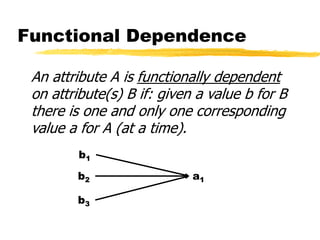
An attribute A is functionally dependent
on attribute(s) B if: given a value b for B
there is one and only one corresponding
value a for A (at a time).
b2
b3
a1
b1
Example: functional
dependence
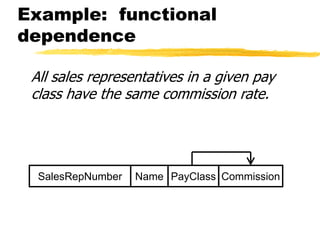
All sales representatives in a given pay
class have the same commission rate.
SalesRepNumber Name PayClass Commission
Keys
Primary Key: a minimal set of attributes
that form a candidate key
Any attribute or collection of attributes that
functionally determine all attributes in a
record is a Candidate Key.
Note: since no two rows in a relational
table can be duplicates, the entire record
is always a candidate key.
Primary Key (C)
C determines all attributes
No subset of the attributes in C is a
candidate key
A key consisting of more than one attribute
is called a “composite key.”
Good Primary Keys
Do not change over the life of the
database
Are not “intelligent keys”
Are not too long
Do not consist of too many attributes (3
or fewer is good)
Foreign Keys
A value in the “child” table that matches
with the related value in the “parent”
table.
SalesRep(SalesRepNumber, Name)
[ 03 | Mary Jones ]
[ 124 | 03 ]
Customer(CustomerNumber, SalesRepNumber)
Foreign Keys
The foreign key in the child table has the
same value as the primary key in the parent.
The foreign key in a many-to-many
relationship goes in the many table.
In a many-to-many relationship, foreign keys
from both tables go into an associative entity.
In a 1-to-1 relationship the foreign key goes
into one of the tables (usually the one most
likely to change)
Normal Forms
A set of conditions on table structure that
improves maintenance. Normalization
removes processing anomalies:
Update
Inconsistent Data
Addition
Deletion
Normal Forms
All attributes depend on the key, the whole
key and nothing but the key.
1NF Keys and no repeating groups
2NF No partial dependencies
3NF All determinants are candidate keys
4NF No multivalued dependencies
1st Normal Form
Table has a primary key
Table has no repeating groups
A multivalued attribute is an attribute that
may have several values for one record
A repeating group is a set of one or more
multivalued attributes that are related
Example
Multivalued attribute:
Orders(OrderNumber, OrderDate, {PartNumber})
[ 12491 | 9/02/2001 | BT04, BZ66 ]
Repeating group:
Orders(OrderNumber, OrderDate, {PartNumber,
NumberOrdered})
[12491 | 9/02/2001 | (BT04, 1), (BZ66,
1)]
Normalization: 1NF
Every repeating group becomes a new
table with the appropriate foreign key
relationships preserved.
Remove nested repeating groups from the
outside in
Order(OrderNumber, OrderDate, {PartNumber,
{Supplier}})
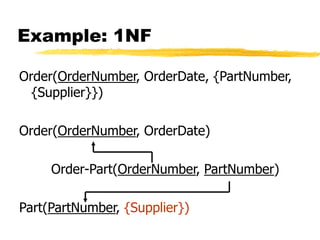
Example: 1NF
Order(OrderNumber, OrderDate, {PartNumber,
{Supplier}})
Order(OrderNumber, OrderDate)
Order-Part(OrderNumber, PartNumber)
Part(PartNumber, {Supplier})
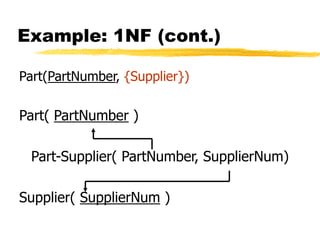
Example: 1NF (cont.)
Part(PartNumber, {Supplier})
Part( PartNumber )
Part-Supplier( PartNumber, SupplierNum)
Supplier( SupplierNum )
2nd Normal Form
No partial dependencies
No attribute depends on only some of the
attributes of a concatenated key.
Order-Part
[OrderNumber | PartNumber | PartDescription]
Create a new table with PartNumber key.
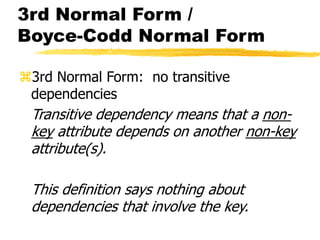
3rd Normal Form /
Boyce-Codd Normal Form
3rd Normal Form: no transitive
dependencies
Transitive dependency means that a non-
key attribute depends on another non-key
attribute(s).
This definition says nothing about
dependencies that involve the key.
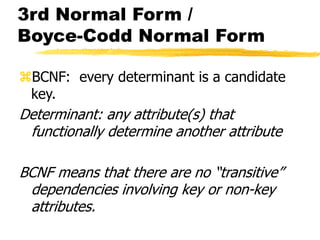
3rd Normal Form /
Boyce-Codd Normal Form
BCNF: every determinant is a candidate
key.
Determinant: any attribute(s) that
functionally determine another attribute
BCNF means that there are no “transitive”
dependencies involving key or non-key
attributes.
3NF
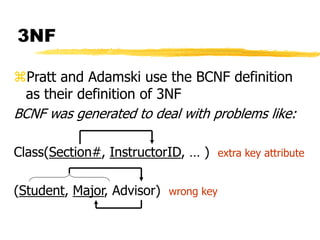
Pratt and Adamski use the BCNF definition
as their definition of 3NF
BCNF was generated to deal with problems like:
Class(Section#, InstructorID, … ) extra key attribute
(Student, Major, Advisor) wrong key
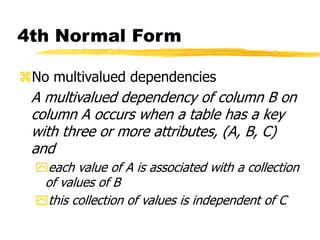
4th Normal Form
No multivalued dependencies
A multivalued dependency of column B on
column A occurs when a table has a key
with three or more attributes, (A, B, C)
and
each value of A is associated with a collection
of values of B
this collection of values is independent of C
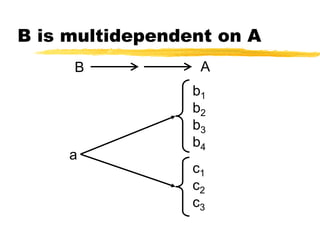
B is multidependent on A
B A
c1
c2
c3
a
b1
b2
b3
b4
Example: multivalued
dependence
Faculty have advisee assignments for one
major and committee assignments
[FacID | AdviseeID | FacultyComm]
[FacultyID]
[FacID | AdviseeID] [FacID | FacultyComm]
Normalization
Improves maintenance for database
changes
Tends to slow down retrieval
Better at finding problems than solving
them
Standard normalization procedures are
subtle and may introduce BCNF or 4NF
problems into tables
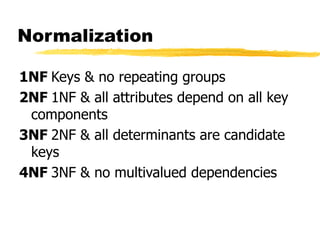
Normalization
1NF Keys & no repeating groups
2NF 1NF & all attributes depend on all key
components
3NF 2NF & all determinants are candidate
keys
4NF 3NF & no multivalued dependencies
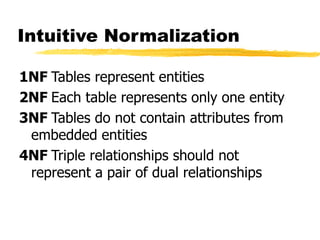
Intuitive Normalization
1NF Tables represent entities
2NF Each table represents only one entity
3NF Tables do not contain attributes from
embedded entities
4NF Triple relationships should not
represent a pair of dual relationships

E02Normalization.ppt

  • 1.
  • 2.
    Functional Dependence An attributeA is functionally dependent on attribute(s) B if: given a value b for B there is one and only one corresponding value a for A (at a time). b2 b3 a1 b1
  • 3.
    Example: functional dependence All salesrepresentatives in a given pay class have the same commission rate. SalesRepNumber Name PayClass Commission
  • 4.
    Keys Primary Key: aminimal set of attributes that form a candidate key Any attribute or collection of attributes that functionally determine all attributes in a record is a Candidate Key. Note: since no two rows in a relational table can be duplicates, the entire record is always a candidate key.
  • 5.
    Primary Key (C) Cdetermines all attributes No subset of the attributes in C is a candidate key A key consisting of more than one attribute is called a “composite key.”
  • 6.
    Good Primary Keys Donot change over the life of the database Are not “intelligent keys” Are not too long Do not consist of too many attributes (3 or fewer is good)
  • 7.
    Foreign Keys A valuein the “child” table that matches with the related value in the “parent” table. SalesRep(SalesRepNumber, Name) [ 03 | Mary Jones ] [ 124 | 03 ] Customer(CustomerNumber, SalesRepNumber)
  • 8.
    Foreign Keys The foreignkey in the child table has the same value as the primary key in the parent. The foreign key in a many-to-many relationship goes in the many table. In a many-to-many relationship, foreign keys from both tables go into an associative entity. In a 1-to-1 relationship the foreign key goes into one of the tables (usually the one most likely to change)
  • 9.
    Normal Forms A setof conditions on table structure that improves maintenance. Normalization removes processing anomalies: Update Inconsistent Data Addition Deletion
  • 10.
    Normal Forms All attributesdepend on the key, the whole key and nothing but the key. 1NF Keys and no repeating groups 2NF No partial dependencies 3NF All determinants are candidate keys 4NF No multivalued dependencies
  • 11.
    1st Normal Form Tablehas a primary key Table has no repeating groups A multivalued attribute is an attribute that may have several values for one record A repeating group is a set of one or more multivalued attributes that are related
  • 12.
    Example Multivalued attribute: Orders(OrderNumber, OrderDate,{PartNumber}) [ 12491 | 9/02/2001 | BT04, BZ66 ] Repeating group: Orders(OrderNumber, OrderDate, {PartNumber, NumberOrdered}) [12491 | 9/02/2001 | (BT04, 1), (BZ66, 1)]
  • 13.
    Normalization: 1NF Every repeatinggroup becomes a new table with the appropriate foreign key relationships preserved. Remove nested repeating groups from the outside in Order(OrderNumber, OrderDate, {PartNumber, {Supplier}})
  • 14.
    Example: 1NF Order(OrderNumber, OrderDate,{PartNumber, {Supplier}}) Order(OrderNumber, OrderDate) Order-Part(OrderNumber, PartNumber) Part(PartNumber, {Supplier})
  • 15.
    Example: 1NF (cont.) Part(PartNumber,{Supplier}) Part( PartNumber ) Part-Supplier( PartNumber, SupplierNum) Supplier( SupplierNum )
  • 16.
    2nd Normal Form Nopartial dependencies No attribute depends on only some of the attributes of a concatenated key. Order-Part [OrderNumber | PartNumber | PartDescription] Create a new table with PartNumber key.
  • 17.
    3rd Normal Form/ Boyce-Codd Normal Form 3rd Normal Form: no transitive dependencies Transitive dependency means that a non- key attribute depends on another non-key attribute(s). This definition says nothing about dependencies that involve the key.
  • 18.
    3rd Normal Form/ Boyce-Codd Normal Form BCNF: every determinant is a candidate key. Determinant: any attribute(s) that functionally determine another attribute BCNF means that there are no “transitive” dependencies involving key or non-key attributes.
  • 19.
    3NF Pratt and Adamskiuse the BCNF definition as their definition of 3NF BCNF was generated to deal with problems like: Class(Section#, InstructorID, … ) extra key attribute (Student, Major, Advisor) wrong key
  • 20.
    4th Normal Form Nomultivalued dependencies A multivalued dependency of column B on column A occurs when a table has a key with three or more attributes, (A, B, C) and each value of A is associated with a collection of values of B this collection of values is independent of C
  • 21.
    B is multidependenton A B A c1 c2 c3 a b1 b2 b3 b4
  • 22.
    Example: multivalued dependence Faculty haveadvisee assignments for one major and committee assignments [FacID | AdviseeID | FacultyComm] [FacultyID] [FacID | AdviseeID] [FacID | FacultyComm]
  • 23.
    Normalization Improves maintenance fordatabase changes Tends to slow down retrieval Better at finding problems than solving them Standard normalization procedures are subtle and may introduce BCNF or 4NF problems into tables
  • 24.
    Normalization 1NF Keys &no repeating groups 2NF 1NF & all attributes depend on all key components 3NF 2NF & all determinants are candidate keys 4NF 3NF & no multivalued dependencies
  • 25.
    Intuitive Normalization 1NF Tablesrepresent entities 2NF Each table represents only one entity 3NF Tables do not contain attributes from embedded entities 4NF Triple relationships should not represent a pair of dual relationships