Sujata Sajjan
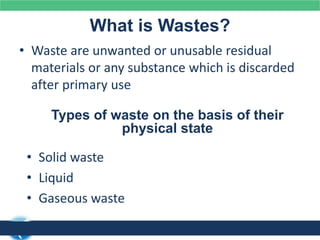
What is Wastes?
• Waste are unwanted or unusable residual
materials or any substance which is discarded
after primary use
Types of waste on the basis of their
physical state
• Solid waste
• Liquid
• Gaseous waste
On the basis of bio-degradability
• Bio degradable
• Non bio degradable
On basis on effects on human health
• Hazardous waste
• Non-Hazardous waste
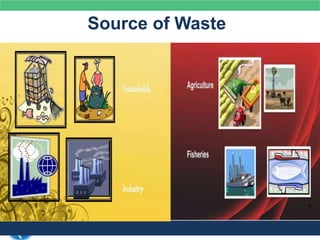
Source of Waste
Reduce / Waste Minimization
• The best way to deal with trash is to not have any!
• Reducing the amount of trash you have to throw out actually prevents
waste from piling up in the first place.
• To reduce your waste, avoid unnecessary packaging and items designed to
be used only once.
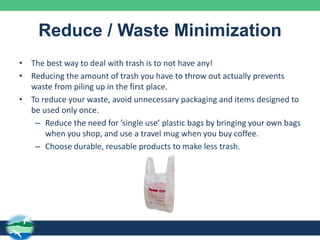
– Reduce the need for ’single use’ plastic bags by bringing your own bags
when you shop, and use a travel mug when you buy coffee.
– Choose durable, reusable products to make less trash.
Reuse
• Reusing items can save energy and money, and prolong the item’s useful
life.
• Extend the life of items you buy by reusing them.
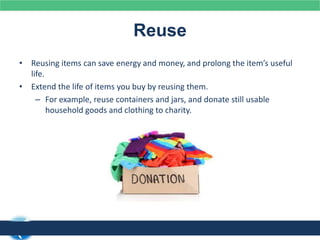
– For example, reuse containers and jars, and donate still usable
household goods and clothing to charity.
Recycle
• Every day we use products made from recycled materials.
• Take your glass, cans, newspapers, milk jugs and other
acceptable recyclable items to your local transfer station, drop
off location or place out for curbside collection so that they
can be turned into new products like fleece jackets,
• Frisbees, paper products, and soda cans. Recycling saves
money, energy, and the environment.
• 36.76% of Maine's municipal solid waste was recycled in 2015.
Compost
• Composting is nature's way of recycling organics.
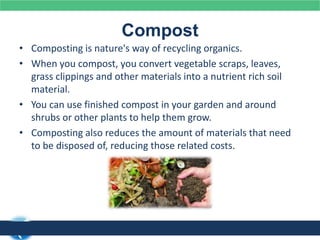
• When you compost, you convert vegetable scraps, leaves,
grass clippings and other materials into a nutrient rich soil
material.
• You can use finished compost in your garden and around
shrubs or other plants to help them grow.
• Composting also reduces the amount of materials that need
to be disposed of, reducing those related costs.
Processing and Beneficial Use
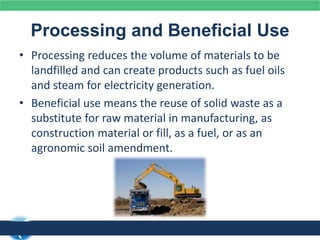
• Processing reduces the volume of materials to be
landfilled and can create products such as fuel oils
and steam for electricity generation.
• Beneficial use means the reuse of solid waste as a
substitute for raw material in manufacturing, as
construction material or fill, as a fuel, or as an
agronomic soil amendment.
Waste-To-Energy
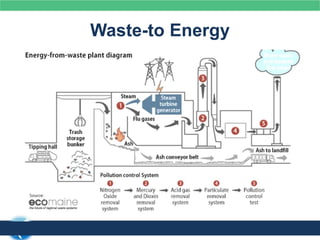
• Waste-to-Energy facilities accept our solid waste and
combust it at very high temperatures, producing heat
that is used to convert water into steam. The steam is
used to run turbines that generate electricity.
• Scrubbers, filters, and other pollution control equipment
reduce pollutants released during the incineration
process. Ash and other residues from this process are
landfilled.
• Over 27% of Maine's municipal solid waste was
combusted in 2015.
Waste-to Energy
E-Waste
• E-waste comprises of waste electronics
goods which are not fit for their originally
intended use.
• Such electronics goods may be television,
telephones, radios, computers, printers,
fax machines, DVDs and CDs etc.
Sources of E-waste
• IT and Telecom Equipments
• Large and small Household Appliances
• Consumer & Lighting Equipments
• Electrical &t Electronic Tools
• Toys, Leisure &t Sports Equipment
• Medical Devices
• Monitoring &t Control Instruments
Effects of E-waste
On Environment
• Pollution of
GroundWater.
• Acidification of soil.
• Air Pollution.
• E-Waste accounts
for40 percent of the
leadand 75 percent
of the heavy metals
found inlandfills
On On Human Health
• DNA damage.
• Lung Cancer.
• Damage to heart liver
and spleen.
• Chronic damage to
the brain.
• Asthmatic bronchitis
E-waste Management
The major components of E-waste Management are
• E-waste collection, sorting and transportation.
• E-waste recycling
In industries, management of E-waste is done by
Waste Minimization Techniques. It involves-
• Inventory management
• Production-process modification
• Volume reduction
• Recovery and reuse
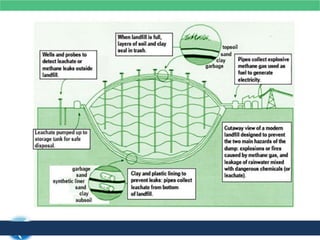
Landfill
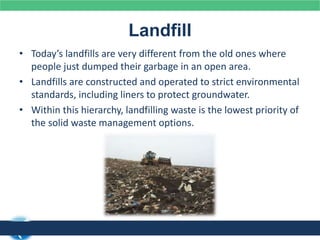
• Today’s landfills are very different from the old ones where
people just dumped their garbage in an open area.
• Landfills are constructed and operated to strict environmental
standards, including liners to protect groundwater.
• Within this hierarchy, landfilling waste is the lowest priority of
the solid waste management options.
Thank you

Solid-Waste-Recycling-PPeeewswsss22.pptx

  • 1.
  • 2.
    What is Wastes? •Waste are unwanted or unusable residual materials or any substance which is discarded after primary use Types of waste on the basis of their physical state • Solid waste • Liquid • Gaseous waste
  • 3.
    On the basisof bio-degradability • Bio degradable • Non bio degradable
  • 4.
    On basis oneffects on human health • Hazardous waste • Non-Hazardous waste
  • 5.
  • 6.
    Reduce / WasteMinimization • The best way to deal with trash is to not have any! • Reducing the amount of trash you have to throw out actually prevents waste from piling up in the first place. • To reduce your waste, avoid unnecessary packaging and items designed to be used only once. – Reduce the need for ’single use’ plastic bags by bringing your own bags when you shop, and use a travel mug when you buy coffee. – Choose durable, reusable products to make less trash.
  • 7.
    Reuse • Reusing itemscan save energy and money, and prolong the item’s useful life. • Extend the life of items you buy by reusing them. – For example, reuse containers and jars, and donate still usable household goods and clothing to charity.
  • 8.
    Recycle • Every daywe use products made from recycled materials. • Take your glass, cans, newspapers, milk jugs and other acceptable recyclable items to your local transfer station, drop off location or place out for curbside collection so that they can be turned into new products like fleece jackets, • Frisbees, paper products, and soda cans. Recycling saves money, energy, and the environment. • 36.76% of Maine's municipal solid waste was recycled in 2015.
  • 9.
    Compost • Composting isnature's way of recycling organics. • When you compost, you convert vegetable scraps, leaves, grass clippings and other materials into a nutrient rich soil material. • You can use finished compost in your garden and around shrubs or other plants to help them grow. • Composting also reduces the amount of materials that need to be disposed of, reducing those related costs.
  • 10.
    Processing and BeneficialUse • Processing reduces the volume of materials to be landfilled and can create products such as fuel oils and steam for electricity generation. • Beneficial use means the reuse of solid waste as a substitute for raw material in manufacturing, as construction material or fill, as a fuel, or as an agronomic soil amendment.
  • 11.
    Waste-To-Energy • Waste-to-Energy facilitiesaccept our solid waste and combust it at very high temperatures, producing heat that is used to convert water into steam. The steam is used to run turbines that generate electricity. • Scrubbers, filters, and other pollution control equipment reduce pollutants released during the incineration process. Ash and other residues from this process are landfilled. • Over 27% of Maine's municipal solid waste was combusted in 2015.
  • 12.
  • 13.
    E-Waste • E-waste comprisesof waste electronics goods which are not fit for their originally intended use. • Such electronics goods may be television, telephones, radios, computers, printers, fax machines, DVDs and CDs etc.
  • 14.
    Sources of E-waste •IT and Telecom Equipments • Large and small Household Appliances • Consumer & Lighting Equipments • Electrical &t Electronic Tools • Toys, Leisure &t Sports Equipment • Medical Devices • Monitoring &t Control Instruments
  • 15.
    Effects of E-waste OnEnvironment • Pollution of GroundWater. • Acidification of soil. • Air Pollution. • E-Waste accounts for40 percent of the leadand 75 percent of the heavy metals found inlandfills On On Human Health • DNA damage. • Lung Cancer. • Damage to heart liver and spleen. • Chronic damage to the brain. • Asthmatic bronchitis
  • 16.
    E-waste Management The majorcomponents of E-waste Management are • E-waste collection, sorting and transportation. • E-waste recycling In industries, management of E-waste is done by Waste Minimization Techniques. It involves- • Inventory management • Production-process modification • Volume reduction • Recovery and reuse
  • 17.
    Landfill • Today’s landfillsare very different from the old ones where people just dumped their garbage in an open area. • Landfills are constructed and operated to strict environmental standards, including liners to protect groundwater. • Within this hierarchy, landfilling waste is the lowest priority of the solid waste management options.
  • 19.

Editor's Notes

  • #7 The waste hierarchy is a set of priorities for the efficient use of resources. Source: http://www.epa.nsw.gov.au/wastestrategy/waste-hierarchy.htm http://www.maine.gov/dep/sustainability/sw-hierarchy.html trash bag photo: https://wattsupwiththat.com/2014/02/12/those-much-maligned-plastic-grocery-bags-can-run-your-diesel-truck-or-car/
  • #8 http://www.maine.gov/dep/sustainability/sw-hierarchy.html Photo: donation - http://bargainbabe.com/donation-pick-up/
  • #9 http://www.maine.gov/dep/sustainability/sw-hierarchy.htmlWorld photo: pintrest, Recycling of products and materials has many benefits and is an important component in achieving sustainable systems. By recycling products and materials, air and water pollution from waste disposal activities are reduced, and the recapturing of those products and materials lessens the amount of mining and extraction of minerals needed to manufacture new products. Additionally, energy and water consumption is decreased in many manufacturing processes. Many recyclable materials have commodity value, which provides additional incentive to their recovery. Maine DEP provides technical and educational assistance to residents, municipalities, schools and businesses to help increase the amount of resources that are recovered from the waste stream. DEP also collects, synthesizes, and reports data on solid waste management in Maine. Source: http://www.maine.gov/dep/waste/recycle/
  • #10 http://www.maine.gov/dep/sustainability/sw-hierarchy.html Photo: http://www.waste360.com/waste-energy/food-waste-recycling-energy-program-launches-portland-maine
  • #11 http://www.maine.gov/dep/sustainability/sw-hierarchy.html Photo: http://www.esol.net/fillconversions/fillconversions.htm
  • #12 http://www.maine.gov/dep/sustainability/sw-hierarchy.html
  • #13 https://www.americanprogress.org/issues/green/reports/2013/04/17/60712/energy-from-waste-can-help-curb-greenhouse-gas-emissions/ The first incinerator in the United States was built in 1885 on Governors Island in New York, NY.  Source: https://www.epa.gov/smm/energy-recovery-combustion-municipal-solid-waste-msw The upfront money needed to build an MSW combustion facility can be significant and economic benefits may take several years to be fully realized. A new plant typically requires at least 100 million dollars to finance the construction; larger plants may require double to triple that amount. Source: https://www.epa.gov/smm/energy-recovery-combustion-municipal-solid-waste-msw#01
  • #14 The waste hierarchy is a set of priorities for the efficient use of resources. Source: http://www.epa.nsw.gov.au/wastestrategy/waste-hierarchy.htm http://www.maine.gov/dep/sustainability/sw-hierarchy.html trash bag photo: https://wattsupwiththat.com/2014/02/12/those-much-maligned-plastic-grocery-bags-can-run-your-diesel-truck-or-car/
  • #15 The waste hierarchy is a set of priorities for the efficient use of resources. Source: http://www.epa.nsw.gov.au/wastestrategy/waste-hierarchy.htm http://www.maine.gov/dep/sustainability/sw-hierarchy.html trash bag photo: https://wattsupwiththat.com/2014/02/12/those-much-maligned-plastic-grocery-bags-can-run-your-diesel-truck-or-car/
  • #18 http://www.maine.gov/dep/sustainability/sw-hierarchy.html Photo:http://bangordailynews.com/2015/08/25/news/midcoast/more-trash-in-bath-requires-additional-landfill-gas-control/
  • #19 https://www.epa.gov/sites/production/files/2016-03/landfillpicjpg_revised2.jpg