Incivility and Healthful Environments
No unread replies.No replies.
Purpose
The purpose of the graded collaborative discussions is to engage
faculty and students in an interactive dialogue to assist the
student in organizing, integrating, applying, and critically
appraising knowledge regarding advanced nursing practice.
Scholarly information obtained from credible sources as well as
professional communication are required. Application of
information to professional experiences promotes the analysis
and use of principles, knowledge, and information learned and
related to real-life professional situations. Meaningful dialogue
among faculty and students fosters the development of a
learning community as ideas, perspectives, and knowledge are
shared.
Activity Learning Outcomes
Through this discussion, the student will demonstrate the ability
to:
1. Examine roles and competencies of advanced practice nurses
essential to performing as leaders and advocates of holistic,
safe, and quality care (CO1)
2. Apply concepts of person-centered care to nursing practice
situations (CO2)
3. Analyze essential skills needed to lead within the context of
complex systems (CO3)
4. Explore the process of scholarship engagement to improve
health and healthcare outcomes in various settings (CO4)
Due Date
A 10% late penalty will be imposed for discussions posted after
the deadline on Wednesday, regardless of the number of days
late. NOTHING will be accepted after 11:59pm MT on Sunday
(i.e. student will receive an automatic 0 for any portion of the
discussion not posted by that time). Week 8 discussion closes
on Saturday at 11:59pm MT.
NOTE: To receive credit for a week's discussion, students may
begin posting no earlier than
the Sunday immediately before each week opens. Unless
otherwise specified, access to most weeks begins on Sunday at
12:01 a.m. MT, and that week's assignments are due by the
next Sunday by 11:59 p.m. MT. Week 8 opens at 12:01 a.m.
MT Sunday and closes at 11:59 p.m. MT Saturday.
A zero is the lowest score that a student can be assigned.
Faculty may submit any collaborative discussion posting to
Turnitin in order to verify originality.
Total Points Possible: 75
Requirements:
Discussion Criteria
I. Application of Course Knowledge: of Course Knowledge:
The
student post contributes unique perspectives or insights gleaned
from personal experience or examples from the healthcare field.
The student must accurately and fully discuss the topic for the
week in addition to providing personal or
professional examples. The student must completely answer the
entire initial question.
II. Engagement in Meaningful Dialogue: I. The student
responds to a student peer and course faculty to further
dialogue.
a. Peer Response: The student responds substantively to at
least one topic-related post by a student peer.
A substantive post adds
content or insights or asks a question that will add to
the learning experience and/or generate discussion.
· A post of “I agree” with a repeat of the other student’s post
does not count as a substantive post. A collection of shallow
posts does not equal a substantive post.
· The peer response must occur on a separate day from the
initial posting.
· The peer response must occur before Sunday, 11:59 p.m. MT.
· The peer response does not require a scholarly citation and
reference unless the information is paraphrased and/or direct
quotes are used, in which APA style standards then apply.
Faculty Response: The student responds substantively to at least
one question by course faculty. The faculty question may be
directed to the student, to another student, or to the entire class.
· A post of "I agree" with a repeat of the faculty's post does not
count as a substantive post. A collection of shallow posts does
not equal a substantive post.
· The faculty response must occur on a separate day from the
initial posting.
· Responses to the faculty member must occur by Sunday, 11:59
p.m. MT.
· This response does not require a scholarly citation and
reference unless the information is paraphrased and/or direct
quotes are used, in which APA style standards then apply.
III. Integration of Evidence: The student post provides support
from a minimum of one scholarly in-text citation with a
matching reference AND assigned readings OR online lessons,
per discussion topic per week.
a. What is a scholarly resource? A scholarly resource is one that
comes from a professional, peer-reviewed publication (e.g.,
journals and government reports such as those from the FDA or
CDC).
· Contains references for sources cited
· Written by a professional or scholar in the field and indicates
credentials of the author(s)
· Is no more than 5 years old for clinical or research article
b. What is not considered a scholarly resource?
· Newspaper articles and layperson literature (e.g., Readers
Digest, Healthy Life Magazine, Food, and Fitness)
· Information from Wikipedia or any wiki
· Textbooks
· Website homepages
· The weekly lesson
· Articles in healthcare and nursing-oriented trade magazines,
such as Nursing Made Incredibly
Easy and RNMagazine (Source: What is a scholarly
article.docx; Created 06/09 CK/CL Revised: 02/17/11, 09/02/11
nlh/clm)
c. Can the lesson for the week be used as a scholarly source?
· Information from the weekly lesson can be cited in a posting;
however, it is not to be the sole source used in the post.
d. Are resources provided from CU acceptable sources (e.g., the
readings for the week)?
· Not as a sole source within the post. The textbook and/or
assigned (required) articles for the week can be used, but
another outside source must be cited for full credit. Textbooks
are not considered scholarly sources for the purpose of
discussions.
e. Are websites acceptable as scholarly resources for
discussions?
· Yes, if they are documents or data cited from credible
websites. Credible websites usually end in .gov or .edu;
however, some .org sites that belong to professional
associations (e.g., American Heart Association, National League
for Nursing, American Diabetes Association) are also
considered credible websites. Websites ending with .com are not
to be used as scholarly resources
IV. Professionalism in Communication: The post presents
information in logical, meaningful, and understandable
sequence, and is clearly relevant to the discussion topic.
Grammar, spelling, and/or punctuation are accurate.
V. Wednesday Participation Requirement: The student provides
a substantive response to the graded discussion question(s) or
topic(s), posted by the course faculty (not a response to a peer),
by Wednesday, 11:59 p.m. MT of each week.
VI. Total Participation Requirement: The student provides at
least three substantive posts (one to the initial question or topic,
one to a student peer, and one to a faculty question) on two
different days during the week.
DISCUSSION CONTENT
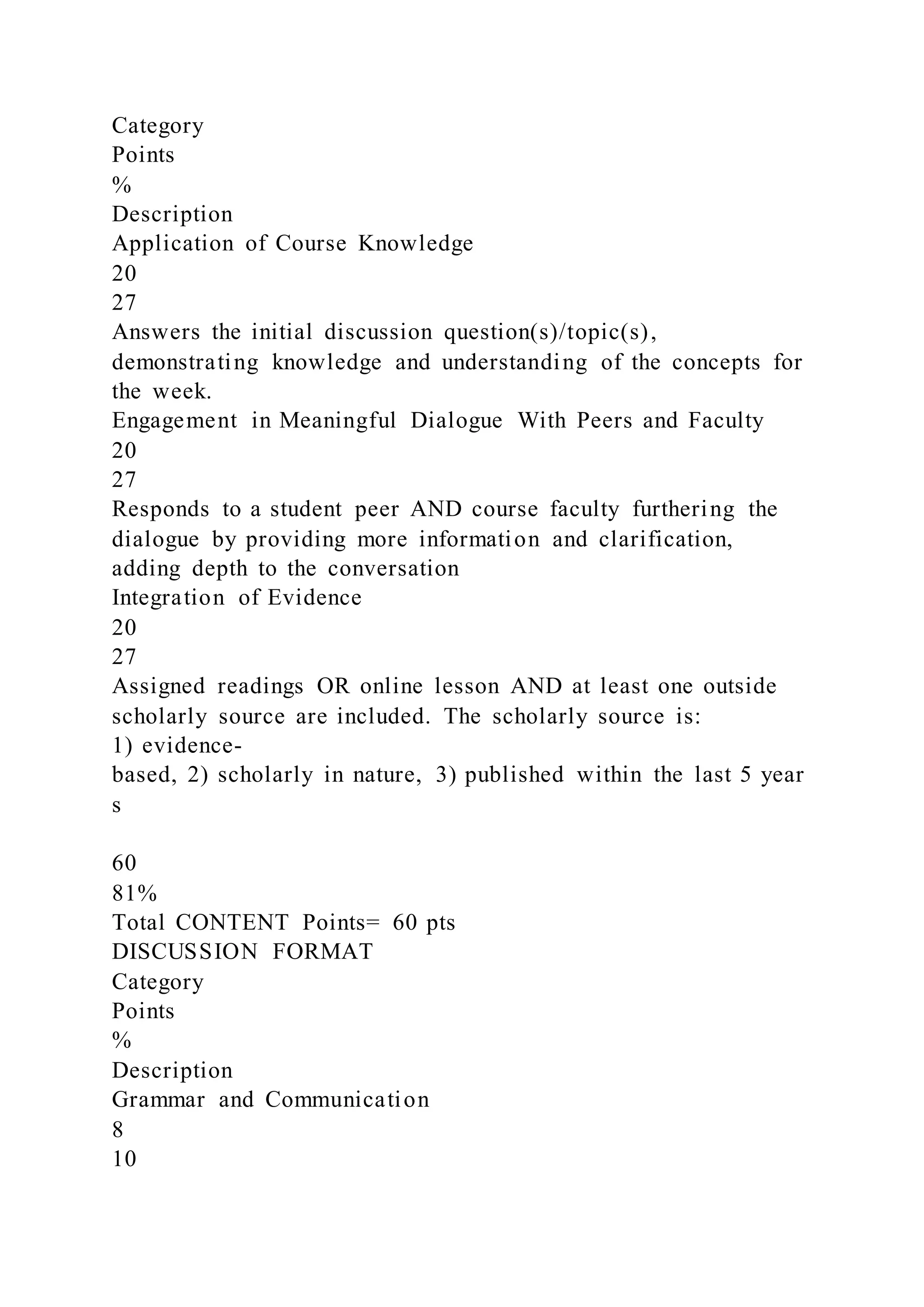
Category
Points
%
Description
Application of Course Knowledge
20
27
Answers the initial discussion question(s)/topic(s),
demonstrating knowledge and understanding of the concepts for
the week.
Engagement in Meaningful Dialogue With Peers and Faculty
20
27
Responds to a student peer AND course faculty furthering the
dialogue by providing more information and clarification,
adding depth to the conversation
Integration of Evidence
20
27
Assigned readings OR online lesson AND at least one outside
scholarly source are included. The scholarly source is:
1) evidence-
based, 2) scholarly in nature, 3) published within the last 5 year
s
60
81%
Total CONTENT Points= 60 pts
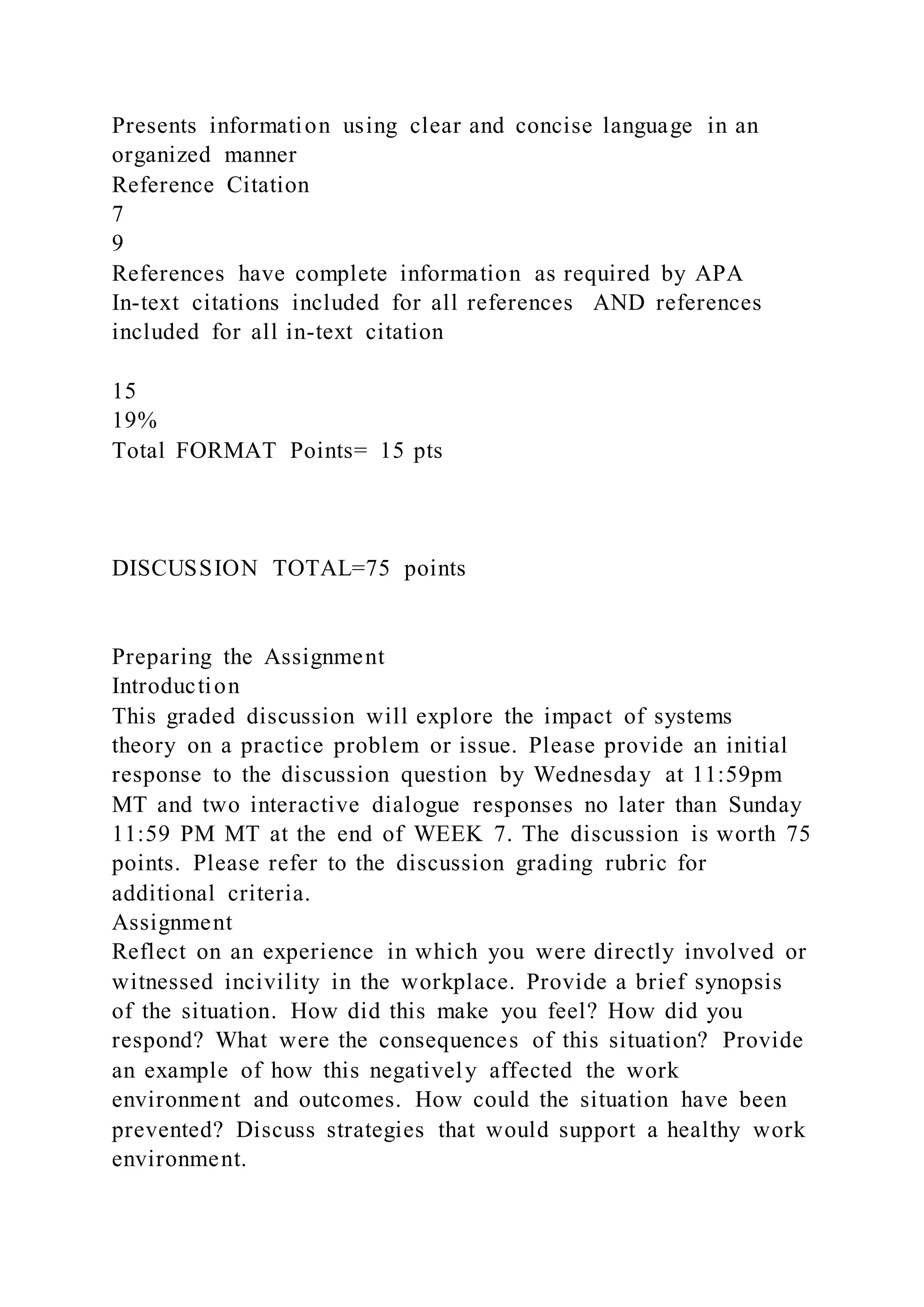
DISCUSSION FORMAT
Category
Points
%
Description
Grammar and Communication
8
10
Presents information using clear and concise language in an
organized manner
Reference Citation
7
9
References have complete information as required by APA
In-text citations included for all references AND references
included for all in-text citation
15
19%
Total FORMAT Points= 15 pts
DISCUSSION TOTAL=75 points
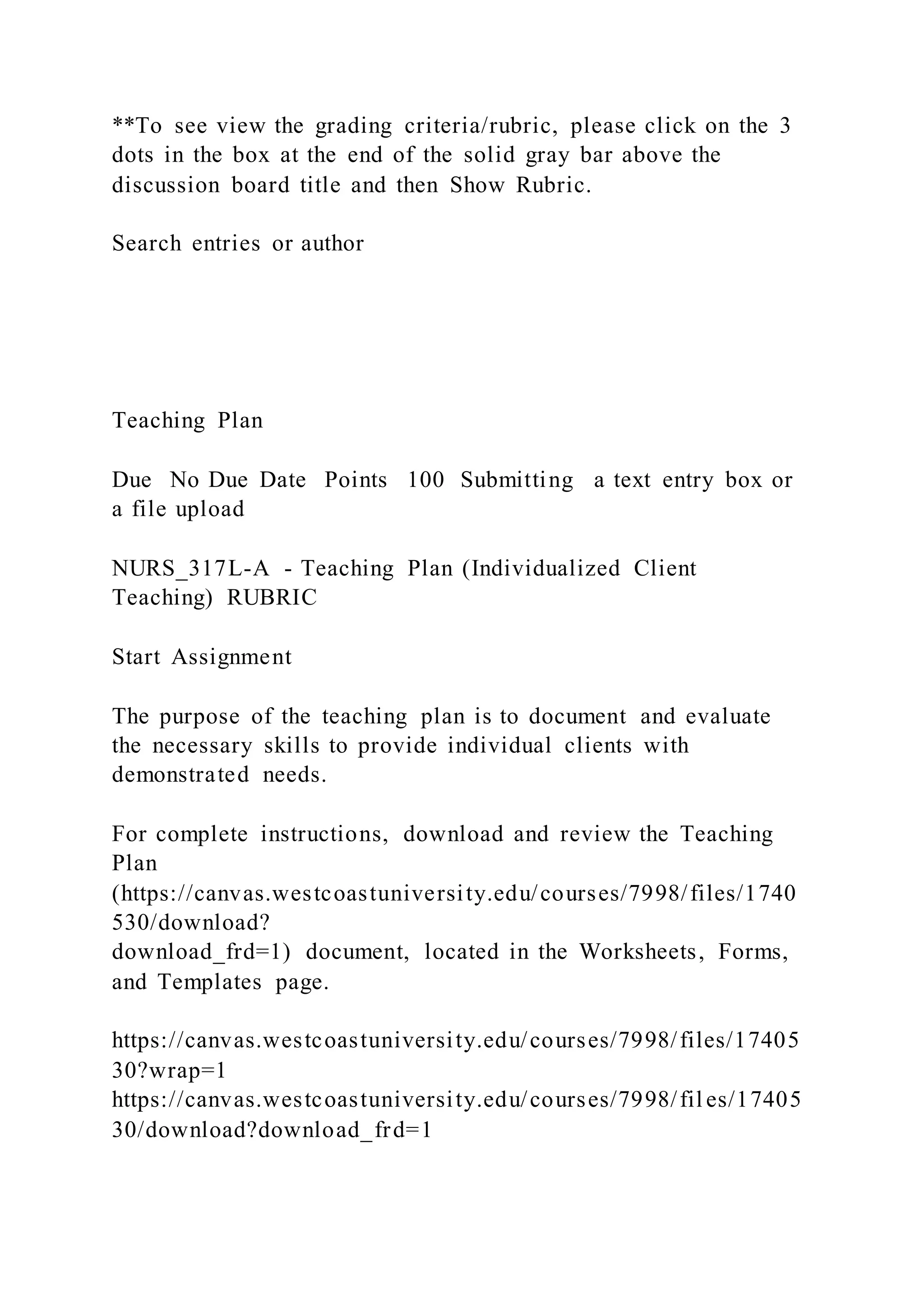
Preparing the Assignment
Introduction
This graded discussion will explore the impact of systems
theory on a practice problem or issue. Please provide an initial
response to the discussion question by Wednesday at 11:59pm
MT and two interactive dialogue responses no later than Sunday
11:59 PM MT at the end of WEEK 7. The discussion is worth 75
points. Please refer to the discussion grading rubric for
additional criteria.
Assignment
Reflect on an experience in which you were directly involved or
witnessed incivility in the workplace. Provide a brief synopsis
of the situation. How did this make you feel? How did you
respond? What were the consequences of this situation? Provide
an example of how this negatively affected the work
environment and outcomes. How could the situation have been
prevented? Discuss strategies that would support a healthy work
environment.
**To see view the grading criteria/rubric, please click on the 3
dots in the box at the end of the solid gray bar above the
discussion board title and then Show Rubric.
Search entries or author
Teaching Plan
Due No Due Date Points 100 Submitting a text entry box or
a file upload
NURS_317L-A - Teaching Plan (Individualized Client
Teaching) RUBRIC
Start Assignment
The purpose of the teaching plan is to document and evaluate
the necessary skills to provide individual clients with
demonstrated needs.
For complete instructions, download and review the Teaching
Plan
(https://canvas.westcoastuniversity.edu/courses/7998/files/1740
530/download?
download_frd=1) document, located in the Worksheets, Forms,
and Templates page.
https://canvas.westcoastuniversity.edu/courses/7998/files/17405
30?wrap=1
https://canvas.westcoastuniversity.edu/courses/7998/fil es/17405
30/download?download_frd=1
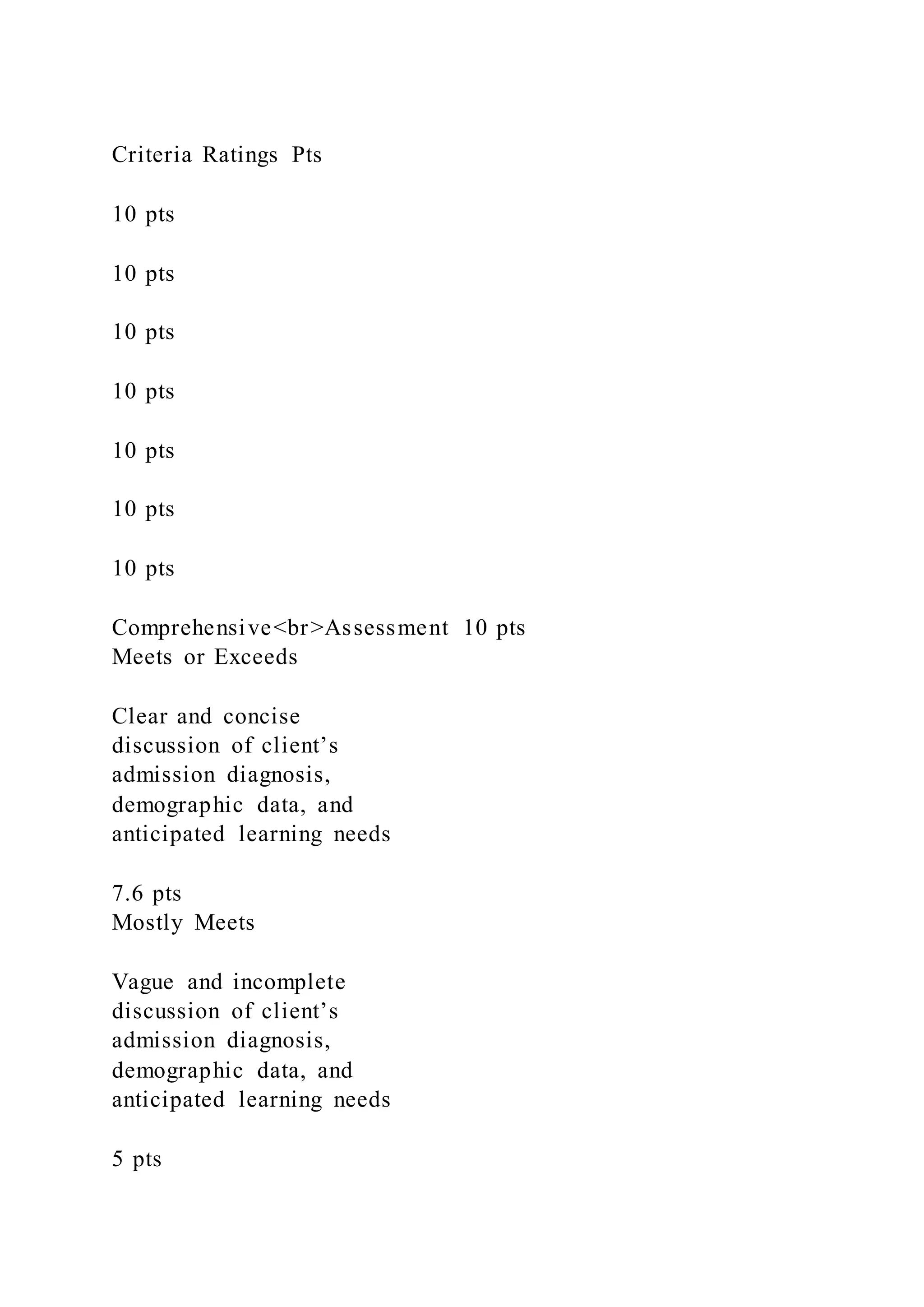
Criteria Ratings Pts
10 pts
10 pts
10 pts
10 pts
10 pts
10 pts
10 pts
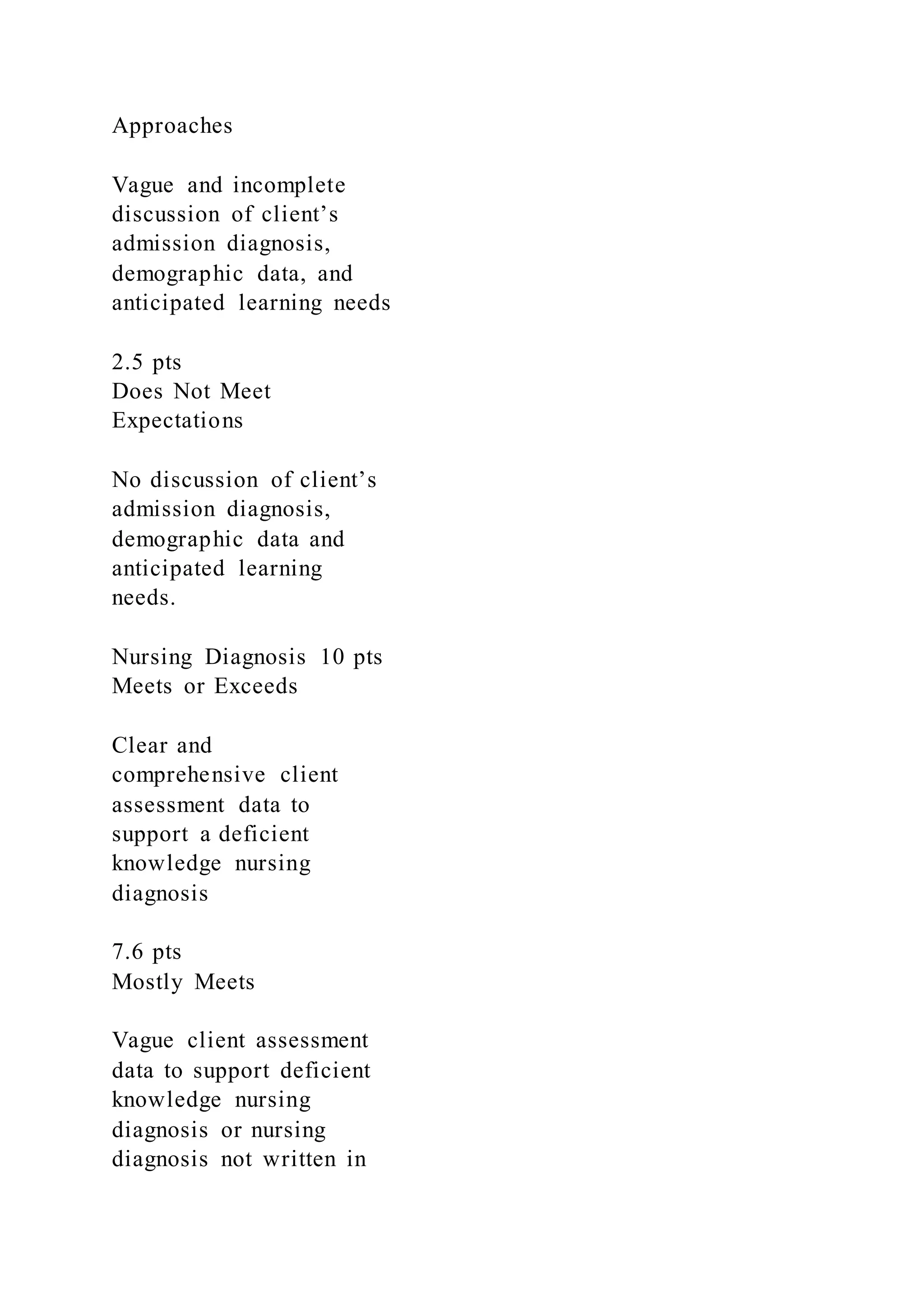
Comprehensive<br>Assessment 10 pts
Meets or Exceeds
Clear and concise
discussion of client’s
admission diagnosis,
demographic data, and
anticipated learning needs
7.6 pts
Mostly Meets
Vague and incomplete
discussion of client’s
admission diagnosis,
demographic data, and
anticipated learning needs
5 pts
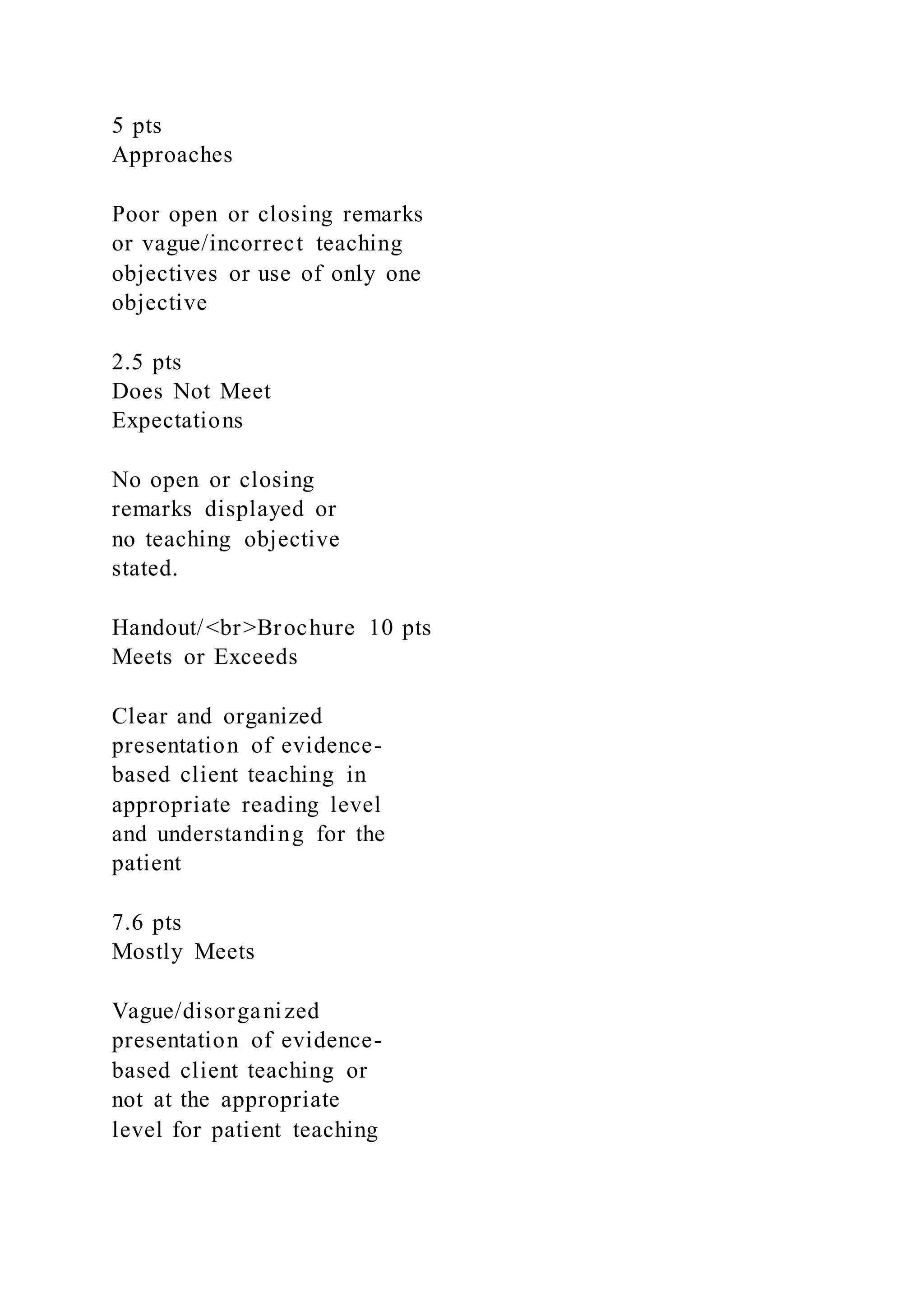
Approaches
Vague and incomplete
discussion of client’s
admission diagnosis,
demographic data, and
anticipated learning needs
2.5 pts
Does Not Meet
Expectations
No discussion of client’s
admission diagnosis,
demographic data and
anticipated learning
needs.
Nursing Diagnosis 10 pts
Meets or Exceeds
Clear and
comprehensive client
assessment data to
support a deficient
knowledge nursing
diagnosis
7.6 pts
Mostly Meets
Vague client assessment
data to support deficient
knowledge nursing
diagnosis or nursing
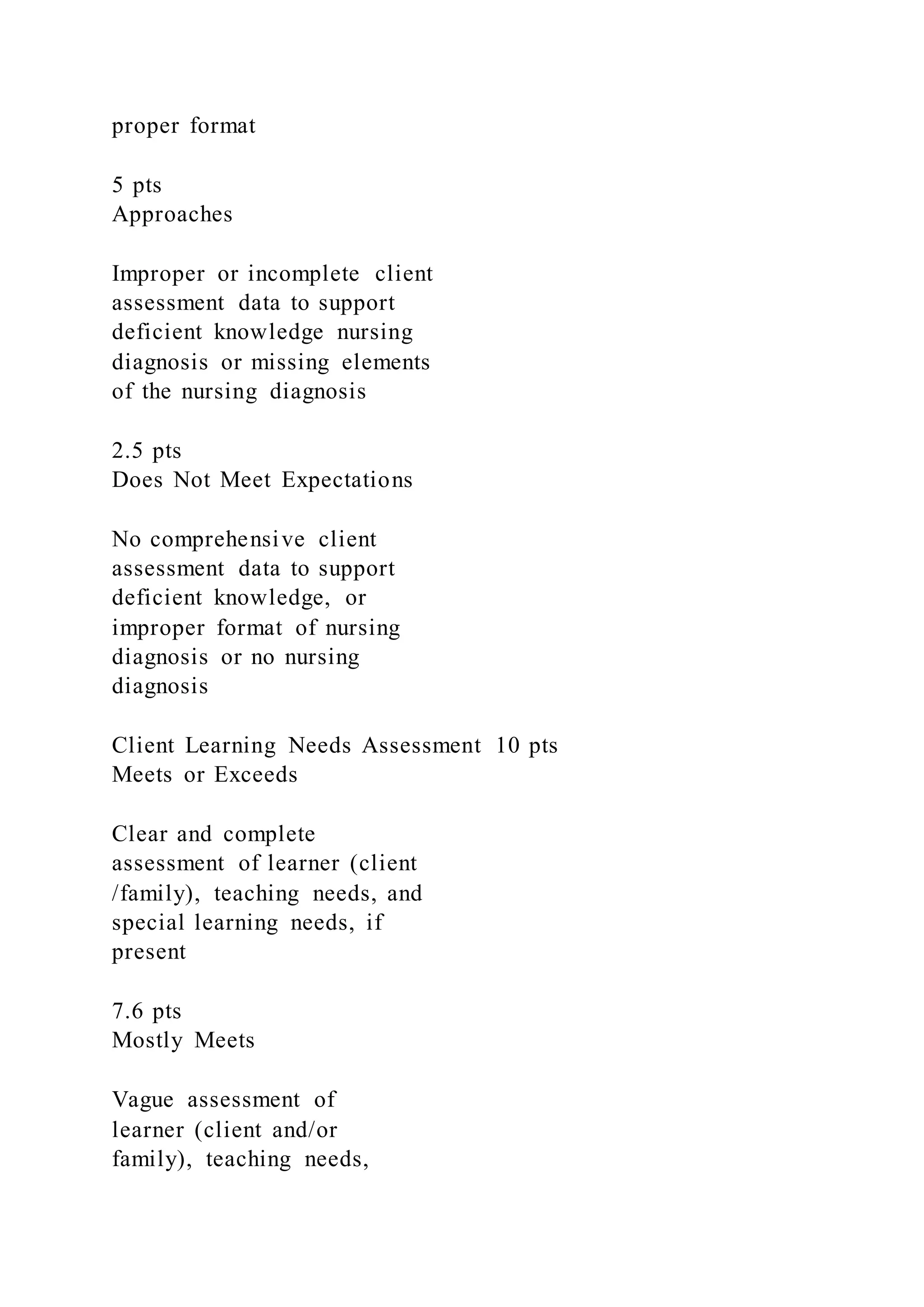
diagnosis not written in
proper format
5 pts
Approaches
Improper or incomplete client
assessment data to support
deficient knowledge nursing
diagnosis or missing elements
of the nursing diagnosis
2.5 pts
Does Not Meet Expectations
No comprehensive client
assessment data to support
deficient knowledge, or
improper format of nursing
diagnosis or no nursing
diagnosis
Client Learning Needs Assessment 10 pts
Meets or Exceeds
Clear and complete
assessment of learner (client
/family), teaching needs, and
special learning needs, if
present
7.6 pts
Mostly Meets
Vague assessment of
learner (client and/or
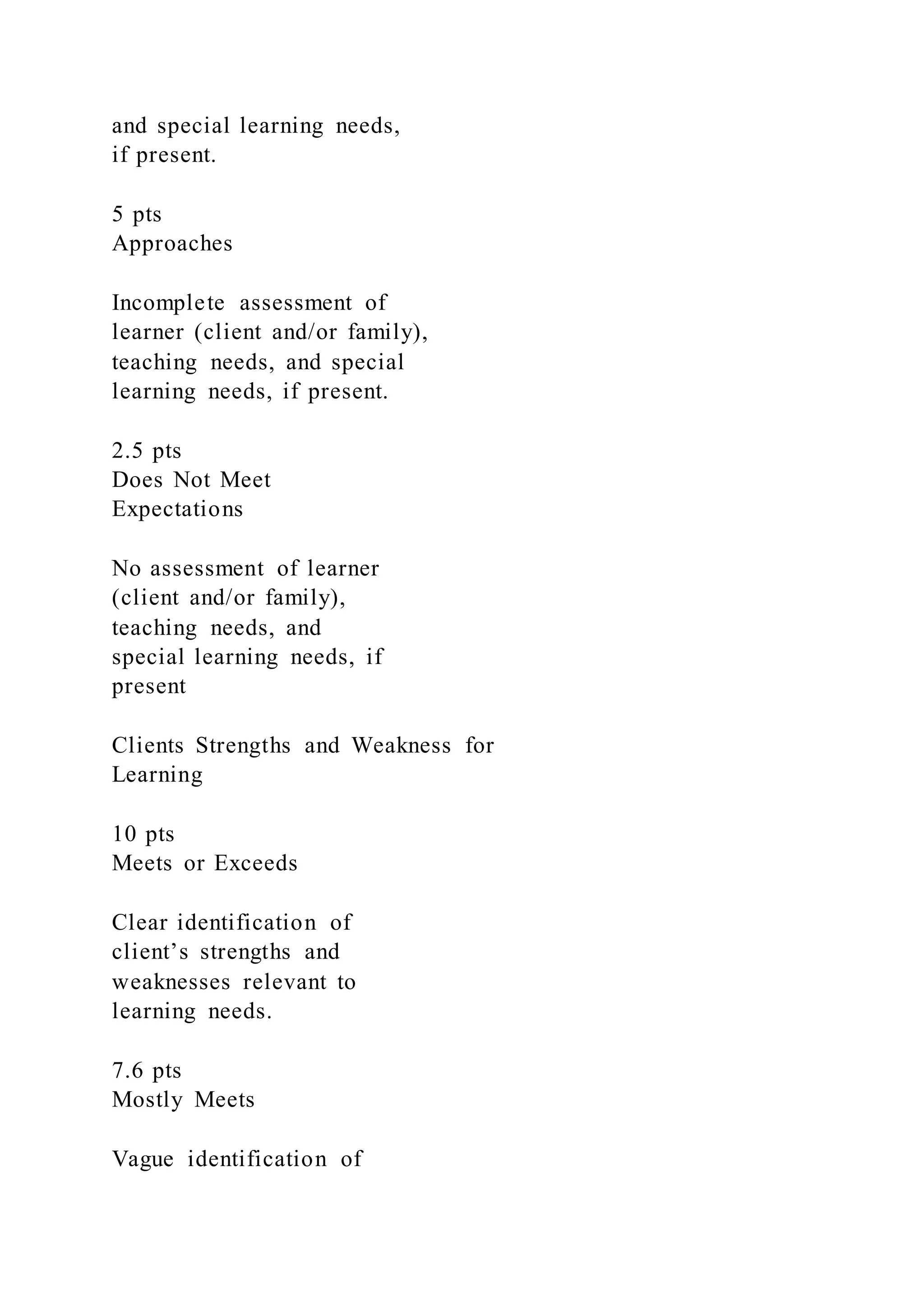
family), teaching needs,
and special learning needs,
if present.
5 pts
Approaches
Incomplete assessment of
learner (client and/or family),
teaching needs, and special
learning needs, if present.
2.5 pts
Does Not Meet
Expectations
No assessment of learner
(client and/or family),
teaching needs, and
special learning needs, if
present
Clients Strengths and Weakness for
Learning
10 pts
Meets or Exceeds
Clear identification of
client’s strengths and
weaknesses relevant to
learning needs.
7.6 pts
Mostly Meets
Vague identification of
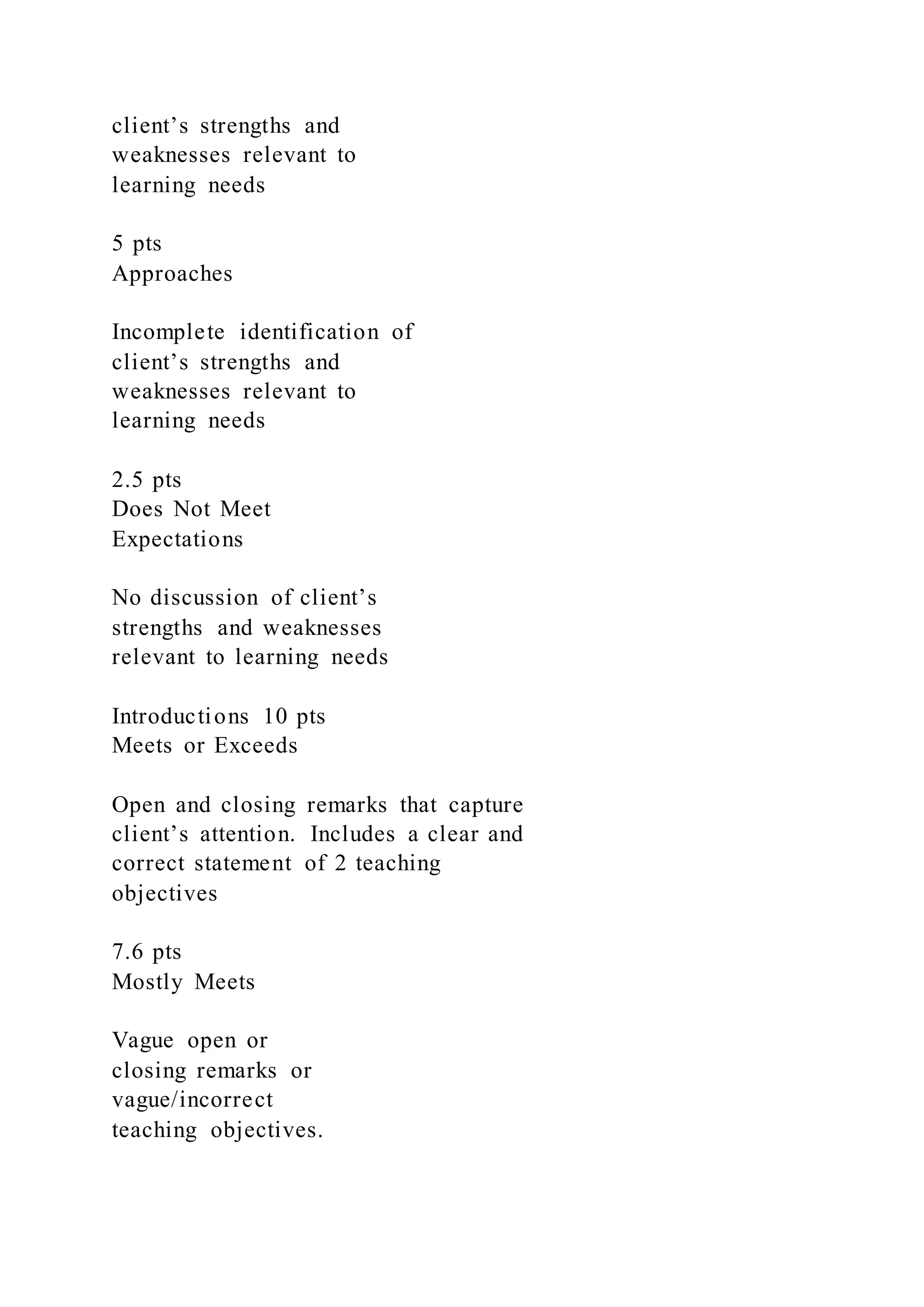
client’s strengths and
weaknesses relevant to
learning needs
5 pts
Approaches
Incomplete identification of
client’s strengths and
weaknesses relevant to
learning needs
2.5 pts
Does Not Meet
Expectations
No discussion of client’s
strengths and weaknesses
relevant to learning needs
Introductions 10 pts
Meets or Exceeds
Open and closing remarks that capture
client’s attention. Includes a clear and
correct statement of 2 teaching
objectives
7.6 pts
Mostly Meets
Vague open or
closing remarks or
vague/incorrect
teaching objectives.
5 pts
Approaches
Poor open or closing remarks
or vague/incorrect teaching
objectives or use of only one
objective
2.5 pts
Does Not Meet
Expectations
No open or closing
remarks displayed or
no teaching objective
stated.
Handout/<br>Brochure 10 pts
Meets or Exceeds
Clear and organized
presentation of evidence-
based client teaching in
appropriate reading level
and understanding for the
patient
7.6 pts
Mostly Meets
Vague/disorganized
presentation of evidence-
based client teaching or
not at the appropriate
level for patient teaching
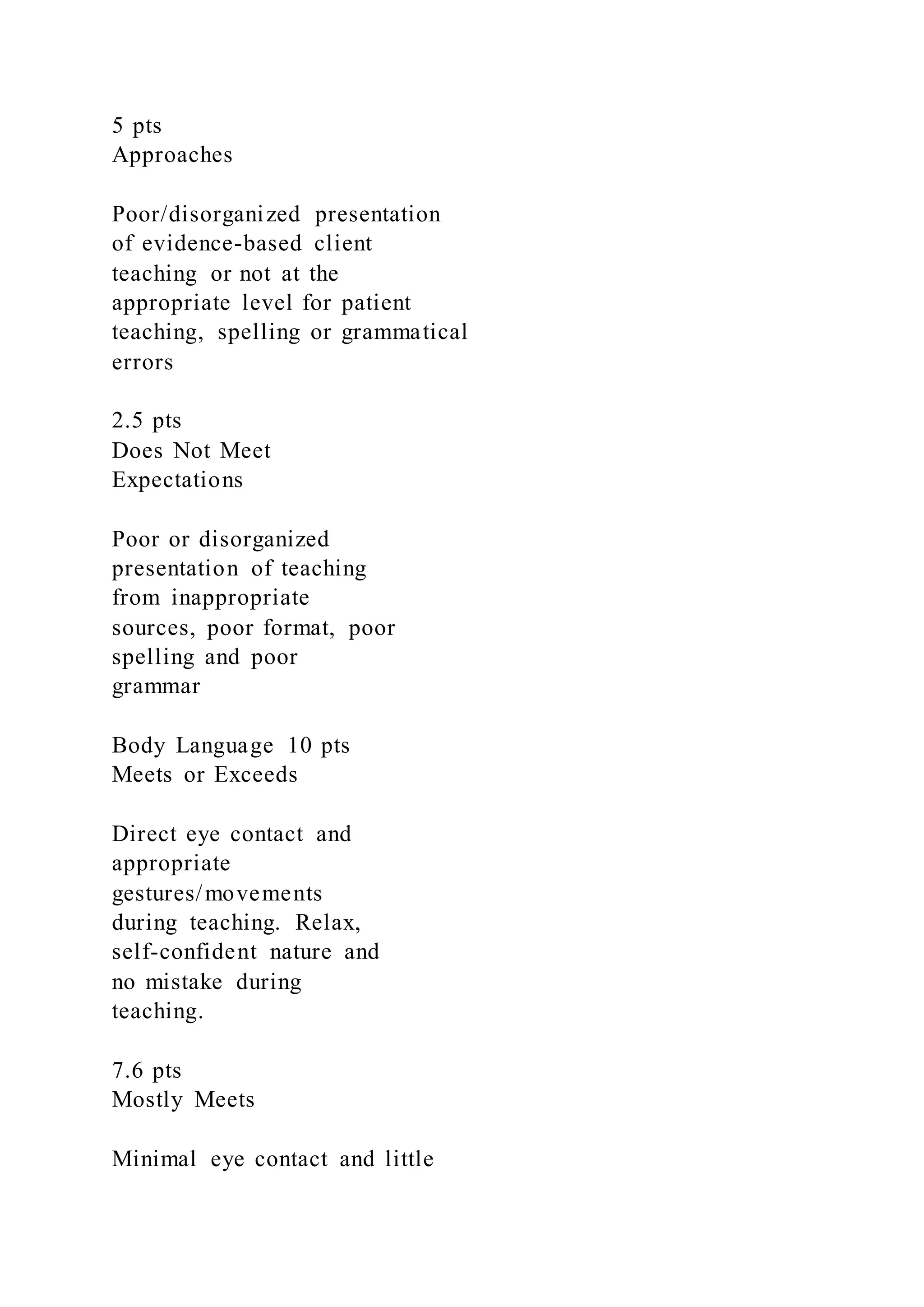
5 pts
Approaches
Poor/disorganized presentation
of evidence-based client
teaching or not at the
appropriate level for patient
teaching, spelling or grammatical
errors
2.5 pts
Does Not Meet
Expectations
Poor or disorganized
presentation of teaching
from inappropriate
sources, poor format, poor
spelling and poor
grammar
Body Language 10 pts
Meets or Exceeds
Direct eye contact and
appropriate
gestures/movements
during teaching. Relax,
self-confident nature and
no mistake during
teaching.
7.6 pts
Mostly Meets
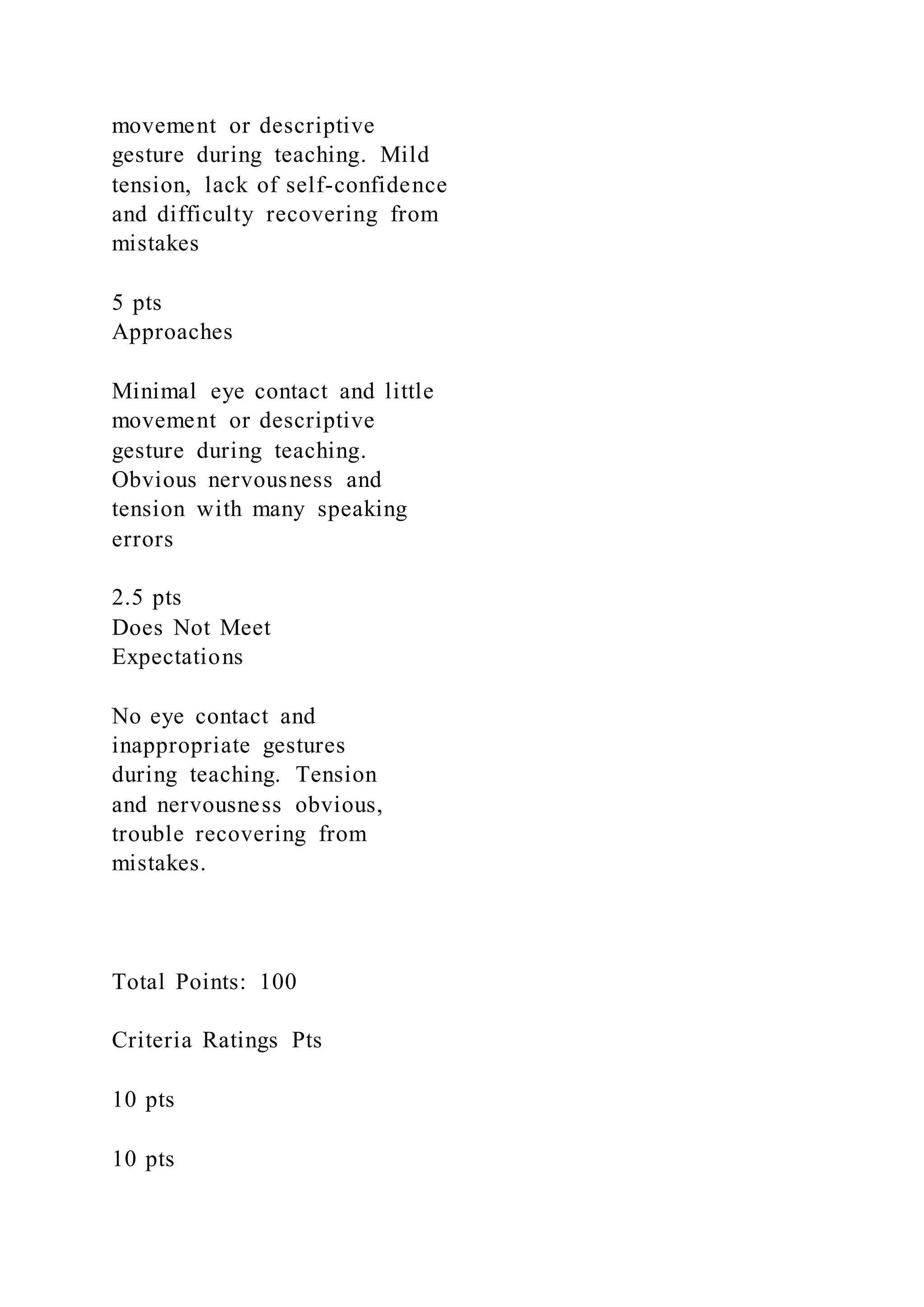
Minimal eye contact and little
movement or descriptive
gesture during teaching. Mild
tension, lack of self-confidence
and difficulty recovering from
mistakes
5 pts
Approaches
Minimal eye contact and little
movement or descriptive
gesture during teaching.
Obvious nervousness and
tension with many speaking
errors
2.5 pts
Does Not Meet
Expectations
No eye contact and
inappropriate gestures
during teaching. Tension
and nervousness obvious,
trouble recovering from
mistakes.
Total Points: 100
Criteria Ratings Pts
10 pts
10 pts
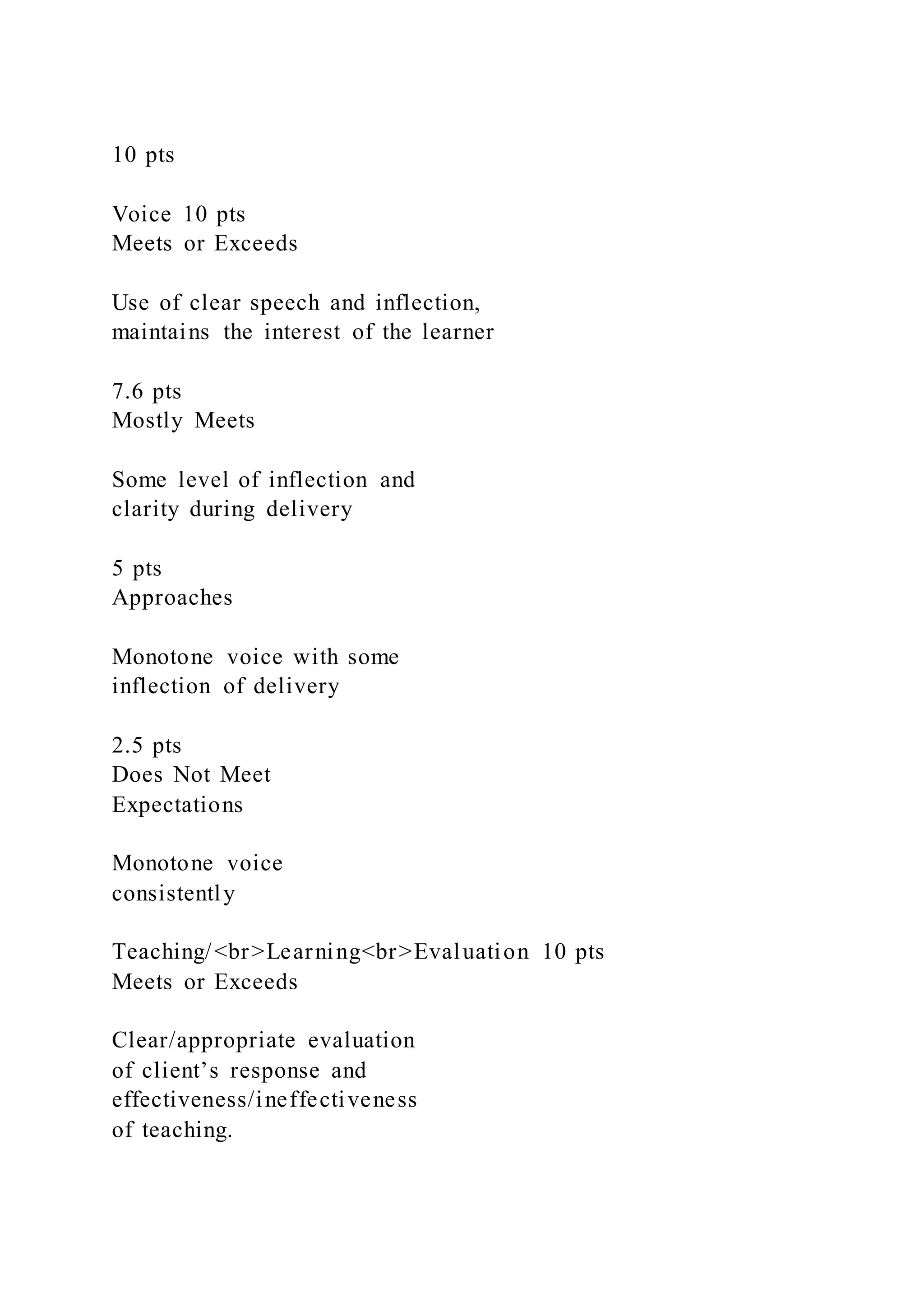
10 pts
Voice 10 pts
Meets or Exceeds
Use of clear speech and inflection,
maintains the interest of the learner
7.6 pts
Mostly Meets
Some level of inflection and
clarity during delivery
5 pts
Approaches
Monotone voice with some
inflection of delivery
2.5 pts
Does Not Meet
Expectations
Monotone voice
consistently
Teaching/<br>Learning<br>Evaluation 10 pts
Meets or Exceeds
Clear/appropriate evaluation
of client’s response and
effectiveness/ineffectiveness
of teaching.
7.6 pts
Mostly Meets
Vague/inappropriate
evaluation of client’s
response and
effectiveness/ineffectiveness
of teaching
5 pts
Approaches
Poor/inappropriate
evaluation of client’s
response and
effectiveness/ineffectiveness
of teaching.
2.5 pts
Does Not Meet
Expectations
No evaluation of client’s
response and
effectiveness/ineffectiveness
of teaching
Reflective Analysis 10 pts
Meets or Exceeds
Reflective analysis of teaching
including discussion of
strengths and weaknesses.
7.6 pts
Mostly Meets
Vague reflective analysis of
teaching including discussion of
strengths and weaknesses
5 pts
Approaches
Reflective analysis of teaching that
lacks insight or a poor discussion of
strengths and weaknesses
2.5 pts
Does Not
Meet
Expectations
Absent
reflective
analysis of
teaching
Teaching Plan
1. Purpose: To document and evaluate teaching skills necessary
to provide teaching to an
individual client with a demonstrated need. With the completion
of this assignment the student
will be able to achieve the following objectives.
a. Demonstrate ability to thoroughly assess the learning styles
of an individual or family
using given developmental or cultural models.
b. Demonstrate ability to anticipate learning needs based on
developmental or cultural
assessments.
c. Identify and utilize teaching/learning principles to facilitate
achievement of learning
goals and outcomes.
d. Select and prioritize learning strategies based on the
developmental or cultural
assessment to achieve learning goals and outcomes.
e. Support rationales for teaching plan using teaching and
learning theories from required
readings with references.
2. Nursing Competencies:
a. Assessing and identifying developmental, cultural, and
socioeconomic factors affecting a
client.
b. Providing evidence-based health information and teaching
based on developmental,
cultural, and socioeconomic factors affecting a client or family
c. Integrating teaching/learning activities into client
interactions based on developmental,
cultural, and socioeconomic factors affecting a client or family.
d. Incorporating health promotion and teaching into the plan of
care based on
developmental, cultural, and socioeconomic factors affecting a
family or client.
3. Plan: submitted to the clinical instructor during the teaching
experience. Your clinical
instructor must approve the topic.
a. Develop nursing diagnosis (NANDA)
b. Develop two (2) learning objectives
c. State methodology (teaching methods)
d. Provide and utilize teaching aids
e. State needed resources
4. Implementation: Outline (step by step)
5. Evaluation: Evaluate your project describing the
effectiveness of teaching methods and aids,
learner’s response, ability to meet objectives, and self-
evaluation including what the student
learned and what the student would do differently in the future.
A copy of the entire teaching
plan with the evaluation of patient learning is to be submitted to
your clinical instructor during
the teaching presentation. This write-up should be 2-3 pages.

Incivility and healthful environments no unread replies.no replie

  • 1.
    Incivility and HealthfulEnvironments No unread replies.No replies. Purpose The purpose of the graded collaborative discussions is to engage faculty and students in an interactive dialogue to assist the student in organizing, integrating, applying, and critically appraising knowledge regarding advanced nursing practice. Scholarly information obtained from credible sources as well as professional communication are required. Application of information to professional experiences promotes the analysis and use of principles, knowledge, and information learned and related to real-life professional situations. Meaningful dialogue among faculty and students fosters the development of a learning community as ideas, perspectives, and knowledge are shared. Activity Learning Outcomes Through this discussion, the student will demonstrate the ability to: 1. Examine roles and competencies of advanced practice nurses essential to performing as leaders and advocates of holistic, safe, and quality care (CO1) 2. Apply concepts of person-centered care to nursing practice situations (CO2) 3. Analyze essential skills needed to lead within the context of complex systems (CO3) 4. Explore the process of scholarship engagement to improve health and healthcare outcomes in various settings (CO4) Due Date A 10% late penalty will be imposed for discussions posted after the deadline on Wednesday, regardless of the number of days late. NOTHING will be accepted after 11:59pm MT on Sunday (i.e. student will receive an automatic 0 for any portion of the discussion not posted by that time). Week 8 discussion closes on Saturday at 11:59pm MT.
  • 2.
    NOTE: To receivecredit for a week's discussion, students may begin posting no earlier than the Sunday immediately before each week opens. Unless otherwise specified, access to most weeks begins on Sunday at 12:01 a.m. MT, and that week's assignments are due by the next Sunday by 11:59 p.m. MT. Week 8 opens at 12:01 a.m. MT Sunday and closes at 11:59 p.m. MT Saturday. A zero is the lowest score that a student can be assigned. Faculty may submit any collaborative discussion posting to Turnitin in order to verify originality. Total Points Possible: 75 Requirements: Discussion Criteria I. Application of Course Knowledge: of Course Knowledge: The student post contributes unique perspectives or insights gleaned from personal experience or examples from the healthcare field. The student must accurately and fully discuss the topic for the week in addition to providing personal or professional examples. The student must completely answer the entire initial question. II. Engagement in Meaningful Dialogue: I. The student responds to a student peer and course faculty to further dialogue. a. Peer Response: The student responds substantively to at least one topic-related post by a student peer. A substantive post adds content or insights or asks a question that will add to the learning experience and/or generate discussion. · A post of “I agree” with a repeat of the other student’s post does not count as a substantive post. A collection of shallow posts does not equal a substantive post. · The peer response must occur on a separate day from the initial posting. · The peer response must occur before Sunday, 11:59 p.m. MT. · The peer response does not require a scholarly citation and
  • 3.
    reference unless theinformation is paraphrased and/or direct quotes are used, in which APA style standards then apply. Faculty Response: The student responds substantively to at least one question by course faculty. The faculty question may be directed to the student, to another student, or to the entire class. · A post of "I agree" with a repeat of the faculty's post does not count as a substantive post. A collection of shallow posts does not equal a substantive post. · The faculty response must occur on a separate day from the initial posting. · Responses to the faculty member must occur by Sunday, 11:59 p.m. MT. · This response does not require a scholarly citation and reference unless the information is paraphrased and/or direct quotes are used, in which APA style standards then apply. III. Integration of Evidence: The student post provides support from a minimum of one scholarly in-text citation with a matching reference AND assigned readings OR online lessons, per discussion topic per week. a. What is a scholarly resource? A scholarly resource is one that comes from a professional, peer-reviewed publication (e.g., journals and government reports such as those from the FDA or CDC). · Contains references for sources cited · Written by a professional or scholar in the field and indicates credentials of the author(s) · Is no more than 5 years old for clinical or research article b. What is not considered a scholarly resource? · Newspaper articles and layperson literature (e.g., Readers Digest, Healthy Life Magazine, Food, and Fitness) · Information from Wikipedia or any wiki · Textbooks · Website homepages · The weekly lesson · Articles in healthcare and nursing-oriented trade magazines,
  • 4.
    such as NursingMade Incredibly Easy and RNMagazine (Source: What is a scholarly article.docx; Created 06/09 CK/CL Revised: 02/17/11, 09/02/11 nlh/clm) c. Can the lesson for the week be used as a scholarly source? · Information from the weekly lesson can be cited in a posting; however, it is not to be the sole source used in the post. d. Are resources provided from CU acceptable sources (e.g., the readings for the week)? · Not as a sole source within the post. The textbook and/or assigned (required) articles for the week can be used, but another outside source must be cited for full credit. Textbooks are not considered scholarly sources for the purpose of discussions. e. Are websites acceptable as scholarly resources for discussions? · Yes, if they are documents or data cited from credible websites. Credible websites usually end in .gov or .edu; however, some .org sites that belong to professional associations (e.g., American Heart Association, National League for Nursing, American Diabetes Association) are also considered credible websites. Websites ending with .com are not to be used as scholarly resources IV. Professionalism in Communication: The post presents information in logical, meaningful, and understandable sequence, and is clearly relevant to the discussion topic. Grammar, spelling, and/or punctuation are accurate. V. Wednesday Participation Requirement: The student provides a substantive response to the graded discussion question(s) or topic(s), posted by the course faculty (not a response to a peer), by Wednesday, 11:59 p.m. MT of each week. VI. Total Participation Requirement: The student provides at least three substantive posts (one to the initial question or topic, one to a student peer, and one to a faculty question) on two different days during the week. DISCUSSION CONTENT
  • 5.
    Category Points % Description Application of CourseKnowledge 20 27 Answers the initial discussion question(s)/topic(s), demonstrating knowledge and understanding of the concepts for the week. Engagement in Meaningful Dialogue With Peers and Faculty 20 27 Responds to a student peer AND course faculty furthering the dialogue by providing more information and clarification, adding depth to the conversation Integration of Evidence 20 27 Assigned readings OR online lesson AND at least one outside scholarly source are included. The scholarly source is: 1) evidence- based, 2) scholarly in nature, 3) published within the last 5 year s 60 81% Total CONTENT Points= 60 pts DISCUSSION FORMAT Category Points % Description Grammar and Communication 8 10
  • 6.
    Presents information usingclear and concise language in an organized manner Reference Citation 7 9 References have complete information as required by APA In-text citations included for all references AND references included for all in-text citation 15 19% Total FORMAT Points= 15 pts DISCUSSION TOTAL=75 points Preparing the Assignment Introduction This graded discussion will explore the impact of systems theory on a practice problem or issue. Please provide an initial response to the discussion question by Wednesday at 11:59pm MT and two interactive dialogue responses no later than Sunday 11:59 PM MT at the end of WEEK 7. The discussion is worth 75 points. Please refer to the discussion grading rubric for additional criteria. Assignment Reflect on an experience in which you were directly involved or witnessed incivility in the workplace. Provide a brief synopsis of the situation. How did this make you feel? How did you respond? What were the consequences of this situation? Provide an example of how this negatively affected the work environment and outcomes. How could the situation have been prevented? Discuss strategies that would support a healthy work environment.
  • 7.
    **To see viewthe grading criteria/rubric, please click on the 3 dots in the box at the end of the solid gray bar above the discussion board title and then Show Rubric. Search entries or author Teaching Plan Due No Due Date Points 100 Submitting a text entry box or a file upload NURS_317L-A - Teaching Plan (Individualized Client Teaching) RUBRIC Start Assignment The purpose of the teaching plan is to document and evaluate the necessary skills to provide individual clients with demonstrated needs. For complete instructions, download and review the Teaching Plan (https://canvas.westcoastuniversity.edu/courses/7998/files/1740 530/download? download_frd=1) document, located in the Worksheets, Forms, and Templates page. https://canvas.westcoastuniversity.edu/courses/7998/files/17405 30?wrap=1 https://canvas.westcoastuniversity.edu/courses/7998/fil es/17405 30/download?download_frd=1
  • 8.
    Criteria Ratings Pts 10pts 10 pts 10 pts 10 pts 10 pts 10 pts 10 pts Comprehensive<br>Assessment 10 pts Meets or Exceeds Clear and concise discussion of client’s admission diagnosis, demographic data, and anticipated learning needs 7.6 pts Mostly Meets Vague and incomplete discussion of client’s admission diagnosis, demographic data, and anticipated learning needs 5 pts
  • 9.
    Approaches Vague and incomplete discussionof client’s admission diagnosis, demographic data, and anticipated learning needs 2.5 pts Does Not Meet Expectations No discussion of client’s admission diagnosis, demographic data and anticipated learning needs. Nursing Diagnosis 10 pts Meets or Exceeds Clear and comprehensive client assessment data to support a deficient knowledge nursing diagnosis 7.6 pts Mostly Meets Vague client assessment data to support deficient knowledge nursing diagnosis or nursing diagnosis not written in
  • 10.
    proper format 5 pts Approaches Improperor incomplete client assessment data to support deficient knowledge nursing diagnosis or missing elements of the nursing diagnosis 2.5 pts Does Not Meet Expectations No comprehensive client assessment data to support deficient knowledge, or improper format of nursing diagnosis or no nursing diagnosis Client Learning Needs Assessment 10 pts Meets or Exceeds Clear and complete assessment of learner (client /family), teaching needs, and special learning needs, if present 7.6 pts Mostly Meets Vague assessment of learner (client and/or family), teaching needs,
  • 11.
    and special learningneeds, if present. 5 pts Approaches Incomplete assessment of learner (client and/or family), teaching needs, and special learning needs, if present. 2.5 pts Does Not Meet Expectations No assessment of learner (client and/or family), teaching needs, and special learning needs, if present Clients Strengths and Weakness for Learning 10 pts Meets or Exceeds Clear identification of client’s strengths and weaknesses relevant to learning needs. 7.6 pts Mostly Meets Vague identification of
  • 12.
    client’s strengths and weaknessesrelevant to learning needs 5 pts Approaches Incomplete identification of client’s strengths and weaknesses relevant to learning needs 2.5 pts Does Not Meet Expectations No discussion of client’s strengths and weaknesses relevant to learning needs Introductions 10 pts Meets or Exceeds Open and closing remarks that capture client’s attention. Includes a clear and correct statement of 2 teaching objectives 7.6 pts Mostly Meets Vague open or closing remarks or vague/incorrect teaching objectives.
  • 13.
    5 pts Approaches Poor openor closing remarks or vague/incorrect teaching objectives or use of only one objective 2.5 pts Does Not Meet Expectations No open or closing remarks displayed or no teaching objective stated. Handout/<br>Brochure 10 pts Meets or Exceeds Clear and organized presentation of evidence- based client teaching in appropriate reading level and understanding for the patient 7.6 pts Mostly Meets Vague/disorganized presentation of evidence- based client teaching or not at the appropriate level for patient teaching
  • 14.
    5 pts Approaches Poor/disorganized presentation ofevidence-based client teaching or not at the appropriate level for patient teaching, spelling or grammatical errors 2.5 pts Does Not Meet Expectations Poor or disorganized presentation of teaching from inappropriate sources, poor format, poor spelling and poor grammar Body Language 10 pts Meets or Exceeds Direct eye contact and appropriate gestures/movements during teaching. Relax, self-confident nature and no mistake during teaching. 7.6 pts Mostly Meets Minimal eye contact and little
  • 15.
    movement or descriptive gestureduring teaching. Mild tension, lack of self-confidence and difficulty recovering from mistakes 5 pts Approaches Minimal eye contact and little movement or descriptive gesture during teaching. Obvious nervousness and tension with many speaking errors 2.5 pts Does Not Meet Expectations No eye contact and inappropriate gestures during teaching. Tension and nervousness obvious, trouble recovering from mistakes. Total Points: 100 Criteria Ratings Pts 10 pts 10 pts
  • 16.
    10 pts Voice 10pts Meets or Exceeds Use of clear speech and inflection, maintains the interest of the learner 7.6 pts Mostly Meets Some level of inflection and clarity during delivery 5 pts Approaches Monotone voice with some inflection of delivery 2.5 pts Does Not Meet Expectations Monotone voice consistently Teaching/<br>Learning<br>Evaluation 10 pts Meets or Exceeds Clear/appropriate evaluation of client’s response and effectiveness/ineffectiveness of teaching.
  • 17.
    7.6 pts Mostly Meets Vague/inappropriate evaluationof client’s response and effectiveness/ineffectiveness of teaching 5 pts Approaches Poor/inappropriate evaluation of client’s response and effectiveness/ineffectiveness of teaching. 2.5 pts Does Not Meet Expectations No evaluation of client’s response and effectiveness/ineffectiveness of teaching Reflective Analysis 10 pts Meets or Exceeds Reflective analysis of teaching including discussion of strengths and weaknesses. 7.6 pts Mostly Meets
  • 18.
    Vague reflective analysisof teaching including discussion of strengths and weaknesses 5 pts Approaches Reflective analysis of teaching that lacks insight or a poor discussion of strengths and weaknesses 2.5 pts Does Not Meet Expectations Absent reflective analysis of teaching Teaching Plan 1. Purpose: To document and evaluate teaching skills necessary to provide teaching to an individual client with a demonstrated need. With the completion of this assignment the student will be able to achieve the following objectives. a. Demonstrate ability to thoroughly assess the learning styles of an individual or family using given developmental or cultural models.
  • 19.
    b. Demonstrate abilityto anticipate learning needs based on developmental or cultural assessments. c. Identify and utilize teaching/learning principles to facilitate achievement of learning goals and outcomes. d. Select and prioritize learning strategies based on the developmental or cultural assessment to achieve learning goals and outcomes. e. Support rationales for teaching plan using teaching and learning theories from required readings with references. 2. Nursing Competencies: a. Assessing and identifying developmental, cultural, and socioeconomic factors affecting a client. b. Providing evidence-based health information and teaching based on developmental, cultural, and socioeconomic factors affecting a client or family c. Integrating teaching/learning activities into client interactions based on developmental, cultural, and socioeconomic factors affecting a client or family. d. Incorporating health promotion and teaching into the plan of care based on developmental, cultural, and socioeconomic factors affecting a family or client.
  • 20.
    3. Plan: submittedto the clinical instructor during the teaching experience. Your clinical instructor must approve the topic. a. Develop nursing diagnosis (NANDA) b. Develop two (2) learning objectives c. State methodology (teaching methods) d. Provide and utilize teaching aids e. State needed resources 4. Implementation: Outline (step by step) 5. Evaluation: Evaluate your project describing the effectiveness of teaching methods and aids, learner’s response, ability to meet objectives, and self- evaluation including what the student learned and what the student would do differently in the future. A copy of the entire teaching plan with the evaluation of patient learning is to be submitted to your clinical instructor during the teaching presentation. This write-up should be 2-3 pages.