TeAM
YYeP
G
Digitally signed by
TeAM YYePG
DN: cn=TeAM
YYePG, c=US,
o=TeAM YYePG,
ou=TeAM YYePG,
email=yyepg@msn.
com
Reason: I attest to
the accuracy and
integrity of this
document
Date: 2005.02.15
05:50:50 +08'00'
e-Human Resources
Management:
Managing Knowledge People
TeresaTorres-Coronas
Universitat Rovira i Virgili, Spain
Mario Arias-Oliva
Universitat Rovira Virgili, Spain
Hershey • London • Melbourne • Singapore
IDEA GROUP PUBLISHING
Acquisitions Editor: Mehdi Khosrow-Pour
SeniorManagingEditor: Jan Travers
ManagingEditor: Amanda Appicello
Development Editor: Michele Rossi
Copy Editor: Maria Boyer
Typesetter: Jennifer Wetzel
CoverDesign: Lisa Tosheff
Printed at: Yurchak Printing Inc.
Published in the United States of America by
Idea Group Publishing (an imprint of Idea Group Inc.)
701 E. Chocolate Avenue, Suite 200
Hershey PA 17033
Tel: 717-533-8845
Fax: 717-533-8661
E-mail:cust@idea-group.com
Web site: http://www.idea-group.com
and in the United Kingdom by
Idea Group Publishing (an imprint of Idea Group Inc.)
3 Henrietta Street
Covent Garden
London WC2E 8LU
Tel: 44 20 7240 0856
Fax: 44 20 7379 3313
Web site: http://www.eurospan.co.uk
Copyright © 2005 by Idea Group Inc. All rights reserved. No part of this book may be repro-
duced in any form or by any means, electronic or mechanical, including photocopying, without
written permission from the publisher.
Library of Congress Cataloging-in-Publication Data
e-Human resources management : managing knowledge people / Teresa Torres-Coronas,
Mario Arias-Oliva, editors.
p. cm.
Includesbibliographicalreferencesandindex.
ISBN 1-59140-435-5 (h/c) -- ISBN 1-59140-436-3 (s/c) -- ISBN 1-59140-437-1 (eISBN)
1. Personnel management. 2. Information technology--Management. 3. Knowledge
management. I. Torres-Coronas, Teresa, 1966- II. Arias-Oliva, Mario, 1968-
HF5549.E14 2005
658.3'00285'4678--dc22
2004016385
British Cataloguing in Publication Data
A Cataloguing in Publication record for this book is available from the British Library.
All work contributed to this book is new, previously-unpublished material. The views expressed in
this book are those of the authors, but not necessarily of the publisher.
As we were writing this preface, Madrid went through one of the
worst days in its history. This is why we want to dedicate this
book to the memory of those who are no longer with us, to the
memory of those who lost their lives in the bomb attack on a train
in Madrid on March 11, 2004. They were going to work, struggling
to balance work and life; they were part of our human capital;
they were inimitable, irreplaceable, and very special assets…they
should be here.
Dedication
E-Human Resources
Management:
Managing Knowledge People
Table of Contents
Preface ................................................................................................. vii
SECTION I:THE CUTTING-EDGE IN HRM
ChapterI.
Web-BasedOrganizinginTraditionalBrick-and-MortarCompanies:
The Impact on HR ................................................................................. 1
Jaap Paauwe, Erasmus University Rotterdam, The Netherlands
Elaine Farndale, Erasmus University Rotterdam, The Netherlands
Roger Williams, Erasmus University Rotterdam, The Netherlands
ChapterII.
IntegratingHandheldComputerTechnologyintoHRResearchand
Practice................................................................................................. 31
Scott A. Davies, Hogan Assessment Systems, USA
Robert F. Calderón, Caliber Associates, Inc., USA
ChapterIII.
Social Network Mapping Software: New Frontiers in HRM ............ 68
Mousumi Bhattacharya, Fairfield University, USA
Christopher Huntley, Fairfield University, USA
SECTION II:REDESIGNING HRADMINISTRATIVE PROCESSES
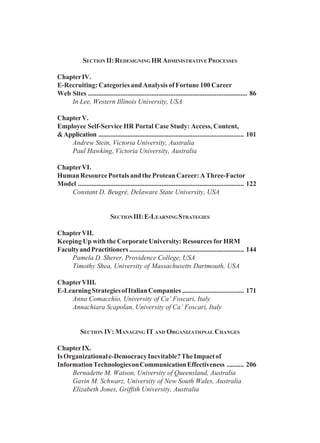
ChapterIV.
E-Recruiting: Categories and Analysis of Fortune 100 Career
Web Sites ............................................................................................. 86
In Lee, Western Illinois University, USA
ChapterV.
Employee Self-Service HR Portal Case Study: Access, Content,
&Application ..................................................................................... 101
Andrew Stein, Victoria University, Australia
Paul Hawking, Victoria University, Australia
ChapterVI.
HumanResourcePortalsandtheProteanCareer:AThree-Factor
Model ................................................................................................. 122
Constant D. Beugré, Delaware State University, USA
SECTIONIII:E-LEARNINGSTRATEGIES
ChapterVII.
Keeping Up with the Corporate University: Resources for HRM
FacultyandPractitioners................................................................... 144
Pamela D. Sherer, Providence College, USA
Timothy Shea, University of Massachusetts Dartmouth, USA
ChapterVIII.
E-LearningStrategiesofItalianCompanies .................................... 171
Anna Comacchio, University of Ca’ Foscari, Italy
Annachiara Scapolan, University of Ca’ Foscari, Italy
SECTION IV: MANAGING IT AND ORGANIZATIONAL CHANGES
ChapterIX.
IsOrganizationale-DemocracyInevitable?TheImpactof
InformationTechnologiesonCommunicationEffectiveness .......... 206
Bernadette M. Watson, University of Queensland, Australia
Gavin M. Schwarz, University of New South Wales, Australia
Elizabeth Jones, Griffith University, Australia
ChapterX.
ManagingandPracticingODinanITEnvironment:AStructured
ApproachtoDevelopingITProjectTeams ...................................... 236
Joseph Logan, AstraZeneca Pharmaceuticals, USA
AbouttheAuthors.............................................................................. 269
Index................................................................................................... 276
Preface
vii
Aim of This Book
In1998,ahighlyinnovativefilm,Antz,directedbyEricDarnellandTimJohnson,
was released. In the first scene of the movie, Ant Z 4195 is talking to his
psychoanalyst and saying:
“…and my job, don’t get me started on, cause it really annoys me…I feel
physically inadequate, I, I, my whole life I’ve never been able to lift 10
times my own body weight and when you get down to it, handling dirt
is…yuck, you know is not my idea of a rewarding career. It’s this whole
gung-ho super-organism thing that I, I, you know I can’t get, I try but I
can’t get it. I mean you know, what is it, I’m supposed to do everything
for the colony, and what about my needs, what about me? I mean I gotta
believe there’s someplace out there that’s better than this! Otherwise I’d
just curl up in a larva position and weep! The whole system out there just
makes me feel...insignificant!”
Z 4195 is striving to reconcile his own individuality with the communal work
of the ant colony. Our unhappy and depressed ant is working for a traditional
hierarchical organization, where people are not treated as valuable assets and
IT systems are not yet implemented. Even worse, he is currently working for
an organization that may have neither examined people management prac-
tices, nor made a real connection between people and organizational perfor-
mance.While this behavior is still prevalent in many of today’s companies, we
are presenting a book about e-HRM, about how IT is changing traditional
HRM functions, about how e-HRM practices are implemented. Could this be
a paradox? We hope so, because as Junipier (1996) pointed out: “Paradox is
viii
an excellent creativity facilitator; it delivers a seismic jolt to dominant ideas,
themselves the most efficient suppressor of original thinking” (p. 19). We need
creative facilitators to develop the new e-HRM landscape.
The above presents one of our oldest concerns about managing people: Most
organizations are far from considering people as their most important asset.
They are also far from applying common sense practices such as those to be
found in Pfeffer’s book, The Human Equation (Harvard Business School
Press, 1996). These organizations are now entering the knowledge era, using
IT solutions to solve their old HRM problems in one out of 10 cases, and in an
uncreative way. Those in the world of HRM are being accused of living in an
ivory tower, managing the human side of their organizations in ways that lack
relevance in the new information era. The impetus for the HRM change comes
from recognition of recent developments in the HRM profession and a real-
ization that current practices do not reflect those changes, especially those
concerning IT strategies. The problem often results in policies, practices, and
strategies that may be outdated.
Organizations are progressively incorporating ITCs into their processes, using
different tools and solutions. These tools are applied in a wide variety of ways
(i.e., manufacturing resource planning, office automation, computer-supported
cooperative work, distributed teams, supply chain, enterprise-wide resource
planning, or virtual integration). The entry into service of the first high-capac-
ity transatlantic cable in 1956 and the launch of Sputnik in 1957 marked the
beginnings of the era of global information exchange. In 1956, for the first
time in history, the number of white-collar workers exceeded that of blue-
collar workers (Naisbitt, 1984).
The factor we would stress in this growth in TICs is not the increase in the
amount, capacity, or inter-connectivity of technology in organizations. The
strategic key lies in the organization’s ability to integrate these technologies
into their current business processes, and also in their ability to reorganize the
said processes (Orlikowski, 1999, p. 3). And this is what this book is all
about.
Content of This Book
e-HRM: Managing Knowledge People responds to the challenge of docu-
menting recognizable, innovative, and creative approaches to e-HRM. Its aim
is to define and carry forward the debate in a complex and versatile matter.
ix
Future research will continue the process of clarifying and documenting the
evolution of e-HRM. In the meantime, however, human resources manage-
ment researchers, faculty, practitioners, and consultants may find the ideas
and experiences offered in this book genuinely helpful and illuminating.
This book is presented in four sections — the first intended to be more gen-
eral in nature, the following three devoted to specific aspects of the HRM field
in the new information era. Section I, The Cutting-Edge in HRM, presents an
overview of how ITCs are modifying general HRM processes and functions.
This is the aim of the first three contributions.
In the first chapter, Web-Based Organizing in Traditional Brick-and-Mor-
tar Companies: The Impact on HR, Jaap Paauwe, Elaine Farndale, and
Roger Williams, based mostly on their personal experience, focus on how old
economy organizations are developing new business models. These models
are changing both customers’ and suppliers’ relationships with the organiza-
tion and, of course, e-commerce strategy as a whole. With these new models
being implemented, the potential implications for HRM need to be explored.
The effects of Web-based organizing in HRM, including workers’ selection,
training and development, learning, trust-building within an organization, and
knowledge sharing, among others, are discussed. One relevant conclusion of
their analysis is that “internal improvements, necessary for the successful trans-
ference of business to the Internet, will enable the HR function to justify its
existence in financial terms.”
Scott A. Davis and Robert F. Calderón, in their chapter Integrating Handheld
Computer Technology into HR Research and Practice, present potential
applications of handheld computers for HR practice and research. They an-
ticipate major improvements and widespread implementation of wireless net-
works with resulting implications for worker mobility, availability, and com-
munication. These factors will impact work planning, schedules, conducting
meetings, organizational data sharing, and an optimum balance between work
and life. Their model, which integrates empirical research and practical
knowledge, will be useful for those researchers and practitioners eager
to explore handheld computer technology applied to strategic HR plan-
ning and management.
Mousumi Bhattacharya and Christopher L. Huntley’s chapter, Social Net-
work Mapping Software: New Frontiers in HRM, discuss the connections
between social network mapping software and the effectiveness of HRM pro-
grams. Their study is based upon research into social networks and the ef-
fects of these networks on both business processes and HRM. The authors
clearly show the uses of information on social networks in HRM processes
x
andwhatinformationisgeneratedbysocialnetworkmappingsoftware(SNMS).
They classify the functionality offered by SNMS in the categories of data
collection, descriptive modeling, and decision support. They also discuss how
each of these functions provides information relevant to different HRM func-
tions.
Section II, Redesigning HR Administrative Processes, explains how some
HRM functions, such as e-recruitment and developing appropriate systems
for employee relationships, are being implemented in the knowledge era.
As hiring qualified employees is a critical organizational decision in the knowl-
edge-based economy, In Lee, in his chapter E-Recruiting: Categories and
Analysis of Fortune 100 Career Web Sites, analyzes the corporate career
Web sites of the Fortune 100 companies. He identifies 33 attributes that char-
acterize corporate career Web sites and groups them into four major areas:
recruiting methods, job search tools, job application tools, and information on
organizational attributes. Knowing how other organizations are using Web
sites to recruit their human capital is a first step towards finding breakthrough
ideas for one’s own organization.
In the next chapter, Employee Self-Service HR Portal Case Study: Access,
Content, & Application, Andrew Stein and Paul Hawking examine the de-
velopment of the human resources (HR) ESS portal. Without any doubt, the
added value in this chapter consists of the case studies of three Australian
organizations that have implemented an ESS portal. The authors show the
information and process focus of these organizations’ ESS portals, which are
used to place the organizations into Brosche’s (2002) portal development
model.
Focusing on the development of human resources, Constant D. Beugré’s chap-
ter, Human Resource Portals and the Protean Career: A Three-Factor
Model, develops a three-point model (individual attributes, characteristics of
the human resource portals, and organizational factors) to describe the fac-
tors in the effective use of Web-based human resource services. On the basis
of this model, he argues that the effective use of Web-based human resource
services plays an important role in the management of the protean career.
As organizations have started to recognize e-learning as having the power to
transform the performance, knowledge, and skills landscape (Gunasekaran,
McNeil, & Shaul, 2002, p. 44), Section III, E-Learning Strategies, concen-
trates on the e-training and e-learning world.
Pamela D. Sherer and Timothy Shea, in their chapter Keeping Up with the
Corporate University: Resources for HRM Faculty and Practitioners, dis-
xi
cuss the major factors that influence the growth and role of the corporate
university within organizations: in terms of strategy and human resources,
knowledge management, and technology and e-learning. They also include in
their chapter an annotated compendium of key resources in each of these
areas, especially Internet resources. These resources are a good starting point
to begin digging deeper into this rapidly changing subject.
E-Learning Strategies of Italian Companies, a chapter by Anna Comacchio
and Annachiara Scapolan, is devoted to the empirical study of country-spe-
cific e-learning models, focusing on the e-learning experience of Italian com-
panies in the pharmaceutical and banking industries. How are companies imple-
menting e-learning? How are they analyzing the most important features of the
e-learning strategies: users, contents, infrastructure, and service and support?
The two cases presented will help the reader to answer these questions.
Section IV, Managing IT and Organizational Changes, discusses the pro-
cesses for achieving success when implementing IT solutions within organiza-
tions.
In the chapter, Is Organizational e-Democracy Inevitable? The Impact of
Information Technologies on Communication Effectiveness, Bernadette
M. Watson, Gavin M. Schwarz, and Elizabeth Jones consider the relation-
ships between social identity and e-democracy. They also discuss the inevita-
bilityoforganizationale-democracyinorganizationspursuinginformationtech-
nology changes. They investigate perceptions of changes in effective commu-
nication during the implementation of organizational change in a hospital. Their
findings are discussed in terms of the implications that arise for HR practitio-
ners.
Finally, Joseph Logan, in his chapter Managing and Practicing OD in an IT
Environment: A Structured Approach to Developing IT Project Teams,
outlines a framework for improving success in IT projects by leveraging the
organization development (OD) practitioner’s expertise in fostering coopera-
tion and learning in teams. In the author’s opinion, failures in IT projects are
caused by a lack of integration of OD and IT.
In summary, this book’s content sets out to highlight the trends in theory and
practice which are likely to influence human resource management practices
in the IT era, to examine innovative e-HR strategies from a variety of empiri-
cal and theory-based perspectives, to provide insightful analysis, and to pro-
mote the discovery and dissemination of innovative theories and best prac-
tices. But there are important strategic HRM issues missing, such as, for ex-
ample: e-work and teleworking, the development of new industrial relations
xii
models, managing the e-workforce in multinational organizations, e-ethics, or
managing values and IT. Of course, some critical reflections on competencies
and abilities should have been considered (i.e., IT competencies for an HR
manager, e-leadership and e-team skills, e-facilitation and e-coaching, e-trust,
or e-creativity — developing skills of creative application of IT on organiza-
tions). So, there is still a lot work to do!
The Book’s Audience
e-HRM: Managing Knowledge People presents insights gained by leading
professionals from the practice, research, and consulting side of the e-HRM
field. This book should be useful to a variety of constituencies who are inter-
ested in the interrelationships between human resources management and IT,
including managers who treat their personnel as a key factor for organizational
success, leaders wishing to develop the human side of their organizations, IT
experts, human resources managers, researchers, consultants, and practitio-
ners. Each audience may have different levels of interest in the theoretical
concepts, practical experiences, and empirical data presented in this book.
As we are exploring an evolving discipline, we assume that any of these read-
ers will begin, but not complete, an exploration of the e-HRM new world.
Enjoy the reading and enjoy the learning!
References
Brosche, C. (2002). Designing the corporate portal. Masters Thesis, De-
partment of Computer Science, University of Gothenburg, Sweden.
Gunasekaran, A., McNeil, R.D., & Shaul, D. (2002). E-learning: Research
and applications. Industrial and Commercial Training, 34(2), 44-53.
Junipier, D. (1996). Human resource and creativity. Work Study, 45(7), 15-
22.
Naisbitt (1984). Megatrends. New York: Warner Bros.
Orlikowski, W. (1999). The truth is not out there: An enacted view of the
digital economy. Understanding the digital economy—Data, tools,
and research. Washington, DC: U.S. Department of Commerce.
xiii
Acknowledgments
With gratitude, love, and respect we thank…
Our publisher, Idea Group Inc., who supported this project and, of course,
Jennifer Sundstrom, for her great job during the complex work of editing this
book. Both our contributors and reviewers. The contents of this book were
made possible because of contributors and the generous cooperation and valu-
able suggestions given by the reviewers. We are indebted to them for sharing
their knowledge with us. All those working to expand and enhance scientific
knowledge in the field of human resources management and IT, and who have
contributed — and continue to do so — to the development of guidelines to
achieve more efficient, effective management.
And last but not least:
To my beloved husband Jordi and my charming sons Arnau and Jordi,
who have made my life a fascinating journey. (Teresa’s special thanks)
To my wife, Mar, who has always supported me. (Mario’s special thanks)
Teresa Torres-Coronas & Mario Arias-Oliva
March 11, 2004
Section I
The Cutting-Edge
in HRM
Web-Based Organizing in Traditional Brick-and-Mortar Companies 1
Copyright © 2005, Idea Group Inc. Copying or distributing in print or electronic forms without written
permission of Idea Group Inc. is prohibited.
Chapter I
Web-BasedOrganizing
inTraditional
Brick-and-Mortar
Companies:
The Impact on HR
Jaap Paauwe, Erasmus University Rotterdam, The Netherlands
Elaine Farndale, Erasmus University Rotterdam, The Netherlands
Roger Williams, Erasmus University Rotterdam, The Netherlands
Abstract
This chapter introduces the notion of how old-economy brick-and-mortar
firms are adapting their HRM policies and practices and the roles of their
HR departments in light of newly introduced Web-based business-to-
business transaction practices. It argues that the Internet has introduced
three new business models in old-economy companies: the Internet as a
marketplace, the Internet as a supply chain integrator, and the Internet as
2 Paauwe, Farndale, & Williams
Copyright © 2005, Idea Group Inc. Copying or distributing in print or electronic forms without written
permission of Idea Group Inc. is prohibited.
a catalyst for business model redefinition. These innovative ways of
organizing are providing HR with opportunities to rise to new challenges
and increase their added value to the firm.
Introduction
The so-called new economy has taken a beating over the past few years. The
dot.coms have come — and many have gone again. Even the last great hope
of the new revolutionary age, Enron, filed for bankruptcy. However, the
phenomenon known as the Internet is not going to go away; it just keeps
expanding.Slowlybutsurelymoreandmoreindividualsandcompaniesare
comingtorelyonitfordoingbusiness.Maybethechangeswillbemoregradual
thanoriginallypredicted.Butthechangesarehappening.Thepurposeofthis
chapter is to look at some of the possible consequences of these current
developmentsforHR.
TheInternetcan,ofcourse,beusedfordifferentpurposes.Throughtheuseof
e-mail and similar derivatives, it is a messaging medium par excellence.
However, it is more than mere communication: it is also a medium for
entertainmentandinformation.Moreover,theInternetcanbeusedasamedium
fortransactions,forbuyingandselling.Althoughallapplicationshaveimplica-
tions for the utilization of an organization’s human resources, this chapter
concentratesonthearealikelytoimpingeclosestonmostorganizations:the
mediumof transactions.
The largest growth in transactions using the Internet has been in the area of
transactions between businesses; the so-called business-to-business (B2B)
sector.Sincetheendofthe1990swhenglobale-commercewasworthalittle
morethan$150billion(The Economist, February 26, 2000), the growth rate
hasslowed,butisstillcontinuingstrongly.Forrester(www.forrester.com),a
respected research organization in the field, expects this sector to reach $7
trillionor27%oftotalU.S.tradeby2006.Itishardtoknowhowseriouslyto
take such a dramatic prediction, but major growth in this area — despite the
downturnbothintheworldeconomyingeneralandinInternet-relatedstocks
inparticular—seemsinevitable.
One particular area of growth in B2B transactions is taking place in old-
economyfirms.Thesecompaniesareinvolvedintransactionswithinthenew
economyindifferentways.Firstly,theycaninvestinandeventakeovernew
Web-Based Organizing in Traditional Brick-and-Mortar Companies 3
Copyright © 2005, Idea Group Inc. Copying or distributing in print or electronic forms without written
permission of Idea Group Inc. is prohibited.
economy companies. Secondly, they can start up their own subsidiaries to
operate within the new economy. Thirdly, they can attempt to incorporate
the new economy into their old-economy organization. It is this third area
that is probably most interesting from the point of view of the utilization of
humanresources.Thisisbecauseold-economycompanies,whichstartuptheir
ownneweconomycompanies,normallyrunthemasseparateentities.Clearly
financialreasonsplayanimportantpartinthisdecision,butsodoorganizational
considerations. New economy companies may require a different organiza-
tionalstructureandculturethantheparentcompany,andhencerunningnew
economy companies as separate entities minimizes any possible cross-con-
taminationfromthenewtotheoldorviceversa.However,whenold-economy
companies attempt to integrate business-to-business e-commerce into their
existing organization, solving the problems that arise can provide new chal-
lengesandopportunitiesinHRM.Itisonthisthirdwayoforganizingthatthis
chapterconcentrates.
BecausethisB2Bgrowthareaisconcentratedinold-economycompaniesthat
are the majority employers, it is likely to have a significant impact on HRM.
MostHRprofessionalsarestillconcentratedinthesemedium-sizedandlarge,
old-economycompanies,andthisiswheretheHRfunctionissubjecttoradical
anddramaticchangebecauseoftheimplicationsofWeb-basedorganizing.The
neweconomystart-ups,thosestillaround,hardlyusetheHRfunctioninspite
of the proclaimed importance of their people to their success. This chapter
therefore focuses on the consequences of Web-based B2B transactions in
medium-sizedandlarge,old-economycompanies,anddiscussestheimplica-
tionsforHRMandHRprofessionals.
However, before we begin our exploration, we will give an overview of the
striking characteristics that distinguish Web-based transactions from more
traditionaltransactions.Wewillthencontinuewithadiscussionofthedifferent
waysinwhichold-economycompaniesareattemptingtointegrateelementsof
Web-basedorganizingintotheircurrentbusinessandtheresultantimplications
forHRM.Wemustremarkthoughthatthereisalackofreliableinformation
aboutthiswholearea.Mostpublicationsatthetimeofwritinghavebeenbased
moreonpersonalexperiencethanresearchandtendtofocusonthesamefew
companies that are often not only reorganizing to accommodate the new
Internet economy, but are also intimately involved in selling equipment or
services related to it. This chapter is therefore based on personal experience
ofworkinginthefield,interviewswithothersmoreexperiencedthanus,anda
reviewoftheavailableliteraturesources.
4 Paauwe, Farndale, & Williams
Copyright © 2005, Idea Group Inc. Copying or distributing in print or electronic forms without written
permission of Idea Group Inc. is prohibited.
The Effect of the Internet on
Business Transactions
TheInternetishavingamajorimpactonbusinesstransactionsbecauseofthe
differentopportunitiesitoffers.Anumberofsignificantdifferencesdistinguish
transactionsusingelectronicmarketsfromwhathasgonebefore.Theseinclude
the opportunities for global sourcing and selling, mass-customization, and
networking (Timmers, 1999). By lowering the costs of transactions and
information,technologyhasreducedmarketfrictionsandprovidedasignificant
impetustotheprocessofbroadeningworldmarkets(Greenspan,2000).This
meansthatconsiderationsaboutwheretolocatebecomesecondary,whereas
price competition increases. Internet technologies also allow specification
design and pricing online, which again increases price competition. This
facilitatesmeetingcustomerneeds,oftenthroughanetworkofmultiplebusiness
partnersabletodelivervaluemorequicklyandcheaplydirecttothecustomer.
Expertshavearguedthattransactionsusinge-commercecomefarclosertothe
economists’ ideal of perfect competition than transactions using traditional
media, as barriers to entry are lowered, transaction costs are reduced, and
buyers have improved access to information (see Shapiro & Varian, 1999;
Wyckoff,1997).
Therearethreemainresponsestothedevelopmentsinbusiness-to-business
transactionsviatheInternetbeingobserved(Wright&Dyer,2000):
• E-commerce:buyingandsellingviatheInternet;
• Supplychainintegration:collaborationthroughoutthetotalvaluechain;
and
• Fullyintegratede-business:internal and external integration sharing
real-time information (resulting in ‘bricks-and-clicks’ or ‘clicks-and-
mortar’hybridorganizations).
WrightandDyeralsoidentifyafourthderivative,enterpriseresourceplanning
(ERP),howeverthisfocusesondevelopinganintranetforinternalintegration
withinafirm,andlessonrelationshipsbetweenbusinesses.Hereweshallfocus
onthethreeB2Boutcomesidentified.
Firstly,theInternetisseenasanextensionofnormalmarketchannelsforbuying
andselling.Inthisapproach,companiesprimarilyusetheInternetinorderto
Web-Based Organizing in Traditional Brick-and-Mortar Companies 5
Copyright © 2005, Idea Group Inc. Copying or distributing in print or electronic forms without written
permission of Idea Group Inc. is prohibited.
improvethequalityandspeedofcustomerservice,andasamediumtobuyand
sell more products or services cheaper. Thus for every business, the Internet
— at theveryleast—offersopportunitiesforreducingoperatingcostlevels
andenhancingservicelevels(Venkatraman,2000).
Thesecondwayinwhichold-economycompaniesattempttointegratethenew
economyisbyusingtheInternettoexpandandimprovetheircurrentcollabo-
rativerelationshipsamongtheirkeysuppliers;theInternetcanencourageclose
integrationbetweenthepartnersthroughtotalvaluechainintegration(Timmers,
1999),establishingvirtualmarketplaceswithinthesupplychainprimarilyto
reducetransactioncosts.
Finally,thethirdapproach,whichismuchmorefundamental,requiresthatold-
economyorganizationstotallyrethinktheirbusinessmodelsbeforedecidingon
theire-commerceandsupplychainstrategies.Thisapproachrequiresmanage-
ment to re-examine why customers buy from them, look at all stages in the
processesinvolved,andconsiderhowtheInternetcouldimpacteachstageof
the processes. Then, if necessary, new business models can be developed to
fullyintegratetheneweconomyprinciples.Thisimpliesorganizationalrevolu-
tion.
Alongsidethisriseine-business,thereisalackofreliabledataonthepeople
issuesarisingfromamovefromatraditionalbrick-and-mortarbusinessmodel
toane-businessmodel.Thechangeshoweverimplyaneedtolearntousethese
newtechnologiesandtoembraceaclimateofconstantchange.Somespecific
outcomesmightbeaneedtoadoptmoreaggressiverecruitmentcampaignsto
attract the necessary technical staff when competing against the dynamic
dot.coms.Theremayalsobearesultantcultureclashwhenthenew‘techies’
jointhecompanyonhighsalaries,comparedwithexistingnon-technicalstaff,
whichmightleadtoresentmentandperceivedunfairtreatment.
In a review of the potential implications, Wright and Dyer (2000) have
suggested six broad HRM principles in response to the issues e-business is
raising:
1. Thecompanyshouldpromoteindividualautonomyandpersonalaccount-
abilityatalllevelsoftheorganizationthroughtheprocessofworkdesign,
tomakethecompanymoreflexibletochange.
2. Shared organizational vision and values should be reinforced through
HRM policies and practices, particularly recruitment and training, to
maintainasenseofcommunityintimesofchange.
6 Paauwe, Farndale, & Williams
Copyright © 2005, Idea Group Inc. Copying or distributing in print or electronic forms without written
permission of Idea Group Inc. is prohibited.
3. Thecompanyneedstoensureemployeesunderstandthebusinessstrat-
egyandcontextsothattheycanseewheretheyfitintothewhole.Thiscan
beachievedthroughcommunication,participation,training,andperfor-
mance-linkedrewardinparticular.
4. Thereisaneedtodevelopalearningorganization,sharingtheresponsi-
bilityjointlybetweenemployeesandthecompanytokeepcompetency
levelsattheleadingedge.
5. It is also important to develop a sense of belonging, trust, support, and
commitmentthroughouttheorganization.Thisentailsarrangingappropri-
ate induction, providing access to information, investing in employee
development, being a responsible employer with regard to work-life
balance,andbeinghonestregardingjobsecurity.
6. And ultimately, rewards must be provided which are perceived to be
commensuratewiththeeffortapplied.
Theseimplicationscouldbearguedtoapplyacrossmultipletypesoforganiza-
tion;however,weexploretheseimplicationsindetailinthecontextofthee-
business model throughout this chapter. Each of the three responses to the
Interneteconomyisnowexploredinturn,sheddingfurtherlightonthemajor
changestakingplaceinbothHRMpracticesandwithintheHRdepartment.
Companies Buying and
Selling on the Internet
The first major developments in this area started in the mid-1990s and saw
majorU.S.firmssuchasWal-MartandGeneralElectricmovingtobuyingand
sellingonlinetocutcostsandspeedsupplies.Theaimsofcuttingpaperwork
and time may have been simple, but the results were impressive (see Box 1).
Theinitialrapidspreadofbusinessexchangeswasfollowedbyarealizationby
manylargecustomersthatiftheycombinedtheirindividualbuyingpowerwith
thatoftheirlargecompetitorsintoaseparatebuyingandsellingexchange,then
thismighthaveamajoreffectontheirprocurementcosts.Forexample,General
Motors,Ford,DaimlerChrysler,andRenault-Nissanmergedtheirindividual
exchangesin2000tocreateCovisint,avirtualmarketplacefortheautomotive
Web-Based Organizing in Traditional Brick-and-Mortar Companies 7
Copyright © 2005, Idea Group Inc. Copying or distributing in print or electronic forms without written
permission of Idea Group Inc. is prohibited.
industry. Later they were also joined by PSA Peugeot Citroen. In 2001,
Covisinthandledprocurementtransactionsworthmorethan$45billion(Fi-
nancial Times, November 13, 2001), and in 2003, the Covisint user base
expandedby178%(www.covisint.com).Covisintprovidestheglobalmotor
industry with a common connection to its suppliers and customers based on
commonbusinessprocesses,reducingcosts,increasingefficiency,enhancing
quality,andimprovingtime-to-market.
LargecompaniescanusetheInternetforbuyingandsellingtoputthemselves
atthecenterofnewe-businesseco-systemsthattransformtheirwayofdoing
businessandtheirwayoforganizing.Theinterconnectivitydemandedexter-
nally influences how the company is organized. For example, order-taking
systems have to be made very customer-friendly and closely linked with
planningandproductionsystemsinordertoensurejust-in-timedeliveryand
zerostocks.Hencewemightexpectthemarketingfunctiontoincreaseinstatus
and power at the expense of the sales function, as customer relationships
becomemoreimportantandmoreandmoredirectsalesaretakenoverbythe
Internet.
Procurement will also have to be online to ensure adequate supplies. Closer
linkswithinthewholeadministrativesystemwillalsoberequiredtoensurethat,
as far as possible, the whole paper chain from order to invoice to payment
shouldproceedautomatically.Finally,logisticsanddistributionmustalsobe
linked to the system, as delivery windows agreed with customers have to be
met.Thesefunctionsarethusalsolikelytogaininstatusandimportance.But
whatoftheimpactontheHRfunction?
GE has built up a trading process network, which is a Web-based link to suppliers so that they can
bid for GE components’ contracts. This global supplier network links 1,500 corporate buyers and
around 16,000 suppliers. According to information issued by GE in 2000, the system cut
procurement cycles in half, processing costs by one-third and the cost of goods purchased by
between five and 50% (The Economist, March 4, 2000). Every GE company now has targets for e-
auctioning of around 60-70% of total spending, and this e-procurement model is applied not only
to indirect spending, but to many services as well (Financial Times, December 5, 2001). Indeed
GE’s CEO, Jeff Imelt, has been reported as going even further in suggesting that his managers
should either digitalize or outsource all parts of their business that do not touch the customer
directly (Useem & Watson, 2001).
Box 1. GE saves time and costs by using the Internet
8 Paauwe, Farndale, & Williams
Copyright © 2005, Idea Group Inc. Copying or distributing in print or electronic forms without written
permission of Idea Group Inc. is prohibited.
Implications for HRM
TheimplicationsfortheHRfunctionoflargecompaniesdoingbusinessthrough
e-hubs have not been as immediate as those observed for the marketing and
distributionfunctionsdiscussedearlier,buttheyarebecomingclearer.Many
Western-economycompaniesneedtolowertheircostsasglobalcompetition
increases from developing countries with lower operating costs. In order to
avoid being classified as just another commodity supplier, they also have to
endeavor to add unique value by being able to offer exceptional levels of
customerserviceandcustomizedproductsandservices.
Companiesaimingtoreducecosts,whileatthesametimeincreasingflexibility
and speed of response to customer wishes, are forced to adopt innovative
practices.Thesenewpracticesfallunderthreebroadheadings:
• theintroductionofflexibleworkingpracticestomeetflexibleproduction
requirements;
• anagileproductionapproach,focusingonminimizingbuffersandconcen-
tratingonajust-in-timesupplyapproach;and
• globalizationofthemarketplaceandworkforce.
An overview of each approach is presented next.
Flexible Working Practices
Introducingflexibilitytotheworkingpracticesofacompanycanhavemultiple
meanings in different contexts (Brewster et al., 2001). Cost savings can be
achievedbymatchingworkinghoursascloselyaspossibletofluctuationsin
supplyanddemand.Thiscanalsoimproveproductivitybyenablingpeopleto
workthehoursthatsuitthem,oftenleadingtolowerlevelsofabsenceamong
employees.Long-termuncertaintyforthecompanycanbereducedbyfocusing
on non-permanent employment contracts and external resourcing arrange-
ments.Companiesarealsoofferingnewpatternsofworkingtotapintoareas
ofthelabormarketpreviouslyignoredwhereessentialskillsandmanpowerare
available.Furtherflexibilitycanbeachievedbyrenegotiatingtherangeoftasks
existing employees are expected to undertake. Finally, in order to reduce
uncertaintyforthecompany,flexibleformsoffinancialrewardlinkingindividual
Web-Based Organizing in Traditional Brick-and-Mortar Companies 9
Copyright © 2005, Idea Group Inc. Copying or distributing in print or electronic forms without written
permission of Idea Group Inc. is prohibited.
and company performance enable salary costs to represent financial perfor-
mancemoreclosely.
The extent to which each of these practices is adopted relates largely to the
organizationalcontext:thecompany’sstrategicchoices,thenormswithinthe
sector,andthenationallevelregulationsandstandardsinforce.Forexample,
decisionsregardingtheintroductionofsuchschemesasprofitsharingorshare
options are most commonly closely related to the tax laws within a country.
Theremayalsoberegulationsthroughemploymentlaworstandardsacrossa
sector regarding the type of contracts a company is able to issue.
Afinalwarningregardingtheintroductionofmoreflexibleworkingpractices
involves the notion of a company creating a core and periphery workforce
(Atkinson & Meager, 1986). The core consists of those employees on
traditional permanent contracts, while all those on non-standard contracts
makeuptheperiphery.Extraattentionneedstobepaidonhowthecompany
managesthisformoforganization:howitcommunicateswithemployeeswho
arenotpresentthroughouttheweek,howitmotivatesperipheryemployeesso
that they do not feel like second-class employees, and how people working
non-standard hours are actually supervised. All these challenges raise new
issues for the HR department to master.
Agile Production Techniques
Cost and quality issues have dominated production manufacturing environ-
mentsthroughoutthelastdecade,resultingintheideaofleanmanufacturing
emanatingfrompracticesinplaceintheJapanesemotorindustryinparticular
(McCurry & McIvor, 2002). Characteristics of lean manufacturing include
integratedproductionflow,lowinventory,qualityenhancement,flexiblework-
ingpractices,aproblem-solvingfocus,andflatorganizationstructures.These
have led to linked HRM practices in the form of high performance work
systems(HPWSs).ThesehighperformanceorhighinvolvementHRMsystems
focus on four core practices: employee development, flexible job design in
terms of employee participation and teamwork, incentive-based payment
systems,andinvestmentinrecruitmentandselection(Boselie&Dietz,2003).
Team-basedorganizationalchangeprograms(suchas6Sigma,QualityCircles,
and TQM) have also been associated with this approach to HRM. These
programs emphasize process management, customer focus, organizational
learning,andself-managedteams(Wood,1999).However,theliteratureisnot
10 Paauwe, Farndale, & Williams
Copyright © 2005, Idea Group Inc. Copying or distributing in print or electronic forms without written
permission of Idea Group Inc. is prohibited.
unequivocal to the benefits of lean production, and criticism of the original
Japanese approach has been voiced (Cusumano, 1994).
More recently, attention has switched to developing an agile production
system.Leanproductionsystemswereseenaslimitinginnovation(McCurry&
McIvor,2002),whichisundesirableinthefast-movingB2Btransactionworld.
More attention is paid under the agile model of production to readiness for
changeandformingvirtualpartnerships.Agilityisdescribedasfocusingon
customer rather than market needs, mass customization rather than mass or
leanproduction(Sharp,Irani,&Desai,1999).Thismeansthatagilityentails
morethanjusttheproductionsystem—itisaholisticapproachincorporating
technical,information,andhumanresourceconsiderations.Inessence,anagile
productionsystemimpliesaveryfastandefficientadaptivelearningorganiza-
tion, encouraging multi-skilling, empowerment, and reconfigurable teams.
Undersuchasystem,HRMpracticesfocusparticularlyonemployeedevelop-
ment, the encouragement of learning, and knowledge management. These
issuesarediscussedfurtherinthefollowingsection,exploringinmoredepththe
virtualpartnershipsbeingformedwithinthee-businesscommunity.
Globalization
Finally,asafurtheroutcomeoftheglobalizationofthemarketplace,wemight
also expect to see a globalization of the potential workforce for companies
involvedine-commerce.Theapparentboundariesbetweencountriesappear
to be lowering, and as opportunities for buying and selling products and
servicesacrosstheseboundariesincrease,newopportunitiesforinternational
expansion or the hiring-in of non-home country nationals who have a better
understandingofinternationalmarketsmightbeexpectedtooccur.Thismeans
theintroductionofinternationalHRMpractices,anewareaofexpertiseforHR
professionals used to operating in a single country. The national culture and
institutions—includinglaws,standards,andcommonpracticeforthedifferent
countries — need to be considered alongside any international business
strategy to ensure effective HRM (Harris, Brewster, & Sparrow, 2003).
Implications for the HR Department
To meet the need for cost savings and improved speed of service, there is an
obvious need for better, faster, and smarter HR solutions. Alongside a
Web-Based Organizing in Traditional Brick-and-Mortar Companies 11
Copyright © 2005, Idea Group Inc. Copying or distributing in print or electronic forms without written
permission of Idea Group Inc. is prohibited.
requirementforabroadeningoftheexpertiseportfolioofHRprofessionalsto
coverflexibleworkingpractices,highperformanceworksystems,andglobal-
ization issues, there is also a demand for increased flexibility of systems,
providingmoreservicesonline,streamliningadministration,andsupportingthe
process-drivenworksystemsenvironment.
HRhasforalongtimebeenlockedintotransactionalactivities(administration)
andtraditionalactivities(suchasrecruitment,selection,andtraining)which
takeupthemajorityoftime(Wright&Dyer,2000).ManyHRdepartmentsare
soboggeddowninsuchactivitiesthattheyhavenotimeforhighervalue-added
servicessuchasknowledgemanagement,culturemanagement,andstrategic
redirectionandrenewal.However,informationtechnologyischangingthings.
TransactionaltasksarenowlargelycarriedoutusingITsystemseitherin-house
oroutsourced.Traditionalandtransformationalactivitiesarealsogradually
movingthiswaywiththeincreasingintroductionofe-enableddeliveryofHR
(e-HRM), saving more cost and time with online recruitment and training
systems in particular. This e-HRM trend appears to be set to continue in the
contextoftheInternet/intranetbusinessmodel(Ruël,Bondarouk,&Looise,
2003).Thispointofviewis,needlesstosay,sharedbythosewhosupplysuch
e-HRM systems and who predict that Employee Relations Management
(ERM) packages market will be a best seller (Siebel, 2001).
The resultant impact of e-HRM on the roles of HR professionals has been
explored by Van den Bos and Methorst (2004) in relation to the roles of
Ulrich’s (1997) well-known model that divides out people and process-
oriented activities, and operational and strategic activities. The use of IT to
supportoperationalprocessescanincreasetheamountofinformationavailable
topeoplebyprovidingonlineaccesstoHRMpolicyandpracticehandbooks.
Strategicprocessescanbestreamlinedthroughonlinenotificationofevents
such as holiday or sickness, and online selection of options such as training
courseregistrationandcafeteria-stylebenefitsystems.Internet-orintranet-
based operational activities focusing on people can facilitate collaboration
betweenindividualsthroughdiscussiongroups,video-conferencing,andcom-
munitiesofpractice,aswellasgivingpeopletheopportunitytocarryouttheir
workatremotelocationsthroughtele-workingfacilities.Finally,atthestrategic
level, e-HRM can be applied to help people be constantly ready for change,
encouragingonlinetrainingandlearningactivities,aswellas360°feedback
systemsandinternalvacancyapplicationsystems.
Hansen and Deimler (2001) describe such an e-HRM system as a fully
integratedB2E(business-to-employee)enterpriseportal.Thisformofrealizing
12 Paauwe, Farndale, & Williams
Copyright © 2005, Idea Group Inc. Copying or distributing in print or electronic forms without written
permission of Idea Group Inc. is prohibited.
major cost reductions has already been undertaken by a number of large
organizations such as Cisco Systems, Coca-Cola Co., and Delta Air. These
B2E systems combine traditional e-HRM with online business processes
(employeeinteraction,informationsearches,workscheduling)andcommunity
services(balancingworkandhomelifebyallowingpeopletodealwithcertain
personal tasks at work, for example, discount deals and services through
differentcompanies).
Implementing e-HRM does however require difficult decisions to be made
regardingtheextenttowhichthenewsystemsshouldbeoutsourcedtogainthe
relevantexpertiseandcost-savings,andtherequiredbalancebetweentechno-
logical and personal service delivery (Van den Bos & Methorst, 2004). In
order to realize potential savings, the company also needs to ensure its
managers and employees understand the benefits of the new system and are
actually prepared to use it; this is an important task for HR to adopt to ensure
successfulimplementation.
Virtual Supply Chain Communities
Another way in which old-economy companies are reacting to the new
challenges and opportunities posed by the growth of business-to-business
transactionsusingtheInternetiseithertosetuporjoinsupplychaincommu-
nities. Such communities are most commonly a vertical chain of all the key
suppliersinvolvedinservicingonemajorcustomer.
Thesupplychainisamajorcosttocompanies,accountingfor60-80%ofmany
companies’ total costs (Bovet & Martha, 2000). It is therefore logical for
companies to focus on extracting greater value from these operations. The
ultimate aim of any manufacturer is to build-to-order and not to carry stock,
sincethefinancialsavingsarepotentiallymassive.Thisgoalhasprobablyonly
beenattainedbyafewcompaniessuchasDellComputersandCiscoSystems
(see Box 2) (Hartman & Sifonis, 2000). However, it has been reported that
althoughittakesonaveragebetween60and100daystomakeacaranddeliver
it to the customer, manufacturers such as General Motors and Toyota are
planning systems to bring this down to five days (The Economist, January 8,
2000).Cuttingcycletimetothisextentwillresultintakingaround50%outof
overall inventory for car manufacturers. With at least $20 billion in parts on
handatanyonetimetosupportassemblysystems,thesavingsoncarryingcosts
Web-Based Organizing in Traditional Brick-and-Mortar Companies 13
Copyright © 2005, Idea Group Inc. Copying or distributing in print or electronic forms without written
permission of Idea Group Inc. is prohibited.
alonecouldadduptoseveralhundredmilliondollarsperyear(TheEconomist,
August 26, 2000).
Ifanorganizationistobesuccessfulinbecomingamemberofavirtualsupply
chaincommunity,itwillhavetomaintainthehighperformanceworksystems
wementionedinthelastsection,whilecontinuingtodevelopinotherareasas
well. There needs to be a balance between the rationality and order resulting
fromtheHPWStechniques,andawillingnesstoconstantlyconsiderchange
andimplementinnovationquicklyasintheagileproductionmodeldiscussed
earlier. This balance is difficult for any organization to achieve, yet it is not
impossible. For example, the definitive study of why Toyota was able to
achievesuchadominantpositionintheworldautomotivemarketconcluded
that this balance was the major reason for its success (Fujimoto, 1999).
Itisobviousthatsuchfundamentalchangerequiresinnovationnotjustinafirm’s
own systems, but also in its whole supply chain. Web-based links need to be
formedbetweenbothinternaldepartmentsandsuppliersandcustomersright
throughthechain.Italsomeansintegratingthewholevaluechainintovirtual
business communities (Timmers, 1999), virtual value chains (Rayport &
Sviolka, 1995), or value nets (Bovet & Martha, 2000) depending on the
preferredterminology.
Closeandtrustingcollaborationbetweenpartnersisessentialinsuchachain.
No business involved can afford to have even one weak link in the chain
Box 2. Cisco Systems’ total value chain integration
Cisco Systems is a classic example of a manufacturer using a total value supply chain network.
Cisco develops and manufactures high performance networking products that link geographically
dispersed local and wide area networks. The company has created an elaborate web of partners on
the Internet, including manufacturers, assemblers, distributors, original equipment manufacturer
strategic partners, and sales channels. Products are conceived, designed, developed, manufactured,
sold, serviced, and enhanced from multiple locations all on the Web. Cisco transfers its strategic
knowledge (customer requirements and company strategy) and product knowledge assets to its
strategic partners. In return Cisco receives system design input and planning knowledge from these
partners. With Cisco’s active encouragement, participants lubricate the system by freely
exchanging knowledge and opinions. This community enables dramatically lower product cycle
times, reduced costs, and fast innovation. Cisco’s value network is drenched in intangible value
exchanges that create its strategic advantage in the market (Tapscott, 1999).
14 Paauwe, Farndale, & Williams
Copyright © 2005, Idea Group Inc. Copying or distributing in print or electronic forms without written
permission of Idea Group Inc. is prohibited.
because, increasingly, a firm’s competitiveness does not depend on its own
resourcesandcapabilitiesalone,butisdecidedthroughitsabilitytomobilize
itswholevaluechain.Hence,itisvaluechainsratherthanbusinessesthatare
competingagainsteachother(Cool,1997).Inavirtualsupplychaincommu-
nity,therelationshipbetweenpartnerswillbeoneofcollaboration,basedon
long-termrelationshipsandjointinvolvementinnewproductdevelopment.
Suchvaluechaincollaborationiscriticallydependentonaffiliation,loyalty,and
trust(VanAlstyne,1997).
Theabilitytoconsiderchangeandinnovationinthecontextofavirtualsupply
chain is thus complex. It requires the development and maintenance of a
climate of trust between network partners, both internally and externally.
Learningbothatindividualandatorganizationallevelswillalsohavetobeof
ahighorderinordertofacilitatethenecessarycontinuousimprovementand
innovation.Developingandsupportingbothtrustrelationshipsandalearning
climatesimultaneouslythusappearstobethecrucialcompetencerequiredby
companies.
Theacademicliteratureontrustamongindividualshasadistinguishedhistory
and, recently, the high incidence of mergers, alliances, joint ventures, and
outsourcing interesting work has also been carried out at the organizational
level (e.g., Blois, 1999; Child & Faulkner, 1998).
Amajorreasonwhytrustisimportantinthecontextofavirtualsupplychain
is as a possible governing device. Traditionally the most popular governing
deviceinrelationsbetweencustomerandsupplierhasbeenthelegalcontract.
Unfortunately, legal contracts rely on being able to prescribe what should
happen in all possible eventualities for their effectiveness. Thus, the more
unpredictable the situation, the less effective any legal contract will be
(Nooteboom, 2000). Virtual supply chains, in particular, operate within
unpredictabledynamicsituations.Ifapartnerreliesonmethodsofgovernance
other than legal formality, this sends a clear message to the other partner;
therefore, to trust someone or something is to accept risk, vulnerability, and
uncertainty. It is not a state to be entered into lightly. Nevertheless, a
relationship of trust can be economically sensible because the opposite —
mistrust—may,infact,addtothetransactioncostsinvolvedinarelationship.
Thereareimportantdistinctionsinorganizationaltrustbetweentechnicalor
competence trust, and intentional or motivational trust (Nooteboom, 1996).
ThesedistinctionsaresomewhatsimilartothosemadebyMcAllister(1995)
who,attheindividuallevel,hassplittrustintocognition-basedandaffect-based
Web-Based Organizing in Traditional Brick-and-Mortar Companies 15
Copyright © 2005, Idea Group Inc. Copying or distributing in print or electronic forms without written
permission of Idea Group Inc. is prohibited.
trust.Cognition-basedtrustisrelatedtoconfidenceinthepartners’technical
work-relatedabilities,whereasaffect-basedtrustisprimarilydependentupon
apersonalemotionalrelationship.Partnerswillseektoheightenbothkindsof
trustsothattherelativevalueofthepartnershipisraised,thusincreasingthe
switchingcoststhatwouldbeincurredbymovingtoadifferentpartner.
Cognition-basedtrustaffectsindividualsatatransactionallevel.Ifapartner
provesincapableofdoingthejob,deliveringaspromisedontime,quality,and
price, then a mistake has been made in assessing their technical capacity;
however,therehasbeennopersonalbetrayal.Affect-basedtrustontheother
handinvolvesindividualspersonally.Theyfeelasenseofpersonallossifthey
cannolongerworktogether.Ifthisaffect-basedtrustisbroken,thenthedeep
emotionofbetrayalisfelt.Affect-basedtrustthustakesalongtimetodevelop
butismoreresilient.AsBraunschvig(1998)haspointedout,alliancesbetween
individualsandgroupsdevelopmoreintenselyinanunstructuredsituation,such
asavirtualsupplynetwork,thaninaclearcommandandcontrolenvironment.
Implications for HRM
Thisnewemphasisontrustrelationshipsbetweenorganizationsneedssimilar
trustrelationstobeencouragedamongmanagerswithinorganizations.Asthe
organizationbecomeslesshierarchicalandstructured,sothemanager’srole
changes.Asaconsequenceofhavingtotrustpeopletoperformtothebestof
theirabilities,managershavetobecomefacilitators,creatingtheconditions
under which employees can and want to give optimum performance. This
clearlyposesamajorchallengeforHRtosupportmanagersinthesenewroles.
Given our earlier discussion of creating a more flexible workforce to meet
productionandservicerequirements,theissueoftrustisparticularlypertinent,
as this is becoming the key mechanism (rather than control) required for
managingaworkforcethatismoredispersedinbothlocationandtime(Handy,
1995).
Inattemptingtodevelopaclimateoftrust,certainbundlesofHRMpractices
can be adopted to support such an endeavor. For example, Whitener (1997)
emphasizestheissuesaroundthepsychologicalcontractbetweentheemployee
andemployer:alongsideexplicitcontractualobligationssuchasappropriate
payandbenefitsinreturnforworkcarriedout,thereareotherdevelopmental
andemotionalobligationsrelatingtojobsecurity,traininganddevelopment,
loyalty,commitment,andmeetingpromisessuchasovertimeorsupport.
16 Paauwe, Farndale, & Williams
Copyright © 2005, Idea Group Inc. Copying or distributing in print or electronic forms without written
permission of Idea Group Inc. is prohibited.
Theleveloftrustandrespectindividualshavefortheirimmediatesupervisor
alsoinfluencesperceptionsofjusticeandfairness,forexample,inperformance
management systems. It is important to create systems that support both
proceduralandinteractionaljustice,providingsufficientfeedbackandappeal
opportunities,aswellastreatingpeoplefairlyandconsistently.Theseareall
skillsthatsupervisorsatdifferentlevelswithinthecompanyneedtobeableto
master,alongsidethecreationofappropriateHRMpolicies.Thewordingof
suchpoliciesalsorevealsacompany’sattitudetowardsitsemployeesandthe
levels of trust it is displaying; for example, an overemphasis on control and
monitoringsystemsinpolicydocumentscanundermineanyattempttobuild
trust relationships by individuals (Shockley-Zalabak, Ellis, & Winograd,
2000).
Other ways of facilitating trust in the work environment include focusing
people’s attention on small groups of workers with whom they work on a
regular basis, such as through teamwork, to foster trusting relationships and
encourage membership of a community (Handy, 1995). Particularly during
timesofextensivechange,aswewilldiscussinthefollowingsection,acompany
needs to monitor trust levels among employees to anticipate how people are
likelytoreacttothechangesbeingintroduced(Shockley-Zalabaketal.,2000).
Finally,consideringbrieflytheotherkeyaspectofsupplychainintegration,
namelyinnovation,acompanyneedstofocusondevelopingHRMpractices
that encourage organizational learning. However, learning both within and
betweenorganizationshasprovendifficulttomanage.Manyorganizationsare
stillstrugglingtorealizeanyvaluefromknowledgeexploitation(Grimshaw,
Breu, & Myers, 2002). And as Seely Brown and Duguid (2000) point out,
experiencehasshownthatknowledgeandbestpracticeishardtodisseminate
evenwithinthesameorganization,letalonealongasupplychain,unlessvery
closelyguidedandencouraged.
Although creating learning experiences from explicit knowledge sources is
relativelystraightforward,toacquirelearningfromthetacitknowledgeheldby
individualsismorechallenging.Tolearnmosteffectively,individualsmusthave
sufficientpriorknowledgetobeabletounderstandthecomplexitiesofanew
situation. Otherwise they will be slow to process and retain new facts and
conceptsbecausetheywilllackanabilitytointerpretandclassifyinformation
basedonpre-existingschemasandframeworks(Cohen&Levinthal,1990).In
otherwords,onemustbelongtoaworldinordertoknowit(Baumard,1999).
Immersionintheappropriatepracticeisthusthebestwaytogainaccesstothis
tacitknowledge.
Web-Based Organizing in Traditional Brick-and-Mortar Companies 17
Copyright © 2005, Idea Group Inc. Copying or distributing in print or electronic forms without written
permission of Idea Group Inc. is prohibited.
Inadditiontocreatingalearningorganization,otherHRMpracticescanalso
be useful to encourage a culture of innovation. For example, reward and
performance evaluation systems can be devised to encourage rather than
punishrisk-taking.Suggestionschemescanalsobeintroducedforindividuals
toputforwardtheirideasonhowprocessesmightbeimproved,regardlessof
their position in the company. These activities — in combination with an
environmentthatencouragesknowledgesharing,learning,anddevelopment—
cansignificantlyimproveacompany’screativetalent.
Implications for the HR Department
InpracticaltermsfortheHRdepartment,guidingandencouragingknowledge
exchange both within and between organizations can be considered a three-
stage process (Seely Brown & Duguid, 2000). The first stage is to find out
whereinterestingexperiencemightbeavailable.HRdepartmentshavearole
to play in identifying organizations to which their own company can relate,
whichhaveusefulexperienceinfacingandovercomingtheissuesinwhichthey
areinterested.Soifthecorporateaimistodevelopandmaintainmoretrusting
relationships with suppliers and customers, HR needs to be aware of other
relevant organizations from whose experience they could learn. The second
stage is then gaining access to this experience through collaborative discus-
sions,andthethirdstageisdecidingifandhowtheexperiencecanbeexploited
to fit the company’s situation. The latter can best be done through setting up
communitiesofpractice,thatis,bringingtogethersimilarpeoplewithsimilar
interestsfacingsimilarproblems.
AtypicalexampleofhowtheHRfunctionmightoperateinthiscontextwould
beasfollows.Thecompanyaimistoswitchaportionofitscurrentinvestment
inR&Dtomoreventurecapitaltypeactivities;itaimstotakestakesinortake
overyoungstart-upcompanieswithinnovativeideasandtechnologiesrelevant
to the basic business, instead of trying to grow them in house. However, the
success rate of mergers and acquisitions is known to be low, and especially
troublesome are takeovers where the objective is obtaining technological
expertise (The Economist, August 5, 2000). So the company wants to learn
howtoimproveitssuccessrateinthisimportantfield.
Knowing,forexample,thatCiscoSystemshasbeenpracticingforsometime
ahighlysuccessfulstrategybasedongrowingprimarilythroughacquisitions,
many of which have been small innovative start-ups, and that much of this
18 Paauwe, Farndale, & Williams
Copyright © 2005, Idea Group Inc. Copying or distributing in print or electronic forms without written
permission of Idea Group Inc. is prohibited.
informationabouttheCiscoapproachisinthepublicdomain,thiswouldbea
goodstartingpointforHRtoexplore.Forexample,Bunnell(2000,pp.64-76)
outlinestheCiscoacquisitionprocessinsomedetail,showingtheimportance
ofthemanydifferentsystemsused.Butnostory,howeverwelltold,cancover
the whole situation. In order to fill out the total picture, contact needs to be
made between relevant individuals in both companies: the learner and the
example company. Relevant individuals need to be able to talk with their
equivalents, thus forming a community of practice. And it is of course the
development of precisely such communities that has been facilitated by the
growth of the Internet (Seely Brown & Duguid, 2000). The HR department
thushasapowerfulroletoplayinthedevelopmentoforganizationallearning.
Themoveswehaveoutlinedabovetowardsanewbalancebetweeninnovation,
trust,andlearningontheonehandandnewformsofdisciplineandcontrolon
the other will not be easy. They will require a refocusing of role for HR
professionals. HR roles have been widely discussed (see for a current over-
view:Paauwe,2004),butoneofthemostwellknownisUlrich’s(1997)model
offourroles,namelystrategicpartner,changeagent,administrativeexpert,and
employeechampion.However,theserolesarenotindependentofeachother.
Forexample,bothchangeagencyandhigh-levelstrategicadvicearerequired
in converting a company from traditional supply chain processes to those
immersedinthevirtualsupplychaineconomy.Thisbecomesclearifwethink,
forexample,aboutpeopleinpositionsofpowerwhohaveachievedtheirstatus
through competence and expertise relevant to different aspects of the value
chain.Movingtoavirtualchainmeansthatthepowerstructurewillhavetobe
dismantled and rearranged. Therefore, institutionalized systems and extant
politicalpowerstructuresarelikelytoresistchange.Wediscussinfurtherdetail
the implications of managing this significant change situation for the HR
departmentinthefollowingsection.
Organizational Revolution
Thethirdandfinalpossiblereactionofold-economycompaniestothegrowth
oftheInterneteconomywhichwewilldiscusshereisforthecompanytostep
backandreassesshowtheInternetmightaffectitsbusiness.Schwartz(1997)
indeedarguesthatthemajoropportunitiesposedbytheInterneteconomylie
firstinde-constructingthevaluechaininordersubsequentlytoreassembleit,
Web-Based Organizing in Traditional Brick-and-Mortar Companies 19
Copyright © 2005, Idea Group Inc. Copying or distributing in print or electronic forms without written
permission of Idea Group Inc. is prohibited.
ifnecessarywithnewrolesandnewbusinessactors.Companiesarethusbeing
counseledtorethinkthestrategicfundamentalsoftheirbusiness.
Forexample,itisarguedthatinformationdefinesexistingsupplierrelationships
(Evans & Wurster, 1997); having a relationship means that two or more
companiesinasupplychainhaveestablishedcertainchannelsofcommunica-
tionandinformation.However,theeconomicsofinformationarechanging.The
Internet enables this information to be unbundled from its physical carrier,
hence reaching a wider community very cheaply. This has the potential to
undermineestablishedvaluechains.Manycompaniesthusneedtorethinktheir
informationstrategiesfundamentally—aprocessthatoftenresultsinunravel-
ingverticallyintegratedvaluechains.
What a company needs to examine is how transacting its business using the
Internetmighthelpaddnewformsofvaluetothecompany.Rethinkingthus
startswiththecustomer.Itinvolvesgoingrightbacktothefundamentalvalue
propositionandunderstandingwhatmotivatesend-customerstobuyfromthe
companyandnotfromthecompetition.Oncethisisestablished,allaspectsof
theorganizationmustbeanalyzed,suchasthegoodsorservicesoffered,the
key business processes, the financial and human resources required, the
organizationalstructures,andthemajorsystemsandprocedures.Thesearethe
buildingblocksthatcanberedesigned,addedto,andreconfiguredtotransform
thevaluepropositionusingthenewopportunitiesofferedbytheInternet.
The need for this radical rethinking of strategy and unraveling of vertically
integratedvaluechainsisparticularlyhighindistributivenetworks(Tapscott,
Ticoll,&Lowy,2000).Distributivenetworksusemediatingtechnologiesto
facilitateexchangesacrosstimeandspace(Stabell&Fjeldstad,1998).Hence
theyarethekeyorganizationssupportingbusinesstransactionsviatheInternet;
theyallocateanddelivergoods—beitinformation,objects,money,orother
resources — from providers to users (see Box 3).
In Europe, distributive networks such as power companies, postal and
telecommunicationsservices,andrailwaysusedtobegovernment-regulated
monopolies.Theyreflectedaphysicalcapitalasset-basedmindset—aview
that to deliver value to a customer, the company should own its entire value
chain. In the case of electricity supply, this would incorporate generating
facilities,transmissionlines,localdistributionnetworks,andaccesstoend-
customers.Rethinkingthestrategybyconcentratingontheopportunitiesand
threats posed by transactions using the Internet raises opportunities for
redefiningthegeneration,transmission,andmarketingbusinesses.Thisprocess
20 Paauwe, Farndale, & Williams
Copyright © 2005, Idea Group Inc. Copying or distributing in print or electronic forms without written
permission of Idea Group Inc. is prohibited.
iscurrentlyunderwayinanumberofcountries,withoneresultantinternational
initiative being the setting up of an electronic marketplace for the utilities
industry,Eutilia,similarinnaturetothatofCovisintintheautomotiveindustry
discussedearlier.
It is clear that business model redefinition can be a radical revolution. Thus,
despitetheenthusiasmwithwhichsomeconsultantspropagateit,itisahigh-
risk strategy, as Enron found out to its cost. However, for some businesses,
doingnothingmaymeanahigherlong-termrisk.Thekeytosuccessforhigh-
risk strategy such as value proposition redefinition lies in the way the whole
processofredefinitionandsubsequentrepositioningofthebusinessisman-
aged.Thisislikelytobeahighlythreateningorganizationalchangeprocess,
leaving many managers and employees facing an unpredictable future in
comparisontotherelativesecuritytowhichtheywereaccustomed.
Such redefinition can be a highly threatening exercise for employees, and
particularlyseniormanagement.Thesepeoplemayneedstrongencouragement
beforetheyarewillingtoundertakesuchanexercise.Forexample,in1999,GE
recruited an estimated 100 external top e-commerce experts to be used as
‘black belts’ or team leaders of a program entitled, “Destroy Your Own
Business” (Floyd, 2002). These teams were set up in every GE business unit
withtheobjectiveofredefininghowtheInternetcouldbeusedtoannihilatethe
unit’smainstreambusiness.Thetaskprovedverydifficult.Manyunitswererun
byseniormanagerswho,foryears,hadsuccessfullyrunbusinessesunderpre-
Internet conditions. Such individuals often had little understanding of e-
commerce,andhaddifficultyenvisioninganypositiveimpactoftheInterneton
theirthrivingbusinesses.
Box 3. The transformation of a distributive network: Federal Express
Federal Express started life in 1971 as a transportation company using trucks and roads to deliver
goods. As early as 1979 it was using a centralized computer system to manage people, packages,
vehicles, and weather scenarios in real time. Following a name change to FedEx in 1994, it has since
moved further ahead into the Internet age. In late 1998, FedEx decided that its physical distribution
system of trucks and airplanes was less valuable than its Internet-worked information resources: its
digital capital was gaining value over its physical capital. FedEx decided to focus on value-added
context services like online package tracking and logistics outsourcing and leave the actual driving jobs
to outsourcers; hence, the company began selling its transport network, marshalling a web of truck and
air transporters to handle the physical delivery. In the process, it created a $16 billion transportation
powerhouse (www.fedex.com).
Web-Based Organizing in Traditional Brick-and-Mortar Companies 21
Copyright © 2005, Idea Group Inc. Copying or distributing in print or electronic forms without written
permission of Idea Group Inc. is prohibited.
Implications for HRM
Employee-employerrelationshipsareconstantlychangingascompaniesare
forced to cut costs and hence often headcount in achieving revolutionary
change.Organizationalcommitmentandloyaltyisbeingundermined,yetwe
have already seen the importance of developing trust-based relationships
within the workplace if a company is to survive in the new economy. This is
provingamajorchallengeforHRdepartments,resultinginaneedforchange
management activities to be very carefully planned, implemented, and
monitored to ensure as smooth as possible transition from a traditional
brick-and-mortar culture to a new e-business environment.
Balogun and Hope Hailey (2004) in their book exploring strategic change
emphasize the importance of having an understanding of the organization
climateandculture,andthecurrentattitudeofemployeesandmanagementin
ordertoassessthebestwaytotacklerevolutionarychange.Employeesurveys
are an appropriate means of looking at issues such as the clarity of corporate
strategy and sharing of common values, communication and feedback pro-
cesses,levelsoftrustandperceivedorganizationaljustice,employeecommit-
ment, and organizational readiness and flexibility for change. Appropriate
HRM practices can then be implemented to encourage desired behavior and
performance in the new e-business environment, based on the enablers and
constraintstochangeidentifiedinthecurrentculture.
Inthisrevolutionarysituation,maximizinghumanresourceswill,however,not
onlydependontheeffectivenessoforganizationalchangeprograms.Itwillalso
dependonindividualsbeingabletocapitalizeuponthemajoropportunitiesthat
sucharevolutionarysituationcanbringformanagementandindividualdevel-
opment, and hence the company’s HR assets.
Managerslearnmost,notfromanyclassroom-basedcourse,butratherfrom
theirownpracticalexperience,particularlyinnewsituations.Learningexperi-
encescanincludesuchactivitiesascross-boundarymovement,beinginvolved
in task forces or special projects, managing a downsizing operation, or
switching from a series of staff jobs to being a line manager. As long as the
situationisimportantandisnew,thenlearningwillbeoptimal(McCall,1988).
The process and outcomes of the business model redefinition process de-
scribedabovewillbeatotallynovelsituationformostofthemanagersinvolved.
Itisclearthatthisprocesscanhavemajorpotentialforindividualdevelopment.
Therefore, the choice of who is to take part in such an exercise is extremely
22 Paauwe, Farndale, & Williams
Copyright © 2005, Idea Group Inc. Copying or distributing in print or electronic forms without written
permission of Idea Group Inc. is prohibited.
Box 4. Four roles of HR in the knowledge economy (Lengnick-Hall &
Lengnick-Hall, 2002)
Human Capital Steward
HR can act as a facilitator in partnership with employees with the aim of achieving the highest return
possible on the company’s human capital investments. Human capital goes beyond task-related
knowledge, skills, and abilities to include general life experiences, social skills, values, beliefs, and
attitudes. As such, individuals need to be guided and facilitated rather than controlled and dominated.
The HR department needs to lose the policing or paternalistic role to encourage individual voluntary
contribution. Given human capital’s value to the organization, and that it is both unique and perishable,
appropriate strategies for hiring, training, retaining, and removing need to be adopted, including the
encouragement of innovation and flexibility.
Knowledge Facilitator
The HR department has a role to play in facilitating both knowledge capital (held in explicit and
implicit sources) and knowledge flows. This can be achieved by promoting an understanding and value
of knowledge management, creating knowledge sharing and usage expectations. Other strategies
include schemes for continuous learning and brokering knowledge exchange. An overhaul of existing
appraisal and compensation practices may be required to support the desired knowledge management
behaviors. Furthermore, the HR department needs to encourage the organization to change its behavior
in light of what it learns.
Relationship Builder
The focus here lies on managing relationships between individuals and groups both internal and
external to the organization to enhance social capital across the total value chain. However,
relationships are complex, requiring multiple dimensions to be considered, including: rapport (trust,
respect, empathy), bonding (collaboration), breadth (scope, range of transactions), and affinity (interest,
attraction). Appropriate HRM strategies for building such relationships include cross-functional
teamwork, intra- and inter-organizational communication, inter-unit resource exchange, and inter-firm
learning.
Rapid Deployment Specialist
As firm competitiveness is increasingly dependent on speed, the HR department needs to take
responsibility for the development of flexible human capital resources with an emphasis on
adaptability, tolerance, and capacity to learn. This means creating human capital configurations that can
rapidly be assembled, deployed, and disassembled to meet the needs of fluid work assignments. This
entails the encouragement of appropriate employee attitudes, team behavior, and values that support
flexibility, adaptability, and creativity. Employees must be encouraged to self-organize, and be capable
of working in situations of crisis, stress, and uncertainty. A culture of widespread sharing of
organizational information and team-working is essential to achieve these aims.
Web-Based Organizing in Traditional Brick-and-Mortar Companies 23
Copyright © 2005, Idea Group Inc. Copying or distributing in print or electronic forms without written
permission of Idea Group Inc. is prohibited.
important, not just from a business point of view, but also from a human
resource development perspective. So what are the implications for HR
professionalsofthisrevolutionarychangeprocess?
Implications for the HR Department
A major implication for the HR function in a business model redefinition
situation is probably the sea of change of the department’s own function.
Traditionally,theHRfunctionhasfocusedondeliveringalmostperfectquality
HRsystemsandservicestotheorganization(Wright&Dyer,2000).Todoso
has required that they spend considerable amounts of time gathering and
analyzinginformation,garneringpoliticalsupport,andsolicitinginputfrom
multiplesourcesateachstageinthedevelopmentprocess.
Toreachsuchperfectiontakesalongtimeandagreatdealoflabor.Itishardly
surprisingthereforethatWrightandcolleagues(1999)foundthatthedesign
and implementation of HR systems takes on average between 18 and 20
months.Giventherapidpaceofthealmostpermanentchangeinvolvedinany
organizationrevolutionsituation,firmscannolongeraffordtowaitthislong,nor
topaythecostofsuchanelaboratedevelopmentandimplementationprocess.
HRhastodeliversolutionsasclosetorealtimeaspossible,otherwisethefirm
riskslosingitsadvantagetocompetitorsthataremoreagile.Theoutcomeisa
focusonsimplerbutsatisfactoryratherthancomprehensiveandoptimalHR
solutions(Wright&Dyer,2000)—asignificantchangeinculture.
Perhapsitisinthisrevolutionarysituationthatwecanthusbeststarttoseehow
WeborganizingisimpactingonthefunctionofHRasawhole.Lengnick-Hall
andLengnick-Hall(2002)introducefournewrolesforHRbasedonwhatthey
describe as the knowledge economy in which many organizations are now
working:(a)humancapitalsteward,(b)knowledgefacilitator,(c)relationship
builder, and (d) rapid deployment specialist (see Box 4).
Parallels can easily be drawn between the new economy that Lengnick-Hall
and Lengnick-Hall (2002) describe and the Web-organized structures of
brick-and-mortarcompaniesthatthischapterhasexplored.Lengnick-Halland
Lengnick-Hall’s roles are all elements of the HR role and HRM practices
discussed so far in this chapter as part of company responses to the Internet
economy. These responses and implications are now summarized in the
followingsection,drawingoutthebroaderimplicationsofWeborganizingin
brick-and-mortarcompanies.
24 Paauwe, Farndale, & Williams
Copyright © 2005, Idea Group Inc. Copying or distributing in print or electronic forms without written
permission of Idea Group Inc. is prohibited.
Conclusions
In this brief overview, we have suggested that there are three main ways in
whichold-economycompaniesareattemptingtointegratetheneweconomyas
extensionsoftheircurrentbusinesses.Thesebusinessmodelsaresummarized
in turn below, considering the implications for HRM practices and the HR
department.Itisemphasizedherethatthisisanewandinterestingfieldinthe
HRMliteraturethathasnotyetbeenfullyexploredempirically.Weencourage
others to take up the challenge in this dynamic world to explore further the
tentativeconclusionswearereachinghere.
The first e-business model treats the Internet as an extension of the normal
marketplace.Companiesuseitprimarilytosellmoreproductsorservicesand
to buy cheaper. This will involve many organizations operating primarily
throughbusiness-to-businessexchanges.Thetransparencyandglobalreachof
these exchanges will put major pressure on suppliers’ costs and speed and
flexibilityofresponse.
We have suggested that the major accepted way for Western companies to
achievenecessarycostsavingsandperformanceincreasesistoadoptanagile
managementapproachcombinedwithaflexible,highperformanceorganiza-
tiontogainthemaximumadvantagefromtheglobalizationoftheeconomy.This
implies a clear human capital steward role for the HR function to be highly
cost-efficientinthewayinwhichitoperates.Inadditiontobroadeningtheir
portfolioofexpertisetocovertheimplementationofflexibleworkingpractices,
highperformanceworksystems,andinternationalHRMpractices,HRprofes-
sionalsneedtorethinkhowtheydelivertheirservicetotheirclients.E-HRM
hasbeendiscussedhereasatoolforstreamliningandimprovingthescopeand
depthofservicedelivery,hencedeliveringtherequiredcostsavingsandquality
improvementsdemandedofthedepartment.
Thesecondwayinwhichold-economycompaniesareattemptingtointegrate
theneweconomyisbyusingtheInternettoexpandandimprovecollaborative
relationships among their key suppliers. We envisage many business-to-
businesssuppliersbecomingmembersoffullyintegratedvirtualsupplychains,
with a need to develop trusting relationships between all partners in the
network,combinedwiththenecessityofconstantimprovementinperformance
andinnovation.
Insuchasituation,whatisneededisacombinationoftherationalityandorder
of high performance work systems along with a willingness to constantly
Web-Based Organizing in Traditional Brick-and-Mortar Companies 25
Copyright © 2005, Idea Group Inc. Copying or distributing in print or electronic forms without written
permission of Idea Group Inc. is prohibited.
considerchangeand,wherenecessary,toimplementinnovationquickly.This
balance between strong routines on the one hand, and the freedom to
experimentandinnovateontheother,isdifficultforanyorganizationtoachieve.
Itrequiresthedevelopmentandmaintenanceofaclimateoftrustbothinternally
inthefirmandexternallybetweennetworkpartners.Inaddition,learningboth
atindividualandatorganizationallevelswillhavetobeofahighorderinorder
tofacilitatethenecessarycontinuousimprovementandinnovation.
So again the role of the HR department is clear. Not only must they ensure
developmentandmaintenanceofahighperforming,flexibleorganization,but
theymustalsoassistinthedevelopmentoftrustingrelationshipsandlearning
and innovation. This involves a re-evaluation of the employer-employee
relationshipthatthecompanyadvocates,monitoringemployeeattitudesand
encouragingandrewardingparticipation,knowledgesharing,andrisktakingto
the benefit of the company. The focus is on the relationship builder and
knowledge facilitator roles of HR professionals in developing a climate of
trust,innovation,andlearning.
Finally,aswehavesuggested,thereisalsoathirdwaythatmaybeatemporary
state, but is much more fundamental. This approach requires old-economy
organizationstorethinktotallytheirbusinessmodelsbeforedecidingontheir
e-commercestrategy.Theymustre-examinewhycustomersbuyfromthem,
lookatallstagesintheprocessesinvolved,andconsiderhowtheInternetcould
impact each stage in the processes, and then, if necessary, develop new
businessmodelsfortherequiredreorganization.
Here, the rapid deployment specialist role for HR is clear, alongside the
knowledge facilitator role. HR professionals must assist in managing the
multiplechangeprocessesinvolvedandalsohelpthoseinvolvedintheprocess
togatherwhateverlearningisavailableaseffectivelyaspossible.Andsatisfying
ratherthanstrivingforperfectionindailyoperationswillbetheorderoftheday.
Asouroverviewhaspointedout,theuncertainties,problems,andcomplexities
formanyorganizationsofmovingbusiness-to-businesstransactionsontothe
Internetwillmeanthatthepaceformanywillbeslowevenifitissteady.Tostart
with,bothInternet-basedandnon-Internet-basedsystemsarelikelytobekept
runninginparallel.Forexample,business-to-businesssellinginmanycompa-
nieswillexistside-by-sidewithamoretraditionalapproach.Sellingthroughthe
Internetmayhavemajorcostadvantages,butitdoesnotgivemuchopportunity
fordevelopingpersonalcontacts,norfortheflexibilitysometimesneededto
clinch the sale. For example, it is hard to enquire about a customer’s family
26 Paauwe, Farndale, & Williams
Copyright © 2005, Idea Group Inc. Copying or distributing in print or electronic forms without written
permission of Idea Group Inc. is prohibited.
during an ordering process on the Internet. Moreover, the Internet is often
inflexibleinquotingadeliverydate,whereasagoodsalesmanknowshowto
twist the system so that the customer gets the goods within his desired
timeframe.AndsotheHRfunctionwillalsohavetomoveinthedirectionswe
havesuggested,whileatthesametimecontinuingtofulfillitsmoretraditional
roles.
Final Remarks
Web-basedorganizingisacomplexissue.Fewcompaniescaneasilybeslotted
into the three models we have just described. Sub-units of many companies
maywellbespreadacrossdifferentmodels,andsomemaybemovingfromone
modeltoanother.Thespeedofchangewillalsovaryacrossbusinesssectors.
In addition, there are many and varied problems alongside HRM issues
involvedinthetransferofbusiness-to-businesstransactionsontotheInternet
that we have not discussed here. The move does however appear to be
inevitable. There is, therefore, a need to act quickly in order to be ready.
HRM is arguably becoming more important in this changing economy: the
relativeuniquevalueoffixedassetssuchaspropertyandfactoriesisdeclining,
whiletheuniquevalueascribedtointangibleassetsisincreasing.Intangible
assets involve people: people’s ideas, people’s contacts, people’s ability to
manageinthemidstofchaos,people’svisionandexperience,people’sintuition
orunderstandingofmarkets,andsoon.However,peoplearefreeagents;they
can, and do, change employers frequently. Therefore, HRM should concen-
trateonthesystemsthatunderpinpeople’ssuccessfulbehavior,thatistosay
thesystemsthatstimulateandsupportthenewdesiredbehaviorswehavebeen
discussing.ThesesystemsarewhatHRmanagersneedtoidentifyasappropri-
atefortheirowncompany,sothattheycanthenguidemanagementinadapting
andimprovingthesesystemstorealizeorganizationalpotential.Theseinternal
improvements,necessaryforsuccessfultransferenceofbusinesstotheInternet,
mayatlastenabletheHRfunctiontojustifyitsexistenceinfinancialterms.
A fitting end to this chapter is perhaps provided by Braunschvig’s (1998, p.
178) conclusion that both American and especially European old-economy
firmsmustleveragetheirhumanandtechnologicalresourcessimultaneouslyto
achievehigherproductivitygrowth:
Web-Based Organizing in Traditional Brick-and-Mortar Companies 27
Copyright © 2005, Idea Group Inc. Copying or distributing in print or electronic forms without written
permission of Idea Group Inc. is prohibited.
“This could well be the opportunity of last resort for mature economies
challenged by companies from younger, hungrier cultures and countries.”
References
Atkinson, J., & Meager, N. (1986). Changing working patterns: How
companies achieve flexibility. London: NEDO.
Balogun,J.,&Hope-Hailey,V.(2004).Exploringstrategicchange.Harlow:
FT/Prentice-Hall.
Baumard, P. (1999). Tacit knowledge in organizations. Thousand Oaks,
CA:SagePublications.
Blois,K.(1999).Trustinbusiness-to-businessrelationships:Anevaluationof
its status. Journal of Management Studies, 36(2), 197-215.
Boselie,P.,&Dietz,G.(2003).Commonalitiesandcontradictionsinresearch
onhumanresourcemanagementandperformance.Paperpresentedatthe
Academy of Management Meeting, Seattle, Washington, August.
Bovet, D., & Martha, J. (2000). Value nets. New York: John Wiley & Sons.
Braunschvig, D. (1998). Work remade. In D. Leebaert (Ed.), The future of
the electronic marketplace. Boston, MA: MIT Press.
Brewster, C., Communal, C., Farndale, E., Hegewisch, A., Johnson, G., &
Van Ommeren, J. (2001). The HR Healthcheck. Benchmarking HRM
practiceacrosstheUKandEurope.London:FinancialTimes/Prentice-
Hall.
Bunnell,C.(2000).MakingtheCiscoconnection.NewYork:JohnWiley&
Sons.
Child, J., & Faulkner, D. (1998). Strategies of cooperation, managing
alliances, networks and joint ventures. Oxford: Oxford University
Press.
Cohen, W.M., & Levinthal, D.A. (1990). Absorptive capacity: A new per-
spectiveonlearningandinnovation.AdministrativeScienceQuarterly,
35(1), 128-152.
Cool, K. (1997). The competitiveness of European industry. Inauguration
addressfortheBPChairinEuropeanCompetitiveness,INSEAD,June3.
28 Paauwe, Farndale, & Williams
Copyright © 2005, Idea Group Inc. Copying or distributing in print or electronic forms without written
permission of Idea Group Inc. is prohibited.
Cusumano, M.A. (1994). The limits of lean. Sloan Management Review,
35(4), 27-32.
Evans, P.B., & Wurster, T.S. (1997). Strategy and the new economics of
information. Harvard Business Review, 75(5), 71-83.
Floyd, P. (2002). Organizational change. Oxford: Capstone.
Fujimoto, T. (1999). The evolution of a manufacturing system at Toyota.
NewYork:OxfordUniversityPress.
Greenspan,A.(2000).Globaleconomicintegration:Opportunitiesandchal-
lenges. Retrieved from www.federalreserve.gov (symposium speech,
August25).
Grimshaw, D., Breu, K., & Myers, A. (2002). Releasing the value of
knowledge: A Cranfield School of Management and Microsoft sur-
veyofUKindustry.London:FinancialTimes/Prentice-Hall.
Handy, C. (1995). Trust and the virtual organization. Harvard Business
Review, 73(3), 40-50.
Hansen,M.T.,&Deimler,M.S.(2001).Cuttingcostswhileimprovingmorale
with B2E management. Sloan Management Review, 43(1), 96-100.
Harris, H., Brewster, C., & Sparrow, P. (2003). International human
resource management. London: CIPD.
Hartman, A., & Sifonis, J. (2000). Net ready. New York: McGraw Hill.
Lengnick-Hall,M.L.,&Lengnick-Hall,C.A.(2002).Humanresourceman-
agement in the knowledge economy: New challenges, new roles, new
capabilities. San Francisco, CA: Berrett-Koehler.
McAllister,D.J.(1995).Affectandcognition-basedtrustasfoundationsfor
interpersonal cooperation in organizations. Academy of Management
Journal, 38(1), 24-59.
McCall, M.W. (1988). Developing executives through work experiences.
Human Resource Planning, 2(1), 1-12.
McCurry,L.,&McIvor,R.(2002).Agilemanufacturing:21stcenturystrategy
for manufacturing on the periphery? Irish Journal of Management,
23(2), 75-93.
Nooteboom, B. (1996). Trust, opportunism and governance: A process and
control model. Organizational Studies, 17(6), 985-1010.
Web-Based Organizing in Traditional Brick-and-Mortar Companies 29
Copyright © 2005, Idea Group Inc. Copying or distributing in print or electronic forms without written
permission of Idea Group Inc. is prohibited.
Nooteboom, B. (2000). Trust as a governance device. In M. Casson & A.
Godley (Eds.), Cultural factors in economic growth (Chapter 1).
Berlin:Springer-Verlag.
Paauwe, J. (2004). Changing HRM roles: Towards a real balanced HRM
scorecard. In J. Paauwe (Ed.), HRM and performance: Unique ap-
proaches for achieving long-term viability (Chapter 9, pp. 217-251).
Oxford:OxfordUniversityPress.
Rayport, J.F., & Sviolka, J.J. (1995). Exploiting the virtual value chain.
Harvard Business Review, 73(6), 75-85.
Ruël, H., Bondarouk, T., & Looise, J.K. (2003). E-HRM, innovation or
irritation?AnexplorationofWeb-basedhumanresourcemanagementin
large companies. Paper presented at the 7th Conference on Interna-
tionalHumanResourceManagement,UniversityofLimerick,Ireland,
June.
Schwartz, E. (1997). Webonomics. New York: Broadway Books.
Seely Brown, J., & Duguid, P. (2000). The social life of information.
Boston,MA:HarvardBusinessSchool.
Shapiro, C., & Varian, H.R. (1999). Information rules. Boston, MA:
HarvardBusinessSchoolPress.
Sharp, J.M., Irani, Z., & Desai, S. (1999). Working towards agile manufac-
turing in the UK industry. International Journal of Production Eco-
nomics, 62(1/2), 155-69.
Shockley-Zalabak,P.,Ellis,K.,&Winograd,G.(2000).Organizationaltrust:
What it means, why it matters. Organization Development Journal,
18(4), 35-48.
Siebel,T.(2001).HowSiebelsystemsfounditsgroove.RetrievedDecember
19, 2001, from knowledge.wharton.upenn.edu/
Stabell, C.B., & Fjeldstad, O.J. (1998). Configuring value for competitive
advantage: On chains, shops, and networks. Strategic Management
Journal, 19(5), 420-431.
Tapscott, D. (1999). Creating value in the network economy. Boston, MA:
HarvardBusinessSchoolPress.
Tapscott, D., Ticoll, D., & Lowy, A. (2000). Digital capital. London:
Brealey.
Timmers, P. (1999).Electronic commerce. New York: John Wiley & Sons.
30 Paauwe, Farndale, & Williams
Copyright © 2005, Idea Group Inc. Copying or distributing in print or electronic forms without written
permission of Idea Group Inc. is prohibited.
Ulrich, D. (1997). Human resource champions. Cambridge, MA: Harvard
BusinessSchoolPress.
Useem, J., & Watson, N. (2001). It’s all yours Jeff. Now what? Fortune,
144(5), 64-68.
VanAlstyne,M.(1997).Thestateofnetworkorganization:Asurveyinthree
frameworks. Journal of Organizational Computing, 7(2/3), 83-151.
Van den Bos, M., & Methorst, W. (2004). E-HRM: HRM ondersteund door
ICT. In J. Paauwe & J. Van Breukelen (Eds.), Personeelsmanagement
in bedrijf: Een bijdrage aan het beter presteren van individu en
organisatie.Alphena/dRijn:Kluwer.
Venkatraman, N. (2000). Five steps to a dot-com strategy: How to find your
footing on the Web. Sloan Management Review, 41(3), 15-28.
Whitener,E.M.(1997).Theimpactofhumanresourceactivitiesonemployee
trust. Human Resource Management Review, 7(4), 389-404.
Wood, S. (1999). Human resource management and performance.Interna-
tional Journal of Management Reviews, 1(4), 367-414.
Wright, P.M., & Dyer, L. (2000). People in the e-business. New challenges
andnewsolutions.WorkingPaper00-11,CenterforAdvancedHuman
ResourceStudies,CornellUniversity,Ithaca,NewYork.
Wright, P.M., Dyer, L., & Takla, M. (1999). Execution: The critical what’s
next in strategic human resource management. The 1999 Human
Resource Planning Society State of the Art and Practice Council
report. NewYork:HumanResourcePlanningSociety.
Wyckoff,A.(1997).Imaginetheimpactofelectroniccommerce.TheOECD
Observer, 208(October-November).
Integrating Handheld Computer Technology 31
Copyright © 2005, Idea Group Inc. Copying or distributing in print or electronic forms without written
permission of Idea Group Inc. is prohibited.
Chapter II
IntegratingHandheld
ComputerTechnology
into HR Research
andPractice
Scott A. Davies, Hogan Assessment Systems, USA
Robert F. Calderón, Caliber Associates, Inc., USA
Abstract
Current theory, applications, and future opportunities for the utilization
ofhandheldcomputertechnologyinHRresearchandpracticearepresented
in this chapter. Empirical research findings on the use of handheld
computers for passive collection of workplace data and as a platform for
electronic diaries are presented. Potential applications of handheld
computers for HR practice are also presented. Finally, current issues and
opportunities concerning integration of handheld computer technology
into HR research and practice are discussed.
32 Davies & Calderón
Copyright © 2005, Idea Group Inc. Copying or distributing in print or electronic forms without written
permission of Idea Group Inc. is prohibited.
Introduction
Theintegrationofhandheldcomputertechnologywithhumanresource(HR)
researchandapplicationisanareathathasnotreceivedagreatdealofattention
from HR researchers or practitioners. However, as the efficiencies and
economies associated with handheld computers have continued to increase
overthepastfiveyears,withmeaningfuladvancementsinhardware(e.g.,400
MHz processor speeds, transflective color screens), storage (e.g., 1GB+
memory cards), software (e.g., MS Pocket PC 2003), and wireless connec-
tivity options (e.g., Bluetooth, Wi-Fi, Sprint PCS 153 Kbps service), their
utilitytohumanresourceresearchandpracticeisgreaterthanever.Basedon
ourresearch,webelievethatfullutilizationofhandheldcomputersinHRwill
be most fully realized through the collaborative efforts of HR researchers,
practitioners,andITspecialists.
Inthischapterwebringtogetherempiricalresearchandpracticalknowledge
on the integration of handheld computer technology with strategic human
resourceplanning,management,andresearchtheoryintoaworkingmodelthat
may serve as a foundation for future work in this area. We begin with an
overview of how handheld computer technology fits into a model with HR
research, HR practice, and IT infrastructure. We then review the role of
handheldcomputersinstrategichumanresourcepracticeandresearch,includ-
ing the use of handheld computers to: (a) gather data for business process
engineering,workflowmapping,andjobanalysis;(b)conductorganizational
needs assessments; (c) gather and manage performance data, and provide
employeefeedbackinperformancemanagementsystems;(d)providetraining
toemployeesandgathertrainingevaluationdata;(e)conductorganizational
surveying;and(f)enhanceadministrativetasks,suchasscheduling,messaging,
and provision of HR forms. Finally, we present our view of future research
opportunities and challenges associated with the integration of handheld
computertechnologyintostrategichumanresourceplanning,management,and
research.
We hope readers find what we present in this chapter useful to their own HR
researchandpractice.Asinallapplicationsoftechnology,thefieldisbursting
withactivityandconstantlychanging,butwebelievethatthematerialpresented
herewillremainarelevantfoundationforworkinthisareafortheforeseeable
future. It is our goal not only to inform the reader, but to increase interest in
pursuingadditionalresearchinthisarea.
Integrating Handheld Computer Technology 33
Copyright © 2005, Idea Group Inc. Copying or distributing in print or electronic forms without written
permission of Idea Group Inc. is prohibited.
A Model of Handheld Computer
Technology Integrated into HR
Currently, handheld computers are often used as stand-alone devices in the
workplace to supplement individuals’ computing resources. This situation
neglectsthepotentialforuseofthetechnologyinasystematicmanner.Inour
conceptualmodel(Figure1),theboxesrepresentwhatweseearethethreekey
elementsintherelationshipbetweenhandheldcomputertechnologyandHR.
As shown by the arrows, this is not a linear relationship, but one of conver-
Figure 1. Working model of handheld computer technology integrated
into HR practice, research, and IT infrastructure
2. Research on handheld
computers in HR
Opportunity for
portable data
gathering with real-
time researcher and/or
employee input
Multimedia
capabilities
Diary capability
Capacity to both
“push” and “pull”
data from a network
1. Integration into
IT infrastructure
Handheld units
need to be linked
to IT network
through wireless
or terminals
IT training and
support needs for
users
Opportunity for
strategic link
between HR and
IT
3. Application of
handheld computers
in strategic HR
planning and
management
Workflow
mapping
Needs
assessment
Performance
management
Training
provision
Organizational
surveying
Administrative
HR tasks
34 Davies & Calderón
Copyright © 2005, Idea Group Inc. Copying or distributing in print or electronic forms without written
permission of Idea Group Inc. is prohibited.
gence, with each element both contributing to and drawing from the other
elements. The key to optimizing the use of the handheld in HR research and
practiceisattendancetoallthreefactorsinthemodelsimultaneously.
Factor #1: Integration into IT Infrastructure
Aswithanyorganizationaltechnologysolution,handheldcomputersneedtobe
apartofthelargerITsystem.Accordingtoourmodel,ITintegrationislinked
to both the HR research and HR application factors. Some aspects of these
linkages are supported by empirical work in this area. For example, we have
found that optimal use of handheld technology in HR research requires
integrationintotheorganization’sITsystemasanenterprisesolution(Davies,
Rodbard, Brandes, & Poropatich, 2004; Lyons, Davies, Rodbard, Brandes,
& Poropatich, 2004; Rodbard, Brandes, Davies, & Lyons, 2002). Further-
more,ourresearchhasshownthatalackofintegrationwillbeaninsurmount-
ableroadblocktosuccessfulhandhelduse.Wehavealsofoundthatsuccessful
integration of handhelds as research or applied HR tools is dependent on
strategic links to the organizational IT infrastructure through HotSynching
terminalsorwirelessmethods.Successfulapplicationsalsorequireadequate,
ongoingIT-relatedtrainingandsupporttohandheldusers.Finally,collabora-
tionbetweenHRandITstaffisacriticalfactorinmakingintegrationofhandheld
technologyapartofanorganization’sstrategicbusinessplan.
Factor #2: Research on Handheld Computers in HR
WhileintegrationintotheITsystemwillmakehandheldtechnologyavailableto
HR, it is up to the HR researchers to identify opportunities for a wide variety
ofdata-collectionactivitiesintheworkplace,suchasdiarystudies,multimedia
interventions,surveywork,andreal-timeassessments/evaluations.Organiza-
tionalresearchershavebeguntoutilizehandheldsintheirresearchtoalimited
extent, but the full potential of having entire organizations of respondents
voluntarilycarryingcomputersaroundwiththemeverydayhasnotyetbeen
capitalizedonforresearchpurposes.Wehaveidentifiedfourresearchfunc-
tions in our model that would be accentuated through handheld use, but the
publishedworkinthisareaisscarce.Asanotableexception,Miner,Glomb,
and Hulin (2001) gathered employee mood data in an experience sampling
Integrating Handheld Computer Technology 35
Copyright © 2005, Idea Group Inc. Copying or distributing in print or electronic forms without written
permission of Idea Group Inc. is prohibited.
design using the diary feature of handheld computers. From feedback we
received from others in the field, other programs of HR research using
handheldsexist,butarebeingconductedbyorganizationsinternally;asistoo
oftenthecaseinappliedsettings,theresultsarenotavailableforpublication.
Inourresearch,weutilizedthereal-timeevaluationanddiaryfunctionofthe
handheld,buthavenothadtheopportunitytoexploremultimediaandwireless
capabilities (Lyons et al., 2004; Rodbard et al., 2002). These conceptual
factorsinourmodelprovideanimpetusforfutureempiricalresearch.
Factor #3: Application of Handheld Computers in
Strategic HR Planning and Management
In our research, we have found that introducing handheld technology as a
platform for HR applications provides a means of conducting HR-related
researchonavarietyofissues(Lyonsetal.,2004;Rodbardetal.,2002).This
isthebasisfortherelationshipinourmodelbetweenFactor#1,HRResearch,
and Factor #2, HR Application. Our findings support the concept that the
research capacity of handhelds can be captured as a byproduct of the
implementationofHRfunctionsonthesamedevice.Forexample,inoccupa-
tions that rely heavily on forms to complete work activities (e.g., nurses use
forms to chart patients, lawyers use forms to bill time, teachers use forms to
trackstudents,warehouseworkersuseformstomaintaininventory),byplacing
theformsonhandheldsandpassivelygatheringformusedatafromthedevices,
researchonworkflowmapping,jobanalysis,andjobdesigncanbeconducted
with little to no extra data collection. We expand on these findings in the
followingsectionsonhandheldapplicationsandresearch.
Overall,weproposethattheresearchandapplicationofhandheldtechnology
toHRfunctionswouldbewellservedtofollowaconceptualmodel,notoccur
in an unsystematic manner with post hoc evaluation, as is often the case.
Evidencethatthismayalreadybethestateofthescienceinthisareaisthelack
ofpublishedresearchonhandheldtechnologyandHR(Cascio,2003).There
ismuchtobegainedinthispotentiallyfruitfulareaofHRpracticeandresearch
byworkingfromacommonunderstandingandpublishingresultsbothsupport-
iveandunsupportiveofthatunderstanding.
Inourmodel,weacknowledgetheimportanceofrelatingITinfrastructureto
HR practice and research on handhelds, but we do not further develop the IT
issue in this chapter. We urge the reader to examine resources and to
36 Davies & Calderón
Copyright © 2005, Idea Group Inc. Copying or distributing in print or electronic forms without written
permission of Idea Group Inc. is prohibited.
collaboratewithITexpertsinthisarea.Inthefollowingsections,weexpand
on the research supporting Factors #2 and #3 of our model (Figure 1).
HR Applications on Handhelds
HR-relatedapplicationsonhandheldsarebeingdevelopedatanever-increas-
ingpace.Themostpopularofthesefallsintotherealmofpersonalinformation
management(PIM)functions,suchasacalendar,contactlist,to-dolist,ande-
mail.Inourmodel,thesefunctionsonindividualemployee’shandheldsbecome
importantpartsofastrategicHRpracticeand,ifmanagedproperly,become
asystemoforganizationalinformationmanagement(OIM)functions.
Applications are available for time management, for example, that have
advancedcapabilitiesforapplyingcomplexworkrules(e.g.,managingover-
timeaccrualsandemployeeleaveperiods),processingtimebilling,providing
sophisticatedscheduling,andallocationcapabilities;theyfurtherincludethe
ability to equalize overtime in schedules, match skills to jobs, and provide a
platformforresourcesubstitutionandalternatives.Physiciansinsomemedical
facilitiesareusingahandhelddevicetomanageavarietyofworkflowfunctions,
includingaccessingreal-timepatientschedulinginformation,capturingcharges,
anddictatingpoint-of-carepatientnotes.Theseprofessionalsusetheirhandheld
devicestoreviewmedicalreferencelibraries,currentdiagnosticandprocedure
coding, and coding compliance rules. These applications are applicable to
otheroccupationsaswell.
Organizational-levelcontactmanagementcanbeaccomplishedbyenabling
multiplehandhelduserstosynchronizewithamasterlistofcontacts,updatethe
contact list, then resynchronize the changes to the master database. For
example,usinga.NETCompactFrameworksolutiononPocketPCsprovides
aSQLServerCEdatabaseoneachdevicethatcontainsareplicaofthemaster
database. The handheld database is synchronized with the master database
programmaticallytobuildtheorganizationalcontactlist.
Most directly related to HR practice are applications that make various
organizationalformsanddocumentsavailabletoemployeesonthehandheld—
eitherdownloadablefromaPCorviadistanceconnectionthroughland-based
orwirelessconnection.Formsmaybe“pushed”outtoemployeesasrequired,
or“pulled”asneeded,completed,andreturnedelectronically.Otherapplica-
Integrating Handheld Computer Technology 37
Copyright © 2005, Idea Group Inc. Copying or distributing in print or electronic forms without written
permission of Idea Group Inc. is prohibited.
tionsenhancerecordkeepingfortravelingemployees,includingprogramsfor
timemanagement,projectmanagement,salestracking,andexpenseaccounts.
Handhelds are also capable of holding quick reference material that can be
accessedimmediatelyinanon-cumbersomefashion.Insomeorganizations,
individualsareabletoreferencejournals/databaseswiththepushofabutton
and provide critical information in real time. For example, Hayes (2003)
examined the benefits of using handheld computers for a population of
psychiatristsandfoundthatthesedeviceswereextremelyusefulinstoringand
retrieving information and applications that could be accessed anyplace at
anytime.Basically,thehandheldcomputerscanprovidethesamebasicbenefits
that are available via an individual’s personal computer (e.g., reference
materials,Websearches),withtheaddedbonusofbeingwiththeindividualat
alltimes.
TherearealsomanyhandheldapplicationswithimplicationsforpotentialHR
use.Forexample,organizationswithworkersinthefieldarefindingrugged-use
handheldsusefulforlandsurveying,mapping,civilengineeringandconstruc-
tion, forestry,utility,facilitiesandassetmanagement,machinecontrol,law
enforcement,andmilitaryapplications.Thetechnologyisalsobeingusedto
assist employment of people with disabilities. For example, networked job
trainingandcoachingapplicationscanbeprovidedonhandheldswithaudio-
or graphics-based step-by-step instruction on how to complete a job, check
progresstocompletion,andasameansforfamilyandcoachtocommunicate
withworkers(MobileVillage,2003).
Insummary,handheldtechnologyisbeingutilizedasameanstoprovideawide
range of HR-related applications. In many cases, the opportunity exists for
provisionoftheHRfunctiontobeimprovedthroughtheuseofthehandheld.
Inourmodel,weconceptualizetherelationshipofHRfunctionsonthehandheld
to the IT infrastructure and increasing capacity for HR research. In the next
section,wedescribehowHRresearchandhandheldresearchcanbeaccom-
plished as a byproduct of handheld use.
Researching HR Functions
on Handhelds
Inpreparingthischapter,wediscoveredthatthedearthofpublishedresearch
onintegrationofHRfunctionsandhandheldtechnologycontinues.Whenwe
38 Davies & Calderón
Copyright © 2005, Idea Group Inc. Copying or distributing in print or electronic forms without written
permission of Idea Group Inc. is prohibited.
first started work in this area in 2001, the lack of existing research was not
entirely surprising given the age of the technology. However, now — three
yearslater—thetechnologyhasmaturedandthebodyofresearchappearsto
have grown very little. Much of the work that has been accomplished in this
areaappearstobeproprietaryandthereforenotavailableforourreview.Inthis
section we present reviews of the few published studies we have identified,
along with a description of our own research program in this area.
AgroupofresearchersatCarnegie-Mellonhaveconductedhandheldresearch
since 1997 in the PEBBLES project (PDAs for Entry of Both Bytes and
Locations from External Sources). Although not explicitly focused on HR
functions,theworkoftheteamisofimportancetothisarea.Forexample,the
PEBBLES team has researched multi-machine user interfaces (MMUIs),
whichareofimportanceinourconceptualizationofhandheldintegrationwith
thelargerITsystem.Intheirresearch,thePEBBLESteamhasexaminedhow
handhelds and PCs can be used together (Myers, 2001; Myers, Steil, &
Gargiulo,1998).
Inonestudy,theteamfoundthatinameetingsetting,handheldscouldbeused
tomakeaPC-basedslidepresentationmoreeffectivebyprovidingadditional
details of the presentation to handheld meeting attendees wirelessly, on
demand.Thedetailsincludedadditionaldata,graphs,andotherinformation
that were not included on the more macro slide presentation, but were of
interest to some of the attendees during the slide show (Myers, Steil, &
Gargiulo,1998).
In another study, the team found that real-time classroom assessment via
handheldslinkedwirelesslytotheinstructor’sPCwasmoreeffectivefromboth
thestudentandinstructorperspectives.Finally,thePEBBLESteamisexam-
iningtheeffectivenessofhandheldusebymultiplemeetingparticipantswhen
annotating large, shared electronic displays, such as military maps (Myers,
2001).
The bulk of the research on the use of handheld computers in organizational
settingshasbeenconductedinmedicalfacilities.Manyresourceshavebeen
devotedtodevelopingmedicalprogramsforhandhelds,andevaluatingboth
theiruseandeffectivenessintheworkofmedicalprofessionals.Forexample,
Rosenbloom(2003)reportedontheuseofhandheldstoreducemedicalerrors
inanumberofwaysacrossthemedicalprofessions.Primarily,Rosenbloom
identifiestheneedformedicalproviderstohavethecorrectinformationina
usable format at the point of care and recognizes the handheld as the best
portableplatformforfulfillingthisneed.
Integrating Handheld Computer Technology 39
Copyright © 2005, Idea Group Inc. Copying or distributing in print or electronic forms without written
permission of Idea Group Inc. is prohibited.
LanwayandGraham(2003)reportedastudyonhandheldimplementationin
amedicalfacility,withresultsthatgeneralizebeyondthemedicalfield.The
study involved nurses who performed primarily administrative functions in
evaluatingqualityofpatientcare.Thisrolerequiredagreatdealofdocumen-
tation, usually at the site of patient service. The nurses were using a paper-
based system to meet the portability requirements and then transcribing the
handwrittennotesontotheirdesktopcomputersastheopportunityarose.This
situationresultedinanunmanageableamountoflagtimebetweenevaluation
and feedback to the medical providers, and unnecessary costs for double
documentation.Findingthatlaptopcomputersweretoobulkyforthejob,the
organization moved the nurses to wireless handheld computers. The nurses
coulddocumenttheevaluationsonceandtransmittheinformationimmediately
totheorganization’smainframeforuse.Theuseofhandheldssavedthenurses
two to three hours each — per day — in the double documentation process.
Also,theimmediatedeliveryofinformationbacktothemedicalfacilityoften
results in patient discharge a day earlier than under the old system — an
outcome that has shown in the decreasing average length of stay since the
handheldswereputintouse.Finally,theresearchersreportthatthenurses’job
satisfaction has increased since the handheld technology has been imple-
mented.Itisunlikelythattheseresultswouldbespecifictothemedicalfield;
they would more likely generalize to administrative applications in other
professions.
Theimpactofhandhelduseinthemedicalprofessionhasbeennoticednotonly
bymedicalprofessions,butbycorporationspayingforhealthcareaswell.In
order to reduce healthcare costs due to prescription inaccuracies, insurance
billing errors, and other problems created by poor penmanship, General
MotorsCorporationhasdistributedhandheldstoover5,000physicianswho
attendtothecompany’semployees(Konrad,2001).Generalizingthistechnol-
ogyefforttothecorporateHRprogramwouldprobablyhavesimilareffects.
Inourownresearchprogram(e.g.,Rodbardetal.,2002),weareexploringthe
use of handheld computers in both laboratory and field settings. Current
laboratory research is focusing on the human factors of the user-machine
interface and how those factors are impacted by various software solutions.
This basic research is primarily of importance to the IT domain for effective
hardware and software design; therefore, we do not describe that line of
research in this chapter. We will instead focus on the research we have
conductedonhandheldcomputersinthefieldandpresentfindingsprimarilyof
importancetoHRresearchersandpractitioners.
40 Davies & Calderón
Copyright © 2005, Idea Group Inc. Copying or distributing in print or electronic forms without written
permission of Idea Group Inc. is prohibited.
Description of the Rodbard Study
ThegoaloftheRodbardetal.(2002)studywastoprovidemedicalprofession-
alswithhandheldcomputers,traintheprofessionalstousethehandheldsintheir
work,andthengatherdataregardingwhen,how,andwhythehandheldswere
used.Thisstudywasuniqueinitsinductive,“bottom-up”approachtounder-
standing how professionals would use handhelds in their work, how work-
related functions could be provided on the handhelds, and how handhelds
wouldperformasdata-gatheringdevicesfororganizationalresearch.
Overall,thestudyemployedbothqualitativeandquantitativemethods,with
measurement of actual use from objective data captured from the handheld
computers, measurement of user preparation through survey methodology,
measurementofreal-timeuserreactionsthroughtheuseofanelectronicdiary
onthehandhelds,andqualitativeuserinputthroughfocusgroupsandDelphi
methods. Use of multiple methods provided more valid measurement of the
complexphenomenonofinterestintheworkplace.
Participants
Atotalof84medicalpersonnelfromtwomilitarymedicalfacilitiesparticipated
inourstudyofhandheldsintheworkplace.Specifically,thesampledistribution
byoccupationwasasfollows:30physicians,26nurses,15pharmacists,and
13combatmedics.Theoverallgenderdistributionwasfairlyeven:45males
and39females.EthnicoriginwasrepresentativeoftheU.S.militarypopulation
and the area labor force.
Procedure
Theconceptofthestudywastoprovidetrainingandexperiencewithhandhelds
thatwereequippedwithavarietyofapplications(i.e.,10medicalapplications
and14personalinformationmanagementapplications)toincumbentsinthe
twomedicalfacilities,andsubsequentlygather:(a)objectivedataonapplica-
tion usage, (b) feedback through a diary style logbook on the handheld, (c)
qualitativeinformationthroughfocusgroups,and(d)prioritiesregardingthe
informationgatheredfromthisgroupof“experienced”usersinafinalDelphi-
oriented focus group session. In addition to these primary data, secondary
Integrating Handheld Computer Technology 41
Copyright © 2005, Idea Group Inc. Copying or distributing in print or electronic forms without written
permission of Idea Group Inc. is prohibited.
analyseswereconductedtoexaminetheutilityofmonitoringhandhelduseinthe
workplace as a potential source of workflow mapping and rudimentary job
analysisdata.
Readiness to Participate
Inordertoassessreadinesstoparticipateinthestudyandtoplantraining,we
administereda20-itemsurveyduringtheinitialsessionwiththeparticipants,
measuringpastexperiencewithhandhelds,computersingeneral,andsoftware
use.Figure2showsthedistributionofsurveyscores.Itisimportanttonotethe
wide range of scores, indicating that participants came into this study with
relevantexperiencesrangingfromnone(i.e.,“1”)tohighexpertise(i.e.,“19”).
Thisisimportanttonoteinlightofthefindingsinthisstudythatregardlessof
previous relevant experience, the majority of participants were willing and
eagertousethehandheldcomputerswithadequatetrainingandsupport.
Training
Participants were provided training in three two-hour sessions, one week
apart.Trainingwasconductedbyanexpertinmedicalinformaticswithseveral
yearsofexperiencewithhandheldcomputers,whowasassistedbytwoPhD
psychologists. The design of the sessions was interactive, with hands-on
experiential learning as the primary focus. After each of the sessions, the
participantscompletedquestionnairestoassessincreasesinrelevantknowl-
edge and attitudes towards the handheld devices. Additionally, a 15-minute
‘mini’focusgroupwasconductedaftereachsessioninordertoelicitthemajor
strengths and weaknesses of using the handheld computers in the work
environment.
Thetrainingsessionswereacriticalfactorinthesuccessofthisstudy.Fromthe
resultsoftheknowledgequestionnaires,focusgroupfindings,andtheobser-
vationsofthetrainingteams,thetrainingseffectivelypreparedeventheleast
experiencedparticipanttousethehandheldcomputerinhis/herwork.Inmost
cases,attitudestowardthedevices(aselicitedinthefocusgroups)movedfrom
negative to positive and fear to trust. Any initial resistance to the use of
handheldsbythisgroupofmedicalprofessionalswasfoundtodiminishacross
thespanofthethreetrainingsessions.Fromourobservations,thischangewas
42 Davies & Calderón
Copyright © 2005, Idea Group Inc. Copying or distributing in print or electronic forms without written
permission of Idea Group Inc. is prohibited.
duetoanincreasedunderstandingofthebenefitsofthehandheldcomputersto
the work through personal experiences and anecdotal learning from fellow
professionals (i.e., “I was able to access a necessary medical reference book
on my PDA during a critical diagnosis at bedside and this made me more
confidentinmydecision”).
Focus Groups
The mini focus group results provided focus for subsequent trainings and
supportfollow-upwithindividualparticipants,aswellasabasisfortheDelphi
portion of the study. The primary findings from these early group sessions
included:
• Caregiversareenthusiasticaboutusingthehandheldcomputers.
• Caregiversreadilyadoptbothpersonalinformationmanagement(PIM)
andselectedmedicalapplicationsintotheirdailypractices.
• The handheld computers were easily configured and deployed to the
physicians,nurses,medics,andpharmacists.
• Skills sufficient to use the handhelds are easily acquired with limited
trainingand“buddy”support.
Figure 2. Histogram of previous relevant experience survey scores by
percent of participants at each score point, 1-20
Integrating Handheld Computer Technology 43
Copyright © 2005, Idea Group Inc. Copying or distributing in print or electronic forms without written
permission of Idea Group Inc. is prohibited.
• Caregiversrequestadditionalfunctionalitiesforthehandhelds:accessto
patient records, lab data, x-rays, patient instructional materials, CME
credits,andtheInternet.
Support
Participants also received ongoing support in their use of the handheld
computersthroughabuddysystem.Weactivelypromotedlesswell-prepared
participants to team with better prepared participants within their work
environment.Thiswasalsoacriticalsuccessfactorinconductingthestudyand
forimplementingthetechnology.Throughthissystem,individualswereableto
access support specific to the problem encountered, both at the point in time
mostneededandfromarecognizedcoworker.Participantswerealsoprovided
supportfromtheresearchteamviae-mail,telephonecontact,sitevisits,and
from the base IT staff on an ongoing basis.
Research Methods
Throughoutthecourseofthestudy(i.e.,eightweeks),weutilizedapplication
use tracking software on the handheld computers to track the use of various
handheld applications. We employed “App Usage Hack, Version 1.1” from
Benc Software for this purpose (Benc, 2002). In addition, we requested the
developer of App Usage Hack to create a version that would also record the
date, time, and duration of each use of each application. The latter version,
designatedAppUsageHackVersion1.2,wasemployedforourstudies.Inthis
manner, we were able to examine patterns of use by participant, day, time of
day, and day of week.
Use of this advanced version resulted in a decreased need for frequent
HotSyncing(i.e.,linkingthehandheldcomputertoadesktopcomputerthrough
a cradle to synchronize the data on shared programs) on the part of partici-
pants. Even if the participant HotSynced only once — at the end of the study
— we could still identify the pattern of use, day-by-day and week-by-week
(provided that data were not lost or corrupted due to battery failure or
inappropriateuseofBackupandRestorefunctions).
Ouranalysisoftheuse-trackingdataresultedinprofilesofapplicationusage
atthepersonandgrouplevel,andprovidedabasisfordescribingdifferences
44 Davies & Calderón
Copyright © 2005, Idea Group Inc. Copying or distributing in print or electronic forms without written
permission of Idea Group Inc. is prohibited.
in handheld application usage across medical professions. In order to better
understandtheusagedata,weemployedfocusgroupsandlogbooksoftware
onthehandhelddevicesforgatheringreactiondatafromparticipants.
Thelogbook,aformofelectronicdiary,wasdesignedasastandardizedsurvey
form.Itwaswellreceivedbyparticipantsandwouldbeusefulforgatheringa
varietyofinputfromemployees.Theparticipantswereinstructedtoaccessthe
logbookatleastonceaday,andeachtimetheyhadacriticalexperiencewith
the handheld computer. Also, the participants received automatic alarms on
theirhandheldeveryweekremindingthemtoHotSync,aswellasreminders
every second day to make a recording in their logbooks. The logbook asked
fivequestionswithafive-pointresponsescaleforeach:
1. Ifaspecificapplicationwasthesubjectofthereport,whichapplication
was it?
2. How many times was the application used today, or if not a specific
application,howmanytimesthehandheldwasused?
3. Did the application or handheld save time, and if so, how much?
4. Did the application or handheld make your job easier?
5. Comments.
Theparticipantshadtheoptiontochangeanswers,whichwerethenstoredin
aHanDBasefilefordownloadingatHotSynchandcollectionbytheresearch
team.
Focusgroupswereconductedattheendofeachtrainingsessionandfollowed
appropriateprotocolforqualitativedatagathering(Berg,2001).Thepartici-
pant discussion was guided by two or three primary points provided at the
beginningofthefocusgroupbyatrainedfacilitator.Participantsweregiventhe
opportunitytospeaktothepoints,withthegoalofelicitingthemostinformation
possible from the group. The groups were recorded in both audio and video
formatforcontentanalysis.Theaudiorecordingsweretranscribedandcontent
analyzedusingtheQualrus(2002)softwareprogram.
A special type of focus group was conducted at the end of the eight-week
study.Tento15participantswereassignedtoeachoffiveDelphifocusgroups.
TheDelphimethodusesaconventionalfacilitatedfocusgroupformat,butadds
structuredlistsofissueswithinatopicofinterest.Eachmemberofthegroup
independentlyreadsandratestheimportanceoftheissuesonthelist,andthen
Integrating Handheld Computer Technology 45
Copyright © 2005, Idea Group Inc. Copying or distributing in print or electronic forms without written
permission of Idea Group Inc. is prohibited.
thefacilitatorprovidesthemeanratingsforthegroupbacktotheindividuals.
Thedifferencesbetweenanyonememberandthegroupmeanarethenusedas
alevertoelicitdiscussionfromthegroupindefenseofeachindividual’sratings.
Aftertwoiterationsofratingsanddiscussion,afinalratingforthelistisagreed
uponthroughgroupconsensus.Thismethodprovidesanoptimumamountof
groupdiscussionconcerningaspecificsetofissues.
Results
Theinitialtrainingandfocusgroupsessionswereattendedbyall84participants
inthestudy.However,duemainlytowork-relatedreasons(e.g.,basetransfer,
shiftchange),only80%completedthetrainingsessionsandremainedactivein
thestudy.Toreducetheprobabilityofattrition,therequirementsforthestudy
wereclearlystatedinthematerialsforrecruitmentofsubjects,intheinformed
consent, in the initial questionnaire, and in the announcements at the initial
session. Conceivably, some or many of these individuals may have been
motivatedtoobtainahandheldcomputerfortheirownuse,butdidnotwishto
participateactivelyinthestudy.Thisbehaviorpersisteddespitethefactthat(a)
announcementsofmeetingsweremadeatstaffmeetings,(b)e-mailreminders
were sent prior to each of the focus groups and Delphi sessions, (c) frequent
reminders were sent urging participants to enter observations into their log-
booksandtoHotSync,and(d)theparticipantsreceivedautomaticalarmson
their handheld reminding them to HotSync and to make recordings in their
logbooks.
From the logbook results, we found that across the eight weeks of the study,
47ofthe84participantsmade826logbookentriesforanaverageof18entries
per participant who used the logbook and 103 entries per week of the study.
Itwasapparentthatmanyoftheparticipantswhodidnotmakelogbookentries
were also the participants who did not complete training. The participants
providedcommentson34differentapplicationsandstatedthatthehandheld
saved time in 81% of entries and saved effort in 73% of entries. Overall, the
logbook was well accepted and, according to the focus group findings, was
unanimouslypreferredtopaperrecordsore-mail-baseddatacollection.
Accordingtoanalysisoftheapplicationusagedata,thetotalstudypopulation
of 84 individuals used the PDA 20,250 times during the two-month study.
Physiciansaccountedfor8,751uses,nurses—4,839,pharmacists—2,853,
and medics — 3,807. The total number of uses cannot be compared directly
46 Davies & Calderón
Copyright © 2005, Idea Group Inc. Copying or distributing in print or electronic forms without written
permission of Idea Group Inc. is prohibited.
becausethenumberofsubjectsineachoccupationalgroupwasnotidentical.
Table1presentstheresultsrelativetothenumberofindividualsineachgroup,
thatis,showingnumberofusesperindividualforthetotalstudyperiod.
FromouranalysisofresultssuchasthosepresentedinTable1,wefoundthat
usagemonitoringwasusefulforexaminingoccupationaldifferencesinoverall
handheld use. Physicians and medics had the highest usage, followed by
pharmacists,thennurses.Inordertobetterunderstandthesedifferences,we
analyzed differences in the applications used by each group as well. As
expected,wefoundmeaningfuldifferencesacrossmedicalprofessionsinthe
types of applications most used by each group. For example, the physicians
usedmedicalreferencesanddiagnosticapplicationsmuchmorefrequentlythan
did the medics, while the medics more frequently used PIM applications for
administrativefunctions.Bothgroupsusedtheaddressbook,calendar,memo
pad,andcalculatorthemostofanynon-medicallyrelatedapplications,butwe
found differences in how these applications were used in participant focus
groups.Thiswasacriticalcomponentofthestudy—qualitativeinputfromthe
participantstohelpusunderstandtheapplicationusageresultscollectedfrom
thehandhelds.
From the usage data, we were also able to chart handheld use patterns over
time. Figure 3 shows the aggregate use of the handheld by an average
Table 1. Total uses of handheld applications by medical profession
USES
TOTAL AVERAGE
Physicians 8,751 292
(n = 30)
Nurses 4,839 186
(n = 26)
Pharmacists 2,853 190
(n = 15)
Medics
3,807 293
(n = 13)
Total 20,250 241
(n = 84)
Integrating Handheld Computer Technology 47
Copyright © 2005, Idea Group Inc. Copying or distributing in print or electronic forms without written
permission of Idea Group Inc. is prohibited.
participant by day over two months of use. The number of applications used
dailyrosethroughtheperiodofthetrainingsessions,thendroppedofftothe
number that the participant used on a regular basis.
Figure4showstheoveralluseacrossparticipantsbytimeofday.Thesedata
were useful for examining differences in handheld use across work shifts.
Alone, these results can show differences in overall usage by occupational
group and provide insights for training and IT support. When analyzed in
relationshiptoapplicationusagebydayoftheweek,thesedailyusepatterns
providedimportantinformationconcerningthemannerinwhichthehandhelds
were being used in work-related tasks.
ResultsobtainedattheDelphisessionsatthecloseofthestudycorresponded
closelytotheactuallevelofusagethroughoutthestudy.Thefinalratingsacross
participantsforeachtopicintheDelphistudyarepresentedinTables2,3,and
4.TheparticipantsineachDelphigroupindividuallyrankorderedalistwithin
each of the three topic areas, then through an iterative process of group
discussionandrerankingcametoafinalconsensussetofrankings.Themean
rankingsprovidedineachtablearethemeanconsensusrankingsforallDelphi
groups.
In Table 2 are the mean rankings made by the groups for the most important
medicalapplicationtypesonthehandhelds.Therankingslargelysupportedthe
resultsfromtheapplicationusagedataandfromthelogbookresults.
Figure 3. Daily use of handheld for one participant, based on application
usage data
OneParticipant'sDailyUsageOver Study
0
5
10
15
20
25
30
8
/
1
2
/
2
0
0
2
8
/
1
4
/
2
0
0
2
8
/
1
6
/
2
0
0
2
8
/
2
0
/
2
0
0
2
8
/
2
2
/
2
0
0
2
8
/
2
6
/
2
0
0
2
8
/
2
8
/
2
0
0
2
9
/
3
/
2
0
0
2
9
/
9
/
2
0
0
2
9
/
1
1
/
2
0
0
2
9
/
2
3
/
2
0
0
2
9
/
2
7
/
2
0
0
2
1
0
/
2
/
2
0
0
2
1
0
/
6
/
2
0
0
2
1
0
/
9
/
2
0
0
2
D
ate
Number
of
Applications
Used
48 Davies & Calderón
Copyright © 2005, Idea Group Inc. Copying or distributing in print or electronic forms without written
permission of Idea Group Inc. is prohibited.
Figure 4. Application usage by time of day for all participants, based on
application usage data
Number of application uses bytime of dayacross applications and users
(WRAMC)
0
1
0
0
2
0
0
3
0
0
4
0
0
5
0
0
6
0
0
7
0
0
8
0
0
9
0
0
1
0
0
0
1
1
0
0
1
2
0
0
1
3
0
0
1
4
0
0
1
5
0
0
1
6
0
0
1
7
0
0
1
8
0
0
1
9
0
0
1:00
2:00
3:00
4:00
5:00
6:00
7:00
8:00
9:00
10:00
11:00
12:00
13:00
14:00
15:00
16:00
17:00
18:00
19:00
20:00
21:00
22:00
23:00
0:00
Time
of
day
Number of uses
Table 2. Final ranking of the priorities for 10 medical applications
PDA Medical Applications (All Participants)
Rank
of
Mean
Application
Mean
Rank
1 Drug formularies (e.g., ePocrates, Tarascon, LexiDrug) 2.1
2
Reference materials, textbooks, manuals (e.g., Harrison’s,
Merck Manual, Wash U., Harriet Lane) 3.2
3 Medical calculations (e.g., MedCalc) 4.3
4 Patient data retrieval, H&P, lab, x-ray 4.4
5 Patient data entry (e.g., PatientKeeper, Patient Tracker) 4.8
6 Treatment guidelines (e.g., ATP III, Shots) 5.5
7 Decision support (e.g., 5 Min Clinical Consult) 6.0
8 Administrative (e.g., ICD coding, visit coding) 8.0

9 CMEmultiple topics 8.2
10 Prescription writing 8.5
Integrating Handheld Computer Technology 49
Copyright © 2005, Idea Group Inc. Copying or distributing in print or electronic forms without written
permission of Idea Group Inc. is prohibited.
In Figures 5, 6, and 7 are the mean across Delphi groups of the final set
of rankingsbyoccupationalgroupbeforetheconsensusround.Asshownin
Figure5,theoverallrankingtrendacrossoccupationgroupswassimilaracross
applications,butthereweregroupdifferences.Thedifferenceswerelargestfor
theapplicationsthatwerefoundtobeofgreatimportancetooneoccupational
groupandoflowimportancetoanothergroup(i.e.,patientdataentrytomedics
andpharmacists).
Figure 5. Final round mean ratings by occupation: medical functions
1.00
2.00
3.00
4.00
5.00
6.00
7.00
8.00
9.00
10.00
Drug
Formularies
References
Medical
Calculations
Patient
Data
Retrieval
Patient
Data
Entry
Treatment
Guidelines
Decision
Support
Continuing
Medical
Education
Prescription
Writing
Administrative
MDA Medical Functions
Mean
Ranking
Physician Pharmacist Nurse Medic Total
50 Davies & Calderón
Copyright © 2005, Idea Group Inc. Copying or distributing in print or electronic forms without written
permission of Idea Group Inc. is prohibited.
In Table 3 are the mean rankings made by the groups for the most important
PIM application types on the handhelds. The rankings also supported the
resultsfromtheapplicationusagedataandfromthelogbookresults.
TherewerealsodifferencesevidentacrossoccupationalgroupsintheDelphi
rankingsforthemostimportantPIMapplications,asshowninFigure6.The
differences in group ratings were similar to those found for the medical
applications.
InTable4arethemeanrankingsforthemostimportantareasforchangeonthe
handhelds.Thisinformationwasnotcollectedintheapplicationusagedata,but
it does mirror what was found in the earlier focus groups.
Thedifferencesinmeanoccupationalgroupratingsfor“MostImportantAreas
for Change” topics are shown in Figure 7. Compared to the two topics
presented in Figures 5 and 6, the differences in mean ratings for “Most
ImportantAreasforChange”werelessclearlydefinedforallgroups.
ThetranscriptsoftheDelphisessionsprovidedarichsourceofdata.Fromour
contentanalysisofthesedata,themainthemeexpressedfromallfiveDelphi
sessionswastheneedforintegrationbetweenthePDAapplicationsandclinical
work systems. In addition, three sub-themesarose from the main theme: (1)

Table 3. Final ranking of the priorities for 10 personal information
management (PIM) applications
Personal Information Management Functions (All Participants)
Rank
of
Mean
Application
Mean
Rank
1 Calendar/storing appointments 2.5
2 Storing addresses/phone numbers 2.8
3 Number calculation 4.9
4 Writing notes/data 5.0
5 Keeping a “to do” list 5.2
6 Reading/writing e-mail 6.1
7 Alarm function 6.2
8 Accessing notes/data 6.4
9 Storing voice recordings 7.7
10 Entertainment 9.2
Integrating Handheld Computer Technology 51
Copyright © 2005, Idea Group Inc. Copying or distributing in print or electronic forms without written
permission of Idea Group Inc. is prohibited.
1.00
2.00
3.00
4.00
5.00
6.00
7.00
8.00
9.00
10.00
Calendar/
storing
appointments
Storing
addresses/phone
numbers
Keeping
a
“to
do”
list
Writing
notes/data
Number
calculation
Accessing
notes/data
Reading/writing
email
Alarm
function
Storing
voice
recordings
Entertainment
MDA PIM Functions
Mean
Rankings
Physician Pharmacist Nurse Medic Total
PDA integration with workflow, (2) PDA customization, and (3) PDA stan-
dardization.
SeveralsuggestionswereofferedtoimprovetheuseofthePDAbyintegrating
itwiththedailyworkflow.Specifically,severalcommentsfocusedonautomat-
ingtheworkloadmanagement(WLM)reportingprocessfornursesbyusing
PDAHotSyncdata.Similarly,participantsalsobelievedthattheopportunity
todownloadpatientandstaffschedulestotheirPDAcalendarswouldprovide
significanttimesavingstotheirdailyworkload.Participantssuggestedthatan
Figure 6. Final round mean ratings by occupation: PIM functions
52 Davies & Calderón
Copyright © 2005, Idea Group Inc. Copying or distributing in print or electronic forms without written
permission of Idea Group Inc. is prohibited.
interfacebetweentheirPDAsandhospitalpatientinformationmanagement
systemwouldallowthemtoinputandextractpatientdataatthepointofcare.
ByintegratingthePDAandhospitalpatientinformationmanagement,partici-
pantsalsoenvisionedtheabilitytoreceivewirelessnotificationoflaboratory
resultstotheirPDA,resultinginsavingsofaconsiderableamountoftime.
Participants expressed the need for their PDA applications to be specific to
theirprofessionalspecialty.Severalparticipantssuggestedthattheabilityto
annotatereferencesandtocustomizeprovider-specificapplicationswouldbe
useful. Similarly, participants expressed the need to customize each PDA’s
applicationstotheindividual,professionalgroup,andmedicalspecialtyarea
(e.g.,gastroenterologyorpediatricsreferencematerialsfornurses).Partici-
pants also desired facility-specific applications (e.g., facility-specific drug
formularyandstafftelephone/addressbook)adaptabletotheirPDA.Finally,
someparticipantssuggestedthattheuseofmultilingualtranslations(Spanish,
Table 4. Ranking of the priorities for 12 “Most Important Areas for
Change in the PDA”
Most Important Areas for Change (All Participants)
Rank
of
Mean
Application
Mean
Rank
1 Interface with hospital information systems 2.0
2 Memory size and type 5.5
3 Downloading applications to PDA 5.7
4 Drug formulary/drug database 5.9
5 Monochrome display 5.9
6 Readability 6.4
7
Accuracy/reliability of medical decision support
applications 6.4
8 Pen (handwriting recognition) versus keyboard data input 7.5
9 Organization of reader applications (i.e., index) 7.5
10 Application familiarity (e.g., look and feel, content) 7.8
11 General navigation in applications 8.0
12 Calculator 9.7
Integrating Handheld Computer Technology 53
Copyright © 2005, Idea Group Inc. Copying or distributing in print or electronic forms without written
permission of Idea Group Inc. is prohibited.
Figure 7. Final round mean ratings by occupation: “Most Important
Areas for Change”
Mean First Round Delphi Rankings By Occupational Group Across
Sites (Most Important Changes Needed in PDA)
1.00
2.00
3.00
4.00
5.00
6.00
7.00
8.00
9.00
10.00
11.00
12.00
Interface
with
Hospital
information
systems
Downloading
applications
to
MDA
Drug
formulary/
drug
database
Memory
size
&
type
Readability
Accuracy/
reliability
of
medical
decision
support
applications
Monochrome
display
General
navigation
in
applications
Pen
versus
keyboard
data
input
Organization
of
reader
application
(i.e.,
index)
Application
familiarity
(e.g.,
look
and
feel,
content)
Calculator
Most Important Changes Needed
Mean
Ranking
Physician Pharmacist Nurse Medic Total
54 Davies & Calderón
Copyright © 2005, Idea Group Inc. Copying or distributing in print or electronic forms without written
permission of Idea Group Inc. is prohibited.
Chinese, etc.) in each application would be helpful when they are on duty in
foreigncountries,andwhenprovidingcaretonon-English-speakingpatients.
The third sub-theme that arose during the five sessions, standardization,
primarilyfocusedonthereliabilityofthePDAwhenutilizingitintheclinical
workplace(e.g.,checkingdrugdosages,writingprescriptions).Participants
wanted each application standardized and reliable across locations to help
meetmedicalcertificationguidelines.ToeasethetransitiontoaPDA-based
process,participantsalsosuggestedthattheforms-baseddatainputscreenson
their PDA be similar to the current paper-based forms. Finally, participants
wantedtoincorporatemedicalerrorreportingfeaturesintothePDAapplication.
Discussion
Althoughtherewasafairlyhighattritionrateamongtheparticipants,wejudged
theoverallstudydesignandimplementationasuccess.Wewereabletoshow
that regardless of previous experience, participants were able to use the
handheld computers with little training. Also, we were able to show that the
handheldcomputerswereusefulforprovidingHR-practice-relatedapplica-
tionsandforthecollectionofresearchdataforavarietyofHR-relatedneeds.
Finally,wefoundthatasabyproductofhandhelduse,rudimentaryjobanalysis
datacouldbecollectedpassivelyfromtheparticipants.
That the participants were able to use the handhelds effectively with little
trainingandevenlessorganizationalsupportwasanimportantfinding.With
only three training sessions provided and minimal follow-up support, most
participants were able to successfully utilize the handheld hardware and
applicationstoenhancetheirwork.However,wefoundoneprimarysupport
dimensionlackingfortheparticipants—integrationofthehandheldswiththe
organizationalITsystem.ThislackofsupportfromtheITsystemresultedin
most of the reported usage problems in the study and was the foundation for
includingthisfactorinourmodel(Figure1).
Our results did show that the handheld could be used successfully to deliver
applicationsandcollectdatasuchasthatneededforHRpracticeandresearch.
The logbook application was well received and did show that standardized
questionnairescouldbeadministeredoverahandheldplatform.ThebasicPIM
applicationswereutilizedinawork-relatedfashionandwouldbebeneficialto
capturingschedulesandcontactsacrossanorganization.Finally,withaccess
toawirelessnetwork,theparticipantsreportedthattheywouldhaveutilized
Integrating Handheld Computer Technology 55
Copyright © 2005, Idea Group Inc. Copying or distributing in print or electronic forms without written
permission of Idea Group Inc. is prohibited.
forms-based reporting of many administrative work functions. From these
results, the second factor in our model in Figure 1 was supported.
Ourlastclaiminthefirstparagraphofthisdiscussionsection,thatrudimentary
job analysis data can be collected passively from the handheld use, was a
primaryfindingofthisstudyandwassupportedthroughthelogbook,applica-
tionusage,andfocusgroupdata.Thelogbookdatadidshowthatthehandheld
computer is useful for collecting job-related information in a standardized
formatinrealtime.Theapplicationusagedatadidshowthatpatternsofwork-
relatedbehaviors,specifictooccupation,canbeinferredfromtheapplications
usedbyanindividual.ThisisthelinchpininthemodelpresentedinFigure1,that
thehandheldcanbeusedtoprovideusefulapplicationsintheworkplace(i.e.,
forconductingworkandadministeringstrategicHRfunctions),andthroughthis
use, valuable HR-related research data can be collected and utilized.
Handheld technology must be introduced with careful attention to existing
workflowprocessesandpossiblycombinedwithprocessreengineeringtotake
advantage of the mobile and wireless functions. As depicted in the Delphi
sessions, there were requests for a single “system” rather than a myriad of
disconnected,stand-aloneapplications.Ingeneral,theresultsfromthisstudy
should be utilized as a framework for future assessments of handhelds in the
workplace.
Ourplansforcontinuingthislineofresearchinvolves“processreengineering”
topermitandfacilitatetheintegrationofhandheldtechnologyintotheclinical
and administrative processes utilized by healthcare providers. We plan to
examineclinicalbusinesspracticestoevaluatehowworkflowscanbemodified
totakemaximumadvantageofhandheldtechnologies.Byidentifyinglocations
inworkflowprocessestoinsertandimplementhandheldtechnologies,aswell
asperformancemeasurementindicators,wewillbeabletoevaluatetheimpact
ofhandheldsonworkperformance.
Beyond the Current Research:
HR Functions on Handhelds
Beyondthecurrentorganizationalresearchthatisutilizinghandheldtechnol-
ogy,thereareadditionalHRfunctionsthatcouldbestreamlinedviahandheld
computers.Theseincludeareaswithinperformanceappraisal/management,
selection,andtraining.
56 Davies & Calderón
Copyright © 2005, Idea Group Inc. Copying or distributing in print or electronic forms without written
permission of Idea Group Inc. is prohibited.
Performance Appraisal
Akeyconcernwithintheperformanceappraisalframework,forexample,has
been the accuracy of the ratings provided by raters. Two proposed solutions
to this concern have been frame-of-reference (FOR) training (Murphy &
Cleveland, 1991) and behavioral diaries (Sulsky & Day, 1994; Maurer,
Palmer,&Ashe,1993).Withframe-of-referencetraining,asetofraterswill
typicallyviewvignettesthatcontaincriticalincidentsofjobperformance.Each
oftheseisdesignedtocontainexamplesofoutstanding,average,andunsatis-
factory performance, and raters are asked to rate the behaviors within the
vignettesandprovidejustificationfortheirratings.Trainerstheninformthe
raters about what the intended ratings were supposed to be; a discussion
followstodeterminewheretherearediscrepanciesbetweenthe“true”ratings
and the ratings the individuals provided (Keown-Gerrard & Sulsky, 2001).
Thiscalibrationtaskthenservestoprovideaconsistent“frame-of-reference”
thatisusedtoevaluateactualperformanceasitisobservedandsubsequently
rated.Inotherwords,acommonframeworkisestablishedthathasbeenshown
toincrease‘interrater’agreementonperformanceratings.Subsequently,this
increase in interrater agreement has been shown to positively impact the
accuracyoftheperformanceratings(McIntyre,Smith,&Hassett,1984).
Withbehavioraldiaries,raterskeepadiaryofeachratee’sbehaviorthroughout
theperformanceappraisalcycle(Murphy&Cleveland,1995).Thesedonot
needtoincludelengthyentriesonadailybasis,butrathershouldbemeaningful
entries of critical incidents that can serve as retrieval cues when it is time to
appraise.Therationaleisthattheraterwillthenbeabletoaccessthebehaviors
within the journal instead of relying strictly on memory, which can affect
accuracy.Furthermore,thediarieswillallowraterstoestablishmoreaccurate
descriptionsof“typical”performance.Oftentimesaratercanrecallextreme
performance (either good or bad), but often struggles to describe average
performance.Thediarieswillallowraterstodocumentthefullrangeofeach
ratee’sperformance.Lastly,thediariesmayhelpratersorganizeinformation
intomeaningfulperformancecategories(DeNisi,Robbins,&Cafferty,1989).
Unfortunately,verylittletechnologyhasbeenutilizedwithintheperformance
appraisalframework.However,theopportunitiesavailablefortechnologyto
addresscertainissuesthatcandirectlyaffectratingaccuracyarelimitless.For
example,inframe-of-referencetraining,raterstypicallyworkthroughtheinitial
exercise that is used to calibrate the various raters. However, over time, the
raters may become forgetful of what was meant by the different levels of
Integrating Handheld Computer Technology 57
Copyright © 2005, Idea Group Inc. Copying or distributing in print or electronic forms without written
permission of Idea Group Inc. is prohibited.
performance.Thiscouldleadtoadecreaseintheaccuracyoftheratings,which
is a key concern within the literature (Murphy & Cleveland, 1991). A quick
referenceofthedifferentcriticalincidentsthatdefineoutstanding,average,and
unsatisfactoryperformanceonsomethinglikeahandheldcomputerwouldbe
botheasyfortheraterandwouldensuretheframe-of-referencetrainingisnot
lostovertime.Furthermore,theremaybedifferentsetsofcriteriafordifferent
jobs, and all of this could be centrally located and easily accessible via a
handheldcomputer.
A handheld computer would also be a logical choice for keeping track of a
ratee’sperformanceovertheperiodofperformance(i.e.,anelectronicdiary).
Oftentimes,ratersdonottakethetimetofillintheirdiaries,ortheydonothave
their diarieshandywhencertaincriticalincidentsoccurduringtheperiodof
performance.Withthehandheldcomputer,theraterwouldalwaysbeableto
trackperformance;thiswouldhelpinprovidingaccurateexamplesduringthe
performancereview.Thehandheldcomputerwouldalsomakethecategoriza-
tionofcriticalincidentsintoperformancedimensionsamoremanageabletask.
For example, the handheld computer would allow individuals to search,
reconfigure, and crunch data quickly from anywhere (Greene, 2001). This
wouldenableindividualstodeterminewheremoredataisneeded(e.g.,certain
performancedimensionsthatdonothaveanybehavioralindicators)aswellas
sort the data that has already been gathered.
Specifically, a handheld computer would be valuable in both storing and
retrievinginformationonemployeeswhicharetheareasthatoftentimesimpact
theaccuracyoftheratings(i.e.,ratershavedifficultyretainingcriticalincidents
onemployees—andoftentheyareresponsibleformultipleemployees—and
subsequentlyretrievingrepresentativebehavioralexamplesofperformance
over a set period of time). The use of a handheld computer to directly enter
performancedatawouldalsoeliminatetheneedforlatermanualdataentryof
responseswrittenonpaperforms(Fletcher,Erickson,Toomey,&Wagenaar,
2003).
Furthermore,bytrackingcriticalincidentsofrateeperformanceastheyoccur,
thiswillalsohelpinthedevelopment(orrevising)oftheperformanceappraisal
system.Thetypicalmethodforcreatingaperformanceappraisalratingformis
to gather a large number of critical incidents that are then sorted into unique
performancedimensions.Informationcontainedwithineachcriticalincidentis
thenusedtodefinewhatismeantbygood,average,andpoorperformancevia
specificbehavioralexamples(Murphy&Cleveland,1991;Sanchez&DeLa
Torre, 1996; Smith & Kendall, 1963). A typical problem with this type of
58 Davies & Calderón
Copyright © 2005, Idea Group Inc. Copying or distributing in print or electronic forms without written
permission of Idea Group Inc. is prohibited.
developmentofperformancedimensionsisthatittakesseveralhundred(ata
minimum)criticalincidentstocompletetheprocess.Ifthecriticalincidents
weregatheredviaeachrater’shandheldcomputer,aswasmentionedabove,
a large number of critical incidents would be available that could then be
leveragedincreatingagroup’sperformancedimensions.Forexample,each
raterwouldbeinformedofhowtogeneratecriticalincidents.Theywouldthen
beaskedtoprovideratingsofeachincident.Allcriticalincidentsgatheredfrom
the various raters could then be grouped together to assist in the process of
developingperformancedimensions.Thisuseofhandheldcomputerswould
specificallyassistinthegatheringofexamplesofaverageperformance.Often
times,individualsdonothaveanydifficultyindescribingexceptionallygoodor
exceptionallypoorperformance.However,aswasmentionedabove,itcanbe
difficult to describe average performance. The raters who are creating the
behavioraldiariesshouldbeabletodocumentnumerousinstancesofaverage
performance.Furthermore,allcriticalincidentswouldberecent,whichisakey
element in ensuring that the performance dimensions that are created are
relevanttotheexistingjob(s).
Lastly,oncetheperformancedimensionshavebeencreated,thisinformation
could easily be made available to each rater via a handheld computer. Each
ratercouldmaketheirratingselectronically,andthisinformationcouldthenbe
linkeduptoacentraldatabasewithinHRimmediately.Thetransportabilityof
theratingprocesswouldalsobenefitindividualswhooftenfinditdifficulttofind
timetocompletetheirratings(whichdefinitelyinfluencesthenegativeattitude
thattypicallyexistswithrespecttotheperformanceappraisalprocess).That
is, they would be able to carry their ratings around with them, reference the
criticalincidentsastheyrelatetoeachindividual’sperformance,andcomplete
theirratingswhenitismostconvenient.Lastly,theinterfaceprovidedbymost
handheldcomputersisverynatural(i.e.,muchlikefillingoutapaper-and-pencil
form)whichshoulddecreasethetimeneededtocompletetheratings(Tseng,
Tiplady, Macleod, & Wright, 1998). The various ways in which handheld
computertechnologycanimprovethecurrentperformanceappraisalframe-
workistrulylimitless!
Selection
Inadditiontotheexampleswiththeperformanceappraisaldomain,thereare
also many facets within the selection framework that could be improved by
utilizingahandheldcomputer.Fromtheapplicantside,theapplicationform
Integrating Handheld Computer Technology 59
Copyright © 2005, Idea Group Inc. Copying or distributing in print or electronic forms without written
permission of Idea Group Inc. is prohibited.
itselfcouldbepostedonahandheldcomputer.Moreandmorecompaniesare
moving in the direction of posting application forms on a computer (Sinar,
Reynolds, & Paquet, 2003), so the use of a handheld computer may be an
option (especially for jobs where the use of handheld computers will be
required).Furthermore,selectiontests,aswellasreal-lifescenarioscontained
within an assessment center or an in-basket task, could be developed and
administered via a handheld device. This would contain all the benefits
associatedwithselectionteststhatmayalreadybeinelectronicformat(e.g.,
automatedscoring,immediatedatastorage,applicantprofiledevelopment)as
wellasallowforbettertransportabilitywithintheselectionenvironment(Burke,
1993).Theonefacetofusinghandheldcomputersinselectionthatwouldneed
tobefurtherexamined,though,isanindividual’sfamiliarityandcomfortlevel
with these devices. A fair amount of research has been conducted recently
examiningindividuals’reactionstocomputerizedtestingwithintheselection
context(Heil&Agnew,2000;Wiechmann&Ryan,2003),whichmaytransfer
directlytohandheldcomputers(i.e.,willindividualswhoarenotasfamiliarwith
handheldcomputersbelesscomfortableandsubsequentlyperformlesswell
thanthosewhoarefamiliarwiththem?).
Fromthesupervisorside,ratingsaboutdifferentapplicants’performancescan
be made directly into a handheld computer, and analyses can be generated
immediately.Forexample,structuredinterviewquestions(completewithrating
scales) can be posted on handheld computers. Raters can then take notes
directlyintothehandheldcomputerandgenerateratingsinrealtime.Further-
more,handheldcomputerscanbeusedbyraterstoprovideratingsinrealtime
forworksamples.Lastly,handhelddevicesallowforgreaterflexibilityinthe
selectionprocedurethantypicalpaper-and-pencilformats(e.g.,pullingitems
fromlargerdatabases).Thiswouldallowsupervisorstheabilitytopulldifferent
questions(albeitinasemi-structuredformat)whenevaluatinganapplicant.Of
course the issues of familiarity and comfort level are again facets that may
impact the use of handheld computers by supervisors within the selection
process.Furthermore,theabilitytosimultaneouslymanipulatethePDAwhile
tracking performance (especially within a simulation) has the potential to
increasethesupervisor’sworkloadratherthanreduceit(Johnston,Rushby,&
Maclean,2000).Specifically,theremaybecertainjobs/situationswherethe
dataneedstobecollectedataratethatwillnotmakethePDAaviableoption.
In these instances, however, the use of a handheld computer to enter/
summarize the data immediately upon completion of the exercise may still
provideforricherdatathanarecurrentlyavailable.
60 Davies & Calderón
Copyright © 2005, Idea Group Inc. Copying or distributing in print or electronic forms without written
permission of Idea Group Inc. is prohibited.
Training
Lastly,trainingisanareawithinthepersonnelassessmentframeworkthatcan
beassistedviatechnology.Forexample,certaintrainingcoursescanbeoffered
online complete with certification exams at the conclusion of each module.
More and more companies are moving to this concept of distance learning
(Burgess & Russell, 2003; Kosarzycki, Salas, DeRouin & Fiore, 2003) that
allowsforindividuals(vialargerstructuredclassrooms)tocompleterequired
trainingatthelearner’space.Withintheonlinelearningframework,thetraining
can be broken down into manageable modules that are self-contained and
allowindividualstocompletesmallersectionsoftrainingattheirleisure.These
self-containedmoduleswillalsoprovidetheindividualwitheasilyaccessible
reference guides that they can access while on the job or in the field (i.e.,
examineasmallsectionofthecontentthatisrelevanttotheemployee’scurrent
situation).
Technologycanalsoplayaroleinprovidingatraineewithimmediatefeedback
when the training is online (Goldstein & Ford, 2002). Information about a
trainee’sperformancewithinatrainingmodulecanbesummarizedinrealtime,
andthetraineewillbeabletounderstandwherefollow-uptrainingisneeded
(and potentially be directed to specific locations that can provide the trainee
withdetailedinformationintheirweakareas).Forexample,thetraineewould
beabletocompleteamoduleoftrainingandanonlineassessmentthatmeasures
theirknowledgebaseduponthetraining.Thetraineewouldthenbeprovided
withfeedbackthatdemonstratestheirstrengthsandweaknessesonthesubject
matter,andbeprovidedwithreferencesthatwouldallowthemtoreviewareas
wheretheyaredeficient.Again,withtheuseofhandheldcomputers,allofthis
informationcouldbedirectlyattheirfingertips.
Discussion
Inthischapter,wehaveprovidedaconceptualmodelofintegratinghandheld
computertechnologyintoHRresearchandpractice,withtiestoITinfrastruc-
ture.Wehavepresentedresearchsupportingourmodelanddescribedtopics
foradditionalempiricalworkandapplicationinthisarea.Itwasnotourgoal
topresentonlypositiveaspectsofhandheldcomputertechnologyasrelatedto
Integrating Handheld Computer Technology 61
Copyright © 2005, Idea Group Inc. Copying or distributing in print or electronic forms without written
permission of Idea Group Inc. is prohibited.
HR,althoughmanyofourresultshavebeenpositiveandwefindthepotential
for research is exciting. In order to provide a balanced view, we put forward
inthisDiscussionsectionthemostsalientnegativeaspectsofutilizinghandhelds
in HR research and practice.
One of the primary issues regarding new technology is cost. As is true of all
current technology solutions, costs are ever changing and, for the most part,
diminishing. At the time of publication of this chapter, handheld computer
hardware with sufficient capacity to handle the tasks we describe were
availableforlessthanUS$200each.Thenecessarysoftwareforperforming
HRactivitiesonhandheldcomputersvariesinscope/priceandisoftencustom
built by an organization’s MIS department. Also, much of the software
infrastructurenecessaryforimplementinghandheldcomputersalreadyexistsin
an organization’s IT system. However, cost will continue to be a major
considerationforusinghandheldsinHRresearchandpractice.
A related issue to new technology implementation is the potential for using
“technologyfortechnology’ssake.”Oneofthemainfindingsfromourresearch
was that in a high-stakes, fast-paced profession that relies heavily on forms,
suchastheU.S.medicalfield,handheldcomputertechnologyprovidedseveral
benefitsoverpaper-basedsolutionsandwasnotviewedbyourparticipantsas
“technology for technology’s sake,” but rather technology for the sake of
improvedpatientcare.Thebenefitsidentifiedbyourfocusgroupsincludedtime
savingsincriticalsituations(e.g.,emergencyroomsituations)andincreased
accuracy of job performance.
However,itwillbeimportanttorevisitthisissueinothersettings,forthefactors
identifiedasbenefitsinourresearchsetting(i.e.,U.S.medicalfield)maynot
outweigh the perceived costs in other settings (e.g., other cultures, other
professions),wherepersonalinteractionisthemostimportantprocessvariable
andthehandheldcomputerisperceivedasanimpedimenttothisinteraction.
WhileourfindingsreplicatethosefromotherU.S.medicalsettings,suchasat
Baptist Health (Extended Systems, 2004), St. Vincent’s Hospitals, and the
UniversityofMiamiSchoolofMedicine(ClarinetSystems,2004,2004a),little
empiricalworkiscurrentlyavailablefromotherprofessionsorcultures.
A final issue related to technology in general and specifically the use of
handheldsbyprofessionalsasameansofaccomplishingtheirworkisthatof
resistance to technology by the professionals themselves. According to re-
search in the U.S. medical field, this does not appear to be a problem. For
example, Manhattan Research (Miller, 2004) has found that approximately
62 Davies & Calderón
Copyright © 2005, Idea Group Inc. Copying or distributing in print or electronic forms without written
permission of Idea Group Inc. is prohibited.
two-thirdsofpracticingphysiciansarecurrentlyusingahandheldcomputerin
their work and they expect that number to increase drastically as hospitals
increasesupportingITinfrastructure.Theseprofessionalsfindthehandheldsto
beoneanswertoproblemscreatedbyever-increasingneedsforservicesoften
accompaniedbydecreasesinavailablestaffresources.However,differences
in reaction to and adoption of handheld technology will be found at the
individual,organizational,occupational,andculturallevel,requiringadditional
researchonthesemoderatingvariablesandtheirimpactonthepotentialvalue
of handhelds as an HR research and practice tool.
Future Opportunities for
Handheld Computers in e-HRM
As we pointed out in an earlier section, opportunities abound in this area for
both research and application. As the technology continues to improve and
expand, the limits to new research on handheld computers in HR will be
boundedonlybyalackofideasandresources.FewresearchersoutsidetheIT
communityarecurrentlyexaminingtheimpactofhandheldcomputersonwork
atanylevel,andweproposethatthissituationleavesus(i.e.,HRpractitioners
andresearchers)asspectatorsinagameweknowmuchaboutandthatwould
benefitfromourdirectparticipation.
As is the case for many organizational research topics, access to data will be
an issue, as will security risks and personal privacy issues (particularly with
increased use of wireless access). On the other side of the security coin,
handheldsarebecomingincreasinglypopularassecurityenhancements.For
example,HP’swirelessiPAQPocketPC5500currentlyhasthermalbiometric
fingerprintauthenticationtechnologycapability.Itisreasonabletoassumethat
forsomeorganizations,handheldswillbecomewirelesssecuritybadgesthat
identifythecarrierofthedevicetotheorganization’snetwork.The21st
century
has brought a heightened awareness of security in organizations around the
globe,theimpactofwhichonindividualshasnotyetreceivedsufficientattention
from researchers. The handheld computer provides a platform for gathering
diaryandbehavioraldataforforwardingthisresearch.
Weanticipatemajorimprovementsandwidespreadimplementationofwireless
networkswithinthenearfuture,withresultingimplicationsforworkermobility,
Integrating Handheld Computer Technology 63
Copyright © 2005, Idea Group Inc. Copying or distributing in print or electronic forms without written
permission of Idea Group Inc. is prohibited.
availability, and communication. These factors will impact the way we plan
work schedules, conduct meetings, share organizational data, and balance
workwithlife.Thereareamultitudeofresearchquestions—bothbasicand
applied—thatwillbegeneratedfromthissinglefacetofimplementingmobile
handheldcomputertechnology.
Wepredictthathandheldtechnologyinsomeform,beitPDA,tabletcomputer,
cellphone,oraplatformyettobereleased,willbecomeastandardcomponent
oforganizationalITsystems—withorwithoutinputfromHRpractitionersand
researchers.Ifweprovideourinputasthesystemsandapplicationsarebeing
developed, we stand to gain an excellent opportunity to integrate research
opportunities into a system of HR-related applications. As we found in our
research,handheldcomputeruseprovidesbothaplatformforresearchanda
rich data source.
We hope that this chapter has provided a basis for moving HR practice and
researchonhandheldcomputersaheadinafocusedmanner,possiblyusingthe
conceptual model presented in Figure 1 as a basis. We also hope that our
empiricalworkwillbeanimpetustoothersinthefieldtoconductadditional
laboratoryandappliedresearchtoprovideempiricaltestsofourmodel.The
need for basic human factors research continues to exist as new handheld
programs are written and applied in new ways. And the potential for applied
researchforhandheldcomputertechnologywithinorganizationsisimmense.
References
Benc. (2002). Accessed November 20 from www.benc.hr/appusage.htm
Berg, B. (2001). Qualitative research methods for the social sciences.
NeedhamHeights,MA:Allyn&Bacon.
Burgess,J.R.,&Russell,J.E.A.(2003).Theeffectivenessofdistancelearning
initiativesinorganizations.JournalofVocationalBehavior,63(2),289-
303.
Burke,M.J.(1993).Computerizedpsychologicaltesting:Impactsonmeasur-
ingpredictorconstructsandfuturejobbehaviors.InN.Schmitt&W.C.
Borman (Eds.), Personnel selection in organizations. San Francisco,
CA:Jossey-Bass.
Cascio, W. (2003). Personal communication, October 23.
64 Davies & Calderón
Copyright © 2005, Idea Group Inc. Copying or distributing in print or electronic forms without written
permission of Idea Group Inc. is prohibited.
ClarinetSystems.(2004).Puttingvitalinformationinphysicians’hands:St.
Vincent Hospitals and Health Services provides physician access to
patientdataquicklyandsecurelyviaPDA.RetrievedDecember15from
http://www.clarinetsys.com/site/downloads-page/St-Vincent-Applica-
tion-Study.pdf
Clarinet Systems. (2004a). Wireless, low-cost link to hospital networks:
University of Miami School of Medicine uses infrared technology to
improveefficiencyandsatisfactionlevels.RetrievedDecember15from
http://www.clarinetsys.com/site/downloads-page/Miami-Application-
Story.pdf
Davies, S., Rodbard, D., Brandes, W., & Poropatich, R. (2004). Human
resourcesinthepalmofyourhand:Scienceandpractice.Proceedingsof
the Society for Industrial and Organizational Psychologists Annual
Convention,April 2, Chicago, Illinois.
DeNisi,A.S.,Robbins,T.,&Cafferty,T.P.(1989).Organizationofinforma-
tionusedforperformanceappraisals:Roleofdiarykeeping.Journalof
Applied Psychology, 74, 124-129.
Extended Systems. (2004). Baptist Health: Arkansas’ largest healthcare
providerimprovespatientcarewithmobileITstrategy.RetrievedJanuary
5 from http://software.symbol.com/files/BaptistHealth.pdf
Fletcher, L.A., Erickson, D.J., Toomey, T.L., & Wagenaar, A.C. (2003).
Handheldcomputers:Afeasiblealternativetopaperformsforfielddata
collection. Evaluation Review, 27(2), 165-178.
Goldstein, I.L., & Ford, J.K. (2002). Training in organizations: Needs
assessment, development, and evaluation (4th
ed.). Belmont, CA:
Wadsworth.
Greene,P.D.(2001).Handheldcomputersastoolsforwritingandmanaging
field data. Field Methods, 13(2), 181-197.
Hayes,D.(2003).Personaldigitalassistants(PDAs)forpsychiatrists.Psychi-
atric Bulletin, 27, 161-163.
Heil, M.C., & Agnew, B.O. (2000). The effects of previous computer
experience on Air Traffic-Selection and Training (AT-SAT) test
performance.(DOT/FAA/AM-00/12).Washington,DC:FederalAvia-
tionAdministrationOfficeofAviationMedicine.
Johnston, A.N., Rushby, N., & Maclean, I. (2000). An assistant for crew
performance assessment. The International Journal of Aviation Psy-
chology, 10(1), 99-108.
Integrating Handheld Computer Technology 65
Copyright © 2005, Idea Group Inc. Copying or distributing in print or electronic forms without written
permission of Idea Group Inc. is prohibited.
Keown-Gerrard,J.L.,&Sulsky,L.M.(2001).Theeffectsoftaskinformation
trainingandframe-of-referencetrainingwithsituationalconstraintson
rating accuracy. Human Performance, 14(4), 305-320.
Konrad,R.(2001).GMtoputmorehandheldsintodoctors’blackbags.CNet
News.com, (January 25).
Kosarzycki, M.P., Salas, E., DeRouin, R., & Fiore, S.M. (2003). Distance
learninginorganizations:Areviewandassessmentoffutureneeds.InD.
Stone (Ed.), Advances in human performance and cognitive engi-
neeringresearch(Volume3).City:ElsevierScience/JAIPress.
Lanway, C., & Graham, P. (2003). Mobile documentation. Healthcare
Infomatics Online, (October).
Lyons, B., Davies, S., Rodbard, D., Brandes, W., & Poropatich, R. (2004).
NeedsassessmentofPDAs in clinical practice in U.S. Army medical
environments. Proceedings of the Society for Industrial and
Organizational Psychologists Annual Convention, Chicago, Illi-
nois,April.
Maurer, T.J., Palmer, J.K., & Ashe, D.K. (1993). Diaries, checklists, evalu-
ations, and contrast effects in measurement of behavior. Journal of
Applied Psychology, 78, 226-231.
McIntyre, R.M., Smith, D.E., & Hassett, C.E. (1984). Accuracy of perfor-
mance ratings as affected by rater training and perceived purpose of
rating. Journal of Applied Psychology, 69, 147-156.
Miller, J. (2002). PDAs key emerging technology for physicians. Retrieved
January 20, 2004, from http://www.pocketpccity.com/articles/2002/
12/2002-12-11-PDAs-Key-Emerging.html
Miner,A.G.,Glomb,T.M.,&Hulin,C.L.(2001).Correlatesofmoodatwork:
An experience sampling study. Proceedings of the Meeting of the
Society for Industrial and Organizational Psychology, San Diego,
California,April.
MobileVillage. (2003). Pocket PCs can help people with disabilities. Re-
trieved October 30 from http://www.mobilevillage.com/news/
2003.10.27/disabilities.htm
Murphy, K.R., & Cleveland, J.N. (1991). Performance appraisal: An
organizational perspective. Needham Heights, MA: Allyn & Bacon.
Murphy, K.R., & Cleveland, J.N. (1995). Understanding performance
appraisal:Social,organizational,andgoal-basedperspectives.Thou-
sand Oaks, CA: Sage Publications.
66 Davies & Calderón
Copyright © 2005, Idea Group Inc. Copying or distributing in print or electronic forms without written
permission of Idea Group Inc. is prohibited.
Myers,B.A.(2001).UsinghandheldsandPCstogether.Communicationsof
the ACM, 44(11), 34-41.
Myers, B.A., Stiel, H., & Gargiulo R. (1998). Collaboration using multiple
PDAs connected to a PC. Retrieved August 13, 2003, from http://
www.cs.cmu.edu/~pebbles
Qualrus Software. (2002). Columbia, MO: Idea Works, Inc.
Rodbard, D., Brandes, W., Davies, S., & Lyons, B. (2002). Clinical needs
assessment of medical digital assistants in clinical practice in U.S.
Army medical environments. Technical report.
Rosenbloom, M. (2003). Medical error reduction and PDAs. International
Pediatrics, 18, 69-77.
Sanchez, J.I., & De La Torre, P. (1996). A second look at the relationship
betweenratingandbehavioralaccuracyinperformanceappraisal.Jour-
nal of Applied Psychology, 81, 3-10.
Sinar, E.F., Reynolds, D.H., & Paquet, S.L. (2003). Nothing but ‘net?
Corporate image and Web-based testing. International Journal of
Selection & Assessment, 11(2-3), 150-157.
Smith, P.C., & Kendall, L.M. (1963). Retranslation of expectations: An
approachtotheconstructionofunambiguousanchorsforratingscales.
Journal of Applied Psychology, 47, 149-155.
Sulsky,L.M.,&Day,D.V.(1994).Effectsofframe-of-referencetrainingand
cognitive categorization: An empirical investigation of rater memory
issues. Journal of Applied Psychology, 77, 501-510.
Tseng, H.M., Tiplady, B, Macleod, H.A., & Wright, P. (1998). Computer
anxiety:Acomparisonofpen-basedpersonaldigitalassistants,conven-
tional computer and paper assessments of mood and performance.
British Journal of Psychology, 89(4), 599-610.
Wiechmann,D.,&Ryan,A.M.(2003).Reactionstocomputerizedtestingin
selection contexts. International Journal of Selection & Assessment,
11(2-3), 215-229.
Integrating Handheld Computer Technology 67
Copyright © 2005, Idea Group Inc. Copying or distributing in print or electronic forms without written
permission of Idea Group Inc. is prohibited.
Endnotes
1
Thegeneric“handheldcomputer”referstoPersonalDigitalAssistantsof
all types, including the currently popular Pocket PC and Palm Pilot
models.
2
ThisstudywasconductedbytheAmericanInstitutesforResearch(AIR)
inWashington,DC,with:DavidRodbard,MD,ProjectDirector;Scott
Davies,PhD,DeputyProjectDirector;andBrianLyons,MA,Research
Analyst.TheprojectwasfundedbyTelemedicineandAdvancedTech-
nology Research Center (TATRC), U.S., Army Medical Research and
MaterialCommand,Ft.Detrick,Maryland,andwasconceivedbythelate
Dr. G. Rufus Sessions, Project Officer, TATRC. COL. Ronald K.
Poropatich, MD MC, Chief, Telemedicine Directorate, North Atlantic
RegionalMedicalCommand,U.S.Army,servedastheclinicalPrincipal
Investigator.Invaluableresearchandlogisticsupportwasprovidedtothe
projectbyMichaelKeeney,PhD(AIR),JessicaKenyon(TATRC),and
DamienMichaels(TATRC).
68 Bhattacharya & Huntley
Copyright © 2005, Idea Group Inc. Copying or distributing in print or electronic forms without written
permission of Idea Group Inc. is prohibited.
ChapterIII
SocialNetwork
MappingSoftware:
New Frontiers in HRM
Mousumi Bhattacharya, Fairfield University, USA
Christopher Huntley, Fairfield University, USA
Abstract
Recent developments in social network mapping software have opened up
new opportunities for human resource management (HRM). In this
chapter we discuss how social network mapping information may
provide critical inputs to managers for increasing the effectiveness of
their HRM programs.
Introduction
Inaknowledge-driveneconomy,returnsoneffectivemanagementofhuman
capitalarelikelytoexceedthoseavailablefrommoreefficientmanagementof
financial and physical assets. In order to realize these returns, however,
companiesmustgobeyondnotionsofproductivityandcosteffectiveness,and
Social Network Mapping Software 69
Copyright © 2005, Idea Group Inc. Copying or distributing in print or electronic forms without written
permission of Idea Group Inc. is prohibited.
developnewapproachesandmanagementtechniquestotaptheknowledge,
intellect,andcreativityusedtoachievetheseoutcomes.Mappingandunder-
standingsocialnetworkswithinanorganizationisanapproachtounderstand
howsocialrelationshipsmayaffectbusinessprocesses.Networkperspectives
buildonthegeneralnotionthateconomicactionsareinfluencedbythesocial
context in which they are embedded and by the position of actors in social
networks (Granovetter, 1985). Research on social networks indicates that
networkstructureandactivitiesinfluenceemployeesandaffectindividualand
organizational outcomes (Sparrowe, Liden, Wayne, & Kraimer, 2001), and
provides motivation to explore this rich field for possible inputs in human
resource management (HRM) activities. In this chapter we suggest ways in
whichsocialnetworkscanbeanalyzedusingnetworkmappingsoftwareand
howsometheinformationderivedcanbeusedmeaningfullyforHRM.
What do networks within organizations look like? How do we efficiently
constructandanalyzemapsofthesenetworks?Whateffectdothesenetworks
have on HRM activities? What opportunities exist to use social network
mappinginformationtoimproveHRMactivities?Thesequestionsaresignifi-
cant for organizations that want to manage their social and human capital
efficientlyandeffectively.Giventhatvigorousnetworkactivitiesusuallytake
placewithinorganizations,andthatsocialcapitalmayhaveadirectbearingon
humancapitalmanagement,itbecomesimportanttoexaminehowthesesocial
processes affect HRM activities. Recent developments in social network
mappingsoftwarehelporganizationstodiscoverandanalyzenetworkstruc-
tures.Whilesuchsoftwarehasbeenavailableforquitesometime,onlyrecently
have high-quality tools become readily accessible to mainstream business
users.Partlythisisbecauseofimprovementsincomputingpower(i.e.,modern
computers are more capable), but there has also been significant improve-
ments in the functionality and usability of the software. Our discussion
highlights the capabilities of some of these software applications,aswellas
theirimplicationsforvariousHRMfunctions.
What are Social Networks?
The social network theory (Uzzi, 1996; Ibarra, 1993; Granovetter, 1973,
1985)emphasizesthathumandecisionsare,toalargeextent,functionsofthe
tiesbetweenpeople(Burt,1992).Individualsobtainsupport,information,and
70 Bhattacharya & Huntley
Copyright © 2005, Idea Group Inc. Copying or distributing in print or electronic forms without written
permission of Idea Group Inc. is prohibited.
powerfromthenetworkstructurearoundthemandfromtheirpositioninthe
network.Factorsthatdeterminetheinfluenceofasocialnetworkondecision
makingincludeaccessibilitytonetwork,networkstructure,theactorsinvolved,
and the location of the decision maker in the network (Burt, 1992).
While the influence of social networks within organizations has long been
acknowledged,itisonlyrecentlythatonecouldquantifyandvisualizesocial
networksofsubstantialsize.Tounderstandthecomplexityofthetask,letus
considerthevariousstructuralmeasuresthatcanbeappliedtosocialnetworks.
Networkstructuresrefertoadefinablesetofrelationships,whichholdtogether
anumberofobjects(orpeople)injuxtapositionwithoneanother(Burt,1992).
Thesestructuresarecharacterizedbyrelationships,entities,context,configu-
rations,andtemporalstability.Someoftheindicesanddimensionsthatexpress
outcomesofnetworkare:
• frequency of interaction among the contacts;
• structural holes or non-connectivity between contacts;
• centrality,whichreferstotheextenttowhichanindividualcouldreach
othersinthenetworkthroughaminimumnumberoflinks;
• criticality,whichrevealsthedegreetowhichanindividual’spositionwas
crucialtotheflowofmaterialsintheworkflownetwork;
• transaction alternatives, which refers to whether or not redundancy
wasbuiltintothesystemintermsofinputstoparticularindividualsand
theiroutputtoothers;
• reachability, which focuses on how many links a communication must
flow through to get from one node to another;
• connectiveness,whichreferstowhetherornotallofthepossiblelinkages
inanaggregatearebeingutilized;
• inclusiveness, which refers to the number of points that are included
within the various connected parts of the network; and
• density ofanetwork, which is defined as the number of relationships
expressed as a proportionofthemaximumpossiblenumberofrelation-
ships.
Clearly,withsucharichvocabularyofquantitativetermsusedtodescribejust
the structure of a network, there is much more to network mapping and
Social Network Mapping Software 71
Copyright © 2005, Idea Group Inc. Copying or distributing in print or electronic forms without written
permission of Idea Group Inc. is prohibited.
analysis than constructing a few diagrams. Calculating even one measure
manually would be quite tedious and error-prone. Thus, network analyses
are almost always performed using specialized software,thesubjectofour
nextsection.
Social Network Mapping Software
Figure1summarizesthecommonfeaturesofnetworkmappingsoftware.Most
socialnetworkanalysissoftwaresupportsatleastoneofthreefunctions:data
collection,descriptivemodeling,anddecisionsupport.Datacollectionisthe
mostfundamentalrequirement.Generally,theinputdatatakesononeoftwo
forms, depending on the focus of the analysis. For perceptual or egocentric
data, the traditional method is to survey individuals about themselves (age,
gender,etc.)andtheirrelationshipstoothersintheorganization.Iftheobjective
is to provide a onetime or occasional snapshot of the network, such methods
can work very well. However, for more frequent analyses, an alternative
methodistocollectinteractiondata(e.g.,adjacencymatrices)basedonsome
measureofactivitybetweenpeopleintheorganization.Thedataistheninput
tothesoftwarethroughsomesortofimportutility.Insomecases,theimport
utilitycanbeusedtocollectactivitydatafrome-mailservers,instantmessaging
gateways,andother“wateringholes”incyberspace.
Descriptivemodeling,thesecondfunction,isusedto“map”thestructureofthe
network.Quantitativemodelsusedescriptivestatistics(e.g.,centrality,criti-
cality,etc.)tomeasureglobalorlocalpropertiesofthenetwork.Forexample,
IKNOW (2003) can calculate measures of centrality and prestige for demo-
graphicgroupswithinalargernetwork.Similarly,UCINET(2003)provides
dozensofanalyticalmodels,rangingfrommeasuresofcriticality,cohesion,
inclusiveness,andsimilarquantities,tomoreadvancedprocedureslikecorre-
spondence analysis and multiple regressions. Visualization models are also
useful,particularlywhenlookingforusefulpatterns(e.g.,centersofcontrol)in
the network structure. Two of the most common visual models are network
“graphs”(NetVis,2003)thatlooklikestickandballmodelsusedinchemistry
classes and clustering diagrams (UCINET, 2003) that use tree shapes called
“dendrograms”orcoloredscatterplotstogroupindividualswithinthenetwork.
Thelastandmostadvancedfunctionofsocialnetworksoftwareistoprovide
72 Bhattacharya & Huntley
Copyright © 2005, Idea Group Inc. Copying or distributing in print or electronic forms without written
permission of Idea Group Inc. is prohibited.
decisionsupporttothosewhoseektoalterormanagethesocialnetworkitself.
Providingthatthedatacollectionprocessissufficientlyautomated,customized
reports can be used to detect trends or unusual activity in the network. They
mayalsobeusedinso-calledwhat-ifanalyses,wherethenetworkisanalyzed
undervariousscenarios.Sinceinprincipleanydescriptivemodelcanbeused
asthebasisforthereport,virtuallyanypackagewillsupportthisfunctionality
tosomedegree.Asomewhatmoresophisticateduseofsuchlongitudinaldata
issimulation(SIENA,2003),whichtriestopredicttheevolutionandlong-term
behavior of the network given certain network parameters. Typically, these
parametersareestimatedfromseveralsnapshotsoftheinteractionmatrices.
A representative sample of the available software packages taken from the
INSNA Web site (INSNA, 2003) is presented in Table 1. IKNOW (2003)
is a Web-based package that uses surveys to elicit network data. It is free for
noncommercial use, but you must contact the developer for a commercial
license.InFlow(2003)andNetForm(2003)areofferedaspartofconsulting
servicesbythedevelopersandincludeaformalmethodologyforconducting
network analysis. NetVis (2003) and SIENA (2003) are free packages
targetedatresearchersthatsupportadvancedstatisticalfeatureslikesimula-
tion.UCINET(2003)issimilarlyadvanced,butrequiresacommerciallicense.
As even this small sample demonstrates, social network software is quite a
diverselot,rangingfromrelativelysimplenetworkmapperstocomprehensive
methodologies to cutting-edge research tools. Further, each tool has its
strengths and weaknesses, making the choice of which to use somewhat
Figure 1. Social network mapping software classification
Data Collection Descriptive Modeling Decision Support
Surveys Interaction Data Statistical Visual Reporting Simulation
Social Network Mapping Software 73
Copyright © 2005, Idea Group Inc. Copying or distributing in print or electronic forms without written
permission of Idea Group Inc. is prohibited.
dependentonindividualneedsandresources.Ifyourneedsareextensiveand
youhavethebudgettoaffordit,thenyoumaywanttoconsidersoftwarelike
InFloworNetFormthatarebackedbyconsultingorganizations.Similarly,if
youcan’taffordconsultingservicesanddonotwanttoscalethelearningcurve
ofthemoreadvancedtoolslikeSIENAorUCINET,thenyoumaywanttoopt
for the simplicity of a tool like IKNOW or NetVis which, once installed,
requiresverylittlemaintenanceortraining.
HRM and Social Network Mapping
Social network theorists have discussed how networks provide access to
information and knowledge (Burt, 1992). Flow of information, power, and
status are the three major outcomes from social networks and the network
positionofanindividualoragroupfacilitatesthisflow(Sparroweetal.,2001).
FromtheHRMperspective,informationonknowledge,power,andstatusflow
canbeinputforeffectivemanagementofpeople.HRMactivitieslikerecruit-
ment and selection, performance management, training and development,
communication,employeerelation,andcompensationcanusethisinformation
forbetterdecisionmaking.Flowofknowledgetellsushowhuman,social,and
Table 1. A sample of social network software
IKNOW InFlow NetVis NetForm SIENA UCINET
Data Collection
Surveys X X X X
Import Utility X X X X
Descriptive
Modeling
Statistics X X X X X X
Graphs X X X X X
Decision Support
Custom Reports X X X
Simulation X X
Software
Vendor Univ. Illinois Orgnet.com Netvis.org NetForm Tom
Snijders
Analytic
Technologies
Platform Web PC Web PC PC PC
Free Download Yes No Yes No Yes Evaluation
Licenses Free
Commercial
Commercial Free Commercial Free Commercial
Paid Support
Available
Yes Yes No Yes No Yes
74 Bhattacharya & Huntley
Copyright © 2005, Idea Group Inc. Copying or distributing in print or electronic forms without written
permission of Idea Group Inc. is prohibited.
intellectualcapitalaregeneratedwithinanorganization(Ibarra,1993).Power
andstatusflowshelpHRmanagerstoidentifysourcesofmotivationandgreater
productivity. Thus, visualization of social networks and measurements of
networkpropertieswithinanorganizationrevealinformationthatmayleadto
newfrontiersinHRMfunctions.
Before the advent of network mapping software, subjective assessments of
social processes were made by supervisors and managers. However, recent
researchrevealsthatsupervisors’assessmentsdonotcorrelatewitheitherthe
perceptionsoftheactualincumbent,orwithcriticalworkoutcomemeasures
(Marchese & Delprino, 1998). Network mapping provides visual as well as
statisticalrepresentationofnetworkstructuresandtheactualflowofinforma-
tion,providingamuch-neededquantitativetoolforthistypeofinformation.
Dependingonthetypeofsoftwareused,thisinformationcanbecollectedover
timeforseveraldifferentoccupantsofapositionsothatagenericpictureofthe
‘social’requirementsofthepositionemerges.Equippedwiththisinformation,
themanagercanmakeabetter-informeddecisionabouthowtomanagepeople
withinanorganization.Whilewecertainlydonotwishtoimplythatobjective
data is better than subjective assessment, there is a case for numbers and
pictures from actual data supplementing qualitative judgments for greater
accuracyindecisionmaking.
Table2showsthetypeofinformationrelevanttoHRMfromsocialnetworks
mapping and how they can be possible inputs in HRM processes. Social
networks within an organization can reveal information related to a job, an
employee,a group(team, department, unit, etc.), or the wholeorganization.
Wediscussinputfromsocialnetworkmappingtoeachoftheselevelswithinthe
organizationandtheimpactofthisinformationonHRMfunctions.Indoingso,
wefollowourclassificationofsocialnetworksoftware(Table1)anddiscuss
datacollectionmethodsandthedescriptivestatisticsthatarerelevantforthe
HRMfunctionsandareinputstodecision-makingprocesses.
Information Relevant to the Job
Social network mapping can be a valuable source of information for social
interaction activities associated with a job or position. Recent research has
highlightedthatevenfora‘technical’positionlikewebmaster,organizational
andmanagementskillsarecriticalandcanmakeadifferenceinperformance
(Wade&Parent,2002).Socialinteractionisamajorrequirementinorganiza-
Social Network Mapping Software 75
Copyright © 2005, Idea Group Inc. Copying or distributing in print or electronic forms without written
permission of Idea Group Inc. is prohibited.
HRM
practice
Input
from
social
network
mapping
Use
in
HRM
Data
collection
Descriptive
modeling
Decision
support
Job
related
Employee
related
Group
related
Organization
related
Recruitment
and
selection
Temporal
and
snapshot,
periodical,
infrequent
Frequency,
structural
holes,
centrality
Identify
patterns,
detect
outliers,
detect
abnormal
patterns,
prediction
of
skill
requirements,
forecasting
models
Identify
interpersonal/orga
nizational
skill
requirements,
cross-functional
skill
requirements,
leadership
skill
requirements
Match
social
profile
for
internal
selection
Skill
demand
analysis,
select
group
members
Organizational
skill
demand
analysis
Training
and
development
Temporal,
periodical,
frequent
Centrality,
criticality,
connectiveness,
structural
holes
Prediction
of
skill
requirements,
forecasting
models
Identify
current
and
future
training
requirements,
succession
planning
Identify
training
candidates,
career
planning
Culture
building,
consensus
building
Organizational
communication
Performance
management
Temporal,
ongoing
Frequency,
structural
holes,
centrality,
criticality,
transaction
alternatives,
reachability,
inclusiveness,
density,
social
profile
Normative
models
Set
normative
targets
for
organizational
skills,
identify
or
build
redundancies
Evaluate
against
targets,
identify
high
performers
Optimize
reachability
and
inclusiveness,
facilitate
goal-
sharing
and
team
work,
maximize
efficiency
Set
organizational
targets,
balance
efficiency
and
flexibility
among
inter-unit
work
Employee
relations
Snapshot,
based
on
requirement
Frequency,
centrality,
criticality
Negotiation
models
Identify
critical
positions
for
maintaining
harmonious
relations
Identify
critical/central
candidates
for
negotiation/
consensus
building
Identify
critical/central
groups
for
negotiation/
consensus
building
Monitor
overall
employee
relations
patterns
Compensation
and
benefits
Temporal,
ongoing
Structural
holes,
centrality,
criticality,
connectiveness,
inclusiveness
Identify
patterns
in
information
flow
Measure
the
social
component
of
a
job
for
determining
compensation
Identify
motivating
factors
for
an
individual
Identify
groups
for
similar
compensation
patterns
Architecture
for
compensation
and
benefit
management
Table 2. HRM and social network mapping
76 Bhattacharya & Huntley
Copyright © 2005, Idea Group Inc. Copying or distributing in print or electronic forms without written
permission of Idea Group Inc. is prohibited.
tionalskills.Thereforemappingofthe‘social’interactionrequirementsofajob
helpsmanagerslearnmoreaboutitandmayprovidecriticalinformationthat
constitutes the job description of a position, either formal or informal. Data
collectionforsuchinformationmaybeperiodical,althoughtemporaldatais
needed to get a stable pattern for the social aspect of the job.
Job-relatedinformationprovidedbysocialnetworkmappingcanbeofseveral
types.Whatisthelevelofinteractionrequirementofthejobinrelationtoother
jobs/positions at the same or different organizational levels (frequency of
interaction)?Complexinteractionpatternswouldrevealahigherrequirement
ofpeople-relatedskills,whilesparseinteractionmayindicateeithertechnical/
specialized skills or lower skill requirements. Structural holes — that is, the
distance between the network contacts — is also relevant for describing a
position. Are the network contacts far apart or close together? Far-flung
networksmayindicatecross-functionalinteractionrequirements,sometimes
acrosshierarchicallevels,whiletightlyknitnetworksindicatehomogeneous
work groups. Centrality of the position is yet another critical dimension that
indicatesrequirementforleadershipabilitiesbecausetheincumbentmayneed
to exercise more decision-making capabilities if most of the contacts in the
networkarereferringbacktothispositionoften.Allthisinformationprovides
criticalinputforrecruitmentandselectionprocesses,andhelpsinchoosingthe
‘right’ candidate for a job.
Job-relatedinformationprovidedbysocialnetworkmappingcanbeusedfor
training and development purposes as well — to identify current and future
training requirements for a job. For example, central and critical jobs have
greaterrequirementforinterpersonaltraining.Effectivesuccessionplanning,an
emergingcriticalHRMactivity(Burke,1997),canalsobenefitfromnetwork
informationonjobs.Jobsthataremorecentralandcriticalinanetworkwould
require more planning for succession in case of turnover/retirement of the
current incumbents. Network-based decision support tools may help to set
normativetargetsforajobusedinperformancemanagementprocesses.For
example,transactionalternatives,adimensionofnetworks,showredundancies
inthesystemintermsofinputtoparticularindividualsandtheiroutputtoothers.
Redundancies need to be optimized because of the trade-off between effi-
ciency(lowredundancy)andflexibility(highredundancy).Performanceman-
agement processes need to incorporate these trade-offs in their normative
targets for job performance. In yet another function of HRM, employee
relations,identificationofcentralandcriticaljobswouldhelpindetermining
better negotiation strategies, as well as assist in maintaining a harmonious
Social Network Mapping Software 77
Copyright © 2005, Idea Group Inc. Copying or distributing in print or electronic forms without written
permission of Idea Group Inc. is prohibited.
relationship. Management can focus their efforts on these jobs, and achieve
greaterefficiencyinemployeerelations.Finally,networkinformationrelatedto
jobcanalsobeaninputforcompensationandbenefitmanagementprocesses.
By measuring the social component of a job, managers get an opportunity to
reliablyincorporatethesocialcomponentsintheircompensationdesign.
Information about the Person
Whodoesanindividualinteractwith?Aretheystrongorweakties?Arethey
staticordynamicties?Whattypesofinformationflowthroughtheseties?Are
therepowerandstatusflowthroughtheseties?Howcanthenetworkdetermine
performanceoutcomes?Thesearesomeofthequestionsthatcanbeanswered
bysocialnetworkmappingattheindividuallevel.Thisinformationcanbean
inputforseveralHRMfunctionsthataimtomotivatepeopletogivetheirbest
andtoimproveproductivityandcreativity.
Forexample,differentnetworkpositionsrepresentdifferentopportunitiesfor
an individual to access new knowledge. An employee’s network position
reveals his/her ability to access external information and knowledge. By
occupyingacentralpositionintheintra-organizationnetwork,anemployeeis
likely to access desired strategic resources. Such resources will fuel the
individual’sinnovativeactivitiesbyprovidingtheexternalinformationneces-
sarytogeneratenewideas.Ifanorganizationcanidentifytheindividualswho
occupy central positions in networks through social network mapping, then
moretargetedeffortscanbedirectedtowardstheseindividualsindeveloping
themforgreatercreativityandproductivity.
Atthesametime,theinnovativeworkoftheorganizationwillbenefitfromdirect
access to the knowledge residing in the individual. Knowledge is usually
distributedunevenlywithinanorganization(Ibarra,1993)becauseitisdifficult
tospreaditacrossdifferentindividualswherepreexistingrelationshipsamong
peopleareabsent.Indeed,innovativeideasareoftentheresultofinteraction
among groups and team members. To foster innovation, information and
knowledgeshouldbedeliberatelydistributed.Anetworkofpeopleprovides
channelsfordistributinginformationandknowledgethatastostimulateand
supportinnovativeactivities.Thereforeacentralnetworkpositionisassociated
withinnovationoutcomeswithinanorganization(Tsai&Ghoshal,1998).An
individualoccupyingamorecentralpositioninthenetworkislikelytoproduce
moreinnovations.
78 Bhattacharya & Huntley
Copyright © 2005, Idea Group Inc. Copying or distributing in print or electronic forms without written
permission of Idea Group Inc. is prohibited.
Networkinformationthatprofilesthesocialcapabilitiesofindividualsmaybe
usedforeffectiveselection,fortraininganddevelopment,formatchingthem
with positions, as well as to grow them within an organization. Effective
utilizationofsocialskillswouldenablethefirmtoachievebetterproductivity.
Fulfillmentofsocialneedsofindividualswillincreasetheprobabilityofretention
oftheindividual.Forperformancemanagementprocesses,individualscanbe
assessedreliablyagainstnormativetargetssetthroughestablishedpatternsof
interaction.Thiswouldbeasignificantimprovementoversubjectiveassess-
mentsoforganizationalandsocialskills,andmayhelpreducecostsassociated
withalternativeevaluationprocesseslike360-degreefeedback.Inemployee
relationsactivities,identificationofcentralandcriticalindividualshelpsman-
agementtofocuseffortstowardsnegotiationandharmony.Networksofthese
individualscanbereachedquicklyandeffectivelythroughthem.Exerciseof
control in difficult situations can also be accomplished using their network
leverage. For compensation and benefit management processes, the social
profileofanindividualhelpsmanagerstoidentifysomeofthefactorsthatwould
motivatehim/her.Therefore,customizedcompensationandbenefitsmaybe
designedtomatcheachindividual’spreferences.
Information about Groups
Socialnetworkmappinginformationismostrelevantformanagementofgroups
orunitswithinanorganization.Althoughthereisanincreasingrecognitionthat
groupsandteamworkareessentialfororganizationalsuccess,todateweknow
little about how to best manage social activities within a group. Network
mappinghelpsbyprovidingsomeanswerstoquestionslike:
• Is the group formal or informal (compare mapped interactions with
organizationaldesign)?
• Do members of the group change?
• How does the group operate?
• Areinteractionsfrequentorsparse?
• Who occupies the central position, the group leader or somebody else
whoissociallymorepowerful?
• Domostoftheinteractionswithinthegroupoccurduringprojectsordo
thesocialinteractionscontinueinbetweenprojectstoo?
Social Network Mapping Software 79
Copyright © 2005, Idea Group Inc. Copying or distributing in print or electronic forms without written
permission of Idea Group Inc. is prohibited.
Structural holes, which are non-connected distances between contacts in a
network;connectiveness,whichreferstowhetherornotallpossiblelinkages
inanaggregatearebeingutilized;density,whichisthenumberofrelationships
expressed as a proportion of all possible linkages — are some of the main
parametersofnetworkinformationthatareusefulformanagementofgroups.
Anetworkshowinglargestructuralholesindicateseitheralesscohesivegroup
oradiversegroupintermsoffunctionalorculturalbackground.Thiswillimpact
theskilldemandanalysisofthegroup,selectionofmembersforthegroup,as
well as culture and consensus-building exercises that can be applied to the
group. Connectiveness is a relative concept, and the optimal level of
connectivenessisdifferentfordifferentgroups.Centralityofagroupandits
connectiveness, both within the group and with other groups, can provide
significantinputfortrainingofthegroupmembers.Forexample,cross-training
is expected to increase connectivity. Similarly, density of interaction may
indicate the homogeneity/heterogeneity of the group culture, which is an
importantinputforgroupinterventionprocesses.
Performancemanagementimplicationsofnetworkinformationofgroupsare
themostsignificant.Mappedpatternsallowmanagersthescopetooptimize
reachability(howmanylinksacommunicationmustflowthroughtogetfrom
one node to another) and inclusiveness (number of points that are included
within the various connected parts of the network) for greater efficiency in
communicationwithingroups.Thisfacilitatesmanagementofperformanceby
effective sharing of goals, and by fostering efficient team work. Employee
relationseffortsarealsoaidedbyimprovementofcommunicationchannelsfor
reachingouttogroups.Moreover,networkinformationhelpsmanagementto
identifycriticalandcentralgroupsfornegotiationandconsensusbuilding.For
compensationmanagement,networkmappinghelpsthemanagementidentify
groups,eitherformalorinformal,forwhomcompensationandbenefitpack-
agesshouldbehomogeneous.Researchindicatesthatemployeedissatisfaction
arisesmostfromperceptionsofinequitablecompensation(Mowday,1991),
compared to referent others in the organization. Network mapping provides
informationonwhothesereferentothersaresothatthecauseofdissatisfaction
may be addressed.
Information about Organization
At the organizational level, network mapping provides an overall picture of
network patterns within the organization. Although it may get extremely
80 Bhattacharya & Huntley
Copyright © 2005, Idea Group Inc. Copying or distributing in print or electronic forms without written
permission of Idea Group Inc. is prohibited.
complexanddifficulttointerpretthesenetworks,thereisquitesomeusefulness
forthisinformation.Apartfromshowingthesocialcultureoftheorganization,
networkmappingidentifiesthecommunicationpatternwithintheorganization.
DoestheCEOcommunicatewiththemanagersandtheemployees?Ifso,what
isthefrequency?Whatisthepatternofinteractionofmanagerswithemploy-
ees?Canemployees,ingeneral,crosshierarchical,functionalboundariestoget
theworkdone?Isknowledge shared among employees? These are some of
thechallengingbutcriticalorganizationalquestionsthatnetworkmappingcan
shed some light on.
Researchhasalreadyhighlightedthesignificanceofintra-unitnetworktiesin
spreading knowledge and best practices (Tsai & Ghoshal, 1998). Organiza-
tional units differ in their internal knowledge, practices, and capabilities.
Networksofinter-unitlinksalloworganizationalunitstoaccessnewknowl-
edgefromeachotherandmayincreasetheircostefficiencythroughdissemi-
nationof“bestpractices”withinorganizations.Thecentralityandcriticalityof
a unit in the intraorganizational network may determine the unit’s access to
differentknowledge,thusaffectingitsabilitytorecognizeandrespondtonew
marketopportunities.
TheHRMoutputsthatcanbederivedfromnetworkmappinginformationatthe
organizationallevelareorganizationalskilldemandanalysisforrecruitmentand
selection,organizationalcommunicationpatternsfortrainingneedanalysis,
organizationaltargetsettingforperformancemanagementprocesses,balance
betweenefficiencyandflexibilityamonginter-unitworkflow,monitoringof
overallemployeerelationpatterns,andascertainmentofanoverallarchitecture
forcompensationandbenefitmanagement.
Complementary Network Information
at Difference Levels
Although social network maps can be constructed and analyzed at different
levelswithintheorganization,andtheinformationisusefulforindividualHRM
processes,thebestusageofnetworkdataarecomplementaryandsymbiotic.
Consistent with the ‘configurational’ approach to HRM (Delery & Doty,
1996),thisviewisrepresenteddiagrammaticallyinFigure2.Theconfigura-
tionalviewproposesthatHRMactivitiesaremosteffectivewhenappliedin
Social Network Mapping Software 81
Copyright © 2005, Idea Group Inc. Copying or distributing in print or electronic forms without written
permission of Idea Group Inc. is prohibited.
‘bundles’ where practices are synergistic with each other. We assert that
information from social network mapping can also be applied in ‘bundles’.
Informationatthejob-,employee-,group-,andorganization-levelcanbeused
interactivelyinHRMdecisionprocesses.
Discussion
In this chapter we have discussed a new use of information technology in
managementofpeople:theuseofsocialnetworkmappingsoftwareformaking
better-informeddecisionsinHRM.Theadventofuser-friendly,yetadvanced
networkmappingsoftwarehaspromptedustoenquirehowthissoftwarecan
providemeaningfulinformationforHRMprocesses.Wehaveclassifiedthe
functionalityofferedbythesoftwareintodatacollection,descriptivemodeling,
and decision support, and have discussed how each of these functions can
provideinformationrelevanttoHRMfunctions.Wehaveidentifiedfourlevels
of information usage in HRM related to a job, to a person, to a group or unit,
Figure 2. Use of social network mapping information at different levels
Employee
related
information
Job related
information
Organization
related
information
Group related
information
82 Bhattacharya & Huntley
Copyright © 2005, Idea Group Inc. Copying or distributing in print or electronic forms without written
permission of Idea Group Inc. is prohibited.
andtotheorganizationasawhole.Foreachoftheselevels,wehaveexplored
howtheinformationobtainedfromsocialnetworkmappingcantranslateinto
HRMinputandassistinmoreinformeddecisionmaking.
Thecontributionofthischapterliesinopeningupawholenewwayoflooking
atHRMdecisionmaking.Traditionally,theinformationalcontentforsocial
processeswithinanorganizationisassessedsubjectively,throughperceptions
of individual managers or supervisors. Social network mapping software
permitsaradicalchangeinassessingthesocialinteractionwithinorganizations.
Throughvisualmappingaswellasstatisticalmodeling,thesoftwarecanprovide
precise, relevant quantitative data for the network interactions. We have
exploredtheintersectionofthistechnologyandHRMactivitiestoinquirehow
itcanassistdecisionmakinginHRM.
We feel that such application of social network mapping software would be
especially beneficial for managers at all levels. For the supervisor or HR
managerlookingtofillagivenposition,studyingthenetworkinteractionsof
current or previous holders of that position can greatly aid in selecting
candidateswiththe“intangibles”desiredforsuccess.Similarly,foramanager
investigatingthebehaviororperformanceofaparticularemployee,takinga
snapshotofactivityaroundtheemployeecangreatlyaidunderstanding.Atthe
groupordepartmentlevel,networkmodelsmayhelptoidentifysynergiesor
otherstronglinkagesbetweenthegroups.Finally,attheenterpriseororgani-
zational level, a survey of the social network may help to explain certain
phenomena discovered through benchmarking studies of other firms. For
example,ifafirmisanearlyadopterofadvancedcommunicationtechnology,
onemightexpectittohavefewerlayersofcommunicationbetweendecision
makers (i.e., improved reachability) which could permit the firm to have a
“flatter”organizationalstructure.
However, technology is not an end by itself, it is an enabler. By no means do
weimplythattechnologycanreplacethehumanjudgmentelementindecision
making.Theapplicabilityofsocialnetworkmappingsoftwareislimitedbythe
capability of the decision maker. Nonetheless, tools like visualization and
descriptivemodelingdomakethetaskeasier.Thelearningcurveforusingthe
software and interpreting the results is relatively low compared to other
extensivedatabasemanagementorknowledgemanagementpackages.Wecan
conclude, therefore, that social network software has the potential to be a
convenientandeffectiveinputforHRMprocesses.
Social Network Mapping Software 83
Copyright © 2005, Idea Group Inc. Copying or distributing in print or electronic forms without written
permission of Idea Group Inc. is prohibited.
References
Burke,W.W.(1997).Whathumanresourcepractitionersneedtoknowforthe
21st
century. Human Resource Management, 36(1), 71-79.
Burt, R.S. (1992). Structural holes: The social structure of competition.
Cambridge,MA:HarvardUniversityPress.
Delery, J.E., & Doty, D.H. (1996). Modes of theorizing in strategic human
resourcemanagement:Testsofuniversalistic,contingency,andconfigu-
rational performance predictions. Academy of Management Journal,
39, 802-835.
Granovetter, M. (1973). The strength of weak ties. American Journal of
Sociology, 78, 1360-1380.
Granovetter,M.(1985).Economicactionandsocialstructure:Theproblemof
embeddedness. American Journal of Sociology, 91(3), 481-510.
Ibarra,H.(1993).Personalnetworksofwomenandminoritiesinmanagement:
A conceptual framework. Academy of Management Review, 18, 56-
87.
IKNOW. (2003). Retrieved from iknow.spcomm.uiuc.edu
InFlow. (2003). Retrieved from www.orgnet.com
INSNA. (2003). Retrieved from www.sfu.ca/~insna
Marchese, M.C., & Delprino, R.P. (1998). Do supervisors and subordinates
see eye-to-eye on job enrichment? Industrial and Labor Relations
Review, 51(4), 179-191.
Mowday,R.T.(1991).Equitytheorypredictionsofbehaviorinorganizations.
In R.M. Steers & L.W. Porter (Eds.), Motivation and work behavior
(5th
edition) (pp. 111-131). New York: McGraw Hill.
NetForm. (2003). Retrieved from www.netform.com
NetVis. (2003). Retrieved from www.netvis.org
SIENA. (2003). Retrieved from stat.gamma.rug.nl/snijders/siena.html
Sparrowe, R.T., Liden, R.C., Wayne, S.J., & Kraimer, M.L. (2001). Social
networks and the performance of individuals and groups. Academy of
Management Journal, 44(20), 316-325.
Tsai,W.,&Ghoshal,S.(1998).Socialcapitalandvaluecreation:Theroleof
intrafirm networks. Academy of Management Journal, 41(4), 464-
476.
84 Bhattacharya & Huntley
Copyright © 2005, Idea Group Inc. Copying or distributing in print or electronic forms without written
permission of Idea Group Inc. is prohibited.
UCINET. (2003). Retrieved from www.analytictech.com/ucinet_5_
description.htm
Uzzi, B. (1996). The sources and consequences of embeddedness for the
economicperformanceoforganizations:Thenetworkeffect.American
Sociological Review, 61, 674-698.
Wade, M.R., & Parent, M. (2002). Relationships between job skills and
performance: A study of webmasters. Journal of Management Infor-
mation Systems, 18(3), 71-96.
Social Network Mapping Software 85
Copyright © 2005, Idea Group Inc. Copying or distributing in print or electronic forms without written
permission of Idea Group Inc. is prohibited.
Section II
Redesigning
HR Administrative
Processes
86 Lee
Copyright © 2005, Idea Group Inc. Copying or distributing in print or electronic forms without written
permission of Idea Group Inc. is prohibited.
ChapterIV
E-Recruiting:
Categories and Analysis of
Fortune 100
Career Web Sites
In Lee, Western Illinois University, USA
Abstract
Since the mid-1990s, a number of e-recruiting methods such as job
boards, corporate career Web sites, and e-recruiting consortia have been
introduced into the labor market. Recruiting through the corporate career
Web site has been touted as the most efficient and cost-effective recruiting
method among them. While most large and medium-sized organizations
have deployed corporate career Web sites, many of them have failed to
achieve the maximum benefits because they do not have the appropriate
e-recruiting practice in place. After identifying six categories of e-
recruiting sources, this study analyzes the corporate career Web sites of
the Fortune 100 companies. Thirty-three attributes that characterize the
E-Recruiting 87
Copyright © 2005, Idea Group Inc. Copying or distributing in print or electronic forms without written
permission of Idea Group Inc. is prohibited.
corporate career Web sites were identified, named, and analyzed around
fourmajorcategories:recruitingmethods,jobsearchtools,jobapplication
tools, and information on organizational attributes.
Introduction
Currently,e-recruitingisoneofthemostsuccessfule-commerceapplications
asamethodforquicklyreachingalargepoolofthepotentialjobseekers.The
capability of advanced e-recruiting tools has enabled recruiters to quickly
identifyandhirequalifiedcandidates,andtobuildongoingrelationshipswith
prospectiveemployees.AccordingtoForresterResearch(www.forrester.com),
theaveragecostofhiringanemployeeviatheInternetisUS$183,whereasthe
averagecostofhiringanemployeeviathetraditionalmethods(i.e.,newspapers
ormagazines)is$1,383.ForresterResearchpredictedthatcorporaterecruit-
erswouldincreasethee-recruitingbudgetby52%by2004,whilecuttingthe
budgetfortraditionalrecruitmentby31%.
Major advantages cited for the successful adoption of e-recruiting methods
includecostsavings,efficiency,andconvenienceforbothrecruitersandjob
seekers (Tomlinson, 2002; Miller, 2001; Gale, 2001). In a 2001 poll of 400
recruitersbyRecruitersNetwork(www.recruitersnetwork.com),46%indi-
catedthate-recruitingwasthemosteffectivewaytogetthemosthiresandbest
résumés,followedbyreferrals(35%)andnewspaperclassifieds(11%).
Therehasbeenafundamentalshiftinthewaycompaniesusethee-recruiting
methodssincetheirinceptioninthemid-1990s.Whilemostcompaniesutilize
at least one of the third-party job boards, more and more companies are
creatingtheirowncorporatecareerWebsites.AccordingtoiLogos’research
(http://www.ilogos.com),29%ofGlobal500companieshadcorporatecareer
Websitesand57%subscribedtothethird-partyjobboardsin1998.In2002,
the figure had changed to 91% and 9%, respectively.
The main purposes of this chapter are to classify the various e-recruiting
sources and to analyze the content of Fortune 100 companies’ career Web
sites. This chapter is organized as follows: The first section compares the
traditionalrecruitingande-recruitingprocesses.Sixmajorcategoriesofthee-
recruiting sources are then discussed, followed by a content analysis of the
Fortune100companies’careerWebsites.Thechapterconcludeswithfuture
e-recruitingtrends.
88 Lee
Copyright © 2005, Idea Group Inc. Copying or distributing in print or electronic forms without written
permission of Idea Group Inc. is prohibited.
Background: Traditional Recruiting
vs. E-Recruiting Processes
The traditional recruiting process consists of the following iterative phases:
identificationofhiringneeds;submissionofjobrequisitionandapproval;job
posting, submission of job applications; screening of résumé/application;
interviewing;pre-employmentscreening;andjobofferandemploymentcon-
tract. Both hiring managers and recruiters rely on hard-copy documents and
conventionaldeliverymechanismstocompletetherecruitingprocess.
Thetraditionalrecruitingprocessistypicallyastep-by-stepsequentialprocess
wherebythesubsequentphasestartstherequiredtasksonlyaftertheprevious
phase completes its tasks. Labor-intensive hiring tools like face-to-face
interviews, paper and pencil tests, and job previews are widely used in
traditionalrecruiting.Thetraditionalprocesshasbeenfraughtwithtaskdelays
andmiscommunications,whichresultinthelonghiringprocessandhighhiring
cost.
Computershadbeenusedinthetraditionalrecruitingprocessevenbeforethe
introductionofe-recruiting.However,computerapplicationswerelimitedto
the automation of internal processes rather than the rationalization of the
process.Softwarepackagescouldnotcommunicatewitheachother,andthe
quantity and quality of the job applications remained the same. Even with
automation,mostrecruitingprocesseswerestillbatchprocesses.Theadvent
ofe-recruitingmovedthecomputerapplicationoftherecruitingprocesstoa
higherlevel.Thee-recruitingsystemisaWeb-enabled,“anytime-anyplace,”
ubiquitous system for both job seekers and recruiters.
We define the e-recruiting as practices and activities carried on by the
organization that utilizes a variety of electronic means to fill open
positions effectively and efficiently. The e-recruiting process consists of the
following iterative steps: identification of hiring needs; submission of job
requisition;approvalofthejobrequisitionviaajobdatabase;jobpostingon
the Internet; online search of the job database by job seekers, online pre-
screening/online self-assessment; submission of applications by applicants
directlyintoanapplicantdatabase;onlinesearchoftheapplicantdatabasefor
candidateselection;onlineevaluationofrésumé/application;interviewingby
recruiters/hiringmanagers;onlinepre-employmentscreening;andjobofferand
employmentcontract.
E-Recruiting 89
Copyright © 2005, Idea Group Inc. Copying or distributing in print or electronic forms without written
permission of Idea Group Inc. is prohibited.
Whiletraditionalrecruitingischaracterizedasasequentialbatchprocess,e-
recruitingischaracterizedasacontinuousandonlineprocessinwhichsomeof
the recruiting activities may be performed concurrently. The benefits of e-
recruitingareaccomplishedwiththeextensiveuseofacentralizedjobdatabase
andanarrayofWeb-enabledintegratedapplications.Forexample,whenthere
isaneedforanewemployee,hiringmanagersmaypreparethejobrequisition
by entering the predefined job code into the job analysis database and
retrievingadetailedlistofthejobrequirements.Thesubmissionoftheretrieved
jobrequisitiontodivisionmanagersiselectronicallyprocessed.Oncethejob
requisitionisapproved,thejobrequisitiondataareusedforthejobpostingat
the career Web site. The job requisition data are also used to search résumés
based on specific criteria/keywords. The qualified candidates are further
narroweddownwithanadditionalscreeningprocessthatutilizesvariousonline
Table 1. Summary of six categories of the e-recruiting sources: Recruiters’
perspectives
E-Recruiting Source Advantages Disadvantages Sample Participants
General-Purpose Job Board Brand recognition; E-
recruiting experience;
High traffic; Industry best
tools; Large candidate
base; Large recruiter base
Relatively high job
posting cost;
Potentially low
quality applications;
Limited content
control; Stickiness of
the job board; Limited
candidate relationship
Monster.com;
HotJobs.com;
CareerBuilder.com
Niche Job Board Gathering of passive job
seekers; Focused search;
Community of
professionals
Low brand
recognition;
Possibility of identity
theft
Dice.com;
Erexchange.com;
Taon-line.com;
JournalismJobs.com;
MarketingJobs.com;
TexasJobs.com
E-Recruiting Application
Service Provider
Low application
development cost for
recruiters; Quick
application development
Integration issues
with existing systems;
Possibility of closeout
due to competition;
Possibility of lock-in;
Low traffic
Recruitsoft; Brassring;
RecruitUSA;
PeopleClick;
TalentFusion; Lawson
Hybrid Recruiting Service
Providers
Expertise in advertising
industry; Portfolio of
recruiting media;
Price bundling with
conventional media
Strong image as a
conventional media;
Low traffic; Low
technology
New York Times, Wall
Street Journal;
Chronicle of Higher
Education
E-Recruiting Consortium Low service cost; Direct
and immediate link to
corporate career site
Potential conflicts
among members; Low
exposure; Low
technology
DirectEmployers.com;
NACElink
Corporate Career Web Site Candidate relationship
management; High
interest in jobs by job
applicants; Integration
with exiting systems
Needs for IT
specialists; High up-
front development
cost
94% of Fortune 100
companies; 81% of
Fortune 500 companies
90 Lee
Copyright © 2005, Idea Group Inc. Copying or distributing in print or electronic forms without written
permission of Idea Group Inc. is prohibited.
andoff-lineinterviewandtesttools,andthenthecompanyconductsanonline
pre-employment background check and makes a job offer to the best candi-
date.
Categories of E-Recruiting Sources
Corporate recruiters tend to be interested in such factors as whether certain
recruiting sources are more likely to yield a higher percentage of new hires,
whethercertainsourcesarelikelytogenerateminorityapplicants,andwhether
the quality of job applicants is higher for certain recruiting sources (Barber,
1998).Whilenumerouse-recruitingsourceshavebeenintroducedtoimprove
therecruitingeffectivenesssincethemid-1990s,noformalclassificationsystem
for e-recruiting sources has been developed yet.
In order to give recruiters and job seekers a better understanding of the e-
recruitingmethods,wesurveyedawiderangeofrecruitingsources.Basedon
this analysis, we identify six basic categories of the e-recruiting sources: (1)
general purpose job board, (2) niche job board, (3) e-recruiting application
serviceprovider,(4)hybrid(onlineandoff-line)recruitingserviceprovider,(5)
e-recruiting consortium, and (6) corporate career Web site. Table 1 summa-
rizesthesixcategoriesofthee-recruitingsources.
Thegeneral-purposejobboardprovidesacomprehensiveonlinerecruiting
solutiontobothemployersandjobseekersacrossdifferentindustries.Mon-
ster,HotJobs,andCareerbuilderareleadersinthiscategory.Jobseekerscan
searchforjobsbycategory,experience,education,location,oranycombina-
tion of these job attributes. Most of the leading general-purpose job boards
employanagenttechnologytoincreaseutilityforthejobseekersandrecruiters.
Personalizedjobagentsmatchjobseekers’profileswiththelatestjobpostings
and e-mail the list of the matched jobs to the job seekers.
The recruiters can search the job boards’ database based on the skill,
experience level, job preference, salary, education, and any combination of
keywordstofindqualifiedcandidates.Toaddressjobseekers’andrecruiters’
rising dissatisfaction with services and costs, the general-purpose job board
hasevolvedintoanarrayofcomprehensivecareerservices,offeringcustom-
ized placement services, applicant assessment, and candidate relationship
management.
E-Recruiting 91
Copyright © 2005, Idea Group Inc. Copying or distributing in print or electronic forms without written
permission of Idea Group Inc. is prohibited.
Thenichejobboardserveshighlyspecializedjobmarketssuchasaparticular
profession,industry,education,location,oranycombinationofthesespecial-
ties.Sampleprofession-orientednichejobboardsincludeJournalismJobs.com,
MarketingJobs.com,AllRetailJobs.com,andJobsInLogistics.com.Location-
oriented niche job boards include NJ.com, TexasJobs.com, and
ArizonaJobs.com. The advantage of the niche job board is a focused search
with which recruiters can reach a large pool of qualified candidates most
effectively.Mostnichejobboardsoperatespecializedonlinecommunitiesor
newsgroups that draw professionals, such as engineers, programmers, and
journalistswhosharespecificinterests,skills,experience,andknowledge.
Boththegeneral-purposeandnichejobboardsgeneraterevenuebyproviding
recruiterswithapplicanttrackingservice,hiringtools,jobposting,Website
hosting, pre-screening tools, and advertisements. As the success of the job
boardsdependsonthecriticalmassofjobapplicants,thejobboardstypically
providejobseekerswithfreeaccesstotheservices.Advancedservicessuch
asrésuméwritingandinterviewguidancemaybeaccessibletothejobseekers
forafee.Theadvantagesofusingthejobboardsincludeaccesstoalargepool
ofrecruitersandjobseekers,andavailabilityofstate-of-the-arte-recruiting
tools. Medium- and small-sized recruiters with low name recognition can
access a large pool of qualified job applicants at a reasonable cost.
Becauseoftherelativeeaseofentryintothee-recruitingmarket,thegeneral-
purposeandnichejobboardsovercrowdedthee-recruitingindustryinthelate
1990s,andwentthroughaseriesofmergersandacquisitionsintheearly2000s.
Forexample,TMP,theparentcompanyofMonster,acquiredFlipDogin2001
to gain competitive advantage in the general-purpose job board market.
Careerbuilder acquired CareerPath in 2000 and Headhunter.net in 2001.
Yahoo! acquired HotJobs, which became a wholly owned subsidiary of
Yahoo!
The e-recruiting application service provider (ASP) develops and markets
to recruiters and job boards a combination of specialized services in recruit-
mentsoftware,recruitmentprocessmanagement,educationandtraining,and
management expertise. Specialized recruitment software for the in-house
developmentoflarger-scalee-recruitingWebsitesisavailableforrecruiters
who want to quickly develop career Web sites on their own servers. Some
service providers also support the hosting of the corporate career Web sites.
Widelyknowne-recruitingapplicationserviceprovidersincludeRecruitsoft,
BrassRing,RecruitUSA,PeopleClick,TalentFusion,Lawson,andDevelop-
ment Dimensions International Inc. These e-recruiting application service
92 Lee
Copyright © 2005, Idea Group Inc. Copying or distributing in print or electronic forms without written
permission of Idea Group Inc. is prohibited.
providers are competing with larger enterprise system developers such as
Oracle,PeopleSoft,andSAP,whichhavebeendevelopingrecruitingsoftware
as a part of their enterprise-wide systems.
Thehybrid(onlineandoff-line)recruitingserviceprovideristhetraditional
mediaorrecruitingfirmthatprovidese-recruitingservicestobothrecruiters
andjobseekers.Employmentadvertisinginnewspapershassufferedsignifi-
cant percentage declines as recruiters switch to the more efficient and cost-
effectiverecruitingmethods.TheHelpWantedIndex,ameasurementofhow
manyhelpwantedadsruninnewspapers,hasregisteredacontinuousdecline
inthepastfewyears.Inthefaceoflosingsignificantrevenuesources,media
organizations such as the publishers of the New York Times, Chronicle of
Higher Education, and the Wall Street Journal now provide e-recruiting
services as well as paper-based job advertisement services in order to
compensate for the loss of job ad revenue.
The traditional media companies have reduced job ad prices and introduced
new recruiting services to differentiate themselves from the job boards and
corporate career Web sites. The New York Times now offers a variety of e-
recruitingservicesincludingrésumébuilders,searchengines,andjobmarket
research reports to both employers and job seekers. CareerJournal.com,
developedbytheWallStreetJournal,focusesexclusivelyonthecareerneeds
ofexecutives,managers,andprofessionals,leveragingtheWallStreetJournal
brand.CareerJournal.comprovidesrecruitersandjobseekerswithadatabase
ofjobopeningsandrésumés,aswellassalaryinformation,careernews,and
industrytrends.Theadvantageofthehybridrecruitingserviceprovidercomes
from the leveraging of existing resources and expertise developed in the
traditionaljobadindustry.ThepremiercontentofCareerJournal.comcomes
from the editorial resources of the Wall Street Journal as well as from the
CareerJournal.comeditorialteam.
An e-recruiting consortium is a cost-effective alternative to the services
provided by the job boards. DirectEmployers.com, the first cooperative,
employer-ownede-recruitingconsortium,wasformedbyDirectEmployers
Association,anon-profitorganizationcreatedbyexecutivesfromleadingU.S.
companies. According to a 2003 press release by Recruiters Network
(www.recruitersnetwork.com),DirectEmployersAssociationachieveda500%
increaseinmembershipwithinjustoneyearafteritslaunchinFebruary2002.
Whilethejobboardsplacemuchimportanceonthe“stickiness”oftheirWeb
sites (because job seekers who stay longer will be more likely to read the
E-Recruiting 93
Copyright © 2005, Idea Group Inc. Copying or distributing in print or electronic forms without written
permission of Idea Group Inc. is prohibited.
employmentopportunities),DirectEmployers’searchenginemerelydrives
traffic directly to members’ corporate career Web sites. A vast majority of
membersreportedthatDirectEmployers.comisdrivingmoretraffictotheir
Web sites than any other job board.
NACElinkisanothere-recruitingconsortiumthatwascreatedasaresultofan
alliancebetweentheDirectEmployersAssociationandtheNationalAssocia-
tionofCollegesandEmployers(NACE)(http://www.naceweb.org).NACElink
— a national, integrated, Web-based college recruiting system — was de-
signedtobettermeettheplacementandrecruitingneedsofcolleges,students,
and employers. In the fall of 2003, 137 colleges were using the NACElink
system, and more colleges are joining daily. Cost saving was the greatest
incentiveforformingNACElink.Forexample,dependingoncompanysize,the
members of DirectEmployers Association pay annual dues of $6,000 to
$60,000, which is only a fraction of the job ad costs paid to the job boards.
The corporate career Web site is the hiring source most widely used by
Fortune500companies(2002iLogosResearchstudy).Whilethemajorityof
the companies (64%) used a combination of the job boards and their career
Web sites to advertise job openings, they posted more jobs on their career
Websitesthanonthejobboards.Onaverage,thecorporatecareerWebsites
listed184jobs,comparedwith118onCareerBuilder,99onMonster,and37
on HotJobs. The deployment of the corporate career Web site is a natural
extension of the e-commerce applications when companies have already
establishedhigh-traffice-commerceWebsites.Theexposureofthecorporate
career Web site to visitors is almost as great as the exposure of the existing
e-commerce Web site as long as the e-commerce Web site has a hyperlink
to the career Web page.
ThecostofpostinganadditionaljobopeningonthecorporatecareerWebsite
ismarginallyincreased,whereasthefeeforpostingtheadditionaljobopening
is considerably higher on the job boards. The career Web site also has a cost
advantage and flexibility compared with the job boards in publishing other
corporateinformation—suchasuniversityrecruiting,workplace,diversity,
benefit,career,andculture—withwhichtheapplicantscanmakeaninformed
decision about the job applications. In view of the significant impact of the
corporatecareerWebsiteonthecorporaterecruitingstrategy,thefollowing
section discusses the evolution of the corporate career Web site.
94 Lee
Copyright © 2005, Idea Group Inc. Copying or distributing in print or electronic forms without written
permission of Idea Group Inc. is prohibited.
A Content Analysis of
Fortune 100 Career Web Sites
Inthissection,weanalyzee-recruitingpracticesoftheFortune100companies.
DatawerecollectedfromthecareerWebsitesoftheFortune100companies
listedbythe2003 Fortunemagazine(http://www.fortune.com/fortune/for-
tune500).Allattributesanalyzedwerederivedanddevelopedfromthereviews
oftheFortune100companies’careerWebsites.Thirty-threeattributeswere
selected, named, and organized around four major categories: recruiting
methods,jobsearchtools,jobapplicationtools,andinformationonorganiza-
tionalattributes.WedividedthestatisticsoftheFortune100companiesinto
two groups (Fortune 1 to 50 company group and Fortune 51 to 100 company
group) to investigate the relationships between the company size and the
characteristics of the career Web sites. Each of the Fortune 100 companies’
Web sites was visited to determine the content of the corporate career Web
sites. Table 2 shows the composition of the industries in the Fortune 100
companies.
Findings
We searched each company’s homepage for information on career opportu-
nities(orjobs).Ifinformationonthecareeropportunitieswasnotfound,search
engines were used to identify the existence of the career-related Web pages.
Once the career Web pages were accessed, the contents were analyzed and
Table 2: Composition of industries by Fortune 100 companies
Industry Number of
Companies
Retail/Distribution 19
Manufacturing 20
Finance (Banking, Insurance) 24
Telecommunication 6
Chemical (Oil, Pharmaceutical) 12
IT (Computer Manufacturing, Consulting) 8
Food 7
Others (Broadcasting, Entertainment, Healthcare) 4
E-Recruiting 95
Copyright © 2005, Idea Group Inc. Copying or distributing in print or electronic forms without written
permission of Idea Group Inc. is prohibited.
Table 3: Summary of the content analysis of Fortune 100 companies’
Category Attribute
Fortune
1- 50
Fortune
51-100
Total
(%)
Corporate career Web site 46 48 94
No corporate career Web site* 4 2 6
Homepage’s hyperlink to career Web site 37 35 72
Use of third-party job boards Hotjobs 38 38 76
Monster 39 32 71
Careerbuilder 31 27 58
E-recruiting
methods
Job search engine Category 40 38 78
Location 38 36 74
Type (part/full
time) 17 8 25
Job search tools Experience level 10 7 17
Posting of featured (hot)
jobs 11 2 13
Job postingNo job search
engine provided 5 5 10
Online résumé submission 42 41 83
Job application
tools Profile update 25 26 51
Job basket 21 15 36
Job agent 17 14 31
E-mail application 8 13 21
Regular mailing application 2 8 10
Fax application 1 5 6
Prescreen/online interview 3 2 5
Benefit 41 35 76
Privacy/security policy 39 26 65
Work environment 28 27 55
Diversity 34 20 54
Corporate
information Core value/vision 27 22 49
Career development 20 18 38
FAQ 13 16 29
Culture 15 14 29
Employee testimonials 13 11 24
Training 14 9 23
Interview tips 7 9 16
recordedwithrespecttoall33attributes.Inordertoanalyzetheuseofthethree
major job boards (i.e., HotJobs, Monster, and Careerbuilder), we searched
each job board and identified the job postings placed by each of the Fortune
100companies.Table3summarizestheresultofthecontentanalysis.
96 Lee
Copyright © 2005, Idea Group Inc. Copying or distributing in print or electronic forms without written
permission of Idea Group Inc. is prohibited.
The first category is the e-recruiting methods adopted by the Fortune 100
companies.TheresultsshowthatalltheFortune100companiesuseatleastone
of the e-recruiting methods. The most widely used method is the corporate
careerWebsite:94%ofthecompanieshavecorporatecareerWebsites.The
remainingsixcompaniessubscribetothethird-partyjobboards.Overall,the
findingsaresimilartothoseofiLogos’2002research,whichreportedthat90%
of the Global 500 companies had corporate career Web sites. Of these 94
companies,72postemploymentopportunitiesontheirhomepagesandhave
hyperlinks to the career Web sites to provide job seekers with detailed job
information.Theother22companieshaveahyperlinktothecareerWebsites
throughthe“AboutourCompany”or“CorporateOverview”Webpage.For
example,ChevronTexacohasahyperlinktothecareerWebpagethroughthe
“AboutChevronTexaco”Webpage.
WhilesomejobseekerspreferthecorporatecareerWebsitewhenlookingfor
jobopenings,otherspreferthethird-partyjobboards.Oneoftheadvantages
ofthethird-partyjobboardsisthatjobseekerscanapplyformultiplejobswith
onlyonesubmissionoftherésumé.Thethird-partyjobboardsmaintainalist
ofprospectiveemployersandhyperlinks.Whilemostcompaniesusecorporate
career Web sites, they also supplement with the third-party job board: 96 of
the Fortune 100 companies subscribe to at least one of the three general-
purposejobboardswestudied.Onaverage,eachcompanysubscribestotwo
out of the three job boards.
Our analysis indicates that the Fortune 100 companies are more actively
utilizingthejobboardsthantheGlobal500companiessurveyedbyiLogosin
2002.OurstudyalsofoundthatHotJobs.com,asubsidiaryofYahoo.com,has
the largest number of Fortune 100 companies as customers (76 Fortune 100
companies),followedbyMonster.com(71companies)andCareerbuilder.com
(58 companies). This result is consistent with the recent poll conducted by
RecruitersNetworkinNovember2002,inwhichHotJobs.comisrankedasthe
mostpopularjobboardamongjobseekers(45%),followedbyMonster.com
(37%)andCareerbuilder.com(8%).Overall,wefoundnosignificantdiffer-
ence in terms of the use of the recruiting methods between Fortune 1-50 and
51-100 companies.
ThesecondcategoryisthesearchcapabilityofthecorporatecareerWebsites.
Eighty-four out of the 94 companies employ a search engine. Category and
Locationarethemostwidelysupportedjobattributesbythesearchengine(78
and74Websites,respectively).SearchesforJobTypeandExperiencearethe
least supported (25 and 17 Web sites, respectively). Thirteen Web sites
E-Recruiting 97
Copyright © 2005, Idea Group Inc. Copying or distributing in print or electronic forms without written
permission of Idea Group Inc. is prohibited.
provide a list of featured (“hot”) jobs. Ten companies provided a list of jobs
without the support of search engines. Overall, the Fortune 1-50 companies
provide more sophisticated search engines than the Fortune 51-100 compa-
nies.
Thethirdcategoryisthejobapplicationtools.Eighty-threecompaniesallow
onlinerésumésubmissionsviaonlineformsandrésumébuilders.Therésuméis
transmitted to an internal database to be used for automated candidate
management.Fifty-onecompaniesprovideprofileupdating.Thirty-sixcompa-
nies utilize job baskets, and 31 companies employ job agents. Several
companiessuchasMerckandWashingtonMutualexplicitlyindicatethatthey
do not accept job applications via fax and regular mail due to the cost and
difficultyintransferringdatafromhardcopyintotherésumédatabase.Other
companiessuchasStateFarm,MassMutualFinancialGroup,andDellallow
job seekers to use a variety of application tools such as fax, mail, e-mail, or
onlinerésumébuilders.
Itissurprisingthatonlyfivecompaniesutilizepre-screen/onlineinterviewtools
to screen out candidates. The corporate career Web sites are quite often
flooded with job applications, due to the fact that applicants can apply for as
many jobs as possible to different companies at the same time. The pre-
screening/self-assessmenttoolscanquicklyseparatequalifiedjobapplicants
fromunqualifiedonesbyaccuratelymatchingapplicants’skillsandexperience
to the job requirements. In a 2000 survey of more than 1,500 visitors to the
careerWebsitesoffourFortune500companies,iLogosResearchfoundthat
a large majority (88%) of job seekers are willing to answer questions and
provideinformationabouttheirskills.Jobseekerswantedtoutilizetheself-
servicetoexpeditetheprocessofmatchingthemselveswiththeappropriatejob
opportunity. The pre-screening/self-assessment tools give the job seekers a
moreaccuratepictureofwhatajobwillentailandbetterinsightintotheirown
capabilities.Asthee-recruitingtechnologiesandmanagementpracticesim-
prove, we expect that leading companies will deploy pre-screening/self-
assessment tools more extensively in the near future. It is noted that a larger
number of the Fortune 51-100 companies accept the traditional submission
methods,suchasfax,e-mailattachments,andregularmail,thantheFortune1-
50companies.
Thefourthcategoryistheinformationonorganizationalattributes.Duringthe
jobsearch,jobseekersfrequentlylackinformationonorganizationalattributes
(Breaugh & Starke, 2000). Barber and Roehling (1993) reported that job
seekers who had more information about the job and/or organization were
98 Lee
Copyright © 2005, Idea Group Inc. Copying or distributing in print or electronic forms without written
permission of Idea Group Inc. is prohibited.
moreattractedtotheorganization.Theinformationprovidedmostfrequently
isaboutbenefits(76Fortune100companies).Whileprivacyandsecurityisthe
most important concern to job seekers who use the e-recruiting services, 39
companiesfromtheFortune1-50and26companiesfromtheFortune51-100
include their privacy and job security statements on their career Web sites.
Most of the companies share the same privacy/security statements across
different purposes (e.g., customers, suppliers, and job seekers). Work envi-
ronment, diversity, and core value/vision follow next. While job seekers
typicallyareinterestedintraining,informationontrainingisprovidedbyonly
23% of the companies.
Overall,companiescanimprovethiscategorysignificantly.Theemployee-
organizational fit is important for long-term retention and job satisfaction.
Barber and Roehling (1993) found that job applicants pay more attention to
specificthantogeneralinformation.Otherresearchalsosuggestedthatspecific
informationandmoreinformationhavepositiveeffectsonjobseekers(Yuce
& Highhouse, 1998; Mason & Belt, 1986). The Fortune 1-50 companies
provide more information on their organizations than the Fortune 51-100
companies.
Conclusions
The purposes of this chapter were to classify e-recruiting sources and to
analyzethecontentoftheFortune100companies’corporatecareerWebsites.
Weclassifiede-recruitingmethodsintosixcategories:(1)generalpurposejob
board, (2) niche job board, (3) e-recruiting application service provider, (4)
hybrid(onlineandoff-line)recruitingserviceprovider,(5)e-recruitingconsor-
tium, and (6) corporate career Web site. Among them, the corporate career
Web site is the most popular recruiting method used by the Fortune 100
companies.WeexpectthatwiththegrowthofInternetusersandadvancesin
e-recruitingtechnologies,thedeploymentofthecorporatecareerWebsitewill
increase. The career Web site has a cost advantage and flexibility compared
with the job board in publishing corporate information such as university
recruiting, workplace, diversity, benefits, career, and culture with which
applicantscanmakeaninformeddecisionabouttheirjobapplications.
E-Recruiting 99
Copyright © 2005, Idea Group Inc. Copying or distributing in print or electronic forms without written
permission of Idea Group Inc. is prohibited.
InrecognitionofthesignificantimpactofthecorporatecareerWebsiteonthe
corporaterecruitingstrategy,ourchapterconductedthecontentanalysisofthe
Fortune 100 companies’ career Web sites All the Fortune 100 companies
practicee-recruiting.However,thecontentanalysisindicatesthatmostofthem
needtodevelopbettere-recruitingsystemstoimprovetheirrecruitingperfor-
mance. Specific areas of improvement include deployment of advanced e-
recruitingtechnologiessuchasjobagentandjobbasket.Inaddition,compa-
niesneedtoprovideasmuchspecificinformationaboutthejobandorganiza-
tionaspossibleontheircareerWebsitestoattractbetter-qualifiedapplicants.
Hiringthemostqualifiedemployeesisoneofthemostcriticalorganizational
decisions in the knowledge-based economy. Moving one step ahead of
competitors in recruiting is a source of strategic advantage. The technology
advances very quickly, and with it, the recruitment practices should change
accordingly.Asmorepeoplesearchandapplyforjobsthroughthecorporate
career Web site, the timely development and management of the corporate
career Web site becomes more important. As each organization may have
differente-recruitingneeds,thebestfitbetweenthetechnologicaloptionsand
theorganizationshouldbeidentified.
One of the disadvantages of the e-recruiting methods is a lack of the human
touch,suchasface-to-facemeetingsorconferencecalls.Eventhoughembrac-
ingthemostcurrente-recruitingtechnologyiscrucialtocompaniescompeting
forthebestcandidates,thehumantouchisstillindispensable(Cappelli,2001).
Giving applicants a feeling that they have an ongoing relationship with the
companythrougha“virtualhumantouch”willenhancethechanceofthejob
acceptanceandpost-recruitmentperformance.
Whiletherearenumerousopportunitiesine-recruiting,therearealsoanumber
ofdrawbackstoanelectronicrecruitingsystem,nottheleastofwhichislegal
defensibility.Theproblemswithdiscouragedjobapplicants,differentialaccess
toe-recruitingtechnologiesacrossethnicgroups,andthedifferencesinaccess
byotherdemographicfeatureshavenotbeenwellunderstoodyet.Researchin
theperceptionofthejobseekersonthedifferente-recruitingmethodsandjob
attributescangiverecruitersvaluabledesignguidelines.Thelongitudinalstudy
ofe-recruitingmethodsandjobperformancemayprovideimportantinforma-
tion that can be used to optimize the mix of recruiting methods and budget
allocations.
100 Lee
Copyright © 2005, Idea Group Inc. Copying or distributing in print or electronic forms without written
permission of Idea Group Inc. is prohibited.
Acknowledgment
Theauthorgratefullyacknowledgeshelpfulcommentsfromtheanonymous
reviewers,whichresultedinthisimprovedversion.
References
Barber, A.E. (1998). Recruiting employees. Thousand Oaks, CA: Sage
Publications.
Barber, A.E., & Roehling, M.V. (1993). Job posting and the decision to
interview: A verbal protocol analysis. Journal of Applied Psychology,
78(5), 845-856.
Breaugh, J.A., & Starke, M. (2000). Research on employment: So many
studies, so many remaining questions. Journal of Management, 26(3),
405-434.
Cappelli,P.(2001).Makingthemostofon-linerecruiting.HarvardBusiness
Review, 79(3), 5-12.
Gale, S.F. (2001). Internet recruiting: Better, cheaper, faster. Workforce,
80(12), 74-77.
Gill, J. (2001). Now hiring apply on-line. Businessweek, (July 18).
Mason,N.A.,&Belt,J.A.(1986).Theeffectivenessofspecificityinrecruit-
ment advertising. Journal of Management, 12(3), 425-432.
Miller,S.M.(2001).Helpwanted:Istheon-linejobmarketworkingforyour
business? Office Solutions, 18(4), 27-29.
Tomlinson,A.(2002).Energyfirmsharpensrecruiting,savesmoneywithin-
house job board. Canadian HR Reporter, 15(20), 7-8.
Yuce, P., & Highhouse, S. (1998). Effects of attribute set size and pay
ambiguity on reactions to “Help Wanted” advertisements. Journal of
Organizational Behavior, 19(4), 337-352.
Employee Self-Service HR Portal Case Study 101
Copyright © 2005, Idea Group Inc. Copying or distributing in print or electronic forms without written
permission of Idea Group Inc. is prohibited.
Chapter V
EmployeeSelf-Service
HR Portal Case Study:
Access, Content,
& Application
Andrew Stein, Victoria University, Australia
Paul Hawking, Victoria University, Australia
Abstract
A number of Australian companies have realized the relative quick gains
with low associated risks that can be achieved through the business-to-
employee (B2E) model. Employee Self Service (ESS) is a solution based on
the B2E model and it enables employee access to the corporate human
resource information system. This chapter looks at the development of a
human resources (HR) ESS portal and presents the findings of a case study
of three Australian organizations that have implemented an ESS portal.
A model depicting portal maturity is presented and analysis shows that
ESS portals can be categorized as first generation with an “Access Rich”
focus, second generation with a “Collaboration Rich” focus, or third
generation with an “Application Rich” focus. The information and process
102 Stein & Hawking
Copyright © 2005, Idea Group Inc. Copying or distributing in print or electronic forms without written
permission of Idea Group Inc. is prohibited.
focus of the ESS portal of three organizations will be presented and will
be used to place the organization into the portal development model
proposed by Brosche (2002).
Introduction
Approximately 320 of Australia’s top companies have implemented SAP’s
ERPsystem(SAPR/3),andoftheseapproximately150haveimplementedthe
human resources (HR) module, with 33 implementing the ESS component.
ThesecompaniesincludeToyota,Westpac,RMIT,NationalAustraliaBank,
Siemens,Telstra,andLinfox(Hawking&Stein,2002).Inrecenttimesthere
hasbeenaplethoraofresearchassociatedwiththeimpactandimplicationsof
e-commerce. Much of this research has focused on the various business
models,suchasbusiness-to-business(B2B)andbusiness-to-consumer(B2C),
withtheimportanceofdevelopingcustomerandpartnerrelationshipsbeing
espoused.TherehasbeenlittleattentionpaidtothepotentialofB2Esystems
and the role that B2E systems can play in improving business-to-employee
relationships.Manyorganizationshaverealizedtherelativequickgainswith
low associated risks that can be achieved through the B2E model.
TheB2EhumanresourcesEmployeeSelfService(ESS)systemisclaimedto
incorporate“bestbusinesspractice”andthereforethesignificantgrowthinESS
systems(WebsterBuchanan,2002)isunderstandablewhenyouconsiderthe
potentialreturnoninvestmentofESSapplications.Lehman(2000)sawESS
transforminglabor-intensive,paper-basedHRformstodigital-enabledforms,
allowinga50%reductionoftransactioncosts,40%reductioninadministrative
staffing,80%reductioninmanagementHRduties,anda10-foldspeed-upof
HRprocesses(Workforce,2001).ManyofAustralia’slargercompaniesand
publicsectororganizationsareimplementingESSfunctionalityasanadjunctto
theirenterpriseresourceplanning(ERP)humanresourcessystems,andthis
chapterlooksatcasestudiesofthreemajorAustralianorganizations,thepre-
eminentAustraliantelecommunicationscompanyandtwostategovernment
departments.
Employee Self-Service HR Portal Case Study 103
Copyright © 2005, Idea Group Inc. Copying or distributing in print or electronic forms without written
permission of Idea Group Inc. is prohibited.
From Traditional HR to ESS Portals
ThefunctionofHumanResourceManagementhaschangeddramaticallyover
time.Ithasevolvedfromanadministrativefunction,primarilyresponsiblefor
payroll,toastrategicrolethatcanaddvaluetoanorganization.Organizations
havenowrealizedtheimportanceofthisfunctionandareinvestingresources
intosupportingHumanResourceManagementInformationSystems(HRMIS).
Hamerman (2002) describes a model of how Internet technology can be
applied to HR functions. His Employee Relationship Management (ERM)
landscape presents corporate, personal, and employee elements (Figure 1).
Hamerman (2002) views ERM suites as being platforms for information
delivery,processexecution,andcollaborationintheorganization.Heseesthe
ERMsuitebeingfocusedonorganization-wideissuesincludingrecruitment,
development,retention,progression,andsuccession.WithintheERMsuitesits
ESSfunctionality.TheESSallowsforgreateroperationalefficiencyandthe
elevationoftheHRfunctionfromareactingfunctiontoamorecreativestrategic
function.TheHumanCapitalManagement(HCM)componentsignifiesthatthe
human resource is a very important resource for modern organizations.
Hamerman proposes the advantages in empowering employees through an
ERMsuiteinclude:
• multiplevaluepropositions,
• consistentportalGUIs,
• allemployee24x7,
• real-timedynamicinformationdelivery,and
• Acomprehensivecollaborativeworkenvironment.
The evolution of traditional HR to ESS portals has been accelerated by the
convergence of several organizational forces. The internal process of HR is
changingitsrolefromsupporttoamorestrategicfocusintheorganization.The
rolehasdevelopedfrombeingprimarilyadministrative,tosupport,thentothe
role of a business partner. At the same time HR is a stable, reliable business
process; has high recognition within the organization; and touches every
employee.ThishighrecognitiongivesHRarapidacceptancewhenbeinggiven
the“e”treatment.AnotherforceactingonHRisthe“addingvalue”imperative.
104 Stein & Hawking
Copyright © 2005, Idea Group Inc. Copying or distributing in print or electronic forms without written
permission of Idea Group Inc. is prohibited.
Organizationsareinvolvedina“warontalent”(Link,2001),andorganizations
seee-HRasanimportanttechnologicaltoolinwinningthewar.HRhasseized
this change in organizational focus and adopted the B2E model to further
enhancethebusinesspartnerrole.
InternettechnologycontinuestoshapethewaythatHRinformationisbeing
delivered to employees (Gildner, 2002). There are three main information
delivery platforms — Customer Service Representative (CSR), Interactive
VoiceResponse(IVR),andESSWebapplications.CSRandIVRsystemsare
used in 20-30% of employee enquiries, with ESS Web applications used in
another50%ofemployeeenquiries.TheCustomerServiceRepresentativeis
still the dominant access method for complex transactions, with ESS access
replacingIVRasthepreferredself-servicemethodinlargeorganizations.
Manyoftheworld’sleadingcompaniesareusingERPsystemstosupporttheir
HRinformationneeds.Thisispartlyduetotherealizationoftheintegrativerole
HR has in numerous business processes such as work scheduling, travel
management,productionplanning,andoccupationalhealthandsafety(Curran
& Kellar, 1998). The B2E ESS model involves the provision of databases,
Figure 1. Employee Relationship Management landscape (Hamerman,
2002)
ERM/B2E
ESS/eHR
HCM
Corporate, Job & Workplace
Personal & HR Self-Service
Employee Development & Staffing
Employee Self-Service HR Portal Case Study 105
Copyright © 2005, Idea Group Inc. Copying or distributing in print or electronic forms without written
permission of Idea Group Inc. is prohibited.
knowledge management tools, and employee-related processes online to
enablegreateraccessibilityforemployees(Deimler&Hansen,2001).
B2EEmployeeSelfService(ESS)isanInternet-basedsolutionthatprovides
employeeswithabrowserinterfacetorelevantHRdataandtransactions.This
enablesemployees’real-timeaccesstotheirdatawithoutleavingtheirdesktop.
Theycanupdatetheirpersonaldetails,applyforleave,viewtheirpaydetails
and associated benefits, view internal job vacancies, and book training and
travel. The benefits of this type of technology have been well documented
(Alexander, 2002; McKenna, 2002; Webster Buchanan, 2002; Wiscombe,
2001).TheyincludereducedadministrativeoverheadsandthefreeingofHR
staffformorestrategicactivities,improveddataintegrity,andempowermentof
employees. One report identified a major benefit as the provision of HR
servicestoemployeesinageographicallydecentralizedcompany(NetKey,
2002).Tangiblemeasuresincludereductionsinadministrativestaffby40%,a
reductionintransactioncostsof50%(Wiscombe,2001),andthereductionof
processes from two to three days to a few hours (NetKey, 2002). A recent
studyoftheUK’stop500firmsrevealedthatthemajorityofB2EESSsolutions
were still at a basic level, and have focussed on improved efficiency and
electronicdocumentdelivery(Dunford,2002).Ordonez(2002)maintainsthe
themeofinformationdeliveryinpresentingESSasallowingemployeesaccess
totherightinformationattherighttimetocarryoutandprocesstransactions,
andfurther,ESSallowstheabilitytocreate,view,andmaintaindatathrough
multiple access technologies. Companies such as Toyota Australia are now
extendingthisfunctionalitybeyondthedesktopbyprovidingaccesstoelec-
tronicHRkiosksincommonmeetingareas.
ESS: State of Play
The Cedar Group (2002, 2001, 2000, 1999) carries out an annual survey of
majorglobalorganizationsinregardtotheirB2Eintentions.Thesurveycovers
manyfacetsofESSincludingtechnology,vendors,drivers,costs,andbenefits.
The average expenditure in 2001 on an ESS implementation was US$1.505
million.Thiscostisbrokendown:
• Software – 22%
• Hardware – 18%
106 Stein & Hawking
Copyright © 2005, Idea Group Inc. Copying or distributing in print or electronic forms without written
permission of Idea Group Inc. is prohibited.
• Internalimplementationcosts–18%
• Externalimplementationcosts–17%
• Marketing – 10%
• ApplicationServiceProviders– 17%
Lookingatthiscostfromanemployeeperspective,weseetheaveragecostof
anESSimplementationrangingfromUS$32/employeeforalargeorganization
(>60,000 employees) to US$155/employee for a medium-size organization
(7,500employees).ThefundingfortheHRESScomesfromtheHRfunction
inNorthAmericanandAustralianorganizations,whereastheheadofficefunds
thesolutioninEuropeanorganizations.Thestudyfoundthatthemaindriversfor
ESS are improved service (98%), better information access (90%), reduced
costs(85%),streamlinedprocesses(70%),andstrategicHR(80%).Employ-
eescanutilizeavarietyofapplicationsintheESS,andthemainonesidentified
intheCedarsurveyare:employeecommunications(95%),pensionservices
(72%), training (40%), leave requests (25%), and many others.
Manager Self-Service (MSS) is used differently in the three regions of the
survey. North American managers use MSS to process travel and expenses
(42%),Europeanmanagerstoprocesspurchaseorders(48%),andAustralian
managers to process leave requests (45%). Employee services can be deliv-
ered by a variety of methods, and the Web-based self-service (B2E) is
undergoingsubstantialplannedgrowthfrom42%in2001to80%plannedin
2004.
ThetrendisforimplementingHRMISapplicationsfrommajorERPvendors
like SAP or PeopleSoft. ESS implementations show overwhelming success
measures,with53%indicatingtheirimplementationwassuccessfuland43%
somewhatsuccessful.ThevaluepropositionforESSincludes:
• Average cost of transaction (down 60%)
• Inquiries(down10%)
• Cycle time (reduced 60%)
• Headcount(70%reduction)
• Returnoninvestment(100%in22months)
• Employeesatisfaction(increased50%)
Employee Self-Service HR Portal Case Study 107
Copyright © 2005, Idea Group Inc. Copying or distributing in print or electronic forms without written
permission of Idea Group Inc. is prohibited.
The culmination of the Cedar Group reports lists the barriers to benefit
attainmentandcriticalsuccessfactorsinESSapplications.NorthAmericaand
Australianorganizationsbothlistcostofownership/lackofbudgetasthemain
barriers,whileEuropeanorganizationsperceivelackofprivacyandsecurityas
themainbarriers.Otherbarriersincludelackoftechnicalskills,inabilitytostate
businesscase,lowHRpriority,andHRMSnotinplace.Aswithothercomplex
IT application projects, executive commitment, internal collaboration, and
availabilityoftechnicalskillstoimplementtheapplicationareallconsidered
importantsuccessfactors.
Web Portals
The term “portal” has been an Internet buzzword that has promised great
benefits to organizations. Dias (2001) predicted that the corporate portal
would become the most important information delivery project of the next
decade.Thetermportaltakesadifferentmeaningdependingontheviewpoint
of the participant in the portal. To the business user, the portal is all about
informationaccessandnavigation;totheorganization,theportalisallabout
addingvalue;tothemarketplace,theportalisallaboutnewbusinessmodels;
andtothetechnologist,aportalisallaboutintegration.
Theportalwasdevelopedtoaddressproblemswiththelarge-scaledevelop-
ment of corporate intranets. Corporate intranets promised much but had to
addressmultipleproblemsintheorganization(CollinsasreportedinBrosche,
Table 1. Portal generations (Eckerson, 1998)
Generation Descriptor Features
First Referential Generic focus
Hierarchical catalog of pages
Pull flow
Decision support
Second Personalized Personalized focus
Push and pull flow
Customized distribution
Third Interactive Application focused
Collaborative flow
Fourth Specialized Role focused
Corporate applications
Integrated workflow
108 Stein & Hawking
Copyright © 2005, Idea Group Inc. Copying or distributing in print or electronic forms without written
permission of Idea Group Inc. is prohibited.
2002,p.14).Ontheuserside,employeesmustmakeinformedandconsistent
decisions,andarebeingimploredtoaccessmultipleinformationsourcesonthe
Web.Onthetechnologyside,intranetsitesinorganizationshaveproliferated,
resultinginanincreaseinsearchcomplexityforcorporateusers.Earlyversions
of portals were merely Web pages with extensive document linkages, a
gateway to the Web. These early versions have been replaced by several
generationsofportals.
Eckerson (1998) proposed four generations of portals (Table 1) and that
portalscanbeanalyzedbytheinformationcontent,informationflow,andthe
technologyfocusthatmakeuptheportal.Justastheintranetproliferatedwithin
organizations, portals are now starting to multiply. The portal management
system or the mega portal is being developed to take control of portal
proliferation with the aim to enhance business process convergence and
integration.ShilakesandTylman(1998)coinedtheterm“EnterpriseInforma-
tionPortal”(EIP),andthisdefinitionencompassedinformationaccess,appli-
cation nature, and Internet gateway that are apparent in the second and third
generationsoforganizationalportals.
Oneareathatisbeingdevelopedviaportaltechnologyisemployeerelation-
ships. We have already looked at ESS as an example of a B2E system; some
additional employee applications are M2E (Manager to Employee), E2E
(EmployeetoEmployee)andX2E(eXternaltoEmployee).Takentogether,all
these relationships are considered part of the ERM strategy (Doerzaph &
Udolph,2002).AnERMstrategyismadeupofthefollowingcomponents:
• self-servicetechnology,
• collaborationtools,
• communicationtools,
• knowledgemanagementtechniques,
• personalizationfocus,andlastly
• accesstechnology.
The access technology can encompass employee interaction centers like
hotlines,Helpdesksorenterpriseportals.
General Motors is one of the leading HR portals in the world and they have
proposedthreegenerationsofHRportal(Dessert&Colby,2002).Thethree
Employee Self-Service HR Portal Case Study 109
Copyright © 2005, Idea Group Inc. Copying or distributing in print or electronic forms without written
permission of Idea Group Inc. is prohibited.
Table 2. Generations of HR portals (Dessert & Colby, 2002)
Dimensions 1st
Generation 2nd
Generation 3rd
Generation
User
Stickiness
Static Web
High Usage
Search
Dynamic
Personalized
Robust Search
Anywhere Access
Analytics
Dashboard
Communications
& Collaboration
News
Chat
Jobs
Unified Messaging
Targeted Push vs. Pull
Role Based
E-Learning
E-Culture
Broadcast Media
Information
Access
Online Publications
Links
Launching Pad
Dynamic Publishing
Native Web Apps
Content Integration b/w Functions
Online Publishing
Int Content
Services Travel Expenses
Payroll
E-Procurement
Life/Work Events
Communities
E-Health
Role Based
Online Consulting
Technology Web/App Servers
Unsecured
Basic Login
Content Management
LDAP
Int E-Mail, Chat, IM,
Federated Services
Wireless
Multi-Media
Broadband
phases are presented in Table 2 and are presented in five organizational
dimensions.
A conceptual model of portal architecture is proposed by Brosche (2002, p.
19)anddepictsaportalhavingcore,keyelementsandspecializationcompo-
nents.
The components proposed by Brosche (2002) can be further categorized as
having an information focus, technology focus, or a process focus. We can
further combine Eckerson generations with the Brosche portal model and
analyzeanorganization’sportalbyitsinformationfocus,processfocus,and
technologyfocus,andcategorizeitasbeingfirst,second,orthirdgeneration
(Figure3).
Access rich refers to a portal that is a static information dissemination tool
where the information is “pushed” to the user. This could be a portal where
minutes,memos,andnoticesarepostedand“pushed”totheuser.Thecontent
rich portal has information that is posted by users in a two-way flow. In this
portalinformationis“pulled”fromtheportalbytheuserandtherealissuesare
allconcernedwithcontentmanagement.Theapplication-richportalelevated
the portal to be more than an information tool; it becomes a fundamental
processtoolwherebusinessisconducted.Usingthisproposedcategorization
ofportals,wewillanalyzeESSportalsofthreemajorAustralianorganizations
110 Stein & Hawking
Copyright © 2005, Idea Group Inc. Copying or distributing in print or electronic forms without written
permission of Idea Group Inc. is prohibited.
Figure 3. Portal generations by Brosche categories
Portal Generations
Portal Categories
First
ACCESS
RICH
Second
CONTENT
RICH
Third
APPLICATION
RICH
Information Focus Static
Aggregated
Dynamic
Personalized
Integrated
Analytics
Process Focus Single
HR Forms
Multi
HR Publication
All
HR Application
Technology Focus Unsecured
Web Servers
Content Management Wireless
Broadband
Figure 2. Conceptual model of the corporate portal (Broche, 2002)
Core
Information Aggregation
Information Integration
Information Personalization
Key Elements
Web Services
Interfaces
Push and Pull
Search Tools
Security
Taxonomy
Specialization
Decision Support
Collaboration
Mobile Support
Employee Self-Service HR Portal Case Study 111
Copyright © 2005, Idea Group Inc. Copying or distributing in print or electronic forms without written
permission of Idea Group Inc. is prohibited.
byanalyzingtheirinformationandprocessfocusoftheirportal.Thisanalysis
will then allow us to substantiate the applicability of Broche’s categories of
portaldevelopment.
Research Methodology
ThemovetoB2EESSportalsisdetailedthroughtheuseofacasestudy.Case
studyresearchmethodologywasused,asthechapterpresentsanexploratory
lookatimplicationsofESSimplementations.Yin(1994,p.35)emphasizesthe
importanceofasking“what”whenanalyzinginformationsystems.Yingoes
furtherandemphasizestheneedtostudycontemporaryphenomenawithinreal-
lifecontexts.Theethicoroutsiderapproachwasusedinthiscasestudy.This
approachemphasizesananalysisbaseduponanoutsider’scategorizationof
themeaningsandreadingoftherealityinsidethefirm.Theanalysisisbased
uponobjectivemethodssuchasdocumentanalysis,surveys,andinterviews.
Assumptionsthatweregleanedintheanalysisofmaturityofportaldevelopment
werequeriedandclarifiedbyinterview.Walsham(2000,p.204)supportscase
study methodology and sees the need for a move away from traditional
informationsystemsresearchmethodssuchassurveystowardmoreinterpre-
tativecasestudies,ethnographies,andactionresearchprojects.Severalworks
have used case studies (Chan & Roseman, 2001; Lee, 1989) in presenting
information systems research. Cavaye (1995) used case study research to
analyzeinter-organizationalsystemsandthecomplexityofinformationsys-
tems.
Amultiplecompanycasestudywaschoseninanattempttoidentifytheimpact
of an ESS implementation and the associated development across both the
privateandpublicsector.Thecasestudycompanieswerechosenbecausethey
areleadingAustralianorganizationswithalong,matureSAPhistoryandhad
implementedSAPESSmodule.Initiallyinformationwascollectedasaresult
ofthecompany’spresentationattheESSforuminJune2002.Interviewswere
conducted firstly by e-mail with managers from the organizations. These
predetermined questions were then analyzed and enhanced, and formed the
basis of the interviews supported by observations through access to the ESS
system.Projectdocumentationandpolicydocumentswerealsosupplied.The
nameofoneofthecasestudyorganizationshasbeenwithheldduetoconditions
set in the case study interview. The analysis will look at the information,
112 Stein & Hawking
Copyright © 2005, Idea Group Inc. Copying or distributing in print or electronic forms without written
permission of Idea Group Inc. is prohibited.
process, and technology aspects as derived from the Broche model and will
alsolookatimplementationissuesindevelopingtheHRESSportal.
Case Study
Private Sector Organization (Auscom)
Auscom is one of Australia’s leading companies. Auscom’s vision is to be a
world-class,full-serviceorganizationbydeliveringcompany-wideprocess
improvement,productivitygains,andcostefficiency(AuscomVision,2002).It
wasprivatizedin1997andcurrentlyhas40,000full-timeemployees,20,000
contractors, 2,000 information systems, and 50,000 desktops (Greenblat,
2002).IntheyearendingJune2002,ithadAUD$20billionofsalesandaprofit
ofAUD$3billion.Thecompanyoperationsaredividedintoseveralbusiness
units: retail, wholesale, infrastructure, and corporate center. This last unit is
responsiblefortheHRprocesseswithinthecompanyandhadfullresponsibility
fortheITstrategyunderpinningtheESSimplementationinitiatives,aswellas
theend-to-endprojectmanagementoftheimplementations.Oneoftheareas
thatAuscomhadanalyzedandfeltwasabletobetterdelivertheirvisionwas
HR. The existing HR system was cost bloated, process fragmented, and had
poor data access. Auscom wanted to explore the strategic aspects of HR,
especiallytheconceptof“employerofchoice,”andinstigated“PeopleOnline”
in May 2001. Initially the project was to be developed in three phases:
• Phase1introducedESStoprovidesimpleHRemployee-basedtransac-
tions and information search facilities. Phase 1 had two components,
MyDetails,thesimpleemployeeHRESS,andPeopleSearch,theinfor-
mationsearchcomponent.
• Phase 2 would introduce workflow for both HR and non-HR pro-
cesses.
• Phase 3 would provide access to corporate-wide applications.
Phase 1 was rolled out in May 2002 and Phase 2 was scheduled to be rolled
outinNovember2002withDeloitteConsultingtheimplementationpartner.
Employee Self-Service HR Portal Case Study 113
Copyright © 2005, Idea Group Inc. Copying or distributing in print or electronic forms without written
permission of Idea Group Inc. is prohibited.
Detailsofthebenefitmetricswerenotavailableduetocommercialinconfi-
dence.ThebusinesscaseforPhase 1identifiedfourgroupsofbenefits:
• quantifiablecostsavings,
• increaseddataintegrity,
• enablingprocessre-engineering,and
• e-enablingtheworkforce.
Fourmonthsaftertheimplementation,anexternalorganizationcarriedouta
reviewandanalyzedthebusinessrequirements,performance,implementation,
and project management of PeopleOnline. An analysis of the review is
presentedwithreferencetotheportalgenerationsinFigure2.
Government Organization 1
Victorian Department of National Resources & Environment (NRE)
TheNREwasformedfromsixstategovernmentorganizationsandemploys
approximately5,000staffatmorethan200diverselocationsacrossVictoria.
TheNREisresponsibleforpreservingandmanagingVictoria’svastwealthof
naturalresources,includingmajoroilandnaturalgasfields,substantialmining
andagriculturalresources,aswellasoneoftheworld’s(OnSun,2000)largest
depositsofbrowncoal.TheNREmustbalancetheneedfordevelopmentand
wealthgenerationwiththeobligationtoprotectthelandanditsresourcesfor
sustainabilityandlong-termbenefits.OndiscussingtheimportanceofITinthe
strategicplan,SecretaryMichaelJ.Taylorofthedepartmentcommented:
“The information revolution is inescapable. Managing IT strategically in
NRE is the department’s response to that revolution.” (NRE, 2003)
NRE first implemented SAP R/3 in 1999 to support its HR function (Shone,
2002).Priortothis,NREwasusinganotherHRsystemwithacustomizedESS.
Oneofthemajorbenefitsthedepartmentnoticedwiththeimplementationof
SAP’sESSwasthereductioninpayrollprocessing,whichwaspartlyachieved
throughtheintroductionofonlinepayslips.Therewasimproveddataintegrity,
not just with the use of ESS but due also to the integrative nature of the ERP
114 Stein & Hawking
Copyright © 2005, Idea Group Inc. Copying or distributing in print or electronic forms without written
permission of Idea Group Inc. is prohibited.
system.Dataonlyneededtobeenteredonceandemployeescouldthenensure
the accuracy of their own data. Staff were also able to apply for leave and
overtimeelectronically,andapplyandreceiveapprovalfortrainingcourses.
Government Organization 2
NSW Department of Housing (DoH)
The Department of Housing in New South Wales aims to assist people into
lowercosthousingwhentheirneedscannotbemetbyprivatesectorhousing.
Themissionstatementofthedepartmentreflectsthisfocus:
“The purpose of the New South Wales Department of Housing is to work
in partnership with the community to supply and sustain safe, decent, and
affordable housing for people on low incomes, and to enable people in
need to create environments where they live with dignity, find support,
and make sustainable futures”. (DoH, 2002/2003)
It has approximately 130,000 properties across NSW and employs about
2,300 people. The information technology drivers for the DoH ESS portal
include(King,2003):
• replacetechnologyofunsupportedlegacysystems;
• enable best-practice HR processes;
• deliverinformationtosupportmodernpeoplemanagement;and
• empoweremployeesthroughtheprovisionofESS,MSS,andworkflow
processsystems.
It is important to consider that the terms information, processes, and
technologyareparamountinthestatementofDoH’smaintechnologydrivers.
TheESSprojectwasdevelopedintwophases,withthefirstphasebeingrolled
out in April 2003 after a project length of 11 months.
Employee Self-Service HR Portal Case Study 115
Copyright © 2005, Idea Group Inc. Copying or distributing in print or electronic forms without written
permission of Idea Group Inc. is prohibited.
Discussion
Information Focus
Information focus or stickiness refers to the ability of the ESS portal to draw
andretaintheuser.InAuscomtheMydetailsapplicationdidprovideenhanced
stickiness,butPeopleSearchdidnot.Thereviewteamfoundthattheneedsof
super/power users in switchboard/reception who use PeopleSearch exten-
sively had not been analyzed enough in the initial business requirements
analysis.Therewasalsoaproblemwhencostconsiderationscreatedascope
andsoftwarechange,andprojectrequirementsofthespecialpoweruserswere
notre-visitedafterthischange.Therewasalsoanoperationalproblemwhere
service level agreements did not have adequate time/penalty clauses and/or
metricsbuiltin,therebycausingperformanceproblemstobeneglected.The
implementation of the Phase 2 ESS portal led to the reduction from 40 to 16
HRsystemsandthesavingsofAUD$5millionperyear(Fleming,2003).
In NRE the ESS portal has six employee information categories: employee
details,leaveinformation,payroll,training,recruitment,andrésuméinforma-
tion(Shone,2002).Earlierversionsofthesoftwarewereprimarilyinformation
browsing applications, whereas this version allows employees to read and
amend a multitude of information. Overtime hours, bank details, taxation
details,andleavedetailsarealllive.Oneofthemajorbenefitstheynoticedwith
the implementation of SAP’s ESS was the reduction in payroll processing
whichwaspartlyachievedthroughtheintroductionofonlinepayslips.There
wasimproveddataintegrity,notjustwiththeuseofESS,butalsotheintegrative
natureoftheERPsystem.Dataonlyneededtobeenteredonce,andemployees
couldthenensuretheaccuracyoftheirowndata.Theleavedetailsinstigatea
workflowrequestthatistransportedviae-mailtosupervisors.
InDoH,Phase1lookedtoextendinformationaccessanddisseminationacross
the enterprise to allow employees to process payroll information, personnel
details,andfinancialpostingandreporting(King,2003).Bothemployeesand
managerswereabletoaccessinformationfromtheportal,buttheinformation
flowwasmainlydirectedtotheemployee.
116 Stein & Hawking
Copyright © 2005, Idea Group Inc. Copying or distributing in print or electronic forms without written
permission of Idea Group Inc. is prohibited.
Process Focus
Thisdimensionlooksattheextentthattheportalreachesouttootherareasof
theorganization,andtheextentthattheportalenablescollaborationandcross-
integrationbusinessprocessoperations,likee-procurement,travelexpenses
authorization,payroll,time,andHRdatamanagement.InAuscomtheservices
providedbythePhase1projectwerelimitedtoHRtypedataincludingpayroll.
Theextensionintootherareasoftheorganizationandacrossbusinessunitswas
achievedinPhase2.ThePeopleseachcomponentenhancedcommunications
by providing a one-stop search facility in the whole organization. It was
important that this communication tool should have been aligned to the
corporate intranet look and feel. The process focus of the NRE portal
emphasizedtraditionalHRbusinessprocessesandactivities(Shone,2002).
ThemorestrategicHRprocessesofrecruitmentandtrainingwerepresent,but
there was no employee scheduling. Cross-functional processes were not
accommodatedgreatlyexceptfortheabilitytoentertheSAPR/3systemtodo
maintenance tasks. Staff were also able to apply for leave and overtime
electronically,andapplyandreceiveapprovalfortrainingcourses.TheDoH
was again focused on the traditional HR processes, with the only cross-
functional process being financial posting and reporting (King, 2003). This
entailed some degree of collaboration into other functional areas of the
organizationwithresultantproblemsoflackofintegrativebusinessprocesses.
Inanalyzingtheportalsfortheirinformationcontent,allthreeESSportalsdid
enhanceinformationstickinessastheyprovidedthefullrangeoftypical“pull”
ESSfeatures:personaldetails,pay,leave,bank,andbenefitpackages.They
alsoprovidedarangeofpersonalized“push”features.ThistypeofESSsiteis
somewhere between a first-generation “access-rich” site with predomi-
nately “pull” features (static Web, high usage) and a second-generation
“content-rich” site.
Inanalyzingtheportalsfortheirprocessfocus,theinformationprovidedtothe
userwaslimitedtoHR-oremployee-basedinformation.Therewasnoacross-
function process information, business transaction information, or product
informationprovided.Theprocessfocusoftheportalwouldindicatethatthe
portalwasimmatureandstillfirstgeneration.Allportalsdemonstratedmoder-
atecommunicationsbutlimitedcollaborationfeatures,againanexampleofa
first-generation“access-rich”HRportal.TheDoHportalwassomewhatmore
advanced with the ability to access financial reports, demonstrating cross-
processcollaboration.Asorganizationsmovetomoreadvancedportalslike
Employee Self-Service HR Portal Case Study 117
Copyright © 2005, Idea Group Inc. Copying or distributing in print or electronic forms without written
permission of Idea Group Inc. is prohibited.
AuscomPhase3andDoHPhase2,itisexpectedthatmorecollaborationwill
be used. The Auscom representative touched upon this collaboration focus
whenhecommentedonthedifficultyofdevelopingtheinterfacebetweenthe
corporateandtheHRportal.Itisalmostanecessitytohavealineofdelineation
betweenthefunctionalareas.
Conclusions
Compared to other e-business solutions, B2E portals have a relatively low
impact on the organization, employees, and processes. The risks of a B2E
portal are minimal, as it provides a Web interface to an existing system and
improves data integrity, as employees are responsible for much of their own
data.ESSportalsdopromisetoprovideextendedfunctionalityintoandacross
theorganization.WecananalyzetherelativepositionsofAuscom,NRE,and
DoHportalmaturitybyreferringtoTable3.
Auscomdevelopeditsfirst-generationportaltobeprimarilyaninformationpull
application,withthemainfocusontraditionalHRforms.Littlecollaborationor
communication applications were developed in the first release. The next
versionoftheportallookedattheonlineroutingofstandardHRtransactions,
onlinerecruitment,talentmanagement,andanenhancedemphasisontraining.
ThisdevelopmentwouldmovetheAuscomportalintothe“content-rich”and
partiallyintothe“application-rich”phases.Auscomseemstobemovinginthe
right direction. There seems no doubt that the technology exists to move an
organization like Auscom from first-generation “access-rich” to second-
Table 3. Portal generations by Brosche categories
Portal Generations
Portal Categories
First
Access Rich
Second
Content Rich
Third
Application Rich
Information Focus Static
Aggregated
Dynamic
Personalized
Auscom
NRE
DoH
Integrated
Analytics
Process Focus Single
HR Forms
Auscom
NRE
Multi
HR Publication
DoH
All
HR Application
118 Stein & Hawking
Copyright © 2005, Idea Group Inc. Copying or distributing in print or electronic forms without written
permission of Idea Group Inc. is prohibited.
generation“content-rich”andontothird-generation“application-rich”por-
tals. The DoH portal seems to be located in Broche’s “content-rich” phase,
readyfortheimplementationofadditionalapplications.TheNREportalstillis
placedinthe“access-rich” phase, but is developing the collaboration focus
of a Phase 2 portal.
While the technology exists, organizations seem to be slow in moving to the
moredevelopedcross-process,integratedfunctionalportal.Itispossiblethat
thebusinessprocessesthatwouldbeutilizedinan“application-rich”portaldo
notexistintheorganizations.Portaldevelopmentmustfollowthebusiness,not
leadthebusiness.WhatisnotvagueistheunderstandingthatESSportalsare
informationdeliveryplatformsthathavemuchpotentialtodelivernotonlycost-
focusedsavings,butthemoreimportantstrategicHRbenefitsbeingsoughtby
modern organizations. The recent Cedar Report (2002, p. 1) commented on
theimportanceofhighperformanceworkforcesandtheneedforenterprise-to-
employeesolutions.
MajorAustralianorganizationsareexploringtheuseofESSportals,andthese
moderne-enabledapplicationssetthestageforotherAustralianorganizations
tobeaggressivefollowers.WewillwatchwithgreatinterestthemarchtoESS
andthentheadvancementtoHR/corporate/enterpriseportals.
References
Alexander,S.(2002).HRe-powertothepeople.RetrievedAugust2002from
archive.infoworld.com/articles/ca/xml/01/02/12/010212cahr.xml
Auscomvision. (2002). Auscom’s vision and direction. Retrieved October
2002 from www.Auscom.com.au/investor/vision.html
Brosche, C. (2002, May). Designing the corporate portal. Masters Thesis,
DepartmentofComputerScience,UniversityofGothenburg,Sweden.
Cavaye, A. (1996). Case study research: A multi-faceted approach for IS.
Information Systems Journal, 63, 227-242.
Cedar Group. (1999).Cedar 1999 human resources self service.Baltimore,
MD: Cedar Group.
Cedar Group. (2000).Cedar 2000 human resources self service.Baltimore,
MD: Cedar Group.
Employee Self-Service HR Portal Case Study 119
Copyright © 2005, Idea Group Inc. Copying or distributing in print or electronic forms without written
permission of Idea Group Inc. is prohibited.
Cedar Group. (2001). Cedar 2001 human resources self service/portal
survey. Baltimore, MD: Cedar Group.
Cedar Group. (2002). Cedar 2002 Human resources self service/portal
survey. Baltimore, MD: Cedar Group.
Chan,R.,&Roseman,M.(2001).Integratingknowledgeintoprocessmodels
– a case study. Proceedings of the Twelfth Australasian Conference
on Information Systems, Southern Cross University, Australia.
Curran, T., & Kellar, G. (1998). SAP R/3 business blueprint. Englewood
Cliffs,NJ:Prentice-Hall.
Deimler,M.,&Hansen,M.(2001).Theonlineemployee.BostonConsulting
Group. Retrieved March 2002 from www.bcg.com/publications/files/
Online_Employee_Aug_01_perpsective.pdf
Dessert, M., & Colby, E. (2002). General Motor’s employee portal – lift-off
plus 1 year: The sky’s the limit. Proceedings of the IHRIM2002
Conference, Boston, USA.
Dias, C. (2001). Corporate portals. International Journal of Information
Management, 21, 269-287.
Doerzapf,A.,&Udolph,S.(2002).Maximisingreturnonemployeerelation-
ships. SAP Insider, 4(1), 20-29.
DoH. (2003). DoH corporate plan 2002/2003. Retrieved August 2003 from
www.housing.nsw.gov.au/
Dunford,I.(2002).B2E:Thefuturelooksrosy.RetrievedMarch2002from
www.computing.co.uk/Analysis/1136393
Eckerson,W.(1999).Plumtreeblossoms:Newversionfulfilsenterpriseportal
requirements. Patricia Seybold report. Retrieved March 2003 from
www.e-global.es/017/017_eckerson_plumtree.pdf
Fleming, F. (2003). mySAP from a customer perspective: Auscom Ltd.
PresentationatSaphire2003,Sydney,Australia,May.
Gildner,initial.(2002).TrendsinHRservicedelivery.WhitepaperforGildner
Human Resources Outsourcing Forum. Retrieved March 2003 from
www.gildner.net/White%20Paper%20-%20HR%20Service%20
Delivery%20Trends.pdf
Greenblat, E. (2002). Auscom hurting on profit of 3.6 billion. Retrieved
October2002fromwww.theage.com.au/articles/2002/08/28/1030508
074093.html
120 Stein & Hawking
Copyright © 2005, Idea Group Inc. Copying or distributing in print or electronic forms without written
permission of Idea Group Inc. is prohibited.
Hamerman,P.(2002).Extendingemployeerelationshipswithwebapplica-
tions. Presentation to SAPPHIRE Conference,Lisbon, Portugal, July.
Hawking, P., & Stein, A. (2002). Second wave ERP applications: (B2E)
employee self- service. Proceedings of ISONEWORLD Conference
(pp. 555-568), Las Vegas, Nevada, USA, July.
King, B. (2003). mySAP from a customer perspective: NSW Department of
Housing. Presentation at SAPPHIRE Conference, Sydney, Australia,
May.
Lee,A.(1989).Casestudiesasnaturalexperiments.HumanRelations,422,
117-137.
Lehman, J. (2000). HR self-service strategies: Lessons learned. Gartner
Research Note, (September 26).
Link, D. (2001). How HR can shape corporate portals. HRMagazine, 46(9),
131-137.
McKenna,E.(2002).Empoweringemployees.RetrievedAugust2002from
www.fcw.com/fcw/articles/2002/0107/tec-hr-01-07-02.asp
Netkey.(2002).UnlockingthepowerofHRselfservice.RetrievedSeptem-
ber 2002 from www.netkey.com
NRE.(2003).ManagingITstrategically,StateGovernmentofVictoriapolicy
paper. Retrieved June 2003 from www.resourceweb/corpmgt/its/
index.html
Ordonez,E.(2001).MySAPhumanresources:Humancapitalmanagement
for your business. Retrieved July 2002 fromwww.sap.com
Shilakes, C., & Tylman, J. (1998). Enterprise information portals. Merrill
Lynch Report. Retrieved March 2003 from emarkets.grm.hia.no/gem/
topic7/eip_ind.pdf
Shone, J. (2002). Employee Self Service: ESS. Presentation at the Austra-
lian SAP Users Group Meeting, Gold Coast, Queensland, Australia,
July.
Sun.(2000).Naturalselection:Victoria’sNREturnstoSun.RetrievedJune
2002 from www.sun.com.au/news/onsun/2000-07/naturals.html
Walsham, G. (2000). Globalisation and IT: Agenda for research. In R.
Baskerville,J.Stage,&J.I.DeGross(Eds.),Organizationalandsocial
perspectives on information technology (pp. 195-210). Boston, MA:
KluwerAcademicPublishers.
Employee Self-Service HR Portal Case Study 121
Copyright © 2005, Idea Group Inc. Copying or distributing in print or electronic forms without written
permission of Idea Group Inc. is prohibited.
Webster Buchanan. (2002). HR self service – the practitioners’ view. Re-
trieved August 2002 fromwww.leadersinHR.org
Wiscombe, J. (2001). Using technology to cut costs. Workforce, (Septem-
ber). Retrieved August 2002 from www.workforce.com/archive/fea-
ture/22/29/82/index.php
Workforce. (2001). HR statistics. Workforce, 79(10), 54-61.
Yin, R. (1994). Case study research – design & methods (2nd
ed.). Newbury
Park,CA:SagePublications.
122 Beugré
Copyright © 2005, Idea Group Inc. Copying or distributing in print or electronic forms without written
permission of Idea Group Inc. is prohibited.
ChapterVI
HumanResource
Portals and the
ProteanCareer:
A Three-Factor Model
Constant D. Beugré, Delaware State University, USA
Abstract
This chapter discusses the role of human resource portals in the
management of the protean career. A protean career is a career that is
frequently changing due to both changes in the person’s interests, abilities,
and values, and changes in the work environment. The chapter develops
a three-factor model, which contends that three types of variables
(individual attributes, characteristics of the human resource portals, and
organizational factors) influence the effective use of Web-based human
resource services. The model also argues that the effective use of Web-
based human resource services plays an important role in the management
of the protean career since employees act as free agents, responsible for
Human Resource Portals and the Protean Career 123
Copyright © 2005, Idea Group Inc. Copying or distributing in print or electronic forms without written
permission of Idea Group Inc. is prohibited.
their own career advancement opportunities. The three-factor model has
implications for research and practice for both employees and employers.
Introduction
Careershavebeentraditionallyconceivedaslineartrajectorieswhereemploy-
eesadvancehierarchicallywithinasingleorganizationoverthecourseoftheir
working lives (Eby, Butts, & Lockwood, 2003). The traditional career is a
linear one, measuring success through upward promotions and salary in-
creases.Recently,however,evolvingorganizationalformsaremovingworkers
away from traditional career patterns that emphasized upward progression
withinalimitednumberoftraditional,pyramid-typeorganizationstonontradi-
tional career patterns (Sullivan, Carden, & Martin, 1998). Careers are no
longerlimitedtopositionsinoneorganization,butratherareviewedasmore
diversifiedprofessionalexperiencesentailingworkingindifferentorganizations
andindifferentoccupations.Hall(1996)andMirvisandHall(1996)usedthe
constructofproteancareertodescribesuchcareerpatterns.Aproteancareer
is a career that is frequently changing due to both changes in the person’s
interests, abilities, and values, and changes in the work environment (Hall,
1996).Nolongerdoweexpectalifetimecareertoinvolveworkinginasingle
occupation or for a single employer (Jackson, 1996).
Thepurposeofthischapteristoshedlightontheroleofhumanresourceportals
inmanagingtheproteancareer.Insodoing,thechapterdevelopsathree-factor
model of the impact of human resource portals on the management of the
protean career. The chapter is divided into five sections. The first section
discusses the reasons leading to the emergence of the protean career. The
second section explains the protean career. The third section describes HR
portals. The fourth section presents the three-factor model of the protean
career,whichcontendsthatthreetypesofvariables—organizationalfactors,
HRportalssystem,andindividualattributes—influencetheeffectiveuseof
Web-based HR services. Effective use of Web-based HR services plays an
importantroleinthemanagementoftheproteancareersinceemployeesactas
free agents, responsible for their own career advancement opportunities.
Finally,thefifthsectiondiscussesthemodel’simplicationsforresearchand
practice.
124 Beugré
Copyright © 2005, Idea Group Inc. Copying or distributing in print or electronic forms without written
permission of Idea Group Inc. is prohibited.
Background
Fourreasonsatleastexplaintheemergenceofthenewviewofacareer.First,
downsizinghasdramaticallytransformedthelandscapeoforganizationsnot
onlyintheUnitedStatesbutalsoinotherindustrializednations,breakingtheold
psychologicalcontractbetweenemployersandemployees.Apsychological
contractreferstoexpectationsaboutreciprocalobligationsbetweenemploy-
ees and employers (Rousseau, 1989). Whereas under the old psychological
contract,employeestradedloyaltyagainstjobsecurity,thenewcontractcalls
for employees to “look out” for themselves. Thus, the new career requires
employeestobeinthedriver’sseat,leadingbothtopersonalresponsibilityand
accountabilityinmanagingtheircareers.Underthenewcontract,thecompany
undertakesto:
“…add labor market value to employees by helping them acquire portable
andmarketableskills—employability…Self-determinationistheunderlying
principle governing the organization, and in this spirit individuals manage
their own careers.” (Nicholson, 1996, p. 41)
Second, the emergence of knowledge workers — those workers who have
specific rather than general competencies (Higgins & Kram, 2001) — rede-
finestheroleofcareers.Becauseknowledgeworkershaveskillsandexpertise
thatareinhighdemand,theytendtodefinethetermsoftheiremployment.For
them,careersuccessisdefinedintermsofknowledgeacquisitionandpersonal
challenges,ratherthanintermsofprogressioninthehierarchywithinthesame
organization.Inaknowledgeandinformation-basedeconomy,theskillsand
knowledge of people with special expertise replace physical and financial
capitalastheessentialassetsoftheorganization(Brousseau,Driver,Eneroth
& Larsson, 1996).
Third,theentryofGenerationXersintheworkforcealsoshapesthedynamics
of workplace demographics. They entered the workforce between 1985 and
2000, and are generally between 25 and 40 years old. Indeed, members of
GenerationXhavemoreloyaltytowardthemselvesandtheirnetworksofsocial
relationsthantowardtheiremployers.Theyarelesswillingtomakepersonal
sacrificesforthesakeoftheiremployers.Buttheyarewillingtotradeoffsalary
increases, titles, security, and promotions for increased leisure time and
expandedlifestyleoptions(Robbins,2003).Thisgenerationhasvaluesthatdo
Human Resource Portals and the Protean Career 125
Copyright © 2005, Idea Group Inc. Copying or distributing in print or electronic forms without written
permission of Idea Group Inc. is prohibited.
notfavororganizationalcommitment(Brousseauetal.,1996).GenerationXers
want to explore and do different kinds of work in order to learn about
themselvesandexpresstheirindividualvalues(Sellers,1994).
Fourth,theadvanceofinformationtechnologyandparticularlytheInternetand
the World Wide Web has dramatically changed how organizations operate.
Themostfar-reachingchangestocareersarecomingfromtransformationsof
workandorganizationbyinformationtechnology(Nicholson,1996).Informa-
tion technology helps improve employee skills and the ability to acquire,
process,anddisseminateinformation.Informationtechnologynotonlyquickly
spreadsknowledge,butalsogivespowertothosewhopossessit,challenging
oldassumptionsaboutorganizationalhierarchyandleadership.Italsohelps
createnewformsoforganizations.Suchorganizationsstronglyimpactcareers.
Informationtechnologyalsoallowsemployeestodevelopnetworksincluding
otherexpertsandprofessionals,therebyplayingacriticalroleinthedevelop-
mentoftheproteancareer.Informationtechnologyfacilitatesorganizational
changes,suchasdelayering,outsourcing,andoffshoring(movingacompany’s
operations in a foreign country to benefit from a cheaper labor pool). Such
organizationalchangesmakecareerslesspermanentandversatile.Byreducing
management layers, today’s organizations provide very few upward move-
ments.Thus,careersuccessisnolongerdefinedintermsofverticalprogression
inahierarchy,butintermsofpsychologicalandpersonalsuccess.
Oneoftheimplicationsofinformationtechnologyisthedevelopmentofhuman
resourceportalsandWeb-basedhumanresourceself-servicesystems.These
informationtechnologieshaveallowedemployeestoself-manageactivities
previously handled by human resource professionals. However, the mere
development of these tools cannot enhance the self-management of careers
unlessemployeeseffectivelyusethem.Theextenttowhichsomeemployeesare
more likely than others to rely on human resource portals and Web-based
humanresourceself-servicesystemstomanagetheirowncareershasreceived
scantattentioninthehumanresourcemanagementliterature.Thisisasurprising
view of the increasing use of these technologies in modern organizations. A
surveyofFortune500companiesconductedbyTowersPerrinfoundthat39%
of the companies provided annual benefit enrollment on the Web in 2000
compared to just 10% in 1999 (HR Focus, 2001).
DespitethisincreasinginvestmentinhumanresourceportalsandWeb-based
humanresourceself-servicesystems,employeesoftendonotusethesetools
for career management opportunities. A 2000 human resource self-service
surveybytheHunterGroupfoundthattoday’smostwidelyusedself-service
126 Beugré
Copyright © 2005, Idea Group Inc. Copying or distributing in print or electronic forms without written
permission of Idea Group Inc. is prohibited.
applications are employee communications (used by more than 60% of
respondents) and 401(k) pension plans (more than 50%) (HR Focus, 2001).
Although respondents in the same survey plan to greatly expand the use of
personaldatamaintenance,benefitinquiries,openenrollment,familystatus
changes, training registration, and so forth, they did not report using human
resourceself-servicesystemsastoolsformanagingtheirowncareers.Thus,
understanding the factors influencing the effective use of HR portals is of
paramountimportance.Inadditiontoprovidinginformationrelatedtowork
benefits, HR portals offer opportunities for continuous learning and self-
development.
The emergence of new technologies, competitive pressures from an ever-
changingworkenvironment,globalizationoftheworldeconomy,andorgani-
zationalchanges,suchasworkforcediversity,delayering,outsourcing,offshoring,
teamwork, networks, and the entry of Generation Xers in the workplace, are
factors that call for a redefinition of the concept of a career. For instance,
information technology makes it possible for employees to learn about the
strategicdirectionofthebusiness,aboutworkopportunitiesindifferentareas,
aboutspecificpositionopenings,andaboutupcomingtraininganddevelop-
ment programs (Hall & Moss, 1998). This knowledge may help employees
takeadvantageofnewopportunities.Today’sworkenvironment,character-
izedbychangeandthebreachofthepsychologicalcontract,requiresemploy-
ees to take control of their own careers. It is no longer the organization that
“takes care” of the employee’s career. Rather, it is the age of the “do-it-
yourself” career. What the organization can do is provide opportunities for
employees to manage their own careers. Human resource portals and Web-
basedhumanresourceself-servicerepresentsuchopportunities.
Protean Career
Defining the Protean Career
The term protean is derived from the Greek god Proteus, who could change
shape at will. Hall (1996) used this construct to describe a career that is
constantlychangingandmostlydrivenbytheemployeehimselforherself.The
constructofproteancareerissimilartothatofboundarylesscareer(Arthur&
Human Resource Portals and the Protean Career 127
Copyright © 2005, Idea Group Inc. Copying or distributing in print or electronic forms without written
permission of Idea Group Inc. is prohibited.
Rousseau, 1996). Boundaryless means employment and careers unfolding
overtime across multiple employment opportunities and employer firms
(Rousseau & Arthur, 1999). Most research on the new career has often used
theconceptofboundarylesscareer(Arthur&Rousseau,1996;Arthur,1994).
Theboundarylesscareerischaracterizedbypathsandtrajectoriesthatarenot
fixedlatticeswithinorganizations(Bird,1994).AsSullivan(1999,p.477)put
it, “The term ‘boundaryless career’ is really a misnomer, as systems need
boundariesinordertodefinethemselvesandtoseparatethemselvesfromthe
environment.Therefore,inarealsense,careersarenotboundaryless.”What
authorsusingthisconceptreallymeanisthatbarriersacrossoccupationsand
organizations are permeable. In this chapter, I use the construct of protean
career to describe a career that is constantly changing, creates a free-agency
relationship between employees and employers, and is self-directed. In dis-
cussing the protean career, I rely on the literatures on the protean career and
ontheboundarylesscareer.Althoughtheseliteraturesusedifferentconstructs,
theydescribethesamereality,whichisacareerthatisdynamic,changing,and
self-directed.
Components of the Protean Career
The protean career includes constant change, free-agency relationship be-
tween employees and employers, continuous learning, employability, self-
direction,andmultiplecommitments.Inafree-agencyrelationship,employees
andemployersexercisetheirrighttoformnewcontractsasneeded,deploying
their resources for their own benefit (Rousseau & Arthur, 1999). The free-
agencyrelationshipalsoimpliesthatemployeesandemployersconsidertheir
relationshipasmoretransactionalthanrelational.Thiscontractualrelationship
is likely to continue as long as it is beneficial to both parties. Boundaryless
careerstreatbothemployersandemployeesasfreeagentsevenmoreexplicitly
than in traditional conceptualizations of the employment relationship (Van
Buren III, 2003).
Anotherkeyelementoftheproteancareeriscontinuouslearningandpersonal
development. To the extent that employees possess skills that are valued by
their employers, they will be likely to remain members of the organization.
Therefore, employees have to seek out opportunities to develop and update
their skills. Kanter (1989) used the concept of employability to explain the
extenttowhichemployeesmustacquireskillsthatincreasetheirmarketability.
128 Beugré
Copyright © 2005, Idea Group Inc. Copying or distributing in print or electronic forms without written
permission of Idea Group Inc. is prohibited.
Employabilityreferstoacommitmenttoenhancingtheskillsandcompetencies
oftheemployeessotheycanprotectandcontinuouslyimprovetheiroptionsfor
gainfulemployment(VanBurenIII,2003).Developingskillsisimportantinthe
ageoftheproteancareerbecauseithelpsimprovebothinternalandexternal
marketability.Employeeswithhighlytransferablecompetenciesarenotorga-
nizationallybound,butinsteadarehighlymarketable.Theircompetenciesare
portableandcanbeappliedtodifferentorganizationalsettings(Sullivanetal.,
1998).
Acorollaryofportableskillsisthelackoforganizationalcommitment.Thisis
understandable since possessing a ‘repertoire of portable skills’ will allow
employeesto‘travel’fromorganizationstoorganizations.Thus,commitment
is less directed toward a specific organization. According to Sullivan et al.
(1998),theroleidentificationofself-designingcareeristscomespredominantly
fromtheirprofessionratherthanfromtheirorganizationalmembership.Whereas
thetraditionalcareerseparatesworkandfamily,thenewcareerblendsthetwo.
Inthetraditionalcareer,successisattheexpenseofthefamilyandviceversa,
leadingtoazero-sumgamesituation.Inthenewcareer,however,professional
success and family are not necessarily incompatible. This multiplicity of
commitmentincludestheprofession,theorganization,thefamily,andsocial
activitiesthattheemployeedeemsimportant.Diversityofactivitiesinthenew
career helps the employee broaden his or her horizon, expertise, and knowl-
edge.
Critical Success Factors in the Protean Career
According to Hall (1996), there are three indicators of success under the
proteancareer:(1)psychologicalsuccess;(2)perceivedinternalmarketability;
and(3)perceivedexternalmarketability.Psychologicalsuccessstemsfrom
accomplishinggoalsthattheemployeeconsidersimportant.Thesegoalsmay
be career-related or personal goals. Success in the new career stems from
fulfillingspecificobjectivesthatmaynotbecareerrelated.Sincetheprotean
careerisnotlimitedtooneorganization,employeesmustdevelopskillsthat
increasetheiremployability(Kanter,1989).Employabilityisincreasedbyboth
internalmarketabilityandexternalmarketability.Theformerreferstotheextent
to which employees have skills that are valued by their current employers,
whereas the latter refers to skills that are valued by outside employers.
Human Resource Portals and the Protean Career 129
Copyright © 2005, Idea Group Inc. Copying or distributing in print or electronic forms without written
permission of Idea Group Inc. is prohibited.
Employees under the protean career should also be able to develop social
networks. Such networks are important for success. They may help garner
information about job opportunities both inside and outside the employing
organization.Thesesocialnetworksshouldextendbeyondone’sunit,depart-
ment,ororganization.Eby,Butts,andLockwood(2003)considertheexten-
siveness of social networks within and outside the organization a critical
successfactorintheproteancareer.Anemployeemayusenetworkstogather
career-relevantratherthanemployer-relevantinformation(DeFillippi&Arthur,
1994).
Despite its positive impact, the protean career has some pitfalls. Not all
individualswillfareequallywellintheproteancareer.Mostemployeesarein
aweakerbargainingpositionintheemploymentrelationshipthanemployers
(Van Buren III, 2003). The path of a protean career is not linear; it can even
bechaotic.Whatthenwouldexplaintheextenttowhichsomeemployeesstrive
intheproteancareer,whereasothersfail?Severalfactors,individualaswellas
contextual,mayhelpexplainsuccessintheproteancareer.Sincetheprotean
careerismarkedbypeaksandvalleys,employeesshoulddevelopthekindof
skillsandpersonathatwillhelpthemnavigatesuchsituations.Forinstance,a
layoff can have damaging effects on employees. Those employees who are
emotionallystrongmayusethesituationtorevampthemselvesandstartanew.
Thosewhocannoteffectivelymanagethistransitionmayhavetheirprofessional
career threatened. Technology, and especially information technology, can
helpsuccessfullynavigatetheproteancareer.Inthefollowingsection,Iexplain
humanresourcemanagementportalsbeforedevelopingamodeloftheirimpact
on the management of the protean career.
Human Resource Portals
A human resource portal (or HR portal) is a set of applications that provides
users with a single gateway to customized and personalized information
(Walker, 2001). This portal can be limited to a company intranet or it can
extend to the Internet or include both. Using these portals, employees can
collectinformationrelatedtobenefits,compensation,trainingopportunities,
knowledge management, and continuous learning, to name a few. Human
resource portals allow the development of Web-based human resource self-
service.
130 Beugré
Copyright © 2005, Idea Group Inc. Copying or distributing in print or electronic forms without written
permission of Idea Group Inc. is prohibited.
“Web-based human resource self-service involves the use of interactive
technology by employees and managers to obtain information, conduct
transactions, and essentially shortcut processes that previously required
multiple steps, paperwork, the involvement of human resource staffers,
and all the delays such processes are heir to.” (Zampetti & Adamson,
2001, p. 15)
Withtheself-serviceprovidedbyhumanresourceportals,employeesareable
tobecomemoreself-sufficientwithrespecttomanyitemspreviouslyhandled
bythehumanresourcestaff,suchasmakingchangesandadditionstotheirown
benefitprograms,participatinginannualbenefitenrollments,selectingtraining
anddevelopmentplans,investigatingjobopportunitiesandpostings,handling
payrolldeductions,participatinginretirementplanning,changingrecordssuch
as marital status or address, and having access to company policies and
procedures.Byputtingtheresponsibilityformanyinformation-management
tasks,suchasfilingchange-of-addressformsandcompletingbenefitsenroll-
ment, in the hands of employees, Web-based human resource self-service
dramaticallyreducestheamountoftimethathumanresourcestaffersspendon
administrative tasks and frees them to focus their energy on achieving more
strategicgoalsforthecompany,suchasreducingturnoveranddevelopingskills
inventories, and helps deliver human resource services with fewer people
(Gale,2003).Thus,thehumanresourcefunctionbecomeslessadministrative
andmorestrategic,aligningitselfwiththeorganization’sgoalsandobjectives.
Suchtoolsmayhelpemployeesmanagetheirowncareers.Whatisparticularly
important in HR portals is the opportunity to collect information about job
opportunitiesinsideandoutsidetheorganization,andtoexploittrainingand
learningopportunities.TheInternetcanbeusedasaself-learningtool,thereby
helping employees develop new skills. HR portals must offer value to both
employees and employers. According to Hansen and Deimler (2001), the
benefitsofbusinessportalsforbothemployeesandcompaniesareobvious:
“Having information tools available on the company portal makes
employees’ jobs easier and less stressful by reducing interaction time and
effort. Because they spend less time searching for information, they are
able to accomplish more and productivity rises. From the company’s
perspective, not only are employees more efficient at getting work done,
their efficiency reduces delays in core processes.” (p. 98)
Human Resource Portals and the Protean Career 131
Copyright © 2005, Idea Group Inc. Copying or distributing in print or electronic forms without written
permission of Idea Group Inc. is prohibited.
Benefits of HR Portals for Employees
Whydoemployeeshavetotakecareofthemanagementoftheirowncareer?
One of the key reasons is that organizations can no longer do it. Thus, the
protean career requires personal initiative and responsibility. In protean
careersbothemployersandemployeesarefreeagents(VanBurenIII,2003).
Free agency means that people and firms exercise their right to form new
contracts as needed, deploying their resources (skills, discretionary time,
money, reputation) for their own benefit (Rousseau & Arthur, 1999, p. 9).
Therefore,employeesshoulddevelopskillstoincreasetheirlevelofemploy-
ability (Kanter, 1989). Employees who will strive in the protean career are
thosewhohavespecializedknowledgeandexpertisethatmakethemvaluable
partners.Theycanexchangethisexpertiseanywhere.Specifically,knowledge
workers may strive in the protean career. For these workers, professional
commitmentmayreplaceorganizationalcommitment.AsSullivanetal.(1998,
p. 168) put it: “Individuals with highly transferable competencies are not
organizationallybound,butinsteadarehighlymarketable.Theircompetencies
areportableandcanbeappliedtodifferentorganizationalsettings.”Employees
should develop a repertoire of portable skills, which refers to a set of skills
thatanemployeepossessesandthatcanbeusedinseveralorganizations.The
repertoireofportableskillsmayincreasetheemployee’sinternalandexternal
marketability.
Benefits of HR Portals for Organizations
HR portals may help reduce costs and improve productivity. Organizations
using HR portals can save an average of 60% (HR Focus, 2001). HR portals
improvecommunication,reducepaperwork,andaboveallincreaseproductiv-
ity. Portals in some ways create an organization without boundaries. For
example,GeneralMotors,DaimlerCrysler,andtheInternationalUnionUAW
(UnitedAutoWorkers)announcedaplaninNovember2000toprovidehuman
resource functions to U.S. workers through employee portals. This plan
connected200,000employeesatGeneralMotorsand100,000employeesat
DaimlerCryslerwithHRtechnology(Workforce,2001).Oneofthegoalsof
thisplanwastoimproveefficiencyandproductivity.
132 Beugré
Copyright © 2005, Idea Group Inc. Copying or distributing in print or electronic forms without written
permission of Idea Group Inc. is prohibited.
Thereturnoninvestment(ROI)ofHRportalsincludesreductioninphonecalls,
the availability of accurate data and information, improved retention and
recruitment,andincreasedsatisfactionwiththehumanresourcesdepartment.
Italsoincludestangiblecosts,suchasreductionincallcenterstaffing,reduction
ininteractivevoiceresponsetrafficandcost,andsavinginpaperandproduc-
tion (Brooks, 1998). HR portals can help locate those employees with
particularexpertisefornewproductdevelopment.Theycanalsohelpeasily
locatesuppliersandclients.Intherecruitingarea,anorganizationmaycreate
adatabaseofprospectiveemployees.Suchadatabasemaycontainthenames
ofemployeesfromcompetitors,formeremployeeswhohaveleftthecompany,
job applicants who have rejected previous job offers, and friends of current
employees.Theorganizationmaythenmanagetherelationshipestablishedwith
theseprospectiveemployees(Michaels,Handfield-Jones,&Axelrod,2001).
HRportalsalsoofferopportunitiesfore-learning.Employeescanscanthesite
fortraininganddevelopmentopportunities.Bysodoing,theymaydevelopnew
skillsthatwillincreaseboththeirinternalandexternalmarketability.Employers
mayalsobenefitfromemployeestakingcareoftheirowncareers.Totheextent
thatemployeesmanagetheirowncareers,organizationswouldreducetimeand
costs related to providing career counseling to employees. In the protean
career,employersareabletopurchaselaboronajust-in-timebasis,allowing
themtogainflexibility(VanBurenIII,2003).Employersmayalsoconnecttheir
portalstoInternetrecruitingsites,allowingthemtofacilitatetherecruitment
process. Employees and potential job applicants may directly apply for job
vacancies. E-recruiting may lead to an open-labor market (Michaels et al.,
2001) in which employees may apply for openings inside or outside their
companies.ToexplaintheroleofHRportalsinmanagingtheproteancareer,
I develop a three-factor model, which is discussed in the next section.
Three-Factor Model
The three-factor model (Figure 1) contends that three types of factors —
individualfactors,factorsrelatedtoHRportals,andorganizationalfactors—
influencetheeffectiveuseofHRportals.
Human Resource Portals and the Protean Career 133
Copyright © 2005, Idea Group Inc. Copying or distributing in print or electronic forms without written
permission of Idea Group Inc. is prohibited.
Individual Factors
Inthismodel,individualfactorsrefertotheemployee’spersonalcharacteristics
thatmayaffectthelikelihoodofusingHRportalstomanagehis/herowncareer.
Theseindividualcharacteristicsincludeself-motivation,attitudetowardHR
portals,andabilitytousetheHRportals.Althoughthislistisnotexhaustive,it
captures the key individual factors that influence the effective use of Web-
basedhumanresourcesservices.Self-motivationisakeydeterminantnotonly
of the protean career, but also of an employee’s growth and personal
developmentinanorganization:
“Pursuing the protean career requires a high level of self-awareness and
personal responsibility. Many people cherish the autonomy of the protean
career, but many others find this freedom terrifying, experiencing it as a
lack of external support.” (Hall, 1996, p. 10)
Totheextentthatemployeesare“masters”oftheirowncareers,theymustfind
theinnerdrivethatwillhelpthempursueameaningfulcareer.Self-motivation
Figure 1. A model of the Web-based human resource self-service and the
protean career
Individual factors
• Self-motivation
• Attitude toward HR portals
• Ability to use HR portals
HR portals systems
• User-friendly system
• Reliable system
Organizational factors
• Organizational culture
• Opportunities for learning
• e-HR policies
Effective use of Web-based human
resources self-service
Protean career
• Continuous learning
• Training/development
• Psychological success
• Self-knowledge
• Adaptability
• Employability
134 Beugré
Copyright © 2005, Idea Group Inc. Copying or distributing in print or electronic forms without written
permission of Idea Group Inc. is prohibited.
mayhelpemployeeslookforopportunitiesforcontinuousimprovementand
learning.UsingWeb-basedhumanresourceself-servicerequiresself-disci-
plineandself-motivation.Employeeswhoarehighlyself-motivatedwouldbe
likelytoprofitfromthetechnology.
Likewise,employeeswhoharborapositiveattitudetowardthetechnologywill
belikelytoembraceit.Indeed,employeeswhohaveapositiveattitudetoward
HRportalswouldembracethem,whereasthosewhohaveanegativeattitude
wouldtendnottousethesystem.Thus,themereexistenceofHRportalsinan
organizationisnotenoughtomakeitsuccessful.Employeesmustbewillingto
usethesystem.However,self-motivationandpositiveattitudesarenotenough
tousethesystem.EmployeesshouldbeabletouseHRportals.Organizations
mayhelpemployeesdevelopsuchabilitiesthroughtraining.Trainingemployees
to use the system would enhance the ability and level of comfort in using the
system. Employees who are technologically challenged will not reap the
benefitsofferedbysuchHRportalsinmanagingtheirowncareers.
Factors Related to the HR Portals
Thesefactorsincludethereliabilityofthesystemandtheextenttowhichthe
systemisuserfriendly.AnHRportalisusefulonlyifitisreliableandprovides
completeandaccurateinformation.Totheextentthatitofferssuchinformation,
it can be used as a tool for career information and continuous learning. The
system should continuously work and the information it provides must be
constantlyupdated.Whenthesystemdoesnotprovideaccurateandcomplete
information,employeesmayrefrainfromusingit.Inadditiontobeingreliable,
an HR portal system should be user friendly. A user-friendly system is less
intimidatingandlikelytospuremployeeenthusiasm.Usingthesystemshould
bestraightforwardandnotcumbersome.
The system should also meet employee needs. Thus, before building an HR
portal,acompanyshouldclearlydeterminewhichgoalsitintendstoaccom-
plish,andthenselectanappropriateteamofinformationtechnologyprofes-
sionalsandavendor.AnHRportalsystemthatisnotreliableanduserfriendly
will have little appeal to employees. There are two types of e-learning that
impact employee behavior, synchronous e-learning and asynchronous e-
learning.Inthefirstone,liveinstructorsengagetrainersintoonlinediscussions,
whereasinthesecondonethetrainerworksathis/herownpace.Attendance
inasynchronouse-learningrequiresself-disciplineandself-motivation.How-
Human Resource Portals and the Protean Career 135
Copyright © 2005, Idea Group Inc. Copying or distributing in print or electronic forms without written
permission of Idea Group Inc. is prohibited.
ever, technology is not the key issue when implementing HR portals. It is
essentiallytheorganizationalcultureandemployeeattitudestowardchangethat
matter.
Organizational Factors
Organizationalfactorsincludeorganizationalculture,opportunitiesforcontinu-
ous learning, and the existence of e-HR policies. When the organization
supports the development and implementation of HR portals and provides
opportunitiesfortrainingandcontinuouslearning,employeeswouldbelikely
to use the system. An organizational culture that encourages innovation and
continuousimprovementwouldmotivateemployeestousenewtechnologies.
However, an organizational culture that cultivates the status quo may not
generatetheincentivesforusingnewtechnologies.Forinstance,theeffective
useofHRportalsentailsanenvironmentofcontinuouslearning.Organizations
may encourage continuous learning in different ways, including rewarding
employeesforskillsdeveloped(skill-basedpay)andprovidingopportunities
tolearnnewskills.Suchopportunitiesmaycreateanenthusiasmfore-learning.
E-learningisanefficientwaytore-skillemployees.However,employeesneed
self-managementskillsinordertotaptheopportunitiesHRportalsoffer.The
adoptionofHRportalsinanorganizationrequiresthedevelopment,implemen-
tation, and enforcement of e-HR policies. E-HR policies refer to rules and
regulationsguidingtheproperuseofHRportals.Forinstance,anorganization
mayrequireemployeesnottoabusethesystem.Suchpoliciesmustbeenforced
foranefficientuseofthesystem.
Althoughthemodelidentifiedthreetypesoffactors,itisworthmentioningthat
thesefactorsaresomehowrelated.Forinstance,theabilitytouseHRportals
may influence attitudes toward the system. Indeed, employees who have
developedtheabilitytousethesystemmayviewthesystempositively,whereas
thosewhodonothavetheabilitytoeffectivelyuseitmayviewitnegatively.
Likewise,thereliabilityofthesystemmayinfluenceanemployee’sabilitytouse
it.Employeesmaybemorelikelytouseasystemthatisreliablethanonethat
isunreliable.Itisalsopossiblethate-HRpoliciesmayaffectthesystemusage.
Forinstance,ifmanagerstrainemployeestousetheportals,theymaydevelop
theskillsrequiredtoeffectivelyusethesystem.
Inhelpingtomanagetheproteancareer,thethree-factormodelcontendsthat
thethreetypesoffactorsfacilitatetheeffectiveuseofWeb-basedHRportals.
136 Beugré
Copyright © 2005, Idea Group Inc. Copying or distributing in print or electronic forms without written
permission of Idea Group Inc. is prohibited.
Specifically, the model contends that managing the protean career requires
continuouslearningfromtheemployee,seekingoutopportunitiesfortraining
anddevelopment,psychologicalsuccess,self-knowledge,employability,and
adaptability.TheuseofWeb-basedhumanresourceself-servicetransforms
employeesintodiscretionaryinvestorsoftheirownhumancapital(Gibbons,
2001). For instance, Allred, Snow, and Miles (1996) note that in today’s
environment,evenintraditionalorganizations,managersandemployeesare
assuminggreaterresponsibilityforplanningtheircareermovesandidentifying
the steps required to achieve them.
Implications of the Three-Factor Model
Thethree-factormodelcontendsthatindividualcharacteristics,factorsrelated
toHRportals,andorganizationalfactorsinfluencetheeffectiveuseofWeb-
based human resource self-service. The effective use of such self-services
dramatically impacts the management of the protean career. This model has
implicationsforbothresearchandpractice.
Implications for Research
Several lines of research may be gleaned from the three-factor model. First,
researchersincareermanagementandhumanresourcemanagementmaytest
thekeyassumptionsofthethree-factormodel.Forinstance,inanalyzingthe
impact of HR portals on the management of the protean career, one may
explore the following issues: What factors lead to the effective use of HR
portals?Arethesefactorsrelatedtotheindividual,thetechnologyitself,orthe
organizationalcontext?Answerstothesequestionsmayproveusefulsincethey
mayhelpimproveourunderstandingoftheimpactofHRportalsontheeffective
management of the protean career. Thus, the three-factor model awaits
empiricalvalidation.
Second,theproteancareerrequirespersonalresilienceandaccountability.The
extenttowhichsuchemployeesarelikelytofavorsuchcareerpaths,whereas
othersmayrejectthem,remainsunclear.Perhapsindividualfactors,suchas
age,intelligence,andneedforachievement,mayplayaroleinsuchendeavors.
Researchexplainingtheimpactofindividualfactorsontheproteancareeris
Human Resource Portals and the Protean Career 137
Copyright © 2005, Idea Group Inc. Copying or distributing in print or electronic forms without written
permission of Idea Group Inc. is prohibited.
verylimited,ifnotnonexistent.Thethree-factormodelidentifiedonlythree
individualfactors—self-motivation,attitudestowardthesystem,andabilityto
use the system. Although these individual factors may play a key role in the
effectiveuseofWeb-basedHRself-services,otherindividualfactorsmayalso
beexplored.Forinstance,Sullivanetal.(1998)speculatethathighintelligence
maybeastrongerpredictorofanindividual’schoiceofaself-designingcareer
overamoretraditionalcareer.Totheextentthatself-designingcareeristsare
goodproblemsolvers,theymaybelikelytotakeadvantageoftheopportunities
HR portals offer in managing their own careers. Empirical studies may
investigatesuchclaims.
Third, researchers should explore the extent to which some organizational
factorsfacilitateorinhibittheuseofWeb-basedHRself-services.Thethree-
factormodelpostulatesthatorganizationalfactors,suchasculture,theexist-
enceofanenvironmentofcontinuouslearning,ande-HRpoliciesmayfacilitate
the effective use of Web-based HR self-services. Research on the effects of
suchorganizationalfactorsmayalsohavepracticalimplicationssincemanagers
tend to control more organizational factors than individual attributes. For
instance,managersmaydesignorganizationalculturesthatareconduciveto
continuouslearningandtheuseofnewtechnologies.
Finally,researchersmayexploretheimpactofsocietalcultureontheadoption
of Web-based HR self-services, and most importantly the emergence of the
protean career. In a given country, attitudes toward change may influence
workers’readinesstowardlesstraditionalcareertypes.Forinstance,employ-
ees in a risk-averse culture may be less likely to embrace the protean career
than their counterparts from a risk-prone culture. Indeed, the protean career
requiresthatemployeesmanagetheirowncareers.However,inaculturewhere
employeesexpectorganizationalauthoritiestomeettheircareerneeds,they
mayconsidertheorganizationastheultimateauthoritythatshouldmanagetheir
career.Addressingtheseissuesrequiresempiricalinvestigations.Althoughthe
three-factormodelawaitsempiricalvalidation,itpresentssomeinsightsfor
managementpractice.
Implications for Practice
Thethree-factormodelcontendsthatindividualcharacteristics,factorsrelated
to HR portals, and organizational factors influence the effective use of HR
portals.Althoughmanagersmaynotdirectlycontrolindividualfactorsrelated
138 Beugré
Copyright © 2005, Idea Group Inc. Copying or distributing in print or electronic forms without written
permission of Idea Group Inc. is prohibited.
toemployees,theymayimpacttheremainingtwo.Forinstance,managersmay
developanorganizationalculturethatfacilitatestheimplementationofchanges,
and specifically technological changes. To the extent that employees are
allowedtoexperimentwithnewprocessesandideas,theywouldbelikelyto
use new technologies that help develop such skills. Managers may also help
developHRportalsthatareuserfriendlyandmeetemployeeneeds.Theymay
alsodevelopclearpoliciesguidingtheuseofWeb-basedHRself-services.
Fororganizations,managingtheproteancareercanrepresentachallenge.How
doyouprovideopportunitiesforemployeesiftheseemployeesdonothaveany
loyaltyandcommitmenttotheorganization?Howdoyoutaptheproductivity
ofemployeeswhohaveafree-agencyrelationshipwiththeorganization?Why
shouldemployerscreateorganizationalenvironmentswhereemployeeswould
becomeexternallymarketableandleavetheorganization?Whatdoessucha
strategy bring to the bottom line? Indeed, discussing the management of the
proteancareerraisesmorequestionsthanitprovidesanswers.Theimplemen-
tation of HR portals helps employers streamline operations and processes,
reducecosts,andprovideemployeesopportunitiesforskilldevelopmentand
personalgrowth.Suchgainsmayhelpimproveproductivity.However,changes
inboththeexternalandinternalenvironmentsoforganizationsrequireanew
definitionofthecareer.Sinceorganizationsarebecomingleaner,theyarefewer
positionsatthetoptowhichemployeescanaspire.Therefore,oneofthenew
strategieswouldconsistofdevelopingafree-agencyarrangementinwhichboth
employersandemployeesmeettheirobligationsaslongastheirmutualcontract
holds.
Managers should consider the effective use of Web-based human resource
self-servicesasstemmingfromthecombinationofindividual,organizational,
andtechnologicalfactors.Forinstance,employeeswouldbemorelikelytouse
a system that is reliable and user friendly. However, when the system is not
reliableordoesnotprovidecompleteandup-to-dateinformation,employees
mayseenoreasontouseit.Similarly,employeesshoulddeveloptheskillsto
use the system. This requires training opportunities from the organization.
Finally,theadoptionofanHRportalrequiresthedevelopmentandimplemen-
tationofpoliciesgoverningtheuseofthesystem.Theexistenceofsuchpolicies
may reduce the likelihood of abusing the system. However, organizations
shouldrealizethatthesystemmightbeadouble-edgedsword.AsHRportals
helporganizationsreducecostsandimproveefficiency,theyalsohelpemploy-
eesdevelopskillsandcompetencies,makingthemmarketableintheopenlabor
market(Michaels,Handfield-Jones,&Axelrod,2001).Suchemployeesmay
Human Resource Portals and the Protean Career 139
Copyright © 2005, Idea Group Inc. Copying or distributing in print or electronic forms without written
permission of Idea Group Inc. is prohibited.
belikelytoleavetheorganizationforbetteropportunities.However,itisbetter
for an organization to lose an uncommitted employee than to keep such an
employee.Lackofcommitmentandloyaltymayprovemoredamagingtothe
organizationthanthelossofanexcellentemployee.
Despite management efforts to facilitate the effective use of HR portals and
therebythemanagementoftheproteancareer,thebulkofthisprocesslieswith
individualemployees.Employeesmustassumepersonalresponsibility.The
three-factormodeltakestheviewthatalthoughorganizationalprogramsmust
supportnontraditionalcareers,individualsmustassumeresponsibilityfortheir
own career management (Sullivan et al., 1998). However, managing the
protean career can be a daunting task. Although most people are highly
optimisticallthetime(Lovallo&Kahneman,2003),employeesshouldavoid
over-optimismwhenitcomestomanagingtheircareers.Theyshouldobjec-
tivelyassesstheirownstrengthsandweaknessesanddevelopcareerstrategies
accordingly.Withitsemphasisonpersonalresponsibility,accountability,and
continuouslearning,theproteancareerismoresuitabletoknowledgeworkers.
Conclusions
This chapter has developed a three-factor model that provides an insight in
understandingtheroleofHRportalsinmanagingtheproteancareer.Torealize
the potential of the new career, the individual must develop competencies
related to the management of self and career (Hall, 1996). Technology, and
specificallyinformationtechnology,canprovidesuchanavenue:
“HR is simultaneously positioning firms and workers to respond flexibly
to market changes while seeking stability by recruiting, developing, and
retaining people whose talents are critical to the firm.” (Rousseau &
Arthur, 1999, p. 7)
Despiteitsadvantages,theproteancareerisnotnecessarilyforeveryone.The
proteancareermaybebeneficialtopeoplewithvaluableskills,butmightprove
harmfultoemployeeswhodonothavesuchskills.Theproteancareerrequires
personalresponsibilityaswellasaccountability.Employeesareresponsiblefor
developing their own career trajectories and managing them. In case of
140 Beugré
Copyright © 2005, Idea Group Inc. Copying or distributing in print or electronic forms without written
permission of Idea Group Inc. is prohibited.
success,theglorywillbetheirs.However,incaseoffailure,theblamewillbe
theirstoo.Employeesshouldthereforeavoidbeingvictimsoftheself-serving
bias — that is, taking credit for positive outcomes (e.g., career success) and
blaming external factors for negative outcomes (e.g., career failure). An
employee embarking on the path of the protean career may reflect on
Komisar’s(2000)advice:
“Figure out who you are. What do you love to do? How do you want to
live? Then, don’t let a career drive you, let passion drive you.” (p. 174)
References
Allred,B.B.,Snow,C.C.,&Miles,R.E.(1996).Characteristicsofmanagerial
careers in the 21st
century. Academy of Management Executive, 10(4),
17-27.
Arthur,M.B.(1994).Theboundarylesscareer:Anewperspectiveoforgani-
zational inquiry. Journal of Organizational Behavior, 15, 295-309.
Arthur, M.B., & Rousseau, D. (1996). A new career lexicon for the 21st
century. Academy of Management Executive, 10(4), 28-39.
Bird,A.(1994).Careersasrepositoriesofknowledge:Anewperspectiveon
boundaryless careers. Journal of Organizational Behavior, 15, 325-
344.
Brooks,M.K.(1998).HRintranets:AnROIstrategy.HRFocus,(August),13-
14.
Brousseau, K.R., Driver, M.J., Eneroth, K., & Larsson, R. (1996). Career
pandemonium: Realigning organizations and individuals.Academy of
Management Executive, 10(4), 52-66.
DeFillipi,R.J.,&Arthur,M.B.(1996).Boundarylesscontextandcareers:A
competency-based perspective. In M.B. Arthur & D.M. Rousseau
(Eds.), The boundaryless career (pp. 116-131). New York: Oxford
UniversityPress.
Eby,L.T.,Butts,M.,&Lockwood,A.(2003).Predictorsofsuccessintheera
of the boundaryless career. Journal of Organizational Behavior, 24,
689-708.
Human Resource Portals and the Protean Career 141
Copyright © 2005, Idea Group Inc. Copying or distributing in print or electronic forms without written
permission of Idea Group Inc. is prohibited.
Gale, S.F. (2003). Three stories of self-service success. Workforce, 82(1),
60-62.
Gibbons,J.(2001).Technologyandemployeedevelopment.InA.J.Walker
(Ed.),Web-basedhumanresources(pp.96-110).NewYork:McGraw-
Hill.
Hall, D.T. (1996). Protean careers of the 21st
century. Academy of Manage-
ment Executive, 11(3), 8-16.
Hall, D.T., & Moss, J.E. (1998). The new protean career contract: Helping
organizations and employees adapt. Organizational Dynamics, (Win-
ter), 22-37.
Hansen,M.T.,&Deimler,M.S.(2001).Cuttingcostwhileimprovingmorale.
MIT Sloan Management Review, 43(1), 96-100.
Higgins,M.C.,&Kram,K.E.(2001).Reconceptualizingmentoringatwork:
A developmental network perspective. Academy of Management Re-
view, 28, 264-288.
HRFocus.(2001).Thepayoffsofself-serviceHRaresignificant.HRFocus,
78(1), 10-11.
Jackson,C.(1996).Managinganddevelopingaboundarylesscareer:Lessons
fromdanceanddrama. EuropeanJournalofWorkandOrganizational
Psychology, 3(4), 617-628.
Kanter, R.M. (1989). When giants learn to dance: Mastering the changes
of strategy, management, and careers in the 1990s. New York: Basic
Books.
Komisar, R. (2000). Goodbye career, hello success. Harvard Business
Review, (March-April), 160-174.
Lovallo, D., & Kahneman, D. (2003). Delusions of success: How optimism
underminesexecutives’decisions.HarvardBusinessReview,(July),56-
63.
Michaels,E.,Handfield-Jones,H.,&Axelrod,B.(2001).Thewarfortalent.
Boston,MA:HarvardBusinessSchoolPress.
Mirvis,P.H.,&Hall,D.T.(1994).Psychologicalsuccessandtheboundaryless
career. Journal of Organizational Behavior, 15, 365-380.
Nicholson,N.(1996).Careersystemsincrisis:Changeandopportunityinthe
information age. Academy of Management Executive, 10, 40-51.
142 Beugré
Copyright © 2005, Idea Group Inc. Copying or distributing in print or electronic forms without written
permission of Idea Group Inc. is prohibited.
Robbins, S.P. (2003). Essentials of organizational behavior (7th
ed.).
UpperSaddleRiver,NJ:Prentice-Hall.
Rousseau,D.M.(1989).Psychologicalandimpliedcontractsinorganizations.
Employee Responsibilities and Rights Journal, 2, 322-337.
Rousseau,D.M.,&Arthur,M.B.(1999).Theboundarylesshumanresource
function: Building agency and community in the new economic era.
Organizational Dynamics, (Spring), 7-17.
Sellers, P. (1994). Don’t call me a slacker. Fortune, (December 12), 181-
196.
Sullivan,S.E.(1999).Thechangingnatureofcareers:Areviewandresearch
agenda. Journal of Management, 25, 457-484.
Sullivan, S.E., Carden, W.A., & Martin, D.F. (1998). Careers in the next
millennium:Directionsforfutureresearch.HumanResourceManage-
ment Review, 8, 165-185.
VanBurenIII,H.J.(2003).Boundarylesscareersandemployabilityobliga-
tions. Business Ethics Quarterly, 13(2), 131-149.
Walker,A.J.(2001).BestpracticesinHRTechnology.InA.J.Walker(Ed.),
Web-based human resources (pp. 3-14). New York: McGraw-Hill.
Workforce. (2001). Making on-line self-service work, (January), 54-61.
Zampetti, R., & Adamson, L. (2001). Web-based employee self-service: A
win-win proposition for organizations and employees. In A.J. Walker
(Ed.), Web-based human resource (pp. 15-23). New York: McGraw-
Hill.
Human Resource Portals and the Protean Career 143
Copyright © 2005, Idea Group Inc. Copying or distributing in print or electronic forms without written
permission of Idea Group Inc. is prohibited.
Section III
E-Learning Strategies
144 Sherer & Shea
Copyright © 2005, Idea Group Inc. Copying or distributing in print or electronic forms without written
permission of Idea Group Inc. is prohibited.
ChapterVII
Keeping Up with the
CorporateUniversity:
Resources for HRM
Faculty and Practitioners
Pamela D. Sherer, Providence College, USA
Timothy Shea, University of Massachusetts Dartmouth, USA
Abstract
The number of corporate universities is increasing by leaps and bounds,
and the role of corporate universities is rapidly evolving and becoming
more tightly integrated with an organization’s strategic planning and
assessment. How can HRM faculty and practitioners keep their respective
curricula and organizations up to date? The first section of this chapter
provides an overview of the current corporate university landscape,
discussing the three major factors that influence both their growth and
their role in organizations: strategy and human resources, knowledge
management, and technology and e-learning. The second section includes
an annotated compendium of key resources in each of these areas,
especially Internet resources.
Keeping Up with the Corporate University 145
Copyright © 2005, Idea Group Inc. Copying or distributing in print or electronic forms without written
permission of Idea Group Inc. is prohibited.
Introduction
Corporationshavebeeninthebusinessoftraininganddevelopingemployees
for a long time. It was estimated that U.S. companies would spend approxi-
mately $56.8 billion (Galvin, 2002) on education and training in 2002 as a
meansbothforkeepingemployeeskills,knowledge,andabilitiesupdated,and
to better retain top employees (Van Buren & Erskine, 2002; Dillich, 2000;
Koprowski, 2000). The rapid development of corporate universities, espe-
ciallyduringthelastfewyears,hasproveneffectiveinmeetingtheseeducational
needs (Vine & Palsule, 1999).
The idea of a corporate university is not new. Meister (1998) describes the
GeneralMotorsInstitute,foundedin1927,asthefirst.However,theoriginsof
modern corporate universities can be traced to the period of the late 1950s
through the 1960s. During that time Disney University, General Electric’s
Crotonville Management Development Institute, McDonald’s Hamburger
University, and several others were established. Jarvis (2001) indicates that
thesein-housetrainingprogramsweredevelopedinlargeparttosupplement
thetraditional,off-siteeducationthattheirstaffmemberswerereceiving.
Overthepast15years,thenumberofcorporateuniversitieshasincreasedfrom
400toover2,000;thatnumberisexpectedtosurpass3,700bytheendofthis
decade (Anderson, 2001). Corporate universities are found in virtually all
industries:consulting,hightech,military,entertainment,financialservices,
healthcare, automobile, and fast food, to name a few. Examples of domestic
and international companies with corporate universities include American
Skandia,BlackandDecker,BoozAllenHamilton,Daimler-Chrysler,Defense
Acquisition,Dell,Disney,eArmy,GeneralMotors,Harley-Davidson,Infosys
TechnologiesLimited,Intel,IsvorFiat,McDonald’s,LandRover,Motorola,
the North Shore - Long Island Jewish Health System, Oracle, the Tennessee
ValleyAuthority,Schwab,andUnisys.
Of particular interest is the fact that many corporate universities are now
extensively involved with their organization’s strategic planning processes
(Carter, Giber, & Goldsmith, 2001). As a result, leaders of human resource
managementanddevelopmentdepartmentsintheseorganizationsarerapidly
becoming repositioned to the highest levels of organizational influence and
decision making, including the introduction of a new position, the Chief
Learning Officer (CLO) (Baldwin & Danielson, 2000). Utilizing the rapid
advancementofe-learningande-humanresourcedevelopmenttechnologies,
146 Sherer & Shea
Copyright © 2005, Idea Group Inc. Copying or distributing in print or electronic forms without written
permission of Idea Group Inc. is prohibited.
inconjunctionwithknowledgemanagementconcepts,thecorporateuniversity
oftodayisquicklybecomingtheprimaryvehicleforconceptualizing,imple-
menting,andassessingworkplacelearningopportunitiesbaseduponcorporate
strategies. However, because we are in the middle of a rapid evolutionary
phaseintheshapeandpurposeofcorporateuniversities,thefinalshapesare
unclear.Amajorissuethatiscurrentlybeingworkedoutiswhetherorganiza-
tionalstrategiclearningobjectivesarebestservedbycompaniesthatempha-
sizeblendedlearningsolutionsorthosethatarepursuingWeb-basedvirtual
corporateuniversities.
Asteadystreamofarticles,conferences,andon-siteworkshopsoncorporate
universityconceptshasemergedoverthepastfewyears.Consultingorganiza-
tionshavedevelopedexpertiseandcanguidecorporationsthroughthedesign
and implementation of a corporate university. Yet, with all the corporate
universitydevelopmentsandaccomplishments—infact,becauseofthespeed
of the evolution of corporate universities — HRM practitioners wishing to
developacorporateuniversityandHRMfacultywishingtocreateorupdate
theircoursesorconductresearchcanfinditdifficulttokeepup.Forexample,
our leading graduate and undergraduate management and human resource
textbookscurrentlyprovideminimalexposuretocorporateuniversitiesand
their impact on workplace learning and their role in organizational change
(Jackson & Schuler, 2003; Mathis & Jackson, 2003; Noe, Hollenbeck,
Gerhart,&Wright,2003;Wexley&Latham,2002).Thischapterprovidesa
way to “jump in” to the world of corporate universities and key resources to
helpin“keepingup”asthenumberofcorporateuniversitiescontinuestogrow
andtheconceptitselfcontinuestoevolve.
Based on a year-long funded study of corporate universities that included a
number of site visits, a review of the literature, and a review of relevant Web
sites, this chapter provides a primer on corporate universities for HRM
practitioners,researchers,aswellasmanagementandhumanresourcefaculty
responsible for delivering HRM curriculum to undergraduate and graduate
students.
Thefirstsectionofthischapterprovidesanoverviewofthecurrentcorporate
universitylandscapebydiscussingthedefinitionofacorporateuniversity,the
different purposes of corporate universities, the three major factors that
influenceboththeirgrowthandtheirroleinorganizations(strategyandhuman
resources,knowledgemanagement,andtechnologyande-learning),examples
of corporate universities today, and emerging research models and research
opportunities.ThesecondsectionofthechapterprovidesHRMpractitioners
Keeping Up with the Corporate University 147
Copyright © 2005, Idea Group Inc. Copying or distributing in print or electronic forms without written
permission of Idea Group Inc. is prohibited.
andfacultywithareadymeansforperiodicallyupdatingtheirunderstandingof
theserapidlyevolvingphenomena.Thissectionincludesanannotatedcompen-
dium of key resources (books, articles, reports, and Web sites) organized by
thefoursubjectareas—corporateuniversities,strategyandhumanresources,
knowledgemanagement,andtechnologyande-learning.
The Web sites, in particular, offer up-to-date perspectives on corporate
universities through information resources (current news, links to related
periodicals,whitepapers,casestudies,books,consultingcompanies,vendors,
upcomingconferenceandeventinformation,andresearchcenters),aswellas
online communities and interactive forums that textbooks cannot keep pace
with.Thischapterprovidesafiltersopractitionersandfacultycankeepupwith
thelatestchangesinthisfieldwithouthavingtoendurethetimeneededtosift
throughthemassiveamountofresourcesavailableontheInternet.
What is a Corporate University?
Thedefinitionofacorporateuniversitycontinuestoevolve,andasyetnosingle
universallyacceptedonehasemerged.Someexamples:
“A corporate university is the strategic umbrella for developing and
educating employees, customers, and suppliers in order to meet an
organization’s business strategies.” (Meister, 1998, p. 267)
“The corporate university concept involves a process — not necessarily
a place — by which all levels of employees (and sometimes customers and
suppliers) participate in learning experiences necessary to improve job
performance and enhance business impact.” (American Productivity and
Quality Center, 2000, p. 6)
Theabovetwodefinitionsunderscorethestrategicfocusofcorporateuniver-
sitiesandtheiremphasisonprocessandassessment.Criticaltothesustainability
of an organization’s corporate university has been the accountability of its
contributions through enhanced metrics (Becker, Huselid, & Ulrich, 2001;
Berry, 2000; Fitz-enz, 2000; Kirkpatrick, 1998).
148 Sherer & Shea
Copyright © 2005, Idea Group Inc. Copying or distributing in print or electronic forms without written
permission of Idea Group Inc. is prohibited.
The next two definitions broaden these definitions by addressing corporate
universities’criticalroleinknowledgemanagement,andinleadingandsupport-
ingacorporatelearningsystem:
“A corporate university is an educational entity that is a strategic tool
designed to assist its parent organization in achieving its mission by
conducting activities that cultivate individual and organizational learning,
knowledge, and wisdom.” (Allen, 2002, p. 9)
“A corporate university is a company-run post-secondary educational
entity that focuses on enhancing the knowledge and skills of its workforce
members by strategically intertwining learning with work. Whether it
exists as a physical campus or a virtual one, the focus has shifted from
providing a classroom to developing a learning process where networking
the entire organization’s knowledge becomes the priority.” (National
Alliance of Business, 2002)
Togetherthesedefinitionsdescribethepotentialbreadthofcorporateuniver-
sitiestoday,andhighlightsomedifferencesintheirgoals,foci,andemphasis,
dependingontheorganization.Inaddition,thelastdefinitionremindsusagain
thatatthispointintheevolutionofcorporateuniversities,akeychallengeisto
closelyalignthecorporateuniversitymissionandstructurewithanorganization’s
strategic objectives. Recent research efforts have begun to develop frame-
worksthatdetailthevariouscomponentsofthecorporateuniversity(Argote,
McEvily, & Reagans, 2003; Prince & Stewart, 2002).
Differing Foci of Corporate Universities
Acommonlyraisedissueiswhethercorporateuniversitiesaresimplyhuman
resourcetrainingdepartmentswithanewname.Theliteraturesuggeststhisis
not the case. In fact six possible foci have been identified for corporate
universities.
These foci are not mutually exclusive. From Table 1, it is apparent that
corporateuniversitiesdifferfromeachothereventhoughsomehaveelements
of all the foci under their corporate university umbrella. Table 2 identifies
Keeping Up with the Corporate University 149
Copyright © 2005, Idea Group Inc. Copying or distributing in print or electronic forms without written
permission of Idea Group Inc. is prohibited.
common differences cited in the literature between traditional HR training
departmentsandtoday’scorporateuniversities,andthusprovidescharacter-
isticsofcorporateuniversitiesastheycontinuetoemerge.
Major Influences on
Corporate University Growth
Aspreviouslymentioned,theconceptualization,development,andimplemen-
tationoftoday’scorporateuniversitieshavebeensignificantlyinfluencedby
threemajortrends:
Table 1. Corporate university foci
Sources: Fulmer (2002), Global Learning Resources (2001)
Focus Description
A training department with a new
name
Focus on traditional HR training and development
Competency-based career
development
Focus on developing individual skills and providing the tools
necessary to meet business challenges, including career
development activities, facilitating succession planning, and
helping to retain key employees
Change-management Focus on easing major changes and transformations within the
company
Initiative driven Focus on facilitating the accomplishment of a corporate-wide
initiative
Leadership development Focus on management development and leadership
Customer-supplier relationship
management
Focus on educating and managing employees, suppliers, and
customers about customer-supplier relationships
Table 2: Differing characteristics of traditional HR training and
development departments and corporate universities
Sources: Barley (2001); Meister (1998)
Traditional HR Training Corporate Universities
& Development
Reactive Proactive
Short-term focus Long-term focus
Problem oriented Strategically aligned
Proprietorship Partnership
Compartmentalized Integrated (under one umbrella)
Individual development focus Corporate growth focus
Limited role for higher education Expanded role for higher education
Resistance to evaluation Grounded in evaluation (ROI)
Classroom based More Web-based delivery
Limited metrics Effective measures
Open enrollment Managed enrollment
Learning as an employee benefit Learning as an employee requirement
150 Sherer & Shea
Copyright © 2005, Idea Group Inc. Copying or distributing in print or electronic forms without written
permission of Idea Group Inc. is prohibited.
1. Recognitionofhumanresourcemanagementasaninstrumentalplayerin
corporate strategy (Prince & Stewart, 2002; Becker et al., 2001);
2. Emergenceofknowledgemanagementconceptsandtheirintegrationinto
organizational practices (Argote et al., 2003; Allee, 2002; Alavi &
Leidner, 2001); and
3. Availabilityandcontinueddevelopmentofnewtechnologiesthatsupport
e-learning approaches to human resource development (Allen, 2002;
Rossett, 2002).
These trends, taken together, have contributed to the significant growth of
corporateuniversitiesandultimatelyinfluencetheirroleintheorganization.
Today’scorporateuniversityisactivelyexploringwhatwasonceconsidered
the “holy grail” of training departments — a link between training, job
performance,andanorganization’sgoals.
Strategy and Human Resource Management
In recent years, organizations have awakened to the critical need to include
human resources as part of their strategic planning processes (Spitzer &
Conway, 2002; Becker et al., 2001; Aldelsberg & Trolley, 1999; Rossett,
1999).Manyfactorshaveinfluencedthischange;forexample,organizations
arerecognizingthat:
• employeesandtheircontinuedwork-relatedlearningarekeytoorgani-
zationalgoalattainment;
• corporatestrategiesmustlinktraininganddevelopment(learning)tokey
business goals, with an emphasis on measurement, such as return on
investment(ROI)andtheaccompanyingnewtoolsforhumanresource
measurement;
• continuousimprovementatalllevelsrequiresongoingwork-basedlearn-
ing opportunities — that is, organizations need to become “learning
organizations”;
• partneringwithmultipleorganizationsrequireslearningabout,from,and
withotherorganizationsandhelpseachorganizationmeetitsowngoals;
Keeping Up with the Corporate University 151
Copyright © 2005, Idea Group Inc. Copying or distributing in print or electronic forms without written
permission of Idea Group Inc. is prohibited.
• theextensivediffusionofenterpriseresourceplanning(ERP)systemshas
openedupextraordinaryopportunities,oftenbundledunderthelabelof
“e-HRM,”forcommunicatingwithanorganization’semployees,workflow
improvementsrelatedtoHRactivities,andthemanagementoforganiza-
tionallearninginitiatives;
• spreading and sustaining organizational culture, especially in today’s
globalorganizations,requiresnewwaystocoordinateanddeliverconsis-
tentinformationandvaluesaboutone’sorganization;
• qualityisastrategicgoalrequiringinvolvementofemployees(atalllevels),
customers,andsuppliersinorganizationalchangeefforts;
• developingmeasurementstandardsforqualityrequiresorganization-wide
learningthroughtraining(e.g.,SixSigma;ISO9000+);
• nationalandinternationalstandardsofexcellence(e.g.,MalcolmBaldridge
Awards)facilitatethesharingoforganizational“bestpractices”;
• lifetimeemployability,effectiverecruitment,andretainingbestemployees
haverenewedimportance;and
• learning is no longer just an employee benefit, but rather a competitive
necessity.
Eachofthesefactorspointstotheneedforcontinuouslearningbyemployees
andrequiresastrategicroleforhumanresources.Asanorganizationalentity,
corporateuniversitieshaveemergedasameanstoinitiate,coordinate,imple-
ment,andevaluateorganizationallearningtomeetorganizationalgoals.
Knowledge Management
Knowledgemanagementisahighprioritytopictodaybecausecompaniesare
strugglingtokeepupwiththeever-increasingrateofchangeintheirenviron-
ments and the resulting need for analysis of greater variety and complexity
(Malhotra, 2001). Organizations need to be able to evaluate and adapt faster
thanever.Intheshortterm,theyneedtheabilitytobringasmuchorganizational
knowledge, wisdom, and experience to bear on business challenges as pos-
sible, and faster than ever. In the long term, and this is where corporate
universitiescomein,organizationsneedtodeterminegapsintheirknowledge
competenciesandworkdiligentlytoclosethosegaps.
152 Sherer & Shea
Copyright © 2005, Idea Group Inc. Copying or distributing in print or electronic forms without written
permission of Idea Group Inc. is prohibited.
Knowledgemanagementhasbeenprominentintheliteraturesincethe1980s
anditsdefinitionisstillevolving.However,therearesomeenduringcommon
components. Knowledge management is about maximizing the knowledge
assets in a company and recognizing that the combination of information,
knowledge,andwisdomthatbothhumansanddigitalfiles(e.g.,e-mail,Excel
spreadsheets, Word documents) possess represent an asset (Barth, 2002).
Whereastraditionallytheworkingaxiomwas“knowledge=power,sohoard
it,” today the theme has become “knowledge = power, so share it and it will
multiply”—quiteadifferentapproach(Allee,2002).Insummary,knowledge
managementisaboutthecreation,retention,andtransferofknowledgewithin
theorganization(Argoteetal.,2003).
Knowledge management is best understood, not as an end, but as a means or
atool(Malhotra,2001).Thatis,knowledgemanagementisthepathtobetter
understand a company’s mission, competitive environment, and/or perfor-
mance, and for creating value from knowledge-based assets. Such a process
oftenincludescapturing,retaining,andsharingtheassets“amongemployees,
departments, and even other companies” (Santosus & Surmacz, 2002),
includingassetsthatmayexistacrossmanymiles.
“Withon-demandaccesstomanagedknowledge,everysituationisaddressed
with the sum total of everything anyone in the organization has ever learned
about a situation of a similar nature” (Bellinger, 2002, p. 6). Knowledge
management,therefore,canincreasetheeffectivenessoftheorganizationand
resultingreatercustomervalue(Barth,2002).
Over the past few years, the concept of knowledge management (KM) has
movedfromnicheapplicationslimitedto certain industries to a generally
discussed concept across all types of business. Today, “every business is
a knowledge business; every worker is a knowledgeworker”(Allee,2002,
p. 1).
CurrentlyKMusehastakentwotracks:KMrelatedtoinformationtechnology
and KM related to people (Sveiby, 2001). IT-related KM, that dates back to
the late 1980s, focuses on the management of information through sharing
information(e.g.,viaintranets,Webtechnologies,e-mail,virtualteams,and
groupwareapplicationssuchasLotusNotes);managingandanalyzinglarge
volumes of management-oriented data — past and present (e.g., through
databases,datawarehousing;datamining;andOn-LineAnalyticProcessing,
or OLAP); and tools to create interactive e-commerce applications that can
bringthesupplierandcustomerclosertothebusinessthaneverbefore(Allee,
Keeping Up with the Corporate University 153
Copyright © 2005, Idea Group Inc. Copying or distributing in print or electronic forms without written
permission of Idea Group Inc. is prohibited.
2002). Together, these technologies are being used to create knowledge
management systems (KMSs) in order to code and share best practices
(especiallyinternalbenchmarking),createcorporateknowledgedirectories
(mappinginternalexpertise),andcreateknowledgenetworks(bringingexperts
together)(Alavi&Leidner,2001).
People-related KM, a much more recent usage, focuses on “assessing,
changing,andimprovinghumanindividualskillsand/orbehavior”(Sveiby,
2001,p.1).ThistypeofKM,tiedmorecloselytocorporateuniversities,isfar
more difficult to employ since it relates to creating a learning organization,
improvingthecorporateculture,andinvestinginpeopleandrecruitment.Thus,
KMincludesunderstandingthedevelopmentandaccessingoftacitknowledge
—theinformationandwisdomthatonlyexistsinthemindsoftheorganization’s
employees (Santosus & Surmacz, 2002). Support vehicles include physical
structures(learningcenters,libraries,meetingrooms,andexecutivestrategy
rooms),tools(jobaids,knowledgemaps,andcomputer-basedperformance
support),ande-learning(Allee,2002).
Overall,thebenefitsofKMfallintosixcategories(Santosus&Surmacz,2002;
Kaplan,2002):
1. fosteringinnovationbyencouragingthefreeflowofideas;
2. improvingcustomerservicebyminimizingresponsetime;
3. boostingrevenuesbygettingproductsandservicestomarketfaster;
4. enhancingemployeeretentionratesbyrecognizingthevalueofemployees
andrewardingthemforit;
5. streamlining operations and reducing costs by eliminating redundant
processes; and
6. reducingtrainingtime.
Today’s knowledge management is a key component of any corporate
university.Knowledgecompetenciesaredefinedandmeasuredbyacompany.
Overtime,employeesbecomefamiliarwiththecompetenciesrequiredfortheir
current job and for achieving promotions, and they can then take more
responsibility for their own knowledge competencies development (Allee,
2002).
154 Sherer & Shea
Copyright © 2005, Idea Group Inc. Copying or distributing in print or electronic forms without written
permission of Idea Group Inc. is prohibited.
Technology and E-Learning
The American Society for Training and Development (2002) defines e-
learningas:
“…a wide set of applications and processes, such as Web-based learning,
computer-based learning, virtual classrooms, and digital collaboration. It
includes the delivery of content via Internet, intranet/extranet (LAN/
WAN), audio and videotape, satellite broadcast, interactive TV, and CD-
ROM.”
A few years ago, other than CD-ROM-based Computer Based Training
(CBT)andsatellitebroadcasts,moste-learninghadasynchronousdeliveryand
lowmultimediacontent.Today,bothasynchronousandsynchronousdelivery
are possible. Asynchronous delivery can include various mixes of recorded
audio, video, simulation, and more traditional text and slides. Synchronous
communication,evenwitha56kphoneline,canalsoincludeavirtualclassroom
withPowerPointslides,multi-personaudio,theabilitytoshareapplications
such as a whiteboard or a spreadsheet, and provide various participation
featuresandseveralwaysforclassmembersto“virtually”participate.When
theparticipantshavebroadbandcommunicationscapability,thevirtualclass-
room can also include videoconferencing. Today’s delivery options, then,
coverabroadspectrum,rangingfromasynchronoustosynchronoustoblended
combinations (Rossett, 2002; Schank, 2002).
Thebenefitsofe-learningincludecostsavings/avoidance;greaterflexibility,
including24/7delivery;andincreasedproductivity,especiallywherelearners
aregeographicallydispersed(Hall,2002).Thesebenefitshavefueledoptimism
thate-learningwillexplodeandovertakeclassroomtrainingasthepredominant
modeofdeliveryevenwhene-learningwasstillprimarilyasynchronouswith
lowmultimediacontent.Yet,evenin2001,e-learningrepresentedonly4%of
theworldwidecorporatetrainingmarket(Graunke,2002).However,by2006,
when instructor-led training is only expected to grow by 2%, e-learning is
expected to grow by 30% (Bean, 2002). And these percentages are based on
alargemarket.Theoverallenterpriselearningmarket(wherethetwolargest
componentsareinstructorledande-learning)isexpectedtogrowfrom$11.2
billion in 2001 to $13.4 billion in 2006 (Gabelhouse, 2002).
Keeping Up with the Corporate University 155
Copyright © 2005, Idea Group Inc. Copying or distributing in print or electronic forms without written
permission of Idea Group Inc. is prohibited.
Withe-learningasacost-effectivevehicleforextensive,multi-sitetrainingby
corporate universities (Sauer, 2001), each company must develop its own
experienceusinge-learningforitscorporateuniversityinitiativetobeproduc-
tive.Willcorporateuniversitiescontinuetoincorporateblendedsolutionsor
evolveintovirtualWeb-basedentities?Also,withagrowingtendencyforthe
corporate university to be treated as a profit center, or at least to justify itself
through positive ROI, e-learning becomes even more important. The good
news is that the technology and software are maturing, and the seemingly
endlessnumberofvendorsappearsreadytostartconsolidating(Parks,2002).
Corporate University’s Today
Ascorporateuniversitiescontinuetoemerge,therearenouniversallyaccepted
definitions,structures,ormissions.Fromourdiscussionsandon-sitevisitswith
anumberofChiefLearningOfficersandDirectorsofcorporateuniversities,we
exploredthediversityandbreadthoftheircorporatelearninginitiatives.For
example,atBoozAllen&Hamilton’sCenterforPerformanceExcellence,the
emphasis is on synchronizing corporate learning opportunities to business
strategy.Thisisaccomplishedthroughfocusingonindividualpersonaldevel-
opment,andthroughlinkingcareeroptionsandadvancementtocorecompe-
tencies.Theyemploybothface-to-faceinstructionande-learningthrougha
combinationoffixedandWeb-basedvirtualcorporateuniversitycomponents.
AtFidelity’sServiceDeliveryUniversity,amajorgoalistosurroundemploy-
eeswithunlimited,seamlessopportunitiestoenhancetheircapabilitiesthrough
the use of professional courses, job-specific development, communities of
knowledge/practice,andnon-traditionallearning.Theyuseablendedlearning
approach that includes collaborative Web-based training, self-study Web-
basedlearning,discussiongroups/communities,Web-basedtesting,andtradi-
tionalclassrooms.
One corporate university stood out above the rest, the Defense Acquisition
University (DAU) (www.dau.mil). In 2002, DAU received the Corporate
University“Best-inClass”(CUBIC)awardinrecognitionofitsbestpractices,
reflectingitsclearlydefinedcorporateuniversitymission,itstransformationof
itslearningenvironmenttomeettoday’slearnersinformationandknowledge
needs,theintegrationoftechnologyintotheirlearningproducts,andtheirability
todelivertherighttrainingtotherightemployeeattherighttime.
156 Sherer & Shea
Copyright © 2005, Idea Group Inc. Copying or distributing in print or electronic forms without written
permission of Idea Group Inc. is prohibited.
DAU’s Performance Learning Model (PLM) is at the core of its efforts. It is
no accident that the name of the model blends the words performance and
learning. DAU’s initiatives meet the learning needs of its workforce while
concurrently focusing on results or improvements in performance. PLM
includesfourcomponentsallalignedwiththeDAUmission:certificationand
assignment-specifictraining,continuouslearning,performancesupport,and
knowledgesharing/communitiesofpractice.Theyhavefocusedonproviding
anappropriatemixofWeb-based,hybrid(orblendedlearningsolutions),and
case-basedinstruction.Animportantthrustofthismixhasbeentheirgrowthin
theirdistributedlearningprogramthatincludescomputer-basedandInternet
instruction. Altogether, the DAU, based on the PLM model and tightly
connectedtothemissionoftheorganization,createsastructuredfoundationfor
thenewlearner-centeredenvironment.Today,theDAUservesover130,000
individuals,andincludesanytime,anywherelearning,makinglearningavailable
seven days a week, 24 hours a day.
Each of the above-mentioned corporate universities has recognized and
harnessed, to differing degrees, the three major trends that are driving the
growthofcorporateuniversities—thegrowingconnectionbetweenorganiza-
tionalstrategyandhumanresources,knowledgemanagement,andtechnology/
e-learning.DAU,inparticular,hasdevelopedbestpracticesinintegratingthese
trends.
Emerging Research Models and
Research Opportunities
Corporateuniversitiesareintendedtofunctionastheprimarydeliverymecha-
nismthatencompassesorganizationalstrategy,HRM(ande-HRM),knowl-
edge management, and e-learning, under one umbrella, with the goal of
fosteringaclimateofcontinuallyimprovingorganizationalperformance.As
manymoreorganizationsgainexperiencewithcorporateuniversitiesandtheir
underlyingcomponents—thechangingroleofhumanresources,thegrowing
importanceofknowledgemanagement,andtherapidlyevolvingtechnologies
thathelpdevelop,deliver,andassesslearninginitiatives—themorecorporate
universitystructuresandactivitieswillcontinuetoevolve.
Fortunately,researchmodelsarebeingdevelopedtosupporttheinvestigation
of corporate universities. Prince and Stewart (2002) have developed a
Keeping Up with the Corporate University 157
Copyright © 2005, Idea Group Inc. Copying or distributing in print or electronic forms without written
permission of Idea Group Inc. is prohibited.
descriptiveandanalyticalframeworkthatisbaseduponknowledgemanage-
ment,learningorganizations,andorganizationallearning.Their“corporate
universitywheel”focusesontwoconcepts.First,therearefourkeyfunctions
acorporateuniversityshouldperform:
• Knowledge Systems and Processes. This category recognizes the
rapidly growing number of computer-based tools that can help an
organizationcapture,organize,anddisseminateknowledge—databases,
expert systems, and decision-making software. It also recognizes the
importanceoffindingwaystousethesetoolseffectively.
• NetworksandPartnerships.Partnershipsthatsupportlearninginclude
connectingpeopleorgroupstogetherwithinanorganization,connecting
with experts in the broader community outside the organization, and
developingoutsourcerelationshipsfortraininganddevelopmentactivities
whereappropriate.
• LearningProcesses.Mostvisibly,learningprocessesinvolvetraining
andeducationprograms.However,thecorporateuniversityshouldalso
befacilitatingthecreationofacultureoflearningthroughouttheorgani-
zation.
• People Processes. People processes include ways that people in the
organization have to learn and “build and reinforce shared meaning”
(Prince & Stewart, 2002, p. 807).
Secondly,themodelemphasizesthattheeffectivenessofcorporateuniversities
todayislimited,notasmuchbythefunctioningofthefourkeyfunctions,buton
the lack of sufficient integration, management, and nurturing of the four
functionsasaninterrelatedsystem—asystemthatsupportstheorganization’s
learning.
Barley’s (2002) corporate university design model clearly illustrates the
importance of strategic alignment between the corporate university and the
organization. She also highlights the need for evaluation at all levels —
organizationalassessment,strategicalignment,curriculumdevelopment,and
program implementation — and the need to connect corporate university
activitiestoperformanceimprovement.
Finally, for those wishing to focus research specifically on the technology
behinde-learningandhowitrelatestocorporateuniversities,onecandelveinto
158 Sherer & Shea
Copyright © 2005, Idea Group Inc. Copying or distributing in print or electronic forms without written
permission of Idea Group Inc. is prohibited.
specifictechnologiesthatsupportextensivee-learninginitiatives—learning
managementsystems,portalsforinformationandcollaboration,synchronous
learningsuchasvideoandaudiocommunication,andlearningcontentmanage-
mentsystemsfordevelopinganddeliveringbothdistancelearningandblended
learning.
Thesemodelsprovideresearchersameansforexploringanumberofinterest-
ingtopicsrelatedtocorporateuniversities,including:
• howcorporateuniversitiescanincreasinglydeveloplearningopportuni-
ties that connect explicitly to improved job and organizational perfor-
mance,includingskillsdevelopment,culturalchanges,anddevelopment
ofbetterandmoremeaningfulmetrics;
• howcorporateuniversities,throughtheuseofe-learning,cancontinueto
speedupthedevelopmentanddeliveryofnewtraininginitiatives,making
ajust-in-timephilosophypossible;
• howe-HRMande-learningadministrationtools(e.g.,learningmanage-
mentsystems)canhelpmanageandassessshort-andlong-termlearning
initiativesbyanorganization’scorporateuniversity;
• howknowledgemanagementsystemscanbeusedbycorporateuniver-
sitiestodevelopandshareexpertiseonanorganizationallevel,aswellas
identifyandmanagegapsintheirknowledgecompetencies;
• how HR and corporate university job roles and job titles change as e-
learningande-HRMmovefromtheexperimentalstageintobecomingfully
integratedintotheHRworkplaceandworkplacelearningactivities(e.g.,
theevolutionoftheChiefLearningOfficer);and
• howcorporateuniversitiesdevelopandexperiencetheexpandinguseof
outsourcearrangementswithsuppliersoflearningproductsandservices.
Inadditiontoresearchchallenges,facultywhoteachHRMandHRMpracti-
tioners alike need a way to “keep up” with the speed with which corporate
universities are evolving. The next section provides a means to do just that,
largelythroughtheextraordinaryresourcesavailableontheInternettodissemi-
nateinformationandconnectpeople.
Keeping Up with the Corporate University 159
Copyright © 2005, Idea Group Inc. Copying or distributing in print or electronic forms without written
permission of Idea Group Inc. is prohibited.
Keeping Up
Onethingiscertain:Mostofwhatwehaverecountedaboveischanging.Aswe
pointedout,corporateuniversitiesdiffer;yet,inwhateverformtheytake,their
roleinshapingorganizationalstrategies,impactingknowledgemanagement,
andutilizinge-learningisincreasinglynecessarytoorganizationsthatwishto
retaintheirbestemployeesandremaincompetitive.Forfaculty,thechallenge
is in keeping up with a phenomenon that’s evolving as rapidly as corporate
universities are and, in addition to incorporating relevant information into
courses, alerting our students that ongoing learning will, in the foreseeable
future, be a critical part of their organizational job requirements. For human
resources practitioners — especially for those designing, implementing, or
managingacorporateuniversity—thechallengeistokeepabreastofthebest
and most current experience by colleagues and researchers in order to bring
thatexperienceandwisdomtotheirownparticularorganization.
Attheendofthischapter,wehaveprovidedseveralresourcesformanagement
and human resource faculty, with which they can stay connected to the
importantandpervasivechangesbeingbroughtaboutbycorporateuniversi-
ties, without the necessity of investing weeks in research. Faculty and HR
practitionersmayhavethebestofintentions,yetbecomediscouragedbecause
of the time needed to filter through the massive amount of resources on the
Internettoidentifyafewuseful,qualitysites.Wehaveattemptedtoprovidethat
filterinordertomakepossiblealesspainfuljourney.Inadditiontokeybooks,
articles,andreports,anannotatedlistofrelevantWebsitesisincludedsothat
facultyandpractitionerscaneasilyupdatetheirknowledgeofthelatestchanges
in this field. The online resources, in particular, offer the most up-to-date
knowledgeandinformationformanagementandhumanresourcefaculty.Many
ofthesiteslistedcontainextensivetreatmentsofcurrentnewsinthefield,as
well as convenient links to related periodicals, white papers, case studies,
books,consultingcompanies,vendors,upcomingconferenceandeventinfor-
mation,researchcenters,andonlinecommunities.
Conclusions
Ascorporateuniversitiescontinuetoemergeandredefinethemselves,thethree
majortrends—involvingstrategy,knowledgemanagement,ande-learning—
160 Sherer & Shea
Copyright © 2005, Idea Group Inc. Copying or distributing in print or electronic forms without written
permission of Idea Group Inc. is prohibited.
willinfluencethoseinstitutions,shapingandexpandingtheirimpactonhuman
resource development and workplace learning. Meister (1998) discusses a
new model for workplace learning: “one that is offered ‘just-in-time’ and
focused on the skills, knowledge, and competencies needed for success in a
fastchangingglobalmarketplace”(p.216).Corporateuniversitiesareplaying
a key role in creating and sustaining this new model for workplace learning.
CorporateUniversityEnterprise,aconsultingfirminMcLean,Virginia,states:
“The most progressive organizations will make a corporate university the
centerpiece of their organizational culture — a university that will
facilitate the kind of lifelong learning employees will need to make
themselves and the organization more successful.” (Prochaska, 2001)
Further,humanresourceacademicfacultyandorganizationalpractitionerswill
play a critical role in introducing today’s — and tomorrow’s — corporate
universityconceptstoourbusinessstudentsandinapplyingtheseconceptsin
organizations.Understandingthechangingworldofcorporateuniversitieswill
keepourfaculty,students,andpractitionerscorrectlyfocusedontheessential
ingredientsforsucceedingonthejob,improvingshort-andlong-termlearning
initiativesintheirorganizations,tighteningconnectionsbetweenhumanre-
source practices and organizational goals, and increasing the ability of an
organizationtoassessitslearninginitiatives.
Resources for Faculty
Corporate Universities
Books
Allen, M. (Ed.). (2002). The corporate university handbook: Designing,
managing and growing a successful program. New York: Amacom.
Jarvis, P. (2001). Universities and corporate universities: The higher
learning industry in global society. London: Kogan Page Limited.
Meister, J. (1998). Corporate universities: Lessons in building a world-
class work force (2nd
ed.). New York: McGraw-Hill.
Keeping Up with the Corporate University 161
Copyright © 2005, Idea Group Inc. Copying or distributing in print or electronic forms without written
permission of Idea Group Inc. is prohibited.
Reports
CorporateUniversityXchangeFifthAnnualBenchmarkingReport.(2002).
AvailablefromCorporateUniversityExchange(http://www.corpu.com)
for $595. Looking at year-to-year trends, the report examines how
organizationsshapetheircorporateuniversitiesbasedonbuildingblocks
suchasfunding,organization,products/services,learningpartners,and
technology.
TheCorporateUniversity:MeasuringtheImpactofLearning.(2000).Avail-
able from American Productivity and Quality Center (APQC) (http://
www.apqc.org) $495. This report details how corporate universities in
leading-edgeorganizationsaremeasured,monitored,andreported.This
APQCBest-PracticeReportprovidestrainingmeasurementandevalu-
ation(M&E)examples,withafocusonthealignmentofemployeetraining
withcorporatestrategy,andtheidentificationandreportingoflearning
measurements.
Web Sites
Chief Learning Officer (http://CLOmedia.com): Access to Chief Learning
Officer Magazine(premier issue September 2002). The magazine fea-
turestopexpertsinthecorporatetrainingindustrywritingtoexecutives
and officers about the importance, benefits, and advancements of a
properlytrainedworkforce.
CorporateUniversityXchange,Inc. (CUX)(http://www.corpu.com):CUX
is a comprehensive Web site that offers research on learning best
practices, consulting services, events listings, publications, and an e-
newsletteroncurrenttrendsandCUactivities.
TheNewCorporateUniversityReview(http://www.traininguniversity.com/
tu_map.php):Includesalistingofcorporateuniversityhumanresource
events,nationalandinternationalconferences,andoffersafreesubscrip-
tiontotheCorporateUniversityandTrainingE-Newsletter.
Strategy and Human Resources
Books
Aldelsberg, D., & Trolley, E. (1999). Running training like a business:
Delivering unmistakable value. San Francisco: Berrett-Koehler.
162 Sherer & Shea
Copyright © 2005, Idea Group Inc. Copying or distributing in print or electronic forms without written
permission of Idea Group Inc. is prohibited.
Becker, B., Huselid, M., & Ulrich, D. (2001). The HR scorecard: Linking
people, strategy and performance. Boston: Harvard Business School
Press.
Boud, D., & Garrick, J. (Eds.) (1999). Understanding learning at work.
London:Routledge.
Fitz-enz, J. (2000). The ROI of human capital: Measuring the economic
value of employee performance. New York: Amacom.
Kirkpatrick, D. (1998). Evaluating training programs: The four levels.
SanFrancisco:Berrett-Koehler.
Lengnick-Hall, M., & Lengnick-Hall, C. (2003). Humanresourcemanage-
ment in the knowledge economy: New challenges, new roles, new
capabilities. SanFrancisco:Berrett-Koehler.
Raelin, J. (2000). Work-based learning: The new frontier of management
development. Upper Saddle River, NJ: Prentice-Hall.
Rossett, A. (1999). First things fast: A handbook for performance analy-
sis.San Francisco: Jossey-Bass.
Wexley, K., & Latham, G. (2002). Developing and training human re-
sources in organizations (3rd
ed.). Upper Saddle River, NJ: Prentice-
Hall.
Reports
Spitzer, D., & Conway, M. (2002). Link training to your bottom line.ASTD
Info-LineReport.Alexandria,VA:AmericanSocietyforTrainingand
Development.
VanBuren,M.,&Erskine,W.(2002).Trendsinemployer-providedtraining
in the United States. ASTD State of the Industry Report 2002. Alexan-
dria,VA:AmericanSocietyforTrainingandDevelopment.
Web Sites
American Productivity and Quality Center (http://www.apqc.org): APQC
is a nonprofit organization that provides information, expertise, and
supportforprocessandperformanceimprovementfororganizations.This
includes benchmarking and best practices, knowledge management,
customer-focusedsystems,organizationaleffectiveness,andperformance
measurementandimprovement.
Keeping Up with the Corporate University 163
Copyright © 2005, Idea Group Inc. Copying or distributing in print or electronic forms without written
permission of Idea Group Inc. is prohibited.
American Society for Training and Development (http://www.astd.org):
ASTDprovidesindividualsandorganizationswithup-to-dateandcom-
prehensiveinformationontraininganddevelopmentthroughpublication
and research reports, online resources, white papers, customized re-
searchservices,conferences,andsoforth.Membershipfeerequiredfor
use of some resources.
SocietyforHumanResourcesManagement(SHRM)(http://www.shrm.org):
Theworld’slargestassociationdevotedtohumanresourcemanagement,
SHRM serves 170,000 members and provides publications, research
reports, online resources, networking opportunities, conferences and
workshops, and so forth. Membership fee required for use of most
resources.
Knowledge Management
Books
Allee, V. (1997). The knowledge evolution: Expanding organizational
intelligence.Newton,MA:Butterworth-Heinemann.
Brown, J., & Duguid, P. (2000). The social life of information. Boston:
HarvardBusinessSchoolPress.
Davenport, T., & Prusak, L. (1998). Working knowledge: How organiza-
tionsmanagewhattheyknow.Boston:HarvardBusinessSchoolPress.
Jurgen, K., Stein, W., & Licht, T. (2002). Knowledge unplugged: The
McKinsey & company global survey on knowledge management.
PalgravePublishing.
Malhotra, Y. (Ed.). (2001). Knowledge management and business model
innovation. Hershey, PA: Idea Group Publishing.
Pfeffer, J., & Sutton, R. (2000). The knowing-doing gap: How smart
companies turn knowledge into action. Boston: Harvard Business
School Press.
Stewart, T. (1997). Intellectual capital: The new wealth of organizations.
NewYork:CurrencyDoubleday.
164 Sherer & Shea
Copyright © 2005, Idea Group Inc. Copying or distributing in print or electronic forms without written
permission of Idea Group Inc. is prohibited.
Article
Raybould, R. (2002). Building performance-centered Web-based systems,
information systems, and knowledge management systems in the 21st
century. In A. Rossett (Ed.), The ASTD e-learning handbook (pp. 338-
353). New York: McGraw-Hill.
Web Sites
KnowledgeManagementMagazine(http://www.kmmagazine.com):“Acase
study-basedjournalfeaturingarticlesfromglobalcompanies…reinforced
withcontributionfromleadingacademics.”
KnowledgeManagementWorld(http://www.kmworld.com):Containsonline
resources, solutions, news, conference information, and publications
relatedtoknowledgemanagement.
The Knowledge Management Resource Center (http://www.kmresource.
com): Offers online news, online communities focused on knowledge
management,conferenceandeventinformation,periodicals,books,and
numerousotherknowledgemanagement-relatedlinks.
@brint.com, the BizTech Network (http://www.brint.com/OrgLrng.htm):
“Thepremierportalandglobalknowledgenetworkforbusiness,informa-
tion,technology,andknowledgemanagers,professionals,andentrepre-
neurs.”Itsknowledgemanagement,organizationallearning,andlearning
organizationsportalhasextensiveresourcesincludingavirtuallibrary,
community discussion forums, quotes, a Knowledge Executives Net-
work, conferences, and KM tools.
CIO’s Knowledge Management Research Center (http://www.cio.com/
research/knowledge/): “Knowledge management is an evolving broad
umbrellaoftopicsandviewpoints,whichtakesacomprehensivelookat
thesubjectdifficult.TheKMResearchCenterhastakentheapproachof
focusingonafewlinkstohighqualitycontentfromCIOandWebsitesthat
encompassmostofthemajortrends.”Thesiteincludeslinkstoarticles,
Websites,publications,forums,aglossary,andwhitepapers.
Keeping Up with the Corporate University 165
Copyright © 2005, Idea Group Inc. Copying or distributing in print or electronic forms without written
permission of Idea Group Inc. is prohibited.
Technology and E-Learning
Books
Lissak, R., & Bailey, G. (2002). A thousand tribes: How technology unites
people in great companies. New York: John Wiley & Sons.
Rosenberg, M. (2000). E-learning strategies for delivering knowledge in
the digital age. New York: McGraw-Hill.
Rossett, A. (2002). The ASTD e-learning handbook. New York: McGraw-
Hill.
Schank,R.(2002).Designingworld-classe-learning. NewYork:McGraw-
Hill.
Reports
CorporateUniversityXchange’sPillarsofE-learningSuccess.(2002).Avail-
ablefromCorporateUniversityExchange(http://www.corpu.com)for
$495. Survey of 65 best-practice e-learning organizations with latest
statisticsonvendors,delivery,andtrendsine-learning.Includesintensive
interviews with leading practitioners to present best-practice case ex-
amples focusing on areas such as: managing vendors, assessing e-
learners’readiness,providingsupporttolearners,andunderstandingthe
criticalelementsneededtocreateaneffectivee-learninginfrastructure.
Web Sites
LearningCircuits:ASTD’sOnlineMagazine(http://www.learningcircuits.
org):Offersup-to-dateindustrynews,featurestories,reviewsoftechnol-
ogyproducts,aquestion-and-answerlink,discussionboard,calendarof
events,andanarchive.
2004 Chief Learning Officer SourceBook (http://CLOmedia.com/
sourcebook): The Chief Learning Officer magazine SourceBook is a
freesearchenginelistinghundredsofleadingcompaniesprovidingprod-
ucts, services, tools, and expertise to chief learning officers and other
executivesinvolvedinworkforcelearninganddevelopment.
e-LearningCentre(http://www.e-learningcentre.co.uk/eclipse/index.html):
“Containslinkstothousandsofselectedandreviewede-learningarticles,
whitepapers,researchreports;examplesofe-learningsolutions;vendors
166 Sherer & Shea
Copyright © 2005, Idea Group Inc. Copying or distributing in print or electronic forms without written
permission of Idea Group Inc. is prohibited.
of e-learning content, technology and services; as well as e-learning
conferences,seminars,workshops,andothere-learningevents.Themain
focus is on adult e-learning, i.e., e-learning in the workplace, in higher
education,andincontinuingprofessionaldevelopment.”
SyllabusMagazine(http://www.syllabus.com/):“Syllabus’missionistoin-
formeducatorsonhowtechnologycanbeusedtosupporttheirteaching,
learning,andadministrativeactivities.Eachissueincludesfeaturearticles,
case studies, product reviews, and profiles of technology use at the
individual,departmental,andinstitutionallevel.Regularfeaturescover
multimedia,distancelearning,theInternet,quantitativetools,publishing,
and administrative technology. The Syllabus Web site supports and
expandsuponthepublication’scontentcoveringthelatesttechnologyfor
highereducation.”
click2learn(http://home.click2learn.com/):“Click2learnistheleadingpro-
vider of enterprise software to help organizations improve workforce
productivityandbusinessperformancethroughthestrategicapplicationof
innovativelearningsoftwaresolutionsandservices.”Click2learnisan
example of a company that is “putting it all together” into a “one-stop-
shopping”business,providingtoolsfore-trainingdevelopment,delivery
(virtual classroom, collaboration, etc.), and evaluation (performance
management,learningmanagement).
References
Alavi, M., & Leidner, D. (2001). Review. Knowledge management and
knowledgemanagementsystems:Conceptualfoundationsandresearch
issues. MIS Quarterly, 25(1), 107-136.
Aldelsberg, D., & Trolley, E. (1999). Running training like a business:
Delivering unmistakable value. San Francisco: Berrett-Koehler.
Allee, V. (2002). 12 principles of knowledge management: ASTD linking
people, learning and performance. Retrieved August 26, 2003, from
www.astd.org/CMS/templates/index.html?template_id=1&
articleid= 10595
Allen, M. (Ed.). (2002). The corporate university handbook. New York:
Amacom.
Keeping Up with the Corporate University 167
Copyright © 2005, Idea Group Inc. Copying or distributing in print or electronic forms without written
permission of Idea Group Inc. is prohibited.
American Productivity & Quality Center (APQC). (2000). The corporate
university: Measuring the impact of learning. Consortium Learning
Forum best-practice report. Houston, TX: American Productivity &
QualityCenter.
AmericanSocietyforTrainingandDevelopment(ASTD).(2002).Retrieved
September 3, 2003, from www.astd.org/
Anderson,L.(2001).Tailor-madeforlife-longlearning[Electronicversion].
Financial Times (London), 1(March 26). Retrieved September 3,
2003, from web.lexis-nexis.com/universe
Argote, L., McEvily, B., & Reagans, R. (2003). Managing knowledge in
organizations:Anintegrativeframeworkandreviewofemergingthemes.
Management Science, 49(4), 571-582.
Baldwin,T.,&Danielson,C.(2000).Buildingalearningstrategyatthetop:
InterviewswithtenofAmerica’sCLOs.BusinessHorizons,43(6),5-14.
Barley,K.(2002).Corporateuniversitystructuresthatreflectorganizational
cultures. In M. Allen (Ed.), The corporate university handbook (pp.
43-65). New York: Amacom.
Barley, K. (2001). Finding golden nuggets: Making the most of corporate
universitybenchmarking.WorkshoppresentationatCorporateUniver-
sityEnterprise,Inc.,CorporateUniversitySiteTour,McLean,Virginia,
December 13-14.
Barth, S. (2002). Defining knowledge management. Retrieved August 16,
2003, from www.destinationcrm.com/print/default.asp?ArticleID=
1400
Bean, M. (2002). Methods that work in global enterprises. Chief Learning
Officer, 22(September).
Becker, B., Huselid, M., & Ulrich, D. (2001). The HR scorecard: Linking
people, strategy, and performance. Boston: Harvard Business School
Press.
Bellinger, G. (2002). Knowledge management—emerging perspectives.
Outsights.RetrievedAugust16,2003,fromwww.systems-thinking.org/
kmgmt/kmgmt.htm
Berry,J.(2000).Corporatetraining—thee-learningcenter—companiesusing
metrics to justify e-learning’s impact on strategic business goals.
Internetweek, 836(November 6), 61-64.
168 Sherer & Shea
Copyright © 2005, Idea Group Inc. Copying or distributing in print or electronic forms without written
permission of Idea Group Inc. is prohibited.
Carter, L., Giber, D., & Goldsmith, M. (Eds.) (2001). Best practices in
organizational development and change.San Francisco: Jossey-Bass/
Pfeiffer.
Dillich, S. (2000). Corporate universities. Computing Canada, 26(16), 25.
Fitz-enz, J. (2000). The ROI of human capital: Measuring the economic
value of employee performance. New York: Amacom.
Fulmer,R.(2002).Bestpracticesincorporateuniversities.InM.Allen(Ed.),
Corporate university handbook (pp. 107-120). New York: Amacom.
Gabelhouse, G. (2002). Enterprise learning: A spending summary. Chief
Learning Officer, (September), 60-62.
Galvin, T. (2002). 2002 industry report. Training, 39(October), 24-52.
Global Learning Resources. (2001). The uses and misuses of the term
“corporateuniversity”.RetrievedAugust16,2003,fromglresources.com
Graunke, T. (2002). E-learning—the second wave. Chief Learning Officer,
13(September).
Hall, B. (2002). Six steps to developing a successful e-learning initiative:
Excerpts from the e-learning guidebook. In A. Rossett, The ASTD e-
learning handbook (pp. 234-250). New York: McGraw-Hill.
Jackson, S., & Schuler, R. (2003). Managing human resources through
strategic partnerships (8th
ed.). Mason, OH: Thomson/Southwestern.
Jarvis, P. (2001). Universities and corporate universities: The higher
learning industry in global society. London: Kogan Page Limited.
Kaplan, S. (2002). KM the right way. CIO Magazine, (July 15). Retrieved
August 12, 2003, from cio.com/archive/071502/right_content.html
Kirkpatrick, D. (1998). Evaluating training programs: The four levels.
SanFrancisco:Berrett-Koehler.
Koprowski, G. (2000). Online learning: The competitive edge.
Informationweek, 801(August 28), 124-128.
Malhotra,Y.(2001).Knowledgemanagementforthenewworldofbusiness.
Retrieved August 26, 2003, from www.brint.com/km/whatis.htm
Mathis, R., & Jackson, J. (2003). Human resource management (10th
ed.).
MasonOH:Thompson/Southwestern.
Meister, J. (1998). Corporate universities: Lessons in building a world-
class work force (2nd
ed.). New York: McGraw-Hill Trade.
Keeping Up with the Corporate University 169
Copyright © 2005, Idea Group Inc. Copying or distributing in print or electronic forms without written
permission of Idea Group Inc. is prohibited.
National Alliance of Business. (2002). Corporate universities. Retrieved
September 3, 2003, from www.nab.com/corpuni.htm
Noe, R., Hollenbeck, J., Gerhart, B., & Wright, P. (2003). Human resource
management (4th
ed.). New York: McGraw-Hill Irwin.
Parks,E.(2002).Dr.Parks’top102003predictionsfore-learning.Retrieved
September3,2003,fromaskintl.com/index.cfm/1,0,794,4389,693,441,
html
Prince,C.,&Stewart,J.(2002).Corporateuniversities—ananalyticalframe-
work. The Journal of Management Development, 21, 794-811.
Prochaska,S.(2001).Isacorporateuniversityinyourorganization’sfuture?
Society for Human Resource Management White Paper. Retrieved
August 16, 2003, from www.shrm.org
Rossett, A. (1999). First things fast: A handbook for performance analy-
sis.San Francisco: Jossey-Bass.
Rossett, A. (2002). The ASTD e-learning handbook. New York: McGraw-
Hill.
Santosus, M., & Surmacz, J. (2002). The ABCs of knowledge management.
CIOMagazine’sKnowledgeManagementResearchCenter.Retrieved
September 3, 2003, from www.cio.com/research/knowledge/edit/
kmabcs.html
Sauer,P.(2001).E-learningenergizesasthenexthorizonincorporatetraining
withpromisesofcostsavings.ChemicalMarketReporter,(September
3), F8-F12.
Schank,R.(2002).Designingworld-classe-learning. NewYork:McGraw-
Hill.
Schettler,J.(2003).Defenseacquisitionuniversity:Weaponsofmassinstruc-
tion. Training, 40(2), 20-30.
Spitzer, D., & Conway, M. (2002). Link training to your bottom line. ASTD
Info-LineReport.Alexandria,VA:AmericanSocietyforTrainingand
Development.
Sveiby,K.(2001).Whatisknowledgemanagement?RetrievedSeptember3,
2003, from www.sveiby.com/library.html
VanBuren,M.,&Erskine,W.(2002).Trendsinemployer-providedtraining
in the United States: ASTD State of the Industry Report 2002. Alexan-
dria,VA:AmericanSocietyforTrainingandDevelopment.
170 Sherer & Shea
Copyright © 2005, Idea Group Inc. Copying or distributing in print or electronic forms without written
permission of Idea Group Inc. is prohibited.
Vine, P., &, Palsule, S. (1999). Corporate universities: Back to school. The
British Journal of Administrative Management, (March/April), 18-
21.
Wexley, K., & Latham, G. (2002). Developing and training human re-
sources in organizations (3rd
ed.). Upper Saddle River, NJ: Prentice-
Hall.
E-Learning Strategies of Italian Companies 171
Copyright © 2005, Idea Group Inc. Copying or distributing in print or electronic forms without written
permission of Idea Group Inc. is prohibited.
ChapterVIII
E-Learning
StrategiesofItalian
Companies
Anna Comacchio, University of Ca' Foscari, Italy
Annachiara Scapolan, University of Ca' Foscari, Italy
Abstract
The chapter gives a contribution to the understanding country-
specific e-learning models, focusing on the e-learning experience of
Italian companies in the pharmaceutical and banking industries. The
chapter analyzes the antecedents of a corporate e-learning adoption
process, asking whether it is forced by the rational search for economic
benefit,orbybandwagonpressures,wherebycompaniesaremoreinterested
intheirreputations.Thechapteralsoaimsatunderstandinghowcompanies
are implementing e-learning, analyzing the most important features of the
e-learning strategies: users, contents, infrastructures, and services and
supports. After having discussed the result of the research conducted on
a document analysis, a survey, some interviews, and two in-depth case
172 Comacchio & Scapolan
Copyright © 2005, Idea Group Inc. Copying or distributing in print or electronic forms without written
permission of Idea Group Inc. is prohibited.
studies, the emerging B2E strategy for e-learning is explained. In the
conclusions the main issues related to the e-learning processes in the
Italian companies are summarized, and the research methodology and the
possible future research lines are discussed.
Introduction
In recent years, corporate e-learning has been the subject of several studies.
Ontheonehand,ithasbeenidentifiedasoneofthelatestbestpracticesinHRM
(Nacamulli, 2003) because it enables companies to meet new intellectual
capital investment requirements (ASTD, 2001). These include the need to
enhance quality and effectiveness in program development while reducing
costs,toupdatetheskillsbasethroughouttheorganization(atalllevels,across
a wide geographical area, etc.), and to increase the organization’s learning
capabilitybyintegratingonlinetrainingandstrategicknowledgemanagement
(Ley & Ulbrich, 2002).
On the other hand, due to the exponential rate at which this innovation was
adopted in the USA, in the last years the experience of pioneers, in both the
publicandprivatesectors,andtheirbestpracticeshavebecomeoneofthemain
issuesdealtwithincorporatee-learningresearchandliterature(Shank,2002;
Horton, 2001; Rosenberg, 2001).
However,corporatee-learningisnotspreadingworldwideasfastasexpected,
anditisfarfrombeingappliedextensivelyinEuropeandItaly,despiteanumber
ofenthusiasticforecasts(Anee,2003;IDC,2002).Furthermore,ifwelookat
companies’ e-learning experiences, it appears that organizations are ap-
proachingitinanincrementalandexperimentalmanner.Amongotherexplana-
tions,threefactors(partiallyrelated)canhelptounderstandthiscontroversial
rateofdiffusion.Firstofall,manybenefitspromisedonpaperarenotwhate-
learningisreallyproviding(Prandstraller,2001).Secondly,evenifthestan-
dardization process does seem to simplify the identification of some main
featuresofacorporatee-learningstrategy,itisstillratherdifficulttorelatethem
toROI.Thirdly,technologicalandorganizationalbestpracticesarenotsimply
introducedastheyarebycompanies,butadoptionofbestmodelsisalearning
processanddependsonspecificorganizationalcapabilitiessuchasabsorptive
capacity (Martin, Robson, & Jennings, 2002; Cohen & Levinthal, 1990).
E-Learning Strategies of Italian Companies 173
Copyright © 2005, Idea Group Inc. Copying or distributing in print or electronic forms without written
permission of Idea Group Inc. is prohibited.
Theseconsiderationssuggestthatthestudyofe-learningshouldtakeamorein-
depth view of the ways it is adopted and of the context-related factors that,
nationallyandwithinorganizations,maypromoteorpreventitandinfluencethe
waycompaniesimplementcorporatee-learning.
Fromthisperspective,thechapteraimstogiveacontributiontounderstanding
thee-learningadoptionprocessinItaly.Firstofall,thechapterwillfocuson
whatmakesacompanyadopte-learning,askingwhetheritisforcedtobythe
rational search for economic benefit, or by institutional pressures whereby
companies are more interested in their reputation and image. The adoption
processwillbeanalyzed,consideringwhothedecisionmakersareincompa-
nies,themainsourcesofinformation,andtheperceivedandachievedorgani-
zationalaims.
Secondly, the chapter will contribute to understand how companies are
implementinge-learningandthemainissuesrelatedtothisprocess.Froman
organizationalpointofview,itwillanalyzethemainfeaturesofthee-learning
strategiesthatareemerginginItaliancompanies.
Since the spread of e-learning in Italy is in its infancy, research has been
undertaken in two industries — pharmaceuticals and banking — where e-
learning has been adopted more extensively than in others, and where both
companieswithveryearlyandmoreadvancedexperiencescanbeanalyzed.
An empirical study has been developed in each industry based on a survey,
interviews,anddocumentanalysis.
Corporate E-Learning: How Companies
Adopt It
Corporate E-Learning and Its Main Drivers
Corporatee-learning canbedefinedasanextensivecomputerandInternet-
based method (Piskurich, 2003) for a company’s training and development
policies.
Today’s new browser-based HR portal technology is changing the way
organizationsmanagehumanresources(Walker,2001),specificallytheway
firmstraintheiremployees.Thedebatearoundthislatestkillerapplicationof
174 Comacchio & Scapolan
Copyright © 2005, Idea Group Inc. Copying or distributing in print or electronic forms without written
permission of Idea Group Inc. is prohibited.
ICT, as John Chamber, Cisco CEO, has defined it, has contributed to the
knowledgeaboute-learningbeingcodified,byupdatingcommonlanguages
and frames of reference. Networks of research projects, consultants, and
companies continuously rationalize experiences at a national and company
level,comparingdifferentalternativesandbuildingcommontheoreticalas-
sumptions on e-learning strategy (Nacamulli, 2003; Cunningham, 2001;
Rosenberg,2001).Researchersandpractitionersmainlyagreethatbyinvest-
ingine-learning,companiestrytogainthreetypesofbenefits(Hartley,2003;
Shank,2002):
1. Streamlining learning processes through cost savings (instructional
costs, opportunity costs, administrative costs, travel costs, scalability
resulting from the repeatability of courses or modules). Cost reduction
andflexibilitycanbeachievedinmanyways,mainlybychoosingthelevel
of interactivity and cooperation of a learning experience and its
synchronicityorasynchronicity.
2. Qualityandeffectivenessoflearningthroughflexibility(just-in-time
access to knowledge/information) and by tailoring time, methods, and
contentofcoursestoworkrequirementsandlearningbydoing.
Figure 1. Benefits of e-learning
Service
&
Infrastr.
cture
Content
s
Users
E-LEARNING SOLUTION
Quality and
Effectiveness of
learning
Motivation and
retention of talented
employees
Streamlining learning
process
E-Learning Strategies of Italian Companies 175
Copyright © 2005, Idea Group Inc. Copying or distributing in print or electronic forms without written
permission of Idea Group Inc. is prohibited.
3. Motivationandretentionoftalentedemployeesthroughcustomization
andlearningondemand.Thedeliveryofonlinecoursesfittingpersonal
learning style seems to enhance the learning experience. Learning on
demandandfreechoiceofcoursesmayalsodevelopemployees’employ-
ability.
Recentdebateisquestioningwhythesebenefitsarenotaccomplishedyet,why
there are more failures than successes in achieving economic and quality
benefits (Prandstraller, 2001). One main question to address is that the
adoption of e-learning is not a rational choice but an ambiguous decision
process, characterized by “opaqueness or lack of clarity surrounding an
organizational assessment of an innovation” (Abrahamson & Rosenkopf,
1993, p. 494). As a company cannot evaluate the technical efficiency or the
returnsofaninnovation,becauseofambiguityofgoals,ofmeans-endrelation-
ships,andenvironment(March&Olsen,1976),itwillrelymoreonsocialas
opposed to economic factors, in order to decide whether to adopt an
innovationornot.
Considering the innovation of e-learning, we may find that ambiguity does
matter. Doubtless there is a codification of best practices process going on
withintheinternationale-learningmarketplace.Itisdrivenbyacademicstudies,
research centers (Astd, Idc, Masie, etc.), and providers, and it is also
facilitated by the actions of standardizing groups (AICC, IEEE Ltsc, EU
Ariadneproject,ADL)(Rosenberg,2001)andbytheemergenceofshareable
coursewareobjectreferencemodels(reusablelearningobjects).Thiscodifi-
cationprocessofe-learningbestpracticesseemstomakeiteasiertoidentify
bothstrategies’dimensionsandadvantages.Consideringthisprocess,mana-
gerial literature and research centers (Astd, Masie, IDC) maintain that a
companycanrationallyidentifythebeste-learningmodelanddecidewhichto
adopt after evaluating the ROI of this type of investment. But even if the
standardization process does seem to help companies identify some main
featuresofane-learningsolutionanditsmainbenefits,itisstillratherdifficult
torelatethemtoeconomicperformance.
First of all, it appears that companies are suffering from ambiguity of goals,
especially in the early-stage adoption. Considering the Italian context as an
exampleofearly-stageadoptions,resultsofresearchintoe-learninginItalyin
2002 by A.D. Little 2002 highlighted that, while companies seem mainly
efficiency driven, when they choose an e-learning solution, their decision
process is far from being rational. Companies do not plan the adoption of e-
176 Comacchio & Scapolan
Copyright © 2005, Idea Group Inc. Copying or distributing in print or electronic forms without written
permission of Idea Group Inc. is prohibited.
learningtakingintoconsiderationeachphaseoftheintroductionprocessand
donotspecifytherelatedobjectivesandmeasurementsofperformance.
Secondly,consideringthetypeofinnovatione-learningtriggers,ambiguityof
means-endsrelationshasaneffect.E-HRMpolicieslikee-learningshouldbe
consideredmorethanjustasimpletechnologicalchangeofpeoplemanagement
toolsandmorethanonlinedeliveryofHRservices(Hansen&Deimler,2001).
Fromthispointofview,firstly,e-learningadoptionimpliesnotonlytechnologi-
calbutalsoorganizationalchangesand,secondly,forthisreason,theirimpact
on efficiency could be less clear. Quality results can be achieved by CBT
asynchronouscourses,butalsobyblendedsolutions.Moreover,eventhough
someindicatorsofefficiencyandalsoofeffectivenessoftrainingarewidely
adopted(Kirkpatrick,1998),individuallearningprocessesare“soft”issues.
Their results are mainly of an intangible nature, and even though skill or
competencydevelopmentcanbeachievedandpartiallymeasured,itisrather
difficulttoisolateitsimpactonjobperformanceandindividualmotivationfrom
severalothercauses.Itisalsomoredifficulttomeasureincreasedemployability
thatpeoplecangainthankstoonlinetraining.Forthisreasonmeasurementsare
notunivocallyquantifiable,relatedindicatorshaveanambiguousmeaning,and
theevaluationprocessisstilltimeconsumingandcostly.Thus,theadoption
process of e-learning could be difficult to evaluate on a traditional basis
(Schank, 2002).
Under these conditions, companies rely more on information about who has
adoptedaninnovation(Abrahamason&Rosenkopf,1997).Moreover,adopt-
ers choose an innovation because of the threat of lost legitimacy under
institutional bandwagon pressure. Recent studies of the managerial best
practices (e.g., quality management or teamwork) (Staw & Epstein, 2000)
demonstratedthatwhatforcestheadoptionofaneworganizationalsolutionis
thepursuitofreputationwithinasocialandculturalenvironment(DiMaggio&
Powell, 1983; Granovetter, 1985).
E-learningisaparticularlyrelevantinnovationfromacorporatepointofview.
For example, it impacts on the issue of lifelong learning, which is one of the
prioritiesoftheEU(2003),nationalgovernments,tradeunions,andtraining
institutions.Furthermore,theflexibilityandtheconnectivityofsuchsolutions
facilitate remote learning from home, and this is an important issue for
workforceretrainingfromatradeunionpointofview.Fromthisperspective,
ase-learningimpactsontheinvestmentinhumancapitalandlifelonglearning,
itmayattracttheattentionofinstitutionsoperatinginthelabormarketsuchas
unions,trainingassociations,andpublicinstitutions.Secondly,companiesseek
E-Learning Strategies of Italian Companies 177
Copyright © 2005, Idea Group Inc. Copying or distributing in print or electronic forms without written
permission of Idea Group Inc. is prohibited.
standardizedresponsestocopewithuncertaintyrelatedtoinnovation.Theydo
thisbyimitatingthoseorganizationsthat,thankstotheircompetitivecapabilities
or their international dimensions, are considered a reference model (for
example,CiscoisoftenreferredtoasabenchmarkinE-HRMande-learning
inmanyconferences,studies,andconsultants’reports)(Haberberg&Binsardi,
2002).Finally,themanagers’choiceofe-learningisinfluencedbytheprofes-
sionalcommunitywithwhichtheysharecommonlearningpathsandthesame
social networks (Haberberg & Binsardi, 2002).
Whentheadoptionprocessisuncertainandresultsareambiguous,theremight
also be competitive bandwagon pressures towards the introduction of an e-
learning strategy by companies (Abrahamson & Rosenkopf, 1993, 1990).
Companies will adopt innovations because of the threat of lost competitive
advantage. Bandwagons occur if potential adopters perceive the risk that an
innovationisasuccessandthatiftheydonotadoptit,theirperformancewill
fallbelowtheaverageperformanceofadopters.
From a bandwagon perspective, benefits like cost cutting, scalability, and
flexibledeliveryofskilltrainingtoaspreadnumberoftraineescanbeeasily
communicatedbecausetheyaremeasurableintheshorttermandquantifiable,
and so are perceived as a threat of a competitive disadvantage. If this threat,
intheutilityschemeofcompanies,outweighstheperceivedvalueofanequally
largecompetitiveadvantage(Abrahamson&Rosenkopf,1993),bandwagon
pressures exceed the company’s adoption threshold — that is, a company’s
reluctanceinthefaceofinnovationandchange.
E-Learning in Italy and the Adoption Process
Asdiscussedpreviously,institutionalandcompetitivebandwagonpressures
maybemaindeterminantsofe-learningadoption.Inthefollowingparagraphs
we will also concentrate on the knowledge creation process related to an
adoptionprocess.Wewilldiscusshowexternalpressuresaretranslatedwithin
anorganizationincompany-specificsolutions,byanalyzingfourmaindimen-
sions of a corporate e-learning strategy: content delivered (asyncronicity,
learningobject,information,knowledge,andcompetencyissues),infrastruc-
ture(learningportal,authoringsystem,LMS,interoperabilityissues),users
(issuesrelatedtotheroleofHRM,pushorpulllearning,learners’problems,
and motivation), and services and supports (tutoring, tracking functions,
feedback,culturebuilding,etc.).
178 Comacchio & Scapolan
Copyright © 2005, Idea Group Inc. Copying or distributing in print or electronic forms without written
permission of Idea Group Inc. is prohibited.
Empirical Research: Research Design and the Sample
Theresearchpresentedinthissectionfocusesontwoindustries—pharmaceu-
tical and banking — that both have undergone significant changes in recent
years.Consideringthecompetitiveenvironmentofthetwoindustries,which
werehighlyprotecteduntilafewyearsago,theyhavebothbeencaughtupby
newchallengesliketechnologicalinnovations,deregulation,globalization,and
M&A. On the one hand, both types of companies have been forced to
reorganize their structures (making them flatter and decentralized) and to
managemoreefficientlyandeffectivelytheirsupplychainprocessesaswellas
staffserviceslikehumanresourcemanagementpolicies.Ontheotherhand,in
ordertoincreasetheirresponsetothemarketandcompetitors,theyhavebeen
inducedtoreskilltheirworkforce,therebyincreasingtheirinvestmentinhuman
capital (for instance, those staff who deal with end customers). For these
reasonsthetwoindustriesareamongthoseinItalywheree-learningseemsto
be widespread (Anee, 2001), and where both early and more advanced
experiences can be studied. Another reason to study them is their different
institutionalcontexts,especiallyfromanindustrialrelationspointofview.This
aspect matters if we consider institutional pressures as determinants of e-
learningadoption.
Theempiricalstudyhasbeendevelopedonasurvey,interviews,anddocument
analysis.Thesurveywasconductedthroughstructuredquestionnairee-mailed
to the main companies in both sectors between September and December
2002.1
Some interviews of HRM managers of leading companies in the two
industrieswereconductedbeforeandafterthesurvey,inordertopreparethe
cross-sectionalanalysis,toassesstriangulatingsourcesofdata,andtodevelop
some case studies. Two cases (Unicredit and BPM) are discussed in the
followingsections.Finally,documentanalysiswascarriedoutoncollective
agreements and on a secondary source of data provided by ABI (the Italian
associationofbanks).
Thepharmaceuticalsample2
includes20organizations,bothmultinationaland
Italian, and represents both large and medium-sized companies. Five of the
companiesinterviewed(25%)belongtothetop10pharmaceuticalcompanies
inItaly.
The banks3
surveyed include 22 companies: both large banking groups and
very small banks like cooperative banks. Six of the companies interviewed
(27%) belong to the top 10 banks in Italy.
E-Learning Strategies of Italian Companies 179
Copyright © 2005, Idea Group Inc. Copying or distributing in print or electronic forms without written
permission of Idea Group Inc. is prohibited.
Adoption Decisions
We started our analysis by looking at the rate of adoption of e-learning in
relationtothedifferentinstitutionalandcompetitivebandwagonpressuresthat
characterizethetwoindustries.
Withregardstolabormarketinstitutionsinthepharmaceuticalindustry,even
thoughthenationalcollectivecontract(CCNL)mentions“thearrangement
of remote training modules on subjects specific to workers of the pharma-
ceutical industry,” and since the end of 2002 the Bilateral National Organi-
zation (created by the same CCNL) has had the task of investing in lifelong
training of employees, e-learning is not explicitly taken into account by the
agreementbetweenemployers’associationsandunions.Besides,thenational
employers’association(Federchimica)hasnotyetadoptedpoliciesorrealized
activitiesaimedatpromotingorstudyinge-learning.Theseconsiderationslead
to the conclusion that regulatory institutional pressures are rather low in the
pharmaceuticalindustry.
Inthebankingsector,bycontrast,theuseofe-learningforcontinuoustraining
isrecognizedbythelabormarket’sinstitutions.Firstofall,theCCNLsaysthat
continuous training of personnel is an essential tool for developing human
capital,andithasastrategicroleinthetransformationofthebankingsystem.
For this reason the collective contract states that the Bilateral National
Organization has the task of promoting training by applying for European,
national,andregionalfunds.Italsostatesthatfromtheyear2000,bankshave
toprovideallemployeeswithnotonlyafixedamountoftraininghoursduring
workingtime,butalso26hoursperyearsparetime“throughself-trainingusing
appropriate computing tools”. Furthermore, the employers’ association is
promotinge-learningadoptionthroughitstrainingcompany(ABIFormazione),
which is also one of the main e-learning providers in the banking industry.
ABIFormazionealsopromotese-learningawarenessintheindustrythrough
conferences and researches. For example, during 2002, ABIFormazione
carriedouttwosurveysonstate-of-the-arte-learninginthebankingindustry.
Finally,BankofItaly(theItaliancentralbank)alsodidasurvey,contributing
tothedevelopmentofe-learningawareness.
180 Comacchio & Scapolan
Copyright © 2005, Idea Group Inc. Copying or distributing in print or electronic forms without written
permission of Idea Group Inc. is prohibited.
Adoption Rate
The rate of adoption in the two industries has been measured by three
indicators: level of adoption (number of companies in the sample that have
adopted e-learning), length of experience (number of years), and type of
experience(aninitialexperiencevs.aconsolidatedone).
Thesurveyresultsshowthatinthepharmaceuticalindustry,therateofadoption
is in its infancy. Only 45% of pharmaceutical companies have adopted e-
learning.However,inthebankingindustry,91%haveadoptedit.Pharmaceu-
ticalcompaniesarestillataninitialphase,themajorityhavenomorethantwo
yearsexperience,andthesolutionsarestillsporadic.Onlyonecompanyhas
well-established experience in e-learning and two organizations are at an
intermediatestage.
Figure 2. Adoption of e-learning and quality of experience
E-Learning Strategies of Italian Companies 181
Copyright © 2005, Idea Group Inc. Copying or distributing in print or electronic forms without written
permission of Idea Group Inc. is prohibited.
In the banking industry, nine banks have already experienced e-learning
solutionsforaboutonetotwoyearsand,insixcases,thistrainingexperience
started more than three years ago. In 65% of the banks that have adopted e-
learning,theapplicationrateisintermediate/high.Aconfirmationofthespread
ofe-learninginthebankingindustrycomesfromanABIsurvey,whichshows
that the majority of the banks interviewed (mostly the larger ones) have
experienceddistancetraining,withahighnumberofcoursesalreadysupplied
technologiesbyadvanced.Moreovere-learninginbanksisdeliveredtomore
segmentsofpersonnelthaninpharmaceuticalcompanies.
Decision Makers
Asregardthedecisionmakers,theunitinchargeofthee-learningstrategyis
usuallytheHRMoneinbothindustries.Itmanagesthebudgetfore-learning(on
average less than 25% of the total investment in training) and decides on the
adoption of e-learning solutions. In half of the pharmaceutical companies
interviewed,theadoptionofe-learningsolutionsisdecidedbyasingleperson
who, in 70% of cases, is a human resources professional (HR director or
training manager). In another nine companies, the responsibility is shared
amongthepersonnelmanagementstafforwiththeITmanager.Inbanks,this
decisionismademainlybythetrainingdirector(18banks);onlyinsevencases
(35% of the total sample) is it made by both the training director and the HR
manager.
Figure 3. E-learning decision makers
3.4%
13.80%
24.10%
31.0%
27.60%
58.10%
35.50%
0%
0%
6.50%
Training manager HR manager Top management It manager Knowledge manager
Pharma
Bank
182 Comacchio & Scapolan
Copyright © 2005, Idea Group Inc. Copying or distributing in print or electronic forms without written
permission of Idea Group Inc. is prohibited.
Maininformationsourcesarenotonlyconsultantsbutalsocolleagues.Theyare
used to make decisions about e-learning adoption and to select the provider,
which is chosen considering its capability to help companies during the
implementationandmaintenancephases.Theadviceofotherusersisasource
for 23.4%ofcompaniesinthepharmaceuticalindustry.In45%ofthecases,
thesetwosourcesareusedtogether.Inhalfthecases,companiesindicatethat
conferencesareimportantsourcesforgatheringinformation,togetherwiththe
advice of other users. This result seems to indicate that a social network is
activated,helpingtheexchangeandgatheringofinformationnecessaryforthe
choice.
Table 2. Main sources of information to decide on e-learning adoption in
the banking industry*
*multiple choices were possible
**weighted average on a scale1-4: 4=very important, 3=important, 2=less important, 1=not
important
w.a.**
Colleagues 2.8
ABI 2.2
Rules 2.5
Training companies 2.2
Unions 2.0
ICT provider 1.9
Table 1. Main sources of information for choosing e-learning providers in
the pharmaceutical industry*
* multiple choices were possible
% of answers
Newspapers and magazines 6.4%
Internet 6.4%
Consultants 31.9%
Professional associations 4.3%
Management studies 10.6%
Conferences/fairs 17.0%
Advice of other users 23.4%
E-Learning Strategies of Italian Companies 183
Copyright © 2005, Idea Group Inc. Copying or distributing in print or electronic forms without written
permission of Idea Group Inc. is prohibited.
Theseoutcomesareconfirmedinthebankingindustry.Theinterviewedbanks
state that the advice given by colleagues in the human resources area are
decisivefortheadoptionofe-learning.Secondly,thecompaniesinterviewed
statedthattrainingregulationshaveasignificantinfluenceontheiradoptionof
e-learning.AnothernotableinfluencecomesfromtheindicationsgivenbyABI
orotherpublicinstitutions,whichdealwithtraining.Itisinterestingtonotethat
ICT providers are the least used source of information from the companies’
pointofview.
Concluding Remarks about the Adoption Decisions
Data suggests that institutional pressures could explain the different rate of
adoptioninthetwoindustries.Inbothindustries,socialprofessionalnetworks
areanimportantsourceofinformationandadvice.Thisisparticularlytruein
bankswherethedecisionismademainlybyhumanresourcesprofessionals.
Moreover, the analysis of sources of information also seems to demonstrate
thatbanks’decisionmakersrelyonlabormarketinstitutions,namelyABI.
Thepresenceofinstitutionalfactorsthatimpactontheadoptiondecisionisalso
demonstratedbythelevelofe-learningeffectivenessstatedbytheinterviewed
companies. In fact, it seems that, despite its diffusion, e-learning is not
perceivedtobeveryeffective.Inthepharmaceuticalindustry,threecompanies
outofthenineexperimentingwithe-learningfindthisexperiencenon-effective
(twoofthemhaveawell-establishedexperienceofovertwoyears).Further-
more,ithastobeunderlinedthatonanevaluationscalefrom1(noteffective)
to4(veryeffective),noneofthecompaniesattributesthemaximumscoretoe-
learning.Inthebankingindustry,onlyoneorganizationstatesthate-learningis
ahighlyeffectivetrainingtoolandanothereight(5%ofthebanksthatusee-
learning) say it is effective, while six (30% of the banks that use e-learning)
admitthatitseffectivenessislimited.Amongtheselastsix,onebankisatan
initialstageintheapplicationofe-learning,whiletheotherfivehavealonger
established experience. The choice of investing in e-learning, although the
effectivenessisnothigh,canbeconsideredasignalofthepresenceofsearch
of reputation rather than of ROI.
One can argue that competitive bandwagon pressures are also present: if
competitorsapplye-learningbecausetheyperceivethatitcanallowflexibility
andefficiencyinthetrainingprocessesevenifintheshorttermthereareafew
problems,thenthefearofcompetitivedisadvantagesrelatedtonon-adoption
184 Comacchio & Scapolan
Copyright © 2005, Idea Group Inc. Copying or distributing in print or electronic forms without written
permission of Idea Group Inc. is prohibited.
of e-learning (in terms of higher training costs) is a pressure that exceeds a
company’sresistancetoadoptioncosts.
E-Learning Strategy
As seen in previous paragraphs, Italian companies belonging to the two
industriesanalyzedhaveinvestedine-learninginthelastfewyears.Thusmost
ofthemdonotyethaveawell-designedandimplementede-learningstrategy.
However,theirreplytothequestiononobjectivesshowsthatacommontrend
amongbanksandpharmaceuticalcompaniescanbeidentified.Datafromthe
survey show that the main benefit expected from e-learning is flexibility of
designinganddeliveringcourses(anywhereandanytime).Asecondadvantage
isconnectivitythatfosterscommunicationanddiffusionofknowledgeinthe
company. In addition to these factors, there is cost reduction. Objectives, as
expected,aremainlyassociatedwithefficiencyandflexibility,thosemoreeasily
relatedtocompetitivebandwagonpressures.
Table 3. Aims of e-learning*
* multiple choices were possible
** weighted average on a scale1-4: 4=very important, 3=important, 2=less important, 1=not
important
E-Learning Strategies of Italian Companies 185
Copyright © 2005, Idea Group Inc. Copying or distributing in print or electronic forms without written
permission of Idea Group Inc. is prohibited.
E-Learning Users
The issue of e-learning users (Figure 1) should be considered from three
perspectives. The first is the HRM perspective. E-learning implementation
could be an opportunity to reorganize the training processes and also HRM
processes from a functional approach (policy-based) towards a more cus-
tomer-based approach, to match two different and sometimes opposite
drivers.Oneistheneedtoreorganizethetraininganddevelopmentfunctionin
ordertofocusitonkeyrolesandtheircompetenciesprofile.Thesecondisto
cutadministrativecosts.Thistypeofchangehasbeenmadebysomecompa-
nies in both the industries studied, where the adoption of e-learning is
associatedwithareorganizationoftrainingactivities(75%ofthepharmaceu-
tical companies and 80% of the banks). The most common impact is the
redefinitionoftrainingprocessesbytargets(professionalfamilies).
Asecondperspectiveisthatoftheenduser.Firstofall,thefullexploitationof
efficiencyadvantages,namelycostreductionandflexibilityofdelivery,are
relatedtothefactthatspecificroles,suchasasalesforce,aregeographically
spread.Theyneedtobeincontinuouscontactwiththeclients/customersand
the market on the one hand, and on the other with the companies to stay up to
date regarding new products or procedures. Thus, courses that can be
deliveredanywhereandanytimeareparticularlysuitableforthem.Secondly,
totheextentthate-learningleavesmorefreedomtousers,trainees’commit-
ment is critical. Thirdly, e-learning needs basic ICT knowledge to access
materialandtests.Finally,theproblemofisolationcouldunderminethelearning
process and results.
Data from both industries confirm that the sales force is the main user of e-
learning courses. In the pharmaceutical industry, the main trainees are sales
Table 4. Impact of e-learning on the reorganization of training activities*
*
multiple choices were possible
PHARMA
No. of companies
BANK
No. of companies
Reorganization by targets 7 15
Reorganization by processes 5 4
Reorganization by geographical area 1 1
No impact 5 4
186 Comacchio & Scapolan
Copyright © 2005, Idea Group Inc. Copying or distributing in print or electronic forms without written
permission of Idea Group Inc. is prohibited.
people and, in a few cases, the personnel in charge of production (training in
standardprocedures).Inthebankingindustry,95%ofthebanksthatadopte-
learningusethistooltotraincounterstaff.E-learningisalsousedtotrainprivate
consultants(80%ofthebanksthatadopte-learning)andcorporateconsultants
(61% of the banks that adopt e-learning). Only a few larger companies with
consolidatede-learningexperiencealsotrainbranchmanagersandheadoffice
personnel.Fivebanks(25%ofthebanksthatusee-learning)statedthatthey
usee-learningwithalltheirpersonnel.
Basic ITC knowledge among learners is a problem in the early stages, but
companies do not think that this will still be a problem in the future. This is
relatedtothefactthatthefirstcoursesprovidedonlineareICTandlanguage
courses, as data show.
Differentresultsregardtraineecommitment.Comparisonsofobjectivesand
problemshighlightthefactthatItaliancompaniesconsidertheself-responsibil-
ityoftraineesoneoftheirmainobjectivesbut,atthesametime,thisisoneof
thecriticalproblemsofthefuture.Toforcepeopletotakeownershipoftheir
learningwillbeabigchallengeforcompaniesthatwanttomovefromjust-in-
casetoajust-in-timeand“just-for-melearning”.
Thethirdperspectiveregardingusersconcernsthelinemanagers.Linemanag-
ersareparticularlyrelevantintheearlystages,whene-learningneedsaculture-
buildingprocess,managerialsupport,andcommunication.Managersthem-
selvescouldbelearners.DataonItalianpharmaceuticalandbankingcompa-
niesconfirmthatamongthemostfrequentproblemscited,thereisalackofe-
Figure 4. Self-responsibility of trainees
2.5
3,1
2.5
3.1
Objectives Results
Pharmaceutical
Banking
E-Learning Strategies of Italian Companies 187
Copyright © 2005, Idea Group Inc. Copying or distributing in print or electronic forms without written
permission of Idea Group Inc. is prohibited.
learning culture and a difficulty to show the benefits of e-learning to the
management.Theseproblemscanbeseennotonlyamongpastproblemsbut
alsoamongfutureissues(Table5).
Content
The choice of content is driven by three factors. First of all content may be
defined as being related to the type of learning it will support. In the IBM
content model, there are four e-learning levels. At the first level, content is
information (learning by information: Web lecture, Web books, etc.). At a
second level, content is knowledge, multimedia, and interactive learning
objects (learning by interaction: CBT, interactive games, self-directed
learningobjects,coaching,andsimulations).Atathirdlevel,themaincontent
iscollaboration(learningbycollaboration:e-labs,real-timeawareness,live
conferences).Atthefourthlevel,thecontentisdeliveredoff-line(learningby
face-to-face:mentoring,coaching,casestudies).
Table 5. Main problems of e-learning strategies*
* multiple choices were possible
** weighted average on a scale1-4: 4=very important, 3=important, 2=less important, 1=not
important
Pharmaceutical
EXPERIENCED
(w.a.)**
Pharmaceutical
FUTURE
(w.a.)**
Banking
EXPERIENCED
(w.a.)**
Banking
FUTURE
(w.a.)**
Changing the training
processes and structure
3.0 3.2 3.3 3.0
Blended learning 4.0 2.8 3.4 3.5
Basic IT knowledge
among learners
4.0 2.6 2.1 2.0
Limited cooperation
between HR and IT
4.0 2.5 2.2 1.8
Showing the benefits of e-
learning to the
management
3.7 3.3 3.1 2.6
Increasing bandwidth 3.7 2.6 3.2 2.3
E-learning culture 3.6 3.3 3.5 3.3
Showing the benefits of e-
learning to the trainees
3.4 2.9 3.1 3.3
Measuring effectiveness 3.0 2.6 2.9 3.3
RU knowledge 3.0 2.3 2.9 2.7
Platform choice 2.7 2.8 3.1 2.5
Infrastructure 2.5 2.9 2.8 3.0
188 Comacchio & Scapolan
Copyright © 2005, Idea Group Inc. Copying or distributing in print or electronic forms without written
permission of Idea Group Inc. is prohibited.
Secondly, content may be identified by taking into consideration the type of
result it would obtain: provide information about products and processes,
enhance job-specific or company-specific knowledge and develop best
performers’ behaviors.
Finally, a third approach to content concerns the architecture of the course-
product.Acourselikeaproductcouldbeconsideredasanintegralproductor
a modular product. In the first case, a company is much more constrained by
its choices, and the course can be changed at a higher cost than a product in
modules.Thesearchformodularitythroughthegranularityofalearningobject
is driven by the advantages of costs (scalability) and flexibility. Designing
learning objects, however, requires a metadata index and a reference for the
content of the learning objects, like skills required for a job.
Asregardse-learningcontents,pharmaceuticalcompaniesdeveloptechnical-
operative skills by e-learning courses; they also train in product and service
knowledge, and computing and foreign language skills. The majority of
companies do not believe that managerial skills can be taught effectively
through e-learning. Training contents delivered mainly by e-learning in the
bankingindustryareinformationconcerningnewproductsandbankingser-
Table 6. Main contents*
* multiple choices were possible
** weighted average on a scale1-4: 4=very important, 3=important, 2=less important, 1=not
important
PHARMA
REALISED
w.a.**
PHARMA
FUTURE
w.a.**
BANK
REALISED
w.a.**
BANK
FUTURE
w.a.**
Technical-operative skills needed to perform one’s
job
3.0
3.5 3.2 3.7
Organizational systems and processes 1.7 3.4 2.9 2.8
Basic and specialist knowledge 2.3 3.2 3.1 3.3
IT training 2.7 3.1 3.2 3.3
Linguistic training 2.8 3.1 2.7 3.2
Distance coaching 1.7 3.0 1.7 1.5
Company’s product and services 2.7 2.8 3.5 2.8
Managerial competencies
(communication, project management, etc.)
1.0 2.6 2.6 2.0
E-Learning Strategies of Italian Companies 189
Copyright © 2005, Idea Group Inc. Copying or distributing in print or electronic forms without written
permission of Idea Group Inc. is prohibited.
vices. E-learning is also considered very important for teaching basic and
specialist knowledge (e.g., basic finance, counter operations, and credit
management),technical-operativeskills(anti-moneylaundering,privacyand
security,Lira/Euroconversionprocedures),aswellasthecompany’sinternal
systemsandprocesses.E-learningisalsoconsideredeffectiveinteachingICT
skillsandforeignlanguageskills.Itisconsideredfarlesseffectivethoughasa
tooltocreatemanagerialskills(sellingorprojectmanagement)ororganiza-
tional skills such as the ability to communicate, and even less important as a
distancecoachingtool.
Inbothindustries,e-learningallowscompaniestodelivercoursesanywhere
andatanytimethankstomodularandasynchronoussolutions.Italsoallows
quickredefinitionsofthecoursesinordertofacechangesinregulationsorthe
reduction of time to market of new products.
Inbrief,Italiancompaniesseemmainlytodeliverlearningbyinformation(about
product and process) and only in part learning by interaction, and they aim
mainlytodevelopjob-specificknowledge.
Infrastructure
Technologyisnotthemaindriverofane-learningstrategy.Fromacompany’s
pointofview,therightlearningmanagementsystemdoesnotensurethequality
ofthee-learning.Assomeauthorsmaintain,thechoiceoftechnologyisrelated
toacomparativeanalysisofcostsandeffectiveness:CBTmaybeanalternative
tooltoonlinetraining(Shank,2001).
DatafromtopcompaniesintheU.S.revealedthattheyarestillstrugglingwith
technological problems (Kruse, 1999). From the trainees’ point of view,
technologymattersinthedailyorweeklyaccesstoe-learningcourses.Some
technological problems (slowdown or failure to access the Intranet) may
undermine the delivery process and should be considered when a company
decides what type of services and support it must provide learners with.
IntheItalianpharmaceuticalindustry,thetechnologicalsolutionconsidered
most effective is the virtual classroom, together with the personalized LMS
platform, computer-based training, and training via mobile phones. In two
cases, CBT is supported by other tools (laptop and virtual classroom).
In the banking industry, the technological solution used mainly and very
effectivelyisindeedpersonalizedLMSplatforms.Computer-basedtrainingis
190 Comacchio & Scapolan
Copyright © 2005, Idea Group Inc. Copying or distributing in print or electronic forms without written
permission of Idea Group Inc. is prohibited.
thesecondchoiceintermsofthenumberofinterviewresponses,eventhough
itisconsideredlesseffective.Virtualclassroomsandtrainingviamobilephones
are used less.
Asforthemainproblemsforthefuture,boththebanksandthepharmaceutical
companiesdeclaredthatthereareinfrastructureproblems,whileincreasing
bandwidth(apresentissue)willnolongerbeapriorityinthefuture.
Services and Supports
Servicesandsupportsmeansthate-learningcanbedeliveredandutilizedby
trainees,iftheyareassistedbyorganizationalandtechnologicalsolutionsatthe
differentstagesinthee-learningprocess.Inordertofostersatisfactionwithe-
learning,toreducedrop-outrates,andtocreateane-learningculturewithinthe
organization,Italiancompaniesareimplementinganumberoforganizational
solutions.
Most companies in the pharmaceutical industry use internal tutoring and
consideritpivotalintheprocessofe-learningtraining.Anothersolutionisthe
supportgivenbyunitmanagers.Apositivejudgmentisgiventocollaborative
learningsuchasonlinediscussionforumsandchatsessions.However,these
toolsarestillnotdiffused.
Table 7. Technological solutions*
* multiple choices were possible
** weighted average on a scale1-4: 4=very important, 3=important, 2=less important, 1=not
important
PHARMA
w.a.**
BANK
w.a.**
Customized LMS platform 3.0 3.6
LMS platform in ASP solution 0 3.3
Standard LMS platform 1.0 3.0
LCMS 0 3.0
CBT 3.0 2.5
Virtual classroom 3.5 2.0
Tools used jointly 0 2.4
Mobile phones 3.0 2.0
Business television 0 0
E-Learning Strategies of Italian Companies 191
Copyright © 2005, Idea Group Inc. Copying or distributing in print or electronic forms without written
permission of Idea Group Inc. is prohibited.
Tutorshipisalsothemostwidelyadoptedsolutioninthebankingindustry.In
particular,aninternaltutorisconsideredmoreeffectivethantheexternalone.
The support of unit managers is less common (six banks), but is considered
effective. Eleven banks (55% of the companies that use e-learning) also
mentiononlinediscussionforums,however,theyarenotconsideredtobeas
effectiveasinternaltutoring.
As regards the control systems used in order to assess the results of courses
andlearningprocesses,pharmaceuticalcompaniesusemorethanoneindica-
tor.Onaveragetheyusethreedifferentones.Feedbackinformationaboute-
learningperformanceisobtainedmainlybytestinghowmuchemployeeshave
Table 8. Organizational supports to technological solutions*
* multiple choices were possible
** weighted average on a scale1-4: 4=very important, 3=important, 2=less important, 1=not
important
PHARMA
w.a. **
BANK
w.a. **
Internal tutoring 3.4 3.2
Support of unit manager 3.0 2.7
Online forum 3.0 2.5
External tutoring 2.5 2.3
Chat rooms 3.0 2.2
Virtual classroom 2.5 2.0
Figure 5. Control systems
14.80% 14.80%
29.20%
0%
22.20%
25.90%
14.80%
3.70% 3.70%
27.10%
6.30%
29.20%
4.20% 4.20%
Real use Trainees
satisfaction
Line
managers
satisfaction
Level of
learning
Application
on the job
Improvement
of
performance
ROI
Pharma
Bank
192 Comacchio & Scapolan
Copyright © 2005, Idea Group Inc. Copying or distributing in print or electronic forms without written
permission of Idea Group Inc. is prohibited.
learnedandhowsatisfiedtheyarewiththecourses.Othercriteriaadoptedin
15%ofthecasesaretheassessmentsofhowsatisfiedthewholeorganization
isandtheextenttowhichtheknowledgeacquiredthroughtrainingappliesto
one’sjob.EvaluationcriteriasuchasROIorimprovementofperformanceare
not used.
Inthebankingindustry,companiesassesstheleveloflearningattainedinorder
tomeasuretheeffectivenessofane-learningprogram;moreover,theycompare
the aimed targets with how effectively the training programs are used and
measurethesatisfactionlevelofusers.Threebanksalsomeasurethesatisfac-
tionlevelofthewholeorganization.Theapplicationofknowledgeandskills
learnedonthejobandtheimprovementofperformancearebothmeasuredonly
in two cases (10% of the banks that use e-learning). ROI is definitely not
contemplated. It should be noted that 15 banks (75 % of the banks that use e-
learning)useatleasttwomeasurements,ninebanks(45%)usethree,andintwo
cases, five indicators are used.
Tosummarize,theresultsindicatethatonaveragemorethanoneindicatoris
used in both industries, pharmaceutical and banking, but the most that are
adoptedaretraditional;monitoringsystemsthatfocusonmeans-endsrelations
(likeimprovementoftrainees’performance)oronreturnsonthisinnovation
(likeROI)arerarelyused,confirmingthehypothesisthattheassessmentofe-
learningreturnsisdifficultandambiguous.
Future Trends
A B2E Strategy for E-Learning
Bothinstitutionalandcompetitivepressuresseemtohaveatwofoldeffecton
adoptionprocesses.Ontheonehand,theypromptasearchforinformationand
bestpracticesthroughsocialnetworks.Ontheotherhand,theyprovideaframe
of reference to companies that have to choose. They seem to highlight two
issuesfromamongothersemergingfromthedebateone-learning.Pressures
areforcingcompaniestowardsaB2Estrategy,throughwhichitmayincrease
both the value to employees and the value to the company. Institutional
pressures highlight the added value to employees of e-learning solutions.
Competitivepressuresseemtohighlightafirmaddedvaluemorerelatedtothe
E-Learning Strategies of Italian Companies 193
Copyright © 2005, Idea Group Inc. Copying or distributing in print or electronic forms without written
permission of Idea Group Inc. is prohibited.
aspectsthatcanmosteasilyberecognizedbycompanies:costsavingsandup-
ratingaflexiblydeployedworkforce.
Recent research into e-HRM (Hansen & Deimler, 2001) developed a model
conceiving both sides of added value. If we apply the model developed by
HansenandDeimlertothewholesystemofe-HRMapplications,specifically
to e-learning, we may identify three facets of a B2E strategy for e-learning:
• Onlinebusinessprocesses:Theprimarydriverofthisfacetistoreduce
interactionandcoordinationcostsandeffortwithintheorganizationtodo
thebusinesswithe-learningsolutions(Maxey,2003).Afirstobjectiveis
thecodificationprocessofknowledgeandinformationaboutproductand
processes—for instance training in common processes in companies
interestedbyM&Astrategies,ortrainingonnewproducts—ininnovat-
ingcompanies.Asecondobjectiveisenhancingindividualinformation
exchangesbyfacilitatingthecreationofdiscussiongroupsandcommuni-
tiesofpracticesasaby-productofane-learningcourse.Third,e-learning
couldhelpcustomer/employeeinteractionbyprovidingjust-in-timeinfor-
mationandintegratingknowledgemanagementtoolswithe-learning,such
asaninformationdesk.
• Online people management: The primary driver of this facet is to
provide easy tools to help employees to develop personal skills and
competencies.Thisfacetononehandcomprisesbundlesofpolicieslike
onlineperformancemanagementand/orcompetencymanagementcomple-
mentarywithe-learning.Ontheotherhandanewdirectionofthispolicy
istofacilitate“learninginthecontextofworkratherthaninthecontextof
training” (Rosenberg, 2003) — increasing not only the freedom of
employees to choose the courses they think they need and the way they
learnthroughthem,butalsoprovidingonlineaccesstosomething(knowl-
edge, information, material, etc.) that people need for a better perfor-
mance, when and where they want.
• Online services and processes: The primary driver of this facet is to
provide services and information useful for benefiting from e-learning
coursessuchascounseling,educationaladvice,ortutorship.E-learning
B2E applications may reduce costs and effort associated with delivery
and training courses, for instance by an online search for courses and
informationoncourseavailability.
194 Comacchio & Scapolan
Copyright © 2005, Idea Group Inc. Copying or distributing in print or electronic forms without written
permission of Idea Group Inc. is prohibited.
Emerging B2E Strategy for E-Learning in Italy
IntheactualexperienceofItaliancompanies,someweaksignalsofanemerging
B2E strategy for e-learning can be seen (two in-depth case studies are in
Appendix Box 1 and Box 2):
• Onlinebusinessprocesses:Respondentsareinterestedinacompany’s
benefitsofstreamlininglearningprocesses.Theimportanceofconnectiv-
ityshowsthatonlinebusinessprocessesofB2Ee-learningstrategy,thus
thecoordinationofemployeesspreadthroughouttheorganizationandin
the field (sales force), is a primary driver. Another objective is the
codification process of knowledge and information of product and
processes, as the two cases of Unicredit and BPM illustrate. As previ-
ouslymentioned,companiesareinsearchofcheaper,fastersolutionsfor
providinglearningbyinformationandbydoingsointhecontextofwork.
Figure 6. “B2E” perspective of e-learning
Services
&
Infrastr.
Contents
Users
E-LEARNING SOLUTION
Online
business processes
Online
people management
Online
services & processes
E-Learning Strategies of Italian Companies 195
Copyright © 2005, Idea Group Inc. Copying or distributing in print or electronic forms without written
permission of Idea Group Inc. is prohibited.
• Online people management: Italian companies analyzed seem to
implemente-learningwithapushapproachinsteadofademandpullone.
Moreover,inthemoreadvancedexperiences,suchasthecasesofBPM
andUnicredit,e-learningisplannedanddeliveredmainlybyfollowing
companies’trainingprogramsandscheduling.Also,companiesarenot
investinginotherpoliciesrelatedtoe-learning,likeknowledgemanage-
ment and performance management. However, they pay a great deal of
attention to properly designed courses and tests, in order to overcome
individual problems and increase motivation. Companies interviewed
seemtobeorientedtofacilitate“learninginthecontextofworkratherthan
inthecontextoftraining”byprovidingjust-in-timeinformation.
• Online services and processes: Tutoring is, among other things, the
solutionItaliancompaniesfavormost,evenifcompaniesapproachitin
differentways:internalvs.external,pushorpulltutorship,orboth.Asthe
twocases(BPMandUnicredit)inthebankingindustrysuggest,thereis
no one best solution. This facet, as well as online people management,
aims to arouse the interest and the motivation of people, by providing
servicesandrolesthatmakee-learningless“cold”andisolated.
Conclusions
This research was aimed at studying the adoption of e-learning in the Italian
pharmaceuticalandbankingindustriesandtheire-learningstrategy.
Theambiguityofdecisiongivesimportancetobandwagonpressures,andto
external networks of colleagues who HR professionals use when they need
informationandsuggestionsaboutadoptinge-learning.Resultsseemtoconfirm
thate-learningismorewidespreadandsophisticatedinthebankingindustry,
where there are more bandwagon pressures. Some common traits can be
identified in the e-learning strategies of companies of the two industries.
However,thetwocasesstudied,UnicreditandBPM,showthate-learningis
adoptedbyanimplementationprocessthatleadstofirm-specificsolutions.
By analyzing the main objectives and problems cited by companies inter-
viewed, the learners’ motivation is the current and future main issue of both
pharmaceuticalandbankingmanagement.Ononehand,e-learning,especially
basedonself-directedtrainingcourses,allowsmoreautonomouslearning.This
196 Comacchio & Scapolan
Copyright © 2005, Idea Group Inc. Copying or distributing in print or electronic forms without written
permission of Idea Group Inc. is prohibited.
meansthate-learninghelpsaparticipantchoosehowandwhentoaccessthe
course. On the other hand, people face problems in terms of isolation,
complexity of multimedia tools, slowness in running cooperative tools, and
technological problems. Consequently, firms should care for their people
commitmentbyinvestingonthefourfeaturesoftheire-learningstrategy.
Finally,withrespecttoourresearchmethodology,itisworthwhilehighlighting
that,giventheexplorativenatureoftheresearch,wehavefavoredtheanalysis
of a small but significant group of companies, together with case studies, in
order to study in greater depth the dynamics of the adoption process at the
organizationallevel.Alineofresearchcouldbetheextensionoftheanalysisto
other cases within the same industries, for stronger literal and theoretical
replication (Yin, 2003; Eisenhardt, 1989). The study of other industries,
characterizedbydifferentinstitutionalandcompetitivepressures,couldhelpto
testthebandwagonmodel.
References
Abrahamson, E., & Rosenkopf, L. (1993). Institutional and competitive
bandwagons:Usingmathematicalmodelingasatooltoexploreinnovation
diffusion. Academy of Management Review, 18(3), 487-517.
Abrahamson, E., & Rosenkopf, L. (1997). Social network effects on the
extent of innovation diffusion: A computer simulation. Organization
Science, 8(3), 289-309.
Anee.(2002). E-learning2001.ReportoftheAssociazionedeiServiziedei
contenutimultimediali,April.
Brewster, C., & Hegewisch, A. (Eds.). (1994). Policy and practices in
European human resource management. London: Routledge.
Cohen, W.M., & Levinthal, D.A. (1990). Absorptive capacity: A new per-
spectiveonlearningandinnovation.AdministrativeScienceQuarterly,
35, 128-152.
Comacchio,A.,&Camuffo,A.(1999).Diffusionpatternsofleanpractices:
LessonsfromtheEuropeanautoindustry.InA.Comacchio,G.Volpato,
& A. Camuffo (Eds.), Automation in automotive industries. Berlin:
Springer
E-Learning Strategies of Italian Companies 197
Copyright © 2005, Idea Group Inc. Copying or distributing in print or electronic forms without written
permission of Idea Group Inc. is prohibited.
DiMaggio,P.J.,&Powell,W.W.(1983).Theironcagerevisited:Institutional
isomorphismandcollectiverationalityinorganizationalfields.American
Sociological Review, 48, 147-160.
Eisenhardt,K.(1989).Buildingtheoriesfromcasestudyresearch.Academy
of Management Review, 14(4), 532-550.
European Commission. (2003). Lifelong learning: An overview of national
measuresintheEUMemberStatesandCandidateCountries,European
trend chart on innovation, Brussel.
Granovetter,M.(1985).Economicactionandsocialstructure:Theproblemof
embeddedness. American Journal of Sociology, 91, 481-510.
Haberberg,A.,&Binsardi,A.(2002).Institutionalinfluencesonorganisational
consensus. Paper presented at the British Academy of Management
Conference, Hammersmith,London,UK.September.
Hansen,M.T.,&Deimler,M.S.(2001).Cuttingcostswhileimprovingmorale
with B2E management. MIT Sloan Management Review, 43(1), 96-
100.
Horton, W. (2000). Designing Web-based training. New York: John Wiley
& Sons.
IDC. (2002). European corporate business skills training market forecast
and analysis 2000-2005.
Kirkpatrick, D.L. (1998). Evaluating training programs: The four levels
(2nd
ed.). San Francisco: Berrett-Koehler.
Kruse, K. (1999). Real world WBT: Lessons learned at the Fortune 500.
Paper presented at the ASTD International Conference & Exposition,
Atlanta,Georgia.
Ley, T., & Ulbrich, A. (2002). Achieving benefits through integrating e-
learning and strategic knowledge management. Retrieved from
www.eurodl.org/materials/2002
Martin,G.,Robson,I.,&Jennings,A.(2002,September).Whenabsorptive
capacitymeetsinstitutionsande-learning:Adopting,diffusingandexploit-
inge-learninginorganizations.PaperpresentedattheBritishAcademy
of Management Annual Conference, Hammersmith, London, Septem-
ber.
Maxey, J. (2003) E-learning brain trust, ASTD, learning circuits. Retrieved
from www.learningcircuits.org/2003/sep2003/braintrust.htm
198 Comacchio & Scapolan
Copyright © 2005, Idea Group Inc. Copying or distributing in print or electronic forms without written
permission of Idea Group Inc. is prohibited.
Nacamulli, R.C.D. (Ed.). (2003). La formazione, il cemento e la rete.
Milano:Etas.
Piskurich, G.M. (2003). Editor’s introduction: What is e-learning? In G.M.
Piskurich(Ed.),TheAMAhandbookofe-learning.NewYork,Amacom.
Prandstraller, F. (2001). Corporate e-learning: Myths and reality. Paper
presented at the Hawaii International Conference of Social Science.
Rosenberg, M.J. (2001). E-learning. Strategies for delivering knowledge
in the digital age. New York: McGraw-Hill.
Rosenberg, M.J. (2003). E-learning brain trust, ASTD, learning circuits.
Retrieved from www.learningcircuits.org/2003/sep2003/
braintrust.htm
Schank, R.C. (2002). Designing world-class e-learning. New York:
McGraw-Hill.
Staw, B.M., & Epstein, L.D. (2000). What bandwagons bring: Effects of
popularmanagementtechniquesoncorporateperformance,reputation,
and CEO pay. Administrative Science Quarterly, 45, 523-556.
Walker, A.J. (Eds.). (2001). Web-based human resources. New York:
McGraw-Hill.
Yin, R.K. (2003). Case study research: Design and methods. Thousand
Oaks:SagePublications.
Endnotes
1
Thecollectionofdataforthesurveyinthepharmaceuticalindustrywas
carriedoutbyBusinessInternationalwithSfera’ssponsorship.
2
Companies interviewed in the pharmaceutical industry were: 3M, Air
LiquideSanità,Astrazeneca,BristolMeyersSquibb,Chiesi,Farmaceutici
Caber, Farmaceutici Damor, Gsk, Informa, Lilly Italia,
Merck&Sharp, Organon, Pfizer, Procter&Gamble, Sanofi
Sythelabo, Taked Italia Farmaceutici, Sigma Tau, UCB Pharma,
WyetLederle,andZambon.
3
Companiesinterviewedinthebankingindustrywere:Credem,Deutsche
Bank Spa, San Paolo IMI S.p.A, Banca Popolare di Milano, Bipielle,
CardineFinanziariaS.p.A.,BancaS.BiagiodelVenetoOrientale,Banca
E-Learning Strategies of Italian Companies 199
Copyright © 2005, Idea Group Inc. Copying or distributing in print or electronic forms without written
permission of Idea Group Inc. is prohibited.
121 S.p.A, Banca di credito cooperativo di Cartura, Banca Fideuram
S.p.A.,BancadelleMarcheS.p.A,BancaCarigeS.p.A,BancaPopolare
dell’Emilia Romagna, Banca Popolare di Verona e Novara, Banca
popolare di Vicenza, Banca Antonveneta, BNL, Cassa di risparmio di
Trento e Rovereto, Banca Intesa, Banca di Roma, Unicredit, and
Bancaintesa.
200 Comacchio & Scapolan
Copyright © 2005, Idea Group Inc. Copying or distributing in print or electronic forms without written
permission of Idea Group Inc. is prohibited.
Unicredito Italiano, created in 1998 by the union of seven Italian banks, is the top banking group in Italy in terms
of stock exchange capitalization and, furthermore, it is one of the major European groups. The group overall has a
network of 4,115 branches and 66,000 employees. Following a reorganization process, which was concluded in
2003, the group operates through three national banks specializing in customer-based operations: Unicredit Banca
(families and small businesses), Unicredit Banca d’Impresa (medium-sized and large companies and
corporations), and Unicredit Private Banking (for major customers). In 2002, UnicreditBanca launched an e-
learning project that was implemented through a company belonging to the group, TradingLab, which coordinates
the project and handles most of the matters together with two of the group’s other companies, jointly with
marketing management and personnel management, and in collaboration with Sda Bocconi-Milano, which acts as
consultant and content auditor.
Infrastructures
For some two years now, the Unicredit Group has already had a platform that carries out online training activities
and is supported by an overall strategy of computer literacy. In the context of this strategy, the group has decided
to provide each employee with a free home computer, which gives comprehensive access to the Internet. The
group is equipped with a network of 400 multimedia stations, which will be expanded in time to 600 stations.
From a technological point of view, TradingLab’s e-learning project is part of a general, wider initiative that seeks
to use the digital approach in order to accomplish an expertise and information development strategy, which not
only benefits the abilities of the individual but the entire know-how of the Unicredit Group. In addition to Banca
Unicredit’s e-learning project, other examples of this strategy are a commercial desk, which is at the disposal of
all the members of the group, and the presence of an online group investment desk.
Content and Learners
The goal of the TradingLab project is to develop and certify the distinctive expertise profile of the private
customer consultants. The goal is also to develop the competencies present in the group, at the same time
standardizing the know-how of the seven member banks.
Planning of the content takes place internally and, as a whole, concerns 10 areas relating to investment services
and to the skills required to sell them (financial mathematics, risk analysis, shares and bonds, the working of the
capital markets, managed savings or funds, warrant certificates, and financial derivatives). Training is at three
levels of expertise and therefore involves three courses: Level A, the most basic, through to C for a senior
consultant. The content for each level is subject to constant checking and re-editing. A preliminary online self-
assessment test, in which nearly all the consultants have participated freely, has allowed the training level and the
course or modules for each learner to follow to be established. Certain consultants had direct access to the B-
level/course.
Box 1. Unicredit
Appendix
E-Learning Strategies of Italian Companies 201
Copyright © 2005, Idea Group Inc. Copying or distributing in print or electronic forms without written
permission of Idea Group Inc. is prohibited.
The 10 modules planned for each level/course are structured in an integrated manner, especially at the higher
levels: the preparatory material for the Level B modules is obligatory, while in the case of Level A, being the
basic, they are only recommended. Blended-learning is envisaged at each level, which integrates eight online
modules with two in the classroom. The classroom activities are spread over four days and are thus aimed at the
modules that are more difficult to manage online (for example, in the case of Level A, warrants, financial
derivatives, and bonds), and the administering of an evaluation test on all 10 of the course’s modules.
Also as part of a path established by company push, the access to each online module (which lasts two to four
hours) is learner pull. The internal structure of each of the eight online courses is divided into three sections.
Unrestricted navigation within each section is possible, just as it is from one section to another. Each module can
be used at different times and flexibly, according to individual requirements. Therefore, for a module with an
average duration of two to four hours, individual utilization time is extremely variable.
The bookmark function is included to make the program even easier to use. This will allow the user to pick up
again from exactly where he/she stopped in the previous session. Furthermore, there will be an interactive exercise
every three or four slides that has the purpose of keeping the user’s attention and monitoring the learning. Each
module has a glossary and perhaps a link to further the study of a particular point (for example, the cross-reference
to a law).
There will be a test at the end of each module that can only be accessed if the entire module has been completed,
and it is recommended that at least a week be dedicated to study after the e-learning is finished. In the event the
test is not passed, the examination can be taken again after doing the complete course once more.
Services and Supports
Services and support materials are aimed at facilitating access to the online course and minimizing the perception
of isolation. To support e-learning courses, printed material is distributed to make it easier for people who find it
hard to follow the online course alone to study. This solution has meant an improvement in the results in the
testing of certain modules, which recorded a 90% pass rate.
As regards the offices equipped with a multimedia station for e-learning, there is a person in charge of the local
organization who fixes the dates for use of the courses during working hours. Each person in charge coordinates
about 40 employees. Even though he is closely involved in the quality and the development of the online training
process, this person does not perform the function of tutor—a role that has not as yet been activated.
From the project’s outset, the group’s portal has had a section dealing with the instructions and to the
recommendations for use of the online courses. There is also a mailbox for users that provides (within 48 hours)
answers to problems both of a technical and organizational nature (method of use). This activity is managed by an
internal structure currently consisting of two people who telephone the users who have taken the examination the
previous week to congratulate them on the positive examination results, and to give advice on the rest of the
course on the basis of an examination of the weekly attendance and exam result statistics. The principal aim of the
service, which is most appreciated by the learners, is that of maintaining the motivation to learn and, above all, to
establish a relationship that the trainees will then have to recreate with the final customer.
Box 1. (continued)
202 Comacchio & Scapolan
Copyright © 2005, Idea Group Inc. Copying or distributing in print or electronic forms without written
permission of Idea Group Inc. is prohibited.
Tracking and Assessment
The tracking activity is currently aimed at monitoring the access to a module (that is freely chosen by the
employee) and the test results. In the future, the plan is to activate more of the platform’s functions for more
in-depth tracking of the use of the courses. Moreover, to check the satisfaction of the e-learners, a “your
opinion of the course” approval test has been prepared, which can only be completed after the whole course
has been attended and which concerns course satisfaction and how clear and usable the course content was.
Box 1. (continued)
Box 2. Banca Popolare di Milano
The Banca Popolare di Milano (BPM), founded in 1865, is an interregional commercial bank and one of the
largest in Italy. The group is developing an expansion strategy nationally, and at the European level, through
internal growth and mergers and acquisitions.
Infrastructures
The Banca Popolare di Milano started using internal distance learning back in 1988, making it one of the pioneers
of distance learning in Italy. It has had training activities available on CD-ROM and videoconference forums since
1997 and, starting from 1999, it has introduced blended solutions (FAD and classroom) supported by tutorship.
The BPM group is equipped with a widespread technology. The platform has become an extranet and the courses
are used from learning points wherever the bank operates through an LMS. Depending upon the number of
people, there are one to three learning points per branch dedicated to distance learning,. Consequently, the
network of 600 branches has one learning point available for every 15 employees, with a total of about 6,700
workers involved. The workstations are also present in the head office and in the training unit, where there are 10
computers available. The distance training activity currently covers 65-70% of the total training delivered to the
employees. The main advantage of the high investment in e-learning is considered, from a business point of view,
to be efficiency in terms of the times and codifying of the company know-how, as, for the first time, new profiles
of expertise are identified and widely developed within the organization.
Content and Learners
Training in BPM is structured on the basis of professional families. For each professional family (private
managers, private plus managers, retail company managers, portfolio managers), a competency model has been
identified on the basis of which a specific blended learning training path is designed, which provides for the
combination of online modules and classroom modules. The competency analysis process, which was begun in
2000, has been implemented with the cooperation of external companies and through interviews with branch and
office managers.
E-Learning Strategies of Italian Companies 203
Copyright © 2005, Idea Group Inc. Copying or distributing in print or electronic forms without written
permission of Idea Group Inc. is prohibited.
The most consolidated competency profile within BPM is that of the private manager and includes knowledge
pertaining to the products and services offered to the customer which in recent years have broadened to include
insurance and the complementary security, as well as knowledge of regulations (national and internal memos).
The skills to manage relations with the customer such as negotiation, customer care, and customer satisfaction
skills also fall under the expertise of the private manager.
Starting with the expertise model thus identified, a training path was designed in seven steps, each of which could
consist of online or classroom modules. As part of planning a modular approach, the learning path is sequential
and each of the didactic units is therefore a preparation for another. On average a course lasts two hours and is
broken down into didactic units of about 20-40 minutes. The individual user time envisaged for an hour of e-
learning is about one week (during working hours), branch activities permitting. The contents of the modules have
been designed with attention to the interactive elements: self-evaluation tests for the quantitative part, cases, tasks,
and interactive games. Each module also comprises supplementary activities such as commercial proposals or
bibliographies that can be called up by clicking on the screen at the user’s discretion. Among the new
professionals involved in training is that of the information broker, who is particularly significant, as s/he is
responsible for finding, researching, and cataloging data and materials useful for the definition of the content. S/he
acts, for example, as the story boarder at the moment when a certain amount of information concerning a
particular subject is necessary, and s/he also has the task of organizing the alternative subjects.
Each module is designed to include a final meeting in the classroom which has an evaluation as well as a training
purpose. The post FAD is considered to be a motivational element that is very important to stimulate the learners
at the end of the course. The path lasts nine months overall.
Services and Supports
The distance training modules are published on the learning management system, which has an
initial “Welcome on Board” session in the classroom or in a videoconference that lasts about
three hours. This session has the aim of introducing the tutors, the training environment, and
the planning of the start of the individual modules. During the Welcome on Board session, the
tutors provide all the instructions necessary for how to use the course. Two types of tutorship
are used in BPM: pull tutorship and push tutorship. Pull tutorship is done through a call center
managed by outsourcing. Push tutorship is internal and based upon the monitoring data (what
and amounts) obtained. It provides the trainees with motivation, coaching, and counseling
services. The tutors telephone the learners during the course to give ongoing encouragement
and advice to do with the course.
Box 2. Banca Popolare di Milano (continued)
204 Comacchio & Scapolan
Copyright © 2005, Idea Group Inc. Copying or distributing in print or electronic forms without written
permission of Idea Group Inc. is prohibited.
The permanent pool of tutors forms part of the training management and is composed of a minimum of two up
to a maximum of six people. The tutor is neither associated with an individual course nor a determined
number of people; he can, therefore, follow different courses and can manage an average of 150-200 learners.
The push tutor does not carry out any expert subject matter activities, which are entrusted externally to a
network of content experts. Second-level tutorship is, therefore, active upon demand, even if generally the
number of questions is filtered by the tutors. The tutors’ pushing activities and the classroom activity at the
end of the e-learning course are considered fundamental factors of success of the training path. With the
activation of the orientation and pushing services, the people who completed the training in an effective and
satisfactory manner went from an initial percentage of 13-17% (completion percentage in line with European
data) to the current percentage of 85-95%.
Tracking and Assessment
The data on the training path are gathered through an evaluation and tracking system. Dependent-learner
monitoring is done at the end of each module and during the classroom meeting at the end of the overall
training path, when both the approval evaluation by the trainees and the evaluation of their level of learning is
ascertained. Independent-learner monitoring refers to the information concerning the work done and the way
people learn (amount, times, methods of use, etc.), collected through the platform’s tracking facility. This type
of information is given to the tutors on a daily basis and is used by them in planning the push calls. The
tracking data and those of the evaluation questionnaires (both individual and as a whole) are used either
during the path or thereafter to evaluate the overall progress of the path or the time actually taken by the
learners to use it, and to review (for example the duration) and design activities for subsequent courses.
Box 2. Banca Popolare di Milano (continued)
E-Learning Strategies of Italian Companies 205
Copyright © 2005, Idea Group Inc. Copying or distributing in print or electronic forms without written
permission of Idea Group Inc. is prohibited.
Section IV
Managing IT and
Organizational Changes
206 Watson, Schwarz, & Jones
Copyright © 2005, Idea Group Inc. Copying or distributing in print or electronic forms without written
permission of Idea Group Inc. is prohibited.
ChapterIX
IsOrganizational
e-DemocracyInevitable?
The Impact of
Information Technologies on
Communication
Effectiveness*
Bernadette M. Watson, University of Queensland, Australia
Gavin M. Schwarz, University of New South Wales, Australia
Elizabeth Jones, Griffith University, Australia
Abstract
In this chapter, we consider the relationships between social identity and
e-democracy in organizations that exist in the constantly changing global
business and technological environment. We also consider the inevitability
of organizational e-democracy in organizations undertaking information
technology (IT) changes, the technology at the base of e-democracy.
Through an examination of employees’ experiences of change, we
Is Organizational e-Democracy Inevitable? 207
Copyright © 2005, Idea Group Inc. Copying or distributing in print or electronic forms without written
permission of Idea Group Inc. is prohibited.
investigate their perceptions of changes in effective communication
during major organizational change implementation in a hospital context.
While the changes were far reaching, we mainly focus on the introduction
of information and communication technology (ICT). We use an empirical
examination of an Australian public hospital’s IT change experience as
the backdrop to assess the accuracy of the statement that there is an
improvement in the autonomy within organizations as a result of IT
changes. We discuss our findings in light of the implications that arise for
HR practitioners.
Introduction
Inthischapter,weconsidertherelationshipsbetweeneffectivecommunication,
socialidentity,ande-democracyinorganizationsthatexistintheconstantly
changingglobalbusinessandtechnologicalenvironment.Wealsoconsiderthe
inevitabilityoforganizationale-democracyinorganizationsundertakinginfor-
mationtechnology(IT)changes,thetechnologyatthebaseofe-democracy.
Throughanexaminationofemployees’experiencesofchange,weinvestigate
theirperceptionsofchangesineffectivecommunicationduringmajororgani-
zationalchangeimplementationinahospitalcontext.Whilethechangeswere
farreaching,wemainlyfocusontheintroductionofinformationandcommu-
nicationtechnology(ICT).
Wedefinee-democracyasthetechnologicaladvancesincommunicationmedia
thatprovideemployeeswithmoreinformationandmoredirectaccesstoother
employees(supervisoryandsubordinatelevels)thanpreviouslyexisted.These
changestocommunicationchannelsprovideorganizationalconnectionsand
lead to e-democracy practices that seek to improve the autonomy of organi-
zationalmembers.Thusthereisafreeingofinformationtohelperaseorease
organizationalboundaries,whichchangestherelationshipbetweenexecutive
andmiddlemanagementparties.
ThechapterusesanempiricalexaminationofanAustralianpublichospital’sIT
changeexperienceasthebackdroptoassesstheaccuracyofthestatementthat
thereisanimprovementintheautonomywithinorganizationsasaresultofIT
changes.Weassertthatwhilehospitalsareaveryspecifictypeoforganization,
they represent a typical hierarchical organization that uses the same human
208 Watson, Schwarz, & Jones
Copyright © 2005, Idea Group Inc. Copying or distributing in print or electronic forms without written
permission of Idea Group Inc. is prohibited.
resource(HR)practicesandprinciplesthatunderlieallsuccessfulICTimple-
mentations. We adopt the theoretical framework of social identity theory
(SIT)(Tajfel,1978)tounderstandhowcommunicationeffectivenessande-
democracyevolveduringITchange.SITproposesthatindividualsunderstand
theirself-conceptthroughtheiridentificationwithsalientsocialgroups(1978,
p.63).Suchgroupsincludegender,profession,nationality,andreligion—to
namejustafew.Individualsderivetheirsenseofself-worthandpositiveself-
esteembyviewingtheirgroupmemberships(in-groups)asbetterthanother
groupstowhichtheydonotbelong(out-groups).Employeeswilloftentendto
make favorable in-group comparisons to ensure that their workgroup is
perceived as more successful and prestigious than comparable out-groups.
Suchcomparisonsleadtopositiveevaluationsofone’sownself-worth.This
theory,whichisdiscussedinmoredetailbelow,hasimportantimplicationsfor
thewaysinwhichindividualswillreacttoandmanageICTchange.
ICT often changes the environment in which individuals work. As the work
environmentchanges,sotodowork-relatedtasksandroles.Changestorole
andworkfunctionsalterthecompositionofworkgroupsandsoimpactonan
employee’sidentificationwithhisorherworkgroupandintergrouprelations
betweengroups.FromanSITperspective,wevieworganizationsascultures.
Thusthehospitalenvironmenthasitsownculture;withinthis,subculturesor
groups (e.g., work units, departments) co-exist. We argue that SIT is a
theoreticalframeworkthatprovidesinsightsintohowemployeesabsorband
manageICT-enabledchanges.
Thusourchapterhighlightsthesocialsideoforganizationalchangethatisoften
ignoredbytheplannersandimplementersofchange.Weemphasizetheneed
forHRmanagerstorecognizethesesocialissues.InthiswayHRpractitioners
willmaintainthegoodemployeeenvironmentthattheyhavedeveloped,aswell
as improve the outcomes of organizational change for members of that
organization.Usingalongitudinalstudy,weexaminehowemployees’work
identitiesimpactontheirunderstandingandadoptionofICTs.Bearinginmind
thechapter’sfocusone-democracy,weexamineemployees’perceptionsof
communicationeffectivenessanddiscussthesefindingsinthecontextoftheHR
focus that frames this book.
Thechapterhighlightstwoimportantissueswithintheareaoforganizational
changeandnewtechnologyintroduction:
Is Organizational e-Democracy Inevitable? 209
Copyright © 2005, Idea Group Inc. Copying or distributing in print or electronic forms without written
permission of Idea Group Inc. is prohibited.
1. thechangesinemployees’perceptionsoftheirroleandthegroupswithin
the organization that they identify with that are brought about by ICT-
enabledchange,and
2. theimplicationsofthesechangesforHRpractitioners.
Focusingonthewaysthatindividualsintraditionallyhierarchicalorganizations
understandandadapttothechangesintheirwork,weexaminetheprocessof
change from the viewpoint of both the implementers of change and the
employees who must adapt to change. In so doing, we investigate how
communication processes and their level of effectiveness change with IT
implementation.Ourintentionistoprovidee-humanresourcesmanagement
withkeyrecommendationsthatneedtobeinplacetosuccessfullyimplement
anorganization’splannedICTchange.
Thisresearchisframedbythearrivaloftheknowledgeeconomythatallowse-
democracypracticestoexist.Astheknowledgeeconomyhasevolved,aspart
ofmorewidespreadchangestoorganizationsincludingICT,someresearchers
have examined how employees’ identification with organizations explains
changeoutcomes(Terry,2001).
Werecognizethatthereisagapinourunderstandingbetweentheemergence
oforganizationale-democracyandthepotentialchangestotheorganizational
structureandcommunicationthatcanresultfromICTimplementations.We
bridgethisgapbyhighlightingthefactthat,becauseindividualsidentifywith
their workgroups, when the current status or existence of these groups is
threatened, resistance to the change may result. HR practitioners need to
understand the composition and function of employee workgroups — both
formalandinformal.Theywillthendevelopanunderstandingofhowandwhy
members of these groups resist the changes within the organization and can
seek to remedy the issues.
Organizationsthattypifytheknowledgeeconomyareviewedasdynamicand
organic (Alvesson, 1995). As a consequence, the nature of organizational
changeinsuchorganizationscanbeunpredictable.Understandingthatchange
willbringaboutunexpectedalterationstothewaythatemployeesrespondto
changeis,therefore,keytobeingabletomanagethesepeople.Inlinewiththis
view,Carlopio(1998)notesthattheimplementationstageoforganizational
change,whilecrucialtosuccessfulchange,hasbeenwronglyconsideredtobe
arationalandlinearprocess.
210 Watson, Schwarz, & Jones
Copyright © 2005, Idea Group Inc. Copying or distributing in print or electronic forms without written
permission of Idea Group Inc. is prohibited.
In the subsequent pages we discuss the implementation of ICT change to
stimulatediscussiononthenatureandplaceoforganizationale-democracy.
We seek to promote debate on the ways that social identification adapts and
modifiesitselfwithinanorganizationundergoingICTchange.Wefocusonthe
implications for HR practice as we examine the uptake of ICT changes, the
emergenceofe-democracy,issuesofidentification,andtheroleofeffective
communication.
In this chapter, we first briefly describe the theoretical background to our
research,focusingontheoverlapbetweenorganizationaldemocracy,change,
andsocialidentity.Usingtheexperiencesofalargepublichospitalundergoing
change,wethenprovideevidencetodemonstratethevalueofconnectingICT
innovation with social identity processes and e-democracy outcomes. We
discuss the role that social identification with an organization or workgroup
playsinanorganizationduringICTchange.Finally,weexaminetheoutcomes
of such change as it affects the core business of an organization and make
recommendationsforHRpractitioners.TheserecommendationswillequipHR
practitionerswithamoreappropriateandrelevantknowledgebasefromwhich
toplanandoperationalizetechnologychange.
Research Background
The Paradox of Democracy in Organizational Research
Over 100 years after de Tocqueville’s (1835) discussion on the triumphs,
hazards, and powers of democracy, Slater and Bennis (1964) argued that
“democracyisinevitable.”Theyoffereddemocracyasthemostefficientand
practical form of social organization, mimicking Weber’s (1924/1968) phi-
losophyonbureaucracy.Atthetimeoftheirargument,theColdWarwasthe
center of world attention, making the issue of democracy both topical and
compelling.Inthecontextoftheglobalandtechnologicalchangesoccurring
overthepastfiveyears,ourresearchborrowsfromSlaterandBennis’thesis,
butconsidersthesameissuefromanorganizationalperspective.
Todayweliveinaknowledgeeconomywhosecoreassetsaretheintelligence,
understanding,skills,andexperienceofemployees,notthemachinery,build-
ings,orrealestateofyesteryear(Drucker,2001;Manville&Ober,2002).This
Is Organizational e-Democracy Inevitable? 211
Copyright © 2005, Idea Group Inc. Copying or distributing in print or electronic forms without written
permission of Idea Group Inc. is prohibited.
environment has focused attention on the role of ICTs and their ability to
disseminate information. The emergence of a knowledge economy, where
effectiveinformationtransferandthedecentralizationoforganizationalpower
structuresisparamount,however,raisesquestionsaboutthenatureoforgani-
zationaldemocracy.
Despite its prominence in change research (e.g., Beer & Nohria, 2000),
organizationaldemocracywithintheknowledgeeconomyisconfusing.Inthe
contemporary workplace, knowledge is regularly portrayed as the primary
resourceforindividuals(Drucker,1992).Thesimultaneoussharingofinforma-
tionthroughsophisticatedtechnologyisviewedasaprimarytooloforganiza-
tion(Orlikowski&Iacono,2001).Thisprocessassumesthatthemilitaristic
conditions of the industrial organization are antiquated and perhaps even
unnecessary.Consequently,changestotraditionalbasesofpowerandinflu-
ence are believed to occur through decentralization and information access
(e.g., Applegate, 1994; Halal, 1996). Change initiated in the knowledge
economyisregularlypresentedasaconstantfeatureofthemodernorganiza-
tion,despitethedissatisfactionthatexistswiththenatureofchangeresearch
(see Tsoukas & Chia, 2002). This perspective that change is constant in the
knowledgeeconomyaddsaparadoxicaltangenttoorganizationale-democ-
racy.
Thesechangesdonotnecessarilyfosterdemocracy(Mantovani,1994),even
thoughthereareimpliedbenefitsoftheevolving,boundary-less,andpluralistic
natureoforganizationsinthecurrentglobaleconomy.Manyorganizationsare
still organized autocratically (Kraemer & Dedrick, 1997; Schwarz, 2002).
Corporateownershipstructures,governancesystems,andincentiveprograms
arestillfirmlyentrenchedintheindustrialage.Organizationsarestillprimarily
organizedthroughsmallmanagementgroupstypicalofhierarchies(Markus,
1983; Robey & Boudreau, 1999). Any features of employee empowerment
arelimited.
Itwould,ofcourse,benegligentnottorecognizetheadvancesmadeintheuse
ofmoredemocraticgovernancemethods,suchasparticipatorymanagement
practices(e.g.,Drehmer,Belohlav,&Coye,2000),organizationalcitizenship
(e.g., Lambert, 2000), and communities of practice (e.g., Wenger, 1999).
Nonetheless, change research is often too concerned with two aspects of
change. First, the research concerns itself with re-evaluating the authority,
power, and control features that normally exist in institutions (Scott, 2001).
Second, it concerns itself with the promotion of alternative organizational
designsandpractices(Schilling&Steensma,2001).
212 Watson, Schwarz, & Jones
Copyright © 2005, Idea Group Inc. Copying or distributing in print or electronic forms without written
permission of Idea Group Inc. is prohibited.
Organizationalchangeinaknowledgeeconomycontextisregularlyhypoth-
esizedtobringaboutamoredemocraticorganizationalshapethanpreviously
existed. For example, we expect more information connectivity and freer
communicationthanbefore.Weexpectmoreautonomy,butlesscentralization
andlesshierarchythanbefore.Yetthereisenoughresearch,andagrowingline
ofargument,tounderminethisassumption.Isorganizationaldemocracyinthe
knowledgeeconomy(i.e.,e-democracy)inevitable?Iforganizationschange,
thenlogically,sotoomustemployeeperceptionsoftheirroleintheorganiza-
tion.Inaconsiderationoftheobjectivesofthischapter,wethereforeinvoke
socialidentitytheory(SIT)asaguidingframeworkthatmayhelpunderstand
theoutcomesfromchangeandwhetherornote-democracyemergesasaresult
of ICTs.
Social Identity Theory and its Organizational Context
In thesectionthatfollows,weprovide apreliminaryoverviewofthetheory,
referringreaderstoHoggandTerry(2001,2000)foracomprehensivereview
ofthetheoryanditslinkstoorganizationalcontexts.Socialidentification“isthe
perception of oneness with or belongingness to some human aggregate”
(Ashforth&Mael,1989,p.21),encompassingsalientgroupclassifications.
Socialidentitytheory,therefore,isbasedonthepremisethatmostoftenitisour
group-basedidentitiesthatareimportantinourinteractionswithothers.
The central tenet of this approach is that belonging to a group is largely a
psychologicalstate.Thisgroupingconferssocialidentity,orasharedrepresen-
tation of who one is and how one should behave (Hogg & Abrams, 1988). In
thisway,groupbelongingnessreducesouruncertaintyaboutwherewefitin
society (Hogg & Mullin, 1999). More recently, SIT has been applied to the
organizationalcontext.Implicitinthisunderstandingoforganizationalidentity
functionistherecognitionthatorganizationsarecomposedofthepeopleinthat
organization.Inessencethen,“Organizationsareinternallystructuredgroups,
which are located in complex networks of intergroup relations that are
characterized by power, status, and prestige differentials” (Hogg & Terry,
2001, p.1). As a result, organizations are implicitly dynamic, continually
changing entities. Changes that affect the organization can therefore have
seriouseffectsonemployeesintermsoftheiridentificationwithworkgroups
andtherelationshipsbetweenworkgroups.
Is Organizational e-Democracy Inevitable? 213
Copyright © 2005, Idea Group Inc. Copying or distributing in print or electronic forms without written
permission of Idea Group Inc. is prohibited.
Whiletherehasbeenalongstandingresearchtraditionexaminingorganizational
identification, more recently SIT researchers have viewed organizations as
being composed of individuals possessing multiple group identities. These
identitiesrangefromtheemployees’overallidentificationasmembersofan
organization,totheiridentificationwithspecificworkunitsandprofessions.At
any one time different group membership may be salient for an employee.
Accordingly,whenamanagerinteractswithasubordinate,heorsheislikely
toidentifywiththeirrespectiverolesofmanagerandsubordinateasmostsalient
in the work situation (Gardner & Jones, 1999). Yet in another context the
person’sprofessionalidentitymaybemostsalient.
SIT has been used by organizational scholars to better understand how the
individualrelatestothesecollectives,andtheintergrouprelationsthataccom-
panytheprocessofidentification(seePratt,2001,foracomprehensivereview
of this trend). Such a perspective does not deny the importance of an
individual’spersonalidentification,butseesitasoftenlessrelevantthangroup
identificationintheworkplace.
Social identity theory proposes that individuals will tend to make favorable
evaluations about their in-group (‘us’), but make unfavorable evaluations
concerningtheout-group(‘them’).Ifweidentifyattheorganizationallevel,we
perceiveallemployeesofourorganizationasin-groupmembersandemploy-
ees of competing organizations as members of an out-group. More often
though, it is at the sub-organizational level that we make the most relevant
comparisons. The result is that employees will then tend to favor their
workgroupordepartmentandevaluateitmorepositivelythanotherworkgroups
or departments. Organizational change, including the development of the
knowledgeeconomy,maynotonlyleadtotheformationofnewidentities,but
maychallenge/threatenexistingidentitiesandintergrouprelations.Thusmerg-
ers, acquisitions, and downsizing have increasingly become the subject of
research examining organizational change and SIT (Terry, 2001; van
Knippenberg & van Leeuwen, 2001).
SuchresearchhasbeencrucialinunderstandingchangefromanSITperspec-
tive, but as Hogg and Terry (2000) note, they do not address important
developments of SIT in the last decade that are particularly relevant as to
whethere-democracymayemergeinresponsetoICTs.Recentdevelopments
includeresearchonidentificationproblemsdealingwith(1)loyalty,and(2)
nested and cross-cutting identities. Looking first at the issue of loyalty, as
informationintensitybecomesmorerelevanttoorganizationalfunctioning,
many of the traditional roles of identity are undercut (Neef, 1998). Group
214 Watson, Schwarz, & Jones
Copyright © 2005, Idea Group Inc. Copying or distributing in print or electronic forms without written
permission of Idea Group Inc. is prohibited.
identificationisaprocesswherebyindividualsbecomeconnectedwithothers
andwherejointinterestsmayovertakethoseoftheindividual.Whenthereare
changesinperceivedmembershiporcompetingidentitiesemergewhichmake
thelinesofgroupbelongingnessunclear,questionsconcerninggrouployalty
may arise. Specifically, employees ask whether their loyalty should be con-
ferredtothegroup,theorganization,theprofessionalassociation,theoccupa-
tion, or to workmates?
Thus,beforeindividualscanactinagivenorganizationalcontext,theyneedto
situatethemselves,allowingcertainidentitiestobenestedorembeddedwithin
others(Ashforth&Johnson,2001).Nestedidentitiesexistatthehigherorder
level, such as an employee’s identification with his or her division, which is
nestedundertheorganizationalidentification.Lowerorderidentitiesarethose
ofidentificationwithanindividual’sjob.Jobidentificationwouldbenested
underanindividual’sworkgroup.Conversely,cross-cuttingidentitiesreferto
an employee’s committee or task force identification that runs across the
hierarchical structure. Cross-cutting identities and lower order level nested
identitiesaremorelikely,moresalient,andmoreproximalthanarehigherorder
level identities (see Ashforth & Johnson, 2001, for a full discussion on this
topic). Internal conflicts may arise when an individual perceives competing
demandsacrosstwoofhisorherworkidentities.Thecognitionsandidentity
changesthatoccurduringchangethereforeneedtobethoroughlyinvestigated
in order to better understand the change outcomes.
The longitudinal study that we present in this chapter acknowledges these
aforementioned complexities and seeks to raise awareness levels of HR
managerstotheseissues.Specifically,wecontendthatanexaminationofany
changeimplementationwithoutdueconsiderationtothepsychologicalpro-
cessesthatunderlieanemployee’sperceptionofthechangewillnotprovidean
accurate picture of the evolution process during change. Nor will such an
examinationprovideanunderstandingofthepotentialsubsequentchangesine-
democracy.
Theempiricalreviewthatfollowsdescribeshowemployeeworkgroupidenti-
ficationinteractswithtechnologychangeandcommunicationeffectiveness,and
theoutcomesintermsofe-democracy.Employeeresponsesincludepercep-
tionsaboutchangestotheirlevelsofjobsatisfactionandcommitment,aswell
aschangestothestatusandprestigeoftheirworkgroupandothergroupswithin
theorganization.ForHRpractitioners,theseareimportantconsiderationsthat,
ifmanagedwell,allowforsmoothtransitionsduringchange.Researchershave
typically neglected the intergroup nature of change, despite the fact that
Is Organizational e-Democracy Inevitable? 215
Copyright © 2005, Idea Group Inc. Copying or distributing in print or electronic forms without written
permission of Idea Group Inc. is prohibited.
corporatechangeinvolvesmajorreallocationsofstatus,power,andresources
across divisions of an organization (Gardner, Paulsen, Gallois, Callan, &
Monaghan,2000).
Wepresentchangeasaprocessthatimpactsonanorganizationinatleasttwo
ways.First,thereistheindividualimpactuponemployeesintermsoftheirlevels
ofjobsatisfactionandorganizationalcommitment.Second,researchers—and
by implication, HR practitioners — need to consider the significant impacts
uponemployees’levelsofidentificationwiththeirworkgroupsorthesocial
categories with which they identify. This second impact is demonstrated by
employees’perceptionsofchangesinthegroupstheyidentifywith,perceived
status, and the levels of in- and out-group bias.
Ourapproachaddstopreviousresearchbyconsideringwhethere-democracy
is an inevitable consequence of ICT changes, and how a social identity
perspective helps us understand the effects of ICT changes. We argue that
socialidentitytheoryprovidesanalternative(socially)evaluativeinsightintothe
natureofchangeandtheprocessofhoworganizationsevolveandadapttothe
knowledge environment economy. In this chapter, we concentrate on how
group memberships within organizations are influenced by change. Our ap-
proach differs from other researchers who have applied democracy at the
organizationallevelindebatingwhattheorganizationandorganizationalchange
will look like (e.g., Lammers & Szell, 1989; Mason, 1982).
Socialidentityarguesthatorganizationsareinternallystructuredgroupsthatare
locatedincomplexnetworksofintergrouprelationscharacterizedbypower
andstatus(Hogg&Terry,2000).Inreferringtotheprocessesthatunderliethe
developmentandmaintenanceofindividualandgroupidentities,socialidentity
allowsustobetterdeconstructtheprocessoforganizationaldemocracyusing
thisprestigedifferential.
Aspartofthisexamination,wediscusschangeandorganizationaldemocracy
by focusing on how the social identity of health professionals in a large
metropolitan hospital affects their understanding of and adaptation to new
ICTs. Our analysis was guided by two research questions:
RQ1: What is the relationship between employees’ perceptions of their
workplace identification and e-democracy change?
216 Watson, Schwarz, & Jones
Copyright © 2005, Idea Group Inc. Copying or distributing in print or electronic forms without written
permission of Idea Group Inc. is prohibited.
RQ2: How do the features of ICT change and organizational e-democracy
relate to employees’ perceptions of communication effectiveness during
change?
Method
Context
Informationandcommunicationtechnologiesareregularlypromotedasdrivers
thattakecostsoutofthesupplychain,improvethemanagementofcustomers,
andenhancethecapabilityoftheorganizationtoquicklyrespondtoachanging
marketplace (Glover, Prawitt, & Romney, 1999). ICT developments are
perceived as key organizational tools that can alter reporting structures,
cultures, job roles, and the identities of employees and their groups. These
technologieshavebeenanexcellentmeansofexpandingaccesstoinformation
acrossanorganization,empoweringemployeesthroughaddedflexibilityand
enhancedfunctionalintegration.Thesenewcapabilitieshaveoccurreddespite
theincreasingrecognitionthatinrealitymanyveryexpensiveITsystemsare
abandonedorneverrealizetheirfullpotential(Fahy,2001).Todate,weknow
that while organizations often have high expectations for change when new
systemsarecommissioned,technologyimplementationsregularlyresultinthe
reduced or failed adoption of complex, integrated technology architectures
(Koch & Buhl, 2001).
Nonetheless,aswithmostindustries,ICTsareanincreasinglyessentialpartof
contemporaryhealthcare.Thehealthcareindustryhasrecentlyexperienced
substantivechangesbroughtaboutbythisnewtechnology,withconsequences
forhealthproviders,professionals,andpatients.Theseincludechangestothe
wayhealthcareisdeliveredthroughtheemergenceofnewmedicalprofessions
(e.g.,geneticspecialists),thedevolutionofminormedicaltreatmentsasnursing
staffbecomemorehighlytrainedinnewtechnology,andlessinvasivetreat-
ments.FuturemedicalICT-relateddevelopmentsincludetheuseofrobotics
andtelemedicine,enhanceddrugdesignthroughtheuseofcomputerization,
and the trend towards electronic services (e.g., e-procurement) as a way to
deliverhealthcareservices.OngoingdevelopmentsrelatedtoICTsthatwill
Is Organizational e-Democracy Inevitable? 217
Copyright © 2005, Idea Group Inc. Copying or distributing in print or electronic forms without written
permission of Idea Group Inc. is prohibited.
changethenatureofhealthcareinthenext20yearsincludeemergingmedical
communication technologies and increasing application of evidence-based
healthcareglobalization.Itiswithinahospitalcontextthatwesoughttoexamine
examplesofsuchindustrychanges.
The Studies
As previously noted, we focus on change in a large Australian metropolitan
publichospitalthatwasundergoingsignificantorganizationalre-engineering
changebothinitsinfrastructureaswellasintheintroductionofnewtechnology.
We used a sample from a series of 85 in-depth, unstructured interviews with
a cross-section of healthcare employees. We examine how these employees
describedandidentifiedwiththechangeprocess.Thischangeincludedstaff
restructuring;theintroductionofinnovativewardstotrialchangesthatwere
plannedtooccurinthenewhospitalbuilding;thedevolutionoffinancefrom
managementtodepartmentlevel,withtheintroductionofnewfinancialtech-
nologies(i.e.,enterpriseresourceplanningsystem:ERP);andthephasinginof
newmedicaltechnologies(e.g.,thepicturearchivecommunicationsystem:
PACS). These changes had implications for increasing the knowledge and
authoritylevelsofstaff.Managementofdepartmentfinancesbychargenurses
rather than by higher management levels meant that senior nurses were now
responsibleforthebudgetofspecificwardsandunits.Thustheywouldhave
accesstoinformationdatabasesthatwerepreviouslynotavailable.Intheory
such changes should empower these nurses. Similarly, the PACS would
provide easy access to patient x-rays across the hospital, and lead to more
efficientandeffectivecommunicationbetweenhospitaldepartments.Infact
improvedandmorefluidcommunicationwasavisionforthenewhospitalwith
morecommunicationbetweenunitsandwardsthanhadpreviouslyexisted.The
participants in our study represented a cross-section of different levels and
rolesinthehospital,includingexecutives(oftenwithmedicalbackgrounds),
doctors, nurses, and allied health professionals (e.g., physiotherapists, psy-
chologists,occupationaltherapists).
In our interviews, we were particularly interested in the ways in which
employees’workunitsorprofessionalidentitiesinfluencedtheirunderstanding
of the changes being implemented. To this end we focused on the health
professionalemployeeswithinthehospitalasidentifiedabove.Weinvestigated
therelationshipbetweenchangedorganizationalstructureandemployeeper-
ceptionsabouttheirroleandidentificationintheorganization.Inparticular,we
218 Watson, Schwarz, & Jones
Copyright © 2005, Idea Group Inc. Copying or distributing in print or electronic forms without written
permission of Idea Group Inc. is prohibited.
examined the ways that new IT implementation altered the dynamics of the
organization in terms of lines of communication (including communication
effectiveness)anddemocraticstructure.
Our research for this chapter was conducted at two stages between 1998 and
2000.AtTime1(1998),weconducted67in-depth,unstructuredinterviews.
From this data collection period, we selected 19 interviews for in-depth
analysis.Thesampleincludedfiveexecutives,fourdoctors,sixnurses,andfour
allied health professionals. During this time period, the hospital was at the
beginningofundertakingmanychanges(e.g.,downsizingandchangestowork
practices—includingICTimplementationssuchasERPandPACS).ForTime
2 (2000), we conducted 28 in-depth unstructured interviews from which we
havedrawnasampleof18interviewees.Duringthistimeperiod,theimplemen-
tation of changes initiated at Time 1 were quite advanced (e.g., hospital
rebuilding, changes to work practices, and the ICT changes).
Forthischapter,weanalyzedtheinterviewsofnineexecutives,onedoctor,five
nurses,andthreealliedhealthprofessionals.ItisunfortunatethatatTime2we
were only able to interview one doctor. For each period of data collection,
interview transcripts were analyzed with the use of the QSR qualitative
softwarepackagecalledNVIVO.Trainedcodersidentifiedcommonthemes
throughoutthedata.TheinterviewsconductedatTimes1and2wereopenand
unstructured.TheaimatTime1wasfortheintervieweestodescribewhatthey
felt was good and bad about the changes that were to occur. At Time 2, the
interviewees again described what they felt was good and bad about the
changesthatwereoccurring.Theyalsodescribedtheirperceptionsconcerning
theimplementationprocess.
Empirical Examination of the
Relationship between e-Democracy,
Communication Effectiveness, and
Social Identity in a Hospital
Inthefollowingresultsweexaminethefindingsinrelationtoourtworesearch
questions.Tothisend,usinghospitalemployees’descriptionsofchange,we
summarize our results as they relate to the nature and place of e-democracy,
HRpractice,andmoregenerallytoemployees’workplaceidentificationduring
Is Organizational e-Democracy Inevitable? 219
Copyright © 2005, Idea Group Inc. Copying or distributing in print or electronic forms without written
permission of Idea Group Inc. is prohibited.
a period of change. We will include specific examples of hospital staff
descriptionsastheyrelatetobothourresearchquestionsinordertoillustrate
their perceptions of the change process. We examine our findings across the
twotimestoinvestigatewhethertherearedistinctdifferencesbetweenthetwo
phases as they relate to identification, e-democracy, and communication
effectiveness.
Overview of Findings
WithrespecttoRQ1,weexaminedtheemergenceofe-democracybylooking
for perceived changes in health professionals’ levels of reporting, their in-
creased access to knowledge, and increased levels of authority. Results
suggested that over the period of change, while there were modifications to
nomenclatureandassociatedrhetorictodescribethechangeprocess,control
overemployeebehaviorandmanagementauthorityremainedasitwaspriorto
thechangesininfrastructureandICTimplementations(e.g.,PACSandERP
technology).Thus,despitethepotentialofthenewsystemstoprovideagreater
availabilityofinformation,servingasameansofempowerment,nochangesto
thedemocraticstructureoccurred.Suchsystems,whileofferingemployeesthe
opportunitytomanagetheirdepartmentalaccountingthemselvesortorapidly
accesspatientinformationindigitalformat,didnotincreaseemployeeinputor
strengthen the knowledge economy. Rather, as shown at Times 1 and 2
respectively,failuretosufficientlytrainandsupportthestaffledtofrustration
and reduced efficiency. Nurses and doctors tended to highlight their profes-
sional memberships in terms of patient care and did not embrace the ICT
changes that would change their management of patients. Regardless of the
impliedbenefitsofchange,substantiverole,function,orempowermentadjust-
ments did not occur.
Hospitalexecutivesneverperceivedtheirrolesorpositionstobethreatened,
and therefore perceived or represented most of the changes (technology and
others) as a positive step for the hospital. Doctors were negative about the
proposed changes and focused their attention on challenges or problems
associatedwiththehospital’sfunctioningandstafffeelingstowardsthechange
process.Nursesalsospokenegativelyofthechangeinthebeliefthattheywere
not involved in decisions made by executives, and that the changes imple-
mented would not enable promised efficiencies. Interestingly, many allied
health workers were the most positive about overall change. However, it is
220 Watson, Schwarz, & Jones
Copyright © 2005, Idea Group Inc. Copying or distributing in print or electronic forms without written
permission of Idea Group Inc. is prohibited.
interesting to note that one group of allied health workers who worked
permanently in one unit rather than moving throughout the hospital (as do
physiotherapists,dieticians,andspeechtherapists)wasmoreaffectedbyICT
changes and was not positive about the outcomes.
WithrespecttoRQ2—communicationeffectiveness—healthprofessionals
notedthatmaintainingtheirperceivedlevelsofcommunicationeffectiveness
priortothechangewasproblematic.Theirconcernstemmedfromthefearthat
becauseofsomeICTinnovations(e.g.,PACS),therewasareductioninface-
to-face communication with other health professionals — a key aspect of
communicationforhealthcareers.Thusinthisorganizationmaintainingeffec-
tivecommunicationdidnotalignwellwithaspectsoftheproposedICTchange.
Clearly,employeeswhocontrolaspectsoftheirworkandworkingconditions
are going to be happier than employees who do not. With relation to our
findings,hospitalexecutiveswhopossessedthemacropictureofthechange
andmonitoredthechangesweremorepositivethanthosestaffmemberswho
wereconfrontedwithchangeimplementationandnewICTs.Justasclearly,
however,despitethepotentialofanorganizationalcommunitythroughICTs,
participatorymanagementandempowermentisnotaninevitablecomponentof
technology change. Results relating to RQ1 and RQ2 suggested that despite
goalsofenhancedperformance,therewasnoredistributionofauthority.Thus,
whilethehospitalexecutiveperceivedthattherewouldbestaffempowerment
throughbetterICTsystems,thisexpectationwasnotrealized.
Specific Findings
Workgroup Identity
Social identity theory posits that when change occurs, some employees will
reactwithperceptionsofthreattotheirin-groups.Asaconsequence,theywill
acttoprotecttheirsocialgroupstatus.Thusin-groupbiasmayincrease,butthe
groupmayalsoseektocreateanewgroupidentity.Ifthegroupdoesstriveto
create a new group identity, then social identity theory would predict a new
energized in-group identity, as was seen in the creation of the “black is
beautiful”newidentityinthe1960sforblackAmericans.Whendoctorsand
alliedhealthprofessionalsspokeaboutthetechnologychange,theyidentified
withtwoin-groups,thehospital(distalin-group)andtheirprofession(proximal
Is Organizational e-Democracy Inevitable? 221
Copyright © 2005, Idea Group Inc. Copying or distributing in print or electronic forms without written
permission of Idea Group Inc. is prohibited.
in-group).Whendiscussingthechangeimplementationinmoregeneralterms
(e.g., patient care), however, both their proximal in-group and out-group
salience were more evident, that is, they spoke more about work units and
professional identity. Interestingly, nurses did not make their professional
identitysalientwhentalkingaboutICTchanges—rathertheyidentifiedwith
the more distal in-group of hospital. The reasons underlying this finding are
unclear. In contrast, when nurses talked about other general change issues,
theiridentityasanurseandinparticulartheirunitwassalient.Thispointistaken
up below,
Overall,executivesidentifiedasbeingpartofthehospitalfirstandforemost.
Doctorstalkedabouthowmedicalprofessionals(thein-group)feltthreatened
bythechangeprocessthatwasbeingmanagedbytheexecutiveboard(theout-
group).Forexample,atTime1,aseniordoctorcommentedonacomputerized
patient file system that he thought would be phased in at a later stage of the
change:
“I’m not so sure it [the new patient file system] will be a success. I suspect
they’re trying to save on clerical staff and turn us, all the clinicians, into
mini-clerks.” (Participant A, Senior Doctor, Time 1)
Thisdoctorwasreportinghisperceptionsthatexecutiveswereimposingnew
work roles on clinicians. The hospital’s non-executive medical employees
understoodthattheirroleshadchangedbecauseofthenewsystem’sinforma-
tion-sharingortask-relatedinitiatives.Theywerecompelledtoadapttothese
role changes as prescribed by the executive level. In the quote, the doctor
stated that his in-group felt threatened as a group by the out-group of
executives. The episode demonstrated the broader principle that rather than
createanewidentity,builtonICT-basedparticipatorypractice,thestrength
oftraditionallyinstitutedgroupaffiliationandgroupstatusremainedinplace.A
Level 3 nurse at Time 1 also spoke about the executive as the out-group and
hisperceptionofthreat.
“They [the executives] all say we’re cutting back on jobs, but nobody
knows what numbers and to who[m] they’re looking at or who[m] they’re
keeping on. It’s that big question mark that everybody’s a little bit
scared.” (Participant B, Registered Nurse, Time 1)
222 Watson, Schwarz, & Jones
Copyright © 2005, Idea Group Inc. Copying or distributing in print or electronic forms without written
permission of Idea Group Inc. is prohibited.
AtTime2adifferentseniordoctorcommentedontheroleoftheexecutiveand
theirpowerinrelationtothegovernmentcontroloftheexecutive.
“Well they [the executives] neither have the given authority nor
management skills. They might acquire the management skills if they were
delegated the authority, but [health state government] is very much rule
and structure, and authority comes from the top down. And any attempts
to give individuals management authority are very rapidly squashed by
reversal of their decisions when they are not liked.” (Participant C, Senior
Doctor, Time 2)
These comments still focused on the executive as the out-group, but this
participant was also viewing the bigger picture of where the executive sat in
terms of their power. The comments again validated the lack of change in
respect to overall structure and democratic process during ICT change.
Effective Communication
Healthprofessionalsexpressedconcernabouttheeffectsofnewtechnologyon
communication.Forexample,analliedhealthprofessionalwasoftheopinion
thatthenewPACStechnologyledtoreducedcommunicationbetweenhealth
professionals,leadingtoalossofrelationshipwithothercliniciansandtrainee
staff.Shecommentedthatthemedicalstaff[people]wouldlosethenetwork
connectionsthatcurrentlyexisted.
“…new residents may not be super-familiar with the techniques…but by
seeing them face to face, you can say well, look, you know, how you can
determine priorities…the personal [contact] will be lost. People won’t
know who to contact when they really need something in a hurry. It’s just
punching into a screen [ordering using a computer screen]…rather than
coming down and seeing someone and say, ‘Look, what can you do about
it?’” (Participant D, Allied Health Professional, Time 1)
Amemberoftheexecutivelevelfocusedonthisreducedlevelofcommunica-
tion at Time 2. However, she looked to the level of efficiency that would be
achieved.
Is Organizational e-Democracy Inevitable? 223
Copyright © 2005, Idea Group Inc. Copying or distributing in print or electronic forms without written
permission of Idea Group Inc. is prohibited.
“We have images available throughout the organization at the same time,
but [do] not have to run around with only one person having access at the
one time.” (Participant E, Member of Executive (and doctor), Time 2)
ThesentimentsregardingthePACStechnologyexpressedbythealliedhealth
professionalatTime1demonstratedtheviewofnon-executivehealthprofes-
sionalsthatcommunicationstillneededtotakeplaceatthephysicalratherthan
theelectroniclevel.Face-to-facecommunicationwasviewedasanimportant
feature of the intra-hospital networking system. A perceived lack of such
communication brought about by the ICT change was therefore viewed as a
threattocommunicationefficiencies.Forexample,PACStechnologymeant
thatx-rayrequestscouldnowberequestedelectronically.Theoldsystemhad
meant that forms were filled out and taken down to the x-ray division. As a
resultofthearchaicmanualsystem,however,internsgotabetterunderstanding
of x-ray procedures and could ask for advice from the radiographers and
radiologistsbecausetheyinteractedwiththem.Asexemplifiedbytheallied
healthprofessionalquoteatTime1,ICTchangetherebyparadoxicallyallowed
bothareductionininformationconnectivityalongsideanincreaseinautonomy.
But rather than enable the ease of information sharing, as e-democracy
practices forecast, our results revealed an atrophying of inter-disciplinary
contact and subsequently lower effective communication than previously
existed.
Inpresentingmuchthesamebeliefintheneedforface-to-facecommunication,
doctors suggested that PACS changes did not allow important information
relayed by people to be received effectively. A doctor related the medical
professionalperspectiveofthePACSchange:
“I think that probably medical staff prefer to communicate in person and
by voice. That’s the way we spend our day talking to people…and we
[doctors] don’t like communicating so much by paper, and yet
administrative staff communicate with us via paper which is seen as
impersonal.” (Participant F, Doctor, Time 1)
Thisdoctorimpliedthatowingtothecultureofmedicalstaff(i.e.,hisin-group),
important information was continuously lost, ignored, or overlooked as the
systems changes started to take effect.
224 Watson, Schwarz, & Jones
Copyright © 2005, Idea Group Inc. Copying or distributing in print or electronic forms without written
permission of Idea Group Inc. is prohibited.
AtTime2anursecommentedthatthestructureofthehospitalwouldimprove
thecommunication.Hiscommentssupportedthenotionthathealthprofession-
alsrecognizetheneedtocommunicateonaface-to-facebasis.Interestingly,
he also addressed the issue of work identities. While this comment does not
directly address ICT, it highlighted the face-to-face culture that exists in the
hospitalcontext.
“Because of the way the building is laid out, it flows on, there is no defined
point of one ward ending and the next ward starting. A lot of units overlap
each other as well, so it’s going to force communication between them.
That has, I mean, it’s positive in one aspect, but negative in that they don’t
have their own identities as such.” (Participant G, Nurse, Time 2)
Change and Adjustment as an Outcome of Social Identity and
Communication
Workgroupidentityandcommunicationworkagainsteachotherortogetherto
influencebothintergroupandindividualadjustmenttochange.Inthehospital
setting described in this chapter, the outcomes were such that the hospital
remained a highly stratified institution. Both executive and non-executive
groupingswereabletodevelopjustificationsandexplanationsforthelackof
participatory change and for existent structural arrangements. Specifically,
althoughsomeexecutivesexpressedconcernforlowerlevelstaffastheywere
experiencingahighworkloadandstressassociatedwiththechanges,theywere
simultaneouslyconvincedthatthereweremorepositiveissuesbroughtabout
bythechangethantherewerenegative.Thesystemandtheprocessesitsetin
place did not bring about an amalgamation of different groups, nor did it
equalizethewayauthoritywastransferred.Non-executivegroupsadopteda
far more reactive outlook to the change, as one doctor states:
“There are some clinicians [who are] very computer literate and very
keen on computers — both in work and recreation. Others like me are not
the slightest bit interested, and that technology’s going to be forced on us,
and I think it’s foolish. I mean we’re not trained and we shouldn’t be paid
to put information into computers and operate computers. We are trained
and should be paid to be skilled clinicians, not computers jockeys.”
(Participant A, Senior Doctor, Time 1)
Is Organizational e-Democracy Inevitable? 225
Copyright © 2005, Idea Group Inc. Copying or distributing in print or electronic forms without written
permission of Idea Group Inc. is prohibited.
Suchareactiontochangessuggestedadifficultyinadaptingtosomekindsof
changes.Theviewheldbythisdoctorwasthatmedicalpractitionersshouldnot
havetobeinvolvedintechnologyunlesstheywishit.Thisreactionalsoreflected
abeliefthatalotoftimewasbeingspentonchange-relatedactivities,without
adequatecompensationorproperattentionbeingpaidtothosebeingforcedto
usethenewsystem.Inparticular,doctorsbelievedthatexecutivesweremaking
decisionsbasedonbudgetaryconstraintsratherthanpatientcare.Thisopinion
clearlyemphasizedthedifferentgroupidentityoutlook(i.e.,healthcareprofes-
sionalsversushealthcaremanagers).Doctorswereresistanttotechnological
changes,andperceivedthattheirjobwastotreatpatientsandeverythingelse
was secondary. Nurses presented a resistance with ICT-enabled changes,
based on similar reasoning, and focused on role changes and possible staff
reduction.
Thedifferenceinindividualandthereforeintergroupadjustmentwasfurther
typified by the executive group’s perception of how adjustment to change
shouldbemanaged.Aseniorexecutivecommentingonthevoluntaryretrench-
mentof40workersastheirjobsbecameobsoleteobservedthatworkingwith
the staff who would be laid off made for a smooth transition.
“Most people were quite happy with the outcome. Instead of building it up
into something that had to go to an Industrial Relations Commission type
thing, we actually managed it at the shop floor level, with the local
managers and us giving them some guidance instead of bringing all the
heavies all the time.” (Participant H, Senior Member of Executive, Time
1)
Theinferencemadebythisveryseniorexecutivewhowasbroughtintomanage
thechangewasthatadaptationtochangesiseasilymadeifthecorrectinternal
proceduresarefollowed.Inhismind,thisprocedureincludedtalkingtostaff
at the shop floor level and discussing the need for redundancies for the
hospital’s own good. This reaction emphasized the view that the hospital’s
cumulativeneedsover-rodethoseofthegroup.Forthisexecutive,inhismind,
hewasreaffirmingthatcommunicationaboutchangeiseffectiveifitiswell
managed through staff involvement. There was, of course, some level of
involvementatthenon-executivelevel,withsomeemployeeshappytobepart
ofaninternalarrangementratherthantakeindustrialaction,generally.None-
theless, the individual risk associated with ICT change overwhelmed the
226 Watson, Schwarz, & Jones
Copyright © 2005, Idea Group Inc. Copying or distributing in print or electronic forms without written
permission of Idea Group Inc. is prohibited.
change rationalization offered by executives. In particular, as the change
implementationprogressed,nursesbecameincreasinglyagitatedbythepoten-
tialjoblossesexpectedtooccur.Thisconcernwaslinkedtofrustrationabout
thelevelofcarethatwouldoccurasanoutcomeoftheresultantdevolutionof
responsibility. Other nurse concerns related to training and patient care
outcomes as a result of role changes.
“…like computers in the wards. They’re everybody’s headache at the
present moment, because the system is not set up to deal with everybody’s
needs and there are loop holes [problems] getting computers up and
running, [and] getting staff [to] use it.” (Participant I, Nurse, Time 1)
This observation reflected a common perception that while new technology
resources were welcome, they were introduced for spurious budgetary rea-
sons,ratherthantoimprovepatientcare.Consequently,theyinitiatedaseries
ofproblemsatthewardlevel.Abeliefamongsomenurseswasthatthehospital
was not prepared for ICT change outcomes. In short, they argued that the
hospital’sinfrastructurewasnotequippedfortheplannedITchanges.
Theexecutiveswereviewedbysomemedicalstaffasinterestedinthebenefits
tothehospitalthatarosefromtheintroductionofnewtechnologyratherthan
health benefits. The most visible outcome of this divide was that the good
changeoutcomesbroughtaboutbythenewsystemwereobscured,asanurse
observes:
“For me personally, it feels like [executives] are only interested in money,
more so than patients. Now I don’t know whether that’s a nursing
perspective or the way I’ve been taught or anything like that, but I feel
that they seem to make decisions, but it’s not in the interests of the
patients. It’s always in the interest of the dollar.” (Participant J, Nurse,
Time 1)
Thedisparitybetweenidentitiesacrossemployeegroupsbroughtaboutbythe
differenttechnologychangefocusledtothenewtechnologybeingundermined.
Whereas the new system offered healthcare professionals a plethora of
sophisticatednewfunctions,thewidespreadbeliefthattheexecutivegrouping
wasmoreinterestedinfinancialgainsthanpatientcarecreatedaseriousbreach
Is Organizational e-Democracy Inevitable? 227
Copyright © 2005, Idea Group Inc. Copying or distributing in print or electronic forms without written
permission of Idea Group Inc. is prohibited.
in faith. As a doctor and nurse noted, far from embracing new roles and
participatory regimes, caregivers concentrated on the legitimacy of the new
system:
“The computerized x-ray facility [is] foolish because I think we’re putting
in unproved systems. We’re going to be the first [using PACS] almost
and it’s always a very silly thing to do.” (Participant A, Senior Doctor,
Time 1)
“It’s annoying in a way because lots of ...the things that seem to get the
most money or the most attention are things that aren’t for patient care.
So even while using the technology for paperwork and things like that, the
things that could make nurses’ jobs easier, we’re not really spending any
money on that technology.” (Participant K, Nurse, Time 1)
Thesecommentshighlightedtheinferencethatpatientsafetywasnotimproving
with the innovations because the hospital is first and foremost interested in
institutionaloutcomes.Thus,whiletechnologyadvancescanaidthepatient,
theywereperceivedtoalsoputthepatientatriskifthenewtechnologyisnot
supportedatalllevelsofthehospital.Hospitalexecutivesmayhavecultivated
a belief that some technology was installed for the sake of the hospital being
seen as a state-of-the-art organization, without prioritizing the needs of the
patients.Clearlypatientoutcomesinthiscontextwerenotasfocalastheymight
be.Inthiscontext,ICTchangeimpliedpatientriskwhenexecutivesimposed
changes on the roles of health professional roles. Health professionals may
resist the changes and so resist the ICT.
Democracy is Inevitable ...
But Maybe Not Just Yet
In this chapter, using the hospital case study, we advance the view that how
employeesperceivegroupmembershipsandtheirrelationswithothergroups
duringtheintroductionofICTchangereinforcestheregulatory,evaluative,and
obligatorydimensionsoforganizationallifeovere-democracypractices.These
228 Watson, Schwarz, & Jones
Copyright © 2005, Idea Group Inc. Copying or distributing in print or electronic forms without written
permission of Idea Group Inc. is prohibited.
findings should generalize to other hierarchically structured organizations,
particularlythoseemployingarangeofprofessionalgroups.
Usingasocialidentityframework,wereiteratethatorganizationssufferfrom
problems of intergroup relations. Unlike other research and commentary,
however,weassertthatgroupidentityandstatusdifferencessimultaneously
impede and enable e-democracy. For instance, whereas Semler (1989)
suggeststhattheparticipatoryfeaturesoforganizationale-democracyare“just
hot air” (1989, p. 3) that needs to be minimized, our results reveal that the
featuresofdemocracyareembeddedintheorganizationunderreview,butmay
not be able to penetrate traditional bases of power and influence. In other
words, the organization chooses to appropriate parts of the democracy
features of a new technology that seem to best fit its preexisting structure or
institutionalarrangement.IT-enabledchangesthereforeparadoxicallyrein-
forcenormativeinstitutionalpractices(afterScott,2001).Inresponsetoour
focalresearchquestionthatexaminestheinevitabilityofe-democracy,Slater
and Bennis (1964) were correct in asserting the place of and importance of
democracy.Ourresultssuggest,however,thatwhileaspectsofe-democracy
areinevitable(i.e.,symbolicallymoreinformationisavailabletostaff),social
identityprovidesabarrierthatreducestheextenttowhiche-democracywill
occur.
OurfindingshaveimportantimplicationsforHRpractitioners.Ourresultsshow
thatICTbringschangestothewaysinwhichemployeesfocusontheirrolesand
identities.Inparticular,wearguethatgroupidentificationisakeypartofthe
successful adoption of e-democracy change. At the two phases of changes
described here, when ICT changes were highlighted, findings suggest that
compared to doctors and allied health professionals, higher order identities
(e.g.,hospital)aremoresalientfornurses.Thisresultmayreflectthatfactthat
thenurseswerelessinvolvedwiththetechnologychangesthanthedoctorsand
allied professionals at these two phases of change. For example, PACS was
highlyrelevantforsomealliedhealthprofessionalsanddoctors.Thus,groups
whofindthemselvesimmersedinthenewsystem,andaffectedbyit,dopresent
theirproximalrolesassalient.Bycontrast,whenchangeimplementationand
patient care was the focal topic, all health professionals identified with their
professionalin-group.
IndividualempowermentthroughPACSwasnottranslatedupwardintogroup
changesintheorganizationalhierarchy.Asnotedabove,ourfindingsfocuson
ahealthcareindustry,buttheirrelevancetootherorganizationswithhierarchi-
Is Organizational e-Democracy Inevitable? 229
Copyright © 2005, Idea Group Inc. Copying or distributing in print or electronic forms without written
permission of Idea Group Inc. is prohibited.
calstructuresisself-evident.Thisfinding,concerningemployeeidentities,also
raisesasecondimplicationthatHRpractitionersneedtobearinmindduring
ICT change. That is, they need to be aware of the salient identities within
organizationsandnotsimplyfocusontheformalrolesandfunctionsthatare
outlinedintheorganizationalcharter.Ourfindingsrevealthat,atleastforsome
groups, higher order identities during IT implementation seem to be more
salient. We would have predicted that lower order level identities would be
moresalientintheICTcontext,butthisisnotso.ThusthemanagementofICT
changesisacomplexphenomenonthatmaydifferfromtheimplementationof
othertypesofchanges.Specifically,rhetoricofempowermentandauthority
voicedbyseniormanagementdonotequatetohighlevelsofe-democracywith
staffwhohistoricallydidnothavesuchresponsibilities—norisitsoughtby
thesestaff.Thisobservationhighlightsthat,atleastinourcontext,theoverall
goodoftheorganization(thehospital)andprofessionalrolesareparamount.
Thisfindinggoessomewaytoexplainingwhyrolerelationsremainintactduring
ICTimplementation,regardlessofthecollaborativepracticesorganizations
adoptduringnewinformationtechnologyimplementations.
A third implication that HR practitioners need to focus on is that employee
identitycanactasabarriertotheuptakeofchange.Resistancetochangeisnot
anewphenomenon,butinthischapterwehavebegununpickingtheelements
ofthatresistance.IfICTbringswithitsignificantchangestoaprofessional’s
jobdescriptionandduties,HRmustacknowledgethischangeandaddressthe
changesdirectlywiththeprofessionalsinvolved.Thislastpointrelatesclosely
tothefollowingtwoHRimplicationsthatarisefromourfindings.
HRpractitionersmustrecognizetheimportanceofensuringtheparticipationof
key groups in the planning and implementation of changes. They must also
recognizetheimportanceofeffectiveandrelevanttrainingproceduresinthe
newlyacquiredtechnology.TheformerimplicationsuggeststhatHRpractitio-
ners should put in place an appropriate program of focus groups and work-
shopsforemployeeswhichwillservetoencouragekeypersonneltoengagein
andchampionthechanges.Fromsuchprograms,theseemployeeswillgainan
in-depth understanding of the rationale for each aspect of ICT change. With
theirincreasedknowledgeandunderstandingofthechange,theywillthenbe
able to impart their knowledge to other employees affected by the change.
Specifically, the rationale that underlies each ICT introduction needs to be
openlyexplainedtothestaff.Inturn,staffshouldbeallowedtoprovideinput
astotheirperceptionsofthevalueoftheimplementation.HRpractitionersneed
230 Watson, Schwarz, & Jones
Copyright © 2005, Idea Group Inc. Copying or distributing in print or electronic forms without written
permission of Idea Group Inc. is prohibited.
to be aware of the critical importance of this level of dialogue throughout all
phasesofchange.
Thelatterimplication,regardingtraining,relatestoourresultsthatrevealthat
despite the potential sophistication of the new systems, such technology
requireseffectivetrainingprocedurestobeputinplace.Stafftrainingprograms
need to timed so that they integrate smoothly with the introduction of new
technology.Trainingmustbeviewedbythechangeagentsasanotherimportant
aspect of the change and implemented at the appropriate time in the change
program, with back-up and training assistance available as needed. Clearly
then,HRmanagersneedtoaddressresourceandtrainingissuesand,inthecase
ofsomeprofessions,createanenvironmentwheretheprofessionalwillwantto
engageinthetechnology.Whiletherearesomeprofessionalswhowillseekto
resistnewtechnology,itisimportantthateducationandtrainingbealignedwith
technologypreparationandaclearoutlineofthebenefitstotheorganization.
Again,activedialogueatallstagesofchangeiscritical.
AfinalimplicationforHRistheneedtorecognizethecommunicationculture
of the organization. If the organization is one that relies on face-to-face and
one-on-onecommunication,HRpractitionersmustnotonlyaddresstheimpact
ofthenewtechnology,butmustmonitorhowemployeesmanagethechangein
theirtraditionalchannelsofcommunication.Nottorecognizethehugeculture
changethatnewcommunicationmediabringtotraditionalorganizationsisto
jeopardize the efficient functioning of the organization and risk increases in
miscommunicationanddisharmony.
Wehavehighlightedtheunintendedconsequencesofnewtechnologyimple-
mentation.Byillustratingtheproblemswithassumingtheinevitabilityofe-
democracy,weindicatethatintegratingHRpracticeswiththetaskofdesigning
informationsystemsismuchmorethansimplyspecifyingparticularequipment
parameters.Rathertheprocessisaboutdesigning,inscribing,andconfiguring
thesystembothforusersandrecipientsalike—inthiscase,healthprofession-
alsandtheirpatients.Thisprocessneedstoincludeongoingnegotiationasthe
systemevolves.Wewouldsuggestthatpatientsorotherclientsmaynotbenefit
from new ICTs, at least in the short term and in the current climate of HR-
managedchange.Thisdisadvantagetopatients/clientsneedstobeaddressed
by HR practitioners through the suggestions above. Our SIT framework
highlightstheneedforattentiononhumanresourceissuesduringtheimplemen-
tationofnewinformationtechnology.Theimpactofinformationtechnology
improvements on the workforce needs careful evaluation beyond a simple
assessmentoftechnologyoutcomesororganizationalbenefits.
Is Organizational e-Democracy Inevitable? 231
Copyright © 2005, Idea Group Inc. Copying or distributing in print or electronic forms without written
permission of Idea Group Inc. is prohibited.
Conclusions
Inthischapter,weillustratehowsocialidentityprocessesdriveorganizational
e-democracychangeoutcomes.Weemphasizehowanorganization’scommu-
nication processes and its levels of effectiveness may change with ICT
implementation.OurfindingssuggestthatITimplementationsaresometimes
installedattheexpenseofothersystems,whichmaybemoredirectlybeneficial
tothepatient.Togeneralizetootherorganizations,weask:Areorganizations
installingITforIT’ssakewithoutdueconsiderationoftheneeds?Paradoxi-
callythisapproachtoITand,inparticular,ICTchangemaydisadvantagethe
originalaimsoftheorganization.
ICTchangesdonotnecessarilyequatetoimprovedcommunicationbetween
employeesorworkgroups.OurfindingshighlightthatasnewICTsystemsare
putinplace,communicationchannelsanddynamicsalter.Thisalterationmay
notalignwithstaffempowermentorincreasedcommunicationeffectiveness.
HR practitioners need to examine current communication procedures and
involveemployeesinthepotentialchangestocommunicationthatthenewICT
brings. With the introduction of new technology, communication networks
within organizations such as hospitals are often likely to break down. If the
organizational culture has a tradition of face-to-face communication (as do
hospitals), HR practitioners need to be aware that ICT implementation will
haveahugeimpactonpracticeandonculture.Opendiscussionofdisadvan-
tagesinanewsystemcanonlybeacknowledgedandconstructivelydealtwith
if there is genuine staff input and dialogue. Our findings suggest that HR
managersneedtobecognizantofthefactthateffectivecommunicationmaybe
compromised.Furthertheyneedtoensurethatthechangeprogramiscommu-
nicatedandmanagedeffectively.Inthisway,furthermiscommunicationissues
may be reduced or even avoided.
Our current findings suggest that e-democracy is not enhanced through IT
change. Rather, we have found that the contrary is true. HR must respond to
thefrustrationexpressedbyprofessionalsconcerningtheactualchangesand
theimplementationprocess.Toaddresstheseconcernseffectively,HRmust
understandboththeformalandinformalorganizationalcharter.Withoutdue
considerationtotheopinionsofprofessionalsthroughoutthechangeprocess,
ourfindingssuggestresistance.
232 Watson, Schwarz, & Jones
Copyright © 2005, Idea Group Inc. Copying or distributing in print or electronic forms without written
permission of Idea Group Inc. is prohibited.
References
Alvesson,M.(2000).Socialidentityandtheproblemofloyaltyinknowledge-
intensive companies. Journal of Management Studies, 37, 1101-1123.
Applegate,L.M.(1994).Managinginaninformationage:Transformingthe
organizationforthe1990s.InR.Baskerville,S.Smithson,O.Ngwenyama,
& J.I. DeGross (Eds.), Transforming organizations with information
technology (pp. 15-94). Amsterdam: North-Holland.
Ashforth, B.E., & Johnson, S.A. (2001). Which hat to wear? The relative
salienceofmultipleidentitiesinorganizationalcontexts.InM.A.Hogg&
D.J. Terry (Eds.), Social identity processes in organizational contexts
(pp.31-48).Philadelphia,PA:PsychologyPress.
Ashforth,B.E.,&Mael,F.(1989).Socialidentitytheoryandtheorganization.
Academy of Management Review, 14, 20-39.
Beer,M.,&Nohria,N.(2000).ResolvingthetensionbetweentheoriesEand
O of change. In M. Beer & N. Nohria (Eds.), Breaking the code of
change (pp. 1-34). Boston: Harvard Business School Press.
Carlopio, J. (1998). Implementation: Making workplace innovation and
technical change happen. Roseville, NSW: McGraw-Hill.
deTocqueville,A.(1835/1966).DemocracyinAmerica.NewYork:Harper
& Row.
Drehmer, D.E., Belohlav, J.A., & Coye, R.W. (2000). An exploration of
employeeparticipationusingascalingapproach.GroupandOrganiza-
tion Management, 25, 397-419.
Drucker, P.F. (1992). The new society of organizations. Harvard Business
Review, 70(5), 95-104.
Drucker,P.F.(2001).TheessentialDrucker.Oxford:ButterworthHeinemann.
Fahy,M.(2001).Enterpriseresourceplanningsystems.London:Chartered
InstituteofManagementAccountants.
Gardner.J.,&Jones,E.(1999).Problematiccommunicationintheworkplace:
Beliefsofsuperiorsandsubordinates.InternationalJournalofApplied
Linguistics, 9, 198-205.
Gardner,J.,Paulsen,N.,Gallois,C.,Callan,V.,&Monaghan,P.(2000).An
intergroupperspectiveoncommunicationinorganizations.InH.Giles&
Is Organizational e-Democracy Inevitable? 233
Copyright © 2005, Idea Group Inc. Copying or distributing in print or electronic forms without written
permission of Idea Group Inc. is prohibited.
W.P. Robinson (Eds.), Handbook of language and social psychology
(2nd
ed.). London: John Wiley & Sons.
Glover, S.M., Prawitt, D.F., & Romney, M.B. (1999). Implementing ERP.
Internal Auditor, (February), 40.
Halal,W.E.(1994).Fromhierarchytoenterprise:Internalmarketsarethenew
foundation of management. Academy of Management Executive,8(4),
69-83.
Hogg, M.A. (2001). A social identity theory of leadership. Personality and
Social Psychology Review, 5, 184-200.
Hogg,M.A.,&Abrams,D.(1988).Socialidentification.London:Routledge
Hogg, M.A., & Mullin, B.A. (1999). Joining groups to reduce uncertainty:
Subjectiveuncertaintyreductionandgroupidentification.InD.Abrams
& M.A. Hogg (Eds.), Social identity and social cognition (pp. 249-
279).Oxford,UK:Blackwell.
Hogg, M.A., & Terry, D. (2000). Social identity and self-categorization
processesinorganizationalcontexts.AcademyofManagementReview,
25, 121-140.
Hogg, M.A., & Terry, D. (2001). Social identity theory and organizational
processes.InM.A.Hogg&D.J.Terry(Eds.), Socialidentityprocesses
in organizational contexts (pp 1-12). Philadelphia, PA: Psychology
Press
Koch, C., & Buhl, H. (2001). ERP supported team working in Danish
manufacturing. New Technology, Work and Employment, 16, 164-
177.
Kraemer, K.L. & Dedrick, J. (1997) Computing and public organizations.
Journal of Public Administration Research and Theory, 7, 89-113.
Lambert,S.J.(2000).Addedbenefits:Thelinkbetweenwork-lifebenefitsand
organizationalcitizenshipbehavior.AcademyofManagementJournal,
43, 801-816.
Lammers, C.J., & Szell, G. (Eds.). (1989). International handbook of
participation in organizations. Oxford: Oxford University Press.
Mantovani,G.(1994).Iscomputer-mediatedcommunicationintrinsicallyapt
to enhance democracy in organizations? Human Relations, 47, 45-63.
Manville,B.,&Ober,J.(2003).Beyondempowerment:Buildingacompany
of citizens. Harvard Business Review, 81(1), 48-53
234 Watson, Schwarz, & Jones
Copyright © 2005, Idea Group Inc. Copying or distributing in print or electronic forms without written
permission of Idea Group Inc. is prohibited.
Markus, M.L. (1983). Power, politics and MIS implementation. Communi-
cations of the ACM, 26, 430-444.
Mason,R.M.(1982).Participatoryandworkplacedemocracy.Carbondale,
IL:SouthernIllinoisUniversityPress.
Neef, D. (Ed.). (1998). The knowledge economy. Boston: Butterworth-
Heinemann.
Orlikowski, W.J., & Iacono, C.S. (2001). Research commentary: Desper-
atelyseekingthe“IT”inITresearch–acalltotheorizingtheITartifact.
Information Systems Research, 12, 121-134.
Pratt, M.G. (2001). Social identity dynamics in modern organizations: An
organizationalpsychology/organizationalbehaviorperspective.InM.A.
Hogg & D.J. Terry (Eds.), Social identity processes in organizational
contexts (pp. 13-30). Philadelphia, PA: Psychology Press.
Robey, D., & Boudreau, M.C. (1999). Accounting for the contradictory
organizationalconsequencesofinformationtechnology:Theoreticaldi-
rections and methodological implications. Information Systems Re-
search, 10(2), 167-185.
Rothschild, J., & Whitt, J.A. (1986). The cooperative workplace: Poten-
tials and dilemmas of organizational democracy and participation.
Cambridge:CambridgeUniversityPress.
Schilling,M.A.,&Steensma,H.K.(2001).Theuseofmodularorganizational
forms: An industry-level analysis. Academy of Management Journal,
44, 1149-1168.
Schwarz,G.M.(2002).Organizationalhierarchyadaptationandinformation
technology. Information and Organization, 12(3), 153-182.
Scott, W.R. (2001). Institutions and organizations (2nd ed.). Thousand
Oaks,CA:SagePublications.
Semler,R.(1989).Managingwithoutmanagers.HarvardBusinessReview,
89(5), 76-84.
Slater, P., & Bennis, W.G. (1964). Democracy is inevitable. Harvard Busi-
ness Review, 2, 51-59.
Tajfel,H.(1978).Differentiationbetweensocialgroups:Studiesinthesocial
psychology of intergroup relations. European Monographs in Social
Psychology, 14. London: Academic Press.
Is Organizational e-Democracy Inevitable? 235
Copyright © 2005, Idea Group Inc. Copying or distributing in print or electronic forms without written
permission of Idea Group Inc. is prohibited.
Terry,D.J.(2001).Intergrouprelationsandorganizationalmergers.InM.A.
Hogg & D.J. Terry (Eds.), Social identity processes in organizational
contexts (pp. 229-248). Philadelphia, PA: Psychology Press.
Tsoukas, H., & Chia, R. (2002). On organizational becoming: Rethinking
organizational change. Organization Science, 13, 567-582.
vanKnippenberg,D.,&vanLeeuwen,E.(2001).Organizationalidentityafter
amerger:Senseofcontinuityasthekeytopost-mergeridentification.In
M.A. Hogg & D.J. Terry (Eds.), Social identity processes in organiza-
tional contexts (pp. 249-264). Philadelphia, PA: Psychology Press.
Weber, M. (1968). Economy and society: An outline of interpretive
sociology.EditedandwithanintroductionbyG.Roth&C.Wittich.New
York:BedminsterPress.
Wenger, E. (1999). Communities of practice: Learning, meaning and
identity.Cambridge:CambridgeUniversityPress.
Endnote
*
The authors wish to acknowledge that the data from this publication
formed part of a large 3 year project funded by the Australian Strategic
PartnershipwithIndustry–ResearchandTraining(SPIRT),RefC0010720
entitled Employee Adjustment to Continued Organisational Change.
236 Logan
Copyright © 2005, Idea Group Inc. Copying or distributing in print or electronic forms without written
permission of Idea Group Inc. is prohibited.
Chapter X
Managingand
Practicing OD in an
ITEnvironment:
A Structured Approach
to Developing
IT Project Teams
Joseph Logan, AstraZeneca Pharmaceuticals, USA
Abstract
This chapter introduces a framework for improving success in information
technology (IT) projects by leveraging the organization development
(OD) practitioner’s expertise in fostering cooperation and learning in
teams. It argues that IT project failure can be addressed and prevented by
building teams that anticipate and recover from issues of communication,
goal clarity, and internal support. The author intends this framework to
provide a foundation for OD practitioners and IT project teams to engage
the domain knowledge of each in order to successfully execute projects
Managing and Practicing OD in an IT Environment 237
Copyright © 2005, Idea Group Inc. Copying or distributing in print or electronic forms without written
permission of Idea Group Inc. is prohibited.
that are cooperative, focused on improvement through learning, and
ultimately dedicated to more productive outcomes for the organizations
they serve.
Introduction
FailurewasnotanoptionfortheeRecordsproject.Thehealth,safety,andlives
ofitsconstituentswereatstake.Theinitiativesoughttocreateaclient-server
applicationanddatabasetoreplacethehundredsofthousandsofpaperfilesa
government agency used to track those in its care. These files contained the
mostsensitivebitsofinformationoneachbenefitrecipient,andthedecisions
madefromthesefileswereliterallyamatteroflifeanddeath.Thegovernment
hadallocatedmillionsofdollarsinfundingtoeRecords(apseudonym),andthe
projectwaspubliclysupportedandpromotedatthehighestlevelsofgovern-
ment.Multipleagenciescontributedfinancialandhumanresources.Thebest-
known,mostexpensivecontractorsformedanintegratedteamtodevelopand
implementthenewsystem.Theprojectpersonnelwerevirtuallyanall-starteam
ofthebestandbrightestintheirfield.Everypossibleresourcewasdevotedto
theinitiative’ssuccess,andthelivesandcareersofthousandswereridingon
it.
And yet, eRecords failed.
Infact,itdidn’tjustfail—itfailedspectacularly.eRecordsfailedinthemost
publicpossibleways,leadingtointernalinvestigations,governmentaudits,and
anongoingpresenceonthefrontpageofthenewspaper.Itsstafffledforsafer
positions, its management scrambled to shift blame, and its sponsors were
publiclyhumiliatedanddemoted.Theprojectexceededitsschedulemorethan
threefold,consumedmanytimesitsprojectedbudget,anddeliveredfewerthan
halfofitspromisedbenefits.Theapplicationcontinuesinusetothisday,and
everydayitisuseditexactsanescalatingcostinlosttime,unnecessarywork
duplication, and user frustration. Far from being an isolated example of IT
projectfailure,itillustratesthenorm.
KurtLewinonthelastdayofhislifetoldRonaldLippitt,“Interdependenceis
the greatest challenge” (Weisbord, 1987, p. 104). He was remarking on the
hazardsindividualismpresentstogroupsworkingtogethertowardcommon
goals, and, 60 years after his death, the father of organization development
(OD) could just as easily have been addressing a group of information
238 Logan
Copyright © 2005, Idea Group Inc. Copying or distributing in print or electronic forms without written
permission of Idea Group Inc. is prohibited.
technology (IT) project managers. Despite linking people around the world
with new and innovative uses of technology, IT project teams continue to
contributetremendouswasteanddysfunctiontotheirorganizationsandclients
throughtheirfailuretoworktogethereffectively.
IT professionals, the premiere knowledge workers, are among the most
individually gifted professionals in the world. They are able to interpret the
processes of the physical world to a digital form, enabling quantum leaps in
productivity and creating new opportunities in industry, government, and
service organizations. Their work contributed US$255 billion in IT project
spendingintheUnitedStatesin2002(TheStandishGroup[Standish],2003),
and over US$1 trillion globally (Microsoft Corporation [Microsoft], 2002).
Yet,projectwastereached$55billionintheU.S.thatyear,over20%oftotal
ITprojectspending(Standish,2003).Assumingaproportionalglobalsuccess
rate, IT project waste could easily top a quarter of a trillion U.S. dollars each
year.
IfglobalITprojectwasteisoveraquarterofatrillionU.S.dollarseachyear,
is it the case that modern technology is too complex to be developed and
deployedpredictably?No.Graduatesofeliteprojectmanagementprograms
liketheoneatBostonUniversity—manyofwhommanageknowledgework
inlargeITprojects—consistentlycitethefollowingreasonsforthefailureof
ITprojects:
• poorcommunication,
• uncleargoals,and
• lackofseniormanagementsupport.
Ten years of research into project success and failure by the Standish Group
supports these findings (Standish, 2003). In other words, these hundreds of
billionsofdollarsinwasteareattributablenottofailuresinthetechnologyitself,
but rather to the human systems that create the technology.
ODisafielddevotedtoimprovingorganizationaleffectiveness.Therecurrent
issuesinITprojects—communication,clarityaboutobjectives,andleader-
shipalignmentandsupport—arepreciselytheopportunitiesODaddresses.
WhiletheODpractitionerhasnottraditionallybeenakeymemberofITproject
teams, the persistent issues these teams face indicate a strong need, integral
role, and clear challenge for teachers, managers, and practitioners of OD.
Managing and Practicing OD in an IT Environment 239
Copyright © 2005, Idea Group Inc. Copying or distributing in print or electronic forms without written
permission of Idea Group Inc. is prohibited.
Perspectives on OD and IT
FailureinITprojectscanbedefinedasexceedingaprojectedbudget,taking
longerthantheestimatedschedule,failingtomeetagreed-uponqualityrequire-
ments, or (most common) some combination of the three. Some of the more
commontypesofITprojectsinclude:
• softwareapplicationdevelopment(creatingnewsoftwarepackages),
• hardwareandsoftwareimplementation(implementingnewcomputersor
software),
• database management and revision (ensuring proper data storage and
access),
• hardwareandsoftwareupgrades(replacingorenhancingexistingassets),
and
• networkinfrastructureimprovements(continuingtoinvolvethepathsdata
travel).
While there are differences among these and other types of IT projects, one
commonalityisthatmostITprojectstakelonger,costmore,orcontributeless
thanoriginallyplanned.
ODpractitionersspecializeinaddressingtheissuesoforganizationallearning
and alignment that plague IT projects, and yet OD practitioners are usually
absent or marginal in such projects. IT professionals instead use project
managementtechniquestoexertgreatercontroloveruncertaintyinprojects,
butITprojectscontinuetoexperiencecostandscheduleoverruns,aswellas
unmet requirements. These gaps indicate a need for complementary roles
between IT project managers and OD practitioners. IT offers a substantial
market for increasingly underused OD practitioners, and OD offers relief
for the cycle of dysfunction that drains IT budgets. The key to realizing
thesebenefitsistoeliminatethetraditionalbarriersbetweenthesefieldsand
frame a new working relationship.
IT and OD suffer from stereotypes that create barriers between them. IT
professionalsareoftencastasaloof,antisocial,arrogant,analyticalgeeks.OD
is usually dismissed as being too “touchy-feely” and largely useless for
producingrealresults.Thesestereotypesmaskthepotentialforeachfieldto
240 Logan
Copyright © 2005, Idea Group Inc. Copying or distributing in print or electronic forms without written
permission of Idea Group Inc. is prohibited.
complementandextendtheother.Workingtogether,thesetwofieldsarefar
more effective than either is alone. To be accepted in IT projects, OD
practitionersmustrespectthepurposeandpaceofIT,workingwithaccount-
abilitytowarditssuccess.Inreturn,ITprofessionalsmustbereceptivetothe
presenceandoutcome-orientedapproachesoftheODpractitioner.Theshort-
termresultwillbeimmediatesavingsintechnologybudgets.Long-termbenefits
include more strategic use of technology, more and better jobs for both IT
professionalsandODconsultants,andthepromotionofinnovationandgrowth.
NotethatthelackofODpractitionersisnotthesourceofprojectfailure.The
sourceofprojectfailureisaninabilityorunwillingnesstoworkcooperatively
(as evidenced by the previously cited issues of poor communication, lack of
clarityaboutobjectives,andabsenceofleadershipsupport)andtocollectively
learnfromself-reflection(asevidencedbyproblemrepetitionwithinandacross
ITprojects).NorareODpractitionerstheonlywaytoaddresssuchissues;in
fact,anODpractitionerwithoutaframeworkforengagingtheITprojectteam
canhastenitsdemise.SuccessinITprojectscanbeimprovedwhenITproject
teams work cooperatively and learn from experience, two behaviors that
qualifiedODpractitionersunderstandandcultivate.Thekeytounlockingthat
successistobuildaframeworkforenablingtheITprojectteam’scooperation
andlearning.
Objectives of This Chapter
The objectives of this chapter are to:
• explainthemostcommonissuesresultinginITfailureandwaste;
• explain how OD can address these issues;
• presentamodelformanagingandpracticingODinanITenvironment;
• describe how to use the model to create effective teams, organizational
alignment,andorganizationallearninginITprojects;and
• prescribepracticalstrategiesforensuringsuccessinITprojects.
This chapter establishes a framework for using OD to minimize common IT
issues.ItsfocusisneithertechnologynorODtechnique.Thechapterdoesnot
Managing and Practicing OD in an IT Environment 241
Copyright © 2005, Idea Group Inc. Copying or distributing in print or electronic forms without written
permission of Idea Group Inc. is prohibited.
discusssuchtechnicaldistinctionsaswhethertheITprojectcomprisessoft-
ware development, implementation, network configuration, or other objec-
tives.ItalsoisnotconcernedwithspecificODapproachesororientations.This
chapterpresentsageneralapproachthatcanbeusedinmosttechnicalprojects
and with many OD approaches. This chapter brings IT and OD together to
minimizetherecurrentissuesthatconsumeaquarterofatrillionU.S.dollarsin
ITprojectwasteeachyear,andtorealizesignificant,lastingtechnologicaland
organizationalchange.
Theprimaryintendedaudienceforthischapteristhemanagerorpractitioner
of OD interested in engaging with IT projects as a means of improving and
influencingtheorganizationstheyserve.Thischaptermayalsobeofinterestto
the IT project manager or executive interested in new approaches to the
persistent,expensiveissuesplaguingITprojects.
Background
AthoroughoverviewoftheissuesandopportunitiesfacingODpractitionersin
IT projects requires a common set of definitions and some background
informationontheissue.Thenextsectionsdiscusscommonterminologyand
presentafoundationoftheoryforthisdiscussion.
Definitions
WhendiscussingtwofieldsasdisparateasODandIT,itisessentialtoclarify
theterminologyofeachattheoutset.Inthecaseoftheseparticularfields,where
a word such as “system” or “process” may have different meanings in each,
suchdefinitionisabsolutelynecessary.ITandODarefundamentallydistanced
fromeachotherbytheirterminology,andeachviewsitsworkthroughitsown
metaphors. Agreement on terms or at least the differences between similar
termsisalogicalfirststeptowardbridgingthatdistance.Definingtermsisalso
a good investment of time in the early stages of IT-specific OD efforts,
minimizingmisunderstandingslaterintheproject.Thefollowingtermsarekey
tothisdiscussion.
242 Logan
Copyright © 2005, Idea Group Inc. Copying or distributing in print or electronic forms without written
permission of Idea Group Inc. is prohibited.
• Organizationdevelopment:Thoughtherearenearlyasmanydefinitions
as people purporting to practice it, organization development in the
context of this discussion can be defined as “a process that applies
behavioralscienceknowledgeandpracticestohelporganizationsachieve
greatereffectiveness,includingincreasedfinancialperformanceandim-
provedqualityofworklife”(Cummings&Worley,1997,p.1).Marvin
Weisbord(1987)notesthathigh-qualityworkrequiresacreativeinter-
action of the three perspectives of people, economics, and technology.
ThisdefinitionofODaccommodatesthatessentialinteraction,andthe
paceandinvestmentinITprojectsdemandthesuccessfulmanagementof
thatinteraction.
• Informationtechnology:Informationtechnologyalsohasavarietyof
definitions,mostofwhicharelargelyderivedfromtheperspectiveofthe
persondoingthedefining.JohnThorpdefinesinformationtechnologyas
“ageneraltermusedtorefertoallaspectsofcomputingandcommunica-
tions technology, including hardware and software (both system and
applicationsoftware)thatencompassesthecreation,storage,processing,
distribution, and display of information for a variety of uses, including
business,educational,artistic,scientific,recreational,orpersonal”(Thorp,
1998, p. 257). For the purpose of succinctness, let’s consider IT to be
softwaresystemsthatprocessinformationandthetechnologiessupport-
ing these systems. This definition accommodates office applications,
communications systems such as e-mail and groupware, specialized
systemssuchasaccountingpackages,andInternetandWorldWideWeb
sitesandapplications.WhilethefieldofITisasbroadanddiverseasthe
organizationsandindividualsthatuseit,thisdiscussionwillplaceITina
muchmorefocusedcontext.
• Projects and project management: IT is executed in discrete efforts
called “projects.” The Project Management Body of Knowledge
(PMBOK) defines a project as “a temporary endeavor undertaken to
createauniqueproduct,service,orresult”(ProjectManagementInstitute
[PMI], 2000, p. 204). Projects may be as short as a few weeks or as long
asafewyears,buttheyaredistinctfromanongoingbusinessconcernin
thattheyhaveaplannedbeginningandend.Thefieldofprojectmanage-
ment, defined as “the application of knowledge, skills, tools, and tech-
niquestoprojectactivitiestomeettheprojectrequirements,”isthelingua
franca of IT projects, and the PMBOK is its bible (PMI, 2000, p. 205).
Managing and Practicing OD in an IT Environment 243
Copyright © 2005, Idea Group Inc. Copying or distributing in print or electronic forms without written
permission of Idea Group Inc. is prohibited.
WhileitisnotnecessaryfortheODpractitionertobecertifiedasaproject
manager in order to understand these terms of art, it is useful to have a
copy of the PMBOK as a reference.
• Systems,processes,andprocessconsultation:Asmentionedearlier,
ITandODhavedifferentmeaningsforthesameterms,andbeingclearon
thesedualmeaningswillhelpinestablishingrapport.Itwillalsosavetime
andconfusionduringthemorecriticalpointsintheproject.A“system”in
IT terms usually refers to some combination of software, hardware, or
boththatworktogethertoperformaspecificfunctionorsetoffunctions.
TheODpractitionerislikelymorefamiliarwithhuman“systems”suchas
organizationsorgroups.Similarly,ITprofessionalsunderstand“process”
asanactivitythatreceivesinputsandactsuponthemtoproduceoutputs.
Forexample,apersonalfinancesoftwaresystemmighttakeone’sbank
balancesasaninputandactuponthemtoproduceapiechart,comparing
these balances as an output. OD practitioners compare “process” with
“task,” where the “task” is what is to be done and the “process” is how
(Weisbord, 1987, p. 221). Weisbord (1987) notes that process reflects
perceptions,attitudes,feelings,andreasoning,adefinitionthatwilllikely
soundquiteforeigntothoseaccustomedtomappingprocessesinflow-
charts.
EdgarScheindefines“processconsultation”as“asetofactivitiesonthe
partoftheconsultantthathelptheclienttoperceive,understand,andact
upontheprocesseventsthatoccurintheclient’senvironmentinorderto
improve the situation as defined by the client” [italics added] (Schein,
1988,p.11).ThisdefinitioncomesclosesttotheODpractitioner’srole
described here, and the emphasis on the customer’s definition helps to
frame that role. However, in this discussion the OD practitioner will be
presented with a model that specifies inputs, outputs, and quality in
relationtotheactivitiesofprocessconsultation,inessencemergingthe
ODdefinitionofprocesswiththetechnicalone.Thetechnicaldefinition
of process considers an input to be any product, service, or piece of
informationthatcomesintoaprocessfromasupplier(Pande,Neuman,
&Cavanagh,2000,p.397).Inthismodel,inputswillbeinformationabout
thefunctioningoftheITprojectteam,andthesupplierswillbetheteam,
its members, and its customers. Similarly, an output is any product,
service, or piece of information coming out of, or resulting from, the
activitiesinaprocess(Pandeetal.,2000,p.399).Theoutputsfromthis
244 Logan
Copyright © 2005, Idea Group Inc. Copying or distributing in print or electronic forms without written
permission of Idea Group Inc. is prohibited.
modelarenewinformationabouttheITprojectteam’sfunctioningand
newbehaviorsthatimprovethatfunctioning.
• Customers, requirements, and quality: Three important and related
termsinthisdiscussionare“quality,”“requirements,”and“customer.”
“Quality” is defined as “measurable standards of comparison so that
applicationscanbeconsistentlydirectedtowardbusinessgoals”(Pande
etal.,2000,p.401).Notethat“businessgoals”inthissensereferstothe
business of the organization, whether that business is making cars or
abatingglobalwarming.“Requirements”arespecificstatementsofthose
measurablestandardsofcomparisonforagivenprocess.A“customer”
isanypersonororganizationwhoreceivestheoutputofaprocess(Pande
et al., 2000, p. 395). In this context, quality is the degree to which a
process actsuponinputstoproduceoutputsthatmeetthe(process)
customer’s requirements. These terms are important in this model
becausetheITprojectteam(thecustomer)hasveryspecificrequirements
(including schedule and cost), and the OD practitioner will select the
inputs into and seek outputs from the OD process that meet these
requirements (quality). The OD practitioner in the IT project is using
Schein’s process consultation, with the more technical definition of
“process”framingthedatagoingintoandtheoutcomesresultingfromthe
process consultation. In essence, this is one type of process embedded
withintheother.
• Teambuilding: One final term needs to be defined for this discussion:
“teambuilding.”WilliamDyerlistsfourcriteriaforsuccessinteambuilding:
• Topmanagementmustprovideclearsupport.
• Organizationalrewardsshouldsupportteamwork.
• Time for team development should be encouraged and made
available.
• Peoplemustclearlyunderstandwhatteambuildingisandwhatitis
not. (Dyer, 1995, pp. 13-15)
Dyer goes on to satisfy the last item by defining teambuilding as an activity
whosepurposeis“tohelpthosewhomustworktogethertoaccomplishresults,
toidentifyanyconditionthatimpedeseffectivecollaboration,andengagein
actionsthatimprovethequalityofteamwork”(Dyer,1995,p.15).Incontrast
Managing and Practicing OD in an IT Environment 245
Copyright © 2005, Idea Group Inc. Copying or distributing in print or electronic forms without written
permission of Idea Group Inc. is prohibited.
tothecommonperceptionofteambuildingasanactivitythathelpspeoplefeel
good about working with each other but drains time and money from the
organization,thisdefinitionemphasizesresults,effectivecollaboration,and
quality. These are the priorities of the IT project team, and they are what the
OD practitioner will help to achieve as a part of that team.
The terminology used by IT and OD in their respective domains may seem
obscureandcontradictory,butinworkingtogether,simplicityanddirectness
are key. The better the two fields are able to understand each other, the more
effectivelytheycanworktogethertoproducetheresultstheyjointlyseek.
Literature
The2001IDCITEconomicImpactstudyestimatedannualglobalspendingon
information technology — computer hardware, software, and services — at
US$1 trillion (Microsoft, 2002). The most recent Standish Group CHAOS
Report on project success and failure noted that of the US$255 billion in IT
project spending in the United States, only a third of these projects are
successful(completedontime,withinbudget,andaccordingtorequirements).
The report asserts that US$55 billion of IT project spending is wasted
(Standish, 2003). The report goes on to note that IT projects overrun their
schedules an average of 82%, and that only 52% of required features and
functionsappearinthereleasedproduct(Standish,2003).Theseareastound-
ingstatistics.IfglobalITprojectsuccessandfailureratesareevenclosetothe
U.S.averages—andtrendssuggesttheyareevenworse—thoseprojectsare
contributinghundredsofbillionsofdollarsinwasteevenastheydriveglobal
economicdevelopment.ConservativeestimatesextrapolatingtherateofU.S.
ITprojectwastetoglobalITspendingpegsannualglobalITprojectwasteat
overUS$250billion.
ITexpenditureshavebeengrowing20-30%annuallyfor20yearsandaccount
forabout40%ofannualbusinessequipmentexpenditureintheU.S.(Thorp,
1998,p.xxi).In1997ITaccountedforabout7%oftotalcorporatecosts,and
about 60% of corporations depended to some extent on IT systems (Thorp,
1998, p. 4). These figures have risen substantially since then. Yet, project
successratesindicatesevereinefficienciesinrealizingareturnonITinvestment.
In 1996, 73% of corporate IT projects were late, over budget, or canceled
(Thorp, 1998, p.12). As these rates of failure increase, their costs will also
increase with global IT spending. The U.S. Government alone spends over
246 Logan
Copyright © 2005, Idea Group Inc. Copying or distributing in print or electronic forms without written
permission of Idea Group Inc. is prohibited.
US$59 billion annually on IT, and non-profit organizations are becoming
increasinglyreliantonIT’spower(ExecutiveOfficeofthePresident,Officeof
Management and Budget, 2003). Global IT spending is projected to top
US$1.4 trillion by 2005 (Microsoft, 2002).
IT success and failure is interesting (and shocking) at a global level, but it is
experienced at the organizational and IT project level. IT is created and
disseminatedthroughdiscreteprojects,andtheseprojectscumulativelyand
exponentiallyinfluencetheorganizationsthataretheircustomers.Changeinthe
organizational, societal, and global effects of IT must begin at the IT project
level. Margaret Mead believed in the importance of the small, face-to-face
groupasthelinkbetweenthepersonand‘macro’system.TheITprojectteam
issuchagroup.Whileonlyasmallsubsetofthebodyoforganizationaltheory
targetsprojectteamsandtheirlimitedlifecycles,thelinkbetweenprojectteam
and organization is a link between tactics and strategy (PMI, 2000, p. 110).
The IT project team offers an opportunity to translate the individual IT
professional’stalentsintoproductivegroup,organizational,andglobalresults
(Weisbord, 1987, pp. 85-86).
MostITprofessionalsarefamiliarwiththemaxim“garbagein,garbageout.”
Buriedwithinthisbonmotistheassertionthatsolongastechnicalinputsare
ofgoodquality,outputswillbeaswell.Theunderlyingassumptioninthemaxim
isthatthesystemorprocessactingontheinputsworksperfectly.Thereality
is that few systems or processes are perfect. Processes are at least important
asinputsandoutputswhenseekingperformanceimprovements.WhenanIT
projectteamcomprisingnumeroustalentedindividualsbeginsworkingtoward
a common purpose, the result is often a shared set of processes that can be
improved to lead to better results.
The project manager is the person responsible for managing the technical
aspects of a project (PMI, 2000, p. 205), but Dyer notes that the manager is
also responsible for the development of the work team (Dyer, 1995, p. 87).
The IT project manager is usually so focused on the content and scope of the
projectthatteamdevelopmentisanafterthought,ifathoughtatall.Also,given
that the IT project team is often a mix of people from different divisions or
companies,andthatanITprojectteamisusuallydesignedtobeatemporary
unit (PMI, 2000, p. 204), the IT project manager may not have formal
responsibility for team development. Still, there is a connection between
teamwork and the content and scope of the IT project. Weisbord (1987)
explainsMikeBlansfield’sidentificationofuniversalprocesses(purposes,in/
out,elbowroom,discussion,useofskills,conflict,support)thatworkteams
Managing and Practicing OD in an IT Environment 247
Copyright © 2005, Idea Group Inc. Copying or distributing in print or electronic forms without written
permission of Idea Group Inc. is prohibited.
rarelyconnecttoresults,notingthatmostmanagersdefinepositiveresultsas
higherproductivity,betterquality,moreprofits,andlowercosts.Blansfield
directly links the key processes to the managerial definition of results in his
TeamEffectivenessTheory,indicatingastrong,thoughoftenunacknowledged,
causalrelationship(Weisbord,1987,p.303).Theimplicationisclear:Focus-
ingonimprovingITprojectteams’processescanhaveapositiveeffectontheir
results,andthusontheorganizationstheyserve.Infact,theveryactofbringing
the team to reflection about its behaviors can result in a sort of Hawthorne
effect,improvingperformancethroughtheactofchangedespitetheintentofthe
change(Roethlisberger&Dickson,1939).
Participation in decision-making processes would seem a natural operating
modeforoneashighlyskilledastheITprofessional.Yet,projectmanagement
works at cross-purposes with participation in practice if not in theory. The
tendencyinafast-paced,high-pressureenvironmentlikeITistocontrol,and
one person in control can always make decisions faster than many. Project
managementasacontrollingmechanismmayproducetemporaryresults,but
willultimatelycreatemoreissuesthanwouldparticipation.Similarly,Lewin
knew that participation alone would also fail absent careful diagnosis and
application,reflectingtheuniquenessofeachsituation(Weisbord,1987,pp.
93-94). Involving people is more than just a technique. A truly effective IT
project team operates from an integration of the structured theory of project
managementandtheprovenfoundationofparticipationinthedecision-making
process. The key is in finding a way to integrate the two.
Main Thrust of the Chapter
ODhasatremendousopportunityintheITfield.ODpractitionerswhowant
jobs,influence,andanopportunitytomakeameaningfuldifferencecanfindall
threeinITbyfirstbuildingtheeffectivenessoftheITprojectteam.EricTrist
wrote,“Informationtechnologies,especiallythoseconcernedwiththemicro-
processor and telecommunication, give immense scope for solving many
currentproblems—iftherightvaluechoicescanbemade”(Trist,1981,p.59).
MorethantwodecadesafterTrist’sobservation,ITisthesinglelargestcapital
investmentinmostorganizationstoday(Thorp,1998).ITdrivestremendous
changes in organizations and is one of the most powerful organizational
interventions. The way IT products and services are created and deployed
248 Logan
Copyright © 2005, Idea Group Inc. Copying or distributing in print or electronic forms without written
permission of Idea Group Inc. is prohibited.
significantlyinfluencesanorganization’sculture,structure,development,and
survival(Beckhard&Harris,1987).ODpractitionersseekbutseldomfindthis
levelofinfluenceinorganizations,andtheITprojectteamprovidesaccessto
thatinfluence.TheprocessofcreatingITproductsandservicesalsoproduces
the issues associated with IT projects: poor communication, unclear or
competing objectives, and lack of leadership buy-in. While these issues are
common,approachestoovercomingthemarenot.TheITprojectmanagement
processdoesnotbyitselfoffermechanismsforlearningandimprovingduring
projects. The OD process does.
OD“appliesbehavioralscienceknowledgeandpracticestohelporganizations
achievegreatereffectiveness”(Cummings&Worley,1997,p.1).Themajor
issuesinITprojects—poorcommunication,lackofclearobjectives,andlack
ofleadershipsupport—aretargetedandminimizedbyODinterventionsthat
create participation and learning. OD addresses the issues with which IT
struggles.Inthissense,therelationshipbetweenODandITis—orshouldbe
—symbiotic.
Yet, IT continues to repeat its mistakes, and OD continues to be considered
more a luxury than an IT project necessity. The next section discusses the
issues, controversies, and problems that maintain distance between these
seeminglycomplementaryfields.
Issues, Controversies, Problems
ITandODremaindistancedbydifferencesinpriorities,undefinedrelation-
ships, and incomplete approaches. Each pursues different — and often
conflicting—goalsandvalues.Similarly,therelationshipbetweenITandOD
—andthebenefitsofcreatingsucharelationship—hasnotbeendefinedand
does not have many models to emulate. Perhaps most important, IT and OD
continuetoemployincomplete,insularapproacheswhenmorerobust,comple-
mentary, and collaborative approaches are required. This section discusses
each of these issues.
Differences in Priorities
The persistent issue in the way IT projects are currently conducted is the
astoundingwasteincostandscheduleoverrunsandinunmetrequirements.The
Managing and Practicing OD in an IT Environment 249
Copyright © 2005, Idea Group Inc. Copying or distributing in print or electronic forms without written
permission of Idea Group Inc. is prohibited.
humanandopportunitycostsofsuchwastearetremendous,bothgloballyand
locally.Yet,thisbigproblemmasksanequallydisturbingissue:Fewpeople
seemtoreallycareaboutsolvingthebigproblem.
ITprofessionalsrarelyoccupyalevelintheirorganizationsthatrequiresoreven
offersaclearviewoftheorganization’sstrategyandfinances.Theirconcerns
oftenfocusonproducingITproductsandservicesthatmeetimmediateornear-
term needs, and the boundaries of their current projects often define their
spheres of concern. The larger organizational picture is often missing. IT
professionalswhodohaveaviewofthelargerorganizationalpicture—usually
mid-toupper-levelmanagers—areoftencaughtupinthepoliticalstruggles
commonintheupperlevelsoforganizations.Whilebothgroupsbelieveinthe
holyITtrinityofcost,schedule,andrequirements,thattrinityservesdifferent
endsforeach.NeitherdirectlyfeelsthemountinglossesofITprojectwaste,
andalmostnoonecomprehendsthemagnifiedcostsdownstream.Theseare
measuredinlostopportunities,lostrevenue,andlostjobs.
OD practitioners are seldom more strategic than IT professionals in their
orientation, but they do care about lost opportunities and lost jobs. When
marketsexpand,peoplehavesecurejobsandgrowingroom(Weisbord,1987,
p. 2). When there is waste that results in lost jobs and shrinking opportunity,
the opposite is true. OD practitioners usually work toward personal and
organizationalgrowth,andareoftenstymiedbytheeconomicconditionsthat
make jobs less secure. Their work resides in the diagnosis and correction of
organizationalissuessuchaspoorcommunication,clarityaboutobjectives,and
issues of organizational alignment and support. The espoused theory is that
eliminatingtheseproblemswillproduceorganizationsthataremoreproductive
and rewarding places to work. The unfortunate reality is that when times get
tough,ODisconsideredanexpendableluxuryratherthanastrategictool.
Undefined Relationships
While the most common, persistent issues in IT projects are the very sorts of
issues OD addresses, few IT projects have an OD practitioner as a team
member or consider OD critical to success. The historic role of the OD
practitionerinITprojectshasbeenlimitedtonarrowlyfocusedeffortssuchas
training,projectcommunication,anddocumentation.Whilethesefunctionsare
importantinanyITenvironment,theODpractitionerhasfarmoretoofferto
theITorganization.TherealODworklieswithintheITprojectteamitself.
250 Logan
Copyright © 2005, Idea Group Inc. Copying or distributing in print or electronic forms without written
permission of Idea Group Inc. is prohibited.
Whyhaven’tITprojectstraditionallyhadODpractitionersaspartoftheteam?
Three reasons immediately present themselves. First, both IT and OD value
competence, and asking for help is analogous to admitting fault. IT and OD
practitioners are experts brought into an organization to solve the toughest
problems,nottointroducenewones.Whetherfromarroganceorinsecurity,
people in both fields often opt for working problems out alone rather than
seeking help. Second, IT and OD tend to approach issues differently. While
ODpractitionerstendtotakethebroad,big-pictureviewoforganizationswith
thehumanelementasaprimaryconcern,ITprofessionalsarenarrowlyfocused
on the technical requirements, schedule, and cost of their particular project,
oftentotheexclusionofindividualandorganizationalconcerns.Yet,themost
importantreasonITandODpeopledonotoftenworktogetherisalsothemost
obvious: Most have never done it before.
ThereareveryfewexamplesofsuccessfulIT-ODpartnerships.Despitefailing
in exactly the areas OD seeks to improve, IT professionals tend not to notice
orvalueODpractitioners.AskmostITprofessionalstheirimpressionofOD
andtheywillgladlyrecountthepointlessteambuildingsessionthatcostthem
half a day of work or the boring “people skills” training their manager made
themattend.AskODpractitionersaboutITprojectsandtheywilllikelyoffer
blank stares or nervous laughter. Despite having complementary needs and
talents, the two fields remain separated by ego, approach, and ignorance.
Incomplete Approaches
ThefieldofODhasnotinvestedtheeffortindefiningitsrelationshiptoITinthe
same way project management has. As a result, IT professionals know little
about OD, and OD takes little notice of IT. In the past several years, OD has
becomeincreasinglytechnique-focusedwhileminimizingtheimportanceofthe
outcomes of using those techniques, a shift that runs counter to the most
pressingneedsofIT.ITdemandsresults,andODisseldomheldaccountable
for them. While OD practitioners seem to believe that newer and better
techniques will produce more consistent, meaningful — though vague —
outcomes,ITcontinuestoinvestitsfaithinthecontrolling(andoftencreativity-
starving)mechanismsofprojectmanagement,andbotharetheworseforit.
It seems clear that OD and IT can play a role in each other’s success, and the
challengeatthispointisindefiningthatrole.ITcannolongeraffordtospend
a quarter trillion dollars each year on ego and ignorance, and OD is equally
challengedinestablishingitsrelevanceandcredibility.Throughcareful,system-
Managing and Practicing OD in an IT Environment 251
Copyright © 2005, Idea Group Inc. Copying or distributing in print or electronic forms without written
permission of Idea Group Inc. is prohibited.
atic, sensitive application of OD theory and approach within the specific
projectmanagementcontextoftheITproject,bothITandODcanachievethe
costsavingsandorganizationalimpactasyetunrealizedbyeach.
Solutions and Recommendations
InordertostopthecycleofITprojectfailureandwaste,ITprojectteamsmust
learn to learn, correcting recurrent behaviors that impede their success. OD
efforts to facilitate these improvements must respect the boundaries of the
project,deliveringresultswhileworkingwithinthescheduleandbudgetofthe
ITproject.TimeandcostareatapremiumintheITproject;thisisperhapsthe
strongestelementoftheITculture.TheODpractitionerinterestedinworking
withITprojectteamsmustunderstandthattheirworkwillbeevaluatedinthese
terms.
TheODpractitionercancontributetothesuccessoftheITprojectbyusinga
model for integrating IT and OD, adapting the model to each IT project with
a customized project charter, and employing a structured team-building
approachthatfocusesthemodelontheprocesslevel.Oncethepropercontext
hasbeenestablished,teambuildingisalogicalfirstapproachtoaddressingthe
mostcumbersomeproblemsofIT.Whiletherearemanyinterventionsthatcan
produce positive results in the IT project, the structured team-building ap-
proachistheonethatmostdirectlyaddressesthemosttroublesomeissuesin
ITprojects.Thegoalinthisapproachistopromoteastructured,results-driven
methodologyforengagingandpromotingproductivelearningintheseprojects.
WorkingwiththeITprojectmanager—theformalleaderoftheITproject—
theODpractitionerbuildstheteam’scapacitytoplanandmanageitsownwork
withintheparametersoftheproject’sscope,purpose,andorganizationalgoal.
A Model for Integrating IT and OD
Differencesinpriorities,undefinedrelationships,andincompleteapproaches
have impeded IT-OD collaboration. A model for integrating and defining
shared priorities, relationships, and approaches creates a way to overcome
these barriers and begin the work of developing the IT project team. The IT
Project Success Funnel is that model.
252 Logan
Copyright © 2005, Idea Group Inc. Copying or distributing in print or electronic forms without written
permission of Idea Group Inc. is prohibited.
TheITProjectSuccessFunnel(Figure1)bringstogethertheprioritiesofthe
ODpractitionerandtheITprojectmanagerinoneunified,consistentapproach
to the work of the project. The model takes the primary concerns of the OD
practitioner — organizational strategy and project purpose — and merges
them with the on-the-ground imperatives of the IT project manager: project
requirements, schedule, and cost. The combination dictates the alignment
essentialtocreatinganddemonstratingvaluethroughITprojects.Thisalign-
mentcreatesthefoundationforconsistentcommunication,clarityaboutproject
objectives,andsupportthroughouttheorganization.
• Organizational strategy: At the top of the funnel is organizational
strategy.Organizationalstrategyisthebroadestcontextwithinwhichan
IT project is conducted. Every IT project should be able to be directly
traced to the organizational strategy. If not, the project is likely not
somethingonwhichtheorganizationshouldbespendingtimeandenergy.
Whilethismayseemasomewhatextremeview,ITinvestmentistoolarge
Figure 1. IT Project Success Funnel (The elements of IT project success
are considered by working downward through the levels of the funnel.)
Organizational strategy
Project purpose
Requirements
Schedule
Cost
Managing and Practicing OD in an IT Environment 253
Copyright © 2005, Idea Group Inc. Copying or distributing in print or electronic forms without written
permission of Idea Group Inc. is prohibited.
apartoforganizationalinvestmenttobeanythingotherthanperfectlyclear
about how the IT project supports organizational strategy. When the
project’s benefit is unclear, so is its entitlement to be a part of the
organization.
• Project purpose: Under organizational strategy is project purpose.
Project purpose is the specific objective or objectives met by the IT
project, and these are where the most direct links to organizational
strategyareemphasized.Theprojectpurposeisthemeansbywhichthe
IT project supports the organizational strategy. The project purpose is
ideally a very brief (one- to two-sentence) statement of how the project
supportsanorganizationalstrategicobjective.
• Requirements:Thenextlevelisrequirements,whichrefertothespecific
things the product or service of the IT project must do. These are the
means for achieving the ends of the project purpose. The requirements
specify what the IT project’s end product or service is supposed to do.
While IT project teams sometimes confuse requirements with features
(such as “Oracle database” or “Microsoft Word-like spell check fea-
ture”), IT project requirements specify the outcomes of the project that
make the project purpose a reality.
• Schedule:Nextistheprojectschedule;thiselementinthefunneldefines
thetimebywhichtherequirementsoftheprojectcanbedeliveredupon.
The project schedule plays an important role in supporting the require-
ments, purpose, and strategy in that the IT project’s role is often time
sensitive.ITprojects’abilitytodelivervalueupwardintotheorganiza-
tionalstrategyusuallydependsonbeingabletodeliverthatvaluewithin
a particular window of time, especially when that strategy focuses on
competitive advantage. Lapses in the project schedule can push an IT
project’soutcomesfromindispensabletoirrelevant.
• Cost: At the bottom of the funnel is cost. Cost is the smallest part of the
funnelbutisthepart(alongwithschedule)mostlikelytoreceiveattention
throughouttheproject,especiallyfromtheITprojectteamandmanager.
CostandschedulearethemostclearindicatorsinanyITproject,though
meetingtheserequirementssaysnothingaboutthevaluedeliveredbythe
IT project. Cost is at the bottom of the funnel for the purposes of OD
intervention because problems throughout the funnel’s levels always
trickle down to cost, whether through serving the wrong goals and
purposes,unmetorunnecessaryrequirements,or—mostcommonly—
254 Logan
Copyright © 2005, Idea Group Inc. Copying or distributing in print or electronic forms without written
permission of Idea Group Inc. is prohibited.
lapses in schedule. All these issues exact costs, and these costs can
ultimatelystopanITprojectcold.
The IT Project Success Funnel very clearly defines the boundaries of the IT
project in such a way that the OD practitioner can begin addressing issues of
alignmentandleadershipsupportwhileplanninganapproachtotheITproject
team’s process needs.
Using the Project Charter
ThemodelisausefultheoryforthinkingabouttheparametersofanITproject,
but the OD practitioner has to bridge the gap between theory and practice to
create real results in the IT project. One of the most useful tools for an OD
practitionerincontractingandworkingwithanITprojectmanagerisaproject
charter specifying the IT project’s organizational strategy linkage and the
purpose of the project, and laying out the highest level of requirements,
schedule, and cost. These should ideally be laid out at a level appropriate for
anexecutive,omittingunnecessarydetailsinordertopresentahigh-levelview
of the IT project’s intent and the scope of the OD practitioner’s efforts.
The charter is not a binding contract, but rather a tool for confirming shared
understandingattheoutsetofthepartners’worktogether.Theprojectcharter
announces that a new project has begun, and it demonstrates management
supportfortheprojectandtheprojectmanager(Verzuh,1999,p.53).Ideally
theODpractitionerwouldbepresentattheinceptionoftheITproject,andthus
would recommend the use of a project charter at the outset, but the OD
practitionermayalsoarriveafteraprojectisalreadyunderway.Inthiscase,the
OD practitioner may encourage the IT project manager to collaborate in
creatingacharterthatdescribesthehigh-levelspecificsoftheproject.IftheIT
project manager already has a working charter — and many will — the OD
practitionershouldobtainit,verifythatallnecessaryinformationisincluded,
andnegotiatearelationshipwiththeITprojectmanagerandteambasedonthe
existingcharterandtheteam’sdevelopmentopportunities.
TheITProjectChartercapturesthecommonunderstandingoftheelementsof
the project funnel at a level that is specific enough to guide the project, but
generalenoughtobesharedamongallmembersoftheITprojectteamandits
customers.Thecharterestablishesthedefinitionofqualityforallinvolved,and
Managing and Practicing OD in an IT Environment 255
Copyright © 2005, Idea Group Inc. Copying or distributing in print or electronic forms without written
permission of Idea Group Inc. is prohibited.
thusshouldbevalidatedandsharedacrosstheITprojectteam.TheITproject
managermayalsowishtousethecharterasatoolforframinginteractionswith
the project sponsor and stakeholders.
The IT Project Charter is usually created by the IT project manager and OD
practitionertogetherattheoutsetoftheproject,orwhentheODpractitioner
joinstheteam.Thechartershouldinclude:
• the name of the IT project,
• the name of the IT project’s sponsor,
• the unit of the organization that is requesting and/or sponsoring the
project,
• thebeginningandendingdatesoftheproject,
• thenameoftheODpractitioner(ormanager):thepersonresponsiblefor
increasingcommunication,clarity,andalignmentintheproject,
• the date the OD practitioner (or team) joined the project,
Figure 2. Example of an IT Project Charter
256 Logan
Copyright © 2005, Idea Group Inc. Copying or distributing in print or electronic forms without written
permission of Idea Group Inc. is prohibited.
• the organizational strategic objective the project supports: the specific
element of the organization’s strategy that is directly served by this
project,
• thepurposeoftheproject(phrasedtoindicatehowthestrategicobjective
is supported): what the project will be doing to directly support that
objective,
• a list of three to five high-level requirements for the project, and a
reference to where the complete requirements are recorded: the main
activitiesperformedbytheproductofthisproject,
• ahigh-levelprojectschedulewithmajormilestonedatesanddeliverables:
the key dates in the project, and
• a high-level statement of the project’s budget and funding source: the
broad financial parameters that form part of the definition of project
success.
Theprojectchartershouldideallybenomorethanapageortwo,anditshould
serveasatouchstonethroughouttheproject.Ratherthanoccupyingabinder
onashelf,theITprojectmanagerandODpractitionershouldseekwaystouse
thecharterasanorientingdevicethroughouttheproject.Figure2providesan
example of a template for the IT Project Charter.
The IT Project Charter establishes clarity about the IT project in a way that
provides the OD practitioner and the IT project team the initial data to begin
the work of improving communication and other processes. The very act of
creatingandvalidatingthecharterisitselfaninterventionaddressingbothclarity
aboutobjectivesandanunderstandingofleadershipandstakeholdersupport.
Once created, the charter is a vital foundation document for the work of
addressingtheITprojectteam’sfunctioning.Ifthecharteralreadyexists,itis
an invaluable link between the IT Project Success Funnel and the structured
teambuildingapproachtoimprovingteameffectiveness.
A Teambuilding Approach to IT Project Success
OncetheelementsoftheITProjectSuccessfunnelareestablishedandagreed
upon, the OD practitioner must design ways to use the model as a lever for
positivechangewiththeITprojectteam.TheITprojectteamisabletoimprove
Managing and Practicing OD in an IT Environment 257
Copyright © 2005, Idea Group Inc. Copying or distributing in print or electronic forms without written
permission of Idea Group Inc. is prohibited.
performanceandminimizethehistoricissuesofpoorcommunication,lackof
leadership support, and unclear objectives through focused teambuilding,
organizationalalignment,andorganizationallearning.WarnerBurkenotesthat
when a workgroup has at least one goal common to all members and when
accomplishmentofthatgoalrequirescooperative,interdependentbehaviorson
thepartofallgroupmembers—asfortheITprojectteam—teambuildingmay
beanappropriateintervention(Burke,1982).Teambuildingisanespecially
effectiveinterventionforaddressingthecommonissuesinITprojectsbecause
itsstructureprovidesaframeworkforaddressingorganizationalalignmentand
organizationallearning.AnITexecutiveintheU.S.governmentonceremarked
thatcreatingorganizationalchangewhilecontinuingtodelivermission-critical
servicesislikeattemptingtopaintaBoeing747infullflight.Thestructured
frameworkofteambuilding,organizationalalignment,andorganizationallearn-
ingattemptstodoabetterjobofpaintingtheairplanewhilekeepingtheflight
onschedule.
Burke,citingBeckhard,notesthattherearefourpurposesofteambuilding:
1. to set goals or priorities;
2. to analyze or allocate the way work is performed according to team
members’rolesandresponsibilities;
3. to examine the way the team is working (its processes such as norms,
decisionmaking,communications,etc.);and
4. toexaminerelationshipsamongtheteammembers.(Burke,1982)
BurkeelaboratesonBeckhard’spurposesbyemphasizingthatwhileallthese
purposesareoperatinginateambuildingeffort,onepurposeshouldbedefined
as the primary purpose in order to avoid conflicting notions among team
membersofthepurposeoftheeffort.IntheITproject,theprimarypurposeof
teambuildingistoaddresstheprocessesoftheteam,especiallythosespecific
to the team’s communication behaviors. The reason for this emphasis is that
poorcommunicationamongteammembersisbyfarthemostcommonlycited
issueinITprojects,andthatbettercommunicationmayprovideclarityabout
objectivesandleadershipsupportneeds.
Burke also notes that Beckhard’s purposes are most effectively used in the
orderlisted(Burke,1982).ThereasonforworkingfromthetopofBeckhard’s
modeldownwardisthateachlevelsetscontextforthelevelsbeneathit.Burke
258 Logan
Copyright © 2005, Idea Group Inc. Copying or distributing in print or electronic forms without written
permission of Idea Group Inc. is prohibited.
notes that it may be a misuse of energy to begin work at the interpersonal
relationshiplevelbecausetheseissuesmayresultfrommisunderstandinginthe
otherdomains.ThisapproachisparticularlyusefulfortheITprojectteamand
its typical issues because it addresses objectives and roles (leadership and
otherwise), two of the most common issues in IT projects, in the process of
workingtowardtheprocesslevel,wherecommunicationissuescanbeidenti-
fiedandresolved.
The work of the IT-focused OD practitioner begins with the first level of
Beckhard’s model, goals and priorities, and continues through roles and
responsibilities toward the focus of the OD effort, the processes of the team
itself,andtheinterpersonalconcernsinitswork.
• Goals of the IT-focused OD practitioner: The mission of the OD
practitioner in an IT project — and that of the IT project team — is to
increasetheITproject’scontributiontotheorganization’sstrategy.The
OD practitioner’s goal as a part of the IT project team is to increase the
likelihoodofprojectsuccessbyfacilitatingbettercommunication,clearer
objectives, and support for the project throughout the organization. To
achievetheseends,theODpractitionerinanITprojecttakesintoaccount
alignmentoftheorganization’sstrategy,thepurposeoftheITproject,and
therequirements,schedule,andcostoftheproject.Thisorientationaligns
the organizational concerns of the OD practitioner with the project-
specificconcernsoftheITprofessionaltodefinethevalueboundariesof
workwithintheproject.
Theprocessofcompletingandvalidatingtheprojectcharteristhemost
meaningfulapproachtosatisfyingthegoalsandprioritiesleveloftheIT
project. With shared understanding of the IT project’s organizational
alignment and project boundaries, the IT project team comes to a clear,
commonvisionoftheirworktogether.
Acommonissuefoundatthegoalsandprioritieslevelisamisalignment
through the project funnel, such as contradictions between project
purposeandorganizationalstrategy,requirementsandprojectpurpose,
or any combination of requirements, schedule, and cost. These issues
shouldbecomefairlyobviousduringtheODpractitioner’scontracting
phase with the IT project manager, and they should be noted and
addressed or flagged as likely trouble spots.
Managing and Practicing OD in an IT Environment 259
Copyright © 2005, Idea Group Inc. Copying or distributing in print or electronic forms without written
permission of Idea Group Inc. is prohibited.
Sincethefocusoftheteambuildingeffortisattheprocesslevel,thegoals
and priorities level defines the context and objectives for the project
team’sprocesses.Thegoalsandprioritieslevel,throughthemodelofthe
projectfunnel,alsoestablishestheboundariesfortheinputstoboththeIT
project team and the OD practitioner’s processes. If the data the OD
practitionerobtainsfromtheorganizationalorprojectsystem(theinputs
to the process level) do not fall within or demonstrably affect the
boundariesoftheITprojectfunnel,theyareirrelevant.Inshort,theOD
practitionermustdelivervalueintheeyesofhercustomer,theITproject
team.
• Roles and responsibilities of the IT-focused OD practitioner:
Because of the prominence of the project management approach as a
means to deliver value and increase the probability of success in IT
projects,rolesandresponsibilitiesinITprojectstendtobeexceptionally
welldefined.ProjectmanagersusuallyemployaResponsibilityAssign-
mentMatrix(RAM)suchasthesampleinTable1(PMI,2000),andOD
scholarshaveadvocatedsimilarapproachesinteambuildingandorgani-
zational structure interventions (Dyer, 1995; Weisbord, 1987; Burke,
1982).
AkeyconcernoftheIT-focusedODpractitioneristhespecificoutcomes
to be delivered as a result of having worked with the IT project team.
Specifyingdesiredoutcomesandbehaviorsestablishestheparametersof
thatrelationship.TheODpractitionerhasaresponsibilitytoselectinputs,
interventions,andoutputsthatfallwithinthefunnel,andthusservethe
Table 1. Responsibility Assignment Matrix (Adapted from Guide to the
Project Management Body of Knowledge, 2000 Edition)
P=Participant; A=Accountable; R=Review Required; I=Input Required; S=Sign-off Required
Phase
Person A Person B Person C Person D Person E Person F
Requirements
S R A P P
Functional
S A P
Design
S R A I P
Development
R S A P
Testing
S P I P
260 Logan
Copyright © 2005, Idea Group Inc. Copying or distributing in print or electronic forms without written
permission of Idea Group Inc. is prohibited.
goalsoftheprojectandthestrategyoftheorganization.Thisresponsibility
is demonstrated at the process level in Burke’s model.
• The process of OD in the IT environment: The process level of
Beckhard/Burke’smodelisthefocusoftheteambuildingapproach,and
itiswherethemostcriticalworkwithanITprojectteamisperformed.The
mostcommonissuecontributingtoITprojectfailure—poorcommunica-
tion—isaresultofdysfunctionintheITprojectteam’sprocesses.With
thefoundationofcleargoalsandprioritiesandmutuallyunderstoodroles
andresponsibilities,theODpractitionercanemploytheactionresearch
process to diagnose and positively intervene in the IT project team’s
processes,especiallythosethatproducethesymptomsofpoorcommu-
nication.
ItishelpfultothinkoftheactionresearchprocessinthesamewayanIT
professional thinks of technical processes: a set of steps that receives
inputs and acts upon them to produce outputs. In the case of the IT-
focusedODeffort,theinputstotheprocessareselectedfromwithinthe
ITProjectSuccessFunnel,andthequalityoftheoutputstobeproduced
aredefinedwithintheparametersofthissamefunnel(Figure3).Thefunnel
servesasanorientingdeviceusedtonarrowtherangeofpossibleinputs
and focus the desired results of the OD practitioner’s work.
In practice, this model provides a foundation for each step of the action
research process. In entry and contracting, the OD practitioner and IT
projectmanageralreadyhaveamutualunderstandingoftheenvironment
inwhichtheITprojectoperates,andofitsgoalsandstaffresponsibilities.
TheODpractitionercollectsdatathatfallwithintheboundariesoftheIT
ProjectSuccessFunnelandprovidesgroupfeedbackwithinthesesame
parameters.TheITprojectteamandODpractitionercanjointlydecide
Figure 3. Combining the IT Project Success Funnel with the Action
Research Process to define input and output quality
Organ
izational
strategy
Project
purpose
Requirements
Schedule
Cost
Organ
izational
strategy
Project
purpose
Requirements
Schedule
Cost
Action
Research
Process
input
output
Managing and Practicing OD in an IT Environment 261
Copyright © 2005, Idea Group Inc. Copying or distributing in print or electronic forms without written
permission of Idea Group Inc. is prohibited.
howtoproceedwiththevalidateddata,andtheactionplanandgoalsthey
createcanbecomparedagainstthefunneltoensurethattheOD-related
effort is compatible with the imperatives of the IT project. Subsequent
evaluationandcontractingcanbeconducted,withthefunnelcontinuingto
setcontext.
The action research process works in this context as a process within a
process;Burke’steambuildingprocessservesasapreparatory,orienting
processtotheactionresearchprocess,focusingittowardthelevelandIT
project team processes offering the most opportunity for improvement
andinnovation.ThiscombinationofapproachesinvolvestheITproject
team, not just in getting to the issue or opportunity, but also in agreeing
abouttheenvironmentinwhichtheissueoropportunityexists.
Once the OD practitioner and IT project team have reached the process
levelandbegunmutuallydecidingwhattoworkonandhowtodoit,the
ITProjectSuccessFunnelandBurke’steambuildingmodelcontinueto
providethebackgroundandmuchoftheODpractitioner’sdata(which
tendstoabbreviatethetime-consumingdatacollectionpartoftheaction
researchprocess).TogethertheODpractitionerandtheITprojectteam
can apply the action research process to improve the effectiveness of
meetings,resolvetensionsbetweendifferentbutinterrelatedfunctions,
guideplanningeffortsfortheproject’scompletionandimplementation,
identifydevelopmentalneeds,andanynumberofotherinterventionsthe
team finds appropriate and useful. So long as participation, leadership,
andasharedunderstandingoftheITprojectboundariesarepresent,the
opportunitiespresentedbythisstructuredODapproacharelimitless,as
aretheirresults.
Inactuallyimplementingchangesproposedbytheteam,itisagoodidea
tobreaklargechangeintosmaller,moremanageablephasesseparatedby
timeforreflectionandteamdiscussion(Freedman,1997;Schaffer,1997;
Lippitt&Lippitt,1986).InanyODintervention,andespeciallytoonein
the high-stakes environment of the IT project, the Hippocratic Oath
applies: First, do no harm. OD is a difficult enough sell with a driven IT
team; any approach that disrupts the requirements, schedule, or cost of
theprojectwillcreateanimositytowardtheODpractitioner.Conversely,
smallerphaseswithtimeforevaluationandreflectiongivetheteamthe
opportunitytocreatechange,learnfromthechange,andapplythelessons
of the change to the next phase. Smaller phases also divide the risks of
262 Logan
Copyright © 2005, Idea Group Inc. Copying or distributing in print or electronic forms without written
permission of Idea Group Inc. is prohibited.
change,movingthemfromtheall-or-nothingrealmofwholesaletransfor-
mationtothemanageableparametersofincrementalimplementationand
evaluation.
• The human element: The element of Burke’s model most associated
withtheODfieldandleastassociatedwithITprojectteamsisitsfourth
level, interpersonal relationships. Weisbord (1987, p. 258) lists three
powerful levers in every workplace for turning anxiety into energy:
purposes,structure,andrelationships.TheITProjectSuccessFunneland
the process-focused action research process offer powerful tools for
leveraging purpose and structure to focus the IT project team’s energy.
This alignment and shared momentum create a fertile environment for
buildingpositiveinterpersonalrelationships.Weisbord(1987)advocates
guidedteamdevelopment,andhisrecommendationdependsondevelop-
ingawareness,skills,andcooperationwithinanaturalworkgroupagainst
asocialandbusinessbackdrop.Usingasaguidethecontextandprogress
createdbytheworkattheprocesslevel,andencouragingthedemocratic
behaviorsfundamentaltothatwork,ITprojectteammemberscanamong
themselves (or with the help of the OD practitioner as a coach) begin to
identifyanddevelopthehealthiest,mostharmoniousbehaviorsandnorms
for the IT project team.
Resistance is a topic never far from the IT project, and an important
considerationattheinterpersonalandindividuallevels.Therecipientsof
theITprojectteam’sproductsandservicesinthecustomerorganization
(whether internal or external) may be expected to resist the changes
technologydemands,andtheITprojectteamcancertainlybeexpected
to resist changes in their own familiar processes. McGregor and
KnickerbockeraddressedtheveryopportunitiesandchallengestheIT-
focusedODpractitionerwillface:
“We want to encourage enthusiastic cooperative effort, we want to
increase efficiency to the utmost. These things we can accomplish only if
the changes which are made in technical processes are perceived as
necessary and reasonable by those whom the changes affect.” (1941, p.
57)
ArthurFreedman(1997)notesthetendencyamongconsultantsandorganiza-
tional leaders not to anticipate and prepare for difficulties in accepting and
Managing and Practicing OD in an IT Environment 263
Copyright © 2005, Idea Group Inc. Copying or distributing in print or electronic forms without written
permission of Idea Group Inc. is prohibited.
adoptingchange.IftheODpractitionerandherITprojectmanagercounter-
partusethemodelsdescribedheretofocustheITprojectteam’simprovement
butfailtoanticipateandplanforthosedifficulties,ITprojectteamswilllikely
beworseforhavingwastedprecioustime,andtheODpractitionerwilllikely
be out of work.
Putting Theory into Action
Theteambuildingapproach,whenpracticedwithintheframingandformaliza-
tionofthemodelandcharter,providesastructuredapproachtodiagnosingand
improving the cooperative, interdependent process behaviors required to
delivertheITprojectontime,withinbudget,andaccordingtorequirements.
Itwouldbeamistaketoassertthatthisapproachisapanaceafortheuniverse
ofpitfallsthatcanhappeninanITproject.ITprojectsconcentratecomplexity
intonarrowlydefinedwindowsoftime,tasks,andfunding,bringingtogether
diversepeopleanddisciplinestoachieveacommongoalwithouttheluxuryof
extendedreflectionandexperimentation.ITprojectsmovequickly,andthey
createcomplexdynamicswithinatemporaryorganization.Theapproachand
modelspresentedherearenotauniversalcure,butratheronespecificwayto
defineandengageintheworkofdevelopingtheITteamwithoutimpedingits
work.Inpracticethisapproachisbestusedasaguideandaframeworkwithin
which to apply the specific OD and project management knowledge most
appropriatetoagivensituationandteam.RickFreedman(2000)warnsabout
thedouble-edgedswordofmethodologiesandbestpractices:Whilehavinga
defined process for performing a complex task is clearly an advantage, that
processshouldnotbesorigidastostifleinnovationandimposeuniformityon
thecreativeprocessofdevelopingtheITprojectteam’seffectiveness.
Thefollowingscenariosofferaglimpseofwhatthisapproachmightlooklike
inpractice:
Scenario 1. An IT project is initiated for a telecommunications company to
develop a system through which its customers can create Web pages
aboutthemselves,theirhobbies,andtheirinterests.TheseWebpageswill
be available to anyone with a Web browser, and they will be free to the
customer.AninternalITteamisformedtoperformthisproject.Intalking
withtheprojectsponsorfortheproject,theITprojectmanagerlearnsthat
thesitemustgoliveintwomonths’time,andthatitmustofferfeaturesthat
264 Logan
Copyright © 2005, Idea Group Inc. Copying or distributing in print or electronic forms without written
permission of Idea Group Inc. is prohibited.
itscompetitorsinthismarketdonotyetoffer(thoughthecompetitorshave
beeninthismarketforseveralyears).Whilethetendencymightbetoramp
upthisprojectquicklyandburnasmuchmidnightoilasnecessary,theOD
practitioner has two immediate concerns: First, the project does not
appear to serve the strategy of a telecommunications company; and
second, the requirements and schedule do not appear to be aligned (nor
reasonable).WorkingwiththeITprojectmanager,theODpractitioner
mayfacilitateadditionaldiscussionsbetweentheprojectmanagerspon-
sor before involving the team, ascertaining that the project is a good
strategic fit and that the expectations of the team are reasonable, and
savingconsiderabletroubleinhavingathinlystretchedteamandadubious
product.
Scenario2.AgovernmentagencyisengagedinalargeprojecttoenableWeb-
basedrecordsmanagementamongseveralthousandgeographicallydis-
persed employees. The project supports the organizational strategy by
enablingmoreresponsiveservicetocitizensthroughtheuseofthissystem.
A team of several different contractors representing various specialty
firms is managed by an IT project manager, also a contractor. The
schedule and budget appear reasonable for the requirements of the
system,butskirmishesbetweenvariousfunctionsarecausingtheschedule
slips and turnover among the team. The database analysts and the
programmersareunabletoagreeontheproperwaystopassinformation
back and forth between the interface and the database, and the require-
mentsanalystsandtestersaresparringoverwhatspecificrequirements
meaninpractice.Inthisscenario,theODpractitionercanworkwiththe
ITprojectmanagertoexaminethebarrierstocollaborationandprovide
opportunities for the teams to make changes in their approaches. A
possible approach might be a series of short workshops providing
opportunitiesformutualdefinitionofnormsandgoalsetting.Notethatthis
scenariobeginswithtestsofalignmentbetweenorganizationalstrategy,
project purpose, and requirements, schedule, and cost.
Future Trends
ITprojectswillcontinuetoconsumeorganizationalenergy,time,andmoney.
Yet,theapproachtomanagingandlearninginITprojectscan,withincremental
Managing and Practicing OD in an IT Environment 265
Copyright © 2005, Idea Group Inc. Copying or distributing in print or electronic forms without written
permission of Idea Group Inc. is prohibited.
adaptations,resultinfargreatereffectivenessandorganizationalimpactinIT
projects.Withhundredsofbillionsofdollarsinwastebeingchalkedupeach
year, IT projects are going to face increasing scrutiny before they are started
andthroughouttheirlifecycles.Withsomeincrementalchange,ITcancontinue
its growth with less of the burden of failure it bears today.
Themodelandapproachpresentedhereprovidesaframeworkforplanning,
implementing, and evaluating OD efforts in an IT environment, allowing
organizationstoenvisionsuccessandmakecoursecorrectionsasnecessary.
As this model becomes more common, it will be useful and informative to
perform benchmarking within and among organizations in order to assess
effectivenessandillustratethepossibilitiespresentedbythisapproach.Itwill
alsobeusefultotrackorganizationsusingthisapproachoveraperiodofyears,
and to compare their performance to those with different approaches. Orga-
nizations might also consider augmenting this approach with a system for
capturingandreinvestingITprojectsavingsinameasurableway.
ITandtheprojectsthatcreateitaregoingtobeanincreasinglyintegralpartof
modern life in the years to come. Most organizations already depend upon a
robustITinfrastructure.Thechallengeinthecomingyearswillbetointegrate
rather than compartmentalize, building the capacity of human systems and
technologicalsystemsintandemtoproducethemosteffectivecollaboration
between people and technology. The IT environment of the future must
embracetheconceptofthelearningorganization,“wherepeoplecontinually
expand their capacity to create the results they truly desire, where new and
expansivepatternsofthinkingarenurtured,wherecollectiveaspirationisset
free,andwherepeoplearecontinuallylearninghowtolearntogether”(Senge,
1990, p. 3).
Conclusions
ThischapterhasexplainedthecommonissuescausingITfailureandwaste,and
ithasdescribedthemagnitudeandconsequencesoftheproblem.ODisafield
uniquelyqualifiedtocollaboratewithITtoaddresstheseissues.Thischapter
haspresentedamodelformanagingandpracticingODinanITenvironment.
Using this model, the OD practitioner or team can establish a collaborative,
266 Logan
Copyright © 2005, Idea Group Inc. Copying or distributing in print or electronic forms without written
permission of Idea Group Inc. is prohibited.
mutuallybeneficialrelationshipwiththeITprojectmanager.Theoutcomesof
thispartnershipwillbemoreeffectiveteams,betterorganizationalalignment
bothwithintheteamandwiththeorganizationitserves,andthepromotionof
results-orientedorganizationallearning.
Thisisoneofthefirsteffortstoaddressthepersistentproblemofwasteinthe
ITenvironmentbycodifyingtherelationshipbetweenODpractitionerandIT
projectteam,anditisonlythebeginning.Someotherissuestobeexploredare:
• how to gain entry into IT projects;
• specifictechniquesfornegotiatingtherolesandexpectationsbetweenthe
OD practitioner and the IT team;
• which techniques are more appropriate than others in improving IT
projectteamcommunicationandperformance;
• possible areas of focus beyond the IT project team’s effectiveness;
• howtoestablishabaselineformeasuringresultsofinterventions;and
• what the differences between various types (software development,
upgrades,off-the-shelfproductimplementation)andstagesofITprojects
(requirementsanalysis,development,implementation)implyfortheOD
practitionerworkingtocreatethemostusefuloutcomesfortheITproject
team.
Whatthischapterhasestablishedisageneralcontextforandoverviewofwork
forODprofessionalsinanITenvironment.Whileestablishingthetechnical
context of the IT project is an important step in enabling team development,
Lewin’scoreprincipleforODultimatelystillapplies:Wearelikelytomodify
our own behavior when we participate in problem analysis and solution
and likely to carry out decisions we have helped make (Weisbord, 1987,
p. 89). Yet, participation alone will not solve the issues of IT project waste.
Participation requires goal focus and active leadership (Weisbord, 1987, p.
85).Thetwoarebroughttogetherthroughastructuredcollaborationbetween
theITprojectmanagerandtheODpractitioner.Theopportunitiesforeachare
boundonlybytheirmutualwillanddisciplineincreatingITprojectsuccess.
Managing and Practicing OD in an IT Environment 267
Copyright © 2005, Idea Group Inc. Copying or distributing in print or electronic forms without written
permission of Idea Group Inc. is prohibited.
References
Beckhard, R., & Harris, R. (1987). Organizational transitions: Managing
complex change (2nd ed.). Reading, MA: Addison Wesley.
Block, P. (2000). Flawless consulting: A guide to getting your expertise
used(2ndedition).SanFrancisco:Jossey-Bass/Pfeiffer.
Burke, W. (1982). Team building. In W. Reddy & K. Jamison (Eds.), Team
building: Blueprints for productivity and satisfaction. Alexandria,
VA:NTLInstituteforAppliedBehavioralScience.
Cummings, T., & Worley, C. (1997). Organization development and
change (6th ed.), St. Paul, MN: West Publishing Co.
Dyer, W. (1995). Team building: Current issues and new alternatives (3rd
ed.),Reading,MA:AddisonWesley.
ExecutiveOfficeofthePresident,OfficeofManagementandBudget.(2003).
Report on information technology (IT) spending for the federal
government. Washington, DC: OMB. Retrieved September 9, 2003,
from www.whitehouse.gov/omb/budget/fy2004/sheets/itspending.xls
Freedman,A.(1997).Theundiscussablesidesofimplementingtransforma-
tional change. Consulting Psychology Journal: Practice and Re-
search, 49(1), 51-76.
Freedman, R. (2000). The IT consultant: A commonsense framework for
managingtheclientrelationship.SanFrancisco:Jossey-Bass/Pfeiffer.
Knickerbocker,I.,&McGregor,D.(1941).Industrialrelationsandnational
defense: A change to management. Personnel, 1(July), 49-63. In M.
Weisbord (1987), Productive workplaces: Organizing and managing
for dignity, meaning and community. San Francisco: Jossey-Bass.
Lippitt, G., & Lippitt, R. (1986). The consulting process in action (2nd ed.).
SanFrancisco:Jossey-Bass/Pfeiffer.
MicrosoftCorporation.(2002,April16).Q&A:Informationtechnology:An
engineforglobaleconomicgrowth.Seattle,WA:MicrosoftCorporation.
Retrieved July 1, 2003, from www.microsoft.com/presspass/features/
2002/apr02/04-16glcqa.asp
Pande, P., Neuman, R., & Cavanagh, R. (2000). The six sigma way: How
GE, Motorola, and other top companies are honing their perfor-
mance.New York: McGraw-Hill.
268 Logan
Copyright © 2005, Idea Group Inc. Copying or distributing in print or electronic forms without written
permission of Idea Group Inc. is prohibited.
Project Management Institute. (2000). A guide to the project management
body of knowledge (2000 ed.). Newtown Square, PA: Project Manage-
mentInstitute.
Roethlisberger,F.J.,&Dickson,W.J.(1939). Managementandtheworker.
CambridgeMA:HarvardUniversityPress.
Schaffer, R. (1997). High-impact consulting: How clients and consultants
can leverage rapid results into long-term gains.
Schein, E. (1988). Process consultation, Volume I: Its role in organization
development (2nd ed.). Reading, MA: Addison Wesley.
Senge, P. (1990). The fifth discipline. New York: Doubleday.
The Standish Group. (2003, March 25). Latest Standish Group CHAOS
report shows project success rates have improved by 50%. West
Yarmouth, MA: The Standish Group. Retrieved July 1, 2003, from
www.standishgroup.com/press/article.php?id=2
Thorp, J. (1998). The information paradox: Realizing the business benefits
of information technology.Toronto: McGraw-Hill Ryerson Limited.
Trist, E. (1981). The evolution of socio-technical systems: A conceptual
framework and an action research program. Occasional Paper No. 2,
OntarioQualityofWorkingLifeCentre,City,June.
Verzuh, E. (1999). The fast-forward MBA in project management. New
York: John Wiley & Sons.
Weisbord, M. (1987). Productive workplaces: Organizing and managing
for dignity, meaning and community. San Francisco: Jossey-Bass.
About the Authors 269
Copyright © 2005, Idea Group Inc. Copying or distributing in print or electronic forms without written
permission of Idea Group Inc. is prohibited.
AbouttheAuthors
TeresaTorres-CoronasearnedherPhDfromtheUniversitatRoviraiVirgili,
Spain,whereshecurrentlyisProfessorintheEngineeringSchool.Herresearch
interestsareincreativemanagement,organizationaldevelopment,andTICs
andinformationsystems.SheisoneoftheSpanishassociatesoftheCenterfor
Research in Applied Creativity, Canada. She is interested in using creative
systemsthinkingapproachestoimproveorganizationaldevelopment.Shehas
experienceinconductingconsultancyprojectswithprivate-sectororganiza-
tionsintheareaofappliedcreativity(buildingcreativethinking,innovation,and
problem-solvingcapabilitieswithinorganizations).Sheisalsointerestedin
promotingtheunderstanding,development,andpracticeofmanaginginforma-
tionresourcesaskeybusinessassets.Since2003shehasbeenactingasWorld
Wide Representative for Spain for the Information Resource Management
Association (IRMA-USA). She is a research member of the E-Business
Research Group and main researcher in the Organizational Development
ResearchGroup,bothwithintheRoviraiVigiliUniversity.Dr.Torreswonfirst
prizeinthe2000editionofEADA-relatedmanagementresearchforherwork,
Valuing Brands(Gestion, 2000). Dr. Torres has also published other books,
journalarticles,chaptersincollectiveworks,andinternationalconferencesin
creativemanagement,informationsystems,andotherresearchfieldssuchas
managementeducationandintangibleassetmanagement.
Mario Arias-Oliva holds a PhD in Management from the Rovira i Virgili
University,Spain.HisPhDthesisfocusedonvirtualorganizations,takingall
doctoralcoursesatErasmusUniversiteitRotterdaminHolland.Helecturesat
theRoviraiVigiliUniversityintheInformationManagementarea.Dr.Arias
270 About the Authors
Copyright © 2005, Idea Group Inc. Copying or distributing in print or electronic forms without written
permission of Idea Group Inc. is prohibited.
collaboratesasInternationalResearchAssociatewiththeCenterforComput-
ingandSocialResponsibility,DeMontfortUniversity,UK.Hehasconducted
several research projects including “Self-Employment Analysis in Spain”
(SpanishFinanceMinistry)and“TheRelationshipBetweenTrainingConsultancy
OrganizationalDesignandStrategy:TheEffectsonQualityandPerformance
ofTrainingServices”(UniónGeneraldeTrabajadores,UGT,aleadingSpanish
trade union federation). He has been an invited speaker to several MBA
programs,seminars,andcourses,includingattheAutonomousUniversityof
Madrid, Vigo University, the Rey Juan Carlos University of Madrid, the
Polytechnic University of Madrid, De Montfort University (UK), Unisinos
(Brazil),AutónomadelSur(Chile),andAtacamaUniversity(Chile).In2003
hereceivedtheSpanisheducationministry’sawardforqualityandinnovative
projectsinSpanishuniversities.HeworkedasConsultantforsomeofthemost
importantSpanishfirms,includingtheBBVABank,NationalInstituteofSocial
Affairs,andBankintergroup.Dr.Ariashasparticipatedinseveralinternational
conferences,presentingpapersinthefieldsofHumanResourcesandInforma-
tionTechnology.
* * *
Mousumi Bhattacharya, an Assistant Professor at Fairfield University,
teaches strategy and human resource management at the Charles F. Dolan
SchoolofBusiness.ShehasaPhDinStrategyandHumanResourceManage-
mentfromSyracuseUniversity.Shehasworkedforthelargeststeelmanufac-
turer in India in human resource management and strategic planning. Dr.
Bhattacharya’sresearchinterestsincludestrategichumanresourcemanage-
ment,socialnetworks,flexibility,andrisk.Shehaspresentedherresearchat
nationalandinternationalconferencesoftheAcademyofManagement,Stra-
tegic Management Society, and Eastern Academy of Management. Her
researchhasbeenpublishedbythesesorganizations,aswellasbytheGlobal
Business and Technology Association. She has been nominated for an Out-
standing Empirical Paper Award at the Eastern Academy of Management,
2004. She is a member of the Academy of Management, Society for Human
ResourceManagement,andStrategicManagementSociety.
ConstantD.BeugréisanAssociateProfessorofManagementintheSchool
ofManagementatDelawareStateUniversity(USA),whereheteachescourses
About the Authors 271
Copyright © 2005, Idea Group Inc. Copying or distributing in print or electronic forms without written
permission of Idea Group Inc. is prohibited.
inorganizationalbehavior,humanresourcesmanagementattheundergraduate
level, and organizational leadership at the graduate level. Prior to joining
DelawareStateUniversity,Dr.BeugréwasanAssistantProfessorofManage-
mentandInformationSystemsatKentStateUniversity,TuscarawasCampus.
HehasbeenaVisitingFellowatHarvardUniversity,andaFulbrightScholar
attheUniversityofIndiana,BloomingtonandRensselaerPolytechnicInstitute.
HehasalsotaughtattheNationalUniversityofIvoryCoast.Dr.Beugréholds
a PhD in Management from Rensselaer Polytechnic Institute and a doctoral
degreeinIndustrial/OrganizationalPsychologyfromtheUniversityofParisX/
Nanterre.Hisresearchinterestsincludeorganizationaljusticeandtheorgani-
zationalimpactofinformationtechnology.Hehaspublishedtwobooksand
more than 30 articles.
RobertF.CalderónisaSeniorAssociateforCaliberAssociates.Hereceived
his BA degrees (1991) from Northwestern University in Psychology and
Statistics, and his MA (1994) and PhD (1998) degrees from the Ohio State
UniversityinIndustrial/OrganizationalPsychology.Hisresearchinterestsin-
cludeperformancemanagement,occupationalanalysis,training,trainingevalu-
ation,andpersonnelselection.
Anna Comacchio earned her PhD in Management from the University
Ca’Foscari,Venice,Italy,wheresheisnowAssociateProfessorofOrganiza-
tionalBehaviorandHumanResourcesManagement.Herareasofinterestare
organizationalbehavior,organizationalstructures,andhumanresourcesman-
agement, with main focuses on e-HRM, HRM competence-based organiza-
tions, human capital, innovation and organizations of SMEs, and people
managementinthetourismsector.Shehaswrittenseveralarticlesandbooks
including The Competent Middle Manager: Framing Individual Knowl-
edge in SEMs of North-East of Italy (co-authored with A. Camuffo, to be
published in International Journal of Innovation and Learning, 2004) and
Automation in the Automotive Industries (co-authored with G. Volpato &
A.Camuffo,1998,Springer-Verlag).
Scott A. Davies is Manager of Research and Development for Hogan
Assessment Systems in Tulsa, Oklahoma (USA). He previously served as a
SeniorResearchScientistwiththeAmericanInstitutesforResearchinWash-
ington,DC.HereceivedhisBS(1997)fromMissouriWesternStateCollege
272 About the Authors
Copyright © 2005, Idea Group Inc. Copying or distributing in print or electronic forms without written
permission of Idea Group Inc. is prohibited.
in Psychology, and his MA (1999) and PhD (2002) from the Ohio State
UniversityinIndustrial/OrganizationalPsychology.Hisresearchinterestsin-
clude personnel selection, ability test issues, application of IRT models to
personalityassessment,andstrategichumanresourcemanagement.
ElaineFarndaleiscurrentlyaresearcherattheErasmusUniversityRotterdam,
TheNetherlands.HerresearchinterestslieinthefieldofinternationalHRM,with
particularemphasisontheroleofthepersonneldepartment,itsprofessionalismin
organizationsandtheimpactofnewtechnologyontheprofession.
ElizabethJones isaSeniorLecturerintheSchoolofAppliedPsychologyat
Griffith University, Brisbane, Australia. Her main research interests are in
organizationalcommunicationandemployeewell-beingduringorganizational
change.Shealsopublishesintheareasofstressatwork,andgenderandwork.
PaulHawkingisSeniorLecturerinInformationSystemsatVictoriaUniver-
sity, Melbourne, Australia. He has contributed to the Journal of ERP Imple-
mentation and Management, Management Research News, Virtual Edu-
cation, ERP & Data Warehousing in Organisations, and many conference
papersonIStheoryandpractice.Heisresponsibleformanagingtheuniversity’s
strategic alliance with SAP and is Coordinator of the university’s ERP
Research Group. Professor Hawking is Immediate Past Chairperson of the
SAPAustralianUserGroup.
Christopher L. Huntley holds a PhD in Systems Engineering from the
UniversityofVirginia.PriortocompletinghisPhD,heworkedintheInforma-
tionSystemsandServiceDesigndepartmentsatConrail,aClassIrailroadin
Philadelphia.HeisanAssistantProfessorofInformationSystemsandOpera-
tions Management in the Charles F. Dolan School of Business at Fairfield
University.Hisresearchandteachinginterestsincludeorganizationallearning,
software development processes, and metaheuristic search applications in
systemdesign.Hehaspublishedarticlesinvariousrefereedjournals,including
Interfaces, Computers & Operations Research, and IEEE Computer.
Dr. Huntley is a member of the Decision Science Institute and IN-
FORMS, where he serves as the Web master for the INFORMSInforma-
tionSystemsSociety.
About the Authors 273
Copyright © 2005, Idea Group Inc. Copying or distributing in print or electronic forms without written
permission of Idea Group Inc. is prohibited.
In Leeis an Associate Professor in the Department of Information Manage-
ment and Decision Sciences in the College of Business and Technology at
WesternIllinoisUniversity(USA).HereceivedhisMBAfromtheUniversity
of Texas at Austin and his PhD from the University of Illinois at Urbana-
Champaign. His current research interests include e-commerce technology
developmentandmanagement,agent-orientedenterprisemodeling,andintel-
ligent simulation systems. He has published his research in such journals as
IEEE Transactions on Systems, Man, and Cybernetics, Computers and
Operations Research, Computers and Industrial Engineering, Business
Process Management Journal, Journal of Applied Systems Studies, Inter-
national Journal of Simulation and Process Modeling, and the Journal of
Electronic Commerce in Organizations.
JosephLoganisaSeniorBusinessAnalystforPerformanceandOrganization
EffectivenessintheISorganizationofAstraZenecaPharmaceuticals.Priorto
joiningAstraZenecahewasinvolvedinenterprise-levelstrategyandperfor-
manceconsultingforoveradecadeforseverallargeorganizationsinthepublic
and private sectors. Mr. Logan is a member of the adjunct faculty at Boston
UniversityandAmericanUniversity,andheisafrequentcontributorofarticles
ontheconvergencebetweeninformationtechnologyandorganizationalbehav-
ior. He is currently working on a field guide for organization development
professionalswithinformationtechnologyclients.Mr.Loganisagraduateof
the AU/NTL Master’s of Science in Organization Development program at
AmericanUniversity,Washington,DC.
Jaap Paauwe is Professor of Management and Organization. His research
interestsfocusoncorporatestrategy,humanresourcemanagement,organiza-
tional change and industrial relations. He is a co-founder of the Dutch HRM
Network,anassociationofacademicsintheareaoftheemploymentrelation-
ship.HeiscurrentlyFellowoftheErasmusResearchInstituteinManagement
(ERIM)andresponsiblefortheresearchprogramManagingRelationshipsfor
Performance.Paauweistheauthorofseveralbooksandarticlesininternational
journalsinthefieldoforganizationandHRM.HislatestbookistitledHRMand
Performance: Achieving Long-Term Viability.
AnnachiaraScapolanisaPhDstudentinBusinessEconomicsandManage-
ment at the Ca’ Foscari University of Venice, Italy. Her research areas are
274 About the Authors
Copyright © 2005, Idea Group Inc. Copying or distributing in print or electronic forms without written
permission of Idea Group Inc. is prohibited.
organizationalbehaviorandhumanresourcemanagement,withmainfocuses
one-HRM,intellectualcapital,andorganizationalcomplementarities.
Gavin M. Schwarz is a Lecturer in the School of Industrial Relations and
Organizational Behavior, The University of New South Wales, Sydney,
Australia.HereceivedhisPhDinManagementfromtheUniversityofQueensland
(2001).Hiscurrentresearchinterestsincludestructuralinertiaandinformation
technology change, virtual and distributed team change, and technology
strategy.
TimothySheahasspenthiscareerintheinformationtechnologyfield–first
in industry, developing large systems applications, and more recently as an
informationsystemsfacultymember.HereceivedhisDBAinManagement
InformationSystemsfromBostonUniversity,hisMBAinManagementInfor-
mationSystemsfromIndianaUniversity,andhisBSinOperationsManage-
ment and Computer Science from Boston College. His numerous journal
publications, conference presentations, and consulting activities focus on
corporateuniversities,implementationissuesaroundERPs,e-commerceinthe
groceryindustry,andtheeffectiveuseoflearningtechnologies.HeisAssociate
ProfessorofInformationSystemsattheUniversityofMassachusettsDartmouth
(USA), where he teaches courses in project management, database, and
networking.
PamelaD.ShererreceivedherPhDinManagementfromtheIsenbergSchool
ofManagementattheUniversityofMassachusettsAmherst.ShehasanMBA
fromClarkUniversityandanMSinHigherEducationfromSouthernIllinois
University.Hernumerouspublicationsandconsultingactivitiesfocusonhuman
resourcedevelopmentinbothindustryandhighereducationsettings.Sheisan
AssociateProfessorofManagementatProvidenceCollege,wheresheteaches
coursesinhumanresourcemanagement,internationalhumanresourcemanage-
ment,managingworkplacediversity,andorganizationalchangeanddevelop-
ment. She was the Founding Director of Providence College’s Center for
TeachingExcellenceandhasledfacultydevelopmentworkshopsonabroad
spectrumoftechnology-relatedtopicsatcollegesanduniversitiesintheUnited
States and internationally. Her research on faculty development and online
learning has appeared in College Teaching, Innovative Higher Education,
To Improve the Academy, and The Journal for the Art of Teaching.
About the Authors 275
Copyright © 2005, Idea Group Inc. Copying or distributing in print or electronic forms without written
permission of Idea Group Inc. is prohibited.
AndrewSteinisaLecturerintheSchoolofInformationSystemsintheFaculty
of Business and Law at Victoria University, Melbourne, Australia. He has
contributed to the International Journal of Management, Journal of Infor-
mation Management, ERP Implementation and Management, Manage-
ment Research News, Virtual Education, ERP & Data Warehousing in
Organisations, and many conference papers on IS theory and practice. His
researchinterestsinclude enterprise systems, e-procurement applications,
e-marketplace business models, and reverse auction systems. He is a
member of the university’s ERP Research Group and the Australian SAP
usergroup.
Bernadette M. Watson is an Australian Research Fellow at the Centre for
SocialResearchinCommunicationattheUniversityofQueensland,Brisbane,
Australia.Herkeyresearchareasarehealthcommunication,intergroupand
interpersonalcommunicationsocialidentity,andorganizationalchange.
RogerWilliamsisanEmeritusProfessorofOrganizationandManagementat
ErasmusUniversityRotterdam.Hisfieldofinterestsareamongothershuman
resourcemanagement,managementdevelopment,individualandorganiza-
tionallearning,organizationalchange,andcontinuousimprovement.
276 Index
Copyright © 2005, Idea Group Inc. Copying or distributing in print or electronic forms without written
permission of Idea Group Inc. is prohibited.
Index
A
access technology 109
access-rich site 117
agile production technique 9
Auscom 112
autonomy 5
B
brick-and-mortar companies 1
business process engineering 32
business transactions 4
business-to-consumer (B2C) 102
business-to-employee (B2E) 101
C
centrality 70
chief learning officer (CLO) 145
Cisco Systems 17
cognitive arena 172
collaboration tools 109
communication effectiveness 206
communication tools 109
company-specific knowledge 188
competitive bandwagon pressures 177
complementary network information 80
computer based training (CBT) 154
connectiveness 70
content-rich site 117
corporate career Web site 93
corporate e-Learning 171, 174
corporate intranets 107
corporate recruiter 90
corporate university 144
criticality 70
customer service 153
customer service representative (CSR)
104
cyberspace 71
D
database management 239
decision maker 182
Defense Acquisition University (DAU)
155
democracy 211
descriptive modeling 71
distributive networks 19
E
e-business solutions 117
e-democracy 206
Index 277
Copyright © 2005, Idea Group Inc. Copying or distributing in print or electronic forms without written
permission of Idea Group Inc. is prohibited.
e-HR policies 135
e-HRM 11, 62
e-learning 135, 146, 154
e-learning model 171
e-learning strategy 185
e-learning users 185
e-mail 2
e-recruiting 86
e-recruiting application service provider
91
e-recruiting consortium 92
e-recruiting methods 86, 96
e-recruiting sources 86
E2E (employee to employee) 108
employee relations management (ERM)
11
employee relationship management
(ERM) 103
employee self service (ESS) 101
employee-employer relationship 21
employees 175
eRecords 237
ERM strategy 108
external marketability 128
F
face-to-face learning 188
Fortune 100 career Web sites 94
frame-of-reference (FOR) training 56
frequency of interaction 70
G
general-purpose job board 90
generation X 124
globalization 10
H
handheld computer research 34
handheld computer technology 31
handheld computers 33
high performance work systems 9
HR research 31
HRM faculty 144
human capital 68
human capital management (HCM) 103
human capital steward 23
human resource (HR) 32
human resource management (HRM)
68, 150
human resource management informa-
tion systems 103
human resource portals (HR portal)
122, 129
human resources (HR) 101
hybrid recruiting 92
I
inclusiveness 70
individual factors 133
information and communication technol-
ogy (ICT) 207
information delivery platforms 104
information focus 115
information strategies 19
information technology (IT) 125, 236
infrastructure 178
innovation 16
institutional bandwagon pressure 177
interactive games 187
interactive voice response (IVR) 104
internal marketability 128
Internet 2, 104, 125, 144
IT failure 240
IT infrastructure 34
IT project success funnel 252
Italy 171
J
job application tools 97
K
knowledge facilitator 23
knowledge management 151
knowledge management techniques
109
knowledge systems 157
knowledge-driven economy 68
L
learning by information 187
278 Index
Copyright © 2005, Idea Group Inc. Copying or distributing in print or electronic forms without written
permission of Idea Group Inc. is prohibited.
learning by interaction 187
learning process 157
M
M2E (manager to employee) 108
manager self-service (MSS) 106
mimetic isomorphic pressures 177
motivation 175
N
network density 70
new economy 2
niche job board 91
O
old-economy organization 3
online business process 193
online people management 194, 195
online services and processes 196
organization development (OD) 236
organizational attributes 97
organizational change 208
organizational culture 135
organizational e-democracy 206
organizational surveying 32
organizational vision 5
organizational-level contact manage-
ment 36
P
people process 157
performance appraisal 56
personal information management (PIM)
36, 42
personal privacy 62
personalization 109
point of care 38
portable skills 128
portal 107
privacy 98
process focus 116
protean career 122
R
rapid deployment specialist 23
reachability 70
relationship builder 23
return on investment (ROI) 132
Rodbard study 40
S
security 62, 98
self-directed learning objects 187
self-reflection 240
self-service technology 109
social identity 215
social identity theory (SIT) 208, 212
social network mapping software
68, 71
social networks 69
software application development 239
strategic HR planning 35
strategic planning process 145
structural holes 70, 76
supply chain integration 16
T
teambuilding 244
three-factor model 132
traditional recruiting 88
transaction alternatives 70
transactions 2
trust 6, 14
U
user friendly 134
V
value chains 19
virtual supply chain 14
virtual supply chain communities 12
W
Web lecture 187
Web portals 107
Web site search capability 96
Index 279
Copyright © 2005, Idea Group Inc. Copying or distributing in print or electronic forms without written
permission of Idea Group Inc. is prohibited.
Web-based human resource self-service
system 125
Web-based organizing 1
workgroup identity 220
working practices 8
X
X2E (eXternal to Employee) 108
BOOK CHAPTERS
JOURNAL ARTICLES
CONFERENCE PROCEEDINGS
CASE STUDIES
The InfoSci-Online database is the
most comprehensive collection of
full-text literature published by
Idea Group, Inc. in:
n Distance Learning
n Knowledge Management
n Global Information Technology
n Data Mining & Warehousing
n E-Commerce & E-Government
n IT Engineering & Modeling
n Human Side of IT
n Multimedia Networking
n IT Virtual Organizations
BENEFITS
n Instant Access
n Full-Text
n Affordable
n Continuously Updated
n Advanced Searching Capabilities
The Bottom Line: With easy
to use access to solid, current
and in-demand information,
InfoSci-Online, reasonably
priced, is recommended for
academic libraries.
- Excerpted with permission from
Library Journal, July 2003 Issue, Page 140
“
”
Start exploring at
www.infosci-online.com
Recommend to your Library Today!
Complimentary 30-Day Trial Access Available!
InfoSci-Online
Instant access to the latest offerings of Idea Group, Inc. in the fields of
INFORMATION SCIENCE, TECHNOLOGY AND MANAGEMENT!
Database
InfoSci-Online
Database
A product of:
Information Science Publishing*
Enhancing knowledge through information science
*A company of Idea Group, Inc.
www.idea-group.com
BROADEN YOUR IT COLLECTION
WITH IGP JOURNALS
Journals@idea-group.com www.idea-group.com
A company of Idea Group Inc.
701 East Chocolate Avenue, Hershey, PA 17033-1240, USA
Tel: 717-533-8845; 866-342-6657 • 717-533-8661 (fax)
Visit the IGI website for more information on
these journals at www.idea-group.com/journals/
Name:____________________________________ Affiliation: __________________________
Address: ______________________________________________________________________
_____________________________________________________________________________
E-mail:______________________________________ Fax: _____________________________
Upcoming IGP Journals
January 2005
 Int. Journal of Data Warehousing  Mining  Int. Journal of Enterprise Information Systems
 Int. Journal of Business Data Comm.  Networking  Int. Journal of Intelligent Information Technologies
 International Journal of Cases on E-Commerce  Int. Journal of Knowledge Management
 International Journal of E-Business Research  Int. Journal of Info.  Comm. Technology Education
 International Journal of E-Collaboration  Int. Journal of Technology  Human Interaction
 Int. Journal of Electronic Government Research  Int. J. of Web-Based Learning  Teaching Tech.'s
Established IGP Journals
 Annals of Cases on Information Technology  International Journal of Web Services Research
 Information Management  Journal of Database Management
 Information Resources Management Journal  Journal of Electronic Commerce in Organizations
 Information Technology Newsletter  Journal of Global Information Management
 Int. Journal of Distance Education Technologies  Journal of Organizational and End User Computing
 Int. Journal of IT Standards and Standardization Research
is an innovative international publishing company, founded in 1987, special-
izing in information science, technology and management books, journals
and teaching cases. As a leading academic/scholarly publisher, IGP is pleased
to announce the introduction of 14 new technology-based research journals,
in addition to its existing 11 journals published since 1987, which began
with its renowned Information Resources Management Journal.
Free Sample Journal Copy
Should you be interested in receiving a free sample copy of any of IGP's
existing or upcoming journals please mark the list below and provide your
mailing information in the space provided, attach a business card, or email
IGP at journals@idea-group.com.
Idea
Group
Publishing
IDEA GROUP PUBLISHING
An excellent addition to your library
It’s Easy to Order! Order online at www.idea-group.com or
call 717/533-8845 x10
Mon-Fri8:30am-5:00pm(est)orfax24hoursaday717/533-8661
ISBN 1-59140-198-4 (h/c) • US$74.95 • ISBN 1-59140-290-5 (s/c) • US$59.95
• 250 pages • Copyright © 2004
Information Science Publishing
Hershey • London • Melbourne • Singapore
Managing Psychological
Factors in Information
Systems Work:
An Orientation to Emotional
Intelligence
Eugene Kaluzniacky, University of Winnipeg, Canada
There have arisen, in various settings, unmistakable calls for
involvement of psychological factors in IT work, notably in devel-
opment and deployment of information systems. Managing Psy-
chological Factors in Information Systems Work: An Orientaion to
Emotional Intelligence “pulls together” areas of existing involve-
ment, to suggest yet new areas and to present an initial, and
coherent vision and framework for, essentially, extending and
humanizing the sphere of IT work. It may be indeed noteworthy
that, while the Industrial Revolution may have moved the human
person into intellectual predominance, the IT Revolution, with its
recent calls for addressing and involving the “whole person”, may
indeed be initiating a re-centering of the human being in his/her
essential core, giving rise to new consciousness, new vision and
new, empowering experiences. May this book encourage the first few steps
along a new and vivifying path!
“Although all decisions are about facts, we mediate them through our feelings. In periods of rapid change we rely
muchlessonfactsandmoreonourintuitionsandexperience.TheuncertaintyassociatedwithInformationSystems
(IS) means that the corner-stone for success of IS professionals depends on their feelings-based abilities to work
with people. With this book Eugene Kaluzniacky has filled a gap in the book-shelf of those who would wish to
become successful developers of IS projects.”
-Cathal Brugha, University College Dublin, Ireland

E human resources management managing knowledge people ( pdf drive )

  • 1.
    TeAM YYeP G Digitally signed by TeAMYYePG DN: cn=TeAM YYePG, c=US, o=TeAM YYePG, ou=TeAM YYePG, email=yyepg@msn. com Reason: I attest to the accuracy and integrity of this document Date: 2005.02.15 05:50:50 +08'00'
  • 2.
    e-Human Resources Management: Managing KnowledgePeople TeresaTorres-Coronas Universitat Rovira i Virgili, Spain Mario Arias-Oliva Universitat Rovira Virgili, Spain Hershey • London • Melbourne • Singapore IDEA GROUP PUBLISHING
  • 3.
    Acquisitions Editor: MehdiKhosrow-Pour SeniorManagingEditor: Jan Travers ManagingEditor: Amanda Appicello Development Editor: Michele Rossi Copy Editor: Maria Boyer Typesetter: Jennifer Wetzel CoverDesign: Lisa Tosheff Printed at: Yurchak Printing Inc. Published in the United States of America by Idea Group Publishing (an imprint of Idea Group Inc.) 701 E. Chocolate Avenue, Suite 200 Hershey PA 17033 Tel: 717-533-8845 Fax: 717-533-8661 E-mail:cust@idea-group.com Web site: http://www.idea-group.com and in the United Kingdom by Idea Group Publishing (an imprint of Idea Group Inc.) 3 Henrietta Street Covent Garden London WC2E 8LU Tel: 44 20 7240 0856 Fax: 44 20 7379 3313 Web site: http://www.eurospan.co.uk Copyright © 2005 by Idea Group Inc. All rights reserved. No part of this book may be repro- duced in any form or by any means, electronic or mechanical, including photocopying, without written permission from the publisher. Library of Congress Cataloging-in-Publication Data e-Human resources management : managing knowledge people / Teresa Torres-Coronas, Mario Arias-Oliva, editors. p. cm. Includesbibliographicalreferencesandindex. ISBN 1-59140-435-5 (h/c) -- ISBN 1-59140-436-3 (s/c) -- ISBN 1-59140-437-1 (eISBN) 1. Personnel management. 2. Information technology--Management. 3. Knowledge management. I. Torres-Coronas, Teresa, 1966- II. Arias-Oliva, Mario, 1968- HF5549.E14 2005 658.3'00285'4678--dc22 2004016385 British Cataloguing in Publication Data A Cataloguing in Publication record for this book is available from the British Library. All work contributed to this book is new, previously-unpublished material. The views expressed in this book are those of the authors, but not necessarily of the publisher.
  • 4.
    As we werewriting this preface, Madrid went through one of the worst days in its history. This is why we want to dedicate this book to the memory of those who are no longer with us, to the memory of those who lost their lives in the bomb attack on a train in Madrid on March 11, 2004. They were going to work, struggling to balance work and life; they were part of our human capital; they were inimitable, irreplaceable, and very special assets…they should be here. Dedication
  • 5.
    E-Human Resources Management: Managing KnowledgePeople Table of Contents Preface ................................................................................................. vii SECTION I:THE CUTTING-EDGE IN HRM ChapterI. Web-BasedOrganizinginTraditionalBrick-and-MortarCompanies: The Impact on HR ................................................................................. 1 Jaap Paauwe, Erasmus University Rotterdam, The Netherlands Elaine Farndale, Erasmus University Rotterdam, The Netherlands Roger Williams, Erasmus University Rotterdam, The Netherlands ChapterII. IntegratingHandheldComputerTechnologyintoHRResearchand Practice................................................................................................. 31 Scott A. Davies, Hogan Assessment Systems, USA Robert F. Calderón, Caliber Associates, Inc., USA ChapterIII. Social Network Mapping Software: New Frontiers in HRM ............ 68 Mousumi Bhattacharya, Fairfield University, USA Christopher Huntley, Fairfield University, USA
  • 6.
    SECTION II:REDESIGNING HRADMINISTRATIVEPROCESSES ChapterIV. E-Recruiting: Categories and Analysis of Fortune 100 Career Web Sites ............................................................................................. 86 In Lee, Western Illinois University, USA ChapterV. Employee Self-Service HR Portal Case Study: Access, Content, &Application ..................................................................................... 101 Andrew Stein, Victoria University, Australia Paul Hawking, Victoria University, Australia ChapterVI. HumanResourcePortalsandtheProteanCareer:AThree-Factor Model ................................................................................................. 122 Constant D. Beugré, Delaware State University, USA SECTIONIII:E-LEARNINGSTRATEGIES ChapterVII. Keeping Up with the Corporate University: Resources for HRM FacultyandPractitioners................................................................... 144 Pamela D. Sherer, Providence College, USA Timothy Shea, University of Massachusetts Dartmouth, USA ChapterVIII. E-LearningStrategiesofItalianCompanies .................................... 171 Anna Comacchio, University of Ca’ Foscari, Italy Annachiara Scapolan, University of Ca’ Foscari, Italy SECTION IV: MANAGING IT AND ORGANIZATIONAL CHANGES ChapterIX. IsOrganizationale-DemocracyInevitable?TheImpactof InformationTechnologiesonCommunicationEffectiveness .......... 206 Bernadette M. Watson, University of Queensland, Australia Gavin M. Schwarz, University of New South Wales, Australia Elizabeth Jones, Griffith University, Australia
  • 7.
    ChapterX. ManagingandPracticingODinanITEnvironment:AStructured ApproachtoDevelopingITProjectTeams ...................................... 236 JosephLogan, AstraZeneca Pharmaceuticals, USA AbouttheAuthors.............................................................................. 269 Index................................................................................................... 276
  • 8.
    Preface vii Aim of ThisBook In1998,ahighlyinnovativefilm,Antz,directedbyEricDarnellandTimJohnson, was released. In the first scene of the movie, Ant Z 4195 is talking to his psychoanalyst and saying: “…and my job, don’t get me started on, cause it really annoys me…I feel physically inadequate, I, I, my whole life I’ve never been able to lift 10 times my own body weight and when you get down to it, handling dirt is…yuck, you know is not my idea of a rewarding career. It’s this whole gung-ho super-organism thing that I, I, you know I can’t get, I try but I can’t get it. I mean you know, what is it, I’m supposed to do everything for the colony, and what about my needs, what about me? I mean I gotta believe there’s someplace out there that’s better than this! Otherwise I’d just curl up in a larva position and weep! The whole system out there just makes me feel...insignificant!” Z 4195 is striving to reconcile his own individuality with the communal work of the ant colony. Our unhappy and depressed ant is working for a traditional hierarchical organization, where people are not treated as valuable assets and IT systems are not yet implemented. Even worse, he is currently working for an organization that may have neither examined people management prac- tices, nor made a real connection between people and organizational perfor- mance.While this behavior is still prevalent in many of today’s companies, we are presenting a book about e-HRM, about how IT is changing traditional HRM functions, about how e-HRM practices are implemented. Could this be a paradox? We hope so, because as Junipier (1996) pointed out: “Paradox is
  • 9.
    viii an excellent creativityfacilitator; it delivers a seismic jolt to dominant ideas, themselves the most efficient suppressor of original thinking” (p. 19). We need creative facilitators to develop the new e-HRM landscape. The above presents one of our oldest concerns about managing people: Most organizations are far from considering people as their most important asset. They are also far from applying common sense practices such as those to be found in Pfeffer’s book, The Human Equation (Harvard Business School Press, 1996). These organizations are now entering the knowledge era, using IT solutions to solve their old HRM problems in one out of 10 cases, and in an uncreative way. Those in the world of HRM are being accused of living in an ivory tower, managing the human side of their organizations in ways that lack relevance in the new information era. The impetus for the HRM change comes from recognition of recent developments in the HRM profession and a real- ization that current practices do not reflect those changes, especially those concerning IT strategies. The problem often results in policies, practices, and strategies that may be outdated. Organizations are progressively incorporating ITCs into their processes, using different tools and solutions. These tools are applied in a wide variety of ways (i.e., manufacturing resource planning, office automation, computer-supported cooperative work, distributed teams, supply chain, enterprise-wide resource planning, or virtual integration). The entry into service of the first high-capac- ity transatlantic cable in 1956 and the launch of Sputnik in 1957 marked the beginnings of the era of global information exchange. In 1956, for the first time in history, the number of white-collar workers exceeded that of blue- collar workers (Naisbitt, 1984). The factor we would stress in this growth in TICs is not the increase in the amount, capacity, or inter-connectivity of technology in organizations. The strategic key lies in the organization’s ability to integrate these technologies into their current business processes, and also in their ability to reorganize the said processes (Orlikowski, 1999, p. 3). And this is what this book is all about. Content of This Book e-HRM: Managing Knowledge People responds to the challenge of docu- menting recognizable, innovative, and creative approaches to e-HRM. Its aim is to define and carry forward the debate in a complex and versatile matter.
  • 10.
    ix Future research willcontinue the process of clarifying and documenting the evolution of e-HRM. In the meantime, however, human resources manage- ment researchers, faculty, practitioners, and consultants may find the ideas and experiences offered in this book genuinely helpful and illuminating. This book is presented in four sections — the first intended to be more gen- eral in nature, the following three devoted to specific aspects of the HRM field in the new information era. Section I, The Cutting-Edge in HRM, presents an overview of how ITCs are modifying general HRM processes and functions. This is the aim of the first three contributions. In the first chapter, Web-Based Organizing in Traditional Brick-and-Mor- tar Companies: The Impact on HR, Jaap Paauwe, Elaine Farndale, and Roger Williams, based mostly on their personal experience, focus on how old economy organizations are developing new business models. These models are changing both customers’ and suppliers’ relationships with the organiza- tion and, of course, e-commerce strategy as a whole. With these new models being implemented, the potential implications for HRM need to be explored. The effects of Web-based organizing in HRM, including workers’ selection, training and development, learning, trust-building within an organization, and knowledge sharing, among others, are discussed. One relevant conclusion of their analysis is that “internal improvements, necessary for the successful trans- ference of business to the Internet, will enable the HR function to justify its existence in financial terms.” Scott A. Davis and Robert F. Calderón, in their chapter Integrating Handheld Computer Technology into HR Research and Practice, present potential applications of handheld computers for HR practice and research. They an- ticipate major improvements and widespread implementation of wireless net- works with resulting implications for worker mobility, availability, and com- munication. These factors will impact work planning, schedules, conducting meetings, organizational data sharing, and an optimum balance between work and life. Their model, which integrates empirical research and practical knowledge, will be useful for those researchers and practitioners eager to explore handheld computer technology applied to strategic HR plan- ning and management. Mousumi Bhattacharya and Christopher L. Huntley’s chapter, Social Net- work Mapping Software: New Frontiers in HRM, discuss the connections between social network mapping software and the effectiveness of HRM pro- grams. Their study is based upon research into social networks and the ef- fects of these networks on both business processes and HRM. The authors clearly show the uses of information on social networks in HRM processes
  • 11.
    x andwhatinformationisgeneratedbysocialnetworkmappingsoftware(SNMS). They classify thefunctionality offered by SNMS in the categories of data collection, descriptive modeling, and decision support. They also discuss how each of these functions provides information relevant to different HRM func- tions. Section II, Redesigning HR Administrative Processes, explains how some HRM functions, such as e-recruitment and developing appropriate systems for employee relationships, are being implemented in the knowledge era. As hiring qualified employees is a critical organizational decision in the knowl- edge-based economy, In Lee, in his chapter E-Recruiting: Categories and Analysis of Fortune 100 Career Web Sites, analyzes the corporate career Web sites of the Fortune 100 companies. He identifies 33 attributes that char- acterize corporate career Web sites and groups them into four major areas: recruiting methods, job search tools, job application tools, and information on organizational attributes. Knowing how other organizations are using Web sites to recruit their human capital is a first step towards finding breakthrough ideas for one’s own organization. In the next chapter, Employee Self-Service HR Portal Case Study: Access, Content, & Application, Andrew Stein and Paul Hawking examine the de- velopment of the human resources (HR) ESS portal. Without any doubt, the added value in this chapter consists of the case studies of three Australian organizations that have implemented an ESS portal. The authors show the information and process focus of these organizations’ ESS portals, which are used to place the organizations into Brosche’s (2002) portal development model. Focusing on the development of human resources, Constant D. Beugré’s chap- ter, Human Resource Portals and the Protean Career: A Three-Factor Model, develops a three-point model (individual attributes, characteristics of the human resource portals, and organizational factors) to describe the fac- tors in the effective use of Web-based human resource services. On the basis of this model, he argues that the effective use of Web-based human resource services plays an important role in the management of the protean career. As organizations have started to recognize e-learning as having the power to transform the performance, knowledge, and skills landscape (Gunasekaran, McNeil, & Shaul, 2002, p. 44), Section III, E-Learning Strategies, concen- trates on the e-training and e-learning world. Pamela D. Sherer and Timothy Shea, in their chapter Keeping Up with the Corporate University: Resources for HRM Faculty and Practitioners, dis-
  • 12.
    xi cuss the majorfactors that influence the growth and role of the corporate university within organizations: in terms of strategy and human resources, knowledge management, and technology and e-learning. They also include in their chapter an annotated compendium of key resources in each of these areas, especially Internet resources. These resources are a good starting point to begin digging deeper into this rapidly changing subject. E-Learning Strategies of Italian Companies, a chapter by Anna Comacchio and Annachiara Scapolan, is devoted to the empirical study of country-spe- cific e-learning models, focusing on the e-learning experience of Italian com- panies in the pharmaceutical and banking industries. How are companies imple- menting e-learning? How are they analyzing the most important features of the e-learning strategies: users, contents, infrastructure, and service and support? The two cases presented will help the reader to answer these questions. Section IV, Managing IT and Organizational Changes, discusses the pro- cesses for achieving success when implementing IT solutions within organiza- tions. In the chapter, Is Organizational e-Democracy Inevitable? The Impact of Information Technologies on Communication Effectiveness, Bernadette M. Watson, Gavin M. Schwarz, and Elizabeth Jones consider the relation- ships between social identity and e-democracy. They also discuss the inevita- bilityoforganizationale-democracyinorganizationspursuinginformationtech- nology changes. They investigate perceptions of changes in effective commu- nication during the implementation of organizational change in a hospital. Their findings are discussed in terms of the implications that arise for HR practitio- ners. Finally, Joseph Logan, in his chapter Managing and Practicing OD in an IT Environment: A Structured Approach to Developing IT Project Teams, outlines a framework for improving success in IT projects by leveraging the organization development (OD) practitioner’s expertise in fostering coopera- tion and learning in teams. In the author’s opinion, failures in IT projects are caused by a lack of integration of OD and IT. In summary, this book’s content sets out to highlight the trends in theory and practice which are likely to influence human resource management practices in the IT era, to examine innovative e-HR strategies from a variety of empiri- cal and theory-based perspectives, to provide insightful analysis, and to pro- mote the discovery and dissemination of innovative theories and best prac- tices. But there are important strategic HRM issues missing, such as, for ex- ample: e-work and teleworking, the development of new industrial relations
  • 13.
    xii models, managing thee-workforce in multinational organizations, e-ethics, or managing values and IT. Of course, some critical reflections on competencies and abilities should have been considered (i.e., IT competencies for an HR manager, e-leadership and e-team skills, e-facilitation and e-coaching, e-trust, or e-creativity — developing skills of creative application of IT on organiza- tions). So, there is still a lot work to do! The Book’s Audience e-HRM: Managing Knowledge People presents insights gained by leading professionals from the practice, research, and consulting side of the e-HRM field. This book should be useful to a variety of constituencies who are inter- ested in the interrelationships between human resources management and IT, including managers who treat their personnel as a key factor for organizational success, leaders wishing to develop the human side of their organizations, IT experts, human resources managers, researchers, consultants, and practitio- ners. Each audience may have different levels of interest in the theoretical concepts, practical experiences, and empirical data presented in this book. As we are exploring an evolving discipline, we assume that any of these read- ers will begin, but not complete, an exploration of the e-HRM new world. Enjoy the reading and enjoy the learning! References Brosche, C. (2002). Designing the corporate portal. Masters Thesis, De- partment of Computer Science, University of Gothenburg, Sweden. Gunasekaran, A., McNeil, R.D., & Shaul, D. (2002). E-learning: Research and applications. Industrial and Commercial Training, 34(2), 44-53. Junipier, D. (1996). Human resource and creativity. Work Study, 45(7), 15- 22. Naisbitt (1984). Megatrends. New York: Warner Bros. Orlikowski, W. (1999). The truth is not out there: An enacted view of the digital economy. Understanding the digital economy—Data, tools, and research. Washington, DC: U.S. Department of Commerce.
  • 14.
    xiii Acknowledgments With gratitude, love,and respect we thank… Our publisher, Idea Group Inc., who supported this project and, of course, Jennifer Sundstrom, for her great job during the complex work of editing this book. Both our contributors and reviewers. The contents of this book were made possible because of contributors and the generous cooperation and valu- able suggestions given by the reviewers. We are indebted to them for sharing their knowledge with us. All those working to expand and enhance scientific knowledge in the field of human resources management and IT, and who have contributed — and continue to do so — to the development of guidelines to achieve more efficient, effective management. And last but not least: To my beloved husband Jordi and my charming sons Arnau and Jordi, who have made my life a fascinating journey. (Teresa’s special thanks) To my wife, Mar, who has always supported me. (Mario’s special thanks) Teresa Torres-Coronas & Mario Arias-Oliva March 11, 2004
  • 15.
  • 16.
    Web-Based Organizing inTraditional Brick-and-Mortar Companies 1 Copyright © 2005, Idea Group Inc. Copying or distributing in print or electronic forms without written permission of Idea Group Inc. is prohibited. Chapter I Web-BasedOrganizing inTraditional Brick-and-Mortar Companies: The Impact on HR Jaap Paauwe, Erasmus University Rotterdam, The Netherlands Elaine Farndale, Erasmus University Rotterdam, The Netherlands Roger Williams, Erasmus University Rotterdam, The Netherlands Abstract This chapter introduces the notion of how old-economy brick-and-mortar firms are adapting their HRM policies and practices and the roles of their HR departments in light of newly introduced Web-based business-to- business transaction practices. It argues that the Internet has introduced three new business models in old-economy companies: the Internet as a marketplace, the Internet as a supply chain integrator, and the Internet as
  • 17.
    2 Paauwe, Farndale,& Williams Copyright © 2005, Idea Group Inc. Copying or distributing in print or electronic forms without written permission of Idea Group Inc. is prohibited. a catalyst for business model redefinition. These innovative ways of organizing are providing HR with opportunities to rise to new challenges and increase their added value to the firm. Introduction The so-called new economy has taken a beating over the past few years. The dot.coms have come — and many have gone again. Even the last great hope of the new revolutionary age, Enron, filed for bankruptcy. However, the phenomenon known as the Internet is not going to go away; it just keeps expanding.Slowlybutsurelymoreandmoreindividualsandcompaniesare comingtorelyonitfordoingbusiness.Maybethechangeswillbemoregradual thanoriginallypredicted.Butthechangesarehappening.Thepurposeofthis chapter is to look at some of the possible consequences of these current developmentsforHR. TheInternetcan,ofcourse,beusedfordifferentpurposes.Throughtheuseof e-mail and similar derivatives, it is a messaging medium par excellence. However, it is more than mere communication: it is also a medium for entertainmentandinformation.Moreover,theInternetcanbeusedasamedium fortransactions,forbuyingandselling.Althoughallapplicationshaveimplica- tions for the utilization of an organization’s human resources, this chapter concentratesonthearealikelytoimpingeclosestonmostorganizations:the mediumof transactions. The largest growth in transactions using the Internet has been in the area of transactions between businesses; the so-called business-to-business (B2B) sector.Sincetheendofthe1990swhenglobale-commercewasworthalittle morethan$150billion(The Economist, February 26, 2000), the growth rate hasslowed,butisstillcontinuingstrongly.Forrester(www.forrester.com),a respected research organization in the field, expects this sector to reach $7 trillionor27%oftotalU.S.tradeby2006.Itishardtoknowhowseriouslyto take such a dramatic prediction, but major growth in this area — despite the downturnbothintheworldeconomyingeneralandinInternet-relatedstocks inparticular—seemsinevitable. One particular area of growth in B2B transactions is taking place in old- economyfirms.Thesecompaniesareinvolvedintransactionswithinthenew economyindifferentways.Firstly,theycaninvestinandeventakeovernew
  • 18.
    Web-Based Organizing inTraditional Brick-and-Mortar Companies 3 Copyright © 2005, Idea Group Inc. Copying or distributing in print or electronic forms without written permission of Idea Group Inc. is prohibited. economy companies. Secondly, they can start up their own subsidiaries to operate within the new economy. Thirdly, they can attempt to incorporate the new economy into their old-economy organization. It is this third area that is probably most interesting from the point of view of the utilization of humanresources.Thisisbecauseold-economycompanies,whichstartuptheir ownneweconomycompanies,normallyrunthemasseparateentities.Clearly financialreasonsplayanimportantpartinthisdecision,butsodoorganizational considerations. New economy companies may require a different organiza- tionalstructureandculturethantheparentcompany,andhencerunningnew economy companies as separate entities minimizes any possible cross-con- taminationfromthenewtotheoldorviceversa.However,whenold-economy companies attempt to integrate business-to-business e-commerce into their existing organization, solving the problems that arise can provide new chal- lengesandopportunitiesinHRM.Itisonthisthirdwayoforganizingthatthis chapterconcentrates. BecausethisB2Bgrowthareaisconcentratedinold-economycompaniesthat are the majority employers, it is likely to have a significant impact on HRM. MostHRprofessionalsarestillconcentratedinthesemedium-sizedandlarge, old-economycompanies,andthisiswheretheHRfunctionissubjecttoradical anddramaticchangebecauseoftheimplicationsofWeb-basedorganizing.The neweconomystart-ups,thosestillaround,hardlyusetheHRfunctioninspite of the proclaimed importance of their people to their success. This chapter therefore focuses on the consequences of Web-based B2B transactions in medium-sizedandlarge,old-economycompanies,anddiscussestheimplica- tionsforHRMandHRprofessionals. However, before we begin our exploration, we will give an overview of the striking characteristics that distinguish Web-based transactions from more traditionaltransactions.Wewillthencontinuewithadiscussionofthedifferent waysinwhichold-economycompaniesareattemptingtointegrateelementsof Web-basedorganizingintotheircurrentbusinessandtheresultantimplications forHRM.Wemustremarkthoughthatthereisalackofreliableinformation aboutthiswholearea.Mostpublicationsatthetimeofwritinghavebeenbased moreonpersonalexperiencethanresearchandtendtofocusonthesamefew companies that are often not only reorganizing to accommodate the new Internet economy, but are also intimately involved in selling equipment or services related to it. This chapter is therefore based on personal experience ofworkinginthefield,interviewswithothersmoreexperiencedthanus,anda reviewoftheavailableliteraturesources.
  • 19.
    4 Paauwe, Farndale,& Williams Copyright © 2005, Idea Group Inc. Copying or distributing in print or electronic forms without written permission of Idea Group Inc. is prohibited. The Effect of the Internet on Business Transactions TheInternetishavingamajorimpactonbusinesstransactionsbecauseofthe differentopportunitiesitoffers.Anumberofsignificantdifferencesdistinguish transactionsusingelectronicmarketsfromwhathasgonebefore.Theseinclude the opportunities for global sourcing and selling, mass-customization, and networking (Timmers, 1999). By lowering the costs of transactions and information,technologyhasreducedmarketfrictionsandprovidedasignificant impetustotheprocessofbroadeningworldmarkets(Greenspan,2000).This meansthatconsiderationsaboutwheretolocatebecomesecondary,whereas price competition increases. Internet technologies also allow specification design and pricing online, which again increases price competition. This facilitatesmeetingcustomerneeds,oftenthroughanetworkofmultiplebusiness partnersabletodelivervaluemorequicklyandcheaplydirecttothecustomer. Expertshavearguedthattransactionsusinge-commercecomefarclosertothe economists’ ideal of perfect competition than transactions using traditional media, as barriers to entry are lowered, transaction costs are reduced, and buyers have improved access to information (see Shapiro & Varian, 1999; Wyckoff,1997). Therearethreemainresponsestothedevelopmentsinbusiness-to-business transactionsviatheInternetbeingobserved(Wright&Dyer,2000): • E-commerce:buyingandsellingviatheInternet; • Supplychainintegration:collaborationthroughoutthetotalvaluechain; and • Fullyintegratede-business:internal and external integration sharing real-time information (resulting in ‘bricks-and-clicks’ or ‘clicks-and- mortar’hybridorganizations). WrightandDyeralsoidentifyafourthderivative,enterpriseresourceplanning (ERP),howeverthisfocusesondevelopinganintranetforinternalintegration withinafirm,andlessonrelationshipsbetweenbusinesses.Hereweshallfocus onthethreeB2Boutcomesidentified. Firstly,theInternetisseenasanextensionofnormalmarketchannelsforbuying andselling.Inthisapproach,companiesprimarilyusetheInternetinorderto
  • 20.
    Web-Based Organizing inTraditional Brick-and-Mortar Companies 5 Copyright © 2005, Idea Group Inc. Copying or distributing in print or electronic forms without written permission of Idea Group Inc. is prohibited. improvethequalityandspeedofcustomerservice,andasamediumtobuyand sell more products or services cheaper. Thus for every business, the Internet — at theveryleast—offersopportunitiesforreducingoperatingcostlevels andenhancingservicelevels(Venkatraman,2000). Thesecondwayinwhichold-economycompaniesattempttointegratethenew economyisbyusingtheInternettoexpandandimprovetheircurrentcollabo- rativerelationshipsamongtheirkeysuppliers;theInternetcanencourageclose integrationbetweenthepartnersthroughtotalvaluechainintegration(Timmers, 1999),establishingvirtualmarketplaceswithinthesupplychainprimarilyto reducetransactioncosts. Finally,thethirdapproach,whichismuchmorefundamental,requiresthatold- economyorganizationstotallyrethinktheirbusinessmodelsbeforedecidingon theire-commerceandsupplychainstrategies.Thisapproachrequiresmanage- ment to re-examine why customers buy from them, look at all stages in the processesinvolved,andconsiderhowtheInternetcouldimpacteachstageof the processes. Then, if necessary, new business models can be developed to fullyintegratetheneweconomyprinciples.Thisimpliesorganizationalrevolu- tion. Alongsidethisriseine-business,thereisalackofreliabledataonthepeople issuesarisingfromamovefromatraditionalbrick-and-mortarbusinessmodel toane-businessmodel.Thechangeshoweverimplyaneedtolearntousethese newtechnologiesandtoembraceaclimateofconstantchange.Somespecific outcomesmightbeaneedtoadoptmoreaggressiverecruitmentcampaignsto attract the necessary technical staff when competing against the dynamic dot.coms.Theremayalsobearesultantcultureclashwhenthenew‘techies’ jointhecompanyonhighsalaries,comparedwithexistingnon-technicalstaff, whichmightleadtoresentmentandperceivedunfairtreatment. In a review of the potential implications, Wright and Dyer (2000) have suggested six broad HRM principles in response to the issues e-business is raising: 1. Thecompanyshouldpromoteindividualautonomyandpersonalaccount- abilityatalllevelsoftheorganizationthroughtheprocessofworkdesign, tomakethecompanymoreflexibletochange. 2. Shared organizational vision and values should be reinforced through HRM policies and practices, particularly recruitment and training, to maintainasenseofcommunityintimesofchange.
  • 21.
    6 Paauwe, Farndale,& Williams Copyright © 2005, Idea Group Inc. Copying or distributing in print or electronic forms without written permission of Idea Group Inc. is prohibited. 3. Thecompanyneedstoensureemployeesunderstandthebusinessstrat- egyandcontextsothattheycanseewheretheyfitintothewhole.Thiscan beachievedthroughcommunication,participation,training,andperfor- mance-linkedrewardinparticular. 4. Thereisaneedtodevelopalearningorganization,sharingtheresponsi- bilityjointlybetweenemployeesandthecompanytokeepcompetency levelsattheleadingedge. 5. It is also important to develop a sense of belonging, trust, support, and commitmentthroughouttheorganization.Thisentailsarrangingappropri- ate induction, providing access to information, investing in employee development, being a responsible employer with regard to work-life balance,andbeinghonestregardingjobsecurity. 6. And ultimately, rewards must be provided which are perceived to be commensuratewiththeeffortapplied. Theseimplicationscouldbearguedtoapplyacrossmultipletypesoforganiza- tion;however,weexploretheseimplicationsindetailinthecontextofthee- business model throughout this chapter. Each of the three responses to the Interneteconomyisnowexploredinturn,sheddingfurtherlightonthemajor changestakingplaceinbothHRMpracticesandwithintheHRdepartment. Companies Buying and Selling on the Internet The first major developments in this area started in the mid-1990s and saw majorU.S.firmssuchasWal-MartandGeneralElectricmovingtobuyingand sellingonlinetocutcostsandspeedsupplies.Theaimsofcuttingpaperwork and time may have been simple, but the results were impressive (see Box 1). Theinitialrapidspreadofbusinessexchangeswasfollowedbyarealizationby manylargecustomersthatiftheycombinedtheirindividualbuyingpowerwith thatoftheirlargecompetitorsintoaseparatebuyingandsellingexchange,then thismighthaveamajoreffectontheirprocurementcosts.Forexample,General Motors,Ford,DaimlerChrysler,andRenault-Nissanmergedtheirindividual exchangesin2000tocreateCovisint,avirtualmarketplacefortheautomotive
  • 22.
    Web-Based Organizing inTraditional Brick-and-Mortar Companies 7 Copyright © 2005, Idea Group Inc. Copying or distributing in print or electronic forms without written permission of Idea Group Inc. is prohibited. industry. Later they were also joined by PSA Peugeot Citroen. In 2001, Covisinthandledprocurementtransactionsworthmorethan$45billion(Fi- nancial Times, November 13, 2001), and in 2003, the Covisint user base expandedby178%(www.covisint.com).Covisintprovidestheglobalmotor industry with a common connection to its suppliers and customers based on commonbusinessprocesses,reducingcosts,increasingefficiency,enhancing quality,andimprovingtime-to-market. LargecompaniescanusetheInternetforbuyingandsellingtoputthemselves atthecenterofnewe-businesseco-systemsthattransformtheirwayofdoing businessandtheirwayoforganizing.Theinterconnectivitydemandedexter- nally influences how the company is organized. For example, order-taking systems have to be made very customer-friendly and closely linked with planningandproductionsystemsinordertoensurejust-in-timedeliveryand zerostocks.Hencewemightexpectthemarketingfunctiontoincreaseinstatus and power at the expense of the sales function, as customer relationships becomemoreimportantandmoreandmoredirectsalesaretakenoverbythe Internet. Procurement will also have to be online to ensure adequate supplies. Closer linkswithinthewholeadministrativesystemwillalsoberequiredtoensurethat, as far as possible, the whole paper chain from order to invoice to payment shouldproceedautomatically.Finally,logisticsanddistributionmustalsobe linked to the system, as delivery windows agreed with customers have to be met.Thesefunctionsarethusalsolikelytogaininstatusandimportance.But whatoftheimpactontheHRfunction? GE has built up a trading process network, which is a Web-based link to suppliers so that they can bid for GE components’ contracts. This global supplier network links 1,500 corporate buyers and around 16,000 suppliers. According to information issued by GE in 2000, the system cut procurement cycles in half, processing costs by one-third and the cost of goods purchased by between five and 50% (The Economist, March 4, 2000). Every GE company now has targets for e- auctioning of around 60-70% of total spending, and this e-procurement model is applied not only to indirect spending, but to many services as well (Financial Times, December 5, 2001). Indeed GE’s CEO, Jeff Imelt, has been reported as going even further in suggesting that his managers should either digitalize or outsource all parts of their business that do not touch the customer directly (Useem & Watson, 2001). Box 1. GE saves time and costs by using the Internet
  • 23.
    8 Paauwe, Farndale,& Williams Copyright © 2005, Idea Group Inc. Copying or distributing in print or electronic forms without written permission of Idea Group Inc. is prohibited. Implications for HRM TheimplicationsfortheHRfunctionoflargecompaniesdoingbusinessthrough e-hubs have not been as immediate as those observed for the marketing and distributionfunctionsdiscussedearlier,buttheyarebecomingclearer.Many Western-economycompaniesneedtolowertheircostsasglobalcompetition increases from developing countries with lower operating costs. In order to avoid being classified as just another commodity supplier, they also have to endeavor to add unique value by being able to offer exceptional levels of customerserviceandcustomizedproductsandservices. Companiesaimingtoreducecosts,whileatthesametimeincreasingflexibility and speed of response to customer wishes, are forced to adopt innovative practices.Thesenewpracticesfallunderthreebroadheadings: • theintroductionofflexibleworkingpracticestomeetflexibleproduction requirements; • anagileproductionapproach,focusingonminimizingbuffersandconcen- tratingonajust-in-timesupplyapproach;and • globalizationofthemarketplaceandworkforce. An overview of each approach is presented next. Flexible Working Practices Introducingflexibilitytotheworkingpracticesofacompanycanhavemultiple meanings in different contexts (Brewster et al., 2001). Cost savings can be achievedbymatchingworkinghoursascloselyaspossibletofluctuationsin supplyanddemand.Thiscanalsoimproveproductivitybyenablingpeopleto workthehoursthatsuitthem,oftenleadingtolowerlevelsofabsenceamong employees.Long-termuncertaintyforthecompanycanbereducedbyfocusing on non-permanent employment contracts and external resourcing arrange- ments.Companiesarealsoofferingnewpatternsofworkingtotapintoareas ofthelabormarketpreviouslyignoredwhereessentialskillsandmanpowerare available.Furtherflexibilitycanbeachievedbyrenegotiatingtherangeoftasks existing employees are expected to undertake. Finally, in order to reduce uncertaintyforthecompany,flexibleformsoffinancialrewardlinkingindividual
  • 24.
    Web-Based Organizing inTraditional Brick-and-Mortar Companies 9 Copyright © 2005, Idea Group Inc. Copying or distributing in print or electronic forms without written permission of Idea Group Inc. is prohibited. and company performance enable salary costs to represent financial perfor- mancemoreclosely. The extent to which each of these practices is adopted relates largely to the organizationalcontext:thecompany’sstrategicchoices,thenormswithinthe sector,andthenationallevelregulationsandstandardsinforce.Forexample, decisionsregardingtheintroductionofsuchschemesasprofitsharingorshare options are most commonly closely related to the tax laws within a country. Theremayalsoberegulationsthroughemploymentlaworstandardsacrossa sector regarding the type of contracts a company is able to issue. Afinalwarningregardingtheintroductionofmoreflexibleworkingpractices involves the notion of a company creating a core and periphery workforce (Atkinson & Meager, 1986). The core consists of those employees on traditional permanent contracts, while all those on non-standard contracts makeuptheperiphery.Extraattentionneedstobepaidonhowthecompany managesthisformoforganization:howitcommunicateswithemployeeswho arenotpresentthroughouttheweek,howitmotivatesperipheryemployeesso that they do not feel like second-class employees, and how people working non-standard hours are actually supervised. All these challenges raise new issues for the HR department to master. Agile Production Techniques Cost and quality issues have dominated production manufacturing environ- mentsthroughoutthelastdecade,resultingintheideaofleanmanufacturing emanatingfrompracticesinplaceintheJapanesemotorindustryinparticular (McCurry & McIvor, 2002). Characteristics of lean manufacturing include integratedproductionflow,lowinventory,qualityenhancement,flexiblework- ingpractices,aproblem-solvingfocus,andflatorganizationstructures.These have led to linked HRM practices in the form of high performance work systems(HPWSs).ThesehighperformanceorhighinvolvementHRMsystems focus on four core practices: employee development, flexible job design in terms of employee participation and teamwork, incentive-based payment systems,andinvestmentinrecruitmentandselection(Boselie&Dietz,2003). Team-basedorganizationalchangeprograms(suchas6Sigma,QualityCircles, and TQM) have also been associated with this approach to HRM. These programs emphasize process management, customer focus, organizational learning,andself-managedteams(Wood,1999).However,theliteratureisnot
  • 25.
    10 Paauwe, Farndale,& Williams Copyright © 2005, Idea Group Inc. Copying or distributing in print or electronic forms without written permission of Idea Group Inc. is prohibited. unequivocal to the benefits of lean production, and criticism of the original Japanese approach has been voiced (Cusumano, 1994). More recently, attention has switched to developing an agile production system.Leanproductionsystemswereseenaslimitinginnovation(McCurry& McIvor,2002),whichisundesirableinthefast-movingB2Btransactionworld. More attention is paid under the agile model of production to readiness for changeandformingvirtualpartnerships.Agilityisdescribedasfocusingon customer rather than market needs, mass customization rather than mass or leanproduction(Sharp,Irani,&Desai,1999).Thismeansthatagilityentails morethanjusttheproductionsystem—itisaholisticapproachincorporating technical,information,andhumanresourceconsiderations.Inessence,anagile productionsystemimpliesaveryfastandefficientadaptivelearningorganiza- tion, encouraging multi-skilling, empowerment, and reconfigurable teams. Undersuchasystem,HRMpracticesfocusparticularlyonemployeedevelop- ment, the encouragement of learning, and knowledge management. These issuesarediscussedfurtherinthefollowingsection,exploringinmoredepththe virtualpartnershipsbeingformedwithinthee-businesscommunity. Globalization Finally,asafurtheroutcomeoftheglobalizationofthemarketplace,wemight also expect to see a globalization of the potential workforce for companies involvedine-commerce.Theapparentboundariesbetweencountriesappear to be lowering, and as opportunities for buying and selling products and servicesacrosstheseboundariesincrease,newopportunitiesforinternational expansion or the hiring-in of non-home country nationals who have a better understandingofinternationalmarketsmightbeexpectedtooccur.Thismeans theintroductionofinternationalHRMpractices,anewareaofexpertiseforHR professionals used to operating in a single country. The national culture and institutions—includinglaws,standards,andcommonpracticeforthedifferent countries — need to be considered alongside any international business strategy to ensure effective HRM (Harris, Brewster, & Sparrow, 2003). Implications for the HR Department To meet the need for cost savings and improved speed of service, there is an obvious need for better, faster, and smarter HR solutions. Alongside a
  • 26.
    Web-Based Organizing inTraditional Brick-and-Mortar Companies 11 Copyright © 2005, Idea Group Inc. Copying or distributing in print or electronic forms without written permission of Idea Group Inc. is prohibited. requirementforabroadeningoftheexpertiseportfolioofHRprofessionalsto coverflexibleworkingpractices,highperformanceworksystems,andglobal- ization issues, there is also a demand for increased flexibility of systems, providingmoreservicesonline,streamliningadministration,andsupportingthe process-drivenworksystemsenvironment. HRhasforalongtimebeenlockedintotransactionalactivities(administration) andtraditionalactivities(suchasrecruitment,selection,andtraining)which takeupthemajorityoftime(Wright&Dyer,2000).ManyHRdepartmentsare soboggeddowninsuchactivitiesthattheyhavenotimeforhighervalue-added servicessuchasknowledgemanagement,culturemanagement,andstrategic redirectionandrenewal.However,informationtechnologyischangingthings. TransactionaltasksarenowlargelycarriedoutusingITsystemseitherin-house oroutsourced.Traditionalandtransformationalactivitiesarealsogradually movingthiswaywiththeincreasingintroductionofe-enableddeliveryofHR (e-HRM), saving more cost and time with online recruitment and training systems in particular. This e-HRM trend appears to be set to continue in the contextoftheInternet/intranetbusinessmodel(Ruël,Bondarouk,&Looise, 2003).Thispointofviewis,needlesstosay,sharedbythosewhosupplysuch e-HRM systems and who predict that Employee Relations Management (ERM) packages market will be a best seller (Siebel, 2001). The resultant impact of e-HRM on the roles of HR professionals has been explored by Van den Bos and Methorst (2004) in relation to the roles of Ulrich’s (1997) well-known model that divides out people and process- oriented activities, and operational and strategic activities. The use of IT to supportoperationalprocessescanincreasetheamountofinformationavailable topeoplebyprovidingonlineaccesstoHRMpolicyandpracticehandbooks. Strategicprocessescanbestreamlinedthroughonlinenotificationofevents such as holiday or sickness, and online selection of options such as training courseregistrationandcafeteria-stylebenefitsystems.Internet-orintranet- based operational activities focusing on people can facilitate collaboration betweenindividualsthroughdiscussiongroups,video-conferencing,andcom- munitiesofpractice,aswellasgivingpeopletheopportunitytocarryouttheir workatremotelocationsthroughtele-workingfacilities.Finally,atthestrategic level, e-HRM can be applied to help people be constantly ready for change, encouragingonlinetrainingandlearningactivities,aswellas360°feedback systemsandinternalvacancyapplicationsystems. Hansen and Deimler (2001) describe such an e-HRM system as a fully integratedB2E(business-to-employee)enterpriseportal.Thisformofrealizing
  • 27.
    12 Paauwe, Farndale,& Williams Copyright © 2005, Idea Group Inc. Copying or distributing in print or electronic forms without written permission of Idea Group Inc. is prohibited. major cost reductions has already been undertaken by a number of large organizations such as Cisco Systems, Coca-Cola Co., and Delta Air. These B2E systems combine traditional e-HRM with online business processes (employeeinteraction,informationsearches,workscheduling)andcommunity services(balancingworkandhomelifebyallowingpeopletodealwithcertain personal tasks at work, for example, discount deals and services through differentcompanies). Implementing e-HRM does however require difficult decisions to be made regardingtheextenttowhichthenewsystemsshouldbeoutsourcedtogainthe relevantexpertiseandcost-savings,andtherequiredbalancebetweentechno- logical and personal service delivery (Van den Bos & Methorst, 2004). In order to realize potential savings, the company also needs to ensure its managers and employees understand the benefits of the new system and are actually prepared to use it; this is an important task for HR to adopt to ensure successfulimplementation. Virtual Supply Chain Communities Another way in which old-economy companies are reacting to the new challenges and opportunities posed by the growth of business-to-business transactionsusingtheInternetiseithertosetuporjoinsupplychaincommu- nities. Such communities are most commonly a vertical chain of all the key suppliersinvolvedinservicingonemajorcustomer. Thesupplychainisamajorcosttocompanies,accountingfor60-80%ofmany companies’ total costs (Bovet & Martha, 2000). It is therefore logical for companies to focus on extracting greater value from these operations. The ultimate aim of any manufacturer is to build-to-order and not to carry stock, sincethefinancialsavingsarepotentiallymassive.Thisgoalhasprobablyonly beenattainedbyafewcompaniessuchasDellComputersandCiscoSystems (see Box 2) (Hartman & Sifonis, 2000). However, it has been reported that althoughittakesonaveragebetween60and100daystomakeacaranddeliver it to the customer, manufacturers such as General Motors and Toyota are planning systems to bring this down to five days (The Economist, January 8, 2000).Cuttingcycletimetothisextentwillresultintakingaround50%outof overall inventory for car manufacturers. With at least $20 billion in parts on handatanyonetimetosupportassemblysystems,thesavingsoncarryingcosts
  • 28.
    Web-Based Organizing inTraditional Brick-and-Mortar Companies 13 Copyright © 2005, Idea Group Inc. Copying or distributing in print or electronic forms without written permission of Idea Group Inc. is prohibited. alonecouldadduptoseveralhundredmilliondollarsperyear(TheEconomist, August 26, 2000). Ifanorganizationistobesuccessfulinbecomingamemberofavirtualsupply chaincommunity,itwillhavetomaintainthehighperformanceworksystems wementionedinthelastsection,whilecontinuingtodevelopinotherareasas well. There needs to be a balance between the rationality and order resulting fromtheHPWStechniques,andawillingnesstoconstantlyconsiderchange andimplementinnovationquicklyasintheagileproductionmodeldiscussed earlier. This balance is difficult for any organization to achieve, yet it is not impossible. For example, the definitive study of why Toyota was able to achievesuchadominantpositionintheworldautomotivemarketconcluded that this balance was the major reason for its success (Fujimoto, 1999). Itisobviousthatsuchfundamentalchangerequiresinnovationnotjustinafirm’s own systems, but also in its whole supply chain. Web-based links need to be formedbetweenbothinternaldepartmentsandsuppliersandcustomersright throughthechain.Italsomeansintegratingthewholevaluechainintovirtual business communities (Timmers, 1999), virtual value chains (Rayport & Sviolka, 1995), or value nets (Bovet & Martha, 2000) depending on the preferredterminology. Closeandtrustingcollaborationbetweenpartnersisessentialinsuchachain. No business involved can afford to have even one weak link in the chain Box 2. Cisco Systems’ total value chain integration Cisco Systems is a classic example of a manufacturer using a total value supply chain network. Cisco develops and manufactures high performance networking products that link geographically dispersed local and wide area networks. The company has created an elaborate web of partners on the Internet, including manufacturers, assemblers, distributors, original equipment manufacturer strategic partners, and sales channels. Products are conceived, designed, developed, manufactured, sold, serviced, and enhanced from multiple locations all on the Web. Cisco transfers its strategic knowledge (customer requirements and company strategy) and product knowledge assets to its strategic partners. In return Cisco receives system design input and planning knowledge from these partners. With Cisco’s active encouragement, participants lubricate the system by freely exchanging knowledge and opinions. This community enables dramatically lower product cycle times, reduced costs, and fast innovation. Cisco’s value network is drenched in intangible value exchanges that create its strategic advantage in the market (Tapscott, 1999).
  • 29.
    14 Paauwe, Farndale,& Williams Copyright © 2005, Idea Group Inc. Copying or distributing in print or electronic forms without written permission of Idea Group Inc. is prohibited. because, increasingly, a firm’s competitiveness does not depend on its own resourcesandcapabilitiesalone,butisdecidedthroughitsabilitytomobilize itswholevaluechain.Hence,itisvaluechainsratherthanbusinessesthatare competingagainsteachother(Cool,1997).Inavirtualsupplychaincommu- nity,therelationshipbetweenpartnerswillbeoneofcollaboration,basedon long-termrelationshipsandjointinvolvementinnewproductdevelopment. Suchvaluechaincollaborationiscriticallydependentonaffiliation,loyalty,and trust(VanAlstyne,1997). Theabilitytoconsiderchangeandinnovationinthecontextofavirtualsupply chain is thus complex. It requires the development and maintenance of a climate of trust between network partners, both internally and externally. Learningbothatindividualandatorganizationallevelswillalsohavetobeof ahighorderinordertofacilitatethenecessarycontinuousimprovementand innovation.Developingandsupportingbothtrustrelationshipsandalearning climatesimultaneouslythusappearstobethecrucialcompetencerequiredby companies. Theacademicliteratureontrustamongindividualshasadistinguishedhistory and, recently, the high incidence of mergers, alliances, joint ventures, and outsourcing interesting work has also been carried out at the organizational level (e.g., Blois, 1999; Child & Faulkner, 1998). Amajorreasonwhytrustisimportantinthecontextofavirtualsupplychain is as a possible governing device. Traditionally the most popular governing deviceinrelationsbetweencustomerandsupplierhasbeenthelegalcontract. Unfortunately, legal contracts rely on being able to prescribe what should happen in all possible eventualities for their effectiveness. Thus, the more unpredictable the situation, the less effective any legal contract will be (Nooteboom, 2000). Virtual supply chains, in particular, operate within unpredictabledynamicsituations.Ifapartnerreliesonmethodsofgovernance other than legal formality, this sends a clear message to the other partner; therefore, to trust someone or something is to accept risk, vulnerability, and uncertainty. It is not a state to be entered into lightly. Nevertheless, a relationship of trust can be economically sensible because the opposite — mistrust—may,infact,addtothetransactioncostsinvolvedinarelationship. Thereareimportantdistinctionsinorganizationaltrustbetweentechnicalor competence trust, and intentional or motivational trust (Nooteboom, 1996). ThesedistinctionsaresomewhatsimilartothosemadebyMcAllister(1995) who,attheindividuallevel,hassplittrustintocognition-basedandaffect-based
  • 30.
    Web-Based Organizing inTraditional Brick-and-Mortar Companies 15 Copyright © 2005, Idea Group Inc. Copying or distributing in print or electronic forms without written permission of Idea Group Inc. is prohibited. trust.Cognition-basedtrustisrelatedtoconfidenceinthepartners’technical work-relatedabilities,whereasaffect-basedtrustisprimarilydependentupon apersonalemotionalrelationship.Partnerswillseektoheightenbothkindsof trustsothattherelativevalueofthepartnershipisraised,thusincreasingthe switchingcoststhatwouldbeincurredbymovingtoadifferentpartner. Cognition-basedtrustaffectsindividualsatatransactionallevel.Ifapartner provesincapableofdoingthejob,deliveringaspromisedontime,quality,and price, then a mistake has been made in assessing their technical capacity; however,therehasbeennopersonalbetrayal.Affect-basedtrustontheother handinvolvesindividualspersonally.Theyfeelasenseofpersonallossifthey cannolongerworktogether.Ifthisaffect-basedtrustisbroken,thenthedeep emotionofbetrayalisfelt.Affect-basedtrustthustakesalongtimetodevelop butismoreresilient.AsBraunschvig(1998)haspointedout,alliancesbetween individualsandgroupsdevelopmoreintenselyinanunstructuredsituation,such asavirtualsupplynetwork,thaninaclearcommandandcontrolenvironment. Implications for HRM Thisnewemphasisontrustrelationshipsbetweenorganizationsneedssimilar trustrelationstobeencouragedamongmanagerswithinorganizations.Asthe organizationbecomeslesshierarchicalandstructured,sothemanager’srole changes.Asaconsequenceofhavingtotrustpeopletoperformtothebestof theirabilities,managershavetobecomefacilitators,creatingtheconditions under which employees can and want to give optimum performance. This clearlyposesamajorchallengeforHRtosupportmanagersinthesenewroles. Given our earlier discussion of creating a more flexible workforce to meet productionandservicerequirements,theissueoftrustisparticularlypertinent, as this is becoming the key mechanism (rather than control) required for managingaworkforcethatismoredispersedinbothlocationandtime(Handy, 1995). Inattemptingtodevelopaclimateoftrust,certainbundlesofHRMpractices can be adopted to support such an endeavor. For example, Whitener (1997) emphasizestheissuesaroundthepsychologicalcontractbetweentheemployee andemployer:alongsideexplicitcontractualobligationssuchasappropriate payandbenefitsinreturnforworkcarriedout,thereareotherdevelopmental andemotionalobligationsrelatingtojobsecurity,traininganddevelopment, loyalty,commitment,andmeetingpromisessuchasovertimeorsupport.
  • 31.
    16 Paauwe, Farndale,& Williams Copyright © 2005, Idea Group Inc. Copying or distributing in print or electronic forms without written permission of Idea Group Inc. is prohibited. Theleveloftrustandrespectindividualshavefortheirimmediatesupervisor alsoinfluencesperceptionsofjusticeandfairness,forexample,inperformance management systems. It is important to create systems that support both proceduralandinteractionaljustice,providingsufficientfeedbackandappeal opportunities,aswellastreatingpeoplefairlyandconsistently.Theseareall skillsthatsupervisorsatdifferentlevelswithinthecompanyneedtobeableto master,alongsidethecreationofappropriateHRMpolicies.Thewordingof suchpoliciesalsorevealsacompany’sattitudetowardsitsemployeesandthe levels of trust it is displaying; for example, an overemphasis on control and monitoringsystemsinpolicydocumentscanundermineanyattempttobuild trust relationships by individuals (Shockley-Zalabak, Ellis, & Winograd, 2000). Other ways of facilitating trust in the work environment include focusing people’s attention on small groups of workers with whom they work on a regular basis, such as through teamwork, to foster trusting relationships and encourage membership of a community (Handy, 1995). Particularly during timesofextensivechange,aswewilldiscussinthefollowingsection,acompany needs to monitor trust levels among employees to anticipate how people are likelytoreacttothechangesbeingintroduced(Shockley-Zalabaketal.,2000). Finally,consideringbrieflytheotherkeyaspectofsupplychainintegration, namelyinnovation,acompanyneedstofocusondevelopingHRMpractices that encourage organizational learning. However, learning both within and betweenorganizationshasprovendifficulttomanage.Manyorganizationsare stillstrugglingtorealizeanyvaluefromknowledgeexploitation(Grimshaw, Breu, & Myers, 2002). And as Seely Brown and Duguid (2000) point out, experiencehasshownthatknowledgeandbestpracticeishardtodisseminate evenwithinthesameorganization,letalonealongasupplychain,unlessvery closelyguidedandencouraged. Although creating learning experiences from explicit knowledge sources is relativelystraightforward,toacquirelearningfromthetacitknowledgeheldby individualsismorechallenging.Tolearnmosteffectively,individualsmusthave sufficientpriorknowledgetobeabletounderstandthecomplexitiesofanew situation. Otherwise they will be slow to process and retain new facts and conceptsbecausetheywilllackanabilitytointerpretandclassifyinformation basedonpre-existingschemasandframeworks(Cohen&Levinthal,1990).In otherwords,onemustbelongtoaworldinordertoknowit(Baumard,1999). Immersionintheappropriatepracticeisthusthebestwaytogainaccesstothis tacitknowledge.
  • 32.
    Web-Based Organizing inTraditional Brick-and-Mortar Companies 17 Copyright © 2005, Idea Group Inc. Copying or distributing in print or electronic forms without written permission of Idea Group Inc. is prohibited. Inadditiontocreatingalearningorganization,otherHRMpracticescanalso be useful to encourage a culture of innovation. For example, reward and performance evaluation systems can be devised to encourage rather than punishrisk-taking.Suggestionschemescanalsobeintroducedforindividuals toputforwardtheirideasonhowprocessesmightbeimproved,regardlessof their position in the company. These activities — in combination with an environmentthatencouragesknowledgesharing,learning,anddevelopment— cansignificantlyimproveacompany’screativetalent. Implications for the HR Department InpracticaltermsfortheHRdepartment,guidingandencouragingknowledge exchange both within and between organizations can be considered a three- stage process (Seely Brown & Duguid, 2000). The first stage is to find out whereinterestingexperiencemightbeavailable.HRdepartmentshavearole to play in identifying organizations to which their own company can relate, whichhaveusefulexperienceinfacingandovercomingtheissuesinwhichthey areinterested.Soifthecorporateaimistodevelopandmaintainmoretrusting relationships with suppliers and customers, HR needs to be aware of other relevant organizations from whose experience they could learn. The second stage is then gaining access to this experience through collaborative discus- sions,andthethirdstageisdecidingifandhowtheexperiencecanbeexploited to fit the company’s situation. The latter can best be done through setting up communitiesofpractice,thatis,bringingtogethersimilarpeoplewithsimilar interestsfacingsimilarproblems. AtypicalexampleofhowtheHRfunctionmightoperateinthiscontextwould beasfollows.Thecompanyaimistoswitchaportionofitscurrentinvestment inR&Dtomoreventurecapitaltypeactivities;itaimstotakestakesinortake overyoungstart-upcompanieswithinnovativeideasandtechnologiesrelevant to the basic business, instead of trying to grow them in house. However, the success rate of mergers and acquisitions is known to be low, and especially troublesome are takeovers where the objective is obtaining technological expertise (The Economist, August 5, 2000). So the company wants to learn howtoimproveitssuccessrateinthisimportantfield. Knowing,forexample,thatCiscoSystemshasbeenpracticingforsometime ahighlysuccessfulstrategybasedongrowingprimarilythroughacquisitions, many of which have been small innovative start-ups, and that much of this
  • 33.
    18 Paauwe, Farndale,& Williams Copyright © 2005, Idea Group Inc. Copying or distributing in print or electronic forms without written permission of Idea Group Inc. is prohibited. informationabouttheCiscoapproachisinthepublicdomain,thiswouldbea goodstartingpointforHRtoexplore.Forexample,Bunnell(2000,pp.64-76) outlinestheCiscoacquisitionprocessinsomedetail,showingtheimportance ofthemanydifferentsystemsused.Butnostory,howeverwelltold,cancover the whole situation. In order to fill out the total picture, contact needs to be made between relevant individuals in both companies: the learner and the example company. Relevant individuals need to be able to talk with their equivalents, thus forming a community of practice. And it is of course the development of precisely such communities that has been facilitated by the growth of the Internet (Seely Brown & Duguid, 2000). The HR department thushasapowerfulroletoplayinthedevelopmentoforganizationallearning. Themoveswehaveoutlinedabovetowardsanewbalancebetweeninnovation, trust,andlearningontheonehandandnewformsofdisciplineandcontrolon the other will not be easy. They will require a refocusing of role for HR professionals. HR roles have been widely discussed (see for a current over- view:Paauwe,2004),butoneofthemostwellknownisUlrich’s(1997)model offourroles,namelystrategicpartner,changeagent,administrativeexpert,and employeechampion.However,theserolesarenotindependentofeachother. Forexample,bothchangeagencyandhigh-levelstrategicadvicearerequired in converting a company from traditional supply chain processes to those immersedinthevirtualsupplychaineconomy.Thisbecomesclearifwethink, forexample,aboutpeopleinpositionsofpowerwhohaveachievedtheirstatus through competence and expertise relevant to different aspects of the value chain.Movingtoavirtualchainmeansthatthepowerstructurewillhavetobe dismantled and rearranged. Therefore, institutionalized systems and extant politicalpowerstructuresarelikelytoresistchange.Wediscussinfurtherdetail the implications of managing this significant change situation for the HR departmentinthefollowingsection. Organizational Revolution Thethirdandfinalpossiblereactionofold-economycompaniestothegrowth oftheInterneteconomywhichwewilldiscusshereisforthecompanytostep backandreassesshowtheInternetmightaffectitsbusiness.Schwartz(1997) indeedarguesthatthemajoropportunitiesposedbytheInterneteconomylie firstinde-constructingthevaluechaininordersubsequentlytoreassembleit,
  • 34.
    Web-Based Organizing inTraditional Brick-and-Mortar Companies 19 Copyright © 2005, Idea Group Inc. Copying or distributing in print or electronic forms without written permission of Idea Group Inc. is prohibited. ifnecessarywithnewrolesandnewbusinessactors.Companiesarethusbeing counseledtorethinkthestrategicfundamentalsoftheirbusiness. Forexample,itisarguedthatinformationdefinesexistingsupplierrelationships (Evans & Wurster, 1997); having a relationship means that two or more companiesinasupplychainhaveestablishedcertainchannelsofcommunica- tionandinformation.However,theeconomicsofinformationarechanging.The Internet enables this information to be unbundled from its physical carrier, hence reaching a wider community very cheaply. This has the potential to undermineestablishedvaluechains.Manycompaniesthusneedtorethinktheir informationstrategiesfundamentally—aprocessthatoftenresultsinunravel- ingverticallyintegratedvaluechains. What a company needs to examine is how transacting its business using the Internetmighthelpaddnewformsofvaluetothecompany.Rethinkingthus startswiththecustomer.Itinvolvesgoingrightbacktothefundamentalvalue propositionandunderstandingwhatmotivatesend-customerstobuyfromthe companyandnotfromthecompetition.Oncethisisestablished,allaspectsof theorganizationmustbeanalyzed,suchasthegoodsorservicesoffered,the key business processes, the financial and human resources required, the organizationalstructures,andthemajorsystemsandprocedures.Thesearethe buildingblocksthatcanberedesigned,addedto,andreconfiguredtotransform thevaluepropositionusingthenewopportunitiesofferedbytheInternet. The need for this radical rethinking of strategy and unraveling of vertically integratedvaluechainsisparticularlyhighindistributivenetworks(Tapscott, Ticoll,&Lowy,2000).Distributivenetworksusemediatingtechnologiesto facilitateexchangesacrosstimeandspace(Stabell&Fjeldstad,1998).Hence theyarethekeyorganizationssupportingbusinesstransactionsviatheInternet; theyallocateanddelivergoods—beitinformation,objects,money,orother resources — from providers to users (see Box 3). In Europe, distributive networks such as power companies, postal and telecommunicationsservices,andrailwaysusedtobegovernment-regulated monopolies.Theyreflectedaphysicalcapitalasset-basedmindset—aview that to deliver value to a customer, the company should own its entire value chain. In the case of electricity supply, this would incorporate generating facilities,transmissionlines,localdistributionnetworks,andaccesstoend- customers.Rethinkingthestrategybyconcentratingontheopportunitiesand threats posed by transactions using the Internet raises opportunities for redefiningthegeneration,transmission,andmarketingbusinesses.Thisprocess
  • 35.
    20 Paauwe, Farndale,& Williams Copyright © 2005, Idea Group Inc. Copying or distributing in print or electronic forms without written permission of Idea Group Inc. is prohibited. iscurrentlyunderwayinanumberofcountries,withoneresultantinternational initiative being the setting up of an electronic marketplace for the utilities industry,Eutilia,similarinnaturetothatofCovisintintheautomotiveindustry discussedearlier. It is clear that business model redefinition can be a radical revolution. Thus, despitetheenthusiasmwithwhichsomeconsultantspropagateit,itisahigh- risk strategy, as Enron found out to its cost. However, for some businesses, doingnothingmaymeanahigherlong-termrisk.Thekeytosuccessforhigh- risk strategy such as value proposition redefinition lies in the way the whole processofredefinitionandsubsequentrepositioningofthebusinessisman- aged.Thisislikelytobeahighlythreateningorganizationalchangeprocess, leaving many managers and employees facing an unpredictable future in comparisontotherelativesecuritytowhichtheywereaccustomed. Such redefinition can be a highly threatening exercise for employees, and particularlyseniormanagement.Thesepeoplemayneedstrongencouragement beforetheyarewillingtoundertakesuchanexercise.Forexample,in1999,GE recruited an estimated 100 external top e-commerce experts to be used as ‘black belts’ or team leaders of a program entitled, “Destroy Your Own Business” (Floyd, 2002). These teams were set up in every GE business unit withtheobjectiveofredefininghowtheInternetcouldbeusedtoannihilatethe unit’smainstreambusiness.Thetaskprovedverydifficult.Manyunitswererun byseniormanagerswho,foryears,hadsuccessfullyrunbusinessesunderpre- Internet conditions. Such individuals often had little understanding of e- commerce,andhaddifficultyenvisioninganypositiveimpactoftheInterneton theirthrivingbusinesses. Box 3. The transformation of a distributive network: Federal Express Federal Express started life in 1971 as a transportation company using trucks and roads to deliver goods. As early as 1979 it was using a centralized computer system to manage people, packages, vehicles, and weather scenarios in real time. Following a name change to FedEx in 1994, it has since moved further ahead into the Internet age. In late 1998, FedEx decided that its physical distribution system of trucks and airplanes was less valuable than its Internet-worked information resources: its digital capital was gaining value over its physical capital. FedEx decided to focus on value-added context services like online package tracking and logistics outsourcing and leave the actual driving jobs to outsourcers; hence, the company began selling its transport network, marshalling a web of truck and air transporters to handle the physical delivery. In the process, it created a $16 billion transportation powerhouse (www.fedex.com).
  • 36.
    Web-Based Organizing inTraditional Brick-and-Mortar Companies 21 Copyright © 2005, Idea Group Inc. Copying or distributing in print or electronic forms without written permission of Idea Group Inc. is prohibited. Implications for HRM Employee-employerrelationshipsareconstantlychangingascompaniesare forced to cut costs and hence often headcount in achieving revolutionary change.Organizationalcommitmentandloyaltyisbeingundermined,yetwe have already seen the importance of developing trust-based relationships within the workplace if a company is to survive in the new economy. This is provingamajorchallengeforHRdepartments,resultinginaneedforchange management activities to be very carefully planned, implemented, and monitored to ensure as smooth as possible transition from a traditional brick-and-mortar culture to a new e-business environment. Balogun and Hope Hailey (2004) in their book exploring strategic change emphasize the importance of having an understanding of the organization climateandculture,andthecurrentattitudeofemployeesandmanagementin ordertoassessthebestwaytotacklerevolutionarychange.Employeesurveys are an appropriate means of looking at issues such as the clarity of corporate strategy and sharing of common values, communication and feedback pro- cesses,levelsoftrustandperceivedorganizationaljustice,employeecommit- ment, and organizational readiness and flexibility for change. Appropriate HRM practices can then be implemented to encourage desired behavior and performance in the new e-business environment, based on the enablers and constraintstochangeidentifiedinthecurrentculture. Inthisrevolutionarysituation,maximizinghumanresourceswill,however,not onlydependontheeffectivenessoforganizationalchangeprograms.Itwillalso dependonindividualsbeingabletocapitalizeuponthemajoropportunitiesthat sucharevolutionarysituationcanbringformanagementandindividualdevel- opment, and hence the company’s HR assets. Managerslearnmost,notfromanyclassroom-basedcourse,butratherfrom theirownpracticalexperience,particularlyinnewsituations.Learningexperi- encescanincludesuchactivitiesascross-boundarymovement,beinginvolved in task forces or special projects, managing a downsizing operation, or switching from a series of staff jobs to being a line manager. As long as the situationisimportantandisnew,thenlearningwillbeoptimal(McCall,1988). The process and outcomes of the business model redefinition process de- scribedabovewillbeatotallynovelsituationformostofthemanagersinvolved. Itisclearthatthisprocesscanhavemajorpotentialforindividualdevelopment. Therefore, the choice of who is to take part in such an exercise is extremely
  • 37.
    22 Paauwe, Farndale,& Williams Copyright © 2005, Idea Group Inc. Copying or distributing in print or electronic forms without written permission of Idea Group Inc. is prohibited. Box 4. Four roles of HR in the knowledge economy (Lengnick-Hall & Lengnick-Hall, 2002) Human Capital Steward HR can act as a facilitator in partnership with employees with the aim of achieving the highest return possible on the company’s human capital investments. Human capital goes beyond task-related knowledge, skills, and abilities to include general life experiences, social skills, values, beliefs, and attitudes. As such, individuals need to be guided and facilitated rather than controlled and dominated. The HR department needs to lose the policing or paternalistic role to encourage individual voluntary contribution. Given human capital’s value to the organization, and that it is both unique and perishable, appropriate strategies for hiring, training, retaining, and removing need to be adopted, including the encouragement of innovation and flexibility. Knowledge Facilitator The HR department has a role to play in facilitating both knowledge capital (held in explicit and implicit sources) and knowledge flows. This can be achieved by promoting an understanding and value of knowledge management, creating knowledge sharing and usage expectations. Other strategies include schemes for continuous learning and brokering knowledge exchange. An overhaul of existing appraisal and compensation practices may be required to support the desired knowledge management behaviors. Furthermore, the HR department needs to encourage the organization to change its behavior in light of what it learns. Relationship Builder The focus here lies on managing relationships between individuals and groups both internal and external to the organization to enhance social capital across the total value chain. However, relationships are complex, requiring multiple dimensions to be considered, including: rapport (trust, respect, empathy), bonding (collaboration), breadth (scope, range of transactions), and affinity (interest, attraction). Appropriate HRM strategies for building such relationships include cross-functional teamwork, intra- and inter-organizational communication, inter-unit resource exchange, and inter-firm learning. Rapid Deployment Specialist As firm competitiveness is increasingly dependent on speed, the HR department needs to take responsibility for the development of flexible human capital resources with an emphasis on adaptability, tolerance, and capacity to learn. This means creating human capital configurations that can rapidly be assembled, deployed, and disassembled to meet the needs of fluid work assignments. This entails the encouragement of appropriate employee attitudes, team behavior, and values that support flexibility, adaptability, and creativity. Employees must be encouraged to self-organize, and be capable of working in situations of crisis, stress, and uncertainty. A culture of widespread sharing of organizational information and team-working is essential to achieve these aims.
  • 38.
    Web-Based Organizing inTraditional Brick-and-Mortar Companies 23 Copyright © 2005, Idea Group Inc. Copying or distributing in print or electronic forms without written permission of Idea Group Inc. is prohibited. important, not just from a business point of view, but also from a human resource development perspective. So what are the implications for HR professionalsofthisrevolutionarychangeprocess? Implications for the HR Department A major implication for the HR function in a business model redefinition situation is probably the sea of change of the department’s own function. Traditionally,theHRfunctionhasfocusedondeliveringalmostperfectquality HRsystemsandservicestotheorganization(Wright&Dyer,2000).Todoso has required that they spend considerable amounts of time gathering and analyzinginformation,garneringpoliticalsupport,andsolicitinginputfrom multiplesourcesateachstageinthedevelopmentprocess. Toreachsuchperfectiontakesalongtimeandagreatdealoflabor.Itishardly surprisingthereforethatWrightandcolleagues(1999)foundthatthedesign and implementation of HR systems takes on average between 18 and 20 months.Giventherapidpaceofthealmostpermanentchangeinvolvedinany organizationrevolutionsituation,firmscannolongeraffordtowaitthislong,nor topaythecostofsuchanelaboratedevelopmentandimplementationprocess. HRhastodeliversolutionsasclosetorealtimeaspossible,otherwisethefirm riskslosingitsadvantagetocompetitorsthataremoreagile.Theoutcomeisa focusonsimplerbutsatisfactoryratherthancomprehensiveandoptimalHR solutions(Wright&Dyer,2000)—asignificantchangeinculture. Perhapsitisinthisrevolutionarysituationthatwecanthusbeststarttoseehow WeborganizingisimpactingonthefunctionofHRasawhole.Lengnick-Hall andLengnick-Hall(2002)introducefournewrolesforHRbasedonwhatthey describe as the knowledge economy in which many organizations are now working:(a)humancapitalsteward,(b)knowledgefacilitator,(c)relationship builder, and (d) rapid deployment specialist (see Box 4). Parallels can easily be drawn between the new economy that Lengnick-Hall and Lengnick-Hall (2002) describe and the Web-organized structures of brick-and-mortarcompaniesthatthischapterhasexplored.Lengnick-Halland Lengnick-Hall’s roles are all elements of the HR role and HRM practices discussed so far in this chapter as part of company responses to the Internet economy. These responses and implications are now summarized in the followingsection,drawingoutthebroaderimplicationsofWeborganizingin brick-and-mortarcompanies.
  • 39.
    24 Paauwe, Farndale,& Williams Copyright © 2005, Idea Group Inc. Copying or distributing in print or electronic forms without written permission of Idea Group Inc. is prohibited. Conclusions In this brief overview, we have suggested that there are three main ways in whichold-economycompaniesareattemptingtointegratetheneweconomyas extensionsoftheircurrentbusinesses.Thesebusinessmodelsaresummarized in turn below, considering the implications for HRM practices and the HR department.Itisemphasizedherethatthisisanewandinterestingfieldinthe HRMliteraturethathasnotyetbeenfullyexploredempirically.Weencourage others to take up the challenge in this dynamic world to explore further the tentativeconclusionswearereachinghere. The first e-business model treats the Internet as an extension of the normal marketplace.Companiesuseitprimarilytosellmoreproductsorservicesand to buy cheaper. This will involve many organizations operating primarily throughbusiness-to-businessexchanges.Thetransparencyandglobalreachof these exchanges will put major pressure on suppliers’ costs and speed and flexibilityofresponse. We have suggested that the major accepted way for Western companies to achievenecessarycostsavingsandperformanceincreasesistoadoptanagile managementapproachcombinedwithaflexible,highperformanceorganiza- tiontogainthemaximumadvantagefromtheglobalizationoftheeconomy.This implies a clear human capital steward role for the HR function to be highly cost-efficientinthewayinwhichitoperates.Inadditiontobroadeningtheir portfolioofexpertisetocovertheimplementationofflexibleworkingpractices, highperformanceworksystems,andinternationalHRMpractices,HRprofes- sionalsneedtorethinkhowtheydelivertheirservicetotheirclients.E-HRM hasbeendiscussedhereasatoolforstreamliningandimprovingthescopeand depthofservicedelivery,hencedeliveringtherequiredcostsavingsandquality improvementsdemandedofthedepartment. Thesecondwayinwhichold-economycompaniesareattemptingtointegrate theneweconomyisbyusingtheInternettoexpandandimprovecollaborative relationships among their key suppliers. We envisage many business-to- businesssuppliersbecomingmembersoffullyintegratedvirtualsupplychains, with a need to develop trusting relationships between all partners in the network,combinedwiththenecessityofconstantimprovementinperformance andinnovation. Insuchasituation,whatisneededisacombinationoftherationalityandorder of high performance work systems along with a willingness to constantly
  • 40.
    Web-Based Organizing inTraditional Brick-and-Mortar Companies 25 Copyright © 2005, Idea Group Inc. Copying or distributing in print or electronic forms without written permission of Idea Group Inc. is prohibited. considerchangeand,wherenecessary,toimplementinnovationquickly.This balance between strong routines on the one hand, and the freedom to experimentandinnovateontheother,isdifficultforanyorganizationtoachieve. Itrequiresthedevelopmentandmaintenanceofaclimateoftrustbothinternally inthefirmandexternallybetweennetworkpartners.Inaddition,learningboth atindividualandatorganizationallevelswillhavetobeofahighorderinorder tofacilitatethenecessarycontinuousimprovementandinnovation. So again the role of the HR department is clear. Not only must they ensure developmentandmaintenanceofahighperforming,flexibleorganization,but theymustalsoassistinthedevelopmentoftrustingrelationshipsandlearning and innovation. This involves a re-evaluation of the employer-employee relationshipthatthecompanyadvocates,monitoringemployeeattitudesand encouragingandrewardingparticipation,knowledgesharing,andrisktakingto the benefit of the company. The focus is on the relationship builder and knowledge facilitator roles of HR professionals in developing a climate of trust,innovation,andlearning. Finally,aswehavesuggested,thereisalsoathirdwaythatmaybeatemporary state, but is much more fundamental. This approach requires old-economy organizationstorethinktotallytheirbusinessmodelsbeforedecidingontheir e-commercestrategy.Theymustre-examinewhycustomersbuyfromthem, lookatallstagesintheprocessesinvolved,andconsiderhowtheInternetcould impact each stage in the processes, and then, if necessary, develop new businessmodelsfortherequiredreorganization. Here, the rapid deployment specialist role for HR is clear, alongside the knowledge facilitator role. HR professionals must assist in managing the multiplechangeprocessesinvolvedandalsohelpthoseinvolvedintheprocess togatherwhateverlearningisavailableaseffectivelyaspossible.Andsatisfying ratherthanstrivingforperfectionindailyoperationswillbetheorderoftheday. Asouroverviewhaspointedout,theuncertainties,problems,andcomplexities formanyorganizationsofmovingbusiness-to-businesstransactionsontothe Internetwillmeanthatthepaceformanywillbeslowevenifitissteady.Tostart with,bothInternet-basedandnon-Internet-basedsystemsarelikelytobekept runninginparallel.Forexample,business-to-businesssellinginmanycompa- nieswillexistside-by-sidewithamoretraditionalapproach.Sellingthroughthe Internetmayhavemajorcostadvantages,butitdoesnotgivemuchopportunity fordevelopingpersonalcontacts,norfortheflexibilitysometimesneededto clinch the sale. For example, it is hard to enquire about a customer’s family
  • 41.
    26 Paauwe, Farndale,& Williams Copyright © 2005, Idea Group Inc. Copying or distributing in print or electronic forms without written permission of Idea Group Inc. is prohibited. during an ordering process on the Internet. Moreover, the Internet is often inflexibleinquotingadeliverydate,whereasagoodsalesmanknowshowto twist the system so that the customer gets the goods within his desired timeframe.AndsotheHRfunctionwillalsohavetomoveinthedirectionswe havesuggested,whileatthesametimecontinuingtofulfillitsmoretraditional roles. Final Remarks Web-basedorganizingisacomplexissue.Fewcompaniescaneasilybeslotted into the three models we have just described. Sub-units of many companies maywellbespreadacrossdifferentmodels,andsomemaybemovingfromone modeltoanother.Thespeedofchangewillalsovaryacrossbusinesssectors. In addition, there are many and varied problems alongside HRM issues involvedinthetransferofbusiness-to-businesstransactionsontotheInternet that we have not discussed here. The move does however appear to be inevitable. There is, therefore, a need to act quickly in order to be ready. HRM is arguably becoming more important in this changing economy: the relativeuniquevalueoffixedassetssuchaspropertyandfactoriesisdeclining, whiletheuniquevalueascribedtointangibleassetsisincreasing.Intangible assets involve people: people’s ideas, people’s contacts, people’s ability to manageinthemidstofchaos,people’svisionandexperience,people’sintuition orunderstandingofmarkets,andsoon.However,peoplearefreeagents;they can, and do, change employers frequently. Therefore, HRM should concen- trateonthesystemsthatunderpinpeople’ssuccessfulbehavior,thatistosay thesystemsthatstimulateandsupportthenewdesiredbehaviorswehavebeen discussing.ThesesystemsarewhatHRmanagersneedtoidentifyasappropri- atefortheirowncompany,sothattheycanthenguidemanagementinadapting andimprovingthesesystemstorealizeorganizationalpotential.Theseinternal improvements,necessaryforsuccessfultransferenceofbusinesstotheInternet, mayatlastenabletheHRfunctiontojustifyitsexistenceinfinancialterms. A fitting end to this chapter is perhaps provided by Braunschvig’s (1998, p. 178) conclusion that both American and especially European old-economy firmsmustleveragetheirhumanandtechnologicalresourcessimultaneouslyto achievehigherproductivitygrowth:
  • 42.
    Web-Based Organizing inTraditional Brick-and-Mortar Companies 27 Copyright © 2005, Idea Group Inc. Copying or distributing in print or electronic forms without written permission of Idea Group Inc. is prohibited. “This could well be the opportunity of last resort for mature economies challenged by companies from younger, hungrier cultures and countries.” References Atkinson, J., & Meager, N. (1986). Changing working patterns: How companies achieve flexibility. London: NEDO. Balogun,J.,&Hope-Hailey,V.(2004).Exploringstrategicchange.Harlow: FT/Prentice-Hall. Baumard, P. (1999). Tacit knowledge in organizations. Thousand Oaks, CA:SagePublications. Blois,K.(1999).Trustinbusiness-to-businessrelationships:Anevaluationof its status. Journal of Management Studies, 36(2), 197-215. Boselie,P.,&Dietz,G.(2003).Commonalitiesandcontradictionsinresearch onhumanresourcemanagementandperformance.Paperpresentedatthe Academy of Management Meeting, Seattle, Washington, August. Bovet, D., & Martha, J. (2000). Value nets. New York: John Wiley & Sons. Braunschvig, D. (1998). Work remade. In D. Leebaert (Ed.), The future of the electronic marketplace. Boston, MA: MIT Press. Brewster, C., Communal, C., Farndale, E., Hegewisch, A., Johnson, G., & Van Ommeren, J. (2001). The HR Healthcheck. Benchmarking HRM practiceacrosstheUKandEurope.London:FinancialTimes/Prentice- Hall. Bunnell,C.(2000).MakingtheCiscoconnection.NewYork:JohnWiley& Sons. Child, J., & Faulkner, D. (1998). Strategies of cooperation, managing alliances, networks and joint ventures. Oxford: Oxford University Press. Cohen, W.M., & Levinthal, D.A. (1990). Absorptive capacity: A new per- spectiveonlearningandinnovation.AdministrativeScienceQuarterly, 35(1), 128-152. Cool, K. (1997). The competitiveness of European industry. Inauguration addressfortheBPChairinEuropeanCompetitiveness,INSEAD,June3.
  • 43.
    28 Paauwe, Farndale,& Williams Copyright © 2005, Idea Group Inc. Copying or distributing in print or electronic forms without written permission of Idea Group Inc. is prohibited. Cusumano, M.A. (1994). The limits of lean. Sloan Management Review, 35(4), 27-32. Evans, P.B., & Wurster, T.S. (1997). Strategy and the new economics of information. Harvard Business Review, 75(5), 71-83. Floyd, P. (2002). Organizational change. Oxford: Capstone. Fujimoto, T. (1999). The evolution of a manufacturing system at Toyota. NewYork:OxfordUniversityPress. Greenspan,A.(2000).Globaleconomicintegration:Opportunitiesandchal- lenges. Retrieved from www.federalreserve.gov (symposium speech, August25). Grimshaw, D., Breu, K., & Myers, A. (2002). Releasing the value of knowledge: A Cranfield School of Management and Microsoft sur- veyofUKindustry.London:FinancialTimes/Prentice-Hall. Handy, C. (1995). Trust and the virtual organization. Harvard Business Review, 73(3), 40-50. Hansen,M.T.,&Deimler,M.S.(2001).Cuttingcostswhileimprovingmorale with B2E management. Sloan Management Review, 43(1), 96-100. Harris, H., Brewster, C., & Sparrow, P. (2003). International human resource management. London: CIPD. Hartman, A., & Sifonis, J. (2000). Net ready. New York: McGraw Hill. Lengnick-Hall,M.L.,&Lengnick-Hall,C.A.(2002).Humanresourceman- agement in the knowledge economy: New challenges, new roles, new capabilities. San Francisco, CA: Berrett-Koehler. McAllister,D.J.(1995).Affectandcognition-basedtrustasfoundationsfor interpersonal cooperation in organizations. Academy of Management Journal, 38(1), 24-59. McCall, M.W. (1988). Developing executives through work experiences. Human Resource Planning, 2(1), 1-12. McCurry,L.,&McIvor,R.(2002).Agilemanufacturing:21stcenturystrategy for manufacturing on the periphery? Irish Journal of Management, 23(2), 75-93. Nooteboom, B. (1996). Trust, opportunism and governance: A process and control model. Organizational Studies, 17(6), 985-1010.
  • 44.
    Web-Based Organizing inTraditional Brick-and-Mortar Companies 29 Copyright © 2005, Idea Group Inc. Copying or distributing in print or electronic forms without written permission of Idea Group Inc. is prohibited. Nooteboom, B. (2000). Trust as a governance device. In M. Casson & A. Godley (Eds.), Cultural factors in economic growth (Chapter 1). Berlin:Springer-Verlag. Paauwe, J. (2004). Changing HRM roles: Towards a real balanced HRM scorecard. In J. Paauwe (Ed.), HRM and performance: Unique ap- proaches for achieving long-term viability (Chapter 9, pp. 217-251). Oxford:OxfordUniversityPress. Rayport, J.F., & Sviolka, J.J. (1995). Exploiting the virtual value chain. Harvard Business Review, 73(6), 75-85. Ruël, H., Bondarouk, T., & Looise, J.K. (2003). E-HRM, innovation or irritation?AnexplorationofWeb-basedhumanresourcemanagementin large companies. Paper presented at the 7th Conference on Interna- tionalHumanResourceManagement,UniversityofLimerick,Ireland, June. Schwartz, E. (1997). Webonomics. New York: Broadway Books. Seely Brown, J., & Duguid, P. (2000). The social life of information. Boston,MA:HarvardBusinessSchool. Shapiro, C., & Varian, H.R. (1999). Information rules. Boston, MA: HarvardBusinessSchoolPress. Sharp, J.M., Irani, Z., & Desai, S. (1999). Working towards agile manufac- turing in the UK industry. International Journal of Production Eco- nomics, 62(1/2), 155-69. Shockley-Zalabak,P.,Ellis,K.,&Winograd,G.(2000).Organizationaltrust: What it means, why it matters. Organization Development Journal, 18(4), 35-48. Siebel,T.(2001).HowSiebelsystemsfounditsgroove.RetrievedDecember 19, 2001, from knowledge.wharton.upenn.edu/ Stabell, C.B., & Fjeldstad, O.J. (1998). Configuring value for competitive advantage: On chains, shops, and networks. Strategic Management Journal, 19(5), 420-431. Tapscott, D. (1999). Creating value in the network economy. Boston, MA: HarvardBusinessSchoolPress. Tapscott, D., Ticoll, D., & Lowy, A. (2000). Digital capital. London: Brealey. Timmers, P. (1999).Electronic commerce. New York: John Wiley & Sons.
  • 45.
    30 Paauwe, Farndale,& Williams Copyright © 2005, Idea Group Inc. Copying or distributing in print or electronic forms without written permission of Idea Group Inc. is prohibited. Ulrich, D. (1997). Human resource champions. Cambridge, MA: Harvard BusinessSchoolPress. Useem, J., & Watson, N. (2001). It’s all yours Jeff. Now what? Fortune, 144(5), 64-68. VanAlstyne,M.(1997).Thestateofnetworkorganization:Asurveyinthree frameworks. Journal of Organizational Computing, 7(2/3), 83-151. Van den Bos, M., & Methorst, W. (2004). E-HRM: HRM ondersteund door ICT. In J. Paauwe & J. Van Breukelen (Eds.), Personeelsmanagement in bedrijf: Een bijdrage aan het beter presteren van individu en organisatie.Alphena/dRijn:Kluwer. Venkatraman, N. (2000). Five steps to a dot-com strategy: How to find your footing on the Web. Sloan Management Review, 41(3), 15-28. Whitener,E.M.(1997).Theimpactofhumanresourceactivitiesonemployee trust. Human Resource Management Review, 7(4), 389-404. Wood, S. (1999). Human resource management and performance.Interna- tional Journal of Management Reviews, 1(4), 367-414. Wright, P.M., & Dyer, L. (2000). People in the e-business. New challenges andnewsolutions.WorkingPaper00-11,CenterforAdvancedHuman ResourceStudies,CornellUniversity,Ithaca,NewYork. Wright, P.M., Dyer, L., & Takla, M. (1999). Execution: The critical what’s next in strategic human resource management. The 1999 Human Resource Planning Society State of the Art and Practice Council report. NewYork:HumanResourcePlanningSociety. Wyckoff,A.(1997).Imaginetheimpactofelectroniccommerce.TheOECD Observer, 208(October-November).
  • 46.
    Integrating Handheld ComputerTechnology 31 Copyright © 2005, Idea Group Inc. Copying or distributing in print or electronic forms without written permission of Idea Group Inc. is prohibited. Chapter II IntegratingHandheld ComputerTechnology into HR Research andPractice Scott A. Davies, Hogan Assessment Systems, USA Robert F. Calderón, Caliber Associates, Inc., USA Abstract Current theory, applications, and future opportunities for the utilization ofhandheldcomputertechnologyinHRresearchandpracticearepresented in this chapter. Empirical research findings on the use of handheld computers for passive collection of workplace data and as a platform for electronic diaries are presented. Potential applications of handheld computers for HR practice are also presented. Finally, current issues and opportunities concerning integration of handheld computer technology into HR research and practice are discussed.
  • 47.
    32 Davies &Calderón Copyright © 2005, Idea Group Inc. Copying or distributing in print or electronic forms without written permission of Idea Group Inc. is prohibited. Introduction Theintegrationofhandheldcomputertechnologywithhumanresource(HR) researchandapplicationisanareathathasnotreceivedagreatdealofattention from HR researchers or practitioners. However, as the efficiencies and economies associated with handheld computers have continued to increase overthepastfiveyears,withmeaningfuladvancementsinhardware(e.g.,400 MHz processor speeds, transflective color screens), storage (e.g., 1GB+ memory cards), software (e.g., MS Pocket PC 2003), and wireless connec- tivity options (e.g., Bluetooth, Wi-Fi, Sprint PCS 153 Kbps service), their utilitytohumanresourceresearchandpracticeisgreaterthanever.Basedon ourresearch,webelievethatfullutilizationofhandheldcomputersinHRwill be most fully realized through the collaborative efforts of HR researchers, practitioners,andITspecialists. Inthischapterwebringtogetherempiricalresearchandpracticalknowledge on the integration of handheld computer technology with strategic human resourceplanning,management,andresearchtheoryintoaworkingmodelthat may serve as a foundation for future work in this area. We begin with an overview of how handheld computer technology fits into a model with HR research, HR practice, and IT infrastructure. We then review the role of handheldcomputersinstrategichumanresourcepracticeandresearch,includ- ing the use of handheld computers to: (a) gather data for business process engineering,workflowmapping,andjobanalysis;(b)conductorganizational needs assessments; (c) gather and manage performance data, and provide employeefeedbackinperformancemanagementsystems;(d)providetraining toemployeesandgathertrainingevaluationdata;(e)conductorganizational surveying;and(f)enhanceadministrativetasks,suchasscheduling,messaging, and provision of HR forms. Finally, we present our view of future research opportunities and challenges associated with the integration of handheld computertechnologyintostrategichumanresourceplanning,management,and research. We hope readers find what we present in this chapter useful to their own HR researchandpractice.Asinallapplicationsoftechnology,thefieldisbursting withactivityandconstantlychanging,butwebelievethatthematerialpresented herewillremainarelevantfoundationforworkinthisareafortheforeseeable future. It is our goal not only to inform the reader, but to increase interest in pursuingadditionalresearchinthisarea.
  • 48.
    Integrating Handheld ComputerTechnology 33 Copyright © 2005, Idea Group Inc. Copying or distributing in print or electronic forms without written permission of Idea Group Inc. is prohibited. A Model of Handheld Computer Technology Integrated into HR Currently, handheld computers are often used as stand-alone devices in the workplace to supplement individuals’ computing resources. This situation neglectsthepotentialforuseofthetechnologyinasystematicmanner.Inour conceptualmodel(Figure1),theboxesrepresentwhatweseearethethreekey elementsintherelationshipbetweenhandheldcomputertechnologyandHR. As shown by the arrows, this is not a linear relationship, but one of conver- Figure 1. Working model of handheld computer technology integrated into HR practice, research, and IT infrastructure 2. Research on handheld computers in HR Opportunity for portable data gathering with real- time researcher and/or employee input Multimedia capabilities Diary capability Capacity to both “push” and “pull” data from a network 1. Integration into IT infrastructure Handheld units need to be linked to IT network through wireless or terminals IT training and support needs for users Opportunity for strategic link between HR and IT 3. Application of handheld computers in strategic HR planning and management Workflow mapping Needs assessment Performance management Training provision Organizational surveying Administrative HR tasks
  • 49.
    34 Davies &Calderón Copyright © 2005, Idea Group Inc. Copying or distributing in print or electronic forms without written permission of Idea Group Inc. is prohibited. gence, with each element both contributing to and drawing from the other elements. The key to optimizing the use of the handheld in HR research and practiceisattendancetoallthreefactorsinthemodelsimultaneously. Factor #1: Integration into IT Infrastructure Aswithanyorganizationaltechnologysolution,handheldcomputersneedtobe apartofthelargerITsystem.Accordingtoourmodel,ITintegrationislinked to both the HR research and HR application factors. Some aspects of these linkages are supported by empirical work in this area. For example, we have found that optimal use of handheld technology in HR research requires integrationintotheorganization’sITsystemasanenterprisesolution(Davies, Rodbard, Brandes, & Poropatich, 2004; Lyons, Davies, Rodbard, Brandes, & Poropatich, 2004; Rodbard, Brandes, Davies, & Lyons, 2002). Further- more,ourresearchhasshownthatalackofintegrationwillbeaninsurmount- ableroadblocktosuccessfulhandhelduse.Wehavealsofoundthatsuccessful integration of handhelds as research or applied HR tools is dependent on strategic links to the organizational IT infrastructure through HotSynching terminalsorwirelessmethods.Successfulapplicationsalsorequireadequate, ongoingIT-relatedtrainingandsupporttohandheldusers.Finally,collabora- tionbetweenHRandITstaffisacriticalfactorinmakingintegrationofhandheld technologyapartofanorganization’sstrategicbusinessplan. Factor #2: Research on Handheld Computers in HR WhileintegrationintotheITsystemwillmakehandheldtechnologyavailableto HR, it is up to the HR researchers to identify opportunities for a wide variety ofdata-collectionactivitiesintheworkplace,suchasdiarystudies,multimedia interventions,surveywork,andreal-timeassessments/evaluations.Organiza- tionalresearchershavebeguntoutilizehandheldsintheirresearchtoalimited extent, but the full potential of having entire organizations of respondents voluntarilycarryingcomputersaroundwiththemeverydayhasnotyetbeen capitalizedonforresearchpurposes.Wehaveidentifiedfourresearchfunc- tions in our model that would be accentuated through handheld use, but the publishedworkinthisareaisscarce.Asanotableexception,Miner,Glomb, and Hulin (2001) gathered employee mood data in an experience sampling
  • 50.
    Integrating Handheld ComputerTechnology 35 Copyright © 2005, Idea Group Inc. Copying or distributing in print or electronic forms without written permission of Idea Group Inc. is prohibited. design using the diary feature of handheld computers. From feedback we received from others in the field, other programs of HR research using handheldsexist,butarebeingconductedbyorganizationsinternally;asistoo oftenthecaseinappliedsettings,theresultsarenotavailableforpublication. Inourresearch,weutilizedthereal-timeevaluationanddiaryfunctionofthe handheld,buthavenothadtheopportunitytoexploremultimediaandwireless capabilities (Lyons et al., 2004; Rodbard et al., 2002). These conceptual factorsinourmodelprovideanimpetusforfutureempiricalresearch. Factor #3: Application of Handheld Computers in Strategic HR Planning and Management In our research, we have found that introducing handheld technology as a platform for HR applications provides a means of conducting HR-related researchonavarietyofissues(Lyonsetal.,2004;Rodbardetal.,2002).This isthebasisfortherelationshipinourmodelbetweenFactor#1,HRResearch, and Factor #2, HR Application. Our findings support the concept that the research capacity of handhelds can be captured as a byproduct of the implementationofHRfunctionsonthesamedevice.Forexample,inoccupa- tions that rely heavily on forms to complete work activities (e.g., nurses use forms to chart patients, lawyers use forms to bill time, teachers use forms to trackstudents,warehouseworkersuseformstomaintaininventory),byplacing theformsonhandheldsandpassivelygatheringformusedatafromthedevices, researchonworkflowmapping,jobanalysis,andjobdesigncanbeconducted with little to no extra data collection. We expand on these findings in the followingsectionsonhandheldapplicationsandresearch. Overall,weproposethattheresearchandapplicationofhandheldtechnology toHRfunctionswouldbewellservedtofollowaconceptualmodel,notoccur in an unsystematic manner with post hoc evaluation, as is often the case. Evidencethatthismayalreadybethestateofthescienceinthisareaisthelack ofpublishedresearchonhandheldtechnologyandHR(Cascio,2003).There ismuchtobegainedinthispotentiallyfruitfulareaofHRpracticeandresearch byworkingfromacommonunderstandingandpublishingresultsbothsupport- iveandunsupportiveofthatunderstanding. Inourmodel,weacknowledgetheimportanceofrelatingITinfrastructureto HR practice and research on handhelds, but we do not further develop the IT issue in this chapter. We urge the reader to examine resources and to
  • 51.
    36 Davies &Calderón Copyright © 2005, Idea Group Inc. Copying or distributing in print or electronic forms without written permission of Idea Group Inc. is prohibited. collaboratewithITexpertsinthisarea.Inthefollowingsections,weexpand on the research supporting Factors #2 and #3 of our model (Figure 1). HR Applications on Handhelds HR-relatedapplicationsonhandheldsarebeingdevelopedatanever-increas- ingpace.Themostpopularofthesefallsintotherealmofpersonalinformation management(PIM)functions,suchasacalendar,contactlist,to-dolist,ande- mail.Inourmodel,thesefunctionsonindividualemployee’shandheldsbecome importantpartsofastrategicHRpracticeand,ifmanagedproperly,become asystemoforganizationalinformationmanagement(OIM)functions. Applications are available for time management, for example, that have advancedcapabilitiesforapplyingcomplexworkrules(e.g.,managingover- timeaccrualsandemployeeleaveperiods),processingtimebilling,providing sophisticatedscheduling,andallocationcapabilities;theyfurtherincludethe ability to equalize overtime in schedules, match skills to jobs, and provide a platformforresourcesubstitutionandalternatives.Physiciansinsomemedical facilitiesareusingahandhelddevicetomanageavarietyofworkflowfunctions, includingaccessingreal-timepatientschedulinginformation,capturingcharges, anddictatingpoint-of-carepatientnotes.Theseprofessionalsusetheirhandheld devicestoreviewmedicalreferencelibraries,currentdiagnosticandprocedure coding, and coding compliance rules. These applications are applicable to otheroccupationsaswell. Organizational-levelcontactmanagementcanbeaccomplishedbyenabling multiplehandhelduserstosynchronizewithamasterlistofcontacts,updatethe contact list, then resynchronize the changes to the master database. For example,usinga.NETCompactFrameworksolutiononPocketPCsprovides aSQLServerCEdatabaseoneachdevicethatcontainsareplicaofthemaster database. The handheld database is synchronized with the master database programmaticallytobuildtheorganizationalcontactlist. Most directly related to HR practice are applications that make various organizationalformsanddocumentsavailabletoemployeesonthehandheld— eitherdownloadablefromaPCorviadistanceconnectionthroughland-based orwirelessconnection.Formsmaybe“pushed”outtoemployeesasrequired, or“pulled”asneeded,completed,andreturnedelectronically.Otherapplica-
  • 52.
    Integrating Handheld ComputerTechnology 37 Copyright © 2005, Idea Group Inc. Copying or distributing in print or electronic forms without written permission of Idea Group Inc. is prohibited. tionsenhancerecordkeepingfortravelingemployees,includingprogramsfor timemanagement,projectmanagement,salestracking,andexpenseaccounts. Handhelds are also capable of holding quick reference material that can be accessedimmediatelyinanon-cumbersomefashion.Insomeorganizations, individualsareabletoreferencejournals/databaseswiththepushofabutton and provide critical information in real time. For example, Hayes (2003) examined the benefits of using handheld computers for a population of psychiatristsandfoundthatthesedeviceswereextremelyusefulinstoringand retrieving information and applications that could be accessed anyplace at anytime.Basically,thehandheldcomputerscanprovidethesamebasicbenefits that are available via an individual’s personal computer (e.g., reference materials,Websearches),withtheaddedbonusofbeingwiththeindividualat alltimes. TherearealsomanyhandheldapplicationswithimplicationsforpotentialHR use.Forexample,organizationswithworkersinthefieldarefindingrugged-use handheldsusefulforlandsurveying,mapping,civilengineeringandconstruc- tion, forestry,utility,facilitiesandassetmanagement,machinecontrol,law enforcement,andmilitaryapplications.Thetechnologyisalsobeingusedto assist employment of people with disabilities. For example, networked job trainingandcoachingapplicationscanbeprovidedonhandheldswithaudio- or graphics-based step-by-step instruction on how to complete a job, check progresstocompletion,andasameansforfamilyandcoachtocommunicate withworkers(MobileVillage,2003). Insummary,handheldtechnologyisbeingutilizedasameanstoprovideawide range of HR-related applications. In many cases, the opportunity exists for provisionoftheHRfunctiontobeimprovedthroughtheuseofthehandheld. Inourmodel,weconceptualizetherelationshipofHRfunctionsonthehandheld to the IT infrastructure and increasing capacity for HR research. In the next section,wedescribehowHRresearchandhandheldresearchcanbeaccom- plished as a byproduct of handheld use. Researching HR Functions on Handhelds Inpreparingthischapter,wediscoveredthatthedearthofpublishedresearch onintegrationofHRfunctionsandhandheldtechnologycontinues.Whenwe
  • 53.
    38 Davies &Calderón Copyright © 2005, Idea Group Inc. Copying or distributing in print or electronic forms without written permission of Idea Group Inc. is prohibited. first started work in this area in 2001, the lack of existing research was not entirely surprising given the age of the technology. However, now — three yearslater—thetechnologyhasmaturedandthebodyofresearchappearsto have grown very little. Much of the work that has been accomplished in this areaappearstobeproprietaryandthereforenotavailableforourreview.Inthis section we present reviews of the few published studies we have identified, along with a description of our own research program in this area. AgroupofresearchersatCarnegie-Mellonhaveconductedhandheldresearch since 1997 in the PEBBLES project (PDAs for Entry of Both Bytes and Locations from External Sources). Although not explicitly focused on HR functions,theworkoftheteamisofimportancetothisarea.Forexample,the PEBBLES team has researched multi-machine user interfaces (MMUIs), whichareofimportanceinourconceptualizationofhandheldintegrationwith thelargerITsystem.Intheirresearch,thePEBBLESteamhasexaminedhow handhelds and PCs can be used together (Myers, 2001; Myers, Steil, & Gargiulo,1998). Inonestudy,theteamfoundthatinameetingsetting,handheldscouldbeused tomakeaPC-basedslidepresentationmoreeffectivebyprovidingadditional details of the presentation to handheld meeting attendees wirelessly, on demand.Thedetailsincludedadditionaldata,graphs,andotherinformation that were not included on the more macro slide presentation, but were of interest to some of the attendees during the slide show (Myers, Steil, & Gargiulo,1998). In another study, the team found that real-time classroom assessment via handheldslinkedwirelesslytotheinstructor’sPCwasmoreeffectivefromboth thestudentandinstructorperspectives.Finally,thePEBBLESteamisexam- iningtheeffectivenessofhandheldusebymultiplemeetingparticipantswhen annotating large, shared electronic displays, such as military maps (Myers, 2001). The bulk of the research on the use of handheld computers in organizational settingshasbeenconductedinmedicalfacilities.Manyresourceshavebeen devotedtodevelopingmedicalprogramsforhandhelds,andevaluatingboth theiruseandeffectivenessintheworkofmedicalprofessionals.Forexample, Rosenbloom(2003)reportedontheuseofhandheldstoreducemedicalerrors inanumberofwaysacrossthemedicalprofessions.Primarily,Rosenbloom identifiestheneedformedicalproviderstohavethecorrectinformationina usable format at the point of care and recognizes the handheld as the best portableplatformforfulfillingthisneed.
  • 54.
    Integrating Handheld ComputerTechnology 39 Copyright © 2005, Idea Group Inc. Copying or distributing in print or electronic forms without written permission of Idea Group Inc. is prohibited. LanwayandGraham(2003)reportedastudyonhandheldimplementationin amedicalfacility,withresultsthatgeneralizebeyondthemedicalfield.The study involved nurses who performed primarily administrative functions in evaluatingqualityofpatientcare.Thisrolerequiredagreatdealofdocumen- tation, usually at the site of patient service. The nurses were using a paper- based system to meet the portability requirements and then transcribing the handwrittennotesontotheirdesktopcomputersastheopportunityarose.This situationresultedinanunmanageableamountoflagtimebetweenevaluation and feedback to the medical providers, and unnecessary costs for double documentation.Findingthatlaptopcomputersweretoobulkyforthejob,the organization moved the nurses to wireless handheld computers. The nurses coulddocumenttheevaluationsonceandtransmittheinformationimmediately totheorganization’smainframeforuse.Theuseofhandheldssavedthenurses two to three hours each — per day — in the double documentation process. Also,theimmediatedeliveryofinformationbacktothemedicalfacilityoften results in patient discharge a day earlier than under the old system — an outcome that has shown in the decreasing average length of stay since the handheldswereputintouse.Finally,theresearchersreportthatthenurses’job satisfaction has increased since the handheld technology has been imple- mented.Itisunlikelythattheseresultswouldbespecifictothemedicalfield; they would more likely generalize to administrative applications in other professions. Theimpactofhandhelduseinthemedicalprofessionhasbeennoticednotonly bymedicalprofessions,butbycorporationspayingforhealthcareaswell.In order to reduce healthcare costs due to prescription inaccuracies, insurance billing errors, and other problems created by poor penmanship, General MotorsCorporationhasdistributedhandheldstoover5,000physicianswho attendtothecompany’semployees(Konrad,2001).Generalizingthistechnol- ogyefforttothecorporateHRprogramwouldprobablyhavesimilareffects. Inourownresearchprogram(e.g.,Rodbardetal.,2002),weareexploringthe use of handheld computers in both laboratory and field settings. Current laboratory research is focusing on the human factors of the user-machine interface and how those factors are impacted by various software solutions. This basic research is primarily of importance to the IT domain for effective hardware and software design; therefore, we do not describe that line of research in this chapter. We will instead focus on the research we have conductedonhandheldcomputersinthefieldandpresentfindingsprimarilyof importancetoHRresearchersandpractitioners.
  • 55.
    40 Davies &Calderón Copyright © 2005, Idea Group Inc. Copying or distributing in print or electronic forms without written permission of Idea Group Inc. is prohibited. Description of the Rodbard Study ThegoaloftheRodbardetal.(2002)studywastoprovidemedicalprofession- alswithhandheldcomputers,traintheprofessionalstousethehandheldsintheir work,andthengatherdataregardingwhen,how,andwhythehandheldswere used.Thisstudywasuniqueinitsinductive,“bottom-up”approachtounder- standing how professionals would use handhelds in their work, how work- related functions could be provided on the handhelds, and how handhelds wouldperformasdata-gatheringdevicesfororganizationalresearch. Overall,thestudyemployedbothqualitativeandquantitativemethods,with measurement of actual use from objective data captured from the handheld computers, measurement of user preparation through survey methodology, measurementofreal-timeuserreactionsthroughtheuseofanelectronicdiary onthehandhelds,andqualitativeuserinputthroughfocusgroupsandDelphi methods. Use of multiple methods provided more valid measurement of the complexphenomenonofinterestintheworkplace. Participants Atotalof84medicalpersonnelfromtwomilitarymedicalfacilitiesparticipated inourstudyofhandheldsintheworkplace.Specifically,thesampledistribution byoccupationwasasfollows:30physicians,26nurses,15pharmacists,and 13combatmedics.Theoverallgenderdistributionwasfairlyeven:45males and39females.EthnicoriginwasrepresentativeoftheU.S.militarypopulation and the area labor force. Procedure Theconceptofthestudywastoprovidetrainingandexperiencewithhandhelds thatwereequippedwithavarietyofapplications(i.e.,10medicalapplications and14personalinformationmanagementapplications)toincumbentsinthe twomedicalfacilities,andsubsequentlygather:(a)objectivedataonapplica- tion usage, (b) feedback through a diary style logbook on the handheld, (c) qualitativeinformationthroughfocusgroups,and(d)prioritiesregardingthe informationgatheredfromthisgroupof“experienced”usersinafinalDelphi- oriented focus group session. In addition to these primary data, secondary
  • 56.
    Integrating Handheld ComputerTechnology 41 Copyright © 2005, Idea Group Inc. Copying or distributing in print or electronic forms without written permission of Idea Group Inc. is prohibited. analyseswereconductedtoexaminetheutilityofmonitoringhandhelduseinthe workplace as a potential source of workflow mapping and rudimentary job analysisdata. Readiness to Participate Inordertoassessreadinesstoparticipateinthestudyandtoplantraining,we administereda20-itemsurveyduringtheinitialsessionwiththeparticipants, measuringpastexperiencewithhandhelds,computersingeneral,andsoftware use.Figure2showsthedistributionofsurveyscores.Itisimportanttonotethe wide range of scores, indicating that participants came into this study with relevantexperiencesrangingfromnone(i.e.,“1”)tohighexpertise(i.e.,“19”). Thisisimportanttonoteinlightofthefindingsinthisstudythatregardlessof previous relevant experience, the majority of participants were willing and eagertousethehandheldcomputerswithadequatetrainingandsupport. Training Participants were provided training in three two-hour sessions, one week apart.Trainingwasconductedbyanexpertinmedicalinformaticswithseveral yearsofexperiencewithhandheldcomputers,whowasassistedbytwoPhD psychologists. The design of the sessions was interactive, with hands-on experiential learning as the primary focus. After each of the sessions, the participantscompletedquestionnairestoassessincreasesinrelevantknowl- edge and attitudes towards the handheld devices. Additionally, a 15-minute ‘mini’focusgroupwasconductedaftereachsessioninordertoelicitthemajor strengths and weaknesses of using the handheld computers in the work environment. Thetrainingsessionswereacriticalfactorinthesuccessofthisstudy.Fromthe resultsoftheknowledgequestionnaires,focusgroupfindings,andtheobser- vationsofthetrainingteams,thetrainingseffectivelypreparedeventheleast experiencedparticipanttousethehandheldcomputerinhis/herwork.Inmost cases,attitudestowardthedevices(aselicitedinthefocusgroups)movedfrom negative to positive and fear to trust. Any initial resistance to the use of handheldsbythisgroupofmedicalprofessionalswasfoundtodiminishacross thespanofthethreetrainingsessions.Fromourobservations,thischangewas
  • 57.
    42 Davies &Calderón Copyright © 2005, Idea Group Inc. Copying or distributing in print or electronic forms without written permission of Idea Group Inc. is prohibited. duetoanincreasedunderstandingofthebenefitsofthehandheldcomputersto the work through personal experiences and anecdotal learning from fellow professionals (i.e., “I was able to access a necessary medical reference book on my PDA during a critical diagnosis at bedside and this made me more confidentinmydecision”). Focus Groups The mini focus group results provided focus for subsequent trainings and supportfollow-upwithindividualparticipants,aswellasabasisfortheDelphi portion of the study. The primary findings from these early group sessions included: • Caregiversareenthusiasticaboutusingthehandheldcomputers. • Caregiversreadilyadoptbothpersonalinformationmanagement(PIM) andselectedmedicalapplicationsintotheirdailypractices. • The handheld computers were easily configured and deployed to the physicians,nurses,medics,andpharmacists. • Skills sufficient to use the handhelds are easily acquired with limited trainingand“buddy”support. Figure 2. Histogram of previous relevant experience survey scores by percent of participants at each score point, 1-20
  • 58.
    Integrating Handheld ComputerTechnology 43 Copyright © 2005, Idea Group Inc. Copying or distributing in print or electronic forms without written permission of Idea Group Inc. is prohibited. • Caregiversrequestadditionalfunctionalitiesforthehandhelds:accessto patient records, lab data, x-rays, patient instructional materials, CME credits,andtheInternet. Support Participants also received ongoing support in their use of the handheld computersthroughabuddysystem.Weactivelypromotedlesswell-prepared participants to team with better prepared participants within their work environment.Thiswasalsoacriticalsuccessfactorinconductingthestudyand forimplementingthetechnology.Throughthissystem,individualswereableto access support specific to the problem encountered, both at the point in time mostneededandfromarecognizedcoworker.Participantswerealsoprovided supportfromtheresearchteamviae-mail,telephonecontact,sitevisits,and from the base IT staff on an ongoing basis. Research Methods Throughoutthecourseofthestudy(i.e.,eightweeks),weutilizedapplication use tracking software on the handheld computers to track the use of various handheld applications. We employed “App Usage Hack, Version 1.1” from Benc Software for this purpose (Benc, 2002). In addition, we requested the developer of App Usage Hack to create a version that would also record the date, time, and duration of each use of each application. The latter version, designatedAppUsageHackVersion1.2,wasemployedforourstudies.Inthis manner, we were able to examine patterns of use by participant, day, time of day, and day of week. Use of this advanced version resulted in a decreased need for frequent HotSyncing(i.e.,linkingthehandheldcomputertoadesktopcomputerthrough a cradle to synchronize the data on shared programs) on the part of partici- pants. Even if the participant HotSynced only once — at the end of the study — we could still identify the pattern of use, day-by-day and week-by-week (provided that data were not lost or corrupted due to battery failure or inappropriateuseofBackupandRestorefunctions). Ouranalysisoftheuse-trackingdataresultedinprofilesofapplicationusage atthepersonandgrouplevel,andprovidedabasisfordescribingdifferences
  • 59.
    44 Davies &Calderón Copyright © 2005, Idea Group Inc. Copying or distributing in print or electronic forms without written permission of Idea Group Inc. is prohibited. in handheld application usage across medical professions. In order to better understandtheusagedata,weemployedfocusgroupsandlogbooksoftware onthehandhelddevicesforgatheringreactiondatafromparticipants. Thelogbook,aformofelectronicdiary,wasdesignedasastandardizedsurvey form.Itwaswellreceivedbyparticipantsandwouldbeusefulforgatheringa varietyofinputfromemployees.Theparticipantswereinstructedtoaccessthe logbookatleastonceaday,andeachtimetheyhadacriticalexperiencewith the handheld computer. Also, the participants received automatic alarms on theirhandheldeveryweekremindingthemtoHotSync,aswellasreminders every second day to make a recording in their logbooks. The logbook asked fivequestionswithafive-pointresponsescaleforeach: 1. Ifaspecificapplicationwasthesubjectofthereport,whichapplication was it? 2. How many times was the application used today, or if not a specific application,howmanytimesthehandheldwasused? 3. Did the application or handheld save time, and if so, how much? 4. Did the application or handheld make your job easier? 5. Comments. Theparticipantshadtheoptiontochangeanswers,whichwerethenstoredin aHanDBasefilefordownloadingatHotSynchandcollectionbytheresearch team. Focusgroupswereconductedattheendofeachtrainingsessionandfollowed appropriateprotocolforqualitativedatagathering(Berg,2001).Thepartici- pant discussion was guided by two or three primary points provided at the beginningofthefocusgroupbyatrainedfacilitator.Participantsweregiventhe opportunitytospeaktothepoints,withthegoalofelicitingthemostinformation possible from the group. The groups were recorded in both audio and video formatforcontentanalysis.Theaudiorecordingsweretranscribedandcontent analyzedusingtheQualrus(2002)softwareprogram. A special type of focus group was conducted at the end of the eight-week study.Tento15participantswereassignedtoeachoffiveDelphifocusgroups. TheDelphimethodusesaconventionalfacilitatedfocusgroupformat,butadds structuredlistsofissueswithinatopicofinterest.Eachmemberofthegroup independentlyreadsandratestheimportanceoftheissuesonthelist,andthen
  • 60.
    Integrating Handheld ComputerTechnology 45 Copyright © 2005, Idea Group Inc. Copying or distributing in print or electronic forms without written permission of Idea Group Inc. is prohibited. thefacilitatorprovidesthemeanratingsforthegroupbacktotheindividuals. Thedifferencesbetweenanyonememberandthegroupmeanarethenusedas alevertoelicitdiscussionfromthegroupindefenseofeachindividual’sratings. Aftertwoiterationsofratingsanddiscussion,afinalratingforthelistisagreed uponthroughgroupconsensus.Thismethodprovidesanoptimumamountof groupdiscussionconcerningaspecificsetofissues. Results Theinitialtrainingandfocusgroupsessionswereattendedbyall84participants inthestudy.However,duemainlytowork-relatedreasons(e.g.,basetransfer, shiftchange),only80%completedthetrainingsessionsandremainedactivein thestudy.Toreducetheprobabilityofattrition,therequirementsforthestudy wereclearlystatedinthematerialsforrecruitmentofsubjects,intheinformed consent, in the initial questionnaire, and in the announcements at the initial session. Conceivably, some or many of these individuals may have been motivatedtoobtainahandheldcomputerfortheirownuse,butdidnotwishto participateactivelyinthestudy.Thisbehaviorpersisteddespitethefactthat(a) announcementsofmeetingsweremadeatstaffmeetings,(b)e-mailreminders were sent prior to each of the focus groups and Delphi sessions, (c) frequent reminders were sent urging participants to enter observations into their log- booksandtoHotSync,and(d)theparticipantsreceivedautomaticalarmson their handheld reminding them to HotSync and to make recordings in their logbooks. From the logbook results, we found that across the eight weeks of the study, 47ofthe84participantsmade826logbookentriesforanaverageof18entries per participant who used the logbook and 103 entries per week of the study. Itwasapparentthatmanyoftheparticipantswhodidnotmakelogbookentries were also the participants who did not complete training. The participants providedcommentson34differentapplicationsandstatedthatthehandheld saved time in 81% of entries and saved effort in 73% of entries. Overall, the logbook was well accepted and, according to the focus group findings, was unanimouslypreferredtopaperrecordsore-mail-baseddatacollection. Accordingtoanalysisoftheapplicationusagedata,thetotalstudypopulation of 84 individuals used the PDA 20,250 times during the two-month study. Physiciansaccountedfor8,751uses,nurses—4,839,pharmacists—2,853, and medics — 3,807. The total number of uses cannot be compared directly
  • 61.
    46 Davies &Calderón Copyright © 2005, Idea Group Inc. Copying or distributing in print or electronic forms without written permission of Idea Group Inc. is prohibited. becausethenumberofsubjectsineachoccupationalgroupwasnotidentical. Table1presentstheresultsrelativetothenumberofindividualsineachgroup, thatis,showingnumberofusesperindividualforthetotalstudyperiod. FromouranalysisofresultssuchasthosepresentedinTable1,wefoundthat usagemonitoringwasusefulforexaminingoccupationaldifferencesinoverall handheld use. Physicians and medics had the highest usage, followed by pharmacists,thennurses.Inordertobetterunderstandthesedifferences,we analyzed differences in the applications used by each group as well. As expected,wefoundmeaningfuldifferencesacrossmedicalprofessionsinthe types of applications most used by each group. For example, the physicians usedmedicalreferencesanddiagnosticapplicationsmuchmorefrequentlythan did the medics, while the medics more frequently used PIM applications for administrativefunctions.Bothgroupsusedtheaddressbook,calendar,memo pad,andcalculatorthemostofanynon-medicallyrelatedapplications,butwe found differences in how these applications were used in participant focus groups.Thiswasacriticalcomponentofthestudy—qualitativeinputfromthe participantstohelpusunderstandtheapplicationusageresultscollectedfrom thehandhelds. From the usage data, we were also able to chart handheld use patterns over time. Figure 3 shows the aggregate use of the handheld by an average Table 1. Total uses of handheld applications by medical profession USES TOTAL AVERAGE Physicians 8,751 292 (n = 30) Nurses 4,839 186 (n = 26) Pharmacists 2,853 190 (n = 15) Medics 3,807 293 (n = 13) Total 20,250 241 (n = 84)
  • 62.
    Integrating Handheld ComputerTechnology 47 Copyright © 2005, Idea Group Inc. Copying or distributing in print or electronic forms without written permission of Idea Group Inc. is prohibited. participant by day over two months of use. The number of applications used dailyrosethroughtheperiodofthetrainingsessions,thendroppedofftothe number that the participant used on a regular basis. Figure4showstheoveralluseacrossparticipantsbytimeofday.Thesedata were useful for examining differences in handheld use across work shifts. Alone, these results can show differences in overall usage by occupational group and provide insights for training and IT support. When analyzed in relationshiptoapplicationusagebydayoftheweek,thesedailyusepatterns providedimportantinformationconcerningthemannerinwhichthehandhelds were being used in work-related tasks. ResultsobtainedattheDelphisessionsatthecloseofthestudycorresponded closelytotheactuallevelofusagethroughoutthestudy.Thefinalratingsacross participantsforeachtopicintheDelphistudyarepresentedinTables2,3,and 4.TheparticipantsineachDelphigroupindividuallyrankorderedalistwithin each of the three topic areas, then through an iterative process of group discussionandrerankingcametoafinalconsensussetofrankings.Themean rankingsprovidedineachtablearethemeanconsensusrankingsforallDelphi groups. In Table 2 are the mean rankings made by the groups for the most important medicalapplicationtypesonthehandhelds.Therankingslargelysupportedthe resultsfromtheapplicationusagedataandfromthelogbookresults. Figure 3. Daily use of handheld for one participant, based on application usage data OneParticipant'sDailyUsageOver Study 0 5 10 15 20 25 30 8 / 1 2 / 2 0 0 2 8 / 1 4 / 2 0 0 2 8 / 1 6 / 2 0 0 2 8 / 2 0 / 2 0 0 2 8 / 2 2 / 2 0 0 2 8 / 2 6 / 2 0 0 2 8 / 2 8 / 2 0 0 2 9 / 3 / 2 0 0 2 9 / 9 / 2 0 0 2 9 / 1 1 / 2 0 0 2 9 / 2 3 / 2 0 0 2 9 / 2 7 / 2 0 0 2 1 0 / 2 / 2 0 0 2 1 0 / 6 / 2 0 0 2 1 0 / 9 / 2 0 0 2 D ate Number of Applications Used
  • 63.
    48 Davies &Calderón Copyright © 2005, Idea Group Inc. Copying or distributing in print or electronic forms without written permission of Idea Group Inc. is prohibited. Figure 4. Application usage by time of day for all participants, based on application usage data Number of application uses bytime of dayacross applications and users (WRAMC) 0 1 0 0 2 0 0 3 0 0 4 0 0 5 0 0 6 0 0 7 0 0 8 0 0 9 0 0 1 0 0 0 1 1 0 0 1 2 0 0 1 3 0 0 1 4 0 0 1 5 0 0 1 6 0 0 1 7 0 0 1 8 0 0 1 9 0 0 1:00 2:00 3:00 4:00 5:00 6:00 7:00 8:00 9:00 10:00 11:00 12:00 13:00 14:00 15:00 16:00 17:00 18:00 19:00 20:00 21:00 22:00 23:00 0:00 Time of day Number of uses Table 2. Final ranking of the priorities for 10 medical applications PDA Medical Applications (All Participants) Rank of Mean Application Mean Rank 1 Drug formularies (e.g., ePocrates, Tarascon, LexiDrug) 2.1 2 Reference materials, textbooks, manuals (e.g., Harrison’s, Merck Manual, Wash U., Harriet Lane) 3.2 3 Medical calculations (e.g., MedCalc) 4.3 4 Patient data retrieval, H&P, lab, x-ray 4.4 5 Patient data entry (e.g., PatientKeeper, Patient Tracker) 4.8 6 Treatment guidelines (e.g., ATP III, Shots) 5.5 7 Decision support (e.g., 5 Min Clinical Consult) 6.0 8 Administrative (e.g., ICD coding, visit coding) 8.0 9 CMEmultiple topics 8.2 10 Prescription writing 8.5
  • 64.
    Integrating Handheld ComputerTechnology 49 Copyright © 2005, Idea Group Inc. Copying or distributing in print or electronic forms without written permission of Idea Group Inc. is prohibited. In Figures 5, 6, and 7 are the mean across Delphi groups of the final set of rankingsbyoccupationalgroupbeforetheconsensusround.Asshownin Figure5,theoverallrankingtrendacrossoccupationgroupswassimilaracross applications,butthereweregroupdifferences.Thedifferenceswerelargestfor theapplicationsthatwerefoundtobeofgreatimportancetooneoccupational groupandoflowimportancetoanothergroup(i.e.,patientdataentrytomedics andpharmacists). Figure 5. Final round mean ratings by occupation: medical functions 1.00 2.00 3.00 4.00 5.00 6.00 7.00 8.00 9.00 10.00 Drug Formularies References Medical Calculations Patient Data Retrieval Patient Data Entry Treatment Guidelines Decision Support Continuing Medical Education Prescription Writing Administrative MDA Medical Functions Mean Ranking Physician Pharmacist Nurse Medic Total
  • 65.
    50 Davies &Calderón Copyright © 2005, Idea Group Inc. Copying or distributing in print or electronic forms without written permission of Idea Group Inc. is prohibited. In Table 3 are the mean rankings made by the groups for the most important PIM application types on the handhelds. The rankings also supported the resultsfromtheapplicationusagedataandfromthelogbookresults. TherewerealsodifferencesevidentacrossoccupationalgroupsintheDelphi rankingsforthemostimportantPIMapplications,asshowninFigure6.The differences in group ratings were similar to those found for the medical applications. InTable4arethemeanrankingsforthemostimportantareasforchangeonthe handhelds.Thisinformationwasnotcollectedintheapplicationusagedata,but it does mirror what was found in the earlier focus groups. Thedifferencesinmeanoccupationalgroupratingsfor“MostImportantAreas for Change” topics are shown in Figure 7. Compared to the two topics presented in Figures 5 and 6, the differences in mean ratings for “Most ImportantAreasforChange”werelessclearlydefinedforallgroups. ThetranscriptsoftheDelphisessionsprovidedarichsourceofdata.Fromour contentanalysisofthesedata,themainthemeexpressedfromallfiveDelphi sessionswastheneedforintegrationbetweenthePDAapplicationsandclinical work systems. In addition, three sub-themesarose from the main theme: (1) Table 3. Final ranking of the priorities for 10 personal information management (PIM) applications Personal Information Management Functions (All Participants) Rank of Mean Application Mean Rank 1 Calendar/storing appointments 2.5 2 Storing addresses/phone numbers 2.8 3 Number calculation 4.9 4 Writing notes/data 5.0 5 Keeping a “to do” list 5.2 6 Reading/writing e-mail 6.1 7 Alarm function 6.2 8 Accessing notes/data 6.4 9 Storing voice recordings 7.7 10 Entertainment 9.2
  • 66.
    Integrating Handheld ComputerTechnology 51 Copyright © 2005, Idea Group Inc. Copying or distributing in print or electronic forms without written permission of Idea Group Inc. is prohibited. 1.00 2.00 3.00 4.00 5.00 6.00 7.00 8.00 9.00 10.00 Calendar/ storing appointments Storing addresses/phone numbers Keeping a “to do” list Writing notes/data Number calculation Accessing notes/data Reading/writing email Alarm function Storing voice recordings Entertainment MDA PIM Functions Mean Rankings Physician Pharmacist Nurse Medic Total PDA integration with workflow, (2) PDA customization, and (3) PDA stan- dardization. SeveralsuggestionswereofferedtoimprovetheuseofthePDAbyintegrating itwiththedailyworkflow.Specifically,severalcommentsfocusedonautomat- ingtheworkloadmanagement(WLM)reportingprocessfornursesbyusing PDAHotSyncdata.Similarly,participantsalsobelievedthattheopportunity todownloadpatientandstaffschedulestotheirPDAcalendarswouldprovide significanttimesavingstotheirdailyworkload.Participantssuggestedthatan Figure 6. Final round mean ratings by occupation: PIM functions
  • 67.
    52 Davies &Calderón Copyright © 2005, Idea Group Inc. Copying or distributing in print or electronic forms without written permission of Idea Group Inc. is prohibited. interfacebetweentheirPDAsandhospitalpatientinformationmanagement systemwouldallowthemtoinputandextractpatientdataatthepointofcare. ByintegratingthePDAandhospitalpatientinformationmanagement,partici- pantsalsoenvisionedtheabilitytoreceivewirelessnotificationoflaboratory resultstotheirPDA,resultinginsavingsofaconsiderableamountoftime. Participants expressed the need for their PDA applications to be specific to theirprofessionalspecialty.Severalparticipantssuggestedthattheabilityto annotatereferencesandtocustomizeprovider-specificapplicationswouldbe useful. Similarly, participants expressed the need to customize each PDA’s applicationstotheindividual,professionalgroup,andmedicalspecialtyarea (e.g.,gastroenterologyorpediatricsreferencematerialsfornurses).Partici- pants also desired facility-specific applications (e.g., facility-specific drug formularyandstafftelephone/addressbook)adaptabletotheirPDA.Finally, someparticipantssuggestedthattheuseofmultilingualtranslations(Spanish, Table 4. Ranking of the priorities for 12 “Most Important Areas for Change in the PDA” Most Important Areas for Change (All Participants) Rank of Mean Application Mean Rank 1 Interface with hospital information systems 2.0 2 Memory size and type 5.5 3 Downloading applications to PDA 5.7 4 Drug formulary/drug database 5.9 5 Monochrome display 5.9 6 Readability 6.4 7 Accuracy/reliability of medical decision support applications 6.4 8 Pen (handwriting recognition) versus keyboard data input 7.5 9 Organization of reader applications (i.e., index) 7.5 10 Application familiarity (e.g., look and feel, content) 7.8 11 General navigation in applications 8.0 12 Calculator 9.7
  • 68.
    Integrating Handheld ComputerTechnology 53 Copyright © 2005, Idea Group Inc. Copying or distributing in print or electronic forms without written permission of Idea Group Inc. is prohibited. Figure 7. Final round mean ratings by occupation: “Most Important Areas for Change” Mean First Round Delphi Rankings By Occupational Group Across Sites (Most Important Changes Needed in PDA) 1.00 2.00 3.00 4.00 5.00 6.00 7.00 8.00 9.00 10.00 11.00 12.00 Interface with Hospital information systems Downloading applications to MDA Drug formulary/ drug database Memory size & type Readability Accuracy/ reliability of medical decision support applications Monochrome display General navigation in applications Pen versus keyboard data input Organization of reader application (i.e., index) Application familiarity (e.g., look and feel, content) Calculator Most Important Changes Needed Mean Ranking Physician Pharmacist Nurse Medic Total
  • 69.
    54 Davies &Calderón Copyright © 2005, Idea Group Inc. Copying or distributing in print or electronic forms without written permission of Idea Group Inc. is prohibited. Chinese, etc.) in each application would be helpful when they are on duty in foreigncountries,andwhenprovidingcaretonon-English-speakingpatients. The third sub-theme that arose during the five sessions, standardization, primarilyfocusedonthereliabilityofthePDAwhenutilizingitintheclinical workplace(e.g.,checkingdrugdosages,writingprescriptions).Participants wanted each application standardized and reliable across locations to help meetmedicalcertificationguidelines.ToeasethetransitiontoaPDA-based process,participantsalsosuggestedthattheforms-baseddatainputscreenson their PDA be similar to the current paper-based forms. Finally, participants wantedtoincorporatemedicalerrorreportingfeaturesintothePDAapplication. Discussion Althoughtherewasafairlyhighattritionrateamongtheparticipants,wejudged theoverallstudydesignandimplementationasuccess.Wewereabletoshow that regardless of previous experience, participants were able to use the handheld computers with little training. Also, we were able to show that the handheldcomputerswereusefulforprovidingHR-practice-relatedapplica- tionsandforthecollectionofresearchdataforavarietyofHR-relatedneeds. Finally,wefoundthatasabyproductofhandhelduse,rudimentaryjobanalysis datacouldbecollectedpassivelyfromtheparticipants. That the participants were able to use the handhelds effectively with little trainingandevenlessorganizationalsupportwasanimportantfinding.With only three training sessions provided and minimal follow-up support, most participants were able to successfully utilize the handheld hardware and applicationstoenhancetheirwork.However,wefoundoneprimarysupport dimensionlackingfortheparticipants—integrationofthehandheldswiththe organizationalITsystem.ThislackofsupportfromtheITsystemresultedin most of the reported usage problems in the study and was the foundation for includingthisfactorinourmodel(Figure1). Our results did show that the handheld could be used successfully to deliver applicationsandcollectdatasuchasthatneededforHRpracticeandresearch. The logbook application was well received and did show that standardized questionnairescouldbeadministeredoverahandheldplatform.ThebasicPIM applicationswereutilizedinawork-relatedfashionandwouldbebeneficialto capturingschedulesandcontactsacrossanorganization.Finally,withaccess toawirelessnetwork,theparticipantsreportedthattheywouldhaveutilized
  • 70.
    Integrating Handheld ComputerTechnology 55 Copyright © 2005, Idea Group Inc. Copying or distributing in print or electronic forms without written permission of Idea Group Inc. is prohibited. forms-based reporting of many administrative work functions. From these results, the second factor in our model in Figure 1 was supported. Ourlastclaiminthefirstparagraphofthisdiscussionsection,thatrudimentary job analysis data can be collected passively from the handheld use, was a primaryfindingofthisstudyandwassupportedthroughthelogbook,applica- tionusage,andfocusgroupdata.Thelogbookdatadidshowthatthehandheld computer is useful for collecting job-related information in a standardized formatinrealtime.Theapplicationusagedatadidshowthatpatternsofwork- relatedbehaviors,specifictooccupation,canbeinferredfromtheapplications usedbyanindividual.ThisisthelinchpininthemodelpresentedinFigure1,that thehandheldcanbeusedtoprovideusefulapplicationsintheworkplace(i.e., forconductingworkandadministeringstrategicHRfunctions),andthroughthis use, valuable HR-related research data can be collected and utilized. Handheld technology must be introduced with careful attention to existing workflowprocessesandpossiblycombinedwithprocessreengineeringtotake advantage of the mobile and wireless functions. As depicted in the Delphi sessions, there were requests for a single “system” rather than a myriad of disconnected,stand-aloneapplications.Ingeneral,theresultsfromthisstudy should be utilized as a framework for future assessments of handhelds in the workplace. Ourplansforcontinuingthislineofresearchinvolves“processreengineering” topermitandfacilitatetheintegrationofhandheldtechnologyintotheclinical and administrative processes utilized by healthcare providers. We plan to examineclinicalbusinesspracticestoevaluatehowworkflowscanbemodified totakemaximumadvantageofhandheldtechnologies.Byidentifyinglocations inworkflowprocessestoinsertandimplementhandheldtechnologies,aswell asperformancemeasurementindicators,wewillbeabletoevaluatetheimpact ofhandheldsonworkperformance. Beyond the Current Research: HR Functions on Handhelds Beyondthecurrentorganizationalresearchthatisutilizinghandheldtechnol- ogy,thereareadditionalHRfunctionsthatcouldbestreamlinedviahandheld computers.Theseincludeareaswithinperformanceappraisal/management, selection,andtraining.
  • 71.
    56 Davies &Calderón Copyright © 2005, Idea Group Inc. Copying or distributing in print or electronic forms without written permission of Idea Group Inc. is prohibited. Performance Appraisal Akeyconcernwithintheperformanceappraisalframework,forexample,has been the accuracy of the ratings provided by raters. Two proposed solutions to this concern have been frame-of-reference (FOR) training (Murphy & Cleveland, 1991) and behavioral diaries (Sulsky & Day, 1994; Maurer, Palmer,&Ashe,1993).Withframe-of-referencetraining,asetofraterswill typicallyviewvignettesthatcontaincriticalincidentsofjobperformance.Each oftheseisdesignedtocontainexamplesofoutstanding,average,andunsatis- factory performance, and raters are asked to rate the behaviors within the vignettesandprovidejustificationfortheirratings.Trainerstheninformthe raters about what the intended ratings were supposed to be; a discussion followstodeterminewheretherearediscrepanciesbetweenthe“true”ratings and the ratings the individuals provided (Keown-Gerrard & Sulsky, 2001). Thiscalibrationtaskthenservestoprovideaconsistent“frame-of-reference” thatisusedtoevaluateactualperformanceasitisobservedandsubsequently rated.Inotherwords,acommonframeworkisestablishedthathasbeenshown toincrease‘interrater’agreementonperformanceratings.Subsequently,this increase in interrater agreement has been shown to positively impact the accuracyoftheperformanceratings(McIntyre,Smith,&Hassett,1984). Withbehavioraldiaries,raterskeepadiaryofeachratee’sbehaviorthroughout theperformanceappraisalcycle(Murphy&Cleveland,1995).Thesedonot needtoincludelengthyentriesonadailybasis,butrathershouldbemeaningful entries of critical incidents that can serve as retrieval cues when it is time to appraise.Therationaleisthattheraterwillthenbeabletoaccessthebehaviors within the journal instead of relying strictly on memory, which can affect accuracy.Furthermore,thediarieswillallowraterstoestablishmoreaccurate descriptionsof“typical”performance.Oftentimesaratercanrecallextreme performance (either good or bad), but often struggles to describe average performance.Thediarieswillallowraterstodocumentthefullrangeofeach ratee’sperformance.Lastly,thediariesmayhelpratersorganizeinformation intomeaningfulperformancecategories(DeNisi,Robbins,&Cafferty,1989). Unfortunately,verylittletechnologyhasbeenutilizedwithintheperformance appraisalframework.However,theopportunitiesavailablefortechnologyto addresscertainissuesthatcandirectlyaffectratingaccuracyarelimitless.For example,inframe-of-referencetraining,raterstypicallyworkthroughtheinitial exercise that is used to calibrate the various raters. However, over time, the raters may become forgetful of what was meant by the different levels of
  • 72.
    Integrating Handheld ComputerTechnology 57 Copyright © 2005, Idea Group Inc. Copying or distributing in print or electronic forms without written permission of Idea Group Inc. is prohibited. performance.Thiscouldleadtoadecreaseintheaccuracyoftheratings,which is a key concern within the literature (Murphy & Cleveland, 1991). A quick referenceofthedifferentcriticalincidentsthatdefineoutstanding,average,and unsatisfactoryperformanceonsomethinglikeahandheldcomputerwouldbe botheasyfortheraterandwouldensuretheframe-of-referencetrainingisnot lostovertime.Furthermore,theremaybedifferentsetsofcriteriafordifferent jobs, and all of this could be centrally located and easily accessible via a handheldcomputer. A handheld computer would also be a logical choice for keeping track of a ratee’sperformanceovertheperiodofperformance(i.e.,anelectronicdiary). Oftentimes,ratersdonottakethetimetofillintheirdiaries,ortheydonothave their diarieshandywhencertaincriticalincidentsoccurduringtheperiodof performance.Withthehandheldcomputer,theraterwouldalwaysbeableto trackperformance;thiswouldhelpinprovidingaccurateexamplesduringthe performancereview.Thehandheldcomputerwouldalsomakethecategoriza- tionofcriticalincidentsintoperformancedimensionsamoremanageabletask. For example, the handheld computer would allow individuals to search, reconfigure, and crunch data quickly from anywhere (Greene, 2001). This wouldenableindividualstodeterminewheremoredataisneeded(e.g.,certain performancedimensionsthatdonothaveanybehavioralindicators)aswellas sort the data that has already been gathered. Specifically, a handheld computer would be valuable in both storing and retrievinginformationonemployeeswhicharetheareasthatoftentimesimpact theaccuracyoftheratings(i.e.,ratershavedifficultyretainingcriticalincidents onemployees—andoftentheyareresponsibleformultipleemployees—and subsequentlyretrievingrepresentativebehavioralexamplesofperformance over a set period of time). The use of a handheld computer to directly enter performancedatawouldalsoeliminatetheneedforlatermanualdataentryof responseswrittenonpaperforms(Fletcher,Erickson,Toomey,&Wagenaar, 2003). Furthermore,bytrackingcriticalincidentsofrateeperformanceastheyoccur, thiswillalsohelpinthedevelopment(orrevising)oftheperformanceappraisal system.Thetypicalmethodforcreatingaperformanceappraisalratingformis to gather a large number of critical incidents that are then sorted into unique performancedimensions.Informationcontainedwithineachcriticalincidentis thenusedtodefinewhatismeantbygood,average,andpoorperformancevia specificbehavioralexamples(Murphy&Cleveland,1991;Sanchez&DeLa Torre, 1996; Smith & Kendall, 1963). A typical problem with this type of
  • 73.
    58 Davies &Calderón Copyright © 2005, Idea Group Inc. Copying or distributing in print or electronic forms without written permission of Idea Group Inc. is prohibited. developmentofperformancedimensionsisthatittakesseveralhundred(ata minimum)criticalincidentstocompletetheprocess.Ifthecriticalincidents weregatheredviaeachrater’shandheldcomputer,aswasmentionedabove, a large number of critical incidents would be available that could then be leveragedincreatingagroup’sperformancedimensions.Forexample,each raterwouldbeinformedofhowtogeneratecriticalincidents.Theywouldthen beaskedtoprovideratingsofeachincident.Allcriticalincidentsgatheredfrom the various raters could then be grouped together to assist in the process of developingperformancedimensions.Thisuseofhandheldcomputerswould specificallyassistinthegatheringofexamplesofaverageperformance.Often times,individualsdonothaveanydifficultyindescribingexceptionallygoodor exceptionallypoorperformance.However,aswasmentionedabove,itcanbe difficult to describe average performance. The raters who are creating the behavioraldiariesshouldbeabletodocumentnumerousinstancesofaverage performance.Furthermore,allcriticalincidentswouldberecent,whichisakey element in ensuring that the performance dimensions that are created are relevanttotheexistingjob(s). Lastly,oncetheperformancedimensionshavebeencreated,thisinformation could easily be made available to each rater via a handheld computer. Each ratercouldmaketheirratingselectronically,andthisinformationcouldthenbe linkeduptoacentraldatabasewithinHRimmediately.Thetransportabilityof theratingprocesswouldalsobenefitindividualswhooftenfinditdifficulttofind timetocompletetheirratings(whichdefinitelyinfluencesthenegativeattitude thattypicallyexistswithrespecttotheperformanceappraisalprocess).That is, they would be able to carry their ratings around with them, reference the criticalincidentsastheyrelatetoeachindividual’sperformance,andcomplete theirratingswhenitismostconvenient.Lastly,theinterfaceprovidedbymost handheldcomputersisverynatural(i.e.,muchlikefillingoutapaper-and-pencil form)whichshoulddecreasethetimeneededtocompletetheratings(Tseng, Tiplady, Macleod, & Wright, 1998). The various ways in which handheld computertechnologycanimprovethecurrentperformanceappraisalframe- workistrulylimitless! Selection Inadditiontotheexampleswiththeperformanceappraisaldomain,thereare also many facets within the selection framework that could be improved by utilizingahandheldcomputer.Fromtheapplicantside,theapplicationform
  • 74.
    Integrating Handheld ComputerTechnology 59 Copyright © 2005, Idea Group Inc. Copying or distributing in print or electronic forms without written permission of Idea Group Inc. is prohibited. itselfcouldbepostedonahandheldcomputer.Moreandmorecompaniesare moving in the direction of posting application forms on a computer (Sinar, Reynolds, & Paquet, 2003), so the use of a handheld computer may be an option (especially for jobs where the use of handheld computers will be required).Furthermore,selectiontests,aswellasreal-lifescenarioscontained within an assessment center or an in-basket task, could be developed and administered via a handheld device. This would contain all the benefits associatedwithselectionteststhatmayalreadybeinelectronicformat(e.g., automatedscoring,immediatedatastorage,applicantprofiledevelopment)as wellasallowforbettertransportabilitywithintheselectionenvironment(Burke, 1993).Theonefacetofusinghandheldcomputersinselectionthatwouldneed tobefurtherexamined,though,isanindividual’sfamiliarityandcomfortlevel with these devices. A fair amount of research has been conducted recently examiningindividuals’reactionstocomputerizedtestingwithintheselection context(Heil&Agnew,2000;Wiechmann&Ryan,2003),whichmaytransfer directlytohandheldcomputers(i.e.,willindividualswhoarenotasfamiliarwith handheldcomputersbelesscomfortableandsubsequentlyperformlesswell thanthosewhoarefamiliarwiththem?). Fromthesupervisorside,ratingsaboutdifferentapplicants’performancescan be made directly into a handheld computer, and analyses can be generated immediately.Forexample,structuredinterviewquestions(completewithrating scales) can be posted on handheld computers. Raters can then take notes directlyintothehandheldcomputerandgenerateratingsinrealtime.Further- more,handheldcomputerscanbeusedbyraterstoprovideratingsinrealtime forworksamples.Lastly,handhelddevicesallowforgreaterflexibilityinthe selectionprocedurethantypicalpaper-and-pencilformats(e.g.,pullingitems fromlargerdatabases).Thiswouldallowsupervisorstheabilitytopulldifferent questions(albeitinasemi-structuredformat)whenevaluatinganapplicant.Of course the issues of familiarity and comfort level are again facets that may impact the use of handheld computers by supervisors within the selection process.Furthermore,theabilitytosimultaneouslymanipulatethePDAwhile tracking performance (especially within a simulation) has the potential to increasethesupervisor’sworkloadratherthanreduceit(Johnston,Rushby,& Maclean,2000).Specifically,theremaybecertainjobs/situationswherethe dataneedstobecollectedataratethatwillnotmakethePDAaviableoption. In these instances, however, the use of a handheld computer to enter/ summarize the data immediately upon completion of the exercise may still provideforricherdatathanarecurrentlyavailable.
  • 75.
    60 Davies &Calderón Copyright © 2005, Idea Group Inc. Copying or distributing in print or electronic forms without written permission of Idea Group Inc. is prohibited. Training Lastly,trainingisanareawithinthepersonnelassessmentframeworkthatcan beassistedviatechnology.Forexample,certaintrainingcoursescanbeoffered online complete with certification exams at the conclusion of each module. More and more companies are moving to this concept of distance learning (Burgess & Russell, 2003; Kosarzycki, Salas, DeRouin & Fiore, 2003) that allowsforindividuals(vialargerstructuredclassrooms)tocompleterequired trainingatthelearner’space.Withintheonlinelearningframework,thetraining can be broken down into manageable modules that are self-contained and allowindividualstocompletesmallersectionsoftrainingattheirleisure.These self-containedmoduleswillalsoprovidetheindividualwitheasilyaccessible reference guides that they can access while on the job or in the field (i.e., examineasmallsectionofthecontentthatisrelevanttotheemployee’scurrent situation). Technologycanalsoplayaroleinprovidingatraineewithimmediatefeedback when the training is online (Goldstein & Ford, 2002). Information about a trainee’sperformancewithinatrainingmodulecanbesummarizedinrealtime, andthetraineewillbeabletounderstandwherefollow-uptrainingisneeded (and potentially be directed to specific locations that can provide the trainee withdetailedinformationintheirweakareas).Forexample,thetraineewould beabletocompleteamoduleoftrainingandanonlineassessmentthatmeasures theirknowledgebaseduponthetraining.Thetraineewouldthenbeprovided withfeedbackthatdemonstratestheirstrengthsandweaknessesonthesubject matter,andbeprovidedwithreferencesthatwouldallowthemtoreviewareas wheretheyaredeficient.Again,withtheuseofhandheldcomputers,allofthis informationcouldbedirectlyattheirfingertips. Discussion Inthischapter,wehaveprovidedaconceptualmodelofintegratinghandheld computertechnologyintoHRresearchandpractice,withtiestoITinfrastruc- ture.Wehavepresentedresearchsupportingourmodelanddescribedtopics foradditionalempiricalworkandapplicationinthisarea.Itwasnotourgoal topresentonlypositiveaspectsofhandheldcomputertechnologyasrelatedto
  • 76.
    Integrating Handheld ComputerTechnology 61 Copyright © 2005, Idea Group Inc. Copying or distributing in print or electronic forms without written permission of Idea Group Inc. is prohibited. HR,althoughmanyofourresultshavebeenpositiveandwefindthepotential for research is exciting. In order to provide a balanced view, we put forward inthisDiscussionsectionthemostsalientnegativeaspectsofutilizinghandhelds in HR research and practice. One of the primary issues regarding new technology is cost. As is true of all current technology solutions, costs are ever changing and, for the most part, diminishing. At the time of publication of this chapter, handheld computer hardware with sufficient capacity to handle the tasks we describe were availableforlessthanUS$200each.Thenecessarysoftwareforperforming HRactivitiesonhandheldcomputersvariesinscope/priceandisoftencustom built by an organization’s MIS department. Also, much of the software infrastructurenecessaryforimplementinghandheldcomputersalreadyexistsin an organization’s IT system. However, cost will continue to be a major considerationforusinghandheldsinHRresearchandpractice. A related issue to new technology implementation is the potential for using “technologyfortechnology’ssake.”Oneofthemainfindingsfromourresearch was that in a high-stakes, fast-paced profession that relies heavily on forms, suchastheU.S.medicalfield,handheldcomputertechnologyprovidedseveral benefitsoverpaper-basedsolutionsandwasnotviewedbyourparticipantsas “technology for technology’s sake,” but rather technology for the sake of improvedpatientcare.Thebenefitsidentifiedbyourfocusgroupsincludedtime savingsincriticalsituations(e.g.,emergencyroomsituations)andincreased accuracy of job performance. However,itwillbeimportanttorevisitthisissueinothersettings,forthefactors identifiedasbenefitsinourresearchsetting(i.e.,U.S.medicalfield)maynot outweigh the perceived costs in other settings (e.g., other cultures, other professions),wherepersonalinteractionisthemostimportantprocessvariable andthehandheldcomputerisperceivedasanimpedimenttothisinteraction. WhileourfindingsreplicatethosefromotherU.S.medicalsettings,suchasat Baptist Health (Extended Systems, 2004), St. Vincent’s Hospitals, and the UniversityofMiamiSchoolofMedicine(ClarinetSystems,2004,2004a),little empiricalworkiscurrentlyavailablefromotherprofessionsorcultures. A final issue related to technology in general and specifically the use of handheldsbyprofessionalsasameansofaccomplishingtheirworkisthatof resistance to technology by the professionals themselves. According to re- search in the U.S. medical field, this does not appear to be a problem. For example, Manhattan Research (Miller, 2004) has found that approximately
  • 77.
    62 Davies &Calderón Copyright © 2005, Idea Group Inc. Copying or distributing in print or electronic forms without written permission of Idea Group Inc. is prohibited. two-thirdsofpracticingphysiciansarecurrentlyusingahandheldcomputerin their work and they expect that number to increase drastically as hospitals increasesupportingITinfrastructure.Theseprofessionalsfindthehandheldsto beoneanswertoproblemscreatedbyever-increasingneedsforservicesoften accompaniedbydecreasesinavailablestaffresources.However,differences in reaction to and adoption of handheld technology will be found at the individual,organizational,occupational,andculturallevel,requiringadditional researchonthesemoderatingvariablesandtheirimpactonthepotentialvalue of handhelds as an HR research and practice tool. Future Opportunities for Handheld Computers in e-HRM As we pointed out in an earlier section, opportunities abound in this area for both research and application. As the technology continues to improve and expand, the limits to new research on handheld computers in HR will be boundedonlybyalackofideasandresources.FewresearchersoutsidetheIT communityarecurrentlyexaminingtheimpactofhandheldcomputersonwork atanylevel,andweproposethatthissituationleavesus(i.e.,HRpractitioners andresearchers)asspectatorsinagameweknowmuchaboutandthatwould benefitfromourdirectparticipation. As is the case for many organizational research topics, access to data will be an issue, as will security risks and personal privacy issues (particularly with increased use of wireless access). On the other side of the security coin, handheldsarebecomingincreasinglypopularassecurityenhancements.For example,HP’swirelessiPAQPocketPC5500currentlyhasthermalbiometric fingerprintauthenticationtechnologycapability.Itisreasonabletoassumethat forsomeorganizations,handheldswillbecomewirelesssecuritybadgesthat identifythecarrierofthedevicetotheorganization’snetwork.The21st century has brought a heightened awareness of security in organizations around the globe,theimpactofwhichonindividualshasnotyetreceivedsufficientattention from researchers. The handheld computer provides a platform for gathering diaryandbehavioraldataforforwardingthisresearch. Weanticipatemajorimprovementsandwidespreadimplementationofwireless networkswithinthenearfuture,withresultingimplicationsforworkermobility,
  • 78.
    Integrating Handheld ComputerTechnology 63 Copyright © 2005, Idea Group Inc. Copying or distributing in print or electronic forms without written permission of Idea Group Inc. is prohibited. availability, and communication. These factors will impact the way we plan work schedules, conduct meetings, share organizational data, and balance workwithlife.Thereareamultitudeofresearchquestions—bothbasicand applied—thatwillbegeneratedfromthissinglefacetofimplementingmobile handheldcomputertechnology. Wepredictthathandheldtechnologyinsomeform,beitPDA,tabletcomputer, cellphone,oraplatformyettobereleased,willbecomeastandardcomponent oforganizationalITsystems—withorwithoutinputfromHRpractitionersand researchers.Ifweprovideourinputasthesystemsandapplicationsarebeing developed, we stand to gain an excellent opportunity to integrate research opportunities into a system of HR-related applications. As we found in our research,handheldcomputeruseprovidesbothaplatformforresearchanda rich data source. We hope that this chapter has provided a basis for moving HR practice and researchonhandheldcomputersaheadinafocusedmanner,possiblyusingthe conceptual model presented in Figure 1 as a basis. We also hope that our empiricalworkwillbeanimpetustoothersinthefieldtoconductadditional laboratoryandappliedresearchtoprovideempiricaltestsofourmodel.The need for basic human factors research continues to exist as new handheld programs are written and applied in new ways. And the potential for applied researchforhandheldcomputertechnologywithinorganizationsisimmense. References Benc. (2002). Accessed November 20 from www.benc.hr/appusage.htm Berg, B. (2001). Qualitative research methods for the social sciences. NeedhamHeights,MA:Allyn&Bacon. Burgess,J.R.,&Russell,J.E.A.(2003).Theeffectivenessofdistancelearning initiativesinorganizations.JournalofVocationalBehavior,63(2),289- 303. Burke,M.J.(1993).Computerizedpsychologicaltesting:Impactsonmeasur- ingpredictorconstructsandfuturejobbehaviors.InN.Schmitt&W.C. Borman (Eds.), Personnel selection in organizations. San Francisco, CA:Jossey-Bass. Cascio, W. (2003). Personal communication, October 23.
  • 79.
    64 Davies &Calderón Copyright © 2005, Idea Group Inc. Copying or distributing in print or electronic forms without written permission of Idea Group Inc. is prohibited. ClarinetSystems.(2004).Puttingvitalinformationinphysicians’hands:St. Vincent Hospitals and Health Services provides physician access to patientdataquicklyandsecurelyviaPDA.RetrievedDecember15from http://www.clarinetsys.com/site/downloads-page/St-Vincent-Applica- tion-Study.pdf Clarinet Systems. (2004a). Wireless, low-cost link to hospital networks: University of Miami School of Medicine uses infrared technology to improveefficiencyandsatisfactionlevels.RetrievedDecember15from http://www.clarinetsys.com/site/downloads-page/Miami-Application- Story.pdf Davies, S., Rodbard, D., Brandes, W., & Poropatich, R. (2004). Human resourcesinthepalmofyourhand:Scienceandpractice.Proceedingsof the Society for Industrial and Organizational Psychologists Annual Convention,April 2, Chicago, Illinois. DeNisi,A.S.,Robbins,T.,&Cafferty,T.P.(1989).Organizationofinforma- tionusedforperformanceappraisals:Roleofdiarykeeping.Journalof Applied Psychology, 74, 124-129. Extended Systems. (2004). Baptist Health: Arkansas’ largest healthcare providerimprovespatientcarewithmobileITstrategy.RetrievedJanuary 5 from http://software.symbol.com/files/BaptistHealth.pdf Fletcher, L.A., Erickson, D.J., Toomey, T.L., & Wagenaar, A.C. (2003). Handheldcomputers:Afeasiblealternativetopaperformsforfielddata collection. Evaluation Review, 27(2), 165-178. Goldstein, I.L., & Ford, J.K. (2002). Training in organizations: Needs assessment, development, and evaluation (4th ed.). Belmont, CA: Wadsworth. Greene,P.D.(2001).Handheldcomputersastoolsforwritingandmanaging field data. Field Methods, 13(2), 181-197. Hayes,D.(2003).Personaldigitalassistants(PDAs)forpsychiatrists.Psychi- atric Bulletin, 27, 161-163. Heil, M.C., & Agnew, B.O. (2000). The effects of previous computer experience on Air Traffic-Selection and Training (AT-SAT) test performance.(DOT/FAA/AM-00/12).Washington,DC:FederalAvia- tionAdministrationOfficeofAviationMedicine. Johnston, A.N., Rushby, N., & Maclean, I. (2000). An assistant for crew performance assessment. The International Journal of Aviation Psy- chology, 10(1), 99-108.
  • 80.
    Integrating Handheld ComputerTechnology 65 Copyright © 2005, Idea Group Inc. Copying or distributing in print or electronic forms without written permission of Idea Group Inc. is prohibited. Keown-Gerrard,J.L.,&Sulsky,L.M.(2001).Theeffectsoftaskinformation trainingandframe-of-referencetrainingwithsituationalconstraintson rating accuracy. Human Performance, 14(4), 305-320. Konrad,R.(2001).GMtoputmorehandheldsintodoctors’blackbags.CNet News.com, (January 25). Kosarzycki, M.P., Salas, E., DeRouin, R., & Fiore, S.M. (2003). Distance learninginorganizations:Areviewandassessmentoffutureneeds.InD. Stone (Ed.), Advances in human performance and cognitive engi- neeringresearch(Volume3).City:ElsevierScience/JAIPress. Lanway, C., & Graham, P. (2003). Mobile documentation. Healthcare Infomatics Online, (October). Lyons, B., Davies, S., Rodbard, D., Brandes, W., & Poropatich, R. (2004). NeedsassessmentofPDAs in clinical practice in U.S. Army medical environments. Proceedings of the Society for Industrial and Organizational Psychologists Annual Convention, Chicago, Illi- nois,April. Maurer, T.J., Palmer, J.K., & Ashe, D.K. (1993). Diaries, checklists, evalu- ations, and contrast effects in measurement of behavior. Journal of Applied Psychology, 78, 226-231. McIntyre, R.M., Smith, D.E., & Hassett, C.E. (1984). Accuracy of perfor- mance ratings as affected by rater training and perceived purpose of rating. Journal of Applied Psychology, 69, 147-156. Miller, J. (2002). PDAs key emerging technology for physicians. Retrieved January 20, 2004, from http://www.pocketpccity.com/articles/2002/ 12/2002-12-11-PDAs-Key-Emerging.html Miner,A.G.,Glomb,T.M.,&Hulin,C.L.(2001).Correlatesofmoodatwork: An experience sampling study. Proceedings of the Meeting of the Society for Industrial and Organizational Psychology, San Diego, California,April. MobileVillage. (2003). Pocket PCs can help people with disabilities. Re- trieved October 30 from http://www.mobilevillage.com/news/ 2003.10.27/disabilities.htm Murphy, K.R., & Cleveland, J.N. (1991). Performance appraisal: An organizational perspective. Needham Heights, MA: Allyn & Bacon. Murphy, K.R., & Cleveland, J.N. (1995). Understanding performance appraisal:Social,organizational,andgoal-basedperspectives.Thou- sand Oaks, CA: Sage Publications.
  • 81.
    66 Davies &Calderón Copyright © 2005, Idea Group Inc. Copying or distributing in print or electronic forms without written permission of Idea Group Inc. is prohibited. Myers,B.A.(2001).UsinghandheldsandPCstogether.Communicationsof the ACM, 44(11), 34-41. Myers, B.A., Stiel, H., & Gargiulo R. (1998). Collaboration using multiple PDAs connected to a PC. Retrieved August 13, 2003, from http:// www.cs.cmu.edu/~pebbles Qualrus Software. (2002). Columbia, MO: Idea Works, Inc. Rodbard, D., Brandes, W., Davies, S., & Lyons, B. (2002). Clinical needs assessment of medical digital assistants in clinical practice in U.S. Army medical environments. Technical report. Rosenbloom, M. (2003). Medical error reduction and PDAs. International Pediatrics, 18, 69-77. Sanchez, J.I., & De La Torre, P. (1996). A second look at the relationship betweenratingandbehavioralaccuracyinperformanceappraisal.Jour- nal of Applied Psychology, 81, 3-10. Sinar, E.F., Reynolds, D.H., & Paquet, S.L. (2003). Nothing but ‘net? Corporate image and Web-based testing. International Journal of Selection & Assessment, 11(2-3), 150-157. Smith, P.C., & Kendall, L.M. (1963). Retranslation of expectations: An approachtotheconstructionofunambiguousanchorsforratingscales. Journal of Applied Psychology, 47, 149-155. Sulsky,L.M.,&Day,D.V.(1994).Effectsofframe-of-referencetrainingand cognitive categorization: An empirical investigation of rater memory issues. Journal of Applied Psychology, 77, 501-510. Tseng, H.M., Tiplady, B, Macleod, H.A., & Wright, P. (1998). Computer anxiety:Acomparisonofpen-basedpersonaldigitalassistants,conven- tional computer and paper assessments of mood and performance. British Journal of Psychology, 89(4), 599-610. Wiechmann,D.,&Ryan,A.M.(2003).Reactionstocomputerizedtestingin selection contexts. International Journal of Selection & Assessment, 11(2-3), 215-229.
  • 82.
    Integrating Handheld ComputerTechnology 67 Copyright © 2005, Idea Group Inc. Copying or distributing in print or electronic forms without written permission of Idea Group Inc. is prohibited. Endnotes 1 Thegeneric“handheldcomputer”referstoPersonalDigitalAssistantsof all types, including the currently popular Pocket PC and Palm Pilot models. 2 ThisstudywasconductedbytheAmericanInstitutesforResearch(AIR) inWashington,DC,with:DavidRodbard,MD,ProjectDirector;Scott Davies,PhD,DeputyProjectDirector;andBrianLyons,MA,Research Analyst.TheprojectwasfundedbyTelemedicineandAdvancedTech- nology Research Center (TATRC), U.S., Army Medical Research and MaterialCommand,Ft.Detrick,Maryland,andwasconceivedbythelate Dr. G. Rufus Sessions, Project Officer, TATRC. COL. Ronald K. Poropatich, MD MC, Chief, Telemedicine Directorate, North Atlantic RegionalMedicalCommand,U.S.Army,servedastheclinicalPrincipal Investigator.Invaluableresearchandlogisticsupportwasprovidedtothe projectbyMichaelKeeney,PhD(AIR),JessicaKenyon(TATRC),and DamienMichaels(TATRC).
  • 83.
    68 Bhattacharya &Huntley Copyright © 2005, Idea Group Inc. Copying or distributing in print or electronic forms without written permission of Idea Group Inc. is prohibited. ChapterIII SocialNetwork MappingSoftware: New Frontiers in HRM Mousumi Bhattacharya, Fairfield University, USA Christopher Huntley, Fairfield University, USA Abstract Recent developments in social network mapping software have opened up new opportunities for human resource management (HRM). In this chapter we discuss how social network mapping information may provide critical inputs to managers for increasing the effectiveness of their HRM programs. Introduction Inaknowledge-driveneconomy,returnsoneffectivemanagementofhuman capitalarelikelytoexceedthoseavailablefrommoreefficientmanagementof financial and physical assets. In order to realize these returns, however, companiesmustgobeyondnotionsofproductivityandcosteffectiveness,and
  • 84.
    Social Network MappingSoftware 69 Copyright © 2005, Idea Group Inc. Copying or distributing in print or electronic forms without written permission of Idea Group Inc. is prohibited. developnewapproachesandmanagementtechniquestotaptheknowledge, intellect,andcreativityusedtoachievetheseoutcomes.Mappingandunder- standingsocialnetworkswithinanorganizationisanapproachtounderstand howsocialrelationshipsmayaffectbusinessprocesses.Networkperspectives buildonthegeneralnotionthateconomicactionsareinfluencedbythesocial context in which they are embedded and by the position of actors in social networks (Granovetter, 1985). Research on social networks indicates that networkstructureandactivitiesinfluenceemployeesandaffectindividualand organizational outcomes (Sparrowe, Liden, Wayne, & Kraimer, 2001), and provides motivation to explore this rich field for possible inputs in human resource management (HRM) activities. In this chapter we suggest ways in whichsocialnetworkscanbeanalyzedusingnetworkmappingsoftwareand howsometheinformationderivedcanbeusedmeaningfullyforHRM. What do networks within organizations look like? How do we efficiently constructandanalyzemapsofthesenetworks?Whateffectdothesenetworks have on HRM activities? What opportunities exist to use social network mappinginformationtoimproveHRMactivities?Thesequestionsaresignifi- cant for organizations that want to manage their social and human capital efficientlyandeffectively.Giventhatvigorousnetworkactivitiesusuallytake placewithinorganizations,andthatsocialcapitalmayhaveadirectbearingon humancapitalmanagement,itbecomesimportanttoexaminehowthesesocial processes affect HRM activities. Recent developments in social network mappingsoftwarehelporganizationstodiscoverandanalyzenetworkstruc- tures.Whilesuchsoftwarehasbeenavailableforquitesometime,onlyrecently have high-quality tools become readily accessible to mainstream business users.Partlythisisbecauseofimprovementsincomputingpower(i.e.,modern computers are more capable), but there has also been significant improve- ments in the functionality and usability of the software. Our discussion highlights the capabilities of some of these software applications,aswellas theirimplicationsforvariousHRMfunctions. What are Social Networks? The social network theory (Uzzi, 1996; Ibarra, 1993; Granovetter, 1973, 1985)emphasizesthathumandecisionsare,toalargeextent,functionsofthe tiesbetweenpeople(Burt,1992).Individualsobtainsupport,information,and
  • 85.
    70 Bhattacharya &Huntley Copyright © 2005, Idea Group Inc. Copying or distributing in print or electronic forms without written permission of Idea Group Inc. is prohibited. powerfromthenetworkstructurearoundthemandfromtheirpositioninthe network.Factorsthatdeterminetheinfluenceofasocialnetworkondecision makingincludeaccessibilitytonetwork,networkstructure,theactorsinvolved, and the location of the decision maker in the network (Burt, 1992). While the influence of social networks within organizations has long been acknowledged,itisonlyrecentlythatonecouldquantifyandvisualizesocial networksofsubstantialsize.Tounderstandthecomplexityofthetask,letus considerthevariousstructuralmeasuresthatcanbeappliedtosocialnetworks. Networkstructuresrefertoadefinablesetofrelationships,whichholdtogether anumberofobjects(orpeople)injuxtapositionwithoneanother(Burt,1992). Thesestructuresarecharacterizedbyrelationships,entities,context,configu- rations,andtemporalstability.Someoftheindicesanddimensionsthatexpress outcomesofnetworkare: • frequency of interaction among the contacts; • structural holes or non-connectivity between contacts; • centrality,whichreferstotheextenttowhichanindividualcouldreach othersinthenetworkthroughaminimumnumberoflinks; • criticality,whichrevealsthedegreetowhichanindividual’spositionwas crucialtotheflowofmaterialsintheworkflownetwork; • transaction alternatives, which refers to whether or not redundancy wasbuiltintothesystemintermsofinputstoparticularindividualsand theiroutputtoothers; • reachability, which focuses on how many links a communication must flow through to get from one node to another; • connectiveness,whichreferstowhetherornotallofthepossiblelinkages inanaggregatearebeingutilized; • inclusiveness, which refers to the number of points that are included within the various connected parts of the network; and • density ofanetwork, which is defined as the number of relationships expressed as a proportionofthemaximumpossiblenumberofrelation- ships. Clearly,withsucharichvocabularyofquantitativetermsusedtodescribejust the structure of a network, there is much more to network mapping and
  • 86.
    Social Network MappingSoftware 71 Copyright © 2005, Idea Group Inc. Copying or distributing in print or electronic forms without written permission of Idea Group Inc. is prohibited. analysis than constructing a few diagrams. Calculating even one measure manually would be quite tedious and error-prone. Thus, network analyses are almost always performed using specialized software,thesubjectofour nextsection. Social Network Mapping Software Figure1summarizesthecommonfeaturesofnetworkmappingsoftware.Most socialnetworkanalysissoftwaresupportsatleastoneofthreefunctions:data collection,descriptivemodeling,anddecisionsupport.Datacollectionisthe mostfundamentalrequirement.Generally,theinputdatatakesononeoftwo forms, depending on the focus of the analysis. For perceptual or egocentric data, the traditional method is to survey individuals about themselves (age, gender,etc.)andtheirrelationshipstoothersintheorganization.Iftheobjective is to provide a onetime or occasional snapshot of the network, such methods can work very well. However, for more frequent analyses, an alternative methodistocollectinteractiondata(e.g.,adjacencymatrices)basedonsome measureofactivitybetweenpeopleintheorganization.Thedataistheninput tothesoftwarethroughsomesortofimportutility.Insomecases,theimport utilitycanbeusedtocollectactivitydatafrome-mailservers,instantmessaging gateways,andother“wateringholes”incyberspace. Descriptivemodeling,thesecondfunction,isusedto“map”thestructureofthe network.Quantitativemodelsusedescriptivestatistics(e.g.,centrality,criti- cality,etc.)tomeasureglobalorlocalpropertiesofthenetwork.Forexample, IKNOW (2003) can calculate measures of centrality and prestige for demo- graphicgroupswithinalargernetwork.Similarly,UCINET(2003)provides dozensofanalyticalmodels,rangingfrommeasuresofcriticality,cohesion, inclusiveness,andsimilarquantities,tomoreadvancedprocedureslikecorre- spondence analysis and multiple regressions. Visualization models are also useful,particularlywhenlookingforusefulpatterns(e.g.,centersofcontrol)in the network structure. Two of the most common visual models are network “graphs”(NetVis,2003)thatlooklikestickandballmodelsusedinchemistry classes and clustering diagrams (UCINET, 2003) that use tree shapes called “dendrograms”orcoloredscatterplotstogroupindividualswithinthenetwork. Thelastandmostadvancedfunctionofsocialnetworksoftwareistoprovide
  • 87.
    72 Bhattacharya &Huntley Copyright © 2005, Idea Group Inc. Copying or distributing in print or electronic forms without written permission of Idea Group Inc. is prohibited. decisionsupporttothosewhoseektoalterormanagethesocialnetworkitself. Providingthatthedatacollectionprocessissufficientlyautomated,customized reports can be used to detect trends or unusual activity in the network. They mayalsobeusedinso-calledwhat-ifanalyses,wherethenetworkisanalyzed undervariousscenarios.Sinceinprincipleanydescriptivemodelcanbeused asthebasisforthereport,virtuallyanypackagewillsupportthisfunctionality tosomedegree.Asomewhatmoresophisticateduseofsuchlongitudinaldata issimulation(SIENA,2003),whichtriestopredicttheevolutionandlong-term behavior of the network given certain network parameters. Typically, these parametersareestimatedfromseveralsnapshotsoftheinteractionmatrices. A representative sample of the available software packages taken from the INSNA Web site (INSNA, 2003) is presented in Table 1. IKNOW (2003) is a Web-based package that uses surveys to elicit network data. It is free for noncommercial use, but you must contact the developer for a commercial license.InFlow(2003)andNetForm(2003)areofferedaspartofconsulting servicesbythedevelopersandincludeaformalmethodologyforconducting network analysis. NetVis (2003) and SIENA (2003) are free packages targetedatresearchersthatsupportadvancedstatisticalfeatureslikesimula- tion.UCINET(2003)issimilarlyadvanced,butrequiresacommerciallicense. As even this small sample demonstrates, social network software is quite a diverselot,rangingfromrelativelysimplenetworkmapperstocomprehensive methodologies to cutting-edge research tools. Further, each tool has its strengths and weaknesses, making the choice of which to use somewhat Figure 1. Social network mapping software classification Data Collection Descriptive Modeling Decision Support Surveys Interaction Data Statistical Visual Reporting Simulation
  • 88.
    Social Network MappingSoftware 73 Copyright © 2005, Idea Group Inc. Copying or distributing in print or electronic forms without written permission of Idea Group Inc. is prohibited. dependentonindividualneedsandresources.Ifyourneedsareextensiveand youhavethebudgettoaffordit,thenyoumaywanttoconsidersoftwarelike InFloworNetFormthatarebackedbyconsultingorganizations.Similarly,if youcan’taffordconsultingservicesanddonotwanttoscalethelearningcurve ofthemoreadvancedtoolslikeSIENAorUCINET,thenyoumaywanttoopt for the simplicity of a tool like IKNOW or NetVis which, once installed, requiresverylittlemaintenanceortraining. HRM and Social Network Mapping Social network theorists have discussed how networks provide access to information and knowledge (Burt, 1992). Flow of information, power, and status are the three major outcomes from social networks and the network positionofanindividualoragroupfacilitatesthisflow(Sparroweetal.,2001). FromtheHRMperspective,informationonknowledge,power,andstatusflow canbeinputforeffectivemanagementofpeople.HRMactivitieslikerecruit- ment and selection, performance management, training and development, communication,employeerelation,andcompensationcanusethisinformation forbetterdecisionmaking.Flowofknowledgetellsushowhuman,social,and Table 1. A sample of social network software IKNOW InFlow NetVis NetForm SIENA UCINET Data Collection Surveys X X X X Import Utility X X X X Descriptive Modeling Statistics X X X X X X Graphs X X X X X Decision Support Custom Reports X X X Simulation X X Software Vendor Univ. Illinois Orgnet.com Netvis.org NetForm Tom Snijders Analytic Technologies Platform Web PC Web PC PC PC Free Download Yes No Yes No Yes Evaluation Licenses Free Commercial Commercial Free Commercial Free Commercial Paid Support Available Yes Yes No Yes No Yes
  • 89.
    74 Bhattacharya &Huntley Copyright © 2005, Idea Group Inc. Copying or distributing in print or electronic forms without written permission of Idea Group Inc. is prohibited. intellectualcapitalaregeneratedwithinanorganization(Ibarra,1993).Power andstatusflowshelpHRmanagerstoidentifysourcesofmotivationandgreater productivity. Thus, visualization of social networks and measurements of networkpropertieswithinanorganizationrevealinformationthatmayleadto newfrontiersinHRMfunctions. Before the advent of network mapping software, subjective assessments of social processes were made by supervisors and managers. However, recent researchrevealsthatsupervisors’assessmentsdonotcorrelatewitheitherthe perceptionsoftheactualincumbent,orwithcriticalworkoutcomemeasures (Marchese & Delprino, 1998). Network mapping provides visual as well as statisticalrepresentationofnetworkstructuresandtheactualflowofinforma- tion,providingamuch-neededquantitativetoolforthistypeofinformation. Dependingonthetypeofsoftwareused,thisinformationcanbecollectedover timeforseveraldifferentoccupantsofapositionsothatagenericpictureofthe ‘social’requirementsofthepositionemerges.Equippedwiththisinformation, themanagercanmakeabetter-informeddecisionabouthowtomanagepeople withinanorganization.Whilewecertainlydonotwishtoimplythatobjective data is better than subjective assessment, there is a case for numbers and pictures from actual data supplementing qualitative judgments for greater accuracyindecisionmaking. Table2showsthetypeofinformationrelevanttoHRMfromsocialnetworks mapping and how they can be possible inputs in HRM processes. Social networks within an organization can reveal information related to a job, an employee,a group(team, department, unit, etc.), or the wholeorganization. Wediscussinputfromsocialnetworkmappingtoeachoftheselevelswithinthe organizationandtheimpactofthisinformationonHRMfunctions.Indoingso, wefollowourclassificationofsocialnetworksoftware(Table1)anddiscuss datacollectionmethodsandthedescriptivestatisticsthatarerelevantforthe HRMfunctionsandareinputstodecision-makingprocesses. Information Relevant to the Job Social network mapping can be a valuable source of information for social interaction activities associated with a job or position. Recent research has highlightedthatevenfora‘technical’positionlikewebmaster,organizational andmanagementskillsarecriticalandcanmakeadifferenceinperformance (Wade&Parent,2002).Socialinteractionisamajorrequirementinorganiza-
  • 90.
    Social Network MappingSoftware 75 Copyright © 2005, Idea Group Inc. Copying or distributing in print or electronic forms without written permission of Idea Group Inc. is prohibited. HRM practice Input from social network mapping Use in HRM Data collection Descriptive modeling Decision support Job related Employee related Group related Organization related Recruitment and selection Temporal and snapshot, periodical, infrequent Frequency, structural holes, centrality Identify patterns, detect outliers, detect abnormal patterns, prediction of skill requirements, forecasting models Identify interpersonal/orga nizational skill requirements, cross-functional skill requirements, leadership skill requirements Match social profile for internal selection Skill demand analysis, select group members Organizational skill demand analysis Training and development Temporal, periodical, frequent Centrality, criticality, connectiveness, structural holes Prediction of skill requirements, forecasting models Identify current and future training requirements, succession planning Identify training candidates, career planning Culture building, consensus building Organizational communication Performance management Temporal, ongoing Frequency, structural holes, centrality, criticality, transaction alternatives, reachability, inclusiveness, density, social profile Normative models Set normative targets for organizational skills, identify or build redundancies Evaluate against targets, identify high performers Optimize reachability and inclusiveness, facilitate goal- sharing and team work, maximize efficiency Set organizational targets, balance efficiency and flexibility among inter-unit work Employee relations Snapshot, based on requirement Frequency, centrality, criticality Negotiation models Identify critical positions for maintaining harmonious relations Identify critical/central candidates for negotiation/ consensus building Identify critical/central groups for negotiation/ consensus building Monitor overall employee relations patterns Compensation and benefits Temporal, ongoing Structural holes, centrality, criticality, connectiveness, inclusiveness Identify patterns in information flow Measure the social component of a job for determining compensation Identify motivating factors for an individual Identify groups for similar compensation patterns Architecture for compensation and benefit management Table 2. HRM and social network mapping
  • 91.
    76 Bhattacharya &Huntley Copyright © 2005, Idea Group Inc. Copying or distributing in print or electronic forms without written permission of Idea Group Inc. is prohibited. tionalskills.Thereforemappingofthe‘social’interactionrequirementsofajob helpsmanagerslearnmoreaboutitandmayprovidecriticalinformationthat constitutes the job description of a position, either formal or informal. Data collectionforsuchinformationmaybeperiodical,althoughtemporaldatais needed to get a stable pattern for the social aspect of the job. Job-relatedinformationprovidedbysocialnetworkmappingcanbeofseveral types.Whatisthelevelofinteractionrequirementofthejobinrelationtoother jobs/positions at the same or different organizational levels (frequency of interaction)?Complexinteractionpatternswouldrevealahigherrequirement ofpeople-relatedskills,whilesparseinteractionmayindicateeithertechnical/ specialized skills or lower skill requirements. Structural holes — that is, the distance between the network contacts — is also relevant for describing a position. Are the network contacts far apart or close together? Far-flung networksmayindicatecross-functionalinteractionrequirements,sometimes acrosshierarchicallevels,whiletightlyknitnetworksindicatehomogeneous work groups. Centrality of the position is yet another critical dimension that indicatesrequirementforleadershipabilitiesbecausetheincumbentmayneed to exercise more decision-making capabilities if most of the contacts in the networkarereferringbacktothispositionoften.Allthisinformationprovides criticalinputforrecruitmentandselectionprocesses,andhelpsinchoosingthe ‘right’ candidate for a job. Job-relatedinformationprovidedbysocialnetworkmappingcanbeusedfor training and development purposes as well — to identify current and future training requirements for a job. For example, central and critical jobs have greaterrequirementforinterpersonaltraining.Effectivesuccessionplanning,an emergingcriticalHRMactivity(Burke,1997),canalsobenefitfromnetwork informationonjobs.Jobsthataremorecentralandcriticalinanetworkwould require more planning for succession in case of turnover/retirement of the current incumbents. Network-based decision support tools may help to set normativetargetsforajobusedinperformancemanagementprocesses.For example,transactionalternatives,adimensionofnetworks,showredundancies inthesystemintermsofinputtoparticularindividualsandtheiroutputtoothers. Redundancies need to be optimized because of the trade-off between effi- ciency(lowredundancy)andflexibility(highredundancy).Performanceman- agement processes need to incorporate these trade-offs in their normative targets for job performance. In yet another function of HRM, employee relations,identificationofcentralandcriticaljobswouldhelpindetermining better negotiation strategies, as well as assist in maintaining a harmonious
  • 92.
    Social Network MappingSoftware 77 Copyright © 2005, Idea Group Inc. Copying or distributing in print or electronic forms without written permission of Idea Group Inc. is prohibited. relationship. Management can focus their efforts on these jobs, and achieve greaterefficiencyinemployeerelations.Finally,networkinformationrelatedto jobcanalsobeaninputforcompensationandbenefitmanagementprocesses. By measuring the social component of a job, managers get an opportunity to reliablyincorporatethesocialcomponentsintheircompensationdesign. Information about the Person Whodoesanindividualinteractwith?Aretheystrongorweakties?Arethey staticordynamicties?Whattypesofinformationflowthroughtheseties?Are therepowerandstatusflowthroughtheseties?Howcanthenetworkdetermine performanceoutcomes?Thesearesomeofthequestionsthatcanbeanswered bysocialnetworkmappingattheindividuallevel.Thisinformationcanbean inputforseveralHRMfunctionsthataimtomotivatepeopletogivetheirbest andtoimproveproductivityandcreativity. Forexample,differentnetworkpositionsrepresentdifferentopportunitiesfor an individual to access new knowledge. An employee’s network position reveals his/her ability to access external information and knowledge. By occupyingacentralpositionintheintra-organizationnetwork,anemployeeis likely to access desired strategic resources. Such resources will fuel the individual’sinnovativeactivitiesbyprovidingtheexternalinformationneces- sarytogeneratenewideas.Ifanorganizationcanidentifytheindividualswho occupy central positions in networks through social network mapping, then moretargetedeffortscanbedirectedtowardstheseindividualsindeveloping themforgreatercreativityandproductivity. Atthesametime,theinnovativeworkoftheorganizationwillbenefitfromdirect access to the knowledge residing in the individual. Knowledge is usually distributedunevenlywithinanorganization(Ibarra,1993)becauseitisdifficult tospreaditacrossdifferentindividualswherepreexistingrelationshipsamong peopleareabsent.Indeed,innovativeideasareoftentheresultofinteraction among groups and team members. To foster innovation, information and knowledgeshouldbedeliberatelydistributed.Anetworkofpeopleprovides channelsfordistributinginformationandknowledgethatastostimulateand supportinnovativeactivities.Thereforeacentralnetworkpositionisassociated withinnovationoutcomeswithinanorganization(Tsai&Ghoshal,1998).An individualoccupyingamorecentralpositioninthenetworkislikelytoproduce moreinnovations.
  • 93.
    78 Bhattacharya &Huntley Copyright © 2005, Idea Group Inc. Copying or distributing in print or electronic forms without written permission of Idea Group Inc. is prohibited. Networkinformationthatprofilesthesocialcapabilitiesofindividualsmaybe usedforeffectiveselection,fortraininganddevelopment,formatchingthem with positions, as well as to grow them within an organization. Effective utilizationofsocialskillswouldenablethefirmtoachievebetterproductivity. Fulfillmentofsocialneedsofindividualswillincreasetheprobabilityofretention oftheindividual.Forperformancemanagementprocesses,individualscanbe assessedreliablyagainstnormativetargetssetthroughestablishedpatternsof interaction.Thiswouldbeasignificantimprovementoversubjectiveassess- mentsoforganizationalandsocialskills,andmayhelpreducecostsassociated withalternativeevaluationprocesseslike360-degreefeedback.Inemployee relationsactivities,identificationofcentralandcriticalindividualshelpsman- agementtofocuseffortstowardsnegotiationandharmony.Networksofthese individualscanbereachedquicklyandeffectivelythroughthem.Exerciseof control in difficult situations can also be accomplished using their network leverage. For compensation and benefit management processes, the social profileofanindividualhelpsmanagerstoidentifysomeofthefactorsthatwould motivatehim/her.Therefore,customizedcompensationandbenefitsmaybe designedtomatcheachindividual’spreferences. Information about Groups Socialnetworkmappinginformationismostrelevantformanagementofgroups orunitswithinanorganization.Althoughthereisanincreasingrecognitionthat groupsandteamworkareessentialfororganizationalsuccess,todateweknow little about how to best manage social activities within a group. Network mappinghelpsbyprovidingsomeanswerstoquestionslike: • Is the group formal or informal (compare mapped interactions with organizationaldesign)? • Do members of the group change? • How does the group operate? • Areinteractionsfrequentorsparse? • Who occupies the central position, the group leader or somebody else whoissociallymorepowerful? • Domostoftheinteractionswithinthegroupoccurduringprojectsordo thesocialinteractionscontinueinbetweenprojectstoo?
  • 94.
    Social Network MappingSoftware 79 Copyright © 2005, Idea Group Inc. Copying or distributing in print or electronic forms without written permission of Idea Group Inc. is prohibited. Structural holes, which are non-connected distances between contacts in a network;connectiveness,whichreferstowhetherornotallpossiblelinkages inanaggregatearebeingutilized;density,whichisthenumberofrelationships expressed as a proportion of all possible linkages — are some of the main parametersofnetworkinformationthatareusefulformanagementofgroups. Anetworkshowinglargestructuralholesindicateseitheralesscohesivegroup oradiversegroupintermsoffunctionalorculturalbackground.Thiswillimpact theskilldemandanalysisofthegroup,selectionofmembersforthegroup,as well as culture and consensus-building exercises that can be applied to the group. Connectiveness is a relative concept, and the optimal level of connectivenessisdifferentfordifferentgroups.Centralityofagroupandits connectiveness, both within the group and with other groups, can provide significantinputfortrainingofthegroupmembers.Forexample,cross-training is expected to increase connectivity. Similarly, density of interaction may indicate the homogeneity/heterogeneity of the group culture, which is an importantinputforgroupinterventionprocesses. Performancemanagementimplicationsofnetworkinformationofgroupsare themostsignificant.Mappedpatternsallowmanagersthescopetooptimize reachability(howmanylinksacommunicationmustflowthroughtogetfrom one node to another) and inclusiveness (number of points that are included within the various connected parts of the network) for greater efficiency in communicationwithingroups.Thisfacilitatesmanagementofperformanceby effective sharing of goals, and by fostering efficient team work. Employee relationseffortsarealsoaidedbyimprovementofcommunicationchannelsfor reachingouttogroups.Moreover,networkinformationhelpsmanagementto identifycriticalandcentralgroupsfornegotiationandconsensusbuilding.For compensationmanagement,networkmappinghelpsthemanagementidentify groups,eitherformalorinformal,forwhomcompensationandbenefitpack- agesshouldbehomogeneous.Researchindicatesthatemployeedissatisfaction arisesmostfromperceptionsofinequitablecompensation(Mowday,1991), compared to referent others in the organization. Network mapping provides informationonwhothesereferentothersaresothatthecauseofdissatisfaction may be addressed. Information about Organization At the organizational level, network mapping provides an overall picture of network patterns within the organization. Although it may get extremely
  • 95.
    80 Bhattacharya &Huntley Copyright © 2005, Idea Group Inc. Copying or distributing in print or electronic forms without written permission of Idea Group Inc. is prohibited. complexanddifficulttointerpretthesenetworks,thereisquitesomeusefulness forthisinformation.Apartfromshowingthesocialcultureoftheorganization, networkmappingidentifiesthecommunicationpatternwithintheorganization. DoestheCEOcommunicatewiththemanagersandtheemployees?Ifso,what isthefrequency?Whatisthepatternofinteractionofmanagerswithemploy- ees?Canemployees,ingeneral,crosshierarchical,functionalboundariestoget theworkdone?Isknowledge shared among employees? These are some of thechallengingbutcriticalorganizationalquestionsthatnetworkmappingcan shed some light on. Researchhasalreadyhighlightedthesignificanceofintra-unitnetworktiesin spreading knowledge and best practices (Tsai & Ghoshal, 1998). Organiza- tional units differ in their internal knowledge, practices, and capabilities. Networksofinter-unitlinksalloworganizationalunitstoaccessnewknowl- edgefromeachotherandmayincreasetheircostefficiencythroughdissemi- nationof“bestpractices”withinorganizations.Thecentralityandcriticalityof a unit in the intraorganizational network may determine the unit’s access to differentknowledge,thusaffectingitsabilitytorecognizeandrespondtonew marketopportunities. TheHRMoutputsthatcanbederivedfromnetworkmappinginformationatthe organizationallevelareorganizationalskilldemandanalysisforrecruitmentand selection,organizationalcommunicationpatternsfortrainingneedanalysis, organizationaltargetsettingforperformancemanagementprocesses,balance betweenefficiencyandflexibilityamonginter-unitworkflow,monitoringof overallemployeerelationpatterns,andascertainmentofanoverallarchitecture forcompensationandbenefitmanagement. Complementary Network Information at Difference Levels Although social network maps can be constructed and analyzed at different levelswithintheorganization,andtheinformationisusefulforindividualHRM processes,thebestusageofnetworkdataarecomplementaryandsymbiotic. Consistent with the ‘configurational’ approach to HRM (Delery & Doty, 1996),thisviewisrepresenteddiagrammaticallyinFigure2.Theconfigura- tionalviewproposesthatHRMactivitiesaremosteffectivewhenappliedin
  • 96.
    Social Network MappingSoftware 81 Copyright © 2005, Idea Group Inc. Copying or distributing in print or electronic forms without written permission of Idea Group Inc. is prohibited. ‘bundles’ where practices are synergistic with each other. We assert that information from social network mapping can also be applied in ‘bundles’. Informationatthejob-,employee-,group-,andorganization-levelcanbeused interactivelyinHRMdecisionprocesses. Discussion In this chapter we have discussed a new use of information technology in managementofpeople:theuseofsocialnetworkmappingsoftwareformaking better-informeddecisionsinHRM.Theadventofuser-friendly,yetadvanced networkmappingsoftwarehaspromptedustoenquirehowthissoftwarecan providemeaningfulinformationforHRMprocesses.Wehaveclassifiedthe functionalityofferedbythesoftwareintodatacollection,descriptivemodeling, and decision support, and have discussed how each of these functions can provideinformationrelevanttoHRMfunctions.Wehaveidentifiedfourlevels of information usage in HRM related to a job, to a person, to a group or unit, Figure 2. Use of social network mapping information at different levels Employee related information Job related information Organization related information Group related information
  • 97.
    82 Bhattacharya &Huntley Copyright © 2005, Idea Group Inc. Copying or distributing in print or electronic forms without written permission of Idea Group Inc. is prohibited. andtotheorganizationasawhole.Foreachoftheselevels,wehaveexplored howtheinformationobtainedfromsocialnetworkmappingcantranslateinto HRMinputandassistinmoreinformeddecisionmaking. Thecontributionofthischapterliesinopeningupawholenewwayoflooking atHRMdecisionmaking.Traditionally,theinformationalcontentforsocial processeswithinanorganizationisassessedsubjectively,throughperceptions of individual managers or supervisors. Social network mapping software permitsaradicalchangeinassessingthesocialinteractionwithinorganizations. Throughvisualmappingaswellasstatisticalmodeling,thesoftwarecanprovide precise, relevant quantitative data for the network interactions. We have exploredtheintersectionofthistechnologyandHRMactivitiestoinquirehow itcanassistdecisionmakinginHRM. We feel that such application of social network mapping software would be especially beneficial for managers at all levels. For the supervisor or HR managerlookingtofillagivenposition,studyingthenetworkinteractionsof current or previous holders of that position can greatly aid in selecting candidateswiththe“intangibles”desiredforsuccess.Similarly,foramanager investigatingthebehaviororperformanceofaparticularemployee,takinga snapshotofactivityaroundtheemployeecangreatlyaidunderstanding.Atthe groupordepartmentlevel,networkmodelsmayhelptoidentifysynergiesor otherstronglinkagesbetweenthegroups.Finally,attheenterpriseororgani- zational level, a survey of the social network may help to explain certain phenomena discovered through benchmarking studies of other firms. For example,ifafirmisanearlyadopterofadvancedcommunicationtechnology, onemightexpectittohavefewerlayersofcommunicationbetweendecision makers (i.e., improved reachability) which could permit the firm to have a “flatter”organizationalstructure. However, technology is not an end by itself, it is an enabler. By no means do weimplythattechnologycanreplacethehumanjudgmentelementindecision making.Theapplicabilityofsocialnetworkmappingsoftwareislimitedbythe capability of the decision maker. Nonetheless, tools like visualization and descriptivemodelingdomakethetaskeasier.Thelearningcurveforusingthe software and interpreting the results is relatively low compared to other extensivedatabasemanagementorknowledgemanagementpackages.Wecan conclude, therefore, that social network software has the potential to be a convenientandeffectiveinputforHRMprocesses.
  • 98.
    Social Network MappingSoftware 83 Copyright © 2005, Idea Group Inc. Copying or distributing in print or electronic forms without written permission of Idea Group Inc. is prohibited. References Burke,W.W.(1997).Whathumanresourcepractitionersneedtoknowforthe 21st century. Human Resource Management, 36(1), 71-79. Burt, R.S. (1992). Structural holes: The social structure of competition. Cambridge,MA:HarvardUniversityPress. Delery, J.E., & Doty, D.H. (1996). Modes of theorizing in strategic human resourcemanagement:Testsofuniversalistic,contingency,andconfigu- rational performance predictions. Academy of Management Journal, 39, 802-835. Granovetter, M. (1973). The strength of weak ties. American Journal of Sociology, 78, 1360-1380. Granovetter,M.(1985).Economicactionandsocialstructure:Theproblemof embeddedness. American Journal of Sociology, 91(3), 481-510. Ibarra,H.(1993).Personalnetworksofwomenandminoritiesinmanagement: A conceptual framework. Academy of Management Review, 18, 56- 87. IKNOW. (2003). Retrieved from iknow.spcomm.uiuc.edu InFlow. (2003). Retrieved from www.orgnet.com INSNA. (2003). Retrieved from www.sfu.ca/~insna Marchese, M.C., & Delprino, R.P. (1998). Do supervisors and subordinates see eye-to-eye on job enrichment? Industrial and Labor Relations Review, 51(4), 179-191. Mowday,R.T.(1991).Equitytheorypredictionsofbehaviorinorganizations. In R.M. Steers & L.W. Porter (Eds.), Motivation and work behavior (5th edition) (pp. 111-131). New York: McGraw Hill. NetForm. (2003). Retrieved from www.netform.com NetVis. (2003). Retrieved from www.netvis.org SIENA. (2003). Retrieved from stat.gamma.rug.nl/snijders/siena.html Sparrowe, R.T., Liden, R.C., Wayne, S.J., & Kraimer, M.L. (2001). Social networks and the performance of individuals and groups. Academy of Management Journal, 44(20), 316-325. Tsai,W.,&Ghoshal,S.(1998).Socialcapitalandvaluecreation:Theroleof intrafirm networks. Academy of Management Journal, 41(4), 464- 476.
  • 99.
    84 Bhattacharya &Huntley Copyright © 2005, Idea Group Inc. Copying or distributing in print or electronic forms without written permission of Idea Group Inc. is prohibited. UCINET. (2003). Retrieved from www.analytictech.com/ucinet_5_ description.htm Uzzi, B. (1996). The sources and consequences of embeddedness for the economicperformanceoforganizations:Thenetworkeffect.American Sociological Review, 61, 674-698. Wade, M.R., & Parent, M. (2002). Relationships between job skills and performance: A study of webmasters. Journal of Management Infor- mation Systems, 18(3), 71-96.
  • 100.
    Social Network MappingSoftware 85 Copyright © 2005, Idea Group Inc. Copying or distributing in print or electronic forms without written permission of Idea Group Inc. is prohibited. Section II Redesigning HR Administrative Processes
  • 101.
    86 Lee Copyright ©2005, Idea Group Inc. Copying or distributing in print or electronic forms without written permission of Idea Group Inc. is prohibited. ChapterIV E-Recruiting: Categories and Analysis of Fortune 100 Career Web Sites In Lee, Western Illinois University, USA Abstract Since the mid-1990s, a number of e-recruiting methods such as job boards, corporate career Web sites, and e-recruiting consortia have been introduced into the labor market. Recruiting through the corporate career Web site has been touted as the most efficient and cost-effective recruiting method among them. While most large and medium-sized organizations have deployed corporate career Web sites, many of them have failed to achieve the maximum benefits because they do not have the appropriate e-recruiting practice in place. After identifying six categories of e- recruiting sources, this study analyzes the corporate career Web sites of the Fortune 100 companies. Thirty-three attributes that characterize the
  • 102.
    E-Recruiting 87 Copyright ©2005, Idea Group Inc. Copying or distributing in print or electronic forms without written permission of Idea Group Inc. is prohibited. corporate career Web sites were identified, named, and analyzed around fourmajorcategories:recruitingmethods,jobsearchtools,jobapplication tools, and information on organizational attributes. Introduction Currently,e-recruitingisoneofthemostsuccessfule-commerceapplications asamethodforquicklyreachingalargepoolofthepotentialjobseekers.The capability of advanced e-recruiting tools has enabled recruiters to quickly identifyandhirequalifiedcandidates,andtobuildongoingrelationshipswith prospectiveemployees.AccordingtoForresterResearch(www.forrester.com), theaveragecostofhiringanemployeeviatheInternetisUS$183,whereasthe averagecostofhiringanemployeeviathetraditionalmethods(i.e.,newspapers ormagazines)is$1,383.ForresterResearchpredictedthatcorporaterecruit- erswouldincreasethee-recruitingbudgetby52%by2004,whilecuttingthe budgetfortraditionalrecruitmentby31%. Major advantages cited for the successful adoption of e-recruiting methods includecostsavings,efficiency,andconvenienceforbothrecruitersandjob seekers (Tomlinson, 2002; Miller, 2001; Gale, 2001). In a 2001 poll of 400 recruitersbyRecruitersNetwork(www.recruitersnetwork.com),46%indi- catedthate-recruitingwasthemosteffectivewaytogetthemosthiresandbest résumés,followedbyreferrals(35%)andnewspaperclassifieds(11%). Therehasbeenafundamentalshiftinthewaycompaniesusethee-recruiting methodssincetheirinceptioninthemid-1990s.Whilemostcompaniesutilize at least one of the third-party job boards, more and more companies are creatingtheirowncorporatecareerWebsites.AccordingtoiLogos’research (http://www.ilogos.com),29%ofGlobal500companieshadcorporatecareer Websitesand57%subscribedtothethird-partyjobboardsin1998.In2002, the figure had changed to 91% and 9%, respectively. The main purposes of this chapter are to classify the various e-recruiting sources and to analyze the content of Fortune 100 companies’ career Web sites. This chapter is organized as follows: The first section compares the traditionalrecruitingande-recruitingprocesses.Sixmajorcategoriesofthee- recruiting sources are then discussed, followed by a content analysis of the Fortune100companies’careerWebsites.Thechapterconcludeswithfuture e-recruitingtrends.
  • 103.
    88 Lee Copyright ©2005, Idea Group Inc. Copying or distributing in print or electronic forms without written permission of Idea Group Inc. is prohibited. Background: Traditional Recruiting vs. E-Recruiting Processes The traditional recruiting process consists of the following iterative phases: identificationofhiringneeds;submissionofjobrequisitionandapproval;job posting, submission of job applications; screening of résumé/application; interviewing;pre-employmentscreening;andjobofferandemploymentcon- tract. Both hiring managers and recruiters rely on hard-copy documents and conventionaldeliverymechanismstocompletetherecruitingprocess. Thetraditionalrecruitingprocessistypicallyastep-by-stepsequentialprocess wherebythesubsequentphasestartstherequiredtasksonlyaftertheprevious phase completes its tasks. Labor-intensive hiring tools like face-to-face interviews, paper and pencil tests, and job previews are widely used in traditionalrecruiting.Thetraditionalprocesshasbeenfraughtwithtaskdelays andmiscommunications,whichresultinthelonghiringprocessandhighhiring cost. Computershadbeenusedinthetraditionalrecruitingprocessevenbeforethe introductionofe-recruiting.However,computerapplicationswerelimitedto the automation of internal processes rather than the rationalization of the process.Softwarepackagescouldnotcommunicatewitheachother,andthe quantity and quality of the job applications remained the same. Even with automation,mostrecruitingprocesseswerestillbatchprocesses.Theadvent ofe-recruitingmovedthecomputerapplicationoftherecruitingprocesstoa higherlevel.Thee-recruitingsystemisaWeb-enabled,“anytime-anyplace,” ubiquitous system for both job seekers and recruiters. We define the e-recruiting as practices and activities carried on by the organization that utilizes a variety of electronic means to fill open positions effectively and efficiently. The e-recruiting process consists of the following iterative steps: identification of hiring needs; submission of job requisition;approvalofthejobrequisitionviaajobdatabase;jobpostingon the Internet; online search of the job database by job seekers, online pre- screening/online self-assessment; submission of applications by applicants directlyintoanapplicantdatabase;onlinesearchoftheapplicantdatabasefor candidateselection;onlineevaluationofrésumé/application;interviewingby recruiters/hiringmanagers;onlinepre-employmentscreening;andjobofferand employmentcontract.
  • 104.
    E-Recruiting 89 Copyright ©2005, Idea Group Inc. Copying or distributing in print or electronic forms without written permission of Idea Group Inc. is prohibited. Whiletraditionalrecruitingischaracterizedasasequentialbatchprocess,e- recruitingischaracterizedasacontinuousandonlineprocessinwhichsomeof the recruiting activities may be performed concurrently. The benefits of e- recruitingareaccomplishedwiththeextensiveuseofacentralizedjobdatabase andanarrayofWeb-enabledintegratedapplications.Forexample,whenthere isaneedforanewemployee,hiringmanagersmaypreparethejobrequisition by entering the predefined job code into the job analysis database and retrievingadetailedlistofthejobrequirements.Thesubmissionoftheretrieved jobrequisitiontodivisionmanagersiselectronicallyprocessed.Oncethejob requisitionisapproved,thejobrequisitiondataareusedforthejobpostingat the career Web site. The job requisition data are also used to search résumés based on specific criteria/keywords. The qualified candidates are further narroweddownwithanadditionalscreeningprocessthatutilizesvariousonline Table 1. Summary of six categories of the e-recruiting sources: Recruiters’ perspectives E-Recruiting Source Advantages Disadvantages Sample Participants General-Purpose Job Board Brand recognition; E- recruiting experience; High traffic; Industry best tools; Large candidate base; Large recruiter base Relatively high job posting cost; Potentially low quality applications; Limited content control; Stickiness of the job board; Limited candidate relationship Monster.com; HotJobs.com; CareerBuilder.com Niche Job Board Gathering of passive job seekers; Focused search; Community of professionals Low brand recognition; Possibility of identity theft Dice.com; Erexchange.com; Taon-line.com; JournalismJobs.com; MarketingJobs.com; TexasJobs.com E-Recruiting Application Service Provider Low application development cost for recruiters; Quick application development Integration issues with existing systems; Possibility of closeout due to competition; Possibility of lock-in; Low traffic Recruitsoft; Brassring; RecruitUSA; PeopleClick; TalentFusion; Lawson Hybrid Recruiting Service Providers Expertise in advertising industry; Portfolio of recruiting media; Price bundling with conventional media Strong image as a conventional media; Low traffic; Low technology New York Times, Wall Street Journal; Chronicle of Higher Education E-Recruiting Consortium Low service cost; Direct and immediate link to corporate career site Potential conflicts among members; Low exposure; Low technology DirectEmployers.com; NACElink Corporate Career Web Site Candidate relationship management; High interest in jobs by job applicants; Integration with exiting systems Needs for IT specialists; High up- front development cost 94% of Fortune 100 companies; 81% of Fortune 500 companies
  • 105.
    90 Lee Copyright ©2005, Idea Group Inc. Copying or distributing in print or electronic forms without written permission of Idea Group Inc. is prohibited. andoff-lineinterviewandtesttools,andthenthecompanyconductsanonline pre-employment background check and makes a job offer to the best candi- date. Categories of E-Recruiting Sources Corporate recruiters tend to be interested in such factors as whether certain recruiting sources are more likely to yield a higher percentage of new hires, whethercertainsourcesarelikelytogenerateminorityapplicants,andwhether the quality of job applicants is higher for certain recruiting sources (Barber, 1998).Whilenumerouse-recruitingsourceshavebeenintroducedtoimprove therecruitingeffectivenesssincethemid-1990s,noformalclassificationsystem for e-recruiting sources has been developed yet. In order to give recruiters and job seekers a better understanding of the e- recruitingmethods,wesurveyedawiderangeofrecruitingsources.Basedon this analysis, we identify six basic categories of the e-recruiting sources: (1) general purpose job board, (2) niche job board, (3) e-recruiting application serviceprovider,(4)hybrid(onlineandoff-line)recruitingserviceprovider,(5) e-recruiting consortium, and (6) corporate career Web site. Table 1 summa- rizesthesixcategoriesofthee-recruitingsources. Thegeneral-purposejobboardprovidesacomprehensiveonlinerecruiting solutiontobothemployersandjobseekersacrossdifferentindustries.Mon- ster,HotJobs,andCareerbuilderareleadersinthiscategory.Jobseekerscan searchforjobsbycategory,experience,education,location,oranycombina- tion of these job attributes. Most of the leading general-purpose job boards employanagenttechnologytoincreaseutilityforthejobseekersandrecruiters. Personalizedjobagentsmatchjobseekers’profileswiththelatestjobpostings and e-mail the list of the matched jobs to the job seekers. The recruiters can search the job boards’ database based on the skill, experience level, job preference, salary, education, and any combination of keywordstofindqualifiedcandidates.Toaddressjobseekers’andrecruiters’ rising dissatisfaction with services and costs, the general-purpose job board hasevolvedintoanarrayofcomprehensivecareerservices,offeringcustom- ized placement services, applicant assessment, and candidate relationship management.
  • 106.
    E-Recruiting 91 Copyright ©2005, Idea Group Inc. Copying or distributing in print or electronic forms without written permission of Idea Group Inc. is prohibited. Thenichejobboardserveshighlyspecializedjobmarketssuchasaparticular profession,industry,education,location,oranycombinationofthesespecial- ties.Sampleprofession-orientednichejobboardsincludeJournalismJobs.com, MarketingJobs.com,AllRetailJobs.com,andJobsInLogistics.com.Location- oriented niche job boards include NJ.com, TexasJobs.com, and ArizonaJobs.com. The advantage of the niche job board is a focused search with which recruiters can reach a large pool of qualified candidates most effectively.Mostnichejobboardsoperatespecializedonlinecommunitiesor newsgroups that draw professionals, such as engineers, programmers, and journalistswhosharespecificinterests,skills,experience,andknowledge. Boththegeneral-purposeandnichejobboardsgeneraterevenuebyproviding recruiterswithapplicanttrackingservice,hiringtools,jobposting,Website hosting, pre-screening tools, and advertisements. As the success of the job boardsdependsonthecriticalmassofjobapplicants,thejobboardstypically providejobseekerswithfreeaccesstotheservices.Advancedservicessuch asrésuméwritingandinterviewguidancemaybeaccessibletothejobseekers forafee.Theadvantagesofusingthejobboardsincludeaccesstoalargepool ofrecruitersandjobseekers,andavailabilityofstate-of-the-arte-recruiting tools. Medium- and small-sized recruiters with low name recognition can access a large pool of qualified job applicants at a reasonable cost. Becauseoftherelativeeaseofentryintothee-recruitingmarket,thegeneral- purposeandnichejobboardsovercrowdedthee-recruitingindustryinthelate 1990s,andwentthroughaseriesofmergersandacquisitionsintheearly2000s. Forexample,TMP,theparentcompanyofMonster,acquiredFlipDogin2001 to gain competitive advantage in the general-purpose job board market. Careerbuilder acquired CareerPath in 2000 and Headhunter.net in 2001. Yahoo! acquired HotJobs, which became a wholly owned subsidiary of Yahoo! The e-recruiting application service provider (ASP) develops and markets to recruiters and job boards a combination of specialized services in recruit- mentsoftware,recruitmentprocessmanagement,educationandtraining,and management expertise. Specialized recruitment software for the in-house developmentoflarger-scalee-recruitingWebsitesisavailableforrecruiters who want to quickly develop career Web sites on their own servers. Some service providers also support the hosting of the corporate career Web sites. Widelyknowne-recruitingapplicationserviceprovidersincludeRecruitsoft, BrassRing,RecruitUSA,PeopleClick,TalentFusion,Lawson,andDevelop- ment Dimensions International Inc. These e-recruiting application service
  • 107.
    92 Lee Copyright ©2005, Idea Group Inc. Copying or distributing in print or electronic forms without written permission of Idea Group Inc. is prohibited. providers are competing with larger enterprise system developers such as Oracle,PeopleSoft,andSAP,whichhavebeendevelopingrecruitingsoftware as a part of their enterprise-wide systems. Thehybrid(onlineandoff-line)recruitingserviceprovideristhetraditional mediaorrecruitingfirmthatprovidese-recruitingservicestobothrecruiters andjobseekers.Employmentadvertisinginnewspapershassufferedsignifi- cant percentage declines as recruiters switch to the more efficient and cost- effectiverecruitingmethods.TheHelpWantedIndex,ameasurementofhow manyhelpwantedadsruninnewspapers,hasregisteredacontinuousdecline inthepastfewyears.Inthefaceoflosingsignificantrevenuesources,media organizations such as the publishers of the New York Times, Chronicle of Higher Education, and the Wall Street Journal now provide e-recruiting services as well as paper-based job advertisement services in order to compensate for the loss of job ad revenue. The traditional media companies have reduced job ad prices and introduced new recruiting services to differentiate themselves from the job boards and corporate career Web sites. The New York Times now offers a variety of e- recruitingservicesincludingrésumébuilders,searchengines,andjobmarket research reports to both employers and job seekers. CareerJournal.com, developedbytheWallStreetJournal,focusesexclusivelyonthecareerneeds ofexecutives,managers,andprofessionals,leveragingtheWallStreetJournal brand.CareerJournal.comprovidesrecruitersandjobseekerswithadatabase ofjobopeningsandrésumés,aswellassalaryinformation,careernews,and industrytrends.Theadvantageofthehybridrecruitingserviceprovidercomes from the leveraging of existing resources and expertise developed in the traditionaljobadindustry.ThepremiercontentofCareerJournal.comcomes from the editorial resources of the Wall Street Journal as well as from the CareerJournal.comeditorialteam. An e-recruiting consortium is a cost-effective alternative to the services provided by the job boards. DirectEmployers.com, the first cooperative, employer-ownede-recruitingconsortium,wasformedbyDirectEmployers Association,anon-profitorganizationcreatedbyexecutivesfromleadingU.S. companies. According to a 2003 press release by Recruiters Network (www.recruitersnetwork.com),DirectEmployersAssociationachieveda500% increaseinmembershipwithinjustoneyearafteritslaunchinFebruary2002. Whilethejobboardsplacemuchimportanceonthe“stickiness”oftheirWeb sites (because job seekers who stay longer will be more likely to read the
  • 108.
    E-Recruiting 93 Copyright ©2005, Idea Group Inc. Copying or distributing in print or electronic forms without written permission of Idea Group Inc. is prohibited. employmentopportunities),DirectEmployers’searchenginemerelydrives traffic directly to members’ corporate career Web sites. A vast majority of membersreportedthatDirectEmployers.comisdrivingmoretraffictotheir Web sites than any other job board. NACElinkisanothere-recruitingconsortiumthatwascreatedasaresultofan alliancebetweentheDirectEmployersAssociationandtheNationalAssocia- tionofCollegesandEmployers(NACE)(http://www.naceweb.org).NACElink — a national, integrated, Web-based college recruiting system — was de- signedtobettermeettheplacementandrecruitingneedsofcolleges,students, and employers. In the fall of 2003, 137 colleges were using the NACElink system, and more colleges are joining daily. Cost saving was the greatest incentiveforformingNACElink.Forexample,dependingoncompanysize,the members of DirectEmployers Association pay annual dues of $6,000 to $60,000, which is only a fraction of the job ad costs paid to the job boards. The corporate career Web site is the hiring source most widely used by Fortune500companies(2002iLogosResearchstudy).Whilethemajorityof the companies (64%) used a combination of the job boards and their career Web sites to advertise job openings, they posted more jobs on their career Websitesthanonthejobboards.Onaverage,thecorporatecareerWebsites listed184jobs,comparedwith118onCareerBuilder,99onMonster,and37 on HotJobs. The deployment of the corporate career Web site is a natural extension of the e-commerce applications when companies have already establishedhigh-traffice-commerceWebsites.Theexposureofthecorporate career Web site to visitors is almost as great as the exposure of the existing e-commerce Web site as long as the e-commerce Web site has a hyperlink to the career Web page. ThecostofpostinganadditionaljobopeningonthecorporatecareerWebsite ismarginallyincreased,whereasthefeeforpostingtheadditionaljobopening is considerably higher on the job boards. The career Web site also has a cost advantage and flexibility compared with the job boards in publishing other corporateinformation—suchasuniversityrecruiting,workplace,diversity, benefit,career,andculture—withwhichtheapplicantscanmakeaninformed decision about the job applications. In view of the significant impact of the corporatecareerWebsiteonthecorporaterecruitingstrategy,thefollowing section discusses the evolution of the corporate career Web site.
  • 109.
    94 Lee Copyright ©2005, Idea Group Inc. Copying or distributing in print or electronic forms without written permission of Idea Group Inc. is prohibited. A Content Analysis of Fortune 100 Career Web Sites Inthissection,weanalyzee-recruitingpracticesoftheFortune100companies. DatawerecollectedfromthecareerWebsitesoftheFortune100companies listedbythe2003 Fortunemagazine(http://www.fortune.com/fortune/for- tune500).Allattributesanalyzedwerederivedanddevelopedfromthereviews oftheFortune100companies’careerWebsites.Thirty-threeattributeswere selected, named, and organized around four major categories: recruiting methods,jobsearchtools,jobapplicationtools,andinformationonorganiza- tionalattributes.WedividedthestatisticsoftheFortune100companiesinto two groups (Fortune 1 to 50 company group and Fortune 51 to 100 company group) to investigate the relationships between the company size and the characteristics of the career Web sites. Each of the Fortune 100 companies’ Web sites was visited to determine the content of the corporate career Web sites. Table 2 shows the composition of the industries in the Fortune 100 companies. Findings We searched each company’s homepage for information on career opportu- nities(orjobs).Ifinformationonthecareeropportunitieswasnotfound,search engines were used to identify the existence of the career-related Web pages. Once the career Web pages were accessed, the contents were analyzed and Table 2: Composition of industries by Fortune 100 companies Industry Number of Companies Retail/Distribution 19 Manufacturing 20 Finance (Banking, Insurance) 24 Telecommunication 6 Chemical (Oil, Pharmaceutical) 12 IT (Computer Manufacturing, Consulting) 8 Food 7 Others (Broadcasting, Entertainment, Healthcare) 4
  • 110.
    E-Recruiting 95 Copyright ©2005, Idea Group Inc. Copying or distributing in print or electronic forms without written permission of Idea Group Inc. is prohibited. Table 3: Summary of the content analysis of Fortune 100 companies’ Category Attribute Fortune 1- 50 Fortune 51-100 Total (%) Corporate career Web site 46 48 94 No corporate career Web site* 4 2 6 Homepage’s hyperlink to career Web site 37 35 72 Use of third-party job boards Hotjobs 38 38 76 Monster 39 32 71 Careerbuilder 31 27 58 E-recruiting methods Job search engine Category 40 38 78 Location 38 36 74 Type (part/full time) 17 8 25 Job search tools Experience level 10 7 17 Posting of featured (hot) jobs 11 2 13 Job postingNo job search engine provided 5 5 10 Online résumé submission 42 41 83 Job application tools Profile update 25 26 51 Job basket 21 15 36 Job agent 17 14 31 E-mail application 8 13 21 Regular mailing application 2 8 10 Fax application 1 5 6 Prescreen/online interview 3 2 5 Benefit 41 35 76 Privacy/security policy 39 26 65 Work environment 28 27 55 Diversity 34 20 54 Corporate information Core value/vision 27 22 49 Career development 20 18 38 FAQ 13 16 29 Culture 15 14 29 Employee testimonials 13 11 24 Training 14 9 23 Interview tips 7 9 16 recordedwithrespecttoall33attributes.Inordertoanalyzetheuseofthethree major job boards (i.e., HotJobs, Monster, and Careerbuilder), we searched each job board and identified the job postings placed by each of the Fortune 100companies.Table3summarizestheresultofthecontentanalysis.
  • 111.
    96 Lee Copyright ©2005, Idea Group Inc. Copying or distributing in print or electronic forms without written permission of Idea Group Inc. is prohibited. The first category is the e-recruiting methods adopted by the Fortune 100 companies.TheresultsshowthatalltheFortune100companiesuseatleastone of the e-recruiting methods. The most widely used method is the corporate careerWebsite:94%ofthecompanieshavecorporatecareerWebsites.The remainingsixcompaniessubscribetothethird-partyjobboards.Overall,the findingsaresimilartothoseofiLogos’2002research,whichreportedthat90% of the Global 500 companies had corporate career Web sites. Of these 94 companies,72postemploymentopportunitiesontheirhomepagesandhave hyperlinks to the career Web sites to provide job seekers with detailed job information.Theother22companieshaveahyperlinktothecareerWebsites throughthe“AboutourCompany”or“CorporateOverview”Webpage.For example,ChevronTexacohasahyperlinktothecareerWebpagethroughthe “AboutChevronTexaco”Webpage. WhilesomejobseekerspreferthecorporatecareerWebsitewhenlookingfor jobopenings,otherspreferthethird-partyjobboards.Oneoftheadvantages ofthethird-partyjobboardsisthatjobseekerscanapplyformultiplejobswith onlyonesubmissionoftherésumé.Thethird-partyjobboardsmaintainalist ofprospectiveemployersandhyperlinks.Whilemostcompaniesusecorporate career Web sites, they also supplement with the third-party job board: 96 of the Fortune 100 companies subscribe to at least one of the three general- purposejobboardswestudied.Onaverage,eachcompanysubscribestotwo out of the three job boards. Our analysis indicates that the Fortune 100 companies are more actively utilizingthejobboardsthantheGlobal500companiessurveyedbyiLogosin 2002.OurstudyalsofoundthatHotJobs.com,asubsidiaryofYahoo.com,has the largest number of Fortune 100 companies as customers (76 Fortune 100 companies),followedbyMonster.com(71companies)andCareerbuilder.com (58 companies). This result is consistent with the recent poll conducted by RecruitersNetworkinNovember2002,inwhichHotJobs.comisrankedasthe mostpopularjobboardamongjobseekers(45%),followedbyMonster.com (37%)andCareerbuilder.com(8%).Overall,wefoundnosignificantdiffer- ence in terms of the use of the recruiting methods between Fortune 1-50 and 51-100 companies. ThesecondcategoryisthesearchcapabilityofthecorporatecareerWebsites. Eighty-four out of the 94 companies employ a search engine. Category and Locationarethemostwidelysupportedjobattributesbythesearchengine(78 and74Websites,respectively).SearchesforJobTypeandExperiencearethe least supported (25 and 17 Web sites, respectively). Thirteen Web sites
  • 112.
    E-Recruiting 97 Copyright ©2005, Idea Group Inc. Copying or distributing in print or electronic forms without written permission of Idea Group Inc. is prohibited. provide a list of featured (“hot”) jobs. Ten companies provided a list of jobs without the support of search engines. Overall, the Fortune 1-50 companies provide more sophisticated search engines than the Fortune 51-100 compa- nies. Thethirdcategoryisthejobapplicationtools.Eighty-threecompaniesallow onlinerésumésubmissionsviaonlineformsandrésumébuilders.Therésuméis transmitted to an internal database to be used for automated candidate management.Fifty-onecompaniesprovideprofileupdating.Thirty-sixcompa- nies utilize job baskets, and 31 companies employ job agents. Several companiessuchasMerckandWashingtonMutualexplicitlyindicatethatthey do not accept job applications via fax and regular mail due to the cost and difficultyintransferringdatafromhardcopyintotherésumédatabase.Other companiessuchasStateFarm,MassMutualFinancialGroup,andDellallow job seekers to use a variety of application tools such as fax, mail, e-mail, or onlinerésumébuilders. Itissurprisingthatonlyfivecompaniesutilizepre-screen/onlineinterviewtools to screen out candidates. The corporate career Web sites are quite often flooded with job applications, due to the fact that applicants can apply for as many jobs as possible to different companies at the same time. The pre- screening/self-assessmenttoolscanquicklyseparatequalifiedjobapplicants fromunqualifiedonesbyaccuratelymatchingapplicants’skillsandexperience to the job requirements. In a 2000 survey of more than 1,500 visitors to the careerWebsitesoffourFortune500companies,iLogosResearchfoundthat a large majority (88%) of job seekers are willing to answer questions and provideinformationabouttheirskills.Jobseekerswantedtoutilizetheself- servicetoexpeditetheprocessofmatchingthemselveswiththeappropriatejob opportunity. The pre-screening/self-assessment tools give the job seekers a moreaccuratepictureofwhatajobwillentailandbetterinsightintotheirown capabilities.Asthee-recruitingtechnologiesandmanagementpracticesim- prove, we expect that leading companies will deploy pre-screening/self- assessment tools more extensively in the near future. It is noted that a larger number of the Fortune 51-100 companies accept the traditional submission methods,suchasfax,e-mailattachments,andregularmail,thantheFortune1- 50companies. Thefourthcategoryistheinformationonorganizationalattributes.Duringthe jobsearch,jobseekersfrequentlylackinformationonorganizationalattributes (Breaugh & Starke, 2000). Barber and Roehling (1993) reported that job seekers who had more information about the job and/or organization were
  • 113.
    98 Lee Copyright ©2005, Idea Group Inc. Copying or distributing in print or electronic forms without written permission of Idea Group Inc. is prohibited. moreattractedtotheorganization.Theinformationprovidedmostfrequently isaboutbenefits(76Fortune100companies).Whileprivacyandsecurityisthe most important concern to job seekers who use the e-recruiting services, 39 companiesfromtheFortune1-50and26companiesfromtheFortune51-100 include their privacy and job security statements on their career Web sites. Most of the companies share the same privacy/security statements across different purposes (e.g., customers, suppliers, and job seekers). Work envi- ronment, diversity, and core value/vision follow next. While job seekers typicallyareinterestedintraining,informationontrainingisprovidedbyonly 23% of the companies. Overall,companiescanimprovethiscategorysignificantly.Theemployee- organizational fit is important for long-term retention and job satisfaction. Barber and Roehling (1993) found that job applicants pay more attention to specificthantogeneralinformation.Otherresearchalsosuggestedthatspecific informationandmoreinformationhavepositiveeffectsonjobseekers(Yuce & Highhouse, 1998; Mason & Belt, 1986). The Fortune 1-50 companies provide more information on their organizations than the Fortune 51-100 companies. Conclusions The purposes of this chapter were to classify e-recruiting sources and to analyzethecontentoftheFortune100companies’corporatecareerWebsites. Weclassifiede-recruitingmethodsintosixcategories:(1)generalpurposejob board, (2) niche job board, (3) e-recruiting application service provider, (4) hybrid(onlineandoff-line)recruitingserviceprovider,(5)e-recruitingconsor- tium, and (6) corporate career Web site. Among them, the corporate career Web site is the most popular recruiting method used by the Fortune 100 companies.WeexpectthatwiththegrowthofInternetusersandadvancesin e-recruitingtechnologies,thedeploymentofthecorporatecareerWebsitewill increase. The career Web site has a cost advantage and flexibility compared with the job board in publishing corporate information such as university recruiting, workplace, diversity, benefits, career, and culture with which applicantscanmakeaninformeddecisionabouttheirjobapplications.
  • 114.
    E-Recruiting 99 Copyright ©2005, Idea Group Inc. Copying or distributing in print or electronic forms without written permission of Idea Group Inc. is prohibited. InrecognitionofthesignificantimpactofthecorporatecareerWebsiteonthe corporaterecruitingstrategy,ourchapterconductedthecontentanalysisofthe Fortune 100 companies’ career Web sites All the Fortune 100 companies practicee-recruiting.However,thecontentanalysisindicatesthatmostofthem needtodevelopbettere-recruitingsystemstoimprovetheirrecruitingperfor- mance. Specific areas of improvement include deployment of advanced e- recruitingtechnologiessuchasjobagentandjobbasket.Inaddition,compa- niesneedtoprovideasmuchspecificinformationaboutthejobandorganiza- tionaspossibleontheircareerWebsitestoattractbetter-qualifiedapplicants. Hiringthemostqualifiedemployeesisoneofthemostcriticalorganizational decisions in the knowledge-based economy. Moving one step ahead of competitors in recruiting is a source of strategic advantage. The technology advances very quickly, and with it, the recruitment practices should change accordingly.Asmorepeoplesearchandapplyforjobsthroughthecorporate career Web site, the timely development and management of the corporate career Web site becomes more important. As each organization may have differente-recruitingneeds,thebestfitbetweenthetechnologicaloptionsand theorganizationshouldbeidentified. One of the disadvantages of the e-recruiting methods is a lack of the human touch,suchasface-to-facemeetingsorconferencecalls.Eventhoughembrac- ingthemostcurrente-recruitingtechnologyiscrucialtocompaniescompeting forthebestcandidates,thehumantouchisstillindispensable(Cappelli,2001). Giving applicants a feeling that they have an ongoing relationship with the companythrougha“virtualhumantouch”willenhancethechanceofthejob acceptanceandpost-recruitmentperformance. Whiletherearenumerousopportunitiesine-recruiting,therearealsoanumber ofdrawbackstoanelectronicrecruitingsystem,nottheleastofwhichislegal defensibility.Theproblemswithdiscouragedjobapplicants,differentialaccess toe-recruitingtechnologiesacrossethnicgroups,andthedifferencesinaccess byotherdemographicfeatureshavenotbeenwellunderstoodyet.Researchin theperceptionofthejobseekersonthedifferente-recruitingmethodsandjob attributescangiverecruitersvaluabledesignguidelines.Thelongitudinalstudy ofe-recruitingmethodsandjobperformancemayprovideimportantinforma- tion that can be used to optimize the mix of recruiting methods and budget allocations.
  • 115.
    100 Lee Copyright ©2005, Idea Group Inc. Copying or distributing in print or electronic forms without written permission of Idea Group Inc. is prohibited. Acknowledgment Theauthorgratefullyacknowledgeshelpfulcommentsfromtheanonymous reviewers,whichresultedinthisimprovedversion. References Barber, A.E. (1998). Recruiting employees. Thousand Oaks, CA: Sage Publications. Barber, A.E., & Roehling, M.V. (1993). Job posting and the decision to interview: A verbal protocol analysis. Journal of Applied Psychology, 78(5), 845-856. Breaugh, J.A., & Starke, M. (2000). Research on employment: So many studies, so many remaining questions. Journal of Management, 26(3), 405-434. Cappelli,P.(2001).Makingthemostofon-linerecruiting.HarvardBusiness Review, 79(3), 5-12. Gale, S.F. (2001). Internet recruiting: Better, cheaper, faster. Workforce, 80(12), 74-77. Gill, J. (2001). Now hiring apply on-line. Businessweek, (July 18). Mason,N.A.,&Belt,J.A.(1986).Theeffectivenessofspecificityinrecruit- ment advertising. Journal of Management, 12(3), 425-432. Miller,S.M.(2001).Helpwanted:Istheon-linejobmarketworkingforyour business? Office Solutions, 18(4), 27-29. Tomlinson,A.(2002).Energyfirmsharpensrecruiting,savesmoneywithin- house job board. Canadian HR Reporter, 15(20), 7-8. Yuce, P., & Highhouse, S. (1998). Effects of attribute set size and pay ambiguity on reactions to “Help Wanted” advertisements. Journal of Organizational Behavior, 19(4), 337-352.
  • 116.
    Employee Self-Service HRPortal Case Study 101 Copyright © 2005, Idea Group Inc. Copying or distributing in print or electronic forms without written permission of Idea Group Inc. is prohibited. Chapter V EmployeeSelf-Service HR Portal Case Study: Access, Content, & Application Andrew Stein, Victoria University, Australia Paul Hawking, Victoria University, Australia Abstract A number of Australian companies have realized the relative quick gains with low associated risks that can be achieved through the business-to- employee (B2E) model. Employee Self Service (ESS) is a solution based on the B2E model and it enables employee access to the corporate human resource information system. This chapter looks at the development of a human resources (HR) ESS portal and presents the findings of a case study of three Australian organizations that have implemented an ESS portal. A model depicting portal maturity is presented and analysis shows that ESS portals can be categorized as first generation with an “Access Rich” focus, second generation with a “Collaboration Rich” focus, or third generation with an “Application Rich” focus. The information and process
  • 117.
    102 Stein &Hawking Copyright © 2005, Idea Group Inc. Copying or distributing in print or electronic forms without written permission of Idea Group Inc. is prohibited. focus of the ESS portal of three organizations will be presented and will be used to place the organization into the portal development model proposed by Brosche (2002). Introduction Approximately 320 of Australia’s top companies have implemented SAP’s ERPsystem(SAPR/3),andoftheseapproximately150haveimplementedthe human resources (HR) module, with 33 implementing the ESS component. ThesecompaniesincludeToyota,Westpac,RMIT,NationalAustraliaBank, Siemens,Telstra,andLinfox(Hawking&Stein,2002).Inrecenttimesthere hasbeenaplethoraofresearchassociatedwiththeimpactandimplicationsof e-commerce. Much of this research has focused on the various business models,suchasbusiness-to-business(B2B)andbusiness-to-consumer(B2C), withtheimportanceofdevelopingcustomerandpartnerrelationshipsbeing espoused.TherehasbeenlittleattentionpaidtothepotentialofB2Esystems and the role that B2E systems can play in improving business-to-employee relationships.Manyorganizationshaverealizedtherelativequickgainswith low associated risks that can be achieved through the B2E model. TheB2EhumanresourcesEmployeeSelfService(ESS)systemisclaimedto incorporate“bestbusinesspractice”andthereforethesignificantgrowthinESS systems(WebsterBuchanan,2002)isunderstandablewhenyouconsiderthe potentialreturnoninvestmentofESSapplications.Lehman(2000)sawESS transforminglabor-intensive,paper-basedHRformstodigital-enabledforms, allowinga50%reductionoftransactioncosts,40%reductioninadministrative staffing,80%reductioninmanagementHRduties,anda10-foldspeed-upof HRprocesses(Workforce,2001).ManyofAustralia’slargercompaniesand publicsectororganizationsareimplementingESSfunctionalityasanadjunctto theirenterpriseresourceplanning(ERP)humanresourcessystems,andthis chapterlooksatcasestudiesofthreemajorAustralianorganizations,thepre- eminentAustraliantelecommunicationscompanyandtwostategovernment departments.
  • 118.
    Employee Self-Service HRPortal Case Study 103 Copyright © 2005, Idea Group Inc. Copying or distributing in print or electronic forms without written permission of Idea Group Inc. is prohibited. From Traditional HR to ESS Portals ThefunctionofHumanResourceManagementhaschangeddramaticallyover time.Ithasevolvedfromanadministrativefunction,primarilyresponsiblefor payroll,toastrategicrolethatcanaddvaluetoanorganization.Organizations havenowrealizedtheimportanceofthisfunctionandareinvestingresources intosupportingHumanResourceManagementInformationSystems(HRMIS). Hamerman (2002) describes a model of how Internet technology can be applied to HR functions. His Employee Relationship Management (ERM) landscape presents corporate, personal, and employee elements (Figure 1). Hamerman (2002) views ERM suites as being platforms for information delivery,processexecution,andcollaborationintheorganization.Heseesthe ERMsuitebeingfocusedonorganization-wideissuesincludingrecruitment, development,retention,progression,andsuccession.WithintheERMsuitesits ESSfunctionality.TheESSallowsforgreateroperationalefficiencyandthe elevationoftheHRfunctionfromareactingfunctiontoamorecreativestrategic function.TheHumanCapitalManagement(HCM)componentsignifiesthatthe human resource is a very important resource for modern organizations. Hamerman proposes the advantages in empowering employees through an ERMsuiteinclude: • multiplevaluepropositions, • consistentportalGUIs, • allemployee24x7, • real-timedynamicinformationdelivery,and • Acomprehensivecollaborativeworkenvironment. The evolution of traditional HR to ESS portals has been accelerated by the convergence of several organizational forces. The internal process of HR is changingitsrolefromsupporttoamorestrategicfocusintheorganization.The rolehasdevelopedfrombeingprimarilyadministrative,tosupport,thentothe role of a business partner. At the same time HR is a stable, reliable business process; has high recognition within the organization; and touches every employee.ThishighrecognitiongivesHRarapidacceptancewhenbeinggiven the“e”treatment.AnotherforceactingonHRisthe“addingvalue”imperative.
  • 119.
    104 Stein &Hawking Copyright © 2005, Idea Group Inc. Copying or distributing in print or electronic forms without written permission of Idea Group Inc. is prohibited. Organizationsareinvolvedina“warontalent”(Link,2001),andorganizations seee-HRasanimportanttechnologicaltoolinwinningthewar.HRhasseized this change in organizational focus and adopted the B2E model to further enhancethebusinesspartnerrole. InternettechnologycontinuestoshapethewaythatHRinformationisbeing delivered to employees (Gildner, 2002). There are three main information delivery platforms — Customer Service Representative (CSR), Interactive VoiceResponse(IVR),andESSWebapplications.CSRandIVRsystemsare used in 20-30% of employee enquiries, with ESS Web applications used in another50%ofemployeeenquiries.TheCustomerServiceRepresentativeis still the dominant access method for complex transactions, with ESS access replacingIVRasthepreferredself-servicemethodinlargeorganizations. Manyoftheworld’sleadingcompaniesareusingERPsystemstosupporttheir HRinformationneeds.Thisispartlyduetotherealizationoftheintegrativerole HR has in numerous business processes such as work scheduling, travel management,productionplanning,andoccupationalhealthandsafety(Curran & Kellar, 1998). The B2E ESS model involves the provision of databases, Figure 1. Employee Relationship Management landscape (Hamerman, 2002) ERM/B2E ESS/eHR HCM Corporate, Job & Workplace Personal & HR Self-Service Employee Development & Staffing
  • 120.
    Employee Self-Service HRPortal Case Study 105 Copyright © 2005, Idea Group Inc. Copying or distributing in print or electronic forms without written permission of Idea Group Inc. is prohibited. knowledge management tools, and employee-related processes online to enablegreateraccessibilityforemployees(Deimler&Hansen,2001). B2EEmployeeSelfService(ESS)isanInternet-basedsolutionthatprovides employeeswithabrowserinterfacetorelevantHRdataandtransactions.This enablesemployees’real-timeaccesstotheirdatawithoutleavingtheirdesktop. Theycanupdatetheirpersonaldetails,applyforleave,viewtheirpaydetails and associated benefits, view internal job vacancies, and book training and travel. The benefits of this type of technology have been well documented (Alexander, 2002; McKenna, 2002; Webster Buchanan, 2002; Wiscombe, 2001).TheyincludereducedadministrativeoverheadsandthefreeingofHR staffformorestrategicactivities,improveddataintegrity,andempowermentof employees. One report identified a major benefit as the provision of HR servicestoemployeesinageographicallydecentralizedcompany(NetKey, 2002).Tangiblemeasuresincludereductionsinadministrativestaffby40%,a reductionintransactioncostsof50%(Wiscombe,2001),andthereductionof processes from two to three days to a few hours (NetKey, 2002). A recent studyoftheUK’stop500firmsrevealedthatthemajorityofB2EESSsolutions were still at a basic level, and have focussed on improved efficiency and electronicdocumentdelivery(Dunford,2002).Ordonez(2002)maintainsthe themeofinformationdeliveryinpresentingESSasallowingemployeesaccess totherightinformationattherighttimetocarryoutandprocesstransactions, andfurther,ESSallowstheabilitytocreate,view,andmaintaindatathrough multiple access technologies. Companies such as Toyota Australia are now extendingthisfunctionalitybeyondthedesktopbyprovidingaccesstoelec- tronicHRkiosksincommonmeetingareas. ESS: State of Play The Cedar Group (2002, 2001, 2000, 1999) carries out an annual survey of majorglobalorganizationsinregardtotheirB2Eintentions.Thesurveycovers manyfacetsofESSincludingtechnology,vendors,drivers,costs,andbenefits. The average expenditure in 2001 on an ESS implementation was US$1.505 million.Thiscostisbrokendown: • Software – 22% • Hardware – 18%
  • 121.
    106 Stein &Hawking Copyright © 2005, Idea Group Inc. Copying or distributing in print or electronic forms without written permission of Idea Group Inc. is prohibited. • Internalimplementationcosts–18% • Externalimplementationcosts–17% • Marketing – 10% • ApplicationServiceProviders– 17% Lookingatthiscostfromanemployeeperspective,weseetheaveragecostof anESSimplementationrangingfromUS$32/employeeforalargeorganization (>60,000 employees) to US$155/employee for a medium-size organization (7,500employees).ThefundingfortheHRESScomesfromtheHRfunction inNorthAmericanandAustralianorganizations,whereastheheadofficefunds thesolutioninEuropeanorganizations.Thestudyfoundthatthemaindriversfor ESS are improved service (98%), better information access (90%), reduced costs(85%),streamlinedprocesses(70%),andstrategicHR(80%).Employ- eescanutilizeavarietyofapplicationsintheESS,andthemainonesidentified intheCedarsurveyare:employeecommunications(95%),pensionservices (72%), training (40%), leave requests (25%), and many others. Manager Self-Service (MSS) is used differently in the three regions of the survey. North American managers use MSS to process travel and expenses (42%),Europeanmanagerstoprocesspurchaseorders(48%),andAustralian managers to process leave requests (45%). Employee services can be deliv- ered by a variety of methods, and the Web-based self-service (B2E) is undergoingsubstantialplannedgrowthfrom42%in2001to80%plannedin 2004. ThetrendisforimplementingHRMISapplicationsfrommajorERPvendors like SAP or PeopleSoft. ESS implementations show overwhelming success measures,with53%indicatingtheirimplementationwassuccessfuland43% somewhatsuccessful.ThevaluepropositionforESSincludes: • Average cost of transaction (down 60%) • Inquiries(down10%) • Cycle time (reduced 60%) • Headcount(70%reduction) • Returnoninvestment(100%in22months) • Employeesatisfaction(increased50%)
  • 122.
    Employee Self-Service HRPortal Case Study 107 Copyright © 2005, Idea Group Inc. Copying or distributing in print or electronic forms without written permission of Idea Group Inc. is prohibited. The culmination of the Cedar Group reports lists the barriers to benefit attainmentandcriticalsuccessfactorsinESSapplications.NorthAmericaand Australianorganizationsbothlistcostofownership/lackofbudgetasthemain barriers,whileEuropeanorganizationsperceivelackofprivacyandsecurityas themainbarriers.Otherbarriersincludelackoftechnicalskills,inabilitytostate businesscase,lowHRpriority,andHRMSnotinplace.Aswithothercomplex IT application projects, executive commitment, internal collaboration, and availabilityoftechnicalskillstoimplementtheapplicationareallconsidered importantsuccessfactors. Web Portals The term “portal” has been an Internet buzzword that has promised great benefits to organizations. Dias (2001) predicted that the corporate portal would become the most important information delivery project of the next decade.Thetermportaltakesadifferentmeaningdependingontheviewpoint of the participant in the portal. To the business user, the portal is all about informationaccessandnavigation;totheorganization,theportalisallabout addingvalue;tothemarketplace,theportalisallaboutnewbusinessmodels; andtothetechnologist,aportalisallaboutintegration. Theportalwasdevelopedtoaddressproblemswiththelarge-scaledevelop- ment of corporate intranets. Corporate intranets promised much but had to addressmultipleproblemsintheorganization(CollinsasreportedinBrosche, Table 1. Portal generations (Eckerson, 1998) Generation Descriptor Features First Referential Generic focus Hierarchical catalog of pages Pull flow Decision support Second Personalized Personalized focus Push and pull flow Customized distribution Third Interactive Application focused Collaborative flow Fourth Specialized Role focused Corporate applications Integrated workflow
  • 123.
    108 Stein &Hawking Copyright © 2005, Idea Group Inc. Copying or distributing in print or electronic forms without written permission of Idea Group Inc. is prohibited. 2002,p.14).Ontheuserside,employeesmustmakeinformedandconsistent decisions,andarebeingimploredtoaccessmultipleinformationsourcesonthe Web.Onthetechnologyside,intranetsitesinorganizationshaveproliferated, resultinginanincreaseinsearchcomplexityforcorporateusers.Earlyversions of portals were merely Web pages with extensive document linkages, a gateway to the Web. These early versions have been replaced by several generationsofportals. Eckerson (1998) proposed four generations of portals (Table 1) and that portalscanbeanalyzedbytheinformationcontent,informationflow,andthe technologyfocusthatmakeuptheportal.Justastheintranetproliferatedwithin organizations, portals are now starting to multiply. The portal management system or the mega portal is being developed to take control of portal proliferation with the aim to enhance business process convergence and integration.ShilakesandTylman(1998)coinedtheterm“EnterpriseInforma- tionPortal”(EIP),andthisdefinitionencompassedinformationaccess,appli- cation nature, and Internet gateway that are apparent in the second and third generationsoforganizationalportals. Oneareathatisbeingdevelopedviaportaltechnologyisemployeerelation- ships. We have already looked at ESS as an example of a B2E system; some additional employee applications are M2E (Manager to Employee), E2E (EmployeetoEmployee)andX2E(eXternaltoEmployee).Takentogether,all these relationships are considered part of the ERM strategy (Doerzaph & Udolph,2002).AnERMstrategyismadeupofthefollowingcomponents: • self-servicetechnology, • collaborationtools, • communicationtools, • knowledgemanagementtechniques, • personalizationfocus,andlastly • accesstechnology. The access technology can encompass employee interaction centers like hotlines,Helpdesksorenterpriseportals. General Motors is one of the leading HR portals in the world and they have proposedthreegenerationsofHRportal(Dessert&Colby,2002).Thethree
  • 124.
    Employee Self-Service HRPortal Case Study 109 Copyright © 2005, Idea Group Inc. Copying or distributing in print or electronic forms without written permission of Idea Group Inc. is prohibited. Table 2. Generations of HR portals (Dessert & Colby, 2002) Dimensions 1st Generation 2nd Generation 3rd Generation User Stickiness Static Web High Usage Search Dynamic Personalized Robust Search Anywhere Access Analytics Dashboard Communications & Collaboration News Chat Jobs Unified Messaging Targeted Push vs. Pull Role Based E-Learning E-Culture Broadcast Media Information Access Online Publications Links Launching Pad Dynamic Publishing Native Web Apps Content Integration b/w Functions Online Publishing Int Content Services Travel Expenses Payroll E-Procurement Life/Work Events Communities E-Health Role Based Online Consulting Technology Web/App Servers Unsecured Basic Login Content Management LDAP Int E-Mail, Chat, IM, Federated Services Wireless Multi-Media Broadband phases are presented in Table 2 and are presented in five organizational dimensions. A conceptual model of portal architecture is proposed by Brosche (2002, p. 19)anddepictsaportalhavingcore,keyelementsandspecializationcompo- nents. The components proposed by Brosche (2002) can be further categorized as having an information focus, technology focus, or a process focus. We can further combine Eckerson generations with the Brosche portal model and analyzeanorganization’sportalbyitsinformationfocus,processfocus,and technologyfocus,andcategorizeitasbeingfirst,second,orthirdgeneration (Figure3). Access rich refers to a portal that is a static information dissemination tool where the information is “pushed” to the user. This could be a portal where minutes,memos,andnoticesarepostedand“pushed”totheuser.Thecontent rich portal has information that is posted by users in a two-way flow. In this portalinformationis“pulled”fromtheportalbytheuserandtherealissuesare allconcernedwithcontentmanagement.Theapplication-richportalelevated the portal to be more than an information tool; it becomes a fundamental processtoolwherebusinessisconducted.Usingthisproposedcategorization ofportals,wewillanalyzeESSportalsofthreemajorAustralianorganizations
  • 125.
    110 Stein &Hawking Copyright © 2005, Idea Group Inc. Copying or distributing in print or electronic forms without written permission of Idea Group Inc. is prohibited. Figure 3. Portal generations by Brosche categories Portal Generations Portal Categories First ACCESS RICH Second CONTENT RICH Third APPLICATION RICH Information Focus Static Aggregated Dynamic Personalized Integrated Analytics Process Focus Single HR Forms Multi HR Publication All HR Application Technology Focus Unsecured Web Servers Content Management Wireless Broadband Figure 2. Conceptual model of the corporate portal (Broche, 2002) Core Information Aggregation Information Integration Information Personalization Key Elements Web Services Interfaces Push and Pull Search Tools Security Taxonomy Specialization Decision Support Collaboration Mobile Support
  • 126.
    Employee Self-Service HRPortal Case Study 111 Copyright © 2005, Idea Group Inc. Copying or distributing in print or electronic forms without written permission of Idea Group Inc. is prohibited. byanalyzingtheirinformationandprocessfocusoftheirportal.Thisanalysis will then allow us to substantiate the applicability of Broche’s categories of portaldevelopment. Research Methodology ThemovetoB2EESSportalsisdetailedthroughtheuseofacasestudy.Case studyresearchmethodologywasused,asthechapterpresentsanexploratory lookatimplicationsofESSimplementations.Yin(1994,p.35)emphasizesthe importanceofasking“what”whenanalyzinginformationsystems.Yingoes furtherandemphasizestheneedtostudycontemporaryphenomenawithinreal- lifecontexts.Theethicoroutsiderapproachwasusedinthiscasestudy.This approachemphasizesananalysisbaseduponanoutsider’scategorizationof themeaningsandreadingoftherealityinsidethefirm.Theanalysisisbased uponobjectivemethodssuchasdocumentanalysis,surveys,andinterviews. Assumptionsthatweregleanedintheanalysisofmaturityofportaldevelopment werequeriedandclarifiedbyinterview.Walsham(2000,p.204)supportscase study methodology and sees the need for a move away from traditional informationsystemsresearchmethodssuchassurveystowardmoreinterpre- tativecasestudies,ethnographies,andactionresearchprojects.Severalworks have used case studies (Chan & Roseman, 2001; Lee, 1989) in presenting information systems research. Cavaye (1995) used case study research to analyzeinter-organizationalsystemsandthecomplexityofinformationsys- tems. Amultiplecompanycasestudywaschoseninanattempttoidentifytheimpact of an ESS implementation and the associated development across both the privateandpublicsector.Thecasestudycompanieswerechosenbecausethey areleadingAustralianorganizationswithalong,matureSAPhistoryandhad implementedSAPESSmodule.Initiallyinformationwascollectedasaresult ofthecompany’spresentationattheESSforuminJune2002.Interviewswere conducted firstly by e-mail with managers from the organizations. These predetermined questions were then analyzed and enhanced, and formed the basis of the interviews supported by observations through access to the ESS system.Projectdocumentationandpolicydocumentswerealsosupplied.The nameofoneofthecasestudyorganizationshasbeenwithheldduetoconditions set in the case study interview. The analysis will look at the information,
  • 127.
    112 Stein &Hawking Copyright © 2005, Idea Group Inc. Copying or distributing in print or electronic forms without written permission of Idea Group Inc. is prohibited. process, and technology aspects as derived from the Broche model and will alsolookatimplementationissuesindevelopingtheHRESSportal. Case Study Private Sector Organization (Auscom) Auscom is one of Australia’s leading companies. Auscom’s vision is to be a world-class,full-serviceorganizationbydeliveringcompany-wideprocess improvement,productivitygains,andcostefficiency(AuscomVision,2002).It wasprivatizedin1997andcurrentlyhas40,000full-timeemployees,20,000 contractors, 2,000 information systems, and 50,000 desktops (Greenblat, 2002).IntheyearendingJune2002,ithadAUD$20billionofsalesandaprofit ofAUD$3billion.Thecompanyoperationsaredividedintoseveralbusiness units: retail, wholesale, infrastructure, and corporate center. This last unit is responsiblefortheHRprocesseswithinthecompanyandhadfullresponsibility fortheITstrategyunderpinningtheESSimplementationinitiatives,aswellas theend-to-endprojectmanagementoftheimplementations.Oneoftheareas thatAuscomhadanalyzedandfeltwasabletobetterdelivertheirvisionwas HR. The existing HR system was cost bloated, process fragmented, and had poor data access. Auscom wanted to explore the strategic aspects of HR, especiallytheconceptof“employerofchoice,”andinstigated“PeopleOnline” in May 2001. Initially the project was to be developed in three phases: • Phase1introducedESStoprovidesimpleHRemployee-basedtransac- tions and information search facilities. Phase 1 had two components, MyDetails,thesimpleemployeeHRESS,andPeopleSearch,theinfor- mationsearchcomponent. • Phase 2 would introduce workflow for both HR and non-HR pro- cesses. • Phase 3 would provide access to corporate-wide applications. Phase 1 was rolled out in May 2002 and Phase 2 was scheduled to be rolled outinNovember2002withDeloitteConsultingtheimplementationpartner.
  • 128.
    Employee Self-Service HRPortal Case Study 113 Copyright © 2005, Idea Group Inc. Copying or distributing in print or electronic forms without written permission of Idea Group Inc. is prohibited. Detailsofthebenefitmetricswerenotavailableduetocommercialinconfi- dence.ThebusinesscaseforPhase 1identifiedfourgroupsofbenefits: • quantifiablecostsavings, • increaseddataintegrity, • enablingprocessre-engineering,and • e-enablingtheworkforce. Fourmonthsaftertheimplementation,anexternalorganizationcarriedouta reviewandanalyzedthebusinessrequirements,performance,implementation, and project management of PeopleOnline. An analysis of the review is presentedwithreferencetotheportalgenerationsinFigure2. Government Organization 1 Victorian Department of National Resources & Environment (NRE) TheNREwasformedfromsixstategovernmentorganizationsandemploys approximately5,000staffatmorethan200diverselocationsacrossVictoria. TheNREisresponsibleforpreservingandmanagingVictoria’svastwealthof naturalresources,includingmajoroilandnaturalgasfields,substantialmining andagriculturalresources,aswellasoneoftheworld’s(OnSun,2000)largest depositsofbrowncoal.TheNREmustbalancetheneedfordevelopmentand wealthgenerationwiththeobligationtoprotectthelandanditsresourcesfor sustainabilityandlong-termbenefits.OndiscussingtheimportanceofITinthe strategicplan,SecretaryMichaelJ.Taylorofthedepartmentcommented: “The information revolution is inescapable. Managing IT strategically in NRE is the department’s response to that revolution.” (NRE, 2003) NRE first implemented SAP R/3 in 1999 to support its HR function (Shone, 2002).Priortothis,NREwasusinganotherHRsystemwithacustomizedESS. Oneofthemajorbenefitsthedepartmentnoticedwiththeimplementationof SAP’sESSwasthereductioninpayrollprocessing,whichwaspartlyachieved throughtheintroductionofonlinepayslips.Therewasimproveddataintegrity, not just with the use of ESS but due also to the integrative nature of the ERP
  • 129.
    114 Stein &Hawking Copyright © 2005, Idea Group Inc. Copying or distributing in print or electronic forms without written permission of Idea Group Inc. is prohibited. system.Dataonlyneededtobeenteredonceandemployeescouldthenensure the accuracy of their own data. Staff were also able to apply for leave and overtimeelectronically,andapplyandreceiveapprovalfortrainingcourses. Government Organization 2 NSW Department of Housing (DoH) The Department of Housing in New South Wales aims to assist people into lowercosthousingwhentheirneedscannotbemetbyprivatesectorhousing. Themissionstatementofthedepartmentreflectsthisfocus: “The purpose of the New South Wales Department of Housing is to work in partnership with the community to supply and sustain safe, decent, and affordable housing for people on low incomes, and to enable people in need to create environments where they live with dignity, find support, and make sustainable futures”. (DoH, 2002/2003) It has approximately 130,000 properties across NSW and employs about 2,300 people. The information technology drivers for the DoH ESS portal include(King,2003): • replacetechnologyofunsupportedlegacysystems; • enable best-practice HR processes; • deliverinformationtosupportmodernpeoplemanagement;and • empoweremployeesthroughtheprovisionofESS,MSS,andworkflow processsystems. It is important to consider that the terms information, processes, and technologyareparamountinthestatementofDoH’smaintechnologydrivers. TheESSprojectwasdevelopedintwophases,withthefirstphasebeingrolled out in April 2003 after a project length of 11 months.
  • 130.
    Employee Self-Service HRPortal Case Study 115 Copyright © 2005, Idea Group Inc. Copying or distributing in print or electronic forms without written permission of Idea Group Inc. is prohibited. Discussion Information Focus Information focus or stickiness refers to the ability of the ESS portal to draw andretaintheuser.InAuscomtheMydetailsapplicationdidprovideenhanced stickiness,butPeopleSearchdidnot.Thereviewteamfoundthattheneedsof super/power users in switchboard/reception who use PeopleSearch exten- sively had not been analyzed enough in the initial business requirements analysis.Therewasalsoaproblemwhencostconsiderationscreatedascope andsoftwarechange,andprojectrequirementsofthespecialpoweruserswere notre-visitedafterthischange.Therewasalsoanoperationalproblemwhere service level agreements did not have adequate time/penalty clauses and/or metricsbuiltin,therebycausingperformanceproblemstobeneglected.The implementation of the Phase 2 ESS portal led to the reduction from 40 to 16 HRsystemsandthesavingsofAUD$5millionperyear(Fleming,2003). In NRE the ESS portal has six employee information categories: employee details,leaveinformation,payroll,training,recruitment,andrésuméinforma- tion(Shone,2002).Earlierversionsofthesoftwarewereprimarilyinformation browsing applications, whereas this version allows employees to read and amend a multitude of information. Overtime hours, bank details, taxation details,andleavedetailsarealllive.Oneofthemajorbenefitstheynoticedwith the implementation of SAP’s ESS was the reduction in payroll processing whichwaspartlyachievedthroughtheintroductionofonlinepayslips.There wasimproveddataintegrity,notjustwiththeuseofESS,butalsotheintegrative natureoftheERPsystem.Dataonlyneededtobeenteredonce,andemployees couldthenensuretheaccuracyoftheirowndata.Theleavedetailsinstigatea workflowrequestthatistransportedviae-mailtosupervisors. InDoH,Phase1lookedtoextendinformationaccessanddisseminationacross the enterprise to allow employees to process payroll information, personnel details,andfinancialpostingandreporting(King,2003).Bothemployeesand managerswereabletoaccessinformationfromtheportal,buttheinformation flowwasmainlydirectedtotheemployee.
  • 131.
    116 Stein &Hawking Copyright © 2005, Idea Group Inc. Copying or distributing in print or electronic forms without written permission of Idea Group Inc. is prohibited. Process Focus Thisdimensionlooksattheextentthattheportalreachesouttootherareasof theorganization,andtheextentthattheportalenablescollaborationandcross- integrationbusinessprocessoperations,likee-procurement,travelexpenses authorization,payroll,time,andHRdatamanagement.InAuscomtheservices providedbythePhase1projectwerelimitedtoHRtypedataincludingpayroll. Theextensionintootherareasoftheorganizationandacrossbusinessunitswas achievedinPhase2.ThePeopleseachcomponentenhancedcommunications by providing a one-stop search facility in the whole organization. It was important that this communication tool should have been aligned to the corporate intranet look and feel. The process focus of the NRE portal emphasizedtraditionalHRbusinessprocessesandactivities(Shone,2002). ThemorestrategicHRprocessesofrecruitmentandtrainingwerepresent,but there was no employee scheduling. Cross-functional processes were not accommodatedgreatlyexceptfortheabilitytoentertheSAPR/3systemtodo maintenance tasks. Staff were also able to apply for leave and overtime electronically,andapplyandreceiveapprovalfortrainingcourses.TheDoH was again focused on the traditional HR processes, with the only cross- functional process being financial posting and reporting (King, 2003). This entailed some degree of collaboration into other functional areas of the organizationwithresultantproblemsoflackofintegrativebusinessprocesses. Inanalyzingtheportalsfortheirinformationcontent,allthreeESSportalsdid enhanceinformationstickinessastheyprovidedthefullrangeoftypical“pull” ESSfeatures:personaldetails,pay,leave,bank,andbenefitpackages.They alsoprovidedarangeofpersonalized“push”features.ThistypeofESSsiteis somewhere between a first-generation “access-rich” site with predomi- nately “pull” features (static Web, high usage) and a second-generation “content-rich” site. Inanalyzingtheportalsfortheirprocessfocus,theinformationprovidedtothe userwaslimitedtoHR-oremployee-basedinformation.Therewasnoacross- function process information, business transaction information, or product informationprovided.Theprocessfocusoftheportalwouldindicatethatthe portalwasimmatureandstillfirstgeneration.Allportalsdemonstratedmoder- atecommunicationsbutlimitedcollaborationfeatures,againanexampleofa first-generation“access-rich”HRportal.TheDoHportalwassomewhatmore advanced with the ability to access financial reports, demonstrating cross- processcollaboration.Asorganizationsmovetomoreadvancedportalslike
  • 132.
    Employee Self-Service HRPortal Case Study 117 Copyright © 2005, Idea Group Inc. Copying or distributing in print or electronic forms without written permission of Idea Group Inc. is prohibited. AuscomPhase3andDoHPhase2,itisexpectedthatmorecollaborationwill be used. The Auscom representative touched upon this collaboration focus whenhecommentedonthedifficultyofdevelopingtheinterfacebetweenthe corporateandtheHRportal.Itisalmostanecessitytohavealineofdelineation betweenthefunctionalareas. Conclusions Compared to other e-business solutions, B2E portals have a relatively low impact on the organization, employees, and processes. The risks of a B2E portal are minimal, as it provides a Web interface to an existing system and improves data integrity, as employees are responsible for much of their own data.ESSportalsdopromisetoprovideextendedfunctionalityintoandacross theorganization.WecananalyzetherelativepositionsofAuscom,NRE,and DoHportalmaturitybyreferringtoTable3. Auscomdevelopeditsfirst-generationportaltobeprimarilyaninformationpull application,withthemainfocusontraditionalHRforms.Littlecollaborationor communication applications were developed in the first release. The next versionoftheportallookedattheonlineroutingofstandardHRtransactions, onlinerecruitment,talentmanagement,andanenhancedemphasisontraining. ThisdevelopmentwouldmovetheAuscomportalintothe“content-rich”and partiallyintothe“application-rich”phases.Auscomseemstobemovinginthe right direction. There seems no doubt that the technology exists to move an organization like Auscom from first-generation “access-rich” to second- Table 3. Portal generations by Brosche categories Portal Generations Portal Categories First Access Rich Second Content Rich Third Application Rich Information Focus Static Aggregated Dynamic Personalized Auscom NRE DoH Integrated Analytics Process Focus Single HR Forms Auscom NRE Multi HR Publication DoH All HR Application
  • 133.
    118 Stein &Hawking Copyright © 2005, Idea Group Inc. Copying or distributing in print or electronic forms without written permission of Idea Group Inc. is prohibited. generation“content-rich”andontothird-generation“application-rich”por- tals. The DoH portal seems to be located in Broche’s “content-rich” phase, readyfortheimplementationofadditionalapplications.TheNREportalstillis placedinthe“access-rich” phase, but is developing the collaboration focus of a Phase 2 portal. While the technology exists, organizations seem to be slow in moving to the moredevelopedcross-process,integratedfunctionalportal.Itispossiblethat thebusinessprocessesthatwouldbeutilizedinan“application-rich”portaldo notexistintheorganizations.Portaldevelopmentmustfollowthebusiness,not leadthebusiness.WhatisnotvagueistheunderstandingthatESSportalsare informationdeliveryplatformsthathavemuchpotentialtodelivernotonlycost- focusedsavings,butthemoreimportantstrategicHRbenefitsbeingsoughtby modern organizations. The recent Cedar Report (2002, p. 1) commented on theimportanceofhighperformanceworkforcesandtheneedforenterprise-to- employeesolutions. MajorAustralianorganizationsareexploringtheuseofESSportals,andthese moderne-enabledapplicationssetthestageforotherAustralianorganizations tobeaggressivefollowers.WewillwatchwithgreatinterestthemarchtoESS andthentheadvancementtoHR/corporate/enterpriseportals. References Alexander,S.(2002).HRe-powertothepeople.RetrievedAugust2002from archive.infoworld.com/articles/ca/xml/01/02/12/010212cahr.xml Auscomvision. (2002). Auscom’s vision and direction. Retrieved October 2002 from www.Auscom.com.au/investor/vision.html Brosche, C. (2002, May). Designing the corporate portal. Masters Thesis, DepartmentofComputerScience,UniversityofGothenburg,Sweden. Cavaye, A. (1996). Case study research: A multi-faceted approach for IS. Information Systems Journal, 63, 227-242. Cedar Group. (1999).Cedar 1999 human resources self service.Baltimore, MD: Cedar Group. Cedar Group. (2000).Cedar 2000 human resources self service.Baltimore, MD: Cedar Group.
  • 134.
    Employee Self-Service HRPortal Case Study 119 Copyright © 2005, Idea Group Inc. Copying or distributing in print or electronic forms without written permission of Idea Group Inc. is prohibited. Cedar Group. (2001). Cedar 2001 human resources self service/portal survey. Baltimore, MD: Cedar Group. Cedar Group. (2002). Cedar 2002 Human resources self service/portal survey. Baltimore, MD: Cedar Group. Chan,R.,&Roseman,M.(2001).Integratingknowledgeintoprocessmodels – a case study. Proceedings of the Twelfth Australasian Conference on Information Systems, Southern Cross University, Australia. Curran, T., & Kellar, G. (1998). SAP R/3 business blueprint. Englewood Cliffs,NJ:Prentice-Hall. Deimler,M.,&Hansen,M.(2001).Theonlineemployee.BostonConsulting Group. Retrieved March 2002 from www.bcg.com/publications/files/ Online_Employee_Aug_01_perpsective.pdf Dessert, M., & Colby, E. (2002). General Motor’s employee portal – lift-off plus 1 year: The sky’s the limit. Proceedings of the IHRIM2002 Conference, Boston, USA. Dias, C. (2001). Corporate portals. International Journal of Information Management, 21, 269-287. Doerzapf,A.,&Udolph,S.(2002).Maximisingreturnonemployeerelation- ships. SAP Insider, 4(1), 20-29. DoH. (2003). DoH corporate plan 2002/2003. Retrieved August 2003 from www.housing.nsw.gov.au/ Dunford,I.(2002).B2E:Thefuturelooksrosy.RetrievedMarch2002from www.computing.co.uk/Analysis/1136393 Eckerson,W.(1999).Plumtreeblossoms:Newversionfulfilsenterpriseportal requirements. Patricia Seybold report. Retrieved March 2003 from www.e-global.es/017/017_eckerson_plumtree.pdf Fleming, F. (2003). mySAP from a customer perspective: Auscom Ltd. PresentationatSaphire2003,Sydney,Australia,May. Gildner,initial.(2002).TrendsinHRservicedelivery.WhitepaperforGildner Human Resources Outsourcing Forum. Retrieved March 2003 from www.gildner.net/White%20Paper%20-%20HR%20Service%20 Delivery%20Trends.pdf Greenblat, E. (2002). Auscom hurting on profit of 3.6 billion. Retrieved October2002fromwww.theage.com.au/articles/2002/08/28/1030508 074093.html
  • 135.
    120 Stein &Hawking Copyright © 2005, Idea Group Inc. Copying or distributing in print or electronic forms without written permission of Idea Group Inc. is prohibited. Hamerman,P.(2002).Extendingemployeerelationshipswithwebapplica- tions. Presentation to SAPPHIRE Conference,Lisbon, Portugal, July. Hawking, P., & Stein, A. (2002). Second wave ERP applications: (B2E) employee self- service. Proceedings of ISONEWORLD Conference (pp. 555-568), Las Vegas, Nevada, USA, July. King, B. (2003). mySAP from a customer perspective: NSW Department of Housing. Presentation at SAPPHIRE Conference, Sydney, Australia, May. Lee,A.(1989).Casestudiesasnaturalexperiments.HumanRelations,422, 117-137. Lehman, J. (2000). HR self-service strategies: Lessons learned. Gartner Research Note, (September 26). Link, D. (2001). How HR can shape corporate portals. HRMagazine, 46(9), 131-137. McKenna,E.(2002).Empoweringemployees.RetrievedAugust2002from www.fcw.com/fcw/articles/2002/0107/tec-hr-01-07-02.asp Netkey.(2002).UnlockingthepowerofHRselfservice.RetrievedSeptem- ber 2002 from www.netkey.com NRE.(2003).ManagingITstrategically,StateGovernmentofVictoriapolicy paper. Retrieved June 2003 from www.resourceweb/corpmgt/its/ index.html Ordonez,E.(2001).MySAPhumanresources:Humancapitalmanagement for your business. Retrieved July 2002 fromwww.sap.com Shilakes, C., & Tylman, J. (1998). Enterprise information portals. Merrill Lynch Report. Retrieved March 2003 from emarkets.grm.hia.no/gem/ topic7/eip_ind.pdf Shone, J. (2002). Employee Self Service: ESS. Presentation at the Austra- lian SAP Users Group Meeting, Gold Coast, Queensland, Australia, July. Sun.(2000).Naturalselection:Victoria’sNREturnstoSun.RetrievedJune 2002 from www.sun.com.au/news/onsun/2000-07/naturals.html Walsham, G. (2000). Globalisation and IT: Agenda for research. In R. Baskerville,J.Stage,&J.I.DeGross(Eds.),Organizationalandsocial perspectives on information technology (pp. 195-210). Boston, MA: KluwerAcademicPublishers.
  • 136.
    Employee Self-Service HRPortal Case Study 121 Copyright © 2005, Idea Group Inc. Copying or distributing in print or electronic forms without written permission of Idea Group Inc. is prohibited. Webster Buchanan. (2002). HR self service – the practitioners’ view. Re- trieved August 2002 fromwww.leadersinHR.org Wiscombe, J. (2001). Using technology to cut costs. Workforce, (Septem- ber). Retrieved August 2002 from www.workforce.com/archive/fea- ture/22/29/82/index.php Workforce. (2001). HR statistics. Workforce, 79(10), 54-61. Yin, R. (1994). Case study research – design & methods (2nd ed.). Newbury Park,CA:SagePublications.
  • 137.
    122 Beugré Copyright ©2005, Idea Group Inc. Copying or distributing in print or electronic forms without written permission of Idea Group Inc. is prohibited. ChapterVI HumanResource Portals and the ProteanCareer: A Three-Factor Model Constant D. Beugré, Delaware State University, USA Abstract This chapter discusses the role of human resource portals in the management of the protean career. A protean career is a career that is frequently changing due to both changes in the person’s interests, abilities, and values, and changes in the work environment. The chapter develops a three-factor model, which contends that three types of variables (individual attributes, characteristics of the human resource portals, and organizational factors) influence the effective use of Web-based human resource services. The model also argues that the effective use of Web- based human resource services plays an important role in the management of the protean career since employees act as free agents, responsible for
  • 138.
    Human Resource Portalsand the Protean Career 123 Copyright © 2005, Idea Group Inc. Copying or distributing in print or electronic forms without written permission of Idea Group Inc. is prohibited. their own career advancement opportunities. The three-factor model has implications for research and practice for both employees and employers. Introduction Careershavebeentraditionallyconceivedaslineartrajectorieswhereemploy- eesadvancehierarchicallywithinasingleorganizationoverthecourseoftheir working lives (Eby, Butts, & Lockwood, 2003). The traditional career is a linear one, measuring success through upward promotions and salary in- creases.Recently,however,evolvingorganizationalformsaremovingworkers away from traditional career patterns that emphasized upward progression withinalimitednumberoftraditional,pyramid-typeorganizationstonontradi- tional career patterns (Sullivan, Carden, & Martin, 1998). Careers are no longerlimitedtopositionsinoneorganization,butratherareviewedasmore diversifiedprofessionalexperiencesentailingworkingindifferentorganizations andindifferentoccupations.Hall(1996)andMirvisandHall(1996)usedthe constructofproteancareertodescribesuchcareerpatterns.Aproteancareer is a career that is frequently changing due to both changes in the person’s interests, abilities, and values, and changes in the work environment (Hall, 1996).Nolongerdoweexpectalifetimecareertoinvolveworkinginasingle occupation or for a single employer (Jackson, 1996). Thepurposeofthischapteristoshedlightontheroleofhumanresourceportals inmanagingtheproteancareer.Insodoing,thechapterdevelopsathree-factor model of the impact of human resource portals on the management of the protean career. The chapter is divided into five sections. The first section discusses the reasons leading to the emergence of the protean career. The second section explains the protean career. The third section describes HR portals. The fourth section presents the three-factor model of the protean career,whichcontendsthatthreetypesofvariables—organizationalfactors, HRportalssystem,andindividualattributes—influencetheeffectiveuseof Web-based HR services. Effective use of Web-based HR services plays an importantroleinthemanagementoftheproteancareersinceemployeesactas free agents, responsible for their own career advancement opportunities. Finally,thefifthsectiondiscussesthemodel’simplicationsforresearchand practice.
  • 139.
    124 Beugré Copyright ©2005, Idea Group Inc. Copying or distributing in print or electronic forms without written permission of Idea Group Inc. is prohibited. Background Fourreasonsatleastexplaintheemergenceofthenewviewofacareer.First, downsizinghasdramaticallytransformedthelandscapeoforganizationsnot onlyintheUnitedStatesbutalsoinotherindustrializednations,breakingtheold psychologicalcontractbetweenemployersandemployees.Apsychological contractreferstoexpectationsaboutreciprocalobligationsbetweenemploy- ees and employers (Rousseau, 1989). Whereas under the old psychological contract,employeestradedloyaltyagainstjobsecurity,thenewcontractcalls for employees to “look out” for themselves. Thus, the new career requires employeestobeinthedriver’sseat,leadingbothtopersonalresponsibilityand accountabilityinmanagingtheircareers.Underthenewcontract,thecompany undertakesto: “…add labor market value to employees by helping them acquire portable andmarketableskills—employability…Self-determinationistheunderlying principle governing the organization, and in this spirit individuals manage their own careers.” (Nicholson, 1996, p. 41) Second, the emergence of knowledge workers — those workers who have specific rather than general competencies (Higgins & Kram, 2001) — rede- finestheroleofcareers.Becauseknowledgeworkershaveskillsandexpertise thatareinhighdemand,theytendtodefinethetermsoftheiremployment.For them,careersuccessisdefinedintermsofknowledgeacquisitionandpersonal challenges,ratherthanintermsofprogressioninthehierarchywithinthesame organization.Inaknowledgeandinformation-basedeconomy,theskillsand knowledge of people with special expertise replace physical and financial capitalastheessentialassetsoftheorganization(Brousseau,Driver,Eneroth & Larsson, 1996). Third,theentryofGenerationXersintheworkforcealsoshapesthedynamics of workplace demographics. They entered the workforce between 1985 and 2000, and are generally between 25 and 40 years old. Indeed, members of GenerationXhavemoreloyaltytowardthemselvesandtheirnetworksofsocial relationsthantowardtheiremployers.Theyarelesswillingtomakepersonal sacrificesforthesakeoftheiremployers.Buttheyarewillingtotradeoffsalary increases, titles, security, and promotions for increased leisure time and expandedlifestyleoptions(Robbins,2003).Thisgenerationhasvaluesthatdo
  • 140.
    Human Resource Portalsand the Protean Career 125 Copyright © 2005, Idea Group Inc. Copying or distributing in print or electronic forms without written permission of Idea Group Inc. is prohibited. notfavororganizationalcommitment(Brousseauetal.,1996).GenerationXers want to explore and do different kinds of work in order to learn about themselvesandexpresstheirindividualvalues(Sellers,1994). Fourth,theadvanceofinformationtechnologyandparticularlytheInternetand the World Wide Web has dramatically changed how organizations operate. Themostfar-reachingchangestocareersarecomingfromtransformationsof workandorganizationbyinformationtechnology(Nicholson,1996).Informa- tion technology helps improve employee skills and the ability to acquire, process,anddisseminateinformation.Informationtechnologynotonlyquickly spreadsknowledge,butalsogivespowertothosewhopossessit,challenging oldassumptionsaboutorganizationalhierarchyandleadership.Italsohelps createnewformsoforganizations.Suchorganizationsstronglyimpactcareers. Informationtechnologyalsoallowsemployeestodevelopnetworksincluding otherexpertsandprofessionals,therebyplayingacriticalroleinthedevelop- mentoftheproteancareer.Informationtechnologyfacilitatesorganizational changes,suchasdelayering,outsourcing,andoffshoring(movingacompany’s operations in a foreign country to benefit from a cheaper labor pool). Such organizationalchangesmakecareerslesspermanentandversatile.Byreducing management layers, today’s organizations provide very few upward move- ments.Thus,careersuccessisnolongerdefinedintermsofverticalprogression inahierarchy,butintermsofpsychologicalandpersonalsuccess. Oneoftheimplicationsofinformationtechnologyisthedevelopmentofhuman resourceportalsandWeb-basedhumanresourceself-servicesystems.These informationtechnologieshaveallowedemployeestoself-manageactivities previously handled by human resource professionals. However, the mere development of these tools cannot enhance the self-management of careers unlessemployeeseffectivelyusethem.Theextenttowhichsomeemployeesare more likely than others to rely on human resource portals and Web-based humanresourceself-servicesystemstomanagetheirowncareershasreceived scantattentioninthehumanresourcemanagementliterature.Thisisasurprising view of the increasing use of these technologies in modern organizations. A surveyofFortune500companiesconductedbyTowersPerrinfoundthat39% of the companies provided annual benefit enrollment on the Web in 2000 compared to just 10% in 1999 (HR Focus, 2001). DespitethisincreasinginvestmentinhumanresourceportalsandWeb-based humanresourceself-servicesystems,employeesoftendonotusethesetools for career management opportunities. A 2000 human resource self-service surveybytheHunterGroupfoundthattoday’smostwidelyusedself-service
  • 141.
    126 Beugré Copyright ©2005, Idea Group Inc. Copying or distributing in print or electronic forms without written permission of Idea Group Inc. is prohibited. applications are employee communications (used by more than 60% of respondents) and 401(k) pension plans (more than 50%) (HR Focus, 2001). Although respondents in the same survey plan to greatly expand the use of personaldatamaintenance,benefitinquiries,openenrollment,familystatus changes, training registration, and so forth, they did not report using human resourceself-servicesystemsastoolsformanagingtheirowncareers.Thus, understanding the factors influencing the effective use of HR portals is of paramountimportance.Inadditiontoprovidinginformationrelatedtowork benefits, HR portals offer opportunities for continuous learning and self- development. The emergence of new technologies, competitive pressures from an ever- changingworkenvironment,globalizationoftheworldeconomy,andorgani- zationalchanges,suchasworkforcediversity,delayering,outsourcing,offshoring, teamwork, networks, and the entry of Generation Xers in the workplace, are factors that call for a redefinition of the concept of a career. For instance, information technology makes it possible for employees to learn about the strategicdirectionofthebusiness,aboutworkopportunitiesindifferentareas, aboutspecificpositionopenings,andaboutupcomingtraininganddevelop- ment programs (Hall & Moss, 1998). This knowledge may help employees takeadvantageofnewopportunities.Today’sworkenvironment,character- izedbychangeandthebreachofthepsychologicalcontract,requiresemploy- ees to take control of their own careers. It is no longer the organization that “takes care” of the employee’s career. Rather, it is the age of the “do-it- yourself” career. What the organization can do is provide opportunities for employees to manage their own careers. Human resource portals and Web- basedhumanresourceself-servicerepresentsuchopportunities. Protean Career Defining the Protean Career The term protean is derived from the Greek god Proteus, who could change shape at will. Hall (1996) used this construct to describe a career that is constantlychangingandmostlydrivenbytheemployeehimselforherself.The constructofproteancareerissimilartothatofboundarylesscareer(Arthur&
  • 142.
    Human Resource Portalsand the Protean Career 127 Copyright © 2005, Idea Group Inc. Copying or distributing in print or electronic forms without written permission of Idea Group Inc. is prohibited. Rousseau, 1996). Boundaryless means employment and careers unfolding overtime across multiple employment opportunities and employer firms (Rousseau & Arthur, 1999). Most research on the new career has often used theconceptofboundarylesscareer(Arthur&Rousseau,1996;Arthur,1994). Theboundarylesscareerischaracterizedbypathsandtrajectoriesthatarenot fixedlatticeswithinorganizations(Bird,1994).AsSullivan(1999,p.477)put it, “The term ‘boundaryless career’ is really a misnomer, as systems need boundariesinordertodefinethemselvesandtoseparatethemselvesfromthe environment.Therefore,inarealsense,careersarenotboundaryless.”What authorsusingthisconceptreallymeanisthatbarriersacrossoccupationsand organizations are permeable. In this chapter, I use the construct of protean career to describe a career that is constantly changing, creates a free-agency relationship between employees and employers, and is self-directed. In dis- cussing the protean career, I rely on the literatures on the protean career and ontheboundarylesscareer.Althoughtheseliteraturesusedifferentconstructs, theydescribethesamereality,whichisacareerthatisdynamic,changing,and self-directed. Components of the Protean Career The protean career includes constant change, free-agency relationship be- tween employees and employers, continuous learning, employability, self- direction,andmultiplecommitments.Inafree-agencyrelationship,employees andemployersexercisetheirrighttoformnewcontractsasneeded,deploying their resources for their own benefit (Rousseau & Arthur, 1999). The free- agencyrelationshipalsoimpliesthatemployeesandemployersconsidertheir relationshipasmoretransactionalthanrelational.Thiscontractualrelationship is likely to continue as long as it is beneficial to both parties. Boundaryless careerstreatbothemployersandemployeesasfreeagentsevenmoreexplicitly than in traditional conceptualizations of the employment relationship (Van Buren III, 2003). Anotherkeyelementoftheproteancareeriscontinuouslearningandpersonal development. To the extent that employees possess skills that are valued by their employers, they will be likely to remain members of the organization. Therefore, employees have to seek out opportunities to develop and update their skills. Kanter (1989) used the concept of employability to explain the extenttowhichemployeesmustacquireskillsthatincreasetheirmarketability.
  • 143.
    128 Beugré Copyright ©2005, Idea Group Inc. Copying or distributing in print or electronic forms without written permission of Idea Group Inc. is prohibited. Employabilityreferstoacommitmenttoenhancingtheskillsandcompetencies oftheemployeessotheycanprotectandcontinuouslyimprovetheiroptionsfor gainfulemployment(VanBurenIII,2003).Developingskillsisimportantinthe ageoftheproteancareerbecauseithelpsimprovebothinternalandexternal marketability.Employeeswithhighlytransferablecompetenciesarenotorga- nizationallybound,butinsteadarehighlymarketable.Theircompetenciesare portableandcanbeappliedtodifferentorganizationalsettings(Sullivanetal., 1998). Acorollaryofportableskillsisthelackoforganizationalcommitment.Thisis understandable since possessing a ‘repertoire of portable skills’ will allow employeesto‘travel’fromorganizationstoorganizations.Thus,commitment is less directed toward a specific organization. According to Sullivan et al. (1998),theroleidentificationofself-designingcareeristscomespredominantly fromtheirprofessionratherthanfromtheirorganizationalmembership.Whereas thetraditionalcareerseparatesworkandfamily,thenewcareerblendsthetwo. Inthetraditionalcareer,successisattheexpenseofthefamilyandviceversa, leadingtoazero-sumgamesituation.Inthenewcareer,however,professional success and family are not necessarily incompatible. This multiplicity of commitmentincludestheprofession,theorganization,thefamily,andsocial activitiesthattheemployeedeemsimportant.Diversityofactivitiesinthenew career helps the employee broaden his or her horizon, expertise, and knowl- edge. Critical Success Factors in the Protean Career According to Hall (1996), there are three indicators of success under the proteancareer:(1)psychologicalsuccess;(2)perceivedinternalmarketability; and(3)perceivedexternalmarketability.Psychologicalsuccessstemsfrom accomplishinggoalsthattheemployeeconsidersimportant.Thesegoalsmay be career-related or personal goals. Success in the new career stems from fulfillingspecificobjectivesthatmaynotbecareerrelated.Sincetheprotean careerisnotlimitedtooneorganization,employeesmustdevelopskillsthat increasetheiremployability(Kanter,1989).Employabilityisincreasedbyboth internalmarketabilityandexternalmarketability.Theformerreferstotheextent to which employees have skills that are valued by their current employers, whereas the latter refers to skills that are valued by outside employers.
  • 144.
    Human Resource Portalsand the Protean Career 129 Copyright © 2005, Idea Group Inc. Copying or distributing in print or electronic forms without written permission of Idea Group Inc. is prohibited. Employees under the protean career should also be able to develop social networks. Such networks are important for success. They may help garner information about job opportunities both inside and outside the employing organization.Thesesocialnetworksshouldextendbeyondone’sunit,depart- ment,ororganization.Eby,Butts,andLockwood(2003)considertheexten- siveness of social networks within and outside the organization a critical successfactorintheproteancareer.Anemployeemayusenetworkstogather career-relevantratherthanemployer-relevantinformation(DeFillippi&Arthur, 1994). Despite its positive impact, the protean career has some pitfalls. Not all individualswillfareequallywellintheproteancareer.Mostemployeesarein aweakerbargainingpositionintheemploymentrelationshipthanemployers (Van Buren III, 2003). The path of a protean career is not linear; it can even bechaotic.Whatthenwouldexplaintheextenttowhichsomeemployeesstrive intheproteancareer,whereasothersfail?Severalfactors,individualaswellas contextual,mayhelpexplainsuccessintheproteancareer.Sincetheprotean careerismarkedbypeaksandvalleys,employeesshoulddevelopthekindof skillsandpersonathatwillhelpthemnavigatesuchsituations.Forinstance,a layoff can have damaging effects on employees. Those employees who are emotionallystrongmayusethesituationtorevampthemselvesandstartanew. Thosewhocannoteffectivelymanagethistransitionmayhavetheirprofessional career threatened. Technology, and especially information technology, can helpsuccessfullynavigatetheproteancareer.Inthefollowingsection,Iexplain humanresourcemanagementportalsbeforedevelopingamodeloftheirimpact on the management of the protean career. Human Resource Portals A human resource portal (or HR portal) is a set of applications that provides users with a single gateway to customized and personalized information (Walker, 2001). This portal can be limited to a company intranet or it can extend to the Internet or include both. Using these portals, employees can collectinformationrelatedtobenefits,compensation,trainingopportunities, knowledge management, and continuous learning, to name a few. Human resource portals allow the development of Web-based human resource self- service.
  • 145.
    130 Beugré Copyright ©2005, Idea Group Inc. Copying or distributing in print or electronic forms without written permission of Idea Group Inc. is prohibited. “Web-based human resource self-service involves the use of interactive technology by employees and managers to obtain information, conduct transactions, and essentially shortcut processes that previously required multiple steps, paperwork, the involvement of human resource staffers, and all the delays such processes are heir to.” (Zampetti & Adamson, 2001, p. 15) Withtheself-serviceprovidedbyhumanresourceportals,employeesareable tobecomemoreself-sufficientwithrespecttomanyitemspreviouslyhandled bythehumanresourcestaff,suchasmakingchangesandadditionstotheirown benefitprograms,participatinginannualbenefitenrollments,selectingtraining anddevelopmentplans,investigatingjobopportunitiesandpostings,handling payrolldeductions,participatinginretirementplanning,changingrecordssuch as marital status or address, and having access to company policies and procedures.Byputtingtheresponsibilityformanyinformation-management tasks,suchasfilingchange-of-addressformsandcompletingbenefitsenroll- ment, in the hands of employees, Web-based human resource self-service dramaticallyreducestheamountoftimethathumanresourcestaffersspendon administrative tasks and frees them to focus their energy on achieving more strategicgoalsforthecompany,suchasreducingturnoveranddevelopingskills inventories, and helps deliver human resource services with fewer people (Gale,2003).Thus,thehumanresourcefunctionbecomeslessadministrative andmorestrategic,aligningitselfwiththeorganization’sgoalsandobjectives. Suchtoolsmayhelpemployeesmanagetheirowncareers.Whatisparticularly important in HR portals is the opportunity to collect information about job opportunitiesinsideandoutsidetheorganization,andtoexploittrainingand learningopportunities.TheInternetcanbeusedasaself-learningtool,thereby helping employees develop new skills. HR portals must offer value to both employees and employers. According to Hansen and Deimler (2001), the benefitsofbusinessportalsforbothemployeesandcompaniesareobvious: “Having information tools available on the company portal makes employees’ jobs easier and less stressful by reducing interaction time and effort. Because they spend less time searching for information, they are able to accomplish more and productivity rises. From the company’s perspective, not only are employees more efficient at getting work done, their efficiency reduces delays in core processes.” (p. 98)
  • 146.
    Human Resource Portalsand the Protean Career 131 Copyright © 2005, Idea Group Inc. Copying or distributing in print or electronic forms without written permission of Idea Group Inc. is prohibited. Benefits of HR Portals for Employees Whydoemployeeshavetotakecareofthemanagementoftheirowncareer? One of the key reasons is that organizations can no longer do it. Thus, the protean career requires personal initiative and responsibility. In protean careersbothemployersandemployeesarefreeagents(VanBurenIII,2003). Free agency means that people and firms exercise their right to form new contracts as needed, deploying their resources (skills, discretionary time, money, reputation) for their own benefit (Rousseau & Arthur, 1999, p. 9). Therefore,employeesshoulddevelopskillstoincreasetheirlevelofemploy- ability (Kanter, 1989). Employees who will strive in the protean career are thosewhohavespecializedknowledgeandexpertisethatmakethemvaluable partners.Theycanexchangethisexpertiseanywhere.Specifically,knowledge workers may strive in the protean career. For these workers, professional commitmentmayreplaceorganizationalcommitment.AsSullivanetal.(1998, p. 168) put it: “Individuals with highly transferable competencies are not organizationallybound,butinsteadarehighlymarketable.Theircompetencies areportableandcanbeappliedtodifferentorganizationalsettings.”Employees should develop a repertoire of portable skills, which refers to a set of skills thatanemployeepossessesandthatcanbeusedinseveralorganizations.The repertoireofportableskillsmayincreasetheemployee’sinternalandexternal marketability. Benefits of HR Portals for Organizations HR portals may help reduce costs and improve productivity. Organizations using HR portals can save an average of 60% (HR Focus, 2001). HR portals improvecommunication,reducepaperwork,andaboveallincreaseproductiv- ity. Portals in some ways create an organization without boundaries. For example,GeneralMotors,DaimlerCrysler,andtheInternationalUnionUAW (UnitedAutoWorkers)announcedaplaninNovember2000toprovidehuman resource functions to U.S. workers through employee portals. This plan connected200,000employeesatGeneralMotorsand100,000employeesat DaimlerCryslerwithHRtechnology(Workforce,2001).Oneofthegoalsof thisplanwastoimproveefficiencyandproductivity.
  • 147.
    132 Beugré Copyright ©2005, Idea Group Inc. Copying or distributing in print or electronic forms without written permission of Idea Group Inc. is prohibited. Thereturnoninvestment(ROI)ofHRportalsincludesreductioninphonecalls, the availability of accurate data and information, improved retention and recruitment,andincreasedsatisfactionwiththehumanresourcesdepartment. Italsoincludestangiblecosts,suchasreductionincallcenterstaffing,reduction ininteractivevoiceresponsetrafficandcost,andsavinginpaperandproduc- tion (Brooks, 1998). HR portals can help locate those employees with particularexpertisefornewproductdevelopment.Theycanalsohelpeasily locatesuppliersandclients.Intherecruitingarea,anorganizationmaycreate adatabaseofprospectiveemployees.Suchadatabasemaycontainthenames ofemployeesfromcompetitors,formeremployeeswhohaveleftthecompany, job applicants who have rejected previous job offers, and friends of current employees.Theorganizationmaythenmanagetherelationshipestablishedwith theseprospectiveemployees(Michaels,Handfield-Jones,&Axelrod,2001). HRportalsalsoofferopportunitiesfore-learning.Employeescanscanthesite fortraininganddevelopmentopportunities.Bysodoing,theymaydevelopnew skillsthatwillincreaseboththeirinternalandexternalmarketability.Employers mayalsobenefitfromemployeestakingcareoftheirowncareers.Totheextent thatemployeesmanagetheirowncareers,organizationswouldreducetimeand costs related to providing career counseling to employees. In the protean career,employersareabletopurchaselaboronajust-in-timebasis,allowing themtogainflexibility(VanBurenIII,2003).Employersmayalsoconnecttheir portalstoInternetrecruitingsites,allowingthemtofacilitatetherecruitment process. Employees and potential job applicants may directly apply for job vacancies. E-recruiting may lead to an open-labor market (Michaels et al., 2001) in which employees may apply for openings inside or outside their companies.ToexplaintheroleofHRportalsinmanagingtheproteancareer, I develop a three-factor model, which is discussed in the next section. Three-Factor Model The three-factor model (Figure 1) contends that three types of factors — individualfactors,factorsrelatedtoHRportals,andorganizationalfactors— influencetheeffectiveuseofHRportals.
  • 148.
    Human Resource Portalsand the Protean Career 133 Copyright © 2005, Idea Group Inc. Copying or distributing in print or electronic forms without written permission of Idea Group Inc. is prohibited. Individual Factors Inthismodel,individualfactorsrefertotheemployee’spersonalcharacteristics thatmayaffectthelikelihoodofusingHRportalstomanagehis/herowncareer. Theseindividualcharacteristicsincludeself-motivation,attitudetowardHR portals,andabilitytousetheHRportals.Althoughthislistisnotexhaustive,it captures the key individual factors that influence the effective use of Web- basedhumanresourcesservices.Self-motivationisakeydeterminantnotonly of the protean career, but also of an employee’s growth and personal developmentinanorganization: “Pursuing the protean career requires a high level of self-awareness and personal responsibility. Many people cherish the autonomy of the protean career, but many others find this freedom terrifying, experiencing it as a lack of external support.” (Hall, 1996, p. 10) Totheextentthatemployeesare“masters”oftheirowncareers,theymustfind theinnerdrivethatwillhelpthempursueameaningfulcareer.Self-motivation Figure 1. A model of the Web-based human resource self-service and the protean career Individual factors • Self-motivation • Attitude toward HR portals • Ability to use HR portals HR portals systems • User-friendly system • Reliable system Organizational factors • Organizational culture • Opportunities for learning • e-HR policies Effective use of Web-based human resources self-service Protean career • Continuous learning • Training/development • Psychological success • Self-knowledge • Adaptability • Employability
  • 149.
    134 Beugré Copyright ©2005, Idea Group Inc. Copying or distributing in print or electronic forms without written permission of Idea Group Inc. is prohibited. mayhelpemployeeslookforopportunitiesforcontinuousimprovementand learning.UsingWeb-basedhumanresourceself-servicerequiresself-disci- plineandself-motivation.Employeeswhoarehighlyself-motivatedwouldbe likelytoprofitfromthetechnology. Likewise,employeeswhoharborapositiveattitudetowardthetechnologywill belikelytoembraceit.Indeed,employeeswhohaveapositiveattitudetoward HRportalswouldembracethem,whereasthosewhohaveanegativeattitude wouldtendnottousethesystem.Thus,themereexistenceofHRportalsinan organizationisnotenoughtomakeitsuccessful.Employeesmustbewillingto usethesystem.However,self-motivationandpositiveattitudesarenotenough tousethesystem.EmployeesshouldbeabletouseHRportals.Organizations mayhelpemployeesdevelopsuchabilitiesthroughtraining.Trainingemployees to use the system would enhance the ability and level of comfort in using the system. Employees who are technologically challenged will not reap the benefitsofferedbysuchHRportalsinmanagingtheirowncareers. Factors Related to the HR Portals Thesefactorsincludethereliabilityofthesystemandtheextenttowhichthe systemisuserfriendly.AnHRportalisusefulonlyifitisreliableandprovides completeandaccurateinformation.Totheextentthatitofferssuchinformation, it can be used as a tool for career information and continuous learning. The system should continuously work and the information it provides must be constantlyupdated.Whenthesystemdoesnotprovideaccurateandcomplete information,employeesmayrefrainfromusingit.Inadditiontobeingreliable, an HR portal system should be user friendly. A user-friendly system is less intimidatingandlikelytospuremployeeenthusiasm.Usingthesystemshould bestraightforwardandnotcumbersome. The system should also meet employee needs. Thus, before building an HR portal,acompanyshouldclearlydeterminewhichgoalsitintendstoaccom- plish,andthenselectanappropriateteamofinformationtechnologyprofes- sionalsandavendor.AnHRportalsystemthatisnotreliableanduserfriendly will have little appeal to employees. There are two types of e-learning that impact employee behavior, synchronous e-learning and asynchronous e- learning.Inthefirstone,liveinstructorsengagetrainersintoonlinediscussions, whereasinthesecondonethetrainerworksathis/herownpace.Attendance inasynchronouse-learningrequiresself-disciplineandself-motivation.How-
  • 150.
    Human Resource Portalsand the Protean Career 135 Copyright © 2005, Idea Group Inc. Copying or distributing in print or electronic forms without written permission of Idea Group Inc. is prohibited. ever, technology is not the key issue when implementing HR portals. It is essentiallytheorganizationalcultureandemployeeattitudestowardchangethat matter. Organizational Factors Organizationalfactorsincludeorganizationalculture,opportunitiesforcontinu- ous learning, and the existence of e-HR policies. When the organization supports the development and implementation of HR portals and provides opportunitiesfortrainingandcontinuouslearning,employeeswouldbelikely to use the system. An organizational culture that encourages innovation and continuousimprovementwouldmotivateemployeestousenewtechnologies. However, an organizational culture that cultivates the status quo may not generatetheincentivesforusingnewtechnologies.Forinstance,theeffective useofHRportalsentailsanenvironmentofcontinuouslearning.Organizations may encourage continuous learning in different ways, including rewarding employeesforskillsdeveloped(skill-basedpay)andprovidingopportunities tolearnnewskills.Suchopportunitiesmaycreateanenthusiasmfore-learning. E-learningisanefficientwaytore-skillemployees.However,employeesneed self-managementskillsinordertotaptheopportunitiesHRportalsoffer.The adoptionofHRportalsinanorganizationrequiresthedevelopment,implemen- tation, and enforcement of e-HR policies. E-HR policies refer to rules and regulationsguidingtheproperuseofHRportals.Forinstance,anorganization mayrequireemployeesnottoabusethesystem.Suchpoliciesmustbeenforced foranefficientuseofthesystem. Althoughthemodelidentifiedthreetypesoffactors,itisworthmentioningthat thesefactorsaresomehowrelated.Forinstance,theabilitytouseHRportals may influence attitudes toward the system. Indeed, employees who have developedtheabilitytousethesystemmayviewthesystempositively,whereas thosewhodonothavetheabilitytoeffectivelyuseitmayviewitnegatively. Likewise,thereliabilityofthesystemmayinfluenceanemployee’sabilitytouse it.Employeesmaybemorelikelytouseasystemthatisreliablethanonethat isunreliable.Itisalsopossiblethate-HRpoliciesmayaffectthesystemusage. Forinstance,ifmanagerstrainemployeestousetheportals,theymaydevelop theskillsrequiredtoeffectivelyusethesystem. Inhelpingtomanagetheproteancareer,thethree-factormodelcontendsthat thethreetypesoffactorsfacilitatetheeffectiveuseofWeb-basedHRportals.
  • 151.
    136 Beugré Copyright ©2005, Idea Group Inc. Copying or distributing in print or electronic forms without written permission of Idea Group Inc. is prohibited. Specifically, the model contends that managing the protean career requires continuouslearningfromtheemployee,seekingoutopportunitiesfortraining anddevelopment,psychologicalsuccess,self-knowledge,employability,and adaptability.TheuseofWeb-basedhumanresourceself-servicetransforms employeesintodiscretionaryinvestorsoftheirownhumancapital(Gibbons, 2001). For instance, Allred, Snow, and Miles (1996) note that in today’s environment,evenintraditionalorganizations,managersandemployeesare assuminggreaterresponsibilityforplanningtheircareermovesandidentifying the steps required to achieve them. Implications of the Three-Factor Model Thethree-factormodelcontendsthatindividualcharacteristics,factorsrelated toHRportals,andorganizationalfactorsinfluencetheeffectiveuseofWeb- based human resource self-service. The effective use of such self-services dramatically impacts the management of the protean career. This model has implicationsforbothresearchandpractice. Implications for Research Several lines of research may be gleaned from the three-factor model. First, researchersincareermanagementandhumanresourcemanagementmaytest thekeyassumptionsofthethree-factormodel.Forinstance,inanalyzingthe impact of HR portals on the management of the protean career, one may explore the following issues: What factors lead to the effective use of HR portals?Arethesefactorsrelatedtotheindividual,thetechnologyitself,orthe organizationalcontext?Answerstothesequestionsmayproveusefulsincethey mayhelpimproveourunderstandingoftheimpactofHRportalsontheeffective management of the protean career. Thus, the three-factor model awaits empiricalvalidation. Second,theproteancareerrequirespersonalresilienceandaccountability.The extenttowhichsuchemployeesarelikelytofavorsuchcareerpaths,whereas othersmayrejectthem,remainsunclear.Perhapsindividualfactors,suchas age,intelligence,andneedforachievement,mayplayaroleinsuchendeavors. Researchexplainingtheimpactofindividualfactorsontheproteancareeris
  • 152.
    Human Resource Portalsand the Protean Career 137 Copyright © 2005, Idea Group Inc. Copying or distributing in print or electronic forms without written permission of Idea Group Inc. is prohibited. verylimited,ifnotnonexistent.Thethree-factormodelidentifiedonlythree individualfactors—self-motivation,attitudestowardthesystem,andabilityto use the system. Although these individual factors may play a key role in the effectiveuseofWeb-basedHRself-services,otherindividualfactorsmayalso beexplored.Forinstance,Sullivanetal.(1998)speculatethathighintelligence maybeastrongerpredictorofanindividual’schoiceofaself-designingcareer overamoretraditionalcareer.Totheextentthatself-designingcareeristsare goodproblemsolvers,theymaybelikelytotakeadvantageoftheopportunities HR portals offer in managing their own careers. Empirical studies may investigatesuchclaims. Third, researchers should explore the extent to which some organizational factorsfacilitateorinhibittheuseofWeb-basedHRself-services.Thethree- factormodelpostulatesthatorganizationalfactors,suchasculture,theexist- enceofanenvironmentofcontinuouslearning,ande-HRpoliciesmayfacilitate the effective use of Web-based HR self-services. Research on the effects of suchorganizationalfactorsmayalsohavepracticalimplicationssincemanagers tend to control more organizational factors than individual attributes. For instance,managersmaydesignorganizationalculturesthatareconduciveto continuouslearningandtheuseofnewtechnologies. Finally,researchersmayexploretheimpactofsocietalcultureontheadoption of Web-based HR self-services, and most importantly the emergence of the protean career. In a given country, attitudes toward change may influence workers’readinesstowardlesstraditionalcareertypes.Forinstance,employ- ees in a risk-averse culture may be less likely to embrace the protean career than their counterparts from a risk-prone culture. Indeed, the protean career requiresthatemployeesmanagetheirowncareers.However,inaculturewhere employeesexpectorganizationalauthoritiestomeettheircareerneeds,they mayconsidertheorganizationastheultimateauthoritythatshouldmanagetheir career.Addressingtheseissuesrequiresempiricalinvestigations.Althoughthe three-factormodelawaitsempiricalvalidation,itpresentssomeinsightsfor managementpractice. Implications for Practice Thethree-factormodelcontendsthatindividualcharacteristics,factorsrelated to HR portals, and organizational factors influence the effective use of HR portals.Althoughmanagersmaynotdirectlycontrolindividualfactorsrelated
  • 153.
    138 Beugré Copyright ©2005, Idea Group Inc. Copying or distributing in print or electronic forms without written permission of Idea Group Inc. is prohibited. toemployees,theymayimpacttheremainingtwo.Forinstance,managersmay developanorganizationalculturethatfacilitatestheimplementationofchanges, and specifically technological changes. To the extent that employees are allowedtoexperimentwithnewprocessesandideas,theywouldbelikelyto use new technologies that help develop such skills. Managers may also help developHRportalsthatareuserfriendlyandmeetemployeeneeds.Theymay alsodevelopclearpoliciesguidingtheuseofWeb-basedHRself-services. Fororganizations,managingtheproteancareercanrepresentachallenge.How doyouprovideopportunitiesforemployeesiftheseemployeesdonothaveany loyaltyandcommitmenttotheorganization?Howdoyoutaptheproductivity ofemployeeswhohaveafree-agencyrelationshipwiththeorganization?Why shouldemployerscreateorganizationalenvironmentswhereemployeeswould becomeexternallymarketableandleavetheorganization?Whatdoessucha strategy bring to the bottom line? Indeed, discussing the management of the proteancareerraisesmorequestionsthanitprovidesanswers.Theimplemen- tation of HR portals helps employers streamline operations and processes, reducecosts,andprovideemployeesopportunitiesforskilldevelopmentand personalgrowth.Suchgainsmayhelpimproveproductivity.However,changes inboththeexternalandinternalenvironmentsoforganizationsrequireanew definitionofthecareer.Sinceorganizationsarebecomingleaner,theyarefewer positionsatthetoptowhichemployeescanaspire.Therefore,oneofthenew strategieswouldconsistofdevelopingafree-agencyarrangementinwhichboth employersandemployeesmeettheirobligationsaslongastheirmutualcontract holds. Managers should consider the effective use of Web-based human resource self-servicesasstemmingfromthecombinationofindividual,organizational, andtechnologicalfactors.Forinstance,employeeswouldbemorelikelytouse a system that is reliable and user friendly. However, when the system is not reliableordoesnotprovidecompleteandup-to-dateinformation,employees mayseenoreasontouseit.Similarly,employeesshoulddeveloptheskillsto use the system. This requires training opportunities from the organization. Finally,theadoptionofanHRportalrequiresthedevelopmentandimplemen- tationofpoliciesgoverningtheuseofthesystem.Theexistenceofsuchpolicies may reduce the likelihood of abusing the system. However, organizations shouldrealizethatthesystemmightbeadouble-edgedsword.AsHRportals helporganizationsreducecostsandimproveefficiency,theyalsohelpemploy- eesdevelopskillsandcompetencies,makingthemmarketableintheopenlabor market(Michaels,Handfield-Jones,&Axelrod,2001).Suchemployeesmay
  • 154.
    Human Resource Portalsand the Protean Career 139 Copyright © 2005, Idea Group Inc. Copying or distributing in print or electronic forms without written permission of Idea Group Inc. is prohibited. belikelytoleavetheorganizationforbetteropportunities.However,itisbetter for an organization to lose an uncommitted employee than to keep such an employee.Lackofcommitmentandloyaltymayprovemoredamagingtothe organizationthanthelossofanexcellentemployee. Despite management efforts to facilitate the effective use of HR portals and therebythemanagementoftheproteancareer,thebulkofthisprocesslieswith individualemployees.Employeesmustassumepersonalresponsibility.The three-factormodeltakestheviewthatalthoughorganizationalprogramsmust supportnontraditionalcareers,individualsmustassumeresponsibilityfortheir own career management (Sullivan et al., 1998). However, managing the protean career can be a daunting task. Although most people are highly optimisticallthetime(Lovallo&Kahneman,2003),employeesshouldavoid over-optimismwhenitcomestomanagingtheircareers.Theyshouldobjec- tivelyassesstheirownstrengthsandweaknessesanddevelopcareerstrategies accordingly.Withitsemphasisonpersonalresponsibility,accountability,and continuouslearning,theproteancareerismoresuitabletoknowledgeworkers. Conclusions This chapter has developed a three-factor model that provides an insight in understandingtheroleofHRportalsinmanagingtheproteancareer.Torealize the potential of the new career, the individual must develop competencies related to the management of self and career (Hall, 1996). Technology, and specificallyinformationtechnology,canprovidesuchanavenue: “HR is simultaneously positioning firms and workers to respond flexibly to market changes while seeking stability by recruiting, developing, and retaining people whose talents are critical to the firm.” (Rousseau & Arthur, 1999, p. 7) Despiteitsadvantages,theproteancareerisnotnecessarilyforeveryone.The proteancareermaybebeneficialtopeoplewithvaluableskills,butmightprove harmfultoemployeeswhodonothavesuchskills.Theproteancareerrequires personalresponsibilityaswellasaccountability.Employeesareresponsiblefor developing their own career trajectories and managing them. In case of
  • 155.
    140 Beugré Copyright ©2005, Idea Group Inc. Copying or distributing in print or electronic forms without written permission of Idea Group Inc. is prohibited. success,theglorywillbetheirs.However,incaseoffailure,theblamewillbe theirstoo.Employeesshouldthereforeavoidbeingvictimsoftheself-serving bias — that is, taking credit for positive outcomes (e.g., career success) and blaming external factors for negative outcomes (e.g., career failure). An employee embarking on the path of the protean career may reflect on Komisar’s(2000)advice: “Figure out who you are. What do you love to do? How do you want to live? Then, don’t let a career drive you, let passion drive you.” (p. 174) References Allred,B.B.,Snow,C.C.,&Miles,R.E.(1996).Characteristicsofmanagerial careers in the 21st century. Academy of Management Executive, 10(4), 17-27. Arthur,M.B.(1994).Theboundarylesscareer:Anewperspectiveoforgani- zational inquiry. Journal of Organizational Behavior, 15, 295-309. Arthur, M.B., & Rousseau, D. (1996). A new career lexicon for the 21st century. Academy of Management Executive, 10(4), 28-39. Bird,A.(1994).Careersasrepositoriesofknowledge:Anewperspectiveon boundaryless careers. Journal of Organizational Behavior, 15, 325- 344. Brooks,M.K.(1998).HRintranets:AnROIstrategy.HRFocus,(August),13- 14. Brousseau, K.R., Driver, M.J., Eneroth, K., & Larsson, R. (1996). Career pandemonium: Realigning organizations and individuals.Academy of Management Executive, 10(4), 52-66. DeFillipi,R.J.,&Arthur,M.B.(1996).Boundarylesscontextandcareers:A competency-based perspective. In M.B. Arthur & D.M. Rousseau (Eds.), The boundaryless career (pp. 116-131). New York: Oxford UniversityPress. Eby,L.T.,Butts,M.,&Lockwood,A.(2003).Predictorsofsuccessintheera of the boundaryless career. Journal of Organizational Behavior, 24, 689-708.
  • 156.
    Human Resource Portalsand the Protean Career 141 Copyright © 2005, Idea Group Inc. Copying or distributing in print or electronic forms without written permission of Idea Group Inc. is prohibited. Gale, S.F. (2003). Three stories of self-service success. Workforce, 82(1), 60-62. Gibbons,J.(2001).Technologyandemployeedevelopment.InA.J.Walker (Ed.),Web-basedhumanresources(pp.96-110).NewYork:McGraw- Hill. Hall, D.T. (1996). Protean careers of the 21st century. Academy of Manage- ment Executive, 11(3), 8-16. Hall, D.T., & Moss, J.E. (1998). The new protean career contract: Helping organizations and employees adapt. Organizational Dynamics, (Win- ter), 22-37. Hansen,M.T.,&Deimler,M.S.(2001).Cuttingcostwhileimprovingmorale. MIT Sloan Management Review, 43(1), 96-100. Higgins,M.C.,&Kram,K.E.(2001).Reconceptualizingmentoringatwork: A developmental network perspective. Academy of Management Re- view, 28, 264-288. HRFocus.(2001).Thepayoffsofself-serviceHRaresignificant.HRFocus, 78(1), 10-11. Jackson,C.(1996).Managinganddevelopingaboundarylesscareer:Lessons fromdanceanddrama. EuropeanJournalofWorkandOrganizational Psychology, 3(4), 617-628. Kanter, R.M. (1989). When giants learn to dance: Mastering the changes of strategy, management, and careers in the 1990s. New York: Basic Books. Komisar, R. (2000). Goodbye career, hello success. Harvard Business Review, (March-April), 160-174. Lovallo, D., & Kahneman, D. (2003). Delusions of success: How optimism underminesexecutives’decisions.HarvardBusinessReview,(July),56- 63. Michaels,E.,Handfield-Jones,H.,&Axelrod,B.(2001).Thewarfortalent. Boston,MA:HarvardBusinessSchoolPress. Mirvis,P.H.,&Hall,D.T.(1994).Psychologicalsuccessandtheboundaryless career. Journal of Organizational Behavior, 15, 365-380. Nicholson,N.(1996).Careersystemsincrisis:Changeandopportunityinthe information age. Academy of Management Executive, 10, 40-51.
  • 157.
    142 Beugré Copyright ©2005, Idea Group Inc. Copying or distributing in print or electronic forms without written permission of Idea Group Inc. is prohibited. Robbins, S.P. (2003). Essentials of organizational behavior (7th ed.). UpperSaddleRiver,NJ:Prentice-Hall. Rousseau,D.M.(1989).Psychologicalandimpliedcontractsinorganizations. Employee Responsibilities and Rights Journal, 2, 322-337. Rousseau,D.M.,&Arthur,M.B.(1999).Theboundarylesshumanresource function: Building agency and community in the new economic era. Organizational Dynamics, (Spring), 7-17. Sellers, P. (1994). Don’t call me a slacker. Fortune, (December 12), 181- 196. Sullivan,S.E.(1999).Thechangingnatureofcareers:Areviewandresearch agenda. Journal of Management, 25, 457-484. Sullivan, S.E., Carden, W.A., & Martin, D.F. (1998). Careers in the next millennium:Directionsforfutureresearch.HumanResourceManage- ment Review, 8, 165-185. VanBurenIII,H.J.(2003).Boundarylesscareersandemployabilityobliga- tions. Business Ethics Quarterly, 13(2), 131-149. Walker,A.J.(2001).BestpracticesinHRTechnology.InA.J.Walker(Ed.), Web-based human resources (pp. 3-14). New York: McGraw-Hill. Workforce. (2001). Making on-line self-service work, (January), 54-61. Zampetti, R., & Adamson, L. (2001). Web-based employee self-service: A win-win proposition for organizations and employees. In A.J. Walker (Ed.), Web-based human resource (pp. 15-23). New York: McGraw- Hill.
  • 158.
    Human Resource Portalsand the Protean Career 143 Copyright © 2005, Idea Group Inc. Copying or distributing in print or electronic forms without written permission of Idea Group Inc. is prohibited. Section III E-Learning Strategies
  • 159.
    144 Sherer &Shea Copyright © 2005, Idea Group Inc. Copying or distributing in print or electronic forms without written permission of Idea Group Inc. is prohibited. ChapterVII Keeping Up with the CorporateUniversity: Resources for HRM Faculty and Practitioners Pamela D. Sherer, Providence College, USA Timothy Shea, University of Massachusetts Dartmouth, USA Abstract The number of corporate universities is increasing by leaps and bounds, and the role of corporate universities is rapidly evolving and becoming more tightly integrated with an organization’s strategic planning and assessment. How can HRM faculty and practitioners keep their respective curricula and organizations up to date? The first section of this chapter provides an overview of the current corporate university landscape, discussing the three major factors that influence both their growth and their role in organizations: strategy and human resources, knowledge management, and technology and e-learning. The second section includes an annotated compendium of key resources in each of these areas, especially Internet resources.
  • 160.
    Keeping Up withthe Corporate University 145 Copyright © 2005, Idea Group Inc. Copying or distributing in print or electronic forms without written permission of Idea Group Inc. is prohibited. Introduction Corporationshavebeeninthebusinessoftraininganddevelopingemployees for a long time. It was estimated that U.S. companies would spend approxi- mately $56.8 billion (Galvin, 2002) on education and training in 2002 as a meansbothforkeepingemployeeskills,knowledge,andabilitiesupdated,and to better retain top employees (Van Buren & Erskine, 2002; Dillich, 2000; Koprowski, 2000). The rapid development of corporate universities, espe- ciallyduringthelastfewyears,hasproveneffectiveinmeetingtheseeducational needs (Vine & Palsule, 1999). The idea of a corporate university is not new. Meister (1998) describes the GeneralMotorsInstitute,foundedin1927,asthefirst.However,theoriginsof modern corporate universities can be traced to the period of the late 1950s through the 1960s. During that time Disney University, General Electric’s Crotonville Management Development Institute, McDonald’s Hamburger University, and several others were established. Jarvis (2001) indicates that thesein-housetrainingprogramsweredevelopedinlargeparttosupplement thetraditional,off-siteeducationthattheirstaffmemberswerereceiving. Overthepast15years,thenumberofcorporateuniversitieshasincreasedfrom 400toover2,000;thatnumberisexpectedtosurpass3,700bytheendofthis decade (Anderson, 2001). Corporate universities are found in virtually all industries:consulting,hightech,military,entertainment,financialservices, healthcare, automobile, and fast food, to name a few. Examples of domestic and international companies with corporate universities include American Skandia,BlackandDecker,BoozAllenHamilton,Daimler-Chrysler,Defense Acquisition,Dell,Disney,eArmy,GeneralMotors,Harley-Davidson,Infosys TechnologiesLimited,Intel,IsvorFiat,McDonald’s,LandRover,Motorola, the North Shore - Long Island Jewish Health System, Oracle, the Tennessee ValleyAuthority,Schwab,andUnisys. Of particular interest is the fact that many corporate universities are now extensively involved with their organization’s strategic planning processes (Carter, Giber, & Goldsmith, 2001). As a result, leaders of human resource managementanddevelopmentdepartmentsintheseorganizationsarerapidly becoming repositioned to the highest levels of organizational influence and decision making, including the introduction of a new position, the Chief Learning Officer (CLO) (Baldwin & Danielson, 2000). Utilizing the rapid advancementofe-learningande-humanresourcedevelopmenttechnologies,
  • 161.
    146 Sherer &Shea Copyright © 2005, Idea Group Inc. Copying or distributing in print or electronic forms without written permission of Idea Group Inc. is prohibited. inconjunctionwithknowledgemanagementconcepts,thecorporateuniversity oftodayisquicklybecomingtheprimaryvehicleforconceptualizing,imple- menting,andassessingworkplacelearningopportunitiesbaseduponcorporate strategies. However, because we are in the middle of a rapid evolutionary phaseintheshapeandpurposeofcorporateuniversities,thefinalshapesare unclear.Amajorissuethatiscurrentlybeingworkedoutiswhetherorganiza- tionalstrategiclearningobjectivesarebestservedbycompaniesthatempha- sizeblendedlearningsolutionsorthosethatarepursuingWeb-basedvirtual corporateuniversities. Asteadystreamofarticles,conferences,andon-siteworkshopsoncorporate universityconceptshasemergedoverthepastfewyears.Consultingorganiza- tionshavedevelopedexpertiseandcanguidecorporationsthroughthedesign and implementation of a corporate university. Yet, with all the corporate universitydevelopmentsandaccomplishments—infact,becauseofthespeed of the evolution of corporate universities — HRM practitioners wishing to developacorporateuniversityandHRMfacultywishingtocreateorupdate theircoursesorconductresearchcanfinditdifficulttokeepup.Forexample, our leading graduate and undergraduate management and human resource textbookscurrentlyprovideminimalexposuretocorporateuniversitiesand their impact on workplace learning and their role in organizational change (Jackson & Schuler, 2003; Mathis & Jackson, 2003; Noe, Hollenbeck, Gerhart,&Wright,2003;Wexley&Latham,2002).Thischapterprovidesa way to “jump in” to the world of corporate universities and key resources to helpin“keepingup”asthenumberofcorporateuniversitiescontinuestogrow andtheconceptitselfcontinuestoevolve. Based on a year-long funded study of corporate universities that included a number of site visits, a review of the literature, and a review of relevant Web sites, this chapter provides a primer on corporate universities for HRM practitioners,researchers,aswellasmanagementandhumanresourcefaculty responsible for delivering HRM curriculum to undergraduate and graduate students. Thefirstsectionofthischapterprovidesanoverviewofthecurrentcorporate universitylandscapebydiscussingthedefinitionofacorporateuniversity,the different purposes of corporate universities, the three major factors that influenceboththeirgrowthandtheirroleinorganizations(strategyandhuman resources,knowledgemanagement,andtechnologyande-learning),examples of corporate universities today, and emerging research models and research opportunities.ThesecondsectionofthechapterprovidesHRMpractitioners
  • 162.
    Keeping Up withthe Corporate University 147 Copyright © 2005, Idea Group Inc. Copying or distributing in print or electronic forms without written permission of Idea Group Inc. is prohibited. andfacultywithareadymeansforperiodicallyupdatingtheirunderstandingof theserapidlyevolvingphenomena.Thissectionincludesanannotatedcompen- dium of key resources (books, articles, reports, and Web sites) organized by thefoursubjectareas—corporateuniversities,strategyandhumanresources, knowledgemanagement,andtechnologyande-learning. The Web sites, in particular, offer up-to-date perspectives on corporate universities through information resources (current news, links to related periodicals,whitepapers,casestudies,books,consultingcompanies,vendors, upcomingconferenceandeventinformation,andresearchcenters),aswellas online communities and interactive forums that textbooks cannot keep pace with.Thischapterprovidesafiltersopractitionersandfacultycankeepupwith thelatestchangesinthisfieldwithouthavingtoendurethetimeneededtosift throughthemassiveamountofresourcesavailableontheInternet. What is a Corporate University? Thedefinitionofacorporateuniversitycontinuestoevolve,andasyetnosingle universallyacceptedonehasemerged.Someexamples: “A corporate university is the strategic umbrella for developing and educating employees, customers, and suppliers in order to meet an organization’s business strategies.” (Meister, 1998, p. 267) “The corporate university concept involves a process — not necessarily a place — by which all levels of employees (and sometimes customers and suppliers) participate in learning experiences necessary to improve job performance and enhance business impact.” (American Productivity and Quality Center, 2000, p. 6) Theabovetwodefinitionsunderscorethestrategicfocusofcorporateuniver- sitiesandtheiremphasisonprocessandassessment.Criticaltothesustainability of an organization’s corporate university has been the accountability of its contributions through enhanced metrics (Becker, Huselid, & Ulrich, 2001; Berry, 2000; Fitz-enz, 2000; Kirkpatrick, 1998).
  • 163.
    148 Sherer &Shea Copyright © 2005, Idea Group Inc. Copying or distributing in print or electronic forms without written permission of Idea Group Inc. is prohibited. The next two definitions broaden these definitions by addressing corporate universities’criticalroleinknowledgemanagement,andinleadingandsupport- ingacorporatelearningsystem: “A corporate university is an educational entity that is a strategic tool designed to assist its parent organization in achieving its mission by conducting activities that cultivate individual and organizational learning, knowledge, and wisdom.” (Allen, 2002, p. 9) “A corporate university is a company-run post-secondary educational entity that focuses on enhancing the knowledge and skills of its workforce members by strategically intertwining learning with work. Whether it exists as a physical campus or a virtual one, the focus has shifted from providing a classroom to developing a learning process where networking the entire organization’s knowledge becomes the priority.” (National Alliance of Business, 2002) Togetherthesedefinitionsdescribethepotentialbreadthofcorporateuniver- sitiestoday,andhighlightsomedifferencesintheirgoals,foci,andemphasis, dependingontheorganization.Inaddition,thelastdefinitionremindsusagain thatatthispointintheevolutionofcorporateuniversities,akeychallengeisto closelyalignthecorporateuniversitymissionandstructurewithanorganization’s strategic objectives. Recent research efforts have begun to develop frame- worksthatdetailthevariouscomponentsofthecorporateuniversity(Argote, McEvily, & Reagans, 2003; Prince & Stewart, 2002). Differing Foci of Corporate Universities Acommonlyraisedissueiswhethercorporateuniversitiesaresimplyhuman resourcetrainingdepartmentswithanewname.Theliteraturesuggeststhisis not the case. In fact six possible foci have been identified for corporate universities. These foci are not mutually exclusive. From Table 1, it is apparent that corporateuniversitiesdifferfromeachothereventhoughsomehaveelements of all the foci under their corporate university umbrella. Table 2 identifies
  • 164.
    Keeping Up withthe Corporate University 149 Copyright © 2005, Idea Group Inc. Copying or distributing in print or electronic forms without written permission of Idea Group Inc. is prohibited. common differences cited in the literature between traditional HR training departmentsandtoday’scorporateuniversities,andthusprovidescharacter- isticsofcorporateuniversitiesastheycontinuetoemerge. Major Influences on Corporate University Growth Aspreviouslymentioned,theconceptualization,development,andimplemen- tationoftoday’scorporateuniversitieshavebeensignificantlyinfluencedby threemajortrends: Table 1. Corporate university foci Sources: Fulmer (2002), Global Learning Resources (2001) Focus Description A training department with a new name Focus on traditional HR training and development Competency-based career development Focus on developing individual skills and providing the tools necessary to meet business challenges, including career development activities, facilitating succession planning, and helping to retain key employees Change-management Focus on easing major changes and transformations within the company Initiative driven Focus on facilitating the accomplishment of a corporate-wide initiative Leadership development Focus on management development and leadership Customer-supplier relationship management Focus on educating and managing employees, suppliers, and customers about customer-supplier relationships Table 2: Differing characteristics of traditional HR training and development departments and corporate universities Sources: Barley (2001); Meister (1998) Traditional HR Training Corporate Universities & Development Reactive Proactive Short-term focus Long-term focus Problem oriented Strategically aligned Proprietorship Partnership Compartmentalized Integrated (under one umbrella) Individual development focus Corporate growth focus Limited role for higher education Expanded role for higher education Resistance to evaluation Grounded in evaluation (ROI) Classroom based More Web-based delivery Limited metrics Effective measures Open enrollment Managed enrollment Learning as an employee benefit Learning as an employee requirement
  • 165.
    150 Sherer &Shea Copyright © 2005, Idea Group Inc. Copying or distributing in print or electronic forms without written permission of Idea Group Inc. is prohibited. 1. Recognitionofhumanresourcemanagementasaninstrumentalplayerin corporate strategy (Prince & Stewart, 2002; Becker et al., 2001); 2. Emergenceofknowledgemanagementconceptsandtheirintegrationinto organizational practices (Argote et al., 2003; Allee, 2002; Alavi & Leidner, 2001); and 3. Availabilityandcontinueddevelopmentofnewtechnologiesthatsupport e-learning approaches to human resource development (Allen, 2002; Rossett, 2002). These trends, taken together, have contributed to the significant growth of corporateuniversitiesandultimatelyinfluencetheirroleintheorganization. Today’scorporateuniversityisactivelyexploringwhatwasonceconsidered the “holy grail” of training departments — a link between training, job performance,andanorganization’sgoals. Strategy and Human Resource Management In recent years, organizations have awakened to the critical need to include human resources as part of their strategic planning processes (Spitzer & Conway, 2002; Becker et al., 2001; Aldelsberg & Trolley, 1999; Rossett, 1999).Manyfactorshaveinfluencedthischange;forexample,organizations arerecognizingthat: • employeesandtheircontinuedwork-relatedlearningarekeytoorgani- zationalgoalattainment; • corporatestrategiesmustlinktraininganddevelopment(learning)tokey business goals, with an emphasis on measurement, such as return on investment(ROI)andtheaccompanyingnewtoolsforhumanresource measurement; • continuousimprovementatalllevelsrequiresongoingwork-basedlearn- ing opportunities — that is, organizations need to become “learning organizations”; • partneringwithmultipleorganizationsrequireslearningabout,from,and withotherorganizationsandhelpseachorganizationmeetitsowngoals;
  • 166.
    Keeping Up withthe Corporate University 151 Copyright © 2005, Idea Group Inc. Copying or distributing in print or electronic forms without written permission of Idea Group Inc. is prohibited. • theextensivediffusionofenterpriseresourceplanning(ERP)systemshas openedupextraordinaryopportunities,oftenbundledunderthelabelof “e-HRM,”forcommunicatingwithanorganization’semployees,workflow improvementsrelatedtoHRactivities,andthemanagementoforganiza- tionallearninginitiatives; • spreading and sustaining organizational culture, especially in today’s globalorganizations,requiresnewwaystocoordinateanddeliverconsis- tentinformationandvaluesaboutone’sorganization; • qualityisastrategicgoalrequiringinvolvementofemployees(atalllevels), customers,andsuppliersinorganizationalchangeefforts; • developingmeasurementstandardsforqualityrequiresorganization-wide learningthroughtraining(e.g.,SixSigma;ISO9000+); • nationalandinternationalstandardsofexcellence(e.g.,MalcolmBaldridge Awards)facilitatethesharingoforganizational“bestpractices”; • lifetimeemployability,effectiverecruitment,andretainingbestemployees haverenewedimportance;and • learning is no longer just an employee benefit, but rather a competitive necessity. Eachofthesefactorspointstotheneedforcontinuouslearningbyemployees andrequiresastrategicroleforhumanresources.Asanorganizationalentity, corporateuniversitieshaveemergedasameanstoinitiate,coordinate,imple- ment,andevaluateorganizationallearningtomeetorganizationalgoals. Knowledge Management Knowledgemanagementisahighprioritytopictodaybecausecompaniesare strugglingtokeepupwiththeever-increasingrateofchangeintheirenviron- ments and the resulting need for analysis of greater variety and complexity (Malhotra, 2001). Organizations need to be able to evaluate and adapt faster thanever.Intheshortterm,theyneedtheabilitytobringasmuchorganizational knowledge, wisdom, and experience to bear on business challenges as pos- sible, and faster than ever. In the long term, and this is where corporate universitiescomein,organizationsneedtodeterminegapsintheirknowledge competenciesandworkdiligentlytoclosethosegaps.
  • 167.
    152 Sherer &Shea Copyright © 2005, Idea Group Inc. Copying or distributing in print or electronic forms without written permission of Idea Group Inc. is prohibited. Knowledgemanagementhasbeenprominentintheliteraturesincethe1980s anditsdefinitionisstillevolving.However,therearesomeenduringcommon components. Knowledge management is about maximizing the knowledge assets in a company and recognizing that the combination of information, knowledge,andwisdomthatbothhumansanddigitalfiles(e.g.,e-mail,Excel spreadsheets, Word documents) possess represent an asset (Barth, 2002). Whereastraditionallytheworkingaxiomwas“knowledge=power,sohoard it,” today the theme has become “knowledge = power, so share it and it will multiply”—quiteadifferentapproach(Allee,2002).Insummary,knowledge managementisaboutthecreation,retention,andtransferofknowledgewithin theorganization(Argoteetal.,2003). Knowledge management is best understood, not as an end, but as a means or atool(Malhotra,2001).Thatis,knowledgemanagementisthepathtobetter understand a company’s mission, competitive environment, and/or perfor- mance, and for creating value from knowledge-based assets. Such a process oftenincludescapturing,retaining,andsharingtheassets“amongemployees, departments, and even other companies” (Santosus & Surmacz, 2002), includingassetsthatmayexistacrossmanymiles. “Withon-demandaccesstomanagedknowledge,everysituationisaddressed with the sum total of everything anyone in the organization has ever learned about a situation of a similar nature” (Bellinger, 2002, p. 6). Knowledge management,therefore,canincreasetheeffectivenessoftheorganizationand resultingreatercustomervalue(Barth,2002). Over the past few years, the concept of knowledge management (KM) has movedfromnicheapplicationslimitedto certain industries to a generally discussed concept across all types of business. Today, “every business is a knowledge business; every worker is a knowledgeworker”(Allee,2002, p. 1). CurrentlyKMusehastakentwotracks:KMrelatedtoinformationtechnology and KM related to people (Sveiby, 2001). IT-related KM, that dates back to the late 1980s, focuses on the management of information through sharing information(e.g.,viaintranets,Webtechnologies,e-mail,virtualteams,and groupwareapplicationssuchasLotusNotes);managingandanalyzinglarge volumes of management-oriented data — past and present (e.g., through databases,datawarehousing;datamining;andOn-LineAnalyticProcessing, or OLAP); and tools to create interactive e-commerce applications that can bringthesupplierandcustomerclosertothebusinessthaneverbefore(Allee,
  • 168.
    Keeping Up withthe Corporate University 153 Copyright © 2005, Idea Group Inc. Copying or distributing in print or electronic forms without written permission of Idea Group Inc. is prohibited. 2002). Together, these technologies are being used to create knowledge management systems (KMSs) in order to code and share best practices (especiallyinternalbenchmarking),createcorporateknowledgedirectories (mappinginternalexpertise),andcreateknowledgenetworks(bringingexperts together)(Alavi&Leidner,2001). People-related KM, a much more recent usage, focuses on “assessing, changing,andimprovinghumanindividualskillsand/orbehavior”(Sveiby, 2001,p.1).ThistypeofKM,tiedmorecloselytocorporateuniversities,isfar more difficult to employ since it relates to creating a learning organization, improvingthecorporateculture,andinvestinginpeopleandrecruitment.Thus, KMincludesunderstandingthedevelopmentandaccessingoftacitknowledge —theinformationandwisdomthatonlyexistsinthemindsoftheorganization’s employees (Santosus & Surmacz, 2002). Support vehicles include physical structures(learningcenters,libraries,meetingrooms,andexecutivestrategy rooms),tools(jobaids,knowledgemaps,andcomputer-basedperformance support),ande-learning(Allee,2002). Overall,thebenefitsofKMfallintosixcategories(Santosus&Surmacz,2002; Kaplan,2002): 1. fosteringinnovationbyencouragingthefreeflowofideas; 2. improvingcustomerservicebyminimizingresponsetime; 3. boostingrevenuesbygettingproductsandservicestomarketfaster; 4. enhancingemployeeretentionratesbyrecognizingthevalueofemployees andrewardingthemforit; 5. streamlining operations and reducing costs by eliminating redundant processes; and 6. reducingtrainingtime. Today’s knowledge management is a key component of any corporate university.Knowledgecompetenciesaredefinedandmeasuredbyacompany. Overtime,employeesbecomefamiliarwiththecompetenciesrequiredfortheir current job and for achieving promotions, and they can then take more responsibility for their own knowledge competencies development (Allee, 2002).
  • 169.
    154 Sherer &Shea Copyright © 2005, Idea Group Inc. Copying or distributing in print or electronic forms without written permission of Idea Group Inc. is prohibited. Technology and E-Learning The American Society for Training and Development (2002) defines e- learningas: “…a wide set of applications and processes, such as Web-based learning, computer-based learning, virtual classrooms, and digital collaboration. It includes the delivery of content via Internet, intranet/extranet (LAN/ WAN), audio and videotape, satellite broadcast, interactive TV, and CD- ROM.” A few years ago, other than CD-ROM-based Computer Based Training (CBT)andsatellitebroadcasts,moste-learninghadasynchronousdeliveryand lowmultimediacontent.Today,bothasynchronousandsynchronousdelivery are possible. Asynchronous delivery can include various mixes of recorded audio, video, simulation, and more traditional text and slides. Synchronous communication,evenwitha56kphoneline,canalsoincludeavirtualclassroom withPowerPointslides,multi-personaudio,theabilitytoshareapplications such as a whiteboard or a spreadsheet, and provide various participation featuresandseveralwaysforclassmembersto“virtually”participate.When theparticipantshavebroadbandcommunicationscapability,thevirtualclass- room can also include videoconferencing. Today’s delivery options, then, coverabroadspectrum,rangingfromasynchronoustosynchronoustoblended combinations (Rossett, 2002; Schank, 2002). Thebenefitsofe-learningincludecostsavings/avoidance;greaterflexibility, including24/7delivery;andincreasedproductivity,especiallywherelearners aregeographicallydispersed(Hall,2002).Thesebenefitshavefueledoptimism thate-learningwillexplodeandovertakeclassroomtrainingasthepredominant modeofdeliveryevenwhene-learningwasstillprimarilyasynchronouswith lowmultimediacontent.Yet,evenin2001,e-learningrepresentedonly4%of theworldwidecorporatetrainingmarket(Graunke,2002).However,by2006, when instructor-led training is only expected to grow by 2%, e-learning is expected to grow by 30% (Bean, 2002). And these percentages are based on alargemarket.Theoverallenterpriselearningmarket(wherethetwolargest componentsareinstructorledande-learning)isexpectedtogrowfrom$11.2 billion in 2001 to $13.4 billion in 2006 (Gabelhouse, 2002).
  • 170.
    Keeping Up withthe Corporate University 155 Copyright © 2005, Idea Group Inc. Copying or distributing in print or electronic forms without written permission of Idea Group Inc. is prohibited. Withe-learningasacost-effectivevehicleforextensive,multi-sitetrainingby corporate universities (Sauer, 2001), each company must develop its own experienceusinge-learningforitscorporateuniversityinitiativetobeproduc- tive.Willcorporateuniversitiescontinuetoincorporateblendedsolutionsor evolveintovirtualWeb-basedentities?Also,withagrowingtendencyforthe corporate university to be treated as a profit center, or at least to justify itself through positive ROI, e-learning becomes even more important. The good news is that the technology and software are maturing, and the seemingly endlessnumberofvendorsappearsreadytostartconsolidating(Parks,2002). Corporate University’s Today Ascorporateuniversitiescontinuetoemerge,therearenouniversallyaccepted definitions,structures,ormissions.Fromourdiscussionsandon-sitevisitswith anumberofChiefLearningOfficersandDirectorsofcorporateuniversities,we exploredthediversityandbreadthoftheircorporatelearninginitiatives.For example,atBoozAllen&Hamilton’sCenterforPerformanceExcellence,the emphasis is on synchronizing corporate learning opportunities to business strategy.Thisisaccomplishedthroughfocusingonindividualpersonaldevel- opment,andthroughlinkingcareeroptionsandadvancementtocorecompe- tencies.Theyemploybothface-to-faceinstructionande-learningthrougha combinationoffixedandWeb-basedvirtualcorporateuniversitycomponents. AtFidelity’sServiceDeliveryUniversity,amajorgoalistosurroundemploy- eeswithunlimited,seamlessopportunitiestoenhancetheircapabilitiesthrough the use of professional courses, job-specific development, communities of knowledge/practice,andnon-traditionallearning.Theyuseablendedlearning approach that includes collaborative Web-based training, self-study Web- basedlearning,discussiongroups/communities,Web-basedtesting,andtradi- tionalclassrooms. One corporate university stood out above the rest, the Defense Acquisition University (DAU) (www.dau.mil). In 2002, DAU received the Corporate University“Best-inClass”(CUBIC)awardinrecognitionofitsbestpractices, reflectingitsclearlydefinedcorporateuniversitymission,itstransformationof itslearningenvironmenttomeettoday’slearnersinformationandknowledge needs,theintegrationoftechnologyintotheirlearningproducts,andtheirability todelivertherighttrainingtotherightemployeeattherighttime.
  • 171.
    156 Sherer &Shea Copyright © 2005, Idea Group Inc. Copying or distributing in print or electronic forms without written permission of Idea Group Inc. is prohibited. DAU’s Performance Learning Model (PLM) is at the core of its efforts. It is no accident that the name of the model blends the words performance and learning. DAU’s initiatives meet the learning needs of its workforce while concurrently focusing on results or improvements in performance. PLM includesfourcomponentsallalignedwiththeDAUmission:certificationand assignment-specifictraining,continuouslearning,performancesupport,and knowledgesharing/communitiesofpractice.Theyhavefocusedonproviding anappropriatemixofWeb-based,hybrid(orblendedlearningsolutions),and case-basedinstruction.Animportantthrustofthismixhasbeentheirgrowthin theirdistributedlearningprogramthatincludescomputer-basedandInternet instruction. Altogether, the DAU, based on the PLM model and tightly connectedtothemissionoftheorganization,createsastructuredfoundationfor thenewlearner-centeredenvironment.Today,theDAUservesover130,000 individuals,andincludesanytime,anywherelearning,makinglearningavailable seven days a week, 24 hours a day. Each of the above-mentioned corporate universities has recognized and harnessed, to differing degrees, the three major trends that are driving the growthofcorporateuniversities—thegrowingconnectionbetweenorganiza- tionalstrategyandhumanresources,knowledgemanagement,andtechnology/ e-learning.DAU,inparticular,hasdevelopedbestpracticesinintegratingthese trends. Emerging Research Models and Research Opportunities Corporateuniversitiesareintendedtofunctionastheprimarydeliverymecha- nismthatencompassesorganizationalstrategy,HRM(ande-HRM),knowl- edge management, and e-learning, under one umbrella, with the goal of fosteringaclimateofcontinuallyimprovingorganizationalperformance.As manymoreorganizationsgainexperiencewithcorporateuniversitiesandtheir underlyingcomponents—thechangingroleofhumanresources,thegrowing importanceofknowledgemanagement,andtherapidlyevolvingtechnologies thathelpdevelop,deliver,andassesslearninginitiatives—themorecorporate universitystructuresandactivitieswillcontinuetoevolve. Fortunately,researchmodelsarebeingdevelopedtosupporttheinvestigation of corporate universities. Prince and Stewart (2002) have developed a
  • 172.
    Keeping Up withthe Corporate University 157 Copyright © 2005, Idea Group Inc. Copying or distributing in print or electronic forms without written permission of Idea Group Inc. is prohibited. descriptiveandanalyticalframeworkthatisbaseduponknowledgemanage- ment,learningorganizations,andorganizationallearning.Their“corporate universitywheel”focusesontwoconcepts.First,therearefourkeyfunctions acorporateuniversityshouldperform: • Knowledge Systems and Processes. This category recognizes the rapidly growing number of computer-based tools that can help an organizationcapture,organize,anddisseminateknowledge—databases, expert systems, and decision-making software. It also recognizes the importanceoffindingwaystousethesetoolseffectively. • NetworksandPartnerships.Partnershipsthatsupportlearninginclude connectingpeopleorgroupstogetherwithinanorganization,connecting with experts in the broader community outside the organization, and developingoutsourcerelationshipsfortraininganddevelopmentactivities whereappropriate. • LearningProcesses.Mostvisibly,learningprocessesinvolvetraining andeducationprograms.However,thecorporateuniversityshouldalso befacilitatingthecreationofacultureoflearningthroughouttheorgani- zation. • People Processes. People processes include ways that people in the organization have to learn and “build and reinforce shared meaning” (Prince & Stewart, 2002, p. 807). Secondly,themodelemphasizesthattheeffectivenessofcorporateuniversities todayislimited,notasmuchbythefunctioningofthefourkeyfunctions,buton the lack of sufficient integration, management, and nurturing of the four functionsasaninterrelatedsystem—asystemthatsupportstheorganization’s learning. Barley’s (2002) corporate university design model clearly illustrates the importance of strategic alignment between the corporate university and the organization. She also highlights the need for evaluation at all levels — organizationalassessment,strategicalignment,curriculumdevelopment,and program implementation — and the need to connect corporate university activitiestoperformanceimprovement. Finally, for those wishing to focus research specifically on the technology behinde-learningandhowitrelatestocorporateuniversities,onecandelveinto
  • 173.
    158 Sherer &Shea Copyright © 2005, Idea Group Inc. Copying or distributing in print or electronic forms without written permission of Idea Group Inc. is prohibited. specifictechnologiesthatsupportextensivee-learninginitiatives—learning managementsystems,portalsforinformationandcollaboration,synchronous learningsuchasvideoandaudiocommunication,andlearningcontentmanage- mentsystemsfordevelopinganddeliveringbothdistancelearningandblended learning. Thesemodelsprovideresearchersameansforexploringanumberofinterest- ingtopicsrelatedtocorporateuniversities,including: • howcorporateuniversitiescanincreasinglydeveloplearningopportuni- ties that connect explicitly to improved job and organizational perfor- mance,includingskillsdevelopment,culturalchanges,anddevelopment ofbetterandmoremeaningfulmetrics; • howcorporateuniversities,throughtheuseofe-learning,cancontinueto speedupthedevelopmentanddeliveryofnewtraininginitiatives,making ajust-in-timephilosophypossible; • howe-HRMande-learningadministrationtools(e.g.,learningmanage- mentsystems)canhelpmanageandassessshort-andlong-termlearning initiativesbyanorganization’scorporateuniversity; • howknowledgemanagementsystemscanbeusedbycorporateuniver- sitiestodevelopandshareexpertiseonanorganizationallevel,aswellas identifyandmanagegapsintheirknowledgecompetencies; • how HR and corporate university job roles and job titles change as e- learningande-HRMmovefromtheexperimentalstageintobecomingfully integratedintotheHRworkplaceandworkplacelearningactivities(e.g., theevolutionoftheChiefLearningOfficer);and • howcorporateuniversitiesdevelopandexperiencetheexpandinguseof outsourcearrangementswithsuppliersoflearningproductsandservices. Inadditiontoresearchchallenges,facultywhoteachHRMandHRMpracti- tioners alike need a way to “keep up” with the speed with which corporate universities are evolving. The next section provides a means to do just that, largelythroughtheextraordinaryresourcesavailableontheInternettodissemi- nateinformationandconnectpeople.
  • 174.
    Keeping Up withthe Corporate University 159 Copyright © 2005, Idea Group Inc. Copying or distributing in print or electronic forms without written permission of Idea Group Inc. is prohibited. Keeping Up Onethingiscertain:Mostofwhatwehaverecountedaboveischanging.Aswe pointedout,corporateuniversitiesdiffer;yet,inwhateverformtheytake,their roleinshapingorganizationalstrategies,impactingknowledgemanagement, andutilizinge-learningisincreasinglynecessarytoorganizationsthatwishto retaintheirbestemployeesandremaincompetitive.Forfaculty,thechallenge is in keeping up with a phenomenon that’s evolving as rapidly as corporate universities are and, in addition to incorporating relevant information into courses, alerting our students that ongoing learning will, in the foreseeable future, be a critical part of their organizational job requirements. For human resources practitioners — especially for those designing, implementing, or managingacorporateuniversity—thechallengeistokeepabreastofthebest and most current experience by colleagues and researchers in order to bring thatexperienceandwisdomtotheirownparticularorganization. Attheendofthischapter,wehaveprovidedseveralresourcesformanagement and human resource faculty, with which they can stay connected to the importantandpervasivechangesbeingbroughtaboutbycorporateuniversi- ties, without the necessity of investing weeks in research. Faculty and HR practitionersmayhavethebestofintentions,yetbecomediscouragedbecause of the time needed to filter through the massive amount of resources on the Internettoidentifyafewuseful,qualitysites.Wehaveattemptedtoprovidethat filterinordertomakepossiblealesspainfuljourney.Inadditiontokeybooks, articles,andreports,anannotatedlistofrelevantWebsitesisincludedsothat facultyandpractitionerscaneasilyupdatetheirknowledgeofthelatestchanges in this field. The online resources, in particular, offer the most up-to-date knowledgeandinformationformanagementandhumanresourcefaculty.Many ofthesiteslistedcontainextensivetreatmentsofcurrentnewsinthefield,as well as convenient links to related periodicals, white papers, case studies, books,consultingcompanies,vendors,upcomingconferenceandeventinfor- mation,researchcenters,andonlinecommunities. Conclusions Ascorporateuniversitiescontinuetoemergeandredefinethemselves,thethree majortrends—involvingstrategy,knowledgemanagement,ande-learning—
  • 175.
    160 Sherer &Shea Copyright © 2005, Idea Group Inc. Copying or distributing in print or electronic forms without written permission of Idea Group Inc. is prohibited. willinfluencethoseinstitutions,shapingandexpandingtheirimpactonhuman resource development and workplace learning. Meister (1998) discusses a new model for workplace learning: “one that is offered ‘just-in-time’ and focused on the skills, knowledge, and competencies needed for success in a fastchangingglobalmarketplace”(p.216).Corporateuniversitiesareplaying a key role in creating and sustaining this new model for workplace learning. CorporateUniversityEnterprise,aconsultingfirminMcLean,Virginia,states: “The most progressive organizations will make a corporate university the centerpiece of their organizational culture — a university that will facilitate the kind of lifelong learning employees will need to make themselves and the organization more successful.” (Prochaska, 2001) Further,humanresourceacademicfacultyandorganizationalpractitionerswill play a critical role in introducing today’s — and tomorrow’s — corporate universityconceptstoourbusinessstudentsandinapplyingtheseconceptsin organizations.Understandingthechangingworldofcorporateuniversitieswill keepourfaculty,students,andpractitionerscorrectlyfocusedontheessential ingredientsforsucceedingonthejob,improvingshort-andlong-termlearning initiativesintheirorganizations,tighteningconnectionsbetweenhumanre- source practices and organizational goals, and increasing the ability of an organizationtoassessitslearninginitiatives. Resources for Faculty Corporate Universities Books Allen, M. (Ed.). (2002). The corporate university handbook: Designing, managing and growing a successful program. New York: Amacom. Jarvis, P. (2001). Universities and corporate universities: The higher learning industry in global society. London: Kogan Page Limited. Meister, J. (1998). Corporate universities: Lessons in building a world- class work force (2nd ed.). New York: McGraw-Hill.
  • 176.
    Keeping Up withthe Corporate University 161 Copyright © 2005, Idea Group Inc. Copying or distributing in print or electronic forms without written permission of Idea Group Inc. is prohibited. Reports CorporateUniversityXchangeFifthAnnualBenchmarkingReport.(2002). AvailablefromCorporateUniversityExchange(http://www.corpu.com) for $595. Looking at year-to-year trends, the report examines how organizationsshapetheircorporateuniversitiesbasedonbuildingblocks suchasfunding,organization,products/services,learningpartners,and technology. TheCorporateUniversity:MeasuringtheImpactofLearning.(2000).Avail- able from American Productivity and Quality Center (APQC) (http:// www.apqc.org) $495. This report details how corporate universities in leading-edgeorganizationsaremeasured,monitored,andreported.This APQCBest-PracticeReportprovidestrainingmeasurementandevalu- ation(M&E)examples,withafocusonthealignmentofemployeetraining withcorporatestrategy,andtheidentificationandreportingoflearning measurements. Web Sites Chief Learning Officer (http://CLOmedia.com): Access to Chief Learning Officer Magazine(premier issue September 2002). The magazine fea- turestopexpertsinthecorporatetrainingindustrywritingtoexecutives and officers about the importance, benefits, and advancements of a properlytrainedworkforce. CorporateUniversityXchange,Inc. (CUX)(http://www.corpu.com):CUX is a comprehensive Web site that offers research on learning best practices, consulting services, events listings, publications, and an e- newsletteroncurrenttrendsandCUactivities. TheNewCorporateUniversityReview(http://www.traininguniversity.com/ tu_map.php):Includesalistingofcorporateuniversityhumanresource events,nationalandinternationalconferences,andoffersafreesubscrip- tiontotheCorporateUniversityandTrainingE-Newsletter. Strategy and Human Resources Books Aldelsberg, D., & Trolley, E. (1999). Running training like a business: Delivering unmistakable value. San Francisco: Berrett-Koehler.
  • 177.
    162 Sherer &Shea Copyright © 2005, Idea Group Inc. Copying or distributing in print or electronic forms without written permission of Idea Group Inc. is prohibited. Becker, B., Huselid, M., & Ulrich, D. (2001). The HR scorecard: Linking people, strategy and performance. Boston: Harvard Business School Press. Boud, D., & Garrick, J. (Eds.) (1999). Understanding learning at work. London:Routledge. Fitz-enz, J. (2000). The ROI of human capital: Measuring the economic value of employee performance. New York: Amacom. Kirkpatrick, D. (1998). Evaluating training programs: The four levels. SanFrancisco:Berrett-Koehler. Lengnick-Hall, M., & Lengnick-Hall, C. (2003). Humanresourcemanage- ment in the knowledge economy: New challenges, new roles, new capabilities. SanFrancisco:Berrett-Koehler. Raelin, J. (2000). Work-based learning: The new frontier of management development. Upper Saddle River, NJ: Prentice-Hall. Rossett, A. (1999). First things fast: A handbook for performance analy- sis.San Francisco: Jossey-Bass. Wexley, K., & Latham, G. (2002). Developing and training human re- sources in organizations (3rd ed.). Upper Saddle River, NJ: Prentice- Hall. Reports Spitzer, D., & Conway, M. (2002). Link training to your bottom line.ASTD Info-LineReport.Alexandria,VA:AmericanSocietyforTrainingand Development. VanBuren,M.,&Erskine,W.(2002).Trendsinemployer-providedtraining in the United States. ASTD State of the Industry Report 2002. Alexan- dria,VA:AmericanSocietyforTrainingandDevelopment. Web Sites American Productivity and Quality Center (http://www.apqc.org): APQC is a nonprofit organization that provides information, expertise, and supportforprocessandperformanceimprovementfororganizations.This includes benchmarking and best practices, knowledge management, customer-focusedsystems,organizationaleffectiveness,andperformance measurementandimprovement.
  • 178.
    Keeping Up withthe Corporate University 163 Copyright © 2005, Idea Group Inc. Copying or distributing in print or electronic forms without written permission of Idea Group Inc. is prohibited. American Society for Training and Development (http://www.astd.org): ASTDprovidesindividualsandorganizationswithup-to-dateandcom- prehensiveinformationontraininganddevelopmentthroughpublication and research reports, online resources, white papers, customized re- searchservices,conferences,andsoforth.Membershipfeerequiredfor use of some resources. SocietyforHumanResourcesManagement(SHRM)(http://www.shrm.org): Theworld’slargestassociationdevotedtohumanresourcemanagement, SHRM serves 170,000 members and provides publications, research reports, online resources, networking opportunities, conferences and workshops, and so forth. Membership fee required for use of most resources. Knowledge Management Books Allee, V. (1997). The knowledge evolution: Expanding organizational intelligence.Newton,MA:Butterworth-Heinemann. Brown, J., & Duguid, P. (2000). The social life of information. Boston: HarvardBusinessSchoolPress. Davenport, T., & Prusak, L. (1998). Working knowledge: How organiza- tionsmanagewhattheyknow.Boston:HarvardBusinessSchoolPress. Jurgen, K., Stein, W., & Licht, T. (2002). Knowledge unplugged: The McKinsey & company global survey on knowledge management. PalgravePublishing. Malhotra, Y. (Ed.). (2001). Knowledge management and business model innovation. Hershey, PA: Idea Group Publishing. Pfeffer, J., & Sutton, R. (2000). The knowing-doing gap: How smart companies turn knowledge into action. Boston: Harvard Business School Press. Stewart, T. (1997). Intellectual capital: The new wealth of organizations. NewYork:CurrencyDoubleday.
  • 179.
    164 Sherer &Shea Copyright © 2005, Idea Group Inc. Copying or distributing in print or electronic forms without written permission of Idea Group Inc. is prohibited. Article Raybould, R. (2002). Building performance-centered Web-based systems, information systems, and knowledge management systems in the 21st century. In A. Rossett (Ed.), The ASTD e-learning handbook (pp. 338- 353). New York: McGraw-Hill. Web Sites KnowledgeManagementMagazine(http://www.kmmagazine.com):“Acase study-basedjournalfeaturingarticlesfromglobalcompanies…reinforced withcontributionfromleadingacademics.” KnowledgeManagementWorld(http://www.kmworld.com):Containsonline resources, solutions, news, conference information, and publications relatedtoknowledgemanagement. The Knowledge Management Resource Center (http://www.kmresource. com): Offers online news, online communities focused on knowledge management,conferenceandeventinformation,periodicals,books,and numerousotherknowledgemanagement-relatedlinks. @brint.com, the BizTech Network (http://www.brint.com/OrgLrng.htm): “Thepremierportalandglobalknowledgenetworkforbusiness,informa- tion,technology,andknowledgemanagers,professionals,andentrepre- neurs.”Itsknowledgemanagement,organizationallearning,andlearning organizationsportalhasextensiveresourcesincludingavirtuallibrary, community discussion forums, quotes, a Knowledge Executives Net- work, conferences, and KM tools. CIO’s Knowledge Management Research Center (http://www.cio.com/ research/knowledge/): “Knowledge management is an evolving broad umbrellaoftopicsandviewpoints,whichtakesacomprehensivelookat thesubjectdifficult.TheKMResearchCenterhastakentheapproachof focusingonafewlinkstohighqualitycontentfromCIOandWebsitesthat encompassmostofthemajortrends.”Thesiteincludeslinkstoarticles, Websites,publications,forums,aglossary,andwhitepapers.
  • 180.
    Keeping Up withthe Corporate University 165 Copyright © 2005, Idea Group Inc. Copying or distributing in print or electronic forms without written permission of Idea Group Inc. is prohibited. Technology and E-Learning Books Lissak, R., & Bailey, G. (2002). A thousand tribes: How technology unites people in great companies. New York: John Wiley & Sons. Rosenberg, M. (2000). E-learning strategies for delivering knowledge in the digital age. New York: McGraw-Hill. Rossett, A. (2002). The ASTD e-learning handbook. New York: McGraw- Hill. Schank,R.(2002).Designingworld-classe-learning. NewYork:McGraw- Hill. Reports CorporateUniversityXchange’sPillarsofE-learningSuccess.(2002).Avail- ablefromCorporateUniversityExchange(http://www.corpu.com)for $495. Survey of 65 best-practice e-learning organizations with latest statisticsonvendors,delivery,andtrendsine-learning.Includesintensive interviews with leading practitioners to present best-practice case ex- amples focusing on areas such as: managing vendors, assessing e- learners’readiness,providingsupporttolearners,andunderstandingthe criticalelementsneededtocreateaneffectivee-learninginfrastructure. Web Sites LearningCircuits:ASTD’sOnlineMagazine(http://www.learningcircuits. org):Offersup-to-dateindustrynews,featurestories,reviewsoftechnol- ogyproducts,aquestion-and-answerlink,discussionboard,calendarof events,andanarchive. 2004 Chief Learning Officer SourceBook (http://CLOmedia.com/ sourcebook): The Chief Learning Officer magazine SourceBook is a freesearchenginelistinghundredsofleadingcompaniesprovidingprod- ucts, services, tools, and expertise to chief learning officers and other executivesinvolvedinworkforcelearninganddevelopment. e-LearningCentre(http://www.e-learningcentre.co.uk/eclipse/index.html): “Containslinkstothousandsofselectedandreviewede-learningarticles, whitepapers,researchreports;examplesofe-learningsolutions;vendors
  • 181.
    166 Sherer &Shea Copyright © 2005, Idea Group Inc. Copying or distributing in print or electronic forms without written permission of Idea Group Inc. is prohibited. of e-learning content, technology and services; as well as e-learning conferences,seminars,workshops,andothere-learningevents.Themain focus is on adult e-learning, i.e., e-learning in the workplace, in higher education,andincontinuingprofessionaldevelopment.” SyllabusMagazine(http://www.syllabus.com/):“Syllabus’missionistoin- formeducatorsonhowtechnologycanbeusedtosupporttheirteaching, learning,andadministrativeactivities.Eachissueincludesfeaturearticles, case studies, product reviews, and profiles of technology use at the individual,departmental,andinstitutionallevel.Regularfeaturescover multimedia,distancelearning,theInternet,quantitativetools,publishing, and administrative technology. The Syllabus Web site supports and expandsuponthepublication’scontentcoveringthelatesttechnologyfor highereducation.” click2learn(http://home.click2learn.com/):“Click2learnistheleadingpro- vider of enterprise software to help organizations improve workforce productivityandbusinessperformancethroughthestrategicapplicationof innovativelearningsoftwaresolutionsandservices.”Click2learnisan example of a company that is “putting it all together” into a “one-stop- shopping”business,providingtoolsfore-trainingdevelopment,delivery (virtual classroom, collaboration, etc.), and evaluation (performance management,learningmanagement). References Alavi, M., & Leidner, D. (2001). Review. Knowledge management and knowledgemanagementsystems:Conceptualfoundationsandresearch issues. MIS Quarterly, 25(1), 107-136. Aldelsberg, D., & Trolley, E. (1999). Running training like a business: Delivering unmistakable value. San Francisco: Berrett-Koehler. Allee, V. (2002). 12 principles of knowledge management: ASTD linking people, learning and performance. Retrieved August 26, 2003, from www.astd.org/CMS/templates/index.html?template_id=1& articleid= 10595 Allen, M. (Ed.). (2002). The corporate university handbook. New York: Amacom.
  • 182.
    Keeping Up withthe Corporate University 167 Copyright © 2005, Idea Group Inc. Copying or distributing in print or electronic forms without written permission of Idea Group Inc. is prohibited. American Productivity & Quality Center (APQC). (2000). The corporate university: Measuring the impact of learning. Consortium Learning Forum best-practice report. Houston, TX: American Productivity & QualityCenter. AmericanSocietyforTrainingandDevelopment(ASTD).(2002).Retrieved September 3, 2003, from www.astd.org/ Anderson,L.(2001).Tailor-madeforlife-longlearning[Electronicversion]. Financial Times (London), 1(March 26). Retrieved September 3, 2003, from web.lexis-nexis.com/universe Argote, L., McEvily, B., & Reagans, R. (2003). Managing knowledge in organizations:Anintegrativeframeworkandreviewofemergingthemes. Management Science, 49(4), 571-582. Baldwin,T.,&Danielson,C.(2000).Buildingalearningstrategyatthetop: InterviewswithtenofAmerica’sCLOs.BusinessHorizons,43(6),5-14. Barley,K.(2002).Corporateuniversitystructuresthatreflectorganizational cultures. In M. Allen (Ed.), The corporate university handbook (pp. 43-65). New York: Amacom. Barley, K. (2001). Finding golden nuggets: Making the most of corporate universitybenchmarking.WorkshoppresentationatCorporateUniver- sityEnterprise,Inc.,CorporateUniversitySiteTour,McLean,Virginia, December 13-14. Barth, S. (2002). Defining knowledge management. Retrieved August 16, 2003, from www.destinationcrm.com/print/default.asp?ArticleID= 1400 Bean, M. (2002). Methods that work in global enterprises. Chief Learning Officer, 22(September). Becker, B., Huselid, M., & Ulrich, D. (2001). The HR scorecard: Linking people, strategy, and performance. Boston: Harvard Business School Press. Bellinger, G. (2002). Knowledge management—emerging perspectives. Outsights.RetrievedAugust16,2003,fromwww.systems-thinking.org/ kmgmt/kmgmt.htm Berry,J.(2000).Corporatetraining—thee-learningcenter—companiesusing metrics to justify e-learning’s impact on strategic business goals. Internetweek, 836(November 6), 61-64.
  • 183.
    168 Sherer &Shea Copyright © 2005, Idea Group Inc. Copying or distributing in print or electronic forms without written permission of Idea Group Inc. is prohibited. Carter, L., Giber, D., & Goldsmith, M. (Eds.) (2001). Best practices in organizational development and change.San Francisco: Jossey-Bass/ Pfeiffer. Dillich, S. (2000). Corporate universities. Computing Canada, 26(16), 25. Fitz-enz, J. (2000). The ROI of human capital: Measuring the economic value of employee performance. New York: Amacom. Fulmer,R.(2002).Bestpracticesincorporateuniversities.InM.Allen(Ed.), Corporate university handbook (pp. 107-120). New York: Amacom. Gabelhouse, G. (2002). Enterprise learning: A spending summary. Chief Learning Officer, (September), 60-62. Galvin, T. (2002). 2002 industry report. Training, 39(October), 24-52. Global Learning Resources. (2001). The uses and misuses of the term “corporateuniversity”.RetrievedAugust16,2003,fromglresources.com Graunke, T. (2002). E-learning—the second wave. Chief Learning Officer, 13(September). Hall, B. (2002). Six steps to developing a successful e-learning initiative: Excerpts from the e-learning guidebook. In A. Rossett, The ASTD e- learning handbook (pp. 234-250). New York: McGraw-Hill. Jackson, S., & Schuler, R. (2003). Managing human resources through strategic partnerships (8th ed.). Mason, OH: Thomson/Southwestern. Jarvis, P. (2001). Universities and corporate universities: The higher learning industry in global society. London: Kogan Page Limited. Kaplan, S. (2002). KM the right way. CIO Magazine, (July 15). Retrieved August 12, 2003, from cio.com/archive/071502/right_content.html Kirkpatrick, D. (1998). Evaluating training programs: The four levels. SanFrancisco:Berrett-Koehler. Koprowski, G. (2000). Online learning: The competitive edge. Informationweek, 801(August 28), 124-128. Malhotra,Y.(2001).Knowledgemanagementforthenewworldofbusiness. Retrieved August 26, 2003, from www.brint.com/km/whatis.htm Mathis, R., & Jackson, J. (2003). Human resource management (10th ed.). MasonOH:Thompson/Southwestern. Meister, J. (1998). Corporate universities: Lessons in building a world- class work force (2nd ed.). New York: McGraw-Hill Trade.
  • 184.
    Keeping Up withthe Corporate University 169 Copyright © 2005, Idea Group Inc. Copying or distributing in print or electronic forms without written permission of Idea Group Inc. is prohibited. National Alliance of Business. (2002). Corporate universities. Retrieved September 3, 2003, from www.nab.com/corpuni.htm Noe, R., Hollenbeck, J., Gerhart, B., & Wright, P. (2003). Human resource management (4th ed.). New York: McGraw-Hill Irwin. Parks,E.(2002).Dr.Parks’top102003predictionsfore-learning.Retrieved September3,2003,fromaskintl.com/index.cfm/1,0,794,4389,693,441, html Prince,C.,&Stewart,J.(2002).Corporateuniversities—ananalyticalframe- work. The Journal of Management Development, 21, 794-811. Prochaska,S.(2001).Isacorporateuniversityinyourorganization’sfuture? Society for Human Resource Management White Paper. Retrieved August 16, 2003, from www.shrm.org Rossett, A. (1999). First things fast: A handbook for performance analy- sis.San Francisco: Jossey-Bass. Rossett, A. (2002). The ASTD e-learning handbook. New York: McGraw- Hill. Santosus, M., & Surmacz, J. (2002). The ABCs of knowledge management. CIOMagazine’sKnowledgeManagementResearchCenter.Retrieved September 3, 2003, from www.cio.com/research/knowledge/edit/ kmabcs.html Sauer,P.(2001).E-learningenergizesasthenexthorizonincorporatetraining withpromisesofcostsavings.ChemicalMarketReporter,(September 3), F8-F12. Schank,R.(2002).Designingworld-classe-learning. NewYork:McGraw- Hill. Schettler,J.(2003).Defenseacquisitionuniversity:Weaponsofmassinstruc- tion. Training, 40(2), 20-30. Spitzer, D., & Conway, M. (2002). Link training to your bottom line. ASTD Info-LineReport.Alexandria,VA:AmericanSocietyforTrainingand Development. Sveiby,K.(2001).Whatisknowledgemanagement?RetrievedSeptember3, 2003, from www.sveiby.com/library.html VanBuren,M.,&Erskine,W.(2002).Trendsinemployer-providedtraining in the United States: ASTD State of the Industry Report 2002. Alexan- dria,VA:AmericanSocietyforTrainingandDevelopment.
  • 185.
    170 Sherer &Shea Copyright © 2005, Idea Group Inc. Copying or distributing in print or electronic forms without written permission of Idea Group Inc. is prohibited. Vine, P., &, Palsule, S. (1999). Corporate universities: Back to school. The British Journal of Administrative Management, (March/April), 18- 21. Wexley, K., & Latham, G. (2002). Developing and training human re- sources in organizations (3rd ed.). Upper Saddle River, NJ: Prentice- Hall.
  • 186.
    E-Learning Strategies ofItalian Companies 171 Copyright © 2005, Idea Group Inc. Copying or distributing in print or electronic forms without written permission of Idea Group Inc. is prohibited. ChapterVIII E-Learning StrategiesofItalian Companies Anna Comacchio, University of Ca' Foscari, Italy Annachiara Scapolan, University of Ca' Foscari, Italy Abstract The chapter gives a contribution to the understanding country- specific e-learning models, focusing on the e-learning experience of Italian companies in the pharmaceutical and banking industries. The chapter analyzes the antecedents of a corporate e-learning adoption process, asking whether it is forced by the rational search for economic benefit,orbybandwagonpressures,wherebycompaniesaremoreinterested intheirreputations.Thechapteralsoaimsatunderstandinghowcompanies are implementing e-learning, analyzing the most important features of the e-learning strategies: users, contents, infrastructures, and services and supports. After having discussed the result of the research conducted on a document analysis, a survey, some interviews, and two in-depth case
  • 187.
    172 Comacchio &Scapolan Copyright © 2005, Idea Group Inc. Copying or distributing in print or electronic forms without written permission of Idea Group Inc. is prohibited. studies, the emerging B2E strategy for e-learning is explained. In the conclusions the main issues related to the e-learning processes in the Italian companies are summarized, and the research methodology and the possible future research lines are discussed. Introduction In recent years, corporate e-learning has been the subject of several studies. Ontheonehand,ithasbeenidentifiedasoneofthelatestbestpracticesinHRM (Nacamulli, 2003) because it enables companies to meet new intellectual capital investment requirements (ASTD, 2001). These include the need to enhance quality and effectiveness in program development while reducing costs,toupdatetheskillsbasethroughouttheorganization(atalllevels,across a wide geographical area, etc.), and to increase the organization’s learning capabilitybyintegratingonlinetrainingandstrategicknowledgemanagement (Ley & Ulbrich, 2002). On the other hand, due to the exponential rate at which this innovation was adopted in the USA, in the last years the experience of pioneers, in both the publicandprivatesectors,andtheirbestpracticeshavebecomeoneofthemain issuesdealtwithincorporatee-learningresearchandliterature(Shank,2002; Horton, 2001; Rosenberg, 2001). However,corporatee-learningisnotspreadingworldwideasfastasexpected, anditisfarfrombeingappliedextensivelyinEuropeandItaly,despiteanumber ofenthusiasticforecasts(Anee,2003;IDC,2002).Furthermore,ifwelookat companies’ e-learning experiences, it appears that organizations are ap- proachingitinanincrementalandexperimentalmanner.Amongotherexplana- tions,threefactors(partiallyrelated)canhelptounderstandthiscontroversial rateofdiffusion.Firstofall,manybenefitspromisedonpaperarenotwhate- learningisreallyproviding(Prandstraller,2001).Secondly,evenifthestan- dardization process does seem to simplify the identification of some main featuresofacorporatee-learningstrategy,itisstillratherdifficulttorelatethem toROI.Thirdly,technologicalandorganizationalbestpracticesarenotsimply introducedastheyarebycompanies,butadoptionofbestmodelsisalearning processanddependsonspecificorganizationalcapabilitiessuchasabsorptive capacity (Martin, Robson, & Jennings, 2002; Cohen & Levinthal, 1990).
  • 188.
    E-Learning Strategies ofItalian Companies 173 Copyright © 2005, Idea Group Inc. Copying or distributing in print or electronic forms without written permission of Idea Group Inc. is prohibited. Theseconsiderationssuggestthatthestudyofe-learningshouldtakeamorein- depth view of the ways it is adopted and of the context-related factors that, nationallyandwithinorganizations,maypromoteorpreventitandinfluencethe waycompaniesimplementcorporatee-learning. Fromthisperspective,thechapteraimstogiveacontributiontounderstanding thee-learningadoptionprocessinItaly.Firstofall,thechapterwillfocuson whatmakesacompanyadopte-learning,askingwhetheritisforcedtobythe rational search for economic benefit, or by institutional pressures whereby companies are more interested in their reputation and image. The adoption processwillbeanalyzed,consideringwhothedecisionmakersareincompa- nies,themainsourcesofinformation,andtheperceivedandachievedorgani- zationalaims. Secondly, the chapter will contribute to understand how companies are implementinge-learningandthemainissuesrelatedtothisprocess.Froman organizationalpointofview,itwillanalyzethemainfeaturesofthee-learning strategiesthatareemerginginItaliancompanies. Since the spread of e-learning in Italy is in its infancy, research has been undertaken in two industries — pharmaceuticals and banking — where e- learning has been adopted more extensively than in others, and where both companieswithveryearlyandmoreadvancedexperiencescanbeanalyzed. An empirical study has been developed in each industry based on a survey, interviews,anddocumentanalysis. Corporate E-Learning: How Companies Adopt It Corporate E-Learning and Its Main Drivers Corporatee-learning canbedefinedasanextensivecomputerandInternet- based method (Piskurich, 2003) for a company’s training and development policies. Today’s new browser-based HR portal technology is changing the way organizationsmanagehumanresources(Walker,2001),specificallytheway firmstraintheiremployees.Thedebatearoundthislatestkillerapplicationof
  • 189.
    174 Comacchio &Scapolan Copyright © 2005, Idea Group Inc. Copying or distributing in print or electronic forms without written permission of Idea Group Inc. is prohibited. ICT, as John Chamber, Cisco CEO, has defined it, has contributed to the knowledgeaboute-learningbeingcodified,byupdatingcommonlanguages and frames of reference. Networks of research projects, consultants, and companies continuously rationalize experiences at a national and company level,comparingdifferentalternativesandbuildingcommontheoreticalas- sumptions on e-learning strategy (Nacamulli, 2003; Cunningham, 2001; Rosenberg,2001).Researchersandpractitionersmainlyagreethatbyinvest- ingine-learning,companiestrytogainthreetypesofbenefits(Hartley,2003; Shank,2002): 1. Streamlining learning processes through cost savings (instructional costs, opportunity costs, administrative costs, travel costs, scalability resulting from the repeatability of courses or modules). Cost reduction andflexibilitycanbeachievedinmanyways,mainlybychoosingthelevel of interactivity and cooperation of a learning experience and its synchronicityorasynchronicity. 2. Qualityandeffectivenessoflearningthroughflexibility(just-in-time access to knowledge/information) and by tailoring time, methods, and contentofcoursestoworkrequirementsandlearningbydoing. Figure 1. Benefits of e-learning Service & Infrastr. cture Content s Users E-LEARNING SOLUTION Quality and Effectiveness of learning Motivation and retention of talented employees Streamlining learning process
  • 190.
    E-Learning Strategies ofItalian Companies 175 Copyright © 2005, Idea Group Inc. Copying or distributing in print or electronic forms without written permission of Idea Group Inc. is prohibited. 3. Motivationandretentionoftalentedemployeesthroughcustomization andlearningondemand.Thedeliveryofonlinecoursesfittingpersonal learning style seems to enhance the learning experience. Learning on demandandfreechoiceofcoursesmayalsodevelopemployees’employ- ability. Recentdebateisquestioningwhythesebenefitsarenotaccomplishedyet,why there are more failures than successes in achieving economic and quality benefits (Prandstraller, 2001). One main question to address is that the adoption of e-learning is not a rational choice but an ambiguous decision process, characterized by “opaqueness or lack of clarity surrounding an organizational assessment of an innovation” (Abrahamson & Rosenkopf, 1993, p. 494). As a company cannot evaluate the technical efficiency or the returnsofaninnovation,becauseofambiguityofgoals,ofmeans-endrelation- ships,andenvironment(March&Olsen,1976),itwillrelymoreonsocialas opposed to economic factors, in order to decide whether to adopt an innovationornot. Considering the innovation of e-learning, we may find that ambiguity does matter. Doubtless there is a codification of best practices process going on withintheinternationale-learningmarketplace.Itisdrivenbyacademicstudies, research centers (Astd, Idc, Masie, etc.), and providers, and it is also facilitated by the actions of standardizing groups (AICC, IEEE Ltsc, EU Ariadneproject,ADL)(Rosenberg,2001)andbytheemergenceofshareable coursewareobjectreferencemodels(reusablelearningobjects).Thiscodifi- cationprocessofe-learningbestpracticesseemstomakeiteasiertoidentify bothstrategies’dimensionsandadvantages.Consideringthisprocess,mana- gerial literature and research centers (Astd, Masie, IDC) maintain that a companycanrationallyidentifythebeste-learningmodelanddecidewhichto adopt after evaluating the ROI of this type of investment. But even if the standardization process does seem to help companies identify some main featuresofane-learningsolutionanditsmainbenefits,itisstillratherdifficult torelatethemtoeconomicperformance. First of all, it appears that companies are suffering from ambiguity of goals, especially in the early-stage adoption. Considering the Italian context as an exampleofearly-stageadoptions,resultsofresearchintoe-learninginItalyin 2002 by A.D. Little 2002 highlighted that, while companies seem mainly efficiency driven, when they choose an e-learning solution, their decision process is far from being rational. Companies do not plan the adoption of e-
  • 191.
    176 Comacchio &Scapolan Copyright © 2005, Idea Group Inc. Copying or distributing in print or electronic forms without written permission of Idea Group Inc. is prohibited. learningtakingintoconsiderationeachphaseoftheintroductionprocessand donotspecifytherelatedobjectivesandmeasurementsofperformance. Secondly,consideringthetypeofinnovatione-learningtriggers,ambiguityof means-endsrelationshasaneffect.E-HRMpolicieslikee-learningshouldbe consideredmorethanjustasimpletechnologicalchangeofpeoplemanagement toolsandmorethanonlinedeliveryofHRservices(Hansen&Deimler,2001). Fromthispointofview,firstly,e-learningadoptionimpliesnotonlytechnologi- calbutalsoorganizationalchangesand,secondly,forthisreason,theirimpact on efficiency could be less clear. Quality results can be achieved by CBT asynchronouscourses,butalsobyblendedsolutions.Moreover,eventhough someindicatorsofefficiencyandalsoofeffectivenessoftrainingarewidely adopted(Kirkpatrick,1998),individuallearningprocessesare“soft”issues. Their results are mainly of an intangible nature, and even though skill or competencydevelopmentcanbeachievedandpartiallymeasured,itisrather difficulttoisolateitsimpactonjobperformanceandindividualmotivationfrom severalothercauses.Itisalsomoredifficulttomeasureincreasedemployability thatpeoplecangainthankstoonlinetraining.Forthisreasonmeasurementsare notunivocallyquantifiable,relatedindicatorshaveanambiguousmeaning,and theevaluationprocessisstilltimeconsumingandcostly.Thus,theadoption process of e-learning could be difficult to evaluate on a traditional basis (Schank, 2002). Under these conditions, companies rely more on information about who has adoptedaninnovation(Abrahamason&Rosenkopf,1997).Moreover,adopt- ers choose an innovation because of the threat of lost legitimacy under institutional bandwagon pressure. Recent studies of the managerial best practices (e.g., quality management or teamwork) (Staw & Epstein, 2000) demonstratedthatwhatforcestheadoptionofaneworganizationalsolutionis thepursuitofreputationwithinasocialandculturalenvironment(DiMaggio& Powell, 1983; Granovetter, 1985). E-learningisaparticularlyrelevantinnovationfromacorporatepointofview. For example, it impacts on the issue of lifelong learning, which is one of the prioritiesoftheEU(2003),nationalgovernments,tradeunions,andtraining institutions.Furthermore,theflexibilityandtheconnectivityofsuchsolutions facilitate remote learning from home, and this is an important issue for workforceretrainingfromatradeunionpointofview.Fromthisperspective, ase-learningimpactsontheinvestmentinhumancapitalandlifelonglearning, itmayattracttheattentionofinstitutionsoperatinginthelabormarketsuchas unions,trainingassociations,andpublicinstitutions.Secondly,companiesseek
  • 192.
    E-Learning Strategies ofItalian Companies 177 Copyright © 2005, Idea Group Inc. Copying or distributing in print or electronic forms without written permission of Idea Group Inc. is prohibited. standardizedresponsestocopewithuncertaintyrelatedtoinnovation.Theydo thisbyimitatingthoseorganizationsthat,thankstotheircompetitivecapabilities or their international dimensions, are considered a reference model (for example,CiscoisoftenreferredtoasabenchmarkinE-HRMande-learning inmanyconferences,studies,andconsultants’reports)(Haberberg&Binsardi, 2002).Finally,themanagers’choiceofe-learningisinfluencedbytheprofes- sionalcommunitywithwhichtheysharecommonlearningpathsandthesame social networks (Haberberg & Binsardi, 2002). Whentheadoptionprocessisuncertainandresultsareambiguous,theremight also be competitive bandwagon pressures towards the introduction of an e- learning strategy by companies (Abrahamson & Rosenkopf, 1993, 1990). Companies will adopt innovations because of the threat of lost competitive advantage. Bandwagons occur if potential adopters perceive the risk that an innovationisasuccessandthatiftheydonotadoptit,theirperformancewill fallbelowtheaverageperformanceofadopters. From a bandwagon perspective, benefits like cost cutting, scalability, and flexibledeliveryofskilltrainingtoaspreadnumberoftraineescanbeeasily communicatedbecausetheyaremeasurableintheshorttermandquantifiable, and so are perceived as a threat of a competitive disadvantage. If this threat, intheutilityschemeofcompanies,outweighstheperceivedvalueofanequally largecompetitiveadvantage(Abrahamson&Rosenkopf,1993),bandwagon pressures exceed the company’s adoption threshold — that is, a company’s reluctanceinthefaceofinnovationandchange. E-Learning in Italy and the Adoption Process Asdiscussedpreviously,institutionalandcompetitivebandwagonpressures maybemaindeterminantsofe-learningadoption.Inthefollowingparagraphs we will also concentrate on the knowledge creation process related to an adoptionprocess.Wewilldiscusshowexternalpressuresaretranslatedwithin anorganizationincompany-specificsolutions,byanalyzingfourmaindimen- sions of a corporate e-learning strategy: content delivered (asyncronicity, learningobject,information,knowledge,andcompetencyissues),infrastruc- ture(learningportal,authoringsystem,LMS,interoperabilityissues),users (issuesrelatedtotheroleofHRM,pushorpulllearning,learners’problems, and motivation), and services and supports (tutoring, tracking functions, feedback,culturebuilding,etc.).
  • 193.
    178 Comacchio &Scapolan Copyright © 2005, Idea Group Inc. Copying or distributing in print or electronic forms without written permission of Idea Group Inc. is prohibited. Empirical Research: Research Design and the Sample Theresearchpresentedinthissectionfocusesontwoindustries—pharmaceu- tical and banking — that both have undergone significant changes in recent years.Consideringthecompetitiveenvironmentofthetwoindustries,which werehighlyprotecteduntilafewyearsago,theyhavebothbeencaughtupby newchallengesliketechnologicalinnovations,deregulation,globalization,and M&A. On the one hand, both types of companies have been forced to reorganize their structures (making them flatter and decentralized) and to managemoreefficientlyandeffectivelytheirsupplychainprocessesaswellas staffserviceslikehumanresourcemanagementpolicies.Ontheotherhand,in ordertoincreasetheirresponsetothemarketandcompetitors,theyhavebeen inducedtoreskilltheirworkforce,therebyincreasingtheirinvestmentinhuman capital (for instance, those staff who deal with end customers). For these reasonsthetwoindustriesareamongthoseinItalywheree-learningseemsto be widespread (Anee, 2001), and where both early and more advanced experiences can be studied. Another reason to study them is their different institutionalcontexts,especiallyfromanindustrialrelationspointofview.This aspect matters if we consider institutional pressures as determinants of e- learningadoption. Theempiricalstudyhasbeendevelopedonasurvey,interviews,anddocument analysis.Thesurveywasconductedthroughstructuredquestionnairee-mailed to the main companies in both sectors between September and December 2002.1 Some interviews of HRM managers of leading companies in the two industrieswereconductedbeforeandafterthesurvey,inordertopreparethe cross-sectionalanalysis,toassesstriangulatingsourcesofdata,andtodevelop some case studies. Two cases (Unicredit and BPM) are discussed in the followingsections.Finally,documentanalysiswascarriedoutoncollective agreements and on a secondary source of data provided by ABI (the Italian associationofbanks). Thepharmaceuticalsample2 includes20organizations,bothmultinationaland Italian, and represents both large and medium-sized companies. Five of the companiesinterviewed(25%)belongtothetop10pharmaceuticalcompanies inItaly. The banks3 surveyed include 22 companies: both large banking groups and very small banks like cooperative banks. Six of the companies interviewed (27%) belong to the top 10 banks in Italy.
  • 194.
    E-Learning Strategies ofItalian Companies 179 Copyright © 2005, Idea Group Inc. Copying or distributing in print or electronic forms without written permission of Idea Group Inc. is prohibited. Adoption Decisions We started our analysis by looking at the rate of adoption of e-learning in relationtothedifferentinstitutionalandcompetitivebandwagonpressuresthat characterizethetwoindustries. Withregardstolabormarketinstitutionsinthepharmaceuticalindustry,even thoughthenationalcollectivecontract(CCNL)mentions“thearrangement of remote training modules on subjects specific to workers of the pharma- ceutical industry,” and since the end of 2002 the Bilateral National Organi- zation (created by the same CCNL) has had the task of investing in lifelong training of employees, e-learning is not explicitly taken into account by the agreementbetweenemployers’associationsandunions.Besides,thenational employers’association(Federchimica)hasnotyetadoptedpoliciesorrealized activitiesaimedatpromotingorstudyinge-learning.Theseconsiderationslead to the conclusion that regulatory institutional pressures are rather low in the pharmaceuticalindustry. Inthebankingsector,bycontrast,theuseofe-learningforcontinuoustraining isrecognizedbythelabormarket’sinstitutions.Firstofall,theCCNLsaysthat continuous training of personnel is an essential tool for developing human capital,andithasastrategicroleinthetransformationofthebankingsystem. For this reason the collective contract states that the Bilateral National Organization has the task of promoting training by applying for European, national,andregionalfunds.Italsostatesthatfromtheyear2000,bankshave toprovideallemployeeswithnotonlyafixedamountoftraininghoursduring workingtime,butalso26hoursperyearsparetime“throughself-trainingusing appropriate computing tools”. Furthermore, the employers’ association is promotinge-learningadoptionthroughitstrainingcompany(ABIFormazione), which is also one of the main e-learning providers in the banking industry. ABIFormazionealsopromotese-learningawarenessintheindustrythrough conferences and researches. For example, during 2002, ABIFormazione carriedouttwosurveysonstate-of-the-arte-learninginthebankingindustry. Finally,BankofItaly(theItaliancentralbank)alsodidasurvey,contributing tothedevelopmentofe-learningawareness.
  • 195.
    180 Comacchio &Scapolan Copyright © 2005, Idea Group Inc. Copying or distributing in print or electronic forms without written permission of Idea Group Inc. is prohibited. Adoption Rate The rate of adoption in the two industries has been measured by three indicators: level of adoption (number of companies in the sample that have adopted e-learning), length of experience (number of years), and type of experience(aninitialexperiencevs.aconsolidatedone). Thesurveyresultsshowthatinthepharmaceuticalindustry,therateofadoption is in its infancy. Only 45% of pharmaceutical companies have adopted e- learning.However,inthebankingindustry,91%haveadoptedit.Pharmaceu- ticalcompaniesarestillataninitialphase,themajorityhavenomorethantwo yearsexperience,andthesolutionsarestillsporadic.Onlyonecompanyhas well-established experience in e-learning and two organizations are at an intermediatestage. Figure 2. Adoption of e-learning and quality of experience
  • 196.
    E-Learning Strategies ofItalian Companies 181 Copyright © 2005, Idea Group Inc. Copying or distributing in print or electronic forms without written permission of Idea Group Inc. is prohibited. In the banking industry, nine banks have already experienced e-learning solutionsforaboutonetotwoyearsand,insixcases,thistrainingexperience started more than three years ago. In 65% of the banks that have adopted e- learning,theapplicationrateisintermediate/high.Aconfirmationofthespread ofe-learninginthebankingindustrycomesfromanABIsurvey,whichshows that the majority of the banks interviewed (mostly the larger ones) have experienceddistancetraining,withahighnumberofcoursesalreadysupplied technologiesbyadvanced.Moreovere-learninginbanksisdeliveredtomore segmentsofpersonnelthaninpharmaceuticalcompanies. Decision Makers Asregardthedecisionmakers,theunitinchargeofthee-learningstrategyis usuallytheHRMoneinbothindustries.Itmanagesthebudgetfore-learning(on average less than 25% of the total investment in training) and decides on the adoption of e-learning solutions. In half of the pharmaceutical companies interviewed,theadoptionofe-learningsolutionsisdecidedbyasingleperson who, in 70% of cases, is a human resources professional (HR director or training manager). In another nine companies, the responsibility is shared amongthepersonnelmanagementstafforwiththeITmanager.Inbanks,this decisionismademainlybythetrainingdirector(18banks);onlyinsevencases (35% of the total sample) is it made by both the training director and the HR manager. Figure 3. E-learning decision makers 3.4% 13.80% 24.10% 31.0% 27.60% 58.10% 35.50% 0% 0% 6.50% Training manager HR manager Top management It manager Knowledge manager Pharma Bank
  • 197.
    182 Comacchio &Scapolan Copyright © 2005, Idea Group Inc. Copying or distributing in print or electronic forms without written permission of Idea Group Inc. is prohibited. Maininformationsourcesarenotonlyconsultantsbutalsocolleagues.Theyare used to make decisions about e-learning adoption and to select the provider, which is chosen considering its capability to help companies during the implementationandmaintenancephases.Theadviceofotherusersisasource for 23.4%ofcompaniesinthepharmaceuticalindustry.In45%ofthecases, thesetwosourcesareusedtogether.Inhalfthecases,companiesindicatethat conferencesareimportantsourcesforgatheringinformation,togetherwiththe advice of other users. This result seems to indicate that a social network is activated,helpingtheexchangeandgatheringofinformationnecessaryforthe choice. Table 2. Main sources of information to decide on e-learning adoption in the banking industry* *multiple choices were possible **weighted average on a scale1-4: 4=very important, 3=important, 2=less important, 1=not important w.a.** Colleagues 2.8 ABI 2.2 Rules 2.5 Training companies 2.2 Unions 2.0 ICT provider 1.9 Table 1. Main sources of information for choosing e-learning providers in the pharmaceutical industry* * multiple choices were possible % of answers Newspapers and magazines 6.4% Internet 6.4% Consultants 31.9% Professional associations 4.3% Management studies 10.6% Conferences/fairs 17.0% Advice of other users 23.4%
  • 198.
    E-Learning Strategies ofItalian Companies 183 Copyright © 2005, Idea Group Inc. Copying or distributing in print or electronic forms without written permission of Idea Group Inc. is prohibited. Theseoutcomesareconfirmedinthebankingindustry.Theinterviewedbanks state that the advice given by colleagues in the human resources area are decisivefortheadoptionofe-learning.Secondly,thecompaniesinterviewed statedthattrainingregulationshaveasignificantinfluenceontheiradoptionof e-learning.AnothernotableinfluencecomesfromtheindicationsgivenbyABI orotherpublicinstitutions,whichdealwithtraining.Itisinterestingtonotethat ICT providers are the least used source of information from the companies’ pointofview. Concluding Remarks about the Adoption Decisions Data suggests that institutional pressures could explain the different rate of adoptioninthetwoindustries.Inbothindustries,socialprofessionalnetworks areanimportantsourceofinformationandadvice.Thisisparticularlytruein bankswherethedecisionismademainlybyhumanresourcesprofessionals. Moreover, the analysis of sources of information also seems to demonstrate thatbanks’decisionmakersrelyonlabormarketinstitutions,namelyABI. Thepresenceofinstitutionalfactorsthatimpactontheadoptiondecisionisalso demonstratedbythelevelofe-learningeffectivenessstatedbytheinterviewed companies. In fact, it seems that, despite its diffusion, e-learning is not perceivedtobeveryeffective.Inthepharmaceuticalindustry,threecompanies outofthenineexperimentingwithe-learningfindthisexperiencenon-effective (twoofthemhaveawell-establishedexperienceofovertwoyears).Further- more,ithastobeunderlinedthatonanevaluationscalefrom1(noteffective) to4(veryeffective),noneofthecompaniesattributesthemaximumscoretoe- learning.Inthebankingindustry,onlyoneorganizationstatesthate-learningis ahighlyeffectivetrainingtoolandanothereight(5%ofthebanksthatusee- learning) say it is effective, while six (30% of the banks that use e-learning) admitthatitseffectivenessislimited.Amongtheselastsix,onebankisatan initialstageintheapplicationofe-learning,whiletheotherfivehavealonger established experience. The choice of investing in e-learning, although the effectivenessisnothigh,canbeconsideredasignalofthepresenceofsearch of reputation rather than of ROI. One can argue that competitive bandwagon pressures are also present: if competitorsapplye-learningbecausetheyperceivethatitcanallowflexibility andefficiencyinthetrainingprocessesevenifintheshorttermthereareafew problems,thenthefearofcompetitivedisadvantagesrelatedtonon-adoption
  • 199.
    184 Comacchio &Scapolan Copyright © 2005, Idea Group Inc. Copying or distributing in print or electronic forms without written permission of Idea Group Inc. is prohibited. of e-learning (in terms of higher training costs) is a pressure that exceeds a company’sresistancetoadoptioncosts. E-Learning Strategy As seen in previous paragraphs, Italian companies belonging to the two industriesanalyzedhaveinvestedine-learninginthelastfewyears.Thusmost ofthemdonotyethaveawell-designedandimplementede-learningstrategy. However,theirreplytothequestiononobjectivesshowsthatacommontrend amongbanksandpharmaceuticalcompaniescanbeidentified.Datafromthe survey show that the main benefit expected from e-learning is flexibility of designinganddeliveringcourses(anywhereandanytime).Asecondadvantage isconnectivitythatfosterscommunicationanddiffusionofknowledgeinthe company. In addition to these factors, there is cost reduction. Objectives, as expected,aremainlyassociatedwithefficiencyandflexibility,thosemoreeasily relatedtocompetitivebandwagonpressures. Table 3. Aims of e-learning* * multiple choices were possible ** weighted average on a scale1-4: 4=very important, 3=important, 2=less important, 1=not important
  • 200.
    E-Learning Strategies ofItalian Companies 185 Copyright © 2005, Idea Group Inc. Copying or distributing in print or electronic forms without written permission of Idea Group Inc. is prohibited. E-Learning Users The issue of e-learning users (Figure 1) should be considered from three perspectives. The first is the HRM perspective. E-learning implementation could be an opportunity to reorganize the training processes and also HRM processes from a functional approach (policy-based) towards a more cus- tomer-based approach, to match two different and sometimes opposite drivers.Oneistheneedtoreorganizethetraininganddevelopmentfunctionin ordertofocusitonkeyrolesandtheircompetenciesprofile.Thesecondisto cutadministrativecosts.Thistypeofchangehasbeenmadebysomecompa- nies in both the industries studied, where the adoption of e-learning is associatedwithareorganizationoftrainingactivities(75%ofthepharmaceu- tical companies and 80% of the banks). The most common impact is the redefinitionoftrainingprocessesbytargets(professionalfamilies). Asecondperspectiveisthatoftheenduser.Firstofall,thefullexploitationof efficiencyadvantages,namelycostreductionandflexibilityofdelivery,are relatedtothefactthatspecificroles,suchasasalesforce,aregeographically spread.Theyneedtobeincontinuouscontactwiththeclients/customersand the market on the one hand, and on the other with the companies to stay up to date regarding new products or procedures. Thus, courses that can be deliveredanywhereandanytimeareparticularlysuitableforthem.Secondly, totheextentthate-learningleavesmorefreedomtousers,trainees’commit- ment is critical. Thirdly, e-learning needs basic ICT knowledge to access materialandtests.Finally,theproblemofisolationcouldunderminethelearning process and results. Data from both industries confirm that the sales force is the main user of e- learning courses. In the pharmaceutical industry, the main trainees are sales Table 4. Impact of e-learning on the reorganization of training activities* * multiple choices were possible PHARMA No. of companies BANK No. of companies Reorganization by targets 7 15 Reorganization by processes 5 4 Reorganization by geographical area 1 1 No impact 5 4
  • 201.
    186 Comacchio &Scapolan Copyright © 2005, Idea Group Inc. Copying or distributing in print or electronic forms without written permission of Idea Group Inc. is prohibited. people and, in a few cases, the personnel in charge of production (training in standardprocedures).Inthebankingindustry,95%ofthebanksthatadopte- learningusethistooltotraincounterstaff.E-learningisalsousedtotrainprivate consultants(80%ofthebanksthatadopte-learning)andcorporateconsultants (61% of the banks that adopt e-learning). Only a few larger companies with consolidatede-learningexperiencealsotrainbranchmanagersandheadoffice personnel.Fivebanks(25%ofthebanksthatusee-learning)statedthatthey usee-learningwithalltheirpersonnel. Basic ITC knowledge among learners is a problem in the early stages, but companies do not think that this will still be a problem in the future. This is relatedtothefactthatthefirstcoursesprovidedonlineareICTandlanguage courses, as data show. Differentresultsregardtraineecommitment.Comparisonsofobjectivesand problemshighlightthefactthatItaliancompaniesconsidertheself-responsibil- ityoftraineesoneoftheirmainobjectivesbut,atthesametime,thisisoneof thecriticalproblemsofthefuture.Toforcepeopletotakeownershipoftheir learningwillbeabigchallengeforcompaniesthatwanttomovefromjust-in- casetoajust-in-timeand“just-for-melearning”. Thethirdperspectiveregardingusersconcernsthelinemanagers.Linemanag- ersareparticularlyrelevantintheearlystages,whene-learningneedsaculture- buildingprocess,managerialsupport,andcommunication.Managersthem- selvescouldbelearners.DataonItalianpharmaceuticalandbankingcompa- niesconfirmthatamongthemostfrequentproblemscited,thereisalackofe- Figure 4. Self-responsibility of trainees 2.5 3,1 2.5 3.1 Objectives Results Pharmaceutical Banking
  • 202.
    E-Learning Strategies ofItalian Companies 187 Copyright © 2005, Idea Group Inc. Copying or distributing in print or electronic forms without written permission of Idea Group Inc. is prohibited. learning culture and a difficulty to show the benefits of e-learning to the management.Theseproblemscanbeseennotonlyamongpastproblemsbut alsoamongfutureissues(Table5). Content The choice of content is driven by three factors. First of all content may be defined as being related to the type of learning it will support. In the IBM content model, there are four e-learning levels. At the first level, content is information (learning by information: Web lecture, Web books, etc.). At a second level, content is knowledge, multimedia, and interactive learning objects (learning by interaction: CBT, interactive games, self-directed learningobjects,coaching,andsimulations).Atathirdlevel,themaincontent iscollaboration(learningbycollaboration:e-labs,real-timeawareness,live conferences).Atthefourthlevel,thecontentisdeliveredoff-line(learningby face-to-face:mentoring,coaching,casestudies). Table 5. Main problems of e-learning strategies* * multiple choices were possible ** weighted average on a scale1-4: 4=very important, 3=important, 2=less important, 1=not important Pharmaceutical EXPERIENCED (w.a.)** Pharmaceutical FUTURE (w.a.)** Banking EXPERIENCED (w.a.)** Banking FUTURE (w.a.)** Changing the training processes and structure 3.0 3.2 3.3 3.0 Blended learning 4.0 2.8 3.4 3.5 Basic IT knowledge among learners 4.0 2.6 2.1 2.0 Limited cooperation between HR and IT 4.0 2.5 2.2 1.8 Showing the benefits of e- learning to the management 3.7 3.3 3.1 2.6 Increasing bandwidth 3.7 2.6 3.2 2.3 E-learning culture 3.6 3.3 3.5 3.3 Showing the benefits of e- learning to the trainees 3.4 2.9 3.1 3.3 Measuring effectiveness 3.0 2.6 2.9 3.3 RU knowledge 3.0 2.3 2.9 2.7 Platform choice 2.7 2.8 3.1 2.5 Infrastructure 2.5 2.9 2.8 3.0
  • 203.
    188 Comacchio &Scapolan Copyright © 2005, Idea Group Inc. Copying or distributing in print or electronic forms without written permission of Idea Group Inc. is prohibited. Secondly, content may be identified by taking into consideration the type of result it would obtain: provide information about products and processes, enhance job-specific or company-specific knowledge and develop best performers’ behaviors. Finally, a third approach to content concerns the architecture of the course- product.Acourselikeaproductcouldbeconsideredasanintegralproductor a modular product. In the first case, a company is much more constrained by its choices, and the course can be changed at a higher cost than a product in modules.Thesearchformodularitythroughthegranularityofalearningobject is driven by the advantages of costs (scalability) and flexibility. Designing learning objects, however, requires a metadata index and a reference for the content of the learning objects, like skills required for a job. Asregardse-learningcontents,pharmaceuticalcompaniesdeveloptechnical- operative skills by e-learning courses; they also train in product and service knowledge, and computing and foreign language skills. The majority of companies do not believe that managerial skills can be taught effectively through e-learning. Training contents delivered mainly by e-learning in the bankingindustryareinformationconcerningnewproductsandbankingser- Table 6. Main contents* * multiple choices were possible ** weighted average on a scale1-4: 4=very important, 3=important, 2=less important, 1=not important PHARMA REALISED w.a.** PHARMA FUTURE w.a.** BANK REALISED w.a.** BANK FUTURE w.a.** Technical-operative skills needed to perform one’s job 3.0 3.5 3.2 3.7 Organizational systems and processes 1.7 3.4 2.9 2.8 Basic and specialist knowledge 2.3 3.2 3.1 3.3 IT training 2.7 3.1 3.2 3.3 Linguistic training 2.8 3.1 2.7 3.2 Distance coaching 1.7 3.0 1.7 1.5 Company’s product and services 2.7 2.8 3.5 2.8 Managerial competencies (communication, project management, etc.) 1.0 2.6 2.6 2.0
  • 204.
    E-Learning Strategies ofItalian Companies 189 Copyright © 2005, Idea Group Inc. Copying or distributing in print or electronic forms without written permission of Idea Group Inc. is prohibited. vices. E-learning is also considered very important for teaching basic and specialist knowledge (e.g., basic finance, counter operations, and credit management),technical-operativeskills(anti-moneylaundering,privacyand security,Lira/Euroconversionprocedures),aswellasthecompany’sinternal systemsandprocesses.E-learningisalsoconsideredeffectiveinteachingICT skillsandforeignlanguageskills.Itisconsideredfarlesseffectivethoughasa tooltocreatemanagerialskills(sellingorprojectmanagement)ororganiza- tional skills such as the ability to communicate, and even less important as a distancecoachingtool. Inbothindustries,e-learningallowscompaniestodelivercoursesanywhere andatanytimethankstomodularandasynchronoussolutions.Italsoallows quickredefinitionsofthecoursesinordertofacechangesinregulationsorthe reduction of time to market of new products. Inbrief,Italiancompaniesseemmainlytodeliverlearningbyinformation(about product and process) and only in part learning by interaction, and they aim mainlytodevelopjob-specificknowledge. Infrastructure Technologyisnotthemaindriverofane-learningstrategy.Fromacompany’s pointofview,therightlearningmanagementsystemdoesnotensurethequality ofthee-learning.Assomeauthorsmaintain,thechoiceoftechnologyisrelated toacomparativeanalysisofcostsandeffectiveness:CBTmaybeanalternative tooltoonlinetraining(Shank,2001). DatafromtopcompaniesintheU.S.revealedthattheyarestillstrugglingwith technological problems (Kruse, 1999). From the trainees’ point of view, technologymattersinthedailyorweeklyaccesstoe-learningcourses.Some technological problems (slowdown or failure to access the Intranet) may undermine the delivery process and should be considered when a company decides what type of services and support it must provide learners with. IntheItalianpharmaceuticalindustry,thetechnologicalsolutionconsidered most effective is the virtual classroom, together with the personalized LMS platform, computer-based training, and training via mobile phones. In two cases, CBT is supported by other tools (laptop and virtual classroom). In the banking industry, the technological solution used mainly and very effectivelyisindeedpersonalizedLMSplatforms.Computer-basedtrainingis
  • 205.
    190 Comacchio &Scapolan Copyright © 2005, Idea Group Inc. Copying or distributing in print or electronic forms without written permission of Idea Group Inc. is prohibited. thesecondchoiceintermsofthenumberofinterviewresponses,eventhough itisconsideredlesseffective.Virtualclassroomsandtrainingviamobilephones are used less. Asforthemainproblemsforthefuture,boththebanksandthepharmaceutical companiesdeclaredthatthereareinfrastructureproblems,whileincreasing bandwidth(apresentissue)willnolongerbeapriorityinthefuture. Services and Supports Servicesandsupportsmeansthate-learningcanbedeliveredandutilizedby trainees,iftheyareassistedbyorganizationalandtechnologicalsolutionsatthe differentstagesinthee-learningprocess.Inordertofostersatisfactionwithe- learning,toreducedrop-outrates,andtocreateane-learningculturewithinthe organization,Italiancompaniesareimplementinganumberoforganizational solutions. Most companies in the pharmaceutical industry use internal tutoring and consideritpivotalintheprocessofe-learningtraining.Anothersolutionisthe supportgivenbyunitmanagers.Apositivejudgmentisgiventocollaborative learningsuchasonlinediscussionforumsandchatsessions.However,these toolsarestillnotdiffused. Table 7. Technological solutions* * multiple choices were possible ** weighted average on a scale1-4: 4=very important, 3=important, 2=less important, 1=not important PHARMA w.a.** BANK w.a.** Customized LMS platform 3.0 3.6 LMS platform in ASP solution 0 3.3 Standard LMS platform 1.0 3.0 LCMS 0 3.0 CBT 3.0 2.5 Virtual classroom 3.5 2.0 Tools used jointly 0 2.4 Mobile phones 3.0 2.0 Business television 0 0
  • 206.
    E-Learning Strategies ofItalian Companies 191 Copyright © 2005, Idea Group Inc. Copying or distributing in print or electronic forms without written permission of Idea Group Inc. is prohibited. Tutorshipisalsothemostwidelyadoptedsolutioninthebankingindustry.In particular,aninternaltutorisconsideredmoreeffectivethantheexternalone. The support of unit managers is less common (six banks), but is considered effective. Eleven banks (55% of the companies that use e-learning) also mentiononlinediscussionforums,however,theyarenotconsideredtobeas effectiveasinternaltutoring. As regards the control systems used in order to assess the results of courses andlearningprocesses,pharmaceuticalcompaniesusemorethanoneindica- tor.Onaveragetheyusethreedifferentones.Feedbackinformationaboute- learningperformanceisobtainedmainlybytestinghowmuchemployeeshave Table 8. Organizational supports to technological solutions* * multiple choices were possible ** weighted average on a scale1-4: 4=very important, 3=important, 2=less important, 1=not important PHARMA w.a. ** BANK w.a. ** Internal tutoring 3.4 3.2 Support of unit manager 3.0 2.7 Online forum 3.0 2.5 External tutoring 2.5 2.3 Chat rooms 3.0 2.2 Virtual classroom 2.5 2.0 Figure 5. Control systems 14.80% 14.80% 29.20% 0% 22.20% 25.90% 14.80% 3.70% 3.70% 27.10% 6.30% 29.20% 4.20% 4.20% Real use Trainees satisfaction Line managers satisfaction Level of learning Application on the job Improvement of performance ROI Pharma Bank
  • 207.
    192 Comacchio &Scapolan Copyright © 2005, Idea Group Inc. Copying or distributing in print or electronic forms without written permission of Idea Group Inc. is prohibited. learnedandhowsatisfiedtheyarewiththecourses.Othercriteriaadoptedin 15%ofthecasesaretheassessmentsofhowsatisfiedthewholeorganization isandtheextenttowhichtheknowledgeacquiredthroughtrainingappliesto one’sjob.EvaluationcriteriasuchasROIorimprovementofperformanceare not used. Inthebankingindustry,companiesassesstheleveloflearningattainedinorder tomeasuretheeffectivenessofane-learningprogram;moreover,theycompare the aimed targets with how effectively the training programs are used and measurethesatisfactionlevelofusers.Threebanksalsomeasurethesatisfac- tionlevelofthewholeorganization.Theapplicationofknowledgeandskills learnedonthejobandtheimprovementofperformancearebothmeasuredonly in two cases (10% of the banks that use e-learning). ROI is definitely not contemplated. It should be noted that 15 banks (75 % of the banks that use e- learning)useatleasttwomeasurements,ninebanks(45%)usethree,andintwo cases, five indicators are used. Tosummarize,theresultsindicatethatonaveragemorethanoneindicatoris used in both industries, pharmaceutical and banking, but the most that are adoptedaretraditional;monitoringsystemsthatfocusonmeans-endsrelations (likeimprovementoftrainees’performance)oronreturnsonthisinnovation (likeROI)arerarelyused,confirmingthehypothesisthattheassessmentofe- learningreturnsisdifficultandambiguous. Future Trends A B2E Strategy for E-Learning Bothinstitutionalandcompetitivepressuresseemtohaveatwofoldeffecton adoptionprocesses.Ontheonehand,theypromptasearchforinformationand bestpracticesthroughsocialnetworks.Ontheotherhand,theyprovideaframe of reference to companies that have to choose. They seem to highlight two issuesfromamongothersemergingfromthedebateone-learning.Pressures areforcingcompaniestowardsaB2Estrategy,throughwhichitmayincrease both the value to employees and the value to the company. Institutional pressures highlight the added value to employees of e-learning solutions. Competitivepressuresseemtohighlightafirmaddedvaluemorerelatedtothe
  • 208.
    E-Learning Strategies ofItalian Companies 193 Copyright © 2005, Idea Group Inc. Copying or distributing in print or electronic forms without written permission of Idea Group Inc. is prohibited. aspectsthatcanmosteasilyberecognizedbycompanies:costsavingsandup- ratingaflexiblydeployedworkforce. Recent research into e-HRM (Hansen & Deimler, 2001) developed a model conceiving both sides of added value. If we apply the model developed by HansenandDeimlertothewholesystemofe-HRMapplications,specifically to e-learning, we may identify three facets of a B2E strategy for e-learning: • Onlinebusinessprocesses:Theprimarydriverofthisfacetistoreduce interactionandcoordinationcostsandeffortwithintheorganizationtodo thebusinesswithe-learningsolutions(Maxey,2003).Afirstobjectiveis thecodificationprocessofknowledgeandinformationaboutproductand processes—for instance training in common processes in companies interestedbyM&Astrategies,ortrainingonnewproducts—ininnovat- ingcompanies.Asecondobjectiveisenhancingindividualinformation exchangesbyfacilitatingthecreationofdiscussiongroupsandcommuni- tiesofpracticesasaby-productofane-learningcourse.Third,e-learning couldhelpcustomer/employeeinteractionbyprovidingjust-in-timeinfor- mationandintegratingknowledgemanagementtoolswithe-learning,such asaninformationdesk. • Online people management: The primary driver of this facet is to provide easy tools to help employees to develop personal skills and competencies.Thisfacetononehandcomprisesbundlesofpolicieslike onlineperformancemanagementand/orcompetencymanagementcomple- mentarywithe-learning.Ontheotherhandanewdirectionofthispolicy istofacilitate“learninginthecontextofworkratherthaninthecontextof training” (Rosenberg, 2003) — increasing not only the freedom of employees to choose the courses they think they need and the way they learnthroughthem,butalsoprovidingonlineaccesstosomething(knowl- edge, information, material, etc.) that people need for a better perfor- mance, when and where they want. • Online services and processes: The primary driver of this facet is to provide services and information useful for benefiting from e-learning coursessuchascounseling,educationaladvice,ortutorship.E-learning B2E applications may reduce costs and effort associated with delivery and training courses, for instance by an online search for courses and informationoncourseavailability.
  • 209.
    194 Comacchio &Scapolan Copyright © 2005, Idea Group Inc. Copying or distributing in print or electronic forms without written permission of Idea Group Inc. is prohibited. Emerging B2E Strategy for E-Learning in Italy IntheactualexperienceofItaliancompanies,someweaksignalsofanemerging B2E strategy for e-learning can be seen (two in-depth case studies are in Appendix Box 1 and Box 2): • Onlinebusinessprocesses:Respondentsareinterestedinacompany’s benefitsofstreamlininglearningprocesses.Theimportanceofconnectiv- ityshowsthatonlinebusinessprocessesofB2Ee-learningstrategy,thus thecoordinationofemployeesspreadthroughouttheorganizationandin the field (sales force), is a primary driver. Another objective is the codification process of knowledge and information of product and processes, as the two cases of Unicredit and BPM illustrate. As previ- ouslymentioned,companiesareinsearchofcheaper,fastersolutionsfor providinglearningbyinformationandbydoingsointhecontextofwork. Figure 6. “B2E” perspective of e-learning Services & Infrastr. Contents Users E-LEARNING SOLUTION Online business processes Online people management Online services & processes
  • 210.
    E-Learning Strategies ofItalian Companies 195 Copyright © 2005, Idea Group Inc. Copying or distributing in print or electronic forms without written permission of Idea Group Inc. is prohibited. • Online people management: Italian companies analyzed seem to implemente-learningwithapushapproachinsteadofademandpullone. Moreover,inthemoreadvancedexperiences,suchasthecasesofBPM andUnicredit,e-learningisplannedanddeliveredmainlybyfollowing companies’trainingprogramsandscheduling.Also,companiesarenot investinginotherpoliciesrelatedtoe-learning,likeknowledgemanage- ment and performance management. However, they pay a great deal of attention to properly designed courses and tests, in order to overcome individual problems and increase motivation. Companies interviewed seemtobeorientedtofacilitate“learninginthecontextofworkratherthan inthecontextoftraining”byprovidingjust-in-timeinformation. • Online services and processes: Tutoring is, among other things, the solutionItaliancompaniesfavormost,evenifcompaniesapproachitin differentways:internalvs.external,pushorpulltutorship,orboth.Asthe twocases(BPMandUnicredit)inthebankingindustrysuggest,thereis no one best solution. This facet, as well as online people management, aims to arouse the interest and the motivation of people, by providing servicesandrolesthatmakee-learningless“cold”andisolated. Conclusions This research was aimed at studying the adoption of e-learning in the Italian pharmaceuticalandbankingindustriesandtheire-learningstrategy. Theambiguityofdecisiongivesimportancetobandwagonpressures,andto external networks of colleagues who HR professionals use when they need informationandsuggestionsaboutadoptinge-learning.Resultsseemtoconfirm thate-learningismorewidespreadandsophisticatedinthebankingindustry, where there are more bandwagon pressures. Some common traits can be identified in the e-learning strategies of companies of the two industries. However,thetwocasesstudied,UnicreditandBPM,showthate-learningis adoptedbyanimplementationprocessthatleadstofirm-specificsolutions. By analyzing the main objectives and problems cited by companies inter- viewed, the learners’ motivation is the current and future main issue of both pharmaceuticalandbankingmanagement.Ononehand,e-learning,especially basedonself-directedtrainingcourses,allowsmoreautonomouslearning.This
  • 211.
    196 Comacchio &Scapolan Copyright © 2005, Idea Group Inc. Copying or distributing in print or electronic forms without written permission of Idea Group Inc. is prohibited. meansthate-learninghelpsaparticipantchoosehowandwhentoaccessthe course. On the other hand, people face problems in terms of isolation, complexity of multimedia tools, slowness in running cooperative tools, and technological problems. Consequently, firms should care for their people commitmentbyinvestingonthefourfeaturesoftheire-learningstrategy. Finally,withrespecttoourresearchmethodology,itisworthwhilehighlighting that,giventheexplorativenatureoftheresearch,wehavefavoredtheanalysis of a small but significant group of companies, together with case studies, in order to study in greater depth the dynamics of the adoption process at the organizationallevel.Alineofresearchcouldbetheextensionoftheanalysisto other cases within the same industries, for stronger literal and theoretical replication (Yin, 2003; Eisenhardt, 1989). The study of other industries, characterizedbydifferentinstitutionalandcompetitivepressures,couldhelpto testthebandwagonmodel. References Abrahamson, E., & Rosenkopf, L. (1993). Institutional and competitive bandwagons:Usingmathematicalmodelingasatooltoexploreinnovation diffusion. Academy of Management Review, 18(3), 487-517. Abrahamson, E., & Rosenkopf, L. (1997). Social network effects on the extent of innovation diffusion: A computer simulation. Organization Science, 8(3), 289-309. Anee.(2002). E-learning2001.ReportoftheAssociazionedeiServiziedei contenutimultimediali,April. Brewster, C., & Hegewisch, A. (Eds.). (1994). Policy and practices in European human resource management. London: Routledge. Cohen, W.M., & Levinthal, D.A. (1990). Absorptive capacity: A new per- spectiveonlearningandinnovation.AdministrativeScienceQuarterly, 35, 128-152. Comacchio,A.,&Camuffo,A.(1999).Diffusionpatternsofleanpractices: LessonsfromtheEuropeanautoindustry.InA.Comacchio,G.Volpato, & A. Camuffo (Eds.), Automation in automotive industries. Berlin: Springer
  • 212.
    E-Learning Strategies ofItalian Companies 197 Copyright © 2005, Idea Group Inc. Copying or distributing in print or electronic forms without written permission of Idea Group Inc. is prohibited. DiMaggio,P.J.,&Powell,W.W.(1983).Theironcagerevisited:Institutional isomorphismandcollectiverationalityinorganizationalfields.American Sociological Review, 48, 147-160. Eisenhardt,K.(1989).Buildingtheoriesfromcasestudyresearch.Academy of Management Review, 14(4), 532-550. European Commission. (2003). Lifelong learning: An overview of national measuresintheEUMemberStatesandCandidateCountries,European trend chart on innovation, Brussel. Granovetter,M.(1985).Economicactionandsocialstructure:Theproblemof embeddedness. American Journal of Sociology, 91, 481-510. Haberberg,A.,&Binsardi,A.(2002).Institutionalinfluencesonorganisational consensus. Paper presented at the British Academy of Management Conference, Hammersmith,London,UK.September. Hansen,M.T.,&Deimler,M.S.(2001).Cuttingcostswhileimprovingmorale with B2E management. MIT Sloan Management Review, 43(1), 96- 100. Horton, W. (2000). Designing Web-based training. New York: John Wiley & Sons. IDC. (2002). European corporate business skills training market forecast and analysis 2000-2005. Kirkpatrick, D.L. (1998). Evaluating training programs: The four levels (2nd ed.). San Francisco: Berrett-Koehler. Kruse, K. (1999). Real world WBT: Lessons learned at the Fortune 500. Paper presented at the ASTD International Conference & Exposition, Atlanta,Georgia. Ley, T., & Ulbrich, A. (2002). Achieving benefits through integrating e- learning and strategic knowledge management. Retrieved from www.eurodl.org/materials/2002 Martin,G.,Robson,I.,&Jennings,A.(2002,September).Whenabsorptive capacitymeetsinstitutionsande-learning:Adopting,diffusingandexploit- inge-learninginorganizations.PaperpresentedattheBritishAcademy of Management Annual Conference, Hammersmith, London, Septem- ber. Maxey, J. (2003) E-learning brain trust, ASTD, learning circuits. Retrieved from www.learningcircuits.org/2003/sep2003/braintrust.htm
  • 213.
    198 Comacchio &Scapolan Copyright © 2005, Idea Group Inc. Copying or distributing in print or electronic forms without written permission of Idea Group Inc. is prohibited. Nacamulli, R.C.D. (Ed.). (2003). La formazione, il cemento e la rete. Milano:Etas. Piskurich, G.M. (2003). Editor’s introduction: What is e-learning? In G.M. Piskurich(Ed.),TheAMAhandbookofe-learning.NewYork,Amacom. Prandstraller, F. (2001). Corporate e-learning: Myths and reality. Paper presented at the Hawaii International Conference of Social Science. Rosenberg, M.J. (2001). E-learning. Strategies for delivering knowledge in the digital age. New York: McGraw-Hill. Rosenberg, M.J. (2003). E-learning brain trust, ASTD, learning circuits. Retrieved from www.learningcircuits.org/2003/sep2003/ braintrust.htm Schank, R.C. (2002). Designing world-class e-learning. New York: McGraw-Hill. Staw, B.M., & Epstein, L.D. (2000). What bandwagons bring: Effects of popularmanagementtechniquesoncorporateperformance,reputation, and CEO pay. Administrative Science Quarterly, 45, 523-556. Walker, A.J. (Eds.). (2001). Web-based human resources. New York: McGraw-Hill. Yin, R.K. (2003). Case study research: Design and methods. Thousand Oaks:SagePublications. Endnotes 1 Thecollectionofdataforthesurveyinthepharmaceuticalindustrywas carriedoutbyBusinessInternationalwithSfera’ssponsorship. 2 Companies interviewed in the pharmaceutical industry were: 3M, Air LiquideSanità,Astrazeneca,BristolMeyersSquibb,Chiesi,Farmaceutici Caber, Farmaceutici Damor, Gsk, Informa, Lilly Italia, Merck&Sharp, Organon, Pfizer, Procter&Gamble, Sanofi Sythelabo, Taked Italia Farmaceutici, Sigma Tau, UCB Pharma, WyetLederle,andZambon. 3 Companiesinterviewedinthebankingindustrywere:Credem,Deutsche Bank Spa, San Paolo IMI S.p.A, Banca Popolare di Milano, Bipielle, CardineFinanziariaS.p.A.,BancaS.BiagiodelVenetoOrientale,Banca
  • 214.
    E-Learning Strategies ofItalian Companies 199 Copyright © 2005, Idea Group Inc. Copying or distributing in print or electronic forms without written permission of Idea Group Inc. is prohibited. 121 S.p.A, Banca di credito cooperativo di Cartura, Banca Fideuram S.p.A.,BancadelleMarcheS.p.A,BancaCarigeS.p.A,BancaPopolare dell’Emilia Romagna, Banca Popolare di Verona e Novara, Banca popolare di Vicenza, Banca Antonveneta, BNL, Cassa di risparmio di Trento e Rovereto, Banca Intesa, Banca di Roma, Unicredit, and Bancaintesa.
  • 215.
    200 Comacchio &Scapolan Copyright © 2005, Idea Group Inc. Copying or distributing in print or electronic forms without written permission of Idea Group Inc. is prohibited. Unicredito Italiano, created in 1998 by the union of seven Italian banks, is the top banking group in Italy in terms of stock exchange capitalization and, furthermore, it is one of the major European groups. The group overall has a network of 4,115 branches and 66,000 employees. Following a reorganization process, which was concluded in 2003, the group operates through three national banks specializing in customer-based operations: Unicredit Banca (families and small businesses), Unicredit Banca d’Impresa (medium-sized and large companies and corporations), and Unicredit Private Banking (for major customers). In 2002, UnicreditBanca launched an e- learning project that was implemented through a company belonging to the group, TradingLab, which coordinates the project and handles most of the matters together with two of the group’s other companies, jointly with marketing management and personnel management, and in collaboration with Sda Bocconi-Milano, which acts as consultant and content auditor. Infrastructures For some two years now, the Unicredit Group has already had a platform that carries out online training activities and is supported by an overall strategy of computer literacy. In the context of this strategy, the group has decided to provide each employee with a free home computer, which gives comprehensive access to the Internet. The group is equipped with a network of 400 multimedia stations, which will be expanded in time to 600 stations. From a technological point of view, TradingLab’s e-learning project is part of a general, wider initiative that seeks to use the digital approach in order to accomplish an expertise and information development strategy, which not only benefits the abilities of the individual but the entire know-how of the Unicredit Group. In addition to Banca Unicredit’s e-learning project, other examples of this strategy are a commercial desk, which is at the disposal of all the members of the group, and the presence of an online group investment desk. Content and Learners The goal of the TradingLab project is to develop and certify the distinctive expertise profile of the private customer consultants. The goal is also to develop the competencies present in the group, at the same time standardizing the know-how of the seven member banks. Planning of the content takes place internally and, as a whole, concerns 10 areas relating to investment services and to the skills required to sell them (financial mathematics, risk analysis, shares and bonds, the working of the capital markets, managed savings or funds, warrant certificates, and financial derivatives). Training is at three levels of expertise and therefore involves three courses: Level A, the most basic, through to C for a senior consultant. The content for each level is subject to constant checking and re-editing. A preliminary online self- assessment test, in which nearly all the consultants have participated freely, has allowed the training level and the course or modules for each learner to follow to be established. Certain consultants had direct access to the B- level/course. Box 1. Unicredit Appendix
  • 216.
    E-Learning Strategies ofItalian Companies 201 Copyright © 2005, Idea Group Inc. Copying or distributing in print or electronic forms without written permission of Idea Group Inc. is prohibited. The 10 modules planned for each level/course are structured in an integrated manner, especially at the higher levels: the preparatory material for the Level B modules is obligatory, while in the case of Level A, being the basic, they are only recommended. Blended-learning is envisaged at each level, which integrates eight online modules with two in the classroom. The classroom activities are spread over four days and are thus aimed at the modules that are more difficult to manage online (for example, in the case of Level A, warrants, financial derivatives, and bonds), and the administering of an evaluation test on all 10 of the course’s modules. Also as part of a path established by company push, the access to each online module (which lasts two to four hours) is learner pull. The internal structure of each of the eight online courses is divided into three sections. Unrestricted navigation within each section is possible, just as it is from one section to another. Each module can be used at different times and flexibly, according to individual requirements. Therefore, for a module with an average duration of two to four hours, individual utilization time is extremely variable. The bookmark function is included to make the program even easier to use. This will allow the user to pick up again from exactly where he/she stopped in the previous session. Furthermore, there will be an interactive exercise every three or four slides that has the purpose of keeping the user’s attention and monitoring the learning. Each module has a glossary and perhaps a link to further the study of a particular point (for example, the cross-reference to a law). There will be a test at the end of each module that can only be accessed if the entire module has been completed, and it is recommended that at least a week be dedicated to study after the e-learning is finished. In the event the test is not passed, the examination can be taken again after doing the complete course once more. Services and Supports Services and support materials are aimed at facilitating access to the online course and minimizing the perception of isolation. To support e-learning courses, printed material is distributed to make it easier for people who find it hard to follow the online course alone to study. This solution has meant an improvement in the results in the testing of certain modules, which recorded a 90% pass rate. As regards the offices equipped with a multimedia station for e-learning, there is a person in charge of the local organization who fixes the dates for use of the courses during working hours. Each person in charge coordinates about 40 employees. Even though he is closely involved in the quality and the development of the online training process, this person does not perform the function of tutor—a role that has not as yet been activated. From the project’s outset, the group’s portal has had a section dealing with the instructions and to the recommendations for use of the online courses. There is also a mailbox for users that provides (within 48 hours) answers to problems both of a technical and organizational nature (method of use). This activity is managed by an internal structure currently consisting of two people who telephone the users who have taken the examination the previous week to congratulate them on the positive examination results, and to give advice on the rest of the course on the basis of an examination of the weekly attendance and exam result statistics. The principal aim of the service, which is most appreciated by the learners, is that of maintaining the motivation to learn and, above all, to establish a relationship that the trainees will then have to recreate with the final customer. Box 1. (continued)
  • 217.
    202 Comacchio &Scapolan Copyright © 2005, Idea Group Inc. Copying or distributing in print or electronic forms without written permission of Idea Group Inc. is prohibited. Tracking and Assessment The tracking activity is currently aimed at monitoring the access to a module (that is freely chosen by the employee) and the test results. In the future, the plan is to activate more of the platform’s functions for more in-depth tracking of the use of the courses. Moreover, to check the satisfaction of the e-learners, a “your opinion of the course” approval test has been prepared, which can only be completed after the whole course has been attended and which concerns course satisfaction and how clear and usable the course content was. Box 1. (continued) Box 2. Banca Popolare di Milano The Banca Popolare di Milano (BPM), founded in 1865, is an interregional commercial bank and one of the largest in Italy. The group is developing an expansion strategy nationally, and at the European level, through internal growth and mergers and acquisitions. Infrastructures The Banca Popolare di Milano started using internal distance learning back in 1988, making it one of the pioneers of distance learning in Italy. It has had training activities available on CD-ROM and videoconference forums since 1997 and, starting from 1999, it has introduced blended solutions (FAD and classroom) supported by tutorship. The BPM group is equipped with a widespread technology. The platform has become an extranet and the courses are used from learning points wherever the bank operates through an LMS. Depending upon the number of people, there are one to three learning points per branch dedicated to distance learning,. Consequently, the network of 600 branches has one learning point available for every 15 employees, with a total of about 6,700 workers involved. The workstations are also present in the head office and in the training unit, where there are 10 computers available. The distance training activity currently covers 65-70% of the total training delivered to the employees. The main advantage of the high investment in e-learning is considered, from a business point of view, to be efficiency in terms of the times and codifying of the company know-how, as, for the first time, new profiles of expertise are identified and widely developed within the organization. Content and Learners Training in BPM is structured on the basis of professional families. For each professional family (private managers, private plus managers, retail company managers, portfolio managers), a competency model has been identified on the basis of which a specific blended learning training path is designed, which provides for the combination of online modules and classroom modules. The competency analysis process, which was begun in 2000, has been implemented with the cooperation of external companies and through interviews with branch and office managers.
  • 218.
    E-Learning Strategies ofItalian Companies 203 Copyright © 2005, Idea Group Inc. Copying or distributing in print or electronic forms without written permission of Idea Group Inc. is prohibited. The most consolidated competency profile within BPM is that of the private manager and includes knowledge pertaining to the products and services offered to the customer which in recent years have broadened to include insurance and the complementary security, as well as knowledge of regulations (national and internal memos). The skills to manage relations with the customer such as negotiation, customer care, and customer satisfaction skills also fall under the expertise of the private manager. Starting with the expertise model thus identified, a training path was designed in seven steps, each of which could consist of online or classroom modules. As part of planning a modular approach, the learning path is sequential and each of the didactic units is therefore a preparation for another. On average a course lasts two hours and is broken down into didactic units of about 20-40 minutes. The individual user time envisaged for an hour of e- learning is about one week (during working hours), branch activities permitting. The contents of the modules have been designed with attention to the interactive elements: self-evaluation tests for the quantitative part, cases, tasks, and interactive games. Each module also comprises supplementary activities such as commercial proposals or bibliographies that can be called up by clicking on the screen at the user’s discretion. Among the new professionals involved in training is that of the information broker, who is particularly significant, as s/he is responsible for finding, researching, and cataloging data and materials useful for the definition of the content. S/he acts, for example, as the story boarder at the moment when a certain amount of information concerning a particular subject is necessary, and s/he also has the task of organizing the alternative subjects. Each module is designed to include a final meeting in the classroom which has an evaluation as well as a training purpose. The post FAD is considered to be a motivational element that is very important to stimulate the learners at the end of the course. The path lasts nine months overall. Services and Supports The distance training modules are published on the learning management system, which has an initial “Welcome on Board” session in the classroom or in a videoconference that lasts about three hours. This session has the aim of introducing the tutors, the training environment, and the planning of the start of the individual modules. During the Welcome on Board session, the tutors provide all the instructions necessary for how to use the course. Two types of tutorship are used in BPM: pull tutorship and push tutorship. Pull tutorship is done through a call center managed by outsourcing. Push tutorship is internal and based upon the monitoring data (what and amounts) obtained. It provides the trainees with motivation, coaching, and counseling services. The tutors telephone the learners during the course to give ongoing encouragement and advice to do with the course. Box 2. Banca Popolare di Milano (continued)
  • 219.
    204 Comacchio &Scapolan Copyright © 2005, Idea Group Inc. Copying or distributing in print or electronic forms without written permission of Idea Group Inc. is prohibited. The permanent pool of tutors forms part of the training management and is composed of a minimum of two up to a maximum of six people. The tutor is neither associated with an individual course nor a determined number of people; he can, therefore, follow different courses and can manage an average of 150-200 learners. The push tutor does not carry out any expert subject matter activities, which are entrusted externally to a network of content experts. Second-level tutorship is, therefore, active upon demand, even if generally the number of questions is filtered by the tutors. The tutors’ pushing activities and the classroom activity at the end of the e-learning course are considered fundamental factors of success of the training path. With the activation of the orientation and pushing services, the people who completed the training in an effective and satisfactory manner went from an initial percentage of 13-17% (completion percentage in line with European data) to the current percentage of 85-95%. Tracking and Assessment The data on the training path are gathered through an evaluation and tracking system. Dependent-learner monitoring is done at the end of each module and during the classroom meeting at the end of the overall training path, when both the approval evaluation by the trainees and the evaluation of their level of learning is ascertained. Independent-learner monitoring refers to the information concerning the work done and the way people learn (amount, times, methods of use, etc.), collected through the platform’s tracking facility. This type of information is given to the tutors on a daily basis and is used by them in planning the push calls. The tracking data and those of the evaluation questionnaires (both individual and as a whole) are used either during the path or thereafter to evaluate the overall progress of the path or the time actually taken by the learners to use it, and to review (for example the duration) and design activities for subsequent courses. Box 2. Banca Popolare di Milano (continued)
  • 220.
    E-Learning Strategies ofItalian Companies 205 Copyright © 2005, Idea Group Inc. Copying or distributing in print or electronic forms without written permission of Idea Group Inc. is prohibited. Section IV Managing IT and Organizational Changes
  • 221.
    206 Watson, Schwarz,& Jones Copyright © 2005, Idea Group Inc. Copying or distributing in print or electronic forms without written permission of Idea Group Inc. is prohibited. ChapterIX IsOrganizational e-DemocracyInevitable? The Impact of Information Technologies on Communication Effectiveness* Bernadette M. Watson, University of Queensland, Australia Gavin M. Schwarz, University of New South Wales, Australia Elizabeth Jones, Griffith University, Australia Abstract In this chapter, we consider the relationships between social identity and e-democracy in organizations that exist in the constantly changing global business and technological environment. We also consider the inevitability of organizational e-democracy in organizations undertaking information technology (IT) changes, the technology at the base of e-democracy. Through an examination of employees’ experiences of change, we
  • 222.
    Is Organizational e-DemocracyInevitable? 207 Copyright © 2005, Idea Group Inc. Copying or distributing in print or electronic forms without written permission of Idea Group Inc. is prohibited. investigate their perceptions of changes in effective communication during major organizational change implementation in a hospital context. While the changes were far reaching, we mainly focus on the introduction of information and communication technology (ICT). We use an empirical examination of an Australian public hospital’s IT change experience as the backdrop to assess the accuracy of the statement that there is an improvement in the autonomy within organizations as a result of IT changes. We discuss our findings in light of the implications that arise for HR practitioners. Introduction Inthischapter,weconsidertherelationshipsbetweeneffectivecommunication, socialidentity,ande-democracyinorganizationsthatexistintheconstantly changingglobalbusinessandtechnologicalenvironment.Wealsoconsiderthe inevitabilityoforganizationale-democracyinorganizationsundertakinginfor- mationtechnology(IT)changes,thetechnologyatthebaseofe-democracy. Throughanexaminationofemployees’experiencesofchange,weinvestigate theirperceptionsofchangesineffectivecommunicationduringmajororgani- zationalchangeimplementationinahospitalcontext.Whilethechangeswere farreaching,wemainlyfocusontheintroductionofinformationandcommu- nicationtechnology(ICT). Wedefinee-democracyasthetechnologicaladvancesincommunicationmedia thatprovideemployeeswithmoreinformationandmoredirectaccesstoother employees(supervisoryandsubordinatelevels)thanpreviouslyexisted.These changestocommunicationchannelsprovideorganizationalconnectionsand lead to e-democracy practices that seek to improve the autonomy of organi- zationalmembers.Thusthereisafreeingofinformationtohelperaseorease organizationalboundaries,whichchangestherelationshipbetweenexecutive andmiddlemanagementparties. ThechapterusesanempiricalexaminationofanAustralianpublichospital’sIT changeexperienceasthebackdroptoassesstheaccuracyofthestatementthat thereisanimprovementintheautonomywithinorganizationsasaresultofIT changes.Weassertthatwhilehospitalsareaveryspecifictypeoforganization, they represent a typical hierarchical organization that uses the same human
  • 223.
    208 Watson, Schwarz,& Jones Copyright © 2005, Idea Group Inc. Copying or distributing in print or electronic forms without written permission of Idea Group Inc. is prohibited. resource(HR)practicesandprinciplesthatunderlieallsuccessfulICTimple- mentations. We adopt the theoretical framework of social identity theory (SIT)(Tajfel,1978)tounderstandhowcommunicationeffectivenessande- democracyevolveduringITchange.SITproposesthatindividualsunderstand theirself-conceptthroughtheiridentificationwithsalientsocialgroups(1978, p.63).Suchgroupsincludegender,profession,nationality,andreligion—to namejustafew.Individualsderivetheirsenseofself-worthandpositiveself- esteembyviewingtheirgroupmemberships(in-groups)asbetterthanother groupstowhichtheydonotbelong(out-groups).Employeeswilloftentendto make favorable in-group comparisons to ensure that their workgroup is perceived as more successful and prestigious than comparable out-groups. Suchcomparisonsleadtopositiveevaluationsofone’sownself-worth.This theory,whichisdiscussedinmoredetailbelow,hasimportantimplicationsfor thewaysinwhichindividualswillreacttoandmanageICTchange. ICT often changes the environment in which individuals work. As the work environmentchanges,sotodowork-relatedtasksandroles.Changestorole andworkfunctionsalterthecompositionofworkgroupsandsoimpactonan employee’sidentificationwithhisorherworkgroupandintergrouprelations betweengroups.FromanSITperspective,wevieworganizationsascultures. Thusthehospitalenvironmenthasitsownculture;withinthis,subculturesor groups (e.g., work units, departments) co-exist. We argue that SIT is a theoreticalframeworkthatprovidesinsightsintohowemployeesabsorband manageICT-enabledchanges. Thusourchapterhighlightsthesocialsideoforganizationalchangethatisoften ignoredbytheplannersandimplementersofchange.Weemphasizetheneed forHRmanagerstorecognizethesesocialissues.InthiswayHRpractitioners willmaintainthegoodemployeeenvironmentthattheyhavedeveloped,aswell as improve the outcomes of organizational change for members of that organization.Usingalongitudinalstudy,weexaminehowemployees’work identitiesimpactontheirunderstandingandadoptionofICTs.Bearinginmind thechapter’sfocusone-democracy,weexamineemployees’perceptionsof communicationeffectivenessanddiscussthesefindingsinthecontextoftheHR focus that frames this book. Thechapterhighlightstwoimportantissueswithintheareaoforganizational changeandnewtechnologyintroduction:
  • 224.
    Is Organizational e-DemocracyInevitable? 209 Copyright © 2005, Idea Group Inc. Copying or distributing in print or electronic forms without written permission of Idea Group Inc. is prohibited. 1. thechangesinemployees’perceptionsoftheirroleandthegroupswithin the organization that they identify with that are brought about by ICT- enabledchange,and 2. theimplicationsofthesechangesforHRpractitioners. Focusingonthewaysthatindividualsintraditionallyhierarchicalorganizations understandandadapttothechangesintheirwork,weexaminetheprocessof change from the viewpoint of both the implementers of change and the employees who must adapt to change. In so doing, we investigate how communication processes and their level of effectiveness change with IT implementation.Ourintentionistoprovidee-humanresourcesmanagement withkeyrecommendationsthatneedtobeinplacetosuccessfullyimplement anorganization’splannedICTchange. Thisresearchisframedbythearrivaloftheknowledgeeconomythatallowse- democracypracticestoexist.Astheknowledgeeconomyhasevolved,aspart ofmorewidespreadchangestoorganizationsincludingICT,someresearchers have examined how employees’ identification with organizations explains changeoutcomes(Terry,2001). Werecognizethatthereisagapinourunderstandingbetweentheemergence oforganizationale-democracyandthepotentialchangestotheorganizational structureandcommunicationthatcanresultfromICTimplementations.We bridgethisgapbyhighlightingthefactthat,becauseindividualsidentifywith their workgroups, when the current status or existence of these groups is threatened, resistance to the change may result. HR practitioners need to understand the composition and function of employee workgroups — both formalandinformal.Theywillthendevelopanunderstandingofhowandwhy members of these groups resist the changes within the organization and can seek to remedy the issues. Organizationsthattypifytheknowledgeeconomyareviewedasdynamicand organic (Alvesson, 1995). As a consequence, the nature of organizational changeinsuchorganizationscanbeunpredictable.Understandingthatchange willbringaboutunexpectedalterationstothewaythatemployeesrespondto changeis,therefore,keytobeingabletomanagethesepeople.Inlinewiththis view,Carlopio(1998)notesthattheimplementationstageoforganizational change,whilecrucialtosuccessfulchange,hasbeenwronglyconsideredtobe arationalandlinearprocess.
  • 225.
    210 Watson, Schwarz,& Jones Copyright © 2005, Idea Group Inc. Copying or distributing in print or electronic forms without written permission of Idea Group Inc. is prohibited. In the subsequent pages we discuss the implementation of ICT change to stimulatediscussiononthenatureandplaceoforganizationale-democracy. We seek to promote debate on the ways that social identification adapts and modifiesitselfwithinanorganizationundergoingICTchange.Wefocusonthe implications for HR practice as we examine the uptake of ICT changes, the emergenceofe-democracy,issuesofidentification,andtheroleofeffective communication. In this chapter, we first briefly describe the theoretical background to our research,focusingontheoverlapbetweenorganizationaldemocracy,change, andsocialidentity.Usingtheexperiencesofalargepublichospitalundergoing change,wethenprovideevidencetodemonstratethevalueofconnectingICT innovation with social identity processes and e-democracy outcomes. We discuss the role that social identification with an organization or workgroup playsinanorganizationduringICTchange.Finally,weexaminetheoutcomes of such change as it affects the core business of an organization and make recommendationsforHRpractitioners.TheserecommendationswillequipHR practitionerswithamoreappropriateandrelevantknowledgebasefromwhich toplanandoperationalizetechnologychange. Research Background The Paradox of Democracy in Organizational Research Over 100 years after de Tocqueville’s (1835) discussion on the triumphs, hazards, and powers of democracy, Slater and Bennis (1964) argued that “democracyisinevitable.”Theyoffereddemocracyasthemostefficientand practical form of social organization, mimicking Weber’s (1924/1968) phi- losophyonbureaucracy.Atthetimeoftheirargument,theColdWarwasthe center of world attention, making the issue of democracy both topical and compelling.Inthecontextoftheglobalandtechnologicalchangesoccurring overthepastfiveyears,ourresearchborrowsfromSlaterandBennis’thesis, butconsidersthesameissuefromanorganizationalperspective. Todayweliveinaknowledgeeconomywhosecoreassetsaretheintelligence, understanding,skills,andexperienceofemployees,notthemachinery,build- ings,orrealestateofyesteryear(Drucker,2001;Manville&Ober,2002).This
  • 226.
    Is Organizational e-DemocracyInevitable? 211 Copyright © 2005, Idea Group Inc. Copying or distributing in print or electronic forms without written permission of Idea Group Inc. is prohibited. environment has focused attention on the role of ICTs and their ability to disseminate information. The emergence of a knowledge economy, where effectiveinformationtransferandthedecentralizationoforganizationalpower structuresisparamount,however,raisesquestionsaboutthenatureoforgani- zationaldemocracy. Despite its prominence in change research (e.g., Beer & Nohria, 2000), organizationaldemocracywithintheknowledgeeconomyisconfusing.Inthe contemporary workplace, knowledge is regularly portrayed as the primary resourceforindividuals(Drucker,1992).Thesimultaneoussharingofinforma- tionthroughsophisticatedtechnologyisviewedasaprimarytooloforganiza- tion(Orlikowski&Iacono,2001).Thisprocessassumesthatthemilitaristic conditions of the industrial organization are antiquated and perhaps even unnecessary.Consequently,changestotraditionalbasesofpowerandinflu- ence are believed to occur through decentralization and information access (e.g., Applegate, 1994; Halal, 1996). Change initiated in the knowledge economyisregularlypresentedasaconstantfeatureofthemodernorganiza- tion,despitethedissatisfactionthatexistswiththenatureofchangeresearch (see Tsoukas & Chia, 2002). This perspective that change is constant in the knowledgeeconomyaddsaparadoxicaltangenttoorganizationale-democ- racy. Thesechangesdonotnecessarilyfosterdemocracy(Mantovani,1994),even thoughthereareimpliedbenefitsoftheevolving,boundary-less,andpluralistic natureoforganizationsinthecurrentglobaleconomy.Manyorganizationsare still organized autocratically (Kraemer & Dedrick, 1997; Schwarz, 2002). Corporateownershipstructures,governancesystems,andincentiveprograms arestillfirmlyentrenchedintheindustrialage.Organizationsarestillprimarily organizedthroughsmallmanagementgroupstypicalofhierarchies(Markus, 1983; Robey & Boudreau, 1999). Any features of employee empowerment arelimited. Itwould,ofcourse,benegligentnottorecognizetheadvancesmadeintheuse ofmoredemocraticgovernancemethods,suchasparticipatorymanagement practices(e.g.,Drehmer,Belohlav,&Coye,2000),organizationalcitizenship (e.g., Lambert, 2000), and communities of practice (e.g., Wenger, 1999). Nonetheless, change research is often too concerned with two aspects of change. First, the research concerns itself with re-evaluating the authority, power, and control features that normally exist in institutions (Scott, 2001). Second, it concerns itself with the promotion of alternative organizational designsandpractices(Schilling&Steensma,2001).
  • 227.
    212 Watson, Schwarz,& Jones Copyright © 2005, Idea Group Inc. Copying or distributing in print or electronic forms without written permission of Idea Group Inc. is prohibited. Organizationalchangeinaknowledgeeconomycontextisregularlyhypoth- esizedtobringaboutamoredemocraticorganizationalshapethanpreviously existed. For example, we expect more information connectivity and freer communicationthanbefore.Weexpectmoreautonomy,butlesscentralization andlesshierarchythanbefore.Yetthereisenoughresearch,andagrowingline ofargument,tounderminethisassumption.Isorganizationaldemocracyinthe knowledgeeconomy(i.e.,e-democracy)inevitable?Iforganizationschange, thenlogically,sotoomustemployeeperceptionsoftheirroleintheorganiza- tion.Inaconsiderationoftheobjectivesofthischapter,wethereforeinvoke socialidentitytheory(SIT)asaguidingframeworkthatmayhelpunderstand theoutcomesfromchangeandwhetherornote-democracyemergesasaresult of ICTs. Social Identity Theory and its Organizational Context In thesectionthatfollows,weprovide apreliminaryoverviewofthetheory, referringreaderstoHoggandTerry(2001,2000)foracomprehensivereview ofthetheoryanditslinkstoorganizationalcontexts.Socialidentification“isthe perception of oneness with or belongingness to some human aggregate” (Ashforth&Mael,1989,p.21),encompassingsalientgroupclassifications. Socialidentitytheory,therefore,isbasedonthepremisethatmostoftenitisour group-basedidentitiesthatareimportantinourinteractionswithothers. The central tenet of this approach is that belonging to a group is largely a psychologicalstate.Thisgroupingconferssocialidentity,orasharedrepresen- tation of who one is and how one should behave (Hogg & Abrams, 1988). In thisway,groupbelongingnessreducesouruncertaintyaboutwherewefitin society (Hogg & Mullin, 1999). More recently, SIT has been applied to the organizationalcontext.Implicitinthisunderstandingoforganizationalidentity functionistherecognitionthatorganizationsarecomposedofthepeopleinthat organization.Inessencethen,“Organizationsareinternallystructuredgroups, which are located in complex networks of intergroup relations that are characterized by power, status, and prestige differentials” (Hogg & Terry, 2001, p.1). As a result, organizations are implicitly dynamic, continually changing entities. Changes that affect the organization can therefore have seriouseffectsonemployeesintermsoftheiridentificationwithworkgroups andtherelationshipsbetweenworkgroups.
  • 228.
    Is Organizational e-DemocracyInevitable? 213 Copyright © 2005, Idea Group Inc. Copying or distributing in print or electronic forms without written permission of Idea Group Inc. is prohibited. Whiletherehasbeenalongstandingresearchtraditionexaminingorganizational identification, more recently SIT researchers have viewed organizations as being composed of individuals possessing multiple group identities. These identitiesrangefromtheemployees’overallidentificationasmembersofan organization,totheiridentificationwithspecificworkunitsandprofessions.At any one time different group membership may be salient for an employee. Accordingly,whenamanagerinteractswithasubordinate,heorsheislikely toidentifywiththeirrespectiverolesofmanagerandsubordinateasmostsalient in the work situation (Gardner & Jones, 1999). Yet in another context the person’sprofessionalidentitymaybemostsalient. SIT has been used by organizational scholars to better understand how the individualrelatestothesecollectives,andtheintergrouprelationsthataccom- panytheprocessofidentification(seePratt,2001,foracomprehensivereview of this trend). Such a perspective does not deny the importance of an individual’spersonalidentification,butseesitasoftenlessrelevantthangroup identificationintheworkplace. Social identity theory proposes that individuals will tend to make favorable evaluations about their in-group (‘us’), but make unfavorable evaluations concerningtheout-group(‘them’).Ifweidentifyattheorganizationallevel,we perceiveallemployeesofourorganizationasin-groupmembersandemploy- ees of competing organizations as members of an out-group. More often though, it is at the sub-organizational level that we make the most relevant comparisons. The result is that employees will then tend to favor their workgroupordepartmentandevaluateitmorepositivelythanotherworkgroups or departments. Organizational change, including the development of the knowledgeeconomy,maynotonlyleadtotheformationofnewidentities,but maychallenge/threatenexistingidentitiesandintergrouprelations.Thusmerg- ers, acquisitions, and downsizing have increasingly become the subject of research examining organizational change and SIT (Terry, 2001; van Knippenberg & van Leeuwen, 2001). SuchresearchhasbeencrucialinunderstandingchangefromanSITperspec- tive, but as Hogg and Terry (2000) note, they do not address important developments of SIT in the last decade that are particularly relevant as to whethere-democracymayemergeinresponsetoICTs.Recentdevelopments includeresearchonidentificationproblemsdealingwith(1)loyalty,and(2) nested and cross-cutting identities. Looking first at the issue of loyalty, as informationintensitybecomesmorerelevanttoorganizationalfunctioning, many of the traditional roles of identity are undercut (Neef, 1998). Group
  • 229.
    214 Watson, Schwarz,& Jones Copyright © 2005, Idea Group Inc. Copying or distributing in print or electronic forms without written permission of Idea Group Inc. is prohibited. identificationisaprocesswherebyindividualsbecomeconnectedwithothers andwherejointinterestsmayovertakethoseoftheindividual.Whenthereare changesinperceivedmembershiporcompetingidentitiesemergewhichmake thelinesofgroupbelongingnessunclear,questionsconcerninggrouployalty may arise. Specifically, employees ask whether their loyalty should be con- ferredtothegroup,theorganization,theprofessionalassociation,theoccupa- tion, or to workmates? Thus,beforeindividualscanactinagivenorganizationalcontext,theyneedto situatethemselves,allowingcertainidentitiestobenestedorembeddedwithin others(Ashforth&Johnson,2001).Nestedidentitiesexistatthehigherorder level, such as an employee’s identification with his or her division, which is nestedundertheorganizationalidentification.Lowerorderidentitiesarethose ofidentificationwithanindividual’sjob.Jobidentificationwouldbenested underanindividual’sworkgroup.Conversely,cross-cuttingidentitiesreferto an employee’s committee or task force identification that runs across the hierarchical structure. Cross-cutting identities and lower order level nested identitiesaremorelikely,moresalient,andmoreproximalthanarehigherorder level identities (see Ashforth & Johnson, 2001, for a full discussion on this topic). Internal conflicts may arise when an individual perceives competing demandsacrosstwoofhisorherworkidentities.Thecognitionsandidentity changesthatoccurduringchangethereforeneedtobethoroughlyinvestigated in order to better understand the change outcomes. The longitudinal study that we present in this chapter acknowledges these aforementioned complexities and seeks to raise awareness levels of HR managerstotheseissues.Specifically,wecontendthatanexaminationofany changeimplementationwithoutdueconsiderationtothepsychologicalpro- cessesthatunderlieanemployee’sperceptionofthechangewillnotprovidean accurate picture of the evolution process during change. Nor will such an examinationprovideanunderstandingofthepotentialsubsequentchangesine- democracy. Theempiricalreviewthatfollowsdescribeshowemployeeworkgroupidenti- ficationinteractswithtechnologychangeandcommunicationeffectiveness,and theoutcomesintermsofe-democracy.Employeeresponsesincludepercep- tionsaboutchangestotheirlevelsofjobsatisfactionandcommitment,aswell aschangestothestatusandprestigeoftheirworkgroupandothergroupswithin theorganization.ForHRpractitioners,theseareimportantconsiderationsthat, ifmanagedwell,allowforsmoothtransitionsduringchange.Researchershave typically neglected the intergroup nature of change, despite the fact that
  • 230.
    Is Organizational e-DemocracyInevitable? 215 Copyright © 2005, Idea Group Inc. Copying or distributing in print or electronic forms without written permission of Idea Group Inc. is prohibited. corporatechangeinvolvesmajorreallocationsofstatus,power,andresources across divisions of an organization (Gardner, Paulsen, Gallois, Callan, & Monaghan,2000). Wepresentchangeasaprocessthatimpactsonanorganizationinatleasttwo ways.First,thereistheindividualimpactuponemployeesintermsoftheirlevels ofjobsatisfactionandorganizationalcommitment.Second,researchers—and by implication, HR practitioners — need to consider the significant impacts uponemployees’levelsofidentificationwiththeirworkgroupsorthesocial categories with which they identify. This second impact is demonstrated by employees’perceptionsofchangesinthegroupstheyidentifywith,perceived status, and the levels of in- and out-group bias. Ourapproachaddstopreviousresearchbyconsideringwhethere-democracy is an inevitable consequence of ICT changes, and how a social identity perspective helps us understand the effects of ICT changes. We argue that socialidentitytheoryprovidesanalternative(socially)evaluativeinsightintothe natureofchangeandtheprocessofhoworganizationsevolveandadapttothe knowledge environment economy. In this chapter, we concentrate on how group memberships within organizations are influenced by change. Our ap- proach differs from other researchers who have applied democracy at the organizationallevelindebatingwhattheorganizationandorganizationalchange will look like (e.g., Lammers & Szell, 1989; Mason, 1982). Socialidentityarguesthatorganizationsareinternallystructuredgroupsthatare locatedincomplexnetworksofintergrouprelationscharacterizedbypower andstatus(Hogg&Terry,2000).Inreferringtotheprocessesthatunderliethe developmentandmaintenanceofindividualandgroupidentities,socialidentity allowsustobetterdeconstructtheprocessoforganizationaldemocracyusing thisprestigedifferential. Aspartofthisexamination,wediscusschangeandorganizationaldemocracy by focusing on how the social identity of health professionals in a large metropolitan hospital affects their understanding of and adaptation to new ICTs. Our analysis was guided by two research questions: RQ1: What is the relationship between employees’ perceptions of their workplace identification and e-democracy change?
  • 231.
    216 Watson, Schwarz,& Jones Copyright © 2005, Idea Group Inc. Copying or distributing in print or electronic forms without written permission of Idea Group Inc. is prohibited. RQ2: How do the features of ICT change and organizational e-democracy relate to employees’ perceptions of communication effectiveness during change? Method Context Informationandcommunicationtechnologiesareregularlypromotedasdrivers thattakecostsoutofthesupplychain,improvethemanagementofcustomers, andenhancethecapabilityoftheorganizationtoquicklyrespondtoachanging marketplace (Glover, Prawitt, & Romney, 1999). ICT developments are perceived as key organizational tools that can alter reporting structures, cultures, job roles, and the identities of employees and their groups. These technologieshavebeenanexcellentmeansofexpandingaccesstoinformation acrossanorganization,empoweringemployeesthroughaddedflexibilityand enhancedfunctionalintegration.Thesenewcapabilitieshaveoccurreddespite theincreasingrecognitionthatinrealitymanyveryexpensiveITsystemsare abandonedorneverrealizetheirfullpotential(Fahy,2001).Todate,weknow that while organizations often have high expectations for change when new systemsarecommissioned,technologyimplementationsregularlyresultinthe reduced or failed adoption of complex, integrated technology architectures (Koch & Buhl, 2001). Nonetheless,aswithmostindustries,ICTsareanincreasinglyessentialpartof contemporaryhealthcare.Thehealthcareindustryhasrecentlyexperienced substantivechangesbroughtaboutbythisnewtechnology,withconsequences forhealthproviders,professionals,andpatients.Theseincludechangestothe wayhealthcareisdeliveredthroughtheemergenceofnewmedicalprofessions (e.g.,geneticspecialists),thedevolutionofminormedicaltreatmentsasnursing staffbecomemorehighlytrainedinnewtechnology,andlessinvasivetreat- ments.FuturemedicalICT-relateddevelopmentsincludetheuseofrobotics andtelemedicine,enhanceddrugdesignthroughtheuseofcomputerization, and the trend towards electronic services (e.g., e-procurement) as a way to deliverhealthcareservices.OngoingdevelopmentsrelatedtoICTsthatwill
  • 232.
    Is Organizational e-DemocracyInevitable? 217 Copyright © 2005, Idea Group Inc. Copying or distributing in print or electronic forms without written permission of Idea Group Inc. is prohibited. changethenatureofhealthcareinthenext20yearsincludeemergingmedical communication technologies and increasing application of evidence-based healthcareglobalization.Itiswithinahospitalcontextthatwesoughttoexamine examplesofsuchindustrychanges. The Studies As previously noted, we focus on change in a large Australian metropolitan publichospitalthatwasundergoingsignificantorganizationalre-engineering changebothinitsinfrastructureaswellasintheintroductionofnewtechnology. We used a sample from a series of 85 in-depth, unstructured interviews with a cross-section of healthcare employees. We examine how these employees describedandidentifiedwiththechangeprocess.Thischangeincludedstaff restructuring;theintroductionofinnovativewardstotrialchangesthatwere plannedtooccurinthenewhospitalbuilding;thedevolutionoffinancefrom managementtodepartmentlevel,withtheintroductionofnewfinancialtech- nologies(i.e.,enterpriseresourceplanningsystem:ERP);andthephasinginof newmedicaltechnologies(e.g.,thepicturearchivecommunicationsystem: PACS). These changes had implications for increasing the knowledge and authoritylevelsofstaff.Managementofdepartmentfinancesbychargenurses rather than by higher management levels meant that senior nurses were now responsibleforthebudgetofspecificwardsandunits.Thustheywouldhave accesstoinformationdatabasesthatwerepreviouslynotavailable.Intheory such changes should empower these nurses. Similarly, the PACS would provide easy access to patient x-rays across the hospital, and lead to more efficientandeffectivecommunicationbetweenhospitaldepartments.Infact improvedandmorefluidcommunicationwasavisionforthenewhospitalwith morecommunicationbetweenunitsandwardsthanhadpreviouslyexisted.The participants in our study represented a cross-section of different levels and rolesinthehospital,includingexecutives(oftenwithmedicalbackgrounds), doctors, nurses, and allied health professionals (e.g., physiotherapists, psy- chologists,occupationaltherapists). In our interviews, we were particularly interested in the ways in which employees’workunitsorprofessionalidentitiesinfluencedtheirunderstanding of the changes being implemented. To this end we focused on the health professionalemployeeswithinthehospitalasidentifiedabove.Weinvestigated therelationshipbetweenchangedorganizationalstructureandemployeeper- ceptionsabouttheirroleandidentificationintheorganization.Inparticular,we
  • 233.
    218 Watson, Schwarz,& Jones Copyright © 2005, Idea Group Inc. Copying or distributing in print or electronic forms without written permission of Idea Group Inc. is prohibited. examined the ways that new IT implementation altered the dynamics of the organization in terms of lines of communication (including communication effectiveness)anddemocraticstructure. Our research for this chapter was conducted at two stages between 1998 and 2000.AtTime1(1998),weconducted67in-depth,unstructuredinterviews. From this data collection period, we selected 19 interviews for in-depth analysis.Thesampleincludedfiveexecutives,fourdoctors,sixnurses,andfour allied health professionals. During this time period, the hospital was at the beginningofundertakingmanychanges(e.g.,downsizingandchangestowork practices—includingICTimplementationssuchasERPandPACS).ForTime 2 (2000), we conducted 28 in-depth unstructured interviews from which we havedrawnasampleof18interviewees.Duringthistimeperiod,theimplemen- tation of changes initiated at Time 1 were quite advanced (e.g., hospital rebuilding, changes to work practices, and the ICT changes). Forthischapter,weanalyzedtheinterviewsofnineexecutives,onedoctor,five nurses,andthreealliedhealthprofessionals.ItisunfortunatethatatTime2we were only able to interview one doctor. For each period of data collection, interview transcripts were analyzed with the use of the QSR qualitative softwarepackagecalledNVIVO.Trainedcodersidentifiedcommonthemes throughoutthedata.TheinterviewsconductedatTimes1and2wereopenand unstructured.TheaimatTime1wasfortheintervieweestodescribewhatthey felt was good and bad about the changes that were to occur. At Time 2, the interviewees again described what they felt was good and bad about the changesthatwereoccurring.Theyalsodescribedtheirperceptionsconcerning theimplementationprocess. Empirical Examination of the Relationship between e-Democracy, Communication Effectiveness, and Social Identity in a Hospital Inthefollowingresultsweexaminethefindingsinrelationtoourtworesearch questions.Tothisend,usinghospitalemployees’descriptionsofchange,we summarize our results as they relate to the nature and place of e-democracy, HRpractice,andmoregenerallytoemployees’workplaceidentificationduring
  • 234.
    Is Organizational e-DemocracyInevitable? 219 Copyright © 2005, Idea Group Inc. Copying or distributing in print or electronic forms without written permission of Idea Group Inc. is prohibited. a period of change. We will include specific examples of hospital staff descriptionsastheyrelatetobothourresearchquestionsinordertoillustrate their perceptions of the change process. We examine our findings across the twotimestoinvestigatewhethertherearedistinctdifferencesbetweenthetwo phases as they relate to identification, e-democracy, and communication effectiveness. Overview of Findings WithrespecttoRQ1,weexaminedtheemergenceofe-democracybylooking for perceived changes in health professionals’ levels of reporting, their in- creased access to knowledge, and increased levels of authority. Results suggested that over the period of change, while there were modifications to nomenclatureandassociatedrhetorictodescribethechangeprocess,control overemployeebehaviorandmanagementauthorityremainedasitwaspriorto thechangesininfrastructureandICTimplementations(e.g.,PACSandERP technology).Thus,despitethepotentialofthenewsystemstoprovideagreater availabilityofinformation,servingasameansofempowerment,nochangesto thedemocraticstructureoccurred.Suchsystems,whileofferingemployeesthe opportunitytomanagetheirdepartmentalaccountingthemselvesortorapidly accesspatientinformationindigitalformat,didnotincreaseemployeeinputor strengthen the knowledge economy. Rather, as shown at Times 1 and 2 respectively,failuretosufficientlytrainandsupportthestaffledtofrustration and reduced efficiency. Nurses and doctors tended to highlight their profes- sional memberships in terms of patient care and did not embrace the ICT changes that would change their management of patients. Regardless of the impliedbenefitsofchange,substantiverole,function,orempowermentadjust- ments did not occur. Hospitalexecutivesneverperceivedtheirrolesorpositionstobethreatened, and therefore perceived or represented most of the changes (technology and others) as a positive step for the hospital. Doctors were negative about the proposed changes and focused their attention on challenges or problems associatedwiththehospital’sfunctioningandstafffeelingstowardsthechange process.Nursesalsospokenegativelyofthechangeinthebeliefthattheywere not involved in decisions made by executives, and that the changes imple- mented would not enable promised efficiencies. Interestingly, many allied health workers were the most positive about overall change. However, it is
  • 235.
    220 Watson, Schwarz,& Jones Copyright © 2005, Idea Group Inc. Copying or distributing in print or electronic forms without written permission of Idea Group Inc. is prohibited. interesting to note that one group of allied health workers who worked permanently in one unit rather than moving throughout the hospital (as do physiotherapists,dieticians,andspeechtherapists)wasmoreaffectedbyICT changes and was not positive about the outcomes. WithrespecttoRQ2—communicationeffectiveness—healthprofessionals notedthatmaintainingtheirperceivedlevelsofcommunicationeffectiveness priortothechangewasproblematic.Theirconcernstemmedfromthefearthat becauseofsomeICTinnovations(e.g.,PACS),therewasareductioninface- to-face communication with other health professionals — a key aspect of communicationforhealthcareers.Thusinthisorganizationmaintainingeffec- tivecommunicationdidnotalignwellwithaspectsoftheproposedICTchange. Clearly,employeeswhocontrolaspectsoftheirworkandworkingconditions are going to be happier than employees who do not. With relation to our findings,hospitalexecutiveswhopossessedthemacropictureofthechange andmonitoredthechangesweremorepositivethanthosestaffmemberswho wereconfrontedwithchangeimplementationandnewICTs.Justasclearly, however,despitethepotentialofanorganizationalcommunitythroughICTs, participatorymanagementandempowermentisnotaninevitablecomponentof technology change. Results relating to RQ1 and RQ2 suggested that despite goalsofenhancedperformance,therewasnoredistributionofauthority.Thus, whilethehospitalexecutiveperceivedthattherewouldbestaffempowerment throughbetterICTsystems,thisexpectationwasnotrealized. Specific Findings Workgroup Identity Social identity theory posits that when change occurs, some employees will reactwithperceptionsofthreattotheirin-groups.Asaconsequence,theywill acttoprotecttheirsocialgroupstatus.Thusin-groupbiasmayincrease,butthe groupmayalsoseektocreateanewgroupidentity.Ifthegroupdoesstriveto create a new group identity, then social identity theory would predict a new energized in-group identity, as was seen in the creation of the “black is beautiful”newidentityinthe1960sforblackAmericans.Whendoctorsand alliedhealthprofessionalsspokeaboutthetechnologychange,theyidentified withtwoin-groups,thehospital(distalin-group)andtheirprofession(proximal
  • 236.
    Is Organizational e-DemocracyInevitable? 221 Copyright © 2005, Idea Group Inc. Copying or distributing in print or electronic forms without written permission of Idea Group Inc. is prohibited. in-group).Whendiscussingthechangeimplementationinmoregeneralterms (e.g., patient care), however, both their proximal in-group and out-group salience were more evident, that is, they spoke more about work units and professional identity. Interestingly, nurses did not make their professional identitysalientwhentalkingaboutICTchanges—rathertheyidentifiedwith the more distal in-group of hospital. The reasons underlying this finding are unclear. In contrast, when nurses talked about other general change issues, theiridentityasanurseandinparticulartheirunitwassalient.Thispointistaken up below, Overall,executivesidentifiedasbeingpartofthehospitalfirstandforemost. Doctorstalkedabouthowmedicalprofessionals(thein-group)feltthreatened bythechangeprocessthatwasbeingmanagedbytheexecutiveboard(theout- group).Forexample,atTime1,aseniordoctorcommentedonacomputerized patient file system that he thought would be phased in at a later stage of the change: “I’m not so sure it [the new patient file system] will be a success. I suspect they’re trying to save on clerical staff and turn us, all the clinicians, into mini-clerks.” (Participant A, Senior Doctor, Time 1) Thisdoctorwasreportinghisperceptionsthatexecutiveswereimposingnew work roles on clinicians. The hospital’s non-executive medical employees understoodthattheirroleshadchangedbecauseofthenewsystem’sinforma- tion-sharingortask-relatedinitiatives.Theywerecompelledtoadapttothese role changes as prescribed by the executive level. In the quote, the doctor stated that his in-group felt threatened as a group by the out-group of executives. The episode demonstrated the broader principle that rather than createanewidentity,builtonICT-basedparticipatorypractice,thestrength oftraditionallyinstitutedgroupaffiliationandgroupstatusremainedinplace.A Level 3 nurse at Time 1 also spoke about the executive as the out-group and hisperceptionofthreat. “They [the executives] all say we’re cutting back on jobs, but nobody knows what numbers and to who[m] they’re looking at or who[m] they’re keeping on. It’s that big question mark that everybody’s a little bit scared.” (Participant B, Registered Nurse, Time 1)
  • 237.
    222 Watson, Schwarz,& Jones Copyright © 2005, Idea Group Inc. Copying or distributing in print or electronic forms without written permission of Idea Group Inc. is prohibited. AtTime2adifferentseniordoctorcommentedontheroleoftheexecutiveand theirpowerinrelationtothegovernmentcontroloftheexecutive. “Well they [the executives] neither have the given authority nor management skills. They might acquire the management skills if they were delegated the authority, but [health state government] is very much rule and structure, and authority comes from the top down. And any attempts to give individuals management authority are very rapidly squashed by reversal of their decisions when they are not liked.” (Participant C, Senior Doctor, Time 2) These comments still focused on the executive as the out-group, but this participant was also viewing the bigger picture of where the executive sat in terms of their power. The comments again validated the lack of change in respect to overall structure and democratic process during ICT change. Effective Communication Healthprofessionalsexpressedconcernabouttheeffectsofnewtechnologyon communication.Forexample,analliedhealthprofessionalwasoftheopinion thatthenewPACStechnologyledtoreducedcommunicationbetweenhealth professionals,leadingtoalossofrelationshipwithothercliniciansandtrainee staff.Shecommentedthatthemedicalstaff[people]wouldlosethenetwork connectionsthatcurrentlyexisted. “…new residents may not be super-familiar with the techniques…but by seeing them face to face, you can say well, look, you know, how you can determine priorities…the personal [contact] will be lost. People won’t know who to contact when they really need something in a hurry. It’s just punching into a screen [ordering using a computer screen]…rather than coming down and seeing someone and say, ‘Look, what can you do about it?’” (Participant D, Allied Health Professional, Time 1) Amemberoftheexecutivelevelfocusedonthisreducedlevelofcommunica- tion at Time 2. However, she looked to the level of efficiency that would be achieved.
  • 238.
    Is Organizational e-DemocracyInevitable? 223 Copyright © 2005, Idea Group Inc. Copying or distributing in print or electronic forms without written permission of Idea Group Inc. is prohibited. “We have images available throughout the organization at the same time, but [do] not have to run around with only one person having access at the one time.” (Participant E, Member of Executive (and doctor), Time 2) ThesentimentsregardingthePACStechnologyexpressedbythealliedhealth professionalatTime1demonstratedtheviewofnon-executivehealthprofes- sionalsthatcommunicationstillneededtotakeplaceatthephysicalratherthan theelectroniclevel.Face-to-facecommunicationwasviewedasanimportant feature of the intra-hospital networking system. A perceived lack of such communication brought about by the ICT change was therefore viewed as a threattocommunicationefficiencies.Forexample,PACStechnologymeant thatx-rayrequestscouldnowberequestedelectronically.Theoldsystemhad meant that forms were filled out and taken down to the x-ray division. As a resultofthearchaicmanualsystem,however,internsgotabetterunderstanding of x-ray procedures and could ask for advice from the radiographers and radiologistsbecausetheyinteractedwiththem.Asexemplifiedbytheallied healthprofessionalquoteatTime1,ICTchangetherebyparadoxicallyallowed bothareductionininformationconnectivityalongsideanincreaseinautonomy. But rather than enable the ease of information sharing, as e-democracy practices forecast, our results revealed an atrophying of inter-disciplinary contact and subsequently lower effective communication than previously existed. Inpresentingmuchthesamebeliefintheneedforface-to-facecommunication, doctors suggested that PACS changes did not allow important information relayed by people to be received effectively. A doctor related the medical professionalperspectiveofthePACSchange: “I think that probably medical staff prefer to communicate in person and by voice. That’s the way we spend our day talking to people…and we [doctors] don’t like communicating so much by paper, and yet administrative staff communicate with us via paper which is seen as impersonal.” (Participant F, Doctor, Time 1) Thisdoctorimpliedthatowingtothecultureofmedicalstaff(i.e.,hisin-group), important information was continuously lost, ignored, or overlooked as the systems changes started to take effect.
  • 239.
    224 Watson, Schwarz,& Jones Copyright © 2005, Idea Group Inc. Copying or distributing in print or electronic forms without written permission of Idea Group Inc. is prohibited. AtTime2anursecommentedthatthestructureofthehospitalwouldimprove thecommunication.Hiscommentssupportedthenotionthathealthprofession- alsrecognizetheneedtocommunicateonaface-to-facebasis.Interestingly, he also addressed the issue of work identities. While this comment does not directly address ICT, it highlighted the face-to-face culture that exists in the hospitalcontext. “Because of the way the building is laid out, it flows on, there is no defined point of one ward ending and the next ward starting. A lot of units overlap each other as well, so it’s going to force communication between them. That has, I mean, it’s positive in one aspect, but negative in that they don’t have their own identities as such.” (Participant G, Nurse, Time 2) Change and Adjustment as an Outcome of Social Identity and Communication Workgroupidentityandcommunicationworkagainsteachotherortogetherto influencebothintergroupandindividualadjustmenttochange.Inthehospital setting described in this chapter, the outcomes were such that the hospital remained a highly stratified institution. Both executive and non-executive groupingswereabletodevelopjustificationsandexplanationsforthelackof participatory change and for existent structural arrangements. Specifically, althoughsomeexecutivesexpressedconcernforlowerlevelstaffastheywere experiencingahighworkloadandstressassociatedwiththechanges,theywere simultaneouslyconvincedthatthereweremorepositiveissuesbroughtabout bythechangethantherewerenegative.Thesystemandtheprocessesitsetin place did not bring about an amalgamation of different groups, nor did it equalizethewayauthoritywastransferred.Non-executivegroupsadopteda far more reactive outlook to the change, as one doctor states: “There are some clinicians [who are] very computer literate and very keen on computers — both in work and recreation. Others like me are not the slightest bit interested, and that technology’s going to be forced on us, and I think it’s foolish. I mean we’re not trained and we shouldn’t be paid to put information into computers and operate computers. We are trained and should be paid to be skilled clinicians, not computers jockeys.” (Participant A, Senior Doctor, Time 1)
  • 240.
    Is Organizational e-DemocracyInevitable? 225 Copyright © 2005, Idea Group Inc. Copying or distributing in print or electronic forms without written permission of Idea Group Inc. is prohibited. Suchareactiontochangessuggestedadifficultyinadaptingtosomekindsof changes.Theviewheldbythisdoctorwasthatmedicalpractitionersshouldnot havetobeinvolvedintechnologyunlesstheywishit.Thisreactionalsoreflected abeliefthatalotoftimewasbeingspentonchange-relatedactivities,without adequatecompensationorproperattentionbeingpaidtothosebeingforcedto usethenewsystem.Inparticular,doctorsbelievedthatexecutivesweremaking decisionsbasedonbudgetaryconstraintsratherthanpatientcare.Thisopinion clearlyemphasizedthedifferentgroupidentityoutlook(i.e.,healthcareprofes- sionalsversushealthcaremanagers).Doctorswereresistanttotechnological changes,andperceivedthattheirjobwastotreatpatientsandeverythingelse was secondary. Nurses presented a resistance with ICT-enabled changes, based on similar reasoning, and focused on role changes and possible staff reduction. Thedifferenceinindividualandthereforeintergroupadjustmentwasfurther typified by the executive group’s perception of how adjustment to change shouldbemanaged.Aseniorexecutivecommentingonthevoluntaryretrench- mentof40workersastheirjobsbecameobsoleteobservedthatworkingwith the staff who would be laid off made for a smooth transition. “Most people were quite happy with the outcome. Instead of building it up into something that had to go to an Industrial Relations Commission type thing, we actually managed it at the shop floor level, with the local managers and us giving them some guidance instead of bringing all the heavies all the time.” (Participant H, Senior Member of Executive, Time 1) Theinferencemadebythisveryseniorexecutivewhowasbroughtintomanage thechangewasthatadaptationtochangesiseasilymadeifthecorrectinternal proceduresarefollowed.Inhismind,thisprocedureincludedtalkingtostaff at the shop floor level and discussing the need for redundancies for the hospital’s own good. This reaction emphasized the view that the hospital’s cumulativeneedsover-rodethoseofthegroup.Forthisexecutive,inhismind, hewasreaffirmingthatcommunicationaboutchangeiseffectiveifitiswell managed through staff involvement. There was, of course, some level of involvementatthenon-executivelevel,withsomeemployeeshappytobepart ofaninternalarrangementratherthantakeindustrialaction,generally.None- theless, the individual risk associated with ICT change overwhelmed the
  • 241.
    226 Watson, Schwarz,& Jones Copyright © 2005, Idea Group Inc. Copying or distributing in print or electronic forms without written permission of Idea Group Inc. is prohibited. change rationalization offered by executives. In particular, as the change implementationprogressed,nursesbecameincreasinglyagitatedbythepoten- tialjoblossesexpectedtooccur.Thisconcernwaslinkedtofrustrationabout thelevelofcarethatwouldoccurasanoutcomeoftheresultantdevolutionof responsibility. Other nurse concerns related to training and patient care outcomes as a result of role changes. “…like computers in the wards. They’re everybody’s headache at the present moment, because the system is not set up to deal with everybody’s needs and there are loop holes [problems] getting computers up and running, [and] getting staff [to] use it.” (Participant I, Nurse, Time 1) This observation reflected a common perception that while new technology resources were welcome, they were introduced for spurious budgetary rea- sons,ratherthantoimprovepatientcare.Consequently,theyinitiatedaseries ofproblemsatthewardlevel.Abeliefamongsomenurseswasthatthehospital was not prepared for ICT change outcomes. In short, they argued that the hospital’sinfrastructurewasnotequippedfortheplannedITchanges. Theexecutiveswereviewedbysomemedicalstaffasinterestedinthebenefits tothehospitalthatarosefromtheintroductionofnewtechnologyratherthan health benefits. The most visible outcome of this divide was that the good changeoutcomesbroughtaboutbythenewsystemwereobscured,asanurse observes: “For me personally, it feels like [executives] are only interested in money, more so than patients. Now I don’t know whether that’s a nursing perspective or the way I’ve been taught or anything like that, but I feel that they seem to make decisions, but it’s not in the interests of the patients. It’s always in the interest of the dollar.” (Participant J, Nurse, Time 1) Thedisparitybetweenidentitiesacrossemployeegroupsbroughtaboutbythe differenttechnologychangefocusledtothenewtechnologybeingundermined. Whereas the new system offered healthcare professionals a plethora of sophisticatednewfunctions,thewidespreadbeliefthattheexecutivegrouping wasmoreinterestedinfinancialgainsthanpatientcarecreatedaseriousbreach
  • 242.
    Is Organizational e-DemocracyInevitable? 227 Copyright © 2005, Idea Group Inc. Copying or distributing in print or electronic forms without written permission of Idea Group Inc. is prohibited. in faith. As a doctor and nurse noted, far from embracing new roles and participatory regimes, caregivers concentrated on the legitimacy of the new system: “The computerized x-ray facility [is] foolish because I think we’re putting in unproved systems. We’re going to be the first [using PACS] almost and it’s always a very silly thing to do.” (Participant A, Senior Doctor, Time 1) “It’s annoying in a way because lots of ...the things that seem to get the most money or the most attention are things that aren’t for patient care. So even while using the technology for paperwork and things like that, the things that could make nurses’ jobs easier, we’re not really spending any money on that technology.” (Participant K, Nurse, Time 1) Thesecommentshighlightedtheinferencethatpatientsafetywasnotimproving with the innovations because the hospital is first and foremost interested in institutionaloutcomes.Thus,whiletechnologyadvancescanaidthepatient, theywereperceivedtoalsoputthepatientatriskifthenewtechnologyisnot supportedatalllevelsofthehospital.Hospitalexecutivesmayhavecultivated a belief that some technology was installed for the sake of the hospital being seen as a state-of-the-art organization, without prioritizing the needs of the patients.Clearlypatientoutcomesinthiscontextwerenotasfocalastheymight be.Inthiscontext,ICTchangeimpliedpatientriskwhenexecutivesimposed changes on the roles of health professional roles. Health professionals may resist the changes and so resist the ICT. Democracy is Inevitable ... But Maybe Not Just Yet In this chapter, using the hospital case study, we advance the view that how employeesperceivegroupmembershipsandtheirrelationswithothergroups duringtheintroductionofICTchangereinforcestheregulatory,evaluative,and obligatorydimensionsoforganizationallifeovere-democracypractices.These
  • 243.
    228 Watson, Schwarz,& Jones Copyright © 2005, Idea Group Inc. Copying or distributing in print or electronic forms without written permission of Idea Group Inc. is prohibited. findings should generalize to other hierarchically structured organizations, particularlythoseemployingarangeofprofessionalgroups. Usingasocialidentityframework,wereiteratethatorganizationssufferfrom problems of intergroup relations. Unlike other research and commentary, however,weassertthatgroupidentityandstatusdifferencessimultaneously impede and enable e-democracy. For instance, whereas Semler (1989) suggeststhattheparticipatoryfeaturesoforganizationale-democracyare“just hot air” (1989, p. 3) that needs to be minimized, our results reveal that the featuresofdemocracyareembeddedintheorganizationunderreview,butmay not be able to penetrate traditional bases of power and influence. In other words, the organization chooses to appropriate parts of the democracy features of a new technology that seem to best fit its preexisting structure or institutionalarrangement.IT-enabledchangesthereforeparadoxicallyrein- forcenormativeinstitutionalpractices(afterScott,2001).Inresponsetoour focalresearchquestionthatexaminestheinevitabilityofe-democracy,Slater and Bennis (1964) were correct in asserting the place of and importance of democracy.Ourresultssuggest,however,thatwhileaspectsofe-democracy areinevitable(i.e.,symbolicallymoreinformationisavailabletostaff),social identityprovidesabarrierthatreducestheextenttowhiche-democracywill occur. OurfindingshaveimportantimplicationsforHRpractitioners.Ourresultsshow thatICTbringschangestothewaysinwhichemployeesfocusontheirrolesand identities.Inparticular,wearguethatgroupidentificationisakeypartofthe successful adoption of e-democracy change. At the two phases of changes described here, when ICT changes were highlighted, findings suggest that compared to doctors and allied health professionals, higher order identities (e.g.,hospital)aremoresalientfornurses.Thisresultmayreflectthatfactthat thenurseswerelessinvolvedwiththetechnologychangesthanthedoctorsand allied professionals at these two phases of change. For example, PACS was highlyrelevantforsomealliedhealthprofessionalsanddoctors.Thus,groups whofindthemselvesimmersedinthenewsystem,andaffectedbyit,dopresent theirproximalrolesassalient.Bycontrast,whenchangeimplementationand patient care was the focal topic, all health professionals identified with their professionalin-group. IndividualempowermentthroughPACSwasnottranslatedupwardintogroup changesintheorganizationalhierarchy.Asnotedabove,ourfindingsfocuson ahealthcareindustry,buttheirrelevancetootherorganizationswithhierarchi-
  • 244.
    Is Organizational e-DemocracyInevitable? 229 Copyright © 2005, Idea Group Inc. Copying or distributing in print or electronic forms without written permission of Idea Group Inc. is prohibited. calstructuresisself-evident.Thisfinding,concerningemployeeidentities,also raisesasecondimplicationthatHRpractitionersneedtobearinmindduring ICT change. That is, they need to be aware of the salient identities within organizationsandnotsimplyfocusontheformalrolesandfunctionsthatare outlinedintheorganizationalcharter.Ourfindingsrevealthat,atleastforsome groups, higher order identities during IT implementation seem to be more salient. We would have predicted that lower order level identities would be moresalientintheICTcontext,butthisisnotso.ThusthemanagementofICT changesisacomplexphenomenonthatmaydifferfromtheimplementationof othertypesofchanges.Specifically,rhetoricofempowermentandauthority voicedbyseniormanagementdonotequatetohighlevelsofe-democracywith staffwhohistoricallydidnothavesuchresponsibilities—norisitsoughtby thesestaff.Thisobservationhighlightsthat,atleastinourcontext,theoverall goodoftheorganization(thehospital)andprofessionalrolesareparamount. Thisfindinggoessomewaytoexplainingwhyrolerelationsremainintactduring ICTimplementation,regardlessofthecollaborativepracticesorganizations adoptduringnewinformationtechnologyimplementations. A third implication that HR practitioners need to focus on is that employee identitycanactasabarriertotheuptakeofchange.Resistancetochangeisnot anewphenomenon,butinthischapterwehavebegununpickingtheelements ofthatresistance.IfICTbringswithitsignificantchangestoaprofessional’s jobdescriptionandduties,HRmustacknowledgethischangeandaddressthe changesdirectlywiththeprofessionalsinvolved.Thislastpointrelatesclosely tothefollowingtwoHRimplicationsthatarisefromourfindings. HRpractitionersmustrecognizetheimportanceofensuringtheparticipationof key groups in the planning and implementation of changes. They must also recognizetheimportanceofeffectiveandrelevanttrainingproceduresinthe newlyacquiredtechnology.TheformerimplicationsuggeststhatHRpractitio- ners should put in place an appropriate program of focus groups and work- shopsforemployeeswhichwillservetoencouragekeypersonneltoengagein andchampionthechanges.Fromsuchprograms,theseemployeeswillgainan in-depth understanding of the rationale for each aspect of ICT change. With theirincreasedknowledgeandunderstandingofthechange,theywillthenbe able to impart their knowledge to other employees affected by the change. Specifically, the rationale that underlies each ICT introduction needs to be openlyexplainedtothestaff.Inturn,staffshouldbeallowedtoprovideinput astotheirperceptionsofthevalueoftheimplementation.HRpractitionersneed
  • 245.
    230 Watson, Schwarz,& Jones Copyright © 2005, Idea Group Inc. Copying or distributing in print or electronic forms without written permission of Idea Group Inc. is prohibited. to be aware of the critical importance of this level of dialogue throughout all phasesofchange. Thelatterimplication,regardingtraining,relatestoourresultsthatrevealthat despite the potential sophistication of the new systems, such technology requireseffectivetrainingprocedurestobeputinplace.Stafftrainingprograms need to timed so that they integrate smoothly with the introduction of new technology.Trainingmustbeviewedbythechangeagentsasanotherimportant aspect of the change and implemented at the appropriate time in the change program, with back-up and training assistance available as needed. Clearly then,HRmanagersneedtoaddressresourceandtrainingissuesand,inthecase ofsomeprofessions,createanenvironmentwheretheprofessionalwillwantto engageinthetechnology.Whiletherearesomeprofessionalswhowillseekto resistnewtechnology,itisimportantthateducationandtrainingbealignedwith technologypreparationandaclearoutlineofthebenefitstotheorganization. Again,activedialogueatallstagesofchangeiscritical. AfinalimplicationforHRistheneedtorecognizethecommunicationculture of the organization. If the organization is one that relies on face-to-face and one-on-onecommunication,HRpractitionersmustnotonlyaddresstheimpact ofthenewtechnology,butmustmonitorhowemployeesmanagethechangein theirtraditionalchannelsofcommunication.Nottorecognizethehugeculture changethatnewcommunicationmediabringtotraditionalorganizationsisto jeopardize the efficient functioning of the organization and risk increases in miscommunicationanddisharmony. Wehavehighlightedtheunintendedconsequencesofnewtechnologyimple- mentation.Byillustratingtheproblemswithassumingtheinevitabilityofe- democracy,weindicatethatintegratingHRpracticeswiththetaskofdesigning informationsystemsismuchmorethansimplyspecifyingparticularequipment parameters.Rathertheprocessisaboutdesigning,inscribing,andconfiguring thesystembothforusersandrecipientsalike—inthiscase,healthprofession- alsandtheirpatients.Thisprocessneedstoincludeongoingnegotiationasthe systemevolves.Wewouldsuggestthatpatientsorotherclientsmaynotbenefit from new ICTs, at least in the short term and in the current climate of HR- managedchange.Thisdisadvantagetopatients/clientsneedstobeaddressed by HR practitioners through the suggestions above. Our SIT framework highlightstheneedforattentiononhumanresourceissuesduringtheimplemen- tationofnewinformationtechnology.Theimpactofinformationtechnology improvements on the workforce needs careful evaluation beyond a simple assessmentoftechnologyoutcomesororganizationalbenefits.
  • 246.
    Is Organizational e-DemocracyInevitable? 231 Copyright © 2005, Idea Group Inc. Copying or distributing in print or electronic forms without written permission of Idea Group Inc. is prohibited. Conclusions Inthischapter,weillustratehowsocialidentityprocessesdriveorganizational e-democracychangeoutcomes.Weemphasizehowanorganization’scommu- nication processes and its levels of effectiveness may change with ICT implementation.OurfindingssuggestthatITimplementationsaresometimes installedattheexpenseofothersystems,whichmaybemoredirectlybeneficial tothepatient.Togeneralizetootherorganizations,weask:Areorganizations installingITforIT’ssakewithoutdueconsiderationoftheneeds?Paradoxi- callythisapproachtoITand,inparticular,ICTchangemaydisadvantagethe originalaimsoftheorganization. ICTchangesdonotnecessarilyequatetoimprovedcommunicationbetween employeesorworkgroups.OurfindingshighlightthatasnewICTsystemsare putinplace,communicationchannelsanddynamicsalter.Thisalterationmay notalignwithstaffempowermentorincreasedcommunicationeffectiveness. HR practitioners need to examine current communication procedures and involveemployeesinthepotentialchangestocommunicationthatthenewICT brings. With the introduction of new technology, communication networks within organizations such as hospitals are often likely to break down. If the organizational culture has a tradition of face-to-face communication (as do hospitals), HR practitioners need to be aware that ICT implementation will haveahugeimpactonpracticeandonculture.Opendiscussionofdisadvan- tagesinanewsystemcanonlybeacknowledgedandconstructivelydealtwith if there is genuine staff input and dialogue. Our findings suggest that HR managersneedtobecognizantofthefactthateffectivecommunicationmaybe compromised.Furthertheyneedtoensurethatthechangeprogramiscommu- nicatedandmanagedeffectively.Inthisway,furthermiscommunicationissues may be reduced or even avoided. Our current findings suggest that e-democracy is not enhanced through IT change. Rather, we have found that the contrary is true. HR must respond to thefrustrationexpressedbyprofessionalsconcerningtheactualchangesand theimplementationprocess.Toaddresstheseconcernseffectively,HRmust understandboththeformalandinformalorganizationalcharter.Withoutdue considerationtotheopinionsofprofessionalsthroughoutthechangeprocess, ourfindingssuggestresistance.
  • 247.
    232 Watson, Schwarz,& Jones Copyright © 2005, Idea Group Inc. Copying or distributing in print or electronic forms without written permission of Idea Group Inc. is prohibited. References Alvesson,M.(2000).Socialidentityandtheproblemofloyaltyinknowledge- intensive companies. Journal of Management Studies, 37, 1101-1123. Applegate,L.M.(1994).Managinginaninformationage:Transformingthe organizationforthe1990s.InR.Baskerville,S.Smithson,O.Ngwenyama, & J.I. DeGross (Eds.), Transforming organizations with information technology (pp. 15-94). Amsterdam: North-Holland. Ashforth, B.E., & Johnson, S.A. (2001). Which hat to wear? The relative salienceofmultipleidentitiesinorganizationalcontexts.InM.A.Hogg& D.J. Terry (Eds.), Social identity processes in organizational contexts (pp.31-48).Philadelphia,PA:PsychologyPress. Ashforth,B.E.,&Mael,F.(1989).Socialidentitytheoryandtheorganization. Academy of Management Review, 14, 20-39. Beer,M.,&Nohria,N.(2000).ResolvingthetensionbetweentheoriesEand O of change. In M. Beer & N. Nohria (Eds.), Breaking the code of change (pp. 1-34). Boston: Harvard Business School Press. Carlopio, J. (1998). Implementation: Making workplace innovation and technical change happen. Roseville, NSW: McGraw-Hill. deTocqueville,A.(1835/1966).DemocracyinAmerica.NewYork:Harper & Row. Drehmer, D.E., Belohlav, J.A., & Coye, R.W. (2000). An exploration of employeeparticipationusingascalingapproach.GroupandOrganiza- tion Management, 25, 397-419. Drucker, P.F. (1992). The new society of organizations. Harvard Business Review, 70(5), 95-104. Drucker,P.F.(2001).TheessentialDrucker.Oxford:ButterworthHeinemann. Fahy,M.(2001).Enterpriseresourceplanningsystems.London:Chartered InstituteofManagementAccountants. Gardner.J.,&Jones,E.(1999).Problematiccommunicationintheworkplace: Beliefsofsuperiorsandsubordinates.InternationalJournalofApplied Linguistics, 9, 198-205. Gardner,J.,Paulsen,N.,Gallois,C.,Callan,V.,&Monaghan,P.(2000).An intergroupperspectiveoncommunicationinorganizations.InH.Giles&
  • 248.
    Is Organizational e-DemocracyInevitable? 233 Copyright © 2005, Idea Group Inc. Copying or distributing in print or electronic forms without written permission of Idea Group Inc. is prohibited. W.P. Robinson (Eds.), Handbook of language and social psychology (2nd ed.). London: John Wiley & Sons. Glover, S.M., Prawitt, D.F., & Romney, M.B. (1999). Implementing ERP. Internal Auditor, (February), 40. Halal,W.E.(1994).Fromhierarchytoenterprise:Internalmarketsarethenew foundation of management. Academy of Management Executive,8(4), 69-83. Hogg, M.A. (2001). A social identity theory of leadership. Personality and Social Psychology Review, 5, 184-200. Hogg,M.A.,&Abrams,D.(1988).Socialidentification.London:Routledge Hogg, M.A., & Mullin, B.A. (1999). Joining groups to reduce uncertainty: Subjectiveuncertaintyreductionandgroupidentification.InD.Abrams & M.A. Hogg (Eds.), Social identity and social cognition (pp. 249- 279).Oxford,UK:Blackwell. Hogg, M.A., & Terry, D. (2000). Social identity and self-categorization processesinorganizationalcontexts.AcademyofManagementReview, 25, 121-140. Hogg, M.A., & Terry, D. (2001). Social identity theory and organizational processes.InM.A.Hogg&D.J.Terry(Eds.), Socialidentityprocesses in organizational contexts (pp 1-12). Philadelphia, PA: Psychology Press Koch, C., & Buhl, H. (2001). ERP supported team working in Danish manufacturing. New Technology, Work and Employment, 16, 164- 177. Kraemer, K.L. & Dedrick, J. (1997) Computing and public organizations. Journal of Public Administration Research and Theory, 7, 89-113. Lambert,S.J.(2000).Addedbenefits:Thelinkbetweenwork-lifebenefitsand organizationalcitizenshipbehavior.AcademyofManagementJournal, 43, 801-816. Lammers, C.J., & Szell, G. (Eds.). (1989). International handbook of participation in organizations. Oxford: Oxford University Press. Mantovani,G.(1994).Iscomputer-mediatedcommunicationintrinsicallyapt to enhance democracy in organizations? Human Relations, 47, 45-63. Manville,B.,&Ober,J.(2003).Beyondempowerment:Buildingacompany of citizens. Harvard Business Review, 81(1), 48-53
  • 249.
    234 Watson, Schwarz,& Jones Copyright © 2005, Idea Group Inc. Copying or distributing in print or electronic forms without written permission of Idea Group Inc. is prohibited. Markus, M.L. (1983). Power, politics and MIS implementation. Communi- cations of the ACM, 26, 430-444. Mason,R.M.(1982).Participatoryandworkplacedemocracy.Carbondale, IL:SouthernIllinoisUniversityPress. Neef, D. (Ed.). (1998). The knowledge economy. Boston: Butterworth- Heinemann. Orlikowski, W.J., & Iacono, C.S. (2001). Research commentary: Desper- atelyseekingthe“IT”inITresearch–acalltotheorizingtheITartifact. Information Systems Research, 12, 121-134. Pratt, M.G. (2001). Social identity dynamics in modern organizations: An organizationalpsychology/organizationalbehaviorperspective.InM.A. Hogg & D.J. Terry (Eds.), Social identity processes in organizational contexts (pp. 13-30). Philadelphia, PA: Psychology Press. Robey, D., & Boudreau, M.C. (1999). Accounting for the contradictory organizationalconsequencesofinformationtechnology:Theoreticaldi- rections and methodological implications. Information Systems Re- search, 10(2), 167-185. Rothschild, J., & Whitt, J.A. (1986). The cooperative workplace: Poten- tials and dilemmas of organizational democracy and participation. Cambridge:CambridgeUniversityPress. Schilling,M.A.,&Steensma,H.K.(2001).Theuseofmodularorganizational forms: An industry-level analysis. Academy of Management Journal, 44, 1149-1168. Schwarz,G.M.(2002).Organizationalhierarchyadaptationandinformation technology. Information and Organization, 12(3), 153-182. Scott, W.R. (2001). Institutions and organizations (2nd ed.). Thousand Oaks,CA:SagePublications. Semler,R.(1989).Managingwithoutmanagers.HarvardBusinessReview, 89(5), 76-84. Slater, P., & Bennis, W.G. (1964). Democracy is inevitable. Harvard Busi- ness Review, 2, 51-59. Tajfel,H.(1978).Differentiationbetweensocialgroups:Studiesinthesocial psychology of intergroup relations. European Monographs in Social Psychology, 14. London: Academic Press.
  • 250.
    Is Organizational e-DemocracyInevitable? 235 Copyright © 2005, Idea Group Inc. Copying or distributing in print or electronic forms without written permission of Idea Group Inc. is prohibited. Terry,D.J.(2001).Intergrouprelationsandorganizationalmergers.InM.A. Hogg & D.J. Terry (Eds.), Social identity processes in organizational contexts (pp. 229-248). Philadelphia, PA: Psychology Press. Tsoukas, H., & Chia, R. (2002). On organizational becoming: Rethinking organizational change. Organization Science, 13, 567-582. vanKnippenberg,D.,&vanLeeuwen,E.(2001).Organizationalidentityafter amerger:Senseofcontinuityasthekeytopost-mergeridentification.In M.A. Hogg & D.J. Terry (Eds.), Social identity processes in organiza- tional contexts (pp. 249-264). Philadelphia, PA: Psychology Press. Weber, M. (1968). Economy and society: An outline of interpretive sociology.EditedandwithanintroductionbyG.Roth&C.Wittich.New York:BedminsterPress. Wenger, E. (1999). Communities of practice: Learning, meaning and identity.Cambridge:CambridgeUniversityPress. Endnote * The authors wish to acknowledge that the data from this publication formed part of a large 3 year project funded by the Australian Strategic PartnershipwithIndustry–ResearchandTraining(SPIRT),RefC0010720 entitled Employee Adjustment to Continued Organisational Change.
  • 251.
    236 Logan Copyright ©2005, Idea Group Inc. Copying or distributing in print or electronic forms without written permission of Idea Group Inc. is prohibited. Chapter X Managingand Practicing OD in an ITEnvironment: A Structured Approach to Developing IT Project Teams Joseph Logan, AstraZeneca Pharmaceuticals, USA Abstract This chapter introduces a framework for improving success in information technology (IT) projects by leveraging the organization development (OD) practitioner’s expertise in fostering cooperation and learning in teams. It argues that IT project failure can be addressed and prevented by building teams that anticipate and recover from issues of communication, goal clarity, and internal support. The author intends this framework to provide a foundation for OD practitioners and IT project teams to engage the domain knowledge of each in order to successfully execute projects
  • 252.
    Managing and PracticingOD in an IT Environment 237 Copyright © 2005, Idea Group Inc. Copying or distributing in print or electronic forms without written permission of Idea Group Inc. is prohibited. that are cooperative, focused on improvement through learning, and ultimately dedicated to more productive outcomes for the organizations they serve. Introduction FailurewasnotanoptionfortheeRecordsproject.Thehealth,safety,andlives ofitsconstituentswereatstake.Theinitiativesoughttocreateaclient-server applicationanddatabasetoreplacethehundredsofthousandsofpaperfilesa government agency used to track those in its care. These files contained the mostsensitivebitsofinformationoneachbenefitrecipient,andthedecisions madefromthesefileswereliterallyamatteroflifeanddeath.Thegovernment hadallocatedmillionsofdollarsinfundingtoeRecords(apseudonym),andthe projectwaspubliclysupportedandpromotedatthehighestlevelsofgovern- ment.Multipleagenciescontributedfinancialandhumanresources.Thebest- known,mostexpensivecontractorsformedanintegratedteamtodevelopand implementthenewsystem.Theprojectpersonnelwerevirtuallyanall-starteam ofthebestandbrightestintheirfield.Everypossibleresourcewasdevotedto theinitiative’ssuccess,andthelivesandcareersofthousandswereridingon it. And yet, eRecords failed. Infact,itdidn’tjustfail—itfailedspectacularly.eRecordsfailedinthemost publicpossibleways,leadingtointernalinvestigations,governmentaudits,and anongoingpresenceonthefrontpageofthenewspaper.Itsstafffledforsafer positions, its management scrambled to shift blame, and its sponsors were publiclyhumiliatedanddemoted.Theprojectexceededitsschedulemorethan threefold,consumedmanytimesitsprojectedbudget,anddeliveredfewerthan halfofitspromisedbenefits.Theapplicationcontinuesinusetothisday,and everydayitisuseditexactsanescalatingcostinlosttime,unnecessarywork duplication, and user frustration. Far from being an isolated example of IT projectfailure,itillustratesthenorm. KurtLewinonthelastdayofhislifetoldRonaldLippitt,“Interdependenceis the greatest challenge” (Weisbord, 1987, p. 104). He was remarking on the hazardsindividualismpresentstogroupsworkingtogethertowardcommon goals, and, 60 years after his death, the father of organization development (OD) could just as easily have been addressing a group of information
  • 253.
    238 Logan Copyright ©2005, Idea Group Inc. Copying or distributing in print or electronic forms without written permission of Idea Group Inc. is prohibited. technology (IT) project managers. Despite linking people around the world with new and innovative uses of technology, IT project teams continue to contributetremendouswasteanddysfunctiontotheirorganizationsandclients throughtheirfailuretoworktogethereffectively. IT professionals, the premiere knowledge workers, are among the most individually gifted professionals in the world. They are able to interpret the processes of the physical world to a digital form, enabling quantum leaps in productivity and creating new opportunities in industry, government, and service organizations. Their work contributed US$255 billion in IT project spendingintheUnitedStatesin2002(TheStandishGroup[Standish],2003), and over US$1 trillion globally (Microsoft Corporation [Microsoft], 2002). Yet,projectwastereached$55billionintheU.S.thatyear,over20%oftotal ITprojectspending(Standish,2003).Assumingaproportionalglobalsuccess rate, IT project waste could easily top a quarter of a trillion U.S. dollars each year. IfglobalITprojectwasteisoveraquarterofatrillionU.S.dollarseachyear, is it the case that modern technology is too complex to be developed and deployedpredictably?No.Graduatesofeliteprojectmanagementprograms liketheoneatBostonUniversity—manyofwhommanageknowledgework inlargeITprojects—consistentlycitethefollowingreasonsforthefailureof ITprojects: • poorcommunication, • uncleargoals,and • lackofseniormanagementsupport. Ten years of research into project success and failure by the Standish Group supports these findings (Standish, 2003). In other words, these hundreds of billionsofdollarsinwasteareattributablenottofailuresinthetechnologyitself, but rather to the human systems that create the technology. ODisafielddevotedtoimprovingorganizationaleffectiveness.Therecurrent issuesinITprojects—communication,clarityaboutobjectives,andleader- shipalignmentandsupport—arepreciselytheopportunitiesODaddresses. WhiletheODpractitionerhasnottraditionallybeenakeymemberofITproject teams, the persistent issues these teams face indicate a strong need, integral role, and clear challenge for teachers, managers, and practitioners of OD.
  • 254.
    Managing and PracticingOD in an IT Environment 239 Copyright © 2005, Idea Group Inc. Copying or distributing in print or electronic forms without written permission of Idea Group Inc. is prohibited. Perspectives on OD and IT FailureinITprojectscanbedefinedasexceedingaprojectedbudget,taking longerthantheestimatedschedule,failingtomeetagreed-uponqualityrequire- ments, or (most common) some combination of the three. Some of the more commontypesofITprojectsinclude: • softwareapplicationdevelopment(creatingnewsoftwarepackages), • hardwareandsoftwareimplementation(implementingnewcomputersor software), • database management and revision (ensuring proper data storage and access), • hardwareandsoftwareupgrades(replacingorenhancingexistingassets), and • networkinfrastructureimprovements(continuingtoinvolvethepathsdata travel). While there are differences among these and other types of IT projects, one commonalityisthatmostITprojectstakelonger,costmore,orcontributeless thanoriginallyplanned. ODpractitionersspecializeinaddressingtheissuesoforganizationallearning and alignment that plague IT projects, and yet OD practitioners are usually absent or marginal in such projects. IT professionals instead use project managementtechniquestoexertgreatercontroloveruncertaintyinprojects, butITprojectscontinuetoexperiencecostandscheduleoverruns,aswellas unmet requirements. These gaps indicate a need for complementary roles between IT project managers and OD practitioners. IT offers a substantial market for increasingly underused OD practitioners, and OD offers relief for the cycle of dysfunction that drains IT budgets. The key to realizing thesebenefitsistoeliminatethetraditionalbarriersbetweenthesefieldsand frame a new working relationship. IT and OD suffer from stereotypes that create barriers between them. IT professionalsareoftencastasaloof,antisocial,arrogant,analyticalgeeks.OD is usually dismissed as being too “touchy-feely” and largely useless for producingrealresults.Thesestereotypesmaskthepotentialforeachfieldto
  • 255.
    240 Logan Copyright ©2005, Idea Group Inc. Copying or distributing in print or electronic forms without written permission of Idea Group Inc. is prohibited. complementandextendtheother.Workingtogether,thesetwofieldsarefar more effective than either is alone. To be accepted in IT projects, OD practitionersmustrespectthepurposeandpaceofIT,workingwithaccount- abilitytowarditssuccess.Inreturn,ITprofessionalsmustbereceptivetothe presenceandoutcome-orientedapproachesoftheODpractitioner.Theshort- termresultwillbeimmediatesavingsintechnologybudgets.Long-termbenefits include more strategic use of technology, more and better jobs for both IT professionalsandODconsultants,andthepromotionofinnovationandgrowth. NotethatthelackofODpractitionersisnotthesourceofprojectfailure.The sourceofprojectfailureisaninabilityorunwillingnesstoworkcooperatively (as evidenced by the previously cited issues of poor communication, lack of clarityaboutobjectives,andabsenceofleadershipsupport)andtocollectively learnfromself-reflection(asevidencedbyproblemrepetitionwithinandacross ITprojects).NorareODpractitionerstheonlywaytoaddresssuchissues;in fact,anODpractitionerwithoutaframeworkforengagingtheITprojectteam canhastenitsdemise.SuccessinITprojectscanbeimprovedwhenITproject teams work cooperatively and learn from experience, two behaviors that qualifiedODpractitionersunderstandandcultivate.Thekeytounlockingthat successistobuildaframeworkforenablingtheITprojectteam’scooperation andlearning. Objectives of This Chapter The objectives of this chapter are to: • explainthemostcommonissuesresultinginITfailureandwaste; • explain how OD can address these issues; • presentamodelformanagingandpracticingODinanITenvironment; • describe how to use the model to create effective teams, organizational alignment,andorganizationallearninginITprojects;and • prescribepracticalstrategiesforensuringsuccessinITprojects. This chapter establishes a framework for using OD to minimize common IT issues.ItsfocusisneithertechnologynorODtechnique.Thechapterdoesnot
  • 256.
    Managing and PracticingOD in an IT Environment 241 Copyright © 2005, Idea Group Inc. Copying or distributing in print or electronic forms without written permission of Idea Group Inc. is prohibited. discusssuchtechnicaldistinctionsaswhethertheITprojectcomprisessoft- ware development, implementation, network configuration, or other objec- tives.ItalsoisnotconcernedwithspecificODapproachesororientations.This chapterpresentsageneralapproachthatcanbeusedinmosttechnicalprojects and with many OD approaches. This chapter brings IT and OD together to minimizetherecurrentissuesthatconsumeaquarterofatrillionU.S.dollarsin ITprojectwasteeachyear,andtorealizesignificant,lastingtechnologicaland organizationalchange. Theprimaryintendedaudienceforthischapteristhemanagerorpractitioner of OD interested in engaging with IT projects as a means of improving and influencingtheorganizationstheyserve.Thischaptermayalsobeofinterestto the IT project manager or executive interested in new approaches to the persistent,expensiveissuesplaguingITprojects. Background AthoroughoverviewoftheissuesandopportunitiesfacingODpractitionersin IT projects requires a common set of definitions and some background informationontheissue.Thenextsectionsdiscusscommonterminologyand presentafoundationoftheoryforthisdiscussion. Definitions WhendiscussingtwofieldsasdisparateasODandIT,itisessentialtoclarify theterminologyofeachattheoutset.Inthecaseoftheseparticularfields,where a word such as “system” or “process” may have different meanings in each, suchdefinitionisabsolutelynecessary.ITandODarefundamentallydistanced fromeachotherbytheirterminology,andeachviewsitsworkthroughitsown metaphors. Agreement on terms or at least the differences between similar termsisalogicalfirststeptowardbridgingthatdistance.Definingtermsisalso a good investment of time in the early stages of IT-specific OD efforts, minimizingmisunderstandingslaterintheproject.Thefollowingtermsarekey tothisdiscussion.
  • 257.
    242 Logan Copyright ©2005, Idea Group Inc. Copying or distributing in print or electronic forms without written permission of Idea Group Inc. is prohibited. • Organizationdevelopment:Thoughtherearenearlyasmanydefinitions as people purporting to practice it, organization development in the context of this discussion can be defined as “a process that applies behavioralscienceknowledgeandpracticestohelporganizationsachieve greatereffectiveness,includingincreasedfinancialperformanceandim- provedqualityofworklife”(Cummings&Worley,1997,p.1).Marvin Weisbord(1987)notesthathigh-qualityworkrequiresacreativeinter- action of the three perspectives of people, economics, and technology. ThisdefinitionofODaccommodatesthatessentialinteraction,andthe paceandinvestmentinITprojectsdemandthesuccessfulmanagementof thatinteraction. • Informationtechnology:Informationtechnologyalsohasavarietyof definitions,mostofwhicharelargelyderivedfromtheperspectiveofthe persondoingthedefining.JohnThorpdefinesinformationtechnologyas “ageneraltermusedtorefertoallaspectsofcomputingandcommunica- tions technology, including hardware and software (both system and applicationsoftware)thatencompassesthecreation,storage,processing, distribution, and display of information for a variety of uses, including business,educational,artistic,scientific,recreational,orpersonal”(Thorp, 1998, p. 257). For the purpose of succinctness, let’s consider IT to be softwaresystemsthatprocessinformationandthetechnologiessupport- ing these systems. This definition accommodates office applications, communications systems such as e-mail and groupware, specialized systemssuchasaccountingpackages,andInternetandWorldWideWeb sitesandapplications.WhilethefieldofITisasbroadanddiverseasthe organizationsandindividualsthatuseit,thisdiscussionwillplaceITina muchmorefocusedcontext. • Projects and project management: IT is executed in discrete efforts called “projects.” The Project Management Body of Knowledge (PMBOK) defines a project as “a temporary endeavor undertaken to createauniqueproduct,service,orresult”(ProjectManagementInstitute [PMI], 2000, p. 204). Projects may be as short as a few weeks or as long asafewyears,buttheyaredistinctfromanongoingbusinessconcernin thattheyhaveaplannedbeginningandend.Thefieldofprojectmanage- ment, defined as “the application of knowledge, skills, tools, and tech- niquestoprojectactivitiestomeettheprojectrequirements,”isthelingua franca of IT projects, and the PMBOK is its bible (PMI, 2000, p. 205).
  • 258.
    Managing and PracticingOD in an IT Environment 243 Copyright © 2005, Idea Group Inc. Copying or distributing in print or electronic forms without written permission of Idea Group Inc. is prohibited. WhileitisnotnecessaryfortheODpractitionertobecertifiedasaproject manager in order to understand these terms of art, it is useful to have a copy of the PMBOK as a reference. • Systems,processes,andprocessconsultation:Asmentionedearlier, ITandODhavedifferentmeaningsforthesameterms,andbeingclearon thesedualmeaningswillhelpinestablishingrapport.Itwillalsosavetime andconfusionduringthemorecriticalpointsintheproject.A“system”in IT terms usually refers to some combination of software, hardware, or boththatworktogethertoperformaspecificfunctionorsetoffunctions. TheODpractitionerislikelymorefamiliarwithhuman“systems”suchas organizationsorgroups.Similarly,ITprofessionalsunderstand“process” asanactivitythatreceivesinputsandactsuponthemtoproduceoutputs. Forexample,apersonalfinancesoftwaresystemmighttakeone’sbank balancesasaninputandactuponthemtoproduceapiechart,comparing these balances as an output. OD practitioners compare “process” with “task,” where the “task” is what is to be done and the “process” is how (Weisbord, 1987, p. 221). Weisbord (1987) notes that process reflects perceptions,attitudes,feelings,andreasoning,adefinitionthatwilllikely soundquiteforeigntothoseaccustomedtomappingprocessesinflow- charts. EdgarScheindefines“processconsultation”as“asetofactivitiesonthe partoftheconsultantthathelptheclienttoperceive,understand,andact upontheprocesseventsthatoccurintheclient’senvironmentinorderto improve the situation as defined by the client” [italics added] (Schein, 1988,p.11).ThisdefinitioncomesclosesttotheODpractitioner’srole described here, and the emphasis on the customer’s definition helps to frame that role. However, in this discussion the OD practitioner will be presented with a model that specifies inputs, outputs, and quality in relationtotheactivitiesofprocessconsultation,inessencemergingthe ODdefinitionofprocesswiththetechnicalone.Thetechnicaldefinition of process considers an input to be any product, service, or piece of informationthatcomesintoaprocessfromasupplier(Pande,Neuman, &Cavanagh,2000,p.397).Inthismodel,inputswillbeinformationabout thefunctioningoftheITprojectteam,andthesupplierswillbetheteam, its members, and its customers. Similarly, an output is any product, service, or piece of information coming out of, or resulting from, the activitiesinaprocess(Pandeetal.,2000,p.399).Theoutputsfromthis
  • 259.
    244 Logan Copyright ©2005, Idea Group Inc. Copying or distributing in print or electronic forms without written permission of Idea Group Inc. is prohibited. modelarenewinformationabouttheITprojectteam’sfunctioningand newbehaviorsthatimprovethatfunctioning. • Customers, requirements, and quality: Three important and related termsinthisdiscussionare“quality,”“requirements,”and“customer.” “Quality” is defined as “measurable standards of comparison so that applicationscanbeconsistentlydirectedtowardbusinessgoals”(Pande etal.,2000,p.401).Notethat“businessgoals”inthissensereferstothe business of the organization, whether that business is making cars or abatingglobalwarming.“Requirements”arespecificstatementsofthose measurablestandardsofcomparisonforagivenprocess.A“customer” isanypersonororganizationwhoreceivestheoutputofaprocess(Pande et al., 2000, p. 395). In this context, quality is the degree to which a process actsuponinputstoproduceoutputsthatmeetthe(process) customer’s requirements. These terms are important in this model becausetheITprojectteam(thecustomer)hasveryspecificrequirements (including schedule and cost), and the OD practitioner will select the inputs into and seek outputs from the OD process that meet these requirements (quality). The OD practitioner in the IT project is using Schein’s process consultation, with the more technical definition of “process”framingthedatagoingintoandtheoutcomesresultingfromthe process consultation. In essence, this is one type of process embedded withintheother. • Teambuilding: One final term needs to be defined for this discussion: “teambuilding.”WilliamDyerlistsfourcriteriaforsuccessinteambuilding: • Topmanagementmustprovideclearsupport. • Organizationalrewardsshouldsupportteamwork. • Time for team development should be encouraged and made available. • Peoplemustclearlyunderstandwhatteambuildingisandwhatitis not. (Dyer, 1995, pp. 13-15) Dyer goes on to satisfy the last item by defining teambuilding as an activity whosepurposeis“tohelpthosewhomustworktogethertoaccomplishresults, toidentifyanyconditionthatimpedeseffectivecollaboration,andengagein actionsthatimprovethequalityofteamwork”(Dyer,1995,p.15).Incontrast
  • 260.
    Managing and PracticingOD in an IT Environment 245 Copyright © 2005, Idea Group Inc. Copying or distributing in print or electronic forms without written permission of Idea Group Inc. is prohibited. tothecommonperceptionofteambuildingasanactivitythathelpspeoplefeel good about working with each other but drains time and money from the organization,thisdefinitionemphasizesresults,effectivecollaboration,and quality. These are the priorities of the IT project team, and they are what the OD practitioner will help to achieve as a part of that team. The terminology used by IT and OD in their respective domains may seem obscureandcontradictory,butinworkingtogether,simplicityanddirectness are key. The better the two fields are able to understand each other, the more effectivelytheycanworktogethertoproducetheresultstheyjointlyseek. Literature The2001IDCITEconomicImpactstudyestimatedannualglobalspendingon information technology — computer hardware, software, and services — at US$1 trillion (Microsoft, 2002). The most recent Standish Group CHAOS Report on project success and failure noted that of the US$255 billion in IT project spending in the United States, only a third of these projects are successful(completedontime,withinbudget,andaccordingtorequirements). The report asserts that US$55 billion of IT project spending is wasted (Standish, 2003). The report goes on to note that IT projects overrun their schedules an average of 82%, and that only 52% of required features and functionsappearinthereleasedproduct(Standish,2003).Theseareastound- ingstatistics.IfglobalITprojectsuccessandfailureratesareevenclosetothe U.S.averages—andtrendssuggesttheyareevenworse—thoseprojectsare contributinghundredsofbillionsofdollarsinwasteevenastheydriveglobal economicdevelopment.ConservativeestimatesextrapolatingtherateofU.S. ITprojectwastetoglobalITspendingpegsannualglobalITprojectwasteat overUS$250billion. ITexpenditureshavebeengrowing20-30%annuallyfor20yearsandaccount forabout40%ofannualbusinessequipmentexpenditureintheU.S.(Thorp, 1998,p.xxi).In1997ITaccountedforabout7%oftotalcorporatecosts,and about 60% of corporations depended to some extent on IT systems (Thorp, 1998, p. 4). These figures have risen substantially since then. Yet, project successratesindicatesevereinefficienciesinrealizingareturnonITinvestment. In 1996, 73% of corporate IT projects were late, over budget, or canceled (Thorp, 1998, p.12). As these rates of failure increase, their costs will also increase with global IT spending. The U.S. Government alone spends over
  • 261.
    246 Logan Copyright ©2005, Idea Group Inc. Copying or distributing in print or electronic forms without written permission of Idea Group Inc. is prohibited. US$59 billion annually on IT, and non-profit organizations are becoming increasinglyreliantonIT’spower(ExecutiveOfficeofthePresident,Officeof Management and Budget, 2003). Global IT spending is projected to top US$1.4 trillion by 2005 (Microsoft, 2002). IT success and failure is interesting (and shocking) at a global level, but it is experienced at the organizational and IT project level. IT is created and disseminatedthroughdiscreteprojects,andtheseprojectscumulativelyand exponentiallyinfluencetheorganizationsthataretheircustomers.Changeinthe organizational, societal, and global effects of IT must begin at the IT project level. Margaret Mead believed in the importance of the small, face-to-face groupasthelinkbetweenthepersonand‘macro’system.TheITprojectteam issuchagroup.Whileonlyasmallsubsetofthebodyoforganizationaltheory targetsprojectteamsandtheirlimitedlifecycles,thelinkbetweenprojectteam and organization is a link between tactics and strategy (PMI, 2000, p. 110). The IT project team offers an opportunity to translate the individual IT professional’stalentsintoproductivegroup,organizational,andglobalresults (Weisbord, 1987, pp. 85-86). MostITprofessionalsarefamiliarwiththemaxim“garbagein,garbageout.” Buriedwithinthisbonmotistheassertionthatsolongastechnicalinputsare ofgoodquality,outputswillbeaswell.Theunderlyingassumptioninthemaxim isthatthesystemorprocessactingontheinputsworksperfectly.Thereality is that few systems or processes are perfect. Processes are at least important asinputsandoutputswhenseekingperformanceimprovements.WhenanIT projectteamcomprisingnumeroustalentedindividualsbeginsworkingtoward a common purpose, the result is often a shared set of processes that can be improved to lead to better results. The project manager is the person responsible for managing the technical aspects of a project (PMI, 2000, p. 205), but Dyer notes that the manager is also responsible for the development of the work team (Dyer, 1995, p. 87). The IT project manager is usually so focused on the content and scope of the projectthatteamdevelopmentisanafterthought,ifathoughtatall.Also,given that the IT project team is often a mix of people from different divisions or companies,andthatanITprojectteamisusuallydesignedtobeatemporary unit (PMI, 2000, p. 204), the IT project manager may not have formal responsibility for team development. Still, there is a connection between teamwork and the content and scope of the IT project. Weisbord (1987) explainsMikeBlansfield’sidentificationofuniversalprocesses(purposes,in/ out,elbowroom,discussion,useofskills,conflict,support)thatworkteams
  • 262.
    Managing and PracticingOD in an IT Environment 247 Copyright © 2005, Idea Group Inc. Copying or distributing in print or electronic forms without written permission of Idea Group Inc. is prohibited. rarelyconnecttoresults,notingthatmostmanagersdefinepositiveresultsas higherproductivity,betterquality,moreprofits,andlowercosts.Blansfield directly links the key processes to the managerial definition of results in his TeamEffectivenessTheory,indicatingastrong,thoughoftenunacknowledged, causalrelationship(Weisbord,1987,p.303).Theimplicationisclear:Focus- ingonimprovingITprojectteams’processescanhaveapositiveeffectontheir results,andthusontheorganizationstheyserve.Infact,theveryactofbringing the team to reflection about its behaviors can result in a sort of Hawthorne effect,improvingperformancethroughtheactofchangedespitetheintentofthe change(Roethlisberger&Dickson,1939). Participation in decision-making processes would seem a natural operating modeforoneashighlyskilledastheITprofessional.Yet,projectmanagement works at cross-purposes with participation in practice if not in theory. The tendencyinafast-paced,high-pressureenvironmentlikeITistocontrol,and one person in control can always make decisions faster than many. Project managementasacontrollingmechanismmayproducetemporaryresults,but willultimatelycreatemoreissuesthanwouldparticipation.Similarly,Lewin knew that participation alone would also fail absent careful diagnosis and application,reflectingtheuniquenessofeachsituation(Weisbord,1987,pp. 93-94). Involving people is more than just a technique. A truly effective IT project team operates from an integration of the structured theory of project managementandtheprovenfoundationofparticipationinthedecision-making process. The key is in finding a way to integrate the two. Main Thrust of the Chapter ODhasatremendousopportunityintheITfield.ODpractitionerswhowant jobs,influence,andanopportunitytomakeameaningfuldifferencecanfindall threeinITbyfirstbuildingtheeffectivenessoftheITprojectteam.EricTrist wrote,“Informationtechnologies,especiallythoseconcernedwiththemicro- processor and telecommunication, give immense scope for solving many currentproblems—iftherightvaluechoicescanbemade”(Trist,1981,p.59). MorethantwodecadesafterTrist’sobservation,ITisthesinglelargestcapital investmentinmostorganizationstoday(Thorp,1998).ITdrivestremendous changes in organizations and is one of the most powerful organizational interventions. The way IT products and services are created and deployed
  • 263.
    248 Logan Copyright ©2005, Idea Group Inc. Copying or distributing in print or electronic forms without written permission of Idea Group Inc. is prohibited. significantlyinfluencesanorganization’sculture,structure,development,and survival(Beckhard&Harris,1987).ODpractitionersseekbutseldomfindthis levelofinfluenceinorganizations,andtheITprojectteamprovidesaccessto thatinfluence.TheprocessofcreatingITproductsandservicesalsoproduces the issues associated with IT projects: poor communication, unclear or competing objectives, and lack of leadership buy-in. While these issues are common,approachestoovercomingthemarenot.TheITprojectmanagement processdoesnotbyitselfoffermechanismsforlearningandimprovingduring projects. The OD process does. OD“appliesbehavioralscienceknowledgeandpracticestohelporganizations achievegreatereffectiveness”(Cummings&Worley,1997,p.1).Themajor issuesinITprojects—poorcommunication,lackofclearobjectives,andlack ofleadershipsupport—aretargetedandminimizedbyODinterventionsthat create participation and learning. OD addresses the issues with which IT struggles.Inthissense,therelationshipbetweenODandITis—orshouldbe —symbiotic. Yet, IT continues to repeat its mistakes, and OD continues to be considered more a luxury than an IT project necessity. The next section discusses the issues, controversies, and problems that maintain distance between these seeminglycomplementaryfields. Issues, Controversies, Problems ITandODremaindistancedbydifferencesinpriorities,undefinedrelation- ships, and incomplete approaches. Each pursues different — and often conflicting—goalsandvalues.Similarly,therelationshipbetweenITandOD —andthebenefitsofcreatingsucharelationship—hasnotbeendefinedand does not have many models to emulate. Perhaps most important, IT and OD continuetoemployincomplete,insularapproacheswhenmorerobust,comple- mentary, and collaborative approaches are required. This section discusses each of these issues. Differences in Priorities The persistent issue in the way IT projects are currently conducted is the astoundingwasteincostandscheduleoverrunsandinunmetrequirements.The
  • 264.
    Managing and PracticingOD in an IT Environment 249 Copyright © 2005, Idea Group Inc. Copying or distributing in print or electronic forms without written permission of Idea Group Inc. is prohibited. humanandopportunitycostsofsuchwastearetremendous,bothgloballyand locally.Yet,thisbigproblemmasksanequallydisturbingissue:Fewpeople seemtoreallycareaboutsolvingthebigproblem. ITprofessionalsrarelyoccupyalevelintheirorganizationsthatrequiresoreven offersaclearviewoftheorganization’sstrategyandfinances.Theirconcerns oftenfocusonproducingITproductsandservicesthatmeetimmediateornear- term needs, and the boundaries of their current projects often define their spheres of concern. The larger organizational picture is often missing. IT professionalswhodohaveaviewofthelargerorganizationalpicture—usually mid-toupper-levelmanagers—areoftencaughtupinthepoliticalstruggles commonintheupperlevelsoforganizations.Whilebothgroupsbelieveinthe holyITtrinityofcost,schedule,andrequirements,thattrinityservesdifferent endsforeach.NeitherdirectlyfeelsthemountinglossesofITprojectwaste, andalmostnoonecomprehendsthemagnifiedcostsdownstream.Theseare measuredinlostopportunities,lostrevenue,andlostjobs. OD practitioners are seldom more strategic than IT professionals in their orientation, but they do care about lost opportunities and lost jobs. When marketsexpand,peoplehavesecurejobsandgrowingroom(Weisbord,1987, p. 2). When there is waste that results in lost jobs and shrinking opportunity, the opposite is true. OD practitioners usually work toward personal and organizationalgrowth,andareoftenstymiedbytheeconomicconditionsthat make jobs less secure. Their work resides in the diagnosis and correction of organizationalissuessuchaspoorcommunication,clarityaboutobjectives,and issues of organizational alignment and support. The espoused theory is that eliminatingtheseproblemswillproduceorganizationsthataremoreproductive and rewarding places to work. The unfortunate reality is that when times get tough,ODisconsideredanexpendableluxuryratherthanastrategictool. Undefined Relationships While the most common, persistent issues in IT projects are the very sorts of issues OD addresses, few IT projects have an OD practitioner as a team member or consider OD critical to success. The historic role of the OD practitionerinITprojectshasbeenlimitedtonarrowlyfocusedeffortssuchas training,projectcommunication,anddocumentation.Whilethesefunctionsare importantinanyITenvironment,theODpractitionerhasfarmoretoofferto theITorganization.TherealODworklieswithintheITprojectteamitself.
  • 265.
    250 Logan Copyright ©2005, Idea Group Inc. Copying or distributing in print or electronic forms without written permission of Idea Group Inc. is prohibited. Whyhaven’tITprojectstraditionallyhadODpractitionersaspartoftheteam? Three reasons immediately present themselves. First, both IT and OD value competence, and asking for help is analogous to admitting fault. IT and OD practitioners are experts brought into an organization to solve the toughest problems,nottointroducenewones.Whetherfromarroganceorinsecurity, people in both fields often opt for working problems out alone rather than seeking help. Second, IT and OD tend to approach issues differently. While ODpractitionerstendtotakethebroad,big-pictureviewoforganizationswith thehumanelementasaprimaryconcern,ITprofessionalsarenarrowlyfocused on the technical requirements, schedule, and cost of their particular project, oftentotheexclusionofindividualandorganizationalconcerns.Yet,themost importantreasonITandODpeopledonotoftenworktogetherisalsothemost obvious: Most have never done it before. ThereareveryfewexamplesofsuccessfulIT-ODpartnerships.Despitefailing in exactly the areas OD seeks to improve, IT professionals tend not to notice orvalueODpractitioners.AskmostITprofessionalstheirimpressionofOD andtheywillgladlyrecountthepointlessteambuildingsessionthatcostthem half a day of work or the boring “people skills” training their manager made themattend.AskODpractitionersaboutITprojectsandtheywilllikelyoffer blank stares or nervous laughter. Despite having complementary needs and talents, the two fields remain separated by ego, approach, and ignorance. Incomplete Approaches ThefieldofODhasnotinvestedtheeffortindefiningitsrelationshiptoITinthe same way project management has. As a result, IT professionals know little about OD, and OD takes little notice of IT. In the past several years, OD has becomeincreasinglytechnique-focusedwhileminimizingtheimportanceofthe outcomes of using those techniques, a shift that runs counter to the most pressingneedsofIT.ITdemandsresults,andODisseldomheldaccountable for them. While OD practitioners seem to believe that newer and better techniques will produce more consistent, meaningful — though vague — outcomes,ITcontinuestoinvestitsfaithinthecontrolling(andoftencreativity- starving)mechanismsofprojectmanagement,andbotharetheworseforit. It seems clear that OD and IT can play a role in each other’s success, and the challengeatthispointisindefiningthatrole.ITcannolongeraffordtospend a quarter trillion dollars each year on ego and ignorance, and OD is equally challengedinestablishingitsrelevanceandcredibility.Throughcareful,system-
  • 266.
    Managing and PracticingOD in an IT Environment 251 Copyright © 2005, Idea Group Inc. Copying or distributing in print or electronic forms without written permission of Idea Group Inc. is prohibited. atic, sensitive application of OD theory and approach within the specific projectmanagementcontextoftheITproject,bothITandODcanachievethe costsavingsandorganizationalimpactasyetunrealizedbyeach. Solutions and Recommendations InordertostopthecycleofITprojectfailureandwaste,ITprojectteamsmust learn to learn, correcting recurrent behaviors that impede their success. OD efforts to facilitate these improvements must respect the boundaries of the project,deliveringresultswhileworkingwithinthescheduleandbudgetofthe ITproject.TimeandcostareatapremiumintheITproject;thisisperhapsthe strongestelementoftheITculture.TheODpractitionerinterestedinworking withITprojectteamsmustunderstandthattheirworkwillbeevaluatedinthese terms. TheODpractitionercancontributetothesuccessoftheITprojectbyusinga model for integrating IT and OD, adapting the model to each IT project with a customized project charter, and employing a structured team-building approachthatfocusesthemodelontheprocesslevel.Oncethepropercontext hasbeenestablished,teambuildingisalogicalfirstapproachtoaddressingthe mostcumbersomeproblemsofIT.Whiletherearemanyinterventionsthatcan produce positive results in the IT project, the structured team-building ap- proachistheonethatmostdirectlyaddressesthemosttroublesomeissuesin ITprojects.Thegoalinthisapproachistopromoteastructured,results-driven methodologyforengagingandpromotingproductivelearningintheseprojects. WorkingwiththeITprojectmanager—theformalleaderoftheITproject— theODpractitionerbuildstheteam’scapacitytoplanandmanageitsownwork withintheparametersoftheproject’sscope,purpose,andorganizationalgoal. A Model for Integrating IT and OD Differencesinpriorities,undefinedrelationships,andincompleteapproaches have impeded IT-OD collaboration. A model for integrating and defining shared priorities, relationships, and approaches creates a way to overcome these barriers and begin the work of developing the IT project team. The IT Project Success Funnel is that model.
  • 267.
    252 Logan Copyright ©2005, Idea Group Inc. Copying or distributing in print or electronic forms without written permission of Idea Group Inc. is prohibited. TheITProjectSuccessFunnel(Figure1)bringstogethertheprioritiesofthe ODpractitionerandtheITprojectmanagerinoneunified,consistentapproach to the work of the project. The model takes the primary concerns of the OD practitioner — organizational strategy and project purpose — and merges them with the on-the-ground imperatives of the IT project manager: project requirements, schedule, and cost. The combination dictates the alignment essentialtocreatinganddemonstratingvaluethroughITprojects.Thisalign- mentcreatesthefoundationforconsistentcommunication,clarityaboutproject objectives,andsupportthroughouttheorganization. • Organizational strategy: At the top of the funnel is organizational strategy.Organizationalstrategyisthebroadestcontextwithinwhichan IT project is conducted. Every IT project should be able to be directly traced to the organizational strategy. If not, the project is likely not somethingonwhichtheorganizationshouldbespendingtimeandenergy. Whilethismayseemasomewhatextremeview,ITinvestmentistoolarge Figure 1. IT Project Success Funnel (The elements of IT project success are considered by working downward through the levels of the funnel.) Organizational strategy Project purpose Requirements Schedule Cost
  • 268.
    Managing and PracticingOD in an IT Environment 253 Copyright © 2005, Idea Group Inc. Copying or distributing in print or electronic forms without written permission of Idea Group Inc. is prohibited. apartoforganizationalinvestmenttobeanythingotherthanperfectlyclear about how the IT project supports organizational strategy. When the project’s benefit is unclear, so is its entitlement to be a part of the organization. • Project purpose: Under organizational strategy is project purpose. Project purpose is the specific objective or objectives met by the IT project, and these are where the most direct links to organizational strategyareemphasized.Theprojectpurposeisthemeansbywhichthe IT project supports the organizational strategy. The project purpose is ideally a very brief (one- to two-sentence) statement of how the project supportsanorganizationalstrategicobjective. • Requirements:Thenextlevelisrequirements,whichrefertothespecific things the product or service of the IT project must do. These are the means for achieving the ends of the project purpose. The requirements specify what the IT project’s end product or service is supposed to do. While IT project teams sometimes confuse requirements with features (such as “Oracle database” or “Microsoft Word-like spell check fea- ture”), IT project requirements specify the outcomes of the project that make the project purpose a reality. • Schedule:Nextistheprojectschedule;thiselementinthefunneldefines thetimebywhichtherequirementsoftheprojectcanbedeliveredupon. The project schedule plays an important role in supporting the require- ments, purpose, and strategy in that the IT project’s role is often time sensitive.ITprojects’abilitytodelivervalueupwardintotheorganiza- tionalstrategyusuallydependsonbeingabletodeliverthatvaluewithin a particular window of time, especially when that strategy focuses on competitive advantage. Lapses in the project schedule can push an IT project’soutcomesfromindispensabletoirrelevant. • Cost: At the bottom of the funnel is cost. Cost is the smallest part of the funnelbutisthepart(alongwithschedule)mostlikelytoreceiveattention throughouttheproject,especiallyfromtheITprojectteamandmanager. CostandschedulearethemostclearindicatorsinanyITproject,though meetingtheserequirementssaysnothingaboutthevaluedeliveredbythe IT project. Cost is at the bottom of the funnel for the purposes of OD intervention because problems throughout the funnel’s levels always trickle down to cost, whether through serving the wrong goals and purposes,unmetorunnecessaryrequirements,or—mostcommonly—
  • 269.
    254 Logan Copyright ©2005, Idea Group Inc. Copying or distributing in print or electronic forms without written permission of Idea Group Inc. is prohibited. lapses in schedule. All these issues exact costs, and these costs can ultimatelystopanITprojectcold. The IT Project Success Funnel very clearly defines the boundaries of the IT project in such a way that the OD practitioner can begin addressing issues of alignmentandleadershipsupportwhileplanninganapproachtotheITproject team’s process needs. Using the Project Charter ThemodelisausefultheoryforthinkingabouttheparametersofanITproject, but the OD practitioner has to bridge the gap between theory and practice to create real results in the IT project. One of the most useful tools for an OD practitionerincontractingandworkingwithanITprojectmanagerisaproject charter specifying the IT project’s organizational strategy linkage and the purpose of the project, and laying out the highest level of requirements, schedule, and cost. These should ideally be laid out at a level appropriate for anexecutive,omittingunnecessarydetailsinordertopresentahigh-levelview of the IT project’s intent and the scope of the OD practitioner’s efforts. The charter is not a binding contract, but rather a tool for confirming shared understandingattheoutsetofthepartners’worktogether.Theprojectcharter announces that a new project has begun, and it demonstrates management supportfortheprojectandtheprojectmanager(Verzuh,1999,p.53).Ideally theODpractitionerwouldbepresentattheinceptionoftheITproject,andthus would recommend the use of a project charter at the outset, but the OD practitionermayalsoarriveafteraprojectisalreadyunderway.Inthiscase,the OD practitioner may encourage the IT project manager to collaborate in creatingacharterthatdescribesthehigh-levelspecificsoftheproject.IftheIT project manager already has a working charter — and many will — the OD practitionershouldobtainit,verifythatallnecessaryinformationisincluded, andnegotiatearelationshipwiththeITprojectmanagerandteambasedonthe existingcharterandtheteam’sdevelopmentopportunities. TheITProjectChartercapturesthecommonunderstandingoftheelementsof the project funnel at a level that is specific enough to guide the project, but generalenoughtobesharedamongallmembersoftheITprojectteamandits customers.Thecharterestablishesthedefinitionofqualityforallinvolved,and
  • 270.
    Managing and PracticingOD in an IT Environment 255 Copyright © 2005, Idea Group Inc. Copying or distributing in print or electronic forms without written permission of Idea Group Inc. is prohibited. thusshouldbevalidatedandsharedacrosstheITprojectteam.TheITproject managermayalsowishtousethecharterasatoolforframinginteractionswith the project sponsor and stakeholders. The IT Project Charter is usually created by the IT project manager and OD practitionertogetherattheoutsetoftheproject,orwhentheODpractitioner joinstheteam.Thechartershouldinclude: • the name of the IT project, • the name of the IT project’s sponsor, • the unit of the organization that is requesting and/or sponsoring the project, • thebeginningandendingdatesoftheproject, • thenameoftheODpractitioner(ormanager):thepersonresponsiblefor increasingcommunication,clarity,andalignmentintheproject, • the date the OD practitioner (or team) joined the project, Figure 2. Example of an IT Project Charter
  • 271.
    256 Logan Copyright ©2005, Idea Group Inc. Copying or distributing in print or electronic forms without written permission of Idea Group Inc. is prohibited. • the organizational strategic objective the project supports: the specific element of the organization’s strategy that is directly served by this project, • thepurposeoftheproject(phrasedtoindicatehowthestrategicobjective is supported): what the project will be doing to directly support that objective, • a list of three to five high-level requirements for the project, and a reference to where the complete requirements are recorded: the main activitiesperformedbytheproductofthisproject, • ahigh-levelprojectschedulewithmajormilestonedatesanddeliverables: the key dates in the project, and • a high-level statement of the project’s budget and funding source: the broad financial parameters that form part of the definition of project success. Theprojectchartershouldideallybenomorethanapageortwo,anditshould serveasatouchstonethroughouttheproject.Ratherthanoccupyingabinder onashelf,theITprojectmanagerandODpractitionershouldseekwaystouse thecharterasanorientingdevicethroughouttheproject.Figure2providesan example of a template for the IT Project Charter. The IT Project Charter establishes clarity about the IT project in a way that provides the OD practitioner and the IT project team the initial data to begin the work of improving communication and other processes. The very act of creatingandvalidatingthecharterisitselfaninterventionaddressingbothclarity aboutobjectivesandanunderstandingofleadershipandstakeholdersupport. Once created, the charter is a vital foundation document for the work of addressingtheITprojectteam’sfunctioning.Ifthecharteralreadyexists,itis an invaluable link between the IT Project Success Funnel and the structured teambuildingapproachtoimprovingteameffectiveness. A Teambuilding Approach to IT Project Success OncetheelementsoftheITProjectSuccessfunnelareestablishedandagreed upon, the OD practitioner must design ways to use the model as a lever for positivechangewiththeITprojectteam.TheITprojectteamisabletoimprove
  • 272.
    Managing and PracticingOD in an IT Environment 257 Copyright © 2005, Idea Group Inc. Copying or distributing in print or electronic forms without written permission of Idea Group Inc. is prohibited. performanceandminimizethehistoricissuesofpoorcommunication,lackof leadership support, and unclear objectives through focused teambuilding, organizationalalignment,andorganizationallearning.WarnerBurkenotesthat when a workgroup has at least one goal common to all members and when accomplishmentofthatgoalrequirescooperative,interdependentbehaviorson thepartofallgroupmembers—asfortheITprojectteam—teambuildingmay beanappropriateintervention(Burke,1982).Teambuildingisanespecially effectiveinterventionforaddressingthecommonissuesinITprojectsbecause itsstructureprovidesaframeworkforaddressingorganizationalalignmentand organizationallearning.AnITexecutiveintheU.S.governmentonceremarked thatcreatingorganizationalchangewhilecontinuingtodelivermission-critical servicesislikeattemptingtopaintaBoeing747infullflight.Thestructured frameworkofteambuilding,organizationalalignment,andorganizationallearn- ingattemptstodoabetterjobofpaintingtheairplanewhilekeepingtheflight onschedule. Burke,citingBeckhard,notesthattherearefourpurposesofteambuilding: 1. to set goals or priorities; 2. to analyze or allocate the way work is performed according to team members’rolesandresponsibilities; 3. to examine the way the team is working (its processes such as norms, decisionmaking,communications,etc.);and 4. toexaminerelationshipsamongtheteammembers.(Burke,1982) BurkeelaboratesonBeckhard’spurposesbyemphasizingthatwhileallthese purposesareoperatinginateambuildingeffort,onepurposeshouldbedefined as the primary purpose in order to avoid conflicting notions among team membersofthepurposeoftheeffort.IntheITproject,theprimarypurposeof teambuildingistoaddresstheprocessesoftheteam,especiallythosespecific to the team’s communication behaviors. The reason for this emphasis is that poorcommunicationamongteammembersisbyfarthemostcommonlycited issueinITprojects,andthatbettercommunicationmayprovideclarityabout objectivesandleadershipsupportneeds. Burke also notes that Beckhard’s purposes are most effectively used in the orderlisted(Burke,1982).ThereasonforworkingfromthetopofBeckhard’s modeldownwardisthateachlevelsetscontextforthelevelsbeneathit.Burke
  • 273.
    258 Logan Copyright ©2005, Idea Group Inc. Copying or distributing in print or electronic forms without written permission of Idea Group Inc. is prohibited. notes that it may be a misuse of energy to begin work at the interpersonal relationshiplevelbecausetheseissuesmayresultfrommisunderstandinginthe otherdomains.ThisapproachisparticularlyusefulfortheITprojectteamand its typical issues because it addresses objectives and roles (leadership and otherwise), two of the most common issues in IT projects, in the process of workingtowardtheprocesslevel,wherecommunicationissuescanbeidenti- fiedandresolved. The work of the IT-focused OD practitioner begins with the first level of Beckhard’s model, goals and priorities, and continues through roles and responsibilities toward the focus of the OD effort, the processes of the team itself,andtheinterpersonalconcernsinitswork. • Goals of the IT-focused OD practitioner: The mission of the OD practitioner in an IT project — and that of the IT project team — is to increasetheITproject’scontributiontotheorganization’sstrategy.The OD practitioner’s goal as a part of the IT project team is to increase the likelihoodofprojectsuccessbyfacilitatingbettercommunication,clearer objectives, and support for the project throughout the organization. To achievetheseends,theODpractitionerinanITprojecttakesintoaccount alignmentoftheorganization’sstrategy,thepurposeoftheITproject,and therequirements,schedule,andcostoftheproject.Thisorientationaligns the organizational concerns of the OD practitioner with the project- specificconcernsoftheITprofessionaltodefinethevalueboundariesof workwithintheproject. Theprocessofcompletingandvalidatingtheprojectcharteristhemost meaningfulapproachtosatisfyingthegoalsandprioritiesleveloftheIT project. With shared understanding of the IT project’s organizational alignment and project boundaries, the IT project team comes to a clear, commonvisionoftheirworktogether. Acommonissuefoundatthegoalsandprioritieslevelisamisalignment through the project funnel, such as contradictions between project purposeandorganizationalstrategy,requirementsandprojectpurpose, or any combination of requirements, schedule, and cost. These issues shouldbecomefairlyobviousduringtheODpractitioner’scontracting phase with the IT project manager, and they should be noted and addressed or flagged as likely trouble spots.
  • 274.
    Managing and PracticingOD in an IT Environment 259 Copyright © 2005, Idea Group Inc. Copying or distributing in print or electronic forms without written permission of Idea Group Inc. is prohibited. Sincethefocusoftheteambuildingeffortisattheprocesslevel,thegoals and priorities level defines the context and objectives for the project team’sprocesses.Thegoalsandprioritieslevel,throughthemodelofthe projectfunnel,alsoestablishestheboundariesfortheinputstoboththeIT project team and the OD practitioner’s processes. If the data the OD practitionerobtainsfromtheorganizationalorprojectsystem(theinputs to the process level) do not fall within or demonstrably affect the boundariesoftheITprojectfunnel,theyareirrelevant.Inshort,theOD practitionermustdelivervalueintheeyesofhercustomer,theITproject team. • Roles and responsibilities of the IT-focused OD practitioner: Because of the prominence of the project management approach as a means to deliver value and increase the probability of success in IT projects,rolesandresponsibilitiesinITprojectstendtobeexceptionally welldefined.ProjectmanagersusuallyemployaResponsibilityAssign- mentMatrix(RAM)suchasthesampleinTable1(PMI,2000),andOD scholarshaveadvocatedsimilarapproachesinteambuildingandorgani- zational structure interventions (Dyer, 1995; Weisbord, 1987; Burke, 1982). AkeyconcernoftheIT-focusedODpractitioneristhespecificoutcomes to be delivered as a result of having worked with the IT project team. Specifyingdesiredoutcomesandbehaviorsestablishestheparametersof thatrelationship.TheODpractitionerhasaresponsibilitytoselectinputs, interventions,andoutputsthatfallwithinthefunnel,andthusservethe Table 1. Responsibility Assignment Matrix (Adapted from Guide to the Project Management Body of Knowledge, 2000 Edition) P=Participant; A=Accountable; R=Review Required; I=Input Required; S=Sign-off Required Phase Person A Person B Person C Person D Person E Person F Requirements S R A P P Functional S A P Design S R A I P Development R S A P Testing S P I P
  • 275.
    260 Logan Copyright ©2005, Idea Group Inc. Copying or distributing in print or electronic forms without written permission of Idea Group Inc. is prohibited. goalsoftheprojectandthestrategyoftheorganization.Thisresponsibility is demonstrated at the process level in Burke’s model. • The process of OD in the IT environment: The process level of Beckhard/Burke’smodelisthefocusoftheteambuildingapproach,and itiswherethemostcriticalworkwithanITprojectteamisperformed.The mostcommonissuecontributingtoITprojectfailure—poorcommunica- tion—isaresultofdysfunctionintheITprojectteam’sprocesses.With thefoundationofcleargoalsandprioritiesandmutuallyunderstoodroles andresponsibilities,theODpractitionercanemploytheactionresearch process to diagnose and positively intervene in the IT project team’s processes,especiallythosethatproducethesymptomsofpoorcommu- nication. ItishelpfultothinkoftheactionresearchprocessinthesamewayanIT professional thinks of technical processes: a set of steps that receives inputs and acts upon them to produce outputs. In the case of the IT- focusedODeffort,theinputstotheprocessareselectedfromwithinthe ITProjectSuccessFunnel,andthequalityoftheoutputstobeproduced aredefinedwithintheparametersofthissamefunnel(Figure3).Thefunnel servesasanorientingdeviceusedtonarrowtherangeofpossibleinputs and focus the desired results of the OD practitioner’s work. In practice, this model provides a foundation for each step of the action research process. In entry and contracting, the OD practitioner and IT projectmanageralreadyhaveamutualunderstandingoftheenvironment inwhichtheITprojectoperates,andofitsgoalsandstaffresponsibilities. TheODpractitionercollectsdatathatfallwithintheboundariesoftheIT ProjectSuccessFunnelandprovidesgroupfeedbackwithinthesesame parameters.TheITprojectteamandODpractitionercanjointlydecide Figure 3. Combining the IT Project Success Funnel with the Action Research Process to define input and output quality Organ izational strategy Project purpose Requirements Schedule Cost Organ izational strategy Project purpose Requirements Schedule Cost Action Research Process input output
  • 276.
    Managing and PracticingOD in an IT Environment 261 Copyright © 2005, Idea Group Inc. Copying or distributing in print or electronic forms without written permission of Idea Group Inc. is prohibited. howtoproceedwiththevalidateddata,andtheactionplanandgoalsthey createcanbecomparedagainstthefunneltoensurethattheOD-related effort is compatible with the imperatives of the IT project. Subsequent evaluationandcontractingcanbeconducted,withthefunnelcontinuingto setcontext. The action research process works in this context as a process within a process;Burke’steambuildingprocessservesasapreparatory,orienting processtotheactionresearchprocess,focusingittowardthelevelandIT project team processes offering the most opportunity for improvement andinnovation.ThiscombinationofapproachesinvolvestheITproject team, not just in getting to the issue or opportunity, but also in agreeing abouttheenvironmentinwhichtheissueoropportunityexists. Once the OD practitioner and IT project team have reached the process levelandbegunmutuallydecidingwhattoworkonandhowtodoit,the ITProjectSuccessFunnelandBurke’steambuildingmodelcontinueto providethebackgroundandmuchoftheODpractitioner’sdata(which tendstoabbreviatethetime-consumingdatacollectionpartoftheaction researchprocess).TogethertheODpractitionerandtheITprojectteam can apply the action research process to improve the effectiveness of meetings,resolvetensionsbetweendifferentbutinterrelatedfunctions, guideplanningeffortsfortheproject’scompletionandimplementation, identifydevelopmentalneeds,andanynumberofotherinterventionsthe team finds appropriate and useful. So long as participation, leadership, andasharedunderstandingoftheITprojectboundariesarepresent,the opportunitiespresentedbythisstructuredODapproacharelimitless,as aretheirresults. Inactuallyimplementingchangesproposedbytheteam,itisagoodidea tobreaklargechangeintosmaller,moremanageablephasesseparatedby timeforreflectionandteamdiscussion(Freedman,1997;Schaffer,1997; Lippitt&Lippitt,1986).InanyODintervention,andespeciallytoonein the high-stakes environment of the IT project, the Hippocratic Oath applies: First, do no harm. OD is a difficult enough sell with a driven IT team; any approach that disrupts the requirements, schedule, or cost of theprojectwillcreateanimositytowardtheODpractitioner.Conversely, smallerphaseswithtimeforevaluationandreflectiongivetheteamthe opportunitytocreatechange,learnfromthechange,andapplythelessons of the change to the next phase. Smaller phases also divide the risks of
  • 277.
    262 Logan Copyright ©2005, Idea Group Inc. Copying or distributing in print or electronic forms without written permission of Idea Group Inc. is prohibited. change,movingthemfromtheall-or-nothingrealmofwholesaletransfor- mationtothemanageableparametersofincrementalimplementationand evaluation. • The human element: The element of Burke’s model most associated withtheODfieldandleastassociatedwithITprojectteamsisitsfourth level, interpersonal relationships. Weisbord (1987, p. 258) lists three powerful levers in every workplace for turning anxiety into energy: purposes,structure,andrelationships.TheITProjectSuccessFunneland the process-focused action research process offer powerful tools for leveraging purpose and structure to focus the IT project team’s energy. This alignment and shared momentum create a fertile environment for buildingpositiveinterpersonalrelationships.Weisbord(1987)advocates guidedteamdevelopment,andhisrecommendationdependsondevelop- ingawareness,skills,andcooperationwithinanaturalworkgroupagainst asocialandbusinessbackdrop.Usingasaguidethecontextandprogress createdbytheworkattheprocesslevel,andencouragingthedemocratic behaviorsfundamentaltothatwork,ITprojectteammemberscanamong themselves (or with the help of the OD practitioner as a coach) begin to identifyanddevelopthehealthiest,mostharmoniousbehaviorsandnorms for the IT project team. Resistance is a topic never far from the IT project, and an important considerationattheinterpersonalandindividuallevels.Therecipientsof theITprojectteam’sproductsandservicesinthecustomerorganization (whether internal or external) may be expected to resist the changes technologydemands,andtheITprojectteamcancertainlybeexpected to resist changes in their own familiar processes. McGregor and KnickerbockeraddressedtheveryopportunitiesandchallengestheIT- focusedODpractitionerwillface: “We want to encourage enthusiastic cooperative effort, we want to increase efficiency to the utmost. These things we can accomplish only if the changes which are made in technical processes are perceived as necessary and reasonable by those whom the changes affect.” (1941, p. 57) ArthurFreedman(1997)notesthetendencyamongconsultantsandorganiza- tional leaders not to anticipate and prepare for difficulties in accepting and
  • 278.
    Managing and PracticingOD in an IT Environment 263 Copyright © 2005, Idea Group Inc. Copying or distributing in print or electronic forms without written permission of Idea Group Inc. is prohibited. adoptingchange.IftheODpractitionerandherITprojectmanagercounter- partusethemodelsdescribedheretofocustheITprojectteam’simprovement butfailtoanticipateandplanforthosedifficulties,ITprojectteamswilllikely beworseforhavingwastedprecioustime,andtheODpractitionerwilllikely be out of work. Putting Theory into Action Theteambuildingapproach,whenpracticedwithintheframingandformaliza- tionofthemodelandcharter,providesastructuredapproachtodiagnosingand improving the cooperative, interdependent process behaviors required to delivertheITprojectontime,withinbudget,andaccordingtorequirements. Itwouldbeamistaketoassertthatthisapproachisapanaceafortheuniverse ofpitfallsthatcanhappeninanITproject.ITprojectsconcentratecomplexity intonarrowlydefinedwindowsoftime,tasks,andfunding,bringingtogether diversepeopleanddisciplinestoachieveacommongoalwithouttheluxuryof extendedreflectionandexperimentation.ITprojectsmovequickly,andthey createcomplexdynamicswithinatemporaryorganization.Theapproachand modelspresentedherearenotauniversalcure,butratheronespecificwayto defineandengageintheworkofdevelopingtheITteamwithoutimpedingits work.Inpracticethisapproachisbestusedasaguideandaframeworkwithin which to apply the specific OD and project management knowledge most appropriatetoagivensituationandteam.RickFreedman(2000)warnsabout thedouble-edgedswordofmethodologiesandbestpractices:Whilehavinga defined process for performing a complex task is clearly an advantage, that processshouldnotbesorigidastostifleinnovationandimposeuniformityon thecreativeprocessofdevelopingtheITprojectteam’seffectiveness. Thefollowingscenariosofferaglimpseofwhatthisapproachmightlooklike inpractice: Scenario 1. An IT project is initiated for a telecommunications company to develop a system through which its customers can create Web pages aboutthemselves,theirhobbies,andtheirinterests.TheseWebpageswill be available to anyone with a Web browser, and they will be free to the customer.AninternalITteamisformedtoperformthisproject.Intalking withtheprojectsponsorfortheproject,theITprojectmanagerlearnsthat thesitemustgoliveintwomonths’time,andthatitmustofferfeaturesthat
  • 279.
    264 Logan Copyright ©2005, Idea Group Inc. Copying or distributing in print or electronic forms without written permission of Idea Group Inc. is prohibited. itscompetitorsinthismarketdonotyetoffer(thoughthecompetitorshave beeninthismarketforseveralyears).Whilethetendencymightbetoramp upthisprojectquicklyandburnasmuchmidnightoilasnecessary,theOD practitioner has two immediate concerns: First, the project does not appear to serve the strategy of a telecommunications company; and second, the requirements and schedule do not appear to be aligned (nor reasonable).WorkingwiththeITprojectmanager,theODpractitioner mayfacilitateadditionaldiscussionsbetweentheprojectmanagerspon- sor before involving the team, ascertaining that the project is a good strategic fit and that the expectations of the team are reasonable, and savingconsiderabletroubleinhavingathinlystretchedteamandadubious product. Scenario2.AgovernmentagencyisengagedinalargeprojecttoenableWeb- basedrecordsmanagementamongseveralthousandgeographicallydis- persed employees. The project supports the organizational strategy by enablingmoreresponsiveservicetocitizensthroughtheuseofthissystem. A team of several different contractors representing various specialty firms is managed by an IT project manager, also a contractor. The schedule and budget appear reasonable for the requirements of the system,butskirmishesbetweenvariousfunctionsarecausingtheschedule slips and turnover among the team. The database analysts and the programmersareunabletoagreeontheproperwaystopassinformation back and forth between the interface and the database, and the require- mentsanalystsandtestersaresparringoverwhatspecificrequirements meaninpractice.Inthisscenario,theODpractitionercanworkwiththe ITprojectmanagertoexaminethebarrierstocollaborationandprovide opportunities for the teams to make changes in their approaches. A possible approach might be a series of short workshops providing opportunitiesformutualdefinitionofnormsandgoalsetting.Notethatthis scenariobeginswithtestsofalignmentbetweenorganizationalstrategy, project purpose, and requirements, schedule, and cost. Future Trends ITprojectswillcontinuetoconsumeorganizationalenergy,time,andmoney. Yet,theapproachtomanagingandlearninginITprojectscan,withincremental
  • 280.
    Managing and PracticingOD in an IT Environment 265 Copyright © 2005, Idea Group Inc. Copying or distributing in print or electronic forms without written permission of Idea Group Inc. is prohibited. adaptations,resultinfargreatereffectivenessandorganizationalimpactinIT projects.Withhundredsofbillionsofdollarsinwastebeingchalkedupeach year, IT projects are going to face increasing scrutiny before they are started andthroughouttheirlifecycles.Withsomeincrementalchange,ITcancontinue its growth with less of the burden of failure it bears today. Themodelandapproachpresentedhereprovidesaframeworkforplanning, implementing, and evaluating OD efforts in an IT environment, allowing organizationstoenvisionsuccessandmakecoursecorrectionsasnecessary. As this model becomes more common, it will be useful and informative to perform benchmarking within and among organizations in order to assess effectivenessandillustratethepossibilitiespresentedbythisapproach.Itwill alsobeusefultotrackorganizationsusingthisapproachoveraperiodofyears, and to compare their performance to those with different approaches. Orga- nizations might also consider augmenting this approach with a system for capturingandreinvestingITprojectsavingsinameasurableway. ITandtheprojectsthatcreateitaregoingtobeanincreasinglyintegralpartof modern life in the years to come. Most organizations already depend upon a robustITinfrastructure.Thechallengeinthecomingyearswillbetointegrate rather than compartmentalize, building the capacity of human systems and technologicalsystemsintandemtoproducethemosteffectivecollaboration between people and technology. The IT environment of the future must embracetheconceptofthelearningorganization,“wherepeoplecontinually expand their capacity to create the results they truly desire, where new and expansivepatternsofthinkingarenurtured,wherecollectiveaspirationisset free,andwherepeoplearecontinuallylearninghowtolearntogether”(Senge, 1990, p. 3). Conclusions ThischapterhasexplainedthecommonissuescausingITfailureandwaste,and ithasdescribedthemagnitudeandconsequencesoftheproblem.ODisafield uniquelyqualifiedtocollaboratewithITtoaddresstheseissues.Thischapter haspresentedamodelformanagingandpracticingODinanITenvironment. Using this model, the OD practitioner or team can establish a collaborative,
  • 281.
    266 Logan Copyright ©2005, Idea Group Inc. Copying or distributing in print or electronic forms without written permission of Idea Group Inc. is prohibited. mutuallybeneficialrelationshipwiththeITprojectmanager.Theoutcomesof thispartnershipwillbemoreeffectiveteams,betterorganizationalalignment bothwithintheteamandwiththeorganizationitserves,andthepromotionof results-orientedorganizationallearning. Thisisoneofthefirsteffortstoaddressthepersistentproblemofwasteinthe ITenvironmentbycodifyingtherelationshipbetweenODpractitionerandIT projectteam,anditisonlythebeginning.Someotherissuestobeexploredare: • how to gain entry into IT projects; • specifictechniquesfornegotiatingtherolesandexpectationsbetweenthe OD practitioner and the IT team; • which techniques are more appropriate than others in improving IT projectteamcommunicationandperformance; • possible areas of focus beyond the IT project team’s effectiveness; • howtoestablishabaselineformeasuringresultsofinterventions;and • what the differences between various types (software development, upgrades,off-the-shelfproductimplementation)andstagesofITprojects (requirementsanalysis,development,implementation)implyfortheOD practitionerworkingtocreatethemostusefuloutcomesfortheITproject team. Whatthischapterhasestablishedisageneralcontextforandoverviewofwork forODprofessionalsinanITenvironment.Whileestablishingthetechnical context of the IT project is an important step in enabling team development, Lewin’scoreprincipleforODultimatelystillapplies:Wearelikelytomodify our own behavior when we participate in problem analysis and solution and likely to carry out decisions we have helped make (Weisbord, 1987, p. 89). Yet, participation alone will not solve the issues of IT project waste. Participation requires goal focus and active leadership (Weisbord, 1987, p. 85).Thetwoarebroughttogetherthroughastructuredcollaborationbetween theITprojectmanagerandtheODpractitioner.Theopportunitiesforeachare boundonlybytheirmutualwillanddisciplineincreatingITprojectsuccess.
  • 282.
    Managing and PracticingOD in an IT Environment 267 Copyright © 2005, Idea Group Inc. Copying or distributing in print or electronic forms without written permission of Idea Group Inc. is prohibited. References Beckhard, R., & Harris, R. (1987). Organizational transitions: Managing complex change (2nd ed.). Reading, MA: Addison Wesley. Block, P. (2000). Flawless consulting: A guide to getting your expertise used(2ndedition).SanFrancisco:Jossey-Bass/Pfeiffer. Burke, W. (1982). Team building. In W. Reddy & K. Jamison (Eds.), Team building: Blueprints for productivity and satisfaction. Alexandria, VA:NTLInstituteforAppliedBehavioralScience. Cummings, T., & Worley, C. (1997). Organization development and change (6th ed.), St. Paul, MN: West Publishing Co. Dyer, W. (1995). Team building: Current issues and new alternatives (3rd ed.),Reading,MA:AddisonWesley. ExecutiveOfficeofthePresident,OfficeofManagementandBudget.(2003). Report on information technology (IT) spending for the federal government. Washington, DC: OMB. Retrieved September 9, 2003, from www.whitehouse.gov/omb/budget/fy2004/sheets/itspending.xls Freedman,A.(1997).Theundiscussablesidesofimplementingtransforma- tional change. Consulting Psychology Journal: Practice and Re- search, 49(1), 51-76. Freedman, R. (2000). The IT consultant: A commonsense framework for managingtheclientrelationship.SanFrancisco:Jossey-Bass/Pfeiffer. Knickerbocker,I.,&McGregor,D.(1941).Industrialrelationsandnational defense: A change to management. Personnel, 1(July), 49-63. In M. Weisbord (1987), Productive workplaces: Organizing and managing for dignity, meaning and community. San Francisco: Jossey-Bass. Lippitt, G., & Lippitt, R. (1986). The consulting process in action (2nd ed.). SanFrancisco:Jossey-Bass/Pfeiffer. MicrosoftCorporation.(2002,April16).Q&A:Informationtechnology:An engineforglobaleconomicgrowth.Seattle,WA:MicrosoftCorporation. Retrieved July 1, 2003, from www.microsoft.com/presspass/features/ 2002/apr02/04-16glcqa.asp Pande, P., Neuman, R., & Cavanagh, R. (2000). The six sigma way: How GE, Motorola, and other top companies are honing their perfor- mance.New York: McGraw-Hill.
  • 283.
    268 Logan Copyright ©2005, Idea Group Inc. Copying or distributing in print or electronic forms without written permission of Idea Group Inc. is prohibited. Project Management Institute. (2000). A guide to the project management body of knowledge (2000 ed.). Newtown Square, PA: Project Manage- mentInstitute. Roethlisberger,F.J.,&Dickson,W.J.(1939). Managementandtheworker. CambridgeMA:HarvardUniversityPress. Schaffer, R. (1997). High-impact consulting: How clients and consultants can leverage rapid results into long-term gains. Schein, E. (1988). Process consultation, Volume I: Its role in organization development (2nd ed.). Reading, MA: Addison Wesley. Senge, P. (1990). The fifth discipline. New York: Doubleday. The Standish Group. (2003, March 25). Latest Standish Group CHAOS report shows project success rates have improved by 50%. West Yarmouth, MA: The Standish Group. Retrieved July 1, 2003, from www.standishgroup.com/press/article.php?id=2 Thorp, J. (1998). The information paradox: Realizing the business benefits of information technology.Toronto: McGraw-Hill Ryerson Limited. Trist, E. (1981). The evolution of socio-technical systems: A conceptual framework and an action research program. Occasional Paper No. 2, OntarioQualityofWorkingLifeCentre,City,June. Verzuh, E. (1999). The fast-forward MBA in project management. New York: John Wiley & Sons. Weisbord, M. (1987). Productive workplaces: Organizing and managing for dignity, meaning and community. San Francisco: Jossey-Bass.
  • 284.
    About the Authors269 Copyright © 2005, Idea Group Inc. Copying or distributing in print or electronic forms without written permission of Idea Group Inc. is prohibited. AbouttheAuthors TeresaTorres-CoronasearnedherPhDfromtheUniversitatRoviraiVirgili, Spain,whereshecurrentlyisProfessorintheEngineeringSchool.Herresearch interestsareincreativemanagement,organizationaldevelopment,andTICs andinformationsystems.SheisoneoftheSpanishassociatesoftheCenterfor Research in Applied Creativity, Canada. She is interested in using creative systemsthinkingapproachestoimproveorganizationaldevelopment.Shehas experienceinconductingconsultancyprojectswithprivate-sectororganiza- tionsintheareaofappliedcreativity(buildingcreativethinking,innovation,and problem-solvingcapabilitieswithinorganizations).Sheisalsointerestedin promotingtheunderstanding,development,andpracticeofmanaginginforma- tionresourcesaskeybusinessassets.Since2003shehasbeenactingasWorld Wide Representative for Spain for the Information Resource Management Association (IRMA-USA). She is a research member of the E-Business Research Group and main researcher in the Organizational Development ResearchGroup,bothwithintheRoviraiVigiliUniversity.Dr.Torreswonfirst prizeinthe2000editionofEADA-relatedmanagementresearchforherwork, Valuing Brands(Gestion, 2000). Dr. Torres has also published other books, journalarticles,chaptersincollectiveworks,andinternationalconferencesin creativemanagement,informationsystems,andotherresearchfieldssuchas managementeducationandintangibleassetmanagement. Mario Arias-Oliva holds a PhD in Management from the Rovira i Virgili University,Spain.HisPhDthesisfocusedonvirtualorganizations,takingall doctoralcoursesatErasmusUniversiteitRotterdaminHolland.Helecturesat theRoviraiVigiliUniversityintheInformationManagementarea.Dr.Arias
  • 285.
    270 About theAuthors Copyright © 2005, Idea Group Inc. Copying or distributing in print or electronic forms without written permission of Idea Group Inc. is prohibited. collaboratesasInternationalResearchAssociatewiththeCenterforComput- ingandSocialResponsibility,DeMontfortUniversity,UK.Hehasconducted several research projects including “Self-Employment Analysis in Spain” (SpanishFinanceMinistry)and“TheRelationshipBetweenTrainingConsultancy OrganizationalDesignandStrategy:TheEffectsonQualityandPerformance ofTrainingServices”(UniónGeneraldeTrabajadores,UGT,aleadingSpanish trade union federation). He has been an invited speaker to several MBA programs,seminars,andcourses,includingattheAutonomousUniversityof Madrid, Vigo University, the Rey Juan Carlos University of Madrid, the Polytechnic University of Madrid, De Montfort University (UK), Unisinos (Brazil),AutónomadelSur(Chile),andAtacamaUniversity(Chile).In2003 hereceivedtheSpanisheducationministry’sawardforqualityandinnovative projectsinSpanishuniversities.HeworkedasConsultantforsomeofthemost importantSpanishfirms,includingtheBBVABank,NationalInstituteofSocial Affairs,andBankintergroup.Dr.Ariashasparticipatedinseveralinternational conferences,presentingpapersinthefieldsofHumanResourcesandInforma- tionTechnology. * * * Mousumi Bhattacharya, an Assistant Professor at Fairfield University, teaches strategy and human resource management at the Charles F. Dolan SchoolofBusiness.ShehasaPhDinStrategyandHumanResourceManage- mentfromSyracuseUniversity.Shehasworkedforthelargeststeelmanufac- turer in India in human resource management and strategic planning. Dr. Bhattacharya’sresearchinterestsincludestrategichumanresourcemanage- ment,socialnetworks,flexibility,andrisk.Shehaspresentedherresearchat nationalandinternationalconferencesoftheAcademyofManagement,Stra- tegic Management Society, and Eastern Academy of Management. Her researchhasbeenpublishedbythesesorganizations,aswellasbytheGlobal Business and Technology Association. She has been nominated for an Out- standing Empirical Paper Award at the Eastern Academy of Management, 2004. She is a member of the Academy of Management, Society for Human ResourceManagement,andStrategicManagementSociety. ConstantD.BeugréisanAssociateProfessorofManagementintheSchool ofManagementatDelawareStateUniversity(USA),whereheteachescourses
  • 286.
    About the Authors271 Copyright © 2005, Idea Group Inc. Copying or distributing in print or electronic forms without written permission of Idea Group Inc. is prohibited. inorganizationalbehavior,humanresourcesmanagementattheundergraduate level, and organizational leadership at the graduate level. Prior to joining DelawareStateUniversity,Dr.BeugréwasanAssistantProfessorofManage- mentandInformationSystemsatKentStateUniversity,TuscarawasCampus. HehasbeenaVisitingFellowatHarvardUniversity,andaFulbrightScholar attheUniversityofIndiana,BloomingtonandRensselaerPolytechnicInstitute. HehasalsotaughtattheNationalUniversityofIvoryCoast.Dr.Beugréholds a PhD in Management from Rensselaer Polytechnic Institute and a doctoral degreeinIndustrial/OrganizationalPsychologyfromtheUniversityofParisX/ Nanterre.Hisresearchinterestsincludeorganizationaljusticeandtheorgani- zationalimpactofinformationtechnology.Hehaspublishedtwobooksand more than 30 articles. RobertF.CalderónisaSeniorAssociateforCaliberAssociates.Hereceived his BA degrees (1991) from Northwestern University in Psychology and Statistics, and his MA (1994) and PhD (1998) degrees from the Ohio State UniversityinIndustrial/OrganizationalPsychology.Hisresearchinterestsin- cludeperformancemanagement,occupationalanalysis,training,trainingevalu- ation,andpersonnelselection. Anna Comacchio earned her PhD in Management from the University Ca’Foscari,Venice,Italy,wheresheisnowAssociateProfessorofOrganiza- tionalBehaviorandHumanResourcesManagement.Herareasofinterestare organizationalbehavior,organizationalstructures,andhumanresourcesman- agement, with main focuses on e-HRM, HRM competence-based organiza- tions, human capital, innovation and organizations of SMEs, and people managementinthetourismsector.Shehaswrittenseveralarticlesandbooks including The Competent Middle Manager: Framing Individual Knowl- edge in SEMs of North-East of Italy (co-authored with A. Camuffo, to be published in International Journal of Innovation and Learning, 2004) and Automation in the Automotive Industries (co-authored with G. Volpato & A.Camuffo,1998,Springer-Verlag). Scott A. Davies is Manager of Research and Development for Hogan Assessment Systems in Tulsa, Oklahoma (USA). He previously served as a SeniorResearchScientistwiththeAmericanInstitutesforResearchinWash- ington,DC.HereceivedhisBS(1997)fromMissouriWesternStateCollege
  • 287.
    272 About theAuthors Copyright © 2005, Idea Group Inc. Copying or distributing in print or electronic forms without written permission of Idea Group Inc. is prohibited. in Psychology, and his MA (1999) and PhD (2002) from the Ohio State UniversityinIndustrial/OrganizationalPsychology.Hisresearchinterestsin- clude personnel selection, ability test issues, application of IRT models to personalityassessment,andstrategichumanresourcemanagement. ElaineFarndaleiscurrentlyaresearcherattheErasmusUniversityRotterdam, TheNetherlands.HerresearchinterestslieinthefieldofinternationalHRM,with particularemphasisontheroleofthepersonneldepartment,itsprofessionalismin organizationsandtheimpactofnewtechnologyontheprofession. ElizabethJones isaSeniorLecturerintheSchoolofAppliedPsychologyat Griffith University, Brisbane, Australia. Her main research interests are in organizationalcommunicationandemployeewell-beingduringorganizational change.Shealsopublishesintheareasofstressatwork,andgenderandwork. PaulHawkingisSeniorLecturerinInformationSystemsatVictoriaUniver- sity, Melbourne, Australia. He has contributed to the Journal of ERP Imple- mentation and Management, Management Research News, Virtual Edu- cation, ERP & Data Warehousing in Organisations, and many conference papersonIStheoryandpractice.Heisresponsibleformanagingtheuniversity’s strategic alliance with SAP and is Coordinator of the university’s ERP Research Group. Professor Hawking is Immediate Past Chairperson of the SAPAustralianUserGroup. Christopher L. Huntley holds a PhD in Systems Engineering from the UniversityofVirginia.PriortocompletinghisPhD,heworkedintheInforma- tionSystemsandServiceDesigndepartmentsatConrail,aClassIrailroadin Philadelphia.HeisanAssistantProfessorofInformationSystemsandOpera- tions Management in the Charles F. Dolan School of Business at Fairfield University.Hisresearchandteachinginterestsincludeorganizationallearning, software development processes, and metaheuristic search applications in systemdesign.Hehaspublishedarticlesinvariousrefereedjournals,including Interfaces, Computers & Operations Research, and IEEE Computer. Dr. Huntley is a member of the Decision Science Institute and IN- FORMS, where he serves as the Web master for the INFORMSInforma- tionSystemsSociety.
  • 288.
    About the Authors273 Copyright © 2005, Idea Group Inc. Copying or distributing in print or electronic forms without written permission of Idea Group Inc. is prohibited. In Leeis an Associate Professor in the Department of Information Manage- ment and Decision Sciences in the College of Business and Technology at WesternIllinoisUniversity(USA).HereceivedhisMBAfromtheUniversity of Texas at Austin and his PhD from the University of Illinois at Urbana- Champaign. His current research interests include e-commerce technology developmentandmanagement,agent-orientedenterprisemodeling,andintel- ligent simulation systems. He has published his research in such journals as IEEE Transactions on Systems, Man, and Cybernetics, Computers and Operations Research, Computers and Industrial Engineering, Business Process Management Journal, Journal of Applied Systems Studies, Inter- national Journal of Simulation and Process Modeling, and the Journal of Electronic Commerce in Organizations. JosephLoganisaSeniorBusinessAnalystforPerformanceandOrganization EffectivenessintheISorganizationofAstraZenecaPharmaceuticals.Priorto joiningAstraZenecahewasinvolvedinenterprise-levelstrategyandperfor- manceconsultingforoveradecadeforseverallargeorganizationsinthepublic and private sectors. Mr. Logan is a member of the adjunct faculty at Boston UniversityandAmericanUniversity,andheisafrequentcontributorofarticles ontheconvergencebetweeninformationtechnologyandorganizationalbehav- ior. He is currently working on a field guide for organization development professionalswithinformationtechnologyclients.Mr.Loganisagraduateof the AU/NTL Master’s of Science in Organization Development program at AmericanUniversity,Washington,DC. Jaap Paauwe is Professor of Management and Organization. His research interestsfocusoncorporatestrategy,humanresourcemanagement,organiza- tional change and industrial relations. He is a co-founder of the Dutch HRM Network,anassociationofacademicsintheareaoftheemploymentrelation- ship.HeiscurrentlyFellowoftheErasmusResearchInstituteinManagement (ERIM)andresponsiblefortheresearchprogramManagingRelationshipsfor Performance.Paauweistheauthorofseveralbooksandarticlesininternational journalsinthefieldoforganizationandHRM.HislatestbookistitledHRMand Performance: Achieving Long-Term Viability. AnnachiaraScapolanisaPhDstudentinBusinessEconomicsandManage- ment at the Ca’ Foscari University of Venice, Italy. Her research areas are
  • 289.
    274 About theAuthors Copyright © 2005, Idea Group Inc. Copying or distributing in print or electronic forms without written permission of Idea Group Inc. is prohibited. organizationalbehaviorandhumanresourcemanagement,withmainfocuses one-HRM,intellectualcapital,andorganizationalcomplementarities. Gavin M. Schwarz is a Lecturer in the School of Industrial Relations and Organizational Behavior, The University of New South Wales, Sydney, Australia.HereceivedhisPhDinManagementfromtheUniversityofQueensland (2001).Hiscurrentresearchinterestsincludestructuralinertiaandinformation technology change, virtual and distributed team change, and technology strategy. TimothySheahasspenthiscareerintheinformationtechnologyfield–first in industry, developing large systems applications, and more recently as an informationsystemsfacultymember.HereceivedhisDBAinManagement InformationSystemsfromBostonUniversity,hisMBAinManagementInfor- mationSystemsfromIndianaUniversity,andhisBSinOperationsManage- ment and Computer Science from Boston College. His numerous journal publications, conference presentations, and consulting activities focus on corporateuniversities,implementationissuesaroundERPs,e-commerceinthe groceryindustry,andtheeffectiveuseoflearningtechnologies.HeisAssociate ProfessorofInformationSystemsattheUniversityofMassachusettsDartmouth (USA), where he teaches courses in project management, database, and networking. PamelaD.ShererreceivedherPhDinManagementfromtheIsenbergSchool ofManagementattheUniversityofMassachusettsAmherst.ShehasanMBA fromClarkUniversityandanMSinHigherEducationfromSouthernIllinois University.Hernumerouspublicationsandconsultingactivitiesfocusonhuman resourcedevelopmentinbothindustryandhighereducationsettings.Sheisan AssociateProfessorofManagementatProvidenceCollege,wheresheteaches coursesinhumanresourcemanagement,internationalhumanresourcemanage- ment,managingworkplacediversity,andorganizationalchangeanddevelop- ment. She was the Founding Director of Providence College’s Center for TeachingExcellenceandhasledfacultydevelopmentworkshopsonabroad spectrumoftechnology-relatedtopicsatcollegesanduniversitiesintheUnited States and internationally. Her research on faculty development and online learning has appeared in College Teaching, Innovative Higher Education, To Improve the Academy, and The Journal for the Art of Teaching.
  • 290.
    About the Authors275 Copyright © 2005, Idea Group Inc. Copying or distributing in print or electronic forms without written permission of Idea Group Inc. is prohibited. AndrewSteinisaLecturerintheSchoolofInformationSystemsintheFaculty of Business and Law at Victoria University, Melbourne, Australia. He has contributed to the International Journal of Management, Journal of Infor- mation Management, ERP Implementation and Management, Manage- ment Research News, Virtual Education, ERP & Data Warehousing in Organisations, and many conference papers on IS theory and practice. His researchinterestsinclude enterprise systems, e-procurement applications, e-marketplace business models, and reverse auction systems. He is a member of the university’s ERP Research Group and the Australian SAP usergroup. Bernadette M. Watson is an Australian Research Fellow at the Centre for SocialResearchinCommunicationattheUniversityofQueensland,Brisbane, Australia.Herkeyresearchareasarehealthcommunication,intergroupand interpersonalcommunicationsocialidentity,andorganizationalchange. RogerWilliamsisanEmeritusProfessorofOrganizationandManagementat ErasmusUniversityRotterdam.Hisfieldofinterestsareamongothershuman resourcemanagement,managementdevelopment,individualandorganiza- tionallearning,organizationalchange,andcontinuousimprovement.
  • 291.
    276 Index Copyright ©2005, Idea Group Inc. Copying or distributing in print or electronic forms without written permission of Idea Group Inc. is prohibited. Index A access technology 109 access-rich site 117 agile production technique 9 Auscom 112 autonomy 5 B brick-and-mortar companies 1 business process engineering 32 business transactions 4 business-to-consumer (B2C) 102 business-to-employee (B2E) 101 C centrality 70 chief learning officer (CLO) 145 Cisco Systems 17 cognitive arena 172 collaboration tools 109 communication effectiveness 206 communication tools 109 company-specific knowledge 188 competitive bandwagon pressures 177 complementary network information 80 computer based training (CBT) 154 connectiveness 70 content-rich site 117 corporate career Web site 93 corporate e-Learning 171, 174 corporate intranets 107 corporate recruiter 90 corporate university 144 criticality 70 customer service 153 customer service representative (CSR) 104 cyberspace 71 D database management 239 decision maker 182 Defense Acquisition University (DAU) 155 democracy 211 descriptive modeling 71 distributive networks 19 E e-business solutions 117 e-democracy 206
  • 292.
    Index 277 Copyright ©2005, Idea Group Inc. Copying or distributing in print or electronic forms without written permission of Idea Group Inc. is prohibited. e-HR policies 135 e-HRM 11, 62 e-learning 135, 146, 154 e-learning model 171 e-learning strategy 185 e-learning users 185 e-mail 2 e-recruiting 86 e-recruiting application service provider 91 e-recruiting consortium 92 e-recruiting methods 86, 96 e-recruiting sources 86 E2E (employee to employee) 108 employee relations management (ERM) 11 employee relationship management (ERM) 103 employee self service (ESS) 101 employee-employer relationship 21 employees 175 eRecords 237 ERM strategy 108 external marketability 128 F face-to-face learning 188 Fortune 100 career Web sites 94 frame-of-reference (FOR) training 56 frequency of interaction 70 G general-purpose job board 90 generation X 124 globalization 10 H handheld computer research 34 handheld computer technology 31 handheld computers 33 high performance work systems 9 HR research 31 HRM faculty 144 human capital 68 human capital management (HCM) 103 human capital steward 23 human resource (HR) 32 human resource management (HRM) 68, 150 human resource management informa- tion systems 103 human resource portals (HR portal) 122, 129 human resources (HR) 101 hybrid recruiting 92 I inclusiveness 70 individual factors 133 information and communication technol- ogy (ICT) 207 information delivery platforms 104 information focus 115 information strategies 19 information technology (IT) 125, 236 infrastructure 178 innovation 16 institutional bandwagon pressure 177 interactive games 187 interactive voice response (IVR) 104 internal marketability 128 Internet 2, 104, 125, 144 IT failure 240 IT infrastructure 34 IT project success funnel 252 Italy 171 J job application tools 97 K knowledge facilitator 23 knowledge management 151 knowledge management techniques 109 knowledge systems 157 knowledge-driven economy 68 L learning by information 187
  • 293.
    278 Index Copyright ©2005, Idea Group Inc. Copying or distributing in print or electronic forms without written permission of Idea Group Inc. is prohibited. learning by interaction 187 learning process 157 M M2E (manager to employee) 108 manager self-service (MSS) 106 mimetic isomorphic pressures 177 motivation 175 N network density 70 new economy 2 niche job board 91 O old-economy organization 3 online business process 193 online people management 194, 195 online services and processes 196 organization development (OD) 236 organizational attributes 97 organizational change 208 organizational culture 135 organizational e-democracy 206 organizational surveying 32 organizational vision 5 organizational-level contact manage- ment 36 P people process 157 performance appraisal 56 personal information management (PIM) 36, 42 personal privacy 62 personalization 109 point of care 38 portable skills 128 portal 107 privacy 98 process focus 116 protean career 122 R rapid deployment specialist 23 reachability 70 relationship builder 23 return on investment (ROI) 132 Rodbard study 40 S security 62, 98 self-directed learning objects 187 self-reflection 240 self-service technology 109 social identity 215 social identity theory (SIT) 208, 212 social network mapping software 68, 71 social networks 69 software application development 239 strategic HR planning 35 strategic planning process 145 structural holes 70, 76 supply chain integration 16 T teambuilding 244 three-factor model 132 traditional recruiting 88 transaction alternatives 70 transactions 2 trust 6, 14 U user friendly 134 V value chains 19 virtual supply chain 14 virtual supply chain communities 12 W Web lecture 187 Web portals 107 Web site search capability 96
  • 294.
    Index 279 Copyright ©2005, Idea Group Inc. Copying or distributing in print or electronic forms without written permission of Idea Group Inc. is prohibited. Web-based human resource self-service system 125 Web-based organizing 1 workgroup identity 220 working practices 8 X X2E (eXternal to Employee) 108
  • 295.
    BOOK CHAPTERS JOURNAL ARTICLES CONFERENCEPROCEEDINGS CASE STUDIES The InfoSci-Online database is the most comprehensive collection of full-text literature published by Idea Group, Inc. in: n Distance Learning n Knowledge Management n Global Information Technology n Data Mining & Warehousing n E-Commerce & E-Government n IT Engineering & Modeling n Human Side of IT n Multimedia Networking n IT Virtual Organizations BENEFITS n Instant Access n Full-Text n Affordable n Continuously Updated n Advanced Searching Capabilities The Bottom Line: With easy to use access to solid, current and in-demand information, InfoSci-Online, reasonably priced, is recommended for academic libraries. - Excerpted with permission from Library Journal, July 2003 Issue, Page 140 “ ” Start exploring at www.infosci-online.com Recommend to your Library Today! Complimentary 30-Day Trial Access Available! InfoSci-Online Instant access to the latest offerings of Idea Group, Inc. in the fields of INFORMATION SCIENCE, TECHNOLOGY AND MANAGEMENT! Database InfoSci-Online Database A product of: Information Science Publishing* Enhancing knowledge through information science *A company of Idea Group, Inc. www.idea-group.com
  • 296.
    BROADEN YOUR ITCOLLECTION WITH IGP JOURNALS Journals@idea-group.com www.idea-group.com A company of Idea Group Inc. 701 East Chocolate Avenue, Hershey, PA 17033-1240, USA Tel: 717-533-8845; 866-342-6657 • 717-533-8661 (fax) Visit the IGI website for more information on these journals at www.idea-group.com/journals/ Name:____________________________________ Affiliation: __________________________ Address: ______________________________________________________________________ _____________________________________________________________________________ E-mail:______________________________________ Fax: _____________________________ Upcoming IGP Journals January 2005 Int. Journal of Data Warehousing Mining Int. Journal of Enterprise Information Systems Int. Journal of Business Data Comm. Networking Int. Journal of Intelligent Information Technologies International Journal of Cases on E-Commerce Int. Journal of Knowledge Management International Journal of E-Business Research Int. Journal of Info. Comm. Technology Education International Journal of E-Collaboration Int. Journal of Technology Human Interaction Int. Journal of Electronic Government Research Int. J. of Web-Based Learning Teaching Tech.'s Established IGP Journals Annals of Cases on Information Technology International Journal of Web Services Research Information Management Journal of Database Management Information Resources Management Journal Journal of Electronic Commerce in Organizations Information Technology Newsletter Journal of Global Information Management Int. Journal of Distance Education Technologies Journal of Organizational and End User Computing Int. Journal of IT Standards and Standardization Research is an innovative international publishing company, founded in 1987, special- izing in information science, technology and management books, journals and teaching cases. As a leading academic/scholarly publisher, IGP is pleased to announce the introduction of 14 new technology-based research journals, in addition to its existing 11 journals published since 1987, which began with its renowned Information Resources Management Journal. Free Sample Journal Copy Should you be interested in receiving a free sample copy of any of IGP's existing or upcoming journals please mark the list below and provide your mailing information in the space provided, attach a business card, or email IGP at journals@idea-group.com. Idea Group Publishing IDEA GROUP PUBLISHING
  • 297.
    An excellent additionto your library It’s Easy to Order! Order online at www.idea-group.com or call 717/533-8845 x10 Mon-Fri8:30am-5:00pm(est)orfax24hoursaday717/533-8661 ISBN 1-59140-198-4 (h/c) • US$74.95 • ISBN 1-59140-290-5 (s/c) • US$59.95 • 250 pages • Copyright © 2004 Information Science Publishing Hershey • London • Melbourne • Singapore Managing Psychological Factors in Information Systems Work: An Orientation to Emotional Intelligence Eugene Kaluzniacky, University of Winnipeg, Canada There have arisen, in various settings, unmistakable calls for involvement of psychological factors in IT work, notably in devel- opment and deployment of information systems. Managing Psy- chological Factors in Information Systems Work: An Orientaion to Emotional Intelligence “pulls together” areas of existing involve- ment, to suggest yet new areas and to present an initial, and coherent vision and framework for, essentially, extending and humanizing the sphere of IT work. It may be indeed noteworthy that, while the Industrial Revolution may have moved the human person into intellectual predominance, the IT Revolution, with its recent calls for addressing and involving the “whole person”, may indeed be initiating a re-centering of the human being in his/her essential core, giving rise to new consciousness, new vision and new, empowering experiences. May this book encourage the first few steps along a new and vivifying path! “Although all decisions are about facts, we mediate them through our feelings. In periods of rapid change we rely muchlessonfactsandmoreonourintuitionsandexperience.TheuncertaintyassociatedwithInformationSystems (IS) means that the corner-stone for success of IS professionals depends on their feelings-based abilities to work with people. With this book Eugene Kaluzniacky has filled a gap in the book-shelf of those who would wish to become successful developers of IS projects.” -Cathal Brugha, University College Dublin, Ireland