KISHOR NAKHALE
MSPT(SPORT)
 Prepares the body and mind for the demands
of a work out or practice
 Increases core body temperature
 Allows the heart rate get to a workable rate
for beginning exercise
 Enhances muscle elasticity
 Improved performance
 Reduce muscle stiffness
 Reduce the risk of injuries
 Creates a team spirit
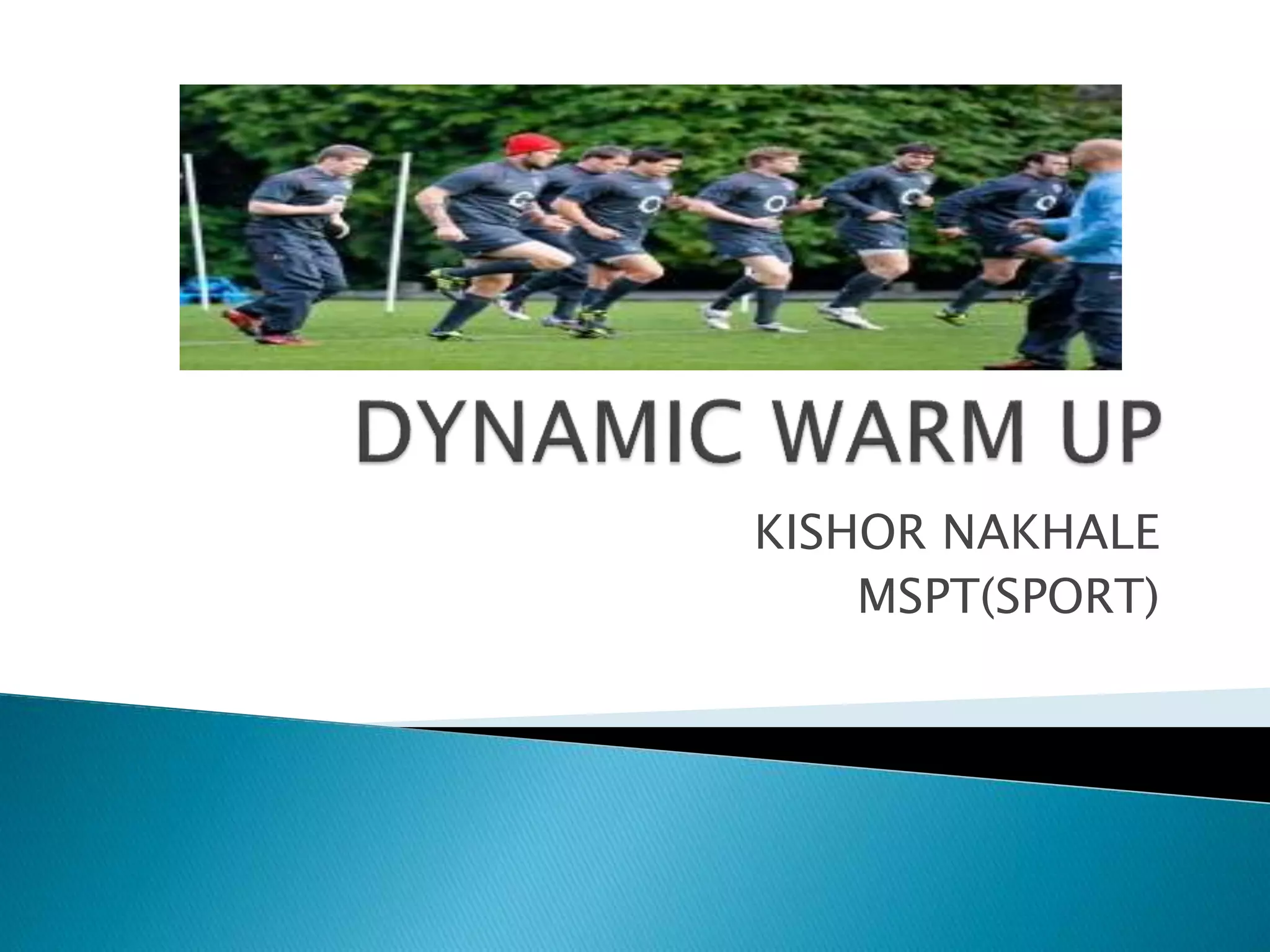
Dynamic mobility exercises during your
pre-workout warm-up period
prepare your body completely for the
vigorous movements that make up
the main part of your workout. Most
sports involve forceful, strenuous
activity, and mobility exercises and
drills stimulate your nervous system,
muscles, tendons, and joints in a
very dynamic manner. Static
stretching exercises, in which you're
not moving around at all but are
simply elongating a particular muscle
or group of muscles, do have a place
in your training programme, but
their value and proper usage are
often misunderstood.
To make your warm up effective, you need
to do movements that increase your heart
rate and breathing, and slightly increase the
temperature of your muscle tissue. A good
indication is warming up to the point where
you have raised a light sweat.
 If you are exercising for general fitness, allow
5 to 10 minutes for your pre-exercise warm-
up (or slightly longer in cold weather).
 If you are exercising at a higher level than for
general fitness, or have a particular sporting
goal in mind, you may need a longer warm-
up, and one that is designed specifically for
your sport.
 The general warm up.
 Warm up stretching.
 The sports specific warm up.
 Jogging 8mins
 Surya Namaskar
 Neck circles- 10 Each way
 Arm Circles -10 Each way
 Both Arms Together - Forward and Backward
 Both Arms in Alternate Directions
 Trunk twists- 10 Each way
 Lower Back Warm Up
 Hip Circles -10 Both ways
 Toe Support Ankle Curls 10
 Windmills 10 Each way
 Walking lunges
 High Knee
 Carioca
To begin your warm-up
do 5 minutes of light (low
intensity) physical activity
such as walking, jogging
on the spot or on a
trampoline. Pump your
arms or make large but
controlled circular
movements with your
arms to help warm the
muscles of your upper
body.
 Surya Namskar is a set of 12 powerful yoga
asanas (postures) that provide a good
cardiovascular workout in the form of Surya
Namaskar. Literally translated to sun
salutation, these postures are a good way to
keep the body in shape and the mind calm
and healthy.
 Pose Description: Moving your head in slow, gentle
circles is a great warm up exercise before stretching
and a nice way to complete a series of neck stretches.
If you are suffering from whiplash, post fracture or
disc problems, either avoid this move or be very
careful. These small neck muscles help with your
neck range of motion.
 Muscle Group - Upper Body:
 Trapezius
 Levator Scapula
 Sternocleidomastoid
 Scalenes
 Minutes: 0
 Seconds: 50secs
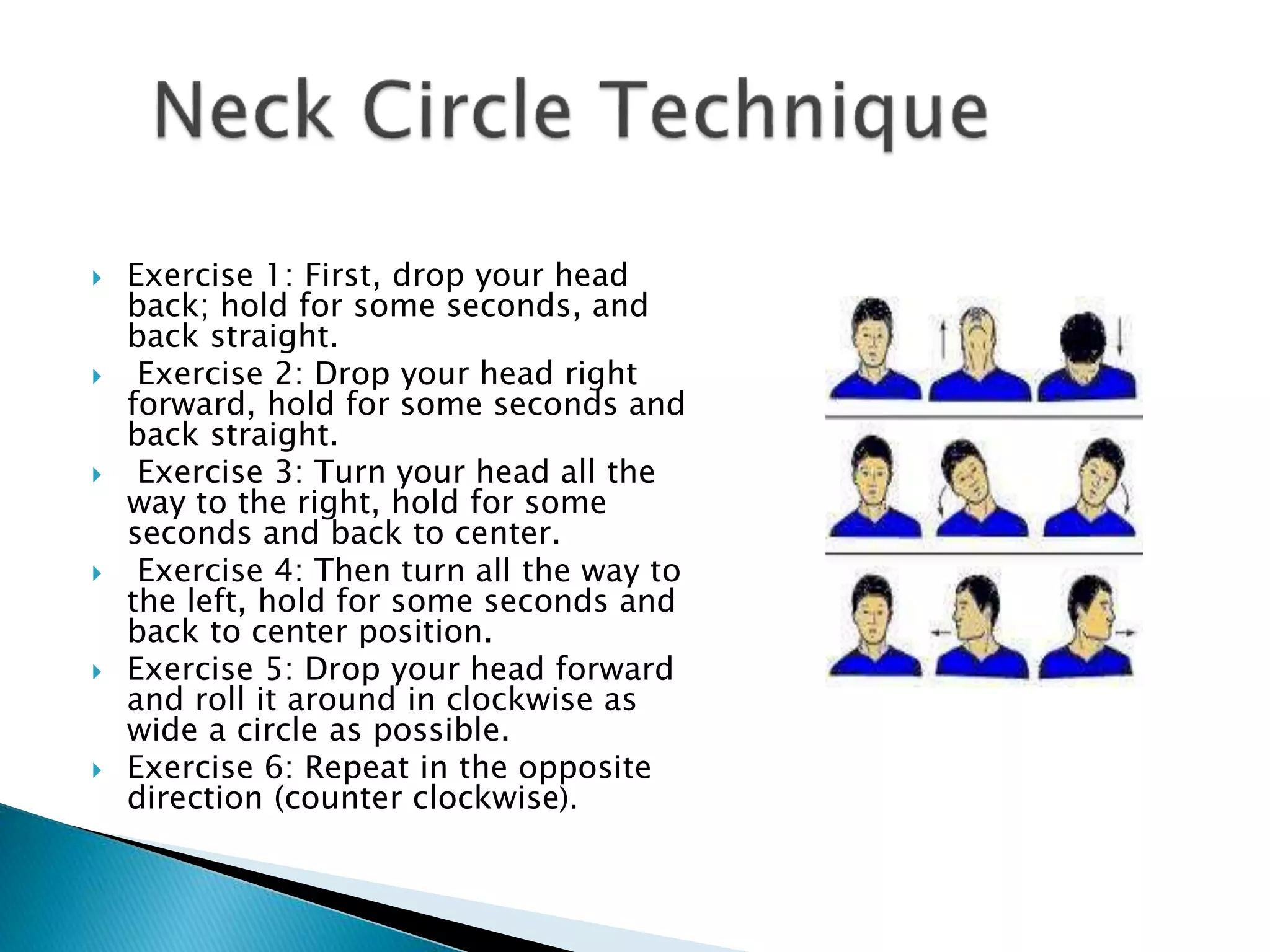
 Exercise 1: First, drop your head
back; hold for some seconds, and
back straight.
 Exercise 2: Drop your head right
forward, hold for some seconds and
back straight.
 Exercise 3: Turn your head all the
way to the right, hold for some
seconds and back to center.
 Exercise 4: Then turn all the way to
the left, hold for some seconds and
back to center position.
 Exercise 5: Drop your head forward
and roll it around in clockwise as
wide a circle as possible.
 Exercise 6: Repeat in the opposite
direction (counter clockwise).
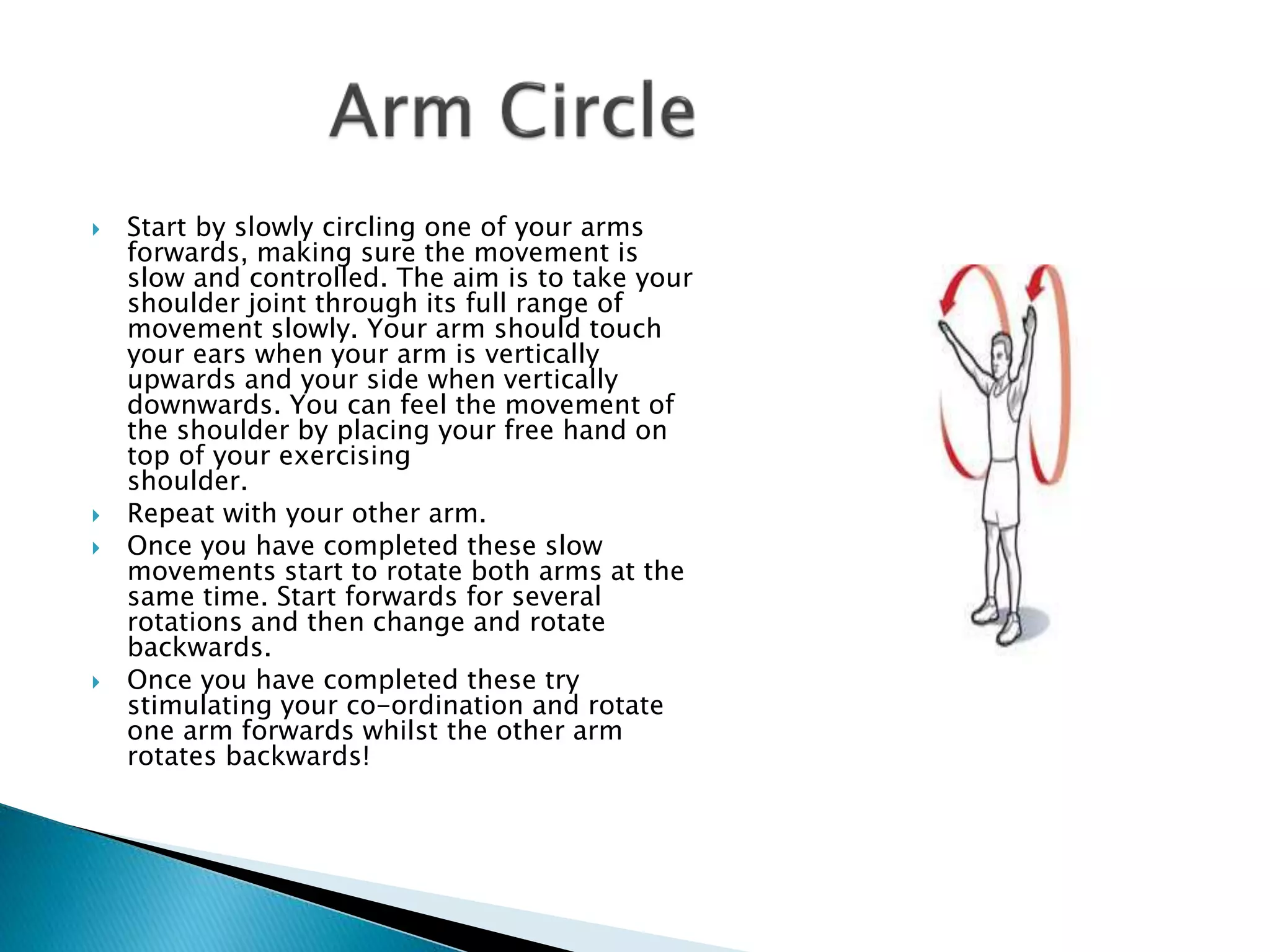
 Start by slowly circling one of your arms
forwards, making sure the movement is
slow and controlled. The aim is to take your
shoulder joint through its full range of
movement slowly. Your arm should touch
your ears when your arm is vertically
upwards and your side when vertically
downwards. You can feel the movement of
the shoulder by placing your free hand on
top of your exercising
shoulder.
 Repeat with your other arm.
 Once you have completed these slow
movements start to rotate both arms at the
same time. Start forwards for several
rotations and then change and rotate
backwards.
 Once you have completed these try
stimulating your co-ordination and rotate
one arm forwards whilst the other arm
rotates backwards!
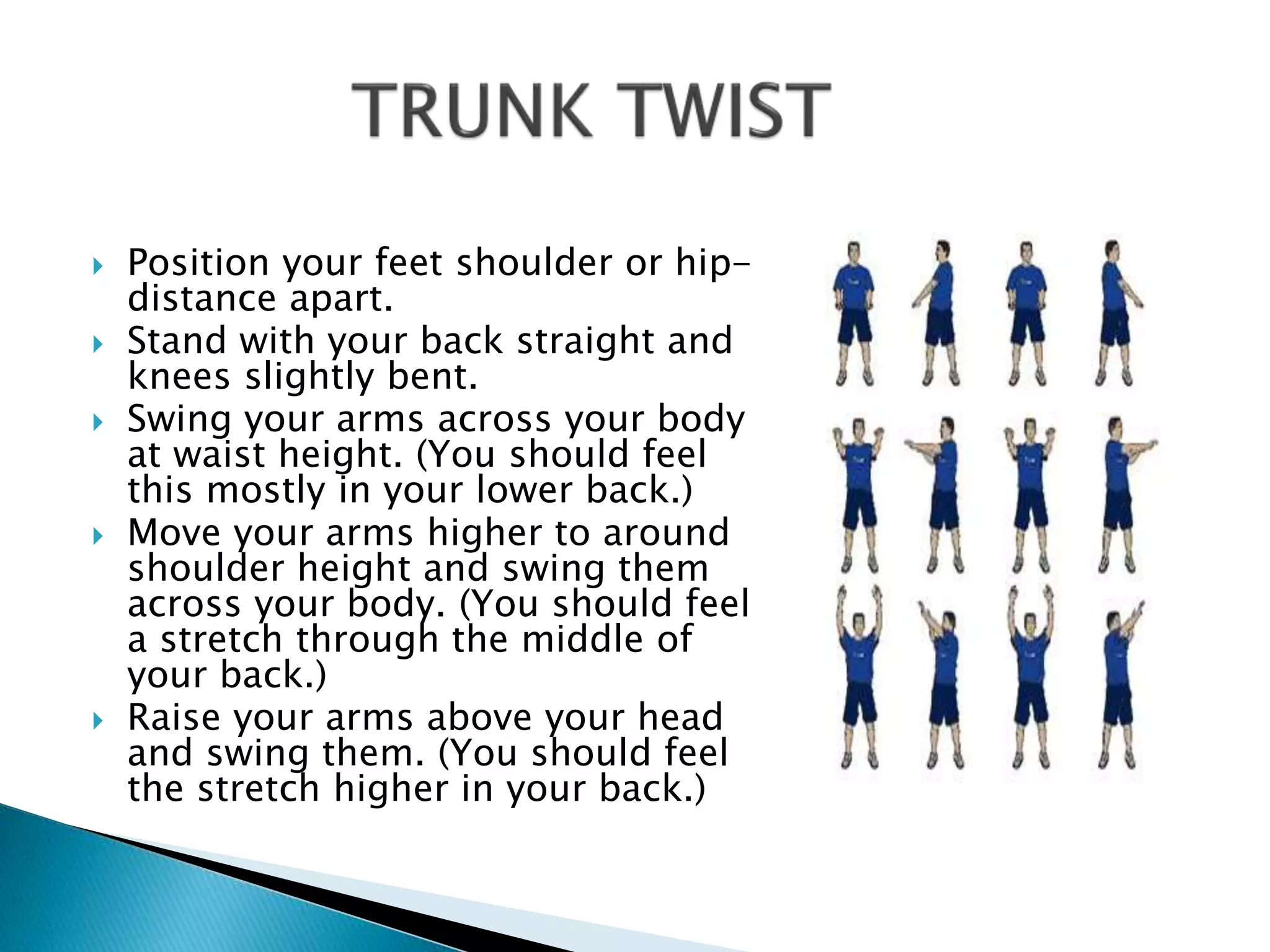
 Position your feet shoulder or hip-
distance apart.
 Stand with your back straight and
knees slightly bent.
 Swing your arms across your body
at waist height. (You should feel
this mostly in your lower back.)
 Move your arms higher to around
shoulder height and swing them
across your body. (You should feel
a stretch through the middle of
your back.)
 Raise your arms above your head
and swing them. (You should feel
the stretch higher in your back.)
Keep standing with
your feet shoulder-
width apart and
rotate your hips.
10 times one side
and 10 times other
side.
Ankle rolls are a good warm up
exercise to get your ankles ready for
tap dancing and prevent injury.
To begin, place both hands on your
hips to help maintain your balance.
Start with your right foot and hold it
out in front of you.
Start rolling your ankle around in a
clockwise circle. It's really important
to make large circles to get the full
range of motion.
Warms up: Abductors, adductors,
quadriceps, hamstrings, glutes, calves.
Start: Stand in a crouched position with
your back straight, abs tight and head
in a neutral position looking forward.
Movement: Raise your torso slightly
and hop to the side, bringing your
trailing leg to your lead leg and
landing in a crouched position. Move
side to side for reps.
Cadence: Moderate
 keeping the head and chest
up and abdominal muscle
tight, take a big step forward
with one foot, landing in
lunge position.
 Lower into a full lunge with
back knee just brushing the
floor.
 The front knee should be
directly over the foot at 90
degree.
 Lunges work to stretch out
the hip and activate the hip
extensors, quadriceps and
hamstrings.
 Procedure:
 Begin by driving one knee up forcefully
and high.
 Swing the opposite arm forward
keeping it at a 90degree angle.
 Drive the opposite foot into the ground
forcefully and swing the opposite elbow
back vigorously.
 Dorsiflex the toes of the foot in the air.
 Keep the hands relaxed.
 When one leg is flexed, the other leg
should be fully extended.
 Bend forward slightly at the waist while
keeping the back straight.
 Relax the face and arms.
 Take short, quick, one-foot steps.
 Procedure:
 Start facing laterally with the feet hip width apart.
 Keeping the shoulders square to the line, take a small
lateral step with the left foot and drive the right knee
up and across the body while swing the left arm
forward.
 Use the abs to swing the hips one direction and the
ribs and shoulders the opposite.
 Land on the right foot, side step to the left foot, cross
behind with the right foot and side step with the left
foot.
 Drive the right knee up and across the body while
swing the left arm forward and continue for 10 yards.
 Switch directions and repeat.
 Key Points:
 Perform each step quickly and forcefully and drive the
back knee up high.
 When pushing off the back foot, fully extend the back
leg to get full triple extension and optimal power
production.
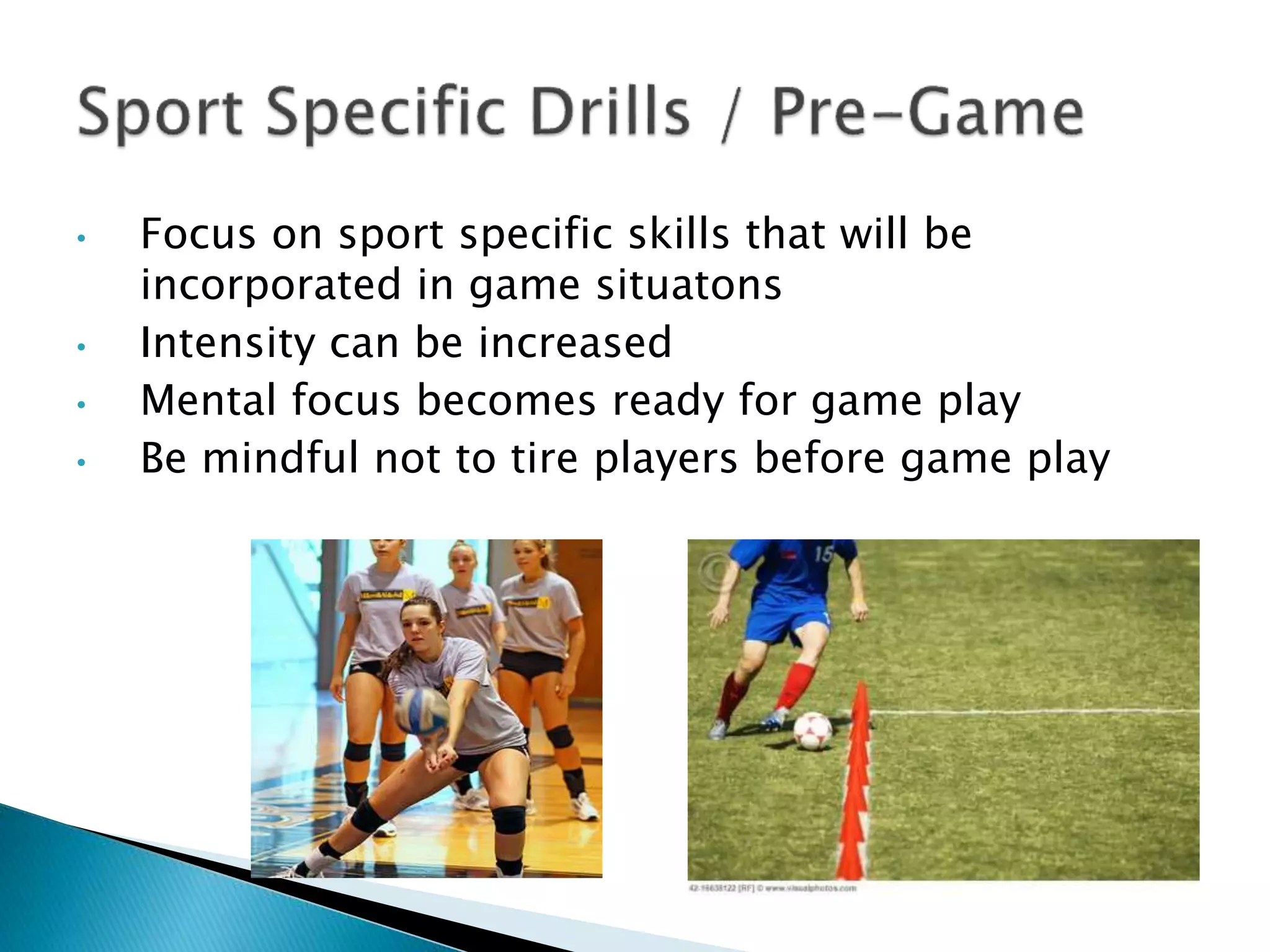
• Focus on sport specific skills that will be
incorporated in game situatons
• Intensity can be increased
• Mental focus becomes ready for game play
• Be mindful not to tire players before game play
 Morgan, J. ECIS PE Conference (2012).
 Shelton J., Kumar, P. (2009).Comparison
between static and dynamic warm-up
exercise regimes on lower limb muscle
power. Health Journal 1(2), 117-120.

Dynamic Warm Up

  • 1.
  • 2.
     Prepares thebody and mind for the demands of a work out or practice  Increases core body temperature  Allows the heart rate get to a workable rate for beginning exercise  Enhances muscle elasticity  Improved performance  Reduce muscle stiffness  Reduce the risk of injuries  Creates a team spirit
  • 3.
    Dynamic mobility exercisesduring your pre-workout warm-up period prepare your body completely for the vigorous movements that make up the main part of your workout. Most sports involve forceful, strenuous activity, and mobility exercises and drills stimulate your nervous system, muscles, tendons, and joints in a very dynamic manner. Static stretching exercises, in which you're not moving around at all but are simply elongating a particular muscle or group of muscles, do have a place in your training programme, but their value and proper usage are often misunderstood.
  • 4.
    To make yourwarm up effective, you need to do movements that increase your heart rate and breathing, and slightly increase the temperature of your muscle tissue. A good indication is warming up to the point where you have raised a light sweat.
  • 5.
     If youare exercising for general fitness, allow 5 to 10 minutes for your pre-exercise warm- up (or slightly longer in cold weather).  If you are exercising at a higher level than for general fitness, or have a particular sporting goal in mind, you may need a longer warm- up, and one that is designed specifically for your sport.
  • 6.
     The generalwarm up.  Warm up stretching.  The sports specific warm up.
  • 7.
     Jogging 8mins Surya Namaskar  Neck circles- 10 Each way  Arm Circles -10 Each way  Both Arms Together - Forward and Backward  Both Arms in Alternate Directions  Trunk twists- 10 Each way  Lower Back Warm Up  Hip Circles -10 Both ways  Toe Support Ankle Curls 10  Windmills 10 Each way  Walking lunges  High Knee  Carioca
  • 8.
    To begin yourwarm-up do 5 minutes of light (low intensity) physical activity such as walking, jogging on the spot or on a trampoline. Pump your arms or make large but controlled circular movements with your arms to help warm the muscles of your upper body.
  • 9.
     Surya Namskaris a set of 12 powerful yoga asanas (postures) that provide a good cardiovascular workout in the form of Surya Namaskar. Literally translated to sun salutation, these postures are a good way to keep the body in shape and the mind calm and healthy.
  • 11.
     Pose Description:Moving your head in slow, gentle circles is a great warm up exercise before stretching and a nice way to complete a series of neck stretches. If you are suffering from whiplash, post fracture or disc problems, either avoid this move or be very careful. These small neck muscles help with your neck range of motion.  Muscle Group - Upper Body:  Trapezius  Levator Scapula  Sternocleidomastoid  Scalenes  Minutes: 0  Seconds: 50secs
  • 12.
     Exercise 1:First, drop your head back; hold for some seconds, and back straight.  Exercise 2: Drop your head right forward, hold for some seconds and back straight.  Exercise 3: Turn your head all the way to the right, hold for some seconds and back to center.  Exercise 4: Then turn all the way to the left, hold for some seconds and back to center position.  Exercise 5: Drop your head forward and roll it around in clockwise as wide a circle as possible.  Exercise 6: Repeat in the opposite direction (counter clockwise).
  • 13.
     Start byslowly circling one of your arms forwards, making sure the movement is slow and controlled. The aim is to take your shoulder joint through its full range of movement slowly. Your arm should touch your ears when your arm is vertically upwards and your side when vertically downwards. You can feel the movement of the shoulder by placing your free hand on top of your exercising shoulder.  Repeat with your other arm.  Once you have completed these slow movements start to rotate both arms at the same time. Start forwards for several rotations and then change and rotate backwards.  Once you have completed these try stimulating your co-ordination and rotate one arm forwards whilst the other arm rotates backwards!
  • 14.
     Position yourfeet shoulder or hip- distance apart.  Stand with your back straight and knees slightly bent.  Swing your arms across your body at waist height. (You should feel this mostly in your lower back.)  Move your arms higher to around shoulder height and swing them across your body. (You should feel a stretch through the middle of your back.)  Raise your arms above your head and swing them. (You should feel the stretch higher in your back.)
  • 16.
    Keep standing with yourfeet shoulder- width apart and rotate your hips. 10 times one side and 10 times other side.
  • 17.
    Ankle rolls area good warm up exercise to get your ankles ready for tap dancing and prevent injury. To begin, place both hands on your hips to help maintain your balance. Start with your right foot and hold it out in front of you. Start rolling your ankle around in a clockwise circle. It's really important to make large circles to get the full range of motion.
  • 18.
    Warms up: Abductors,adductors, quadriceps, hamstrings, glutes, calves. Start: Stand in a crouched position with your back straight, abs tight and head in a neutral position looking forward. Movement: Raise your torso slightly and hop to the side, bringing your trailing leg to your lead leg and landing in a crouched position. Move side to side for reps. Cadence: Moderate
  • 19.
     keeping thehead and chest up and abdominal muscle tight, take a big step forward with one foot, landing in lunge position.  Lower into a full lunge with back knee just brushing the floor.  The front knee should be directly over the foot at 90 degree.  Lunges work to stretch out the hip and activate the hip extensors, quadriceps and hamstrings.
  • 20.
     Procedure:  Beginby driving one knee up forcefully and high.  Swing the opposite arm forward keeping it at a 90degree angle.  Drive the opposite foot into the ground forcefully and swing the opposite elbow back vigorously.  Dorsiflex the toes of the foot in the air.  Keep the hands relaxed.  When one leg is flexed, the other leg should be fully extended.  Bend forward slightly at the waist while keeping the back straight.  Relax the face and arms.  Take short, quick, one-foot steps.
  • 21.
     Procedure:  Startfacing laterally with the feet hip width apart.  Keeping the shoulders square to the line, take a small lateral step with the left foot and drive the right knee up and across the body while swing the left arm forward.  Use the abs to swing the hips one direction and the ribs and shoulders the opposite.  Land on the right foot, side step to the left foot, cross behind with the right foot and side step with the left foot.  Drive the right knee up and across the body while swing the left arm forward and continue for 10 yards.  Switch directions and repeat.  Key Points:  Perform each step quickly and forcefully and drive the back knee up high.  When pushing off the back foot, fully extend the back leg to get full triple extension and optimal power production.
  • 22.
    • Focus onsport specific skills that will be incorporated in game situatons • Intensity can be increased • Mental focus becomes ready for game play • Be mindful not to tire players before game play
  • 23.
     Morgan, J.ECIS PE Conference (2012).  Shelton J., Kumar, P. (2009).Comparison between static and dynamic warm-up exercise regimes on lower limb muscle power. Health Journal 1(2), 117-120.